株探米国株
英語
エドガーで原本を確認する

UNITED STATES

SECURITIES AND EXCHANGE COMMISSION

Washington, D.C. 20549

FORM 40-F
REGISTRATION STATEMENT PURSUANT TO SECTION 12 OF THE SECURITIES EXCHANGE ACT OF 1934
OR
ANNUAL REPORT PURSUANT TO SECTION 13(a) OR 15(d) OF THE SECURITIES EXCHANGE ACT OF 1934
For the fiscal year ended December 31, 2025 Commission File Number 001-37946
ALGONQUIN POWER & UTILITIES CORP.
(Exact name of Registrant as specified in its charter)
N/A
(Translation of Registrant’s name into English (if applicable))
Canada
(Province or other jurisdiction of incorporation or organization)
4911
(Primary Standard Industrial Classification Code Number (if applicable))
N/A
(I.R.S. Employer Identification Number (if applicable))
354 Davis Road
Oakville, Ontario
L6J 2X1, Canada
(905) 465-4500
(Address and telephone number of Registrant’s principal executive offices)
CT Corporation System
111 Eighth Avenue
New York, New York 10011
(212)894-8940
(Name, address (including zip code) and telephone number (including area code)
of agent for service in the United States)
Securities registered or to be registered pursuant to Section 12(b) of the Act:
Title of each class
Trading Symbol(s)
Name of each exchange on which registered
Common shares, no par value
AQN
The New York Stock Exchange
6.20% Fixed-to-Floating Subordinated Notes - Series 2019-A due July 1, 2079
AQNB
The New York Stock Exchange
Rights to Purchase One Common Share of the Company
N/A
The New York Stock Exchange
Securities registered or to be registered pursuant to Section 12(g) of the Act:
Common Shares, no par value
(Title of Class)
Securities for which there is a reporting obligation pursuant to Section 15(d) of the Act: None For annual reports indicate by check mark the information filed with this Form:


☒ Annual Information Form
☒ Audited Annual Financial Statements
Indicate the number of outstanding shares of each of the issuer’s classes of capital or common stock as of the close of the period covered by the annual report:
As of December 31, 2025, there were 768,351,419 Common Shares outstanding.
Indicate by check mark whether the Registrant (1) has filed all reports required to be filed by Section 13 or 15(d) of the Exchange Act during the preceding 12 months (or for such shorter period that the Registrant was required to file such reports) and (2) has been subject to such filing requirements for the past 90 days.
Yes ☒
No

Indicate by check mark whether the Registrant has submitted electronically every Interactive Data File required to be submitted pursuant to Rule 405 of Regulation S-T during the preceding 12 months (or for such shorter period that the Registrant was required to submit such files).
Yes ☒
No

Indicate by check mark whether the Registrant is an emerging growth company as defined in Rule 12b-2 of the Exchange Act.
Emerging growth company ☐
If an emerging growth company that prepares its financial statements in accordance with U.S. GAAP, indicate by check mark if the Registrant has elected not to use the extended transition period for complying with any new or revised financial accounting standards provided pursuant to Section 13(a) of the Exchange Act. ☐
The term “new or revised financial accounting standard” refers to any update issued by the Financial Accounting Standards Board to its Accounting Standards Codification after April 5, 2012.
Indicate by check mark whether the Registrant has filed a report on and attestation to its management’s assessment of the effectiveness of its internal control over financial reporting under Section 404(b) of the Sarbanes-Oxley Act (15 U.S.C. 7262(b)) by the registered public accounting firm that prepared or issued its audit report. ☒
If securities are registered pursuant to Section 12(b) of the Exchange Act, indicate by check mark whether the financial statements of the Registrant included in the filing reflect the correction of an error to previously issued financial statements. ☐
Indicate by check mark whether any of those error corrections are restatements that required a recovery analysis of incentive-based compensation received by any of the Registrant’s executive officers during the relevant recovery period pursuant to §240.10D-1(b). ☐
This Annual Report on Form 40-F shall be incorporated by reference into or as an exhibit to, as applicable, the Registrant’s Registration Statements on Form F-3 (File Nos. 333-220059, 333-227246 and 333-263839), Form F-10 (File No. 333-277803) and Form S-8 (File Nos. 333-177418, 333-213648, 333-213650, 333-218810, 333-232012, 333-238961 and 333-289664) under the Securities Act of 1933, as amended.


ANNUAL INFORMATION FORM
The Annual Information Form (the “AIF”) of Algonquin Power & Utilities Corp. (“AQN” or the “Company”) for the fiscal year ended December 31, 2025 is filed as Exhibit 99.1 to this annual report on Form 40-F. All capitalized terms used herein but not otherwise defined herein shall have the meanings given to such terms in the AIF.
AUDITED ANNUAL FINANCIAL STATEMENTS
The Audited Annual Consolidated Financial Statements of AQN for the fiscal year ended December 31, 2025 (the “Consolidated Financial Statements”) are filed as Exhibit 99.2 to this annual report on Form 40-F.
MANAGEMENT’S DISCUSSION AND ANALYSIS
The Management’s Discussion and Analysis for the fiscal year ended December 31, 2025 (the “MD&A”) is filed as Exhibit 99.3 to this annual report on Form 40-F.
DISCLOSURE CONTROLS AND PROCEDURES
The information provided under the heading “Disclosure Controls and Procedures” in the MD&A, filed as Exhibit 99.3 to this annual report on Form 40-F, is incorporated by reference herein.
INTERNAL CONTROL OVER FINANCIAL REPORTING
A. Management’s report on internal control over financial reporting
The information provided under the headings “Disclosure Controls and Procedures—Management Report on Internal Controls over Financial Reporting” and “Disclosure Controls and Procedures—Inherent Limitations on Effectiveness of Controls” in the MD&A, filed as Exhibit 99.3 to this annual report on Form 40-F, is incorporated by reference herein.
B. Auditor’s attestation report on internal control over financial reporting
Ernst & Young LLP (PCAOB ID#: 1263), the independent registered public accounting firm of AQN, which audited the consolidated financial statements of AQN for the year ended December 31, 2025, has also issued an attestation report on the effectiveness of AQN’s internal control over financial reporting as of December 31, 2025. The attestation report is provided in Exhibit 99.2 to this annual report on Form 40-F and is incorporated by reference herein.
C. Changes in internal control over financial reporting
The information provided under the heading “Disclosure Controls and Procedures—Changes in Internal Controls over Financial Reporting” in the MD&A, filed as Exhibit 99.3 to this annual report on Form 40-F, is incorporated by reference herein.
AUDIT & FINANCE COMMITTEE FINANCIAL EXPERTS
AQN’s board of directors has designated two audit committee financial experts serving on its audit & finance committee. Dilek Samil and Christopher Lopez have been determined to be such audit committee financial experts and each of them are “independent” as set forth in the Canadian National Instrument 58-101 Disclosure of Corporate Governance Practices and Rule 10A-3 of the U.S. Securities Exchange Act of 1934, as amended (the “Exchange Act”). The U.S. Securities and Exchange Commission (“SEC”) has indicated that the designation as an audit committee financial expert does not make a person an “expert” for any purpose, impose any duties, obligations or liability on such persons that are greater than those imposed on members of the audit & finance committee and board of directors who do not carry this designation or affect the duties, obligations or liability of any other member of the audit & finance committee or board of directors.


CODE OF ETHICS
AQN has adopted a code of business conduct and ethics (the “Code of Conduct”) that applies to all employees and officers, including its Chief Executive Officer and Chief Financial Officer. The Code of Conduct is available without charge to any shareholder upon request to Brian Chin, Telephone: (905) 465-4450, E-mail: InvestorRelations@APUCorp.com, Algonquin Power & Utilities Corp., 354 Davis Road, Oakville, Ontario L6J 2X1.
PRINCIPAL ACCOUNTANT FEES AND SERVICES
The information provided under the heading “Pre-Approval Policies and Procedures” in the AIF, filed as Exhibit 99.1 to this annual report on Form 40-F, is incorporated by reference herein. All audit services, audit-related services, tax services, and other services provided for the years ended December 31, 2024 and 2025 were pre-approved by the audit & finance committee.
OFF-BALANCE SHEET ARRANGEMENTS
As of December 31, 2025, AQN did not have any off-balance sheet arrangements.
CONTRACTUAL OBLIGATIONS
The information provided under the heading “Liquidity and Capital Reserves—Contractual Obligations” in the MD&A, filed as Exhibit 99.3 to this annual report on Form 40-F, is incorporated by reference herein.
NON-GAAP FINANCIAL MEASURES
The MD&A contains financial measures that are not recognized measures under U.S. generally accepted accounting principles (“U.S. GAAP”). Such terms include: “Adjusted Net Earnings”, “Adjusted Net Earnings per common share”, “Earnings Before Interest and Taxes”, and “Net Utility Sales”. There is no standardized measure of these terms and, consequently, the Company’s method of calculating these measures may differ from methods used by other companies and therefore may not be comparable to similar measures presented by other companies. A calculation and analysis of “Adjusted Net Earnings”, “Adjusted Net Earnings per common share”, “Earnings Before Interest and Taxes”, and “Net Utility Sales”, including a reconciliation to the U.S. GAAP equivalent, can be found in the MD&A under the headings “Caution Concerning Non-GAAP Measures”, “Non-GAAP Financial Measures”, “Regulated Services Group—2025 Fourth Quarter and Annual Regulated Services Group Net Earnings”, “Corporate Group Net Earnings and Adjusted Net Earnings”, and “Hydro Group Net Earnings”. As a pure-play regulated utility, as of the first quarter of 2025, the Company no longer presents “Adjusted Earnings Before Interest, Taxes, Depreciation and Amortization” or “Adjusted Funds from Operations” as these metrics were relevant mainly to the Company’s former renewable energy group (excluding hydro) that was sold in connection with the Company’s previously announced sale of its renewable energy business (excluding hydro).
AQN does not provide reconciliations for forward-looking non-GAAP financial measures as AQN is unable to provide a meaningful or accurate calculation or estimation of reconciling items and the information is not available without unreasonable effort. This is due to the inherent difficulty of forecasting the timing or amount of various events that have not yet occurred, are out of AQN’s control and/or cannot be reasonably predicted, and that would impact the most directly comparable forward-looking U.S. GAAP financial measure. For these same reasons, AQN is unable to address the probable significance of the unavailable information. Forward-looking non-GAAP financial measures may vary materially from the corresponding U.S. GAAP financial measures.
The MD&A is attached hereto as Exhibit 99.3 and is incorporated herein by reference and is also available on EDGAR at www.sec.gov and SEDAR+ at www.sedarplus.com.


CAUTION CONCERNING FORWARD-LOOKING STATEMENTS
This document, which includes the information set forth in the exhibits hereto, contains statements that constitute “forward-looking information” within the meaning of applicable securities laws in each of the provinces and territories of Canada and the respective policies, regulations and rules under such laws or “forward-looking statements” within the meaning of the U.S. Private Securities Litigation Reform Act of 1995 (collectively, “forward-looking information”). The words “aims”, “anticipates”, “believes”, “budget”, “could”, “estimates”, “expects”, “forecasts”, “intends”, “may”, “might”, “plans”, “projects”, “pursue”, “schedule”, “seeks”, “should”, “strives”, “targets”, “will”, “would”, “pursue”, “outlook” (and grammatical variations of such terms) and similar expressions are often intended to identify forward-looking information, although not all forward-looking information contains these identifying words. The forward-looking information contained herein is subject to risks, uncertainties and other factors that could cause actual results to differ materially from historical results or results anticipated by the forward-looking information.
The sections entitled “Caution Concerning Forward-Looking Statements and Forward-Looking Information” set forth in each of Exhibits 99.1 and 99.3 hereto are incorporated by reference herein. You should carefully review such information for examples of specific forward-looking information included and incorporated in this document, for examples of factors or assumptions reflected in the forward-looking information and for a summary of risks, uncertainties and other factors that could cause actual results to differ materially from historical or anticipated results.
Forward-looking information contained herein (including any financial outlook) is provided for the purposes of assisting the reader in understanding the Company and its business, operations, risks, financial performance, financial position and cash flows as at and for the periods indicated and to present information about management’s current expectations and plans relating to the future and the reader is cautioned that such information may not be appropriate for other purposes. Forward-looking information contained herein is made as of the date of this document and based on the plans, beliefs, estimates, projections, expectations, opinions and assumptions of management on the date hereof. There can be no assurance that forward-looking information will prove to be accurate, as actual results and future events could differ materially from those anticipated in such forward-looking information. Accordingly, readers should not place undue reliance on forward-looking information. While subsequent events and developments may cause the Company’s views to change, the Company disclaims any obligation to update any forward-looking information or to explain any material difference between subsequent actual events and such forward-looking information, except to the extent required by applicable law. All forward-looking information contained herein is qualified by these cautionary statements.
All forward-looking information is given pursuant to the “safe harbor” provisions of applicable securities legislation.
IDENTIFICATION OF THE AUDIT & FINANCE COMMITTEE
AQN has a standing audit & finance committee of its board of directors established in accordance with Section 3(a)(58)(A) of the Exchange Act. The information provided under the heading “Audit & Finance Committee” identifying AQN’s audit & finance committee and confirming the independence of the audit & finance committee in the AIF, filed as Exhibit 99.1 to this annual report on Form 40-F, is incorporated by reference herein.
INTERACTIVE DATA FILE
The required disclosure for the fiscal year ended December 31, 2025 is filed as Exhibit 101 to this annual report on Form 40-F.
MINE SAFETY DISCLOSURE
Not applicable.


COMPARISON OF NYSE CORPORATE GOVERNANCE RULES
AQN is subject to corporate governance guidelines and requirements prescribed by the Toronto Stock Exchange and the Canadian securities regulatory authorities (“Canadian Rules”). AQN is also subject to corporate governance requirements prescribed by the listing standards of the New York Stock Exchange (“NYSE”), and certain rules and regulations promulgated by the SEC under the Exchange Act (including those applicable rules and regulations mandated by the Sarbanes-Oxley Act of 2002). In particular, Section 303A.06 of the NYSE Listed Company Manual requires AQN to have an audit committee that meets the requirements of Rule 10A-3 of the Exchange Act, and Section 303A.11 of the NYSE Listed Company Manual requires AQN to disclose any significant ways in which its corporate governance practices differ from those followed by U.S. companies listed on the NYSE. A description of those differences follows.
Section 303A.01 of the NYSE Listed Company Manual requires that boards have a majority of independent directors and Section 303A.02 defines independence standards for directors. AQN’s board of directors is responsible for determining whether each director is independent. In making this determination, the board of directors has adopted the higher standard of “independence” that applies to each member of its audit & finance committee pursuant to Canadian National Instrument 52-110 Audit Committees and Rule 10A-3 of the Exchange Act instead of the definition of independence set forth in the NYSE rules. In applying this Canadian standard, the board of directors considers all relationships of its directors, including business, family and other relationships. Through this process, AQN’s board of directors also determines whether each member of its audit & finance committee is independent pursuant to Canadian National Instrument 52-110 Audit Committees and Rule 10A-3 of the Exchange Act.
Section 303A.04(a) of the NYSE Listed Company Manual requires that all members of the nominating/corporate governance committee be independent as defined in the NYSE rules. In making this determination, the board of directors has adopted the standard of “independence” applicable to members of its audit & finance committee, described in the preceding paragraph, rather than the NYSE rules. All members of the corporate governance committee are independent directors.
Section 303A.05(a) of the NYSE Listed Company Manual requires that all members of the compensation committee be independent as defined in the NYSE rules. In making this determination, the board of directors has adopted the standard of “independence” applicable to members of its audit & finance committee, described above, rather than the NYSE rules. All members of the human resources and compensation committee are independent directors.
Section 303A.07(b)(iii)(A) of the NYSE Listed Company Manual requires, among other things, that the written charter of the audit committee state that the audit committee at least annually, obtain and review a report by the independent auditor describing: the firm’s internal quality-control procedures, any material issues raised by the most recent internal quality-control review, or peer review, of the firm, or by any inquiry or investigation by governmental or professional authorities, within the preceding five years, respecting one or more independent audits carried out by the firm, and any steps taken to deal with any such issues; and (to assess the auditor’s independence) all relationships between the independent auditor and the listed company. The written charter of the audit & finance committee complies with Canadian Rules, and requires that prior to the completion of each annual external audit the audit & finance committee review and discuss with management and the external auditor the adequacy of the Company’s internal controls, but does not explicitly require that the audit & finance committee at least annually obtain and review a report from the independent auditor regarding the matters noted above, which is not required by Canadian Rules.
Section 303A.08 of the NYSE Listed Company Manual requires that shareholders of a listed company be given the opportunity to vote on all equity compensation plans and material revisions thereto. AQN complies with Canadian Rules, which generally require that shareholders approve equity compensation plans. However, the Canadian Rules are not identical to the NYSE rules. For example, Canadian Rules require shareholder approval of equity compensation plans only when such plans involve the issuance or potential issuance of newly issued securities. In addition, equity compensation plans that do not provide for a fixed maximum number of securities to be issued must have a rolling maximum number of securities to be issued, based on a fixed percentage of the issuer’s outstanding securities and must also be approved by shareholders every three years.


If a plan provides a procedure for its amendment, Canadian Rules require shareholder approval of amendments only where the amendment involves a reduction in the exercise price or purchase price, an extension of the term of an award benefiting an insider, the removal or exceeding of the insider participation limit prescribed by the Canadian Rules, an increase to the maximum number of securities issuable, or is an amendment to the amending provision itself.
Section 303A.09 of the NYSE Listed Company Manual requires that a listed company adopt and disclose corporate governance guidelines that address certain topics, including director compensation guidelines. AQN has adopted its Board Mandate, which is the equivalent of corporate governance guidelines, in compliance with the Canadian Rules. AQN’s corporate governance guidelines do not address director compensation, but AQN provides disclosure about the decision making process for non-employee director compensation in the annual management information circular. AQN has also adopted equity ownership guidelines for non-employee directors.
Section 303A.10 of the NYSE Listed Company Manual requires that a listed company’s code of business conduct and ethics require that any waiver of the code for executive officers or directors may be made only by the board or a board committee and must be promptly disclosed. AQN’s code of business conduct and ethics complies with Canadian Rules. Waivers must receive prior approval by the board and will be disclosed promptly in accordance with applicable securities laws and AQN’s disclosure policy.
Section 303A.14 of the NYSE Listed Company Manual requires that a listed company adopt and comply with a written recovery policy providing that the listed company will recover reasonably promptly the amount of erroneously awarded incentive-based compensation in the event that the listed company is required to prepare an accounting restatement due to the material noncompliance of the listed company with any financial reporting requirement under the securities laws, including any required accounting restatement to correct an error in previously issued financial statements that is material to the previously issued financial statements, or that would result in a material misstatement if the error were corrected in the current period or left uncorrected in the current period. While the Canadian Rules do not require that an issuer adopt a written recovery policy, the Company has adopted a compensation clawback policy that complies with Section 303A.14 of the NYSE Listed Company Manual. The Company’s compensation clawback policy also provides that where (i) a senior executive was engaged in conduct determined to be misconduct (as defined in the policy); or (ii) clawback is required under applicable law, rule or regulation or by a regulatory body, the Human Resources and Compensation Committee has the discretion to recoup amounts paid or awarded to any executive officer as performance-based compensation or to cancel any performance-based compensation awards made to any executive officer within the three preceding years.
Section 312.03 of the NYSE Listed Company Manual requires that a listed company obtain shareholder approval prior to the issuance of securities in connection with, among other things, the establishment or amendment of certain equity compensation plans, issuances of common stock, or of securities convertible into or exercisable for commons stock, to certain related parties (subject to certain exceptions), the issuance of 20% or greater of shares outstanding or voting power (subject to certain exceptions), and issuances that will result in a change in control. AQN follows the Canadian Rules for shareholder approval of new issuances of its common shares instead of the NYSE shareholder approval rules. Under the Canadian Rules, shareholder approval is required for certain issuances of shares that (i) materially affect control of AQN or (ii) provide consideration to insiders in aggregate of 10% or greater of the market capitalization of AQN and have not been negotiated at arm’s length. Shareholder approval is also required, pursuant to the Canadian Rules, in the case of private placements (x) for an aggregate number of listed securities issuable greater than 25% of the number of securities of the listed issuer which are outstanding, on a non-diluted basis, prior to the date of closing of the transaction if the price per security is less than the market price or (y) that during any six month period are to insiders for listed securities or options, rights or other entitlements to listed securities greater than 10% of the number of securities of AQN which are outstanding, on a non-diluted basis, prior to the date of the closing of the first private placement to an insider during the six month period.
In addition to the foregoing, the Company may from time-to-time seek relief from the NYSE corporate governance requirements on specific transactions under the NYSE Listed Company Guide, in which case, the Company expects to make the disclosure of such transactions available on the Company’s website at www.algonquinpower.com. Information contained on the Company’s website is not part of this annual report on Form 40-F.


UNDERTAKING
AQN undertakes to make available, in person or by telephone, representatives to respond to inquiries made by the SEC staff, and to furnish promptly, when requested to do so by the SEC staff, information relating to the securities in relation to which the obligation to file an annual report on Form 40-F arises or transactions in said securities.
CONSENT TO SERVICE OF PROCESS
AQN previously filed with the SEC a written irrevocable consent and power of attorney on Form F-X. Any change to the name or address of the agent for service of AQN shall be communicated promptly to the SEC by amendment to Form F-X referencing the file number of AQN.


SIGNATURES
Pursuant to the requirements of the Securities Exchange Act of 1934, as amended, the Registrant certifies that it meets all of the requirements for filing on Form 40-F and has duly caused this annual report to be signed on its behalf by the undersigned, thereto duly authorized.
ALGONQUIN POWER & UTILITIES CORP.
(Registrant)
Date: March 6, 2026
By: /s/ Robert Stefani
Name: Robert Stefani
Title: Chief Financial Officer


EXHIBIT INDEX
97     Stock Exchange Recoupment Policy (incorporated by reference to Exhibit 97 to the Registrant’s Annual Report on Form 40-F for the fiscal year ended December 31, 2023).
99.1    Annual Information Form of AQN for the year ended December 31, 2025.
99.2    Audited Annual Financial Statements of AQN for the year ended December 31, 2025.
99.3    Management’s Discussion & Analysis of AQN for the year ended December 31, 2025
99.4    Consent Letter from Ernst & Young LLP.
99.5    Certifications of Chief Executive Officer pursuant to Section 302 of the Sarbanes-Oxley Act of 2002.
99.6    Certifications of Chief Financial Officer pursuant to Section 302 of the Sarbanes-Oxley Act of 2002.
99.7    Certifications of Chief Executive Officer pursuant to Section 906 of the Sarbanes-Oxley Act of 2002.
99.8    Certifications of Chief Financial Officer pursuant to Section 906 of the Sarbanes-Oxley Act of 2002.
101    Inline Interactive Data File.
104    Cover Page Interactive Data File.

EX-99.1 2 a2025q4exhibit991-aif.htm EX-99.1 2025 Q4 AIF Document


image_0a.jpg
ALGONQUIN POWER & UTILITIES CORP.
ANNUAL INFORMATION FORM
For the year ended December 31, 2025
March 6, 2026


Table of Contents


TABLE OF CONTENTS
(continued)


- 1 -
Caution Concerning Forward-Looking Statements and Forward-Looking Information
This document may contain statements that constitute “forward-looking information” within the meaning of applicable securities laws in each of the provinces and territories of Canada and the respective policies, regulations and rules under such laws or “forward-looking statements” within the meaning of the U.S. Private Securities Litigation Reform Act of 1995 (collectively, “forward-looking information”). The words “aims”, “anticipates”, “believes”, “budget”, “could”, “estimates”, “expects”, “forecasts”, “intends”, “may”, “might”, “plans”, “projects”, “pursue”, “schedule”, “seeks”, “should”, “strives”, “targets”, “will”, “would” (and grammatical variations of such terms) and similar expressions are often intended to identify forward-looking information, although not all forward-looking information contains these identifying words. Specific forward-looking information in this document includes, but is not limited to, statements relating to: expected future investments and growth, results of operations, performance, business prospects and opportunities of the Corporation; the expected expiry date of the 2025 Cooperation Agreement (as defined herein); the Renewables Sale, including the receipt of proceeds therefrom; expectations regarding earnings and cash flows; share price appreciation; expectations regarding the use of proceeds from financings; expectations regarding credit ratings and the maintenance thereof and equity credit from rating agencies; statements relating to renewable energy credits expected to be generated and sold; expectations regarding U.S. federal grants; statements regarding the Corporation’s sustainability and environmental, social and governance goals; expectations and plans with respect to current and planned projects; expectations with respect to revenues pursuant to Offtake Contracts; financing plans; asset sales; sources of funding, including adequacy and availability of credit facilities, cash flows from operations and capital markets financing; anticipated customer benefits; potential acquisitions, dispositions, projects, initiatives or other transactions; expectations regarding the Corporation’s corporate development activities and the results thereof; expectations regarding future capital investments and development pipeline, including expected timing, investment plans, sources of funds and impacts; expectations regarding the outcome of legal claims and disputes; strategy and goals; expected demand for power; expected capacity of and energy sales from existing facilities; joint ventures; environmental liabilities; dividends to shareholders, including the sustainability thereof and the Corporation’s ability to achieve its targeted annual dividend payout ratio; the Reinvestment Plan; the future impact on the Corporation of actual or proposed laws, regulations and rules; the expected impact of changes in customer usage on the Regulated Services Group’s revenue; accounting estimates; the implementation of new technology systems and infrastructure, including the expected timing thereof; financing costs; the expected impact of tariffs; and currency exchange rates. All forward-looking information is given pursuant to the “safe harbour” provisions of applicable securities legislation.
The forecasts and projections that make up the forward-looking information contained herein are based on certain factors or assumptions which include, but are not limited to: the receipt of applicable regulatory approvals and requested rate decisions; the absence of material adverse regulatory decisions being received and the expectation of regulatory stability; the absence of any material equipment breakdown or failure; availability of financing (including tax equity financing, self-monetization transactions and third-party monetization transactions for U.S. federal tax credits) on commercially reasonable terms and the stability of credit ratings of AQN and its subsidiaries; the absence of unexpected material liabilities or uninsured losses; the continued availability of commodity supplies and stability of commodity prices; the absence of interest rate increases or significant currency exchange rate fluctuations; the absence of significant operational, financial or supply chain disruptions or liability, including relating to additional import controls and tariffs; the continued ability to maintain systems and facilities to ensure their continued performance; the absence of a severe and prolonged downturn in general economic, credit, social or market conditions; the successful and timely development and construction of new projects; the absence of capital project or financing cost overruns; sufficient liquidity and capital resources; the continuation of long-term weather patterns and trends; the absence of significant counterparty defaults; the continued competitiveness of electricity pricing when compared with alternative sources of energy; the realization of the anticipated benefits of the Corporation’s dispositions, acquisitions and joint ventures; the absence of a change in applicable laws, political conditions, public policies and directions by governments materially negatively affecting the Corporation; the ability to obtain and maintain licenses and permits; maintenance of adequate insurance coverage; the absence of material fluctuations in market energy prices; the absence of material disputes with taxation authorities or changes to applicable tax laws; continued maintenance of information technology infrastructure and the absence of a material breach of cybersecurity; the successful implementation of new information technology systems and infrastructure; favourable relations with external stakeholders; favourable labour relations; that the Corporation will be able to successfully integrate newly acquired entities, and the absence of any material adverse changes to such entities prior to closing; the absence of undisclosed liabilities of entities being acquired; the absence of any significant indemnification claims arising from the Renewables Sale; the absence of any reputational harm to the Corporation as a result of the Renewables Sale; the absence of adverse reactions or changes in business relationships or relationships with employees following the Renewables Sale; and the ability of the Corporation to realize the anticipated benefits from the Renewables Sale.


- 2 -
The forward-looking information contained herein is subject to risks, uncertainties and other factors that could cause actual results to differ materially from historical results or results anticipated by the forward-looking information. Factors which could cause results or events to differ materially from current expectations include, but are not limited to: changes in general economic, credit, social or market conditions; changes in customer energy usage patterns and energy demand; reductions in the liquidity of energy markets; global climate change; the incurrence of environmental liabilities; natural disasters, diseases, pandemics, public health emergencies, geopolitical conflict and other force majeure events and the collateral consequences thereof, including the disruption of economic activity, volatility in capital and credit markets and legislative and regulatory responses; critical equipment breakdown or failure; supply chain disruptions; the impact of existing import controls and tariffs and the imposition of additional import controls or tariffs; the failure of information technology infrastructure and other cybersecurity measures to protect against data, privacy and cybersecurity breaches; failure to successfully implement, and cost overruns and delays in connection with, new information technology systems and infrastructure; physical security breach; the loss of key personnel and/or labour disruptions; seasonal fluctuations and variability in weather conditions and natural resource availability; reductions in demand for electricity, water and natural gas due to developments in technology; reliance on transmission systems owned and operated by third parties; issues arising with respect to land use rights and access to the Corporation’s facilities; terrorist attacks; fluctuations in commodity and energy prices; capital expenditures; reliance on subsidiaries; the incurrence of an uninsured loss; a credit rating downgrade; an increase in financing costs or limits on access to credit and capital markets; inflation; increases and fluctuations in interest rates and failure to manage exposure to credit and financial instrument risk; currency exchange rate fluctuations; restricted financial flexibility due to covenants in existing credit agreements; an inability to refinance maturing debt on favourable terms; disputes with taxation authorities or changes to applicable tax laws; requirement for greater than expected contributions to post-employment benefit plans; default by a counterparty; inaccurate assumptions, judgments and/or estimates with respect to asset retirement obligations; failure to maintain required regulatory authorizations; changes in, or failure to comply with, applicable laws and regulations; failure of compliance programs; failure to dispose of assets (at all or at a competitive price) to fund the Corporation’s operations and strategic objectives; delays and cost overruns in the design and construction of projects; loss of key customers; a third party joint venture partner acting in a manner contrary to the Corporation’s interests; facilities being condemned or otherwise taken by governmental entities; increased external stakeholder activism adverse to the Corporation’s interests; fluctuations in the price and liquidity of the Common Shares and the Corporation’s other securities; the failure to implement the Corporation’s strategic objectives or achieve expected benefits relating to acquisitions, dispositions or other initiatives; and risks related to the Renewables Sale and its impact on the Corporation’s remaining business, including the possibility of adverse reactions or changes in business relationships or relationships with employees resulting from the Renewables Sale. Although the Corporation has attempted to identify important factors that could cause actual actions, events or results to differ materially from those described in forward-looking information, there may be other factors that cause actions, events or results not to be as anticipated, estimated or intended. Some of these and other factors are discussed in more detail under the heading “Enterprise Risk Factors” in this AIF and under the heading “Enterprise Risk Management” in the Corporation’s management discussion and analysis for the three and twelve months ended December 31, 2025 (which may be found on SEDAR+ at www.sedarplus.com and on EDGAR at www.sec.gov/edgar) (the “MD&A”).
Forward-looking information contained herein is provided for the purposes of assisting the reader in understanding the Corporation and its business, operations, risks, financial performance, financial position and cash flows as at and for the periods indicated and to present information about management’s current expectations and plans relating to the future, and the reader is cautioned that such information may not be appropriate for other purposes. Forward-looking information contained herein is made as of the date of this document and based on the plans, beliefs, estimates, projections, expectations, opinions and assumptions of management on the date hereof. There can be no assurance that forward-looking information will prove to be accurate, as actual results and future events could differ materially from those anticipated in such forward-looking information. Accordingly, readers should not place undue reliance on forward-looking information. While subsequent events and developments may cause the Corporation’s views to change, the Corporation disclaims any obligation to update any forward-looking information or to explain any material difference between subsequent actual events and such forward-looking information, except to the extent required by applicable law. All forward-looking information contained herein is qualified by these cautionary statements.

Explanatory Notes

All information contained in this AIF is presented as at December 31, 2025, unless otherwise specified. In this AIF, all dollar figures are in U.S. dollars, unless otherwise indicated.


- 3 -
The term “rate base” is used in this document. Rate base is a measure specific to rate-regulated utilities that is not intended to represent any financial measure as defined by U.S. GAAP. The measure is used by the regulatory authorities in the jurisdictions where the Corporation’s rate-regulated subsidiaries operate. The calculation of this measure may not be comparable to similarly titled measures used by other companies.
1.CORPORATE STRUCTURE
1.1Name, Address and Incorporation
Algonquin Power & Utilities Corp. (“AQN”) was originally incorporated under the Canada Business Corporations Act on August 1, 1988 as Traduction Militech Translation Inc. Pursuant to articles of amendment dated August 20, 1990 and January 24, 2007, the Corporation amended its articles to change its name to Société Hydrogenique Incorporée – Hydrogenics Corporation and Hydrogenics Corporation – Corporation Hydrogenique, respectively. Pursuant to a certificate and articles of arrangement dated October 27, 2009, the Corporation, among other things, created a new class of common shares, transferred its existing operations to a newly formed independent corporation, exchanged new common shares for all of the trust units of Algonquin Power Co. (“APCo”) and changed its name to Algonquin Power & Utilities Corp. AQN amended its articles on November 2, 2012, January 1, 2013, February 27, 2014, October 16, 2018, May 21, 2019 and January 14, 2022 to provide for the creation of series of preferred shares of the Corporation. See “Description of Capital Structure – Preferred Shares”. On June 10, 2016, the Corporation amended its articles to provide for a minimum of three directors and a maximum of 20 directors and to provide that the registered office of the Corporation be situated anywhere within the Province of Ontario. The head and registered office of AQN is located at Suite 100, 354 Davis Road, Oakville, Ontario L6J 2X1.
Unless the context indicates otherwise, references in this AIF to the “Corporation” refer collectively to AQN, its direct and indirect subsidiary entities and partnership interests held by AQN and its subsidiary entities.
1.2Intercorporate Relationships
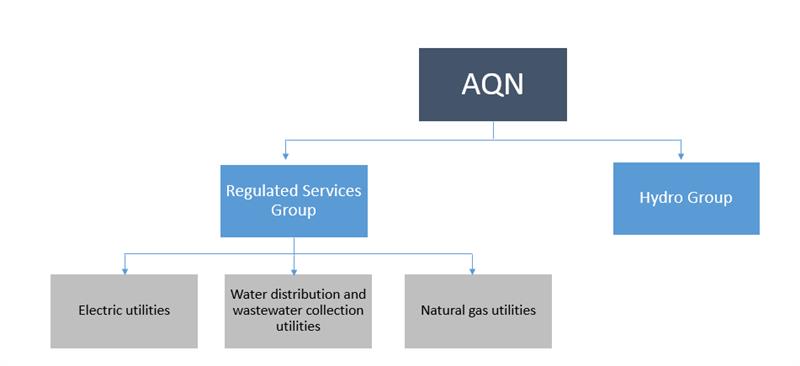
Most of the Corporation’s business is conducted through subsidiary entities, including those entities which hold project assets. The following chart depicts, in summary form, the Corporation’s key operating business units as of the date of this AIF.
image_1a.jpg

The following table outlines the Corporation’s significant subsidiaries and excludes certain other subsidiaries. The assets and revenues of the excluded subsidiaries did not individually exceed 10%, or in the aggregate exceed 20%, of the total consolidated assets or total consolidated revenues of the Corporation as at December 31, 2025. The voting securities of each subsidiary are held in the form of common shares, share quotas or partnership interests in the case of partnerships and their foreign equivalents.


- 4 -
Significant Subsidiaries
Description
Jurisdiction of Incorporation or Formation
Ownership of Voting Securities
REGULATED SERVICES GROUP
Liberty Utilities (Canada) Corp.
Canada
100%
Liberty Utilities Co. (“Liberty Utilities”)
Delaware
100%
Liberty Utilities (CalPeco Electric) LLC
Owner of the CalPeco Electric System
California
100%
Liberty Utilities (Granite State Electric) Corp.
Owner of the Granite State Electric System
New Hampshire
100%
Liberty Utilities (EnergyNorth Natural Gas) Corp.
Owner of the EnergyNorth Gas System
New Hampshire
100%
Liberty Utilities (Litchfield Park Water & Sewer) Corp.
Owner of the Litchfield Park Water System
Arizona
100%
Liberty Utilities (Midstates Natural Gas) Corp.
Owner of the Midstates Gas Systems
Missouri
100%
Liberty Utilities (Peach State Natural Gas) Corp.
Owner of the Peach State Gas System
Georgia
100%
Liberty Utilities (New England Natural Gas Company) Corp.
Owner of the New England Gas System
Delaware
100%
Liberty Utilities (New York Water) Corp.
Owner of the New York Water System
New York
100%
Liberty Utilities (St. Lawrence Gas) Corp.
Owner of the St. Lawrence Gas System
New York
100%
The Empire District Electric Company (“Empire”)
Owner of, among other things, electric distribution, generation and transmission utility system serving locations in Missouri, Kansas, Oklahoma and Arkansas
Kansas
100%
    Neosho Ridge Wind, LLC
Owner of the Neosho Ridge Wind Facility
Delaware
100%1
    North Fork Ridge Wind, LLC
Owner of the North Fork Ridge Wind Facility
Delaware
100%1
    Kings Point Wind, LLC
Owner of the Kings Point Wind Facility
Delaware
100%1
The Empire District Gas Company (“EDG”)
Operator of a natural gas distribution utility in Missouri
Kansas
100%
Liberty Utilities (Canada) LP (“Liberty Utilities Canada”)
Ontario
100%
    Liberty Utilities (Gas New Brunswick) LP
Owner of the New Brunswick Gas System
New Brunswick
100%
Bermuda Electric Light Company Limited (“BELCO”)
Owner of an electric distribution, transmission and generation system in Bermuda
Bermuda
100%
Suralis S.A. (“Suralis”) (previously known as Empresa de Servicios Sanitarios de Los Lagos S.A. )
Owner of a water and wastewater system in Chile
Chile
64%
1 The Corporation directly or indirectly holds 100% of the managing interests, with 100% of the tax equity interests directly or indirectly held by third-party partners.
2.GENERAL DEVELOPMENT OF THE BUSINESS
The Corporation owns and operates a diversified portfolio of regulated generation, distribution, and transmission assets, as well as hydroelectric generation assets. Through its activities, the Corporation aims to drive growth in earnings and cash flows to support a sustainable dividend and share price appreciation. On January 8, 2025, the Corporation completed the sale of its renewable energy business (excluding hydro) to a wholly-owned subsidiary of LS Power (“LS Buyer”) by way of an acquisition of 100% of the issued and outstanding trust units of APCo (the “Renewables Sale”).
One of AQN’s financial objectives is to maintain an investment grade credit rating. In an effort to realize that objective, AQN monitors and strives to adhere to various targets communicated by rating agencies related to their assessments of financial and business risk at AQN. These targets currently include expectations that AQN satisfies specific leverage targets.


- 5 -
Since completing the Renewables Sale and the sale of its interest in Atlantica, AQN has generated nearly all of its revenue from the Regulated Services Group.
AQN’s operations are organized across two business units consisting of: the Regulated Services Group, which primarily owns and operates a portfolio of regulated electric, water distribution and wastewater collection and natural gas utility systems and transmission operations in the United States, Canada, Bermuda and Chile; and the Hydro Group, which consists of hydroelectric generation facilities located in Canada that were not sold as part of the Renewables Sale. Additionally, the Corporation has a corporate function, the Corporate Group, primarily consisting of corporate debt and corporate and shared services that primarily support the Regulated Services Group and the Hydro Group.
Regulated Services Group
Hydro Group
Corporate Group
Electric Utilities
Water and Wastewater Utilities
Natural Gas Utilities
Electric and Natural Gas Transmission
Energy Generation and Storage
Hydro Power Generation
Corporate and Shared Services
Corporate Debt
Regulated Services Group
The Regulated Services Group primarily operates a diversified portfolio of regulated utility systems located in the United States, Canada, Bermuda and Chile serving approximately 1,272,000 customer connections as of December 31, 2025. The Regulated Services Group seeks to provide safe, high-quality and reliable services to its customers and to deliver stable and predictable earnings to the Corporation. The Regulated Services Group seeks to deliver long-term growth within its service territories, including through the pursuit of capital investment opportunities and other initiatives.
Hydro Group
The Hydro Group generates and sells electrical energy produced by its 14 hydroelectric generating facilities located in the Canadian provinces of Alberta, Ontario, New Brunswick and Quebec, with a combined gross generating capacity of approximately 112 MW and a net generating capacity of approximately 105 MW.
Corporate Group
The Corporate Group includes the Corporation’s corporate and shared services that primarily support the Regulated Services Group and the Hydro Group, in addition to holding certain ancillary investments.
2.1Three Year History
The following is a description of the general development of the business of the Corporation over the last three fiscal years.
2.1.1Fiscal 2023
Corporate
(i)APUC Revolving Credit Facility and Bilateral Credit Facility
On March 31, 2023, the Corporation completed an amendment and restatement of its senior unsecured revolving credit facility entered into as of July 12, 2019, which increased the borrowing capacity from $500 million to $1 billion, extended the maturity date to March 31, 2028 and included sustainability-linked performance targets (the “APUC Revolving Credit Facility”). The APUC Revolving Credit Facility was further amended on November 13, 2025. See “Three Year History – Fiscal 2025 – Corporate – APUC Revolving Credit Facility Amendments” for additional details.
The Corporation also entered into a new $75 million uncommitted bilateral credit facility on March 31, 2023.
On June 1, 2023, the Corporation terminated its former $50.0 million uncommitted bilateral credit facility .


- 6 -
(ii)Completion of Strategic Review and Management Changes
On May 11, 2023, the Corporation announced that the Board had initiated a strategic review of its renewable energy business. To oversee the strategic review process, the Board formed a Strategic Review Committee, comprised of directors Christopher Huskilson (Chair), Amee Chande and Dan Goldberg. On August 10, 2023, the Corporation announced that it was pursing a sale of its renewable energy business. Concurrently, the Corporation also announced that Arun Banskota was stepping down as President and Chief Executive Officer and as a member of the Board and announced the appointment of Christopher Huskilson as Interim Chief Executive Officer. Mr. Huskilson was subsequently appointed Chief Executive Officer on May 10, 2024.
See “Three Year History – Fiscal 2025 – Corporate – Completion of Renewables Sale” for more detail on the Renewables Sale.
(iii)Redemption of Series C Preferred Shares
During the year ended December 31, 2023, 100 Series C Shares of AQN that had previously been issued in exchange for 100 Class B limited partnership units of St. Leon Wind Energy LP (“St. Leon LP”) were redeemed for $14.5 million. As a result of the redemption, no Series C Shares of AQN remained outstanding. AQN subsequently sold all of its interest in St. Leon LP as part of the Renewables Sale.
(iv)Redemption of 6.875% Fixed-to-Floating Subordinated Notes – Series 2018-A due 2078
On November 6, 2023, AQN redeemed all $287,500,000 aggregate principal amount of its outstanding 6.875% Fixed-to-Floating Subordinated Notes – Series 2018-A due October 17, 2078 at a redemption price equal to 100% of the aggregate principal amount plus accrued and unpaid interest thereon.
Regulated Services Group
(i)Termination of Kentucky Power Transaction
On April 17, 2023, Liberty Utilities, American Electric Power Company, Inc. and AEP Transmission Company, LLC mutually agreed to terminate the agreement entered into on October 26, 2021 for Liberty Utilities to acquire Kentucky Power Company and AEP Kentucky Transmission Company.
2.1.2Fiscal 2024
Corporate
(i)Director Changes and 2024 Cooperation Agreement
On February 2, 2024, the Corporation announced that the Board had appointed David Levenson as a director.
Subsequently, on April 18, 2024, the Corporation announced that the Board intended to nominate Brett Carter and Christopher Lopez for election to the Board at the Corporation’s 2024 annual meeting of shareholders (the “2024 Annual Meeting”). In connection with the announcement, the Corporation announced that it had entered into a cooperation agreement with Starboard Value LP and certain of its affiliates (collectively, “Starboard”) dated April 18, 2024 (the “2024 Cooperation Agreement”), pursuant to which Starboard agreed to withdraw its previously-announced director nominations for election to the Board and to support the Corporation’s nominees for election at the 2024 Annual Meeting, including Messrs. Carter and Lopez. In addition, Starboard and the Corporation agreed to, among other things, customary standstill, voting and other provisions related to the composition of the Board and committees of the Board. Pursuant to the 2024 Cooperation Agreement the Corporation also agreed that it would not, following the 2024 Annual Meeting, increase the size of its Board to more than nine directors without Starboard’s prior consent. Subsequently, on March 13, 2025, the Corporation announced that it had entered into a further cooperation agreement with Starboard dated March 13, 2025 (the “2025 Cooperation Agreement”).
See “Three Year History – Fiscal 2025 – Corporate – Director Changes and 2025 Cooperation Agreement” for more detail on the 2025 Cooperation Agreement.
(ii)Successful Remarketing of Equity Units and Subsequent Settlement of Purchase Contracts
On March 28, 2024, the Corporation successfully remarketed its $1.15 billion aggregate principal amount of 1.18% Senior Notes due June 15, 2026 (the “Notes”). The Notes were originally issued in June 2021, together with the related purchase contracts (the “Purchase Contracts”), as a component of the Corporation’s corporate units (the “Equity Units”). In connection with the remarketing, the interest rate on the Notes was reset to 5.365%, with the maturity date remaining as June 15, 2026. The proceeds from the remarketing of the Notes were used to purchase a portfolio of treasury securities maturing on June 13, 2024.


- 7 -
Subsequently, on June 17, 2024, all outstanding Purchase Contracts were settled. In connection with the settlement of the Purchase Contracts, holders of Equity Units received, following payment of $50.00 for each Purchase Contract, 3.3439 Common Shares for each Purchase Contract held. The payment obligation of holders was satisfied with the proceeds of the treasury portfolio purchased in connection with the remarketing of the Notes. In aggregate, the Corporation received $1.15 billion in exchange for the issuance of approximately 76.9 million Common Shares upon settlement of the Purchase Contracts.
(iii)Sale of Interest in Atlantica
On May 28, 2024, the Corporation entered into a support agreement with Atlantica and a private limited company controlled by Energy Capital Partners (“Bidco”) pursuant to which the Corporation and its subsidiary, Liberty (AY Holdings) B.V., which held approximately 42.2% of the shares of Atlantica, agreed to cause such shares to be voted in favour of a transaction agreement separately announced by Atlantica and Bidco on May 28, 2024 pursuant to which Bidco agreed to acquire Atlantica. Subsequently, on December 12, 2024, Bidco completed the acquisition of Atlantica, including the 42.2% equity interest in Atlantica held by Liberty (AY Holdings) B.V. The Corporation received total proceeds of approximately $1.1 billion in connection with the sale.
(iv)Final Deployment of Integrated Customer Solution Technology Platform
In the second quarter of 2024, the Corporation completed the final deployment of its integrated customer solution technology platform, which includes customer billing, enterprise resource planning systems and asset management systems.
(v)Agreement to Sell Renewable Energy Business
On August 9, 2024, the Corporation entered into a securities purchase agreement with LS Buyer (the “Renewables Securities Purchase Agreement”) in respect of the Renewables Sale. See “Three Year History – Fiscal 2025 – Corporate – Completion of Renewables Sale” for more detail on the Renewables Sale and the Renewables Securities Purchase Agreement.
Regulated Services Group
(i)Offering of Senior Unsecured Notes
On January 12, 2024, Liberty Utilities completed an offering of $500 million aggregate principal amount of 5.577% senior notes due January 31, 2029 (the “2029 Notes”) and $350 million aggregate principal amount of 5.869% senior notes due January 31, 2034 (the “2034 Notes”, and together with the 2029 Notes, the “Senior Notes”). The Senior Notes are unsecured and unsubordinated obligations of Liberty Utilities and rank equally with all of Liberty Utilities’ existing and future unsecured and unsubordinated indebtedness and senior in right of payment to any existing and future Liberty Utilities subordinated indebtedness.
(ii)Offering of Securitized Utility Tariff Bonds
On January 30, 2024, Empire District Bondco, LLC, a wholly owned subsidiary of Empire, completed an offering of approximately $180.5 million of aggregate principal amount of 4.943% Securitized Utility Tariff Bonds with a maturity date of January 1, 2035 and $125 million aggregate principal amount of 5.091% Securitized Utility Tariff Bonds with a maturity date of January 1, 2039, to recover previously incurred qualified extraordinary costs associated with the February 2021 extreme winter storm conditions experienced in Texas and parts of the central U.S. and energy transition costs related to the retirement of the Asbury generating plant. The principal asset securing these bonds is the securitized utility tariff property.
2.1.3Fiscal 2025
Corporate
(i)Completion of Renewables Sale
On January 8, 2025, the Corporation completed the Renewables Sale. Pursuant to the Renewables Securities Purchase Agreement, LS Buyer acquired the Corporation’s renewable energy business (excluding hydro) by way of an acquisition of 100% of the issued and outstanding trust units of APCo for proceeds of approximately $2.1 billion, after subtracting taxes, transaction fees and other preliminary closing adjustments, including an adjustment for estimated remaining completion costs for in-construction assets. Approximately $1.95 billion of such proceeds were received upon the closing of the transaction, and an additional approximately $115 million in proceeds were received in 2025 upon monetization of tax attributes on certain in-construction projects, with the remaining approximately $35 million of proceeds expected in 2026 upon monetization of tax attributes on additional in-construction projects.


- 8 -
Additionally, the Corporation can receive up to $220 million in cash pursuant to an earn out agreement relating to certain wind assets (the “Earn Out Agreement”).
(ii)Management Changes
On January 14, 2025, the Corporation announced that Darren Myers would resign as Chief Financial Officer following the reporting of the Corporation’s fourth quarter 2024 results.
On January 31, 2025, the Corporation announced that Roderick West would join the Corporation as Chief Executive Officer. Mr. West’s appointment as Chief Executive Officer was effective as of 12:00 p.m. (Eastern time) on March 7, 2025. Chris Huskilson stepped down as Chief Executive Officer and continued in his role as a director of the Corporation until November 24, 2025.
On February 14, 2025, the Corporation announced that Brian Chin, the Corporation’s Vice President, Investor Relations, would be appointed as Interim Chief Financial Officer. Mr. Chin’s appointment was effective as of 12:00 p.m. (Eastern time) on March 7, 2025. Subsequently, on November 7, 2025, the Corporation announced the appointment of Robert J. Stefani as Chief Financial Officer, effective January 5, 2026. Brian Chin acted as Interim Chief Financial Officer until January 5, 2026, and after such date, has continued with the Corporation in his Vice President, Investor Relations role.
On June 9, 2025, the Corporation announced the appointment of Noel Black as Chief Regulatory and External Affairs Officer, effective June 30, 2025.
On June 18, 2025, the Corporation announced the appointment of Amy Walt as Chief Customer Officer, effective June 30, 2025.
(iii)Director Changes and 2025 Cooperation Agreement
On March 13, 2025, the Corporation announced that the Board had appointed Roderick West as a director. The Corporation also announced that it intended to appoint Gavin Molinelli, Senior Partner and Portfolio Manager at Starboard, to the Board, subject to approval by FERC. Mr. Molinelli’s appointment was subsequently approved by FERC and he was appointed to the Board on May 20, 2025.
In connection with the announcement, the Corporation also announced that it had entered into the 2025 Cooperation Agreement. Pursuant to the 2025 Cooperation Agreement, Starboard agreed to support the Corporation’s nominees for election at the Corporation’s 2025 annual meeting of shareholders (the “2025 Annual Meeting”), which was held on June 3, 2025. In addition, Starboard and the Corporation agreed to customary standstill, voting and other provisions related to, among other things, the composition of the Board and Board committees. The 2025 Cooperation Agreement is expected to expire on March 20, 2026.
On June 3, 2025, in connection with the 2025 Annual Meeting, Melissa Stapleton Barnes retired from the Board and DeAnn Walker was appointed to the Board.
(iv)APUC Revolving Credit Facility Amendments
On November 13, 2025, the Corporation completed an amendment and restatement of the APUC Revolving Credit Facility which, among other things, decreased the borrowing capacity from $1 billion to $750 million and removed sustainability-linked performance targets.
Regulated Services Group
(i)Regulated Services Group Credit Facilities
On November 13, 2025, the maturity date of the Liberty Utilities $1.0 billion senior unsecured revolving credit facility was extended from April 29, 2027 to November 13, 2030.
On November 13, 2025, Liberty Utilities increased the size of its unsecured commercial paper program by $500 million to $1.0 billion. This commercial paper program permits Liberty Utilities to issue, from time to time, unsecured commercial paper notes up to a maximum aggregate amount outstanding at any one time of $1.0 billion, with varying maturities of up to 270 days from the date of issue.
2.1.4Fiscal 2026
Corporate


- 9 -
(i)Management Changes
On January 5, 2026, the Corporation announced the appointment of Peter Norgeot as Chief Operating Officer, effective as of such date.
On February 16, 2026, the Corporation appointed Kristin von Fischer as Chief Human Resources Officer, effective as of such date.

3.DESCRIPTION OF THE BUSINESS
The Corporation’s operating groups consist of the Regulated Services Group and the Hydro Group. The Regulated Services Group is the primary source of revenues and accounts for a substantial majority of the assets of the Corporation. For the year ended December 31, 2025, the Regulated Services Group represented approximately 98.39% and 95.62% of the Corporation’s revenues and assets, respectively.
3.1Regulated Services Group
The Regulated Services Group primarily operates a diversified portfolio of regulated utility systems located in the United States, Canada, Bermuda and Chile, serving approximately 1,272,000 customer connections as at December 31, 2025.
The Regulated Services Group’s regulated electrical distribution utility systems and related transmission and generation assets are located in the U.S. states of Arkansas, California, Kansas, Missouri, Nevada, New Hampshire, and Oklahoma, as well as in Bermuda, which together served approximately 311,000 electric customer connections as at December 31, 2025. The group also owns and operates generating assets with a gross capacity of approximately 2.0 GW and has investments in generating assets with approximately 0.3 GW of net generation capacity.
The Regulated Services Group’s regulated water distribution and wastewater utility systems are located in the U.S. states of Arizona, Arkansas, California, Illinois, Missouri, New York and Texas, as well as in Chile, which together served approximately 583,000 customer connections as at December 31, 2025.
The Regulated Services Group’s regulated natural gas distribution utility systems are located in the U.S. states of Georgia, Illinois, Iowa, Massachusetts, Missouri, New Hampshire and New York, and in the Canadian province of New Brunswick, which together served approximately 378,000 natural gas customer connections as at December 31, 2025.
Below is a breakdown of revenue for the Regulated Services Group by geographic area for the twelve months ended December 31, 2025.
Geographic Area
% of Total Revenue
United States
81.66%
Canada
2.62%
Bermuda
11.51%
Chile
4.21%
3.1.1Description of Operations
Electric Distribution Systems
(i)Method of Providing Services and Distribution Methods
Electric distribution is the final stage in the delivery system of providing electricity to end users. An electric distribution utility sources and distributes electricity to its customers through a network of buried or overhead lines. The electricity is sourced from power generation facilities. The electricity is transported from the source(s) of generation at high voltages through transmission lines and is then reduced through transformers to lower voltages at substations. The electricity from the substations is then delivered through distribution lines to the customers where the voltage is again lowered through a transformer for use by the customer.
The rates charged for electric distribution service are comprised of a fixed charge that recovers customer related costs and a variable rate component that recovers the cost of generation (except in New Hampshire), transmission and distribution.


- 10 -
Other revenues are comprised of fees for other services such as establishing a connection, late fee, reconnections, and energy efficiency programs.
The electric utilities located in Arkansas, California, Kansas, Missouri, New Hampshire and Oklahoma are subject to state and federal regulation and rates charged by these utilities must be reviewed and approved by their respective state regulatory authorities and FERC in limited circumstances. Similarly, the electric utility in Bermuda, BELCO, is subject to regulation by the RAB and its rates must be approved by the RAB.
(ii)Principal Markets and Regulatory Environments
The Regulated Services Group operates electrical distribution systems in the states of Arkansas, California, Kansas, Missouri, New Hampshire and Oklahoma, and in Bermuda under a cost-of-service methodology. The utilities use either a historical test year, adjusted pro forma for known and measurable changes in the establishment of their rates, or prospective test years based on expenses expected to be incurred in future periods. Pursuant to these methods, the revenue requirement upon which rates are based is determined by applying an approved return on rate base, and adding depreciation, operating expenses and administrative and general expenses.
Rate cases allow a particular utility the opportunity to recover its appropriate operating costs and earn a reasonable rate of return on its capital investment as allowed by the regulatory authority under which the utility operates.
(iii)Selected Facilities
(1)CalPeco Electric System
The CalPeco Electric System provides electric distribution service to the Lake Tahoe basin and surrounding areas. The service territory, centered on a highly popular tourist destination, has a customer base spread throughout Alpine, El Dorado, Mono, Nevada, Placer, Plumas and Sierra counties in northeastern California. CalPeco Electric System’s connection base is primarily residential. Its commercial connections consist primarily of ski resorts, hotels, hospitals, schools and grocery stores. The CalPeco Electric System is regulated by the CPUC.
The CalPeco Electric System entered into a multi-year full services agreement with NV Energy that commenced in December 2020, initially expiring in December 2025, and which was extended by an amendment effective December 29, 2025. The amended and restated full services agreement extends the term until the earlier of May 31, 2027 or a date upon which NV Energy has completed the construction of certain transmission facilities that will provide the CalPeco Electric System with sufficient capacity to transition it to taking network integration transmission services for its entire network load. The full services agreement obligates NV Energy to supply the CalPeco Electric System with a percentage of the CalPeco Electric System’s power from renewable sources under contract with NV Energy. This agreement lowers fixed rates for customers, while providing the CalPeco Electric System the opportunity to add renewable generation capacity. The CalPeco Electric System received approval from the CPUC to recover the costs it will incur under the original agreement with NV Energy as well as costs incurred to acquire, own and operate the Luning Solar Facility and the Turquoise Solar Facility.
(2)Granite State Electric System
The Granite State Electric System provides electric distribution service in southern and northwestern New Hampshire, centered around operating centers in Salem in the south and Lebanon in the northwest. The Granite State Electric System’s customer base includes a mixture of residential, commercial and industrial customers. The Granite State Electric System consists of approximately 2,517 circuit miles, 43 distribution circuits and 15 electric distribution substations.
The Granite State Electric System is regulated by the NHPUC and FERC. The Granite State Electric System is required to provide electric commodity supply for all customers who do not choose to take supply from a competitive supplier (“Energy Service”) in the New England power market and is allowed to fully recover its costs for the provision and administration of Energy Service under the Energy Service Adjustment Factor, as approved by the NHPUC. The Granite State Electric System must file with the NHPUC twice a year to adjust for market prices of purchased power. Additionally, the Granite State Electric System serves a “borderline” customer under a retail delivery service tariff approved by the NHPUC for which it charges distribution rates that are subject to FERC jurisdiction.
(3)Empire District Electric System
Based in Joplin, Missouri, Empire is a regulated utility providing electric distribution, generation and transmission services in parts of Missouri, Kansas, Oklahoma and Arkansas. The largest urban area served is the city of Joplin, Missouri, and its immediate vicinity. Empire, including its subsidiaries (other than EDG), represents approximately 32.07% and 44.29% of the Regulated Services Group’s operating revenues and assets, respectively. Empire’s customer base includes a mixture of residential, commercial, and industrial customers.


- 11 -
Empire, through a subsidiary entity, operates a fibre optics business. Empire is subject to regulation by the MPSC, the KCC, the OCC, the APSC and FERC.
Empire has various owned generation located in Missouri, Kansas and Arkansas. Its facilities include, among others, the approximately 150 MW North Fork Ridge Wind Facility located in northwestern Jasper County and southwestern Barton County, Missouri; the approximately 150 MW Kings Point Wind Facility located in Barton County, southwestern Dade County, northeastern Jasper County, and northwestern Lawrence County, Missouri; Empire’s share of the approximately 430 MW jointly-owned State Line natural gas fired thermal generation facility, located in Joplin, Missouri; the approximately 250 MW Energy Center, a natural gas fired thermal generation facility located in Sarcoxie, Missouri; Empire’s share of the approximately 200 MW jointly-owned Iatan 1 and 2 coal-fired thermal generation facilities located in Weston, Missouri; the approximately 300 MW Neosho Ridge Wind Facility located in Neosho County, Kansas; the approximately 300 MW Riverton natural gas-fired thermal generation facility located in Riverton, Kansas; Empire’s share of the approximately 50 MW jointly-owned Plum Point coal-fired thermal generation facility located in Osceola, Arkansas; and the approximately 16 MW Ozark beach hydroelectric facility located in Taney County, Missouri.
(4)BELCO Electric System
BELCO is the sole provider of electricity transmission, distribution, and retail services to all customers in Bermuda and is a bulk generator of electricity on the island. BELCO’s customer base includes a mixture of residential, commercial, and industrial customers. Its network includes approximately 1,000 km of high voltage distribution lines, approximately 600 km of low voltage overhead service lines, approximately 200 km of underground transmission cables and 34 substations.
BELCO has various owned reciprocating and gas turbine generation units with a combined capacity of approximately 140 MW. There is also a 10 MW Battery Energy Storage System.
BELCO is regulated by the RAB, the sole utility regulator in Bermuda. The RAB approves pass through costs such as fuel as part of its Fuel Adjustment Rate mechanism, which is set and adjusted quarterly. The Electricity Act 2016 brought changes to Bermuda’s electricity market which included the development of the first integrated resource plan, the encouragement of competitive electricity generation and a new retail tariff methodology.
Water Distribution and Wastewater Collection Systems
(i)Method of Providing Services and Distribution Methods
A water and/or wastewater utility company provides water distribution and/or wastewater collection and treatment services to its customers.
A water utility sources, treats and stores potable water and subsequently distributes it to customers through a network of buried pipes (distribution mains). The raw water for human consumption is sourced from the ground and extracted through wells or from surface water such as lakes or rivers. The water is treated to potable water standards that are specified in federal and state regulations as administered and which are typically enforced by a federal, state or local agency. Following treatment, the water is either pumped directly into the distribution system or pumped into storage reservoirs from which it is subsequently pumped into the distribution system. This system of wells, pumps, storage vessels and distribution infrastructure is owned and maintained by the private utility. The fees or rates charged for water service are comprised of a fixed charge component plus a variable fee based on the volume of water used. Additional fees are typically charged for other services such as establishing a connection, late fees and reconnects.
A wastewater utility collects wastewater from its customers and transports it through a network of collection pipes, lift stations and manholes to a centralized facility where it is treated, rendering it suitable for discharge to the environment or for reuse, usually as irrigation. The wastewater is ultimately delivered to a treatment plant. Primary treatment at the plant consists of the screening out of larger solids, floating material and other foreign objects and, at some facilities, grit removal. These removed materials are hauled to a landfill. Secondary treatment at the plant consists of biological digestion of the organic and other impurities which is performed by beneficial bacteria in an oxygen enriched environment. Excess and spent bacteria are collected from the bottom of the tanks, digested and/or dewatered and the resulting solids are sent to landfill or to land application as a soil amendment. The treated water, referred to as “effluent”, is then used for irrigation or groundwater recharging or is discharged by permit. The standards to which this wastewater is treated are specified in each treatment facility’s operating permit and the wastewater is routinely tested to confirm its continuing compliance therewith. The effluent quality standards are based on federal, state or local regulations which are administered, and continuing compliance is enforced by the state agency to which federal enforcement powers are delegated.


- 12 -
(ii)Principal Markets and Regulatory Environments
The Regulated Services Group’s water and wastewater facilities are located in the United States in the states of Arizona, Arkansas, California, Illinois, Missouri, New York and Texas, and in Chile. The water and wastewater utilities are generally subject to regulation by the public utility commissions and state regulators of the jurisdiction in which they operate. The respective public utility commissions have jurisdiction with respect to rate, service, accounting procedures, issuance of securities, acquisitions, while the state regulators manage the systems through the issuance of environmental permits. These utilities generally operate under cost-of-service regulation as administered by these regulatory authorities. The utilities generally use a historic or forward-looking test year in the establishment of rates for the utility and pursuant to this method the determination of the rate of return on approved rate base, recovery of depreciation on plant, together with all reasonable and prudent operating costs, establishes the revenue requirement upon which each utility’s customer rates are determined.
Rate cases allow a particular utility the opportunity to recover appropriate operating costs and to earn a rate of return on its capital investment as allowed by the regulatory authority under which the facility operates. The Corporation monitors the rates of return on each of its water and wastewater utility investments to determine the appropriate time to file rate cases in order to pursue its goal of earning the regulatory approved rate of return on its investments and increased operating costs in accordance with any legal requirements.
(iii)Selected Facilities
(1)Litchfield Park Water System
The Litchfield Park Water System is a regulated water and wastewater utility located in and around the cities of Avondale, Goodyear, Litchfield Park, and unincorporated Maricopa County, west of Phoenix, Arizona that has a service area that includes the City of Litchfield Park, sections of land located in the cities of Goodyear and Avondale as well as portions of unincorporated Maricopa County. Litchfield Park Water System’s operations consist of sixteen well sites, two reservoir sites, and approximately 508 km of water mains and distribution lines. Wastewater operations at the Litchfield Park Water System consist of two lift stations and approximately 509 km of collection and force mains to both the Palm Valley Water Reclamation Facility and the newly constructed Sarival Water Reclamation Facility. The Palm Valley Water Reclamation Facility has a permitted treatment capacity of 6.9 million gallons per day and the Sarival Water Reclamation Facility has a permitted treatment capacity of 4.4 million gallons per day. The Litchfield Park Water System’s customer base includes a mixture of residential, commercial, and industrial customers. The Litchfield Park Water System is regulated by the Arizona Corporation Commission and uses a historic test year in the establishment of rates for the utility. Pursuant to this method, the determination of the rate of return on approved rate base and recovery of depreciation on plant, together with all reasonable and prudent operating costs, establishes the revenue requirement upon which customer rates are determined. The Arizona Corporation Commission recently adopted a policy statement providing for formula rates, which may be available for Arizona regulated utilities, pending results of a legal challenge.
(2)Liberty Park Water and Liberty Apple Valley Water System
Liberty Utilities (Park Water) Corp. (“Liberty Park Water”) provides, owns and operates water systems in Los Angeles County, California. Liberty Park Water also wholly owns Liberty Utilities (Apple Valley Ranchos Water) Corp. (“Liberty Apple Valley Water”), which is a regulated utility providing water utility services to customers in and around the Town of Apple Valley, California. Liberty Park Water’s and Liberty Apple Valley Water’s customer base includes a mixture of residential, commercial, and industrial customers. The Liberty Park Water system consists of approximately 428 km of pipeline, 11 wells, eight booster pump stations, seven purchase water connections, and 6.9 million gallons of storage reservoirs and tank capacity. The Liberty Apple Valley Water system consists of approximately 777 km of pipeline, 25 wells, 8 booster pump stations, and 12 million gallons of storage reservoirs and tank capacity. Liberty Park Water and Liberty Apple Valley Water are regulated by the CPUC and use a forward-looking, multi-year rate plan.
(3)Suralis System
Suralis is a water and wastewater utility company located in Southern Chile. The utility operates 51 potable water production systems, 29 sewage plants, approximately 2,320 km of drinking water distribution networks and approximately 2,022 km of sewage networks covering 31 municipalities in the provinces of Valdivia, Ranco, Osorno, Llanquihue, Chiloé and Palena in the regions of Los Lagos and Los Ríos. The Corporation indirectly owns approximately 68.073% of the outstanding shares of Suralis. Suralis’ customer base includes a mixture of residential, commercial, and industrial customers. Suralis is regulated by the Superintendence of Sanitary Services of Chile and is also subject to the jurisdiction of the Chilean National Consumer Service, being Chile’s consumer protection agency.


- 13 -
(4)New York Water System
The New York Water System is a regulated water and wastewater utility serving customers across seven counties in southeastern New York. Operations include approximately 1,270 miles of water mains and distribution lines, 92 groundwater wells, 52 treatment stations and 41 tanks. Approximately 86% of the New York Water System’s customer base is residential, with 98% of customers located in Nassau County on Long Island.
The water utility comprising the New York Water System is regulated by the New York State Public Service Commission while the wastewater utility is regulated by the Town of Mt. Ebo. The New York Water System uses a forward-looking, multi-year rate plan and has a reconciliation mechanism designed to allow the Corporation to recover or refund, through a surcharge or credit, the annual difference between projections of revenues, production costs and property taxes and the actual amounts experienced by the New York Water System. The New York Water System also utilizes an infrastructure surcharge mechanism to recover water quality and system improvement investments, and a pension and other post-employment benefits tracker mechanism that tracks changes from authorized expenses.
Natural Gas Distribution Systems
(i)Method of Providing Services and Distribution Methods
Natural gas is a fossil fuel composed almost entirely of methane (a hydrocarbon gas) usually found in deep underground reservoirs formed by porous rock. In making its journey from the wellhead to the customer, natural gas may travel thousands of miles through interstate pipelines owned and operated by pipeline companies. Along the route, the natural gas may be stored underground in depleted oil and gas wells or other natural geological formations for use during seasonal periods of high demand. Interstate pipelines interconnect with other pipelines and other utility systems and offer system operators flexibility in moving the gas from point to point. The interstate pipeline companies are regulated by FERC. Typically, the distribution network operates pipelines (including transmission and distribution pipelines), gate stations, district regulator stations, peak shaving plants and natural gas meters.
The Regulated Services Group is also active in the RNG sector. RNG is pipeline compatible gaseous fuel derived from biogenic or other renewable sources that has lower lifecycle emissions than geologic natural gas. RNG is a “drop in” fuel requiring no modification to company or customer equipment and provides a low to negative carbon lifecycle footprint. The Regulated Services Group has RNG projects in various stages of development across several gas distribution companies which are, or are expected to be, connected to the Regulated Services Group’s local infrastructure. The Regulated Services Group, through its gas distribution subsidiaries in New York and Georgia, has also entered into physical supply contracts for locally produced RNG which does not include the environmental attributes/credits associated with the RNG. The gas distribution utilities owned by the Regulated Services Group are subject to state or provincial regulation and rates charged by these facilities may be reviewed and altered by the state or provincial regulatory authorities from time to time.
(ii)Principal Markets and Regulatory Environments
The Regulated Services Group owns and operates natural gas distribution systems under cost-of-service regulation in the states of Georgia, Illinois, Iowa, Massachusetts, Missouri, New Hampshire and New York and the province of New Brunswick. In establishing rates, the natural gas utilities use either a historical test year that is adjusted on a pro forma basis for known and measurable changes or a prospective test year based on expenses expected to be incurred in a future period, which is the methodology utilized in New Brunswick and Illinois. Pursuant to either the historic or prospective rate making methodology, rates are determined by establishing the rate of return on approved rate base and recovery of depreciation on plant, together with all reasonable and prudent operating costs, thereby establishing the revenue requirement upon which each utility’s customer rates are determined.
Rate cases allow a particular utility the opportunity to recover its appropriate operating costs and earn a reasonable rate of return on its capital investment as allowed by the regulatory authority under which the facility operates. The Corporation monitors the rates of return on its utility investments and increases in operating costs to determine the appropriate times to file rate cases, with the goal of earning a reasonable rate of return on its investments in accordance with any legal requirements.
(iii)Selected Facilities
(1)EnergyNorth Gas System
The EnergyNorth Gas System is a regulated natural gas utility providing natural gas distribution services in 32 communities covering six counties in New Hampshire. Its franchise service area includes the communities of Nashua, Manchester, Concord, Keene, and Berlin. The EnergyNorth Gas System’s customer base includes a mixture of residential, commercial, industrial and transportation customers.


- 14 -
The EnergyNorth Gas System operates and maintains approximately 2,399 km of underground distribution and transmission mains, approximately 71,746 service lines, and approximately 70 local and district regulator stations.
The EnergyNorth Gas System is regulated by the NHPUC. The EnergyNorth Gas System has a revenue per customer decoupling mechanism to recover lost distribution revenue associated with energy efficiency and to otherwise account for the effects of abnormal weather and economic conditions, and includes a real-time weather normalization adjustment. In addition, the EnergyNorth Gas System has a cost of gas adjustment mechanism that allows for monthly adjustments to account for commodity cost changes within certain tolerances. Subject to the satisfaction of certain criteria, New Hampshire natural gas utilities are allowed to procure RNG at quantities up to 5% of their total annual delivered volume through contracts with terms of up to 15 years, to recover prudently incurred costs of procuring RNG, and to recover the costs of and earn a return on qualified investments in RNG infrastructure.
(2)Empire District Gas System
EDG is engaged in the distribution of natural gas in Missouri, serving customers in northwest, north central and west central Missouri. The franchise service area includes the communities within eight major service areas of Maryville, Chillicothe, Platte City, Henrietta, Sedalia, Marshall, Clinton and Nevada. EDG operates and maintains approximately 1,976 km of distribution mains and 140 km of transmission mains, approximately 49,327 service lines, and approximately 477 local and district regulator stations. EDG’s customer base includes a mixture of residential, commercial, industrial and transportation customers.
EDG is regulated by the MPSC. A PGA allows EDG to recover from its customers, subject to audit and final determination by regulators, the cost of purchased natural gas supplies and related carrying costs associated with EDG’s use of natural gas financial instruments to hedge the purchase price of natural gas. This PGA allows EDG to make rate changes periodically (up to four times) throughout the year in response to weather conditions and supply demands. Missouri law allows companies to include investments in RNG production, gathering and delivery infrastructure in rate base. It also includes the ability to include RNG in the supply portfolio as well as delivery to customers.
(3)Peach State Gas System
The Peach State Gas System is a regulated natural gas system providing natural gas distribution services in 15 communities covering eight counties in Georgia. The Peach State Gas System franchise service area includes the communities of Columbus, Gainesville, Waverly Hall, Oakwood, Hamilton and Manchester. The Peach State Gas System’s customer base primarily includes a mixture of residential, commercial, industrial and transportation customers. The Peach State Gas System operates and maintains approximately 2,278 km of underground distribution mains, approximately 109 km of transmission mains and approximately 131 local and district regulator stations. In addition, the Peach State Gas System has a 50-year privatization agreement to operate and maintain the natural gas system at Fort Moore.
The Peach State Gas System is regulated by the Georgia Public Service Commission. The Peach State Gas System’s rates are reviewed and updated annually through a tariff provision called the Georgia Rate Adjustment Mechanism. Georgia allows recovery of natural gas costs (including commodity price, transportation, reservation and demand costs, hedging costs and storage costs). Georgia also allows certain RNG investments to be included in rate base.
(4)New England Gas System
The New England Gas System is a regulated natural gas utility providing natural gas distribution services in eleven communities, including Fall River, North Attleborough, Blackstone and surrounding communities, located in the southeastern portion of Massachusetts. The New England Gas System operates approximately 1,120 km of underground distribution mains, approximately 39,922 service lines, and 38 local and district regulator stations. The New England Gas System’s customer base includes a mixture of residential, commercial, and industrial customers.
The New England Gas System is regulated by the MDPU. The cost of natural gas is recoverable from customers through the Gas Adjustment Factor (“GAF”) when billed to “firm” natural gas customers included in approved tariffs by the MDPU.  The GAF is adjusted twice annually and more frequently under certain circumstances.
(5)Midstates Gas Systems
The Midstates Gas Systems own regulated natural gas utilities providing natural gas distribution services to approximately 203 communities within 41 counties in the states of Illinois, Iowa and Missouri. The franchise service area includes the communities of Virden, Vandalia, Harrisburg and Metropolis in Illinois, Keokuk in Iowa, and Butler, Kirksville, Canton, Hannibal, Jackson, Sikeston, Malden and Caruthersville in Missouri. The Midstates Gas Systems’ customer base includes a mixture of residential, commercial, industrial and transportation customers.


- 15 -
The Midstates Gas Systems operate and maintain approximately 4,647 km of underground distribution mains, 357 km of transmission mains, and approximately 622 local and district regulator stations.
The Midstates Gas Systems are regulated by the Illinois Commerce Commission, the Iowa Utilities Board, the MPSC and FERC. The regulators in Illinois, Iowa and Missouri allow recovery of natural gas costs (including commodity price, transportation, reservation and demand costs, hedging costs, and storage costs).  The rate is adjusted monthly in Illinois and Iowa with an annual reconciliation. In Missouri, the rate is adjusted annually with allowance to file quarterly. In Missouri and Illinois, mechanisms exist to allow for the recovery of the revenue requirement approved by the regulator. In Missouri, the weather normalization adjustment mechanism allows for the adjustment in revenue due to weather and in Illinois, the volume balancing adjustment mechanism allows for the recovery of revenue due to variances in the volume of natural gas used.
(6)New Brunswick Gas System
The New Brunswick Gas System is regulated by the NB Energy Board and has a distribution network that includes approximately 860 km of underground distribution mains and approximately 397 km of service lines. The New Brunswick Gas System provides service to customers in 14 communities in New Brunswick. The NB Energy Board’s regulatory activities in the natural gas sector are primarily in relation to the New Brunswick Gas System which is the exclusive holder of the natural gas distribution franchise for the Province of New Brunswick, which expires in 2044 and is extendable for an additional 25-year period. The New Brunswick Gas System’s customer base includes a mixture of residential, commercial, and industrial customers.
For rate cases, the NB Energy Board can review all facets of the operations but primarily focuses on the approval of the previous calendar year’s regulatory financial statements, future test year budgets, establishing revenue requirements, rate design and other decisions such as community expansion plans, customer retention and incentive programs, load retention rate proposals, return on equity, debt structure and rate class reviews. The New Brunswick Gas System has a weather normalization adjustment for its small general service/residential rate customers.
(7)St. Lawrence Gas System
The St. Lawrence Gas System is a regulated natural gas utility operating approximately 783 km of underground distribution and transmission mains. It distributes natural gas to customers in more than 24 communities covering three counties in northern New York State, including the Villages of Canton, Malone, Massena, Potsdam and the City of Ogdensburg located in St. Lawrence County, Franklin County and a portion of Lewis County. The St. Lawrence Gas System’s customer base includes a mixture of residential, commercial, industrial, and electric generation customers.
The St. Lawrence Gas System is regulated by the New York State Public Service Commission. In a traditional rate case filing, the filing includes historical operating results (test year) and a 12-month forecast for the period the rates will be in effect (rate year). More commonly, the St. Lawrence Gas System will endeavor to settle the rate case filing, in which case it is expected that there would be a multi-year plan in which the rate base and revenue requirement is adjusted for subsequent years within the plan. The St. Lawrence Gas System has a revenue decoupling mechanism which applies to residential and commercial customers within sales and transportation service types. This mechanism reconciles actual delivery service revenue to allowed delivery service revenues, which effectively adjusts the revenue for weather, energy efficiency and customer numbers.
Electric Transmission
(i)Method of Providing Services and Transmission Methods
Electric transmission is the bulk transportation of generated electricity over long distances from a generating site, such as a power plant, to an electrical substation. Transmission lines move large amounts of power at a high voltage level to a substation for voltage step-down and on to a lower voltage distribution network resulting in electricity delivered to homes and businesses. Transmission services obtained through FERC-governed OATT include network and point-to-point transmission service along with other ancillary services. Some examples of these types of services include spinning and non-spinning reserves, black-start capability, regulation and voltage support and system control and dispatch.
(ii)Principal Markets and Regulatory Environments
Empire’s transmission rates and services, electric wholesale sales of electric energy in interstate commerce, and its facilities are subject to the jurisdiction of FERC, under the Federal Power Act. Wholesale rate recovery of transmission costs, as with wholesale rate recovery of any other cost, is subject to FERC review.


- 16 -
The operations and rates of AQN’s transmission facility in New Brunswick are regulated by the NB Energy Board. It is entitled to recover the transmission revenue requirement, pursuant to the transmission tariff administered by New Brunswick Power Corporation. Any increase to its revenue requirement would result in an increase to the transmission rates under the OATT.
BELCO’s transmission rates are regulated by the RAB. BELCO’s transmission function and bulk generation functions are regulated under two licences held by BELCO: one for electricity transmission, distribution, and retail services and one for bulk generation.
(iii)Selected Facilities
(1)Empire Transmission Facilities
The Empire electric transmission facilities are located in a four-state area of Missouri, Kansas, Oklahoma and Arkansas and primarily consist of approximately 22 miles of 345 kV lines, approximately 404 miles of 161 kV lines, approximately 813 miles of 69 kV lines and approximately 18 miles of 34.5 kV lines.
Empire is a member of the SPP, which spans an area from the Canadian border in Montana and North Dakota in the north to parts of New Mexico, Texas and Louisiana in the south.  The transmission facilities are offered for service under an OATT approved by FERC and administered by SPP.  Service requests are placed in the SPP Open Access Same-Time Information System and are evaluated by SPP for available capacity which is provided subject to the SPP Tariff and SPP Market Rules on a non-discriminatory basis.  Service requests can be either point-to-point or network service, where network service is used for serving electric load.  Empire is subject to four different states’ regulatory bodies, the Midwest Reliability Organization regional entity for NERC compliance, SPP Market Rules and FERC.
3.1.2Specialized Skill and Knowledge
The Regulated Services Group requires specialized knowledge of its utility systems, including electrical, water and wastewater and natural gas. The Regulated Services Group has developed in-house regulatory expertise in order to interact with regulators in the various jurisdictions in which it operates. The Regulated Services Group believes that the relationship with regulators is unique to each jurisdiction and therefore is best delivered locally. The local regulatory teams and business representatives meet with regulatory agencies on a regular basis to review regulatory policies, service delivery results and strategies, operating results and rate making initiatives.
3.1.3Competitive Conditions
Generally, the Regulated Services Group’s utility businesses have geographic monopolies in their service territories. Competition at the Regulated Services Group’s electric distribution systems is primarily from other energy sources and on-site generation. Competition at the Regulated Services Group’s natural gas distribution systems is primarily with other methods of heating, including electricity, oil, and propane. Government policy and any changing societal perceptions of natural gas could also impact the competitiveness of natural gas in relation to other energy sources.
3.1.4Cycles and Seasonality
(i)Electricity Systems
The CalPeco Electric System’s demand for energy sales fluctuate depending on weather conditions. The CalPeco Electric System is a winter-peaking utility. Above normal snowfall in the Lake Tahoe area may bring more tourists and may increase demand for electricity. The CalPeco Electric System has implemented a BRRBA rate mechanism that removes the annual variations of recorded revenues to confirm that it recovers its authorized base revenues (gross revenues less fuel, purchased power, and other non-base revenues) over each rate case cycle.
The Granite State Electric System experiences peak loads in both the winter and summer seasons, due to heating and cooling loads associated with New England weather. The competitive market for power supply is managed by the ISO-NE. Generally, the Energy Service price for power may fluctuate as a result of the weather, but those costs are typically passed through directly to customers. The Granite State Electric System’s distribution revenues are also subject to true-up under a rate decoupling mechanism.
The Empire District Electric System experiences peak loads in both the winter and summer seasons, due to heating and cooling loads associated with weather in its service territory.  Generally, the Energy Service price for power may fluctuate as a result of the weather, but those costs are typically passed through directly to customers. However, certain unusual or extraordinary events may require different forms of cost recovery.


- 17 -
BELCO system’s demand is largely driven by peak loads in a six-month period of hot, humid weather followed by six months of relatively mild weather. Demand is driven by cooling requirements with a very small amount of heating required.
(ii)Water and Wastewater Systems
Demand for water is affected by weather conditions including temperature and precipitation. For certain service areas, water usage during the summer months is significantly greater than the winter months primarily because of the outdoor water usage associated with irrigation as well as the water used for other purposes, including swimming pools, construction and cooling systems.
When either the amount or frequency of precipitation is significantly above average, water usage may decrease, resulting in reduced operating revenues. Drought conditions arise when the amount and frequency of precipitation is significantly below average for an extended period of time. Drought conditions may lead to voluntary and mandatory restrictions on water usage and thereby impact each water utility’s ability to recover its fixed costs in delivering clean, safe and reliable water to customers.
The Regulated Services Group attempts to mitigate the risk of reduced water usage by seeking regulatory mechanisms in rate case proceedings. Certain regulatory jurisdictions have approved regulatory mechanisms that address changes in the actual recorded water usage as compared to the authorized water usage. Not all regulatory jurisdictions in which the Regulated Services Group operates have approved mechanisms to mitigate reduced water usage and the resulting reduction in revenues.
(iii)Natural Gas Systems
The Regulated Services Group’s primary demand for natural gas from its natural gas distribution systems is driven by the seasonal heating requirements of its residential, commercial and industrial customers. The colder the weather, the greater the demand for natural gas to heat homes and businesses. As such, the natural gas distribution systems’ demand profile typically peaks in the winter months of January and February and declines in the summer months of July and August. Year to year variability also occurs depending on how cold the weather is in any particular year.
The Regulated Services Group attempts to mitigate the above noted fluctuations by seeking regulatory mechanisms during rate case proceedings. Certain jurisdictions have approved constructs to mitigate demand fluctuations. For example, at the Peach State Gas System, EnergyNorth Gas System and Midstates Gas Systems, a weather normalization adjustment is applied to customer bills that adjusts commodity rates to stabilize the revenues of the utility for changes in billing units attributable to weather patterns. Most regulatory jurisdictions in which the Regulated Services Group operates have approved mechanisms to mitigate natural gas demand fluctuations.
3.2Hydro Group
The Hydro Group generates and sells electrical energy, capacity and renewable attributes produced by its portfolio of 14 hydroelectric power generation facilities located in the Canadian provinces of Alberta, Ontario, New Brunswick and Quebec. For the year ended December 31, 2025, the Hydro Group represented approximately 1.55% and 1.22% of the Corporation’s revenues and assets, respectively.
As of December 31, 2025, the Hydro Group had a combined gross generating capacity of approximately 112 MW and a combined net generating capacity of approximately 105 MW. Approximately 90% of the electrical output is sold pursuant to long-term contractual arrangements which, as of December 31, 2025, had a production-weighted average remaining contract life of approximately 17.8 years.
3.2.1Description of Operations
(i)Production Method
A hydroelectric generating facility consists of a number of key components, including a dam, intake structure, electromechanical equipment consisting of a turbine(s) and a generator(s). A dam structure is required to create or increase the natural elevation difference between the upstream reservoir and the downstream tailrace, as well as to provide sufficient depth within the reservoir for an intake. Water flows are conveyed from the upstream reservoir to the generating equipment via a penstock or headrace canal and an intake structure. Turbine(s) and generator(s) transform the hydraulic energy into electrical energy. The water which has flowed through the hydraulic turbine(s) is discharged back to the natural watercourse. A transmission line is often required to interconnect a facility with the grid. The majority of hydroelectric generating facilities are also equipped with remote monitoring equipment, which allows the facility to be monitored and operated from a remote location.


- 18 -
(ii)Principal Markets and Distribution Methods
The principal markets in which the Hydro Group operates its hydroelectric generating facilities are Alberta, Ontario, New Brunswick and Québec. The electricity is generally transferred by transmission line from the generating facility to the delivery point for the purchaser, and it is distributed through the grid to end user customers of the purchaser.
(iii)Selected Facilities
(1)Tinker Hydro Facility
The Tinker Hydro Facility is located approximately 8 km north of Perth-Andover, New Brunswick and is situated near the mouth of the Aroostook River. The facility has a net operating capacity of approximately 31 MW.
In May 2024, a PPA was entered into between Algonquin Hydro Holdings Corp. and New Brunswick Power Corporation whereby the full output of the Tinker Hydro Facility was contracted to New Brunswick Power Corporation for a 25-year term.
The Corporation also owns an electrical transmission system used to interconnect the Tinker Hydro Facility. The Tinker Hydro Facility delivers its output to New Brunswick Power Corporation at this interconnection point.
(2)Dickson Dam Hydro Facility
The Dickson Dam Hydro Facility is located 20 km west of the Town of Innisfail, Alberta. The Dickson Dam Hydro Facility has a net operating capacity of approximately 15 MW, utilizing the infrastructure located at Dickson Dam and powered by the water flows of the Red Deer River. The Hydro Group sells all the power generated at the Dickson Dam Hydro Facility in the AESO market at market rates. Additionally, the Dickson Dam Hydro Facility generates environmental attributes that are sold into the market.
(3)Côte Ste-Catherine Hydro Facility
The Côte Ste-Catherine Hydro Facility is located on federal lands with the right to divert water on the St. Lawrence River near the Town of Côte Ste-Catherine, Quebec. The Côte Ste-Catherine Hydro Facility has a net operating capacity of approximately 11 MW. The Côte Ste-Catherine Hydro Facility has a PPA with Hydro-Québec under which all power generated by the facility is sold to Hydro-Québec.
(4)Long Sault Rapids Hydro Facility
The Long Sault Rapids Hydro Facility is located approximately 25 km north of Cochrane, Ontario and is situated on the Abitibi River. The facility has a total net operating capacity of approximately 16 MW. The Long Sault Rapids Hydro Facility is a joint venture partnership whereby the Corporation and N-R Power & Energy Corp. each hold a 50% indirect interest in the facility, with the Corporation acting as the operating partner. The Long Sault Rapids Hydro Facility has a PPA with the Ontario Electricity Financial Corporation under which all power generated by the facility is sold.
3.2.2Specialized Skill and Knowledge
The Hydro Group’s employees have extensive experience in the independent power industry. The production of energy from hydro facilities requires specialized skill and knowledge in relation to such facilities, their component parts and the various markets in which the projects are operated. The Hydro Group uses a mix of self-performance and contractor-provided services in connection with the operation and maintenance of its facilities.
3.2.3Competitive Conditions
In Canada, the generation of electricity through the exploitation of natural resources falls mainly under the jurisdiction of the provinces and territories. Consequently, the hydro industry in Canada is structured according to provincial models. In most provinces, the industry is very integrated, with the production, transportation and distribution being provided in large part by a few large and dominant public service providers.
Accordingly, the Corporation depends, in part, on long-term PPAs with provincially-owned entities for the sale of the power generated by its hydroelectric facilities. Exposure to market mechanisms, present in deregulated electricity markets, can expose certain facilities to operating restrictions, increased downtime due to limited demand or transmission constraints and location-based pricing mechanisms.


- 19 -
The Hydro Group owns and operates a number of smaller scale hydroelectric generating facilities located within much broader provincial energy markets.
3.2.4Cycles and Seasonality
The Hydro Group’s operations are impacted by seasonal fluctuations and year to year variability of the available hydrology. These assets are “run-of-river” and as such fluctuate with natural water flows. During the winter and summer periods, flows are generally lower, while during the spring and fall periods flows are generally higher. The ability of these assets to generate income may be impacted by changes in water availability or other material hydrologic events within a watercourse. Year to year, the level of hydrology varies, impacting the amount of power that can be generated in a year.
3.3Corporate Development Activities
The Corporation undertakes business development activities primarily in North America. Such activities may include identifying, developing, acquiring, investing in or divesting of facilities and other complementary infrastructure assets, and acquiring, or divesting of, electric, water distribution and wastewater collection and natural gas utility systems. Anticipated capital expenditure initiatives for the Regulated Services Group include rate base capital investments and select initiatives focused on the transition to green energy.
3.4Principal Revenue Sources
AQN owns, directly or indirectly, interests in electricity distribution utilities, natural gas and propane distribution utilities, water distribution and wastewater utilities and hydroelectric generation facilities.
The following provides a breakdown of the Corporation’s total revenue by percentage for the years ended December 31, 2024 and December 31, 2025, excluding revenue derived from the Corporation’s former renewable energy group (other than hydro), which was sold to LS Buyer on January 8, 2025 pursuant to the Renewables Sale:
% of Total Revenue
December 31, 2024
December 31, 2025
Utility electricity sales & distribution
55.02%
53.12%
Utility water distribution and wastewater treatment sales & distribution
17.51%
17.53%
Utility natural gas sales & distribution
23.56%
25.25%
Non-regulated energy sales
1.51%
1.49%
Other revenue1
2.40%
2.61%
1Other revenue primarily includes non-regulated ancillary services provided by the Corporation’s utilities.
For the Regulated Services Group, the following provides a breakdown of revenue by percentage for the years ended December 31, 2024 and December 31, 2025:
% of Revenue
December 31, 2024
December 31, 2025
Utility electricity sales & distribution
55.87%
53.99%
Utility water distribution and wastewater treatment sales & distribution
17.78%
17.82%
Utility natural gas sales & distribution
23.92%
25.66%
Other revenue1
2.43%
2.53%
1Other revenue includes natural gas transportation.


- 20 -
3.5Environmental Protection
The Corporation is subject to extensive federal, state, provincial and local laws, rules and regulations, including with regard to air and water quality, hazardous and solid waste management, storage, handling, use, transportation and/or disposal of certain materials, wastewater discharges, soil quality, discharge of pollutants, historical artifact preservation, wildlife, human health, investigation and remediation of environmental impacts, natural resources, threatened or endangered species and other environmental matters. These laws, rules and regulations require the Corporation to conduct its operations in a specified manner and, among other things, to obtain and comply with a wide variety of environmental registrations, licenses, permits, inspections and other approvals. The Corporation’s environmental policies and procedures are intended to achieve compliance with such applicable laws and regulations, and AQN’s environmental and compliance departments have responsibility for monitoring AQN and its subsidiaries’ operations. The Corporation engages in a process of updating and revising its procedures for the ongoing evaluation of its operations to identify potential environmental exposures and to enhance compliance with regulatory requirements.
Environmental protection requirements did not have a significant financial or operational effect on the Corporation’s capital expenditures, earnings and competitive position for the twelve months ended December 31, 2025.
The Corporation faces a number of environmental risks that are normal aspects of operating within the utilities and hydroelectric power generation business units which have the potential to become environmental liabilities (see “Enterprise Risk Factors – Risk Factors Relating to Operations”).
3.6Employees
As at December 31, 2025, the Corporation employed a total of 3,233 people.
3.7Foreign Operations
For the twelve months ended December 31, 2025, 81.68% of the revenue of the Regulated Services Group was generated from operations located in the United States.
3.8Economic Dependence
The Corporation does not believe it is substantially dependent on any single contractual agreement or set of related agreements.
3.9Social and Environmental Policies and Commitment to Sustainability
The Corporation is committed to advancing a sustainable energy and water future. Sustainability reflects a company’s philosophy to operate in an economically, socially and environmentally sustainable manner, while recognizing the interests of its stakeholders. The Corporation has formal policies and procedures that align with its sustainability goals.
Oversight of Sustainability
The mandate of the Board states that in providing oversight of the corporate strategy, the Board will review strategic plans in light of management’s assessment of emerging trends, opportunities, the competitive environment, risk issues and significant business practices, including those relating to sustainability. The Board has delegated to its Corporate Governance Committee primary oversight of sustainability matters, including the ongoing development of the Corporation’s sustainability plan and progress on sustainability initiatives. The Corporate Governance Committee reports to the Board on such matters.
Social Policies
The Corporation’s Code of Business Conduct and Ethics is a key component of the Corporation’s sustainability plan. All directors, officers, employees, agents and contractors are expected to adhere to the Code of Business Conduct and Ethics. The Corporation has also published a Human Rights Policy, underscoring its commitment to acting with integrity and respect for human rights.
The Corporation’s commitment to people is demonstrated through its employee training, learning and development programs, emergency management programs and community involvement. Policies that support the Corporation’s commitment to sustainability include its Board and Executive Diversity Policy, Ethics Reporting Policy, Supplier Code of Conduct and Human Rights Policy.


- 21 -
Environmental, Health and Safety
The Corporation has in place safety and environmental compliance policies, standards and procedures. The Corporation’s Environmental and Health and Safety Groups are responsible for developing environmental and safety policies and procedures, identifying, assessing and managing risk, providing employee training, monitoring performance, conducting internal audits, and arranging for third party audits. In addition, the Corporation has environmental programs in place that promote energy efficiency, responsible water use, habitat conservation, greenhouse gas emissions monitoring, waste reduction, and spill prevention.
Sustainability Report
On December 1, 2025, the Corporation released its 2025 Corporate Sustainability Report, which sets out the Corporation’s sustainability strategies, initiatives, goals and performance, including progress towards its previously announced 2030 carbon emissions intensity targets. The 2025 Sustainability Report was prepared in accordance with the Global Reporting Initiative and Sustainability Accounting Standards Board frameworks , and includes reference to the United Nations’ Sustainable Development Goals that the Corporation feels align best with its business and strategy. In 2020, the Corporation formally began alignment with the Task Force on Climate-Related Financial Disclosures (“TCFD”) recommendations, and in December 2025, released an updated Climate Change Assessment Report, including information on all four TCFD categories (governance, strategy, risk management, and metrics and targets).
3.10Credit Ratings
The following chart shows credit ratings issued to the Corporation and currently in effect.1
S&P
DBRS3
Fitch
Moody’s
AQN - Issuer rating
BBB
BBB
BBB
-
AQN - Preferred Shares
P-3
(high)
Pfd-3
-
-
AQN - 2019 Subordinated Notes
BB+
-
BB+
-
AQN – Remarketed Notes
BBB-
BBB
AQN – 2022-A Subordinated Notes
BB+
-
BB+
-
AQN – 2022-B Subordinated Notes
BB+
-
BB+
-
Liberty Utilities Canada - Issuer Rating
-
BBB
-
-
Liberty Utilities Canada - Senior unsecured debt
-
BBB
-
-
Liberty Utilities - Issuer rating
BBB
-
BBB
Baa2
Liberty Utilities - Commercial Paper
A-2
-
F2
-
Liberty Utilities – Senior Unsecured Notes
BBB
BBB+
Baa2
Liberty Utilities Finance GP1 - Issuer rating2
BBB
BBB
(high)
-
Baa2
Liberty Utilities Finance GP1 - Senior unsecured notes2
-
BBB
(high)
BBB+
Baa2
Liberty Utilities Finance GP1 – 2.050% senior unsecured notes2
BBB
BBB+
Baa2
Empire - Issuer rating
BBB
-
-
Baa1
Empire - First mortgage bonds
A-
-
-
A2
Empire - Senior unsecured debt
BBB
-
-
Baa1
Empire District Bondco, LLC
AAA (sf)
Aaa (sf)


- 22 -
1    Credit ratings are intended to provide investors with an independent measure of the credit quality of an issuer or issue of securities. Credit ratings are not a recommendation to buy, sell or hold securities of AQN or any of its subsidiaries and do not comment as to market price or suitability for a particular investor. There can be no assurance that a rating will remain in effect for any given period of time or that the rating will not be revised or withdrawn at any time by the rating agency.
2    Issued by Liberty Utilities Finance GP1 and guaranteed by Liberty Utilities.
3    In January 2026, DBRS affirmed the existing issuer ratings of both AQN and Liberty Utilities Finance GP1.
S&P
S&P rates long-term debt instruments and issuers with ratings ranging from “AAA”, which represents an extremely strong capacity of an obligor to meet its financial commitments on the obligation, to “D”, which means, in the case of an issue rating, that the obligation is in default or in breach of an imputed promise, and in the case of an issuer rating, that the obligor is in default on one of more of its financial obligations and S&P believes that the default will be a general default and that the obligor will fail to pay all or substantially all of its obligations as they come due. A rating of “A” by S&P denotes an obligation somewhat more susceptible to the adverse effects of changes in circumstances and economic conditions than obligations in higher-rated categories; however, the obligor’s capacity to meet its financial commitments on the obligation is still strong. A rating of “BBB” by S&P denotes an obligor having adequate capacity to meet its financial commitments; however, adverse economic conditions or changing circumstances are more likely to weaken the obligor’s capacity to meet its financial commitments. A rating of “BB” by S&P is included amongst a range of ratings determined to have significant speculative characteristics. An obligation rated “BB” is less vulnerable to nonpayment than other speculative issues; however, it faces major ongoing uncertainties or exposure to adverse business, financial, or economic conditions that could lead to the obligor having inadequate capacity to meet its financial commitments. S&P ratings from “AA” to “CCC” may be modified by the addition of a plus “+” or minus “-” sign to show relative standing within the major rating categories. The absence of either a plus “+” or minus “-” sign indicates that the rating is in the middle of the category.
S&P rates short-term debt instruments and issuers with ratings ranging from “A-1”, which represents a strong capacity of an obligor to meet its financial commitments, to “D”, which means that the obligor is in default or in breach of an imputed promise. A rating of “A-2” by S&P denotes an obligation somewhat more susceptible to the adverse effects of changes in circumstances and economic conditions than obligations in higher-rated categories; however, the obligor’s capacity to meet its financial commitments on the obligation is still satisfactory.
S&P’s Canadian preferred share rating scale serves the Canadian financial markets by expressing preferred share ratings in terms of rating symbols that have been actively used in the Canadian market over a number of years. A S&P preferred share rating on the Canadian preferred share rating scale is a forward-looking opinion about the creditworthiness of an obligor with respect to a specific preferred share obligation issued in the Canadian market, relative to preferred shares issued by other issuers in the Canadian market. There is a direct correspondence between the specific ratings assigned on the Canadian preferred share scale and the various rating levels on S&P’s global preferred share rating scale. S&P’s Canadian preferred share rating scale ranges from “P-1”, which represents a very strong capacity of an obligor to meet its financial commitments, to “D”, which represents a general default and that the obligor that will fail to pay all or substantially all of its obligations as they become due. A preferred share rating of “P-3 (high)” is equivalent to a rating of “BB+” on S&P’s global scale (which is discussed above). Ratings from “P-1” to “P-5” may be modified by “high” and “low” grades which indicate relative standing within the major rating categories.
DBRS
DBRS rates debt instruments and issuers with ratings ranging from “AAA”, which represents debt instruments and issuers of the highest credit quality, to “D”, which represents debt instruments for which an issuer has filed under any applicable bankruptcy, insolvency or winding up statute or for which there is a failure to satisfy an obligation after the exhaustion of grace periods. A rating of “BBB” by DBRS denotes an obligor having adequate credit quality; the capacity for the payment of financial obligations is considered acceptable although it may be vulnerable to future events. All rating categories other than “AAA” and “D” also contain subcategories “(high)” and “(low)”. The absence of either a “(high)” or “(low)” designation indicates that the rating is in the middle of the category.
The DBRS preferred share rating scale ranges from “Pfd-1”, which represents a superior credit quality, supported by entities with strong earnings and balance sheet characteristics, to “D”, which represents that an issuer has filed under any applicable bankruptcy, insolvency or winding up statute or is in default per the legal documents. Preferred shares rated “Pfd-3” are of adequate credit quality. While protection of dividends and principal is still considered acceptable, the issuing entity is more susceptible to adverse changes in financial and economic conditions, and there may be other adverse conditions present which detract from debt protection. Each rating category may be denoted by the subcategories “high” and “low”.


- 23 -
The absence of either a “high” or “low” designation indicates the rating is in the middle of the category.
Fitch
Fitch rates long-term debt instruments and issuers with ratings ranging from “AAA”, which represents the highest credit quality and denotes the lowest expectation of default risk, to, in the case of rating for the debt instruments themselves, “C” which indicates exceptionally high levels of credit risk, or, in the case of issuer ratings, “D”, which indicates an issuer that in Fitch’s opinion has entered into bankruptcy filings, administration, receivership, liquidation or other formal winding-up procedure or that has otherwise ceased business and debt is still outstanding. A rating of “BBB” by Fitch indicates that expectations of default risk are currently low. The capacity for payment of financial commitments is considered adequate, but adverse business or economic conditions are more likely to impair this capacity. A rating of “BB” by Fitch indicates an elevated vulnerability to credit risk, particularly in the event of adverse changes in business or economic conditions over time; however, business or financial alternatives may be available to allow financial commitments to be met. Ratings from “AA” to “CCC” may be modified by the addition of a plus “+” or minus “-” sign to show relative status within major rating categories.
Fitch rates short-term debt instruments and issuers with ratings ranging from “F1”, which represents the highest short-term credit quality and indicates the strongest intrinsic capacity for timely payment of financial commitments, to “D”, which indicates a broad-based default event for an entity or the default of a short-term obligation. A rating of “F2” by Fitch indicates good intrinsic capacity for timely payment of financial commitments. Ratings of “F1” may have an added “+” to denote any exceptionally strong credit feature.
Moody’s
Moody’s rates long-term debt instruments and issuers with ratings ranging from “Aaa”, which represents obligations judged to be of the highest quality, subject to the lowest level of credit risk, to “C”, which represents an obligation typically in default, with little prospect for recovery of principal or interest. A rating of “A” by Moody’s denotes obligations judged to be upper-medium grade and subject to low credit risk, while a rating of “Baa” by Moody’s denotes obligations judged to be medium-grade and subject to moderate credit risk and as such may possess certain speculative characteristics. Moody’s appends numerical modifiers 1, 2 and 3 to each generic rating classification from Aa through Caa. The modifier 1 indicates that the obligation ranks in the higher end of its generic rating category; the modifier 2 indicates a mid-range ranking; and the modifier 3 indicates a ranking in the lower end of that generic rating category.
Short-term obligations and issuers thereof may carry a rating ranging from Prime-1 or “P-1”, which represents an issuer’s superior ability to repay short-term debt obligations, to “Prime-3” or “P-3”, which represents an issuer’s acceptable ability to repay short-term obligations. Issuers may also be rated “Not Prime” or “NP”, which represents that an issuer does not fall within any of the Prime rating categories.
The Corporation has made, or will make, payments to each of S&P, DBRS, Fitch and Moody’s in connection with the assignment of ratings to both the Corporation and its securities. In addition, the Corporation has made customary payments in respect of certain subscription services provided to the Corporation by S&P and Fitch during the last two years.
4.ENTERPRISE RISK FACTORS
The Corporation is subject to a number of risks and uncertainties, certain of which are described in more detail below. The actual effect of any event on the Corporation’s business could be materially different from what is anticipated or described below. The description of risks below does not include all possible risks. See the Corporation’s MD&A for the year ended December 31, 2025 for additional risks that it faces.


- 24 -
4.1Risk Factors Relating to Operations
The Corporation’s operations involve numerous risks which, if they materialize, could disrupt or adversely affect its business, results of operations, financial position and cash flows.
The Corporation’s ability to safely and reliably operate, maintain, construct and decommission (as applicable) its utility systems, power generation facilities and other assets involve a variety of risks customary to the utilities and power sectors, many of which are beyond the Corporation’s control, including those that arise from:
•loss of key personnel;
•employee performance/workforce effectiveness;
•severe weather conditions and natural disasters;
•environmental contamination/wildlife impacts;
•acts by third parties, including cyber-attacks, criminal acts, physical security breaches, information security breaches, vandalism, war and acts of terrorism;
•casualty or other significant events such as fires, explosions, security breaches or drinking water contamination;
•customer affordability;
•workplace and public safety events;
•lower-than-expected levels of efficiency or operational performance;
•critical equipment breakdown or failure;
•supply chain disruptions and changes in global trade policies, including tariffs;
•global climate change and changes in climate and ESG- related regulations and policies;
•increased competition;
•commodity supply and transmission constraints or interruptions;
•infectious diseases, pandemics and similar public health threats;
•increased labour costs or labour disputes;
•improper, negligent, illegal or erroneous acts of employees, contractors, vendors or other third parties;
•demand (including seasonality);
•loss of key customers, including large load customers leading to stranded cost recovery risk;
•loss of key equipment, materials, or service suppliers;
•the performance of newly developed technologies;
•reduction in the price received for goods/services;
•reliance on transmission systems and facilities operated by third parties;
•land, equipment and water use rights/access;
•the reduction, elimination or expiration of beneficial government subsidies, credits, grants or incentives;
•introduction of new laws or regulations;
•projects with a limited operating history;
•opposition by external stakeholders, including local groups, communities and landowners;
•general economic and capital market conditions, including interest rates, commodity price fluctuations and inflation;
•the availability of, and pricing for, alternative power or fuel sources;
•obligations to serve utility customers within its certificated service territories;
•the Corporation’s reliance on subsidiaries; and
•the Corporation’s reliance on contract counterparties.
These and other operating events and conditions could result in service and operational disruptions and may reduce the Corporation’s revenues, increase costs or both and may materially affect the Corporation’s customers and other third parties or the Corporation’s business, results of operations, financial position, valuation and cash flows, particularly if a situation is not resolved in a timely manner or the financial impacts of restoration are not alleviated through insurance policies or regulated rate recovery.
Risks related to technology systems, including the upgrading of certain technology infrastructure systems by the Corporation and outsourced arrangements, could adversely affect the Corporation’s operations, financial condition, cash flows and results of operations.
The Corporation relies upon various information and operational technology infrastructure systems to carry out its business processes and operations. This subjects the Corporation to inherent costs and risks associated with maintaining, upgrading, replacing and changing information and operational technology systems.


- 25 -
This includes impairment of its technology systems, potential disruption of operations, business process and internal control systems, substantial capital expenditures, demands on management time and other risks of delays, and difficulties in upgrading, transitioning and integrating technology systems.
The Corporation and certain of its subsidiaries have completed the implementation of an integrated customer solution platform, which includes customer billing, enterprise resource planning systems and asset management systems. Transitioning operations to these new technology systems, or deficiencies in the design or implementation of these systems, could adversely affect the Corporation’s operations, including its ability to monitor its business, pay its suppliers, bill its customers, and record and report financial information accurately and on a timely basis; lead to higher than expected costs; lead to increased regulatory scrutiny or adverse regulatory consequences; or result in the failure to achieve the expected benefits. As a result, the Corporation’s operations, financial condition, cash flows and results of operations could be adversely affected.
The Corporation has entered into, and may in the future continue to enter into, outsourcing arrangements with third parties for the provision of certain information technology, customer support and related services. The Corporation is exposed to risks inherent in these arrangements, including service interruptions, performance failures, loss or misuse of data, cybersecurity vulnerabilities, and delays in the delivery or execution of contracted services. Any disruption or deficiency in third-party performance could adversely affect the Corporation’s ability to carry out critical business functions and could have a material adverse effect on the Corporation.
Additionally, if an outsourcing arrangement, or any statement of work thereunder, is terminated or expires before a successor service provider is engaged and fully transitioned, the Corporation may be required to transition services to an alternative provider or to insource. Such transitions may involve significant time, expense, operational complexity, and risk of interruption to business processes, and may result in increased costs or other adverse impacts. Any of these events could have a material adverse effect on the Corporation’s operations and financial results.
The Corporation and its facilities, projects, operations and personnel are exposed to the effects of severe weather, natural disasters, diseases, pandemics, acts of war, piracy and terrorism or other physical attacks, and other catastrophic and force majeure events beyond the Corporation’s control, and such events could result in a material adverse effect on the Corporation.
The Corporation’s facilities and operations are exposed to potential interruption and damage, and partial or full loss, resulting from environmental disasters, seismic activity, equipment failures, severe weather, natural and man-made disasters, diseases, pandemics, and other catastrophic and force majeure events. In the event of an earthquake, hurricane, tornado, fire, extreme heat, drought, flood, ice storm, snow events, tsunami, typhoon, atmospheric river, geomagnetic storm, thunderstorm, electromagnetic pulse, terrorist attack, acts of war, piracy attack, geopolitical conflict or other natural, man-made or technical catastrophe, all or some parts of the Corporation’s generation facilities and infrastructure systems may be disrupted and project development or construction delays or injuries may occur. The occurrence of any such event may not release the Corporation from performing its obligations pursuant to Offtake Contracts or other agreements or obligations with third parties. The occurrence of a significant event which disrupts the ability of the Corporation to provide utility services, or for its power generation assets to produce or sell power for an extended period, including events which preclude existing customers under Offtake Contracts from purchasing electricity, could have a material negative impact on the Corporation’s business. In addition, certain of the Corporation’s utilities operate in remote and/or mountainous terrain, including islands, where the Corporation’s facilities are at increased risk of loss or damage from fires, floods, washouts, landslides, earthquakes, hurricanes, tornadoes, avalanches and other acts of nature.
Wildfires have occurred, and may in the future occur, within the Corporation’s service territories, including, without limitation, in California and other parts of the United States in which the Corporation operates, such as the Mountain View fire that occurred on November 17, 2020 within the CalPeco Electric System’s service territory in California. Due to the dense vegetation and dry brush that characterize much of the CalPeco Electric System’s landscape, the Lake Tahoe basin and surrounding forested areas have been designated either “Tier 2” (Elevated) or “Tier 3” (Extreme) fire risk areas by the State of California’s High Fire Threat District Map.
Fires may arise from equipment breakdown or failure, trees falling on and lightning strikes to, distribution lines or equipment, and other causes. If it is accused or found to be responsible for such a fire (regardless of whether it is at fault or negligent) or does not have sufficient water available to respond to a fire in its water distribution utility service territory, and/or does not have an approved wildfire mitigation plan, the Corporation could suffer costs, losses and damages, all or some of which may not be recoverable through insurance, legal, regulatory cost recovery or other processes and could materially affect the Corporation’s business, results of operations and cash flows, including its reputation with customers, regulators, governments and financial markets.


- 26 -
Resulting costs and impacts from fires could include impairment of utility assets, fire suppression costs, fines, regeneration, timber value, asset replacement costs, inverse condemnation, personal injury and property damage costs, increased insurance costs, costs resulting from the inability to obtain insurance and costs arising from damages and losses incurred by third parties, including consequential or punitive damages.
Further, a physical attack or physical security intrusion on the Corporation’s transmission, distribution or generation assets could lead to damage, theft, vandalism, harm to employees and/or the release of critical operating information, which could adversely affect the Corporation’s operations or adversely impact its reputation. Such events could also result in significant costs, fines and litigation. Strategic targets, such as energy and water assets, may be at greater risk of attack than other targets. Uncertainty surrounding continued hostilities or sustained military campaigns may affect operations of the Corporation in unpredictable ways, including disruptions of supplies and markets for products of the Corporation, and the possibility that the Corporation’s operations or facilities could be direct targets of, or indirect casualties of, an act of terror or other physical attack. The effects of hostilities, military campaigns, or terrorist attacks could include disruption to the Corporation’s transmission, distribution and generation systems, to the Corporation’s hydroelectric facilities or to the electrical grid in general and could result in a decline in the general economy and have a material adverse effect on the Corporation.
Security breaches, criminal activity, theft, cyber-attacks and other threats or incidents relating to the Corporation’s information security could directly or indirectly interfere with the Corporation’s operations, could expose the Corporation or its customers or employees to risk of loss, and could expose the Corporation to liability, regulatory penalties, reputational damage and other harm to its business.
The Corporation relies upon its own and third-party information and operational technology networks, systems and devices to process, transmit and store electronic information, and to manage and support a variety of business processes and activities and safely operate its assets. The Corporation also uses its and third-party information technology systems to record, process and summarize financial information and results of operations for internal reporting purposes and to comply with financial reporting, legal and tax requirements. The Corporation’s and certain of its third-party vendors’ technology networks, systems and devices collect and store sensitive data, including system operating information and proprietary business information belonging to the Corporation and third parties, as well as personal information belonging to the Corporation’s customers, employees, and other stakeholders. Further, the Corporation’s use of artificial intelligence (“AI”) also carries inherent risks related to data privacy and cybersecurity, including the potential for intended or unintended transmission of proprietary or sensitive information. As the Corporation operates critical infrastructure, it or its third-party vendors may be at an increased risk of cyber-attacks or other security threats by third parties. The Corporation’s, its third-party vendors’ or other counterparties’ technology systems and technology networks, devices and infrastructure may be vulnerable to damage, disruptions or shutdowns due to attacks by hackers or breaches due to employee error or malfeasance, disruptions during software or hardware upgrades, telecommunication failures, theft, politically-driven attacks (including as a result of geopolitical tension, and any associated sanctions imposed or actions taken by the United States, Canada or other countries or retaliatory measures by nation states or other actors), acts of war or terrorism, natural disasters or other similar events. In addition, certain sensitive information and data may be stored by the Corporation on physical devices, in physical files and records on its premises or transmitted to the Corporation verbally, subjecting such information and data to a risk of loss, theft, release and misuse. Methods used to attack critical assets could include social engineering and general purpose or industry-specific malware or ransomware delivered via network transfer, removable media, viruses, attachments, or links in e-mails. The methods used by attackers are continuously evolving, including the increased and more sophisticated use of AI, and can be difficult to predict and detect. The occurrence of any of these events could negatively impact the Corporation’s operations, power generation facilities and utility distribution and transmission systems; could cause services disruptions or system failures; could adversely affect safety; could expose the Corporation, its customers or its employees to a risk of loss or misuse of information; could affect the ability to earn or collect revenue or correctly record, process and report financial information; and could result in increased costs, legal claims or proceedings, liability or regulatory penalties against the Corporation, damage the Corporation’s reputation or otherwise harm the Corporation’s business.
The long-term impact of cyber-attacks and the magnitude of the threat of future cyber-attacks on the utility and power generation industries in general, and on the Corporation in particular, cannot be known. Increased security measures to be taken by the Corporation as a precaution against possible cyber-attacks may result in increased costs to the Corporation. The Corporation must also comply with data privacy laws in each of the jurisdictions in which it operates. Certain data privacy laws and other cybersecurity regulations have expanded in recent years, leading to increased compliance obligations, and fines for breaches of such laws and regulations have increased.


- 27 -
The Corporation may incur additional costs and require significant internal and external resources to maintain compliance, or may face significant financial penalties, in the event of a breach.
In general, the severity, volume and sophistication of targeted cyber-attacks are increasing by various actors, including state-sponsored attackers. The Corporation cannot accurately assess the probability that a security breach may occur or accurately quantify the potential impact of such an event. The Corporation provides no assurance that it and its third-party vendors will be able to identify, protect against and remedy all cybersecurity, physical security or system vulnerabilities or that unauthorized access or errors will be identified and remedied. Should a breach occur, the Corporation may suffer costs, losses and damages, all or some of which may not be recoverable through insurance, legal, regulatory, or other processes, and could materially adversely affect the Corporation’s business and results of operations including its reputation with customers, regulators, governments and financial markets. Resulting costs could include, among others, response, recovery (including ransom costs) and remediation costs, increased protection or insurance costs, and costs arising from damages and losses incurred by third parties.
The loss of key personnel, the inability to hire and retain qualified employees, and labour disruptions could adversely affect the Corporation’s business, financial position and results of operations.
The Corporation’s operations depend on the continued efforts of its employees. Attracting and retaining key employees, including employees required for critical functions, and maintaining the ability to attract new skilled employees is important to the Corporation’s operational and financial performance. The Corporation cannot guarantee that any member of its management or any one of its key employees will continue to serve in any capacity for any particular period of time or that any leadership transitions will be successful. In particular, since March 2025, the Corporation has appointed a new Chief Executive Officer, Chief Financial Officer, Chief Operating Officer, Chief Regulatory and External Affairs Officer, Chief Customer Officer and Chief Human Resources Officer, which may lead to changes to the Corporation’s operations as well as its strategic planning and financial reporting processes. Additionally, the process of integrating new members of the Corporation’s management team can be time consuming and may divert management’s attention from other aspects of the Corporation’s business. There can also be no assurance that the Corporation will be able to attract and retain a permanent replacement for any of its executives, if required, in a timely manner. Given the aforementioned management transitions, coupled with the Corporation’s ongoing transition to a pure-play utility, current and prospective employees of the Corporation may experience uncertainty about the Corporation’s strategic direction, prospects and their future roles, which may adversely affect the ability of the Corporation to attract, retain and motivate key personnel. If key employees depart, the Corporation may incur significant costs in identifying, hiring, and retaining replacements for departing employees, which could have a material adverse effect on the Corporation’s business operations and financial results.
Certain events or conditions, such as competition with other potential employers, an aging workforce, epidemic, pandemic or similar public health emergency, lack of diversity, mismatch of skill set or complement to future needs or unavailability of contract resources may lead to operating challenges, labour disruption, increased risk of liability and increased costs. The challenges the Corporation might face as a result of such risks include a lack of resources, an increase in safety risks, potential negative impacts to diversity, equity and inclusion efforts, losses to its knowledge base and the time required to develop new workers’ skills. In any such case, costs, including costs for contractors to replace employees, productivity costs and safety costs may rise. If the Corporation is unable to successfully attract and retain an appropriately qualified workforce, its financial position or results of operations could be negatively affected.
The maintenance of a productive and efficient labour environment without disruptions cannot be assured. In the event of a strike, work stoppage or other form of labour disruption, the Corporation would be responsible for procuring replacement labour and could experience disruptions in its operations and incur additional expense. Further, an increase in the number of collective bargaining agreements or the inability to maintain or negotiate future agreements on acceptable terms could impact the Corporation’s reputation or result in work disruptions or higher labour costs for which regulators may not allow full recovery in customer rates.
The Corporation may experience critical equipment breakdown or failure, safety events or other operating events, which could have a material adverse effect on the Corporation’s business, financial condition, results of operations and reputation.
The Corporation’s facilities are subject to the risk of critical equipment breakdown or failure, safety shutdowns and lower-than-expected levels of efficiency or operational performance due to the deterioration of assets from use or age, design flaws and modification requests from original equipment manufacturers and/or service providers or errors in the operation or maintenance of these facilities, and damage caused by third parties or activities of contractors (including excavation and construction activities) among other risks.


- 28 -
These and other safety and operating events and conditions have resulted and, in the future, could result in bodily injury or death, property damage, the release of hazardous substances or other impacts to the environment, increased capital expenditures, reduced production and service disruptions and, to the extent that a facility’s equipment requires longer than forecasted down times for maintenance and repair, or suffers disruptions of power generation, distribution or transmission for other reasons, the Corporation’s business, operating results, financial condition, reputation or prospects could be adversely affected. In addition, a portion of the Corporation’s infrastructure is located in remote areas, which may make access to perform maintenance and repairs difficult if such assets become damaged.
Such events could, among other things, potentially result in dam failures or drowning incidents that could impact the Corporation’s hydroelectric facilities, and result in a loss of generating capacity, damage to the environment or damage and harm to third parties or the public, including as a result of the flow of large amounts of water causing flooding upstream or downriver. There are inherent hazards and operational risks in electric generation and distribution and natural gas distribution and transmission activities, such as electric contact, fires, leaks, explosions and mechanical problems that could cause the loss of human life, significant damage to property, environmental pollution and operational disruptions or impairment.
Water and wastewater distribution systems operate under pressurized conditions within pressure ranges approved by regulators. Should a water distribution network become compromised or damaged, the resulting release of pressure could result in serious injury or death to individuals or damage to property. In addition, contamination of water or equipment in a drinking water distribution system could result in severe injury, illness or death to those who consume the impacted water. During periods of high rainfall, certain sewage networks may become saturated, including Suralis’, which may result in mixed waters flowing onto the public roads and/or activating emergency spillways, and by operating at an increased or maximum capacity, the sewage system may be subject to increased deterioration over time. Additionally, wastewater collection systems operate under either a pressurized system or flow under gravity conditions as approved by regulation. Should a sanitary spill occur due to a blockage or a sewer line break, this could result in a release of untreated wastewater resulting in severe injury, illness or damage to those who come into contact with untreated wastewater.
The Corporation is subject to risks associated with aging infrastructure. These risks can be driven by threats such as, but not limited to, electrical faults, mechanical failure, internal corrosion, external corrosion, ground movement and stress corrosion and/or cracking. The age of these assets may result in a need for replacement, higher maintenance costs or unscheduled outages, despite efforts by the Corporation to properly maintain or upgrade these assets through inspection, scheduled maintenance and capital investment. In addition, the nature of the information available on aging infrastructure assets, which in some cases may be incomplete, may pose challenges to the operation of the infrastructure, inspections, maintenance, upgrading and replacement of the assets.
The Corporation’s generation, distribution and transmission assets may be negatively impacted by changes in general economic, credit, social and market conditions.
The Corporation’s generation, distribution and transmission assets are affected by energy and water demand, sales and operating costs, among other things, in the jurisdictions and markets in which they operate. Demand, sales, and operating costs may change as a result of, among other things, fluctuations in general economic conditions, energy and commodity prices, inflation, interest rates, employment levels, personal disposable income, customer preferences, advancements in new technologies, population or demographic changes and housing starts. Significantly reduced energy or water demand in the Corporation’s service territories could reduce capital spending forecasts, and specifically capital spending related to new customer growth. A reduction in capital spending could, in turn, affect the Corporation’s rate base and earnings growth. A downturn in economic conditions may have an adverse effect on the Corporation’s results of operations, financial condition, and cash flows despite regulatory measures, where applicable, available to compensate for some or all of the reduced demand and increased costs, and which recovery, if any, may lag costs incurred by the Corporation. In addition, an extended decline in economic conditions could make it more difficult for customers to pay for the utility services they consume, thereby affecting the aging and collection of the utilities’ trade receivables.
The Corporation is subject to the risks associated with climate change, weather and environmental, social and governance (“ESG”) matters, as well as government and societal responses to respond thereto, that may result in a material adverse effect on the Corporation.


- 29 -
The Corporation is subject to risks that arise or may arise from the impacts of climate change that may result in a material adverse effect on the Corporation. In addition to the physical and operational risks to the Corporation’s facilities and operations from climate change and ESG matters generally, the Corporation is subject to the transitional, reputational and litigation risks associated with climate change, including increasing regulations and increasing public concern about climate change and growing support for reducing carbon emissions. City, state, provincial, federal and local governments have in the past and may in the future set policies and enact laws and regulations to deal with climate change impacts in a variety of ways, including de-carbonization initiatives and promotion of cleaner energy and renewable energy generation of electricity. Insurance companies are also evaluating the impacts of climate change which may result in fewer insurers, more restrictive coverage and increased premiums. Additionally, even if the Corporation undertakes projects aimed at addressing climate change, it may not receive rate recovery of expenditures on such projects.
Weather and Physical Risks
Climate change is predicted to increase the frequency and intensity of severe weather events and related impacts such as storms, wildfires, extreme temperatures, ice storms, tornadoes, hurricanes, cyclones, heavy rainfall, heavy snowfall, extreme winds, changes in water availability and quality, flooding, sea level rise, storm surge and other changing weather patterns. To the extent the frequency and intensity of extreme weather events and storms increase as a result of climate change, the Corporation may face higher capital and maintenance costs, increased service delivery expenses, and challenges related to the availability and rising costs of insurance related to such impacts.
Climate change, including extreme weather events, creates a risk of physical damage to the Corporation’s assets, which may negatively impact the Corporation’s ability to reliably provide services and production. High winds can increase the risk of wildfires, damage infrastructure, and cause widespread damage to transmission and distribution systems. Increased frequency and severity of severe weather events increases the likelihood that the duration of power outages and energy, fuel and water supply disruptions could increase. With respect to the Corporation’s wind facilities, ice accumulation on turbine blades during cold weather events can have a significant impact on energy yields and could result in down-time. Increased rainfall or severe flooding, or conversely extended periods of drought, could adversely affect the operations of the Corporation’s hydroelectric generating facilities as well as impact the Corporation’s water systems. Similarly, rising sea levels and stronger storm surges from more intense hurricanes could cause greater damage to facilities located near coasts or on islands. Additionally, extreme weather conditions may increase the cost of maintaining the Corporation’s systems, and can contribute to increased system stress, including service interruptions. Weather conditions outside of the Corporation’s service territory could also have an impact on revenues as the Corporation buys and sells electricity depending upon its needs and market opportunities. Extreme weather conditions driving high energy demand on the Corporation’s own and/or other systems and facilities could lead to higher market electricity prices or unavailability of electricity or natural gas. Prices of natural gas, which is necessary for the production of the Corporation’s electricity, may also rise. Such climate change risks may also impact third parties on which the Corporation relies, such as suppliers and services providers, resulting in delays and increased costs for goods or services.
Climate change is also characterized by increases in global air temperatures, which may increase the frequency and severity of wildfires, including within the Corporation’s service territories. Higher air temperatures could also result in decreased efficiencies over time of both generation and transmission facilities. Additionally, changes in precipitation patterns due to climate change, such as droughts, could also increase the risk of wildfire. If it is found to be responsible for such a fire, or has inadequate water resources to respond to one, the Corporation could suffer costs, losses and damages, all or some of which may not be recoverable through insurance, legal or regulatory cost recovery or other means and could materially affect the Corporation’s business, results of operations and cash flows, while also damaging its reputation with customers, regulators, governments and financial markets.
Generation and Customer Consumption Risks
The Corporation operates hydroelectric generation and water distribution businesses in certain of its markets. Such businesses depend on availability of water. Changes in precipitation patterns, water table levels, groundwater availability, water temperatures and ambient air temperatures could adversely affect the availability of water and consequently the output from such facilities. In addition, changes in intensity of wind resources due to climate change could impact the Corporation’s wind generation facilities and increased seasonal irradiance variance caused by climate change could impact the Corporation’s solar generation facilities.
Customers’ energy needs vary significantly in response to weather conditions, primarily temperature and humidity. For residential customers, heating and cooling represent their largest energy use. To the extent weather conditions are affected by climate change, customers’ energy use could increase or decrease depending on the duration and magnitude of the changes, which may adversely affect the Corporation’s business, results of operations and cash flows.


- 30 -
Further, shifts in attitudes towards mitigating climate change may also lead to reduced energy and water consumption among the Corporation’s customers.
Moreover, to the extent climate change negatively impacts a region’s economic health, it may also negatively impact the Corporation’s revenues as the Corporation’s financial performance depends in part on the health of the regional economies that it serves.
Reputational Risks
Stakeholders in the Corporation, including shareholders, customers, federal, state and provincial regulatory authorities, and the communities in which the Corporation operates, hold diverse and often conflicting views on ESG topics, and will often have differing priorities and expectations regarding ESG issues. If the Corporation takes action in conflict with one or another of such stakeholders’ expectations, it could experience an increase in customer complaints, a loss of business, adverse governmental and/or shareholder actions, or reputational harm. For example, there is a growing anti-ESG sentiment among certain stakeholders and government institutions, including legislative measures enacted by certain governmental authorities that are intended to limit or change corporate ESG policies. The Corporation’s commitment to environmental and sustainability matters may negatively affect its reputation with these stakeholders.
Conversely, the Corporation’s failure, or perceived failure, to address issues related to climate change or to achieve greenhouse gas emission reductions and other sustainability goals may affect the Corporation’s reputation with certain stakeholders, its ability to operate and grow, its access to, and cost of, capital or insurance, the confidence of investors and customers who may seek more sustainable products and services, and the ability to recruit and retain employees. In addition, proxy advisory firms and certain institutional investors who manage investments in public companies integrate ESG factors into their investment analysis. The consideration of ESG factors in making investment and voting decisions is relatively new and evolving. Accordingly, the frameworks and methods for assessing ESG policies are not fully developed, vary considerably among the investment community and will likely continue to evolve over time.
Public scrutiny of the energy industry related to climate change and reducing environmental impact may also expose the Corporation to the risk of activism related to the processing, transportation and distribution of natural gas, even where such activities are conducted in compliance with applicable laws. Activism, including protests, demonstrations or blockades, could result in temporary disruptions to the Corporation’s operations. Furthermore, activism may impact the Corporation’s ability to obtain or maintain permits and regulatory approvals or negatively impact the anticipated timing and costs associated with capital projects.
Regulatory Risks
Changing carbon-related costs, policy and regulatory changes and shifts in supply and demand factors could lead to higher costs or limited availability of essential products and services required for the Corporation’s operations. This could lead to supply shortages, delivery delays, and the need to source alternate products and services.
Government and regulatory initiatives, including greenhouse gas emissions standards and targets, air quality regulations, water conservation programs, and infrastructure investment limitations are being proposed and adopted in many jurisdictions in response to climate change. In some jurisdictions, government policies include carbon pricing, emissions limits, electrification initiatives (such as converting natural gas loads) and cap-and-trade mechanisms. Over the medium and longer terms, these measures could potentially lead to a significant portion of hydrocarbon infrastructure assets being subject to additional regulation and limitations in respect of greenhouse gas emissions and operations. Early closure of the Corporation’s owned and jointly owned gas distribution infrastructure and electric generating facilities due to environmental risks, litigation or public policy changes could have a material adverse impact on the Corporation’s results of operations and liquidity. Conversely, government and regulatory initiatives designed to support the fossil-fuel industry could hinder the Corporation’s ability to pursue and implement its strategic initiatives or otherwise impact the Corporation’s operations or ability to obtain financing, which could have a material adverse impact on the Corporation’s results of operations or liquidity.
Additionally, the Corporation may become subject to emerging mandatory or voluntary climate-related reporting requirements which may entail significant investments in data collection, monitoring, reporting and verification processes, including in respect of data generated by third parties, and high-quality data may not always be available. The direct or indirect cost of compliance with these climate-related reporting requirements, the inability to meet future regulatory reporting requirements, unexpected changes in reporting requirements and methodologies, the inability to collect comprehensive and high-quality data or the current and future expectations of stakeholders with respect to such matters, including investors, may adversely affect the Corporation’s reputation, financial condition, ability to obtain regulatory permits or approvals and raise capital.


- 31 -
Compliance and other Costs
The Corporation may be required to comply with existing or new climate-related and environmental legislative and regulatory requirements and may be subject to other pressures related to emission reduction, including its own targets. Such legislative and regulatory initiatives, along with other external pressures, could adversely affect the Corporation’s operations and financial performance over time. Depending on the regulatory response to government legislation and regulations, the Corporation may be exposed to the risk of reduced cost recovery through rates or “regulatory lag” in its Regulated Services Group in respect of such compliance costs, or may be required to take other actions in the case where costs may not be fully recoverable, or at all.
Litigation and Activism Risk
The Corporation could face litigation or regulatory action related to climate change, including claims related to environmental harm from carbon emissions or impacts from the Corporation’s facilities, damage caused to customers or other third parties by the Corporation’s utility systems as a result of weather and/or climate change, or inaccurate or inadequate public disclosure with respect to climate change or other ESG matters. The Corporation may also face shareholder proposals or activism focused on ESG issues that may detract management’s attention from the Corporation’s day to day operations, affect public perceptions of the Corporation, and lead to increased costs in addressing such matters. Conversely, the Corporation may face anti-ESG focused activism intended to limit or change corporate ESG policies, which could create uncertainty about future strategic direction and investments for the Corporation.
The Corporation’s revenues and results of operations are affected by seasonal fluctuations and year to year variability in weather conditions and natural resource availability.
The Corporation is subject to risks associated with seasonal fluctuations and year to year variability in weather conditions and natural resource availability, which affect the availability of water to be distributed by the Regulated Services Group, the demand for the utility services of the Regulated Services Group and the quantity of electric power generated by the Corporation. The Corporation’s operations are also sensitive to long-term weather variations, including as a result of climate change.
The Regulated Services Group’s water distribution operations depend on an adequate supply of water to meet present and future demands of customers. Additionally, the Hydro Group’s “run-of-river” hydroelectric facilities depend on the availability of natural water flows. There can be no assurance that adequate supplies of water will remain available in the long term. For example, drought conditions could interfere with sources of water supply used by the utilities and affect their ability to supply water in sufficient quantities to existing and future customers. Drought conditions may also impact natural water flows to the Hydro Group’s hydroelectric facilities, thereby decreasing the electric power generated by such facilities. An interruption in the water supply could have an adverse effect on the results of operations of these utilities and the Hydro Group. Demand for electricity, water and natural gas from the Regulated Services Group’s utility distribution systems is affected by weather conditions and temperature. Demand for water may decrease if there is above normal rainfall or rainfall is more frequent than normal, or if government restrictions are imposed on water usage during drought conditions.
Demand for electricity and natural gas are also subject to significant seasonal variation, year-to-year variations and changes in weather patterns, including as a result of climate change. Demand for electricity is typically greater in the summer and winter months associated with cooling and heating, respectively. Demand for natural gas depends heavily upon winter-weather patterns throughout the Corporation’s service territory and a significant amount of natural gas revenues are recognized in the first and fourth quarters related to the heating season. Accordingly, the Corporation’s utilities have historically generated lower revenues, income and cash flows when weather conditions are cooler than normal in the summer and warmer than normal in the winter. Unusually mild summers and winters, therefore, could have an adverse effect on the Corporation’s financial operating results, including earnings, cash flow and liquidity. Please see “Description of the Business – Regulated Services Group – Cycles and Seasonality” for a description and discussion of these risks.


- 32 -
Energy conservation, energy efficiency, distributed generation, community choice aggregation, deregulation, technology, regulatory policies and other factors that reduce energy and water demand could adversely affect the Corporation’s business, financial condition and results of operations.
Initiatives designed to reduce greenhouse gas emissions have resulted in incentives and programs to increase energy efficiency and reduce water and energy consumption. There may also be efforts to move to deregulation in certain of the markets in which the Regulated Services Group operates, which could adversely affect the Corporation’s business, financial condition and results of operations.
Significant technological advancements are taking place in the generation and utility industry, including advancements related to self-generation and distributed energy technologies such as fuel cells, micro turbines, battery storage, wind turbines, solar panels and technologies related to lower energy, natural gas and water use. Adoption of these and other technologies may increase as a result of government subsidies or policies, improving economics and changing customer preferences. Increased adoption of these practices, requirements and technologies could reduce demand for utility-scale electricity generation and electric, water, and natural gas distribution, and as a result, the Corporation’s business, financial condition and results of operations could be adversely affected.
The Corporation may also invest in and use newly developed, less proven, technologies or generation methods in its development and construction projects or in maintaining or enhancing its existing operations and assets. There is no guarantee that such new technologies will perform as anticipated. The failure of a new technology or generation method to perform as anticipated may adversely affect the profitability of a particular development project or existing operations and assets.
Disruption, delays and excess costs in the Corporation’s supply chain may have a material adverse effect on the Corporation’s business, results of operations, financial condition and cash flows.
The Corporation’s ability to operate effectively is partially dependent upon access to, and the provision of, equipment, materials and services in a timely and cost-effective manner. Loss or delay of key equipment, materials or service suppliers, or the provision of key equipment, materials and services at higher than expected or budgeted costs could affect the Corporation’s operations, timing of execution, viability and profitability of capital projects, or otherwise adversely impact the Corporation’s financial condition. Such losses, delays or increased costs could result from events such as, but not limited to, changes in laws, regulations, industry standards, inflation, tariffs and other barriers to international trade, geopolitical tension, transportation delays, equipment failure, defects or quality issues, delays in approvals, customs issues, disease, pandemics or other public health threats. Further, cybersecurity incidents in the Corporation’s supply chain or cyber attacks originating from the Corporation’s supply chain may further result in disruption of services and other business operations which could have a material adverse effect on the Corporation’s business, results of operations, financial condition, and cash flows.

The Corporation’s facilities rely on national and regional transmission systems and other commodity transportation facilities that are owned and operated by third parties and have both regulatory and physical constraints that could impede access to electricity markets or other commodity markets.
Certain of the Corporation’s facilities depend on electric transmission systems and related facilities owned and operated by third parties to deliver the electricity the Corporation generates to delivery points where ownership changes and the Corporation is paid. These grids operate with both regulatory and physical constraints which in certain circumstances may impede access to electricity markets.
Additionally, there may be instances following system studies, in system emergencies, chronic weather events, system mismanagement or other system issues in which the Corporation’s power generation facilities are physically disconnected from the power grid, or their production curtailed, for periods of time.
Moreover, the power generation facilities of the Corporation may be subject to changes in regulations governing the cost and characteristics of use of the transmission and distribution systems to which its power generation facilities are connected. In the future, these power generation facilities may not be able to secure access to interconnection or transmission capacity at reasonable prices, in a timely fashion or at all, which could then cause delays and additional costs in attempting to negotiate or renegotiate Offtake Contracts or other contracts and obligations with third parties, obtain/maintain permits or operate existing projects.
Certain of the Corporation’s subsidiaries depend upon natural gas and other commodity transportation facilities, many of which they do not own.


- 33 -
Occurrences affecting the operation of these facilities may be beyond the control of the Corporation’s subsidiaries (such as severe weather, a pipeline rupture, compressor failure or cybersecurity or physical events rendering pipeline facilities unavailable) and may limit or halt their ability to sell and deliver natural gas or other commodities and generate electricity, which could materially adversely impact the Corporation’s business, financial condition and results of operations.
The Corporation does not own the land on which certain of its projects and facilities are located and its use and enjoyment of real property rights for its projects and facilities may be adversely affected by the rights of lienholders and leaseholders, which could have a material adverse effect on its business, results of operations, financial condition and cash flows.
The Corporation does not own the land or certain project-related assets on which certain of its projects and facilities are located. A number of the Corporation’s projects and facilities are located on land occupied under long-term easements, leases, and rights of way. The ownership interests in the land subject to these easements, leases and rights of way may be subject to mortgages securing loans or other liens and other easements, lease rights and rights of way of third parties that were created previously. As a result, some of the rights held by the Corporation under such easements, leases or rights of way may be subject to the rights of these third parties, and the rights of the Corporation to use the land on which its projects are or will be located and its rights to such easements, leases and rights of way could be lost or curtailed.
In certain cases, the Corporation’s leases or other land-use arrangements have expired or may expire in the near future. The Corporation may not be able to renew or renegotiate such arrangements on favourable terms or at all. Any inability to maintain necessary land-use rights may restrict, interrupt, or terminate the Corporation’s ability to access or operate its projects and facilities.
Any loss or curtailment of the rights of the Corporation to use the land on which its projects or facilities are or will be located could have a material adverse effect on its business, results of operations, financial condition and cash flows.
The modification, reduction, elimination or expiration of government subsidies, credits, grants or incentives could adversely affect the Corporation’s prospects for growth and its results of operations, financial condition and cash flows.
The Corporation seeks to take advantage of government policies that promote power generation and enhance the economic feasibility of power projects. Power generation sources currently benefit from various incentives in the form of rebates, tax credits, grants and other incentives throughout the markets in which the Corporation participates or intends to participate. The modification, removal or phasing out of any such policies or laws could increase customer rates, adversely affect the viability of certain of the Corporation’s expected growth initiatives or energy projects, and could adversely affect the Corporation’s results of operations, financial condition and cash flows.
In 2024, the Corporation received two grants pursuant to the U.S. Infrastructure and Investment Jobs Act under the Grid Resilience and Innovation Partnership (“GRIP”) program. The Corporation continues to pursue one of these grants, however the second was cancelled by the U.S. Department of Energy. While the Corporation is currently appealing the cancellation, there can be no assurance that the appeal will be successful or that any or all of the grant funding will be restored. Additionally, political developments have introduced significant uncertainty regarding the continuation and payment of these federal grants and any future federal funding for clean energy and infrastructure initiatives more generally. A reduction or elimination of the GRIP program or its funding could adversely increase customer rates, delay the implementation of the projects expected to be funded by such grants and could adversely affect the Corporation’s results of operations, financial conditions and cash flows, including failure to be reimbursed by the US Department of Energy for funds expended pursuant to the GRIP grants.
The Corporation’s financial performance may be adversely affected by fluctuations in commodity prices, lower prices for alternative fuel sources or reductions in energy market liquidity.
Market prices for power, generation capacity, ancillary services and natural gas are unpredictable and tend to fluctuate, which may affect the Corporation’s operating results. With respect to the Regulated Services Group, commodity price exposure is primarily limited to the cost of electricity and natural gas. Although the Regulated Services Group’s utility rates and tariffs are generally designed to allow recovery of commodity costs, timing differences and other factors, which may be exacerbated by fluctuating prices, may result in less than full recovery. There is no assurance that current regulator-approved mechanisms or strategies for recovery will continue to exist in the future. Additionally, despite these mechanisms and strategies, severe and prolonged commodity price increases could result in rates that customers are unable to pay and/or could affect consumption and sales growth, which could result in a material adverse effect on the Corporation.


- 34 -
Further, customers may change consumption patterns depending on the cost of alternative energy or fuel sources. Demand for the electrical energy generated by the Corporation’s electric generation assets is affected by the market price and availability of other fuels, including, but not limited to, nuclear, coal and oil.
The Corporation is an active participant in certain energy markets. The liquidity of the relevant energy markets is an important factor in the Corporation’s ability to manage risks in these operations. Market liquidity is driven in part by the number of active market participants. Liquidity in the energy markets can be adversely affected by price volatility, restrictions on the availability of credit and other factors, and any reduction in the liquidity of energy markets could have an adverse effect on the Corporation’s business, financial condition and results of operations.
Cash flow deferrals related to energy commodities can be significant.
The Corporation is permitted to collect from customers only amounts approved by regulatory commissions. However, the Corporation’s costs to provide utility services can be much higher or lower than the amounts currently billed to customers. The Corporation is permitted to defer income statement recognition and recovery from customers for some of these differences, which are recorded as deferred charges with the opportunity for future recovery through retail rates. These deferred costs are subject to review for prudence and potential disallowance by regulators, who have discretion as to the extent and timing of future recovery or refund to customers.
Power and natural gas costs higher than those recovered in retail rates reduce cash flows. Amounts that are not allowed for deferral or which are not approved to become part of customer rates affect the Corporation’s financial results.
Even if the regulators ultimately allow the Corporation to recover deferred power and natural gas costs, the Corporation’s operating cash flows can be negatively affected until these costs are recovered from customers.
The Regulated Services Group is obligated to serve utility customers within its certificated service territories, which may require that the Corporation make capital expenditures and incur indebtedness to expand service to new customers.
The Regulated Services Group may have facilities located within areas experiencing growth. These utilities may have an obligation to service new residential, commercial and industrial customers. While expansion to serve new customers could result in increased future cash flows, it may require significant capital commitments in the immediate term, some or all of which may not be recoverable in rates. Accordingly, the Regulated Services Group may be required to obtain additional capital or incur additional borrowings to finance these future construction obligations.
As a holding company, AQN does not have its own operating income and must rely on the cash flows from its subsidiaries to pay dividends and make debt payments.
AQN is a holding company with no significant operations of its own, and AQN’s primary assets are shares or other ownership interests of its subsidiaries. AQN’s subsidiaries are separate and distinct legal entities and may have no obligation to pay any amounts to AQN, whether through dividends, loans or other means. The ability of AQN’s subsidiaries to pay dividends or make distributions to AQN depends on several factors, including each subsidiary’s actual and projected earnings and cash flow, capital requirements and general financial condition, regulatory restrictions, covenants contained in credit facilities to which they are parties, and the prior rights of holders of their existing and future secured debt and other debt or equity securities. Further, the amount and payment of dividends or distributions from any subsidiary is at the discretion of such subsidiary’s board, which may reduce or cease payment of dividends or distributions at any time. In addition, there may be changes to tax regulation affecting the repatriation of dividends from other countries, which may negatively affect AQN.
The Corporation is not able to insure against all potential risks and may become subject to higher insurance premiums, and the Corporation’s ability to obtain insurance and the terms of any available insurance coverage could be materially adversely affected by international, national, state or local events and company-specific events, as well as the financial condition of insurers.
The Corporation maintains insurance coverage for certain exposures, but this coverage is limited and the Corporation is generally not fully insured against all potential significant losses. Insurance coverage for the Corporation is subject to policy conditions and exclusions, coverage limits, and various deductibles, and not all types of liabilities and losses may be covered by insurance. Further, certain assets and facilities of the Corporation are not fully insured, as the cost of the coverage may not be economically viable or may not otherwise be available. Insurance may not continue to be offered on an economically feasible basis, or at all, and may not cover all events that could give rise to a loss or claim involving the Corporation’s assets or operations in any given time period. There can also be no assurance that insurers will fulfill their obligations.


- 35 -
The Corporation’s ability to obtain and maintain insurance and the terms of any available insurance coverage could be materially adversely affected by international, national, state or local events and company-specific events, as well as the financial condition of insurers.
If the Corporation were to incur significant uninsured losses or a loss or losses significantly exceeding the limits of its insurance policies, the results could have a material adverse effect on the Corporation’s business, results of operations, financial condition and cash flows. In the event of a large uninsured loss, including those caused by severe weather conditions, wildfires, natural disasters and certain other events beyond the control of the Regulated Services Group, the Corporation may make an application to an applicable regulatory authority for the recovery of these costs through customer rates to offset any loss. However, the Corporation cannot provide assurance that the regulatory authorities would approve any such application in whole or in part. This potential recovery mechanism is not available to the Hydro Group.
The Corporation is currently and may in the future become subject to litigation and administrative proceedings, which may adversely impact the Corporation’s consolidated financial position, results of operations and cash flows.
The Corporation is currently and may in the future become subject to legal proceedings, administrative proceedings, claims and other litigation that arise in the course of its business and activities, including proceedings related to the April 9, 2025 gas incident in Lexington, Missouri. These actions may include but are not limited to contractual disputes, employment-related claims, securities-based litigation, claims from customers or regulators related to the services provided by the Corporation (including pursuant to consumer protection legislation), claims for personal injury or property damage, public nuisance claims (including claims relating to emissions from coal or fossil fuel-based generation facilities and claims associated with environmental exposures), claims for inverse condemnation, claims for eminent domain and municipalization, class actions and actions by regulatory or tax authorities.
The final outcome with respect to such proceedings cannot be predicted with certainty, and unfavourable outcomes or developments relating to these proceedings or future proceedings, such as judgments for monetary damages, injunctions, denial or revocation of permits or regulatory authorizations, or settlement of claims could have a material adverse effect on the Corporation’s financial condition, results of operations and cash flows. Such outcomes may not be covered by insurance. Even if the Corporation prevails in any such proceedings, the proceedings could result in a reputational risk, be costly, time-consuming and divert the attention of management and other personnel, which could have a material adverse effect on the Corporation.
The Corporation may be exposed to certain risks in relation to AI tools.
The Corporation continues to invest in its operations and data management and governance to, among other things, support reporting needs, business decision-making and grow its analytics practices. This includes the use of third-party and open-source AI tools in connection with its business.
The Corporation currently uses AI tools provided by third-party vendors. Alongside the potential benefits of AI tools and technology come risks, including the potential exposure of the Corporation’s proprietary or confidential information to unauthorized recipients, the misuse of the Corporation’s or third-party intellectual property, the exposure or misuse of personal information, and allegations or claims against the Corporation related to violation of third-party intellectual property rights. Additionally, the use of AI may not yield materially better results, higher outputs or increased productivity and there is no certainty that the Corporation will realize benefits from investments in AI tools. As AI systems make decisions based on data and models, they can inherit or amplify bias or raise concerns about fairness or ethical use. In addition, AI models may not be sufficiently transparent in order to allow users to evaluate the accuracy or appropriateness of the output, which could result in inaccurate responses that could lead to errors in the Corporation’s decision-making or other business activities. Further, the legal and regulatory framework for AI remains uncertain and under development, with potential liability related to breaches of intellectual property or privacy rights. As new AI laws and regulations develop, the Corporation’s obligation to comply with such laws and regulations could result in significant costs, impact its business or limit the incorporation of certain AI capabilities into its operations. The future development of AI technologies and the nature of any related new laws and regulations, and their costs and consequences, cannot be reasonably predicted at this time. These risks could have a negative impact on the Corporation’s business, operating results and financial condition.
The Corporation is subject to the risks associated with an outbreak of infectious disease, a pandemic or a similar public health threat.
A local, regional, national or international outbreak of a contagious disease, pandemic or similar public health threat, or a fear of any of the foregoing could result in restrictive measures being taken by the Corporation or various governments and businesses which may result in additional risks and uncertainties to the Corporation’s business, operations and financial condition.


- 36 -
The extent of the effect of the disease, pandemic or public health threat on the Corporation’s operational and financial performance will depend on numerous factors, including the duration, spread and intensity of the outbreak, the actions by governments and others taken to contain the outbreak or mitigate its impact and changes in the preferences of consumers, all of which are uncertain and difficult to predict as such factors evolve rapidly over the course of any such event or public health threat. Certain aspects of the Corporation’s business and operations that have been or could potentially continue to be impacted by the outbreak of any disease, pandemic or public health threat include increased operating costs (which the Corporation may not be able to recover through future rates), delays or longer-term stoppage of development projects, temporary or long-term labour shortages or disruptions, temporary or long-term impacts on domestic and global supply chains, impairments and/or write-downs of assets, decreased demand for electricity and natural gas, impacts on the timing and extent of capital expenditures, increased credit risk and counterparty risks, delayed collection of accounts receivable, increased market volatility and the deterioration of worldwide credit and financial markets that could limit the Corporation’s ability to access capital and financing on acceptable terms or at all. Any such impact could have a material adverse effect on the Corporation’s business, operations and financial condition.
The Corporation historically has entered, and may in the future enter, into long‐term derivative contracts to reduce the risk of fluctuations in electricity prices, which contracts could give rise to performance and financial risks and could result in significant costs to the Corporation.
Any requirement for the Corporation to post letters of credit or other margin cash collateral under any of its derivative instruments or similar instruments could have a material adverse effect on the Corporation’s business, financial condition and results of operations. These risks may be increased during periods of adverse market or economic conditions. Additionally, the Corporation is unable to assure that these derivative instruments will be effective to protect against material adverse effects on the Corporation’s business, financial condition and results of operations.
4.2Risk Factors Relating to Regulatory Environment
The Corporation’s business, financial condition, results of operations and prospects depends in part on regulatory climates and regulatory outcomes in the jurisdictions in which it operates, and the failure to recover in a timely manner any significant amount of costs or obtain expected returns on assets or invested capital through rate base, cost recovery clauses, and other regulatory mechanisms or otherwise maintain required regulatory authorizations could materially and adversely affect the Corporation.
The Corporation is subject to comprehensive laws, regulations, orders and other requirements of a variety of federal, provincial, state, and local governments, including regulatory commissions, environmental and safety agencies and other regulatory bodies, which laws, regulations, orders and other requirements affect the operations and activities of, and costs incurred by, the Corporation. This extensive regulatory framework regulates, among other things and to varying degrees, the Corporation’s industry, operations, businesses, rates and cost structures, operation and licensing of generation facilities, management, financing, affiliate transactions, planning, growth, construction and operation of transmission, distribution and generation facilities, acquisition, disposal, depreciation and amortization of facilities and other assets, decommissioning costs and funding, service reliability, wholesale and retail competition, commodities trading, derivatives transactions, financing, affiliate transactions, employees, and environmental, health and safety standards, and operational safety requirements. Such laws and regulations impose significant and increasing compliance costs on the Corporation’s operations. If any of the Corporation’s business units is found to be in violation of applicable requirements or regulations, it could be subject to significant penalties, regulatory action and reputational risk. Changes in rules or regulations or the imposition of additional rules or regulations also could have a material adverse effect on the Corporation’s business, prospects, financial condition and results of operations.
The utility commissions in the jurisdictions in which the Regulated Services Group operates regulate many aspects of its utility operations, including the rates that the Regulated Services Group can charge customers, issuance of securities or other financing instruments and debt obligations, affiliate transactions, siting and construction of facilities, pipeline safety and compliance, customer service and the utility’s ability to recover the costs that it incurs, including capital expenditures and fuel and purchased power and water costs. Changes in rate-setting models and methodologies may have a material adverse impact on the Corporation’s revenue and net income.
A fundamental risk faced by a regulated utility is the disallowance by the utility’s regulator of operating expenses or capital costs for which recovery is sought through regulatory proceedings. The Corporation has invested significant capital in its utilities for which it is or will be seeking cost recovery. There is a risk that the utilities’ regulators may not approve, or may otherwise delay recovery, of some or all of the Corporation’s invested capital.


- 37 -
In certain jurisdictions, the Corporation’s utilities may be exposed to infrastructure-related responsibilities (including stormwater or climate adaptation systems) for which there is limited or no established cost recovery framework. In addition, as the Corporation has updated its technology infrastructure systems, there is additional risk that financial data required for rate filings could be difficult to produce or the data is deemed unreliable for ratemaking purposes. Further, there is additional risk that customer billing services may be deemed inadequate and such customer billing concerns could negatively impact the risk of disallowance and/or regulatory lag and may result in additional administrative actions and complaint proceedings against the Corporation and its operating subsidiaries. In addition, capital investments that have become stranded may pose additional risk for cost recovery and could be subject to legislation or rulings that would impact the extent to which such costs could be recovered. Similarly, recovery of extraordinary fuel expenses may pose additional risk for cost recovery and could be subject to legislation or regulatory action that would impact the extent to which such costs could be recovered. Further, there is a risk that utility regulators may scrutinize the Corporation’s allocation of shared costs. The time between the incurrence of costs and invested capital and the granting of the rates to recover those costs by such regulatory agencies – known as “regulatory lag” – can adversely affect profitability. If the Corporation is unable to recover increased costs of operations or its investments in new facilities, or in the event of significant regulatory lag, the Corporation’s results of operations could be adversely affected.
Furthermore, the economies of Canada and the United States each experienced a significant rise in the inflation rate in the post-pandemic era compared to recent historical inflation rates. While the inflation rate has subsided due, in part, to actions taken by the Bank of Canada and the U.S. Federal Reserve System, there remains uncertainty in the near-term outlook as to whether inflation will remain elevated. Increases in inflation raise the Corporation’s costs for labour, materials and services, and a failure to recover these increased costs could result in under-recovery. Cost recovery efforts could also face resistance from customers and other stakeholders especially in a rising cost environment, whether due to inflation or high fuel prices or otherwise, and/or in periods of economic decline or hardship. Significant increases in costs also could increase financing needs and otherwise adversely affect the Corporation’s business, financial position and results of operations.
In addition, there is a risk that the utility’s regulator will not approve the revenue requirements or rate adjustments requested in outstanding or future rate applications or will, on its own initiative, seek to reduce the existing revenue requirements or approved rates. Rate applications are subject to the utility regulator’s review process, usually involving participation from intervenors and other stakeholders that are involved in the case, and a public hearing process. There can be no assurance that resulting decisions or rate orders issued by the utility regulators will permit the Corporation to recover all costs actually incurred, costs of debt and income taxes, or to earn a particular return on equity. The outcome of rate applications can be affected by many factors, including the level of opposition by intervening parties; customer billing and service issues; potential rate impacts, including the ability of customers to pay for any potential rate increase; increasing levels of regulatory review; changes in the political, regulatory, or legislative environments; the adequacy and accuracy of the Corporation’s records and billing practices; and the opinions of the Corporation’s regulators, customers, and consumer and other stakeholder organizations, about the Corporation’s ability to provide safe, reliable and affordable services.
Political pressure or intervention to address energy prices and customer affordability concerns may impact regulatory decisions, as well as the period over which the Corporation’s utilities recover allowed costs. Regulators that have jurisdiction over the Corporation’s operations may be under pressure from various stakeholders, including state consumer advocates, elected officials and public interest organizations, to alleviate reliability and affordability concerns. If government officials at the state or federal level determine that market reform is needed to alleviate reliability and affordability concerns, then increased political pressure or oversight over such regulators could facilitate or accelerate changes in market structures. This could disrupt competitive market dynamics and create uncertainty for the Corporation and other market participants. Additionally, decisions from regulators are typically subject to appeal, and any such appeal could further exacerbate regulatory lag and lead to additional uncertainty associated with, or unfavourable outcomes from, rate case proceedings.
A failure to obtain acceptable rate orders, or approvals of appropriate returns on equity and costs actually incurred, may materially adversely affect: the Regulated Services Group’s businesses, the undertaking or timing of capital expenditures, ratings assigned by credit rating agencies, the cost and issuance of debt, and other matters, any of which may in turn have a material adverse effect on the Corporation. In some instances, denial of recovery may cause the regulated subsidiaries to record an impairment of assets. In addition, there is no assurance that the Corporation will receive regulatory decisions in a timely manner and, therefore, there may be a significant lag in the timing of cost recovery relative to the time in which costs are incurred.


- 38 -
In the case of some of the Corporation’s hydroelectric generating facilities, water rights are owned by governments that reserve the right to control water levels, which may affect revenue. The failure to obtain all necessary licenses or permits for such facilities, including renewals thereof or modifications thereto, may result in an inability to operate the facility and could adversely affect cash generated from operating activities.
FERC has jurisdiction over wholesale rates for electric energy sold by the Regulated Services Group in the United States. Certain of the Regulated Services Group’s facilities in the United States are required to meet the requirements of a “qualifying facility” or an “exempt wholesale generator” and, subject to certain exceptions, to obtain and maintain authority from FERC to sell power at market-based rates. The failure of the Regulated Services Group to obtain or maintain, as applicable, market-based rate authorization for its facilities and to comply with market rules, regulations and other applicable legal requirements could materially and adversely affect the Corporation.
Additionally, owners, operators and users of the bulk electric system in the United States are subject to mandatory reliability standards developed by the NERC and its regional entities. In Bermuda, the RAB regulates the reliability standards related to electricity transmission, distribution, and retail services and bulk electric generation. Increased reliability standard compliance obligations may cause higher operating costs or capital expenditures for the Corporation’s utilities. If the Corporation were found to be in non-compliance with the mandatory reliability standards, the Corporation could be subject to sanctions, including substantial monetary penalties.
The Regulated Services Group’s electricity, water, wastewater and natural gas distribution systems could be subject to condemnation or other methods of taking by government entities under certain conditions.
The Regulated Services Group’s electricity, water, wastewater and natural gas distribution systems could be subject to condemnation or other methods of taking by government entities under certain conditions (including, without limitation, Liberty Utilities (Apple Valley Ranchos Water) Corp., which has been the subject of a condemnation lawsuit filed by the Town of Apple Valley and Liberty Utilities (New York Water) Corp., which has received municipalization inquiries). There can be no assurance that the Corporation will receive fair market value for such assets or that the Corporation would not incur a loss.
The Corporation is subject to numerous environmental, health and safety laws, rules, regulations and other standards and faces various environmental risks which have the potential to result in significant liabilities, including environmental, civil or criminal penalties, increased capital expenditures, reputational impacts or in mitigation or cessation of certain operations or projects, and could have a material adverse effect on the Corporation’s business, financial condition, results of operation and cash flows.
The Corporation is subject to extensive federal, state, provincial and local laws, rules and regulations, including with regard to air and water quality, hazardous and solid waste management, storage, handling, use, transportation and/or disposal of certain materials, wastewater discharges, soil quality, pollutant emissions, historical artifact preservation, wildlife protection, human health, investigation and remediation of environmental impacts, natural resources, the protection of threatened or endangered species, and other environmental matters. The Corporation is also subject to extensive laws, rules and regulations relating to workplace and public health and safety matters. Failure to comply with these laws, rules and regulations may expose the Corporation to significant fines, penalties, claims, litigation and/or operational disruption and could have a material adverse effect on the Corporation’s results of operations and financial performance. In addition, the adoption of new or amended environmental, health or safety laws and regulations, and new interpretations of existing environmental, health or safety laws and regulations, could lead to substantial increases in the Corporation’s expenditures and compliance costs, and could cause the Corporation to retire generating assets prior to the end of their estimated useful life.
The Corporation faces a range of environmental risks that could result in environmental harm, including to wildlife, and lead to significant liabilities and reputational damage. Certain environmental risks associated with the Corporation’s operations include uncontrolled releases of natural gas or contaminants (or releases above the permitted limits), water contamination above permitted levels, uncontrolled releases of hazardous materials, failure to maintain compliance with obligations under laws, rules, regulations, permits and licenses, acquired legacy environmental liabilities, operations adjustments or liability, and related financial impacts. In certain circumstances, the Corporation may be responsible, jointly or severally, for the remediation of contamination or historic contamination of property, even without fault, and even if such contamination was caused by a third party or results from activities that were lawful at the time they were conducted. Remediation costs incurred by the Corporation as a result of the foregoing events may be significant and may not be recoverable through the Corporation’s insurance coverage or through utility rates in the case of our Regulated Services Group.


- 39 -
In addition, the Corporation’s operating subsidiaries generate certain wastes, or have chemicals or constituents such as perfluorooctanoic acid and per-and polyfluoroalkyl substances in its water supply, some of which are characterized as hazardous, which must be managed in accordance with various federal, state, provincial and local environmental laws. Under these laws, liability for historic contamination of property may be imposed on potentially responsible parties jointly and severally, without fault, even if the activities were lawful when they occurred.
Additionally, transmission, distribution and power generation operations can adversely impact endangered, threatened or otherwise protected species under federal, state or provincial statutes, laws, rules and regulations. Operation of wind projects and transmission and distribution lines involve a risk that protected flying species, such as birds and bats, may be impacted, and such impacts can be fatal. Violations of wildlife protection laws in certain jurisdictions, including violations of certain laws protecting migratory birds and endangered species, may result in civil or criminal penalties, require mitigation or cessation of certain operations or projects, and could adversely affect the Corporation’s financial condition, results of operations and cash flows.
The operation of fossil-fueled generation plants, including resulting emissions of nitrogen and sulfur oxides, mercury, particulates and the disposal of solid waste (including coal combustion residuals), is subject to extensive federal, state and local environmental statutes, rules and regulations relating to air quality, water quality, waste management, natural resources and health and safety. Compliance with these requirements may require the Corporation to incur significant costs, including capital expenditures for environmental monitoring, pollution control equipment, emission fees, disposal activities, decommissioning and permitting obligations. If these costs become uneconomical, the Corporation may ultimately be required to retire generating capacity prior to the end of its estimated life. The costs of complying with these legal requirements could also adversely affect the Corporation’s results of operations, financial condition and cash flows. Additionally, stricter future regulations on air emissions, waste disposal, and other power generation substances could further increase compliance costs and adversely impact the Corporation’s financial performance.
The Corporation is subject to risks related to changes in laws and regulations, and other actions by governmental and regulatory authorities, that could adversely affect the Corporation’s business, regulatory approvals, assets, results of operations and financial condition.
The operations and activities of AQN, its subsidiaries and its business units are subject to the laws, regulations, orders and other requirements or actions of a variety of federal, state, provincial and local governments and courts, including regulatory commissions, environmental agencies and other regulatory bodies, which laws, regulations, decisions, orders, rules and other requirements affect the operations and activities of, and costs incurred by, the Corporation. The Corporation is accordingly subject to: risks associated with changing political conditions and changes in, modifications to, reinterpretations of or application of existing laws, orders, rules or regulations, the imposition of new laws, rules, orders or regulations (including the imposition of import controls and tariffs and the power of eminent domain), court decisions, and the taking of other action by governmental, judicial or regulatory authorities, including, but not limited to, a pause, reduction or elimination of relevant federal funding, incentives, credits or programs, revocation, lapse, limitation or non-renewal of utility franchises or other rights to provide utility services to existing or new customers, lack of approval of wildfire mitigation plans which could adversely affect the Corporation’s ability to defend against wildfire litigation or obtain sufficient wildfire liability insurance, potential complaint and administrative proceedings, potential limitations on water rights used by utilities in providing service, eminent domain of assets, termination of contracts, actions to municipalize utility service areas or limitations on utility growth and/or expansions of service areas and anti-foreign ownership sentiment and actions resulting therefrom, any of which could adversely affect the Corporation’s business, regulatory approvals, assets, results of operations and financial condition. If the Corporation or any of its subsidiaries or business units were found to be in violation of such applicable laws, regulations, orders or other requirements, they could be subject to significant penalties or legal actions and/or legal or regulatory decisions that could have a material impact on the Corporation.


- 40 -
Additionally, the jurisdictions in which the Corporation operates may be adversely affected by local, national and international political and economic developments. Such developments may include nationalization or expropriation initiatives, political instability, changes in government or governmental priorities, increased political or trade tensions between countries, legislation or policies affecting foreign ownership or investment, acts or threats of war, terrorism or other hostilities, actions taken by governments or regulatory bodies in response to such events, military actions or conflicts, and significant cybersecurity incidents originating from or directed at state or non‑state actors. Any such developments could disrupt economic conditions, impair the Corporation’s ability to operate or develop its assets, increase compliance or operating costs, restrict access to capital or markets, or otherwise adversely affect the Corporation’s business, assets, results of operations, cash flows or financial condition. As a Canadian-domiciled company with the majority of its operations and assets located in the United States, the Corporation may also be subject to heightened risks associated with foreign ownership or control, including the enactment or enforcement of U.S. federal, state or local laws, regulations or policies that could impose additional restrictions, conditions, review requirements or limitations on the Corporation or its utilities, which could adversely affect the Corporation’s operations, growth strategies or financial performance.
The Corporation operates in markets, and may in the future pursue growth opportunities in new markets, that are subject to foreign laws and regulations that are more onerous or uncertain than the laws and regulations of the United States or Canada.
The Corporation operates in markets, or may pursue growth opportunities in new markets, that are subject to regulation by various foreign governments and regulatory authorities and to the application of foreign laws. Such foreign laws or regulations may not provide the same type of legal certainty and rights, in connection with the Corporation’s contractual relationships in such countries, as are afforded to the Corporation in Canada and the U.S., which may adversely affect the Corporation’s ability to receive revenues or enforce its rights in connection with any operations or projects in such jurisdictions. In addition, the laws and regulations of some countries may limit the Corporation’s ability to hold a majority interest in certain projects, thus limiting the Corporation’s ability to control the operations of such projects. Any existing or new operations or interests of the Corporation may also be subject to significant political, economic and financial risks, which vary by country, and may include: (i) changes in government laws, policies or personnel or a country’s constitution; (ii) changes in general economic conditions; (iii) restrictions on currency transfer or convertibility; (iv) changes in labour relations; (v) political instability and civil unrest; (vi) regulatory or other changes adversely affecting the local market; (vii) breach or repudiation of important contractual undertakings and expropriation and confiscation of assets and facilities without compensation or compensation that is less than fair market value; (viii) less developed or efficient financial markets than in North America; (ix) the absence of uniform accounting, auditing and financial reporting standards, practices and disclosure requirements; (x) less government supervision and regulation; (xi) a less developed legal or regulatory environment, including uncertainty in outcomes and actions that may be inconsistent with the rule of law; (xii) heightened exposure to bribery and corruption risk; (xiii) political hostility to investments by foreign investors, including laws affecting foreign ownership; (xiv) less publicly available information in respect of companies; (xv) adversely higher or lower rates of inflation; (xvi) higher transaction costs; and (xvii) fewer investor protections.
Tariffs imposed on imported goods and import restrictions imposed by governmental authorities may increase the capital cost of projects and have a negative impact on the Corporation’s expected returns, results of operations and cash flows.
Changes in tariffs may adversely affect the capital expenditures required to maintain, develop or construct the Corporation’s projects or infrastructure. In 2025, the U.S. government issued numerous executive orders imposing tariffs on goods from most countries around the world, including Canada, Mexico and China, as well as product-specific tariffs on various goods, such as steel, aluminum, copper and automobiles, and have indicated further measures may be under consideration. Several countries have similarly announced reciprocal or other tariffs impacting products manufactured or produced in the United States. New or existing trade agreements, including the ongoing review of the U.S.-Mexico-Canada Agreement, may also impact the tariff rate applicable to goods imported by the Corporation or its suppliers. Additionally, certain tariffs are subject to legal challenges. Accordingly, the situation is fluid and changes rapidly. Whether existing tariffs will be increased, decreased, or suspended altogether, as well as the imposition of additional tariffs by the U.S., the potential for further retaliation or tariff imposition by other countries, or any further adjustment to trade policies and tariffs and the timing thereof are difficult to predict at this time.
Tariffs may increase the cost of imported materials and equipment, disrupt supply chains, drive economic volatility, and create adverse capital and credit market conditions. The impact of tariffs on the cost of products and supplies used by the Corporation may increase the Corporation’s operating costs and elevate the cost of capital projects. Given the evolving nature of global trade policies, the Corporation cannot reasonably estimate the potential effects of current or future tariffs.


- 41 -
Such effects could include project delays, cost increases, and other challenges to the execution of the Corporation’s strategic plans.
In addition, import restrictions, border delays and governmental seizures may also increase the cost of projects and result in construction and placed-in-service delays. These events could adversely affect the Corporation as a buyer and importer of goods, and ultimately impacts its expected returns, results of operations and cash flows.
The Corporation may suffer a significant loss resulting from fraud, bribery, corruption, other illegal acts, inadequate or failed internal processes or systems.
The Corporation may suffer a significant loss resulting from fraud, bribery, corruption or other illegal acts, or from inadequate or failed internal processes or systems. The Corporation operates in multiple jurisdictions and it is possible that its operations and development activities may expand into new jurisdictions. Doing business in multiple jurisdictions requires the Corporation to comply with the laws and regulations of such jurisdictions. These laws and regulations may apply to the Corporation, its subsidiaries, individual directors, officers, employees and third-party agents. The Corporation is also subject to anti-bribery and anti-corruption laws, including the Canadian Corruption of Foreign Public Officials Act and the U.S. Foreign Corrupt Practices Act. As the Corporation makes acquisitions and pursues development activities internationally, it is exposed to increased corruption-related risks, including potential violations of applicable anti-corruption laws.
The Corporation relies on its infrastructure, controls, systems and personnel to manage the risk of illegal and corrupt acts or failed systems. The Corporation also relies on its employees and certain third parties to comply with its policies and processes as well as applicable laws. The failure to adequately identify or manage these risks, and the acquisition of businesses with weak internal controls to manage the risk of illegal or corrupt acts, could result in direct or indirect financial loss, regulatory censure and/or harm to the Corporation’s reputation.
4.3Risk Factors Relating to Financing and Financial Reporting
A downgrade in AQN’s credit ratings or the credit ratings of its subsidiaries could have a material adverse effect on the Corporation’s business, cost of capital, financial condition and results of operations.
AQN has long-term consolidated corporate credit ratings of BBB from S&P, BBB from DBRS and BBB from Fitch. The ratings indicate the agencies’ assessment of the ability to pay the interest and principal of debt securities issued by the Corporation. See “Description of the Business – Credit Ratings”.
There can be no assurance that any of the current ratings of the Corporation will remain in effect for any given period of time or that a rating will not be lowered or withdrawn entirely by a rating agency if, in its judgment, circumstances in the future so warrant. Factors rating agencies typically consider in evaluating the creditworthiness of a business such as AQN’s include but are not limited to the following: the amount of leverage used in the business, the business mix including the relative contribution to EBITDA (as determined by applicable rating agency methodologies) of regulated utility operations versus non-regulated operations, and the countries and regulatory jurisdictions in which the business operates. Ratings agencies may also consider the group status (as determined by applicable rating agency methodologies) of a subsidiary when evaluating the creditworthiness of such entity. Negative changes in these and other factors a rating agency deems to be significant that are expected to be prolonged, including but not limited to an increase in business risk associated with climate change, could result in a credit rating downgrade. Additionally, changes in the capital structure of the Corporation could cause the rating agencies to re-evaluate and potentially downgrade the Corporation’s current credit ratings. A downgrade in credit ratings would result in an increase in the Corporation’s borrowing costs under its bank credit facilities and future long-term debt securities issued. Any such downgrade could also adversely impact the market price of the outstanding securities of the Corporation, could impact the Corporation’s ability to acquire additional regulated utilities and could require the Corporation or its subsidiaries to post additional or replacement security under certain contracts and hedging arrangements, which could result in increased costs to the Corporation. If any of the Corporation’s ratings fall below investment grade (defined as BBB- or above for S&P and Fitch, BBB (low) or above for DBRS and Baa3 or above for Moody’s), the Corporation’s ability to issue short-term debt or other securities or to market those securities would be constrained or made more difficult or expensive. Therefore, any downgrade could have a material adverse effect on the Corporation’s business, cost of capital, financial condition and results of operations. Each rating agency employs proprietary scoring methodologies that assess business and financial risks of the entity rated. There can be no assurance that the principles on which the rating is based remain consistently applied, and these principles are subject to change from time to time at each rating agency’s discretion. For example, a rating agency’s views on total allowable leverage, specific industry risk factors, the Corporation’s business mix, and risk associated with countries and/or regulatory jurisdictions in which the business operates, among other factors, may change.


- 42 -
Such changes could require AQN to adjust its business and strategy in order to maintain its credit ratings.
Financial market disruptions or other factors could increase financing costs or limit access to credit and capital markets, which could adversely affect the Corporation’s ability to refinance existing indebtedness on favourable terms, execute its acquisition, disposition and/or investment strategies, and finance its other activities upon favourable terms.
As of December 31, 2025, the Corporation had substantial indebtedness. Management of the Corporation believes, based on its current expectations as to the Corporation’s future performance, that the cash flow from operations, the funds available under its credit facilities, the proceeds from potential future dispositions, and its ability to access capital markets will be adequate to enable the Corporation to finance its operations, execute its business strategy and maintain an adequate level of liquidity. However, the Corporation’s expected revenue and capital expenditures are only estimates. Moreover, actual cash flows from operations will depend on regulatory, market and other conditions that are beyond the Corporation’s control and which may be impacted by the risk factors herein. As a result, there can be no assurance that management’s expectations as to future performance will be realized.
The Corporation’s ability to obtain additional debt or equity or issue other securities, on favourable terms or at all, may be adversely affected by negative perceptions of the Corporation, any adverse financial or operational performance, the price of the Common Shares of the Corporation, financial market disruptions, the failure or collapse of any financial institution, prevailing market views and perceptions, or other factors outside the Corporation’s control.
In addition, the Corporation may at times incur indebtedness in excess of its long-term leverage targets, in advance of raising the additional equity capital or similar securities or executing on asset dispositions necessary to repay such indebtedness and maintain its long-term leverage target. Any increase in the Corporation’s leverage or degradation of key credit metrics below threshold levels could, among other things: limit the Corporation’s ability to obtain additional financing for working capital, investment in subsidiaries, capital expenditures, debt service requirements, acquisitions and general corporate or other purposes; restrict the Corporation’s flexibility and discretion to operate its business; limit the Corporation’s ability to declare dividends or maintain prior dividend levels; require the Corporation to dedicate a portion of cash flows from operations to the payment of interest on its existing indebtedness, in which case such cash flows would not be available for other purposes; cause rating agencies to re-evaluate or downgrade the Corporation’s existing credit ratings; require the Corporation to post additional collateral security under some of its contracts and hedging arrangements; expose the Corporation to increased interest expense on borrowings at variable rates; limit the Corporation’s ability to adjust to changing market conditions; place the Corporation at a competitive disadvantage compared to its competitors; make the Corporation vulnerable to any downturn in general economic conditions; render the Corporation unable to make expenditures that are important to its future growth strategies and require the Corporation to pursue alternative funding strategies.
The Corporation will need to refinance or reimburse amounts outstanding under the Corporation’s existing consolidated indebtedness over time. There can be no assurance that the Corporation will be successful in refinancing its indebtedness when necessary or that additional financing will be obtained when needed, on commercially reasonable terms or at all. In the event that the Corporation cannot refinance indebtedness or raise additional indebtedness, or if the Corporation cannot refinance its indebtedness or raise additional indebtedness on terms that are no less favourable than the current terms, the Corporation’s cash flows and ability to declare dividends or repay its indebtedness may be adversely affected.
The Corporation’s ability to meet its debt service requirements will depend on its ability to generate cash in the future, which depends on many factors, including the Corporation’s financial performance, debt service obligations, the realization of the anticipated benefits of acquisition, disposition and investment activities, and working capital and capital expenditure requirements. In addition, the Corporation’s ability to borrow funds in the future to make payments on outstanding debt will depend on the satisfaction of covenants in existing credit agreements and other agreements. A failure to comply with any covenants or obligations under the Corporation’s consolidated indebtedness could result in a default under one or more such instruments, which, if not cured or waived, could result in the termination of dividends by the Corporation and permit acceleration of the relevant indebtedness. There can be no assurance that, if such indebtedness were to be accelerated, the Corporation’s assets would be sufficient to repay such indebtedness in full. There can also be no assurance that the Corporation will generate cash flow in amounts sufficient to pay its outstanding indebtedness or to fund the Corporation’s liquidity needs.


- 43 -
Fluctuations in interest rates could negatively affect the Corporation’s financing costs, ability to access capital and ability to continue successfully implementing its business strategy.
The Corporation is exposed to interest rate risk from certain outstanding variable interest indebtedness and any new credit facilities and debt issuances. Fluctuations in interest rates may also impact the costs to obtain other forms of capital and the feasibility of planned growth initiatives. In addition, for the Regulated Services Group, costs resulting from interest rate increases may not be recoverable in whole or in part, and “regulatory lag” may cause a time delay in the payment to the Regulated Services Group of any such costs that are recoverable. As a result, fluctuations in interest rates could materially increase the Corporation’s financing costs, limit the Corporation’s options for financing or investment and adversely affect its results of operations, cash flows, key credit metrics, borrowing capacity and ability to implement its business strategy.
Currency exchange rate fluctuations may affect the Corporation’s financial results and increase certain financing risks.
The functional currency of a substantial majority of the Corporation’s operations and development activities is the U.S. dollar. However, the Corporation is exposed to currency fluctuations from its Canadian and Chilean operations and may utilize equipment and/or commodities purchased from foreign suppliers. Although the Corporation may hedge currency exchange rate exposure, the Corporation typically does not hedge its full exposure. If the Corporation does enter into currency hedges and exchange rates move in a favourable direction, such currency hedges may reduce or eliminate the Corporation’s realization of the benefit of favourable exchange rate movement. In addition, currency hedging transactions will be subject to risks that the applicable counterparty may prove unable or unwilling to perform its obligations under the contract, as a result of which the Corporation would lose some or all of the anticipated benefits of such hedging transactions.
The Corporation is, and will continue to be, party to agreements, including credit agreements and indentures, that contain covenants that restrict its financial flexibility.
The Corporation’s existing credit facilities contain covenants imposing certain requirements on the Corporation’s business including covenants regarding the ratio of indebtedness to total capitalization. Furthermore, AQN and its subsidiaries have, and may continue to, periodically issue long-term debt, which may consist of both secured and unsecured indebtedness. These third-party debt agreements also contain covenants, including covenants regarding the ratio of indebtedness to total capitalization. These requirements may limit the Corporation’s ability to take advantage of potential business opportunities as they arise and may adversely affect the Corporation’s conduct and the current business of certain operating subsidiaries, including restricting the ability to finance future operations and capital needs and limiting the subsidiaries’ ability to engage in other business activities. Other covenants place or could place restrictions on the Corporation’s ability and the ability of its subsidiaries to, among other things, incur additional debt, create liens, and sell or transfer assets.
Agreements the Corporation enters into in the future may also have similar or more restrictive covenants, especially if the general credit market deteriorates. A breach of any covenant in the existing credit facilities or the agreements governing the Corporation’s other indebtedness would result in an event of default. Certain events of default may trigger automatic acceleration of payment of the underlying obligations or may trigger acceleration of payment if not remedied within a specified period. Events of default under one agreement may trigger events of default under other agreements. Should payments become accelerated as the result of an event of default, the principal and interest on such borrowing would become due and payable immediately. If that should occur, the Corporation may not be able to make all of the required payments or borrow sufficient funds to refinance the accelerated debt obligations. Even if new financing is then available, it may not be on terms that are acceptable to the Corporation.
A significant portion of the Corporation’s debt will mature over the next five years and will need to be paid or refinanced, and changes to the debt and equity markets could adversely affect the Corporation’s business.
A significant portion of the Corporation’s debt is set to mature in the next five years, including its revolving credit facilities. The Corporation may not be able to refinance its maturing debt on commercially reasonable terms, or at all, depending on numerous factors, including its financial condition and prospects at the time and the then current state of the banking and capital markets in Canada and the United States.
Challenges to the Corporation’s tax positions, and changes in applicable tax laws, could materially and adversely affect returns to the Corporation’s shareholders.
The Corporation is subject to income and other taxes primarily in the United States, Canada, Bermuda, and Chile. Changes in tax laws or interpretations or applications thereof, which may or may not have a retroactive effect, in the jurisdictions in which the Corporation does business could adversely affect the Corporation’s results from operations, returns to shareholders, and cash flows.


- 44 -
One or more taxing jurisdictions could seek to impose incremental or new taxes on the Corporation (or the Corporation could lose tax benefits to which it previously was entitled) pursuant to the following or otherwise:
•On July 4, 2025, the U.S. enacted the "One Big Beautiful Bill Act" (the “OBBBA”), which, among other things, significantly modifies and, in certain instances, restricts, certain energy tax provisions, including accelerating phaseout and termination of certain energy tax credits (such as those for wind and solar technologies). The OBBBA also introduced further limitations on a taxpayer’s ability to claim certain clean energy tax credits if that taxpayer is a “specified foreign entity” or a “foreign-influenced entity” or if the tax credits arise from a facility that receives an impermissible amount of assistance from a “specified foreign entity” or a “foreign-influenced entity.”

•On August 15, 2025, the Treasury Department issued Notice 2025-42. Notice 2025-42 requires owners and developers of wind and solar facilities with a maximum net output greater than 1.5 MWs to perform physical work of a significant nature (on wind and solar facilities on which construction begins on or after September 2, 2025) to qualify that facility as having begun construction prior to July 5, 2026, which, under current law, is the date by which a taxpayer must begin construction on a wind or solar facility for that facility to qualify for federal clean energy tax credits. If the Corporation does not meet this requirement in respect of these wind and solar facilities, along with other complex rules necessary to claim federal income tax credits in respect of these facilities, the Corporation may not receive certain economic benefits to which it otherwise would be entitled (including federal income tax credits), resulting in adverse effects on the Corporation, its operations, and returns to shareholders.
The Corporation cannot predict the ultimate effect on the Corporation's business of the OBBBA or of other current or future executive orders or other related legislative or regulatory initiatives. The Corporation cannot provide assurance that the Canada Revenue Agency, the U.S. Internal Revenue Service or any other applicable taxation authority will agree with the tax positions taken by the Corporation, including with respect to claimed expenses, the cost amount of the Corporation’s depreciable properties, and energy-related tax credits claimed by the Corporation. A successful challenge (including one with retroactive effect) by an applicable taxation authority regarding such tax positions could adversely affect the results of operations and financial position of the Corporation.
The Corporation benefits from federal tax credits and other tax incentives with respect to the development and operation of power generation and storage facilities in the United States, including its remaining investments in the operating facilities associated with the Renewables Sale. Recent political developments in the U.S. (including the enactment of the OBBBA and the issuance of Notice 2025-42) have introduced significant uncertainty with respect to these federal tax incentives. The Corporation’s investments in certain tax equity financing and monetization transactions with respect to projects in the United States could be affected adversely (including with retroactive effect) if there are changes in U.S. tax laws.
The Corporation is subject to funding risks associated with defined benefit pension and OPEB plans.
Certain utility businesses acquired by the Corporation maintain traditional defined benefit pension plans covering eligible employees and retirees, and other post-employment benefit (“OPEB”) plans for eligible retired employees, including retiree health care and life insurance benefits. The Corporation also provides benefits under a cash balance pension plan covering substantially all U.S. employees who are not eligible for a traditional pension plan, excluding non-bargained employees hired after January 15, 2026, under which employees are credited annually with a percentage of eligible earnings plus a prescribed interest rate credit.
Future contributions to the Corporation’s plans are impacted by a number of variables, including the investment performance of the plans’ assets, interest rates used to discount future benefits, changes in actuarial assumptions, regulations or life expectancy and the frequency and amount of the Corporation’s contributions made to the plans. If capital market returns are below assumed levels, or if the interest rates used to discount future benefits decrease, the Corporation could be required to make contributions to its plans in excess of those currently expected, which would adversely affect the Corporation’s cash flows.


- 45 -
The Corporation is subject to credit risk of customers and other counterparties and risk of non-performance by counterparties.
The Corporation is subject to credit risk with respect to the ability of customers and other counterparties to perform their obligations to the Corporation, including paying amounts that they owe to the Corporation. This credit risk exists with respect to utility customers, banks and other financing sources, as well as counterparties to Offtake Contracts, supply agreements, construction contracts, and derivative financial instruments, among others. Additionally, bank deposits in excess of deposit insurance limits are subject to the risk that such excess amounts could be lost or forfeited in the event of a bank failure.
Adverse conditions in the energy, gas and water industries or in the general economy, as well as circumstances of individual customers or counterparties, may adversely affect the ability of a customer or counterparty to perform as required under its contract with the Corporation. Losses from a utility customer may not be offset by bad debt reserves approved by the applicable utility regulator. If a customer under an Offtake Contract is unable to perform, the Hydro Group may be unable to replace the contract on comparable terms, in which case sales of power from the facility would be subject to market price risk and may require refinancing of indebtedness related to the facility or otherwise have a material adverse effect on the Hydro Group. Default by other counterparties, including lenders and counterparties to supply and construction contracts, service contracts, hedging contracts that are in an asset position, short-term investments, agreements for the purchase of goods or services or other agreements, also could adversely affect the financial results of the Corporation. Losses associated with equipment failure, defects, design flaws or other issues resulting from counterparty non-performance may not be covered by warranties or insurance.
The Corporation makes certain assumptions, judgments and estimates that affect amounts reported in its consolidated financial statements, which, if not accurate, may adversely affect its financial results.
AQN prepares its consolidated financial statements in accordance with U.S. GAAP. The preparation of consolidated financial statements requires management to make estimates and assumptions that affect the reported amounts of assets and liabilities, related amounts of revenues and expenses, and disclosure of contingent assets and liabilities. Significant areas requiring the use of management judgment relate to the scope of consolidated entities, the recoverability of assets, the measurement of deferred taxes and the recoverability of deferred tax assets, rate-regulation, unbilled revenue, pension and post-employment benefits, fair value of derivatives and fair value of assets and liabilities acquired in a business combination. Actual results may differ from these estimates and any inaccuracies in these estimates could result in the Corporation incurring significant expenses and adversely affect the Corporation’s financial results.
As a foreign private issuer, AQN is subject to different U.S. securities laws and rules than a domestic U.S. issuer, which may limit the information publicly available to shareholders.
AQN is a “foreign private issuer,” as such term is defined in Rule 405 under the U.S. Securities Act of 1933, as amended, and is permitted, under a multijurisdictional disclosure system adopted by the U.S. and Canada (the “MJDS”), to prepare its disclosure documents under the U.S. Securities Exchange Act of 1934, as amended (the “U.S. Exchange Act”), in accordance with Canadian disclosure requirements. Under the U.S. Exchange Act, AQN is subject to reporting obligations that, in certain respects, are less detailed and less frequent than those of U.S. domestic reporting companies. As a result, AQN does not file the same reports that a U.S. domestic issuer would file with the SEC, although AQN is required to file or furnish to the SEC the continuous disclosure documents that it is required to file in Canada under Canadian securities laws. In addition, AQN’s officers, directors, and principal shareholders are exempt from the reporting and “short swing” profit recovery provisions of Section 16 of the U.S. Exchange Act. Therefore, AQN’s shareholders may not know on as timely a basis when AQN’s officers, directors and principal shareholders purchase or sell shares, as the reporting deadlines under the corresponding Canadian insider reporting requirements are longer.
As a foreign private issuer, AQN is exempt from the rules and regulations under the U.S. Exchange Act related to the furnishing and content of proxy statements. AQN is also exempt from Regulation FD, which prohibits issuers from making selective disclosures of material non-public information. While AQN is required to comply with the corresponding requirements relating to proxy statements and disclosure of material non-public information under Canadian securities laws, these requirements differ from those under the U.S. Exchange Act and Regulation FD, and shareholders should not expect to receive the same information at the same time as such information is provided by U.S. domestic companies. In addition, AQN has four months after the end of each fiscal year to file its annual information form with the SEC and is not required under the U.S. Exchange Act to file quarterly reports with the SEC as promptly as U.S. domestic companies whose securities are registered under the U.S. Exchange Act.


- 46 -
In addition, as a foreign private issuer, AQN has the option to follow certain Canadian corporate governance practices instead of those otherwise required under the NYSE Listed Company Manual for U.S. domestic issuers, provided that AQN discloses the requirements that it is not following and describes the Canadian practices it follows instead. AQN currently relies on this exemption with respect to requirements regarding the quorum for any meeting of its shareholders. AQN may in the future elect to follow home country practices in Canada with regard to other matters, in which case AQN’s shareholders may not be afforded the same protection as provided under NYSE corporate governance standards. As a result, AQN’s shareholders may not have the same protections afforded to shareholders of U.S. domestic companies that are subject to all U.S. corporate governance requirements.
AQN could lose its foreign private issuer status in the U.S., which could increase its compliance and financing costs.
AQN may in the future lose its foreign private issuer status, including if a majority of the Common Shares are held in the U.S. and if AQN fails to meet the additional requirements necessary to avoid loss of its foreign private issuer status. If AQN loses its foreign private issuer status, the regulatory and compliance costs under U.S. federal securities laws as a U.S. domestic issuer may be significantly more than the costs incurred as a Canadian foreign private issuer eligible to use the MJDS. AQN will also have to mandatorily comply with U.S. federal proxy requirements, and its officers, directors and principal shareholders will become subject to the short-swing profit disclosure and recovery provisions of Section 16 of the U.S. Exchange Act. In addition, AQN will lose its ability to rely upon exemptions from certain corporate governance requirements under The New York Stock Exchange rules and would not be able to utilize the MJDS forms for registered offerings by Canadian companies in the United States, which could increase the costs of accessing capital markets compared to if AQN were to remain a foreign private issuer able to rely on the MJDS.
4.4Risk Factors Relating to Strategic Planning and Execution
The price of the Common Shares or the Corporation’s other securities may be volatile and the value of shareholders’ investments could decline.
The trading price and value of, and demand for, the Common Shares or the Corporation’s other securities may fluctuate and depend on a number of factors, including:
•the Corporation’s reputation, businesses, operations, prospects and results (including lower than anticipated financial results);
•the risk factors described in this AIF;
•general economic conditions internationally and within Canada and the United States, including changes in interest rates and inflation;
•changes in electricity and natural gas prices;
•weather and seasonal fluctuation in renewable energy resources and in demand for electricity, water and natural gas;
•actual or anticipated fluctuations in the Corporation’s quarterly and annual results and those of the Corporation’s competitors, including failure by the Corporation to achieve any earnings, dividend, capital expenditure or other financial guidance or outlook disclosed by the Corporation;
•the timing and amount of dividends, if any, declared on the Common Shares or the Corporation’s other securities;
•future issuances of Common Shares or other securities by the Corporation;
•acquisitions, dispositions and strategic alliances;
•market conditions in the energy industry;
•changes in government regulation, taxes, legal proceedings or other developments, including adverse or unexpected decisions by regulatory authorities;
•changes in the credit ratings of the Corporation or any of its subsidiaries;
•sales of Common Shares or other securities of the Corporation by insiders;
•shortfalls in the Corporation’s operating results from levels forecasted by securities analysts;
•investor sentiment toward the stock of utility companies in general;
•announcements concerning the Corporation or its competitors;
•maintenance of acceptable credit ratings or credit quality; and
•the general state of the securities markets.


- 47 -
These and other factors may impair the development or sustainability of a liquid market for the Common Shares or the Corporation’s other securities and the ability of investors to sell Common Shares or the Corporation’s other securities at an attractive price. These factors also could cause the market price and demand for the Common Shares or the Corporation’s other securities to fluctuate substantially, which may adversely affect the price and liquidity of the Common Shares or the Corporation’s other securities. These fluctuations could cause shareholders to lose all or part of their investment in Common Shares or the Corporation’s other securities. Many of these factors and conditions are beyond the Corporation’s control and may not be related to its operating performance.
The Corporation may fail to realize the intended benefits of, or may incur unexpected costs or liabilities as a result of, completed acquisitions, dispositions and other strategic transactions.
The Corporation may not effectively integrate the services, technologies, key personnel or businesses of any acquired companies or may not obtain anticipated operating benefits or synergies from contemplated or completed transactions. In addition, the Corporation may incur unexpected costs or liabilities in connection with the closing of any acquisition, disposition or other strategic transaction.
When acquisitions, dispositions and other strategic transactions are pursued or occur, significant demands can be placed on the Corporation’s managerial, operational and financial personnel and systems. No assurance can be given that the Corporation’s systems, procedures and controls will be adequate to support the expansion of the Corporation’s operations resulting from an acquisition. The success of an acquisition or strategic transaction may also depend on retention of the workforce or key employees of the acquired business. The Corporation may not be successful in retaining such workforce or key employees or in retaining them at anticipated costs.
Acquisitions, dispositions and other strategic transactions involve risks that could materially and adversely affect the Corporation’s business plan, including the failure to realize the results that the Corporation expects. Transition and integration activities may not go as planned, creating the potential for increased costs, service disruption, noncompliance, reputational harm and other negative outcomes. There is a risk that some or all of the expected benefits and strategic objectives will fail to materialize, or may not occur within the time periods anticipated by the Corporation. A failure to realize the anticipated benefits of or implement strategic objectives relating to a business combination, disposition or other strategic transaction on an efficient and effective basis could have a material adverse effect on the Corporation’s financial condition, results of operations, reputation and cash flows. Further, the Corporation may experience risk associated with changes in allocation of corporate costs.
In addition, the Corporation may be subject to unexpected liabilities despite any due diligence investigation of an acquired business or any contractual remedies the Corporation may have against the seller. Detailed information regarding an acquired business is generally available only from the seller, and contractual remedies are typically subject to negotiated limitations. Further, though the Corporation negotiates covenants regarding the operation of a target prior to closing, the Corporation will not control the target entity until completion of the transaction, and as a result the business and results of operations may be adversely affected by events that are outside of the Corporation’s control during the intervening period. In addition, in cases in which the target company is publicly traded and its shares are widely held, the Corporation is likely not to have recourse following the completion of the acquisition for misrepresentations made to the Corporation in connection with the acquisition.
The Corporation may not realize some or all of the anticipated benefits from the Renewables Sale, including with respect to the anticipated performance of the Corporation’s remaining business, and the disposition may in fact adversely affect the Corporation. Some of the anticipated benefits may not occur for a significant period of time or at all, including receipt of proceeds related to certain tax attribute monetization transactions or proceeds, if any, under the Earn Out Agreement. Moreover, the amount and timing of the ultimate net cash proceeds will be dependent on final completion costs for in-construction assets and the associated monetization of tax attributes on certain projects. In addition, the Corporation has retained certain liabilities and obligations related to the Corporation’s former renewable energy business. The Corporation may also have difficulties enforcing the Corporation’s rights, contractual or otherwise, against LS Buyer. If the Corporation does not realize the anticipated benefits from the transaction for any reason, it may have a significant adverse effect on the Corporation’s operations, business and financial condition. Finally, the Corporation’s transition to a pure-play utility may not go as planned and the Corporation may not realize some or all of the anticipated benefits from such transition for a significant period of time or at all.
Many of these factors will be outside of the Corporation’s control and any one of them could result in increased costs, including restructuring charges, decreases in the amount of expected revenues and diversion of management’s time and energy, which could adversely affect the Corporation’s business, financial condition and results of operations.


- 48 -
The Corporation may not achieve some or all of the expected benefits of its cost reduction actions, some or all of which may be disruptive to its business.
The Corporation continues to be engaged in cost-reduction initiatives as part of its ongoing efforts to reduce operating costs, streamline how it operates, and advance its ongoing commitment to profitable growth. The Corporation may not be able to obtain the cost savings and benefits that are initially anticipated in connection with such actions. Additionally, as a result of these initiatives and the actions contemplated thereby, the Corporation may experience a loss of continuity, loss of accumulated knowledge, non-compliance with applicable rules, policies and regulations and/or inefficiency during transitional periods. Implementing and overseeing such actions can require a significant amount of management and other employees’ time and focus, which may divert attention from operating and growing its business. If the Corporation fails to achieve some or all of the expected benefits of these measures, it could have a material adverse effect on the Corporation’s competitive position, business, financial condition, results of operations, and cash flows.
Increased external stakeholder activism could have an adverse effect on the Corporation’s business, operations or financial condition.
The Corporation has been, and may in the future be, the subject of shareholder activism. External stakeholders, including shareholders, may seek to challenge companies in areas such as strategy, performance, climate change, sustainability, diversity, utility return on equity (in the case of investor-owned utilities), dividend payout ratio, operations and maintenance costs, and executive compensation. Shareholder activism can arise in a variety of situations and take many forms, including making public demands that the Corporation consider certain strategic alternatives, engaging in public campaigns and advancing shareholder proposals to attempt to influence the Corporation’s governance, management, strategic direction or operations, and commencing proxy contests to attempt to elect activists’ representatives or others to the Corporation’s board of directors. Any such shareholder activism could result in substantial costs and the diversion of management’s and the Board’s attention from the Corporation’s business. Additionally, such shareholder activism could give rise to perceived uncertainties as to the Corporation’s future direction, strategy or leadership, hinder the execution of the Corporation’s business plans, harm the reputation of the Corporation, adversely affect the Corporation’s relationships with its existing or potential employees, customers, service providers, investors or other partners, result in the loss of potential business opportunities and make it more difficult to attract and retain qualified personnel. Also, the Corporation may be required to incur significant fees and other expenses related to activist shareholder matters, including for third-party advisors. AQN’s stock price could be subject to significant fluctuation or otherwise be adversely affected by the events, risks and uncertainties of any shareholder activism. Any of the foregoing could have a material adverse impact on the Corporation’s business, operations and financial condition. While the Corporation intends to continue to engage with shareholders to understand their perspectives, the perspectives of activist shareholders may not align with the Corporation’s business strategies and therefore there is no assurance that the Corporation will achieve the objectives of activist shareholders, or that doing so will decrease the likelihood of activist shareholder engagement in the future.
The Corporation is subject to risks associated with its strategy that may adversely affect its business, results of operations, financial condition and cash flows, and actual capital expenditures may be lower than planned.
The Corporation has a history of acquisitions and organic growth from development projects and capital expenditures. There is no certainty that the Corporation will be successful in pursuing its strategy in the future. There can be no assurance that the Corporation will be able to identify opportunities that improve the Corporation’s financial results or increase the amount of cash available for distribution. There is also a risk that errors and/or inaccurate assumptions in the Corporation’s financial models or forecasts could impact its financial condition.
The Corporation’s strategy may be constrained or impacted by factors associated with the maintenance of its investment grade credit rating. These factors include: (i) constraints on maximum leverage, (ii) the geographies and regulatory jurisdictions in which the Corporation can operate in scale, and (iii) a constrained universe of actionable opportunities. There can be no assurance that these constraints will not negatively impact the Corporation’s ability to successfully execute on available strategic opportunities. The Corporation may also face significant competition for new opportunities and, to the extent that any opportunities are identified, may be unable to execute such opportunities due to a lack of necessary or cost competitive capital resources. Risks related to capital projects include schedule delays and project cost overruns. There is no assurance that any project cost would be approved for recovery in customer rates.
Any new opportunity could involve potential risks, including an increase in indebtedness, the potential disruption to the Corporation’s ongoing business, the diversion of management’s attention from other business concerns and the possibility that the Corporation will incur more costs than originally anticipated or, in the case of acquisitions, more than the acquired company or interest is worth.


- 49 -
In addition, funding requirements associated with the opportunity, including any acquisition, development or integration costs, may reduce the funds available to pay dividends.
The Regulated Services Group’s capital expenditure plans and targeted rate base growth may not be realized. Actual capital expenditures may be lower than planned due to factors beyond the Corporation’s control, which would result in a lower than anticipated rate base and have an adverse effect on the Corporation’s results of operations, financial condition, cash flows and dividend growth.
The Corporation may desire to sell businesses or assets, which may have an adverse effect on the Corporation’s business, operations or financial condition.
For financial, strategic and other reasons, the Corporation may from time to time dispose of, or desire to dispose of, businesses or assets (in whole or in part) that it owns. Any disposition by the Corporation may result in recognition of a loss upon such a sale and may result in a decrease to its revenues, cash flows and net income and a change to its business mix. A disposition may also result in less proceeds than expected or liabilities to the Corporation, including as a result of any post-closing indemnities, purchase price adjustments or foreign exchange implications. In addition, the Corporation may not be able to dispose of businesses or assets that the Corporation desires or expects to sell for financial, strategic, regulatory and other reasons at all or at a price acceptable to the Corporation. Failure to execute on any planned disposition may require the Corporation to seek alternative sources of funds, including one or more potential issuances of equity, or incur additional indebtedness, which may, among other things, cause rating agencies to re-evaluate or downgrade the Corporation’s existing credit ratings. Each of the foregoing items may have an adverse effect on the Corporation’s business, results of operations, cost of capital or financial condition.
There are material risks associated with the development and construction activities carried out by the Corporation, including with respect to expenditures for projects that may prove not to be viable, construction cost overruns and delays, inaccurate estimates of expected energy output or other factors, and failure to satisfy tax incentive requirements or to meet third-party financing requirements.
The Corporation engages in the development and construction of water and wastewater facilities, generation, transmission and distribution assets and other complementary projects. In addition, each of the Corporation’s operating business units may occasionally undertake construction activities as part of normal course maintenance activities. Long periods of time may elapse between the commencement and completion of a project, which can introduce additional risks, such as changes in market conditions, regulatory environments and social conditions, which may adversely affect the project’s viability and profitability as further discussed below. Additionally, the Corporation is often required to incur large capital expenditures over a number of years in respect of such projects.
Significant costs must be incurred to determine the technical feasibility of a project, obtain necessary regulatory approvals and permits, obtain system studies and access, conduct environmental assessments, obtain site control and interconnection rights and negotiate revenue, construction and equipment supply contracts for the facility before the viability of the project can be determined. Regulatory approvals can be challenged through a number of mechanisms which vary across jurisdictions. Such challenges could identify issues that may result in permits or approvals being modified or revoked, or the failure of a project to proceed and the resultant loss of amounts invested or expenses already incurred. Additionally, the Corporation may also be required to advance funds, enter into commitments and/or post performance bonds, parental guarantees, letters of credit or other security in the course of acquiring, developing, constructing and financing new facilities or projects. Further, projects may fail for various reasons, and all investments, cost commitments and credit support provided up to that point, which could be material, may be lost or unrealizable. Additionally, even if a project proves to be viable, it may ultimately fail to meet the Corporation’s expectations in terms of performance, cost recovery, or strategic benefits.
Material delays, cost overruns and lost revenue could be incurred by the Corporation and its development and construction projects as a result of change orders, non-compliance with laws or non-performance by vendors, contractors or the Corporation, technical issues with interconnection, required upgrades to interconnection facilities, required curtailments of generation, disputes with landowners or other parties, severe weather, increased inflation, interest rates, commodity price trends, issues with results of system studies, supply chain issues, and other causes. In addition, there are risks that actual costs may exceed budget estimates, delays may occur in obtaining permits and materials, suppliers and contractors may not perform as required under their contracts, warranties under contracts may be unfilled or insufficient, there may be inadequate availability, productivity or increased cost of qualified craft or local labour, start-up activities may take longer than planned, curtailment of a facility’s output may be required, the scope, actual or expected returns, and timing of projects may change, and other events beyond the Corporation’s control may occur, in each case that may materially affect the viability, schedule, budget, cost and performance of projects.


- 50 -
For certain development projects, the Corporation may rely on financing from third party tax equity investors or purchasers of tax credits, the participation of which depends upon the qualification of the project for U.S. tax incentives and satisfaction of the investors’ investment criteria. These investors typically provide funding upon commercial operation of the facility. Should certain facilities not meet the conditions required for tax equity funding, expected returns from the facilities may be adversely impacted.
The Corporation’s construction activities relating to its utility and power generation projects utilize a variety of products and materials. The cost to the Corporation of such products and materials may be impacted by a number of factors beyond the Corporation’s control, including their general availability, inflationary and commodity price trends, the impact of tariffs, duties and import restrictions imposed by various governmental authorities and the existence of any global or regional political, health or economic crisis. While the Regulated Services Group may be able to recover any such increased costs in future rate cases, there can be no assurance as to the timing or certainty of recovery of costs. The financial condition and results of operations of the Corporation may be impacted as a result.
Public opposition to larger infrastructure projects in certain areas is common, which may impact the Corporation’s capital programs, development activities and operations. The social acceptance by external stakeholders, including, in some cases, First Nations and other indigenous peoples, local communities, landowners and other interest groups, may be critical to the Corporation’s ability to find and develop new sites suitable for viable projects. Failure to obtain proper social acceptance for a project may prevent the development and construction of a project and lead to the loss of all investments made in the development and the write-off of such prospective project. Failure to effectively respond to public opposition may adversely affect the Corporation’s capital expenditure programs, and, therefore growth, which could adversely affect its results of operations, financial condition and cash flows.
Some of the Corporation’s assets are located on land owned by third parties, which may include First Nations and other indigenous peoples, and may be subject to land claims. Present or future assets may be located on lands that have been used for traditional purposes and therefore subject to specific consultations, consents, or conditions for development or operation. If the Corporation’s rights to locate and operate its assets on any such lands are subject to expiry or become invalid, the Corporation may incur material costs to renew rights or obtain such rights. If reasonable terms for land-use rights cannot be negotiated, the Corporation may incur significant costs to remove and relocate its assets and restore the land. Additional costs incurred could cause projects to be uneconomical to proceed with.
The Hydro Group depends on certain key customers for a significant portion of its revenues. The loss of a key customer or the failure to secure new Offtake Contracts or renew existing Offtake Contracts could increase market price risk with respect to the sale of generated energy and renewable energy credits.
A substantial portion of the output of the Hydro Group’s power generation facilities is sold under long-term PPAs, unit contingent or fixed-shape offtake contracts or other energy offtake or hedging arrangements (together with PPAs, “Offtake Contracts”), under which a purchaser is obligated to purchase all or a specified portion of the output of the applicable facility and (in some cases) associated RECs. The breach, termination or expiry of any such Offtake Contract, unless replaced or renewed on equally favourable terms, could adversely affect the Corporation’s results of operations and cash flows and increase the Corporation’s exposure to risks of price fluctuations in the wholesale power market.
Merchant (uncontracted) generation may increase earnings volatility. In a rising price environment, merchant generation generally results in higher earnings than a fully contracted portfolio. In a falling price environment, merchant generation generally results in lower earnings than a fully contracted portfolio. Additionally, the Hydro Group is subject to the risk of impairment to its assets associated with potential declines in long‐term forecasted power prices if the forecasted power prices are materially lower than current contract prices for the period following the expiration of any Offtake Contract, as well as the expiration or decline in value of RECs and other sources of revenue.
Since the transmission and distribution of electricity is highly concentrated in most jurisdictions, there are a limited number of possible purchasers for utility-scale quantities of electricity in a given geographic location. As a result, there is a concentrated pool of potential buyers for electricity generated by the Hydro Group’s businesses, which may restrict its ability to negotiate favourable terms under new Offtake Contracts and could impact its ability to find new customers for the electricity generated by its generation facilities should this become necessary.
The Corporation may fail to complete planned acquisitions, dispositions or other strategic transactions, which may result in a loss of expected benefits from such transactions or may generate significant liabilities, and the pendency of such transactions could adversely affect the business and operations of the Corporation and any acquired entities.
Acquisitions or dispositions of businesses and facilities, and other strategic transactions, may from time to time be part of the Corporation’s overall business strategy.


- 51 -
Because of the regulated nature of certain of the business sectors in which the Corporation operates, such transactions by the Corporation may be subject to various regulatory approvals and, consequently, to the risks that such approvals may not be timely obtained or may impose unfavourable conditions that could impair the ability to complete the transaction or impose adverse conditions on the Corporation in order to complete the transaction. To the extent there are intervenors in the regulatory approval process, such intervenors’ filed positions in these dockets may increase these risks.
There is a risk that announced transactions by the Corporation may not close on the terms negotiated or at all. If a transaction is not completed, the Corporation could be subject to a number of risks that may adversely affect the Corporation’s business, financial condition, results of operations, reputation and cash flows.
In addition, the Corporation may pursue acquisition opportunities through participation in competitive auction processes. During these processes, the Corporation may face competition from other companies with greater purchasing power, capital or other resources or a greater willingness to accept lower returns or risk. The outcomes of such processes are uncertain and the Corporation may fail to win such bids despite incurring costs in connection with such pursuits.
In connection with a pending acquisition or disposition, certain clients, customers or counterparties of each of the Corporation and any entities to be acquired by the Corporation may delay or defer decisions, which could negatively impact the revenues, earnings, cash flows and expenses of the Corporation and such acquired or disposed of entities, regardless of whether the acquisition or disposition is completed. Similarly, current and prospective employees of the Corporation and any acquired entities may experience uncertainty about their future roles following an acquisition, disposition or other strategic transaction, which may materially adversely affect the ability of each of the Corporation and such acquired entities to attract, retain and motivate key personnel during the pendency of an acquisition and which may materially adversely divert attention from the daily activities of the Corporation’s and the acquired entities’ existing employees. If key employees depart due to the uncertainty of employment and difficulty of integration or a desire not to remain with the combined company following completion of any such transaction, the Corporation may incur significant costs in identifying, hiring, and retaining replacements for departing employees, which could have a material adverse effect on the Corporation’s business operations and financial results.
The Corporation may not have sole control over the assets that it invests in with its partners or over the revenues and certain decisions associated with those assets, which may limit the Corporation’s flexibility and financial returns with respect to these projects.
The Corporation has, and may in the future continue to have, an equity interest of less than 100% and/or partners in certain assets. As a result, the Corporation may not operate or control all or any decision-making in respect of such assets and its interest may be subject to the decision-making of third parties, and the Corporation may be reliant on a third party’s personnel, good faith, contractual compliance, expertise, historical performance, technical resources and information systems, proprietary information and judgment in providing the services. This may limit the Corporation’s flexibility and financial returns with respect to these projects and facilities, and create risks to the Corporation, including that the partner may:
•have economic or business interests or goals that are inconsistent with the Corporation’s economic or business interests or goals;
•take actions contrary to the Corporation’s policies or objectives with respect to the Corporation’s investments;
•contravene applicable anti-bribery laws that carry substantial penalties for non-compliance and could cause reputational damage and a material adverse effect on the business, financial position and results of operations of the joint venture and the Corporation;
•have to give its consent with respect to certain transactions and decisions, including among others, decisions relating to funding and transactions with affiliates;
•become bankrupt, limiting its ability to meet calls for capital contributions and potentially making it more difficult to refinance or sell assets;
•become engaged in a dispute with the Corporation that might affect the Corporation’s ability to develop, construct or operate an asset;
•have competing interests in the Corporation’s markets that could create conflict of interest issues; or
•have different accounting policies than the Corporation.


- 52 -
If securities or industry analysts do not publish research or publish inaccurate or unfavourable research about the Corporation or its businesses, the price and trading volume of the Common Shares or the Corporation’s other securities could decline.
The trading market for the Common Shares and the Corporation’s other securities will, to some extent, be impacted by the research and reports that securities or industry analysts publish about the Corporation or its business. The Corporation does not have any control over these publications. If one or more of the analysts who cover the Corporation should downgrade the Common Shares or the Corporation’s other securities, comment unfavorably regarding the Corporation or its securities, or change their opinion of the Corporation’s business prospects or report inaccurate information, the Common Share price or the price of the Corporation’s other securities may decline. If one or more of these analysts cease coverage of the Corporation or fail to publish reports on the Corporation regularly, demand for the Common Shares or the Corporation’s other securities could decrease, which may cause the price and trading volume of the Common Shares or the Corporation’s other securities to decline.
5.DIVIDENDS
5.1Common Shares
The aggregate annual amount of dividends declared for each Common Share for fiscal 2023, 2024 and 2025 was $0.434, $0.347 and $0.260, respectively.
AQN follows a quarterly dividend schedule, subject to Board declarations each quarter. AQN’s current quarterly dividend to shareholders is $0.065 per Common Share or $0.26 per Common Share on an annualized basis (based on the most recent quarterly dividend).
There are no restrictions on the dividend policy of AQN. The amount of dividends declared and paid is ultimately determined by the Board and is dependent on a number of factors, including the risk factors previously noted. There can be no assurance as to the amount or timing of such dividends in the future. See “Enterprise Risk Factors”.
5.2Preferred Shares
On November 9, 2012, AQN issued 4,800,000 Cumulative Rate Reset Preferred Shares, Series A (the “Series A Shares”). Holders of Series A Shares are entitled to receive fixed cumulative preferential cash dividends, as and when declared by the Board, payable quarterly on the last business day of March, June, September and December in each year. In 2023, dividends were paid at an annual rate equal to C$1.2905 per Series A Share. In each of 2024 and 2025, following a reset of the dividend rate on the Series A Shares that became effective as of December 31, 2023, dividends were paid at an annual rate equal to C$1.6440 per Series A Share. This rate applies for the five-year period from December 31, 2023 to December 31, 2028.
On January 1, 2013, the Corporation issued 100 Series C preferred shares (the “Series C Shares”) and exchanged such shares for 100 Class B units of St. Leon LP. The Series C Shares provided dividends essentially identical to those expected from the Class B units. In 2023, dividends paid to holders of Series C Shares were C$4,326.75 per Series C Share (exclusive of amounts paid in respect of accrued and unpaid dividends in connection with the redemption of the Series C Shares). During the three months ended September 30, 2023, all of the outstanding Series C Shares were redeemed for $14.5 million, including C$432,675.13 paid in respect of accrued and unpaid dividends on the Series C Shares. As a result of the redemption, no Series C Shares remain outstanding.
On March 5, 2014, AQN issued 4,000,000 Cumulative Rate Reset Preferred Shares, Series D (the “Series D Shares”). Holders of Series D Shares are entitled to receive fixed cumulative preferential cash dividends, as and when declared by the Board, payable quarterly on the last business day of March, June, September and December in each year. In 2023 and the first quarter of 2024, dividends were paid at an annual rate equal to C$1.2728 per Series D Share. Following a reset of the dividend rate on the Series D Shares that became effective as of March 31, 2024, dividends for the remainder of 2024 and for 2025 were paid at an annual rate equal to $1.7133 per Series D Share. This rate applies for the five-year period from March 31, 2024 to March 31, 2029.


- 53 -
5.3Dividend Reinvestment Plan
AQN has a shareholder dividend reinvestment plan (the “Reinvestment Plan”) in respect of the Common Shares. However, effective March 16, 2023, AQN suspended the Reinvestment Plan. If AQN elects to reinstate the Reinvestment Plan in the future, shareholders who were enrolled in the Reinvestment Plan at its suspension and remain enrolled at reinstatement will automatically resume participation in the Reinvestment Plan. When the Reinvestment Plan is active, holders of Common Shares who reside in Canada, the United States, or, subject to AQN’s consent, other jurisdictions, may opt to reinvest the cash dividends paid on their Common Shares in additional Common Shares which, at AQN’s election, are either purchased on the open market or newly issued from treasury.
6.DESCRIPTION OF CAPITAL STRUCTURE
6.1Common Shares
The Common Shares are publicly traded on the TSX and the NYSE under the ticker symbol “AQN”. As at December 31, 2025, AQN had 768,351,419 issued and outstanding Common Shares.
AQN may issue an unlimited number of Common Shares.  The holders of Common Shares are entitled to dividends, if and when declared; to one vote for each Common Share at meetings of the holders of Common Shares; and to receive a pro rata share of any remaining property and assets upon liquidation, dissolution or winding up of AQN. All Common Shares are of the same class and with equal rights and privileges and are not subject to future calls or assessments.
6.2Preferred Shares
AQN is also authorized to issue an unlimited number of preferred shares, issuable in one or more series, containing terms and conditions as approved by the Board. As at December 31, 2025, AQN had outstanding:
•4,800,000 Series A Shares, yielding 6.576% annually for the five-year period ending on December 31, 2028; and
•4,000,000 Series D Shares, yielding 6.853% annually for the five-year period ending on March 31, 2029.
As at December 31, 2025, no Series B Shares, Series C Shares, Series E Shares, Series G Shares, Series H Shares, or Series I Shares were outstanding.
Series A Shares
The Series A Shares, which rank senior to the Common Shares and rank on parity with every other series of preferred shares as to dividends, may be redeemed by AQN on December 31, 2028 (or the next business day, if such day is not a business day) and every five years thereafter and are convertible upon the occurrence of certain events into cumulative floating rate preferred shares, Series B (the “Series B Shares”). The Series A Shares were redeemable by AQN on December 31, 2023 (the “Series A Shares Redemption Right”), but AQN elected not to exercise its redemption right. The Series A Shares rank on parity with the preferred shares of every other series and senior to the Common Shares upon liquidation, dissolution or winding up of AQN. The Series A Shares are entitled to receive C$25.00 per Series A Share plus all accrued and unpaid dividends thereon, but are not entitled to share in any further distribution of the assets of AQN.
Series B Shares
AQN is authorized to issue up to 4,800,000 Series B Shares upon the conversion of Series A Shares upon the occurrence of certain events. The Series B Shares rank senior to the Common Shares and rank on parity with every other series of preferred shares as to dividends, may be redeemed by AQN on any Series B Conversion Date (as defined in the articles of AQN), and are convertible into Series A Shares upon the occurrence of certain events. The Series B Shares rank on parity with the preferred shares of every other series and senior to the Common Shares upon liquidation, dissolution or winding up of AQN. The Series B Shares are entitled to receive C$25.00 per Series B Share plus all accrued and unpaid dividends thereon, but are not entitled to share in any further distribution of the assets of AQN. Upon AQN’s election not to exercise the Series A Shares Redemption Right, the holders of the Series A Shares had the right to convert all or part of their Series A Shares into Series B Shares on January 2, 2024. However, since less than the required minimum of 1,000,000 Series A Shares were tendered for conversion, none of the Class A Shares were converted into Class B Shares and no Class B Shares have been issued by AQN.


- 54 -
Series D Shares
The Series D Shares rank senior to the Common Shares and rank on parity with every other series of preferred shares as to dividends, may be redeemed by AQN on March 31, 2029 (or the next business day, if such day is not a business day) and every five years thereafter, and are convertible upon the occurrence of certain events into cumulative floating rate preferred shares, Series E (the “Series E Shares”). The Series D Shares were redeemable by AQN on April 1, 2024 (the “Series D Shares Redemption Right”), but AQN elected not to exercise its redemption right. The Series D Shares rank on parity with the preferred shares of every other series and senior to the Common Shares upon liquidation, dissolution or winding up of AQN. The Series D Shares are entitled to receive C$25.00 per Series D Share plus all accrued and unpaid dividends thereon, but are not entitled to share in any further distribution of the assets of AQN.
Series E Shares
AQN is authorized to issue up to 4,000,000 Series E Shares upon the conversion of Series D Shares upon the occurrence of certain events. The Series E Shares rank senior to the Common Shares and rank on parity with every other series of preferred shares as to dividends, may be redeemed by AQN on any Series E Conversion Date (as defined in the articles of AQN), and are convertible into Series D Shares upon the occurrence of certain events. The Series E Shares rank on parity with the preferred shares of every other series and senior to the Common Shares upon liquidation, dissolution or winding up of AQN. The Series E Shares are entitled to receive C$25.00 per Series E Share plus all accrued and unpaid dividends thereon, but are not entitled to share in any further distribution of the assets of AQN. Upon AQN’s election not to exercise the Series D Shares Redemption Right, the holders of the Series D Shares had the right to convert all or part of their Series D Shares into Series E Shares on April 1, 2024. However, since less than the required minimum of 1,000,000 Series D Shares were tendered for conversion, none of the Class D Shares were converted into Class E Shares and no Class E Shares have been issued by AQN.
Series G Shares
AQN is authorized to issue an unlimited number of preferred shares, Series G (the “Series G Shares”) following the conversion of AQN’s 6.2% fixed-to-floating subordinated notes – Series 2019-A (the “2019 Subordinated Notes”) upon the occurrence of certain bankruptcy-related events. The Series G Shares rank senior to the Common Shares and rank on parity with every other series of preferred shares as to dividends. The Series G Shares may be redeemed by AQN, subject to certain restrictions set out in the articles of AQN, at any time after July 1, 2024. The Series G Shares rank on parity with the preferred shares of every other series and senior to the Common Shares upon liquidation, dissolution or winding up of AQN. The Series G Shares are entitled to receive $25.00 per Series G Share plus all accrued and unpaid dividends thereon, but are not entitled to share in any further distribution of the assets of AQN.
Series H Shares
AQN is authorized to issue an unlimited number of preferred shares, Series H (the “Series H Shares”) following the conversion of the 5.25% fixed-to-fixed reset rate junior subordinated notes Series 2022-A (the “2022-A Subordinated Notes”) upon the occurrence of certain bankruptcy-related events. The Series H Shares rank senior to the Common Shares and rank on parity with every other series of preferred shares as to dividends and may be redeemed by AQN, subject to certain restrictions, at any time after October 18, 2031. The Series H Shares rank on parity with the preferred shares of every other series and senior to the Common Shares upon liquidation, dissolution or winding up of AQN. The Series H Shares are entitled to receive C$1,000 per share (less any amount that may have been returned to holders as a return of capital), together with all accrued and unpaid dividends, but are not entitled to share in any further distribution of the assets of AQN.
Series I Shares
AQN is authorized to issue an unlimited number of preferred shares, Series I (the “Series I Shares”) following the conversion of the 4.75% fixed-to-fixed reset rate junior subordinated notes Series 2022-B (the “2022-B Subordinated Notes”) upon the occurrence of certain bankruptcy-related events. The Series I Shares rank senior to the Common Shares and rank on parity with every other series of preferred shares as to dividends and may be redeemed by AQN, subject to certain restrictions, at any time after January 18, 2027. The Series I Shares rank on parity with the preferred shares of every other series and senior to the Common Shares upon liquidation, dissolution or winding up of AQN. The Series I Shares are entitled to receive $1,000 per share (less any amount that may have been returned to holders as a return of capital), together with all accrued and unpaid dividends, but are not entitled to share in any further distribution of the assets of AQN.


- 55 -
Subject to applicable corporate law, the outstanding preferred shares are non-voting and not entitled to receive notice of any meeting of shareholders, except that the Series A Shares (and the Series B Shares into which they are convertible) and Series D Shares (and Series E Shares into which they are convertible) and the Series G Shares will be entitled to one vote per share if AQN shall have failed to pay eight quarterly dividends on such shares, and the Series H Shares and the Series I Shares will be entitled to four one-hundredths of a vote in respect of each $1.00 of the issue price of each such share if AQN shall have failed to pay four semi-annual dividends on such shares.
6.3Subordinated Notes
2019 Subordinated Notes
On May 23, 2019, AQN completed the sale of $350 million aggregate principal amount of 2019 Subordinated Notes. The 2019 Subordinated Notes are publicly traded on the NYSE under the ticker symbol “AQNB”.
The Corporation paid interest on the 2019 Subordinated Notes at a fixed rate of 6.2% per year in equal quarterly installments until July 1, 2024. Starting on July 1, 2024, and quarterly on every January 1, April 1, July 1 and October 1 of each year during which the 2019 Subordinated Notes are outstanding thereafter until July 1, 2079 (each such date, a “2019 Notes Interest Reset Date”), the interest rate on the 2019 Subordinated Notes is reset to an interest rate per annum equal to (i) starting on July 1, 2024, on every 2019 Notes Interest Reset Date until July 1, 2029, the three-month SOFR plus a credit spread adjustment of 0.26161% plus 4.01%, payable in arrears, (ii) starting on July 1, 2029, on every 2019 Notes Interest Reset Date until July 1, 2049, the three-month SOFR plus a credit spread adjustment of 0.26161% plus 4.26%, payable in arrears, and (iii) starting on July 1, 2049, on every 2019 Notes Interest Reset Date until July 1, 2079, the three-month SOFR plus a credit spread adjustment of 0.26161% plus 5.01%, payable in arrears.
The base rate of the 2019 Subordinated Notes was previously LIBOR. However, as the three-month LIBOR rate has been discontinued, the terms of the 2019 Subordinated Notes required that the Corporation appoint a calculation agent to select a successor base rate that was most comparable to the LIBOR rate. In June 2024, AQN appointed a calculation agent, which selected three-month SOFR plus a credit spread adjustment of 0.26161% as the successor base rate.
The 2019 Subordinated Notes have a maturity date of July 1, 2079. On or after July 1, 2024, AQN may, at its option, redeem the 2019 Subordinated Notes at a redemption price equal to 100% of the principal amount thereof, together with accrued and unpaid interest.
Upon the occurrence of certain bankruptcy-related events in respect of AQN, the 2019 Subordinated Notes automatically convert into Series G Shares.
2022-A Subordinated Notes
On January 18, 2022, AQN completed the sale of C$400 million aggregate principal amount of 2022-A Subordinated Notes. The Corporation will pay interest on the 2022-A Subordinated Notes semi-annually in arrears on January 18 and July 18 of each year during which the 2022-A Subordinated Notes are outstanding until January 18, 2082 (each such semi-annual date, a “2022-A Interest Payment Date”).
The 2022-A Subordinated Notes will bear interest, from, and including, January 18, 2022 to, but excluding, January 18, 2032, at a fixed rate of 5.25% per year. Starting on January 18, 2032, and on every fifth anniversary of such date thereafter (each such date, a “2022-A Notes Interest Reset Date”), the interest rate on the 2022-A Subordinated Notes will be reset to an interest rate per annum equal to the 5-Year Government of Canada Yield on the business day immediately preceding such 2022-A Notes Interest Reset Date plus, (i) for the period from, and including, January 18, 2032 to, but excluding, January 18, 2052, 3.717%, and (ii) for the period from, and including, January 18, 2052 to, but excluding, January 18, 2082, 4.467%, in each case, to be reset on each 2022-A Notes Interest Reset Date. So long as no event of default has occurred and is continuing, AQN may elect to defer the interest payable on the 2022-A Subordinated Notes on one or more occasions for up to five consecutive years.
The 2022-A Subordinated Notes have a maturity date of January 18, 2082. From October 18, 2031 to January 18, 2032, and thereafter, on any 2022-A Interest Payment Date, AQN may, at its option, redeem the 2022-A Subordinated Notes at a redemption price equal to 100% of the principal amount thereof, together with accrued and unpaid interest. Prior to October 18, 2031, the Corporation may, at its option, redeem the 2022-A Subordinated Notes at a redemption price equal to 100% of the principal amount of the 2022-A Subordinated Notes to be redeemed, plus a “make-whole” premium and accrued and unpaid interest, if any.


- 56 -
Upon the occurrence of certain bankruptcy-related events in respect of AQN, the 2022-A Subordinated Notes automatically convert into Series H Shares.
2022-B Subordinated Notes
On January 18, 2022, AQN completed the sale of $750 million aggregate principal amount of 2022-B Subordinated Notes. The Corporation will pay interest on the 2022-B Subordinated Notes semi-annually in arrears on January 18 and July 18 of each year during which the 2022-B Subordinated Notes are outstanding until January 18, 2082.
The 2022-B Subordinated Notes will bear interest, from, and including, January 18, 2022 to, but excluding, April 18, 2027, at a fixed rate of 4.75% per year. Starting on April 18, 2027, and on every fifth anniversary of such date thereafter (each such date, a “2022-B Notes Interest Reset Date”), the interest rate on the 2022-B Subordinated Notes will be reset to an interest rate per annum equal to the Five-Year U.S. Treasury Rate on the business day immediately preceding such 2022-B Notes Interest Reset Date plus, (i) for the period from, and including, April 18, 2027 to, but excluding, April 18, 2032, 3.249%, (ii) for the period from, and including, April 18, 2032 to, but excluding, April 18, 2052, 3.499%, and (iii) for the period from, and including, April 18, 2052 to, but excluding, January 18, 2082, 4.249%, in each case, to be reset on each 2022-B Notes Interest Reset Date. So long as no event of default has occurred and is continuing, AQN may elect to defer the interest payable on the 2022-B Subordinated Notes on one or more occasions for up to five consecutive years.
The 2022-B Subordinated Notes have a maturity date of January 18, 2082. From, and including, the January 18 immediately preceding a 2022-B Notes Interest Reset Date to, and including, that particular 2022-B Notes Interest Reset Date (each such period, a “Par Call Period”), AQN may, at its option, redeem the 2022-B Subordinated Notes at a redemption price equal to 100% of the principal amount thereof, together with accrued and unpaid interest. At any time not during a Par Call Period, the Corporation may, at its option, redeem the 2022-B Subordinated Notes at a redemption price equal to 100% of the principal amount of the 2022-B Subordinated Notes to be redeemed, plus a “make-whole” premium and accrued and unpaid interest, if any.
Upon the occurrence of certain bankruptcy-related events in respect of AQN, the 2022-B Subordinated Notes automatically convert into Series I Shares.
6.4Shareholders’ Rights Plan
The shareholders’ rights plan, as amended and restated in 2025 (the “Amended and Restated Rights Plan”) is intended to ensure the fair treatment of shareholders in any transaction involving a potential change of control of AQN and is intended to provide the Board and shareholders with adequate time to evaluate any unsolicited take-over bid and, if appropriate, to seek out alternatives to maximize shareholder value. Under the Amended and Restated Rights Plan, one right is issued with each issued Common Share of the Corporation.
Until the occurrence of certain specific events, the rights will trade with the Common Shares and be represented by certificates or book entries on the Corporation’s securities register representing the Common Shares. The rights become exercisable only when a person, including any party related to it or acting jointly with it (subject to certain exceptions), acquires or announces its intention to acquire 20% or more of the outstanding Common Shares without complying with the permitted bid provisions of the Amended and Restated Rights Plan. Should a non-permitted bid be launched, each right would entitle each holder of Common Shares (other than the acquiring person and persons related to it or acting jointly with it) to purchase additional Common Shares at a 50% discount to the market price at the time.
It is not the intention of the Amended and Restated Rights Plan to prevent take-over bids but to ensure their proper evaluation by the market. Under the Amended and Restated Rights Plan, a permitted bid is a bid made to all holders of Common Shares that is open for no less than 105 days. If at the end of 105 days at least 50% of the outstanding Common Shares, other than those owned by the offeror and certain related parties, have been tendered and not withdrawn, the offeror may take up and pay for the Common Shares but must extend the bid for a further 10 days to allow all other shareholders to tender.
The Amended and Restated Rights Plan will remain in effect until the termination of the annual meeting of the shareholders of AQN in 2028 (unless extended by approval of the shareholders at such meeting) or its termination under the terms of the Amended and Restated Rights Plan.


- 57 -
7.MARKET FOR SECURITIES
7.1Trading Price and Volume
7.1.1Common Shares
The Common Shares are listed and posted for trading on the TSX and NYSE under the symbol “AQN”. The following table sets forth the high and low trading prices and the aggregate volumes of trading of the Common Shares for the periods indicated (as quoted by the TSX and NYSE).
TSX
NYSE
2025
High (C$)
Low (C$)
Volume
High ($)
Low ($)
Volume
January
6.65
6.03
49,343,431
4.61
4.19
20,147,799
February
7.18
6.24
43,383,019
5.06
4.26
23,845,663
March
7.51
6.17
58,955,275
5.26
4.30
34,127,565
April
7.59
6.31
51,817,861
5.49
4.46
38,077,724
May
8.37
7.26
37,340,196
6.01
5.27
35,413,952
June
8.56
7.30
49,164,420
6.24
5.32
36,213,176
July
8.39
7.72
33,995,393
6.14
5.64
22,174,721
August
8.37
7.80
42,420,649
6.08
5.67
27,027,439
September
7.96
7.26
57,222,454
5.76
5.33
17,409,927
October
8.52
7.58
45,616,915
6.07
5.43
25,039,463
November
9.10
7.68
37,170,455
6.45
5.46
19,537,549
December
8.72
7.93
66,428,212
6.34
5.74
19,746,439
7.1.2Preferred Shares
Series A Shares
The Series A Shares are listed and posted for trading on the TSX under the symbol “AQN.PR.A”. The following table sets forth the high and low trading prices and the aggregate volume of trading of the Series A Shares for the periods indicated (as quoted by the TSX).
2025
High (C$)
Low (C$)
Volume
January
23.50
22.63
88,483
February
23.85
22.90
30,846
March
23.60
22.75
63,036
April
23.66
22.04
48,529
May
23.48
22.68
94,776
June
24.25
23.59
30,391
July
24.81
24.01
42,154
August
24.93
24.34
115,132
September
24.95
24.50
29,302
October
25.08
24.54
55,045
November
25.09
24.63
63,857
December
25.28
24.76
88,535


- 58 -
Series D Shares
The Series D Shares are listed and posted for trading on the TSX under the symbol “AQN.PR.D”. The following table sets forth the high and low trading prices and the aggregate volume of trading of the Series D Shares for the periods indicated (as quoted by the TSX).
    2025
High (C$)
Low (C$)
Volume
January
24.75
24.01
61,079
February
24.72
23.93
62,990
March
24.68
24.30
49,060
April
24.81
23.00
81,668
May
24.60
23.74
75,702
June
25.03
24.57
29,469
July
25.54
24.84
108,953
August
25.71
25.11
64,184
September
25.81
25.27
150,743
October
25.77
25.30
153,582
November
25.97
25.32
39,304
December
25.98
25.09
34,872
7.1.32019 Subordinated Notes
The 2019 Subordinated Notes are listed and posted for trading on the NYSE under the symbol “AQNB”. The following table sets forth the high and low trading prices and the aggregate volume of trading of the 2019 Subordinated Notes for the periods indicated (as quoted by the NYSE).
2025
High ($)
Low ($)
Volume
January
25.64
25.15
231,183
February
26.09
25.30
409,809
March
25.97
25.19
579,221
April
25.40
24.59
1,477,042
May
25.70
25.04
528,641
June
25.73
25.08
960,554
July
26.18
25.18
375,369
August
26.22
25.44
502,601
September
25.92
25.30
638,971
October
25.96
25.40
369,666
November
25.90
25.61
195,578
December
25.93
25.45
1,096,645
7.2Prior Sales
During the year ended December 31, 2025, there were no issuances or sales of any class of AQN securities that are outstanding but not listed or quoted on a marketplace.
7.3Escrowed Securities and Securities Subject to Contractual Restrictions on Transfer
There are no securities of AQN that are, to AQN’s knowledge, held in escrow or subject to contractual restrictions on transfer as of the date of this AIF.


- 59 -
8.DIRECTORS AND OFFICERS
8.1Name, Occupation and Security Holdings
The following table sets forth certain information with respect to the directors and executive officers of AQN as of the date of this AIF, and information on their history with the Corporation.
Name and Place of Residence
Principal Occupation
Served as
Director or Officer of AQN from
NOEL BLACK
Washington, District of Columbia, United States
Noel Black is the Chief Regulatory & External Affairs Officer at AQN. Prior to joining AQN, he served as Senior Vice President of Federal Regulatory Affairs at Southern Company from September 2011 to June 2025, where he oversaw regulatory strategy and energy policy advocacy at the federal level—including engagement with FERC, the Environmental Protection Agency, and other key agencies. He also led successful regulatory initiatives such as the Southeastern Energy Exchange Market. His responsibilities extended to strategic engagement with national regulatory and consumer organizations, including the National Association of Regulatory Utility Commissioners and the National Association of State Utility Consumer Advocates.Over the course of his career, Mr. Black has held leadership positions across Southern Company’s subsidiaries, including Alabama Power, Georgia Power, Mississippi Power, and Savannah Electric.
Mr. Black holds a Bachelor of Business Administration in Marketing and a Master of Business Administration from the University of Southern Mississippi. He also serves as a board member of the University of Idaho Energy Executive Course.
Officer of AQN since June 30, 2025
BRETT C. CARTER
Edina, Minnesota,
United States
Brett Carter formerly served as Executive Vice President and Group President, Utilities and Chief Customer Officer of Xcel Energy Inc. (“Xcel”), a major U.S. electric and natural gas delivery company, from March 2022 to December 2023. He served as Xcel’s Executive Vice President and Chief Customer and Innovation Officer from May 2018 to March 2022. Prior to that, Mr. Carter served as Senior Vice President and Shared Services Executive, Global Technology and Operations, at Bank of America Corporation (“BAC”), a global financial services firm, from October 2015 to May 2018, and as Senior Vice President and Chief Operating Officer, Global Technology and Operations, at BAC from March 2015 to October 2015. Before joining BAC, Mr. Carter held several leadership roles at Duke Energy Corporation from 2005 to 2015, including as Senior Vice President and Chief Distribution Officer, Duke Energy Operations, from 2013 to March 2015. Prior to that, he served as President, Duke Energy Carolinas, as Senior Vice President, Customer Origination and Customer Service, and Vice President, Residential and Small Business Customers.

Mr. Carter holds a Bachelor of Science in accounting from Clarion University of Pennsylvania and a Master of Business Administration with a concentration in marketing from the University of Pittsburgh. He has also completed the Advanced Management Program at Harvard Business School.
Director of AQN since June 4, 2024


- 60 -
Name and Place of Residence
Principal Occupation
Served as
Director or Officer of AQN from
AMEE CHANDE
West Vancouver, British Columbia, Canada
Amee Chande is a corporate director and strategy consultant. Ms. Chande is a senior advisor to leading companies in the mobility sector such as ChargePoint and Skyways. From December 2018 to October 2019, Ms. Chande was Chief Commercial Officer for Waymo, Google’s self-driving car project, where she was responsible for defining the overall strategy and laying the foundation for a strong commercial business. From 2015 to 2018, she was a Managing Director at Alibaba Group where she was the first senior executive hired to lead globalization. Ms. Chande has also held divisional Managing Director and Chief Executive Officer roles at global retailers including Tesco, Staples, and Wal-Mart, in both Europe and the United States. She began her career as a strategy consultant with McKinsey & Company. Ms. Chande is an adjunct professor at the University of British Columbia and is an active volunteer with the World Association of Girl Guides and Girl Scouts.
Ms. Chande holds a Bachelor of Business Administration from Simon Fraser University, a Master of Science from the London School of Economics, and a Master of Business Administration from Harvard Business School.
Director of AQN since June 2, 2022
DAN GOLDBERG
Ottawa, Ontario, Canada
Dan Goldberg has been the President and Chief Executive Officer of Telesat Corporation (“Telesat”) since 2006. Prior to joining Telesat, Mr. Goldberg served as Chief Executive Officer of SES New Skies, a position he held following the purchase of New Skies by SES. During that time, Mr. Goldberg also served as a member of the SES Executive Committee. Prior to becoming Chief Executive Officer, he served as Chief Operating Officer of New Skies and prior to that as New Skies’ General Counsel. Before joining New Skies, Mr. Goldberg served as Associate General Counsel and Vice President of Government and Regulatory Affairs at PanAmSat. He began his career as an associate at Covington & Burling and then Goldberg, Godles, Wiener & Wright, law firms in Washington D.C.

Mr. Goldberg obtained a Bachelor of Arts in History from the University of Virginia and a Juris Doctor from Harvard Law School.
Director of AQN since March 28, 2022
D. RANDY LANEY
Farmington, Arkansas, United States
D. Randy Laney was Chairman of the board of directors of Empire from 2009 to 2017. He joined the Empire board in 2003 and served as the Non-Executive Vice Chairman from 2008 to 2009 and Non-Executive Chairman from April 23, 2009 until Algonquin’s acquisition of Empire on January 1, 2017. Mr. Laney, semi-retired since 2008, held numerous senior-level positions with both public and private companies during his career, including 23 years with Wal-Mart Stores, Inc. in various executive positions including Vice President of Finance, Benefits and Risk Management and Vice President of Finance and Treasurer. In addition, Mr. Laney has provided strategic advisory services to both private and public companies and served on numerous profit and not-for-profit boards. Mr. Laney brings significant management and capital markets experience, and strategic and operational understanding to the Board.
Mr. Laney holds a Bachelor of Science and a Juris Doctor from the University of Arkansas.
Director of AQN since February 1, 2017


- 61 -
Name and Place of Residence
Principal Occupation
Served as
Director or Officer of AQN from
DAVID LEVENSON
Toronto, Ontario, Canada
David Levenson is co-founder of Genesis Financial, a private investment firm. Previously, he was the global head of Brookfield Special Investments and Managing Partner at Brookfield Asset Management until March 2023. He joined Brookfield in 2004 and was Chief Investment Officer of its infrastructure business as well as head of its U.S. private equity activities before starting and leading Brookfield Special Investments.
Mr. Levenson holds a Bachelor of Commerce from McGill University and a Master of Business Administration from Harvard Business School and is a Chartered Financial Analyst.
Director of AQN since February 1, 2024
CHRISTOPHER LOPEZ
Calgary, Alberta, Canada
Christopher Lopez served as Executive Vice President, Chief Financial and Regulatory Officer at Hydro One Limited (“Hydro One”), an electricity transmission and distribution company, from April 2023 to June 2024. Mr. Lopez joined Hydro One in 2016 and served as its Chief Financial Officer from May 2019 to April 2023, Acting Chief Financial Officer from September 2018 to May 2019, and Senior Vice President, Finance, from 2016 to 2018. Prior to that, Mr. Lopez served as Vice President, Corporate Planning and Mergers & Acquisitions at TransAlta Corporation (“TransAlta”), a clean energy solutions company, from 2011 to 2015, as Director of Operations Finance at TransAlta from 2007 to 2011, and in various senior financial roles with TransAlta from 1999 to 2007. At the start of his career, he worked as a financial accountant following the completion of the Graduate Leadership Development Program, with Rio Tinto Group.

Mr. Lopez holds a Bachelor of Business degree from Edith Cowan University in Australia and is a Chartered Accountant. He is a Graduate member of the Australian Institute of Company Directors and has completed the CFO Leadership Program at Harvard Business School.
Director of AQN since June 4, 2024
GAVIN
MOLINELLI
New York,
New York, United States
Gavin Molinelli is a Senior Partner and Portfolio Manager of Starboard Value LP. Mr. Molinelli has extensive public company board experience, having served on boards through his role at Starboard. Prior to Starboard’s formation in 2011, Mr. Molinelli was a Director and an Investment Analyst at Ramius LLC for the funds that comprised the Value and Opportunity investment platform. Previously, Mr. Molinelli was an analyst in the Technology Investment Banking group at Banc of America Securities LLC.
Mr. Molinelli received a B.A. in Economics from Washington and Lee University.
Director of AQN since May 20, 2025
PETER NORGEOT
Sunset, South Carolina, United States
Peter Norgeot is the Chief Operating Officer of AQN. Prior to joining AQN, Mr. Norgeot served as Executive Vice President and Chief Operating Officer at Entergy Corporation (“Entergy”), a Fortune 500-integrated energy company, from July 2022 to May 2025. Prior to that, Mr. Norgeot was Senior Vice President, Transformation at Entergy from July 2017 to July 2022. Earlier in his career, Mr. Norgeot held progressive leadership roles at AES Corporation across development, construction, and operations in the United States and internationally, and began his career in nuclear operations at Northeast Nuclear Energy Company.

Mr. Norgeot holds a bachelor’s degree in marine engineering from the Massachusetts Maritime Academy and has completed the AES Senior Executive Program from the Darden Business School at the University of Virginia. He previously served on the Board of Directors of the Southeastern Electric Exchange.
Officer of AQN since January 5, 2026


- 62 -
Name and Place of Residence
Principal Occupation
Served as
Director or Officer of AQN from
DILEK SAMIL
Las Vegas, Nevada, United States
Dilek Samil has over 30 years of finance, operations, and business experience in both the regulated energy utility sector as well as wholesale power production.  Ms. Samil joined NV Energy as Chief Financial Officer and retired as Executive Vice President and Chief Operating Officer.  Prior to her role at NV Energy, Ms. Samil gained considerable experience in generation and system operations as President and Chief Operating Officer for Cleco Power.  Ms. Samil also served as Cleco Power’s Chief Financial Officer and led the company’s efforts in the restructuring of its wholesale and power trading activities.  Prior to NV Energy and Cleco Power, Ms. Samil spent close to 20 years at NextEra where she held positions of increasing responsibility, primarily in the finance area. 
Ms. Samil holds a Bachelor of Science from the City College of New York and a Master of Business Administration from the University of Florida.
Director of AQN since October 1, 2014
ROBERT J.
STEFANI
Hinsdale, Illinois, United States
Mr. Stefani is the Chief Financial Officer of AQN. Prior to joining AQN, Mr. Stefani served as Senior Vice President and Chief Financial Officer of Southwest Gas Holdings, Inc., where he led finance from 2022 to 2025 and played a key leadership role in the company’s transition to a fully regulated, natural gas utility. From 2018 to 2022, he was Senior Vice President, Chief Financial Officer and Treasurer of PECO Energy, a subsidiary of Exelon Corporation, leading financial strategy, capital planning, financial planning and analysis, treasury, and accounting for a large, complex regulated utility. Earlier in his career, Mr. Stefani held senior roles in corporate development and mergers and acquisitions at Exelon Corporation, as well as investment banking positions in the energy and industrial sectors at Marathon Capital and Citigroup. Mr. Stefani began his career as an officer in the United States Navy.

Mr. Stefani holds a Bachelor of Business Administration in Accounting from the University of Notre Dame and an MBA from the University of Texas at Austin.
Officer of AQN since January 5, 2026
JENNIFER TINDALE
Campbellville, Ontario, Canada
Jennifer Tindale is the Chief Legal Officer of AQN. Ms. Tindale has over 20 years of experience advising public companies on acquisitions, dispositions, mergers, financings, corporate governance, and disclosure matters. From July 2011 to February 2017, Ms. Tindale was the Executive Vice President, General Counsel & Secretary at a cross-listed real estate investment trust. Prior to that, she was Vice President, Associate General Counsel & Corporate Secretary at a cross listed pharmaceutical company and before that she was a partner at a top tier Toronto law firm, practising corporate securities law.
Ms. Tindale holds a Bachelor of Arts and a Bachelor of Laws from the University of Western Ontario.
Officer of AQN since February 7, 2017
KRISTIN VON FISCHER
Houston, Texas, United States
Kristin von Fischer is the Chief Human Resources Officer of AQN. Prior to joining AQN, Ms. von Fischer served as Vice President, Talent Management at Entergy from 2025 and as Vice President, Human Resources of Entergy from November 2017. Prior to that, Ms. von Fischer held various human resources roles at Direct Energy LP. Earlier in her career, Ms. von Fischer held progressively senior human resources roles at Telwares, Inc.

Ms. von Fischer holds a Bachelor of Science in Political Science from Wittenberg University.
Officer of AQN since February 16, 2026


- 63 -
Name and Place of Residence
Principal Occupation
Served as
Director or Officer of AQN from
DEANN
WALKER
Austin, Texas, United States
DeAnn Walker was Chairman of the Public Utility Commission of Texas (the “Texas PUC”) from September 2017 through March 2021. During her tenure at the Texas PUC, she served on the board of directors of the Electric Reliability Council of Texas and the Texas Reliability Entity, as well as on the Regional State Committee of the Southwest Power Pool. Subsequent to her time at the Texas PUC, from 2021 to 2022, Ms. Walker was employed as the Diocese of Austin in its tribunal. Since May 2022, Ms. Walker has worked as a contract attorney for various entities, including the Diocese of Austin and the Diocese of Corpus Christi. She has also served as a consultant to several entities and as a corporate director. From January 2015 until her appointment to the Texas PUC, Ms. Walker served in Governor Abbott’s Policy Division. Prior to joining the Governor’s office, she was Associate General Counsel and Director of Regulatory for CenterPoint Energy Houston Electric. Ms. Walker began her career at the Texas PUC in the General Counsel division and as an Administrative Law Judge.

Ms. Walker holds a Bachelor of Business Administration degree from Southern Methodist University and a Juris Doctor from South Texas College of Law.
Director of AQN since June 3, 2025
AMY WALT
Spring, Texas, United States
Amy Walt is the Chief Customer Officer of AQN. Prior to joining AQN, Ms. Walt served as VP, Meter to Cash and VP, Contact Center Operations at Entergy from November 2021 until June 2025, where she she led advancements in customer operations, contact center performance, revenue management, and risk mitigation. Prior to that, Ms. Walt served as Vice President, Operations Support at Consumers Energy Company from July 2019 to September 2020, where she delivered strategic direction for company wide Supply Chain, Corporate Health and Safety, Fleet, Facilities and Real Estate operations. Ms. Walt is widely recognized for her ability to integrate data analytics, lean process improvement, and high-performing team leadership to achieve measurable improvements in customer satisfaction, operational efficiency, and financial outcomes.

Ms. Walt holds a Bachelor of Business Administration from the University of Michigan.
Officer of AQN since June 30, 2025
RODERICK
WEST
New Orleans, Louisiana, United States
Roderick West is the Chief Executive Officer of AQN. Previously, Mr. West served as Group President, Utility Operations for Entergy from 2017 until January 2025. In that role, he was responsible for the operational and financial performance of Entergy’s five operating companies. He oversaw the company’s electric and natural gas distribution, customer service operations, the utility’s engagement with state and local regulators, and regulated retail commercial development and innovation. From 2010 until 2017, Mr. West served as Executive Vice President and Chief Administrative Officer at Entergy, where his responsibilities included the company’s shared services functions supporting utility, nuclear, and wholesale operations, including finance operations, supply chain, business processes, administrative services, information technology, human resources and administration, federal policy, regulatory and governmental affairs, and corporate communications. Mr. West also led the development and execution of the company’s environmental strategy. As president and CEO of Entergy New Orleans from 2007 to 2010, Mr. West led the company’s post-Hurricane Katrina rebuild. He helped lead Entergy’s ongoing effort to replace nearly 850 miles of underground pipe damaged after Hurricane Katrina, an effort recognized as the 2009 Global Infrastructure Project of the Year by Platts Global Energy Awards.
Mr. West holds a Juris Doctor and MBA from Tulane University and a Bachelor of Arts from the University of Notre Dame.
Director of AQN since March 13, 2025

Officer of AQN since March 7, 2025


- 64 -
Each director will serve as a director of AQN until the next annual meeting of shareholders or until his or her successor is elected in accordance with the by-laws of AQN.
To the knowledge of the Corporation, as at March 6, 2026, the directors and executive officers of AQN, as a group, beneficially owned, directly or indirectly, or exercised control or direction over 277,325 Common Shares, representing less than 1% of the total number of issued and outstanding Common Shares before giving effect to the exercise of options to purchase Common Shares held by such directors and executive officers.
8.2Audit & Finance Committee
Pursuant to the by-laws of AQN, the Board has established an Audit & Finance Committee with the functions and responsibilities set out in its mandate. The Audit & Finance Committee is currently comprised of four directors of AQN: Ms. Samil (Chair), Mr. Levenson, Mr. Lopez and Ms. Walker, all of whom are independent and financially literate for purposes of National Instrument 52-110 - Audit Committees. The Audit & Finance Committee is responsible for reviewing significant accounting, reporting and internal control matters, reviewing all published quarterly and annual financial statements and recommending their approval to the Board and assessing the performance of AQN’s auditors.
8.2.1Audit & Finance Committee Charter
The Audit & Finance Committee mandate is attached as Schedule A to this AIF.
8.2.2Relevant Education and Experience
The following is a description of the education and experience, apart from their roles as directors of AQN, of each member of the Audit & Finance Committee that is relevant to the performance of their responsibilities as a member of the Audit & Finance Committee.
Ms. Samil has extensive financial experience, with over 30 years of finance, operations and business experience in the regulated energy utility sector. During her career, Ms. Samil was the Executive Vice President and Chief Operating Officer of NV Energy and gained considerable experience in generation and system operations as President and Chief Operating Officer for Cleco Power LLC. Ms. Samil holds a Bachelor of Science from the City College of New York and a Master of Business Administration from the University of Florida.
Mr. Levenson’s financial experience includes more than 20 years in financial asset management. During his career at Brookfield Asset Management, he held senior investment roles relating to the infrastructure industry and U.S. private equity where he was responsible for reviewing and assessing the financial statements of numerous companies. Mr. Levenson holds a Bachelor of Commerce from McGill University and a Master of Business Administration from Harvard Business School. He is also a Chartered Financial Analyst.
Mr. Lopez has extensive financial experience, with more than 25 years of corporate finance function in the utilities industry in Canada, United States and Australia. During his career, Mr. Lopez was the Chief Financial and Regulatory Officer of Hydro One Limited, where he was responsible for corporate finance, treasury, tax, internal audit, risk, shared services, strategy & growth and regulatory. He also gained considerable experience during his tenure at TransAlta in various senior financial roles. Mr. Lopez holds a Bachelor of Business degree from Edith Cowan University in Australia, and a Chartered Accountant designation. He received a graduate diploma in corporate governance and directorships from the Australian Institute of Company Directors in 2007.
Ms. Walker has extensive financial expertise in the regulated energy utility sector, which has been developed through her work at various regulatory agencies and in the private sector. During her career, Ms. Walker was Chairman of the Texas PUC and also served on the board of directors of the Electric Reliability Council of Texas, the Texas Reliability Entity, as well as on the Regional State Committee of the Southwest Power Pool. She has also served as Associate General Counsel and Director of Regulatory for CenterPoint Energy Houston Electric, and has worked as a corporate director and consultant to various entities. Ms. Walker holds a Bachelor of Business Administration degree from Southern Methodist University and a Juris Doctorate from South Texas College of Law.
8.2.3Pre-Approval Policies and Procedures
The Audit & Finance Committee has established a policy requiring pre-approval by the Audit & Finance Committee of all audit and permitted non-audit services provided to AQN by its external auditor. The Audit & Finance Committee may delegate pre-approval authority to a member of the Audit & Finance Committee; however, the decisions of any member of the Audit & Finance Committee to whom this authority has been delegated must be presented to the full Audit & Finance Committee at its next scheduled meeting.


- 65 -
Services
2025 Fees (C$)
2024 Fees (C$)
Audit Fees1
4,604,300
5,497,325
Audit-Related Fees2
300,883
1,299,939
Tax Fees3
3,118,411
1,025,486
All Other Fees4
51,000
51,000
1 For professional services rendered for audit or review or services in connection with statutory or regulatory filings or engagements.
2 For assurance and related services that are reasonably related to the performance of the audit or review of AQN’s financial statements and not
reported under Audit Fees, including audit procedures related to regulatory commission filings.
3 For tax advisory, compliance and planning services.
4 For all other products and services provided by AQN’s external auditor.
8.3Corporate Governance, Risk, and Human Resources and Compensation Committees
The Board has established a Corporate Governance Committee, currently comprised of four directors of AQN: Mr. Goldberg (Chair), Mr. Carter, Mr. Levenson and Mr. Molinelli.
The Board has established a Risk Committee, currently comprised of four directors of AQN: Ms. Chande (Chair), Mr. Goldberg, Mr. Lopez and Mr. Molinelli.
The Board has also established a Human Resources and Compensation Committee, currently comprised of four directors of AQN: Mr. Carter (Chair), Ms. Chande, Ms. Samil and Ms. Walker.
8.4Cease Trade Orders, Bankruptcies, Penalties or Sanctions
To the knowledge of AQN, no director or officer of AQN:
a)is, as at the date of this AIF, or has been, within ten years before the date of this AIF, a director, chief executive officer or chief financial officer of any company that:
i.was subject to an Order that was issued while the director or officer was acting in the capacity as director, chief executive officer or chief financial officer; or
ii.was subject to an Order that was issued after the director or officer ceased to be a director, chief executive officer or chief financial officer and which resulted from an event that occurred while that person was acting in the capacity as director, chief executive officer of chief financial officer;
b)is, as at the date of this AIF, or has been within ten years before the date of this AIF, a director or executive officer of any company that, while that person was acting in that capacity, or within a year of that person ceasing to act in that capacity, became bankrupt, made a proposal under any legislation relating to bankruptcy or insolvency or was subject to or instituted any proceedings, arrangements or compromise with creditors or had a receiver, receiver manager or trustee appointed to hold its assets;
c)has, within the ten years before the date of this AIF, become bankrupt, made a proposal under any legislation relating to bankruptcy or insolvency, or become subject to or instituted any proceedings, arrangement or compromise with creditors, or had a receiver, receiver manager or trustee appointed to hold the assets of the director or officer; or
d)has been subject to any penalties or sanctions imposed by a court relating to securities legislation or by a securities regulatory body or has entered in a settlement agreement with a securities regulatory body, or is subject to any penalties or sanctions imposed by a court or regulatory body that would likely be considered important to a reasonable investor making an investment decision.
8.5Conflicts of Interest
To the knowledge of the Corporation, there are no existing or potential material conflicts of interest between AQN or a subsidiary and any director or officer of AQN or a subsidiary of AQN.


- 66 -
9.LEGAL PROCEEDINGS AND REGULATORY ACTIONS
9.1Legal Proceedings
The Corporation is not, and was not during the financial year ended December 31, 2025, party to any legal proceedings that involve a claim for damages equal to 10% or more of the current assets of the Corporation, and the Corporation is not aware of any such legal proceedings that are contemplated.
9.2Regulatory Actions
During the financial year ended December 31, 2025, there were:
a)no penalties or sanctions imposed against AQN by a court relating to securities legislation or by a securities regulatory authority;
b)no other penalties or sanctions imposed by a court or regulatory body against AQN that would likely be considered important to a reasonable investor in making an investment decision; and
c)no settlement agreements that AQN has entered into with a court relating to securities legislation or with a securities regulatory authority.
10.INTEREST OF MANAGEMENT AND OTHERS IN MATERIAL TRANSACTIONS
No director, executive officer or 10% holder of voting securities, or any associate or affiliate of the foregoing has, or has had, any material interest in any transaction within the three most recently completed financial years or during the current financial year that has materially affected or will materially affect AQN or any of its affiliates.
11.TRANSFER AGENTS AND REGISTRARS
The transfer agent and registrar for the Common Shares, the Series A Shares and the Series D Shares listed on the TSX is TSX Trust Company, at its offices in Toronto, Ontario.
The transfer agent and registrar for the Common Shares listed on the NYSE is Equiniti Trust Company, LLC (formerly known as American Stock Transfer & Trust Company, LLC), at its office in New York, New York.
12.MATERIAL CONTRACTS
The Corporation does not have any material contracts that were not entered into in the ordinary course of business of the Corporation other than:
1.Securities Purchase Agreement dated August 9, 2024 between the Corporation and LS Buyer with respect to the Renewables Sale (see “General Development of the Business – Three Year History – Fiscal 2025 – Corporate – Completion of Renewables Sale” for further details).
2.Cooperation Agreement dated March 13, 2025 between the Corporation, Starboard and certain of Starboard’s affiliates (see “General Development of the Business – Three Year History – Fiscal 2025 – Corporate – Director Changes and 2025 Cooperation Agreement” for further details).
Copies of the Renewables Securities Purchase Agreement and the 2025 Cooperation Agreement are available under the Corporation’s profile on SEDAR+ at www.sedarplus.com.
13.EXPERTS
Ernst & Young LLP is the external auditor of the Corporation and has confirmed that it is (i) independent with respect to the Corporation within the meaning of the CPA Code of Professional Conduct of the Chartered Professional Accountants of Ontario and (ii) an independent registered public accounting firm with respect to the Corporation within the meaning of the U.S. Securities Act of 1933, the applicable rules and regulations adopted thereunder by the SEC and the Public Company Accounting Oversight Board (United States).


- 67 -
14.ADDITIONAL INFORMATION
Additional information relating to AQN may be found on SEDAR+ at www.sedarplus.com. Additional information, including disclosure regarding directors’ and officers’ remuneration and indebtedness, principal holders of AQN’s securities and securities authorized for issuance under equity compensation plans is contained in AQN’s information circular for its most recent annual meeting. Additional financial information is provided in AQN’s financial statements and MD&A for the fiscal year ended December 31, 2025, which are available on SEDAR+ at www.sedarplus.com and on EDGAR at www.sec.gov/edgar.


A - 1
SCHEDULE A
ALGONQUIN POWER & UTILITIES CORP.
MANDATE OF THE AUDIT & FINANCE COMMITTEE
By resolution of the board of directors (the “Board”) of Algonquin Power & Utilities Corp., the Audit & Finance Committee (the “Committee”) has been established as a standing committee of the Board with the terms of reference set forth below. Unless the context requires otherwise, “Corporation” refers to Algonquin Power & Utilities Corp. and its subsidiaries.
1.PURPOSE
1.1The Committee’s primary purposes are to:
a)assist the Board’s oversight of:
(i)the integrity of the Corporation’s financial statements, Management’s Discussion and Analysis (“MD&A”), earnings releases or news releases containing earnings guidance and other financial reporting;
(ii)the Corporation’s compliance with legal and regulatory requirements in connection with its financial statements, MD&A, earnings releases or news releases containing earnings guidance and other financial reporting;
(iii)the external auditor’s qualifications, independence and performance;
(iv)the performance of the Corporation’s internal audit function and internal auditor;
(v)the communication among management of the Corporation (“Management”), the external auditor, the internal auditor, and the Board;
(vi)business cases relating to significant projects or investments proposed by Management;
(vii)the establishment of, and the Corporation’s performance relative to, annual budgets and long-term financial plans; and
(viii)Management’s strategies for matters relating to treasury, liquidity, credit metrics and ratings, capital and debt markets and plans, financial structures, and tax planning; and
b)review and approve, or recommend the Board’s approval of (as applicable), any report that is required by law or regulation to be included in any of the Corporation’s public disclosure documents relating to the matters contained in this Mandate.
2.COMMITTEE MEMBERSHIP
2.1Number of Members – The Committee shall consist of not fewer than three members.
2.2Independence of Members – Each member of the Committee shall:
a)be a director of the Corporation;
b)not be an officer or employee of the Corporation or any of the Corporation’s subsidiary entities or affiliates;
c)not be a former Chief Executive Officer of the Corporation; and
d)be independent as determined in accordance with sections 1.4 and 1.5 of National Instrument 52-110 (“NI 52-110”) and other applicable laws and regulations, including the standards of The New York Stock Exchange and Section 10A-3 of the U.S. Securities Exchange Act of 1934.
2.3Financial Literacy – Each member of the Committee shall satisfy the financial literacy requirements applicable to members of audit committees under NI 52-110 and other applicable laws and regulations. At least one member of the Committee shall be a “financial expert” within the meaning of item 407(d)(5)(ii) of Regulation S-K under the U.S. Securities Act of 1933.
2.4Chair – The Chair of the Committee shall be selected from among the members of the Committee.
2.5Annual Appointment of Members – The Committee and its Chair shall be appointed annually by the Chair of the Board and each member of the Committee shall serve at the pleasure of the Chair of the Board or until he or she resigns, is removed or ceases to be a director.
3.COMMITTEE MEETINGS


A - 2
3.1Meetings – The time and place of the meetings of the Committee and the procedure in all things at such meetings shall be determined by the Committee. A meeting of the Committee may be called by any member of the Committee or by the external auditor. The Committee shall meet as frequently as necessary to carry out its duties and responsibilities, but not less than four times annually. A majority of members of the Committee shall constitute a quorum and the Committee shall maintain minutes or other records of its meetings and activities.
3.2Access to Management – The Committee shall have unrestricted access to Management and the external auditor.
3.3Meetings Without Management – At each meeting of the Committee it will meet for a portion of the meeting without Management present, and the Committee shall also hold in camera sessions with representatives of the external auditor, internal audit personnel, and such other members of Management as the Committee requests.
4.COMMITTEE AUTHORITY
4.1Advisors – The Committee may retain, at the expense of the Corporation, such outside legal, accounting (other than the external auditor) or other advisors on such terms as the Committee may consider appropriate and shall not be required to obtain any other approval in order to retain or compensate any such advisors.
4.2Funding – The Corporation shall provide for appropriate funding, as determined by the Committee, for payment of compensation of the external auditor and any advisor retained by the Committee under Section 4.1 of this Mandate, and for the payment of the ordinary administrative expenses of the Committee that are necessary or appropriate in carrying out its duties.
4.3Access to Records – The Committee shall have unrestricted access to the documents and records of the Corporation and shall be provided with the resources necessary to carry out its responsibilities.
5.DUTIES AND RESPONSIBILITIES OF THE COMMITTEE
5.1Overview – The Committee’s principal responsibility is one of oversight. Management is responsible for preparing the Corporation’s financial statements and the external auditor is responsible for auditing those financial statements.
The Committee’s specific duties and responsibilities are as follows:
a)Financial and Related Information –
(i)Financial Statements – The Committee shall review and discuss with Management and the external auditor the Corporation’s annual and quarterly financial statements and related MD&A and earnings release and report thereon to the Board before the Board approves such statements, MD&A and earnings release.
(ii)Prospectuses and Other Documents – The Committee shall review and discuss with Management and the external auditor the financial information, financial statements and related MD&A appearing in any prospectus, annual report, annual information form (including Form 40-F), management information circular, news releases containing earnings guidance or any other public disclosure document prior to its public release or filing.
(iii)Accounting Treatment – Prior to the completion of the annual external audit, and at any other time considered advisable by the Committee, the Committee shall review and discuss with Management and the external auditor the quality and not just the acceptability of the Corporation’s accounting principles and financial statement presentation, including the following:
A)all critical accounting policies and practices to be used, including the reasons why certain estimates or policies are or are not considered critical and how current and anticipated future events impact those determinations and an assessment of Management’s disclosures along with any significant proposed modifications by the external auditor that were not included;
B)all alternative treatments within generally accepted accounting principles for policies and practices related to material items that have been discussed with Management, including ramifications of the use of such alternative disclosure and treatments and the treatment preferred by the external auditor, which discussion should address recognition, measurement, and disclosure considerations related to the accounting for specific transactions as well as general accounting policies. Communications regarding specific transactions should identify the underlying facts, financial statement accounts affected, and applicability of existing corporate accounting policies to the transaction. Communications regarding general accounting policies should focus on the initial selection of, and changes in, significant accounting policies, the effect of Management’s judgments and accounting estimates, and the external auditor’s judgments about the quality of the Corporation’s accounting principles.


A - 3
Communications regarding specific transactions and general accounting policies should include the range of alternatives available under generally accepted accounting principles discussed by Management and the external auditor and the reasons for selecting the chosen treatment or policy. If the external auditor’s preferred accounting treatment or accounting policy is not selected, the reasons therefor should also be reported to the Committee;
C)other material written communications between the external auditor and Management, such as any management letter, schedule of unadjusted differences, listing of adjustments and reclassifications not recorded, management representation letter, report on observations, recommendations on internal controls, engagement letter, and independence letter;
D)major issues regarding financial statement presentations;
E)any significant changes in the Corporation’s selection or application of accounting principles;
F)the effect of regulatory and accounting initiatives and off balance sheet structures on the financial statements of the Corporation; and
G)the adequacy of the Corporation’s internal controls and any special audit steps adopted in light of control deficiencies.
(iv)Disclosure of Other Financial Information – The Committee shall:
A)review and discuss with Management the type and presentation of information to be included in all public disclosure by the Corporation containing audited, unaudited or forward-looking financial information in advance of its public release by the Corporation, including earnings guidance and financial information based on unreleased financial statements;
B)discuss with Management the type and presentation of information to be included in earnings and any other financial information given to analysts and rating agencies, if any; and
C)satisfy itself that adequate procedures are in place for the review of the Corporation’s disclosure of financial information extracted or derived from the Corporation’s financial statements, other than the Corporation’s financial statements, MD&A and earnings press releases, and periodically assess the adequacy of those procedures.
b)External Auditor –
(i)Authority with Respect to External Auditor – The Committee shall be directly responsible for the appointment, compensation, retention, termination, and oversight of the work of the external auditor (including resolution of disagreements between Management and the external auditor regarding financial reporting) for the purpose of preparing or issuing an audit report or performing other audit, review or attestation services for the Corporation. The Committee shall have sole authority for recommending the person to be proposed to the Corporation’s shareholders for appointment as external auditor, for determining whether at any time the incumbent external auditor should be removed from office, and for determining the compensation of the external auditor. The Committee shall require the external auditor to confirm in an engagement letter to the Committee each year that the external auditor is accountable to the Board and the Committee as representatives of shareholders and that it will report directly to the Committee.
(ii)Approval of Audit Plan – The Committee shall approve, prior to the external auditor’s audit, the external auditor’s audit plan (including staffing levels), the scope of the external auditor’s review, and all related fees.
(iii)Independence – The Committee shall satisfy itself as to the independence of the external auditor. As part of this process:
A)The Committee shall require the external auditor to submit on a periodic basis to the Committee a formal written statement confirming its independence under applicable laws and regulations and delineating all relationships between the external auditor and the Corporation and the Committee shall actively engage in a dialogue with the external auditor with respect to any disclosed relationships or services that may affect the objectivity or independence of the external auditor and take or, if applicable, recommend that the Board take, any action the Committee considers appropriate in response to such report to satisfy itself of the external auditor’s independence.


A - 4
B)In accordance with applicable laws and regulations, the Committee shall pre–approve any non–audit services (including fees therefor) provided to the Corporation by the external auditor or any auditor of any subsidiary and shall consider whether these services are compatible with the external auditor’s independence, including the nature and scope of the specific non–audit services to be performed and whether the audit process would require the external auditor to review any advice rendered by the external auditor in connection with the provision of non-audit services. The Committee may delegate to one or more designated members of the Committee the authority to approve additional non-audit services that arise between Committee meetings, provided that such designated members report any such approvals to the Committee at its next meeting.
C)The Committee shall establish a policy setting out the restrictions on the Corporation’s subsidiary entities hiring partners, employees, former partners and former employees of the external auditor or former external auditor.
(iv)Rotating of Auditor Partner – The Committee shall evaluate the performance of the external auditor and whether it is appropriate to adopt a policy of rotating lead or responsible partners of the external auditor.
(v)Review of Audit Problems and Internal Audit – The Committee shall review with the external auditor:
A)any problems or difficulties the external auditor may have encountered, including any restrictions on the scope of activities or access to required information, and any disagreements with Management and any management letter provided by the auditor and the Corporation’s response to that letter;
B)any changes required in the planned scope of the internal audit; and
C)the internal audit department’s responsibilities, budget and staffing.
(vi)Review of Proposed Audit and Accounting Changes – The Committee shall review major changes to the Corporation’s auditing and accounting principles and practices suggested by the external auditor.
(vii)Review of Auditor’s Quality Control Report – The Committee shall at least annually, obtain and review a report by the external auditor describing (A) the external auditor’s internal quality-control procedures; (B) any material issues raised by the most recent internal quality-control review, or peer review, of the external auditor, (C) any inquiry or investigation by governmental or professional authorities, within the preceding five years, respecting one or more independent audits carried out by the external auditor, (D) any steps taken to deal with any such issues; and (E) all relationships between the external auditor and the Corporation;
(viii)Regulatory Matters – The Committee shall discuss with the external auditor the matters required to be discussed by Section 5741 of the CICA Handbook – Assurance relating to the conduct of the audit.
c)Internal Audit Function – Controls –
(i)Regular Reporting – Internal audit personnel shall report regularly to the Committee.
(ii)Oversight of Internal Controls – The Committee shall oversee Management’s design and implementation of and reporting on the Corporation’s internal controls and review the adequacy and effectiveness of Management’s financial information systems and internal controls. The Committee shall periodically review and approve the mandate, plan, budget, organizational structure, and staffing of the internal audit department. The Committee shall direct Management to make any changes it deems advisable in respect of the internal audit function.
(iii)Review of Audit Problems – The Committee shall review with internal audit personnel any problem or difficulties internal audit personnel may have encountered, including any restrictions on the scope of activities or access to required information, and any significant reports to Management prepared by internal audit personnel and Management’s responses thereto.
(iv)Review of Internal Audit Leadership –The Committee shall review the appointment, performance, and replacement of the leader of the internal audit function .
d)Risk Assessment and Risk Management –


A - 5
(i)Risk Exposure – The Committee shall discuss periodically with the external auditor, internal audit personnel, and Management the Corporation’s major financial risk exposures and the steps Management has taken to monitor and control such exposures.
(ii)Investment Practices – The Committee shall review Management’s plans and strategies around investment practices and treasury risk management.
(iii)Compliance with Covenants – The Committee shall review Management’s procedures to assess compliance by the Corporation with its loan covenants and restrictions, if any.
e)Finance Matters –
(i)Budgets and Plans – The Committee shall review the data and other inputs into budgeting and planning processes and review the Corporation’s annual budget and long-term plan.
(ii)Financing Structures and Plans – The Committee shall review on a periodic basis the financing structures and plans used by Management to acquire, hold or operate assets, whether wholly owned or through joint ventures with third parties.
(iii)Capital Plans – The Committee shall review on a periodic basis Management’s capital funding plans, including timing, liquidity and credit rating considerations, cost of capital, actual and projected capital requirements, types of instruments to be utilized, and balance sheet management activities.
(iv)Business Cases – The Committee shall review and recommend to the Board for approval business cases relating to proposed significant projects or investments.
f)Taxation – The Committee shall review on a periodic basis Management’s tax planning strategies, tax planning structures, and associated matters.
g)Whistle-Blowing – The Committee shall establish procedures for:
(i)the receipt, retention, and treatment of complaints received by the Corporation regarding accounting, internal accounting controls or auditing matters; and
(ii)the confidential, anonymous submission by the Corporation’s employees of concerns regarding questionable accounting or auditing matters.
h)Review of Management’s Certifications and Reports – The Committee shall review and discuss with Management all certifications of financial information, management reports on internal controls, and all other management certifications and reports relating to the Corporation’s financial position or operations required to be filed or released under applicable laws and regulations prior to the filing or release of such certifications or reports.
i)Liaison – The Committee shall assess whether appropriate liaison and co–operation exist between the external auditor and internal audit personnel and provide a direct channel of communication between the external auditor, internal auditors, and the Committee.
j)Public Reports – The Committee shall review and approve, or recommend the Board’s approval of (as applicable), any report that is required by law or regulation to be included in any of the Corporation’s public disclosure documents relating to the matters contained in this Mandate.
k)Other Matters – The Committee may, in addition to the foregoing, perform such other functions as may be necessary or appropriate for the performance of its duties and responsibilities.
6.REPORTING TO THE BOARD
6.1Regular Reporting – The Committee shall report to the Board on its activities following each meeting of the Committee and at such other times as the Committee may determine to be appropriate.
7.EVALUATION OF COMMITTEE PERFORMANCE
7.1Performance Review – The Committee shall periodically assess its performance and that of its Chair.
7.2Amendments to Mandate – The Committee shall periodically review and discuss the adequacy of this Mandate and, if applicable, recommend any proposed changes to the Board for approval.
8.CURRENCY OF MANDATE
8.1Currency of Mandate – This Mandate is effective as of March 4, 2026.


B - 1
SCHEDULE B
GLOSSARY OF TERMS
In this AIF, the following terms have the meanings set forth below, unless otherwise indicated:
“2019 Notes Interest Reset Date” has the meaning ascribed thereto under “Description of Capital Structure – Subordinated Notes”.
“2019 Subordinated Notes” has the meaning ascribed thereto under “Description of Capital Structure – Preferred Shares – Series G Shares”.
“2022-A Interest Payment Date” has the meaning ascribed thereto under “Description of Capital Structure – Subordinated Notes”.
“2022-A Notes Interest Reset Date” has the meaning ascribed thereto under “Description of Capital Structure – Subordinated Notes”.
“2022-A Subordinated Notes” has the meaning ascribed thereto under “Description of Capital Structure – Preferred Shares – Series H Shares”.
“2022-B Notes Interest Reset Date” has the meaning ascribed thereto under “Description of Capital Structure – Subordinated Notes”.
“2022-B Subordinated Notes” has the meaning ascribed thereto under “Description of Capital Structure – Preferred Shares – Series I Shares”.
“2024 Annual Meeting” has the meaning ascribed thereto under “General Development of the Business – Three Year History – Fiscal 2024 – Corporate”.
“2025 Annual Meeting” has the meaning ascribed thereto under “General Development of the Business – Three Year History – Fiscal 2025 – Corporate”.
“2024 Cooperation Agreement” has the meaning ascribed thereto under “General Development of the Business – Three Year History – Fiscal 2024 – Corporate”.
“2025 Cooperation Agreement” has the meaning ascribed thereto under “General Development of the Business – Three Year History – Fiscal 2024 – Corporate”.
“2029 Notes” has the meaning ascribed thereto under “General Development of the Business – Three Year History – Fiscal 2024 – Regulated Services Group”.
“2034 Notes” has the meaning ascribed thereto under “General Development of the Business – Three Year History – Fiscal 2024 – Regulated Services Group”.
“5-Year Government of Canada Yield” has the meaning ascribed thereto in the first supplemental indenture dated as of January 18, 2022 between AQN and TSX Trust Company providing for the issue of the 2022-A Subordinated Notes.
“AESO” means Alberta Electric System Operator.
“AI” has the meaning ascribed thereto under “Enterprise Risk Factors – Risk Factors Relating to Operations”.
“AIF” means this annual information form.
“Amended and Restated Rights Plan” has the meaning ascribed thereto under “Description of Capital Structure – Shareholders’ Rights Plan”.
“APCo” has the meaning ascribed thereto under “Corporate Structure – Name, Address and Incorporation”.
“APSC” means Arkansas Public Services Commission.
“APUC Revolving Credit Facility” has the meaning ascribed thereto under “General Development of the Business – Three Year History – Fiscal 2023 – Corporate”.
“AQN” has the meaning ascribed thereto under “Corporate Structure – Name, Address and Incorporation”.
“Atlantica” means Atlantica Sustainable Infrastructure plc (formerly Atlantica Yield plc).


B - 2
“BAC” has the meaning ascribed thereto under “Directors and Officers – Name, Occupation and Securities Holdings".

“BELCO” has the meaning ascribed thereto under “Corporate Structure – Intercorporate Relationships”.
“Bidco” has the meaning ascribed thereto under “General Development of the Business – Three Year History – Fiscal 2024 – Corporate”.
“Board” means the Algonquin Power & Utilities Corp. board of directors.
“BRRBA” means base revenue requirement balancing account.
“CalPeco Electric System” means an electricity distribution utility in the Lake Tahoe basin and surrounding areas.
“Common Shares” means the common shares of Algonquin Power & Utilities Corp.
“Corporation” has the meaning ascribed thereto under “Corporate Structure – Name, Address and Incorporation”.
“Côte Ste-Catherine Hydro Facility” means the 11.1 MW Côte Ste-Catherine hydroelectric generating facility in Quebec.
“CPUC” means California Public Utilities Commission.
“DBRS” means the credit rating agency Dominion Bond Rating Service Limited.
“Dickson Dam Hydro Facility” means the 15 MW Dickson hydroelectric generating facility in Alberta.
“Earn Out Agreement” has the meaning ascribed thereto under “General Development of the Business – Three Year History – Fiscal 2025 – Corporate”.
“EBITDA” means earnings before interest, taxes, depreciation and amortization.
“EDG” has the meaning ascribed thereto under “Corporate Structure – Intercorporate Relationships”.
“Empire” has the meaning ascribed thereto under “Corporate Structure – Intercorporate Relationships”.
“Empire District Electric System” means an electricity distribution and generation utility in Missouri, Kansas, Oklahoma and Arkansas.
“Energy Service” has the meaning ascribed thereto under “Description of the Business – Regulated Services Group – Description of Operations – Electric Distribution Systems – Selected Facilities”.
“EnergyNorth Gas System” means a natural gas distribution utility in New Hampshire.
“Entergy” has the meaning ascribed thereto under “Directors and Officers – Name, Occupation and Securities Holdings".
“Equity Units” has the meaning ascribed thereto under “General Development of the Business – Three Year History – Fiscal 2024 – Corporate”.
“ESG” has the meaning ascribed thereto under “Enterprise Risk Factors – Risk Factors Relating to Operations”.
“FERC” means the Federal Energy Regulatory Commission.
“Fitch” means Fitch Ratings, Inc.
“Five-Year U.S. Treasury Rate” has the meaning ascribed thereto in the third supplemental indenture dated as of January 18, 2022 among AQN, Equiniti Trust Company, LLC (as successor to American Stock Transfer & Trust Company, LLC) and TSX Trust Company providing for the issue of the 2022-B Subordinated Notes.
“GAAP” means Generally Accepted Accounting Principles.
“GAF” has the meaning ascribed thereto under “Description of the Business – Regulated Services Group – Description of Operations – Natural Gas Distribution Systems – Selected Facilities”.
“Granite State Electric System” means an electricity distribution utility in New Hampshire.
“GRIP” has the meaning ascribed thereto under “Enterprise Risk Factors – Risk Factors Relating to Operations”.
“GW” means gigawatt.
“Hydro One” has the meaning ascribed thereto under “Directors and Officers – Name, Occupation and Securities Holdings”.


B - 3
“ISO-NE” means Independent System Operator New England.
“KCC” means State Corporation Commission of the State of Kansas.
“Kings Point Wind Facility” means the approximately 150 MW wind facility located in Barton County, southwestern Dade County, northeastern Jasper County, and northwestern Lawrence County, Missouri.
“kV” means kilovolt.
“Liberty Apple Valley Water” has the meaning ascribed thereto under “Description of the Business – Regulated Services Group – Description of Operations – Water Distribution and Wastewater Collection Systems”.
“Liberty Park Water” has the meaning ascribed thereto under “Description of the – Business Regulated Services Group – Description of Operations – Water Distribution and Wastewater Collection Systems”.
“Liberty Utilities” has the meaning ascribed thereto under “Corporate Structure – Intercorporate Relationships”.
“Liberty Utilities Canada” has the meaning ascribed thereto under “Corporate Structure – Intercorporate Relationships”.
“LIBOR” has the meaning ascribed thereto in the second supplemental indenture dated as of May 23, 2019 between AQN, Equiniti Trust Company, LLC (as successor to American Stock Transfer & Trust Company, LLC) and TSX Trust Company (as successor to AST Trust Company (Canada)) providing for the issue of the 2019 Subordinated Notes.
“Litchfield Park Water System” means the Litchfield Park water and wastewater system in Arizona.
“LS Buyer” has the meaning ascribed thereto under “General Development of the Business”.
“Luning Solar Facility” means the 50 MW solar generating facility located in Mineral County, Nevada.
“MD&A” has the meaning ascribed thereto under “Caution Concerning Forward-Looking Statements and Forward-Looking Information”.
“MDPU” means The Massachusetts Department of Public Utilities.
“Midstates Gas Systems” means natural gas distribution utility assets in Missouri, Iowa and Illinois.
“MJDS” has the meaning ascribed thereto under “Enterprise Risk Factors – Risk Factors Relating to Financing and Financial Reporting”.
“Moody’s” means Moody’s Investors Services, Inc.
“MPSC” means Missouri Public Service Commission.
“MW” means megawatt.
“NB Energy Board” means the New Brunswick Energy and Utilities Board.
“Neosho Ridge Wind Facility” means the approximately 300 MW wind facility located in Neosho County, Kansas.
“NERC” means the North American Electric Reliability Corporation.
“New Brunswick Gas System” means the natural gas distribution utility assets in New Brunswick.
“New England Gas System” means natural gas distribution utility assets in Massachusetts.
“New York Water System” means a water and wastewater utility system in New York.
“NHPUC” means the New Hampshire Public Utilities Commission.
“North Fork Ridge Wind Facility” means the approximately 150 MW wind facility located in northwestern Jasper County and southwestern Barton County, Missouri.
“Notes” has the meaning ascribed thereto under “General Development of the Business – Three Year History – Fiscal 2024 – Corporate”.
“NV Energy” means NV Energy, Inc.
“NYSE” means New York Stock Exchange.
“OATT” means open access transmission tariff.


B - 4
“OBBBA” has the meaning ascribed thereto under “Enterprise Risk Factors – Risk Factors Relating to Financing and Financial Reporting”.
“OCC” means Corporation Commission of Oklahoma.
“Offtake Contracts” has the meaning ascribed thereto under “Enterprise Risk Factors – Risk Factors Relating to Strategic Planning and Execution”.
“OPEB” has the meaning ascribed thereto under “Enterprise Risk Factors – Risk Factors Relating to Financing and Financial Reporting”.
“Order” means (a) a cease trade order; (b) an order similar to a cease trade order; or (c) an order that denied the relevant company access to any exemption under securities legislation, that was in effect for a period of more than 30 consecutive days.
“Par Call Period” has the meaning ascribed thereto under “Description of Capital Structure – Subordinated Notes”.
“Peach State Gas System” means natural gas distribution utility assets in Georgia.
“PGA” means purchased gas adjustment.
“PPA” means power purchase agreement.
“Purchase Contracts” has the meaning ascribed thereto under “General Development of the Business – Three Year History – Fiscal 2024 – Corporate”.
“RAB” means the Regulatory Authority of Bermuda.
“REC” means renewable energy credit.
“Reinvestment Plan” has the meaning ascribed thereto under “Dividends – Dividend Reinvestment Plan”.
“Renewables Sale” has the meaning ascribed thereto under “General Development of the Business”.
“Renewables Securities Purchase Agreement” has the meaning ascribed thereto under “General Development of the Business – Three Year History – Fiscal 2024 – Corporate”.
“RNG” means renewable natural gas.
“S&P” means Standard & Poor’s Financial Services LLC.
“SEC” means U.S. Securities and Exchange Commission.
“Senior Notes” has the meaning ascribed thereto under “General Development of the Business – Three Year History – Fiscal 2024 – Regulated Services Group”.
“Series A Shares” has the meaning ascribed thereto under “Dividends – Preferred Shares”.
“Series A Shares Redemption Right” has the meaning ascribed thereto under “Description of Capital Structure – Preferred Shares”.
“Series B Shares” has the meaning ascribed thereto under “Description of Capital Structure – Preferred Shares”.
“Series C Shares” has the meaning ascribed thereto under “Dividends – Preferred Shares”.
“Series D Shares” has the meaning ascribed thereto under “Dividends – Preferred Shares”.
“Series D Shares Redemption Right” has the meaning ascribed thereto under “Description of Capital Structure – Preferred Shares”.
“Series E Shares” has the meaning ascribed thereto under “Description of Capital Structure – Preferred Shares”.
“Series G Shares” has the meaning ascribed thereto under “Description of Capital Structure – Preferred Shares”.
“Series H Shares” has the meaning ascribed thereto under “Description of Capital Structure – Preferred Shares”.
“Series I Shares” has the meaning ascribed thereto under “Description of Capital Structure – Preferred Shares”. “SOFR” means the Secured Overnight Financing Rate.
“SPP” means Southwest Power Pool.


B - 5
“Starboard” has the meaning ascribed thereto under “General Development of the Business – Three Year History – Fiscal 2024 – Corporate”.
“St. Lawrence Gas System” means natural gas distribution utility assets in northern New York State.
“St. Leon LP” has the meaning ascribed thereto under “General Development of the Business – Three Year History – Fiscal 2023 – Corporate”.
“Suralis” has the meaning ascribed thereto under “Corporate Structure – Intercorporate Relationships”.
“TCFD” has the meaning ascribed thereto under “Description of the Business – Social and Environmental Policies and Commitment to Sustainability”.
“Telesat” has the meaning ascribed thereto under “Directors and Officers – Name, Occupation and Securities Holdings".
“Texas PUC” has the meaning ascribed thereto under “Directors and Officers – Name, Occupation and Securities Holdings”.
“Tinker Hydro Facility” means the electric generating facility and transmission assets in New Brunswick.
“TransAlta” has the meaning ascribed thereto under “Directors and Officers – Name, Occupation and Securities Holdings”.
“TSX” means the Toronto Stock Exchange.
“Turquoise Solar Facility” means the 10 MW solar generating facility located in Washoe County, Nevada.
“U.S. Exchange Act” has the meaning ascribed thereto under “Enterprise Risk Factors – Risk Factors Relating to Financing and Financial Reporting”.
“Xcel” has the meaning ascribed thereto under “Directors and Officers – Name, Occupation and Securities Holdings".


P1YP1YP3YP1YP1Yhttp://fasb.org/us-gaap/2025#Liabilitieshttp://fasb.org/us-gaap/2025#Liabilities10001174169FALSEFY2025iso4217:USDiso4217:USDxbrli:sharesaqunf:business_unitaqunf:facilityxbrli:pureaqunf:tax_equity_investmentiso4217:CADaqunf:MWaciso4217:CLFxbrli:sharesaqunf:voteaqunf:rightiso4217:CADxbrli:sharesaqunf:segmentaqunf:lawsuitaqunf:victimutr:dth00011741692025-01-012025-12-310001174169aqunf:RegulatedElectricityMember2025-01-012025-12-310001174169aqunf:RegulatedElectricityMember2024-01-012024-12-310001174169aqunf:RegulatedGasMember2025-01-012025-12-310001174169aqunf:RegulatedGasMember2024-01-012024-12-310001174169aqunf:RegulatedWaterMember2025-01-012025-12-310001174169aqunf:RegulatedWaterMember2024-01-012024-12-310001174169aqunf:NonRegulatedEnergyMember2025-01-012025-12-310001174169aqunf:NonRegulatedEnergyMember2024-01-012024-12-310001174169aqunf:OtherRevenueMember2025-01-012025-12-310001174169aqunf:OtherRevenueMember2024-01-012024-12-3100011741692024-01-012024-12-310001174169us-gaap:ProductAndServiceOtherMember2025-01-012025-12-310001174169us-gaap:ProductAndServiceOtherMember2024-01-012024-12-3100011741692025-12-3100011741692024-12-310001174169us-gaap:CommonStockMember2024-12-310001174169us-gaap:PreferredStockMember2024-12-310001174169us-gaap:AdditionalPaidInCapitalMember2024-12-310001174169us-gaap:RetainedEarningsMember2024-12-310001174169us-gaap:AccumulatedOtherComprehensiveIncomeMember2024-12-310001174169us-gaap:NoncontrollingInterestMember2024-12-310001174169us-gaap:RetainedEarningsMember2025-01-012025-12-310001174169us-gaap:NoncontrollingInterestMember2025-01-012025-12-310001174169us-gaap:AccumulatedOtherComprehensiveIncomeMember2025-01-012025-12-310001174169us-gaap:CommonStockMember2025-01-012025-12-310001174169us-gaap:AdditionalPaidInCapitalMember2025-01-012025-12-310001174169us-gaap:CommonStockMember2025-12-310001174169us-gaap:PreferredStockMember2025-12-310001174169us-gaap:AdditionalPaidInCapitalMember2025-12-310001174169us-gaap:RetainedEarningsMember2025-12-310001174169us-gaap:AccumulatedOtherComprehensiveIncomeMember2025-12-310001174169us-gaap:NoncontrollingInterestMember2025-12-310001174169us-gaap:CommonStockMember2023-12-310001174169us-gaap:PreferredStockMember2023-12-310001174169us-gaap:AdditionalPaidInCapitalMember2023-12-310001174169us-gaap:RetainedEarningsMember2023-12-310001174169us-gaap:AccumulatedOtherComprehensiveIncomeMember2023-12-310001174169us-gaap:NoncontrollingInterestMember2023-12-3100011741692023-12-310001174169us-gaap:RetainedEarningsMember2024-01-012024-12-310001174169us-gaap:NoncontrollingInterestMember2024-01-012024-12-310001174169us-gaap:AccumulatedOtherComprehensiveIncomeMember2024-01-012024-12-310001174169us-gaap:CommonStockMember2024-01-012024-12-310001174169us-gaap:AdditionalPaidInCapitalMember2024-01-012024-12-310001174169srt:MinimumMemberus-gaap:OtherIntangibleAssetsMember2025-01-012025-12-310001174169srt:MaximumMemberus-gaap:OtherIntangibleAssetsMember2025-01-012025-12-310001174169aqunf:InterconnectionAgreementsMember2025-01-012025-12-310001174169srt:MinimumMemberus-gaap:CustomerRelationshipsMember2025-01-012025-12-310001174169srt:MaximumMemberus-gaap:CustomerRelationshipsMember2025-01-012025-12-310001174169srt:MinimumMemberaqunf:ElectricWaterandGasDistributionMember2025-12-310001174169srt:MaximumMemberaqunf:ElectricWaterandGasDistributionMember2025-12-310001174169srt:MinimumMemberaqunf:ElectricWaterandGasDistributionMember2024-12-310001174169srt:MaximumMemberaqunf:ElectricWaterandGasDistributionMember2024-12-310001174169srt:WeightedAverageMemberaqunf:ElectricWaterandGasDistributionMember2025-12-310001174169srt:WeightedAverageMemberaqunf:ElectricWaterandGasDistributionMember2024-12-310001174169srt:MinimumMemberus-gaap:ElectricGenerationEquipmentMember2025-12-310001174169srt:MaximumMemberus-gaap:ElectricGenerationEquipmentMember2025-12-310001174169srt:MinimumMemberus-gaap:ElectricGenerationEquipmentMember2024-12-310001174169srt:MaximumMemberus-gaap:ElectricGenerationEquipmentMember2024-12-310001174169srt:WeightedAverageMemberus-gaap:ElectricGenerationEquipmentMember2025-12-310001174169srt:WeightedAverageMemberus-gaap:ElectricGenerationEquipmentMember2024-12-310001174169srt:MinimumMember2025-01-012025-12-310001174169srt:MaximumMember2025-01-012025-12-310001174169aqunf:LongSaultandSaintDamaseWindPoweredGeneratingFacilityMemberus-gaap:VariableInterestEntityPrimaryBeneficiaryMemberus-gaap:ElectricityGenerationPlantNonNuclearMember2025-12-310001174169aqunf:LongSaultandSaintDamaseWindPoweredGeneratingFacilityMemberus-gaap:VariableInterestEntityPrimaryBeneficiaryMemberus-gaap:ElectricityGenerationPlantNonNuclearMember2024-12-310001174169aqunf:NonRegulatedEnergyMemberaqunf:LongSaultandSaintDamaseWindPoweredGeneratingFacilityMemberus-gaap:VariableInterestEntityPrimaryBeneficiaryMemberus-gaap:ElectricityGenerationPlantNonNuclearMember2025-01-012025-12-310001174169aqunf:NonRegulatedEnergyMemberaqunf:LongSaultandSaintDamaseWindPoweredGeneratingFacilityMemberus-gaap:VariableInterestEntityPrimaryBeneficiaryMemberus-gaap:ElectricityGenerationPlantNonNuclearMember2024-01-012024-12-310001174169aqunf:LongSaultandSaintDamaseWindPoweredGeneratingFacilityMemberus-gaap:VariableInterestEntityPrimaryBeneficiaryMemberus-gaap:ElectricityGenerationPlantNonNuclearMember2025-01-012025-12-310001174169aqunf:LongSaultandSaintDamaseWindPoweredGeneratingFacilityMemberus-gaap:VariableInterestEntityPrimaryBeneficiaryMemberus-gaap:ElectricityGenerationPlantNonNuclearMember2024-01-012024-12-310001174169srt:MinimumMember2025-12-310001174169srt:MaximumMember2025-12-310001174169us-gaap:UnbilledRevenuesMember2025-12-310001174169us-gaap:UnbilledRevenuesMember2024-12-310001174169aqunf:UtilityPlantMember2025-12-310001174169us-gaap:ElectricGenerationEquipmentMember2025-12-310001174169us-gaap:LandMember2025-12-310001174169aqunf:UtilityPlantMemberus-gaap:ConstructionInProgressMember2025-12-310001174169us-gaap:ElectricGenerationEquipmentMemberus-gaap:ConstructionInProgressMember2025-12-310001174169aqunf:UtilityPlantMember2024-12-310001174169us-gaap:ElectricGenerationEquipmentMember2024-12-310001174169us-gaap:LandMember2024-12-310001174169aqunf:UtilityPlantMemberus-gaap:ConstructionInProgressMember2024-12-310001174169us-gaap:ElectricGenerationEquipmentMemberus-gaap:ConstructionInProgressMember2024-12-310001174169aqunf:LibertyUtilitiesGroupMember2025-12-310001174169aqunf:LibertyUtilitiesGroupMember2024-12-310001174169us-gaap:ElectricGenerationEquipmentMember2025-01-012025-12-310001174169us-gaap:ElectricGenerationEquipmentMember2024-01-012024-12-310001174169us-gaap:InterestExpenseMember2025-01-012025-12-310001174169us-gaap:InterestExpenseMember2024-01-012024-12-310001174169us-gaap:InvestmentIncomeMember2025-01-012025-12-310001174169us-gaap:InvestmentIncomeMember2024-01-012024-12-310001174169us-gaap:CustomerRelationshipsMember2025-12-310001174169aqunf:OtherFiniteLivedIntangibleAssetsMember2025-12-310001174169us-gaap:CustomerRelationshipsMember2024-12-310001174169aqunf:OtherFiniteLivedIntangibleAssetsMember2024-12-310001174169us-gaap:CustomerRelationshipsMember2025-01-012025-12-310001174169us-gaap:CustomerRelationshipsMember2024-01-012024-12-310001174169aqunf:RevenueAllowanceApplication2022Memberaqunf:BermudaElectricLightCompanyLimitedBELCOMemberaqunf:GeneralRateCaseMember2021-09-302021-09-300001174169aqunf:RevenueAllowanceApplication2023Memberaqunf:BermudaElectricLightCompanyLimitedBELCOMemberaqunf:GeneralRateCaseMember2021-09-302021-09-300001174169aqunf:BermudaElectricLightCompanyLimitedBELCOMemberaqunf:GeneralRateCaseMember2022-03-182022-03-180001174169aqunf:RevenueAllowanceApplication2022Memberaqunf:BermudaElectricLightCompanyLimitedBELCOMemberaqunf:GeneralRateCaseMember2022-03-182022-03-180001174169aqunf:RevenueAllowanceApplication2023Memberaqunf:BermudaElectricLightCompanyLimitedBELCOMemberaqunf:GeneralRateCaseMember2022-03-182022-03-180001174169aqunf:BermudaElectricLightCompanyLimitedBELCOMemberaqunf:GeneralRateCaseMember2022-03-180001174169aqunf:MidstatesGasMissouriMember2024-02-092024-02-090001174169aqunf:MidstatesGasMissouriMemberaqunf:MissouriPublicServiceCommissionMember2024-07-182024-07-180001174169aqunf:MidstatesGasMissouriMemberaqunf:OfficeOfThePublicCounselMember2024-07-182024-07-180001174169aqunf:MidstatesGasMissouriMember2024-10-222024-10-220001174169aqunf:MissouriWaterMemberaqunf:GeneralRateCaseMember2024-03-132024-03-130001174169aqunf:MissouriWaterMemberaqunf:GeneralRateCaseMember2024-08-202024-08-200001174169aqunf:MissouriWaterMemberaqunf:GeneralRateCaseMember2024-12-062024-12-060001174169aqunf:ArkansasWaterMemberaqunf:GeneralRateCaseMember2024-03-142024-03-140001174169aqunf:ArkansasWaterMemberaqunf:GeneralRateCaseMember2024-08-272024-08-270001174169aqunf:ArkansasWaterMemberaqunf:GeneralRateCaseMember2024-09-242024-09-240001174169aqunf:ArkansasWaterMemberaqunf:ArkansasPublicServiceCommissionMember2024-11-122024-11-120001174169aqunf:NewBrunswickGasMemberaqunf:GeneralRateCaseMember2024-04-152024-04-150001174169aqunf:NewBrunswickGasMemberaqunf:GeneralRateCaseMember2024-12-312024-12-310001174169aqunf:BellaVistaWaterBeardsleyWaterCordesLakesWaterRioRicoWaterSewerMemberaqunf:GeneralRateCaseMember2023-12-282023-12-280001174169aqunf:BellaVistaWaterBeardsleyWaterCordesLakesWaterRioRicoWaterSewerMemberaqunf:GeneralRateCaseMember2024-06-262024-06-260001174169aqunf:BellaVistaWaterBeardsleyWaterCordesLakesWaterRioRicoWaterSewerMemberaqunf:GeneralRateCaseMember2025-02-212025-02-210001174169aqunf:GraniteStateElectricMember2023-05-052023-05-050001174169aqunf:GraniteStateElectricMember2023-07-012023-07-010001174169aqunf:GraniteStateElectricMember2024-04-242024-04-240001174169aqunf:GraniteStateElectricMember2025-03-252025-03-250001174169aqunf:RevenueAllowanceApplication2026Memberaqunf:BermudaElectricLightCompanyLimitedBELCOMemberaqunf:GeneralRateCaseMember2025-01-012025-12-310001174169aqunf:RevenueAllowanceApplication2027Memberaqunf:BermudaElectricLightCompanyLimitedBELCOMemberaqunf:GeneralRateCaseMember2025-01-012025-12-310001174169aqunf:BermudaElectricLightCompanyLimitedBELCOMemberaqunf:GeneralRateCaseMember2025-01-012025-12-310001174169aqunf:BermudaElectricLightCompanyLimitedBELCOMemberaqunf:GeneralRateCaseMember2025-11-030001174169aqunf:BermudaElectricLightCompanyLimitedBELCOMemberaqunf:GeneralRateCaseMember2025-11-032025-11-030001174169aqunf:EnergyNorthGasMember2023-07-272023-07-270001174169aqunf:EnergyNorthGasMember2023-10-312023-10-310001174169aqunf:SecuritizedCostsNetMember2025-12-310001174169aqunf:SecuritizedCostsNetMember2024-12-310001174169aqunf:DeferredCapitalizedCostsMember2025-12-310001174169aqunf:DeferredCapitalizedCostsMember2024-12-310001174169aqunf:RateAdjustmentMember2025-12-310001174169aqunf:RateAdjustmentMember2024-12-310001174169aqunf:WildfireMitigationAndVegetationManagementMember2025-12-310001174169aqunf:WildfireMitigationAndVegetationManagementMember2024-12-310001174169aqunf:EnergyMember2025-12-310001174169aqunf:EnergyMember2024-12-310001174169aqunf:TaxesMember2025-12-310001174169aqunf:TaxesMember2024-12-310001174169us-gaap:EnvironmentalRestorationCostsMember2025-12-310001174169us-gaap:EnvironmentalRestorationCostsMember2024-12-310001174169us-gaap:PensionAndOtherPostretirementPlansCostsMember2025-12-310001174169us-gaap:PensionAndOtherPostretirementPlansCostsMember2024-12-310001174169aqunf:CustomerProgramsMember2025-12-310001174169aqunf:CustomerProgramsMember2024-12-310001174169aqunf:RetiredGeneratingPlantMember2025-12-310001174169aqunf:RetiredGeneratingPlantMember2024-12-310001174169us-gaap:AssetRetirementObligationCostsMember2025-12-310001174169us-gaap:AssetRetirementObligationCostsMember2024-12-310001174169aqunf:RateReviewCostsMember2025-12-310001174169aqunf:RateReviewCostsMember2024-12-310001174169aqunf:CostOfRemovalMember2025-12-310001174169aqunf:CostOfRemovalMember2024-12-310001174169aqunf:DebtPremiumMember2025-12-310001174169aqunf:DebtPremiumMember2024-12-310001174169us-gaap:OtherRegulatoryAssetsLiabilitiesMember2025-12-310001174169us-gaap:OtherRegulatoryAssetsLiabilitiesMember2024-12-310001174169aqunf:TaxesMember2025-12-310001174169aqunf:TaxesMember2024-12-310001174169us-gaap:RemovalCostsMember2025-12-310001174169us-gaap:RemovalCostsMember2024-12-310001174169us-gaap:PensionAndOtherPostretirementPlansCostsMember2025-12-310001174169us-gaap:PensionAndOtherPostretirementPlansCostsMember2024-12-310001174169aqunf:EnergyMember2025-12-310001174169aqunf:EnergyMember2024-12-310001174169aqunf:CustomerProgramsMember2025-12-310001174169aqunf:CustomerProgramsMember2024-12-310001174169aqunf:RateAdjustmentMember2025-12-310001174169aqunf:RateAdjustmentMember2024-12-310001174169us-gaap:OtherRegulatoryAssetsLiabilitiesMember2025-12-310001174169us-gaap:OtherRegulatoryAssetsLiabilitiesMember2024-12-310001174169aqunf:EmpireElectricMemberaqunf:MidwestExtremeWeatherEventMember2024-01-300001174169aqunf:EmpireElectricMemberaqunf:MidwestExtremeWeatherEventMember2025-01-012025-12-310001174169aqunf:EmpireElectricMemberaqunf:MidwestExtremeWeatherEventMember2024-01-012024-12-310001174169aqunf:DeferredCapitalizedCostsMember2025-01-012025-12-310001174169srt:MinimumMemberaqunf:RateAdjustmentMember2025-01-012025-12-310001174169srt:MaximumMemberaqunf:RateAdjustmentMember2025-01-012025-12-310001174169aqunf:MountainViewFireMember2025-12-310001174169aqunf:MountainViewFireMember2025-01-012025-12-310001174169aqunf:MountainViewFireMember2025-06-202025-06-200001174169srt:MinimumMemberaqunf:EnergyMember2025-12-310001174169srt:MaximumMemberaqunf:EnergyMember2025-12-310001174169aqunf:SecuritizedUtilityTariffBondsDueJanuary12035Memberaqunf:EnergyMember2024-01-300001174169aqunf:SecuritizedUtilityTariffBondsDueJanuary12039Memberaqunf:EnergyMember2024-01-300001174169us-gaap:EnvironmentalRestorationCostsMember2025-01-012025-12-310001174169srt:MinimumMemberus-gaap:PensionAndOtherPostretirementPlansCostsMember2025-01-012025-12-310001174169srt:MaximumMemberus-gaap:PensionAndOtherPostretirementPlansCostsMember2025-01-012025-12-310001174169us-gaap:PensionAndOtherPostretirementPlansCostsMember2025-01-012025-12-310001174169srt:MinimumMemberaqunf:CustomerProgramsMember2025-01-012025-12-310001174169srt:MaximumMemberaqunf:CustomerProgramsMember2025-01-012025-12-310001174169aqunf:RetiredGeneratingPlantMember2020-03-010001174169srt:MinimumMemberaqunf:RateCaseCostsMember2025-12-310001174169srt:MaximumMemberaqunf:RateCaseCostsMember2025-12-310001174169aqunf:AtlanticaYieldMember2025-01-012025-12-310001174169aqunf:AtlanticaYieldMember2024-01-012024-12-310001174169aqunf:OtherMember2025-01-012025-12-310001174169aqunf:OtherMember2024-01-012024-12-310001174169aqunf:AtlanticaMember2024-12-122024-12-120001174169aqunf:AtlanticaMember2024-12-120001174169aqunf:SevenRenewableEnergyBusinessMemberaqunf:RenewableEnergyBusinessMember2025-12-310001174169aqunf:SevenRenewableEnergyBusinessMemberaqunf:RenewableEnergyBusinessMember2025-01-012025-12-310001174169aqunf:SevenRenewableEnergyBusinessMember2025-12-310001174169aqunf:SevenRenewableEnergyBusinessMember2025-01-012025-12-310001174169aqunf:SevenRenewableEnergyBusinessMemberus-gaap:OtherNoncurrentLiabilitiesMember2025-12-310001174169aqunf:SevenRenewableEnergyBusinessMemberus-gaap:OtherCurrentLiabilitiesMember2025-12-310001174169aqunf:RegulatedServicesGroupMemberaqunf:RenewableEnergyGroupMember2025-12-310001174169aqunf:SanAntonioWaterSystemMember2025-12-310001174169aqunf:SanAntonioWaterSystemMember2024-12-310001174169us-gaap:RevolvingCreditFacilityMemberaqunf:SeniorUnsecuredRevolvingCreditFacilitiesMemberus-gaap:UnsecuredDebtMember2025-12-310001174169us-gaap:RevolvingCreditFacilityMemberaqunf:SeniorUnsecuredRevolvingCreditFacilitiesMemberus-gaap:UnsecuredDebtMember2024-12-310001174169us-gaap:RevolvingCreditFacilityMemberaqunf:SeniorUnsecuredBankCreditFacilitiesAndDelayedDrawTermFacilityMemberus-gaap:UnsecuredDebtMember2025-12-310001174169us-gaap:RevolvingCreditFacilityMemberaqunf:SeniorUnsecuredBankCreditFacilitiesAndDelayedDrawTermFacilityMemberus-gaap:UnsecuredDebtMember2024-12-310001174169us-gaap:RevolvingCreditFacilityMemberus-gaap:CommercialPaperMemberus-gaap:UnsecuredDebtMember2025-12-310001174169us-gaap:RevolvingCreditFacilityMemberus-gaap:CommercialPaperMemberus-gaap:UnsecuredDebtMember2024-12-310001174169aqunf:USDollarSeniorUnsecuredNotesGreenEquityUnitsMemberus-gaap:UnsecuredDebtMember2025-12-310001174169aqunf:USDollarSeniorUnsecuredNotesGreenEquityUnitsMemberus-gaap:UnsecuredDebtMember2024-12-310001174169aqunf:U.SDollarSeniorUnsecuredNotesMemberus-gaap:UnsecuredDebtMember2025-12-310001174169aqunf:U.SDollarSeniorUnsecuredNotesMemberus-gaap:UnsecuredDebtMember2024-12-310001174169aqunf:U.S.DollarSeniorUnsecuredUtilityNotesMemberus-gaap:UnsecuredDebtMember2025-12-310001174169aqunf:U.S.DollarSeniorUnsecuredUtilityNotesMemberus-gaap:UnsecuredDebtMember2024-12-310001174169aqunf:U.S.DollarSeniorUnsecuredUtilityBondsMemberus-gaap:UnsecuredDebtMember2025-12-310001174169aqunf:U.S.DollarSeniorUnsecuredUtilityBondsMemberus-gaap:UnsecuredDebtMember2024-12-310001174169aqunf:CanadianDollarSeniorUnsecuredNotesMemberus-gaap:UnsecuredDebtMember2025-12-310001174169aqunf:CanadianDollarSeniorUnsecuredNotesMemberus-gaap:UnsecuredDebtMember2024-12-310001174169aqunf:CanadianDollarSeniorSecuredProjectsNotesMemberus-gaap:UnsecuredDebtMember2025-12-310001174169aqunf:CanadianDollarSeniorSecuredProjectsNotesMemberus-gaap:UnsecuredDebtMember2024-12-310001174169aqunf:ChileanSeniorUnsecuredUtilityNotesMemberus-gaap:UnsecuredDebtMember2025-12-310001174169aqunf:ChileanSeniorUnsecuredUtilityNotesMemberus-gaap:UnsecuredDebtMember2024-12-310001174169aqunf:SeniorUnsecuredDebtMemberus-gaap:UnsecuredDebtMember2025-12-310001174169aqunf:SeniorUnsecuredDebtMemberus-gaap:UnsecuredDebtMember2024-12-310001174169aqunf:A525USDollarSubordinatedUnsecuredNotesMemberus-gaap:UnsecuredDebtMember2025-12-310001174169aqunf:A525USDollarSubordinatedUnsecuredNotesMemberus-gaap:UnsecuredDebtMember2024-12-310001174169aqunf:A5.97U.S.DollarSubordinatedUnsecuredNotesMemberus-gaap:UnsecuredDebtMember2025-12-310001174169aqunf:A5.97U.S.DollarSubordinatedUnsecuredNotesMemberus-gaap:UnsecuredDebtMember2024-12-310001174169us-gaap:RevolvingCreditFacilityMemberaqunf:SeniorUnsecuredRevolvingCreditFacilitiesMemberus-gaap:UnsecuredDebtMember2025-06-242025-06-240001174169us-gaap:RevolvingCreditFacilityMemberaqunf:SeniorUnsecuredRevolvingCreditFacilitiesMemberus-gaap:UnsecuredDebtMember2025-07-102025-07-100001174169us-gaap:RevolvingCreditFacilityMemberaqunf:SeniorUnsecuredRevolvingCreditFacilitiesMemberus-gaap:UnsecuredDebtMember2025-07-100001174169us-gaap:RevolvingCreditFacilityMemberaqunf:AmendedAndRestatedSeniorUnsecuredRevolvingCreditFacilitiesMemberus-gaap:UnsecuredDebtMember2025-07-100001174169us-gaap:RevolvingCreditFacilityMemberaqunf:SeniorUnsecuredRevolvingCreditFacilitiesMemberus-gaap:UnsecuredDebtMember2025-11-130001174169us-gaap:RevolvingCreditFacilityMemberaqunf:AmendedAndRestatedSeniorUnsecuredRevolvingCreditFacilitiesMemberus-gaap:UnsecuredDebtMember2025-11-130001174169us-gaap:RevolvingCreditFacilityMemberaqunf:SeniorUnsecuredBankCreditFacilitiesAndDelayedDrawTermFacilityMemberus-gaap:UnsecuredDebtMember2025-07-102025-07-100001174169us-gaap:RevolvingCreditFacilityMemberaqunf:SeniorUnsecuredBankCreditFacilitiesAndDelayedDrawTermFacilityMemberus-gaap:UnsecuredDebtMember2025-09-252025-09-250001174169us-gaap:RevolvingCreditFacilityMemberus-gaap:CommercialPaperMemberus-gaap:UnsecuredDebtMember2025-11-132025-11-130001174169us-gaap:RevolvingCreditFacilityMemberus-gaap:CommercialPaperMemberus-gaap:UnsecuredDebtMember2025-11-130001174169aqunf:U.SDollarSeniorUnsecuredNotesMemberus-gaap:UnsecuredDebtMember2025-07-100001174169aqunf:U.S.DollarSeniorUnsecuredUtilityNotesMemberus-gaap:UnsecuredDebtMember2025-05-192025-05-190001174169aqunf:U.S.DollarSeniorUnsecuredUtilityNotesMemberus-gaap:UnsecuredDebtMember2025-06-302025-06-300001174169us-gaap:RevolvingCreditFacilityMemberaqunf:SecuritizedUtilityTariffBondsDueOnJanuary2035Memberaqunf:SeniorSecuredUtilityBondsMember2025-08-132025-08-130001174169us-gaap:RevolvingCreditFacilityMemberaqunf:SecuritizedUtilityTariffBondsDueOnJanuary2035Memberaqunf:SeniorSecuredUtilityBondsMember2025-08-130001174169us-gaap:PensionPlansDefinedBenefitMember2024-12-310001174169us-gaap:PensionPlansDefinedBenefitMember2023-12-310001174169us-gaap:OtherPostretirementBenefitPlansDefinedBenefitMember2024-12-310001174169us-gaap:OtherPostretirementBenefitPlansDefinedBenefitMember2023-12-310001174169us-gaap:PensionPlansDefinedBenefitMember2025-01-012025-12-310001174169us-gaap:PensionPlansDefinedBenefitMember2024-01-012024-12-310001174169us-gaap:OtherPostretirementBenefitPlansDefinedBenefitMember2025-01-012025-12-310001174169us-gaap:OtherPostretirementBenefitPlansDefinedBenefitMember2024-01-012024-12-310001174169us-gaap:PensionPlansDefinedBenefitMember2025-12-310001174169us-gaap:OtherPostretirementBenefitPlansDefinedBenefitMember2025-12-310001174169us-gaap:EquitySecuritiesMember2025-12-310001174169srt:MinimumMemberus-gaap:EquitySecuritiesMember2025-12-310001174169srt:MaximumMemberus-gaap:EquitySecuritiesMember2025-12-310001174169us-gaap:DebtSecuritiesMember2025-12-310001174169srt:MinimumMemberus-gaap:DebtSecuritiesMember2025-12-310001174169srt:MaximumMemberus-gaap:DebtSecuritiesMember2025-12-310001174169us-gaap:OtherAssetsMember2025-12-310001174169srt:MinimumMemberus-gaap:OtherAssetsMember2025-12-310001174169srt:MaximumMemberus-gaap:OtherAssetsMember2025-12-310001174169us-gaap:EquitySecuritiesMemberus-gaap:FairValueInputsLevel1Member2025-12-310001174169us-gaap:DebtSecuritiesMemberus-gaap:FairValueInputsLevel1Member2025-12-310001174169us-gaap:OtherAssetsMemberus-gaap:FairValueInputsLevel1Member2025-12-310001174169us-gaap:FairValueInputsLevel1Member2025-12-310001174169us-gaap:PrivateEquityFundsMemberus-gaap:FairValueInputsLevel3Member2025-12-310001174169us-gaap:PrivateEquityFundsMemberus-gaap:FairValueInputsLevel3Member2024-12-310001174169us-gaap:PrivateEquityFundsMemberus-gaap:FairValueInputsLevel3Member2025-01-012025-12-310001174169aqunf:EmpireDistrictBondcoMember2025-12-310001174169aqunf:EmpireDistrictBondcoMember2024-12-310001174169us-gaap:CommonStockMember2024-06-172024-06-170001174169us-gaap:PerformanceSharesMember2025-01-012025-12-310001174169us-gaap:PerformanceSharesMember2024-01-012024-12-310001174169aqunf:DirectorsDeferredStockMember2025-01-012025-12-310001174169aqunf:DirectorsDeferredStockMember2024-01-012024-12-310001174169aqunf:EmployeeSharePurchasePlanMember2025-01-012025-12-310001174169aqunf:EmployeeSharePurchasePlanMember2024-01-012024-12-310001174169us-gaap:EmployeeStockOptionMember2025-01-012025-12-310001174169us-gaap:EmployeeStockOptionMember2024-01-012024-12-310001174169aqunf:PerformanceShareUnitsMember2025-01-012025-12-310001174169aqunf:PSUAndRSUPlanMember2025-12-310001174169aqunf:PSUsAndRSUsMember2023-12-310001174169aqunf:PSUsAndRSUsMember2023-01-012023-12-310001174169aqunf:PSUsAndRSUsMember2024-01-012024-12-310001174169aqunf:PSUsAndRSUsMember2024-12-310001174169aqunf:PSUsAndRSUsMember2025-01-012025-12-310001174169aqunf:PSUsAndRSUsMember2025-12-310001174169aqunf:RetirementRestrictedShareUnitsMember2025-01-012025-12-310001174169aqunf:BonusDeferralRestrictedStockUnitsMember2025-01-012025-12-310001174169aqunf:BonusDeferralRestrictedStockUnitsMember2024-01-012024-12-310001174169aqunf:DeferredShareUnitsMember2025-12-310001174169aqunf:DeferredShareUnitsMember2024-12-310001174169us-gaap:TreasuryStockCommonMember2025-01-012025-12-310001174169us-gaap:TreasuryStockCommonMember2024-01-012024-12-310001174169aqunf:DeferredShareUnitsMember2025-01-012025-12-310001174169aqunf:DeferredShareUnitsMember2024-01-012024-12-310001174169aqunf:PublicStockOfferingMemberus-gaap:CommonStockMember2025-01-012025-12-310001174169aqunf:PublicStockOfferingMemberus-gaap:CommonStockMember2024-01-012024-12-310001174169aqunf:DSUPlanMember2025-12-310001174169aqunf:CompanyMatchFirst5000ContributedByEmployeeMember2025-01-012025-12-310001174169aqunf:CompanyMatchEmployeeContributions5001To10000Member2025-01-012025-12-310001174169us-gaap:EmployeeStockMember2025-01-012025-12-310001174169us-gaap:EmployeeStockMember2025-12-310001174169us-gaap:EmployeeStockMember2024-01-012024-12-3100011741692023-01-012023-12-310001174169us-gaap:SeriesAPreferredStockMember2025-12-310001174169us-gaap:SeriesDPreferredStockMember2025-12-310001174169us-gaap:SeriesDPreferredStockMember2024-04-010001174169us-gaap:SeriesAPreferredStockMember2025-01-012025-12-310001174169us-gaap:SeriesDPreferredStockMember2019-03-312024-03-300001174169srt:ScenarioForecastMemberus-gaap:SeriesDPreferredStockMember2024-03-312029-03-300001174169us-gaap:SeriesDPreferredStockMember2025-01-012025-12-310001174169us-gaap:SeriesDPreferredStockMember2024-04-012024-04-010001174169us-gaap:AccumulatedTranslationAdjustmentMember2023-12-310001174169us-gaap:AccumulatedGainLossNetCashFlowHedgeParentMember2023-12-310001174169us-gaap:AccumulatedDefinedBenefitPlansAdjustmentMember2023-12-310001174169us-gaap:AociIncludingPortionAttributableToNoncontrollingInterestMember2023-12-310001174169us-gaap:AccumulatedTranslationAdjustmentMember2024-01-012024-12-310001174169us-gaap:AccumulatedGainLossNetCashFlowHedgeParentMember2024-01-012024-12-310001174169us-gaap:AccumulatedDefinedBenefitPlansAdjustmentMember2024-01-012024-12-310001174169us-gaap:AociIncludingPortionAttributableToNoncontrollingInterestMember2024-01-012024-12-310001174169us-gaap:AccumulatedTranslationAdjustmentMember2024-12-310001174169us-gaap:AccumulatedGainLossNetCashFlowHedgeParentMember2024-12-310001174169us-gaap:AccumulatedDefinedBenefitPlansAdjustmentMember2024-12-310001174169us-gaap:AociIncludingPortionAttributableToNoncontrollingInterestMember2024-12-310001174169us-gaap:AccumulatedTranslationAdjustmentMember2025-01-012025-12-310001174169us-gaap:AccumulatedGainLossNetCashFlowHedgeParentMember2025-01-012025-12-310001174169us-gaap:AccumulatedDefinedBenefitPlansAdjustmentMember2025-01-012025-12-310001174169us-gaap:AociIncludingPortionAttributableToNoncontrollingInterestMember2025-01-012025-12-310001174169us-gaap:AccumulatedTranslationAdjustmentMember2025-12-310001174169us-gaap:AccumulatedGainLossNetCashFlowHedgeParentMember2025-12-310001174169us-gaap:AccumulatedDefinedBenefitPlansAdjustmentMember2025-12-310001174169us-gaap:AociIncludingPortionAttributableToNoncontrollingInterestMember2025-12-310001174169us-gaap:SeriesAPreferredStockMember2024-01-012024-12-310001174169us-gaap:SeriesDPreferredStockMember2024-01-012024-12-310001174169aqunf:TaxEquityPartnershipUnitsMember2025-01-012025-12-310001174169aqunf:TaxEquityPartnershipUnitsMember2024-01-012024-12-310001174169aqunf:RedeemableTaxEquityPartnershipUnitsMember2025-01-012025-12-310001174169aqunf:RedeemableTaxEquityPartnershipUnitsMember2024-01-012024-12-310001174169aqunf:NoncontrollingInterestOtherMember2025-01-012025-12-310001174169aqunf:NoncontrollingInterestOtherMember2024-01-012024-12-310001174169us-gaap:SeriesAMemberaqunf:ClassAPartnershipUnitsMember2024-12-310001174169us-gaap:SeriesAMemberaqunf:ClassAPartnershipUnitsMember2023-12-310001174169aqunf:OtherNoncontrollingInterestMember2024-12-310001174169aqunf:OtherNoncontrollingInterestMember2023-12-310001174169us-gaap:SeriesAMemberaqunf:ClassAPartnershipUnitsMember2025-01-012025-12-310001174169us-gaap:SeriesAMemberaqunf:ClassAPartnershipUnitsMember2024-01-012024-12-310001174169aqunf:OtherNoncontrollingInterestMember2025-01-012025-12-310001174169aqunf:OtherNoncontrollingInterestMember2024-01-012024-12-310001174169us-gaap:SeriesAMemberaqunf:ClassAPartnershipUnitsMember2025-12-310001174169aqunf:OtherNoncontrollingInterestMember2025-12-310001174169country:US2025-01-012025-12-310001174169country:US2024-01-012024-12-310001174169country:BM2025-01-012025-12-310001174169country:BM2024-01-012024-12-310001174169country:CL2025-01-012025-12-310001174169country:CL2024-01-012024-12-310001174169country:NL2025-01-012025-12-310001174169country:NL2024-01-012024-12-310001174169country:PE2025-01-012025-12-310001174169country:PE2024-01-012024-12-310001174169us-gaap:ForeignTaxJurisdictionOtherMember2025-01-012025-12-310001174169us-gaap:ForeignTaxJurisdictionOtherMember2024-01-012024-12-310001174169country:BM2025-12-310001174169country:CA2025-01-012025-12-310001174169country:CA2024-01-012024-12-310001174169us-gaap:StateAndLocalJurisdictionMember2025-01-012025-12-310001174169us-gaap:StateAndLocalJurisdictionMember2024-01-012024-12-310001174169country:CA2025-12-310001174169country:CAaqunf:TaxYears20262030Member2025-12-310001174169country:CAaqunf:TaxYears2031AndAfterMember2025-12-310001174169country:USaqunf:TaxYears20262030Member2025-12-310001174169country:USaqunf:TaxYears2031AndAfterMember2025-12-310001174169country:US2025-12-310001174169aqunf:TaxYears20262030Member2025-12-310001174169aqunf:TaxYears2031AndAfterMember2025-12-310001174169us-gaap:OperatingSegmentsMemberaqunf:RegulatedServicesGroupMember2025-01-012025-12-310001174169us-gaap:OperatingSegmentsMemberaqunf:HydroGroupMember2025-01-012025-12-310001174169us-gaap:CorporateNonSegmentMember2025-01-012025-12-310001174169us-gaap:OperatingSegmentsMemberaqunf:OtherRevenueMemberaqunf:RegulatedServicesGroupMember2025-01-012025-12-310001174169us-gaap:OperatingSegmentsMemberaqunf:OtherRevenueMemberaqunf:HydroGroupMember2025-01-012025-12-310001174169us-gaap:CorporateNonSegmentMemberaqunf:OtherRevenueMember2025-01-012025-12-310001174169us-gaap:OperatingSegmentsMemberaqunf:RegulatedServicesGroupMember2025-12-310001174169us-gaap:OperatingSegmentsMemberaqunf:HydroGroupMember2025-12-310001174169us-gaap:CorporateNonSegmentMember2025-12-310001174169us-gaap:OperatingSegmentsMemberaqunf:RegulatedServicesGroupMember2024-01-012024-12-310001174169us-gaap:OperatingSegmentsMemberaqunf:HydroGroupMember2024-01-012024-12-310001174169us-gaap:CorporateNonSegmentMember2024-01-012024-12-310001174169us-gaap:OperatingSegmentsMemberaqunf:OtherRevenueMemberaqunf:RegulatedServicesGroupMember2024-01-012024-12-310001174169us-gaap:OperatingSegmentsMemberaqunf:OtherRevenueMemberaqunf:HydroGroupMember2024-01-012024-12-310001174169us-gaap:CorporateNonSegmentMemberaqunf:OtherRevenueMember2024-01-012024-12-310001174169us-gaap:OperatingSegmentsMemberaqunf:RegulatedServicesGroupMember2024-12-310001174169us-gaap:OperatingSegmentsMemberaqunf:HydroGroupMember2024-12-310001174169us-gaap:CorporateNonSegmentMember2024-12-310001174169us-gaap:RenewableEnergyProgramMember2024-12-310001174169country:US2025-01-012025-12-310001174169country:US2024-01-012024-12-310001174169country:CA2025-01-012025-12-310001174169country:CA2024-01-012024-12-310001174169aqunf:InternationalExcludingCanadaMember2025-01-012025-12-310001174169aqunf:InternationalExcludingCanadaMember2024-01-012024-12-310001174169country:US2025-12-310001174169country:US2024-12-310001174169country:CA2025-12-310001174169country:CA2024-12-310001174169aqunf:InternationalExcludingCanadaMember2025-12-310001174169aqunf:InternationalExcludingCanadaMember2024-12-310001174169aqunf:MountainViewFireMember2020-11-170001174169aqunf:MountainViewFireMemberus-gaap:DamageFromFireExplosionOrOtherHazardMember2020-11-170001174169aqunf:AppleValleyCondemnationProceedingsMember2022-08-022022-08-020001174169aqunf:LexingtonGasIncidentMember2025-04-090001174169aqunf:PurchasedPowerMember2025-12-310001174169aqunf:ServicesAndSupplyAgreementMember2025-12-310001174169us-gaap:ServiceAgreementsMember2025-12-310001174169aqunf:CapitalProjectsMember2025-12-310001174169aqunf:OperatingLeasesMember2025-12-310001174169us-gaap:CarryingReportedAmountFairValueDisclosureMember2025-12-310001174169us-gaap:EstimateOfFairValueFairValueDisclosureMember2025-12-310001174169us-gaap:FairValueInputsLevel2Member2025-12-310001174169us-gaap:FairValueInputsLevel3Member2025-12-310001174169us-gaap:InterestRateSwapMemberus-gaap:CarryingReportedAmountFairValueDisclosureMemberus-gaap:DesignatedAsHedgingInstrumentMember2025-12-310001174169us-gaap:InterestRateSwapMemberus-gaap:EstimateOfFairValueFairValueDisclosureMemberus-gaap:DesignatedAsHedgingInstrumentMember2025-12-310001174169us-gaap:InterestRateSwapMemberus-gaap:DesignatedAsHedgingInstrumentMemberus-gaap:FairValueInputsLevel1Member2025-12-310001174169us-gaap:InterestRateSwapMemberus-gaap:DesignatedAsHedgingInstrumentMemberus-gaap:FairValueInputsLevel2Member2025-12-310001174169us-gaap:InterestRateSwapMemberus-gaap:DesignatedAsHedgingInstrumentMemberus-gaap:FairValueInputsLevel3Member2025-12-310001174169us-gaap:CommodityContractMemberus-gaap:CarryingReportedAmountFairValueDisclosureMemberus-gaap:DesignatedAsHedgingInstrumentMember2025-12-310001174169us-gaap:CommodityContractMemberus-gaap:EstimateOfFairValueFairValueDisclosureMemberus-gaap:DesignatedAsHedgingInstrumentMember2025-12-310001174169us-gaap:CommodityContractMemberus-gaap:DesignatedAsHedgingInstrumentMemberus-gaap:FairValueInputsLevel1Member2025-12-310001174169us-gaap:CommodityContractMemberus-gaap:DesignatedAsHedgingInstrumentMemberus-gaap:FairValueInputsLevel2Member2025-12-310001174169us-gaap:CommodityContractMemberus-gaap:DesignatedAsHedgingInstrumentMemberus-gaap:FairValueInputsLevel3Member2025-12-310001174169us-gaap:CarryingReportedAmountFairValueDisclosureMember2024-12-310001174169us-gaap:EstimateOfFairValueFairValueDisclosureMember2024-12-310001174169us-gaap:FairValueInputsLevel1Member2024-12-310001174169us-gaap:FairValueInputsLevel2Member2024-12-310001174169us-gaap:FairValueInputsLevel3Member2024-12-310001174169us-gaap:InterestRateSwapMemberus-gaap:CarryingReportedAmountFairValueDisclosureMemberus-gaap:DesignatedAsHedgingInstrumentMember2024-12-310001174169us-gaap:InterestRateSwapMemberus-gaap:EstimateOfFairValueFairValueDisclosureMemberus-gaap:DesignatedAsHedgingInstrumentMember2024-12-310001174169us-gaap:InterestRateSwapMemberus-gaap:DesignatedAsHedgingInstrumentMemberus-gaap:FairValueInputsLevel1Member2024-12-310001174169us-gaap:InterestRateSwapMemberus-gaap:DesignatedAsHedgingInstrumentMemberus-gaap:FairValueInputsLevel2Member2024-12-310001174169us-gaap:InterestRateSwapMemberus-gaap:DesignatedAsHedgingInstrumentMemberus-gaap:FairValueInputsLevel3Member2024-12-310001174169us-gaap:CommodityContractMemberus-gaap:CarryingReportedAmountFairValueDisclosureMemberus-gaap:DesignatedAsHedgingInstrumentMember2024-12-310001174169us-gaap:CommodityContractMemberus-gaap:EstimateOfFairValueFairValueDisclosureMemberus-gaap:DesignatedAsHedgingInstrumentMember2024-12-310001174169us-gaap:CommodityContractMemberus-gaap:DesignatedAsHedgingInstrumentMemberus-gaap:FairValueInputsLevel1Member2024-12-310001174169us-gaap:CommodityContractMemberus-gaap:DesignatedAsHedgingInstrumentMemberus-gaap:FairValueInputsLevel2Member2024-12-310001174169us-gaap:CommodityContractMemberus-gaap:DesignatedAsHedgingInstrumentMemberus-gaap:FairValueInputsLevel3Member2024-12-310001174169us-gaap:ValuationTechniqueDiscountedCashFlowMemberus-gaap:MeasurementInputDiscountRateMember2025-12-310001174169us-gaap:SwapMember2025-12-310001174169us-gaap:InterestRateSwapMemberus-gaap:DesignatedAsHedgingInstrumentMemberaqunf:U.S.DollarSubordinatedUnsecuredNotesMemberaqunf:A350000SubordinatedUnsecuredNotesMember2025-12-310001174169us-gaap:CrossCurrencyInterestRateContractMemberus-gaap:DesignatedAsHedgingInstrumentMemberaqunf:CanadianDollarSeniorUnsecuredNotesMemberaqunf:C400000SubordinatedUnsecuredNotesMember2025-12-310001174169us-gaap:InterestRateSwapMemberus-gaap:DesignatedAsHedgingInstrumentMemberaqunf:U.S.DollarSubordinatedUnsecuredNotesMemberaqunf:A750000SubordinatedUnsecuredNotesMember2025-12-310001174169us-gaap:NondesignatedMember2025-01-012025-12-310001174169us-gaap:NondesignatedMember2024-01-012024-12-310001174169us-gaap:CommodityContractMemberus-gaap:NondesignatedMember2025-01-012025-12-310001174169us-gaap:CommodityContractMemberus-gaap:NondesignatedMember2024-01-012024-12-310001174169us-gaap:RenewableEnergyProgramMember2025-01-0800011741692025-01-080001174169us-gaap:RenewableEnergyProgramMember2025-01-082025-01-080001174169us-gaap:RenewableEnergyProgramMember2025-01-012025-12-310001174169us-gaap:RenewableEnergyProgramMember2024-01-012024-12-310001174169aqunf:NonRegulatedEnergySalesMemberus-gaap:RenewableEnergyProgramMember2025-01-012025-12-310001174169aqunf:NonRegulatedEnergySalesMemberus-gaap:RenewableEnergyProgramMember2024-01-012024-12-310001174169aqunf:OtherRevenueMemberus-gaap:RenewableEnergyProgramMember2025-01-012025-12-310001174169aqunf:OtherRevenueMemberus-gaap:RenewableEnergyProgramMember2024-01-012024-12-310001174169us-gaap:RenewableEnergyProgramMemberaqunf:CanadianDollarSeniorUnsecuredNotesMemberus-gaap:UnsecuredDebtMember2025-01-072025-01-070001174169aqunf:CanadianDollarSeniorUnsecuredNotesMemberus-gaap:RenewableEnergyProgramMember2025-01-072025-01-070001174169us-gaap:RenewableEnergyProgramMemberaqunf:U.S.SeniorSecuredNotesMemberus-gaap:SeniorNotesMember2025-01-082025-01-080001174169aqunf:SeniorUnsecuredCreditFacilityMemberus-gaap:RenewableEnergyProgramMemberus-gaap:UnsecuredDebtMember2025-01-082025-01-080001174169dei:BusinessContactMember2025-01-012025-12-310001174169aqunf:A6.20FixedToFloatingSubordinatedNotesSeries2019ADueJuly12079Member2025-01-012025-12-310001174169aqunf:RightsToPurchaseOneCommonShareOfTheCompanyMember2025-01-012025-12-31

Consolidated Financial Statements of
Algonquin Power & Utilities Corp.
For the years ended December 31, 2025 and 2024


MANAGEMENT'S REPORT
Financial Reporting
The accompanying consolidated financial statements and management discussion and analysis ("MD&A") are the responsibility of management and have been approved by the Board of Directors.
The consolidated financial statements have been prepared by management in accordance with U.S. generally accepted accounting principles. Financial statements by nature include amounts based upon estimates and judgments. When alternative accounting methods exist, management has chosen those it deems most appropriate in the circumstances.
The Board of Directors and its committees are responsible for all aspects related to governance of the Company. The Audit & Finance Committee of the Board of Directors, composed of directors who are unrelated and independent, has a specific responsibility to oversee management's efforts to fulfill its responsibilities for financial reporting and internal controls related thereto. The Committee meets with management and independent auditors to review the consolidated financial statements and the internal controls as they relate to financial reporting. The Audit & Finance Committee reports its findings to the Board of Directors for its consideration in approving the consolidated financial statements for issuance to the shareholders.
Internal Control over Financial Reporting
Management is also responsible for establishing and maintaining adequate internal control over financial reporting. The Company's internal control over financial reporting is a process designed to provide reasonable assurance regarding the reliability of financial reporting and the preparation of consolidated financial statements for external purposes in accordance with generally accepted accounting principles.
Management assessed the effectiveness of the Company's internal control over financial reporting as of December 31, 2025, based on the framework established in Internal Control – Integrated Framework (2013) issued by the Committee of Sponsoring Organizations of the Treadway Commission ("COSO"). Based on this assessment, management concluded that the Company maintained effective internal control over financial reporting as of December 31, 2025. Ernst & Young LLP, the independent registered public accounting firm that audited the accompanying consolidated financial statements has issued its attestation report on the Company's internal control over financial reporting.

March 6, 2026
 
/s/ Rod West
/s/ Robert Stefani
Chief Executive Officer
Chief Financial Officer


REPORT OF INDEPENDENT REGISTERED PUBLIC ACCOUNTING FIRM

To the Shareholders and the Board of Directors of Algonquin Power & Utilities Corp.
Opinion on the Consolidated Financial Statements
We have audited the accompanying consolidated balance sheets of Algonquin Power & Utilities Corp. (the "Company"), as of December 31, 2025 and 2024, the related consolidated statements of operations, comprehensive income (loss), equity and cash flows for the years then ended, and the related notes (collectively referred to as the "consolidated financial statements"). In our opinion, the consolidated financial statements present fairly, in all material respects, the financial position of the Company as of December 31, 2025 and 2024, and the results of its operations and its cash flows for the years then ended in conformity with U.S. generally accepted accounting principles.
We also have audited, in accordance with the standards of the Public Company Accounting Oversight Board (United States) ("PCAOB"), the Company's internal control over financial reporting as of December 31, 2025, based on the criteria established in Internal Control – Integrated Framework issued by the Committee of Sponsoring Organizations of the Treadway Commission (2013 framework), and our report dated March 6, 2026 expressed an unqualified opinion thereon.
Basis for Opinion
These financial statements are the responsibility of the Company's management. Our responsibility is to express an opinion on the Company's financial statements based on our audits. We are a public accounting firm registered with the PCAOB and are required to be independent with respect to the Company in accordance with the U.S. federal securities laws and the applicable rules and regulations of the Securities and Exchange Commission and the PCAOB.
We conducted our audits in accordance with the standards of the PCAOB. Those standards require that we plan and perform the audit to obtain reasonable assurance about whether the financial statements are free of material misstatement, whether due to error or fraud.
Our audits included performing procedures to assess the risks of material misstatement of the financial statements, whether due to error or fraud, and performing procedures that respond to those risks. Such procedures include examining, on a test basis, evidence regarding the amounts and disclosures in the financial statements. Our audits also included evaluating the accounting principles used and significant estimates made by management, as well as evaluating the overall presentation of the financial statements. We believe that our audits provide a reasonable basis for our opinion.
Critical Audit Matter
The critical audit matter communicated below is a matter arising from the current period audit of the financial statements that is communicated or required to be communicated to the Audit & Finance Committee and that: (1) relates to accounts or disclosures that are material to the financial statements and (2) involved our especially challenging, subjective or complex judgments. The communication of the critical audit matter does not alter in any way our opinion on the consolidated financial statements, taken as a whole, and we are not, by communicating the critical audit matter below, providing a separate opinion on the critical audit matter or on the accounts or disclosures to which it relates.


Regulatory assets and liabilities—Recovery of costs through rate regulation
Description of the Matter
As described in Note 6 to the consolidated financial statements, the Company has approximately $1,395.9 million in regulatory assets and approximately $650.7 million in regulatory liabilities that are subject to regulation by the public utility commissions of the regions in which they operate. Rates are determined under cost-of-service regulation. The regulation of rates is premised on the full recovery of prudently incurred costs and a reasonable rate of return on assets or common shareholder's equity. Regulatory decisions can have an impact on the timely recovery of costs and the approved returns. The recoverability of such costs through rate-regulation impacts multiple financial statement line items and disclosures, including property, plant, and equipment, regulatory assets and liabilities, derivative instruments, pension and other post-employment benefit obligation, regulated electricity, gas and water distribution revenues and the corresponding expenses, income tax expense, and depreciation and amortization expense.
Although the Company expects to recover its costs from customers through rates, there is a risk that the respective regulator will not approve full recovery of the costs incurred. Auditing the recoverability of these costs through rates is complex and highly judgmental due to the significant judgments and probability assessments made by the Company to support its accounting and disclosure for regulatory matters when final regulatory decisions or orders have not yet been obtained or when regulatory formulas are complex. There is also subjectivity involved in assessing the potential impact of future regulatory decisions on the financial statements. The Company's judgments include evaluating the probability of recovery of and recovery on costs incurred, or probability of refund to customers through future rates.
How We Addressed the Matter in Our Audit
We obtained an understanding, evaluated the design and tested the operating effectiveness of controls over the Company's evaluation of the likelihood of recovery of regulatory assets and refund of regulatory liabilities, including management's controls over the initial recognition and the monitoring and evaluation of regulatory developments that may affect the likelihood of recovering costs in future rates, a refund, or future changes in rates.
We performed audit procedures that included, amongst others, evaluating the Company's assessment of the probability of future recovery for certain regulatory assets and refund of certain regulatory liabilities, by comparison to the relevant regulatory orders, filings and correspondence, and other publicly available information including past precedents. For regulatory matters for which regulatory decisions or orders have not yet been obtained, we inspected the Company's filings for any evidence that might contradict the Company's assertions, and reviewed other regulatory orders, filings and correspondence for other entities within the same or similar jurisdictions to assess the likelihood of recovery in future rates based on the respective regulator's treatment of similar costs under similar circumstances. We evaluated the Company's analysis and compared that analysis with letters from legal counsel, when appropriate, regarding cost recoveries or future changes in rates. We assessed the methodology and mathematical accuracy of the Company's calculations of certain regulatory asset and liability balances based on provisions and formulas outlined in rate orders and other correspondence with regulators.


/s/ Ernst & Young LLP
Chartered Professional Accountants
Licensed Public Accountants
We have served as the Company's auditor since 2013.
Toronto, Canada
March 6, 2026


REPORT OF INDEPENDENT REGISTERED PUBLIC ACCOUNTING FIRM

To the Shareholders and the Board of Directors of Algonquin Power & Utilities Corp.
Opinion on Internal Control over Financial Reporting
We have audited Algonquin Power & Utilities Corp.'s internal control over financial reporting as of December 31, 2025, based on criteria established in Internal Control—Integrated Framework issued by the Committee of Sponsoring Organizations of the Treadway Commission (2013 framework) (the "COSO criteria"). In our opinion, Algonquin Power & Utilities Corp. (the "Company") maintained, in all material respects, effective internal control over financial reporting as of December 31, 2025, based on the COSO criteria.
We also have audited, in accordance with the standards of the Public Company Accounting Oversight Board (United States) ("PCAOB"), the consolidated balance sheets of the Company as of December 31, 2025, and 2024, the related consolidated statements of operations, comprehensive income (loss), equity and cash flows for the years then ended, and the related notes, and our report dated March 6, 2026, expressed an unqualified opinion thereon.
Basis for Opinion
The Company's management is responsible for maintaining effective internal control over financial reporting and for its assessment of the effectiveness of internal control over financial reporting included in the Management Report on Internal Controls over Financial Reporting section contained in the accompanying Management Discussion and Analysis. Our responsibility is to express an opinion on the Company's internal control over financial reporting based on our audit. We are a public accounting firm registered with the PCAOB and are required to be independent with respect to the Company in accordance with the U.S. federal securities laws and the applicable rules and regulations of the Securities and Exchange Commission and the PCAOB.
We conducted our audit in accordance with the standards of the PCAOB. Those standards require that we plan and perform the audit to obtain reasonable assurance about whether effective internal control over financial reporting was maintained in all material respects.
Our audit included obtaining an understanding of internal control over financial reporting, assessing the risk that a material weakness exists, testing and evaluating the design and operating effectiveness of internal control based on the assessed risk, and performing such other procedures as we considered necessary in the circumstances. We believe that our audit provides a reasonable basis for our opinion.
Definition and Limitations of Internal Control over Financial Reporting
A company's internal control over financial reporting is a process designed to provide reasonable assurance regarding the reliability of financial reporting and the preparation of financial statements for external purposes in accordance with generally accepted accounting principles. A company's internal control over financial reporting includes those policies and procedures that (1) pertain to the maintenance of records that, in reasonable detail, accurately and fairly reflect the transactions and dispositions of the assets of the company; (2) provide reasonable assurance that transactions are recorded as necessary to permit preparation of financial statements in accordance with generally accepted accounting principles, and that receipts and expenditures of the company are being made only in accordance with authorizations of management and directors of the company; and (3) provide reasonable assurance regarding prevention or timely detection of unauthorized acquisition, use, or disposition of the company's assets that could have a material effect on the financial statements.
Because of its inherent limitations, internal control over financial reporting may not prevent or detect misstatements. Also, projections of any evaluation of effectiveness to future periods are subject to the risk that controls may become inadequate because of changes in conditions, or that the degree of compliance with the policies or procedures may deteriorate.

/s/ Ernst & Young LLP
Chartered Professional Accountants
Licensed Public Accountants
Toronto, Canada
March 6, 2026


Algonquin Power & Utilities Corp.
Consolidated Statements of Operations
Years ended
(millions of U.S. dollars, except per share amounts) December 31,
  2025 2024
Revenue
Regulated electricity distribution $ 1,292.7  $ 1,276.1 
Regulated natural gas distribution 614.4  546.4 
Regulated water reclamation and distribution 426.6  406.1 
Non-regulated energy sales 36.5  35.3 
Other revenue 63.4  55.6 
2,433.6  2,319.5 
Expenses
Operating expenses 870.4  873.4 
Regulated electricity purchased 357.8  365.7 
Regulated natural gas purchased 227.0  183.2 
Regulated water purchased 26.6  28.1 
Other cost of sales 28.4  23.8 
Depreciation and amortization 400.3  395.7 
Loss on foreign exchange 18.4  3.5 
1,928.9  1,873.4 
Operating income 504.7  446.1 
Interest expense (note 8)
(282.5) (363.6)
Income from long-term investments (note 7)
21.6  107.5 
Other income (note 6)
22.0  27.5 
Other net losses (note 17)
(52.6) (27.0)
Pension and other post-employment non-service costs (note 9(d))
(3.7) (14.1)
Gain on derivative financial instruments (note 22(b)(iii))
1.5  0.8 
(293.7) (268.9)
Earnings before income taxes 211.0  177.2 
Income tax expense from continuing operations (note 16)
Current (15.9) (18.2)
Deferred (49.1) (168.6)
(65.0) (186.8)
Earnings (loss) from continuing operations 146.0  (9.6)
Loss from discontinued operations, net of tax (note 23(b))
(37.7) (1,506.3)
Net earnings (loss) 108.3  (1,515.9)
Net effect of non-controlling interests from continuing operations (note 15)
72.5  74.9 
Net effect of non-controlling interests from discontinued operations (note 23)
—  60.5 
Net earnings (loss) attributable to shareholders of Algonquin Power & Utilities Corp. $ 180.8  $ (1,380.5)
Series A Shares and Series D Shares dividend (note 14)
10.5  10.5 
Net earnings (loss) attributable to common shareholders of Algonquin Power & Utilities Corp. $ 170.3  $ (1,391.0)
Basic and diluted net earnings per share from continuing operations (note 18)
$ 0.27  $ 0.07 
Basic and diluted net loss per share from discontinued operations (note 18)
$ (0.05) $ (1.97)
Basic and diluted net earnings (loss) per share (note 18)
$ 0.22  $ (1.90)
See accompanying notes to consolidated financial statements.


Algonquin Power & Utilities Corp.
Consolidated Statements of Comprehensive Income (Loss)
 
Years ended
(millions of U.S. dollars) December 31,
  2025 2024
Net earnings (loss) $ 108.3  $ (1,515.9)
Other comprehensive income (loss) ("OCI"):
Foreign currency translation adjustment, net of tax expense of $nil (2024 - tax expense of $nil) (notes 22(b)(iii))
48.2  34.4 
Change in fair value of cash flow hedges, net of tax recovery of $0.6 (2024 - tax expense of $0.4) (note 22(b)(ii))
(33.6) 52.3 
Change in pension and other post-employment benefits, net of tax expense of $3.5 (2024 - tax expense of $3.8)
6.7  7.0 
OCI, net of tax (note 13)
21.3  93.7 
Amounts reclassified from AOCI related to discontinued operations (notes 13 and 23(b))
—  94.6 
Derecognition on sale of the renewable energy business (note 23)
(71.6) — 
Comprehensive income (loss) 58.0  (1,327.6)
Comprehensive loss attributable to the non-controlling interests (72.5) (130.8)
Comprehensive income (loss) attributable to shareholders of Algonquin Power & Utilities Corp. $ 130.5  $ (1,196.8)
See accompanying notes to consolidated financial statements.


Algonquin Power & Utilities Corp.
Consolidated Balance Sheets
(millions of U.S. dollars) December 31, December 31,
  2025 2024
ASSETS
Current assets:
Cash and cash equivalents $ 32.7  $ 34.8 
Trade and other receivables, net (note 3)
494.8  422.6 
Fuel and natural gas in storage 46.6  43.7 
Supplies and consumables inventory 179.9  179.9 
Regulatory assets (note 6)
205.1  194.9 
Prepaid expenses 89.2  68.8 
Derivative instruments (note 22)
6.0  11.1 
Other assets (note 10)
149.8  12.8 
Assets held for sale (note 23)
—  166.5 
1,204.1  1,135.1 
Property, plant and equipment, net (note 4)
9,749.9  9,450.1 
Intangible assets, net (note 5)
69.7  69.1 
Goodwill (note 5)
1,320.1  1,312.2 
Regulatory assets (note 6)
1,190.8  1,126.1 
Long-term investments (note 7)
207.5  67.8 
Derivative instruments (note 22)
77.0  97.4 
Deferred income taxes (note 16)
26.3  11.2 
Other assets (note 10)
290.8  163.6 
Assets held for sale (note 23)
—  3,529.1 
$ 14,136.2  $ 16,961.7 
See accompanying notes to consolidated financial statements.


Algonquin Power & Utilities Corp.
Consolidated Balance Sheets (continued)
(millions of U.S. dollars) December 31, December 31,
  2025 2024
LIABILITIES AND EQUITY
Current liabilities:
Accounts payable $ 145.4  $ 164.2 
Accrued liabilities 396.7  503.3 
Dividends payable 50.1  49.7 
Regulatory liabilities (note 6)
65.8  76.7 
Long-term debt (note 8)
364.0  491.7 
Other long-term liabilities (note 11)
151.1  36.3 
Derivative instruments (note 22)
1.6  1.9 
Other liabilities 24.2  20.7 
Liabilities associated with assets held for sale (note 23)
—  153.0 
1,198.9  1,497.5 
Long-term debt (note 8)
6,168.9  6,207.0 
Regulatory liabilities (note 6)
584.9  559.6 
Deferred income taxes (note 16)
688.9  577.2 
Derivative instruments (note 22)
15.9  17.5 
Pension and other post-employment benefits obligation (note 9)
72.6  73.6 
Other long-term liabilities (note 11)
357.8  273.8 
Liabilities associated with assets held for sale (note 23)
—  1,574.3 
7,889.0  9,283.0 
Redeemable non-controlling interests —  5.0 
Equity:
Preferred shares (note 12(c))
184.3  184.3 
Common shares (note 12(a))
7,401.7  7,391.3 
Additional paid-in capital (14.7) (19.2)
Deficit (2,961.3) (2,929.9)
Accumulated other comprehensive income ("AOCI") (note 13)
31.1  81.4 
Total equity attributable to shareholders of Algonquin Power & Utilities Corp. 4,641.1  4,707.9 
Non-controlling interests (note 15)
Non-controlling interests - tax equity partnership units 328.5  1,099.3 
Other non-controlling interests 78.7  369.0 
407.2  1,468.3 
Total equity 5,048.3  6,176.2 
Commitments and contingencies (note 20)
$ 14,136.2  $ 16,961.7 
See accompanying notes to consolidated financial statements.


Algonquin Power & Utilities Corp.
Consolidated Statements of Equity
(millions of U.S. dollars)
For the year ended December 31, 2025
         
Algonquin Power & Utilities Corp. Shareholders
Common
shares
Preferred
shares
Additional
paid-in
capital
Deficit AOCI Non-
controlling
interests
Total
Balance, December 31, 2024 $ 7,391.3  $ 184.3  $ (19.2) $ (2,929.9) $ 81.4  $ 1,468.3  $ 6,176.2 
Net earnings (loss) —  —  —  180.8  —  (72.5) 108.3 
Regulatory asset attributable to non-controlling interests
—  —  —  —  —  2.5  2.5 
OCI —  —  —  —  21.3  —  21.3 
Dividends declared and distributions to non-controlling interests —  —  —  (212.2) —  (6.0) (218.2)
Contributions received from non-controlling interests, net of cost
—  —  —  —  —  6.9  6.9 
Derecognition on sale of the renewable energy business —  —  —  —  (71.6) (992.0) (1,063.6)
Common shares issued under employee share purchase plan 3.7  —  —  —  —  —  3.7 
Share-based compensation —  —  19.2  —  —  —  19.2 
Common shares issued pursuant to share-based awards 6.7  —  (7.6) —  —  —  (0.9)
Non-controlling interest assumed on asset acquisition
—  —  (7.1) —  —  —  (7.1)
Balance, December 31, 2025 $ 7,401.7  $ 184.3  $ (14.7) $ (2,961.3) $ 31.1  $ 407.2  $ 5,048.3 
See accompanying notes to consolidated financial statements.


Algonquin Power & Utilities Corp.
Consolidated Statements of Equity (continued)
(millions of U.S. dollars)
For the year ended December 31, 2024
         
Algonquin Power & Utilities Corp. Shareholders
Common
shares
Preferred
shares
Additional
paid-in
capital
Deficit AOCI Non-
controlling
interests
Total
Balance, December 31, 2023 $ 6,230.0  $ 184.3  $ 7.3  $ (1,279.7) $ (102.3) $ 1,584.8  $ 6,624.4 
Net loss
—  —  —  (1,380.5) —  (135.4) (1,515.9)
Amounts reclassified from AOCI to the consolidated statements of operations related to discontinued operations (note 23(b))
—  —  —  —  94.6  —  94.6 
Effect of redeemable non-controlling interests not included in equity (note 15)
—  —  —  —  —  1.3  1.3 
OCI —  —  —  —  89.1  4.6  93.7 
Dividends declared and distributions to non-controlling interests —  —  —  (270.6) —  (75.1) (345.7)
Regulatory asset attributable to non-controlling interests
—  —  —  —  —  (1.6) (1.6)
Contributions received from non-controlling interests, net of cost —  —  —  —  —  75.6  75.6 
Common shares issued upon settlement of purchase contracts, net of tax-effected cost
1,150.0  —  (20.3) —  —  —  1,129.7 
Common shares issued under employee share purchase plan 4.0  —  —  —  —  —  4.0 
Share-based compensation —  —  15.2  —  —  —  15.2 
Common shares issued pursuant to share-based
awards
7.3  —  (5.8) 0.9  —  —  2.4 
Non-controlling interest assumed on asset acquisition —  —  (15.6) —  —  14.1  (1.5)
Balance, December 31, 2024 $ 7,391.3  $ 184.3  $ (19.2) $ (2,929.9) $ 81.4  $ 1,468.3  $ 6,176.2 
See accompanying notes to consolidated financial statements.


Algonquin Power & Utilities Corp.
Consolidated Statements of Cash Flows
(millions of U.S. dollars) Years ended December 31,
  2025 2024
Cash provided by (used in):
Operating activities
Net earnings (loss) $ 108.3  $ (1,515.9)
Adjustments and items not affecting cash:
Depreciation and amortization 400.3  476.7 
Deferred taxes 136.4  105.6 
Initial value and changes in derivative financial instruments, net of amortization
(8.9) (5.8)
Share-based compensation 13.0  18.4 
Cost of equity funds used for construction purposes (1.7) (1.7)
Change in value of investments carried at fair value —  38.0 
Pension and post-employment expense lower than contributions
(12.1) (0.4)
Distributions received from equity investments, net of income 1.0  42.2 
Loss from classification as held for sale (note 23(b))
—  1,357.3 
Loss on reclassification of AOCI (note 23(b))
—  94.6 
Other
3.0  12.2 
Net change in non-cash operating items (note 21)
(45.7) (139.5)
593.6  481.7 
Financing activities
Increase in long-term debt 554.7  4,035.0 
Repayments of long-term debt (714.2) (5,344.2)
Net change in commercial paper (46.0) (98.6)
Repayment of long-term debt on disposition of renewable energy business (note 23)
(1,374.8) — 
Issuance of common shares, net of costs 0.8  1,154.0 
Cash dividends on common shares (201.3) (285.1)
Dividends on preferred shares (10.5) (10.5)
Contributions from non-controlling interests and redeemable non-controlling interests
—  60.5 
Production-based cash contributions from non-controlling interest from discontinued operations
—  13.0 
Production-based cash contributions from non-controlling interest from continuing operations
6.9  2.0 
Distributions to non-controlling interests (1.5) (33.3)
Receipts (payments) upon settlement of derivatives
(35.4) 6.0 
Shares surrendered to fund withholding taxes on exercised share options (1.0) (3.4)
Acquisition of non-controlling interest —  (23.4)
Net change in other long-term liabilities 11.1  (28.4)
(1,811.2) (556.4)
Investing activities
Additions to property, plant and equipment and intangible assets (771.9) (872.4)
Proceeds from sale of long-lived assets
—  1,077.2 
Increase in long-term investments (4.9) (115.0)
Decrease in long-term investments —  22.9 
Proceeds from divestiture of operating entity 1,973.3  29.5 
Transaction cost on divestiture of operating entity (16.1) — 
Increase in other assets (17.0) (9.4)
1,163.4  132.8 
Effect of exchange rate differences on cash and restricted cash 1.3  (3.1)
Increase (decrease) in cash, cash equivalents and restricted cash $ (52.9) $ 55.0 
Cash, cash equivalents and restricted cash, beginning of year
131.1  76.1 
Cash, cash equivalents and restricted cash, end of year
$ 78.2  $ 131.1 
See accompanying notes to consolidated financial statements.
Algonquin Power & Utilities Corp.
Consolidated Statements of Cash Flows (continued)
(millions of U.S. dollars) Years ended December 31,
2025 2024
Supplemental disclosure of cash flow information:
Cash paid during the year for interest expense
$ (312.1) $ (432.7)
Cash received during the year for income taxes - net (note 16)
$ 73.4  $ 56.7 
Cash received during the year for distributions from equity investments
$ —  $ 86.3 
Non-cash financing and investing activities:
Increase (decrease) in accrued capital expenditure
$ (121.4) $ 84.7 
Issuance of common shares under share-based compensation plans
$ 10.4  $ 11.3 
Property, plant and equipment, intangible assets and accrued liabilities in exchange of note receivable $ —  $ 195.1 
See accompanying notes to consolidated financial statements.


Algonquin Power & Utilities Corp.
Notes to the Consolidated Financial Statements
December 31, 2025 and 2024
(in millions of U.S. dollars, except as noted and per share amounts)
Algonquin Power & Utilities Corp. ("AQN" or the "Company") is an entity incorporated under the Canada Business Corporations Act. The Company's operations are organized across two business units consisting of (i) the Regulated Services Group, which primarily owns and operates a portfolio of regulated electric, water distribution and wastewater collection, and natural gas utility systems and transmission operations in the United States, Canada, Bermuda and Chile; and (ii) the Hydro Group, which consists of hydroelectric-generating facilities located in Canada that were not sold as part of the Renewables Sale (as defined below). Additionally, the Company has a corporate function, the Corporate Group, consisting of corporate debt and corporate and shared services that primarily support the Regulated Services Group and the Hydro Group. In prior periods, AQN included the Renewable Energy Group as a reportable segment; however, on January 8, 2025, the assets and liabilities of this segment (excluding the Hydro Group) were disposed of and its net earnings have been reported as discontinued operations (the "discontinued operations") (see notes 1(c) and 23).
1.Significant accounting policies
(a)Basis of preparation
The accompanying consolidated financial statements and notes have been prepared in accordance with generally accepted accounting principles in the United States ("U.S. GAAP") and follow disclosure required under Regulation S-X provided by the U.S. Securities and Exchange Commission.
(b)Basis of consolidation
The accompanying consolidated financial statements of AQN include the accounts of AQN, its majority-owned subsidiaries and variable interest entities ("VIEs") where the Company is the primary beneficiary (note 1(n)). Intercompany transactions and balances have been eliminated. Interests in subsidiaries owned by third parties are included in non-controlling interests (note 1(u)).
(c)Discontinued operations
On August 9, 2024, the Company entered into an agreement to sell its renewable energy business (excluding the Hydro Group) to a wholly owned subsidiary of LS Power (the "Renewables Sale"). In the third quarter of 2024, the Company concluded that the consolidated assets within the renewable energy business that were sold met the accounting requirements to be presented as "held for sale" based on the receipt of financial commercial terms, approval of the Board of Directors of AQN (the "Board") to consummate the transaction and the signing of the sale agreement, all occurring within such quarter. As a result, the renewable energy business (excluding the Hydro Group) has been classified as discontinued operations in the 2025 consolidated annual financial statements.
AQN has elected to present the cash flows of discontinued operations combined with cash flows of continuing operations. No interest from corporate-level debt was allocated to discontinued operations. For the years ended December 31, 2025 and 2024, the loss from discontinued operations, net of tax on AQN's consolidated statements of operations, includes amounts related to non-controlling interests, where applicable. A portion of non-controlling interests on AQN's consolidated balance sheets relates to discontinued operations for the periods presented.
On January 8, 2025, the Company completed the Renewables Sale.
Unless otherwise noted, the notes to these consolidated annual financial statements exclude amounts related to discontinued operations for all periods presented.
See note 23 for a discussion of discontinued operations related to the Renewables Sale.
(d)Business combinations, intangible assets and goodwill
The Company accounts for acquisitions of entities or assets that meet the definition of a business as business combinations. Business combinations are accounted for using the acquisition method. Assets acquired and liabilities assumed are measured at their fair value at the acquisition date, except for deferred income taxes, which are accounted for as described in note 1(x). Acquisition costs are expensed in the period incurred. When the set of activities does not represent a business, the transaction is accounted for as an asset acquisition and includes acquisition costs.


Algonquin Power & Utilities Corp.
Notes to the Consolidated Financial Statements
December 31, 2025 and 2024
(in millions of U.S. dollars, except as noted and per share amounts)
1.Significant accounting policies (continued)
(d)Business combinations, intangible assets and goodwill (continued)
Intangible assets acquired are recognized separately at fair value if they arise from contractual or other legal rights or are separable. Power sales contracts within the Hydro Group are amortized on a straight-line basis over the remaining term of the contract ranging from 6 to 25 years from the date of acquisition. Interconnection agreements are amortized on a straight-line basis over their estimated life of 40 years. The majority of the Company's customer relationships are amortized on a straight-line basis over their estimated lives of 25 to 40 years. Certain customer relationships and water rights in Chile as well as brand names are considered indefinite-lived intangible assets and are not amortized, but assessed annually for indicators of impairment. Miscellaneous intangible assets include renewable energy credits that are purchased by the Company's electric utilities to satisfy renewable portfolio standard obligations. These intangible assets are not amortized but are derecognized when remitted to the respective state authority to satisfy the compliance obligation.
Goodwill represents the excess of the purchase price of an acquired business over the fair value of the net assets acquired. Goodwill is generally not included in the rate base on which regulated utilities are allowed to earn a return and is not amortized.
As at September 30 of each year, the Company assesses qualitative and quantitative factors to determine whether it is more likely than not that the fair value of a reporting unit to which goodwill is attributed is less than its carrying amount. If it is more likely than not that a reporting unit's fair value is less than its carrying amount or if a quantitative assessment is elected, the Company calculates the fair value of the reporting unit. If the carrying amount of the reporting unit as a whole exceeds the reporting unit's fair value, an impairment charge is recorded in an amount of that excess, limited to the total amount of goodwill allocated to that reporting unit. Goodwill is tested for impairment between annual tests if an event occurs or circumstances change that would more likely than not reduce the fair value of a reporting unit below its carrying amount.
(e)Accounting for rate-regulated operations
The operating companies within the Regulated Services Group are subject to rate regulation generally overseen by the regulatory authorities of the jurisdictions in which they operate (the "Regulator"). The Regulator provides the final determination of the rates charged to customers. AQN's regulated operating companies are accounted for under the principles of U.S. Financial Accounting Standards Board ("FASB") ASC Topic 980, Regulated Operations ("ASC 980") except for AQN's Chilean operating company, Suralis (Chile) Water System ("Suralis"). The rates that are approved under the Chilean regulatory framework are designed to recover the costs of service of a model water utility. Because the rates are not designed to recover Suralis's specific costs of service, the utility does not meet the criteria to follow the accounting guidance under ASC 980.
Under ASC 980, regulatory assets and liabilities are recorded to the extent that they represent probable future revenue or expenses associated with certain charges or credits that will be recovered from or refunded to customers through the rate-making process. Included in note 6, "Regulatory matters", are details of regulatory assets and liabilities, and their current regulatory treatment.
In the event the Company determines that its net regulatory assets are not probable of recovery, it would no longer apply the principles of the current accounting guidance for rate-regulated enterprises and would be required to record an after-tax, non-cash charge or credit against earnings for any remaining regulatory assets or liabilities. The impact could be material to the Company's reported consolidated financial condition and consolidated results of operations.
The U.S. electric, gas and water utilities' accounts are maintained in accordance with the Uniform System of Accounts prescribed by the Federal Energy Regulatory Commission ("FERC"), the applicable Regulator(s) and National Association of Regulatory Utility Commissioners in the United States. The New Brunswick Gas accounts are maintained in accordance with the Gas Distribution Uniform Accounting Regulation - Gas Distribution Act, 1999 (New Brunswick).
(f)Cash and cash equivalents
Cash and cash equivalents include all highly liquid instruments with an original maturity of three months or less.


Algonquin Power & Utilities Corp.
Notes to the Consolidated Financial Statements
December 31, 2025 and 2024
(in millions of U.S. dollars, except as noted and per share amounts)
1.Significant accounting policies (continued)
(g)Restricted cash
Restricted cash represents reserves and amounts set aside pursuant to requirements of various debt agreements, deposits to be returned back to customers, and certain requirements related to generation and transmission operations. Cash reserves segregated from AQN's cash balances are maintained in accounts administered by a separate agent and disclosed separately as restricted cash in these consolidated financial statements. AQN cannot access restricted cash without the prior authorization of parties not related to AQN.
(h)Accounts receivable
Trade accounts receivable are recorded at the invoiced amount and do not bear interest. The Company maintains an allowance for doubtful accounts for estimated losses inherent in its accounts receivable portfolio. In establishing the required allowance, management considers historical losses adjusted to take into account current market conditions and customers' financial condition, the amount of receivables in dispute, future economic conditions and outlook, and the receivables aging and current payment patterns. Account balances are charged against the allowance after all means of collection have been exhausted and the potential for recovery is considered remote. The Company does not have any off-balance sheet credit exposure related to its customers.
(i)Fuel and natural gas in storage
Fuel and natural gas in storage is reflected at weighted average cost or first-in-first-out as required by regulators and represents fuel, natural gas and liquefied natural gas that will be utilized in the ordinary course of business of the gas utilities and some generating facilities. Existing rate orders and other contracts allow the Company to pass through the cost of gas purchased directly to the customers along with any applicable authorized delivery surcharge adjustments (note 6(e)). Accordingly, the net realizable value of fuel and gas in storage does not fall below the cost to the Company.
(j)Supplies and consumables inventory
Supplies and consumables inventory (other than capital spares and rotatable spares, which are included in property, plant and equipment) is charged to inventory when purchased and then capitalized to plant or expensed, as appropriate, when installed, used or upon becoming obsolete. These items are stated at the lower of cost and net realizable value. Through rate orders and the regulatory environment, capitalized construction jobs are recovered through rate base, and repair and maintenance expenses are recovered through a cost of service calculation. Accordingly, the cost usually reflects the net realizable value.
(k)Property, plant and equipment
Property, plant and equipment are recorded at cost. Project development costs for rate-regulated entities, including expenditures for preliminary surveys, plans, investigations, environmental studies, regulatory applications and other costs incurred for the purpose of determining the feasibility of capital expansion projects, are capitalized either as regulatory assets or property, plant and equipment when it is determined that recovery of such costs through regulated revenue of the completed project is probable.
The costs of acquiring or constructing property, plant and equipment include the following: materials, labour, contractor and professional services, construction overhead directly attributable to the capital project (where applicable), interest for non-regulated property and allowance for funds used during construction ("AFUDC") for regulated property. Where possible, individual components are recorded and depreciated separately in the books and records of the Company. Plant and equipment under finance leases are initially recorded at cost determined as the present value of lease payments to be made over the lease term.
AFUDC represents the cost of borrowed funds and a return on other funds. Under ASC 980, an allowance for funds used during construction projects that are included in rate base is capitalized. This allowance is designed to enable a utility to capitalize financing costs during periods of construction of property subject to rate regulation. For operations that do not apply regulatory accounting, interest related only to debt is capitalized as a cost of construction in accordance with ASC 835, Interest. The interest capitalized that relates to debt reduces interest expense on the consolidated statements of operations. The AFUDC capitalized that relates to equity funds is recorded as interest and other income under income from long-term investments on the consolidated statements of operations.


Algonquin Power & Utilities Corp.
Notes to the Consolidated Financial Statements
December 31, 2025 and 2024
(in millions of U.S. dollars, except as noted and per share amounts)
1.Significant accounting policies (continued)
(k)Property, plant and equipment (continued)
Improvements that increase or prolong the service life or capacity of an asset are capitalized. Costs incurred for major expenditures or overhauls that occur at regular intervals over the life of an asset are capitalized and depreciated over the related interval. Maintenance and repair costs are expensed as incurred. Grants related to capital expenditures are recorded as a reduction to the cost of assets and are amortized at the rate of the related asset as a reduction to depreciation expense. Grants related to operating expenses, such as maintenance and repair costs, are recorded as a reduction of the related expense. Contributions in aid of construction represent amounts contributed by customers, governments and developers to assist with the funding of some or all of the cost of utility capital assets. They also include amounts initially recorded as advances in aid of construction (note 11(a)) once the advance repayment period has expired. These contributions are recorded as a reduction in the cost of utility assets and are amortized at the rate of the related asset as a reduction to depreciation expense.
The Company's depreciation is based on the estimated useful lives of the depreciable assets in each category and is determined using the straight-line method. The ranges of estimated useful lives and the weighted average useful lives are summarized below:
Range of useful lives Weighted average remaining useful lives
2025 2024 2025 2024
Utility plant
1-100
1-100
41 41
Hydro: generation facilities and other
5-60
5-60
35 35
In accordance with regulator-approved accounting policies, when depreciable property, plant and equipment of the Regulated Services Group are replaced or retired, the original cost plus any removal costs incurred (net of salvage) are charged to accumulated depreciation with no gain or loss reflected in results of operations. Gains and losses will be charged to results of operations in the future through adjustments to depreciation expense. In the absence of regulator-approved accounting policies, gains and losses on the disposition of property, plant and equipment are charged to earnings as incurred.
(l)Commonly owned facilities
The Company owns undivided interests in three electric-generating facilities with ownership interest ranging from 7.52% to 60%, with a corresponding share of capacity and generation from the facility used to serve certain of its utility customers. The Company's investment in the undivided interest is recorded as plant in service and recovered through rate base. Commonly owned facilities represent cost of $568.4 million (2024 - $560.7 million) and accumulated depreciation of $120.3 million (2024 - $103.3 million). The Company's share of operating costs is recognized in operating expenses. Total expenditures incurred on these facilities for the year ended December 31, 2025 were $80.7 million (2024 - $69.6 million).
(m)Impairment of long-lived assets
AQN reviews property, plant and equipment and finite-life intangible assets for impairment whenever events or changes in circumstances indicate the carrying amount may not be recoverable.
As at September 30 of each year, the Company assesses qualitative factors to determine whether it is more likely than not that the indefinite-lived intangible asset is impaired. If it is more likely than not that the indefinite-lived intangible asset is impaired, the Company calculates the fair value of the intangible asset. If the carrying value of the intangible asset exceeds its fair value, the Company recognizes an impairment loss in an amount equal to that excess. Indefinite-life intangible assets are tested for impairment between annual tests if an event occurs or circumstances change that would more likely than not reduce the fair value below its carrying amount.
Recoverability of assets expected to be held and used is measured by comparing the carrying amount of an asset to undiscounted expected future cash flows. If the carrying amount exceeds the recoverable amount, the asset is written down to its fair value.


Algonquin Power & Utilities Corp.
Notes to the Consolidated Financial Statements
December 31, 2025 and 2024
(in millions of U.S. dollars, except as noted and per share amounts)
1.Significant accounting policies (continued)
(n)Variable interest entities
The Company performs analyses to assess whether its operations and investments represent VIEs. To identify potential VIEs, management reviews contracts under leases, long-term purchase power agreements and jointly owned facilities. VIEs for which the Company is deemed the primary beneficiary are consolidated. In circumstances where AQN is not deemed the primary beneficiary, the VIE is not consolidated (note 7).
The Company's continuing operation has equity and notes receivable interests in one power-generating facility. AQN has determined that this entity is considered a VIE mainly based on total equity at risk not being sufficient to permit the legal entity to finance its activities without additional subordinated financial support. The key decisions that affect the generating facility's economic performance relate to siting, permitting, technology, construction, operations and maintenance, and financing. As AQN has both the power to direct the activities of the entity that most significantly impact its economic performance and the right to receive benefits or the obligation to absorb losses of the entity that could potentially be significant to the entity, the Company is considered the primary beneficiary.
Total net book values of assets and long-term debt of this facility amount to $32.0 million (2024 - $28.8 million) and $6.8 million (2024 - $9.2 million), respectively. The financial performance of this facility reflected on the consolidated statements of operations includes non-regulated energy sales of $12.4 million (2024 - $11.5 million), operating expenses and amortization of $3.4 million (2024 - $3.2 million), and interest expense of $2.2 million (2024 - $1.1 million).
(o)Long-term investments
Investments in which AQN has significant influence but not control are either accounted for using the equity method or at fair value. Equity-method investments are initially measured at cost including transaction costs and interest when applicable. AQN records its share in the income or loss of its equity-method investees in income from long-term investments in the consolidated statements of operations. AQN records in the consolidated statements of operations the fluctuations in the fair value of its investees held at fair value and dividend income when it is declared by the investee.
Notes receivable are financial assets with fixed or determined payments that are not quoted in an active market. Notes receivable are initially recorded at cost, which is generally face value. Subsequent to acquisition, the notes receivable are recorded at amortized cost using the effective interest method. The Company holds these notes receivable as long-term investments and does not intend to sell these instruments prior to maturity. Interest from long-term investments is recorded as earned and when collectibility of both the interest and principal is reasonably assured.
If a loss in value of a long-term investment is considered other than temporary, an allowance for impairment on the investment is recorded for the amount of that loss. An allowance on notes receivable is recorded in order to present the net amount expected to be collected on the receivable. This allowance reflects the risk of loss over the remaining contractual life of the asset, taking into consideration historical experience, current conditions, and reasonable and supportable forecasts of future economic conditions. The impairment is measured based on the present value of expected future cash flows discounted at the note's effective interest rate.
(p)Tax equity investments
In connection with the Renewables Sale, the Company retained tax equity investments in seven renewable energy projects. These investments were previously considered intercompany investments and eliminated upon consolidation.
The Company elected to account for three eligible tax equity investments using the Proportional Amortization Method ("PAM") as outlined in Accounting Standards Update ("ASU") 2023-02 Investments - Equity Method & Joint Ventures: Accounting for Investments in Tax Credit Structures Using the Proportional Amortization Method.
The PAM requires the cost of eligible investments to be amortized in proportion to the tax benefits received with the resulting amortization reported directly in income tax expense, which aligns with the associated tax credits and other tax benefits.


Algonquin Power & Utilities Corp.
Notes to the Consolidated Financial Statements
December 31, 2025 and 2024
(in millions of U.S. dollars, except as noted and per share amounts)
1.Significant accounting policies (continued)
(p)Tax equity investments (continued)
Delayed equity contributions that are unconditional and legally binding or conditional and probable of occurring are recorded in other liabilities with a corresponding increase in the carrying value of the investment. The Company is required to re-evaluate eligible investments when significant modifications or events occur that result in a change in the nature of the investment or a change in the Company's relationship with the underlying project. During the year, there were no significant modifications or events that resulted in a change in the nature of an eligible investment or a change in the Company's relationship with the underlying projects.
Tax equity investments not eligible for the PAM are recorded at cost.
See note 7 for additional details.
(q)Pension and other post-employment plans
The Company has established defined contribution pension plans, defined benefit pension plans, other post-employment benefit ("OPEB") plans and supplemental executive retirement program ("SERP") plans for its various employee groups. Employer contributions to the defined contribution pension plans are expensed as employees render service. The Company recognizes the funded status of its defined benefit pension plans, OPEB and SERP plans on the consolidated balance sheets. The Company's expense and liabilities are determined by actuarial valuations, using assumptions that are evaluated annually as of December 31, including discount rates, mortality, assumed rates of return, compensation increases, turnover rates and health care cost trend rates. The impact of modifications to those assumptions and modifications to prior services are recorded as actuarial gains and losses in AOCI and amortized to net periodic cost over future periods using the corridor method. When settlements of the Company's pension plans occur, the Company recognizes associated gains or losses immediately in earnings if the cost of all settlements during the year is greater than the sum of the service cost and interest cost components of the pension plan for the year. The amount recognized is a pro rata portion of the gains and losses in AOCI equal to the percentage reduction in the projected benefit obligation as a result of the settlement.
The costs of the Company's pension for employees are expensed over the periods during which employees render service and the service costs are recognized as part of administrative expenses in the consolidated statements of operations. The components of net periodic benefit cost other than the service cost component are included in pension and other post-employment non-service costs in the consolidated statements of operations.
(r)Asset retirement obligations
The Company recognizes a liability for asset retirement obligations based on the fair value of the liability when incurred, which is generally upon acquisition, during construction or through the normal operation of the asset. Concurrently, the Company also capitalizes an asset retirement cost, equal to the estimated fair value of the asset retirement obligation, by increasing the carrying value of the related long-lived asset. The asset retirement costs are depreciated over the asset's estimated useful life and are included in depreciation and amortization expense on the consolidated statements of operations. Increases in the asset retirement obligation resulting from the passage of time are recorded as accretion of asset retirement obligation in the consolidated statements of operations. Actual expenditures incurred are charged against the obligation to the extent that retirement of assets are expected to be recovered through rates, these are recorded as regulatory assets.
(s)Leases
The Company accounts for leases in accordance with ASC Topic 842, Leases. The Company leases land, buildings, vehicles, railcars and office equipment for use in its day-to-day operations. The Company has options to extend the lease term of many of its lease agreements, with renewal periods ranging from one to five years.
The right-of-use assets are included in property, plant and equipment while lease liabilities are included in other liabilities on the consolidated balance sheets. The discount rates used in the measurement of the Company's right-of-use assets and liabilities are the discount rates at the date of lease inception. The Company's lease balances as of December 31, 2025 and its expected lease payments for the next five years and thereafter are not significant.


Algonquin Power & Utilities Corp.
Notes to the Consolidated Financial Statements
December 31, 2025 and 2024
(in millions of U.S. dollars, except as noted and per share amounts)
1.Significant accounting policies (continued)
(t)Share-based compensation
The Company has several share-based compensation plans: a share option plan (inactive as of June 2, 2025); an employee share purchase plan ("ESPP"); a deferred share unit ("DSU") plan; and a restricted share unit ("RSU") and performance share unit ("PSU") plan. Equity-classified awards are measured at the grant date fair value of the award. The Company estimates grant date fair value of options using the Black-Scholes option pricing model. The fair value is recognized over the vesting period of the award granted, adjusted for estimated forfeitures. The compensation cost is recorded as administrative expenses in the consolidated statements of operations and additional paid-in capital in equity. Additional paid-in capital is reduced as the awards are exercised, and the amount initially recorded in additional paid-in capital is credited to common shares.
The Company's share option plan (the "Option Plan") permits the grant of share options to officers, directors, employees and selected service providers. The aggregate number of shares that may be reserved for issuance under the Option Plan must not exceed 8% of the number of shares outstanding at the time the options are granted. In 2025, the Board, on recommendation of the human resources and compensation committee of the Board ("Compensation Committee"), determined not to seek re-approval from shareholders of unallocated share options under the Option Plan at AQN’s annual meeting of shareholders held on June 3, 2025. As a result, as of June 2, 2025: (i) AQN will not be permitted to grant further options under the Option Plan until such time as the required shareholder approval is obtained in the future; and (ii) all options that have already been allocated and granted under the Option Plan that have not yet been exercised continue unaffected in accordance with their current terms; provided that, where such an option is cancelled or terminated, it will not be available for re-grant under the Option Plan until such time as the required shareholder approval is obtained.
The number of shares subject to each option, the option price, the expiration date, the vesting, and other terms and conditions relating to each option shall be determined by the Board (or the Compensation Committee) from time to time. Dividends on the underlying shares do not accumulate during the vesting period. Option holders may elect to surrender any portion of the vested options that is then exercisable in exchange for the "In-the-Money Amount". In accordance with the Option Plan, the "In-The-Money Amount" represents the excess, if any, of the market price of a share at such time over the option price, in each case such "In-the-Money Amount" being payable by the Company in cash or common shares at the election of the Company. As the Company does not expect to settle these instruments in cash, these options are accounted for as equity awards.
The Compensation Committee may accelerate the vesting of the unvested options then held by the optionee at the Compensation Committee's discretion. In the event that the Company restates its financial results, any unpaid or unexercised options may be cancelled at the discretion of the Compensation Committee in accordance with the terms of the Company's clawback policy.
The estimated fair value of options, including the effect of estimated forfeitures, is recognized as expense on a straight-line basis over the options' vesting periods while ensuring that the cumulative amount of compensation cost recognized at least equals the value of the vested portion of the award at that date. The Company determines the fair value of options granted using the Black-Scholes option-pricing model. The risk-free interest rate is based on the zero-coupon Canada Government bond with a similar term to the expected life of the options at the grant date. Expected volatility was estimated based on the historical volatility of the Company's common shares. The expected life was based on experience to date. The dividend yield rate was based upon recent historical dividends paid on AQN common shares.
(u)Non-controlling interests
Non-controlling interests represent the portion of equity ownership in subsidiaries that is not attributable to the equity holders of AQN. Non-controlling interests are initially recorded at fair value and subsequently adjusted for the proportionate share of earnings (loss) and other comprehensive income (loss) attributable to the non-controlling interests and any dividends or distributions paid to the non-controlling interests.
If a transaction results in the acquisition of all, or part, of a non-controlling interest in a consolidated subsidiary, the acquisition of the non-controlling interest is accounted for as an equity transaction. No gain or loss is recognized in net earnings (loss) or comprehensive income (loss) as a result of changes in the non-controlling interest, unless a change results in the loss of control by the Company.


Algonquin Power & Utilities Corp.
Notes to the Consolidated Financial Statements
December 31, 2025 and 2024
(in millions of U.S. dollars, except as noted and per share amounts)
1.Significant accounting policies (continued)
(u)Non-controlling interests (continued)
Certain of the Company's U.S.-based wind and solar companies are organized as limited liability corporations ("LLCs") and partnerships, and have non-controlling membership equity investors ("tax equity partnership units", or "Tax Equity Investors"), which are entitled to allocations of earnings, tax attributes and cash flows in accordance with contractual agreements. These LLCs and partnership agreements have liquidation rights and priorities that are different from the underlying percentage ownership interests. In those situations, simply applying the percentage ownership interest to U.S. GAAP net income in order to determine earnings or losses would not accurately represent the income allocation and cash flow distributions that will ultimately be received by the investors. As such, the share of earnings attributable to the non-controlling interest holders in these entities is calculated using the Hypothetical Liquidation at Book Value ("HLBV") method of accounting (note 15).
The HLBV method uses a balance sheet approach. A calculation is prepared at each balance sheet date to determine the amount that Tax Equity Investors would receive if an equity investment entity were to liquidate all of its assets and distribute that cash to the investors based on the contractually defined liquidation priorities. The difference between the calculated liquidation distribution amounts at the beginning and the end of the reporting period is the Tax Equity Investors' share of the earnings or losses from the investment for that period.
Equity instruments subject to redemption upon the occurrence of uncertain events not solely within AQN's control are classified as temporary equity and presented as redeemable non-controlling interests on the consolidated balance sheets. The Company records temporary equity at issuance based on cash received less any transaction costs. As needed, the Company reevaluates the classification of its redeemable instruments, as well as the probability of redemption. If the redemption amount is probable or currently redeemable, the Company records the instruments at their redemption value. Increases or decreases in the carrying amount of a redeemable instrument are recorded within deficit. When the redemption feature lapses or other events cause the classification of an equity instrument as temporary equity to be no longer required, the existing carrying amount of the equity instrument is reclassified to permanent equity at the date of the event that caused the reclassification.
(v)Recognition of revenue
Revenue is recognized when control of the promised goods or services is transferred to the Company's customers in an amount that reflects the consideration the Company expects to be entitled to in exchange for those goods or services. Refer to note 19, "Segmented information" for details of revenue disaggregation by business units.
The Company primarily derives its revenue from the distribution and generation of electricity, water distribution, wastewater collection and distribution of natural gas.
Revenue related to utility electricity and natural gas sales and distribution is recognized over time as the energy is delivered. At the end of each month, the electricity and natural gas delivered to the customers from the date of their last meter read to the end of the month is estimated and the corresponding unbilled revenue is recorded. These estimates of unbilled revenue and sales are based on the ratio of billable days versus unbilled days, amount of electricity or natural gas procured during that month, historical customer class usage patterns, weather, line loss, unaccounted-for natural gas and current tariffs. Unbilled receivables are typically billed within the next month. Some customers elect to pay their bill on an equal monthly plan.
As a result, in some months cash is received in advance of the delivery of electricity. Deferred revenue is recorded for that amount. The amount of revenue recognized in the period from the balance of deferred revenue is not significant.
Water reclamation and distribution revenue is recognized over time when water is processed or delivered to customers. At the end of each month, the water delivered and wastewater collected from the customers from the date of their last meter read to the end of the month are estimated and the corresponding unbilled revenue is recorded. These estimates of unbilled revenue are based on the ratio of billable days versus unbilled days, amount of water procured and collected during that month, historical customer class usage patterns and current tariffs. Unbilled receivables are typically billed within the next month.


Algonquin Power & Utilities Corp.
Notes to the Consolidated Financial Statements
December 31, 2025 and 2024
(in millions of U.S. dollars, except as noted and per share amounts)
1.Significant accounting policies (continued)
(v)Recognition of revenue (continued)
On occasion, a utility is permitted to implement approved rates that have not been formally approved by the regulatory commission, which are subject to refund. The Company recognizes revenue based on the interim rate and, if needed, establishes a reserve for amounts that could be refunded based on experience for the jurisdiction in which the rates were implemented.
Revenue for certain of the Company's regulated utilities is subject to alternative revenue programs approved by their respective regulators. Under these programs, the Company charges approved annual delivery revenue on a systematic basis over the fiscal year. As a result, the difference between delivery revenue calculated based on metered consumption and approved delivery revenue is disclosed as alternative revenue in note 19, "Segmented information" and is recorded as a regulatory asset or liability to reflect future recovery or refund, respectively, from customers (note 6). The amount subsequently billed to customers is recorded as a recovery of the regulatory asset.
(w)Foreign currency translation
AQN's reporting currency is the U.S. dollar. Within these consolidated financial statements, the Company denotes any amounts denominated in Canadian dollars with "C$", in Chilean pesos with "CLP" and in Chilean Unidad de Fomento with "CLF" immediately prior to the stated amounts.
The Company's Canadian operations have the Canadian dollar as their functional currency since the preponderance of operating, financing and investing transactions is denominated in Canadian dollars. Similarly, the Company's Chilean and Bermudian operations' functional currency is the Chilean peso and the Bermudian dollar, respectively. However, Chilean long-term debt used to finance Suralis's operations is denominated in CLF. The financial statements of these operations are translated into U.S. dollars using the current rate method, whereby assets and liabilities are translated at the rate prevailing as at the balance sheet date, and revenue and expenses are translated using average rates for the period. Unrealized gains or losses arising as a result of the translation of the financial statements of these entities are reported as a component of OCI and are accumulated in a component of equity on the consolidated balance sheets, and are not recorded in income unless there is a complete or substantially complete sale or liquidation of the investment.
(x)Income taxes
Income taxes are accounted for using the asset and liability method. Deferred tax assets and liabilities are recognized for the future tax consequences attributable to differences between the consolidated financial statement carrying amounts of assets and liabilities and their respective tax bases. Deferred tax assets and liabilities are measured using enacted tax rates expected to apply to taxable income in the years in which those temporary differences are expected to be recovered or settled. A valuation allowance is recorded against deferred tax assets to the extent that it is considered more likely than not that the deferred tax asset will not be realized. The effect on deferred tax assets and liabilities of a change in tax rates is recognized in earnings in the period that includes the date of enactment. Investment tax credits for the rate-regulated operations are deferred and amortized as a reduction to income tax expense over the estimated useful lives of the properties. Investment tax credits along with other income tax credits in the non-regulated operations are treated as a reduction to income tax expense in the year the credit arises.
The organizational structure of AQN and its subsidiaries is complex and the related tax interpretations, regulations and legislation in the tax jurisdictions in which they operate are continually changing. As a result, there can be tax matters that have uncertain tax positions. The Company recognizes the effect of income tax positions only if those positions are more likely than not of being sustained. Recognized income tax positions are measured at the largest amount that is greater than 50% likely of being realized. Changes in recognition or measurement are reflected in the period in which the change in judgment occurs.
(y)Financial instruments and derivatives
Accounts receivable and notes receivable are measured at amortized cost. Long-term debt and preferred shares are measured at amortized cost using the effective interest method, adjusted for the amortization or accretion of premiums or discounts.


Algonquin Power & Utilities Corp.
Notes to the Consolidated Financial Statements
December 31, 2025 and 2024
(in millions of U.S. dollars, except as noted and per share amounts)
1.Significant accounting policies (continued)
(y)Financial instruments and derivatives (continued)
Transaction costs that are directly attributable to the acquisition of financial assets are accounted for as part of the asset's carrying value at inception. Transaction costs related to a recognized debt liability are presented in the consolidated balance sheets as a direct deduction from the carrying amount of that debt liability, consistent with debt discounts and premiums. Costs of arranging the Company's revolving credit facilities and intercompany loans are recorded in other assets. Deferred financing costs, premiums and discounts on long-term debt are amortized using the effective interest method while deferred financing costs relating to the revolving credit facilities and intercompany loans are amortized on a straight-line basis over the term of the respective instrument.
The Company uses derivative financial instruments as one method to manage exposures to fluctuations in exchange rates, interest rates and commodity prices. AQN recognizes all derivative instruments as either assets or liabilities on the consolidated balance sheets at their respective fair values. The fair values recognized on derivative instruments executed with the same counterparty under a master netting arrangement are presented on a gross basis on the consolidated balance sheets. The amounts that could net settle are not significant. The Company applies hedge accounting to some of its financial instruments used to manage its foreign currency risk, interest rate risk and price risk exposures associated with sales of generated electricity.
For derivatives designated in a cash flow hedge relationship, the change in fair value is recognized in OCI.
The amount recognized in AOCI is reclassified to earnings (loss) in the same period as the hedged cash flows affect earnings under the same line item in the consolidated statements of operations as the hedged item. If the hedging instrument no longer meets the criteria for hedge accounting, expires or is sold, terminated, exercised, or the designation is revoked, then hedge accounting is discontinued prospectively. The amount remaining in AOCI is transferred to the consolidated statements of operations in the same period that the hedged item affects earnings. If the forecasted transaction is no longer expected to occur, then the balance in AOCI is recognized immediately in earnings (loss).
Foreign currency gain or loss on derivative or financial instruments designated as a hedge of the foreign currency exposure of a net investment in foreign operations that are effective as a hedge is reported in the same manner as the translation adjustment (in OCI) related to the net investment.
The Company's electric distribution facilities enter into power and natural gas purchase contracts for load serving and generation requirements. These contracts meet the exemption for normal purchase and normal sales and, as such, are not required to be recorded at fair value as derivatives and are accounted for on an accrual basis. Counterparties are evaluated on an ongoing basis for non-performance risk to ensure it does not impact the conclusion with respect to this exemption.
(z)Fair value measurements
The Company utilizes valuation techniques that maximize the use of observable inputs and minimize the use of unobservable inputs to the extent possible. The Company determines fair value based on assumptions that market participants would use in pricing an asset or liability in the principal or most advantageous market. When considering market participant assumptions in fair value measurements, the following fair value hierarchy distinguishes between observable and unobservable inputs, which are categorized in one of the following levels:
•Level 1 Inputs: Unadjusted quoted prices in active markets for identical assets or liabilities accessible to the reporting entity at the measurement date.
•Level 2 Inputs: Other than quoted prices included in Level 1, inputs that are observable for the asset or liability, either directly or indirectly, for substantially the full term of the asset or liability.
•Level 3 Inputs: Unobservable inputs for the asset or liability used to measure fair value to the extent that observable inputs are not available, thereby allowing for situations in which there is little, if any, market activity for the asset or liability at the measurement date.


Algonquin Power & Utilities Corp.
Notes to the Consolidated Financial Statements
December 31, 2025 and 2024
(in millions of U.S. dollars, except as noted and per share amounts)
1.Significant accounting policies (continued)
(aa)Commitments and contingencies
Liabilities for loss contingencies arising from environmental remediation, claims, assessments, litigation, fines, penalties and other sources are recorded when it is probable that a liability has been incurred and the amount can be reasonably estimated. Legal costs incurred in connection with loss contingencies are expensed as incurred.
(ab)Use of estimates
The preparation of the consolidated financial statements requires management to make estimates and assumptions that affect the reported amounts of assets and liabilities and disclosure of contingent assets and liabilities as at the date of these consolidated financial statements, and the reported amounts of revenue and expenses during the year. Actual results could differ from those estimates. During the years presented, management has made a number of estimates and valuation assumptions, including the useful lives and recoverability of property, plant and equipment, intangible assets and goodwill; the recoverability of notes receivable and long-term investments; the recoverability of deferred tax assets; assessments of unbilled revenue; pension and OPEB obligations; timing effect of regulated assets and liabilities; contingencies related to environmental matters; the fair value of assets and liabilities acquired in a business combination; and the fair value of financial instruments. These estimates and valuation assumptions are based on present conditions and management's planned course of action, as well as assumptions about future business and economic conditions. Should the underlying valuation assumptions and estimates change, the recorded amounts could change by a material amount.
2.Recently issued accounting pronouncements
(a)Recently adopted accounting pronouncements
In December 2023, the FASB issued ASU 2023-09, Income Taxes (Topic 740): Improvements to Income Tax Disclosures. The amendments in this update enhance the transparency and decision-usefulness of income tax disclosures in the notes to financial statements, through improvements to disclosures primarily related to the rate reconciliation and income taxes paid. The Company adopted the new guidance for the year ended December 31, 2025. The expanded disclosures are presented in note 16.
(b)Recently issued accounting guidance not yet adopted
In November 2025, the FASB issued ASU 2025-09, Derivatives and Hedging (Topic 815): Hedge Accounting Improvements, to more closely align hedge accounting with the economics of an entity's risk management activities. The amendments in this update are effective for annual reporting periods beginning after December 15, 2026. Early adoption is permitted. The Company is currently assessing the relevant disclosure.
In December 2025, the FASB issued ASU 2025-11, Interim Reporting (Topic 270): Narrow-Scope Improvements, which clarifies the scope, form and content, and required disclosures for interim financial statements under ASC 270. The amendments in this update are effective for interim reporting periods within annual reporting periods beginning after December 15, 2027. Early adoption is permitted.
The Company is currently evaluating the impact of this guidance, which is not expected to have a material impact on its consolidated financial statements but may impact interim disclosures.
The Company considers the applicability and impact of all recently issued FASB accounting standard codification updates. ASUs that are not noted above were assessed and determined to be not applicable or not significant to the Company's consolidated financial statements for the year ended December 31, 2025.
3.Trade and other receivables
Trade and other receivables as of December 31, 2025 include unbilled revenue of $136.9 million (2024 - $120.2 million) from the Company's regulated utilities. Trade and other receivables as of December 31, 2025 are presented net of allowance for doubtful accounts of $37.0 million (2024 - $27.1 million).


Algonquin Power & Utilities Corp.
Notes to the Consolidated Financial Statements
December 31, 2025 and 2024
(in millions of U.S. dollars, except as noted and per share amounts)
4.Property, plant and equipment
Property, plant and equipment consist of the following:
2025
(millions of U.S. dollars) Cost Accumulated depreciation Net book value
Utility plant (1)
$ 11,007.0  $ 1,918.1  $ 9,088.9 
Hydro: generation facilities and other (2)
272.3  143.3  129.0 
Land 119.5  —  119.5 
Construction-in-progress
Utility plant
399.5  —  399.5 
Hydro: generation facilities and other
13.0  —  13.0 
$ 11,811.3  $ 2,061.4  $ 9,749.9 
2024
(millions of U.S. dollars) Cost Accumulated depreciation Net book value
Utility plant (1)
$ 10,366.2  $ 1,596.8  $ 8,769.4 
Hydro: generation facilities and other (2)
258.6  129.4  129.2 
Land 117.7  —  117.7 
Construction-in-progress
Utility plant
426.2  —  426.2 
Hydro: generation facilities and other
7.6  —  7.6 
$ 11,176.3  $ 1,726.2  $ 9,450.1 
(1) Utility plant includes cost of $3.4 million (2024 - $3.4 million) and accumulated depreciation of $3.2 million (2024 - $3.0 million) related to assets under finance lease.
(2) Hydro: generation facilities and other include cost of $52.4 million (2024 - $74.8 million) and accumulated depreciation of $31.0 million (2024 - $38.7 million) related to facilities under financing lease or owned by consolidated VIEs. Depreciation expense of facilities under financing lease was $1.5 million (2024 - $1.0 million).
For the year ended December 31, 2025, contributions received in aid of construction of $3.6 million (2024 - $0.7 million) have been credited to the cost of the assets.
Interest and AFUDC capitalized to the cost of the assets in 2025 and 2024 are as follows:
(millions of U.S. dollars)
2025 2024
AFUDC capitalized on regulated property:
Allowance for borrowed funds $ 4.3  $ 4.6 
Allowance for equity funds 1.7  1.7 
$ 6.0  $ 6.3 


Algonquin Power & Utilities Corp.
Notes to the Consolidated Financial Statements
December 31, 2025 and 2024
(in millions of U.S. dollars, except as noted and per share amounts)
5.Intangible assets and goodwill
Intangible assets consist of the following:
(millions of U.S. dollars)
2025 Cost Accumulated amortization Net book value
Customer relationships (a)
$ 76.3  $ 16.3  $ 60.0 
Other (b)
10.0  0.3  9.7 
$ 86.3  $ 16.6  $ 69.7 
2024 Cost Accumulated amortization Net book value
Customer relationships (a) $ 74.3  $ 15.0  $ 59.3 
Other (b)
10.1  0.3  9.8 
$ 84.4  $ 15.3  $ 69.1 
(a) For the year ended December 31, 2025, customer relationships include a foreign exchange gain of $2.0 million (2024 - loss of $2.8 million).
(b) Other includes brand names, water rights, easements and miscellaneous intangible assets.
Estimated amortization expense for intangible assets for each of the next five years is $1.7 million.
Goodwill consist of the following:
(millions of U.S. dollars)
2025 2024
Goodwill
Opening balance $ 1,312.2  $ 1,324.1 
Foreign exchange gain (loss)
7.9  (11.9)
Closing balance $ 1,320.1  $ 1,312.2 
6.Regulatory matters
The operating companies within the Regulated Services Group are subject to regulation by the applicable Regulators of the jurisdictions in which they operate. The applicable Regulators have jurisdiction with respect to rate, service, accounting policies, issuance of securities, acquisitions and other matters. Except for Suralis, these utilities operate under cost-of-service regulation as administered by these authorities. The Company's regulated utility operating companies are accounted for under the principles of ASC 980. Under ASC 980, regulatory assets and liabilities that would not be recorded under U.S. GAAP for non-regulated entities are recorded to the extent that they represent incurred charges or credits that are probable of being recovered from or refunded to customers through the rate-setting process.
At any given time, the Company can have several regulatory proceedings underway. The financial effects of these proceedings are reflected in the consolidated financial statements based on regulatory approval obtained to the extent that there is a financial impact during the applicable reporting period.


Algonquin Power & Utilities Corp.
Notes to the Consolidated Financial Statements
December 31, 2025 and 2024
(in millions of U.S. dollars, except as noted and per share amounts)
6.Regulatory matters (continued)
The following regulatory proceedings were recently completed:
Utility State, Province or Country Regulatory Proceeding Type Details
Bermuda Electric Light Company Limited ("BELCO")
Bermuda General Rate Case ("GRC")
On September 30, 2021, BELCO filed its revenue allowance application in which it requested a $34.8 million increase for 2022 and a $6.1 million increase for 2023. On March 18, 2022, the Regulatory Authority ("RA") approved an annual increase of $22.8 million, for a revenue allowance of $224.1 million for 2022 and $226.2 million for 2023. The RA authorized a 7.16% rate of return, comprised of a 62% equity and an 8.92% return on equity ("ROE"). In April 2022, BELCO filed an appeal in the Supreme Court of Bermuda challenging the decisions made by the RA through the recent Retail Tariff Review. On February 23, 2024, the Bermuda Supreme Court issued an order denying the BELCO appeal. On April 11, 2025, BELCO and the RA filed a consent order with the court thereby concluding the matter.
Midstates Gas Missouri GRC
On February 9, 2024, Midstates Gas filed an application seeking an increase in revenues of $13.2 million based on an ROE of 10.80% and an equity ratio of 52.92%. On July 18, 2024, the Staff of the Missouri Public Service Commission ("MPSC") and Office of the Public Counsel ("OPC") filed direct testimony. Staff proposed a base revenue increase of $4.4 million based on a 50% equity ratio and 9.45% ROE. OPC recommended a 47.5% equity ratio and 9.50% ROE. On August 22, 2024, the parties filed rebuttal testimony. On September 19, 2024, the parties filed surrebuttal testimony. On October 9, 2024, Staff filed a motion to suspend the procedural schedule and evidentiary hearing given that the parties reached a settlement resolving all issues. The parties filed a stipulation agreement on October 22, 2024 agreeing to an increase in annual distribution revenues of $9.1 million. On November 6, 2024, the MPSC unanimously voted to approve the settlement agreement. A written order was issued January 2, 2025 with approved rates effective January 8, 2025.
Missouri Water Missouri GRC
On March 13, 2024, Missouri Water filed an application seeking an increase in revenues of $8.1 million based on an ROE of 10.62% and an equity ratio of 52.6%. On August 20, 2024, Staff filed direct testimony recommending an increase in annual revenues of $7.8 million based on an ROE of 9.45% and an equity ratio of 50%. The City of Bolivar recommended an increase in annual revenues of $7.5 million. On September 27, 2024, the parties filed rebuttal testimony. Surrebuttal testimony was filed on October 24, 2024. On December 6, 2024, a Unanimous Global Stipulation & Agreement was filed with the MPSC with an annual revenue increase of approximately $6.2 million. The MPSC issued an order approving the settlement on January 23, 2025. Approved rates became effective on March 1, 2025.


Algonquin Power & Utilities Corp.
Notes to the Consolidated Financial Statements
December 31, 2025 and 2024
(in millions of U.S. dollars, except as noted and per share amounts)
6.Regulatory matters (continued)
Utility State, Province or Country Regulatory Proceeding Type Details
Arkansas Water Arkansas GRC
On March 14, 2024, Arkansas Water filed an application seeking an increase in revenues of $2.3 million based on an ROE of 10.62% and an equity ratio of 52.5%. On August 27, 2024, Staff filed testimony recommending an annual revenue increase of $1.5 million, based on an ROE of 9.80%. On September 24, 2024, the Company filed rebuttal testimony updating its proposed annual revenue increase to $1.8 million. Surrebuttal testimony was filed by the parties on October 22, 2024 and the Company's surrebuttal testimony was filed on October 29, 2024. On November 12, 2024, the Company and the Staff of the Arkansas Public Service Commission ("APSC") filed a settlement with an annual revenue increase of $1.5 million. On January 14, 2025, the APSC issued an order approving the settlement agreement and ordered compliance tariffs to be filed within seven days of the January 14, 2025 order. The APSC approved the compliance tariffs on February 7, 2025. Approved rates became effective on March 1, 2025.
New Brunswick Gas New Brunswick GRC
On April 15, 2024, New Brunswick Gas filed an application seeking an increase in revenues of C$1.6 million based on an ROE of 9.80% and an equity ratio of 45%. On August 16, 2024, the Office of the Public Intervenor filed testimony. On September 27, 2024, the Company filed rebuttal testimony. An evidentiary hearing was held on October 4, 7 and 8, 2024. On December 31, 2024, the New Brunswick Energy & Utilities Board issued an order authorizing an annual increase in revenue of C$1.2 million; on April 30, 2025, the Board issued its Reasons for Decision.
Bella Vista Water, Beardsley Water, Cordes Lakes Water, Rio Rico Water & Sewer
Arizona GRC
On December 28, 2023, Bella Vista Water, Beardsley Water, Cordes Lakes Water, and Rio Rico Water & Sewer filed an application seeking an increase in revenues of $6.0 million based on an ROE of 10.95% and an equity ratio of 54%. On June 26, 2024, the Arizona Corporation Commission ("ACC") granted the Company's request to extend the procedural schedule with a hearing on the merits scheduled for March 24-28, 2025. Staff testimony, which recommended an increase of $2.9 million in revenue based on an ROE of 9.4% and an equity ratio of 54%, was filed and supplemented on January 8, 2025. On February 5, 2025, the Company notified the ACC that the parties had reached a settlement in principle that would resolve all matters in the rate case. The parties filed a settlement agreement on February 21, 2025, which would result in an increase in revenues of $4.2 million. On March 25-26, 2025, the ACC held a hearing on the settlement agreement. On June 18, 2025, the ACC approved the settlement agreement with approved rates taking effect July 1, 2025.


Algonquin Power & Utilities Corp.
Notes to the Consolidated Financial Statements
December 31, 2025 and 2024
(in millions of U.S. dollars, except as noted and per share amounts)
6.Regulatory matters (continued)
Utility State, Province or Country Regulatory Proceeding Type Details
Granite State Electric New Hampshire GRC
On May 5, 2023, Granite State Electric filed an application seeking a permanent increase in revenues of $15.5 million based on an ROE of 10.35% and an equity ratio of 55%. Temporary rates of $5.5 million were implemented on July 1, 2023. On December 13, 2023, the Department of Energy ("DOE") filed a motion seeking to dismiss the case. An evidentiary hearing was held on January 23, 2024. The case was stayed by the New Hampshire Public Utilities Commission ("NHPUC") until May 15, 2024 so that it may contemplate the motion and the Company's third-party review of its financial information. On April 2, 2024, the NHPUC directed the Company to cooperate with the DOE and all other parties to develop a mutually-agreeable scope of work for the third-party report, to be filed with the NHPUC no later than April 15, 2024. Because there was no agreement on the scope of work, the Company filed the third-party report which concluded that the accounting information included in the rate filing provides a sufficient basis for determining the Company's revenue requirement and that 2023 accounting data provides a sufficient basis for inclusion in the Company's regulatory filings. On April 24, 2024, the Company filed an updated revenue requirement, seeking an increase in revenues of $14.7 million. On April 30, 2024, the NHPUC rejected the scope of the third-party report that was submitted, ordered an independent audit facilitated by the DOE with a procedural schedule for the next phase of the proceeding due no later than May 20, 2024, and deferred a ruling on the DOE motion to dismiss. The NHPUC extended the stay until September 16, 2024 to assess the issues that were raised in the docket and called for a status report required by August 30, 2024. On September 30, 2024, the Company notified the NHPUC that the parties were engaged in settlement discussions. The parties filed a settlement agreement on November 18, 2024. A hearing on the settlement agreement was held on January 15, 2025. Initial briefs on the NHPUC's authority to approve the settlement were filed January 31, 2025. A hearing was held March 20, 2025. On March 25, 2025, the NHPUC issued a Procedural Order approving the settlement agreement which resulted in a $5.5 million increase in annual revenues. Approved rates took effect April 1, 2025. On April 24, 2025, the NHPUC issued a further order stating its reasons for approval of the settlement agreement.
BELCO
Bermuda
GRC
BELCO requested, via data provided to the RA in 2025, an increase in revenue of $1.9 million for 2026 and $1.0 million for 2027 (excluding fuel costs) based on an ROE of 12.36% for both years and an equity ratio of 62%. On November 3, 2025, the RA authorized a 7.85% rate of return, comprised of a 62% equity and a 9.38% ROE. The RA approved incremental revenue decrease of $3.6 million for 2026 and increase of $2.0 million for 2027 (excluding fuel costs).


Algonquin Power & Utilities Corp.
Notes to the Consolidated Financial Statements
December 31, 2025 and 2024
(in millions of U.S. dollars, except as noted and per share amounts)
6.Regulatory matters (continued)
Utility State, Province or Country Regulatory Proceeding Type Details
EnergyNorth Gas New Hampshire GRC
On July 27, 2023, EnergyNorth Gas filed an application seeking an increase in revenues of $27.5 million based on an ROE of 10.35% and an equity ratio of 55%. Temporary rates of $8.7 million were approved by the NHPUC on October 31, 2023. The temporary increased revenue requirement is retroactive to October 1, 2023. On February 5, 2024, the Company requested that the NHPUC stay the case until April 12, 2024 so that the Company can provide the NHPUC with a third-party review of the financial information upon which the revenue requirement is predicated. On February 16, 2024, the DOE filed a motion seeking to dismiss the case. On March 14, 2024, the NHPUC issued an order staying the case until June 7, 2024, so that it may contemplate the motion and so that the Company can provide the NHPUC with a third-party review of the financial information within the rate application. On April 17, 2024, the Company filed a proposed scope for the third-party review. On August 16, 2024, the DOE filed a status update informing NHPUC that the parties met to discuss a comprehensive settlement of all issues in the case and intend to more fully engage in settlement discussions once a settlement in the Granite State Electric case was reached. On November 20, 2024, the NHPUC extended the stay of the proceeding to accommodate settlement negotiations until January 21, 2025. On April 21, 2025, the NHPUC further extended the stay of the proceeding until May 30, 2025. On June 13, 2025, a settlement agreement was filed with the NHPUC supporting a continuation of rates approved on October 31, 2023. A hearing on the settlement was held July 31, 2025. On August 26, 2025, NHPUC issued a procedural order approving the settlement agreement in its entirety and approved distribution rates to be effective on September 1, 2025. On October 16, 2025, the NHPUC issued a Recommended Form for Memorialization Order and requested that the Commission approve such form of Order by the first week of November 2025. On November 7, 2025, the NHPUC issued its order delineating its reasoning for approval of the settlement agreement on permanent rates, thereby concluding the case.


Algonquin Power & Utilities Corp.
Notes to the Consolidated Financial Statements
December 31, 2025 and 2024
(in millions of U.S. dollars, except as noted and per share amounts)
6.Regulatory matters (continued)

Regulatory assets and liabilities consist of the following:
(millions of U.S. dollars)
December 31, 2025 December 31, 2024
Regulatory assets
Securitized costs, net (a) $ 260.0  $ 285.6 
Deferred capitalized costs (b)
244.1  178.4 
Rate adjustment mechanism (c)
184.5  198.2 
Wildfire mitigation and vegetation management (d)
139.7  128.3 
Fuel and commodity cost adjustments (e)
116.1  108.5 
Income taxes (f)
96.9  96.7 
Environmental remediation (g)
72.6  62.3 
Pension and post-employment benefits (h)
47.1  51.8 
Clean energy and other customer programs (i)
41.9  40.5 
Retired generating plant (j)
13.4  14.6 
Asset retirement obligation (k)
11.5  11.7 
Rate review costs (l)
9.9  11.2 
Cost of removal (m)
8.7  9.8 
Debt premium (n)
3.5  12.8 
Other regulatory assets (o)
146.0  110.6 
Total regulatory assets 1,395.9  1,321.0 
Less: current regulatory assets (205.1) (194.9)
Non-current regulatory assets $ 1,190.8  $ 1,126.1 
Regulatory liabilities
Income taxes (f)
$ 242.5  $ 256.7 
Cost of removal (m)
199.5  188.9 
Pension and post-employment benefits (h)
161.9  138.8 
Fuel and commodity cost adjustments (e)
19.6  30.9 
Clean energy and other customer programs (i)
8.7  8.5 
Rate adjustment mechanism (c)
1.2  1.8 
Other regulatory liabilities
17.3  10.7 
Total regulatory liabilities 650.7  636.3 
Less: current regulatory liabilities (65.8) (76.7)
Non-current regulatory liabilities $ 584.9  $ 559.6 
As recovery of regulatory assets is subject to regulatory approval, if there were any changes in regulatory positions that indicate recovery is not probable, the related cost would be charged to earnings in the period of such determination. The Company generally does not earn a return on the regulatory balances except for carrying charges on rate adjustment mechanism (c), fuel and commodity cost adjustments (e), clean energy and other customer programs (i), and rate review costs of some jurisdictions (l). During 2025, the Company recognized $22.0 million (2024 - $27.5 million) of carrying charges on regulatory balances on the consolidated statements of operations under other income, which was computed using only the debt component of the allowed return.


Algonquin Power & Utilities Corp.
Notes to the Consolidated Financial Statements
December 31, 2025 and 2024
(in millions of U.S. dollars, except as noted and per share amounts)
6.Regulatory matters (continued)
(a)Securitized costs, net
On January 30, 2024, The Empire District Electric Company securitized, through the issuance of bonds, $301.5 million of qualified extraordinary costs associated with the February 2021 extreme winter storm conditions experienced in Texas and parts of the central United States and energy transition costs related to the retirement of the Asbury generating plant. The securitized costs will be amortized on a straight-line basis over the life of the bonds. During 2025, $18.3 million (2024 - $15.9 million) was recorded as amortization expense in the consolidated statements of operations under depreciation and amortization. The bonds will be paid through Securitized Utility Tariff Charges, which are designed to recover the full scheduled principal amount of the bonds along with any associated interest and financing costs.
(b)Deferred capitalized costs
Deferred capitalized costs reflect deferred construction costs and fuel-related costs of specific generating facilities of the Empire District Electric System. These amounts are being recovered over the life of the plants. The amount also includes capitalized operating and maintenance costs of New Brunswick Gas, and these amounts are being recovered at a rate of 2.43% annually.
In 2020, the Empire District Electric System made an election under Missouri law to apply the plant-in-service accounting ("PISA") regulatory mechanism, which permits the Empire District Electric System to defer, on a Missouri jurisdictional basis, 85% of the depreciation expense and carrying costs at the applicable weighted average cost of capital ("WACC") on certain property, plant and equipment placed in service after the election date and not included in base rates. The portions of regulatory asset balances that are not yet being recovered through rates shall include carrying costs at the WACC, plus applicable federal, state and local income or excise taxes. Regulatory asset balances included in rate base shall be recovered in rates through a 20-year amortization beginning on the effective date of approved rates. The Company recognizes the cost of debt on PISA deferrals as reduction of interest expense. The difference between the WACC and cost of debt will be recognized in revenue when recovery of such deferrals is reflected in customer rates.
(c)Rate adjustment mechanism
Revenue for CalPeco Electric System, New England Gas System, Midstates Gas System, EnergyNorth Gas System, Granite State Electric System, Peach State Gas System and BELCO is subject to a revenue decoupling mechanism approved by their respective Regulators, which allows revenue decoupling from sales. As a result, the difference between delivery revenue calculated based on metered consumption and approved delivery revenue is recorded as a regulatory asset or liability to reflect future recovery or refund, respectively, from customers over periods ranging from one to five years. The revenue from BELCO includes a component that is designed to recover budgeted capital and operating expenses for the current year. To the extent actual capital and operating expenditures are lower than the budgeted amounts, 60% of the shortfall is refundable to customers and is recorded as a regulatory liability. Retroactive rate adjustments for services rendered are accrued in the year earned, and collected upon approval of the final order over a period not exceeding 24 months. The difference between New Brunswick Gas' regulated revenues and its regulated cost of service in past years is also recorded as a regulatory asset and is recovered on a straight-line basis over 25 years. The New York Water System has similar trackers, which are recovered over periods ranging from one to two years.
(d)Wildfire mitigation and vegetation management
The regulatory asset includes incremental wildfire liability insurance premium costs approved for tracking in the Company's California operations as well as the difference between actual and adopted spending related to dead trees program, to prevent future forest fires and general vegetation management.


Algonquin Power & Utilities Corp.
Notes to the Consolidated Financial Statements
December 31, 2025 and 2024
(in millions of U.S. dollars, except as noted and per share amounts)
6.Regulatory matters (continued)
(d)Wildfire mitigation and vegetation management (continued)
On July 12, 2019, California Assembly Bill 1054 ("AB 1054") was enacted. Pursuant to AB 1054, an electrical corporation may petition the California Public Utilities Commission ("CPUC") for recovery of costs and expenses arising from a covered wildfire and the CPUC may approve recovery of such costs and expenses that are just and reasonable. Liberty Utilities (CalPeco Electric) LLC ("Liberty CalPeco") tracks its wildfire expense (such as payments to satisfy wildfire claims, including any deductibles, co-insurance and other insurance expense paid, outside legal expense incurred in defense of wildfire claims, payments made for wildfire insurance and related risk-transfer mechanisms, and the cost of financing these amounts) through a Wildfire Expense Memorandum Account ("WEMA"). The standard for cost recovery under AB 1054 has not been interpreted or applied by the CPUC.
In relation to the Mountain View Fire (refer to note 20(a)), the Company accrued estimated losses of $178.4 million for claims arising out of the Mountain View Fire, against which it recorded expected recoveries through insurance of $116.0 million and WEMA of $71.5 million. On June 20, 2025, the Company filed an application seeking recovery of $78.2 million, comprising of cost included in WEMA and $6.7 million of forecasted legal expenses, which is subject to approval by the CPUC pursuant to the standards in AB 1054. During the year, the Company paid $174.9 million related to these claims and received insurance recoveries of $116.0 million.
(e)Fuel and commodity cost adjustments
The revenue from the utilities includes a component that is designed to recover the cost of electricity and natural gas through rates charged to customers. To the extent actual costs of power or fuel purchased differ from power or fuel costs recoverable through current rates, that difference is deferred and recorded as a regulatory asset or liability on the consolidated balance sheets. These differences are reflected in adjustments to rates and recorded as an adjustment to cost of electricity and fuel in future periods ranging mostly from 6 to 24 months, subject to regulatory review. Derivatives are often utilized to manage the price risk associated with natural gas purchasing activities in accordance with the expectations of state regulators. The gains and losses associated with these derivatives (note 22(b)(i)) are recoverable through the commodity costs adjustment.
On January 30, 2024, Empire District Bondco, LLC ("Empire District Bondco"), a wholly owned subsidiary of The Empire District Electric Company, completed an offering of approximately $180.5 million of aggregate principal amount of 4.943% Securitized Utility Tariff Bonds with a maturity date of January 1, 2035 and $125.0 million aggregate principal amount of 5.091% Securitized Utility Tariff Bonds with a maturity date of January 1, 2039 (together, the "Securitization Bonds"), to recover previously incurred qualified extraordinary costs associated with the Midwest Extreme Weather Event and energy transition costs related to the retirement of the Asbury generating plant.
(f)Income taxes
The income taxes regulatory assets and liabilities represent income taxes recoverable through future revenues required to fund flow-through deferred income tax liabilities over the life of the plants and amounts owed to customers for deferred taxes collected at a higher rate than the current statutory rates.


Algonquin Power & Utilities Corp.
Notes to the Consolidated Financial Statements
December 31, 2025 and 2024
(in millions of U.S. dollars, except as noted and per share amounts)
6.Regulatory matters (continued)
(g)Environmental remediation
Actual expenditures incurred for the clean-up of certain former natural gas manufacturing facilities (note 11(c)) are recovered through rates over a period of seven years and are subject to an annual cap.
(h)Pension and post-employment benefits
To the extent pension and OPEB costs incurred differ from the costs recoverable through current rates, that difference is deferred and recorded as a regulatory asset or liability as approved by the applicable Regulators and is recovered through rates over a period of three to eight years. In addition, the annual movements in AOCI for pension and OPEB for Empire District Electric System, Empire District Gas System, St. Lawrence Gas System and New York Water System (note 9(b)) are reclassified to regulatory accounts in accordance with ASC 980. The balance is recovered through rates consistent with the treatment of OCI under Compensation Non-retirement Post-employment Benefits ("ASC 712") and Compensation Retirement Benefits ("ASC 715"). As part of certain business acquisitions, the regulators authorized a regulatory asset or liability being set up for the amounts of pension and post-employment benefits that had not yet been recognized in net periodic cost and were presented as AOCI prior to the acquisition. These balances are recovered through rates over the future service years of the employees (an average of 10 years) or consistent with the treatment of OCI under ASC 712 and ASC 715 before the transfer to regulatory asset occurred.
(i)Clean energy and other customer programs
The regulatory asset for clean energy and customer programs includes initiatives related to solar rebate applications processed and resulting rebate-related costs. The amount also includes other energy efficiency programs. The assets are generally included in rate base and recovered over periods of one to three years.
(j)Retired generating plant
On March 1, 2020, the Company's 200 MW coal generation facility located in Asbury, Missouri, ceased operations. The Company transferred the remaining net book value of Asbury's plant retired from plant-in-service to a regulatory asset. The net book value that may be retained as an asset on the consolidated balance sheets for the retired plant is dependent upon amounts that may be recovered through regulated rates, including any return. An impairment charge, if any, would equal the difference between the remaining net book value of the asset and the present value of the future revenues expected from the asset.
On April 27, 2022, the MPSC issued an order consolidating, for purposes of hearing, the cases regarding the quantum financeable through securitization for Asbury and the Midwest Extreme Weather Event. As noted above under (d) Fuel and commodity cost adjustments, on January 30, 2024, the Company completed the securitization of the costs associated with the retirement of the Asbury plant in accordance with the MPSC's order.
(k)Asset retirement obligation
Asset retirement obligations are recorded for legally required removal costs of property, plant and equipment. The costs of retirement of assets as well as the on-going liability accretion and asset depreciation expense are expected to be recovered through rates once expenditures are made.
(l)Rate review costs
The cost to file, prosecute and defend rate review applications is referred to as rate review costs. These costs are capitalized and amortized over the period of rate recovery granted by the Regulator ranging from one to five years.
(m)Cost of removal
Rates charged to customers cover the costs that are expected to be incurred in the future to retire the utility plant. A regulatory liability (or asset) tracks the amounts that have been collected from customers net of costs incurred to date.


Algonquin Power & Utilities Corp.
Notes to the Consolidated Financial Statements
December 31, 2025 and 2024
(in millions of U.S. dollars, except as noted and per share amounts)
6.Regulatory matters (continued)
(n)Debt premium
Debt premium on acquired debt is recovered as a component of the weighted average cost of debt.
(o)Other regulatory assets
The Company's regulated utilities incur other miscellaneous costs such as storm costs, property taxes, financing costs and equipment costs, which are probable of recovery under existing mechanisms.
7.Long-term investments
Long-term investments consist of the following:
(millions of U.S. dollars)
2025 2024
Long-term investments carried at fair value $ 2.1  $ 2.1 
Other long-term investments
Tax equity investments (b) $ 129.0  $ — 
Equity-method investees (c) 49.0  38.1 
 San Antonio Water System and other (d) 27.4  27.6 
$ 205.4  $ 65.7 
Long-term investments $ 207.5  $ 67.8 
Income from long-term investments for the years ended December 31 is as follows:
Years ended December 31,
(millions of U.S. dollars)
2025 2024
Gain on investments carried at fair value
Atlantica (a) $ —  $ 21.4 
Other 0.2  0.3 
$ 0.2  $ 21.7 
Dividend and interest income from investments carried at fair value
Atlantica (a) $ —  $ 76.3 
Other long-term investments
Tax equity investments (b) $ 4.8  $ — 
Equity-method gain (c)
5.0  4.3 
Interest and other income 11.6  5.2 
$ 21.4  $ 9.5 
Income from long-term investments
$ 21.6  $ 107.5 


Algonquin Power & Utilities Corp.
Notes to the Consolidated Financial Statements
December 31, 2025 and 2024
(in millions of U.S. dollars, except as noted and per share amounts)
7.Long-term investments (continued)
(a)Investment in Atlantica
Prior to December 12, 2024, Liberty (AY Holdings) B.V. ("AY Holdings"), an entity controlled and consolidated by AQN, held an approximately 42% share ownership in Atlantica. On December 12, 2024, the Company completed the sale of its stake in Atlantica for $1,077.2 million.
The Company had elected the fair value option under ASC 825, Financial Instruments, to account for its investment in Atlantica, with changes in fair value reflected in the consolidated statements of operations.
(b)Tax equity investments
In connection with the Renewables Sale, the Company retained tax equity investments in seven renewable energy projects amounting to $165.5 million. From such projects, the Company elected to apply the PAM to three eligible tax equity investments, which had a carrying value of $138.0 million. During the year ended December 31, 2025, the Company recorded amortization as a component of income tax expense of $19.9 million as a reduction in the investment, and $12.2 million related to adjustments to the tax credits earned. As of December 31, 2025, the PAM-eligible tax equity investments had a carrying value of $105.9 million. During the year ended December 31, 2025, the Company recorded distribution income of $3.0 million.
The remaining tax equity investments are not eligible to be accounted for under the PAM, as the tax benefits from these investments have been previously realized and the remaining benefits are primarily cash distributions. These investments were recorded at their cost of $27.5 million. During the year ended December 31, 2025, the Company recorded distributions of $6.2 million as a reduction in the investment and income of $1.8 million. As of December 31, 2025, these tax equity investments had a carrying value of $23.1 million.
During the year ended December 31, 2025, the Company recognized tax credits and other tax benefits of $21.9 million in the consolidated statements of operations for the tax equity investments accounted for using the PAM.
The Company has recorded delayed equity contributions in relation to one of the projects accounted for using the PAM of $24.4 million, of which $21.5 million is recorded as part of other long-term liabilities and the remaining $2.9 million as other current liabilities on the consolidated balance sheets.
(c)Equity-method investees
The Regulated Services Group has non-controlling interests, primarily a 9.8% ownership stake in a regulated transmission line in the province of Ontario and other non-regulated operating entities owned by its utilities. In total, the Company has non-controlling interests in various corporations, partnerships and joint ventures with a total carrying value of $49.0 million (2024 - $38.1 million).
(d)San Antonio Water System
The Company does not have significant influence over the San Antonio Water System investment. It is accounted for using the cost method, and as at December 31, 2025, it is recorded at the cost of $25.6 million (2024 - $25.6 million).


Algonquin Power & Utilities Corp.
Notes to the Consolidated Financial Statements
December 31, 2025 and 2024
(in millions of U.S. dollars, except as noted and per share amounts)
8.Long-term debt
Long-term debt consists of the following:
(millions of U.S. dollars unless otherwise noted)
Weighted average coupon
Borrowing type Maturity Par value 2025 2024
Senior unsecured revolving credit facilities (a) —  2027-2030 N/A $ 4.5  $ 250.7 
Senior unsecured bank credit facilities (b) —  2026-2031 N/A 78.5  180.3 
Commercial paper (c)
—  2026 N/A 337.0  383.0 
U.S. dollar borrowings
Senior unsecured notes
5.37  % 2026 $ 1,150.0  1,147.1  1,140.2 
Senior unsecured notes (d)
4.34  % 2027-2047 $ 2,395.0  2,380.7  2,181.8 
Senior unsecured utility notes (e)
6.39  % 2028-2035 $ 107.0  114.0  145.6 
Senior secured utility bonds 4.81  % 2026-2044 $ 836.7  819.5  849.2 
Canadian dollar borrowings
Senior unsecured notes
3.32  % 2050 C$ 200.0  144.8  137.8 
Senior secured project notes 10.21  % 2027 C$ 9.3  6.7  9.1 
Chilean Unidad de Fomento borrowings
Senior unsecured utility bonds (f)
3.40  % 2028-2040 CLF 2.8  125.0  59.4 
$ 5,157.8  $ 5,337.1 
Subordinated borrowings
Subordinated unsecured notes
5.25  % 2082 C$ 400.0  $ 288.2  $ 274.3 
Subordinated unsecured notes
5.76  % 2079-2082 $ 1,100.0  1,086.9  1,087.3 
$ 6,532.9  $ 6,698.7 
Less: current portion (364.0) (491.7)
$ 6,168.9  $ 6,207.0 
Short-term obligations of $1,213.9 million (2024 - $118.3 million) that are expected to be refinanced on a long-term basis are presented as long-term debt.
Long-term debt issued at a subsidiary level (project notes or utility bonds) relating to a specific operating facility is generally collateralized by the respective facility with no other recourse to the Company. Long-term debt issued at a subsidiary level whether or not collateralized generally has certain financial covenants, which must be maintained on a quarterly basis. Non-compliance with the covenants could restrict cash distributions/dividends to the Company from the specific facilities.


Algonquin Power & Utilities Corp.
Notes to the Consolidated Financial Statements
December 31, 2025 and 2024
(in millions of U.S. dollars, except as noted and per share amounts)
8.Long-term debt (continued)
The following table sets out the bank credit facilities available to AQN and its operating groups as of December 31, 2025:
(millions of U.S. dollars)
2025 2024
Revolving and term credit facilities $ 1,928.5  $ 2,380.3 
Funds drawn on facilities/commercial paper issued
(420.0) (814.8)
Letters of credit issued (34.1) (26.2)
Liquidity available under the facilities 1,474.4  1,539.3 
Undrawn portion of uncommitted letter of credit facilities (62.4) (63.3)
Cash on hand 32.7  34.8 
Total liquidity and capital reserves $ 1,444.7  $ 1,510.8 
(a)Senior unsecured revolving credit facilities
On June 24, 2025, BELCO terminated its $25.0 million senior unsecured revolving credit facility on its maturity date.
On July 10, 2025, BELCO fully repaid the $62.4 million drawn on its $100.0 million senior unsecured revolving credit facility (the "Bermuda Credit Facility"). Concurrently, BELCO amended and restated the Bermuda Credit Facility, including to decrease the facility limit to $25.0 million and extend the maturity to July 10, 2027.
On November 13, 2025, the maturity date of Liberty Utilities Co.'s ("LUCo") $1.0 billion senior unsecured revolving credit facility maturity date was extended from April 29, 2027 to November 13, 2030. Concurrently, the Company amended and restated its senior unsecured revolving credit facility, including to decrease the facility limit from $1.0 billion to $750.0 million.
(b)Senior unsecured bank credit facilities
On July 10, 2025, BELCO fully repaid its $49.5 million term loan facility ahead of its scheduled maturity of December 26, 2031.
On September 25, 2025, Suralis partially repaid CLF 1.5 million (equivalent to $62.2 million as of the date of repayment) of its term credit facilities.
(c)Commercial paper
On November 13, 2025, LUCo increased the size of its unsecured commercial paper program by $500.0 million to $1.0 billion. This increased unsecured commercial paper program now permits LUCo to issue, from time to time, unsecured commercial paper notes up to a maximum aggregate amount outstanding at any one time of $1.0 billion with varying maturities of up to 270 days from the date of issue.
(d)Senior unsecured notes
On July 10, 2025, BELCO completed a private placement offering of $200.0 million aggregate principal amount of 5.28% senior notes due June 14, 2030 (the "Senior Notes"). The Senior Notes are unsecured and unsubordinated obligations of BELCO and senior in right of payment to any existing and future subordinated indebtedness. BELCO used the net proceeds from the sale of the Senior Notes to repay certain existing indebtedness and for other general corporate purposes.
(e)Senior unsecured utility notes
On May 19, 2025, Liberty CalPeco repaid a $25.0 million senior unsecured utility note prior to its maturity on December 29, 2025.
On June 30, 2025, Liberty Utilities (Granite State Electric) Corp. repaid a $5.0 million senior unsecured utility note prior to its maturity on July 1, 2025.


Algonquin Power & Utilities Corp.
Notes to the Consolidated Financial Statements
December 31, 2025 and 2024
(in millions of U.S. dollars, except as noted and per share amounts)
8.Long-term debt (continued)
(f)Senior unsecured utility bonds
On August 13, 2025, Suralis completed a private placement offering of CLF 1.5 million (equivalent to $61.6 million as of the date of the placement) aggregate principal amount of 3.30% senior utility bonds due July 10, 2034 (the "Senior Utility Bonds"). The Senior Utility Bonds are unsecured and unsubordinated obligations of Suralis and senior in right of payment to any existing and future subordinated indebtedness. Suralis used the net proceeds to repay certain existing indebtedness and for other general corporate purposes.
As of December 31, 2025, the Company had accrued $71.8 million in interest expense (2024 - $77.0 million). Total interest expenses recognized for the years ended December 31 consist of the following:
(millions of U.S. dollars)
2025 2024
Long-term debt $ 303.6  $ 293.5 
Commercial paper, credit facility draws and related fees 16.4  100.4 
Accretion of fair value adjustments (6.1) (4.8)
AFUDC capitalized on regulated property
(4.3) (4.6)
Other (i)
(27.1) (20.9)
$ 282.5  $ 363.6 
(i)Other
For the year ended December 31, 2025, other interest expense includes carrying costs deferred to regulatory assets in accordance with charges of plant-in-service accounting of $34.4 million (2024 - $31.6 million).
Principal payments due in the next five years and thereafter are as follows:
2026 2027 2028 2029 2030 Thereafter Total
$ 1,577.9  $ 456.7  $ 53.2  $ 871.6  $ 882.7  $ 2,731.1  $ 6,573.2 
9.Pension and other post-employment benefits
The Company provides defined contribution pension plans to substantially all of its employees. The Company's contributions for 2025 were $12.8 million (2024 - $14.7 million).
The Company provides a defined benefit cash balance pension plan under which employees are credited with a percentage of base pay plus a prescribed interest rate credit. In conjunction with the utility acquisitions, the Company also assumes defined benefit pension, SERP and OPEB plans for qualifying employees in the related acquired businesses. The legacy plans are non-contributory defined pension plans covering substantially all employees of the acquired businesses. Benefits are based on each employee's years of service and compensation. The Company permanently freezes the accrual of benefits for participants in legacy plans. Thereafter, employees accrue benefits under the Company's cash balance plan. The OPEB plans provide health care and life insurance coverage to eligible retired employees. Eligibility is based on age and length of service requirements and, in most cases, retirees must cover a portion of the cost of their coverage.


Algonquin Power & Utilities Corp.
Notes to the Consolidated Financial Statements
December 31, 2025 and 2024
(in millions of U.S. dollars, except as noted and per share amounts)
9.Pension and other post-employment benefits (continued)
(a)Net pension and OPEB obligation
The following table sets forth the projected benefit obligations, fair value of plan assets, and funded status of the Company's plans as of December 31:
  Pension benefits OPEB
(millions of U.S. dollars)
2025 2024 2025 2024
Change in projected benefit obligation
Projected benefit obligation, beginning of year $ 616.0  $ 647.1  $ 201.1  $ 209.5 
Plan settlements
(1.2) —  0.7  — 
Service cost 11.4  13.6  2.4  2.9 
Interest cost 34.5  33.3  11.5  11.1 
Actuarial loss (gain) 19.1  (32.6) 9.3  (11.1)
Contributions from retirees —  —  2.5  2.0 
Medicare Part D subsidy receipts
—  —  0.4  0.3 
Benefits paid (53.5) (45.3) (16.5) (13.6)
Foreign exchange (0.1) (0.1) —  — 
Projected benefit obligation, end of year $ 626.2  $ 616.0  $ 211.4  $ 201.1 
Change in plan assets
Fair value of plan assets, beginning of year 620.8  610.2  201.7  193.8 
Actual return on plan assets 78.6  33.4  31.1  16.4 
Employer contributions 20.5  22.6  4.2  2.8 
Plan settlements
(1.1) (0.1) —  — 
Contributions from retirees —  —  2.5  2.0 
Medicare Part D subsidy receipts —  —  0.4  0.3 
Benefits paid (53.5) (45.3) (16.5) (13.6)
Fair value of plan assets, end of year $ 665.3  $ 620.8  $ 223.4  $ 201.7 
Funded status
$ 39.1  $ 4.8  $ 12.0  $ 0.6 
Amounts recognized in the consolidated balance sheets consist of:
Non-current assets (note 10)
66.1  32.6  63.3  51.9 
Current liabilities (1.7) (1.6) (4.0) (3.9)
Non-current liabilities (25.3) (26.2) (47.3) (47.4)
Net amount recognized
$ 39.1  $ 4.8  $ 12.0  $ 0.6 
The accumulated benefit obligations for the pension and OPEB plans are $812.9 million and $792.4 million as of December 31, 2025 and 2024, respectively.
Information for pension and OPEB plans with an accumulated benefit obligation in excess of plan assets:
Pension OPEB
(millions of U.S. dollars)
2025 2024 2025 2024
Accumulated benefit obligation $ 26.9  $ 38.9  $ 70.1  $ 69.6 
Fair value of plan assets $ —  $ 11.3  $ 18.9  $ 18.4 


Algonquin Power & Utilities Corp.
Notes to the Consolidated Financial Statements
December 31, 2025 and 2024
(in millions of U.S. dollars, except as noted and per share amounts)
9.Pension and other post-employment benefits (continued)
(a)Net pension and OPEB obligation (continued)
Information for pension and OPEB plans with a projected benefit obligation in excess of plan assets:
Pension OPEB
(millions of U.S. dollars)
2025 2024 2025 2024
Projected benefit obligation $ 38.5  $ 39.5  $ 70.1  $ 69.6 
Fair value of plan assets $ 11.4  $ 11.3  $ 18.9  $ 18.4 
(b)Pension and post-employment actuarial changes
Change in AOCI, before tax Pension OPEB
(millions of U.S. dollars)
Actuarial losses (gains) Past service losses (gains) Actuarial losses (gains) Past service losses (gains)
Balance, January 1, 2024 $ (6.9) $ (2.6) $ (35.3) $ (1.3)
Additions to AOCI (31.0) —  (17.0) 0.8 
Amortization during the year
1.5  1.5  3.5  — 
Reclassification to regulatory accounts 15.4  (0.8) 15.3  — 
Balance, December 31, 2024 $ (21.0) $ (1.9) $ (33.5) $ (0.5)
Additions to AOCI (21.9) —  (10.8) 0.7 
Amortization during the year
3.2  1.4  4.9  0.9 
Reclassification to regulatory accounts 4.1  (0.8) 8.8  (0.7)
Balance, December 31, 2025 $ (35.6) $ (1.3) $ (30.6) $ 0.4 
The movements related to pension and OPEB in AOCI for Empire District Electric System, Empire District Gas System, St. Lawrence Gas System and New York Water System are reclassified to regulatory accounts since it is probable the unfunded amount of these plans will be afforded rate recovery (note 6(h)).
(c)Assumptions
Weighted average assumptions used to determine net benefit obligation for 2025 and 2024 were as follows: 
  Pension benefits OPEB
  2025 2024 2025 2024
Discount rate 5.49  % 5.73  % 5.55  % 5.77  %
Interest crediting rate (for cash balance plans) 4.42  % 4.45  % N/A N/A
Rate of compensation increase 3.67  % 3.64  % N/A N/A
Health care cost trend rate
Before age 65 7.00  % 6.75  %
Age 65 and after 6.00  % 9.53  %
Assumed ultimate medical inflation rate 4.50  % 4.50  %
Year in which ultimate rate is reached 2036 2034


Algonquin Power & Utilities Corp.
Notes to the Consolidated Financial Statements
December 31, 2025 and 2024
(in millions of U.S. dollars, except as noted and per share amounts)
9.Pension and other post-employment benefits (continued)
(c)Assumptions (continued)
The mortality assumption for December 31, 2025 uses the Pri-2012 mortality table and the projected generationally scale MP-2021, adjusted to reflect the ultimate improvement rates in the 2021 Social Security Administration intermediate assumptions for plans in the United States. The mortality assumption for the Bermuda plan as of December 31, 2025 uses the 2014 Canadian Pensioners' Mortality Table combined with mortality improvement scale CPM-B.
In selecting an assumed discount rate, the Company uses a modelling process that involves selecting a portfolio of high-quality corporate debt issuances (AA or better) whose cash flows (via coupons or maturities) match the timing and amount of the Company's expected future benefit payments. The Company considers the results of this modelling process, as well as overall rates of return on high-quality corporate bonds and changes in such rates over time, to determine its assumed discount rate.
The rate of return assumptions are based on projected long-term market returns for the various asset classes in which the plans are invested, weighted by the target asset allocations.
Weighted average assumptions used to determine net benefit cost for 2025 and 2024 were as follows: 
  Pension benefits OPEB
  2025 2024 2025 2024
Discount rate 5.73  % 5.19  % 5.77  % 5.22  %
Expected return on assets 6.43  % 6.27  % 6.40  % 5.64  %
Rate of compensation increase 5.51  % 5.10  % N/A N/A
Health care cost trend rate
Before age 65
6.75  % 7.00  %
Age 65 and after 9.53  % 6.00  %
Assumed ultimate medical inflation rate 4.50  % 4.50  %
Year in which ultimate rate is reached 2034 2034
(d)Benefit costs
The following table lists the components of net benefit cost for the pension and OPEB plans. Service cost is recorded as part of operating expenses and non-service costs are recorded as part of pension and other post-employment non-service costs in the consolidated statements of operations. The employee benefit costs related to businesses acquired are recorded in the consolidated statements of operations from the date of acquisition.
  Pension benefits OPEB
(millions of U.S. dollars)
2025 2024 2025 2024
Service cost $ 11.4  $ 13.6  $ 2.4  $ 2.9 
Non-service costs
Interest cost 34.5  33.3  11.5  11.1 
Expected return on plan assets (36.9) (34.6) (11.0) (10.5)
Amortization of net actuarial loss (3.2) (1.5) (4.9) (3.5)
Amortization of prior service credits (1.4) (1.5) (0.9) (0.9)
Amortization of regulatory accounts 9.3  15.6  6.7  6.6 
$ 2.3  $ 11.3  $ 1.4  $ 2.8 
Net benefit cost $ 13.7  $ 24.9  $ 3.8  $ 5.7 


Algonquin Power & Utilities Corp.
Notes to the Consolidated Financial Statements
December 31, 2025 and 2024
(in millions of U.S. dollars, except as noted and per share amounts)
9.Pension and other post-employment benefits (continued)
(e)Plan assets
The Company's investment strategy for its pension and post-employment plan assets is to maintain a diversified portfolio of assets with the primary goal of meeting long-term cash requirements as they become due.
The Company's target asset allocation is as follows:
Asset class Target (%) Range (%)
Equity securities 45  %
20% - 100%
Debt securities 46  %
20% - 80%
Other %
0% - 20%
100  %

The fair values of investments as of December 31, 2025, by asset category, are as follows:
Asset class 2025 Percentage
Equity securities $ 431.3  49%
Debt securities 404.5  45%
Other 52.9  6%
$ 888.7  100%
As of December 31, 2025, the plan assets do not include any material investments in AQN. 
All investments as of December 31, 2025 are valued using Level 1 inputs except for $32.9 million of institutional private equity investments using Level 3 fair value measurement. These private equity funds invest in the private equity secondary market and in the credit markets. These funds are not traded in the open market, and are valued based on the underlying securities within the funds. The underlying securities are valued at fair value by the fund managers by using securities exchange quotations, pricing services, obtaining broker-dealer quotations, reflecting valuations provided in the most recent financial reports, or at a good faith estimate using fair market value principles.
The following table summarizes the changes in fair value of these Level 3 assets as of December 31:
(millions of U.S. dollars)
Level 3
Balance, January 1, 2025 $ 29.7 
Contributions into funds 5.9 
Return on assets 1.8 
Distributions (4.5)
Balance, December 31, 2025 $ 32.9 
(f)Cash flows
The Company expects to contribute $19.9 million to its pension plans and $4.0 million to its post-employment benefit plans in 2026.
The expected benefit payments over the next ten years are as follows: 
(millions of U.S. dollars)
2026 2027 2028 2029 2030 2031-2035
Pension plan $ 50.7  $ 50.5  $ 50.7  $ 52.3  $ 51.5  $ 252.9 
OPEB $ 13.4  $ 13.3  $ 13.8  $ 14.1  $ 14.5  $ 75.2 


Algonquin Power & Utilities Corp.
Notes to the Consolidated Financial Statements
December 31, 2025 and 2024
(in millions of U.S. dollars, except as noted and per share amounts)
10.Other assets
Other assets consist of the following:
(millions of U.S. dollars)
2025 2024
Restricted cash (a)
$ 45.5  $ 39.6 
Pension and OPEB plan assets (note 9(a))
129.4  84.5 
Contingent consideration (b) 79.4  — 
Income taxes recoverable 10.4  10.7 
Deferred financing costs (c) 3.7  2.5 
Insurance recoveries (note 20(a)(iii))
135.6  — 
Other (d) 36.6  39.1 
$ 440.6  $ 176.4 
Less: current portion (149.8) (12.8)
$ 290.8  $ 163.6 
(a)Restricted cash
Restricted cash consists of reserves and amounts set aside in accordance with various debt agreements, as well as customer deposits pending return. As of December 31, 2025, restricted cash includes $26.1 million (2024 - $31.1 million) related to Empire District Bondco. These funds are held in a third-party restricted bank account and are designated for the payment of principal, interest, and other expenses associated with the bonds.
(b)Contingent consideration
The Company can receive up to $220 million in cash pursuant to an earn-out agreement relating to certain wind assets, which earn-out agreement was entered into in connection with the Renewables Sale. The amount and timing of the ultimate net cash proceeds will be dependent on final completion costs for in-construction assets, the associated monetization of tax credits on certain of these projects (including, but not limited to, future events, which could cause recapture of part or all of the tax attributes monetized and refund of the associated proceeds), and other final closing adjustments.
(c)Deferred financing costs
Deferred financing costs represent costs of arranging the Company's revolving credit facilities and intercompany loans.
(d)Other
Other includes various deferred charges that are expected to be transferred to utility plant upon reaching certain milestones as well as prepaid long-term service contracts.


Algonquin Power & Utilities Corp.
Notes to the Consolidated Financial Statements
December 31, 2025 and 2024
(in millions of U.S. dollars, except as noted and per share amounts)
11.Other long-term liabilities
Other long-term liabilities consist of the following:
(millions of U.S. dollars)
2025 2024
Advances in aid of construction (a)
$ 133.0  $ 102.9 
Asset retirement obligations (b) 45.3  42.7 
Environmental remediation obligation (c)
54.4  41.7 
Deferred credits and contingent consideration (d)
37.5  34.9 
Customer deposits (e) 32.6  34.8 
Unamortized investment tax credits (f) 17.1  17.2 
Contingent liability (notes 20(a)(i), 20(a)(iii))
137.7  15.7 
Lease liabilities
10.5  10.7 
Hook-up fees (g)
11.8  1.5 
Delayed equity contributions (note 7(b))
21.5  — 
Other 7.5  8.0 
$ 508.9  $ 310.1 
Less: current portion (151.1) (36.3)
$ 357.8  $ 273.8 
(a)Advances in aid of construction
The Company's regulated utilities have various agreements with real estate development companies (the "developers") conducting business within the Company's utility service territories, whereby funds are advanced to the Company by the developers to assist with funding some or all of the costs of the development.
In many instances, developer advances can be subject to refund, but the refund is non-interest bearing. Refunds of developer advances are made over periods generally ranging from 5 to 40 years. Advances not refunded within the prescribed period are usually not required to be repaid. After the prescribed period has lapsed, any remaining unpaid balance is transferred to contributions in aid of construction and recorded as an offsetting amount to the cost of property, plant and equipment. In 2025, $3.6 million (2024 - $0.7 million) was transferred from advances in aid of construction to contributions in aid of construction.
(b)Asset retirement obligations
Asset retirement obligations mainly relate to legal requirements to: (i) cut (disconnect from the distribution system), purge (cleanup of natural gas and polychlorinated biphenyls ("PCB") contaminants) and cap natural gas mains within the natural gas distribution and transmission system when mains are retired in place, or sections of natural gas main are removed from the pipeline system; (ii) clean and remove storage tanks containing waste oil and other waste contaminants; (iii) remove certain river water intake structures and equipment; (iv) dispose of coal combustion residuals and PCB contaminants; and (v) remove asbestos upon major renovation or demolition of structures and facilities.
Changes in the asset retirement obligations are as follows:
(millions of U.S. dollars)
2025 2024
Opening balance $ 42.7  $ 41.8 
Obligation assumed —  2.1 
Retirement activities
(0.1) (1.1)
Accretion
1.5  1.4 
Change in cash flow estimates
1.2  (1.5)
Closing balance $ 45.3  $ 42.7 


Algonquin Power & Utilities Corp.
Notes to the Consolidated Financial Statements
December 31, 2025 and 2024
(in millions of U.S. dollars, except as noted and per share amounts)
11.Other long-term liabilities (continued)
(b)Asset retirement obligations (continued)
As the cost of retirement of utility assets in the United States is expected to be recovered through rates, a corresponding regulatory asset is recorded for liability accretion and asset depreciation expense (note 6(k)).
(c)Environmental remediation obligation
A number of the Company's regulated utilities were named as potentially responsible parties for remediation of several sites at which hazardous waste is alleged to have been disposed as a result of historical operations of manufactured natural gas plants ("MGP") and related facilities. The Company is currently investigating and remediating, as necessary, those MGP and related sites in accordance with plans submitted to the agency with authority for each of the respective sites.
The Company estimates the remaining undiscounted, unescalated cost of the environmental cleanup activities will be $57.0 million (2024 - $49.0 million), which at discount rates ranging from 3.4% to 4.1% represents the recorded accrual of $54.4 million as of December 31, 2025 (2024 - $41.7 million). Approximately $26.2 million is expected to be incurred over the next three years, with the balance of cash flows to be incurred over the following 34 years.
Changes in the environmental remediation obligation are as follows:
(millions of U.S. dollars)
2025 2024
Opening balance $ 41.7  $ 40.8 
Remediation activities
(2.2) (1.2)
Accretion
1.7  1.7 
Changes in cash flow estimates
8.5  3.0 
Revision in assumptions
4.7  (2.6)
Closing balance $ 54.4  $ 41.7 
The Regulators for the New England Gas System and EnergyNorth Gas System provide for the recovery of actual expenditures for site investigation and remediation over a period of seven years and, accordingly, as of December 31, 2025, the Company has reflected a regulatory asset of $72.6 million (2024 - $62.3 million) for the MGP and related sites (note 6(g)).
(d)Deferred credits and contingent consideration
Deferred credits and contingent consideration include unresolved contingent consideration related to prior acquisitions, which is expected to be paid.
(e)Customer deposits
Customer deposits result from the Company's obligation by Regulators to collect a deposit from customers of its facilities under certain circumstances when services are connected. The deposits are refundable as allowed under the facilities' regulatory agreement.
(f)Unamortized investment tax credits
The unamortized investment tax credits were assumed in connection with the acquisition of the Empire District Electric System. The investment tax credits are associated with an investment made in a generating station. The credits are being amortized over the life of the generating station.
(g)Hook-up fees
Hook-up fees result from the collection from customers of funds for installation and connection to the utility's infrastructure. The fees are refundable as allowed under the facilities' regulatory agreement.


Algonquin Power & Utilities Corp.
Notes to the Consolidated Financial Statements
December 31, 2025 and 2024
(in millions of U.S. dollars, except as noted and per share amounts)
12.Shareholders' capital
(a)Common shares
Number of common shares 
2025 2024
Common shares, beginning of year 767,343,863  689,271,039 
Settlement of purchase contracts (a(i))
—  76,909,700 
Exercise of share-based awards (b)
1,007,556  1,162,653 
Conversion of convertible debentures —  471 
Common shares, end of year 768,351,419  767,343,863 
Authorized
AQN is authorized to issue an unlimited number of common shares. The holders of the common shares are entitled to dividends if, as and when declared by the Board; to one vote per share at meetings of the holders of common shares; and upon liquidation, dissolution or winding up of AQN to receive pro rata the remaining property and assets of AQN, subject to the rights of any shares having priority over the common shares.
The Company has a shareholders' rights plan (the "Rights Plan"), which is currently scheduled to expire in the second quarter of 2028. Under the Rights Plan, one right is issued with each issued common share of the Company. The rights remain attached to the common shares and are not exercisable or separable unless one or more certain specified events occur. If a person or group acting in concert acquires 20% or more of the outstanding common shares of the Company (subject to certain exceptions), the rights will entitle the holders thereof (other than the acquiring person or group) to purchase common shares at a 50% discount from the then-current market price. The rights provided under the Rights Plan are not triggered by any person making a "Permitted Bid", as defined in the Rights Plan.
(i)Settlement of purchase contracts
On June 17, 2024, upon settlement of all outstanding purchase contracts that were a component of the Company's equity units, the Company received an aggregate of $1,150.0 million in exchange for the issuance of an aggregate of 76,909,700 common shares at an effective issuance price of approximately $14.95 per common share.
(b)Share-based compensation
For the year ended December 31, 2025, AQN recorded $13.0 million (2024 - $18.4 million) in total share-based compensation expense as follows: 
(millions of U.S. dollars)
2025 2024
Performance and restricted share units (b(i))
$ 10.8  $ 16.0 
Director's deferred share units (b(iii))
1.6 1.1 
Employee share purchase (b(iv))
0.5 0.6
Share options (b(v))
0.1  0.7 
Total share-based compensation $ 13.0  $ 18.4 
The compensation expense is recorded within operating expenses in the consolidated statements of operations.
As of December 31, 2025, total unrecognized compensation costs related to non-vested share-based awards are $8.9 million (2024 - $11.1 million) and are expected to be recognized over a period of 1.46 years.


Algonquin Power & Utilities Corp.
Notes to the Consolidated Financial Statements
December 31, 2025 and 2024
(in millions of U.S. dollars, except as noted and per share amounts)
12.Shareholders' capital (continued)
(b)Share-based compensation (continued)
(i)Performance and restricted share units
The Company offers a PSU and RSU plan to its employees as part of the Company's long-term incentive program. PSUs have been granted annually for three-year overlapping performance cycles. The PSUs vest at the end of the three-year cycle and are calculated based on established performance criteria. At the end of the three-year performance periods, the number of common shares issued can range from 0.0% to 200% of the number of PSUs granted. RSU vesting conditions and dates vary by grant and are outlined in each award letter. RSUs are not subject to performance criteria. Dividends accumulating during the vesting period are converted to PSUs and RSUs based on the market value of the shares on that date and are recorded in equity as the dividends are declared. None of the PSUs or RSUs have voting rights. Any PSUs or RSUs not vested at the end of a performance period will expire. The PSUs and RSUs provide for settlement in cash or common shares at the election of the Company. As the Company does not expect to settle these instruments in cash, these units are accounted for as equity awards. The aggregate number of common shares reserved for issuance from treasury by AQN under the PSU and RSU plan shall not exceed 14,000,000 common shares.
Compensation expense associated with PSUs is recognized ratably over the performance period. Achievement of the performance criteria is estimated as at the consolidated balance sheet dates. Compensation cost recognized is adjusted to reflect the performance conditions estimated to date.
A summary of the PSUs and RSUs is as follows: 
(millions of dollars, except number of awards and per share amounts)
Number of awards Weighted
average
grant-date
fair value
Weighted
average
remaining
contractual
term (years)
Aggregate
intrinsic
value
Balance, January 1, 2024 3,577,747  C$ 18.38  1.76 C$ 29.8 
Granted, including dividends 2,863,298  7.24 2.04 20.0 
Exercised (416,659) 16.66 3.4 
Forfeited (833,416) 11.91 5.3 
Balance, December 31, 2024 5,190,970  C$ 18.38  1.43 C$ 33.1 
Granted, including dividends 1,775,548  6.69  2.10 7.9 
Exercised (578,956) 13.32  3.9 
Forfeited (627,491) 8.94  5.3 
Balance, December 31, 2025 5,760,071  C$ 10.96  1.46 C$ 48.6 
Exercisable, December 31, 2025 3,459,124  C$ 12.74  C$ 29.2 
(ii)Bonus deferral RSUs
Eligible employees have the option to receive a portion or all of their annual bonus payment in RSUs in lieu of cash. These RSUs provide for settlement in shares and, therefore, these RSUs are accounted for as equity awards. The RSUs granted are 100% vested and, therefore, compensation expense associated with these RSUs is recognized immediately upon issuance.
During the year ended December 31, 2025, 9,824 (2024 - 51,776) bonus deferral RSUs were granted to employees of the Company. In addition, the Company settled 134,892 (2024 - 13,232) bonus deferral RSUs in exchange for 65,178 (2024 - 6,147) common shares issued from treasury, and 69,714 (2024 - 7,085) RSUs were settled at their cash value as payment for tax withholdings related to the settlement of the RSUs. As of December 31, 2025, 80,828 (2024 - 205,896) bonus deferral RSUs are outstanding.


Algonquin Power & Utilities Corp.
Notes to the Consolidated Financial Statements
December 31, 2025 and 2024
(in millions of U.S. dollars, except as noted and per share amounts)
12.Shareholders' capital (continued)
(b)Share-based compensation (continued)
(iii)Director's deferred share units
Under the Company's DSU plan, non-employee directors of the Company may elect annually to receive their annual cash remuneration in the form of DSUs, cash, or any combination of DSUs and cash. Directors' fees are paid on a quarterly basis, and at the time of each payment of fees, the applicable amount is converted to DSUs. A DSU has a value equal to one of the Company's common shares. Dividends accumulate in the DSU account and are converted to DSUs based on the market value of the shares on that date. DSUs cannot be redeemed until the director retires, resigns, or otherwise leaves the Board. The DSUs provide for settlement in cash or common shares at the election of the Company. As the Company does not expect to settle these instruments in cash, these options are accounted for as equity awards. For the year ended December 31, 2025, a total of 315,627 DSUs (2024 - 250,369) were issued and 107,818 DSUs (2024 - 373,113) were settled in exchange for 60,014 (2024 - 183,566) common shares issued from treasury, and 47,804 (2024 - 189,547) DSUs were settled at their cash value as payment for tax withholding related to the settlement of the awards. As of December 31, 2025, 809,647 (2024 - 601,838) DSUs are outstanding pursuant to the election of the directors to defer a percentage of their director's fee in the form of DSUs. The aggregate number of common shares reserved for issuance from treasury by AQN under the DSU plan shall not exceed 2,000,000 common shares.
(iv)Employee share purchase plan
Under the Company's ESPP, eligible employees may have a portion of their earnings withheld to be used to purchase the Company's common shares. The Company will match 20% of the employee contribution amount for the first five thousand dollars per employee contributed annually and 10% of the employee contribution amount for contributions over five thousand dollars up to ten thousand dollars annually. Common shares purchased through the Company match portion shall not be eligible for sale by the participant for a period of one year following the purchase date on which such shares were acquired. At the Company's option, the common shares may be (i) issued to participants from treasury at the average share price or (ii) acquired on behalf of participants by purchases through the facilities of the Toronto Stock Exchange or New York Stock Exchange by an independent broker. The aggregate number of common shares reserved for issuance from treasury by AQN under the ESPP shall not exceed 6,500,000 common shares.
The Company uses the fair value-based method to measure the compensation expense related to the Company's contribution. For the year ended December 31, 2025, a total of 559,621 common shares (2024 - 741,849) were issued to employees under the ESPP.
(v)Share option plan
The Option Plan is a "rolling plan" and, as a result, pursuant to the rules and policies of the TSX, all unallocated Options under the Option Plan must be approved by a majority of Shareholders every three years. The Option Plan was last approved by Shareholders at the Company's annual meeting of Shareholders on June 2, 2022 and, as a result, the three-year term of effectiveness prescribed by the TSX in respect of that Shareholder approval expired on June 2, 2025. As a result, as of June 2, 2025: (i) AQN will not be permitted to grant further options under the Option Plan until such time as the required shareholder approval is obtained in the future; and (ii) all options that have already been allocated and granted under the Option Plan that have not yet been exercised continue unaffected in accordance with their current terms; provided that, where such an option is cancelled or terminated, it will not be available for re-grant under the Option Plan until such time as the required shareholder approval is obtained.
No Options were granted during the years ended December 31, 2025 and 2024.


Algonquin Power & Utilities Corp.
Notes to the Consolidated Financial Statements
December 31, 2025 and 2024
(in millions of U.S. dollars, except as noted and per share amounts)
12.Shareholders' capital (continued)
(v)Share option plan (continued)
Share option activity during the years is as follows: 
Number of
awards
Weighted
average
exercise
price
Weighted
average
remaining
contractual
term (years)
Balance, January 1, 2024 2,541,773  C$ 14.71  5.18
Forfeited (622,646) 15.12  — 
Balance, December 31, 2024 1,919,127  C$ 14.93  3.95
Forfeited (234,899) 10.76  — 
Balance, December 31, 2025 1,684,228  C$ 15.52  2.64
Exercisable, December 31, 2025 1,684,228  C$ 15.52  2.64
(c)Preferred shares
AQN is authorized to issue an unlimited number of preferred shares, issuable in one or more series, containing terms and conditions as approved by the Board.
The Company has the following Cumulative Rate Reset Preferred Shares, Series A (the "Series A Shares") and Cumulative Rate Reset Preferred Shares, Series D (the "Series D Shares") issued and outstanding as of December 31, 2025 and 2024:
(in millions, except number of shares and per share amounts)
Number of shares Price per share Carrying amount C$ Carrying amount $
Series A Shares
4,800,000  C$25.00 C$ 116.5  $ 100.5 
Series D Shares
4,000,000  C$25.00 C$ 97.3  $ 83.8 
$ 184.3 
The holders of Series A Shares are entitled to receive quarterly fixed cumulative preferential cash dividends if, as and when declared by the Board. The annual dividend for the five-year period from December 31, 2023 to December 31, 2028, is 6.576% (annual amount of C$1.6440 per share). Unless redeemed, the Series A Shares dividend rate will reset on December 31, 2028 and every five years thereafter at a rate equal to the then five-year Government of Canada bond yield plus 2.94%. The Series A Shares are redeemable at C$25 per share at the option of the Company on December 31, 2028 and every fifth year thereafter. The holders of Series A Shares have the right to convert their shares into cumulative floating rate preferred shares, Series B, subject to certain conditions, on December 31, 2028 (or the next business day, if such day is not a business day), and every fifth year thereafter.
The holders of Series D Shares are entitled to receive quarterly fixed cumulative preferential cash dividends if, as and when declared by the Board. The annual dividend for the five-year period from March 31, 2019 to March 31, 2024, was C$1.2728 per share. The annual dividend rate for the five-year period from March 31, 2024 to March 31, 2029 is 6.853% (annual amount of C$1.71325 per share). Unless redeemed, the Series D Shares dividend rate will reset on March 31, 2029, and every five years thereafter at a rate equal to the then five-year Government of Canada bond plus 3.28%. The Series D Shares were redeemable at the option of the Company at C$25 per share on April 1, 2024, but the Company elected not to exercise its redemption right. The holders of Series D Shares had the right to convert their shares into Cumulative Floating Rate Preferred Shares, Series E (the "Series E Shares") on April 1, 2024; however, since less than 1,000,000 Series D Shares were tendered for conversion, none of the class D Shares were converted into Class E Shares and no Class E Shares have been issued by the Company. The Series D Shares are redeemable at C$25 per share at the option of the Company on March 31, 2029 and every fifth year thereafter. The holders of Series D Shares have the right to convert their shares into Series E Shares, subject to certain conditions, on March 31, 2029 (or the next business day, if such day is not a business day) and every fifth year thereafter.


Algonquin Power & Utilities Corp.
Notes to the Consolidated Financial Statements
December 31, 2025 and 2024
(in millions of U.S. dollars, except as noted and per share amounts)
13.Accumulated other comprehensive income (loss)
AOCI consists of the following balances, net of tax:
Foreign currency cumulative translation Unrealized gain (loss) on cash flow hedges Pension and post-employment actuarial changes Total
Balance, January 1, 2024 $ (104.9) $ (38.3) $ 40.9  $ (102.3)
OCI 33.8  79.4  12.8  126.0 
Amounts reclassified from AOCI to the consolidated statements of operations 0.6  (27.1) (5.8) (32.3)
Net current period OCI $ 34.4  $ 52.3  $ 7.0  $ 93.7 
OCI attributable to the non-controlling interests (4.6) —  —  (4.6)
Net current period OCI attributable to shareholders of AQN $ 29.8  $ 52.3  $ 7.0  $ 89.1 
Amounts reclassified from AOCI to the
consolidated statements of operations related
to discontinued operations (note 23)
—  94.6  —  94.6 
Balance, December 31, 2024 $ (75.1) $ 108.6  $ 47.9  $ 81.4 
OCI 48.5  (41.4) 14.9  22.0 
Amounts reclassified from AOCI to the consolidated statements of operations (0.3) 7.8  (8.2) (0.7)
Net current period OCI attributable to shareholders of AQN $ 48.2  $ (33.6) $ 6.7  $ 21.3 
Amounts derecognized on sale of the renewable energy business
(71.6) —  —  (71.6)
Balance, December 31, 2025 $ (98.5) $ 75.0  $ 54.6  $ 31.1 
Amounts reclassified from AOCI for foreign currency cumulative translation affected interest expense and derivative gain (loss); those for unrealized gain (loss) on cash flow hedges affected revenue from non-regulated energy sales, interest expense and derivative gain (loss) while those for pension and post-employment actuarial changes affected pension and post-employment non-service costs.
14.Dividends
All dividends of the Company are made on a discretionary basis as determined by the Board. The Company declares and pays the dividends on its common shares in U.S. dollars. Holders of common shares may elect to receive the dividends in the Canadian dollar equivalent.
Dividends declared were as follows:
2025 2024
(in millions, except per share amounts)
Dividend Dividend per share Dividend Dividend per share
Common shares $ 201.8  $ 0.2600  $ 260.0  $ 0.3470 
Series A Shares
C$ 7.9  C$ 1.6440  C$ 7.9  C$ 1.6440 
Series D Shares
C$ 6.9  C$ 1.7132  C$ 6.4  C$ 1.6031 


Algonquin Power & Utilities Corp.
Notes to the Consolidated Financial Statements
December 31, 2025 and 2024
(in millions of U.S. dollars, except as noted and per share amounts)
15.Non-controlling interests
Net effect attributable to non-controlling interests ("NCI") for the years ended December 31 consists of the following:
(millions of U.S. dollars)
2025 2024
HLBV and other adjustments attributable to:
Non-controlling interests - tax equity partnership units $ 79.9  $ 79.3 
Non-controlling interests - redeemable tax equity partnership units —  1.3 
Other net earnings attributable to:
Non-controlling interests (7.4) (5.7)
Net effect of non-controlling interests
$ 72.5  $ 74.9 
The non-controlling tax equity investors ("tax equity partnership units") in the Company's U.S. wind power-generating facilities are entitled to allocations of earnings, tax attributes and cash flows in accordance with contractual agreements. The share of earnings (loss) attributable to the non-controlling interest holders in these subsidiaries is calculated using the HLBV method of accounting as described in note 1(u).
Non-controlling interests
Non-controlling interests - tax equity partnership units
Other non-controlling interests
(millions of U.S. dollars) 2025 2024 2025 2024
Opening balance $ 399.0  $ 481.4  $ 77.3  $ 70.1 
Net earnings (loss) attributable to NCI
(79.9) (79.3) 7.4  5.7 
Contributions received, net 6.9  2.0  —  — 
Dividends and distributions declared —  (3.5) (6.0) (3.1)
Regulatory asset attributable to non-controlling interests
2.5  (1.6) —  — 
OCI —  —  —  4.6 
Closing balance $ 328.5  $ 399.0  $ 78.7  $ 77.3 


Algonquin Power & Utilities Corp.
Notes to the Consolidated Financial Statements
December 31, 2025 and 2024
(in millions of U.S. dollars, except as noted and per share amounts)
16.Income taxes
The income tax expense in the consolidated statements of operations represents an effective tax rate different than the Canadian enacted federal statutory income tax rate of 15.0% (2024 - 15.0%).
The differences are as follows:
(millions of U.S. dollars) 2025 Percentage 2024 Percentage
Canadian federal statutory income tax rate $ 31.6  15.0  % $ 26.6  15.0  %
State and local income taxes (primarily Ontario)
(6.3) (3.0) % 61.5 34.7  %
Foreign tax effects
United States
State income tax
17.0  8.1  % 16.4  9.3  %
Rate differential 10.1  4.8  % 4.6  2.6  %
Tax impact on HLBV income 16.8  8.0  % 17.4  9.8  %
Amortization and settlement of excess deferred income tax (13.8) (6.6) % (19.4) (11.0) %
Base erosion and anti-abuse tax
14.0  6.6  % —  —  %
Compensation-related
6.9  3.3  % —  —  %
Tax equity investment under PAM
(2.2) (1.0) % —  —  %
Other (0.4) (0.2) % 0.6  0.4  %
Bermuda
Rate differential (7.9) (3.8) % (5.9) (3.3) %
Chile
Rate differential
1.6  0.7  % 1.3  0.7  %
Other 0.6  0.3  % 0.9  0.5  %
Netherlands
Rate differential —  —  % 3.2  1.8  %
Non-taxable dividend - investment in Atlantica
—  —  % (14.3) (8.1) %
Non-taxable market-to-market gain - investment in Atlantica
—  —  % (4.7) (2.6) %
Changes in valuation allowance —  —  % 3.9  2.2  %
Peru
Capital gain - investment in Atlantica —  —  % 8.6  4.8  %
Other foreign jurisdictions 1.1  0.5  % 1.8  1.0  %
Effect of cross-border tax laws
Foreign Accrual Property Income ("FAPI") - Investment in Atlantica —  —  % 5.6  3.2  %
Cross-border finance arrangement
(5.4) (2.5) % (5.6) (3.1) %
Changes in valuation allowance 13.0  6.2  % 84.4  47.6  %
Non-taxable or non-deductible items
Non-deductible foreign exchange loss on intercompany loan
1.8  0.8  % 1.8  1.0  %
Other
(4.1) (1.9) % (1.9) (1.1) %
Tax basis step-up
(9.4) (4.5) % —  —  %
Income tax expense
$ 65.0  30.8  % $ 186.8  105.4  %


Algonquin Power & Utilities Corp.
Notes to the Consolidated Financial Statements
December 31, 2025 and 2024
(in millions of U.S. dollars, except as noted and per share amounts)
16.Income taxes (continued)
In 2023, the Government of Bermuda enacted the Bermuda Corporate Income Tax Act 2023, introducing a 15% corporate income tax rate effective for fiscal years commencing January 1, 2025. On December 11, 2025, the Government of Bermuda enacted the Corporate Income Tax Amendment (No.2) Act 2025 and Tax Credits Act 2025, which formalized substance-based tax credits for qualifying utility companies.
BELCO, the Company's subsidiary in Bermuda expects that the substance-based tax credits will fully offset its Bermuda corporate income tax liability for the foreseeable future. Accordingly, no current income tax expense was recognized for the year ended December 31, 2025. The Company has no significant temporary differences between book and tax basis of its Bermuda operations and, to the extent any such differences exist, they are expected to reverse in periods when tax credits fully offset taxable income. Therefore, no deferred tax assets or liabilities related to its Bermuda operations were recognized as of December 31, 2025.
In June 2024, Canada enacted the Global Minimum Tax Act, implementing the OECD Pillar Two framework, including a top‑up tax for jurisdictions with an effective tax rate below 15%. For the year ended December 31, 2025, the Company concluded that it meets the conditions for the relevant safe harbour provisions and, accordingly, has not recognized any top‑up tax expense.
For the years ended December 31, 2025 and 2024, earnings (loss) before income taxes consist of the following:
(millions of U.S. dollars)
2025 2024
Earnings (loss) before income taxes
Canada $ (26.7) $ (28.9)
United States 168.8  77.4 
Foreign 68.9  128.7 
Total earnings before income taxes $ 211.0  $ 177.2 
For the years ended December 31, 2025 and 2024, income tax expense (recovery) attributable to earnings (loss) consists of the following:
(millions of U.S. dollars)
Current Deferred Total
Year ended December 31, 2025
Canada (1)
$ 3.8  $ (18.2) $ (14.4)
United States 11.7  62.0  73.7 
Foreign
0.4  5.3  5.7 
$ 15.9  $ 49.1  $ 65.0 
Year ended December 31, 2024
Canada (1)
$ 4.2  $ 137.4  $ 141.6 
United States 1.2  29.9  31.1 
Foreign
12.8  1.3  14.1 
$ 18.2  $ 168.6  $ 186.8 
(1) The Canadian income tax benefit for the year ended December 31, 2025 of $14.4 million comprises a federal income tax benefit of $8.1 million and a provincial income tax benefit of $6.3 million. The Canadian income tax expense for the year ended December 31, 2024 of $141.6 million comprises federal income tax expense of $80.1 million and provincial income tax expense of $61.5 million.


Algonquin Power & Utilities Corp.
Notes to the Consolidated Financial Statements
December 31, 2025 and 2024
(in millions of U.S. dollars, except as noted and per share amounts)
16.Income taxes (continued)
For the years ended December 31, 2025 and 2024, income tax paid (net of refunds) consists of the following:
(millions of U.S. dollars)
2025 2024
Income tax paid (received)
Canada federal $ 4.1  $ 4.6 
Canada provincial —  0.3 
United States federal - primarily sale of tax credits
(99.4) (65.3)
United States - state
3.6  3.2 
Peru
8.6  — 
Bermuda
5.8  — 
Other
3.9  0.5 
Total income tax received
$ (73.4) $ (56.7)
The tax effect of temporary differences between the consolidated financial statement carrying amounts of assets and liabilities and their respective tax bases that give rise to significant portions of the deferred tax assets and deferred tax liabilities as of December 31, 2025 and 2024 are presented below:
(millions of U.S. dollars) 2025 2024
Deferred tax assets:
Non-capital loss, capital loss, investment tax credits, currently non-deductible interest expenses, and financing costs
$ 849.8  $ 781.8 
Outside basis in renewable energy assets —  140.2 
Environmental obligation 12.5  9.1 
Regulatory liabilities 171.8  164.4 
Other 46.7  58.2 
Total deferred income tax assets $ 1,080.8  $ 1,153.7 
Less: valuation allowance (318.7) (281.9)
Total deferred tax assets $ 762.1  $ 871.8 
Deferred tax liabilities:
Property, plant and equipment $ 915.9  $ 866.5 
Pension and OPEB 16.8  9.2 
Outside basis differentials 88.5  165.0 
Regulatory accounts 348.8  329.3 
Other 54.7  67.8 
Total deferred tax liabilities $ 1,424.7  $ 1,437.8 
Net deferred tax liabilities $ (662.6) $ (566.0)
Consolidated balance sheets classification:
 Deferred tax assets $ 26.3  $ 11.2 
 Deferred tax liabilities (688.9) (577.2)
Net deferred tax liabilities $ (662.6) $ (566.0)
The valuation allowance for deferred tax assets as of December 31, 2025 is $318.7 million (2024 - $281.9 million). The valuation allowance primarily relates to operating losses that, in the judgment of management, are not more likely than not to be realized.


Algonquin Power & Utilities Corp.
Notes to the Consolidated Financial Statements
December 31, 2025 and 2024
(in millions of U.S. dollars, except as noted and per share amounts)
16.Income taxes (continued)
In January 2025, the Company completed the Renewables Sale, which resulted in a capital loss for Canadian tax purposes. The Company re-evaluated the realizability of its Canadian deferred tax assets and concluded that it remains more likely than not that there will not be sufficient taxable income in the future to allow for the realization of the majority of these deferred tax assets. As at December 31, 2025, a valuation allowance continues to be recorded against the majority of the deferred tax assets related to Canadian attributes. At December 31, 2025, the Company provided a valuation allowance on Canadian non-capital loss of $562.5 million capital loss of $1,082.3 million, excessive interest and financing expenses limitation carryover of $129.6 million, and income tax credits of $2.2 million. The Company will continue to evaluate the realizability of the deferred tax assets at each reporting period and adjust the valuation allowance as necessary.
The following table illustrates the annual movement in the deferred tax valuation allowance: 
(millions of U.S. dollars)
2025 2024
Beginning balance $ 281.9  $ 5.6 
Charged to income tax expense
23.0  154.6 
Charged to additional paid-in capital
—  5.4 
Valuation allowance charged to discontinued operations
2.8  (5.1)
Charged (reduction) to OCI 10.4  (17.8)
Tax impact on outside basis difference in renewable assets —  140.2 
Reductions to other accounts 0.6  (1.0)
Ending balance $ 318.7  $ 281.9 
As of December 31, 2025, the Company had tax attributes available to reduce future years' taxable income, which expire as follows: 
(millions of U.S. dollars)

2026-2030 2031+ Total
Canada $ 0.8  $ 650.5  $ 651.3 
United States
—  1,379.8  1,379.8 
Total non-capital loss carryforward 0.8  2,030.3  2,031.1 
Capital loss carryforward
—  1,082.3  1,082.3 
Excessive interest and financing expenses limitation
—  129.6  129.6 
Tax credits 9.4  130.3  139.7 
The Company has provided for deferred income taxes for the estimated tax cost of distributed earnings of certain of its subsidiaries. Deferred income taxes have not been provided on approximately of $1,163.2 million undistributed earnings of certain foreign subsidiaries, as the Company has concluded that such earnings are indefinitely reinvested and should not give rise to additional tax liabilities. A determination of the amount of the unrecognized tax liability relating to the remittance of such undistributed earnings is not practicable.
17.Other net losses
Other net losses consist of the following:
(millions of U.S. dollars) 2025 2024
Restructuring costs (a) $ (38.7) $ (27.0)
Other (b) (13.9) — 
$ (52.6) $ (27.0)


Algonquin Power & Utilities Corp.
Notes to the Consolidated Financial Statements
December 31, 2025 and 2024
(in millions of U.S. dollars, except as noted and per share amounts)
17.Other net losses (continued)
(a)Restructuring costs
Restructuring costs include one-time costs related to the Company's ongoing simplification and transition to a premium pure-play utility. Such costs include severance, fees paid to third-party consultants and other non-recurring items.
(b)Other
For the year ended December 31, 2025, other losses primarily consist of other miscellaneous write-downs, net of miscellaneous gains.
18.Basic and diluted net earnings (loss) per share
Basic and diluted net earnings (loss) per share have been calculated on the basis of net earnings (loss) attributable to the common shareholders of the Company and the weighted average number of common shares and bonus deferral restricted share units outstanding. Diluted net earnings (loss) per share are computed using the weighted average number of common shares, additional shares issued subsequent to year-end under the dividend reinvestment plan, and, if dilutive, potential incremental common shares related to the weighted average number of outstanding share options, performance share units, restricted share units and deferred share units outstanding during the period.
The reconciliation of the net earnings (loss) and the weighted average shares used in the computation of basic and diluted net earnings (loss) per share are as follows:
(millions of U.S. dollars, except number of shares and per share amounts)
2025 2024
Net earnings attributable to shareholders of AQN from continuing operations
$ 218.5  $ 65.3 
Series A preferred share dividend 5.6  5.8 
Series D preferred share dividend 4.9  4.7 
Net earnings attributable to common shareholders of AQN from continuing operations
208.0  54.8 
Net loss attributable to common shareholders of AQN from discontinued operations
(37.7) (1,445.8)
Net earnings (loss) attributable to common shareholders of AQN – basic and diluted
$ 170.3  $ (1,391.0)
Weighted average number of shares
Basic 768,098,435  731,721,239 
Effect of dilutive securities 4,308,691  2,328,020 
Diluted average number of shares 772,407,126  734,049,259 
Basic and diluted net earnings per share from continuing operations $ 0.27  $ 0.07 
Basic and diluted net loss per share from discontinued operations
$ (0.05) $ (1.97)
Basic and diluted net earnings (loss) per share
$ 0.22  $ (1.90)
This calculation of diluted average number of shares for the year ended December 31, 2025 excludes the potential impact of 3,701,120 (2024 - 5,104,463) incremental shares that may become issuable pursuant to outstanding securities of the Company.


Algonquin Power & Utilities Corp.
Notes to the Consolidated Financial Statements
December 31, 2025 and 2024
(in millions of U.S. dollars, except as noted and per share amounts)
19.Segmented information
As a result of the classification of the Company's former renewable energy group (excluding hydro) as discontinued operations during 2024, the Regulated Services Group is the only reportable operating segment of the Company. The Regulated Services Group primarily owns and operates a portfolio of regulated electric, water distribution and wastewater collection, and natural gas utility systems and transmission operations in the United States, Canada, Bermuda and Chile. However, management has elected to disclose the "Hydro Group" as a reportable operating segment, which consists of hydroelectric generation facilities located in Canada that were not sold as part of the Renewables Sale. Non-operating segments include the corporate activities of the Company, which are reported under the "Corporate Group".
For purposes of evaluating the performance of the business units, the Company allocates the realized portion of any gains or losses on financial instruments to the specific business unit. Interest income from San Antonio Water System is included in the operations of the Regulated Services Group. Equity method gains and losses are included in the operations of the Regulated Services Group. Dividend income from Atlantica was reported and allocated under the Corporate Group. The change in value of investments carried at fair value, unrealized portion of any gains or losses on derivative instruments not designated in a hedging relationship, and foreign exchange gains and losses are not considered in management's evaluation of divisional performance and are, therefore, allocated and reported under the Corporate Group.
Resources are allocated and performance is assessed by the Company's Chief Executive Officer, who has been determined to be the Chief Operating Decision Maker ("CODM"). For all of the segments, the CODM uses segment earnings before income taxes in the annual budgeting and forecasting process. The CODM also considers budget-to-actual variances on a monthly basis for this profit measure when making decisions about allocating capital.


Algonquin Power & Utilities Corp.
Notes to the Consolidated Financial Statements
December 31, 2025 and 2024
(in millions of U.S. dollars, except as noted and per share amounts)
19.Segmented information (continued)
  Year ended December 31, 2025
(millions of U.S. dollars) Regulated Services Group Hydro Group Corporate Group Total
Revenue (1)
$ 2,333.7  $ 36.5  $ —  $ 2,370.2 
Other revenue 60.7  1.2  1.5  63.4 
Fuel, power, water purchased and other cost of sales
639.8  —  —  639.8 
Net revenue 1,754.6  37.7  1.5  1,793.8 
Operating expenses 853.9  11.2  5.3  870.4 
Depreciation and amortization 392.1  7.3  0.9  400.3 
Loss on foreign exchange
—  —  18.4  18.4 
Operating income (loss) 508.6  19.2  (23.1) 504.7 
Interest expense (141.4) (0.9) (140.2) (282.5)
Income from long-term investments
6.8  0.1  14.7  21.6 
Other income
22.0  —  —  22.0 
Pension and other post-employment non-service
costs
(3.7) —  —  (3.7)
Other net gains (losses)
(30.4) 0.7  (22.9) (52.6)
Gain (loss) on derivative financial instruments
8.9  —  (7.4) 1.5 
Earnings (loss) before income taxes 370.8  19.1  (178.9) 211.0 
Income tax recovery (expense) (96.2) 15.9  15.3  (65.0)
Net effect of non-controlling interests
76.4  (3.9) —  72.5 
Net earnings (loss) from continuing operations
attributable to shareholders
$ 351.0  $ 31.1  $ (163.6) $ 218.5 
Capital expenditures $ 603.5  $ 5.3  $ —  $ 608.8 
Property, plant and equipment $ 9,578.6  $ 141.9  $ 29.4  $ 9,749.9 
Investments carried at fair value 2.1  —  —  2.1 
Equity-method investees 49.0  —  —  49.0 
Total assets 13,517.0  171.9  447.3  14,136.2 
(1) Regulated Services Group revenue includes $26.5 million related to alternative revenue programs for the year ended December 31, 2025 that do not represent revenue recognized from contracts with customers.


Algonquin Power & Utilities Corp.
Notes to the Consolidated Financial Statements
December 31, 2025 and 2024
(in millions of U.S. dollars, except as noted and per share amounts)
19.Segmented information (continued)
  Year ended December 31, 2024
(millions of U.S. dollars) Regulated Services Group
Hydro Group
Corporate Group
Total (2)
Revenue (1)
$ 2,228.6  $ 35.3  $ —  $ 2,263.9 
Other revenue 54.0  0.8  0.8  55.6 
Fuel, power, water purchased and other cost of sales 600.5  0.3  —  600.8 
Net revenue 1,682.1  35.8  0.8  1,718.7 
Operating expenses 855.2  8.8  9.4  873.4 
Depreciation and amortization 386.8  6.8  2.1  395.7 
Loss on foreign exchange
—  —  3.5  3.5 
Operating income (loss) 440.1  20.2  (14.2) 446.1 
Interest expense (191.8) (0.9) (170.9) (363.6)
Income from long-term investments
5.9  —  101.6  107.5 
Other income
27.5  —  —  27.5 
Pension and other post-employment non-service costs
(14.1) —  —  (14.1)
Other net losses
(17.8) —  (9.2) (27.0)
Gain (loss) on derivative financial instruments (0.7) —  1.5  0.8 
Earnings (loss) before income taxes 249.1  19.3  (91.2) 177.2 
Income tax expense (67.0) (4.2) (115.6) (186.8)
Net effect of non-controlling interests 78.0  (3.1) —  74.9 
Net earnings (loss) from continuing operations attributable to shareholders $ 260.1  $ 12.0  $ (206.8) $ 65.3 
Capital expenditures $ 757.2  $ 6.6  $ —  $ 763.8 
Property, plant and equipment $ 9,284.4  $ 136.8  $ 28.9  $ 9,450.1 
Investments carried at fair value 2.1  —  —  2.1 
Equity-method investees 38.1  —  —  38.1 
Total assets(3)
12,927.9  152.3  185.9  13,266.1 
(1) Regulated Services Group revenue includes $30.4 million related to alternative revenue programs for the year ended December 31, 2024 that do not represent revenue recognized from contracts with customers.
(2) Reflect results of continuing operations.
(3) Excluding held for sale assets of $3,695.6 million.


Algonquin Power & Utilities Corp.
Notes to the Consolidated Financial Statements
December 31, 2025 and 2024
(in millions of U.S. dollars, except as noted and per share amounts)
19.Segmented information (continued)
AQN operates in the independent utilities industry in the United States, Canada and other regions. Information on operations by geographic area is as follows:
(millions of U.S. dollars)
2025 2024
Revenue
United States $ 1,955.7  $ 1,852.4 
Canada 101.5  91.6 
Other regions 376.4  375.5 
$ 2,433.6  $ 2,319.5 
Property, plant and equipment
United States $ 8,675.6  $ 8,362.4 
Canada 263.1  328.6 
Other regions 811.2  759.1 
$ 9,749.9  $ 9,450.1 
Intangible assets
United States $ 14.0  $ 15.2 
Canada 0.3  0.3 
Other regions 55.4  53.6 
$ 69.7  $ 69.1 
Revenue is attributed to the regions based on the location of the underlying generating and utility facilities.
20.Commitments and contingencies
(a)Contingencies
AQN and its subsidiaries are involved in various claims and litigation arising out of the ordinary course and conduct of its business. Although such matters cannot be predicted with certainty, management does not consider AQN's exposure to such litigation to be material to these consolidated financial statements. Accruals for any contingencies related to these items are recorded in the consolidated financial statements at the time it is concluded that its occurrence is probable and the related liability is estimable.


Algonquin Power & Utilities Corp.
Notes to the Consolidated Financial Statements
December 31, 2025 and 2024
(in millions of U.S. dollars, except as noted and per share amounts)
20.Commitments and contingencies (continued)
(a)Contingencies (continued)
(i)Mountain View Fire
On November 17, 2020, a wildfire now known as the Mountain View Fire occurred in the territory of Liberty CalPeco. The cause of the fire remains in dispute, and CAL FIRE has not yet released its final report. There were 22 lawsuits filed that name certain subsidiaries of the Company as defendants in connection with the Mountain View Fire, as well as a non-litigation claim brought by the U.S. Department of Agriculture seeking reimbursement for alleged fire suppression costs and a notice from the U.S. Bureau of Land Management seeking damages for the alleged burning of public lands without authorization. Fifteen lawsuits were brought by groups of individual plaintiffs and a Native American group alleging causes of action including negligence, inverse condemnation, nuisance, trespass, and violations of Cal. Pub. Util. Code 2106 and Cal. Health and Safety Code 13007 (one of these 15 lawsuits also alleges the wrongful death of an individual and various subrogation claims on behalf of insurance companies). In six other lawsuits, insurance companies alleged inverse condemnation and negligence and seek recovery of amounts paid and to be paid to their insureds. In one other lawsuit, County of Mono, Antelope Valley Fire Protection District, and Bridgeport Indian Colony allege similar causes of action and seek damages for fire suppression costs, law enforcement costs, property and infrastructure damage, and other costs. Liberty CalPeco has resolved 21 of the lawsuits, and Liberty CalPeco is in the process of obtaining dismissals with prejudice of said lawsuits. The trial date for the remaining lawsuit previously scheduled for April 15, 2025 was vacated. The likelihood of success in this lawsuit is uncertain. Liberty CalPeco intends to vigorously defend it. The Company accrued estimated losses of $178.4 million for claims related to the Mountain View Fire, against which Liberty CalPeco has recorded recoveries through insurance of $116.0 million and WEMA of $71.5 million. On June 20, 2025, the Company filed an application seeking recovery of $78.2 million, comprising of the costs recorded to date in the WEMA and $6.7 million of forecasted legal expenses. The resulting net charge to earnings was $nil. The estimate of losses is subject to change as additional information becomes available. The actual amount of losses may be higher or lower than these estimates. While the Company may incur a material loss in excess of the amount accrued, the Company cannot estimate the upper end of the range of reasonably possible losses that may be incurred. The Company has wildfire liability insurance that was applied up to applicable policy limits.
(ii)Apple Valley Condemnation Proceedings
On January 7, 2016, the Town of Apple Valley (the "Town") filed a lawsuit in California state court seeking to condemn the utility assets of Liberty Utilities (Apple Valley Ranchos Water) Corp. ("Liberty Apple Valley"). On May 7, 2021, the trial court issued a Tentative Statement of Decision denying the Town's attempt to take the Apple Valley water system by eminent domain. The ruling confirmed that Liberty Apple Valley's continued ownership and operation of the water system is in the best interest of the community. On October 14, 2021, the trial court issued the Final Statement of Decision. The trial court signed and entered an Order of Dismissal and Judgment on November 12, 2021. On January 7, 2022, the Town filed a notice of appeal of the judgment entered by the trial court. On August 2, 2022, the trial court issued a ruling awarding Liberty Apple Valley approximately 13.2 million in attorney's fees and litigation costs. The Town filed a notice of appeal of the fee award on August 22, 2022. On January 15, 2025, the California Court of Appeal issued a decision reversing the trial court’s finding that the Town does not have a right to take the assets of Liberty Apple Valley and reversing the award of attorney’s fees to Liberty Apple Valley. The Court of Appeal decision remands the condemnation proceedings to the trial court to determine whether to (i) allow the Town to take the water system, (ii) remand the matter to the Town for further administrative proceedings or (iii) hold a new trial and apply the appropriate burden of proof and standard of review. On February 21, 2025, Liberty Apple Valley filed a petition for review of the Court of Appeal decision with the California Supreme Court. On April 23, 2025, the California Supreme Court granted the petition for review, which is proceeding in due course before the California Supreme Court.


Algonquin Power & Utilities Corp.
Notes to the Consolidated Financial Statements
December 31, 2025 and 2024
(in millions of U.S. dollars, except as noted and per share amounts)
20.Commitments and contingencies (continued)
(a)Contingencies (continued)
(iii)Lexington Gas Incident
On April 9, 2025, an explosion and fire occurred in Lexington, Missouri, destroying or damaging certain structures, including residences, served by the gas distribution system of The Empire District Gas Company. A minor died and two others suffered serious physical injuries. The National Transportation Safety Board is investigating. To date, two active lawsuits remain as well as other pre-litigation demands that have been asserted against a subsidiary of the Company and third-party defendants which seek damages for personal injury and property damage. In addition, the Missouri Attorney General filed a petition for injunctive relief and civil penalties associated with the incident, and on October 9, 2025, the MPSC opened an investigative docket into The Empire District Gas Company's compliance with pipeline safety requirements. Although there can be no assurance, the Company has insurance that is currently expected to apply up to applicable policy limits for personal injury and property damage litigation and claims. The Company has currently accrued and incurred estimated losses of $152.2 million for claims related to the incident, against which recoveries through insurance of $149.0 million have been recorded, reflecting amount recovered and expected to be recovered. While the Company may incur a material loss in excess of the amount accrued, the Company cannot currently estimate the upper end of the range of reasonably possible losses that may be incurred. The estimate of losses is subject to change as additional information becomes available.
(b)Commitments
AQN has outstanding purchase commitments for power purchases, natural gas supply and service agreements, service agreements, capital project commitments, land easements and other commitments.
Detailed below are estimates of significant future commitments under these arrangements as of December 31, 2025: 
(millions of U.S. dollars)
Year 1 Year 2 Year 3 Year 4 Year 5 Thereafter Total
Power purchase (1)
$ 44.3  $ 23.0  $ 12.8  $ 13.0  $ 12.4  $ 104.4  $ 209.9 
Natural gas supply and service agreements (2)
109.3  62.2  51.1  49.0  46.1  159.5  477.2 
Service agreements 12.6  7.4  1.7  —  —  —  21.7 
Capital projects 2.1  —  —  —  —  —  2.1 
Land easements and other 3.6  3.2  3.3  3.3  3.4  68.4  85.2 
Total $ 171.9  $ 95.8  $ 68.9  $ 65.3  $ 61.9  $ 332.3  $ 796.1 
(1)    Power purchase: AQN's electric distribution facilities have commitments to purchase physical quantities of power for load serving requirements. The commitment amounts included in the table above are based on market prices as of December 31, 2025. However, the effects of purchased power unit cost adjustments are mitigated through a purchased power rate adjustment mechanism.
(2)    Natural gas supply and service agreements: AQN's natural gas distribution facilities have commitments to purchase physical quantities of natural gas under contracts for purposes of load serving requirements and of generating power.


Algonquin Power & Utilities Corp.
Notes to the Consolidated Financial Statements
December 31, 2025 and 2024
(in millions of U.S. dollars, except as noted and per share amounts)
21.Non-cash operating items
The changes in non-cash operating items consist of the following:
(millions of U.S. dollars) 2025 2024
Trade and other receivables $ (7.2) $ 15.6 
Fuel and natural gas in storage (2.9) 5.3 
Supplies and consumables inventory —  (7.1)
Income taxes recoverable 0.3  (2.0)
Prepaid expenses (19.8) 11.5 
Accounts payable, accrued liabilities and other 14.2  (58.7)
Current income tax liability (0.8) 12.5 
Net regulatory assets and liabilities (29.5) (116.6)
$ (45.7) $ (139.5)
22.Financial instruments
(a)Fair value of financial instruments
(millions of U.S. dollars)
December 31, 2025 Carrying
amount
Fair
value
Level 1 Level 2 Level 3
Long-term investments carried at fair value $ 2.1  $ 2.1  $ 2.1  $ —  $ — 
Other receivables
0.7  0.7  —  0.7  — 
Contingent consideration 79.4  79.4  —  —  79.4 
Derivative instruments:
Interest rate swaps designated as a hedge 83.0  83.0  —  83.0  — 
Total derivative instruments 83.0  83.0  —  83.0  — 
Total financial assets $ 165.2  $ 165.2  $ 2.1  $ 83.7  $ 79.4 
Long-term debt $ 6,168.9  $ 6,201.6  $ 2,035.6  $ 4,166.0  $ — 
Convertible debentures 0.3  0.3  0.3  —  — 
Derivative instruments:
Interest rate swaps designated as a hedge 16.7  16.7  —  16.7  — 
Commodity contracts for regulated operations 0.8  0.8  —  0.8  — 
Total derivative instruments 17.5  17.5  —  17.5  — 
Total financial liabilities $ 6,186.7  $ 6,219.4  $ 2,035.9  $ 4,183.5  $ — 


Algonquin Power & Utilities Corp.
Notes to the Consolidated Financial Statements
December 31, 2025 and 2024
(in millions of U.S. dollars, except as noted and per share amounts)
22.Financial instruments (continued)
(a)Fair value of financial instruments (continued)
(millions of U.S. dollars)
December 31, 2024 Carrying
amount
Fair
value
Level 1 Level 2 Level 3
Long-term investments carried at fair value $ 2.1  $ 2.1  $ 2.1  $ —  $ — 
Other receivables
0.7  0.6  —  0.6  — 
Derivative instruments:
Interest rate swaps designated as a hedge 108.3  108.3  —  108.3  — 
Commodity contracts for regulatory operations 0.2  0.2  —  0.2  — 
Total derivative instruments 108.5  108.5  —  108.5  — 
Total financial assets $ 111.3  $ 111.2  $ 2.1  $ 109.1  $ — 
Long-term debt $ 6,207.0  $ 6,135.5  $ 1,922.5  $ 4,213.0  $ — 
Convertible debentures 0.3  0.2  0.2  —  — 
Derivative instruments:
Interest rate swaps designated as a hedge 19.1  19.1  —  19.1  — 
Commodity contracts for regulated operations 0.3  0.3  —  0.3  — 
Total derivative instruments 19.4  19.4  —  19.4  — 
Total financial liabilities $ 6,226.7  $ 6,155.1  $ 1,922.7  $ 4,232.4  $ — 
The Company has determined that the carrying value of its short-term financial assets and liabilities approximates the fair value as of December 31, 2025 and December 31, 2024 due to the short-term maturity of these instruments.
The Company's Level 1 fair value of long-term debt is measured at the closing price on the New York Stock Exchange and the Canadian over-the-counter closing price. The Company's Level 2 fair value of long-term debt at fixed interest rates has been determined using a discounted cash flow method and current interest rates. The Company's Level 1 fair value of convertible debentures has been determined as the greater of their face value and the quoted value of AQN's common shares on a converted basis.
The Company's Level 2 fair value derivative instruments primarily consist of swaps, options and forward physical derivatives where market data for pricing inputs are observable. Level 2 pricing inputs are obtained from various market indices and utilize discounting based on quoted interest rate curves, which are observable in the marketplace.
The Company's Level 3 fair value contingent consideration relates to the earn-out component recognized from the Renewables Sale. The fair value of the contingent consideration was determined using a discounted cash flow approach. The significant unobservable inputs used in the fair value measurement of the contingent consideration were the forward-looking Electric Reliability Council of Texas energy curves used to construct the expected cash flows and the discount rate applied to these cash flows, which was 11%.


Algonquin Power & Utilities Corp.
Notes to the Consolidated Financial Statements
December 31, 2025 and 2024
(in millions of U.S. dollars, except as noted and per share amounts)
22.Financial instruments (continued)
(b)Derivative instruments
Derivative instruments are recognized on the consolidated balance sheets as either assets or liabilities and measured at fair value at each reporting period.
(i)Commodity derivatives - regulated accounting
The Company uses derivative financial instruments to reduce the cash flow variability associated with the purchase price for a portion of future natural gas purchases associated with its regulated natural gas and electric service territories. The Company's strategy is to minimize fluctuations in natural gas sale prices to regulated customers. As at December 31, 2025, the commodity volume, in dekatherms, associated with the above derivative contracts is 1,523,127.
The accounting for these derivative instruments is subject to guidance for rate-regulated enterprises. Therefore, the fair value of these derivatives is recorded as current or long-term assets and liabilities, with offsetting positions recorded as regulatory assets and regulatory liabilities in the consolidated balance sheets. Most of the gains or losses on the settlement of these contracts are included in the calculation of the fuel and commodity cost adjustments. As a result, the changes in fair value of these natural gas derivative contracts and their offsetting adjustment to regulatory assets and liabilities had no earnings impact.
(ii)Cash flow hedges
The Company mitigates the risk that interest rates will increase over the life of certain term loan facilities by entering into the following interest rate swap contracts. For an interest rate swap or cross-currency interest rate swap designated as hedging the exposure to variable cash flows of a future transaction, the effective portion of this derivative's gain or loss is initially reported as a component of OCI and subsequently reclassified into earnings once the future transaction impacts earnings. Amounts for interest rate contracts are reclassified to earnings as interest expense over the term of the related debt.
(millions of U.S. dollars, unless otherwise noted)
Derivative Notional quantity Expiry Hedged item
Forward-starting interest rate swap $ 350.0  July 2029
$350.0 subordinated unsecured notes
Cross-currency interest rate swap C$ 400.0  January 2032
C$400.0 subordinated unsecured notes
Forward-starting interest rate swap $ 750.0  April 2032
$750.0 subordinated unsecured notes
The following table summarizes OCI attributable to derivative financial instruments designated as a cash flow hedge: 
(millions of U.S. dollars) 2025 2024
Effective portion of cash flow hedge $ (41.4) $ 79.4 
Amortization of cash flow hedge (5.0) (2.5)
Amounts reclassified from AOCI 12.8  (24.6)
$ (33.6) $ 52.3 
The Company expects $2.0 million of unrealized losses currently in AOCI to be reclassified, net of taxes, into investment loss, interest expense and derivative gains, within the next 12 months, as the underlying hedged transactions settle.


Algonquin Power & Utilities Corp.
Notes to the Consolidated Financial Statements
December 31, 2025 and 2024
(in millions of U.S. dollars, except as noted and per share amounts)
22.Financial instruments (continued)
(b)Derivative instruments (continued)
(iii)Other derivatives and risk management
In the normal course of business, the Company is exposed to financial risks that potentially impact its operating results. The Company employs risk management strategies with a view to mitigating these risks to the extent possible on a cost-effective basis. Derivative financial instruments are used to manage certain exposures to fluctuations in exchange rates, interest rates and commodity prices. The Company does not enter into derivative financial agreements for speculative purposes. For derivatives that are not designated as hedges, the changes in the fair value are immediately recognized in earnings.
The effects on the consolidated statements of operations of derivative financial instruments not designated as hedges consist of the following:
(millions of U.S. dollars) 2025 2024
Amortization of cash flow hedge $ (5.0) $ (2.5)
Unrealized gain on commodity contracts 6.5  3.3 
Gain on derivative financial instruments $ 1.5  $ 0.8 
(c)Supplier financing programs
In the normal course of business, the Company enters into supplier financing programs under which the suppliers can voluntarily elect to sell their receivables. The Company agrees to pay, on the invoice maturity date, the stated amount of the invoices that the Company has confirmed through the execution of bills of exchange. The terms of the trade payable arrangement are consistent with customary industry practice and are not impacted by the supplier's decision to sell amounts under these arrangements.
The roll forwards of the Company's outstanding obligations confirmed as valid under its supplier finance programs for the years ended December 31, 2025 and 2024, are as follows:
(millions of U.S. dollars) 2025 2024
Confirmed obligations outstanding at the beginning of the year
$ 80.5  $ 62.2 
Invoices confirmed during the year —  18.3 
Confirmed invoices paid during the year (80.5) — 
Confirmed obligations outstanding at the end of the year $ —  $ 80.5 
23.Disposition of renewable energy business
On January 8, 2025, the Company completed the Renewables Sale for proceeds of $2,092.8 million after subtracting taxes, transaction fees and other preliminary closing adjustments, including an adjustment for estimated remaining completion costs for in-construction assets. As a result of the disposition, the Company derecognized $3,693.2 million of total assets, $1,694.1 million of total liabilities, $37.1 million of AOCI and $988.0 million of non-controlling interests from its consolidated balance sheets. This resulted in a loss on disposition of $0.8 million recorded within the consolidated statements of operations.
The consideration from the sale included an earn-out component with fair value of $71.7 million that was determined based on the expected cash flows from certain wind assets. These future cash flows have been discounted to reflect their current present values and recorded as contingent consideration within other assets on the consolidated balance sheets.
In addition, the consideration from the sale included tax equity investments in seven renewable projects, the fair value of which amounted to $165.5 million, and was determined based on expected tax benefits and cash flows. These cash flows have been discounted to reflect their current present values and recorded as a long-term investment on the consolidated balance sheets.


Algonquin Power & Utilities Corp.
Notes to the Consolidated Financial Statements
December 31, 2025 and 2024
(in millions of U.S. dollars, except as noted and per share amounts)
23.Disposition of renewable energy business (continued)
(a)Assets held for sale and associated liabilities
The following table presents the carrying values of the major classes of assets held for sale and liabilities associated with assets held for sale included in AQN's consolidated balance sheets:
December 31,
(millions of U.S. dollars) 2024
Assets held for sale
Current assets
Cash and cash equivalents $ 56.7 
Trade and other receivables, net
85.4 
Supplies and consumables inventory 4.2 
Prepaid expenses
8.6 
Derivatives instruments
4.3 
Other assets
7.3 
166.5 
Non-current assets
Property, plant and equipment, net
3,219.8 
Intangible assets, net
15.6 
Other long-term investments 277.6 
Derivative instruments
3.6 
Other assets
12.5 
3,529.1 
Total assets held for sale
$ 3,695.6 
Liabilities associated with assets held for sale
Current liabilities
Accounts payable
$ 23.0 
Accrued liabilities
106.8 
Other long-term liabilities 0.8 
Derivative instruments
22.4 
153.0 
Non-current liabilities
Long-term debt 1,348.7 
Derivative instruments
98.5 
Pension and other post-employment benefits obligation 0.2 
Other long-term liabilities
126.9 
1,574.3 
Total liabilities associated with assets held for sale $ 1,727.3 
As of December 31, 2025, the non-controlling interests - tax equity partnership units balance is $nil (2024 - $700.3 million), the other non-controlling interests balance is $nil (2024 - $291.7 million) and the redeemable non-controlling interest balance is $nil (2024 - $5.0 million).


Algonquin Power & Utilities Corp.
Notes to the Consolidated Financial Statements
December 31, 2025 and 2024
(in millions of U.S. dollars, except as noted and per share amounts)
23.Disposition of renewable energy business (continued)
(b)Net loss from discontinued operations
The following table presents the results of the discontinued operations, which are included in loss from discontinued operations, net of tax in AQN's consolidated statements of operations:
Years ended December 31,
(millions of U.S. dollars) 2025 2024
Revenue
Non-regulated energy sales $ 7.4  $ 276.1 
Other revenue —  63.6 
7.4  339.7 
Operating expenses 8.7  192.9 
Non-regulated energy purchased —  5.4 
Depreciation and amortization —  81.0 
Loss on foreign exchange —  12.5 
$ 8.7  $ 291.8 
Operating earnings (loss) from discontinued operations (1.3) 47.9 
Interest expense —  (55.4)
Income (loss) from long-term investments 8.1  (89.9)
Loss on derivative financial instruments —  (130.7)
Loss on disposition (0.8) (1,357.3)
Other net losses (45.5) (49.1)
Pension and other post-employment non-service costs —  (0.1)
Loss before income taxes (39.5) (1,634.6)
Income tax recovery 1.8  128.3 
Loss from discontinued operations $ (37.7) $ (1,506.3)
Add: Net earnings attributable to non-controlling interests included in discontinued operations —  60.5 
Net loss from discontinued operations attributable to AQN $ (37.7) $ (1,445.8)
The discontinued operations' held for sale assets include pre-tax impairments of $1,357.3 million for the year ended December 31, 2024. The impairment was recorded to write-down the carrying amount of the property, plant and equipment based on the sale consideration. These losses were included in loss from discontinued operations, net of tax in AQN's consolidated statements of operations.
During the third quarter of 2024, the Company discontinued hedge accounting of the Company's net investment in Canadian investments and subsidiaries, and de-designated the related hedging instruments as the forecasted transactions being hedged were no longer probable. As a result, $94.6 million was reclassified from accumulated other comprehensive income to loss from discontinued operations, net of tax, in the Company's consolidated statements of operations for the year ended December 31, 2024.


Algonquin Power & Utilities Corp.
Notes to the Consolidated Financial Statements
December 31, 2025 and 2024
(in millions of U.S. dollars, except as noted and per share amounts)
23.Disposition of renewable energy business (continued)
(c)Cash flow from discontinued operations
AQN has elected not to separately disclose discontinued operations on AQN's consolidated statements of cash flows. The following table summarizes AQN's cash flows from discontinued operations:
Years ended December 31,
(millions of U.S. dollars) 2025 2024
Cash flows provided by (used in)
Operating activities
$ —  $ 121.3 
Investing activities
—  (196.0)
(d)Extinguishment of debt
On January 7, 2025, the renewable energy group announced its intent to extinguish its outstanding Canadian senior unsecured notes of C$1,000.0 million in full and repay all outstanding principal and accrued interest amounts of $722.5 million as of the redemption date. The outstanding Canadian senior unsecured notes were repaid in full on February 6, 2025.
The outstanding U.S. senior secured notes of $475.9 million were repaid in full on January 8, 2025.
The senior unsecured credit facility of $181.0 million was repaid in full on January 8, 2025.
24.Comparative figures
Certain of the comparative figures have been reclassified to conform to the consolidated financial statements presentation adopted in the current year.

EX-99.3 4 a2025q4-exhibit993xmda.htm EX-99.3 2025 Q4 MD&A Document

newalgonquinlogo.jpg
Management Discussion & Analysis
Management of Algonquin Power & Utilities Corp. ("AQN", the "Company" or the "Corporation") has prepared the following discussion and analysis to provide information to assist its securityholders' understanding of the financial results for the three and twelve months ended December 31, 2025. This Management Discussion & Analysis ("MD&A") should be read in conjunction with AQN's audited consolidated financial statements for the years ended December 31, 2025 and 2024. This material is available on SEDAR+ at www.sedarplus.com, on EDGAR at www.sec.gov/edgar and on the AQN website at www.algonquinpower.com. Additional information about AQN, including the most recent Annual Information Form ("AIF"), can be found on SEDAR+ at www.sedarplus.com and on EDGAR at www.sec.gov/edgar.
Contents
Explanatory Notes
Caution Concerning Forward-Looking Statements and Forward-Looking Information
Caution Concerning Non-GAAP Measures
Overview and Business Strategy
Financial Outlook
Significant Updates
2025 Fourth Quarter Results From Operations
2025 Annual Results From Operations
Regulated Services Group
Corporate Group Net Earnings and Adjusted Earnings
Hydro Group Net Earnings
Discontinued Operations: Renewable Energy Group
Non-GAAP Financial Measures
Summary of Property, Plant and Equipment Expenditures
Liquidity and Capital Reserves
Share-Based Compensation Plans
Enterprise Risk Management
Quarterly Financial Information
Disclosure Controls and Procedures
Critical Accounting Estimates and Policies
Algonquin Power & Utilities Corp. - Management Discussion & Analysis
1


Explanatory Notes
Unless otherwise indicated, financial information provided for the years ended December 31, 2025 and 2024 has been prepared in accordance with generally accepted accounting principles in the United States ("U.S. GAAP"). As a result, the Company's financial information may not be comparable with financial information of other Canadian companies that provide financial information on another basis.
All monetary amounts are in U.S. dollars, except where otherwise noted. We denote any amounts denominated in Canadian dollars with "C$" immediately prior to the stated amount. Certain amounts in this MD&A may not total due to rounding.
Capitalized terms used herein and not otherwise defined have the meanings assigned to them in the Company's most recent AIF.
The term "rate base" is used in this document. Rate base is a measure specific to rate-regulated utilities that is not intended to represent any financial measure as defined by U.S. GAAP. The measure is used by the regulatory authorities in the jurisdictions where the Company's rate-regulated subsidiaries operate. The calculation of this measure may not be comparable to similarly-titled measures used by other companies.
Unless noted otherwise, this MD&A is based on information available to management as of March 6, 2026.
Renewables business sale
On January 8, 2025, the Company completed the previously announced sale of its renewable energy business (excluding hydro) (the "Renewables Sale") to a wholly-owned subsidiary of LS Power ("LS Buyer") for proceeds of approximately $2.1 billion, after subtracting taxes, transaction fees and other preliminary closing adjustments, including an adjustment for estimated remaining completion costs for in-construction assets. Approximately $1.95 billion of such proceeds were received upon the closing of the transaction and an additional approximately $115 million in proceeds were received in 2025 upon monetization of tax attributes on certain in-construction projects. The remaining $35 million of proceeds are currently expected to be received in 2026 upon monetization of tax attributes on additional in-construction projects. Additionally, the Company can receive up to $220 million in cash pursuant to an earn out agreement relating to certain wind assets (the "Earn Out"). The amount and timing of the ultimate net cash proceeds will be dependent on final completion costs for in-construction assets, the associated monetization of tax credits on certain of these projects (including, but not limited to, future events which could cause recapture of part or all of the tax attributes monetized and refund of the associated proceeds), and other final closing adjustments.
During the third quarter of 2024, the Company concluded that the consolidated assets within its former renewable energy group (excluding hydro) met the accounting requirements to be presented as "Held for Sale". As a result, the renewable energy group (excluding hydro) was classified as "discontinued operations" until closing of the Renewables Sale on January 8, 2025. The Company recorded a total impairment loss of $1,357.3 million in 2024 as a result of the classification of the renewable energy group (excluding hydro) as "discontinued operations". Further, the Company recorded loss from discontinued operations of $11.0 million and $37.7 million during the three and twelve months ended December 31, 2025, respectively.
The discontinued operations operated as a distinct segment and had no impact on the operations of the Regulated Services Group operating segment, other than sharing certain corporate support functions and benefiting from corporate debt and equity funding. This MD&A reflects the results of continuing operations, unless otherwise noted.
Algonquin Power & Utilities Corp. - Management Discussion & Analysis
2


Caution Concerning Forward-Looking Statements and Forward-Looking Information
This document may contain statements that constitute "forward-looking information" within the meaning of applicable securities laws in each of the provinces and territories of Canada and the respective policies, regulations and rules under such laws or "forward-looking statements" within the meaning of the U.S. Private Securities Litigation Reform Act of 1995 (collectively, "forward-looking information"). The words "aims", "anticipates", "believes", "budget", "could", "estimates", "expects", "forecasts", "intends", "may", "might", "plans", "projects", "schedule", "seeks", "should", "strives", "targets", "will", "would", "pursue", "outlook" (and grammatical variations of such terms) and similar expressions are often intended to identify forward-looking information, although not all forward-looking information contains these identifying words. Specific forward-looking information in this document includes, but is not limited to, statements relating to: expected future investments and growth, earnings (including 2026 and 2027 Adjusted Net Earnings per common share) and results of operations; expected tax rates and tax optimization strategies; the timing and costs of gas operational excellence activities; expectations regarding the timing and amount of certain proceeds and the Earn Out in connection with the Renewables Sale; the Company’s integrated customer solution technology platform; future plans and the expected outcomes thereof; liquidity, capital resources and operational requirements; sources of funding, including adequacy and availability of credit facilities, cash flows from operations, capital markets financing, and asset dispositions; potential acquisitions, dispositions, projects, initiatives or other transactions; financing plans; expectations regarding future macroeconomic conditions; expectations regarding the Company's corporate development activities and the results thereof; expectations regarding regulatory hearings, motions, orders, settlements, proposals, filings, appeals and approvals, including rate reviews, and the timing, impacts and outcomes thereof; expectations regarding the redemption of outstanding notes; expected future generation, capacity and production of the Company's energy facilities; expectations regarding future capital investments, including expected timing, investment plans, sources of funds and impacts; capital management plans and objectives; expectations regarding the outcome of legal claims and disputes; expectations regarding the April 9, 2025 gas incident in Lexington, Missouri, including regulatory actions arising therefrom and availability of insurance coverage; strategy and goals; dividends to shareholders; share price appreciation; credit ratings and equity credit from rating agencies; expectations regarding debt repayment and refinancing; the impact on the Company of actual or proposed laws, regulations and rules; accounting estimates; interest rates, including the anticipated effect of an increase thereof; financing costs; the expected impact of tariffs imposed by the U.S. and Canada and possible changes thereto; and currency exchange rates. All forward-looking information is given pursuant to the "safe harbour" provisions of applicable securities legislation.
The forecasts and projections that make up the forward-looking information contained herein are based on certain factors or assumptions which include, but are not limited to: the receipt of applicable regulatory approvals and requested rate decisions; the absence of material adverse regulatory decisions being received and the expectation of regulatory stability; the absence of any material equipment breakdown or failure; availability of financing including self-monetization transactions for U.S. federal tax credits on commercially reasonable terms; the stability of credit ratings of the Corporation and its subsidiaries; the absence of unexpected material liabilities or uninsured losses; the continued availability of commodity supplies and stability of commodity prices; the absence of interest rate increases or significant currency exchange rate fluctuations; the absence of significant operational, financial or supply chain disruptions or liability, including relating to additional import controls and tariffs; the continued ability to maintain systems and facilities to ensure their continued performance; the absence of a severe and prolonged downturn in general economic, credit, social or market conditions; the successful and timely development and construction of new projects; the absence of capital project or financing cost overruns; sufficient liquidity and capital resources; the continuation of long-term weather patterns and trends; the absence of significant counterparty defaults; the continued competitiveness of electricity pricing when compared with alternative sources of energy; the realization of the anticipated benefits of the Corporation's dispositions, acquisitions and joint ventures; the absence of a change in applicable laws, political conditions, public policies and directions by governments materially negatively affecting the Corporation; the ability to obtain, comply with and maintain licenses and permits; maintenance of adequate insurance coverage; the absence of material fluctuations in market energy prices; the absence of material disputes with taxation authorities or changes to applicable tax laws; continued maintenance of information technology infrastructure and the absence of a material breach of cybersecurity; the successful implementation and operation of new information technology systems and infrastructure; favourable relations with external stakeholders; favourable labour relations; that the Corporation will be able to successfully integrate newly acquired entities, and the absence of any material adverse changes to such entities prior to closing; the absence of undisclosed liabilities of entities being acquired; the absence of any significant indemnification claims arising from the Renewables Sale; the absence of any reputational harm to the Corporation as a result of the Renewables Sale; the absence of adverse reactions or changes in business relationships or relationships with employees following the Renewables Sale; and the ability of the Corporation to realize the anticipated benefits from the Renewables Sale.
The forward-looking information contained herein is subject to risks, uncertainties and other factors that could cause actual results to differ materially from historical results or results anticipated by the forward-looking information. Factors which could cause results or events to differ materially from current expectations include, but are not limited to: changes in general economic, credit, social or market conditions; changes in customer energy usage patterns and energy demand; reductions in the liquidity of energy markets; global climate change; the incurrence of environmental liabilities; natural
Algonquin Power & Utilities Corp. - Management Discussion & Analysis
3


disasters, diseases, pandemics, public health emergencies and other force majeure events and the collateral consequences thereof, including the disruption of economic activity, volatility in capital and credit markets and legislative and regulatory responses; critical equipment breakdown or failure; supply chain disruptions; the impact of existing import controls and tariffs and the imposition of additional import controls or tariffs; the failure of information technology infrastructure and other cybersecurity measures to protect against data, privacy and cybersecurity breaches; failure to successfully implement and operate, and cost overruns and delays in connection with, new information technology systems and infrastructure; physical security breach; the loss of key personnel and/or labour disruptions; seasonal fluctuations and variability in weather conditions and natural resource availability; reductions in demand for electricity, natural gas and water due to developments in technology; reliance on transmission systems owned and operated by third parties; issues arising with respect to land use rights and access to the Corporation's facilities; terrorist attacks; fluctuations in commodity and energy prices; capital expenditures; reliance on subsidiaries; the incurrence of an uninsured loss; a credit rating downgrade; an increase in financing costs or limits on access to credit and capital markets; inflation; increases and fluctuations in interest rates and failure to manage exposure to credit and financial instrument risk; currency exchange rate fluctuations; restricted financial flexibility due to covenants in existing credit agreements; an inability to refinance maturing debt on favourable terms; disputes with taxation authorities or changes to applicable tax laws; requirement for greater than expected contributions to post-employment benefit plans; default by a counterparty; inaccurate assumptions, judgments and/or estimates with respect to asset retirement obligations; failure to maintain required regulatory authorizations; changes in, or failure to comply with, applicable laws and regulations; failure of compliance programs; failure to dispose of assets (at all or at a competitive price) to fund the Company’s operations and strategic objectives; delays and cost overruns in the design and construction of projects; loss of key customers; a third party joint venture partner acting in a manner contrary to the Corporation’s interests; facilities being condemned or otherwise taken by governmental entities; increased external stakeholder activism adverse to the Corporation's interests; fluctuations in the price and liquidity of the Corporation's common shares and the Corporation's other securities; and the failure to implement the Corporation's strategic objectives or achieve expected benefits relating to acquisitions, dispositions or other initiatives. Although the Corporation has attempted to identify important factors that could cause actual actions, events or results to differ materially from those described in forward-looking information, there may be other factors that cause actions, events or results not to be as anticipated, estimated or intended. Some of these and other factors are discussed in more detail under the heading "Enterprise Risk Management" in this MD&A and under the heading "Enterprise Risk Factors" in the Corporation's most recent AIF.
Forward-looking information contained herein (including any financial outlook) is provided for the purposes of assisting the reader in understanding the Corporation and its business, operations, risks, financial performance, financial position and cash flows as at and for the periods indicated and to present information about management's current expectations and plans relating to the future, and the reader is cautioned that such information may not be appropriate for other purposes. Forward-looking information contained herein is made as of the date of this document and based on the plans, beliefs, estimates, projections, expectations, opinions and assumptions of management on the date hereof. There can be no assurance that forward-looking information will prove to be accurate, as actual results and future events could differ materially from those anticipated in such forward-looking information. Accordingly, readers should not place undue reliance on forward-looking information. While subsequent events and developments may cause the Corporation's views to change, the Corporation disclaims any obligation to update any forward-looking information or to explain any material difference between subsequent actual events and such forward-looking information, except to the extent required by applicable law. All forward-looking information contained herein is qualified by these cautionary statements.
Caution Concerning Non-GAAP Measures
AQN uses a number of financial measures to assess the performance of its business lines. Some measures are calculated in accordance with U.S. GAAP, while other measures do not have a standardized meaning under U.S. GAAP. These non-GAAP measures include non-GAAP financial measures and non-GAAP ratios, each as defined in Canadian National Instrument 52-112 Non-GAAP and Other Financial Measures Disclosure. AQN's method of calculating these measures may differ from methods used by other companies and therefore may not be comparable to similar measures presented by other companies.
The terms "Adjusted Net Earnings", "Earnings Before Interest and Taxes" ("EBIT"), and "Net Utility Sales", which are used throughout this MD&A, are non-GAAP financial measures. An explanation of each of these non-GAAP financial measures is set out below and a reconciliation to the most directly comparable U.S. GAAP measure, in each case, can be found in this MD&A. In addition, "Adjusted Net Earnings" is presented throughout this MD&A on a per common share basis. Adjusted Net Earnings per common share is a non-GAAP ratio and is calculated by dividing Adjusted Net Earnings by the weighted average number of common shares outstanding during the applicable period. As a pure-play regulated utility, as of the first quarter of 2025, the Company no longer presents "Adjusted Earnings Before Interest, Taxes, Depreciation and Amortization" or "Adjusted Funds from Operations" as these metrics were relevant mainly to the Company's former renewable energy group (excluding hydro) that was sold in connection with the Renewables Sale.
AQN does not provide reconciliations for forward-looking non-GAAP financial measures as AQN is unable to provide a meaningful or accurate calculation or estimation of reconciling items and the information is not available without
Algonquin Power & Utilities Corp. - Management Discussion & Analysis


unreasonable effort. This is due to the inherent difficulty of forecasting the timing or amount of various events that have not yet occurred, are out of AQN's control and/or cannot be reasonably predicted, and that would impact the most directly comparable forward-looking U.S. GAAP financial measure. For these same reasons, AQN is unable to address the probable significance of the unavailable information. Forward-looking non-GAAP financial measures may vary materially from the corresponding U.S. GAAP financial measures.
EBIT
EBIT is a non-GAAP financial measure used by many investors to assess the Company's core operational profitability by measuring the profit generated from day-to-day business activities, excluding interest and tax expenses. AQN uses EBIT to assess its operating performance without the effects of (as applicable): income tax expense or recoveries, interest expense and earnings attributable to non-controlling interests. Earnings attributable to non-controlling interests includes Hypothetical Liquidation at Book Value ("HLBV") income (which represents the value of net tax attributes earned in the period from electricity generated by certain of AQN's U.S. wind power and U.S. solar generation facilities). AQN believes that presentation of this measure will enhance an investor's understanding of AQN's operating performance. EBIT is not intended to be representative of cash provided by operating activities or results of operations determined in accordance with U.S. GAAP, and can be impacted positively or negatively by these items. For a reconciliation of EBIT to net earnings attributable to common shareholders, see Non-GAAP Financial Measures starting on page 38 of this MD&A. For reconciliations of EBIT by business segments, see 2025 Fourth Quarter and Annual Regulated Services Group Net Earnings starting on page 20, Corporate Group Net Earnings and Adjusted Net Earnings on page 34 and Hydro Group Net Earnings on page 36.
Adjusted Net Earnings
Adjusted Net Earnings is a non-GAAP financial measure used by many investors to compare net earnings attributable to common shareholders from operations without the effects of certain volatile primarily non-cash items that generally have no current economic impact or items such as acquisition expenses or certain litigation expenses that are viewed as not directly related to a company’s operating performance. AQN uses Adjusted Net Earnings to assess its performance without the effects of (as applicable): gains or losses on foreign exchange, foreign exchange forward contracts, interest rate swaps, acquisition and transition costs, one-time costs of arranging tax equity financing, certain litigation expenses and write down of intangibles and property (including restructuring costs related to the Company's transition to a pure-play utility), plant and equipment, earnings or loss from discontinued operations, unrealized mark-to-market revaluation impacts, costs related to management succession and executive retirement, costs related to prior period adjustments due to changes in tax law, costs related to condemnation proceedings, changes in value of investments carried at fair value, gains and losses on disposition of assets, prior period adjustments included in the gain (loss) from equity method investments not operated by the Company and other typically non-recurring or unusual items as these are not reflective of the performance of the underlying business of AQN. AQN believes that analysis and presentation of net earnings or loss on this basis will enhance an investor’s understanding of the operating performance of its businesses. Adjusted Net Earnings is not intended to be representative of net earnings or loss determined in accordance with U.S. GAAP, and can be impacted positively or negatively by these items. For a reconciliation of Adjusted Net Earnings to net earnings attributable to common shareholders, see Non-GAAP Financial Measures starting on page 39 and Corporate Group Net Earnings and Adjusted Net Earnings on page 34 of this MD&A.
The composition of Adjusted Net Earnings has been changed from that previously disclosed in the Company's most-recently filed quarterly interim MD&A to exclude dividends on the Company's Series A and Series D preferred shares. Management believes this change better aligns the measure with industry practice and improves the metric's usefulness to investors. Comparative figures for this metric have been adjusted for the new composition.
Net Utility Sales
Net Utility Sales is a non-GAAP financial measure used by investors to identify utility revenue after commodity costs, either water, natural gas or electricity, where these commodity costs are generally included as a pass through in rates to its utility customers. AQN uses Net Utility Sales to assess its utility revenues without the effects of fluctuating commodity costs as such costs are predominantly passed through and paid for by utility customers. AQN believes that analysis and presentation of Net Utility Sales on this basis will enhance an investor's understanding of the revenue generation of the Regulated Services Group. It is not intended to be representative of revenue as determined in accordance with U.S. GAAP. For a reconciliation of Net Utility Sales to revenue, see 2025 Fourth Quarter and Annual Regulated Services Group Net Earnings on page 20 of this MD&A.
Algonquin Power & Utilities Corp. - Management Discussion & Analysis
5


Overview and Business Strategy
AQN is incorporated under the Canada Business Corporations Act. The Company's operations are organized across two business units consisting of (i) the Regulated Services Group, which primarily owns and operates a portfolio of regulated electric, water distribution and wastewater systems and natural gas utility systems and transmission operations in the United States, Canada, Bermuda and Chile; and (ii) the Hydro Group, which consists of hydroelectric generation facilities located in Canada that were not sold as part of the Renewables Sale. Additionally, the Company has a corporate function, the Corporate Group, consisting of corporate debt and corporate and shared services that primarily support the Regulated Services Group and the Hydro Group. The Company's investment in Atlantica Sustainable Infrastructure plc ("Atlantica"), which previously formed part of the Corporate Group, was sold during the fourth quarter of 2024. The Company’s former renewable energy group (excluding hydro) is reported as discontinued operations (see Note 23 to the audited consolidated financial statements - Disposition of Renewable Energy Business) and was sold by the Company on January 8, 2025. The Company's business units align with how the Company assesses financial performance and makes decisions regarding resource allocations. Through its activities, the Company aims to drive growth in earnings and cash flows to support a sustainable dividend and share price appreciation. AQN strives to achieve these results while also seeking to maintain a business risk profile consistent with its investment grade credit ratings.
Summary Structure of the Business
The following chart depicts, in summary form, AQN's key operating business units. A more detailed description of AQN's organizational structure as of the date of the AIF can be found in the most recent AIF.

image.jpg

Algonquin Power & Utilities Corp. - Management Discussion & Analysis
6


Regulated Services Group
The Regulated Services Group primarily operates a diversified portfolio of regulated utility systems located in the United States, Canada, Bermuda and Chile serving approximately 1,272,000 customer connections as at December 31, 2025 (using an average of 2.5 customers per connection, this translates into approximately 3,170,000 customers). The Regulated Services Group seeks to provide safe, high quality, and reliable services to its customers and to deliver stable and predictable earnings to AQN. The Regulated Services Group seeks to deliver long-term growth within its service territories, including through the pursuit of capital investment opportunities and other initiatives.
The Regulated Services Group's regulated electrical distribution utility systems and related generation assets are located in the U.S. states of Arkansas, California, Kansas, Missouri, Nevada, New Hampshire and Oklahoma, as well as in Bermuda, which together served approximately 311,000 electric customer connections as at December 31, 2025. The group also owns and operates generating assets with a gross capacity of approximately 2.0 GW and has investments in generating assets with approximately 0.3 GW of net generation capacity.
The Regulated Services Group's regulated water distribution and wastewater utility systems are located in the U.S. States of Arizona, Arkansas, California, Illinois, Missouri, New York, and Texas as well as in Chile which together served approximately 583,000 customer connections as at December 31, 2025.
The Regulated Services Group's regulated natural gas distribution utility systems are located in the U.S. States of Georgia, Illinois, Iowa, Massachusetts, Missouri New Hampshire, and New York, and in the Canadian Province of New Brunswick, which together served approximately 378,000 natural gas customer connections as at December 31, 2025.
Below is a breakdown of the Regulated Services Group's Revenue by geographic area and by commodity for the twelve months ended December 31, 2025.
chart-6860fe2ffb624b2689d.jpg
Algonquin Power & Utilities Corp. - Management Discussion & Analysis


chart-2f070ae5a0fc46118de.jpg
Hydro Group
The Hydro Group is comprised of 14 hydroelectric generating facilities located in the Canadian provinces of Alberta, Ontario, New Brunswick and Quebec with a combined gross generating capacity of approximately 112 MW and a net generating capacity of approximately 104 MW.
Corporate Group
The Corporate Group primarily consists of AQN’s corporate and shared services and corporate debt, in addition to certain ancillary investments. Prior to the sale of the Company's investment in Atlantica on December 12, 2024, the Corporate Group also included the Company’s interest in Atlantica.
The Company’s former renewable energy group (excluding hydro) is reported as "discontinued operations" and was sold by the Company on January 8, 2025.
Algonquin Power & Utilities Corp. - Management Discussion & Analysis


Financial Outlook
The following discussion should be read in conjunction with the Caution Concerning Forward-Looking Statements and Forward-Looking Information section in this MD&A. Actual results may differ materially from the estimates below. Accordingly, investors are cautioned not to place undue reliance on these estimates.
The Company estimates that its Adjusted Net Earnings per common share will be within a range of $0.35 - $0.37 for 2026 (see Caution Concerning Non-GAAP Measures). With respect to the Company's previously disclosed Adjusted Net Earnings per common share outlook for 2027, the Company now expects its effective tax rate in 2027 to be in the mid-to-high twenties as compared to the previously anticipated low-to-mid twenties estimate, resulting in a decrease to anticipated 2027 Adjusted Net Earnings per common share of slightly more than $0.03 compared to the Company's previous estimate. The Company also now expects the timing of gas operational excellence activities to extend into 2027. When combined, these factors result in an updated expected Adjusted Net Earnings per common share range of $0.38 - $0.42 for 2027. The Company continues to evaluate various tax strategies to optimize its effective tax rate but expects the majority of the benefits from such strategies to be realized after 2027. The Company also expects the costs of gas operational excellence activities assumed in 2027 to normalize thereafter.
The Company is focused on organic capital investment, with utility capital expenditures of approximately $3.2 billion expected for 2026 through 2028 including approximately $0.8 billion in 2026.
The foregoing financial outlook, including estimated Adjusted Net Earnings per common share and expectations regarding capital expenditures, is based on the following key assumptions, as well as those set out under Caution Concerning Forward-Looking Statements and Forward-Looking Information:
•resolution of customer billing matters, regulatory investigations and rate decisions in line with expectations, including absence of material write downs of assets;
•normalized weather patterns in the geographical areas in which the Company operates;
•insurance coverage remains effective and sufficient;
•capital projects being completed on time, substantially in line with budgeted costs, and without adverse tariff impacts;
•timely receipt of required regulatory approvals and permits;
•the absence of material disruptions to supply chains or labour availability affecting pricing, operations or project execution;
•realization of company-wide efficiency initiatives in line with expectations;
•the absence of significant changes in applicable political or macroeconomic environments or capital markets, including with respect to legislation, interest rates or inflation;
•a Canadian dollar/U.S. dollar exchange rate and a Chilean peso/U.S. dollar exchange rate in line with expectations;
•receipt of anticipated proceeds under the Earn Out;
•a low twenties percentage effective tax rate in 2026, and a mid-to-high twenties percentage effective tax rate in 2027;
•the timing and amount of gas operational excellence activities costs in line with expectations;
•energy production consistent with long-term averages and realized pricing in line with expectations;
•the absence of significant adverse litigation outcomes, fines, penalties, losses and inverse condemnation rulings; and
•access to capital markets at pricing consistent with current market levels.
Algonquin Power & Utilities Corp. - Management Discussion & Analysis
9


Significant Updates
Operating Results
AQN's operating results relative to the same period last year are as follows:
Three months ended
December 31
Twelve months ended
December 31
(all dollar amounts in $ millions except per share information)
2025 2024 Change 2025 2024
Change
Net earnings (loss) attributable to shareholders from continuing operations
$ 32.0  $ (107.5) 130  % $ 218.5  $ 65.3  235  %
Net earnings (loss) attributable to common shareholders from continuing operations
29.4  (110.2) 127  % 208.0  54.8  280  %
Net earnings (loss) attributable to common shareholders from continuing operations and discontinued operations
18.4  (189.1) 110  % 170.3  (1,391.0) 112  %
Adjusted Net Earnings1
47.2  42.5  11  % 258.8  221.6  17  %
EBIT1
93.2  115.8  (20) % 493.5  540.8  (9) %
Net earnings (loss) per common share from continuing operations
$ 0.04  $ (0.14) 129  % $ 0.27  $ 0.07  286  %
Net earnings per common share from continuing operations and discontinued operations
$ 0.02  $ (0.25) 108  % $ 0.22  $ (1.90) 112  %
Adjusted Net Earnings per common share1
$ 0.06  $ 0.06  —  % $ 0.34  $ 0.30  13  %
1 See Caution Concerning Non-GAAP Measures.
Management Changes
On February 16, 2026, the Company appointed Kristin von Fischer as Chief Human Resources Officer, effective as of such date.
On January 5, 2026, the Company announced the appointment of Peter Norgeot as Chief Operating Officer, effective as of such date.
On November 7, 2025, the Company announced the appointment of Robert Stefani as Chief Financial Officer. Mr. Stefani's appointment was effective January 5, 2026. Brian Chin acted as Interim Chief Financial Officer until January 5, 2026 and after such date, has continued with the Company in his Vice President, Investor Relations role.
On June 18, 2025, the Company announced the appointment of Amy Walt as Chief Customer Officer, effective June 30, 2025.
On June 9, 2025, the Company announced the appointment of Noel Black as Chief Regulatory and External Affairs Officer, effective June 30, 2025.
On January 31, 2025, the Company announced that Roderick West would join the Company as Chief Executive Officer. Mr. West’s appointment as Chief Executive Officer was effective as of 12:00 p.m. (Eastern time) on March 7, 2025. Chris Huskilson stepped down as Chief Executive Officer as of such date and continued in his role as a director of the Company until November 24, 2025.
Sale of Renewable Energy Business
On January 8, 2025, the Company completed the sale of its renewable energy business (excluding hydro) to LS Buyer. Please refer to the section titled “Explanatory Notes” above for additional details regarding the Renewables Sale.


Algonquin Power & Utilities Corp. - Management Discussion & Analysis
10


2025 Fourth Quarter Results From Operations
Key Financial Information1 
Three months ended December 31
(all dollar amounts in $ millions except per share information) 2025 2024
Revenue $ 630.7  $ 584.8 
Net revenue
446.8  432.6 
Net earnings (loss) attributable to shareholders
32.0  (107.5)
Net earnings (loss) attributable to common shareholders
29.4  (110.2)
Net earnings (loss) attributable to common shareholders from continuing operations and discontinued operations 18.4  (189.1)
Adjusted Net Earnings2
47.2  42.5 
Dividends declared to common shareholders
50.5  50.4 
Weighted average number of common shares outstanding 768,429,981  767,465,543 
Per common share
Basic and diluted net earnings (loss)
$ 0.04  $ (0.14)
Basic and diluted net earnings from continuing operations and discontinued operations
$ 0.02  $ (0.25)
Basic and diluted net loss from discontinued operations $ (0.01) $ (0.10)
Adjusted Net Earnings2
$ 0.06  $ 0.06 
Dividends declared to common shareholders $ 0.07  $ 0.07 
1
Reflects results of continuing operations unless marked otherwise (see Explanatory Notes).
2
See Caution Concerning Non-GAAP Measures.
For the three months ended December 31, 2025, AQN reported revenue of $630.7 million as compared to $584.8 million in the comparative period, an increase of $45.9 million. This increase was mainly driven by higher pass through commodity costs across all gas systems, as well as the implementation of approved rates of $10.3 million.
The following table outlines the changes to Adjusted Net Earnings1 for the three months ended December 31, 2025 as compared to the same period in 2024, including the breakdown of net earnings attributable to common shareholders by the Company's main business units and the discussion below outlines the changes to net earnings attributable to common shareholders:
Net Earnings by business units2 and Total Adjusted Net Earnings1
Three months ended December 31
(all dollar amounts in $ millions) 2025 2024
Change
Net earnings for Regulated Services Group $ 73.6  $ 60.5  $ 13.1 
Net earnings for Hydro Group 2.1  2.5  $ (0.4)
Net loss for Corporate Group (46.3) (173.2) $ 126.9 
Total Net Earnings (Loss) 29.4  (110.2) 139.6 
Add: Adjusted items
17.8  152.7  (134.9)
Total Adjusted Net Earnings1
$ 47.2  $ 42.5  $ 4.7 
1
See Caution Concerning Non-GAAP Measures.
2
Reflects results of continuing operations unless marked otherwise (see Explanatory Notes).
Algonquin Power & Utilities Corp. - Management Discussion & Analysis
11


Change in Net Earnings and Adjusted Net Earnings1 Breakdown2
Three months ended December 31, 2025
(all dollar amounts in $ millions) Regulated Services Hydro Corporate Total
Change in Net Earnings attributable to common shareholders
Net earnings (loss) attributable to common shareholders - Prior period balances
$ 60.5  $ 2.5  $ (173.2) $ (110.2)
EBIT1,3
Electricity
(4.7) —  —  (4.7)
Natural Gas
6.4  —  —  6.4 
Water
(1.0) —  —  (1.0)
Other
(1.6) (0.3) (21.4) (23.3)
Total change in EBIT1
(0.9) (0.3) (21.4) (22.6)
Interest expense 10.6  —  7.3  17.9 
Income tax expense
1.4  —  140.9  142.3 
Net effect of non-controlling interests
2.0  (0.1) —  1.9 
Series A Shares and Series D Shares dividend
—  —  0.1  0.1 
Total change in net earnings (loss)
13.1  (0.4) 126.9  139.6 
Net earnings (loss) attributable to common shareholders - Current period balances
73.6  2.1  (46.3) 29.4 
Change in Adjusted Net Earnings1
Adjusted Net Earnings (Loss)1 - Prior period balance3
60.5  2.5  (20.5) 42.5 
Total change in net earnings (loss)
13.1  (0.4) 126.9  139.6 
Total change in adjusted items,3
—  —  (134.9) (134.9)
Adjusted Net Earnings (loss)1 - Current period balances
$ 73.6  $ 2.1  $ (28.5) $ 47.2 
1
See Caution Concerning Non-GAAP Measures.
2
Reflects results of continuing operations unless marked otherwise (see Explanatory Notes).
3
See Corporate Group Net Earnings and Adjusted Net Earnings.
For the three months ended December 31, 2025, AQN reported net earnings attributable to common shareholders of $29.4 million and basic net earnings per common share of $0.04. During the comparative period in 2024, the Company reported net loss attributable to common shareholders of $110.2 million and basic net loss per common share of $0.14. The net earnings attributable to common shareholders increased by $139.6 million and the basic net earnings per common share increased by $0.18. These increases were primarily driven by:
•an increase of $13.1 million in the net earnings of the Regulated Services Group primarily due to:
–an increase in net earnings of $26.3 million primarily driven by the implementation of approved rates of $10.3 million, an increase in net earnings of $5.4 million due to favorable weather normalization, lower interest expense of $10.6 million as a result of the repayment of debt with the proceeds from the Renewables Sale and the proceeds from the sale of the Company’s investment in Atlantica; partially offset by;
–a decrease of $13.2 million primarily driven by higher operating expenses of $2.4 million (unfavorable operating expenses such as a targeted relief initiative for customers of $8.5 million agreed to as part of the Empire District Electric System (MO) rate case settlement and a non-recoverable write-off of $2.0 million pertaining to the Lexington gas incident; partially offset by favorable labour and maintenance expenses), higher depreciation expense of $3.7 million due to additional assets placed in service, and other non-recurring expenses primarily due to a $7.3 million write-off related to the discontinuation of a solar project at the CalPeco Electric System; and
Algonquin Power & Utilities Corp. - Management Discussion & Analysis


•an increase of $126.9 million in the net earnings of the Corporate Group primarily due to:
–an increase in net earnings of $148.2 million primarily driven by a decrease in income tax expenses of $140.9 million due to valuation allowance recorded in 2024 on Canadian deferred tax assets and the effect from the restructuring of certain intercompany financing arrangements which were executed in advance of the implementation of global minimum tax rules in the various jurisdictions in which the Company operates, as well as a $7.3 million decrease in interest expense as a result of the repayment of debt with the proceeds of the Renewables Sale and the proceeds from the sale of the Company's investment in Atlantica; partially offset by;
–a decrease of $24.9 million primarily driven by a decrease of $10.9 million owing to decreased dividends received from the Company’s investment in Atlantica during the fourth quarter of 2024, which was sold in the fourth quarter of 2024, as well as a $14.0 million increase in non-recurring charges primarily due to restructuring.
For the three months ended December 31, 2025 and December 31, 2024, AQN reported Adjusted Net Earnings per common share of $0.06 (see Caution Concerning Non-GAAP Measures). Adjusted Net Earnings increased by $4.6 million period over period (see Caution Concerning Non-GAAP Measures). This increase was primarily driven by the factors noted above (see Reconciliation of Adjusted Net Earnings to Net Earnings).
For the three months ended December 31, 2025, cash provided by operating activities increased by $127.9 million as compared to the same period in 2024, primarily as a result of an increase in Net Earnings of $139.6 million and changes in working capital items of $157.7 million (see Note 21 to the audited consolidated financial statements - Non Cash Operating Items). For the three months ended December 31, 2025 cash provided by investing activities decreased by $1,005.0 million as a result of non-recurring proceeds from the sale of the Company's investment in Atlantica in the prior year. For the three months ended December 31, 2025 cash provided by financing activities increased by $890.4 million primarily because in the fourth quarter of the 2024, the Company repaid debt using the proceeds from the sale of the investment in Atlantica.
Algonquin Power & Utilities Corp. - Management Discussion & Analysis


2025 Annual Results From Operations1
Key Financial Information
Twelve months ended December 31
(all dollar amounts in $ millions except per share information) 2025 2024 2023
Revenue $ 2,433.6  $ 2,319.5  $ 2,403.9 
Net Revenue
1,793.8  1,718.7  1,686.9 
Net earnings (loss) attributable to shareholders
218.5  65.3  (14.4)
Net earnings attributable to common shareholders
208.0  54.8  (22.8)
Net earnings (loss) attributable to common shareholders from continuing operations and discontinued operations
170.3  (1,391.0) 20.3 
Adjusted Net Earnings2
258.8  221.6  271.0 
Dividends declared to common shareholders 201.8  260.0  301.8 
Weighted average number of common shares outstanding 768,098,435  731,721,239  688,738,717 
Per common share
Basic and diluted net earnings (loss)
$ 0.27  $ 0.07  $ (0.03)
Basic and diluted net earnings (loss) from continuing operations and discontinued operations
$ 0.22  $ (1.90) 0.03 
Adjusted Net Earnings2
$ 0.34  $ 0.30  $ 0.39 
Dividends declared to common shareholders $ 0.26  $ 0.35  $ 0.43 
Total assets - Continuing and discontinued operations 14,136.2  16,961.7  18,374.0 
Long-term debt - Continuing and discontinued operations 6,532.9  8,047.5  8,516.0 
1
Reflects results of continuing operations unless marked otherwise (see Explanatory Notes).
2
See Caution Concerning Non-GAAP Measures.
For the twelve months ended December 31, 2025, AQN reported revenue of $2,433.6 million as compared to $2,319.5 million in the comparative period, an increase of $114.1 million. This increase was mainly driven by the implementation of approved rates of $41.6 million, favourable weather which resulted in an increase in revenue of approximately $13.9 million at the Empire Electric System, as well as higher pass-through costs driven by increased commodity prices.
The following table outlines the changes to Adjusted Net Earnings1 for the twelve months ended December 31, 2025 as compared to the same period in 2024, including the breakdown of net earnings attributable to common shareholder by the Company's main business units, and the discussion below outlines the changes to net earnings attributable to common shareholders:
Net Earnings and Adjusted Net Earnings1 by business unit2
Twelve months ended December 31
(all dollar amounts in $ millions) 2025 2024
Change
Net earnings for Regulated Services Group
$ 351.0  $ 260.1  $ 90.9 
Net earnings for Hydro Group
31.1  12.0  19.1 
Net loss for Corporate Group
(174.1) (217.3) 43.2 
Total Net Earnings
208.0  54.8  153.2 
Add: Adjusted items
50.8  166.8  (116.0)
Total Adjusted Net Earnings1
$ 258.8  $ 221.6  $ 37.2 
Algonquin Power & Utilities Corp. - Management Discussion & Analysis
14


Change in Net Earnings and Adjusted Net Earnings1 Breakdown2
Twelve months ended December 31, 2025
(all dollar amounts in $ millions) Regulated Services Hydro Corporate Total
Change in Net Earnings attributable to common shareholders
Net earnings (loss) attributable to common shareholders- Prior period balances
$ 260.1  $ 12.0  $ (217.3) $ 54.8 
EBIT1
Electricity
14.4  —  —  14.4 
Natural Gas
35.9  —  —  35.9 
Water
11.8  —  —  11.8 
Other
9.2  (0.2) (118.4) (109.4)
Total change in EBIT1
71.3  (0.2) (118.4) (47.3)
Interest expense
50.4  —  30.7  81.1 
Income tax expense
(29.2) 20.1  130.9  121.8 
Net effect of non-controlling interests
(1.6) (0.8) —  (2.4)
Total change in net earnings
90.9  19.1  43.2  153.2 
Net earnings (loss) attributable to common shareholders - Current period balances
351.0  31.1  (174.1) 208.0 
Change in Adjusted Net Earnings1
Adjusted Net Earnings (Loss)1 - Prior period balance3
260.1  12.0  (50.5) 221.6 
Total change in net earnings
90.9  19.1  43.2  153.2 
Total change in adjusted items3
—  —  (116.0) (116.0)
Adjusted Net Earnings (loss)1 - Current period balances
$ 351.0  $ 31.1  $ (123.3) $ 258.8 
1
See Caution Concerning Non-GAAP Measures.
2
Reflects results of continuing operations unless marked otherwise (see Explanatory Notes).
3
See Corporate Group Net Earnings and Adjusted Net Earnings.
For the twelve months ended December 31, 2025, AQN reported net earnings attributable to common shareholders of $208.0 million and basic net earnings per common share of $0.27. During the comparative period in 2024, the Company reported net earnings attributable to common shareholders of $54.8 million and basic net earnings per common share of $0.07. The net earnings attributable to common shareholders increased by $153.2 million, and basic net earnings per common share increase by $0.20. The increases were primarily driven by:
•an increase of $90.9 million in the net earnings of the Regulated Services Group, primarily due to:
–an increase in net earnings of $105.9 million primarily due to the implementation of approved rates of $41.6 million, favourable weather normalization, which resulted in an increase in net earnings of $13.9 million, and lower interest expense of $50.4 million as a result of the repayment of debt with the proceeds from the Renewables Sale and the proceeds from the sale of the Company’s investment in Atlantica; partially offset by;
–a decrease in net earnings of $14.8 million primarily due to higher depreciation of $5.3 million due to higher organic depreciation, net of $11.9 million due to depreciation deferral adjustments related to the Granite State Electric and EnergyNorth Gas Systems, lower net operating expenses of $2.2 million due to lower labour and maintenance expenses across all systems, partially offset by a targeted relief initiative for customers of $8.5 million agreed to as part of the Empire District Electric System (MO) rate case settlement, and a write-off of $7.3 million related to the discontinuation of a solar project at the CalPeco Electric System.
•an increase of $19.1 million in the net earnings of the Hydro Group primarily due to a tax recovery; and
•an increase in the net earnings of the Corporate Group of $43.2 million, primarily due to:
Algonquin Power & Utilities Corp. - Management Discussion & Analysis


–an increase in net earnings of $161.6 million primarily due to a decrease in income tax expense of $130.9 million primarily driven by valuation allowance recorded in 2024 on Canadian deferred tax assets and the effect from the restructuring of certain intercompany financing arrangements which were executed in advance of the implementation of global minimum tax rules in the various jurisdictions in which the Company operates, as well as a $30.7 million decrease in interest expense as a result of the repayment of debt with the proceeds of the Renewables Sale and the proceeds from the sale of the Company's investment in Atlantica; partially offset by;
–a decrease in net earnings of $97.7 million primarily driven by a $21.4 million fair value mark to market gain recorded in 2024, a decrease of $76.3 million owing to decreased dividends received from the Company’s investment in Atlantica, which was sold in the fourth quarter of 2024, and an increase of $18.4 million in foreign exchange losses due to fluctuations in USD-CAD exchange rates.
•The above increases were offset by common share dilution upon the issuance of 77,293,314 common shares in the second quarter of 2024, which issuance was almost entirely due to common shares that were issued in connection with the settlement of the purchase contracts that were a component of the Company's equity units.
For the twelve months ended December 31, 2025, AQN reported Adjusted Net Earnings per common share of $0.34 as compared to $0.30 per common share during the same period in 2024, an increase of $0.04 (see Caution Concerning Non-GAAP Measures). Adjusted Net Earnings per common share exceeded the top end of Company’s previously provided guidance range by $0.02. This was driven by accelerated realization of operating expense savings, lower depreciation expense resulting from authorized deferrals, and tax adjustments. These benefits were partially offset by costs associated with a targeted relief initiative for customers agreed to as part of the Empire District Electric System (MO) settlement as well as costs associated with the discontinuation of a solar project at the CalPeco Electric System. Adjusted Net Earnings increased by $37.2 million year over year (see Caution Concerning Non-GAAP Measures). This increase was primarily driven by the factors noted above, excluding the impact of the $21.4 million fair value mark to market gain (See Reconciliation of Adjusted Net Earnings to Net Earnings).
For the twelve months ended December 31, 2025, cash provided by operating activities increased by $111.9 million as compared to the same period in 2024, primarily due to changes in working capital items of $93.8 million (See Note 16 to the audited consolidated financial statements - Non Cash Operating Items); partially offset by an increase in net earnings. Cash flow provided by investing activities increased by $1,030.6 million mainly due to proceeds received from the Renewables Sale and the sale of the Company's investment in Atlantica. These proceeds were used for the repayment of debt, which was the primary factor leading to an increase of $1,254.8 million in the cash flow used in financing activities.
Algonquin Power & Utilities Corp. - Management Discussion & Analysis


REGULATED SERVICES GROUP
The Regulated Services Group primarily operates rate-regulated utilities that as of December 31, 2025 provided electric generation and transmission services as well as distribution services in the electric, natural gas and water and wastewater sectors to approximately 1,272,000 customer connections, which is an increase of approximately 7,000 customer connections as compared to December 31, 2024.
The Regulated Services Group seeks to deliver long-term growth within its service territories, including through the pursuit of capital investment opportunities and other initiatives.
Utility System Type As at December 31
2025 2024
(all dollar amounts in $ millions) Assets
Net Utility Sales1
Total Customer Connections2
Assets
Net Utility Sales1
Total Customer Connections2
Electricity 5,566.5  934.9  311,000  5,454.5  910.4  310,000 
Natural Gas 2,018.1  387.4  378,000  1,921.4  363.2  378,000 
Water and Wastewater 1,895.4  400.0  583,000  1,786.3  378.0  577,000 
Other 98.6  32.3  122.2  30.5 
Other revenue 60.7  54.0 
Less: Cost of Sales (28.4) (23.5)
Total $ 9,578.6  $ 1,754.6  1,272,000  $ 9,284.4  $ 1,682.1  1,265,000 
Accumulated Deferred Income Taxes Liability $ 929.4  $ 833.6 
1
Net Utility Sales for the twelve months ended December 31, 2025 and 2024. See Caution Concerning Non-GAAP Measures.
2 Total Customer Connections represents the sum of all active and vacant customer connections.
The Regulated Services Group aggregates the performance of its utility operations by utility system type – electricity, natural gas, and water and wastewater systems.
The electric distribution, generation and transmission systems are comprised of regulated electrical distribution utility systems that served approximately 311,000 customer connections in the U.S. States of Arkansas, California, Kansas, Missouri, New Hampshire and Oklahoma, as well as in Bermuda as at December 31, 2025.
The natural gas distribution systems are comprised of regulated natural gas distribution utility systems that served approximately 378,000 customer connections located in the U.S. States of Georgia, Illinois, Iowa, Massachusetts, Missouri, New Hampshire and New York, and in the Canadian Province of New Brunswick as at December 31, 2025.
The water and wastewater distribution systems are comprised of regulated water distribution and wastewater utility systems that served approximately 583,000 customer connections located in the U.S. States of Arizona, Arkansas, California, Illinois, Missouri, New York, and Texas, as well as in Chile, as at December 31, 2025.
Algonquin Power & Utilities Corp. - Management Discussion & Analysis
17


2025 Fourth Quarter and Annual Usage Results
Electric Distribution Systems Three months ended December 31
Twelve months ended December 31
  2025 2024 2025 2024
Average Active Electric Customer Connections For The Period
Residential 263,500  263,300  263,400  263,400 
Commercial and industrial 43,500  43,200  43,400  43,000 
Total Average Active Electric Customer Connections For The Period 307,000  306,500  306,800  306,400 
Customer Usage (GW-hrs)
Residential 653.3  583.3  2,858.2  2,777.5 
Commercial and industrial 922.9  954.6  3,856.2  3,866.7 
Total Customer Usage (GW-hrs) 1,576.2  1,537.9  6,714.4  6,644.2 
For the three months ended December 31, 2025, the electric distribution systems' usage totaled 1,576.2 GW-hrs as compared to 1,537.9 GW-hrs for the same period in 2024, an increase of 38.3 GW-hrs or 2.5%. The increase in electricity consumption is primarily due to favourable weather at the Empire District Electric System.
For the twelve months ended December 31, 2025, the electric distribution systems' usage totaled 6,714.4 GW-hrs as compared to 6,644.2 GW-hrs for the same period in 2024, an increase of 70.2 GW-hrs or 1.1%. The increase in electricity consumption is primarily due to favourable weather and customer growth at the Empire District Electric System.
Natural Gas Distribution Systems Three months ended December 31
Twelve months ended December 31
2025 2024 2025 2024
Average Active Natural Gas Customer Connections For The Period
Residential 322,100  322,700  322,700  323,000 
Commercial and industrial 40,300  40,300  40,300  40,000 
Total Average Active Natural Gas Customer Connections For The Period 362,400  363,000  363,000  363,000 
Customer Usage (MMBTU)
Residential 5,182,000  4,941,000  20,789,000  19,770,000 
Commercial and industrial 6,864,000  5,114,000  22,799,000  20,301,000 
Total Customer Usage (MMBTU) 12,046,000  10,055,000  43,588,000  40,071,000 
For the three months ended December 31, 2025, usage at the natural gas distribution systems totaled 12,046,000 MMBTU as compared to 10,055,000 MMBTU during the same period in 2024, an increase of 1,991,000 MMBTU, or 19.8%. The increase is primarily due to favourable weather at all distributions systems.
For the twelve months ended December 31, 2025, usage at the natural gas distribution systems totaled 43,588,000 MMBTU as compared to 40,071,000 MMBTU during the same period in 2024, an increase of 3,517,000 MMBTU, or 8.8%. The increase is primarily due to favourable weather at all distributions systems.

Algonquin Power & Utilities Corp. - Management Discussion & Analysis
18


Water and Wastewater Distribution Systems Three months ended December 31
Twelve months ended December 31
2025 2024 2025 2024
Average Active Customer Connections For The Period
Water distribution customer connections 519,200  513,300  516,700  510,600 
Wastewater customer connections 55,700  55,600  55,800  55,700 
Total Average Active Customer Connections For The Period 574,900  568,900  572,500  566,300 
Gallons Provided (millions of gallons)
Water provided 9,747  10,204  41,153  39,747 
Wastewater treated 927  963  3,694  3,716 
Total Gallons Provided (millions of gallons) 10,674  11,167  44,847  43,463 
For the three months ended December 31, 2025, the water and wastewater distribution systems provided approximately 9,747 million gallons of water to customers and treated approximately 927 million gallons of wastewater. This is compared to 10,204 million gallons of water provided and 963 million gallons of wastewater treated during the same period in 2024, a decrease in total gallons provided of 457 million or 4.5% and a decrease in total gallons treated of 36 million or 3.7%. The decrease in water is primarily due lower usage at the Park Water and Litchfield Park Water Systems.
For the twelve months ended December 31, 2025, the water and wastewater distribution systems provided approximately 41,153 million gallons of water to customers and treated approximately 3,694 million gallons of wastewater. This is compared to 39,747 million gallons of water provided and 3,716 million gallons of wastewater treated during the same period in 2024, an increase in total gallons provided of 1,406 million or 3.5% and decrease in total gallons treated of 22 million or 0.6%. The increase in water is primarily due to favourable weather at the New York Water System.

Algonquin Power & Utilities Corp. - Management Discussion & Analysis


2025 Fourth Quarter and Annual Regulated Services Group Net Earnings
Three months ended
Twelve months ended
December 31 December 31
(all dollar amounts in $ millions) 2025 2024 2025 2024
Revenue
Regulated electricity distribution $ 309.5  $ 304.6  $ 1,292.7  $ 1,276.1 
Less: Regulated electricity purchased (87.2) (85.1) (357.8) (365.7)
Net Utility Sales – electricity1
222.3  219.5  934.9  910.4 
Regulated gas distribution 191.1  152.5  614.4  546.4 
Less: Regulated gas purchased (82.1) (51.1) (227.0) (183.2)
Net Utility Sales – natural gas1
 
109.0  101.4  387.4  363.2 
Regulated water reclamation and distribution 103.0  104.0  426.6  406.1 
Less: Regulated water purchased (6.2) (8.4) (26.6) (28.1)
Net Utility Sales – water reclamation and distribution1
96.8  95.6  400.0  378.0 
Other revenue2
17.8  15.8  60.7  54.0 
Less: Other Cost of Sales
(8.4) (7.6) (28.4) (23.5)
Net Utility Sales1,3
437.5  424.7  1,754.6  1,682.1 
Operating expenses 224.1  221.7  853.9  855.2 
Depreciation and amortization 101.3  97.6  392.1  386.8 
Interest, dividend and other income 7.4  10.1  28.8  33.4 
Other expenses
Pension and post-employment non-service costs $ (1.9) $ (3.7) (3.7) $ (14.1)
Other net losses
$ (16.3) $ (10.3) (30.4) $ (17.8)
Gain/(Loss) on derivative financial instruments $ (0.3) $ 0.4  8.9  $ (0.7)
EBIT1,4
$ 101.0  $ 101.9  $ 512.2  $ 440.9 
Interest expense (36.0) (46.6) (141.4) (191.8)
Income tax expense $ (13.9) $ (15.3) (96.2) (67.0)
Net effect of non-controlling interests6
$ 22.5  $ 20.5  76.4  78.0 
Net Earnings $ 73.6  $ 60.5  $ 351.0  $ 260.1 
1
See Caution Concerning Non-GAAP Measures.
2
See Note 19 in the audited consolidated financial statements.
3
This table contains a reconciliation of Net Utility Sales to revenue for the Regulated Services Group. The relevant sections of the table are derived from and should be read in conjunction with the audited consolidated statement of operations and Note 19 in the audited consolidated financial statements, "Segmented Information". This supplementary disclosure is intended to more fully explain disclosures related to Net Utility Sales and provides additional information related to the operating performance of the Regulated Services Group. Investors are cautioned that Net Utility Sales should not be construed as an alternative to revenue.
4
This table contains a reconciliation of EBIT to net earnings for the Regulated Services Group. The relevant sections of the table are derived from and should be read in conjunction with the audited consolidated statement of operations and Note 19 in the audited consolidated financial statements, "Segmented Information". This supplementary disclosure is intended to more fully explain disclosures related to EBIT and provides additional information related to the operating performance of the Regulated Services Group. Investors are cautioned that EBIT should not be construed as an alternative to net earnings.
6
Net effect of non-controlling interests primarily includes HLBV income from Empire Electric.
Algonquin Power & Utilities Corp. - Management Discussion & Analysis
20


2025 Fourth Quarter Regulated Services Group Operating Results
For the three months ended December 31, 2025, the Regulated Services Group reported revenue of $603.6 million (comprised of $309.5 million of regulated electricity distribution, $191.1 million of regulated gas distribution and $103.0 million of regulated water reclamation and distribution) as compared to revenue of $561.1 million in the comparable period in the prior year (comprised of $304.6 million of regulated electricity distribution, $152.5 million of regulated gas distribution and $104.0 million of regulated water reclamation and distribution).
For the three months ended December 31, 2025, the Regulated Services Group reported net earnings of $73.6 million as compared to $60.5 million for the comparable period in the prior year.
Highlights of the changes are summarized in the following table:
(all dollar amounts in $ millions) Three months ended December 31
Prior Period Net Earnings
$ 60.5 
Regulated Services Group EBIT1:
Electricity:
Decrease is primarily due to:
–favourable weather, which resulted in an increase to net earnings of approximately $5.4 million
–lower operating expenses of approximately $9.7 million, including a $4.0 million favourable impact from an adjustment recorded in 2024 (benefiting the fourth quarter of 2024), with the remaining decrease driven by lower labour and maintenance expenses

More than offset by:
–additional expense of $8.5 million in respect of a targeted relief initiative for customers of agreed to as part of the Empire District Electric System (MO) rate case settlement
–unrecoverable fuel costs of approximately $2.3 million at the Empire District Electric System
–a write-off of $7.3 million related to the discontinuation of a solar project at the CalPeco Electric System
(4.7)
Gas:
Increase is primarily due to:
–the implementation of approved rates of $4.0 million at Midstates (MO) and Peach State (GA) Gas Systems
–higher net revenue of approximately $2.0 million due to billing cycle changes at the Midstates (MO) Gas System
–net items totaling $4.8 million recorded in the fourth quarter of 2024, primarily related to the EnergyNorth (NH) and Empire District (MO) Gas Systems.

Partially offset by:
–items totaling $3.5 million, consisting of a $1.0 million fuel inventory write-off at the Midstates (MO) Gas System and $2.5 million of operating expenses associated with the Lexington gas incident
6.4 
Water:
Decrease is primarily due to:
–the implementation of approved rates of $4.2 million at the New York (NY), Missouri Water (MO), Bella Vista (AZ), Beardsley (AZ), Cordes Lake (AZ) Water System and Rio Rico (AZ) Water and Sewer System

More than offset by:
–higher depreciation expense of $3.2 million due to organic growth
–lower revenue at the New York (NY) Water system of approximately $1.0 million related to timing
(1.0)
 Other: decrease primarily due to non-recurring expenses
(1.6)
Interest expense: Decrease primarily due to the repayment of debt with the proceeds of the Renewables Sale and the sale of the Company's investment in Atlantica which were partially pushed down into the Regulated Services Group
10.6 
Income tax expense: Lower income tax expense primarily due to tax adjustment recorded during the quarter as a result of the enacted Tax Credits Act 2025 in Bermuda
1.4 
Net effect of non-controlling interests: Increase due to higher wind production resulting in higher HLBV
2.0 
Current Period Net Earnings
$ 73.6 
1
See Caution Concerning Non-GAAP Measures.
Algonquin Power & Utilities Corp. - Management Discussion & Analysis
21


2025 Annual Regulated Services Group Operating Results
For the twelve months ended December 31, 2025, the Regulated Services Group reported revenue of $2,333.7 million (comprised of $1,292.7 million of regulated electricity distribution revenue, $614.4 million of regulated natural gas distribution revenue and $426.6 million of regulated water reclamation and distribution revenue) as compared to revenue of $2,228.6 million in the same period in the prior year (comprised of $1,276.1 million of regulated electricity distribution revenue, $546.4 million of regulated natural gas distribution revenue and $406.1 million of regulated water reclamation and distribution revenue).
For the twelve months ended December 31, 2025, the Regulated Services Group reported net earnings of $351.0 million as compared to $260.1 million in the comparable period in the prior year.
Highlights of the changes are summarized in the following table:
(all dollar amounts in $ millions)
Twelve months ended December 31
Prior Period Net Earnings $ 260.1 
Regulated Services Group EBIT1:
Electricity:
Increase is primarily due to:
–a $5.5 million true-up recorded in the first quarter of 2024 at the Empire District Electric System
–favourable weather, which resulted in an increase of net earnings of approximately $13.9 million at the Empire District Electric System
–the implementation of approved rates at the BELCO Electric System of $6.3 million (2024 approved rates were effective in the second quarter of 2024)
–lower operating expenses of approximately $11.0 million including $4.0 million favourable impact from an adjustment recorded in 2024, with the remaining decrease driven by lower labour and maintenance expenses

Partially offset by:
–additional expense of $8.5 million in respect of a targeted relief initiative for customers agreed to as part of the Empire District Electric System (MO) rate case settlement
–a write-off of $7.3 million related to the discontinuation of a solar project at the CalPeco Electric System
–higher depreciation across all utilities of $5.6 million partially offset by a depreciation deferral adjustment of $4.8 million related to Granite State Electric System
–lower interest income on regulatory asset accounts of approximately $3.0 million
14.4 
Gas:
Increase is primarily due to:
–the implementation of approved rates of $16.8 million at the Midstates (MO) and Peach State (GA) Gas Systems
–higher net revenue of $1.9 million from the Gas System Enhancement Program at the New England (MA) Gas System
–lower bad debt expense of $6.9 million
–a depreciation deferral adjustment of $7.1 million related to the EnergyNorth (NH) Gas System in 2025 and a depreciation adjustment in 2024 at the Peach State (GA) Gas System of $1.9 million, partly offset by higher depreciation across the majority of gas systems of $6.2 million
–increase in other income of $5.6 million at the Empire (MO) Gas System relating to a rate case adjustment due to over-amortization of pension and Other Post-Employment Benefits balance
–a write-off of $6.8 million at the EnergyNorth (NH) Gas System in the fourth quarter of 2024

Partially offset by:
–expenses of approximately $3.2 million relating to the Lexington gas incident
–higher property taxes of approximately $3.1 million
35.9 
Algonquin Power & Utilities Corp. - Management Discussion & Analysis
22


(all dollar amounts in $ millions)
Twelve months ended December 31
Water:
Increase is primarily due to:
–the implementation of approved rates of $18.5 million at the Arkansas (AR), Missouri Water (MO), New York (NY) (2024 approved rates were effective to the third quarter of 2024, retroactive to the second quarter of 2024) and Bella Vista (AZ), Beardsley (AZ), Cordes Lake (AZ) Water Systems and Rio Rico (AZ) Water and Sewer System
–lower operating expenses of approximately $6.5 million at the New York Water (NY) Water System primarily due to lower labour expenses and a write off of $1.7 million recorded in 2024

Partially offset by:
–higher depreciation expenses of $7.0 million
–rate case adjustment of $3.3 million at the Litchfield Park (AZ) Water and Sewer System
–lower interest income of approximately $1.2 million
11.8 
Other: Increase is primarily due to the gain of $9.1 million on the settlement of a swap at the BELCO Electric System
9.2 
Interest expense: Decrease primarily due to the repayment of debt with the proceeds of the Renewables Sale and the sale of the Company's investment in Atlantica which were partially pushed down into the Regulated Services Group
50.4 
Income tax expense: Increase primarily due to higher earnings before tax (29.2)
Net effect of non-controlling interests: Decrease primarily due to lower wind production resulting in lower HLBV
(1.6)
Current Period Net Earnings $ 351.0 
1 See Caution Concerning Non-GAAP Measures.
Algonquin Power & Utilities Corp. - Management Discussion & Analysis


Regulatory Proceedings
The following table summarizes the major regulatory proceedings currently underway or completed or effective in 2025 within the Regulated Services Group.
Utility Jurisdiction Regulatory Proceeding Type Rate Request
(millions)
Current Status
Completed Rate Reviews
BELCO Bermuda General Rate Case ("GRC") $34.8
On September 30, 2021, BELCO filed its revenue allowance application in which it requested a $34.8 million increase for 2022 and a $6.1 million increase for 2023. On March 18, 2022, the Regulatory Authority ("RA") approved an annual increase of $22.8 million, for a revenue allowance of $224.1 million for 2022 and $226.2 million for 2023. The RA authorized a 7.16% rate of return, comprised of a 62% equity and an 8.92% return on equity ("ROE"). In April 2022, BELCO filed an appeal in the Supreme Court of Bermuda challenging the decisions made by the RA through the recent Retail Tariff Review. On February 23, 2024, the Bermuda Supreme Court issued an order denying the BELCO appeal. On April 11, 2025, BELCO and the RA filed a consent order with the court thereby concluding the matter.
Midstates Gas Missouri GRC $13.2
On February 9, 2024, Midstates Gas filed an application seeking an increase in revenues of $13.2 million based on an ROE of 10.80% and an equity ratio of 52.92%. On July 18, 2024, the Staff of the Missouri Public Service Commission ("MPSC") and Office of the Public Counsel ("OPC") filed direct testimony. Staff proposed a base revenue increase of $4.4 million based on a 50% equity ratio and 9.45% ROE. OPC recommended a 47.5% equity ratio and 9.50% ROE. On August 22, 2024, the parties filed rebuttal testimony. On September 19, 2024, the parties filed surrebuttal testimony. On October 9, 2024, Staff filed a motion to suspend the procedural schedule and evidentiary hearing given that the parties reached a settlement resolving all issues. The parties filed a stipulation agreement on October 22, 2024 agreeing to an increase in annual distribution revenues of $9.1 million. On November 6, 2024, the MPSC unanimously voted to approve the settlement agreement. A written order was issued January 2, 2025 with approved rates effective January 8, 2025.
Missouri Water Missouri GRC $8.1
On March 13, 2024, Missouri Water filed an application seeking an increase in revenues of $8.1 million based on an ROE of 10.62% and an equity ratio of 52.6%. On August 20, 2024, Staff filed direct testimony recommending an increase in annual revenues of $7.8 million based on an ROE of 9.45% and an equity ratio of 50%. The City of Bolivar recommended an increase in annual revenues of $7.5 million. On September 27, 2024, the parties filed rebuttal testimony. Surrebuttal testimony was filed on October 24, 2024. On December 6, 2024, a Unanimous Global Stipulation & Agreement was filed with the MPSC with an annual revenue increase of approximately $6.2 million. The MPSC issued an order approving the settlement on January 23, 2025. Approved rates became effective on March 1, 2025.
Algonquin Power & Utilities Corp. - Management Discussion & Analysis
24


Utility Jurisdiction Regulatory Proceeding Type Rate Request
(millions)
Current Status
Arkansas Water Arkansas GRC $2.3
On March 14, 2024, Arkansas Water filed an application seeking an increase in revenues of $2.3 million based on an ROE of 10.62% and an equity ratio of 52.5%. On August 27, 2024, Staff filed testimony recommending an annual revenue increase of $1.5 million, based on an ROE of 9.80%. On September 24, 2024, the Company filed rebuttal testimony updating its proposed annual revenue increase to $1.8 million. Surrebuttal testimony was filed by the parties on October 22, 2024 and the Company's surrebuttal testimony was filed on October 29, 2024. On November 12, 2024, the Company and the Staff of the Arkansas Public Service Commission ("APSC") filed a settlement with an annual revenue increase of $1.5 million. On January 14, 2025, the APSC issued an order approving the settlement agreement and ordered compliance tariffs to be filed within seven days of the January 14, 2025 order. The APSC approved the compliance tariffs on February 7, 2025. Approved rates became effective on March 1, 2025.
New Brunswick Gas New Brunswick GRC C$1.6
On April 15, 2024, New Brunswick Gas filed an application seeking an increase in revenues of C$1.6 million based on an ROE of 9.80% and an equity ratio of 45%. On August 16, 2024, the Office of the Public Intervenor filed testimony. On September 27, 2024, the Company filed rebuttal testimony. An evidentiary hearing was held on October 4, 7 and 8, 2024. On December 31, 2024, the New Brunswick Energy & Utilities Board (the "Board") issued an order authorizing an annual increase in revenue of C$1.2 million; on April 30, 2025, the Board issued its Reasons for Decision.
Bella Vista Water, Beardsley Water, Cordes Lakes Water, Rio Rico Water & Sewer
Arizona GRC $6.0
On December 28, 2023, Bella Vista Water, Beardsley Water, Cordes Lakes Water, and Rio Rico Water & Sewer filed an application seeking an increase in revenues of $6.0 million based on an ROE of 10.95% and an equity ratio of 54%. On June 26, 2024, the Arizona Corporation Commission ("ACC") granted the Company's request to extend the procedural schedule with a hearing on the merits scheduled for March 24-28, 2025. Staff testimony, which recommended an increase of $2.9 million in revenue based on an ROE of 9.4% and an equity ratio of 54%, was filed and supplemented on January 8, 2025. On February 5, 2025, the Company notified the ACC that the parties had reached a settlement in principle that would resolve all matters in the rate case. The parties filed a settlement agreement on February 21, 2025, which would result in an increase in revenues of $4.2 million. On March 25-26, 2025, the ACC held a hearing on the settlement agreement. On June 18, 2025, the ACC approved the settlement agreement with approved rates taking effect July 1, 2025.
Algonquin Power & Utilities Corp. - Management Discussion & Analysis


Utility Jurisdiction Regulatory Proceeding Type Rate Request
(millions)
Current Status
Granite State Electric New Hampshire GRC $15.5
On May 5, 2023, Granite State Electric filed an application seeking a permanent increase in revenues of $15.5 million based on an ROE of 10.35% and an equity ratio of 55%. Temporary rates of $5.5 million were implemented on July 1, 2023. On December 13, 2023, the Department of Energy ("DOE") filed a motion seeking to dismiss the case. An evidentiary hearing was held on January 23, 2024. The case was stayed by the New Hampshire Public Utilities Commission ("NHPUC") until May 15, 2024 so that it may contemplate the motion and the Company's third-party review of its financial information. On April 2, 2024, the NHPUC directed the Company to cooperate with the DOE and all other parties to develop a mutually-agreeable scope of work for the third-party report, to be filed with the NHPUC no later than April 15, 2024. Because there was no agreement on the scope of work, the Company filed the third-party report which concluded that the accounting information included in the rate filing provides a sufficient basis for determining the Company's revenue requirement and that 2023 accounting data provides a sufficient basis for inclusion in the Company's regulatory filings. On April 24, 2024, the Company filed an updated revenue requirement, seeking an increase in revenues of $14.7 million. On April 30, 2024, the NHPUC rejected the scope of the third-party report that was submitted, ordered an independent audit facilitated by the DOE with a procedural schedule for the next phase of the proceeding due no later than May 20, 2024, and deferred a ruling on the DOE motion to dismiss. The NHPUC extended the stay until September 16, 2024 to assess the issues that were raised in the docket and called for a status report required by August 30, 2024. On September 30, 2024, the Company notified the NHPUC that the parties were engaged in settlement discussions. The parties filed a settlement agreement on November 18, 2024. A hearing on the settlement agreement was held on January 15, 2025. Initial briefs on the NHPUC's authority to approve the settlement were filed January 31, 2025. A hearing was held March 20, 2025. On March 25, 2025, the NHPUC issued a Procedural Order approving the settlement agreement which resulted in a $5.5 million increase in annual revenues. Approved rates took effect April 1, 2025. On April 24, 2025, the NHPUC issued a further order stating its reasons for approval of the settlement agreement.
BELCO
Bermuda
GRC $2.9
BELCO requested, via data provided to the RA in 2025, an increase in revenue of $1.9 million for 2026 and $1.0 million for 2027 (excluding fuel costs) based on an ROE of 12.36% for both years and an equity ratio of 62%. On November 3, 2025, the RA authorized a 7.85% rate of return, comprised of a 62% equity and a 9.38% ROE. The RA approved an incremental revenue decrease of $3.6 million for 2026 and increase of $2.0 million for 2027 (excluding fuel costs).
Algonquin Power & Utilities Corp. - Management Discussion & Analysis


Utility Jurisdiction Regulatory Proceeding Type Rate Request
(millions)
Current Status
EnergyNorth Gas New Hampshire GRC $27.5
On July 27, 2023, EnergyNorth Gas filed an application seeking an increase in revenues of $27.5 million based on an ROE of 10.35% and an equity ratio of 55%. Temporary rates of $8.7 million were approved by the NHPUC on October 31, 2023. The temporary increased revenue requirement is retroactive to October 1, 2023. On February 5, 2024, the Company requested that the NHPUC stay the case until April 12, 2024 so that the Company can provide the NHPUC with a third-party review of the financial information upon which the revenue requirement is predicated. On February 16, 2024, the DOE filed a motion seeking to dismiss the case. On March 14, 2024, the NHPUC issued an order staying the case until June 7, 2024, so that it may contemplate the motion and so that the Company can provide the NHPUC with a third-party review of the financial information within the rate application. On April 17, 2024, the Company filed a proposed scope for the third-party review. On August 16, 2024, the DOE filed a status update informing NHPUC that the parties met to discuss a comprehensive settlement of all issues in the case and intend to more fully engage in settlement discussions once a settlement in the Granite State Electric case was reached. On November 20, 2024, the NHPUC extended the stay of the proceeding to accommodate settlement negotiations until January 21, 2025. On April 21, 2025, the NHPUC further extended the stay of the proceeding until May 30, 2025. On June 13, 2025, a settlement agreement was filed with the NHPUC supporting a continuation of rates approved on October 31, 2023. A hearing on the settlement was held July 31, 2025. On August 26, 2025, NHPUC issued a procedural order approving the settlement agreement in its entirety and approved distribution rates to be effective on September 1, 2025. On October 16, 2025, the NHPUC issued a Recommended Form for Memorialization Order and requested that the Commission approve such form of Order by the first week of November 2025. On November 7, 2025, the NHPUC issued its order delineating its reasoning for approval of the settlement agreement on permanent rates, thereby concluding the case.
Algonquin Power & Utilities Corp. - Management Discussion & Analysis


Utility Jurisdiction Regulatory Proceeding Type Rate Request
(millions)
Current Status

Pending Rate Reviews
Park Water California GRC $9.3
On January 2, 2024, Park Water filed an application seeking an increase in revenues of $9.3 million based on an ROE of 9.35% and an equity ratio of 57%. On July 24, 2024, the Public Advocates Office at the California Public Utilities Commission (the "California PUC") filed testimony recommending a $2.4 million decrease in revenues for 2025. On September 23, 2024, the Company served rebuttal testimony seeking $9.0 million revenue increase. Legal briefs were filed in December 2024. On December 5, 2024, in the Cost of Capital proceeding for Small Class A Water Utilities, the California PUC issued an order increasing Park Water's ROE to 9.57%. On May 30, 2025, the Commission authorized an interim increased revenue requirement of $0.9 million or 2.3%, effective July 1, 2025. The Company is currently awaiting a Commission decision on the rate application which is expected in May 2026.
Apple Valley Water California GRC $3.1
On January 2, 2024, Apple Valley Water filed an application seeking an increase in revenues of $3.1 million based on an ROE of 9.35% and an equity ratio of 57%. On July 24, 2024, the Public Advocates Office at the California PUC filed testimony recommending a $3.9 million decrease in revenues for 2025. On September 23, 2024, the Company served rebuttal testimony seeking $2.9 million revenue increase. Legal briefs were filed in December 2024. On December 5, 2024, in the Cost of Capital proceeding for Small Class A Water Utilities, the California PUC issued an order increasing Apple Valley Water’s ROE to 9.57%. On May 30, 2025, the Commission authorized an interim increased revenue requirement of $0.7 million, or 2.3%, effective July 1, 2025. The Company is currently awaiting a Commission decision on the rate application which is expected in May 2026.
Algonquin Power & Utilities Corp. - Management Discussion & Analysis


Utility Jurisdiction Regulatory Proceeding Type Rate Request
(millions)
Current Status
CalPeco Electric California GRC $39.8
On September 20, 2024, CalPeco Electric filed an application seeking a net increase in total customer rates of $39.8 million including an increase of $64 million in base revenues based on an ROE of 11%, an equity ratio of 52.5% and current revenues at the time of filing. The requested base revenue increase was partially offset by the conclusion of $24.2 million of customer surcharge collections related to the 2022 general rate case, which were in effect at the time of filing and concluded in January 2025. On March 5, 2025, the Company filed a Motion for Interim Rate Relief and Request for Expedited Treatment in which it requested an interim rate recovery of 50% of its proposed base revenue requirement on a monthly basis beginning June 1, 2025 until issuance of a final decision in the proceeding. The Utility Reform Network ("TURN") and the Public Advocates Office ("Cal Advocates") opposed the Company’s request. On July 2, 2025, Cal Advocates, TURN and other intervenors in the proceeding filed testimony. Cal Advocates recommended an overall net increase in customer rates of $24.8 million. The Company served rebuttal testimony on July 24, 2025. Evidentiary hearings were held the week of September 15, 2025. On October 1, 2025, the Company submitted a joint motion requesting approval of a settlement agreement reached with majority of the Cal Advocates, TURN and other intervenors in the proceeding, which resolves all revenue requirement matters except ROE. The settlement agreement would result in a net increase in total customer rates of $24.8 million based on the Company's current authorized ROE of 10%. Legal briefs were filed on October 24, 2025. A proposed decision was issued on February 13, 2026 that would result in a net increase in total customer rates of $23.8 million and an increase of $48.6 million in base revenues based on a ROE of 9.75% and an equity ratio of 52.5%. The proposed decision adopts the settlement agreement provisions with the exception of rejecting the proposed fixed charge for residential customers. Comments on the proposed decision were filed on March 5, 2026.
Algonquin Power & Utilities Corp. - Management Discussion & Analysis


Utility Jurisdiction Regulatory Proceeding Type Rate Request
(millions)
Current Status
Empire Electric Missouri GRC $168.0
On November 6, 2024, Empire Electric filed an application seeking an increase in net operating revenues of $92.1 million based on an ROE of 10% and an equity ratio of 53.1%. On February 3, 2025, Staff of the MPSC and the Office of the Public Counsel filed motions to dismiss the case. The Company withdrew its tariff sheets on February 26, 2025 and refiled revised tariff sheets on the same day seeking a base rate revenue increase of $152.8 million. When considering the rebasing of test year revenues for fuel and purchased power costs and the energy efficiency cost recovery rate, the filing continues to seek a net operating revenue increase of $92.1 million. On March 5, 2025, the MPSC suspended the new tariff sheets until January 2, 2026. On April 10, 2025, the MPSC approved a procedural schedule for the case and on April 23, 2025, the Commission extended the true-up period from September 30, 2024 to March 31, 2025. The Company’s final true-up position reflected an annual revenue increase of approximately $168 million, primarily driven by projected higher natural gas costs required to operate its generating units. The MPSC Staff’s position supported an increase of about $128 million, while OPC recommended no increase, citing ongoing billing issues. To resolve these differences, the Company entered into a global non-unanimous stipulation agreement providing for an annual revenue increase of $97 million, with the potential to earn an additional $13 million annually if certain billing and customer service metrics are met. OPC and Consumers Council of Missouri did not join the settlement, and as a result of their objections, a hearing was held during the week of October 13, 2025. During the hearing, settlement terms were presented as position statements from the signatories. On November 5, 2025, the MPSC deliberated on the case and requested amendments to incorporate customer satisfaction performance metrics. The original signatories of the non-unanimous stipulation agreement submitted performance metrics in December 2025. The Commission held an on the record proceeding on January 7, 2026 related to the performance metrics. On January 14, 2026, the Commission issued its Report and Order effective January 24, 2026 approving the settlement agreements which will allow for the $97 million to be phased in over 3 years once the performance metrics have been met for three consecutive months. The Company will have the ability to earn the additional $13 million annually if it meets additional Customer First Performance metrics with those additional metrics to be agreed and filed with the Commission by May 31, 2026. On January 23, 2026, the Office of Public Counsel filed an application for rehearing and request for reconciliation. On February 5, 2026, the Commission issued an order denying the application for rehearing. On February 19, 2026, the Office of Public Counsel filed a Notice of Election to Not Appeal the Commission’s January 14 Report and Order.
Algonquin Power & Utilities Corp. - Management Discussion & Analysis


Utility Jurisdiction Regulatory Proceeding Type Rate Request
(millions)
Current Status
St. Lawrence Gas New York GRC $2.2
On November 27, 2024, St. Lawrence Gas filed an application seeking an increase of revenues of $2.2 million based on an ROE of 9.9% and an equity ratio of 48%. On April 1, 2025, Staff of the New York Department of Public Service recommended a $1.19 million decrease in rates. On April 22, 2025, the Company submitted rebuttal testimony requesting approximately $2.33 million. The Company filed notice and began confidential settlement negotiations on May 6, 2025. An unopposed Joint Proposal was filed on August 29, 2025 proposing a three-year rate plan ("Rate Plan") from November 1, 2025 through October 31, 2028 with unlevelized rate increases of $0.4M in Rate Year 1, $1.9M in Rate Year 2, and $1.6M in Rate Year 3. Base rate increases will be levelized to reduce rate volatility to customers over the term of the Rate Plan. The Joint Proposal established ROE at 9.3%, and equity ratios of 46% in Rate Year 1, 47% in Rate Year 2, and 48% in Rate Year 3. The Rate Plan includes an Earnings Sharing Mechanism, gas safety and customer service performance metrics, customer programs to assist low-income customers, and a three-year capital investment plan. The Joint Proposal also resolves the Company's outstanding Automated Meter Reading project petition providing funding to support the investment as part of the Rate Plan. The Joint Proposal includes provisions intended to further New York State's ability to meet the goals of the Climate Leadership and Community Protection Act. On January 22, 2026, the NYPSC approved the Joint Proposal.
Algonquin Power & Utilities Corp. - Management Discussion & Analysis


Utility Jurisdiction Regulatory Proceeding Type Rate Request
(millions)
Current Status
New England Natural Gas Massachusetts GRC $55.8
On June 13, 2025, New England Natural Gas filed an application seeking an increase of revenues of $55.8 million based on an ROE of 9.9% and an equity ratio of 53%. The request includes approximately $30 million of previously authorized Gas System Enhancement Program rate base and a 5 year performance based ratemaking plan. A comprehensive settlement agreement was filed on January 30, 2026. The proposed settlement provides for a $45.3 million increase in distribution revenues, of which $27.4 million relates to prior investments under the Gas System Enhancement Program (“GSEP”) and previously included in revenues. The settlement includes two rate base resets. The July 1, 2027 rate base reset would allow recovery of $13.0 million of 2026 pipeline safety investments, $6.7 million of Q4 2025 non-GSEP investments, and up to $13.3 million of 2026 non-GSEP, non-pipeline safety investments. The July 1, 2028 rate base reset would allow recovery of the remaining 2026 non-GSEP deferred additions (up to $13.3 million), $13.9 million of 2027 pipeline safety investments, up to $26.5 million of 2027 non-GSEP projects, and recovery of the 2026 non-GSEP deferred regulatory asset. The settlement reflects a capital structure of 47.1% debt and 52.9% equity, with an authorized return on equity of 9.3%. The Pension Adjustment Factor would be rolled into base rates, with an approximately $9.5 million over-recovery credited to customers in 2026. In addition, $41.6 million of deferred GSEP costs would be recovered over 10 years through the GSEP beginning July 1, 2027, with carrying charges on the unrecovered balance at the Company’s money pool rate. The Company agreed to no further increase or redesign of base distribution rates before November 1, 2029. A decision was requested by March 27, 2026, and new rates would be effective April 1, 2026, if approved. The Company is awaiting a Commission decision.
Litchfield Park Water & Sewer
Arizona GRC $17.8
On June 30, 2025, Litchfield Park Water & Sewer filed rate applications with the Arizona Corporation Commission for its water and wastewater systems, requesting a combined revenue increase of $17.8 million. The request is based on an ROE of 10.8% and an equity ratio of 54%. As part of the application, the Company is seeking approval for the implementation of an annual formula rate based adjustment mechanism. On January 16, 2026, ACC Staff filed testimony which recommends a combined revenue increase of $14.5 million based on an ROE of 9.45% and an equity ratio of 54%. The Company filed rebuttal testimony on February 25, 2026. On March 3, 2026, the Company and Commission Staff jointly submitted a settlement agreement that resolves all matters between the two parties and would result in a combined water and wastewater revenue increase of $15.3 million based on ROE of 9.75% and an equity ratio of 54%. The settlement agreement also proposes deferral of the formula rate request to a separate Phase II of the proceeding. The Residential Utility Consumer Office is not party to the settlement agreement. Hearings are scheduled for the week of March 23, 2026.
Algonquin Power & Utilities Corp. - Management Discussion & Analysis


Utility Jurisdiction Regulatory Proceeding Type Rate Request
(millions)
Current Status
CalPeco Electric
California
Wildfire Expense Memorandum Application
$78.2
On June 20, 2025, CalPeco Electric filed an application to recover $78.2 million in costs associated with the 2020 Mountain View Fire recorded in the Wildfire Expense Memorandum Account. These costs include claim settlements in excess of Liberty’s wildfire insurance coverage, legal costs, and financing costs related to the Mountain View Fire. On December 12, 2025, Cal Advocates and Small Business Utility Advocates ("SBUA") filed testimony opposing the Company’s request. Cal Advocates does not put forward a specific disallowance proposal and SBUA proposes a full disallowance of Liberty's request. Liberty's rebuttal testimony was submitted on January 23, 2026. Hearings were held February 10-11, 2026.
Empire Electric
Kansas
GRC
$15.8
On December 31, 2025 Empire Electric filed an application to increase its Kansas retail electric base rates of $15.8 million, approximately 93.77%. If the Commission approves Empire's request to include the costs of its wind projects, in base rates, then a portion of the increase in base rates will be offset by an expected reduction in fuel costs of approximately $3.3 million per year, reducing the proposed increase in the residential customer's overall bill to 40%. The Company has also proposed a three-year phase-in of rates.
Algonquin Power & Utilities Corp. - Management Discussion & Analysis


CORPORATE GROUP NET EARNINGS AND ADJUSTED NET EARNINGS
Key financial information related to the Corporate Group is as follows:
2025 Fourth Quarter and Annual Corporate Group Net Loss and Adjusted Net Loss1,2
Three months ended Twelve months ended
December 31 December 31
(all dollar amounts in $ millions) 2025 2024 2025 2024
Revenue 0.4  (0.2) 1.5  0.8 
Less: Operating expenses
2.3  3.7  5.3  9.4 
Less: (Gains)/Loss on foreign exchange 2.8  (0.3) 18.4  3.5 
Less: Depreciation and amortization
0.2  0.2  0.9  2.1 
Add: Interest, dividend and other income
3.9  12.3  14.7  79.9 
Add: Change in value of investments carried at fair value
—  (2.1) —  21.4 
Less: Other expenses
Other losses
(10.8) 3.2  (22.9) (9.2)
Gain/(Loss) on derivative financial instruments —  —  (7.4) 1.5 
Corporate Group EBIT1,3
(11.8) 9.6  (38.7) 79.4 
Less: Interest expense
(35.4) (42.7) (140.2) (170.9)
Less: Income tax (loss) recovery 3.5  (137.4) 15.3  (115.6)
Corporate Group Net Loss attributable to shareholders
(43.7) (170.5) (163.6) (206.8)
Less: Series A Shares and Series D Shares dividend
(2.6) (2.7) (10.5) (10.5)
Corporate Group Net Loss attributable to common shareholders
(46.3) (173.2) (174.1) (217.3)
Add / (Less): Adjusted items
Loss/(Gain) on derivative financial instruments
0.3  (0.4) (1.5) (0.8)
Restructuring costs4
16.7  7.1  38.7  27.0 
(Gain)/Loss on foreign exchange 2.8  (0.3) 18.4  3.5 
Change in value of investments carried at fair value
(0.1) 2.0  (0.2) (21.7)
Adjustment for taxes related to above (1.9) 144.3  (4.6) 158.8 
Corporate Group Adjusted Net Loss1
(28.5) (20.5) (123.3) (50.5)
1
See Caution Concerning Non-GAAP Measures.
2
This table contains a reconciliation of Adjusted Net Earnings to net earnings for the Corporate Group. The relevant sections of the table are derived from and should be read in conjunction with the audited consolidated statement of operations and Note 19 in the audited consolidated financial statements, "Segmented Information". This supplementary disclosure is intended to more fully explain disclosures related to Adjusted Net Earnings for the Corporate Group and provides additional information related to the operating performance of the Corporate Group. Investors are cautioned that Adjusted Net Earnings should not be construed as an alternative to net earnings.
3
This table contains a reconciliation of EBIT to net earnings for the Corporate Group. The relevant sections of the table are derived from and should be read in conjunction with the audited consolidated statement of operations and Note 19 in the audited consolidated financial statements, "Segmented Information". This supplementary disclosure is intended to more fully explain disclosures related to EBIT and provides additional information related to the operating performance of the Corporate Group. Investors are cautioned that EBIT should not be construed as an alternative to net earnings.
4
See Note 17 in the audited consolidated financial statements.
For the three and twelve months ended December 31, 2025, interest, dividend and other income includes dividends from Atlantica of $nil as compared to $10.9 million and $76.3 million, respectively, during the same periods in 2024. Similarly, for the three and twelve months ended December 31, 2025, change in investments carried at fair value was $nil as compared to a gain of $2.1 million and $21.4 million, respectively, in the same periods in 2024. The decrease is due to the sale of the Company's ownership interest in Atlantica on December 12, 2024.
During the three and twelve months ended December 31, 2025, interest expense totaled $35.4 million and $140.2 million as compared to $42.7 million and $170.9 million, respectively, in the same periods in 2024. The decrease was primarily driven by lower borrowing due to the use of the proceeds from sale of the Company's investment in Atlantica and the Renewables Sale to repay indebtedness.
Algonquin Power & Utilities Corp. - Management Discussion & Analysis
34


For the three and twelve months ended December 31, 2025, other net losses primarily related to restructuring costs (including third party consulting charges) of $16.7 million and $38.7 million, respectively, as compared to $7.1 million and $27.0 million, respectively, during the same periods in 2024.
Algonquin Power & Utilities Corp. - Management Discussion & Analysis


HYDRO GROUP NET EARNINGS
Key financial information related to the Hydro Group is as follows:
2025 Fourth Quarter and Annual Hydro Group Net Earnings1
Three months ended Twelve months ended
December 31 December 31
(all dollar amounts in $ millions) 2025 2024 2025 2024
Revenue $ 8.4  $ 8.1  $ 36.5  $ 35.3 
Other revenue
0.5  —  1.2  0.8 
Less: Other cost of sales
—  —  —  0.3 
Less: Operating expenses
3.0  2.0  11.2  8.8 
Less: Depreciation and amortization
1.8  1.8  7.3  6.8 
Add: Interest, dividend and other income
(0.1) —  0.1  — 
Add: Other gains
—  —  0.7  — 
Hydro Group EBIT2
4.0  4.3  20.0  20.2 
Less: Interest expense
(0.2) (0.2) (0.9) (0.9)
Less: Income tax (expense) / recovery3
(0.8) (0.8) 15.9  (4.2)
Net earnings from non-controlling interest
(0.9) (0.8) (3.9) (3.1)
Hydro Group Net Earnings
$ 2.1  $ 2.5  $ 31.1  $ 12.0 
1
This table contains a reconciliation of EBIT to net earnings for the Hydro Group. The relevant sections of the table are derived from and should be read in conjunction with the audited consolidated statement of operations and Note 19 in the audited consolidated financial statements, "Segmented Information". This supplementary disclosure is intended to more fully explain disclosures related to EBIT and provides additional information related to the operating performance of the Hydro Group. Investors are cautioned that EBIT should not be construed as an alternative to net earnings.
2
See Caution Concerning Non-GAAP Measures.
3
For the twelve months ended December 31, 2025, income tax primarily relates to $15.9 million of income tax recovery from the tax basis step-up during Hydro Group's asset reorganization related to the Renewables Sale.
Algonquin Power & Utilities Corp. - Management Discussion & Analysis
36


DISCONTINUED OPERATIONS: RENEWABLE ENERGY GROUP
The former renewable energy group (excluding hydro), presented as discontinued operations, generated and sold electrical energy produced by its diverse portfolio of renewable power generation and clean power generation facilities located in the United States and Canada. The renewable energy group (excluding hydro) was sold by the Company on January 8, 2025.
Key financial information related to the discontinued operations is as follows:
2025 Fourth Quarter and Annual Discontinued Operations Results
Three months ended Twelve months ended
December 31 December 31
(all dollar amounts in $ millions) 2025 2024 2025 2024
Revenue $ —  $ 99.2  $ 7.4  $ 339.7 
Operating income (loss)
$ —  $ 57.3  $ (1.3) $ 47.9 
Net loss attributable to AQN $ (11.0) $ (78.9) $ (37.7) $ (1,445.8)
Due to the Renewables Sale, for the three and twelve months ended December 31, 2025, the renewable energy group's facilities generated operating revenue of $nil and $7.4 million, respectively, as compared to $99.2 million and $339.7 million, respectively, in the comparable periods in the prior year. The net loss attributable to the Company for the three and twelve months ended December 31, 2025, was $11.0 million and $37.7 million, respectively, and was primarily driven by finalization of certain closing adjustments. The net loss attributable to the Company for the same periods in 2024 was $78.9 million and $1,445.8 million, respectively. The net loss attributable to the Company for the three and twelve months ended December 31, 2024 was primarily driven by an impairment loss of $55.7 million and $1,357.3 million on the assets of the renewable energy group (excluding hydro) upon classification as held-for-sale.
Due to the Renewables Sale, during the three months ended December 31, 2025, cash provided by operating activities was $nil as compared to $41.8 million during the same period in 2024. Cash used in investing activities was $nil as compared to $61.7 million during the same period in 2024. During the twelve months ended December 31, 2025, cash provided by operating activities was $nil as compared to $121.3 million during the same period in 2024. Cash used in investing activities was $nil as compared to $196.0 million during the same period in 2024.
Algonquin Power & Utilities Corp. - Management Discussion & Analysis
37


NON-GAAP FINANCIAL MEASURES
Reconciliation of EBIT to Net Earnings
The following table is derived from and should be read in conjunction with the audited consolidated statement of operations. This supplementary disclosure is intended to more fully explain disclosures related to EBIT of AQN and provides additional information related to the operating performance of AQN. Investors are cautioned that this measure should not be construed as an alternative to U.S. GAAP consolidated net earnings.
Three months ended Twelve months ended
December 31 December 31
(all dollar amounts in $ millions) 2025 2024 2025 2024
Net earnings (loss) attributable to common shareholders
$ 18.4  $ (189.1) $ 170.3  $ (1,391.0)
Add: Series A Shares and Series D Shares dividend
2.6  2.7  10.5  10.5 
Net earnings (loss) attributable to shareholders
21.0  (186.4) 180.8  (1,380.5)
Add (deduct):
Income tax expense
11.2  153.5  65.0  186.8 
Net effect of non-controlling interest
(21.6) (19.7) (72.5) (74.9)
Loss from discontinued operations, net of tax
11.0  78.9  37.7  1,445.8 
Interest expense 71.6  89.5  282.5  363.6 
EBIT
$ 93.2  $ 115.8  $ 493.5  $ 540.8 

Algonquin Power & Utilities Corp. - Management Discussion & Analysis
38


Reconciliation of Adjusted Net Earnings to Net Earnings
The following table is derived from and should be read in conjunction with the audited consolidated statement of operations. This supplementary disclosure is intended to more fully explain disclosures related to Adjusted Net Earnings of AQN and provides additional information related to the operating performance of AQN. Investors are cautioned that this measure should not be construed as an alternative to U.S. GAAP consolidated net earnings.
The following table shows the reconciliation of net earnings (loss) attributable to common shareholders to Adjusted Net Earnings of AQN exclusive of these items:
Three months ended Twelve months ended
December 31 December 31
(all dollar amounts in $ millions except per share information) 2025 2024 2025 2024
Net earnings (loss) attributable to common shareholders
$ 18.4  $ (189.1) $ 170.3  $ (1,391.0)
Add (deduct):
Loss from discontinued operations, net of tax
11.0  78.9  37.7  1,445.8 
Gain (loss) on derivative financial instruments
0.3  (0.4) (1.5) (0.8)
Restructuring costs1
16.7  7.1  38.7  27.0 
Loss (gain) on foreign exchange
2.8  (0.3) 18.4  3.5 
Change in value of investments carried at fair value2
(0.1) 2.0  (0.2) (21.7)
Adjustment for taxes related to above (1.9) 144.3  (4.6) 158.8 
Adjusted Net Earnings $ 47.2  $ 42.5  $ 258.8  $ 221.6 
Adjusted Net Earnings per common share $ 0.06  $ 0.06  $ 0.34  $ 0.30 
1
See Note 17 in the audited consolidated financial statements.
2
See Note 7 in the audited consolidated financial statements.
For the three months ended December 31, 2025, Adjusted Net Earnings totaled $47.2 million as compared to $42.5 million for the same period in 2024, an increase of $4.7 million.
For the twelve months ended December 31, 2025, Adjusted Net Earnings totaled $258.8 million as compared to $221.6 million for the same period in 2024, an increase of $37.2 million.
Algonquin Power & Utilities Corp. - Management Discussion & Analysis
39


SUMMARY OF PROPERTY, PLANT AND EQUIPMENT EXPENDITURES
Three months ended Twelve months ended
  December 31 December 31
(all dollar amounts in $ millions) 2025 2024 2025 2024
Regulated Services Group
Sustaining1
$ 190.4  $ 231.4  $ 499.7  $ 610.5 
Growth
$ 29.9  $ 27.4  $ 103.8  $ 146.7 
$ 220.3  $ 258.8  $ 603.5  $ 757.2 
Hydro Group $ 2.4  $ 1.7  $ 5.3  $ 6.6 
Total Capital Expenditures $ 222.7  $ 260.5  $ 608.8  $ 763.8 
1
Capital spend to support existing systems (e.g. asset replacements, safety & reliability projects).
2025 Fourth Quarter Property, Plant and Equipment Expenditures
During the three months ended December 31, 2025, the Regulated Services Group made capital expenditures of $220.3 million as compared to $258.8 million during the same period in 2024. The decrease of $38.5 million is mainly due to unrepeated technology projects in 2025. The Regulated Services Group's investments during the fourth quarter of 2025 were primarily related to the construction of transmission and distribution main replacements, work on new and existing substation assets, and initiatives relating to the safety and reliability of water, electric and natural gas systems.
During the three months ended December 31, 2025, the Hydro Group made capital expenditures of $2.4 million as compared to $1.7 million during the same period in 2024. Investments during the fourth quarter of 2025 were primarily related to new construction and ongoing repairs and maintenance at existing operating facilities.
2025 Annual Property, Plant and Equipment Expenditures
During the twelve months ended December 31, 2025, the Regulated Services Group incurred capital expenditures of $603.5 million as compared to $757.2 million during the same period in 2024. The decrease of $153.7 million is mainly due to unrepeated technology projects in 2025. The Regulated Services Group's investments in 2025 were primarily related to the construction of transmission and distribution main replacements, work on new and existing substation assets, and initiatives relating to the safety and reliability of electric and natural gas systems.
During the twelve months ended December 31, 2025, the Hydro Group made capital expenditures of $5.3 million as compared to $6.6 million during the same period in 2024. Investments in 2025 were primarily related to new construction and ongoing repairs and maintenance at existing operating facilities.
Algonquin Power & Utilities Corp. - Management Discussion & Analysis
40


LIQUIDITY AND CAPITAL RESERVES
AQN has revolving credit and letter of credit facilities as well as separate credit facilities for the Regulated Services Group to manage liquidity and working capital requirements (collectively the "Bank Credit Facilities").
Bank Credit Facilities
The following table sets out the Bank Credit Facilities available to AQN and its operating groups as at December 31, 2025:
As at As at
  December 31, 2025 December 31, 2024
(all dollar amounts in $ millions) Total Total
Revolving and term credit facilities1
$ 1,928.5 

$ 2,380.3 
Funds drawn on facilities / commercial paper issued (420.0) (814.8)
Letters of credit issued (34.1) (26.2)
Liquidity available under the facilities 1,474.4  1,539.3 
Undrawn portion of uncommitted letter of credit facilities (62.4) (63.3)
Cash on hand 32.7  34.8 
Total Liquidity and Capital Reserves $ 1,444.7  $ 1,510.8 
1 Includes a $75 million uncommitted standalone letter of credit facility and $78.5 million drawn term facilities of Suralis S.A. ("Suralis") as at December 31, 2025 ($180.3 million as at December 31, 2024).
Regulated Services Group
On June 24, 2025, the Regulated Services Group's $25.0 million senior unsecured revolving credit facility was terminated on its maturity date.
On July 10, 2025, the Regulated Services Group amended and restated its senior unsecured revolving credit facility (the "Bermuda Credit Facility") by decreasing the facility limit from $100.0 million to $25.0 million and extending the maturity to July 10, 2027. As at December 31, 2025, the Bermuda Credit Facility had $4.5 million drawn.
On November 13, 2025, the Regulated Services Group's $1.0 billion senior unsecured revolving credit facility (the "Long-Term Regulated Services Credit Facility") maturity date was extended from April 29, 2027 to November 13, 2030. As at December 31, 2025, the Long-Term Regulated Services Credit Facility had no amounts drawn and had $21.5 million of outstanding letters of credit.
On November 13, 2025, the Regulated Services Group increased the size of its unsecured commercial paper program by $500 million to $1.0 billion. This increased unsecured commercial paper program now permits the Regulated Services Group to issue, from time to time, unsecured commercial paper notes up to a maximum aggregate amount outstanding at any one time of $1.0 billion with varying maturities of up to 270 days from the date of issue. As at December 31, 2025, the Regulated Services Group had $337.0 million of commercial paper issued and outstanding.

Corporate Group
On November 13, 2025, the Corporate Group amended and restated its senior unsecured revolving credit facility (the "Corporate Credit Facility") by decreasing the facility limit from $1.0 billion to $750.0 million and removing sustainability-linked performance targets. As at December 31, 2025, the Corporate Credit Facility had no amounts drawn and had no outstanding letters of credit. The Corporate Credit Facility matures on March 31, 2028.
As at December 31, 2025, the Company had issued $12.6 million of letters of credit from its $75.0 million uncommitted letter of credit facility.
Long-Term Debt
On May 19, 2025, Liberty Utilities (CalPeco Electric) LLC repaid a $25.0 million senior unsecured utility note prior to its maturity on December 29, 2025.
On June 30, 2025, Liberty Utilities (Granite State Electric) Corp. repaid a $5.0 million senior unsecured utility note prior to its maturity on July 1, 2025.
Issuance of $200.0 Million of Senior Unsecured Notes
Algonquin Power & Utilities Corp. - Management Discussion & Analysis
41


On July 10, 2025, BELCO completed a private placement offering of $200.0 million aggregate principal amount of 5.28% senior notes due June 14, 2030 (the "Senior Notes"). The Senior Notes are unsecured and unsubordinated obligations of BELCO and senior in right of payment to any existing and future subordinated indebtedness. BELCO used the net proceeds from the sale of the Senior Notes to repay certain existing indebtedness and for other general corporate purposes. On July 10, 2025, BELCO fully repaid its $49.5 million term loan facility ahead of its scheduled maturity of December 26, 2031. On July 10, 2025, BELCO fully repaid the $62.4 million drawn on its Bermuda Credit Facility.
Issuance of CLF 1.5 Million of Senior Unsecured Bond
On August 13, 2025, Suralis completed a private placement offering of CLF 1.5 million (equivalent to USD $61.6 million) aggregate principal amount of 3.30% senior utility bonds due July 10, 2034 (the "Senior Utility Bonds"). The Senior Utility Bonds are unsecured and unsubordinated obligations of Suralis and senior in right of payment to any existing and future subordinated indebtedness. Suralis used the net proceeds from the sale of the Senior Utility Bonds to repay certain existing indebtedness and for other general corporate purposes.
Credit Ratings
AQN has a long-term consolidated corporate credit rating of BBB from Standard & Poor's Financial Services LLC, ("S&P"), a BBB rating from Morningstar DBRS ("DBRS") and a BBB issuer rating from Fitch Ratings Inc. ("Fitch").
Liberty Utilities Co. has a corporate credit rating of BBB from S&P, a BBB issuer rating from Fitch and a Baa2 issuer rating from Moody's Investor Service, Inc. ("Moody's"). Debt issued by Liberty Utilities Co. has a rating of BBB from S&P, BBB+ from Fitch and Baa2 from Moody's. Debt issued by Liberty Utilities Finance GP1 ("Liberty GP") has a rating of BBB (high) from DBRS, BBB+ from Fitch, BBB from S&P and Baa2 from Moody's. The Empire District Electric Company has an issuer rating of BBB from S&P and a Baa1 rating from Moody's. Liberty Utilities (Canada) LP, the parent company for the Canadian regulated utilities under the Regulated Services Group, has an issuer rating of BBB from DBRS. The fixed-rate securitized utility tariff bonds (series 2024-A) issued by Empire District Bondco, LLC have a rating of AAA (sf) from S&P and Moody's.
Contractual Obligations
Information concerning contractual obligations from continuing operations as of December 31, 2025 is shown below:
(all dollar amounts in $ millions) Total Due in less
than 1 year
Due in 1
to 3 years
Due in 4
to 5 years
Due after
5 years
Principal repayments on debt obligations1,2
$ 6,573.2  $ 1,577.9  $ 509.9  $ 1,754.3  $ 2,731.1 
Advances in aid of construction 133.0  2.0  —  —  131.0 
Interest on long-term debt obligations2
4,377.3  287.5  455.7  332.3  3,301.8 
Purchase obligations 542.1  542.1  —  —  — 
Environmental obligations 56.9  3.6  22.6  15.5  15.2 
Derivative financial instruments:
Cross currency interest rate swaps 16.7  0.9  1.3  0.9  13.6 
Commodity contracts 0.8  0.8  —  —  — 
Purchased power 209.9  44.3  35.8  25.4  104.4 
Gas delivery, service and supply agreements 477.2  109.3  113.3  95.1  159.5 
Service agreements 21.7  12.6  9.1  —  — 
Capital projects 1.1  2.1  —  —  — 
Land easements 85.2  3.6  6.5  6.7  68.4 
Other obligations 3.9  1.7  1.6  0.3  0.3 
Total obligations3
$ 12,499.0  $ 2,588.4  $ 1,155.8  $ 2,230.5  $ 6,525.3 
1 Exclusive of deferred financing costs, bond premium/discount, and fair value adjustments at the time of issuance or acquisition.
2
The Company's subordinated unsecured notes have a maturity in 2079 and 2082, respectively. However, the Company currently anticipates repaying such notes in advance of maturity upon exercise of the Company's redemption rights in accordance with the terms of the applicable indenture.
3
Excludes performance guarantees and other commitments on behalf of variable interest entities. See Note 8 in the audited consolidated financial statements.

Algonquin Power & Utilities Corp. - Management Discussion & Analysis
42


Equity
The common shares of AQN are publicly traded on the Toronto Stock Exchange and the New York Stock Exchange under the trading symbol "AQN". As at March 5, 2026, AQN had 768,691,822 issued and outstanding common shares.
AQN may issue an unlimited number of common shares. The holders of common shares are entitled to dividends, if and when declared; to one vote for each share at meetings of the holders of common shares; and to receive a pro rata share of any remaining property and assets of AQN upon liquidation, dissolution or winding up of AQN. All common shares are of the same class and with equal rights and privileges and are not subject to future calls or assessments.
AQN is also authorized to issue an unlimited number of preferred shares, issuable in one or more series, containing terms and conditions as approved by the board of directors of the Company (the "Board"). As at March 5, 2026, AQN had outstanding:
•4,800,000 Cumulative Rate Reset Preferred Shares, Series A, yielding 6.576% annually for the five-year period ending on December 31, 2028: and
•4,000,000 Cumulative Rate Reset Preferred Shares, Series D, yielding 6.853% annually for the five year period ending on March 31, 2029.
Declaration of 2026 First Quarter Dividend of $0.0650 (C$0.0888) per Common Share
The Board has declared a first quarter 2026 dividend of $0.0650 per common share payable on April 15, 2026 to shareholders of record on March 31, 2026.
The Canadian dollar equivalent for the first quarter 2026 dividend is C$0.0888 per common share.
Changes in the level of dividends paid by AQN are at the discretion of the Board, with dividend levels being reviewed periodically by the Board in the context of AQN's financial performance and growth prospects.
The previous four quarter U.S. and Canadian dollar equivalent dividends per common share have been as follows:
Q2 2025
Q3 2025
Q4 2025
Q1 2026
Total
U.S. dollar dividend $ 0.0650  $ 0.0650  $ 0.0650  $ 0.0650  $ 0.2600 
Canadian dollar equivalent $ 0.0897  $ 0.0893  $ 0.0918  $ 0.0888  $ 0.3596 
Dividend Reinvestment Plan
Effective March 16, 2023, AQN suspended its shareholder dividend reinvestment plan (the "Reinvestment Plan") for registered holders of common shares of AQN. Effective for the first quarter 2023 dividend (paid on April 14, 2023 to shareholders of record on March 31, 2023), shareholders participating in the Reinvestment Plan began receiving cash dividends. If the Company elects to reinstate the Reinvestment Plan in the future, shareholders who were enrolled in the Reinvestment Plan at its suspension and remain enrolled at reinstatement will automatically resume participation in the Reinvestment Plan.
As at December 31, 2025, 168,595,010 common shares representing approximately 22% of total common shares outstanding had been registered with the Reinvestment Plan.
SHARE-BASED COMPENSATION PLANS
As at December 31, 2025, the following share-based compensation awards were outstanding which may be exercised or settled, as applicable, for common shares of the Company:
Share-based compensation awards
Total
Options
1,684,228
Performance and Restricted Share Units
5,760,071
Director's Deferred Share Units
809,647
Bonus Deferral Restricted Share Units
80,828
AQN also has an Employee Share Purchase Plan (the "ESPP") which allows eligible employees to use a portion of their earnings to purchase common shares of AQN. As at December 31, 2025, a total of 4,448,267 common shares had been issued under the ESPP.
Algonquin Power & Utilities Corp. - Management Discussion & Analysis
43


MANAGEMENT OF CAPITAL STRUCTURE
AQN views its capital structure in terms of its debt and equity levels at its individual operating groups and at an overall company level.
AQN's objectives when managing capital are:
•to maintain its capital structure consistent with investment grade credit metrics appropriate to the sectors in which AQN operates;
•to maintain the utilities' capital structures consistent with capital structures approved by regulators in the jurisdictions in which the Company operates;
•to maintain appropriate debt and equity levels and to limit financial constraints on the use of capital;
•to have available capital to finance capital expenditures sufficient to maintain existing assets;
•to generate sufficient cash to fund sustainable dividends to shareholders as well as meet current tax and internal capital requirements; and
•to have appropriately sized revolving credit facilities available for ongoing investment in growth and development opportunities.
AQN monitors its cash position on a regular basis in an effort to have available funds to meet normal course capital and other expenditures.
ENTERPRISE RISK MANAGEMENT
The Corporation is subject to a number of risks and uncertainties, certain of which are described below. The risks discussed below are not intended to be a complete list of all risks that AQN, its subsidiaries and affiliates are encountering or may encounter. Please see the Company's most recent AIF available on SEDAR+ and EDGAR for a further discussion of risk factors to which the Company is subject. To the extent of any inconsistency, the risks discussed below are intended to provide an update on those that were previously disclosed.
OPERATIONAL RISK MANAGEMENT
Mechanical and Operational Risks
AQN's profitability could be impacted by, among other things, equipment failure, the failure of a major customer to fulfill its contractual obligations, reductions in average energy prices, a strike or lock-out at a facility, natural disasters, diseases and other force majeure events, trade and tariff disputes, interruptions in supply chains and expenses related to claims or clean-up to adhere to environmental and safety standards.
The Company's water distribution systems operate under pressurized conditions within pressure ranges approved by regulators. Should a water distribution network become compromised or damaged, the resulting release of pressure could result in serious injury or death to individuals or damage to other property. In addition, contamination from a water main break or equipment failure in a drinking water distribution system could result in severe injury, illness or death to those who consume the impacted water.
The Company’s wastewater collection system operates under either a pressurized system or flow under gravity conditions as approved by regulation. Should a sanitary spill occur due to blockage or sewer line break, this could result in a release of untreated wastewater resulting in severe injury, illness or damage to those who come into contact with untreated wastewater. The Company's electric distribution systems are subject to storm events, usually winter storm events, whereby power lines can be brought down, with the attendant risk to individuals and property. Wildfires have occurred, and may in the future occur, within the Company's electric distribution service territories, including, without limitation, in California and other parts of the United States in which the Corporation operates, such as the Mountain View fire that occurred on November 17, 2020 within the CalPeco Electric System's service territory in California. Trees falling on and lightning strikes to, distribution lines or equipment, can ignite wildfires which may pose a risk to life and property. If the Company is accused or found to be responsible for such a fire (regardless of whether it is at fault or negligent), the Company could suffer costs, losses and damages, including inverse condemnation, all or some of which may not be recoverable through insurance, legal, regulatory recovery and other processes.
The Company's natural gas distribution systems are subject to risks which may lead to fire and/or explosion which may impact life and property. Risks include third-party damage, damage caused by snow or ice to gas infrastructure, compromised system integrity, type/age of pipelines, and severe weather events. On February 2, 2026, an explosion and fire occurred in Nashua, New Hampshire, destroying a commercial building served by the gas distribution system of
Algonquin Power & Utilities Corp. - Management Discussion & Analysis
44


EnergyNorth Natural Gas. No other structures were damaged and there were no fatalities. The National Transportation Safety Board is investigating and on March 5, 2026, issued a preliminary report.
The Company's hydro assets utilize dams to pond water for generation and if the dams fail/breach potentially catastrophic amounts of water would flood downriver from the facility. The dams can be subjected to drought conditions which can result in lower than expected revenues. . The risks of the hydro facilities are mitigated by regular dam inspections and a maintenance program of the facility to lessen the risk of dam failure.
The Company's assets could catch on fire and, depending on the season, could ignite significant amounts of forest or crop downwind from its facilities.
In general, these risks are, in part, mitigated through the diversification of AQN's operations, both operationally and geographically. In addition, AQN seeks to mitigate these risks through the use of regular maintenance programs, including pipeline safety programs and compliance programs, the provision of adequate insurance, an active Enterprise Risk Management program and the establishment of reserves for expenses.
Regulatory Risk
Profitability of AQN businesses is, in part, dependent on regulatory climates in the jurisdictions in which those businesses operate.
In the case of some of the Hydro Group’s hydroelectric facilities, water rights are owned by governments that reserve the right to control water levels, which may affect revenue. The failure to obtain all necessary licenses or permits for such facilities, including renewals thereof or modifications thereto, may result in an inability to operate the facility and could adversely affect cash generated from operating activities.
The Regulated Services Group’s facilities are subject to rate setting by its regulatory agencies. The Company operates utilities in 13 U.S. states, one Canadian province, Bermuda and Chile and therefore is subject to regulation from 17 different regulatory agencies, including FERC. The time between the incurrence of costs and the granting of the rates to recover those costs by regulatory agencies is known as regulatory lag. Regulatory lag, inflationary effects and timing delays may impact the ability to recover expenses and/or capital costs, and profitability could be impacted. In order to mitigate this exposure, the Company seeks to obtain approval for regulatory constructs in the states in which it operates to allow for timely recovery of operating expenses and capital costs. A fundamental risk faced by a regulated utility is the disallowance by the utility’s regulator of operating expenses or capital costs for which recovery is sought through regulatory proceedings. The Company has invested significant capital in its utilities for which it is or will be seeking cost recovery. There is a risk that the utilities’ regulators may not approve, or may otherwise delay recovery, of some or all of the Company’s invested capital. In certain jurisdictions, the Company's utilities may be exposed to infrastructure-related responsibilities (including stormwater or climate adaptation systems) for which there is limited or no established cost recovery framework. In addition, as the Company recently updated its technology infrastructure systems, there is additional risk that financial data required for rate filings could be difficult to produce or the data is deemed unreliable for ratemaking purposes. Further, there is additional risk that customer billing services may be deemed inadequate and such customer billing concerns could negatively impact the risk of disallowance and/or regulatory lag and may result in additional administrative actions and complaint proceedings against the Company and its operating subsidiaries. In addition, capital investments that have become stranded may pose additional risk for cost recovery and could be subject to legislation or rulings that would impact the extent to which such costs could be recovered. Similarly, recovery of extraordinary fuel expenses may pose additional risk for cost recovery and could be subject to legislation or regulatory action that would impact the extent to which such costs could be recovered. Further, there is a risk that utility regulators may scrutinize the Company's allocation of shared costs. If the Company is unable to recover increased costs of operations or its investments in new facilities, or in the event of significant regulatory lag, the Company's results of operations could be adversely affected.
Furthermore, the economies of Canada and the United States each experienced a significant rise in the inflation rate in the post-pandemic era compared to recent historical inflation rates. While the inflation rate has subsided due, in part, to actions taken by the Bank of Canada and the U.S. Federal Reserve System, there remains uncertainty in the near-term outlook as to whether inflation will remain elevated. Increases in inflation raise the Company’s costs for labour, materials and services, and a failure to recover these increased costs could result in under-recovery. Cost recovery efforts could also face resistance from customers and other stakeholders especially in a rising cost environment, whether due to inflation or high fuel prices or otherwise, and/or in periods of economic decline or hardship. Significant increases in costs also could increase financing needs and otherwise adversely affect the Company’s business, financial position and results of operations.
Algonquin Power & Utilities Corp. - Management Discussion & Analysis
45


In addition, there is a risk that the utility’s regulator will not approve the revenue requirements or rate adjustments requested in outstanding or future rate applications or will, on its own initiative, seek to reduce the existing revenue requirements or approved rates. Rate applications are subject to the utility regulator’s review process, usually involving participation from intervenors and other stakeholders that are involved in the case, and a public hearing process. There can be no assurance that resulting decisions or rate orders issued by the utility regulators will permit the Company to recover all costs actually incurred, costs of debt and income taxes, or to earn a particular return on equity.
Condemnation Expropriation Proceedings
The Company's distribution systems could be subject to condemnation or other methods of taking by government entities under certain conditions (including, without limitation, Liberty Utilities (Apple Valley Ranchos Water) Corp., which has been the subject of a condemnation lawsuit filed by the Town of Apple Valley and Liberty New York Water, which has received municipalization inquiries). There can be no assurance that the Corporation will receive fair market value for such assets or that the Corporation would not incur a loss.
Inflation Risk
AQN's profitability could be impacted by inflation increases above long-term averages. The Company's facilities are subject to rate setting by its regulatory agencies. The time between the incurrence of costs and the granting of the rates to recover those costs by regulatory agencies is known as regulatory lag. As a result of regulatory lag, inflationary effects and timing delays may impact the ability to recover expenses and/or capital costs, and profitability could be impacted. In the event of significant inflation, the impact of regulatory lag on the Company would be increased. In order to mitigate this exposure, the Company seeks to obtain approval for regulatory constructs in the states in which it operates to allow for timely recovery of operating expenses and capital costs.
Development and construction projects could experience a decrease in expected returns as a result of increased costs.
Tariff Risk
Changes in tariffs may adversely affect the capital expenditures required to maintain, develop or construct the Company’s projects or infrastructure. In 2025, the U.S. government issued numerous executive orders imposing tariffs on goods from most countries around the world, including Canada, Mexico and China, as well as product-specific tariffs on various goods, such as steel, aluminum, copper and automobiles, and have indicated further measures may be under consideration. Several countries have similarly announced reciprocal or other tariffs impacting products manufactured or produced in the United States. New or existing trade agreements, including the ongoing review of the U.S.-Mexico-Canada Agreement, may also impact the tariff rate applicable to goods imported by the Company or its suppliers. Additionally, certain tariffs are subject to legal challenges. Accordingly, the situation is fluid and changes rapidly. Whether existing tariffs will be increased, decreased, or suspended altogether, as well as the imposition of additional tariffs by the U.S., the potential for further retaliation or tariff imposition by other countries, or any further adjustment to trade policies and tariffs and the timing thereof are difficult to predict at this time.
Tariffs may increase the cost of imported materials and equipment, disrupt supply chains, drive economic volatility, and create adverse capital and credit market conditions. The impact of tariffs on the cost of products and supplies used by the Company may increase the Company’s operating costs and elevate the cost of capital projects. Given the evolving nature of global trade policies, the Company cannot reasonably estimate the potential effects of current or future tariffs. Such effects could include project delays, cost increases, and other challenges to the execution of the Company’s strategic plans.
In addition, import restrictions, border delays and governmental seizures may also increase the cost of projects and result in construction and placed-in-service delays. These events could adversely affect the Company as a buyer and importer of goods, and ultimately impacts its expected returns, results of operations and cash flows.
International Investment Risk
The Company operates in markets, or may pursue growth opportunities in new markets, that are subject to regulation by various foreign governments and regulatory authorities and to the application of foreign laws. Such foreign laws or regulations may not provide the same type of legal certainty and rights, in connection with the Company's contractual relationships in such countries, as are afforded to the Company in Canada and the U.S., which may adversely affect the Company's ability to receive revenues or enforce its rights in connection with any operations or projects in such jurisdictions. In addition, the laws and regulations of some countries may limit the Company's ability to hold a majority interest in certain projects, thus limiting the Company's ability to control the operations of such projects. Any existing or new operations or interests of the Company may also be subject to significant political, economic and financial risks, which vary by country, and may include: (i) changes in government laws, policies or personnel or a country's constitution; (ii) changes in general economic conditions; (iii) restrictions on currency transfer or convertibility; (iv) changes in labour relations; (v) political instability and civil unrest; (vi) regulatory or other changes adversely affecting the local market; (vii) breach or repudiation of important contractual undertakings and expropriation and confiscation of assets and facilities without compensation or compensation that is less than fair market value; (viii) less developed or efficient financial
Algonquin Power & Utilities Corp. - Management Discussion & Analysis
46


markets than in North America; (ix) the absence of uniform accounting, auditing and financial reporting standards, practices and disclosure requirements; (x) less government supervision and regulation; (xi) a less developed legal or regulatory environment, including uncertainty in outcomes and actions that may be inconsistent with the rule of law; (xii) heightened exposure to bribery and corruption risk; (xiii) political hostility to investments by foreign investors, including laws affecting foreign ownership; (xiv) less publicly available information in respect of companies; (xv) adversely higher or lower rates of inflation; (xvi) higher transaction costs; and (xvii) fewer investor protections.
The Company may suffer a significant loss resulting from fraud, bribery, corruption or other illegal acts, or from inadequate or failed internal processes or systems. The Company operates in multiple jurisdictions and it is possible that its operations and development activities may expand into new jurisdictions. Doing business in multiple jurisdictions requires the Company to comply with the laws and regulations of such jurisdictions. These laws and regulations may apply to the Company, its subsidiaries, individual directors, officers, employees and third-party agents. The Company is also subject to anti-bribery and anti-corruption laws, including the Canadian Corruption of Foreign Public Officials Act and the U.S. Foreign Corrupt Practices Act. As the Company makes acquisitions and pursues development activities internationally, it is exposed to increased corruption-related risks, including potential violations of applicable anti-corruption laws.
The Company relies on its infrastructure, controls, systems and personnel to manage the risk of illegal and corrupt acts or failed systems. The Company also relies on its employees and certain third parties to comply with its policies and processes as well as applicable laws. The failure to adequately identify or manage these risks, and the acquisition of businesses with weak internal controls to manage the risk of illegal or corrupt acts, could result in direct or indirect financial loss, regulatory censure and/or harm to the Company's reputation.
Asset Retirement Obligations
AQN and its subsidiaries complete periodic reviews of potential asset retirement obligations that may require recognition. As part of this process, AQN and its subsidiaries consider the contractual requirements outlined in their operating permits, leases, and other agreements, the probability of the agreements being extended, the ability to quantify such expense, the timing of incurring the potential expenses, as well as other factors which may be considered in evaluating if such obligations exist and in estimating the fair value of such obligations.
In conjunction with acquisitions and developed projects, the Company assumed certain asset retirement obligations. The asset retirement obligations mainly relate to legal requirements for: (i) removal or decommissioning of power generating facilities; (ii) cut (disconnect from the distribution system), purge (clean of natural gas and PCB contaminants), and cap natural gas mains within the natural gas distribution and transmission system when mains are retired in place, or dispose of sections of natural gas mains when removed from the pipeline system; (iii) clean and remove storage tanks containing waste oil and other waste contaminants; and (iv) remove asbestos upon major renovation or demolition of structures and facilities.
Cycles and Seasonality
The Company's demand for water is affected by weather conditions and temperature. Demand for water during warmer months is generally greater than cooler months due to requirements for irrigation, swimming pools, cooling systems and other outside water use. If there is above normal rainfall or rainfall is more frequent than normal, or if government restrictions are imposed on water usage during drought conditions, the demand for water may decrease, adversely affecting revenues.
The Company's demand for energy from its electric distribution systems is primarily affected by weather conditions and conservation initiatives. The Company provides information and programs to its customers to encourage the conservation of energy. In turn, demand may be reduced which could have short-term adverse impacts on revenues.
The Company's primary demand for natural gas from its natural gas distribution systems is driven by the seasonal heating requirements of its residential, commercial, and industrial customers. The colder the weather, the greater the demand for natural gas to heat homes and businesses. As such, the natural gas distribution systems demand profile typically peaks in the winter months of January and February and declines in the summer months of July and August. Year to year variability also occurs depending on how cold the weather is in any particular year.
There is a risk that climate change impacts the seasonality and demand for water, electricity and natural gas.
The Company attempts to mitigate the above noted risks by seeking regulatory mechanisms during rate review proceedings. While not all regulatory jurisdictions have approved mechanisms to mitigate demand fluctuations, to date, the Company has successfully obtained regulatory approval to implement such decoupling mechanisms in 7 of 13 jurisdictions. An example of such a mechanism is seen at the Peach State Gas System in Georgia, where a weather normalization adjustment is applied to customer bills during the months of October through May that adjusts commodity rates to stabilize the revenues of the utility for changes in billing units attributable to weather patterns.
Algonquin Power & Utilities Corp. - Management Discussion & Analysis
47


Development and Construction Risk
The Company engages in the development and construction of water and wastewater facilities, transmission and distribution assets and other complementary projects. In addition, each of the Company’s operating business units may occasionally undertake construction activities as part of normal course maintenance activities. There can be no assurance that the Company will be able to identify opportunities that improve the Company’s financial results or increase the amount of cash available for distribution. There is always a risk that material delays, technical issues with interconnection, required upgrades to interconnection facilities, required curtailments of generation and/or cost overruns or lost revenue could be incurred in any of the Company's future projects affecting the Company's overall performance. There are risks that actual costs may exceed budget estimates, delays may occur in obtaining permits and materials, suppliers and contractors may not perform as required under their contracts, warranties under contracts may be unfilled or insufficient, there may be inadequate availability, productivity or increased cost of qualified craft or local labour, start-up activities may take longer than planned, curtailment of a facility's output may be required, the scope, actual or expected returns, and timing of projects may change, and other events beyond the Company's control may occur, in each case that may materially affect the viability, schedule, budget, cost and performance of projects. Regulatory approvals can be challenged by a number of mechanisms which vary across federal, state and provincial jurisdictions. Such permitting challenges could identify issues that may result in permits being modified or revoked.
Litigation Risks and Other Contingencies
AQN and certain of its subsidiaries are involved in various litigation, claims and other legal and regulatory proceedings that arise from time to time in the ordinary course of business. Any accruals for contingencies related to these items are recorded in the financial statements at the time it is concluded that a material financial loss is likely and the related liability is estimable. Anticipated recoveries under existing insurance policies are recorded when reasonably assured of recovery.
Mountain View Fire
On November 17, 2020, a wildfire now known as the Mountain View Fire occurred in the territory of Liberty Utilities (CalPeco Electric) LLC ("Liberty CalPeco"). The cause of the fire remains in dispute, and CAL FIRE has not yet released its final report. There were 22 lawsuits filed that name certain subsidiaries of the Company as defendants in connection with the Mountain View Fire, as well as a non-litigation claim brought by the U.S. Department of Agriculture seeking reimbursement for alleged fire suppression costs and a notice from the U.S. Bureau of Land Management seeking damages for the alleged burning of public lands without authorization. Fifteen lawsuits were brought by groups of individual plaintiffs and a Native American group alleging causes of action including negligence, inverse condemnation, nuisance, trespass, and violations of Cal. Pub. Util. Code 2106 and Cal. Health and Safety Code 13007 (one of these 15 lawsuits also alleges the wrongful death of an individual and various subrogation claims on behalf of insurance companies). In six other lawsuits, insurance companies alleged inverse condemnation and negligence and seek recovery of amounts paid and to be paid to their insureds. In one other lawsuit, County of Mono, Antelope Valley Fire Protection District, and Bridgeport Indian Colony allege similar causes of action and seek damages for fire suppression costs, law enforcement costs, property and infrastructure damage, and other costs. Liberty CalPeco has resolved 21 of the lawsuits, and Liberty CalPeco is in the process of obtaining dismissals with prejudice of said lawsuits. The trial date for the remaining lawsuit previously scheduled for April 15, 2025 was vacated. The likelihood of success in this lawsuit is uncertain. Liberty CalPeco intends to vigorously defend it. The Company accrued estimated losses of $178.4 million for claims related to the Mountain View Fire, against which Liberty CalPeco has recorded recoveries through insurance of $116.0 million and Wildfire Expense Memorandum Account ("WEMA") of $71.5 million. On June 20, 2025, the Company filed an application seeking recovery of $78.2 million, comprising of the costs recorded to date in the WEMA and $6.7 million of forecasted legal expenses. The resulting net charge to earnings was $nil. The estimate of losses is subject to change as additional information becomes available. The actual amount of losses may be higher or lower than these estimates. While the Company may incur a material loss in excess of the amount accrued, the Company cannot estimate the upper end of the range of reasonably possible losses that may be incurred. The Company has wildfire liability insurance that was applied up to applicable policy limits.
Apple Valley Condemnation Proceedings
On January 7, 2016, the Town of Apple Valley (the "Town") filed a lawsuit in California state court seeking to condemn the utility assets of Liberty Utilities (Apple Valley Ranchos Water) Corp. ("Liberty Apple Valley"). On May 7, 2021, the trial court issued a Tentative Statement of Decision denying the Town's attempt to take the Apple Valley water system by eminent domain. The ruling confirmed that Liberty Apple Valley's continued ownership and operation of the water system is in the best interest of the community. On October 14, 2021, the trial court issued the Final Statement of Decision. The trial court signed and entered an Order of Dismissal and Judgment on November 12, 2021. On January 7, 2022, the Town filed a notice of appeal of the judgment entered by the trial court. On August 2, 2022, the trial court issued a ruling awarding Liberty Apple Valley approximately $13.2 million in attorney's fees and litigation costs. The Town filed a notice of appeal of the fee award on August 22, 2022. On January 15, 2025, the California Court of Appeal issued a decision
Algonquin Power & Utilities Corp. - Management Discussion & Analysis
48


reversing the trial court’s finding that the Town does not have a right to take the assets of Liberty Apple Valley and reversing the award of attorney’s fees to Liberty Apple Valley. The Court of Appeal decision remands the condemnation proceedings to the trial court to determine whether to (i) allow the Town to take the water system, (ii) remand the matter to the Town for further administrative proceedings or (iii) hold a new trial and apply the appropriate burden of proof and standard of review. On February 21, 2025, Liberty Apple Valley filed a petition for review of the Court of Appeal decision with the California Supreme Court. On April 23, 2025, the California Supreme Court granted the petition for review, which is proceeding in due course before the California Supreme Court.
Lexington Gas Incident
On April 9, 2025, an explosion and fire occurred in Lexington, Missouri, destroying or damaging certain structures, including residences, served by the gas distribution system of The Empire District Gas Company. A minor died and two others suffered serious physical injuries. The National Transportation Safety Board is investigating. To date, two active lawsuits remain as well as other pre-litigation demands that have been asserted against a subsidiary of the Company and third party defendants which seek damages for personal injury and property damage. In addition, the Missouri Attorney General filed a petition for injunctive relief and civil penalties associated with the incident and on October 9, 2025, the MPSC opened an investigative docket into The Empire District Gas Company’s compliance with pipeline safety requirements. Although there can be no assurance, the Company has insurance that is currently expected to apply up to applicable policy limits for personal injury and property damage litigation and claims. The Company has currently accrued and incurred estimated losses of $152.2 million for claims related to the incident, against which recoveries through insurance of $149.0 million have been recorded, reflecting amount recovered and expected to be recovered. While the Company may incur a material loss in excess of the amount accrued, the Company cannot currently estimate the upper end of the range of reasonably possible losses that may be incurred. The estimate of losses is subject to change as additional information becomes available.
Information Security Risk
The Company relies upon its own and third-party information and operational technology networks, systems and devices to process, transmit and store electronic information and to manage and support a variety of business processes and activities and safely operate its assets. The Company also uses its and third-party information technology systems to record, process and summarize financial information and results of operations for internal reporting purposes and to comply with financial reporting, legal and tax requirements. The Company's and certain of its third-party vendors' technology networks, systems and devices collect and store sensitive data, including system operating information and proprietary business information belonging to the Company and third parties, as well as personal information belonging to the Company's customers, employees and other stakeholders. Further, the Company’s use of artificial intelligence (“AI”) also carries inherent risks related to data privacy and cybersecurity, including the potential for intended or unintended transmission of proprietary or sensitive information. As the Company operates critical infrastructure, it or its third-party vendors may be at an increased risk of cyber-attacks or other security threats by third parties.
The Company's, its third-party vendors' or other counterparties' technology systems and technology networks, devices and infrastructure may be vulnerable to damage, disruptions or shutdowns due to attacks by hackers or breaches due to employee error or malfeasance, disruptions during software or hardware upgrades, telecommunication failures, theft, politically-driven attacks (including as a result of geopolitical tension, and any associated sanctions imposed or actions taken by the United States, Canada or other countries or retaliatory measures by nation states or other actors), acts of war or terrorism, natural disasters or other similar events. In addition, certain sensitive information and data may be stored by the Company on physical devices, in physical files and records on its premises or transmitted to the Company verbally, subjecting such information and data to a risk of loss, theft, release and misuse. Methods used to attack critical assets could include social engineering and general purpose or industry specific malware or ransomware delivered via network transfer, removable media, viruses, attachments, or links in e-mails. The methods used by attackers are continuously evolving, including the increased and more sophisticated use of AI, and can be difficult to predict and detect. The occurrence of any of these events could negatively impact the Company's operations, power generation facilities and utility distribution and transmission systems; could cause services disruptions or system failures; could adversely affect safety; could expose the Company, its customers or its employees to a risk of loss or misuse of information; could affect the ability to earn or collect revenue or correctly record, process and report financial information; and could result in increased costs, legal claims or proceedings, liability or regulatory penalties against the Company, damage the Company's reputation or otherwise harm the Company's business.
The long-term impact of terrorist attacks and cyber-attacks and the magnitude of the threat of future terrorist attacks and cyber-attacks on the utility and power generation industries in general, and on the Company in particular, cannot be known. Increased security measures to be taken by the Company as a precaution against possible terrorist attacks and cyber-attacks may result in increased costs to the Company. The Company must also comply with data privacy laws in each of the jurisdictions in which it operates. Certain data privacy laws and other cybersecurity regulations have expanded in recent years, leading to increased compliance obligations, and fines for breaches of such laws and regulations have increased. The
Algonquin Power & Utilities Corp. - Management Discussion & Analysis
49


Company may incur additional costs and require significant internal and external resources to maintain compliance, or may face significant financial penalties, in the event of a breach.
In general, the severity, volume and sophistication of targeted cyber-attacks are increasing by various actors, including state-sponsored attackers. The Company cannot accurately assess the probability that a security breach may occur or accurately quantify the potential impact of such an event. The Company provides no assurance that it will be able to identify, protect against and remedy all cybersecurity, physical security or system vulnerabilities or that unauthorized access or errors will be identified and remedied. Should a breach occur, the Company may suffer costs, losses and damages, all or some of which may not be recoverable through insurance, legal, regulatory, or other processes, and could materially adversely affect the Company's business and results of operations including its reputation with customers, regulators, governments and financial markets. Resulting costs could include, among others, response, recovery (including ransom costs) and remediation costs, increased protection or insurance costs, and costs arising from damages and losses incurred by third parties.
Uncertainty surrounding continued hostilities or sustained military campaigns may affect operations of the Company in unpredictable ways, including disruptions of supplies and markets for products of the Company, and the possibility that the Company's operations or facilities could be direct targets of, or indirect casualties of, an act of terror or cyber-security attack. The effects of hostilities, military campaigns or terrorist or cyber-security attacks could include disruption to the Company's generation, transmission and distribution systems, to the Company's hydroelectric facilities or to the electrical grid in general, and could result in a decline in the general economy and have a material adverse effect on the Company.
Technology Infrastructure Implementation Risk
The Company relies upon various information and operational technology infrastructure systems to carry out its business processes and operations. This subjects the Company to inherent costs and risks associated with maintaining, upgrading, replacing and changing information and operational technology systems. This includes impairment of its technology systems, potential disruption of operations, business process and internal control systems, substantial capital expenditures, demands on management time and other risks of delays, and difficulties in upgrading, transitioning and integrating technology systems.
AQN and certain of its subsidiaries have completed the implementation of an integrated customer solution platform, which includes customer billing, enterprise resource planning systems and asset management systems. The transition of operations to these new technology systems, or deficiencies in the design or implementation of these systems, could materially adversely affect the Company's operations, including its ability to monitor its business, pay its suppliers, bill its customers, and record and report financial information accurately and on a timely basis; lead to higher than expected costs; lead to increased regulatory scrutiny or adverse regulatory consequences; or result in the failure to achieve the expected benefits. As a result, the Company's operations, financial condition, cash flows and results of operations could be adversely affected.
Energy Consumption and Advancement in Technologies Risk
The Company's generation, distribution and transmission assets are affected by energy and water demand, sales and operating costs, among other things, in the jurisdictions and markets in which they operate. Demand, sales and operating costs may change as a result of, among other things, fluctuations in general economic conditions, energy and commodity prices, inflation, interest rates, employment levels, personal disposable income, customer preferences, advancements in new technologies, population or demographic changes and housing starts. Significantly reduced energy or water demand in the Company's service territories could reduce capital spending forecasts, and specifically capital spending related to new customer growth. A reduction in capital spending could, in turn, affect the Company's rate base and earnings growth. A downturn in economic conditions may have an adverse effect on the Company's results of operations, financial condition and cash flows despite regulatory measures, where applicable, available to compensate for some or all of the reduced demand and increased costs, and which recovery, if any, may lag costs incurred by the Company. In addition, an extended decline in economic conditions could make it more difficult for customers to pay for the utility services they consume, thereby affecting the aging and collection of the utilities' trade receivables.
Initiatives designed to reduce greenhouse gas emissions have resulted in incentives and programs to increase energy efficiency and reduce water and energy consumption. There may also be efforts to move to deregulation in certain of the markets in which the Company operates, which could adversely affect the Company's business, financial condition and results of operations.
Significant technological advancements are taking place in the generation and utility industry, including advancements related to self-generation and distributed energy technologies such as fuel cells, micro turbines, battery storage, wind turbines, solar panels and technologies related to lower energy, natural gas and water use. Adoption of these and other technologies may increase as a result of government subsidies or policies, improving economics and changing customer preferences.
Algonquin Power & Utilities Corp. - Management Discussion & Analysis
50


Increased adoption of these practices, requirements and technologies could reduce demand for utility-scale electricity generation and electric, water, and natural gas distribution, and as a result, the Company's business, financial condition and results of operations could be adversely affected.
The Company may also invest in and use newly developed, less proven, technologies or generation methods in its development and construction projects or in maintaining or enhancing its existing operations and assets. There is no guarantee that such new technologies will perform as anticipated. The failure of a new technology or generation method to perform as anticipated may adversely affect the profitability of a particular development project or existing operations and assets.
The Company seeks to actively engage with regulators, governments and customers, as appropriate, in an effort to ensure these changes in consumption do not negatively impact the services provided.
Dispositions
For financial, strategic and other reasons, the Corporation may from time to time dispose of, or desire to dispose of, businesses or assets (in whole or in part) that it owns. Any disposition by the Corporation may result in recognition of a loss upon such a sale and may result in a decrease to its revenues, cash flows and net income and a change to its business mix. A disposition may also result in less proceeds than expected or liabilities to the Corporation, including as a result of any post-closing indemnities, purchase price adjustments or foreign exchange implications. In addition, the Corporation may not be able to dispose of businesses or assets that the Corporation desires or expects to sell for financial, strategic, regulatory or other reasons at all or at a price acceptable to the Corporation. Failure to execute on any planned disposition may require the Corporation to seek alternative sources of funds, including one or more potential issuances of equity, or incur additional indebtedness, which may, among other things, cause rating agencies to re-evaluate or downgrade the Corporation's existing credit ratings. Each of the foregoing items may have an adverse effect on the Corporation's business, results of operations, cost of capital or financial condition.
Changes in Laws and Regulations
The operations and activities of the Company, its subsidiaries and its business units are subject to the laws, regulations, orders and other requirements or actions of a variety of federal, state, provincial and local governments and courts, including regulatory commissions, environmental agencies and other regulatory bodies, which laws, regulations, decisions, orders, rules and other requirements affect the operations and activities of, and costs incurred by, the Company. The Company is accordingly subject to risks associated with: changing political conditions and changes in political leadership, changes in, modifications to, reinterpretations of or application of existing laws, rules, orders or regulations, the imposition of new laws, rules, orders or regulations (including the imposition of import controls and tariffs and the power of eminent domain), court decisions, and the taking of other action by governmental, judicial or regulatory authorities, including, but not limited to, a pause, reduction or elimination of relevant federal funding, incentives, credits or programs, revocation, lapse, limitation or non-renewal of utility franchises or other rights to provide utility services to existing or new customers, lack of approval of wildfire mitigation plans which could adversely affect the Company's ability to defend against wildfire litigation or obtain sufficient wildfire liability insurance, potential complaint and administrative proceedings, potential limitations on water rights used by utilities in providing service, eminent domain of assets, termination of contracts, actions to municipalize utility service areas or limitations on utility growth and/or expansions of service areas and anti-foreign ownership sentiment and actions resulting therefrom, any of which could adversely affect the Company's business, regulatory approvals, assets, results of operations and financial condition. If the Company or any of its subsidiaries or business units were found to be in violation of such applicable laws, regulations, orders or other requirements, they could be subject to significant penalties or legal actions and/or legal or regulatory decisions that could have a material impact on the Company.
Additionally, the jurisdictions in which the Company operates may be adversely affected by local, national and international political and economic developments. Such developments may include nationalization or expropriation initiatives, political instability, changes in government or governmental priorities, increased political or trade tensions between countries, legislation or policies affecting foreign ownership or investment, acts or threats of war, terrorism or other hostilities, actions taken by governments or regulatory bodies in response to such events, military actions or conflicts, and significant cybersecurity incidents originating from or directed at state or non‑state actors. Any such developments could disrupt economic conditions, impair the Company’s ability to operate or develop its assets, increase compliance or operating costs, restrict access to capital or markets, or otherwise adversely affect the Company’s business, assets, results of operations, cash flows or financial condition. As a Canadian‑domiciled company with the majority of its operations and assets located in the United States, the Corporation may also be subject to heightened risks associated with foreign ownership or control, including the enactment or enforcement of U.S. federal, state or local laws, regulations or policies that could impose additional restrictions, conditions, review requirements or limitations on the Company or its utilities, which could adversely affect the Company’s operations, growth strategies or financial performance.
Algonquin Power & Utilities Corp. - Management Discussion & Analysis
51


Treasury Risk Management
Downgrade in the Company's Credit Rating Risk
AQN has a long-term consolidated corporate credit rating of BBB from S&P, a BBB issuer rating from DBRS and a BBB issuer rating from Fitch. Liberty Utilities, the parent company for the U.S. regulated utilities under the Regulated Services Group, has an issuer credit rating of BBB from S&P, a BBB issuer rating from Fitch and a Baa2 issuer rating from Moody's. Debt issued by Liberty Utilities has a rating of BBB from S&P, BBB+ from Fitch and Baa2 from Moody's. Debt issued by Liberty GP, a special purpose financing entity of Liberty Utilities, has a rating of BBB (high) from DBRS, BBB+ from Fitch, BBB from S&P and Baa2 from Moody's. Empire has a BBB issuer rating from S&P and a Baa1 issuer rating from Moody's. Liberty Utilities (Canada) LP, the parent company for the Canadian regulated utilities under the Regulated Services Group has a BBB issuer rating from DBRS. The fixed-rate securitized utility tariff bonds (series 2024-A) issued by Empire District Bondco, LLC have a rating of AAA (sf) from S&P and Moody's. There can be no assurance that any of the current ratings of AQN or its subsidiaries will remain in effect for any given period of time or that a rating will not be lowered or withdrawn entirely by a rating agency if, in its judgment, circumstances in the future so warrant.
The ratings indicate the agencies' assessment of the ability to pay the interest and principal of debt securities issued by such entities. A rating is not a recommendation to purchase, sell or hold securities and each rating should be evaluated independently of any other rating. The lower the rating, the higher the interest cost of the securities when they are sold. A downgrade in AQN's or any of its subsidiaries' issuer corporate credit ratings would result in an increase in AQN's borrowing costs under its bank credit facilities and future long-term debt securities issued. Any such downgrade could also adversely impact the market price of the outstanding securities of the Company, could impact the Company's ability to acquire additional regulated utilities and could require the Company or its subsidiaries to post additional or replacement security under certain contracts and hedging arrangements, which could result in increased costs to the Company. If any of AQN's ratings fall below investment grade (defined as BBB- or above for S&P and Fitch, BBB (low) or above for DBRS and Baa3 or above for Moody's), AQN's ability to issue short-term debt or other securities or to market those securities would be constrained or made more difficult or expensive. Therefore, any downgrade could have a material adverse effect on AQN's business, cost of capital, financial condition and results of operations.
The Company is not adopting or endorsing such ratings, and such ratings do not indicate AQN's assessment of its own ability to pay the interest or principal of debt securities it issues. The Company is providing such ratings only to assist with the assessment of future risks and effects of ratings on the Company's financing costs.
Each rating agency employs proprietary scoring methodologies that assess business and financial risks of the entity rated. There can be no assurance that the principles on which the rating is based remain consistently applied, and these principles are subject to change from time to time at each rating agency's discretion. For example, a rating agency's views on total allowable leverage, specific industry risk factors, the Company's business mix, and risk associated with countries and/or regulatory jurisdictions in which the business operates, among other factors, may change. Such changes could require AQN to adjust its business and strategy in order to maintain its credit ratings. The Company has completed the sale of the renewable energy business (excluding hydro) and its interest in Atlantica and expects to generate nearly all of its EBITDA from the Regulated Services Group.
Capital Markets and Liquidity Risk
As at December 31, 2025, the Company and its subsidiaries had approximately $6.5 billion of long-term consolidated indebtedness. Management of the Company believes, based on its current expectations as to the Company's future performance, that the cash flow from operations, the funds available under its credit facilities, and its ability to access capital markets will be adequate to enable the Company to finance its operations, execute its business strategy and maintain an adequate level of liquidity. However, the Company's expected revenue and capital expenditures are only estimates. Moreover, actual cash flows from operations will depend on regulatory, market and other conditions that are beyond the Company's control and which may be impacted by the risk factors herein. As a result, there can be no assurance that management's expectations as to future performance will be realized.
The Company's ability to obtain additional debt or equity or issue other securities, on favourable terms or at all, may be adversely affected by negative perceptions of the Company, any adverse financial or operational performance, the price of the Common Shares of the Company, financial market disruptions, the failure or collapse of any financial institution, prevailing market views and perceptions, or other factors outside the Company's control. In addition, the Company may at times incur indebtedness in excess of its long-term leverage targets, in advance of raising the additional equity or similar securities necessary to repay such indebtedness and maintain its long-term leverage target. Any increase in the Company's leverage or degradation of key credit metrics below threshold levels could, among other things: limit the Company's ability to obtain additional financing for working capital, investments in subsidiaries, capital expenditures, debt service requirements, acquisitions and general corporate or other purposes; restrict the Company's flexibility and discretion to operate its business; limit the Company's ability to declare dividends or maintain prior dividend levels; require the Company
Algonquin Power & Utilities Corp. - Management Discussion & Analysis
52


to dedicate a portion of cash flows from operations to the payment of interest on its existing indebtedness, in which case such cash flows would not be available for other purposes; cause rating agencies to re-evaluate or downgrade the Company's existing credit ratings; require the Company to post additional collateral security under some of its contracts and hedging arrangements; expose the Company to increased interest expense on borrowings at variable rates; limit the Company's ability to adjust to changing market conditions; place the Company at a competitive disadvantage compared to its competitors; make the Company vulnerable to any downturn in general economic conditions; render the Company unable to make expenditures that are important to its future growth strategies and require the Company to pursue alternative funding strategies.
The Company will need to refinance or reimburse amounts outstanding under the Company's existing consolidated indebtedness over time. There can be no assurance the Company will be successful in refinancing its indebtedness when necessary or that additional financing will be obtained when needed, on commercially reasonable terms or at all. In the event that the Company cannot refinance its indebtedness or raise additional indebtedness, or if the Company cannot refinance its indebtedness or raise additional indebtedness on terms that are no less favourable than the current terms, the Company's cash flows and ability to declare dividends or repay its indebtedness may be adversely affected.
The Company's ability to meet its debt service requirements will depend on its ability to generate cash in the future, which depends on many factors, including the Company's financial performance, debt service obligations, the realization of the anticipated benefits of any acquisition, disposition and investment activities, and working capital and capital expenditure requirements. In addition, the Company's ability to borrow funds in the future to make payments on outstanding debt will depend on the satisfaction of covenants in existing credit agreements and other agreements. A failure to comply with any covenants or obligations under the Company's consolidated indebtedness could result in a default under one or more such instruments, which, if not cured or waived, could result in the termination of dividends by the Company and permit acceleration of the relevant indebtedness. There can be no assurance that, if such indebtedness were to be accelerated, the Company's assets would be sufficient to repay such indebtedness in full. There can also be no assurance that the Company will generate cash flow in amounts sufficient to pay its outstanding indebtedness or to fund the Company's liquidity needs.
Interest Rate Risk
The Company is exposed to interest rate risk from certain outstanding variable interest indebtedness, as well as any new borrowings on existing and new credit facilities and other debt issuances. Fluctuations in interest rates may also impact the costs to obtain other forms of capital and the feasibility of planned growth initiatives.
In addition, for the Regulated Services Group, costs resulting from interest rate increases may not be recoverable in whole or in part, and "regulatory lag" may cause a time delay in the payment to the Regulated Services Group of any such costs that are recoverable.
As a result, fluctuations in interest rates could materially increase the Corporation's financing costs, limit the Corporation's options for financing or investment and adversely affect its results of operations, cash flows, key credit metrics, borrowing capacity and ability to implement its business strategy.
As at December 31, 2025, approximately 94% of debt outstanding in AQN and its subsidiaries was subject to a fixed rate of interest and, as a result, such debt is not subject to significant interest rate risk in the short-term time horizon.
Borrowings subject to variable interest rates can fluctuate significantly from month to month, quarter to quarter and year to year. AQN's target is to maintain a minimum of 90% fixed rate debt. As a result, the Company may hedge the interest rate risk on its variable interest rate borrowings from time to time.
Based on amounts outstanding as at December 31, 2025, the impact to interest expense on variable rate loans from changes in interest rates are as follows:
•the Corporate Credit Facility is subject to a variable interest rate and had no amounts outstanding as at December 31, 2025. As a result, a 100 basis point change in the variable rate charged would not impact interest expense;
•the Long-Term Regulated Services Credit Facility is subject to a variable interest rate and had no amounts outstanding as at December 31, 2025. As a result, a 100 basis point change in the variable rate charged would not impact interest expense;
•the Regulated Services Group's commercial paper program is subject to a variable interest rate and had $337.0 million outstanding as at December 31, 2025. As a result, a 100 basis point change in the variable rate charged would impact interest expense by $3.4 million annually;
•term facilities at Suralis that are subject to variable interest rates had $78.5 million outstanding as at December 31, 2025. As a result, a 100 basis point change in the variable rate charged would impact interest expense by $0.8 million annually;
•the Bermuda Credit Facility that is subject to variable interest rates had no amounts outstanding as at December 31, 2025. As a result, a 100 basis point change in the variable rate charged would not impact interest expense.
Algonquin Power & Utilities Corp. - Management Discussion & Analysis
53


In summary, a 100 basis point change in the variable interest rate would impact the interest expense of the Company by approximately $4.2 million annually.
Foreign Currency Risk
The functional currency of a substantial majority of AQN's operations is the U.S. dollar, however AQN is exposed to currency fluctuations from its Canadian and Chilean operations and may utilize equipment and/or commodities purchased from foreign suppliers.
AQN may enter into derivative contracts to hedge all or a portion of currency exchange rate exposure that is transactional in nature and where a natural economic hedge does not exist (see Note 24 (b)(iii) in the audited consolidated financial statements). To the extent that the Company does enter into currency hedges, the Company may not realize the full benefits of favourable exchange rate movement, and is subject to risks that the counterparty to the hedging contracts may prove unable or unwilling to perform their obligations under the contracts.
Canadian operations
The Company is exposed to currency fluctuations from its Canadian-based operations. AQN manages this risk primarily through the use of natural hedges by using long-term debt in Canadian Dollars to finance its Canadian operations and a combination of foreign exchange forward contracts and spot purchases.
Chilean operations
The Company is exposed to currency fluctuations from its Chilean-based operations. AQN manages this risk primarily through the use of natural hedges by using long-term debt in Chilean pesos or indexed to the Chilean Peso to finance its Chilean operations.
Tax Risk and Uncertainty
The Company is subject to income and other taxes primarily in the United States, Canada, Bermuda, and Chile. Changes in tax laws or interpretations or applications thereof, which may or may not have a retroactive effect, in the jurisdictions in which the Company does business could adversely affect the Company's results from operations, returns to shareholders, and cash flows. One or more taxing jurisdictions could seek to impose incremental or new taxes on the Company (or the Company could lose tax benefits to which it previously was entitled) pursuant to the following or otherwise:
•On July 4, 2025, the U.S. enacted the "One Big Beautiful Bill Act" (the “OBBBA”), which, among other things, significantly modifies and, in certain instances, restricts, certain energy tax provisions, including accelerating phaseout and termination of certain energy tax credits (such as those for wind and solar technologies). The OBBBA also introduced further limitations on a taxpayer’s ability to claim certain clean energy tax credits if that taxpayer is a “specified foreign entity” or a “foreign-influenced entity” or if the tax credits arise from a facility that receives an impermissible amount of assistance from a “specified foreign entity” or a “foreign-influenced entity.”
•On August 15, 2025, the Treasury Department issued Notice 2025-42. Notice 2025-42 requires owners and developers of wind and solar facilities with a maximum net output greater than 1.5 MWs to perform physical work of a significant nature (on wind and solar facilities on which construction begins on or after September 2, 2025) to qualify that facility as having begun construction prior to July 5, 2026, which, under current law, is the date by which a taxpayer must begin construction on a wind or solar facility for that facility to qualify for federal clean energy tax credits. If the Company does not meet this requirement in respect of these wind and solar facilities, along with other complex rules necessary to claim federal income tax credits in respect of these facilities, the Company may not receive certain economic benefits to which it otherwise would be entitled (including federal income tax credits), resulting in adverse effects on the Corporation, its operations, and returns to shareholders.
The Company cannot predict the ultimate effect on the Company's business of the OBBBA or of other current or future executive orders or other related legislative or regulatory initiatives. The Corporation cannot provide assurance that the Canada Revenue Agency, the U.S. Internal Revenue Service or any other applicable taxation authority will agree with the tax positions taken by the Corporation, including with respect to claimed expenses, the cost amount of the Corporation's depreciable properties, and energy-related tax credits claimed by the Company. A successful challenge (including one with retroactive effect) by an applicable taxation authority regarding such tax positions could adversely affect the results of operations and financial position of the Company.
The Company benefits from federal tax credits and other tax incentives with respect to the development and operation of power generation and storage facilities in the United States, including its remaining investments in the operating facilities associated with the Renewables Sale. Recent political developments in the U.S. (including the enactment of the OBBBA and the issuance of Notice 2025-42) have introduced significant uncertainty with respect to these federal tax incentives. The Company’s investments in certain tax equity financing and monetization transactions with respect to projects in the United States could be affected adversely (including with retroactive effect) if there are changes in U.S. tax laws.
Algonquin Power & Utilities Corp. - Management Discussion & Analysis
54


Credit/Counterparty Risk
AQN and its subsidiaries are subject to credit risk with respect to the ability of customers and other counterparties to perform their obligations to the Company, including paying amounts that they owe to AQN or its subsidiaries. This credit risk exists with respect to utility customers, banks and other financing sources, as well as counterparties to Offtake Contracts (as defined below), among others. Additionally, bank deposits in excess of deposit insurance limits are subject to the risk that such excess amounts could be lost or forfeited in the event of a bank failure.
AQN’s key businesses includes Regulated Services Group, Hydro Group, and Corporate Group. The company’s revenue is primarily earned by the Regulated Services Group.
The credit exposure attributed to the Regulated Services Group's accounts receivable balances at the water and wastewater distribution systems total $90.6 million which is spread over approximately 583,000 customer connections, resulting in an average outstanding balance of approximately $155 dollars per customer connection.
The natural gas distribution systems accounts receivable balances related to the natural gas utilities total $165.1 million, while electric distribution systems accounts receivable balances related to the electric utilities total $161.5 million. The natural gas and electrical utilities both derive over 85% of their revenue from residential customers and have a per customer connection average outstanding balance of $437 and $519 respectively. Counterparty performance risk also exists in the natural gas distribution utilities where suppliers could potentially fail to supply natural gas leading to disruptions and potentially higher procurement costs. These risks are mitigated through the receipt of collateral from counterparties.
Adverse conditions in the energy and water industries or in the general economy, as well as circumstances of individual customers or counterparties, may adversely affect the ability of a customer or counterparty to perform as required under its contract with the Company. Losses from a utility customer may not be offset by bad debt reserves approved by the applicable utility regulator. If a customer under a long-term power purchase agreement ("PPA"), unit contingent or fixed-shape offtake contracts or other energy offtake or hedging arrangements (together with PPAs, "Offtake Contracts") with the Company is unable to perform, the Hydro Group may be unable to replace the contract on comparable terms, in which case sales of power from the facility would be subject to market price risk and may require refinancing of indebtedness related to the facility or otherwise have a material adverse effect on the Hydro Group. Default by other counterparties, including lenders and counterparties to supply and construction contracts, service contracts, hedging contracts that are in an asset position, short-term investments, agreements for the purchase of goods or services or other agreements, also could adversely affect the financial results of the Company. Losses associated with equipment failure, defects, design flaws or other issues resulting from counterparty non-performance may not be covered by warranties or insurance.
Market Price Risk
A substantial portion of the output of the Hydro Group’s power generation facilities is sold under Offtake Contracts, under which a purchaser is obligated to purchase all or a specified portion of the output of the applicable facility and (in some cases) associated renewable energy credits. The breach, termination or expiry of any such Offtake Contract, unless replaced or renewed on equally favourable terms, could adversely affect the Company’s results of operations and cash flows and increase the Company’s exposure to risks of price fluctuations in the wholesale power market.
Merchant (uncontracted) generation may increase earnings volatility. In a rising price environment, merchant generation generally results in higher earnings than a fully contracted portfolio. In a falling price environment, merchant generation generally results in lower earnings than a fully contracted portfolio.
Commodity Price Risk
The Regulated Services Group is exposed to energy and natural gas price risks at its electric and natural gas systems.
The CalPeco Electric System provides electric service to the Lake Tahoe California basin and surrounding areas at rates approved by the CPUC. The CalPeco Electric System purchases the energy, capacity, and related service requirements for its customers from NV Energy via a PPA at rates reflecting NV Energy's system average costs.
The CalPeco Electric System's tariffs allow for the pass-through of energy costs to its rate payers on a dollar for dollar basis, through the Energy Cost Adjustment Clause ("ECAC") mechanism, which allows for the recovery or refund of changes in energy costs that are caused by the fluctuations in the price of fuel and purchased power. On a monthly basis, energy costs are compared to the CPUC approved base tariff energy rates and the difference is deferred to a balancing account. Annually, based on the balance of the ECAC balancing account, if the ECAC revenues were to increase or decrease by more than 5%, the CalPeco Electric System's ECAC tariff allows CalPeco to seek authority for a potential adjustment to its ECAC rates which would eliminate the risk associated with the fluctuating cost of fuel and purchased power.
The Granite State Electric System is an open access electric utility allowing for its customers to procure commodity services from competitive energy suppliers or community aggregators. For those customers who do not choose their own competitive energy supplier or opt out of community power aggregation programs, Granite State Electric System provides a
Algonquin Power & Utilities Corp. - Management Discussion & Analysis
55


Default Service offering to each class of customers through two separate processes. First is a competitive bidding process that is undertaken semi-annually for 50 percent of the Default Service load for customers in rate classes included in the Small Customer Group, which includes residential and small commercial customers. The winning bidder is obligated to provide a full requirements service based on the actual needs of those Granite State Electric System's Default Service customers. Since this is a full requirements service, the winning bidder(s) take on the risk associated with fluctuating customer usage and commodity prices. The supplier is paid for the full-requirements supply by Granite State Electric System which in turn receives pass-through rate recovery through a formal filing and approval process with the NHPUC on a semi-annual basis. Granite State Electric System is only committed to the winning Default Service supplier(s) after approval by the NHPUC, and accordingly, the risk associated with entering into these contracts is mitigated. Under the second process, which applies for the Default Service load for the remaining 50 percent of the Small Customer Group and 100 percent of the Large Customer Group, which includes large commercial customers, Granite State Electric System is required by the NHPUC to self-supply by taking those portions of the Default Service load to the ISO New England market and purchasing energy and other requirements on a daily basis, optimizing between the Day-Ahead and Real-Time markets in accordance with instructions and approval received from the NHPUC. The costs incurred through this market process are also pass-through costs that are reconciled and recovered as part of the same semi-annual process described above, similarly mitigating commodity risk. Cost recovery of both processes is subject to Commission approval.
The EnergyNorth Natural Gas System purchases pipeline capacity, storage and commodity from a variety of counterparties. The EnergyNorth Natural Gas System's portfolio of assets and its planning and forecasting methodology are periodically approved by the NHPUC through Least Cost Integrated Resource Plan filings which typically are filed every four years (the timing of the LCIRP process is currently in flux due to recent statutory changes). In addition, the EnergyNorth Natural Gas System files with the NHPUC for recovery of its transportation and commodity costs on an annual basis through the Cost of Gas ("COG") filing. The EnergyNorth Natural Gas System establishes rates for its customers based on the NHPUC's approval of its filed COG. These rates are designed to fully recover its anticipated transportation and commodity costs. In order to minimize commodity price fluctuations, the EnergyNorth Natural Gas System hedges a portion of its normal winter period purchases under a NHPUC approved hedging program. All costs associated with the hedging program are allowed to be a pass-through to customers as part of the COG filing and the approved rates in said filing. Should commodity prices change relative to the initial annual COG rate, the EnergyNorth Natural Gas System has the right to automatically increase its COG rates going forward up to 25% and decrease with no limit in order to minimize any under or over collection of its natural gas costs. In addition, any under and over collections may be carried forward with interest to the next year's corresponding COG period (i.e. winter to winter and summer to summer).
The Midstates Gas and Empire Gas Systems purchases pipeline capacity, storage and commodity from a variety of counterparties, and file with the individual state commissions for recovery of their respective transportation and commodity costs through an annual/monthly Purchase Gas Adjustment ("PGA") filings and approval process. The Midstates Gas Systems serves customers in Missouri, Illinois and Iowa and establishes rates for its customers within the PGA filing in each state and these rates are designed to fully recover its anticipated transportation, storage and commodity costs. In order to minimize commodity price fluctuations, the Midstates Gas System has implemented a commodity hedging program, consistent with regulator expectations and approvals, designed to hedge approximately 25-50% of its non-storage related commodity purchases. All gains and losses associated with the hedging program are allowed to be a pass-through to customers through the PGA filing and are embedded in the approved rates in said filing. Rates can be adjusted on a monthly or quarterly basis in order to account for any commodity price increase or decrease relative to the initial PGA rate, minimizing any under or over collection of its natural gas costs. Similar to the Midstates Gas System, the Empire Gas System serves customers in Missouri, and also implements a commodity hedging program designed to hedge 70% to 90% of its winter demand inclusive of storage volumes withdrawn during the winter period. All related costs are embedded in approved rates and allowed to be a pass through to customers in the PGA. The Empire Gas System is permitted to file an Actual Cost Adjustment ("ACA") once a year which also includes a PGA filing. In addition to the ACA filing, three more optional PGA filings are allowed during the year. The Empire Gas System's ACA year is from September 1 to August 31 for each year.
The Peach State Gas System purchases pipeline capacity, storage and commodity from a variety of counterparties, and files with the Georgia Public Service Commission ("PSC") for recovery of its transportation, storage and commodity costs through a monthly PGA filing process. The Peach State Gas System establishes rates for its customers within the PGA filings and these rates are designed to fully recover its anticipated transportation, storage and commodity costs. In order to minimize commodity price fluctuations, the annual Gas Supply Plan filed by the Company and approved by the Georgia PSC includes a commodity hedging program designed to hedge approximately 30% of its non-storage related commodity purchases during the winter months. All gains and losses associated with the hedging program are passed through to customers in the PGA filings and are embedded in the approved rates in such filings. Rates can be adjusted on a monthly basis in order to account for any differences in natural gas costs forecasted costs relative to the amounts assumed in the Gas Supply Plan , minimizing any under or over collection of its natural gas costs.

Algonquin Power & Utilities Corp. - Management Discussion & Analysis
56


The St. Lawrence Gas System purchases pipeline capacity, storage and commodity from a variety of counterparties. The St. Lawrence Gas System's portfolio of assets and its planning and forecasting methodology are periodically approved by the New York Public Service Commission ("NYPSC") through annual filings of Gas Purchase and Winter Supply Plans. In addition, St. Lawrence Gas files with the NYPSC for recovery of its transportation and commodity costs via the Gas Average Cost ("GAC") filing. These rates are designed to fully recover its anticipated transportation and commodity costs. In order to minimize commodity price fluctuations, St. Lawrence Gas hedges a portion of its normal winter period purchases as part of its reviewed Winter Supply Plan. All costs associated with hedging are allowed to be a pass-through to customers as part of the GAC filing and the approved rates in said filing. Should commodity prices change relative to the initial annual GAC rate, St. Lawrence Gas is able to carry forward to the next year's corresponding GAC period (i.e. winter to winter and summer to summer).
The Liberty Utility Gas (“LUG”) Standard Offering in New Brunswick purchases pipeline capacity and commodity from a variety of counterparties, and files with the New Brunswick Energy and Utilities Board ("NBEUB") monthly as required for natural gas purchase and sales activity regulations. The Natural Gas Marketers Regulation in New Brunswick establishes rules governing LUG designed to fully recover its anticipated transportation and commodity costs. In order to minimize commodity price fluctuations, LUG price is set based on the forward looking 12 month average expected cost filed by New Brunswick Gas and audited by the NBEUB annually. LUG does not hedge any of its commodity purchases during the year. All costs related to natural gas purchase and sale are passed through to customers and are embedded in the approved rates in such filings. Rates can be adjusted on a monthly basis in order to account for any differences in natural gas costs relative to forecast assumed in the LUG filings, minimizing any under or over collection of its natural gas costs.
The Empire District Electric System's natural gas procurement program for electrical generation is designed to manage costs to mitigate volatile natural gas prices. The Empire District Electric System periodically enters into fixed price contracts with counterparties to hedge future natural gas prices in an attempt to lessen the volatility in fuel expenditures. Generally, the over/under variances associated with the hedging program are passed through to customers in the fuel adjustment clause assuming they are deemed to be prudently incurred.
BELCO purchases Heavy Fuel Oil and Light Fuel Oil (diesel) which are transported and stored in facilities in Bermuda until such time as they are delivered and consumed in its electricity generation operations. While the cost of this fuel is included in traditional rate filings through a Fuel Adjustment Rate ("FAR"), the variability in the commodity pricing has led the Regulatory Authority of Bermuda to establish a quarterly reconciliation and adjustment to the FAR. This filing evaluates current commodity pricing and usage as well as projected commodity pricing to develop the FAR for the upcoming quarter. Additionally, BELCO has periodically used hedging to lock in commodity rates in an effort to reduce pricing volatility and protect customer rates.

Algonquin Power & Utilities Corp. - Management Discussion & Analysis


QUARTERLY FINANCIAL INFORMATION
The following is a summary of unaudited quarterly financial information for each of the eight most recent quarters, the most recent of which ended December 31, 2025:
(all dollar amounts in $ millions except per share information) 1st Quarter 2025 2nd Quarter 2025 3rd Quarter 2025 4th Quarter 2025
Revenue $ 692.4  $ 527.8  $ 582.7  $ 630.7 
Net earnings
94.2  21.5  36.2  18.4 
Net earnings from continuing operations
92.8  14.8  71.0  29.4 
Net earnings (loss) from discontinued operations
1.4  6.7  (34.8) (11.0)
Net earnings per share
0.12  0.03  0.05  0.02 
Net earnings per share from continuing operations
0.12  0.02  0.09  0.04 
Net earnings (loss) per share from discontinued operations
—  0.01  (0.04) (0.01)
Diluted net earnings per share
0.12  0.03  0.05  0.02 
Adjusted Net Earnings1
109.0  33.6  69.0  47.2 
Adjusted Net Earnings per common share1
0.14  0.04  0.09  0.06 
EBIT1
168.7  74.2  157.4  93.2 
Total assets3
13,663.3  13,693.4  13,788.4  14,136.2 
Long-term debt2,3
6,322.0  6,328.8  6,434.6  6,532.9 
Dividends declared per common share
$ 0.07  $ 0.07  $ 0.07  $ 0.07 
1st Quarter 2024 2nd Quarter 2024 3rd Quarter 2024 4th Quarter 2024
Revenue $ 646.2  $ 515.3  $ 573.2  $ 584.8 
Net earnings (loss)
(91.5) 198.0  (1,308.4) (189.1)
Net earnings (loss) from continuing operations
(59.2) 177.4  46.8  (110.2)
Net earnings (loss) from discontinued operations
(32.3) 20.6  (1,355.2) (78.9)
Net earnings (loss) per share (0.13) 0.28  (1.71) (0.25)
Net earnings (loss) per share from continuing operations (0.09) 0.26  0.06  (0.14)
Net earnings (loss) per share from discontinued operations
(0.04) 0.02  (1.77) (0.10)
Diluted net earnings (loss) per share (0.13) 0.28  (1.71) (0.25)
Adjusted Net Earnings1
77.4  39.5  62.2  42.5 
Adjusted Net Earnings per common share1
0.11  0.06  0.08  0.06 
EBIT1
18.6  275.3  131.1  115.8 
Total assets3
18,307.8  18,866.4  17,788.6  16,961.7 
Long-term debt2,3
9,089.9  8,292.9  8,725.0  8,047.5 
Dividends declared per common share
$ 0.11  $ 0.11  $ 0.07  $ 0.07 
1
See Caution Concerning Non-GAAP Measures.
2 Includes current portion of long-term debt and long-term debt.
3
Includes discontinued operations
Quarterly revenues have fluctuated between $515.3 million and $692.4 million over the prior two year period. A number of factors impact quarterly results, including acquisitions, dispositions, seasonal fluctuations and customer rates. In addition, a factor impacting revenues year over year is the fluctuation in the strength of the Canadian dollar relative to the U.S. dollar, which can result in significant changes in reported revenue from Canadian operations.
Quarterly net earnings (loss) attributable to common shareholders have fluctuated between a loss of $1,308.4 million and earnings of $198.0 million over the prior two year period. Earnings have been impacted by non-cash factors such as impairment upon classification of the renewable energy group (excluding hydro) as held for sale, deferred tax recovery and expense, property, plant and equipment and mark-to-market gains and losses on financial instruments.
Algonquin Power & Utilities Corp. - Management Discussion & Analysis
58


DISCLOSURE CONTROLS AND PROCEDURES
AQN's management carried out an evaluation as of December 31, 2025, under the supervision of and with the participation of AQN's Chief Executive Officer ("CEO") and Chief Financial Officer ("CFO"), of the effectiveness of the design and operations of AQN's disclosure controls and procedures (as defined in Rule 13a-15(e) and Rule 15d-15(e) under the Securities Exchange Act of 1934, as amended (the "Exchange Act")). Based on that evaluation, the CEO and the CFO have concluded that as of December 31, 2025, AQN's disclosure controls and procedures are effective to provide reasonable assurance that information required to be disclosed by AQN in reports that it files or submits under the Exchange Act is recorded, processed, summarized, and reported within the time periods specified in rules and forms of the U.S. Securities and Exchange Commission, and is accumulated and communicated to management, including the CEO and CFO, as appropriate, to allow timely decisions regarding required disclosure.
Management Report on Internal Controls over Financial Reporting
Management, including the CEO and the CFO, is responsible for establishing and maintaining internal control over financial reporting to provide reasonable, but not absolute, assurance regarding the reliability of financial reporting and the preparation of financial statements for external purposes in accordance with U.S. GAAP.
Management assessed the effectiveness of the Company's internal control over financial reporting as of December 31, 2025, based on the framework established in Internal Control - Integrated Framework (2013) issued by the Committee of Sponsoring Organizations of the Treadway Commission. This assessment included review of the documentation of controls, evaluation of the design effectiveness of controls, testing of the operating effectiveness of controls, and a conclusion on this evaluation. Based on this assessment, management concluded that the Company's internal control over financial reporting was effective as of December 31, 2025 to provide reasonable assurance regarding the reliability of financial reporting and the preparation of consolidated financial statements for external reporting purposes in accordance with U.S. GAAP. Management reviewed the results of its assessment with the Audit & Finance Committee of the Board.
Changes in Internal Controls over Financial Reporting
For the twelve months ended December 31, 2025, there has been no change in the Company's internal controls over financial reporting that has materially affected, or is reasonably likely to materially affect, the Company's internal controls over financial reporting.
Inherent Limitations on Effectiveness of Controls
Due to its inherent limitations, disclosure controls and procedures or internal control over financial reporting may not prevent or detect all misstatements based on error or fraud. Further, the effectiveness of internal control is subject to the risk that controls may become inadequate because of changes in conditions, or that the degree of compliance with policies or procedures may change.
CRITICAL ACCOUNTING ESTIMATES AND POLICIES
AQN prepared its audited consolidated financial statements in accordance with U.S. GAAP. The preparation of the audited consolidated financial statements requires management to make estimates and assumptions that affect the reported amounts of assets and liabilities, related amounts of revenues and expenses, and disclosure of contingent assets and liabilities. Significant areas requiring the use of management judgment relate to the scope of consolidated entities, the recoverability of assets, the measurement of deferred taxes and the recoverability of deferred tax assets, rate-regulation, unbilled revenue, pension and post-employment benefits, fair value of derivatives and fair value of assets and liabilities acquired in a business combination. Actual results may differ from these estimates.
AQN's significant accounting policies and new accounting standards are discussed in Notes 1 and 2 in the audited consolidated financial statements, respectively. Management believes the following accounting policies involve the application of critical accounting estimates. Accordingly, these accounting estimates have been reviewed and discussed with the Audit & Finance Committee of the Board.
Estimated Useful Lives and Recoverability of Long-Lived Assets, Intangibles Assets, Goodwill and Long-term Investments
The Company makes judgments (a) to determine the recoverability of a development project, and the period over which the costs are capitalized during the development and construction of the project, (b) to assess the nature of the costs to be capitalized, (c) to distinguish individual components and major overhauls, and (d) to determine the useful lives over which assets are depreciated.
Algonquin Power & Utilities Corp. - Management Discussion & Analysis
59


Depreciation rates on most utility assets are subject to regulatory review and approval, and depreciation expense is recovered through rates set by ratemaking authorities. The recovery of those costs is dependent on the ratemaking process.
The carrying value of long-lived assets, intangible assets, goodwill and long-term investments, is reviewed whenever events or changes in circumstances indicate that such carrying values may not be recoverable, and at least annually for goodwill. Equity method investments are reviewed to determine whether an other-than-temporary decline in value has occurred and an impairment exists. Some of the factors AQN considers as indicators of impairment include a significant change in energy pricing operational or financial performance, unexpected outcome from rate orders, natural disasters, and changes in regulation. When such events or circumstances are present, the Company assesses whether the carrying value will be recovered through the expected future cash flows. If the facility includes goodwill, the fair value of the facility is compared to its carrying value. Both methodologies are sensitive to the forecasted cash flows and in particular energy prices, long-term growth rate and, discount rate for the fair value calculation.
In 2025 and 2024, management assessed qualitative and quantitative factors for each of the reporting units that were allocated goodwill. No goodwill impairment provision was required.
Valuation of Deferred Tax Assets
In assessing the realization of deferred tax assets, management aims to consider all evidence, both positive and negative, to determine whether it is more likely than not that deferred tax assets will be realized. A piece of objective evidence evaluated is cumulative earnings or losses incurred over the three-year period. Even with a cumulative loss, management will typically review a forecast of future taxable income and consider tax planning strategies before making its final assessment.
With respect to the Company's Canadian deferred tax assets, management continues to conclude that it is not probable that most of the benefit of these assets will be realized. In January 2025, the Company completed the Renewables Sale, which resulted in a capital loss for Canadian tax purposes. Following the Renewables Sale, the Company has limited Canadian entities that are operationally profitable. Management has evaluated all available positive and negative evidence applicable to the remaining entities in Canada and has concluded that it is not probable that the Canadian businesses will earn sufficient taxable profit to allow for the full utilization of available tax attributes prior to their expiry. A valuation allowance continues to be recorded against the majority of the Canadian deferred tax assets.
Accounting for Rate Regulation
Accounting guidance for regulated operations provides that rate-regulated entities account for and report assets and liabilities consistent with the recovery of those incurred costs in rates if the rates established are designed to recover the costs of providing the regulated service and if the competitive environment makes it probable that such rates can be charged and collected. This accounting guidance is applied to the Regulated Services Group's operations, with the exception of Suralis.
Certain expenses and revenues subject to utility regulation or rate determination normally reflected in income are deferred on the balance sheet as regulatory assets or liabilities and are recognized in income as the related amounts are included in service rates and recovered from or refunded to customers. Regulatory assets and liabilities are recorded when it is probable that these items will be recovered or reflected in future rates. Determining probability requires significant judgment on the part of management and includes, but is not limited to, consideration of testimony presented in regulatory hearings, proposed regulatory decisions, final regulatory orders and industry practice. If events were to occur that would make the recovery of these assets and liabilities no longer probable, these regulatory assets and liabilities would be required to be written off or written down.
Unbilled Energy Revenues
Revenues related to natural gas, electricity and water delivery are generally recognized upon delivery to customers. The determination of customer billings is based on a systematic reading of meters throughout the month. At the end of each month, amounts of natural gas, energy or water provided to customers since the date of the last meter reading are estimated, and the corresponding unbilled revenue is recorded. Factors that can impact the estimate of unbilled energy include, but are not limited to, seasonal weather patterns compared to normal, total volumes supplied to the system, line losses, economic impacts, and composition of customer classes. Estimates are reversed in the following month and actual revenue is recorded based on subsequent meter readings.
Algonquin Power & Utilities Corp. - Management Discussion & Analysis
60


Derivatives
AQN uses derivative instruments to manage exposure to changes in commodity prices, foreign exchange rates, and interest rates. Management's judgment is required to determine if a transaction meets the definition of a derivative and, if it does, whether the normal purchases and sales exception applies or whether individual transactions qualify for hedge accounting treatment. Management's judgment is also required to determine the fair value of derivative transactions. AQN determines the fair value of derivative instruments based on forward market prices in active markets obtained from external parties adjusted for nonperformance risk. A significant change in estimate could affect AQN's results of operations if the hedging relationship was considered no longer effective.
Pension and Post-employment Benefits
The obligations and related costs of defined benefit pension and other post-employment benefit plans ("OPEB") are calculated using actuarial concepts, which include critical assumptions related to the discount rate, mortality rate, compensation increase, expected rate of return on plan assets and medical cost trend rates. These assumptions are important elements of expense and/or liability measurement and are updated on an annual basis, or upon the occurrence of significant events. The mortality assumption for December 31, 2025 uses the Pri-2012 mortality table and the projected generationally scale MP-2021, adjusted to reflect the ultimate improvement rates in the 2021 Social Security Administration intermediate assumptions for plans in the United States. The mortality assumption for the Bermuda plan as of December 31, 2025 uses the 2014 Canadian Pensioners' Mortality Table combined with mortality improvement scale CPM-B.
The sensitivities of key assumptions used in measuring accrued benefit obligations and benefit plan cost for 2025 are outlined in the following table. They are calculated independently of each other. Actual experience may result in changes in a number of assumptions simultaneously. The types of assumptions and method used to prepare the sensitivity analysis has not changed from previous periods and is consistent with the calculation of the retirement benefit obligations and net benefit plan cost recognized in the consolidated financial statements.

2025 Pension Plans 2025 OPEB Plans
(all dollar amounts in $ millions) Accrued Benefit Obligation Net Periodic Pension Cost Accumulated Postretirement Benefit Obligation Net Periodic Postretirement Benefit Cost
Discount Rate
1% increase (52.8) (2.7) (21.6) (3.2)
1% decrease 62.0  2.1  26.2  3.1 
Future compensation rate
1% increase 1.0  1.0  —  — 
1% decrease (1.5) (1.0) —  — 
Expected return on plan assets
1% increase —  (4.6) —  (1.6)
1% decrease —  4.6  —  1.6 
Health care trend
1% increase —  —  24.5  3.2 
1% decrease —  —  (20.3) (3.2)
Algonquin Power & Utilities Corp. - Management Discussion & Analysis
EX-99.4 5 a2025q4ex994eyconsentletter.htm EX-99.4 2025 Q4 EY CONSENT LETTER Document

Exhibit 99.4
Consent of Independent Registered Public Accounting Firm
We consent to the reference to our Firm under the caption “Experts”, and to the incorporation by reference in the following Registration Statements:
1.Form S-8 nos. 333-177418, 333-213648, 333-213650, 333-218810, 333-232012, 333-238961 and 333-289664;
2.Form F-10 no. 333-277803; and
3.Form F-3 nos. 333-220059, 333-227246 and 333-263839
of Algonquin Power and Utilities Corp. (the “Company”) and the use herein of our reports dated March 6, 2026, with respect to the consolidated balance sheets as of December 31, 2025 and December 31, 2024 and the consolidated statements of operations, comprehensive income (loss), equity and cash flows for each of the years in the two-year period ended December 31, 2025, and the effectiveness of internal control over financial reporting of the Company as of December 31, 2025, included in this Annual Report on Form 40-F.

/s/ Ernst & Young LLP
Chartered Professional Accountants, Licensed Public Accountants
Toronto, Canada
March 6, 2026

EX-99.5 6 a2025q4-ex995xceosox302.htm EX-99.5 2025 Q4 SOX 302 CEO CERTIFICATION Document

Exhibit 99.5
CERTIFICATION PURSUANT TO SECTION 302 OF THE U.S. SARBANES-OXLEY ACT OF 2002
I, Roderick West, certify that:
1. I have reviewed this annual report on Form 40-F of Algonquin Power & Utilities Corp.
2. Based on my knowledge, this report does not contain any untrue statement of a material fact or omit to state a material fact necessary to make the statements made, in light of the circumstances under which such statements were made, not misleading with respect to the period covered by this report;
3. Based on my knowledge, the financial statements, and other financial information included in this report, fairly present in all material respects the financial condition, results of operations and cash flows of the issuer as of, and for, the periods presented in this report;
4. The issuer’s other certifying officer and I are responsible for establishing and maintaining disclosure controls and procedures (as defined in Exchange Act Rules 13a-15(e) and 15d-15(e)) and internal control over financial reporting (as defined in Exchange Act Rules 13a-15(f) and 15d-15(f)) for the issuer and have:
(a) Designed such disclosure controls and procedures, or caused such disclosure controls and procedures to be designed under our supervision, to ensure that material information relating to the issuer, including its consolidated subsidiaries, is made known to us by others within those entities, particularly during the period in which this report is being prepared;
(b) Designed such internal control over financial reporting, or caused such internal control over financial reporting to be designed under our supervision, to provide reasonable assurance regarding the reliability of financial reporting and the preparation of financial statements for external purposes in accordance with generally accepted accounting principles;
(c) Evaluated the effectiveness of the issuer’s disclosure controls and procedures and presented in this report our conclusions about the effectiveness of the disclosure controls and procedures, as of the end of the period covered by this report based on such evaluation; and
(d) Disclosed in this report any change in the issuer’s internal control over financial reporting that occurred during the period covered by the annual report that has materially affected, or is reasonably likely to materially affect, the issuer’s internal control over financial reporting; and
5. The issuer’s other certifying officer and I have disclosed, based on our most recent evaluation of internal control over financial reporting, to the issuer’s auditors and the audit committee of the issuer’s board of directors (or persons performing the equivalent functions):
(a) All significant deficiencies and material weaknesses in the design or operation of internal control over financial reporting which are reasonably likely to adversely affect the issuer’s ability to record, process, summarize and report financial information; and
(b) Any fraud, whether or not material, that involves management or other employees who have a significant role in the issuer’s internal control over financial reporting.


Date: March 6, 2026
By:    /s/ Roderick West    
Name:    Roderick West
Title:    Chief Executive Officer


EX-99.6 7 a2025q4-ex996xcfosox302.htm EX-99.6 2025 Q4 SOX 302 CFO CERTIFICATION Document

Exhibit 99.6
CERTIFICATION PURSUANT TO SECTION 302 OF THE U.S. SARBANES-OXLEY ACT OF 2002
I, Robert Stefani, certify that:
1. I have reviewed this annual report on Form 40-F of Algonquin Power & Utilities Corp.
2. Based on my knowledge, this report does not contain any untrue statement of a material fact or omit to state a material fact necessary to make the statements made, in light of the circumstances under which such statements were made, not misleading with respect to the period covered by this report;
3. Based on my knowledge, the financial statements, and other financial information included in this report, fairly present in all material respects the financial condition, results of operations and cash flows of the issuer as of, and for, the periods presented in this report;
4. The issuer’s other certifying officer and I are responsible for establishing and maintaining disclosure controls and procedures (as defined in Exchange Act Rules 13a-15(e) and 15d-15(e)) and internal control over financial reporting (as defined in Exchange Act Rules 13a-15(f) and 15d-15(f)) for the issuer and have:
(a) Designed such disclosure controls and procedures, or caused such disclosure controls and procedures to be designed under our supervision, to ensure that material information relating to the issuer, including its consolidated subsidiaries, is made known to us by others within those entities, particularly during the period in which this report is being prepared;
(b) Designed such internal control over financial reporting, or caused such internal control over financial reporting to be designed under our supervision, to provide reasonable assurance regarding the reliability of financial reporting and the preparation of financial statements for external purposes in accordance with generally accepted accounting principles;
(c) Evaluated the effectiveness of the issuer’s disclosure controls and procedures and presented in this report our conclusions about the effectiveness of the disclosure controls and procedures, as of the end of the period covered by this report based on such evaluation; and
(d) Disclosed in this report any change in the issuer’s internal control over financial reporting that occurred during the period covered by the annual report that has materially affected, or is reasonably likely to materially affect, the issuer’s internal control over financial reporting; and
5. The issuer’s other certifying officer and I have disclosed, based on our most recent evaluation of internal control over financial reporting, to the issuer’s auditors and the audit committee of the issuer’s board of directors (or persons performing the equivalent functions):
(a) All significant deficiencies and material weaknesses in the design or operation of internal control over financial reporting which are reasonably likely to adversely affect the issuer’s ability to record, process, summarize and report financial information; and
(b) Any fraud, whether or not material, that involves management or other employees who have a significant role in the issuer’s internal control over financial reporting.


Date: March 6, 2026
By:    /s/ Robert Stefani
Name:    Robert Stefani
Title:    Chief Financial Officer


EX-99.7 8 a2025q4-ex997xceosox906.htm EX-99.7 2025 Q4 SOX 906 CEO CERTIFICATION Document

Exhibit 99.7
CERTIFICATION PURSUANT TO 18 U.S.C. SECTION 1350, AS ADOPTED PURSUANT TO SECTION 906 OF THE SARBANES-OXLEY ACT OF 2002
In connection with the Annual Report of Algonquin Power & Utilities Corp. (the “Corporation”) on Form 40-F for the year ended December 31, 2025 as filed with the Securities and Exchange Commission on the date hereof (the “Report”), I, Roderick West, Chief Executive Officer of the Corporation, certify, pursuant to 18 U.S.C. Section 1350, as adopted pursuant to Section 906 of the Sarbanes-Oxley Act of 2002, that to my knowledge:
(1) The Report fully complies with the requirements of Section 13(a) or 15(d) of the Securities Exchange Act of 1934, as amended; and
(2) The information contained in the Report fairly presents, in all material respects, the financial condition and results of operations of the Corporation.
Date: March 6, 2026
By:    /s/ Roderick West    
Name:    Roderick West
Title:    Chief Executive Officer


EX-99.8 9 a2025q4-ex998xcfosox906.htm EX-99.8 2025 Q4 SOX 906 CFO CERTIFICATION Document

Exhibit 99.8
CERTIFICATION PURSUANT TO 18 U.S.C. SECTION 1350, AS ADOPTED PURSUANT TO SECTION 906 OF THE SARBANES-OXLEY ACT OF 2002
In connection with the Annual Report of Algonquin Power & Utilities Corp. (the “Corporation”) on Form 40-F for the year ended December 31, 2025 as filed with the Securities and Exchange Commission on the date hereof (the “Report”), I, Robert Stefani, Chief Financial Officer of the Corporation, certify, pursuant to 18 U.S.C. Section 1350, as adopted pursuant to Section 906 of the Sarbanes-Oxley Act of 2002, that to my knowledge:
(1) The Report fully complies with the requirements of Section 13(a) or 15(d) of the Securities Exchange Act of 1934, as amended; and
(2) The information contained in the Report fairly presents, in all material respects, the financial condition and results of operations of the Corporation.
Date: March 6, 2026
By:    /s/ Robert Stefani
Name:    Robert Stefani
Title:    Chief Financial Officer