 エドガーで原本を確認する
UNITED STATES
SECURITIES AND EXCHANGE COMMISSION
Washington, D.C. 20549
Form 6-K
REPORT OF FOREIGN PRIVATE ISSUER PURSUANT TO RULE 13a-16 OR 15d-16 UNDER THE SECURITIES EXCHANGE ACT OF 1934
For the month of March 2025
Commission File Number: 001-41356
Electra Battery Materials Corporation
(Translation of registrant's name into English)
133 Richmond St W, Suite 602
Toronto, Ontario, Canada
M5H 2L3
(416) 900-3891
(Address of principal executive office)
Indicate by check mark whether the registrant files or will file annual reports under cover of Form 20-F or Form 40-F.
Form 20-F ☒ Form 40-F ☐
DOCUMENTS INCLUDED AS PART OF THIS REPORT
SIGNATURES
Pursuant to the requirements of the Securities Exchange Act of 1934, the registrant has duly caused this report to be signed on its behalf by the undersigned, thereunto duly authorized.
| Electra Battery Materials Corporation | ||
| (Registrant) | ||
| Date: March 28, 2025 | /s/ Trent Mell | |
| Trent Mell | ||
| Chief Executive Officer and Director | ||
Exhibit 99.1
ELECTRA BATTERY MATERIALS CORPORATION
CONSOLIDATED FINANCIAL STATEMENTS
FOR THE YEARS ENDED DECEMBER 31, 2024 AND 2023
(EXPRESSED IN THOUSANDS OF CANADIAN DOLLARS)
Report of Management’s Accountability
The accompanying audited consolidated financial statements of Electra Battery Materials Corporation were prepared by management in accordance with International Financial Reporting Standards as issued by the International Accounting Standards Board. Management acknowledges responsibility for significant accounting judgements and estimates and for the choice of accounting principles and methods that are appropriate to the Company’s circumstances.
Management has implemented appropriate processes to support management representations that it has exercised reasonable diligence that the consolidated financial statements fairly present, in all material respects, the financial condition, financial performance and cash flows of the Company, as of the date of and for the periods presented in the consolidated financial statements.
The Board of Directors is responsible for reviewing and approving the audited consolidated financial statements to ensure the Company fulfills its financial reporting responsibilities. The Board of Directors carries out this responsibility principally through its Audit Committee.
The Audit Committee is appointed by the Board of Directors and all of its members are non-management Directors. The Audit Committee reviews the consolidated financial statements, management’s discussion and analysis and the external auditors’ report; examines the fees and expenses for audit services; and considers the engagement or reappointment of the external auditors. The Audit Committee reports its findings to the Board of Directors for its consideration when approving the consolidated financial statements for issuance. MNP LLP, the external auditors, have full and free access to the Audit Committee.
| “Trent Mell” | “Marty Rendall” | |
| President and Chief Executive Officer | Chief Financial Officer |
March 28, 2025

REPORT OF INDEPENDENT REGISTERED PUBLIC ACCOUNTING FIRM
To the Board of Directors of Electra Battery Materials Corporation
Opinion on the Consolidated Financial Statements
We have audited the accompanying consolidated statements of financial position of Electra Battery Materials Corporation (the “Company") as at December 31, 2024 and 2023 and the related consolidated statements of loss and other comprehensive loss, shareholders’ equity, and cash flows for each of the years in the two-year period ended December 31, 2024, and the related notes (collectively referred to as the “consolidated financial statements”).
In our opinion, the consolidated financial statements present fairly, in all material respects, the consolidated financial position of the Company as at December 31, 2024 and 2023, and the results of its consolidated operations and its consolidated cash flows for each of the years in the two-year period ended December 31, 2024, in conformity with IFRS® Accounting Standards as issued by the International Accounting Standards Board.
Material Uncertainty Related to Going Concern
The accompanying consolidated financial statements have been prepared assuming that the Company will continue as a going concern. As discussed in Note 1 of the consolidated financial statements, the Company has suffered recurring losses and negative cash flows from operations which raises substantial doubt about its ability to continue as a going concern. Management's plans in regard to these matters are also described in Note 1. The consolidated financial statements do not include any adjustments that might result from the outcome of this uncertainty.
Change in Accounting Principle
As discussed in Note 4 to the consolidated financial statements, the Company has changed its method of accounting for the classification of convertible notes as current or non-current as of January 1, 2023 due to the adoption of amendments to IAS 1 – Non- current liabilities with covenants.
Basis for Opinion
These consolidated financial statements are the responsibility of the Company’s management. Our responsibility is to express an opinion on the Company’s consolidated financial statements based on our audits. We are a public accounting firm registered with the Public Company Accounting Oversight Board (United States) (“PCAOB”) and are required to be independent with respect to the Company in accordance with the U.S. federal securities laws and the applicable rules and regulations of the Securities and Exchange Commission and the PCAOB.
We conducted our audits in accordance with the standards of the PCAOB. Those standards require that we plan and perform the audits to obtain reasonable assurance about whether the consolidated financial statements are free of material misstatement, whether due to error or fraud. The Company is not required to have, nor were we engaged to perform, an audit of its internal control over financial reporting. As part of our audits, we are required to obtain an understanding of internal control over financial reporting, but not for the purpose of expressing an opinion on the effectiveness of the Company’s internal control over financial reporting. Accordingly, we express no such opinion.
MNP LLP
| 1 Adelaide Street East, Suite 1900, Toronto ON, M5C 2V9 | 1.877.251.2922 T: 416.596.1711 F: 416.596.7894 |
Our audits included performing procedures to assess the risks of material misstatement of the consolidated financial statements, whether due to error or fraud, and performing procedures that respond to those risks. Such procedures included examining, on a test basis, evidence regarding the amounts and disclosures in the consolidated financial statements. Our audits also included evaluating the accounting principles used and significant estimates made by management, as well as evaluating the overall presentation of the consolidated financial statements. We believe that our audits provide a reasonable basis for our opinion.
Chartered Professional Accountants
Licensed Public Accountants
March 28, 2025
Toronto, Ontario
We have served as the Company’s auditor since 2023.
1 Adelaide Street East, Suite 1900, Toronto, Ontario, M5C 2V9
| 1.877.251.2922 T: 416.596.1711 F: 416.596.7894 MNP.ca | |
ELECTRA BATTERY MATERIALS CORPORATION
CONSOLIDATED STATEMENTS OF FINANCIAL POSITION
AS AT DECEMBER 31, 2024 AND 2023
(expressed in thousands of Canadian dollars)
| December 31, 2024 |
December 31, 2023 (Restated Note 4) |
|||||||
| ASSETS | ||||||||
| Current Assets | ||||||||
| Cash and cash equivalents | $ | 3,717 | $ | 7,560 | ||||
| Restricted cash | - | 888 | ||||||
| Marketable securities (Note 8) | 12 | 595 | ||||||
| Prepaid expenses and deposits | 672 | 468 | ||||||
| Receivables (Note 5) | 1,310 | 1,081 | ||||||
| 5,711 | 10,592 | |||||||
| Non-Current Assets | ||||||||
| Exploration and evaluation assets (Note 7) | 93,200 | 85,634 | ||||||
| Property, plant and equipment (Note 6) | 51,189 | 51,258 | ||||||
| Capital long-term prepayments (Note 6) | 139 | - | ||||||
| Long-term restricted cash | 1,208 | 1,208 | ||||||
| Total Assets | $ | 151,447 | $ | 148,692 | ||||
| LIABILITIES AND SHAREHOLDERS’ EQUITY | ||||||||
| Current Liabilities | ||||||||
| Accounts payable and accrued liabilities | $ | 3,579 | $ | 8,828 | ||||
| Accrued interest | 2,799 | 5,730 | ||||||
| Convertible notes payable (Note 11) | 63,963 | 40,101 | ||||||
| Warrants (Note 11) | 1,582 | 1,421 | ||||||
| US warrants (Note 14 (c)) | - | 7 | ||||||
| Lease liability (Note 12) | 50 | 43 | ||||||
| 71,973 | 56,130 | |||||||
| Non-Current Liabilities | ||||||||
| Government loan payable (Note 10) | 7,824 | 4,299 | ||||||
| Government grants (Note 10) | 3,124 | 849 | ||||||
| Royalty (Note 11) | 1,283 | 858 | ||||||
| Lease liability (Note 12) | 83 | 132 | ||||||
| Asset retirement obligations (Note 9) | 2,842 | 3,126 | ||||||
| Total Liabilities | $ | 87,129 | $ | 65,394 | ||||
| Shareholders’ Equity | ||||||||
| Common shares (Note 13) | 307,723 | 304,721 | ||||||
| Reserve (Note 14) | 26,848 | 25,579 | ||||||
| Accumulated other comprehensive loss | 4,639 | (1,557 | ) | |||||
| Deficit | (274,892 | ) | (245,445 | ) | ||||
| Total Shareholders’ Equity | $ | 64,318 | $ | 83,298 | ||||
| Total Liabilities and Shareholders’ Equity | $ | 151,447 | $ | 148,692 | ||||
Going Concern (Note 1)
Commitments and Contingencies (Note 21)
Subsequent events (Note 24)
Approved on behalf of the Board of Directors and authorized for issue on March 28, 2025
| Susan Uthayakumar, Director | Trent Mell, Director |
See accompanying notes to consolidated financial statements.
| Page |
ELECTRA BATTERY MATERIALS CORPORATION
CONSOLIDATED STATEMENTS OF LOSS AND OTHER COMPREHENSIVE LOSS
FOR THE YEARS ENDED DECEMBER 31, 2024 AND 2023
(expressed in thousands of Canadian dollars)
| For the years ended December 31, | ||||||||
| 2024 | 2023 | |||||||
| Operating expenses | ||||||||
| General and administrative | $ | 2,902 | $ | 2,395 | ||||
| Consulting and professional fees | 3,782 | 4,659 | ||||||
| Exploration and evaluation expenditures | 442 | 700 | ||||||
| Investor relations and marketing | 811 | 633 | ||||||
| Salaries and benefits | 4,318 | 3,775 | ||||||
| Share-based payments (Note 14) | 1,739 | 1,821 | ||||||
| Operating loss before noted items below: | 13,994 | 13,983 | ||||||
| Other | ||||||||
| Unrealized gain (loss) on marketable securities (Note 8) | 41 | (253 | ) | |||||
| (Loss) gain on financial derivative liability – Convertible Notes (Note 11) | (4,493 | ) | 6,683 | |||||
| Changes in fair value of US Warrant (Note 14 (c)) | 7 | 1,243 | ||||||
| Other non-operating loss (Note 16) | (11,008 | ) | (6,472 | ) | ||||
| Impairment (Note 6) | - | (51,884 | ) | |||||
| Net loss | $ | (29,447 | ) | $ | (64,666 | ) | ||
| Other comprehensive income (loss): | ||||||||
| Fair value adjustment of 2028 Notes due to credit risk | (1,342 | ) | - | |||||
| Foreign currency translation gain (loss) | 7,538 | (2,082 | ) | |||||
| Net loss and other comprehensive loss | $ | (23,251 | ) | $ | (66,748 | ) | ||
| Basic and diluted loss per share (Note 17) | $ | (2.07 | ) | $ | (5.96 | ) | ||
| Weighted average number of common shares outstanding - Basic and diluted (Note 17) | 14,256,263 | 10,857,737 | ||||||
See accompanying notes to consolidated financial statements.
| Page |
ELECTRA BATTERY MATERIALS CORPORATION
CONSOLIDATED STATEMENTS OF SHAREHOLDERS’ EQUITY
FOR THE YEARS ENDED DECEMBER 31, 2024 AND 2023
(expressed in thousands of Canadian dollars)
| Common Shares | ||||||||||||||||||||||||
| Number of shares (1) | Amount | Reserves | Accumulated Other Comprehensive Income (Loss) |
Deficit | Total | |||||||||||||||||||
| Balance – January 1, 2024 | 13,962,832 | $ | 304,721 | $ | 25,579 | $ | (1,557 | ) | $ | (245,445 | ) | $ | 83,298 | |||||||||||
| Other comprehensive earnings for the period, net of taxes | - | - | - | 6,196 | - | 6,196 | ||||||||||||||||||
| Net loss for the period | - | - | - | - | (29,447 | ) | (29,447 | ) | ||||||||||||||||
| Share-based payment expense | - | - | 1,739 | - | - | 1,739 | ||||||||||||||||||
| Directors’ fees paid in deferred share units | - | - | 29 | - | - | 29 | ||||||||||||||||||
| Proceeds from issuance of shares, net of transaction costs (Note 11) | 443,225 | 1,221 | - | - | - | 1,221 | ||||||||||||||||||
| Warrants issued in connection with 2027 Notes, net of transaction costs (Note 11) | - | - | 605 | - | - | 605 | ||||||||||||||||||
| Performance based incentive payment (Note 13) | 41,314 | 134 | - | - | - | 134 | ||||||||||||||||||
| Exercise of restricted and performance share units (Note 13) | 151,066 | 1,104 | (1,104 | ) | - | - | - | |||||||||||||||||
| Settlement of interest on 2028 Notes (Notes 11 and 13) | 210,760 | 543 | - | - | - | 543 | ||||||||||||||||||
| Balance – December 31, 2024 | 14,809,197 | $ | 307,723 | $ | 26,848 | $ | 4,639 | $ | (274,892 | ) | $ | 64,318 | ||||||||||||
| Balance – January 1, 2023 | 8,796,494 | $ | 288,871 | $ | 17,892 | $ | 525 | $ | (180,779 | ) | $ | 126,509 | ||||||||||||
| Other comprehensive loss for the period, net of taxes | - | - | - | (2,082 | ) | - | (2,082 | ) | ||||||||||||||||
| Net loss for the period | - | - | - | - | (64,666 | ) | (64,666 | ) | ||||||||||||||||
| Share-based payment expense | - | - | 1,226 | - | - | 1,226 | ||||||||||||||||||
| Directors’ fees paid in deferred share units | - | - | 595 | - | - | 595 | ||||||||||||||||||
| Exercise of warrants, options, deferred share units, performance share units and restricted share units | 763 | 17 | (17 | ) | - | - | - | |||||||||||||||||
| Proceeds from issuance of shares, net of transaction costs | 4,886,364 | 14,077 | 5,883 | - | - | 19,960 | ||||||||||||||||||
| Settlement transaction costs on 2028 Notes | 19,375 | 240 | - | - | - | 240 | ||||||||||||||||||
| Convertible notes conversion | 92,136 | 998 | - | - | - | 998 | ||||||||||||||||||
| Settlement of interest on 2028 Notes (Note 11) | 165,200 | 795 | - | - | - | 795 | ||||||||||||||||||
| 2022 Private Placement transaction costs | - | (284 | ) | - | - | - | (284 | ) | ||||||||||||||||
| Settlement of easement | 2,500 | 7 | - | - | - | 7 | ||||||||||||||||||
| Balance – December 31, 2023 | 13,962,832 | $ | 304,721 | $ | 25,579 | $ | (1,557 | ) | $ | (245,445 | ) | $ | 83,298 | |||||||||||
| (1) | Reflects the Company’s consolidation of common shares, see Note 13(a) for details. |
See accompanying notes to consolidated financial statements.
| Page |
ELECTRA BATTERY MATERIALS CORPORATION
CONSOLIDATED STATEMENTS OF CASH FLOWS
FOR THE YEARS ENDED DECEMBER 31, 2024 AND 2023
(expressed in thousands of Canadian dollars)
| Year ended December 31, 2024 |
Year ended December 31, 2023 |
|||||||
| Operating activities | ||||||||
| Net loss | $ | (29,447 | ) | $ | (64,666 | ) | ||
| Adjustments for items not affecting cash: | ||||||||
| Share-based payments | 1,768 | 1,226 | ||||||
| Change in fair value of marketable securities | (41 | ) | 253 | |||||
| Realized gain on marketable securities | (306 | ) | (90 | ) | ||||
| Depreciation (Note 6) | 65 | 56 | ||||||
| Accretion (Notes 9, 10 and 11) | 1,008 | - | ||||||
| Changes in fair value of convertible 2028 Notes and 2027 Notes (Note 11) | 4,356 | - | ||||||
| Interest expense on convertible 2028 Notes and 2027 Notes (Note 11) | 6,731 | 4,805 | ||||||
| Changes in fair value of convertible 2026 Notes | - | 5,076 | ||||||
| Loss on extinguishment of 2026 Notes and recognition of 2028 Notes (Note 11) | - | 18,727 | ||||||
| Change in fair value of warrants related to 2028 Notes (Note 11) | 137 | (30,758 | ) | |||||
| Settlement of transaction costs on 2028 Notes (Note 11) | - | (240 | ) | |||||
| Impairment charge | - | 51,884 | ||||||
| Directors’ fees paid in DSUs | - | 595 | ||||||
| Fair value gain on warrants (US Warrants) | (7 | ) | (1,243 | ) | ||||
| Performance based incentive payment | 134 | - | ||||||
| Unrealized loss on foreign exchange | 4,272 | 696 | ||||||
| Other | - | 15 | ||||||
| $ | (11,330 | ) | $ | (13,664 | ) | |||
| Changes in working capital: | ||||||||
| Decrease in receivables | (229 | ) | 1,848 | |||||
| Increase in prepaid expenses and other assets | (204 | ) | 247 | |||||
| (Decrease) increase in accounts payable and accrued liabilities | (5,249 | ) | (11,477 | ) | ||||
| Cash used in operation activities | $ | (17,012 | ) | $ | (23,046 | ) | ||
| Investing activities | ||||||||
| Payment (transfer) to / from restricted cash | 888 | (1,158 | ) | |||||
| Proceeds from sale of marketable securities (Note 8) | 930 | 816 | ||||||
| Incurring of exploration and evaluation expenditures | (36 | ) | - | |||||
| Additions to property, plant and equipment (Note 6) | (519 | ) | (13,705 | ) | ||||
| Cash provided in investing activities | $ | 1,263 | $ | (14,047 | ) | |||
| Financing activities | ||||||||
| Proceeds from issuance of shares, net transaction cost of $180 (2023 - $1,582) | 1,221 | 19,960 | ||||||
| Transaction costs private placement 2022 | - | (284 | ) | |||||
| Proceeds from government loans, net of repayments of $45 (2023 - $Nil) (Note 10) | 5,222 | 250 | ||||||
| Payment of lease liability, net of interest | (42 | ) | (43 | ) | ||||
| Proceeds from 2028 Notes (Note 11) | - | 68,049 | ||||||
| Proceeds from 2027 Notes, net of transaction costs of $722 (Note 11) | 5,498 | - | ||||||
| Repayment of 2026 Notes (Note 11) | - | (48,036 | ) | |||||
| Settlement of transaction costs on 2028 Notes (Note 11) | - | (2,100 | ) | |||||
| Exercise of Convertible Notes | - | 397 | ||||||
| Interest settlement of 2026 Notes (Note 11) | - | (1,656 | ) | |||||
| Cash provided by financing activities | $ | 11,899 | $ | 36,537 | ||||
| Change in cash during the period | (3,850 | ) | (556 | ) | ||||
| Effect of exchange rates | 7 | 164 | ||||||
| Cash, beginning of the period | 7,560 | 7,952 | ||||||
| Cash, end of period | $ | 3,717 | $ | 7,560 | ||||
See accompanying notes to consolidated financial statements.
| Page |
ELECTRA BATTERY MATERIALS CORPORATION
NOTES TO THE CONSOLIDATED FINANCIAL STATEMENTS
FOR THE YEARS ENDED DECEMBER 31, 2024 AND 2023
(expressed in thousands of Canadian dollars)
| 1. | Significant Nature of Operations |
Electra Battery Materials Corporation (the “Company”, “Electra”) was incorporated on July 13, 2011 under the Business Corporations Act of British Columbia (the “Act”). On September 4, 2018, the Company filed a Certificate of Continuance into Canada and adopted Articles of Continuance as a Federal Company under the Canada Business Corporations Act (the “CBCA”). On December 6, 2021, the Company changed its corporate name from First Cobalt Corp. to Electra Battery Materials Corporation. The Company is in the business of producing battery materials for the electric vehicle supply chain. The Company is focused on building a supply of cobalt, nickel and recycled battery materials.
Electra is a public company which is listed on the Toronto Venture Stock Exchange (“TSXV”) (under the symbol ELBM). On April 27, 2022, the Company began trading on the NASDAQ (under the symbol ELBM). The Company’s registered office is Suite 2400, Bay-Adelaide Centre, 333 Bay Street, Toronto, Ontario, M5H 2T6 and the corporate head office is located at 133 Richmond Street W, Suite 602, Toronto, Ontario, M5H 2L3.
On December 31, 2024, the Company completed a share consolidation on the basis of one new post-consolidation common share for every four (4) pre-consolidation common shares. All prior share capital information has been presented based on this ratio.
The Company is focused on building a North American integrated battery materials facility for the electric vehicle supply chain. The Company is in the process of constructing its expanded hydrometallurgical cobalt refinery (the “Refinery”), assessing the various optimizations and modular growth scenarios for a recycled battery material (known as black mass) program, and exploring and developing its mineral properties.
Going Concern Basis of Accounting
The accompanying audited consolidated financial statements have been prepared on a going concern basis, which contemplates the realization of assets and the satisfaction of liabilities in the normal course of business for the foreseeable future, and, as such, the consolidated financial statements do not include any adjustments relating to the recoverability and classification of recorded asset amounts and classification of liabilities that might be necessary should the Company be unable to continue in existence.
The Company has recurring net operating losses and negative cash flows from operations. As of December 31, 2024 and December 31, 2023, the Company had an accumulated deficit of $274,892 and $245,445, respectively. The Company’s recurring losses from operations and negative cash flows raise substantial doubt about the Company’s ability to continue as a going concern. The global economy, including the financial and credit markets, have experienced extreme volatility and disruptions, including fluctuating inflation rates and interest rates, foreign currency impacts, declines in consumer confidence, and declines in economic growth. Additionally, the Company suspended construction of the Refinery in 2023 due to lack of sufficient funding in the wake of supply chain disruptions. All these factors point to uncertainty about economic stability, and the severity and duration of these conditions on our business cannot be predicted, and the Company cannot assure that it will remain in compliance with the financial covenants contained within its credit facilities. Management monitors recent developments in relation to global tariffs and does not anticipate any material impacts on the financial position of the Company.
| Page |
ELECTRA BATTERY MATERIALS CORPORATION
NOTES TO THE CONSOLIDATED FINANCIAL STATEMENTS
FOR THE YEARS ENDED DECEMBER 31, 2024 AND 2023
(expressed in thousands of Canadian dollars)
In order to continue its operations, the Company must achieve profitable operations and/or obtain additional equity or debt financing. Until the Company achieves profitability, management plans to fund its operations and capital expenditures with cash on hand, borrowings, and issuance of capital stock. Until the Company generates revenue at a level to support its cost structure, the Company expects to continue to incur significant operating losses and net cash outflows from operating activities.
The Company is actively pursuing various alternatives including government grants and loans, strategic partnerships, equity and debt financing to increase its liquidity and capital resources. During 2024, a government loan from Federal Economic Development Agency for Northern Ontario (“FedNor’) was received in the amount of $5,267.
On August 19, 2024, the Company was awarded US$20,000 in funding by the U.S. Department of Defense (“DoD”) for the construction of the Refinery funded on a reimbursement basis. The award was made pursuant to Title III of the Defense Production Act (DPA) to expand domestic production capability. On November 25, 2024, the Company completed a private placement of US$1,000 as detailed in Note 13. On November 27, 2024, the Company issued secured convertible notes in the principal amount of US$4,000 as detailed in Note 11. Although the Company has historically been successful in obtaining financing in the past, there can be no assurances that the Company will be able to obtain adequate financing in the future. These audited consolidated financial statements do not include the adjustments to the amounts and classifications of assets and liabilities that would be necessary should the Company be unable to continue as a going concern. These adjustments may be material.
| 2. | Material Accounting Policies and Basis of Preparation |
Basis of Presentation and Statement of Compliance
These consolidated financial statements, including comparatives, have been prepared in accordance with IFRS® Accounting Standards as issued by the International Accounting Standard Board.
These financial statements have been prepared on a historical cost basis, except for certain financial instruments, which are classified as fair value through profit or loss (“FVTPL”). All amounts on the consolidated financial statements are presented in thousands of Canadian dollars, except share and per share amounts, and otherwise noted.
Certain comparative amounts have been restated to conform with current accounting presentation.
Functional Currency
The functional currency of the Company and its controlled entities are measured using the principal currency of the primary economic environment in which each entity operates. The functional currency of the Company and its subsidiaries is Canadian dollars, except for Australia entities which have a functional currency of Australian Dollars and United States entities which have a functional currency of US Dollars.
Foreign currency transactions are translated into the functional currency using the exchange rates prevailing at the date of the transaction. Foreign currency monetary items are retranslated at the period-end exchange rate. Non-monetary items measured at historical cost continue to be carried at the exchange rate at the date of the transaction. Non-monetary items measured at fair value are reported at the exchange rate at the date when fair values were determined.
| Page |
ELECTRA BATTERY MATERIALS CORPORATION
NOTES TO THE CONSOLIDATED FINANCIAL STATEMENTS
FOR THE YEARS ENDED DECEMBER 31, 2024 AND 2023
(expressed in thousands of Canadian dollars)
Foreign exchange differences on monetary items are recognized in profit or loss in the period in which they arise except for:
| · | Exchange differences on foreign currency borrowings relating to assets under construction for future productive use, which are included in the costs of assets as they are regarded as an adjustment to interest costs on those currency borrowings. |
| · | Foreign exchange gains or losses arising from a monetary item receivable from or payable to a foreign operation, the settlement of which is neither planned nor likely to occur in the foreseeable future and which in substance is considered to form part of the net investment in the foreign operation are recognized in other comprehensive income or loss. |
The assets and liabilities of entities with a functional currency that differs from the presentation currency are translated to the presentation currency as follows:
| · | Assets and liabilities are translated at the closing rate at the end of the financial reporting period; |
| · | Income, expenses, and cash flows are translated at average exchange rates (unless the average is not a reasonable approximation of the cumulative effect of the rates prevailing on the transaction dates, in which case, income and expenses are translated at the rate on the dates of the transactions); |
| · | Equity transactions are translated using the exchange rate at the date of the transaction; and |
| · | All resulting exchange differences are recognized as a separate component of equity as accumulated other comprehensive income or loss. |
During 2023, the Company considered primary and secondary indicators in determining functional currency including the currency in which funds from financing activities were generated, the Company re-evaluated the functional currency of its US subsidiaries and determined that a change in their functional currency from Canadian dollars to US Dollars was appropriate. Accordingly, the Company recorded a translation adjustment in 2023, to reflect the impact of translating the Company’s US Dollar assets and liabilities into Canadian Dollars (the presentation currency) at the opening spot rate for the year. The change in functional currency for these subsidiaries has been applied prospectively.
Basis of Consolidation
These consolidated financial statements include the accounts of the Company and its controlled entities. Control is achieved when the Company has the power to govern the financial operating policies of an entity to obtain benefits from its activities. Subsidiaries are fully consolidated from the date on which control is transferred to the Company until the date on which control ceases.
| Page |
ELECTRA BATTERY MATERIALS CORPORATION
NOTES TO THE CONSOLIDATED FINANCIAL STATEMENTS
FOR THE YEARS ENDED DECEMBER 31, 2024 AND 2023
(expressed in thousands of Canadian dollars)
The following subsidiaries have been consolidated for all dates presented within these financial statements:
| Subsidiary | Ownership | Location | Status |
| Cobalt Projects International Corp. | 100% | Canada | Inactive |
| Cobalt Industries of Canada Corp. | 100% | Canada | Inactive |
| Cobalt One Limited | 100% | Australia | Active |
| Cobalt Camp Refinery Ltd. | 100% | Canada | Active |
| Cobalt Camp Ontario Holdings Corp. | 100% | Canada | Inactive |
| Ophiolite Consultants Pty Ltd. | 100% | Australia | Inactive |
| Acacia Minerals Pty Ltd. | 100% | Australia | Inactive |
| CobalTech Mining Inc. | 100% | Canada | Inactive |
| US Cobalt Inc. (“USCO”) | 100% | Canada | Active |
| 1086360 BC Ltd. | 100% | Canada | Active |
| Idaho Cobalt Company | 100% | United States | Active |
| Scientific Metals (Delaware) Corp. | 100% | United States | Inactive |
| Orion Resources NV | 80% | United States | Inactive |
| Grafito La Barranca de Mexico S.A. de C.V. | 100% | Mexico | Inactive |
| Grafito La Colorada de Mexico S.A. de C.V. | 50% | Mexico | Inactive |
All inter-company transactions, balances, income and expenses are eliminated in full upon consolidation.
Cash and Cash equivalents
Cash and cash equivalents consist of cash on hand, deposits in banks and highly liquid investments with an original maturity of three months or less.
Restricted cash
Restricted cash consists of escrow funds for settlement with vendors held by the Company’s legal counsel with term of less than one year. Long-term restricted cash relates to amounts on deposit as financial assurance for the refinery closure plan.
Marketable Securities
Marketable securities represent shares held in a publicly traded company. Marketable securities held by the Company are held for trading purposes and are classified as financial asset measured at FVTPL. At each reporting date, the Company marks-to-market the value of the marketable securities based on quoted market prices; therefore, these financial assets are classified as Level 1 on the fair value hierarchy.
Any profit or loss arising from the sale of these securities, or the revaluation at reporting dates, is recorded to the consolidated statement of income (loss) and other comprehensive income (loss). As the marketable securities are held for trading purposes and not as part of a strategic investment, they are expected to be liquidated within a twelve-month period and are classified as a current asset on the statement of financial position.
Financial instruments
Cash and cash equivalents, restricted cash, receivables, accounts payable and accrued liabilities, and debt securities issued are initially recognized when they are originated. All other financial assets and financial liabilities are initially recognized when the Company becomes a party to the contractual provisions of the instrument.
| Page |
ELECTRA BATTERY MATERIALS CORPORATION
NOTES TO THE CONSOLIDATED FINANCIAL STATEMENTS
FOR THE YEARS ENDED DECEMBER 31, 2024 AND 2023
(expressed in thousands of Canadian dollars)
The Company recognizes all financial assets initially at fair value and classifies them into one of the following measurement categories: FVTPL, fair value through other comprehensive income or amortized cost, as appropriate.
Financial liabilities are initially recognized at fair value and classified as either FVTPL or amortized cost, as appropriate.
Financial assets are derecognized when the rights to receive cash flows from the investments have expired or have been transferred and the Company has transferred substantially all risks and rewards of ownership.
At each reporting date, the Company assesses whether there is objective evidence that a financial asset has been impaired.
The Company had made the following classification of its financial instruments:
| Financial assets or liabilities, accrued interest and lease liability | Measurement Category |
| Cash and cash equivalents | Amortized Cost |
| Restricted cash | Amortized Cost |
| Receivables | Amortized Cost |
| Marketable securities | FVTPL |
| Account payable and accrued liabilities | Amortized Cost |
| Convertible notes payable | FVTPL |
| Government loan payable | Amortized Cost |
| Warrants | FVTPL |
| Royalty | Amortized Cost |
Financial instruments measured at fair value are classified into one of the three levels in the fair value hierarchy according to the relative reliability of the inputs used to estimate the fair values. The three levels of the fair value hierarchy are:
Level 1 – Unadjusted quoted prices in active markets for identical assets or liabilities;
Level 2 – Inputs other than quoted prices that are observable for the asset or liability either directly or indirectly;
Level 3 – Inputs that are not based on observable market data.
Exploration and Evaluation Assets
The acquisition costs of mineral property interests have been capitalized as exploration and evaluation assets within the Company’s financial statements. Subsequent exploration and evaluation costs are expensed until the property to which they relate has demonstrated technical feasibility and commercial viability, after which costs are capitalized.
The acquisition costs include the cash consideration paid and the fair market value of any shares issued for mineral property interests being acquired or optioned pursuant to the terms of relevant agreements. When a partial sale of a mineral property occurs, if control is lost the asset is derecognized and there is a resultant gain or loss recorded to profit and loss in the period the transaction takes place. When all of the interest in a property is sold, subject only to any retained royalty interests which may exist, the accumulated property costs are derecognized, with any gain or loss included in profit or loss in the period the transaction takes place.
| Page |
ELECTRA BATTERY MATERIALS CORPORATION
NOTES TO THE CONSOLIDATED FINANCIAL STATEMENTS
FOR THE YEARS ENDED DECEMBER 31, 2024 AND 2023
(expressed in thousands of Canadian dollars)
Management reviews its mineral property interests at each reporting period for indicators of impairment taking into consideration whether there has been a significant adverse change in the legal, regulatory, accessibility, title, environmental or political factors that could affect the property’s value; whether exploration activities produced results that are not promising such that no more work is being planned in the foreseeable future and management’s assessment of likely proceeds from the disposition of the property. If a property’s carrying value exceeds its recoverable amount through either not being recoverable, being abandoned, or considered to have no future economic potential, the acquisition and deferred exploration and evaluation costs are written down to their recoverable amount.
Should a project be put into production, the costs of acquisition will be amortized using the units-of-production method over the life of the project based on estimated economic reserves.
Property, Plant and Equipment
Plant and equipment are recorded at cost less accumulated depreciation and accumulated impairment losses. The cost of an asset includes the purchase price or construction cost, any costs directly attributable to bringing the asset to the location and condition necessary for its intended use, an initial estimate of the costs of dismantling and removing the item and restoring the site on which it is located, and borrowing costs related to the acquisition or construction of the qualifying assets.
Depreciation of plant and equipment commences when the asset is in the condition and location necessary for it to operate in the manner intended by management. Plant and equipment assets are depreciated using the straight-line method over the estimated useful life of the asset. Where an item of plant and equipment comprises of major components with different useful lives, the components are accounted for as separate items of plant and equipment. Depreciation is recognized in the consolidated statement of loss and comprehensive loss upon commercial production having been achieved.
At the date of this consolidated financial statements no plant and equipment assets are in use. The Company will assess the useful lives of the assets once they are put into use.
Development costs associated with bringing the Company’s Refinery to the location and condition necessary for it to be capable of operating in its intended manner are capitalized as property, plant and equipment costs.
Capital Long-Term Prepayments
For major equipment items where milestone payments are made during the manufacturing process, these costs are initially recorded as capital long-term prepayments. Once the piece of equipment is delivered to the Refinery site, the associated cost is then reclassified to property, plant and equipment costs.
Leases
At inception of a contract, the Company assesses whether a contract is, or contains, a lease. A contract is, or contains, a lease if the contract conveys the right to control the use of an identified asset for a period of time in exchange for consideration. For such contracts, the Company recognizes a right-of-use (“ROU”) asset and a lease liability at the lease commencement date.
| Page |
ELECTRA BATTERY MATERIALS CORPORATION
NOTES TO THE CONSOLIDATED FINANCIAL STATEMENTS
FOR THE YEARS ENDED DECEMBER 31, 2024 AND 2023
(expressed in thousands of Canadian dollars)
The ROU asset is initially measured at cost, which comprises of initial amount of the lease liability adjusted for any lease payments made at or before the commencement date, plus any initial direct costs incurred and any estimated costs to dismantle or restore the underlying asset, less any lease incentives received. ROU asset is subsequently depreciated using straight-line method over the lease term, or useful life of the underlying asset if a purchase option is expected to be exercised. ROU asset is presented as part of property, plant and equipment.
Lease liabilities are initially measured at the present value of the lease payments that are not paid at the commencement date and subsequently measured at amortized cost using the effective interest rate method.
Lease payments for short-term leases with a term of 12 months or less, leases of low-value assets, as well as leases with variable lease payments are recognized as an expense over the term of such leases.
Borrowing Costs
Borrowing costs are expensed as incurred except where they relate to the financing of construction or development of qualifying assets in which case they are capitalized as property, plant and equipment up to the date when the qualifying asset is ready for its intended use.
Majority of the proceeds from the convertible notes and the government grant are being utilized for the construction and expansion of the Refinery, which given its construction timeline of over a year, is a qualifying asset under IAS 23 Borrowing Costs. Construction of the Refinery has not resumed during 2024 and no borrowing have been capitalized during the year ended December 31, 2024.
Impairment
(i) Financial assets
For financial assets measured at amortized cost, the impairment model under IFRS 9, Financial Instruments (“IFRS 9”), reflects expected credit losses. The Company recognizes loss allowances for expected credit losses and changes in those expected credit losses. At each reporting date, financial assets carried at amortized cost are assessed to determine whether they are credit impaired. A financial asset is credit-impaired when one or more events that have a detrimental impact on the estimated future cash flows of the financial asset have occurred. Loss allowances for financial assets measured at amortized cost are deducted from the gross carrying amount of the assets. The gross carrying amount of a financial asset is written off to the extent that there is no realistic prospect of recovery.
(ii) Non-financial assets
Non-financial assets are evaluated at each reporting period by management for indicators that carrying value is impaired and may not be recoverable. When indicators of impairment are present the recoverable amount of an asset is evaluated at the CGU level, the smallest identifiable group of assets that generates cash inflows that are largely independent of the cash inflows from other assets or groups of assets, where the recoverable amount of a CGU is the greater of the CGU’s fair value less costs to sell and its value in use. An impairment loss is recognized in profit or loss to the extent that the carrying amount exceeds the recoverable amount.
Previously recognized impairment losses are evaluated at each reporting period for indication that an impairment loss recognized in prior periods for an asset may no longer exist or may have decreased. If such indication exists, the Company estimates the recoverable amount of that asset, and an impairment loss is reversed only to the extent that the asset’s carrying amount does not exceed the carrying amount that would have been determined, net of depreciation or amortization, if no impairment loss had been recognized.
| Page |
ELECTRA BATTERY MATERIALS CORPORATION
NOTES TO THE CONSOLIDATED FINANCIAL STATEMENTS
FOR THE YEARS ENDED DECEMBER 31, 2024 AND 2023
(expressed in thousands of Canadian dollars)
Share capital
Common shares are classified as equity. Transaction costs directly attributable to the issue of common shares and share options are recognized as a deduction from equity, net of any tax effects. Common shares issued for consideration other than cash, are valued based on the fair value of goods or services received.
Warrants classified as equity
Warrants classified as equity are recorded at fair value as of the date of issuance on the Company’s consolidated balance sheets and no further adjustments to their valuation are made.
Warrants classified as liabilities
Warrants classified as derivative liabilities and other derivative financial instruments require separate accounting as liabilities are recorded on the Company’s consolidated balance sheets at their fair value on the date of issuance and will be revalued on each subsequent balance sheet date until such instruments are exercised or expire, with any changes in the fair value between reporting periods recorded as other income or expense. Management estimates the fair value of these liabilities using option pricing models and assumptions that are based on the individual characteristics of the warrants or instruments on the valuation date, as well as assumptions for expected volatility, expected life, yield, and risk-free interest rate.
Share-based payment transactions
The Company has a long-term incentive plan that provides for the granting of options, deferred share units (“DSUs”), restricted share units (“RSUs”) and performance share units (“PSUs”) to officers, directors, consultants and related company employees to acquire shares of the Company.
(i) Stock options
The fair value of the options is measured on grant date and is recognized as an expense with a corresponding increase in reserves as the options vest. Options granted to employees and others providing similar services are measured on grant date at the fair value of the instruments issued. Fair value is determined using the Black-Scholes option pricing model considering the terms and conditions upon which the options were granted. The amount recognized as an expense is adjusted to reflect the actual number of stock options that are expected to vest. Each tranche in an award with graded vesting is considered a separate grant with a different vesting date. Each grant is accounted for on that basis.
Options granted to non-employees are measured at the fair value of the goods or services received, unless that fair value cannot be estimated reliably, in which case the fair value of the equity instruments issued is used. The value of the goods or services is recorded at the earlier of the vesting date, or the date the goods or services are received. On vesting, share-based payments are recorded as an operating expense and as reserves. When options are exercised, the consideration received is recorded as share capital. The related share-based payments originally recorded as reserves remain in reserves on either exercise or expiry of the underlying options.
(ii) Deferred, restricted and performance share units
DSUs, RSUs and PSUs are classified as equity settled share-based payments and are measured at fair value on the grant date. The expense for DSUs, RSUs and PSUs, to be redeemed in shares, is recognized over the vesting period, or using management’s best estimate when contractual provisions restrict vesting until completion of certain performance conditions, with a charge as an expense and a corresponding increase in reserves as the instrument vests. Upon exercise of any DSUs, RSUs, and PSUs, the grant date fair value of the instrument is transferred to share capital.
| Page |
ELECTRA BATTERY MATERIALS CORPORATION
NOTES TO THE CONSOLIDATED FINANCIAL STATEMENTS
FOR THE YEARS ENDED DECEMBER 31, 2024 AND 2023
(expressed in thousands of Canadian dollars)
Environmental rehabilitation
An obligation to incur restoration, rehabilitation and environmental costs arises when environmental disturbance is caused by the exploration, development or ongoing production of a mineral property interest. The estimated costs arising from the future decommissioning of plant and other site preparation work, discounted to their net present value where material, are determined, and capitalized at the start of each project to the carrying amount of the asset, as soon as the obligation to incur such costs arises. Discount rates, using a pretax rate that reflect the time value of money and risks specific to the liability, are used to calculate the net present value. Costs are charged against profit or loss over the economic life of the related asset, through amortization of the asset retirement obligation using either the unit-of-production or the straight-line method. The related liability is adjusted at each period end with changes related to the unwinding of the discount rate accounted for in profit or loss and changes related to the current market-based discount rate or the amount or timing of the underlying cash flows needed to settle the obligation accounted for as an adjustment to the related rehabilitation asset.
Income taxes
Income tax expense is comprised of current and deferred taxes. Current tax and deferred tax are recognized in profit or loss, except to the extent that they relate to items recognized directly in equity or equity investments.
Current tax is the expected tax payable or receivable on the taxable income or loss for the year, using tax rates enacted or substantively enacted at the reporting date, and any adjustment to tax payable in respect of previous years.
Deferred tax is recognized in respect of temporary differences between the carrying amounts of assets and liabilities for financial reporting purposes and the amounts used for taxation purposes. Deferred tax is measured at the tax rates that are expected to be applied to temporary differences when they reverse, based on the laws that have been enacted or substantively enacted by the reporting date. Deferred tax assets and liabilities are offset if there is a legally enforceable right to offset current tax liabilities and assets, and they relate to income taxes levied by the same tax authority for the same taxable entity. A deferred tax asset is recognized for unused tax losses, tax credits and deductible temporary differences, to the extent that it is probable that future taxable profits will be available against which they can be utilized. Deferred tax assets are reviewed at each reporting date and are reduced to the extent that it is no longer probable that the related income tax benefit will be realized.
Income / Loss per share
The Company presents basic and diluted income/loss per share (“LPS”) data for its common shares. Basic LPS is calculated by dividing the income/loss attributable to common shareholders of the Company by the weighted average number of common shares outstanding during the period, adjusted for own shares held. Diluted LPS is determined by adjusting the loss attributable to common shareholders and the weighted average number of common shares outstanding, adjusted for own shares held and for the effects of all dilutive potential common shares related to outstanding stock options and warrants issued by the Company. In a period of losses, the warrants, options and non-vested RSUs, PSUs and DSUs are excluded for the determination of dilutive net loss per share because their effect is anti-dilutive.
| Page |
ELECTRA BATTERY MATERIALS CORPORATION
NOTES TO THE CONSOLIDATED FINANCIAL STATEMENTS
FOR THE YEARS ENDED DECEMBER 31, 2024 AND 2023
(expressed in thousands of Canadian dollars)
Operating Segments
The Company’s Chief Operating Decision Maker reviews operating results and assesses performance for the Refinery and Exploration and Evaluation activities on a separate basis, and therefore, the Refinery and Exploration and Evaluation assets both meet the definition of a segment. Upon the decision to move into the full development stage of the Refinery, this business unit is likely to earn revenue and incur expenses that are separate and discrete from the rest of the Company. The Company’s operating segments are as follows:
| · | Refinery |
| · | Exploration and Evaluation |
| · | Corporate and Other |
Related Party Transactions
Parties are related if one party has the ability, directly or indirectly, to control the other party or exercise significant influence over the other party in making financial and operating decisions. Parties are also considered to be related if they are subject to common control. Related parties may be individuals or corporate entities and include directors and key management of the Company and its parent. A transaction is a related party transaction when there is a transfer of resources, services or obligations between related parties.
Government Loans
The Company received funding from the Federal Government of Canada in the form of non-interest-bearing loans. The Company records the present value of these loans, assuming a market rate of interest, as a liability in accordance with IFRS 9 Financial Instruments. The difference between the funding received and the present value of the loan is the benefit provided by the below market interest rate and is recorded as government grant liability. This is amortized to income over the life of the Refinery asset to which the funding related to.
The funding from the Federal Government of Canada is received as a proportion of construction costs incurred.
Government Grant / Award
Governmental grants are accounted for in accordance with IAS 20, Accounting for Governmental Grants. Governmental Grants are recognised when they are received or receivable and when there is reasonable assurance that the Company will comply with any conditions attached to the grant.
The Company received funding from the Ontario Government and US Department of Defense in the form of a non-repayable grant. Government grants will be recognized in profit or loss on a systematic basis over the periods in which the entity recognizes as expenses the related costs for which the grants are intended to compensate. Government grants related to assets shall be presented in the statement of financial position either by setting up the grant as deferred income or by deducting the grant in arriving at the carrying amount of the asset. The Company records government grants by reducing the carrying amount of the asset.
Convertible notes payable
Convertible notes payable are financial instruments which contain a separate financial liability and equity instrument. These financial instruments are accounted for separately dependent on the nature of their components. The identification of such components embedded within a convertible notes payable requires significant judgement given that it is based on the interpretation of the substance of the contractual arrangement. The convertible notes are considered to contain embedded derivatives. The embedded derivatives were measured at fair value upon initial recognition and separated from the debt component of the notes. The debt component of the notes is measured at residual value upon initial recognition. Subsequent to initial recognition, the embedded derivative components are re-measured at fair value at each reporting date while the debt components are accreted to the face value of the note using the effective interest rate through periodic charges to finance expense over the term of the note. The Company elected to measure the convertible notes payable at fair value as a whole instrument (“FVO”), therefore the convertible notes payable are measured at FVTPL at their entirety.
| Page |
ELECTRA BATTERY MATERIALS CORPORATION
NOTES TO THE CONSOLIDATED FINANCIAL STATEMENTS
FOR THE YEARS ENDED DECEMBER 31, 2024 AND 2023
(expressed in thousands of Canadian dollars)
| 3. | Significant Accounting Judgments and Estimates |
The preparation of the Company’s financial statements in conformity with IFRS® Accounting Standards as issued by the International Accounting Standard Board requires management to make judgments, estimates and assumptions that affect the reported amounts of assets, liabilities and contingent liabilities at the date of the financial statements and reported amounts of income and expenses during the reporting period. Estimates and assumptions are continuously evaluated and are based on management’s experience and other factors, including expectations of future events that are believed to be reasonable under the circumstances. However, actual outcomes may differ significantly from these estimates.
Judgments and estimates that have the most significant effect on the amounts recognized in the Company’s consolidated financial statements are as follows:
| · | Refinery Asset |
The net carrying value of the Refinery asset is reviewed regularly for conditions that suggest potential indications of impairment. The review requires significant judgment. Factors considered in the assessment of asset impairment include, but are not limited to, whether there has been a significant adverse change in the technological, market, economic or legal environment in which the entity operates; and internal indicators that the economic performance of the asset will be worse than expected.
| · | Exploration and Evaluation Assets |
The net carrying value of each mineral property is reviewed regularly for conditions that suggest potential indications of impairment. This review requires significant judgment. Factors considered in the assessment of asset impairment include, but are not limited to, whether there has been a significant adverse change in the legal, regulatory, accessibility, title, environmental or political factors that could affect the property’s value; whether exploration activities produced results that are not promising such that no more work is being planned in the foreseeable future and management’s assessment of likely proceeds from the disposition of the property.
| · | Financial Derivative Liability |
The Financial Derivative Liability values relating to convertible note and US dollar denominated warrants involve significant estimation. The fair value of the financial derivative liability was determined at inception and is reviewed and adjusted on a quarterly basis or when conversions take place. Factors considered in the fair value of the financial derivative liability are risk free rate, the Company’s share price, equity volatility, and credit spread.
| Page |
ELECTRA BATTERY MATERIALS CORPORATION
NOTES TO THE CONSOLIDATED FINANCIAL STATEMENTS
FOR THE YEARS ENDED DECEMBER 31, 2024 AND 2023
(expressed in thousands of Canadian dollars)
| · | Environmental Rehabilitation |
Management’s determination of the Company’s decommissioning and rehabilitation provision is based on the reclamation and closure activities it anticipates as being required, the additional contingent mitigation measures it identifies as potentially being required and its assessment of the likelihood of such contingent measures being required, and its estimate of the probable costs and timing of such activities and measures. Significant estimations must be made when determining such reclamation and closure activities and measures required or potentially required.
| 4. | New Accounting Standards Issued |
Certain new accounting standards and interpretations have been published that are either applicable in the current year or not mandatory for the current period. The Company adopted amendments to IAS 1 – Non-current liabilities with covenants, and determined a reclassification of the convertible notes from long-term to current liabilities during the current period. The amendments clarify certain requirements for determining whether a liability should be classified as current or non-current and require new disclosures for non-current liabilities that are subject to covenants within 12 months after the reporting period. This resulted in a change in the accounting policy for classification of liabilities that can be settled in the Company’s own shares (e.g. convertible notes issued by the Company). Previously, the Company excluded all counterparty conversion options when classifying the related liabilities as current or non-current. Under the revised policy, when a liability includes a counterparty conversion option that may be settled by a transfer of a Company’s own shares, the Company takes into account the conversion option in classifying the host liability as current or non-current except when it is classified as a equity component of a compound instrument. The Company’s other liabilities were not impacted by the amendments.
The Company has presented convertible notes payable as current liabilities in these consolidated financial statements in accordance with the amendments. Since the amendments are applicable retrospectively for annual reporting periods beginning on or after January 1, 2024, the Company has restated the comparative figures. The amendments to IAS 1 did not have any impact on the consolidated statement of financial position as at January 1, 2023. The following table outlines the impact of the restatements as at December 31, 2023:
| December 31, 2023 | ||||||||||||
| As reported | Restatement | Restated | ||||||||||
| Current liabilities | $ | 15,986 | $ | 40,144 | $ | 56,130 | ||||||
| Non-current liabilities | 49,408 | (40,144 | ) | 9,264 | ||||||||
IFRS 18 Presentation and Disclosure in Financial Statements was issued by the IASB in April 2024, with mandatory application of the standard in annual reporting periods beginning on or after January 1, 2027. The Company is currently assessing the impact of IFRS 18 on its consolidated financial statements. No standards have been early adopted in the current period.
| Page |
ELECTRA BATTERY MATERIALS CORPORATION
NOTES TO THE CONSOLIDATED FINANCIAL STATEMENTS
FOR THE YEARS ENDED DECEMBER 31, 2024 AND 2023
(expressed in thousands of Canadian dollars)
| 5. | Receivables |
| December 31, 2024 |
December 31, 2023 |
|||||||
| GST receivables | $ | 494 | $ | 1,071 | ||||
| Grant receivables | 570 | - | ||||||
| Other | 246 | 10 | ||||||
| $ | 1,310 | $ | 1,081 | |||||
Grant receivables consist of $432 submitted to the Natural Resources Canada (“NRCan”) of which $101 have been reimbursed as at December 31, 2024. In addition, $362 have been submitted to the U.S. Department of Defense (“DoD”) of which $123 have been reimbursed. These reimbursements have been offset to property, plant and equipment and profit of loss for the year ended December 31, 2024.
| 6. | Property, Plant and Equipment and Capital Long-Term Prepayments |
| Cost | Property, Plant and Equipment | Construction in Progress | Right-of-use Assets | Total | ||||||||||||
| January 1, 2023 | $ | 5,989 | $ | 76,048 | $ | 301 | $ | 82,338 | ||||||||
| Additions during the year | - | 16,942 | - | 16,942 | ||||||||||||
| Transfers from capital long-term prepayments | - | 3,968 | - | 3,968 | ||||||||||||
| Impairment | - | (51,884 | ) | - | (51,884 | ) | ||||||||||
| Balance December 31, 2023 | $ | 5,989 | $ | 45,074 | $ | 301 | $ | 51,364 | ||||||||
| Reclassification | 1,334 | (1,334 | ) | - | - | |||||||||||
| Additions during the period | 133 | 386 | - | 519 | ||||||||||||
| Transfers to capital long-term prepayments | - | (139 | ) | - | (139 | ) | ||||||||||
| Asset retirement obligation - Change in estimate | (384 | ) | - | - | (384 | ) | ||||||||||
| Balance December 31, 2024 | $ | 7,072 | $ | 43,987 | $ | 301 | $ | 51,360 | ||||||||
| Accumulated Depreciation | ||||||||||||||||
| January 1, 2023 | $ | 10 | $ | - | $ | 40 | $ | 50 | ||||||||
| Change for the year | - | - | 56 | 56 | ||||||||||||
| Balance December 31, 2023 | $ | 10 | $ | - | $ | 96 | $ | 106 | ||||||||
| Change for the period | - | - | 65 | 65 | ||||||||||||
| Balance December 31, 2024 | $ | 10 | $ | - | $ | 161 | $ | 171 | ||||||||
| Net Book Value | ||||||||||||||||
| Balance December 31, 2023 | $ | 5,979 | $ | 45,074 | $ | 205 | $ | 51,258 | ||||||||
| Balance December 31, 2024 | $ | 7,062 | $ | 43,987 | $ | 140 | $ | 51,189 | ||||||||
Majority of the Company’s property, plant, and equipment assets relate to the Refinery located near Temiskaming Shores, Ontario, Canada. The carrying value of property, plant, and equipment and construction in progress is $51,059 (December 31, 2023 - $51,063), all of which is pledged as security for the 2028 Notes and 2027 Notes (Note 11).
| Page |
ELECTRA BATTERY MATERIALS CORPORATION
NOTES TO THE CONSOLIDATED FINANCIAL STATEMENTS
FOR THE YEARS ENDED DECEMBER 31, 2024 AND 2023
(expressed in thousands of Canadian dollars)
During the year ended December 31, 2023, an impairment charge was recognized on the Refinery in Ontario. The impairment loss of $49,743 was determined based on the recoverable amount of the Refinery cash generating unit (“CGU”) that was based on value in use, assuming that commercial production will commence in 2026, applying a discount rate of 20% and a terminal multiple of 4.75. The recoverable amount of the Refinery CGU was determined as $44,899. In addition, costs of $2,141 related to the black mass program were included in the impairment charge.
During the year ended December 31, 2024, the Company performed their annual impairment assessment and determined based on third party appraisal, the fair value less costs of disposal was determined to be higher than the carrying value of the Refinery CGU, resulting in no impairment charge.
Capitalized development costs for the year ended December 31, 2024 totaled $Nil (for the year ended December 31, 2023 - $16,942) of which capitalized borrowing costs were $Nil (December 31, 2023 - $2,781). Capital long-term prepayments of $139 (December 31, 3023 - $Nil) relate to payments for long-term capital contracts made for Refinery equipment that have not yet been received by the Company as at December 31, 2024. No depreciation has been recorded for the Refinery in the current year (December 31, 2023 - $Nil) as the asset is not yet in service.
| 7. | Exploration and Evaluation Assets |
| Balance January 1, 2023 | Foreign Exchange | Balance December 31, 2023 | Foreign Exchange | Acquisition cost | Balance December 31, 2024 | |||||||||||||||||||
| Idaho, USA | $ | 87,693 | $ | (2,059 | ) | $ | 85,634 | $ | 7,530 | $ | 36 | $ | 93,200 | |||||||||||
All of the Iron Creek mineral properties are pledged as security for the Convertible Notes issued on February 13, 2023 and November 27, 2024 (Note 11). Upon successful commissioning of the Refinery, the Iron Creek mineral properties will be released from the Convertible Notes security package.
Certain claims relating to the Iron Creek properties were acquired by the Company against earn-in and option agreements entered with the original owners of such claims. These agreements provide a working interest in the property to the Company, upon making certain milestone payments and/or incurring certain expenditures on the property. The claims are also subject to future net smelter royalty (“NSR”) payments.
| 8. | Marketable Securities |
Marketable securities represent Kuya Silver Corp (“Kuya”) shares held by the Company. The Kuya shares were acquired via the Kerr Assets sale on February 26, 2021 and January 31, 2023. The total value of marketable securities at December 31, 2024 was $12 (December 31, 2023 - $595). These shares were marked-to-market at December 31, 2024 resulting in a unrealized gain of $41 being recorded during the year ended December 31, 2024 (the year ended December 31, 2023 – unrealized losses $253). During the year ended December 31, 2024, the Company sold marketable securities for proceeds of $930 from sale of 2,332,000 shares (the year ended December 31, 2023 –$816 from sale of 1,719,500 shares) and realized gain of $306 (the year ended December 31, 2023 – gain of $90).
| Page |
ELECTRA BATTERY MATERIALS CORPORATION
NOTES TO THE CONSOLIDATED FINANCIAL STATEMENTS
FOR THE YEARS ENDED DECEMBER 31, 2024 AND 2023
(expressed in thousands of Canadian dollars)
| 9. | Asset Retirement Obligations |
As at December 31, 2024, the estimated cost of closure is $3,323. The Company maintains a surety bond for $3,450 as financial assurance based on the October 2021 closure plan.
The full estimated closure cost in the latest closure plan incorporated a number of new disturbances that have yet to take place, such as new roadways, new chemicals on site, and a new tailings area. The latest closure plan also included cost updates relating to remediating disturbances that existed at December 31, 2024. The following assumptions were used to calculate the asset retirement obligation:
| · | Discounted cash flows of $2,842 (December 31, 2023 - $3,126) |
| · | Closure activities date of 2073 (December 31, 2023 – 2037) |
| · | Risk-free discount rate of 3.33% (December 31, 2023 – 3.98%) |
| · | Long-term inflation rate of 3.0% (December 31, 2023 – 3.0%) |
The continuity of the asset retirement obligation at December 31, 2024 and December 31, 2023 is as follows:
| December 31, 2024 |
December 31, 2023 |
|||||||
| Balance at January 1, | $ | 3,126 | $ | 1,790 | ||||
| Change in estimate from discounting | (562 | ) | 126 | |||||
| Accretion | 100 | |||||||
| Change in estimate of costs | 178 | 1,210 | ||||||
| Balance | $ | 2,842 | $ | 3,126 | ||||
| 10. | Long-Term Government Loan Payable, Grants and Awards |
On November 24, 2020, the Company had entered into a contribution agreement with the Ministry of Economic Development and Official Languages as represented by the Federal Economic Development Agency for Northern Ontario (“FedNor”) for up to a maximum of $5,000 financing related to the recommissioning and expansion of the Refinery in Ontario. The contribution is in the form of debt bearing a 0% interest rate and funded in proportion to certain Refinery construction activities. The Company received approval for an additional $5,000 funding under the agreement on December 27, 2023, which was fully received during the year ended December 31, 2024.
Once construction is completed, the cumulative balance borrowed will be repaid in 19 equal quarterly instalments. The funding is provided pro rata with incurred Refinery construction costs, with all other conditions required for the funding having been met. The loan is discounted using a market rate between 7.0% and 17.1% with the resulting difference between the amortized cost and cash proceeds recognized as Government Grant. The FedNor loan requires completion of the construction on or before June 30, 2025. The Company is currently in negotiations to extend the commencement of payments based on the Company's latest estimated construction completion date.
On June 10, 2024, the Company received $5,000 in commitment funding on a reimbursement basis from Natural Resources Canada (“NRCan”) to support the development of its proprietary battery materials recycling technology.
| Page |
ELECTRA BATTERY MATERIALS CORPORATION
NOTES TO THE CONSOLIDATED FINANCIAL STATEMENTS
FOR THE YEARS ENDED DECEMBER 31, 2024 AND 2023
(expressed in thousands of Canadian dollars)
On August 19, 2024, the Company was awarded US$20,000 by the U.S. Department of Defense (“DoD”). The award was made pursuant to Title III of the Defense Production Act (“DPA”) to expand domestic production capability and is funded through the Additional Ukraine Supplemental Appropriations Act. Partial proceeds have been received in the fourth quarter of 2024 on a reimbursement basis for approved expenditures.
The following table sets out the balances of Government Loan and Government Grant received at December 31, 2024 and December 31, 2023:
| Government Loan | Government Grant | Total | ||||||||||
| Balance at January 1, 2023 | $ | 3,777 | $ | 1,121 | $ | 4,898 | ||||||
| FedNor loan (Nickel Study) – February 2023 | 250 | - | 250 | |||||||||
| Accretion | 272 | (272 | ) | - | ||||||||
| Balance at December 31, 2023 | $ | 4,299 | $ | 849 | $ | 5,148 | ||||||
| FedNor loan – February 2024 | 2,267 | - | 2,267 | |||||||||
| FedNor Loan – April 2024 | 2,000 | - | 2,000 | |||||||||
| FedNor Loan (Nickel Study) - Payment | (45 | ) | - | (45 | ) | |||||||
| FedNor Loan – August 2024 | 1,000 | - | 1,000 | |||||||||
| Allocation to government grant | (2,275 | ) | 2,275 | - | ||||||||
| Accretion | 578 | - | 578 | |||||||||
| Balance at December 31, 2024 | $ | 7,824 | $ | 3,124 | $ | 10,948 | ||||||
| 11. | Convertible Note Arrangement |
On February 13, 2023, the Company completed subscription agreements with certain institutional investors in the United States with respect to $68,049 (US$51,000) principal amount of 8.99% senior secured notes due February 2028 (“2028 Notes”). The initial conversion rate of the Notes is 100,804 common shares per US$1,000 principal amount of Notes (equivalent to an initial conversion price of approximately US$9.92 per common share) subject to certain adjustments set forth in the 2028 Notes. The 2028 Notes are convertible at the discretion of the lenders. The 2028 Notes bear interest at 8.99% per annum, payable in cash or common shares semi-annually in arrears in February and August of each year and mature in February 2028. In the event the Company achieves a third-party green bond designation during the term of the note indenture, the interest rate on future cash interest payments shall be reduced to 8.75% per year.
The investors in the offering also received an aggregate of 2,699,014 warrants to purchase common shares (“2028 Warrants”) in the Company. The 2028 Warrants are exercisable for five years at an exercisable price US$9.92, subject to certain adjustments. Certain terms of the 2028 Warrants were amended in 2024 as discussed below.
Upon early conversion of the 2028 Notes, the Company will make an interest make whole payment equal to the lesser of the two years of interest payments or interest payable to maturity, which may be made in cash or shares at the Company’s discretion. The investors also received a royalty of: (i) 0.6% on “Operating Revenue” from the sale of all cobalt produced from the Refinery payable in the first twelve months following a defined threshold of commercial production, where Operating Revenue consists of revenue from the Refinery less certain permitted deductions; and (ii) 0.6% on all revenue from sales of cobalt generated from the Refinery in the second to fifth years following the commencement of commercial production. Royalty payments under the royalty agreements are subject to a cumulative cap of US$6,000.
| Page |
ELECTRA BATTERY MATERIALS CORPORATION
NOTES TO THE CONSOLIDATED FINANCIAL STATEMENTS
FOR THE YEARS ENDED DECEMBER 31, 2024 AND 2023
(expressed in thousands of Canadian dollars)
The Company used a portion of the proceeds of the 2028 Notes offering to purchase all of the outstanding convertible notes consisting of $48,035(US$36,000) of existing 6.95% senior secured notes due December 2026 (“2026 Notes”) for cancellation at par, as well as to pay accrued and unpaid interest on the 2026 Notes through the closing date of the 2028 Notes offering for US$51,000 ($68,049). The net proceeds were $20,013, before interest payment of $1,656 and transaction costs of $2,340. As the terms of the 2028 Notes are substantially different from the 2026 Notes, the Company accounted for the 2026 Notes as an extinguishment of the original financial liability and recognized a new financial liability for the 2028 Notes. The extinguishment of 2026 Notes and recognition of 2028 Notes resulted in a loss of $18,727 as determined below.
| Convertible Notes Payable | Financial Derivative Liability | Total | ||||||||||
| Balance at January 1, 2023 | $ | 25,662 | $ | 6,674 | $ | 32,336 | ||||||
| Effective interest | 914 | - | 914 | |||||||||
| Foreign exchange loss | (22 | ) | - | (22 | ) | |||||||
| Loss on fair value derivative re-valuation | - | 5,076 | 5,076 | |||||||||
| Less: Accrued interest | (356 | ) | - | (356 | ) | |||||||
| Balance at February 13, 2023 | $ | 26,198 | $ | 11,750 | $ | 37,948 | ||||||
| Proceeds from 2028 Notes | 20,013 | |||||||||||
| Fair value used to settle 2026 Notes | 57,961 | |||||||||||
| Fair value of 2028 Notes | 74,348 | |||||||||||
| Loss before transaction costs | (16,387 | ) | ||||||||||
| Transaction costs | (2,340 | ) | ||||||||||
| Loss on extinguishment of 2026 Notes and recognition of 2028 Notes | $ | (18,727 | ) | |||||||||
The 2028 Notes contain components of Convertible Notes, 2028 Warrants, and a Royalty. Based on the 2028 Notes agreements, these components are separately exercisable hence the Company has accounted for each as a freestanding financial instrument and initially recorded these components at fair value. They have been recorded as derivative liabilities until they are elected to conversion to common shares.
As at initial recognition on February 13, 2023, the convertible notes were fair valued using the finite difference valuation method with the following key assumptions:
| · | Risk free rate at February of 13, 2023 of 3.96% based on the US dollar zero curve; |
| · | Equity volatility at February 13, 2023 of 56% based on an assessment of the Company’s historical volatility and the estimated maximum a third-party investor would be willing to pay for; |
| · | An Electra share price at February 13, 2023 of $8.92 reflecting the quoted market prices; and |
| · | A credit spread at February 13, 2023 of 28.9%. |
In addition, subject to certain conditions, the noteholders have agreed to waive the requirement set out in the 2028 Notes for the Company to file a registration statement to provide for the resale of the common shares underlying the 2028 Notes and the common share purchase warrants issued on February 13, 2023.
In January 2024, the terms of the 2028 Warrants were amended and the exercise price of US$9.92 was re-priced to $4.00. On November 27, 2024, in conjunction with the issuance of the 2027 Notes discussed below, the exercise price was amended from $4.00 to $3.40.
| Page |
ELECTRA BATTERY MATERIALS CORPORATION
NOTES TO THE CONSOLIDATED FINANCIAL STATEMENTS
FOR THE YEARS ENDED DECEMBER 31, 2024 AND 2023
(expressed in thousands of Canadian dollars)
In addition, the 2028 Warrants now include a revised acceleration clause such that their term will be reduced to thirty-day in the event the closing price of the common shares on the TSXV exceeds $3.40 by twenty percent or more for ten consecutive trading dates, with the reduced term beginning seven calendar days after such 10 consecutive trading-day period. Upon the occurrence of an acceleration event, noteholders of the 2028 Warrants may exercise the 2028 Warrants on a cashless basis, based on the value of the 2028 Warrants at the time of exercise.
On March 21, 2024, the Company satisfied $543(US$401) of the interest through the issuance of 210,760 common shares to certain noteholders. The share issuance was approved by the TSXV.
The 2028 Notes are secured by a first priority security interest (subject to customary permitted liens) in substantially all of the Company’s assets, and the assets and/or equity of the secured guarantors. The 2028 Notes are subject to customary events of default and basic positive and negative covenants. The Company is required to maintain a minimum liquidity balance of US$2,000 under the terms of the 2028 Notes. The 2028 Notes are convertible at the discretion of the lenders and as such have been classified as a current liability.
On November 27, 2024, the Company has also issued additional 2028 Notes to the noteholders, in the principal amount of $9,157(US$6,521), as payment-in-kind for all outstanding accrued interest owing on the 2028 Notes through to August 15, 2024. The additional 2028 Notes carry the same payment conversion terms as the balance of the 2028 Notes and were issued pursuant to a supplement to the indenture dated February 13, 2023, entered into among the Company and the 2028 Notes noteholders.
For the year ended December 31, 2024 and 2023, the 2028 Notes were fair valued using the finite difference valuation method with the following key assumptions:
| · | Risk free rate at December 31, 2024 of 4.393% (December 31, 2023 – 3.85%) based on the US dollar zero curve; |
| · | Equity volatility at December 31, 2024 of 63% (December 31, 2023 – 62%) based on an assessment of the Company’s historical volatility and the estimated maximum a third-party investor would be willing to pay for; |
| · | An Electra share price at December 31, 2024 of US$1.807 (December 31, 2023 - US$1.460) reflecting the quoted market prices; and |
| · | A credit spread at December 31, 2024 of 26.3% (December 31, 2023 – 27.8%). |
| Page |
ELECTRA BATTERY MATERIALS CORPORATION
NOTES TO THE CONSOLIDATED FINANCIAL STATEMENTS
FOR THE YEARS ENDED DECEMBER 31, 2024 AND 2023
(expressed in thousands of Canadian dollars)
The following table sets out the details of the Company’s related the 2028 Notes as of December 31, 2024 and December 31, 2023:
| Convertible Notes Payable | Warrants | Royalty | Total | |||||||||||||
| Balance at January 1, 2023 | $ | - | $ | - | $ | - | $ | - | ||||||||
| Initial recognition at fair value | 60,108 | 13,519 | 721 | 74,348 | ||||||||||||
| Balance at February 13, 2023 | 60,108 | 13,519 | 721 | 74,348 | ||||||||||||
| Portion de-recognized due to conversions | (840 | ) | - | - | (840 | ) | ||||||||||
| Revaluation to fair value | (18,685 | ) | (12,073 | ) | - | (30,758 | ) | |||||||||
| Foreign exchange gain | (482 | ) | (25 | ) | (9 | ) | (516 | ) | ||||||||
| Accretion | - | - | 146 | 146 | ||||||||||||
| Balance at December 31, 2023 | $ | 40,101 | $ | 1,421 | $ | 858 | $ | 42,380 | ||||||||
| Revaluation to fair value | 3,139 | 137 | - | 3,276 | ||||||||||||
| Capitalized interest | 9,157 | - | - | 9,157 | ||||||||||||
| Revaluation to fair value due to own credit risk | 1,342 | - | - | 1,342 | ||||||||||||
| Foreign exchange loss | 3,947 | 24 | 95 | 4,066 | ||||||||||||
| Accretion | - | - | 330 | 330 | ||||||||||||
| Balance at December 31, 2024 | $ | 57,686 | $ | 1,582 | $ | 1,283 | $ | 60,551 | ||||||||
The unpaid interest as at December 31, 2024 is $2,799 (December 31, 2023 - $5,730).
On November 27, 2024, the Company closed a financing transaction (the “2027 Notes”) with the holders of the 2028 Notes for gross proceeds of $5,615 (US$4,000). In connection with closing, 460,405 common shares were issued for gross proceeds of $1,401 at US$2.172 per share. The 2027 Notes were issued together with 1,136,364 detachable common share purchase warrants (“2027 Warrants”) entitling the noteholders to acquire equivalent number of common shares at a price of $4.00 per share until November 26, 2026. The 2027 Warrants were issued as replacement warrants for previously issued equity financing which took place on August 23, 2023 with an exercise price of $6.84. The same number of warrants were cancelled and re-issued as part of the 2027 Notes. 2027 Warrants met the fixed for fixed criteria and were classified as equity. The total proceeds were allocated between convertible notes and warrants using relative fair value on the issuance date. The fair value of warrants on issuance date was estimated using Black-Scholes Option Pricing Model approach with the following main inputs: a risk-free rate of 3.20% per year, an expected life of 2 years, expected volatility based on historical prices in the range of 70.00%, no expected dividends and a share price range of $2.72.
As at initial recognition on November 27, 2024, the convertible notes were fair valued using the finite difference valuation method with the following key assumptions:
| · | Risk free rate at November 27, 2024 of 4.268% based on the US dollar zero curve; |
| · | Equity volatility at November 27, 2024 of 63% based on an assessment of the Company’s historical volatility and the estimated maximum a third-party investor would be willing to pay for; |
| · | An Electra share price at November 27, 2024 of US$1.938 reflecting the quoted market prices; and |
| · | A credit spread at November 27, 2024 of 26.0%. |
The transaction costs relating to the 2027 Notes and equity financing in the amount of $903 were allocated between 2027 Notes, 2027 Warrants and equity based on relative fair value on issuance date in the amount of $633, $89 and $180, respectively. The transaction costs for debt related to 2027 Notes were recorded in the consolidated statements of loss and other comprehensive loss in other non-operating loss. The transaction costs for the 2027 Warrants and equity were deducted from reserves and common shares, respectively in the consolidated statements of equity.
| Page |
ELECTRA BATTERY MATERIALS CORPORATION
NOTES TO THE CONSOLIDATED FINANCIAL STATEMENTS
FOR THE YEARS ENDED DECEMBER 31, 2024 AND 2023
(expressed in thousands of Canadian dollars)
The 2027 Notes will rate pari passu to the 2028 Notes, will bear interest at a rate of 12.0% per annum, payable quarterly in cash, and will mature on November 12, 2027. The 2027 Notes are also guaranteed by substantially all of the Company’s subsidiaries and are secured on a first lien basis by substantially all of the assets of the Company and its subsidiaries. The initial conversion rate of the 2027 Notes is 240,211 common shares per US$1,000 principal amount of Notes (equivalent to an initial conversion price of approximately US$2.4978 per common share) subject to certain adjustments set forth in the 2027 Notes. The conversion price is subject to adjustments on the provision of the subscription agreements. The Company is required to maintain a minimum liquidity balance of US$2,000 under the terms of the 2027 Notes.
In connection with closing the 2027 Notes, the noteholders of the 2028 Notes have waived certain existing events of default regarding the non-payment of interest under the 2027 Notes and the minimum required cash balance through until February 15, 2025, and have agreed that the previous failure to register the resale of the common shares issuable pursuant to the terms of the 2028 Notes and the 2028 Warrants will not constitute an event of default.
For the year ended December 31, 2024, the 2027 Notes were fair valued using the finite difference valuation method with the following key assumptions:
| · | Risk free rate at December 31, 2024 of 4.39% based on the US dollar zero curve; |
| · | Equity volatility at December 31, 2024 of 63% based on an assessment of the Company’s historical volatility and the estimated maximum a third-party investor would be willing to pay for; |
| · | An Electra share price at December 31, 2024 of US$1.807 reflecting the quoted market prices; and |
| · | A credit spread at December 31, 2024 of 26.3%. |
The following table sets out the details of the Company’s financial derivative liability related to convertible notes in the 2027 Notes as of December 31, 2024 and November 27, 2024 (inception of 2027 Notes):
| Convertible Notes Payable | ||||
| Balance at January 1, 2024 | $ | - | ||
| Initial recognition at fair value | 4,921 | |||
| Revaluation to fair value | 1,217 | |||
| Foreign exchange loss | 139 | |||
| Balance at December 31, 2024 | $ | 6,277 | ||
| Page |
ELECTRA BATTERY MATERIALS CORPORATION
NOTES TO THE CONSOLIDATED FINANCIAL STATEMENTS
FOR THE YEARS ENDED DECEMBER 31, 2024 AND 2023
(expressed in thousands of Canadian dollars)
The following table sets out the details of the Company’s financial derivative liability related to convertible notes in the 2028 Notes and 2027 Notes as of December 31, 2024 and December 31, 2023:
| Convertible Notes Payable | Warrants | Royalty | Total | |||||||||||||
| Balance at January 1, 2023 | $ | - | $ | - | $ | - | $ | - | ||||||||
| Initial recognition at fair value | 60,108 | 13,519 | 721 | 74,348 | ||||||||||||
| Balance at February 13, 2023 | 60,108 | 13,519 | 721 | 74,348 | ||||||||||||
| Portion de-recognized due to conversions | (840 | ) | - | - | (840 | ) | ||||||||||
| Revaluation to fair value | (18,685 | ) | (12,073 | ) | - | (30,758 | ) | |||||||||
| Foreign exchange gain | (482 | ) | (25 | ) | (9 | ) | (516 | ) | ||||||||
| Accretion | - | - | 146 | 146 | ||||||||||||
| Balance at December 31, 2023 | $ | 40,101 | $ | 1,421 | $ | 858 | $ | 42,380 | ||||||||
| Initial recognition at fair value | 4,921 | - | - | 4,921 | ||||||||||||
| Revaluation to fair value | 4,356 | 137 | - | 4,493 | ||||||||||||
| Capitalized interest | 9,157 | - | - | 9,157 | ||||||||||||
| Revaluation to fair value due to own credit risk | 1,342 | - | - | 1,342 | ||||||||||||
| Foreign exchange loss | 4,086 | 24 | 95 | 4,205 | ||||||||||||
| Accretion | - | - | 330 | 330 | ||||||||||||
| Balance at December 31, 2024 | $ | 63,963 | $ | 1,582 | $ | 1,283 | $ | 66,828 | ||||||||
For the year ended December 31, 2024, and 2023, the Company incurred the following finance costs relating to 2026 Notes, 2028 Notes and 2027 Notes.
| December 31, 2024 |
December 31, 2023 |
|||||||
| Gain (loss) on financial derivative liability – 2026 Notes | $ | - | $ | (5,076 | ) | |||
| Loss on extinguishment of 2026 Notes and recognition of 2028 Notes | - | (18,727 | ) | |||||
| Fair value gain (loss) on convertible notes payable and warrants | (4,493 | ) | 30,758 | |||||
| Other loss | (272 | ) | ||||||
| Balance at December 31 | $ | (4,493 | ) | $ | 6,683 | |||
| 12. | Lease |
The Company leases an office space, which runs for a period of 5 years from 2022 with an option to renew for an additional 5 years for fair market rent for comparable buildings.
Right-of-use assets
| December 31, 2024 |
December 31, 2023 |
|||||||
| Balance at January 1 | $ | 205 | $ | 261 | ||||
| Depreciation | (65 | ) | (56 | ) | ||||
| Balance at December 31 | $ | 140 | $ | 205 | ||||
Right-of-use assets related to leased office is presented as property, plant and equipment (see Note 6).
| Page |
ELECTRA BATTERY MATERIALS CORPORATION
NOTES TO THE CONSOLIDATED FINANCIAL STATEMENTS
FOR THE YEARS ENDED DECEMBER 31, 2024 AND 2023
(expressed in thousands of Canadian dollars)
Lease liabilities
| December 31, 2024 |
December 31, 2023 |
|||||||
| Balance at January 1 | $ | 175 | $ | 218 | ||||
| Lease interest | 13 | 13 | ||||||
| Lease repayment | (55 | ) | (49 | ) | ||||
| Change in discount rate | - | (7 | ) | |||||
| Balance at December 31 | $ | 133 | $ | 175 | ||||
| Less – Current portion | (50 | ) | (43 | ) | ||||
| Balance at December 31 – Long-term portion | $ | 83 | $ | 132 | ||||
The office lease also requires the Company to make additional payments for the Company’s proportionate share of operating costs including property taxes, utilities, and other operating expenses. These costs are variable and not included in the calculation of right-of-use asset or lease liability.
| 13. | Shareholder’s Equity |
| a) | Authorized Share Capital |
The Company is authorized to issue an unlimited number of common shares without par value. As at December 31, 2024, the Company had 14,809,197 (December 31, 2023 – 13,962,832) common shares outstanding.
On December 31, 2024, the Company completed a share consolidation on the basis of one new post-consolidation common share for every 4 pre-consolidation common shares. All prior share capital information has been presented based on this ratio.
| b) | Issued Share Capital |
During the year ended December 31, 2024, the Company issued common shares as follows:
| · | On February 27, 2024, the Company settled a total of $134 of earned performance-based incentive cash payments to certain non-officer employees by issuing a total of 41,314 common shares at a market price of $3.24 per share to these individuals. The expense was recorded in salaries and benefits. |
| · | On March 21, 2024, the Company issued an aggregate of 210,760 common shares at a market issue price of $2.5756 per common share in satisfaction of a portion of the interest payable to certain of the holders of US$51,000 principal amount of 8.99% senior secured convertible notes. |
| · | On November 27, 2024, the Company closed a financing transaction with the holders of the 2027 Notes for gross proceeds of US$5,000 and issued 443,225 common shares and 1,136,364 detachable common share purchase warrants, valued at $1,221 (net of transaction costs of $180 and $694 (net of transaction costs of $89), respectively (see Note 11). |
| · | During the year ended December 31, 2024, the Company issued 18,568 common shares for the exercise of deferred share units, 130,414 common shares for the exercise of restricted share units and 2,084 for the exercise of performance share units. |
| Page |
ELECTRA BATTERY MATERIALS CORPORATION
NOTES TO THE CONSOLIDATED FINANCIAL STATEMENTS
FOR THE YEARS ENDED DECEMBER 31, 2024 AND 2023
(expressed in thousands of Canadian dollars)
During the year ended December 31, 2023, the Company issued common shares as follows:
| · | The Company made an interest payment of $795 (US$591) to a convertible noteholder, which was settled by issuing 165,200 common shares at an average price of $4.81 (US$3.56). There were no significant transaction costs incurred in relation to this transaction. |
| · | $840 (US$626) of convertible notes were converted by noteholders which resulted in the Company issuing a total of 75,603 common shares. The Company also made interest make-whole payments to the noteholders upon conversion totaling $158 (US$135) which was settled by issuing 16,533 common shares. There were no significant transaction costs incurred in relation to the conversions. |
| · | The Company issued 19,375 common shares to the placement agent for 2028 Notes to settle $240 of transaction costs. |
| · | The Company issued 763 common shares for the exercise of restricted share units. |
| · | The Company issued 2,500 common shares (at issue price of $3.00) for an easement obtained on lands adjacent to the Company’s refinery facilities for the purpose of installing, operating and maintaining certain electrical works servicing water pumping facilities at the refinery. |
| · | On August 11, 2023, the Company completed a private placement for gross proceeds of $21,500 (net proceeds of $19,960), consisting of a brokered placement for $16,500 and a non-brokered placement for $5,000 (the “Offering”). Under the terms of the Offering, the Company issued 4,886,364 units, at a price of $4.40 per unit. Each unit consists of one common share of the Company and one common share purchase warrant. Each warrant entitles the holder thereof to purchase one common share at a price of $6.96 at any time on or before August 11, 2025. As consideration for services under the brokered Offering, the Company paid to the agents a cash commission of $445 equivalent to 6% of gross proceed of brokered placement and issued to the agents 225,000 non-transferable broker warrants of the Company entitling the holder to acquire one common share at a price of $4.40 at any time on or before August 11, 2025. The broker warrants were measured based on the fair value of the warrants issued as the fair value of the consideration for the services cannot be estimated reliably. |
| 14. | Share Based Payments |
Long-term incentive plan
The Company adopted a long-term incentive plan on December 20, 2024 whereby it can grant stock options, restricted share units (“RSUs”), Deferred Share Units (“DSUs”), and Performance Share Units (“PSUs”) to directors, officers, employees, and consultants of the Company. The maximum number of shares that may be reserved for issuance under the incentive plan is limited to 1,825,000 shares.
During the year, the Company implemented an employee share purchase plan (“ESP”) to provide its employees an incentive to promote performance and growth potential over the long-term. The Company has reserved 250,000 common shares that can be issued under the ESP.
| Page |
ELECTRA BATTERY MATERIALS CORPORATION
NOTES TO THE CONSOLIDATED FINANCIAL STATEMENTS
FOR THE YEARS ENDED DECEMBER 31, 2024 AND 2023
(expressed in thousands of Canadian dollars)
Stock options generally vest in equal tranches over three years. The grant date fair value is determined using the Black-Scholes Option Pricing Model and this value is recognized as an expense over the vesting period. DSUs vest in one year but cannot be exercised until the holder ceases to be a Director or Officer of Electra. DSUs are valued based on the market price of the Company’s common shares on the grant date. PSUs generally vest over an 18 – 24 months if certain performance metrics have been achieved. They are valued based on the market price of the Company’s shares on the grant date and this value is expensed over the vesting period. RSUs generally vest over a 12 – 36 months. They are valued based on the market price of the Company’s shares on the grant date and this value is expensed over the vesting period.
| a) | Stock Options |
During the year ended December 31, 2024:
| • | On January 15, 2024, the Company granted 25,000 stock options at an exercise price of $2.00 that will vest in three equal tranches on the first, second and third anniversaries of the grant date over a four year period. The fair value of the options at the date of the grant was $29 using the Black-Scholes Option Pricing Model, assuming a risk-free rate of 4.15% per year, an expected life of 3 years, expected volatility based on historical prices in the range of 86.97%, no expected dividends and a share price of $2.00. |
| · | On February 12, 2024, the Company granted 753,923 incentive stock options and 26,235 restricted share units (RSUs) to certain directors, officers, employees and contractors of the Company. The RSUs will vest on the first anniversary of the grant date and will be settled in cash or common shares at the discretion of the Company. The stock options are exercisable for four years at $3.24 and will vest in two equal tranches, on the first and second anniversary of the grant date. The fair value of the options at the date of the grant was $1,377 using the Black-Scholes Option Pricing Model, assuming a risk-free rate of 4.15% per year, an expected life of 3 years, expected volatility based on historical prices in the range of 84.64%, no expected dividends and a share price of $3.24. |
| Page |
ELECTRA BATTERY MATERIALS CORPORATION
NOTES TO THE CONSOLIDATED FINANCIAL STATEMENTS
FOR THE YEARS ENDED DECEMBER 31, 2024 AND 2023
(expressed in thousands of Canadian dollars)
| · | On August 28, 2024, the Company granted 250,000 incentive stock options to consultants for services to be rendered. The stock options are exercisable for three years at $3.28 and will vest in four equal quarterly tranches, on the first, second, third and fourth quarterly anniversaries of the grant date. The fair value of the options at the date of the grant was $418 using the Black-Scholes Option Pricing Model, assuming a risk-free rate of 3.31% per year, an expected life of 2 years, expected volatility based on historical prices in the range of 93.74%, no expected dividends and a share price of $3.28. |
| · | On September 9, 2024, the Company granted 33,891 deferred share units (DSUs) valued at $96 to certain directors, of the Company. The DSUs will vest on the first anniversary of the grant date and will be settled in cash or common shares at the discretion of the Company. |
During the year ended December 31, 2023:
| · | The Company granted 104,080 stock options to employees under its long-term incentive plan. The options may be exercised within 5 years from the date of the grant at a price of $8.96 per share. The fair value of the options at the date of the grant was $577 using the Black-Scholes Option Pricing Model, assuming a risk-free rate of 3.37% to 4.15% per year, an expected life of 4 to 5 years, expected volatility based on historical prices in the range of 82.51% to 85.41%, no expected dividends and a share price range of $3.92 to $9.60. |
The changes in incentive stock options outstanding are summarized as follows:
| Exercise price | Number of shares issued or issuable on exercise | |||||||
| Balance at January 1, 2023 | $ | 19.80 | 247,990 | |||||
| Granted | 8.96 | 104,080 | ||||||
| Expired | 27.92 | (74,213 | ) | |||||
| Forfeited | 14.36 | (84,715 | ) | |||||
| Balance at December 31, 2023 | $ | 14.00 | 193,142 | |||||
| Granted | 3.22 | 1,028,923 | ||||||
| Expired | 10.02 | (34,953 | ) | |||||
| Forfeited | 12.91 | (16,749 | ) | |||||
| Balance at December 31, 2024 | $ | 4.61 | 1,170,363 | |||||
| Page |
ELECTRA BATTERY MATERIALS CORPORATION
NOTES TO THE CONSOLIDATED FINANCIAL STATEMENTS
FOR THE YEARS ENDED DECEMBER 31, 2024 AND 2023
(expressed in thousands of Canadian dollars)
Incentive stock options outstanding and exercisable (vested) at December 31, 2024 are summarized as follows:
| Options Outstanding | Options Exercisable | |||||||||||||||||||||
| Exercise price | Number of shares issuable on exercise | Weighted average remaining life (Years) | Weighted average exercise price | Number of shares issuable on exercise | Weighted average exercise price | |||||||||||||||||
| $ | 2.00 | 25,000 | 3.04 | $ | 2.00 | - | $ | 2.00 | ||||||||||||||
| 3.24 | 753,923 | 3.12 | 3.24 | - | 3.24 | |||||||||||||||||
| 3.28 | 250,000 | 2.66 | 3.28 | 62,500 | 3.28 | |||||||||||||||||
| 9.60 | 56,425 | 2.19 | 9.60 | 18,808 | 9.60 | |||||||||||||||||
| 10.08 | 10,185 | 0.52 | 10.08 | 10,185 | 10.08 | |||||||||||||||||
| 10.44 | 6,944 | 0.66 | 10.44 | 6,944 | 10.44 | |||||||||||||||||
| 12.84 | 15,000 | 2.87 | 12.84 | 10,000 | 12.84 | |||||||||||||||||
| 21.60 | 44,205 | 2.05 | 21.60 | 29,470 | 21.60 | |||||||||||||||||
| 24.84 | 7,292 | 1.29 | 24.84 | 7,292 | 21.60 | |||||||||||||||||
| 29.16 | 1,389 | 0.13 | 29.16 | 1,389 | 29.16 | |||||||||||||||||
| Total | 1,170,363 | 2.88 | $ | 4.61 | 146,588 | $ | 10.56 | |||||||||||||||
During the year ended December 31, 2024, the Company expensed $1,212 (the year ended December 31, 2023 - $513) for options valued at share prices $2.00 to $24.84 as shared-based payment expense.
Incentive stock options outstanding and exercisable (vested) at December 31, 2023 are summarized as follows:
| Options Outstanding | Options Exercisable | |||||||||||||||||||||
| Exercise price | Number of shares issuable on exercise | Weighted average remaining life (Years) | Weighted average exercise price | Number of shares issuable on exercise | Weighted average exercise price | |||||||||||||||||
| $ | 9.60 | 64,562 | 3.19 | 9.60 | - | $ | 9.60 | |||||||||||||||
| 10.08 | 27,083 | 0.68 | 10.08 | 27,083 | 10.08 | |||||||||||||||||
| 10.44 | 6,944 | 1.66 | 10.44 | 6,944 | 10.44 | |||||||||||||||||
| 11.52 | 4,167 | 0.75 | 11.52 | 4,167 | 11.52 | |||||||||||||||||
| 12.84 | 18,750 | 3.87 | 12.84 | 6,250 | 12.84 | |||||||||||||||||
| 12.98 | 13,889 | 0.14 | 12.98 | 13,889 | 12.98 | |||||||||||||||||
| 18.52 | 4,861 | 3.40 | 18.52 | 1,620 | 18.52 | |||||||||||||||||
| 21.60 | 44,205 | 3.05 | 21.60 | 14,735 | 21.60 | |||||||||||||||||
| 24.84 | 7,292 | 2.29 | 24.84 | 4,862 | 24.84 | |||||||||||||||||
| 29.16 | 1,389 | 1.13 | 29.16 | 1,389 | 29.16 | |||||||||||||||||
| Total | 193,142 | 1.97 | 14.00 | 80,939 | $ | 13.38 | ||||||||||||||||
During the year ended December 31, 2023, the Company expensed $513 (December 31, 2022 - $505) for options valued at share prices $9.50 to $24.84, as shared-based payment expense.
| Page |
ELECTRA BATTERY MATERIALS CORPORATION
NOTES TO THE CONSOLIDATED FINANCIAL STATEMENTS
FOR THE YEARS ENDED DECEMBER 31, 2024 AND 2023
(expressed in thousands of Canadian dollars)
(b) DSUs, RSUs and PSUs
During the year ended December 31, 2024, the Company has expensed $218 (the year ended December 31, 2023 - $586) for DSUs, $ Nil (the year ended December 31, 2023 - $79) for PSUs, and $338 (the year ended December 31, 2023 - $641) for RSUs as shared-based payment expense.
Deferred Shares Units
The Company’s DSUs outstanding at December 31, 2024 and December 31, 2023 were as follows:
| Number of Units | December 31, 2024 |
December 31, 2023 |
||||||
| Balance at January 1, | 154,041 | 58,828 | ||||||
| Granted | 33,891 | 104,545 | ||||||
| Exercised | (18,568 | ) | - | |||||
| Expired | (12,279 | ) | (9,332 | ) | ||||
| Balance | 157,085 | 154,041 | ||||||
Restricted Share Units
The Company’s RSUs outstanding at December 31, 2024 and December 31, 2023 were as follows:
| Number of Units | December 31, 2024 |
December 31, 2023 |
||||||
| Balance at January 1, | 133,288 | 19,572 | ||||||
| Granted | 26,235 | 124,968 | ||||||
| Exercised | (130,414 | ) | (764 | ) | ||||
| Expired | - | (4,750 | ) | |||||
| Forfeited / Cancelled | (2,134 | ) | (5,738 | ) | ||||
| Balance | 26,975 | 133,288 | ||||||
Performance Share Units
The Company’s PSUs outstanding at December 31, 2024 and December 31, 2023 were as follows:
| Number of Units | December 31, 2024 |
December 31, 2023 |
||||||
| Balance at January 1, | 8,507 | 15,972 | ||||||
| Exercised | (2,083 | ) | - | |||||
| Expired / Cancelled | (6,424 | ) | (7,465 | ) | ||||
| Balance | - | 8,507 | ||||||
| Page |
ELECTRA BATTERY MATERIALS CORPORATION
NOTES TO THE CONSOLIDATED FINANCIAL STATEMENTS
FOR THE YEARS ENDED DECEMBER 31, 2024 AND 2023
(expressed in thousands of Canadian dollars)
| c) | Warrants |
Details regarding warrants issued and outstanding are summarized as follows:
| Canadian dollar denominated warrants | Grant date | Expiry date | Weighted average exercise price | Number of shares issued or issuable on exercise | ||||||||
| Balance at January 1, 2023 | $ | 34.64 | 245,257 | |||||||||
| Expired warrants | 34.64 | (245,257 | ) | |||||||||
| Issuance of warrants | August 11, 2023 | August 11, 2025 | 6.84 | 5,111,364 | ||||||||
| Balance at December 31, 2023 | 6.84 | 5,111,364 | ||||||||||
| Repricing of warrants (Note 11) | February 13, 2023 | February 13, 2028 | 3.40 | 2,699,014 | ||||||||
| Cancellation of warrants (Note 11) | August 11, 2023 | August 11, 2025 | 6.84 | (1,136,364 | ) | |||||||
| Issuance of warrants (Note 11) | November 27, 2024 | November 12, 2026 | 4.00 | 1,136,364 | ||||||||
| Balance at December 31, 2024 | $ | 6.23 | 7,810,378 | |||||||||
| United States dollar denominated warrants (US Warrant) | Grant date | Expiry date | Weighted average exercise price | Number of shares issued or issuable on exercise | ||||||
| Balance at January 1, 2023 | November 15, 2022 | November 15, 2025 | US$12.40 | 620,788 | ||||||
| Issuance of warrants (Note 11) | February 13, 2023 | February 13, 2028 | US$9.92 | 2,699,014 | ||||||
| Balance at December 31, 2023 | US$10.38 | 3,319,802 | ||||||||
| Repricing of warrants (Note 11) | February 13, 2023 | February 13, 2028 | US$9.92 | (2,699,014 | ) | |||||
| Balance at December 31, 2024 | US$12.40 | 620,788 | ||||||||
On August 11, 2023, 4,886,364 warrants were issued to subscribers in the Company’s private placement (Note 13). The total value of $6,321 was recorded in reserves. The fair value of the warrants were estimated using the Black-Scholes Option Pricing Model assuming a risk-free interest rate of 4.68%, an expected life of 2 years, an expected volatility of 66.07%, no expected dividends, and a share price of $4.76. As part of the private placement, the Company issued 225,000 Broker Warrants as transaction costs. The Company recorded $990 in reserve, which was measured at fair value of services received.
During the year ended December 31, 2023, the Company issued 2,699,014 warrants in conjunction with 2028 Notes (Note 11). No warrants were exercised during the year ended December 31, 2023. Total of 245,257 warrants expired during the year ended December 31, 2023. During the year ended 2024, the exercise price of the of the 2028 Warrants was amended as detailed in Note 11. In addition, the warrants were to be amended to include an acceleration clause such that the term of the warrants will be reduced to 30-days (the “Reduced Term”) in the event the closing price of the common shares on the TSXV exceeds $4.80 ten consecutive days trading days (the “Acceleration Event”), with the Reduced term to begin upon release of a press release by the Company within seven calendar days after such ten consecutive trading day period. Upon the occurrence of an Acceleration Event, holders of the warrants may exercise the warrants on a cashless basis, based on the value of the warrants at the time of exercise.
On November 27, 2024, in connection with the 2027 Notes, 1,136,364 detachable common share purchase warrants were issued as detailed in Note 11, which replaced 2023 private placement warrants.
| Page |
ELECTRA BATTERY MATERIALS CORPORATION
NOTES TO THE CONSOLIDATED FINANCIAL STATEMENTS
FOR THE YEARS ENDED DECEMBER 31, 2024 AND 2023
(expressed in thousands of Canadian dollars)
| 15. | Income Tax |
Income tax reconciliation
The following table reconciles the expected income taxes expense (recovery) at the Canadian statutory income tax rates to the amounts recognized in the statements of operations for the years ended December 31, 2024 and 2023:
| December 31, 2024 | December 31, 2023 | |||||||
| (Loss) income before income taxes | $ | (29,447 | ) | $ | (64,666 | ) | ||
| Statutory tax rate | 26.5 | % | 26.5 | % | ||||
| Expected expense (recovery) at statutory rate | (7,804 | ) | (17,136 | ) | ||||
| Tax rate difference | (3 | ) | (1 | ) | ||||
| Share based compensation | 461 | - | ||||||
| Permanent differences | 918 | 107 | ||||||
| Net change in benefits previously not recognized | 8,815 | 17,699 | ||||||
| Share issuance costs | (48 | ) | (515 | ) | ||||
| True up | 227 | (170 | ) | |||||
| OCI | (355 | ) | - | |||||
| Foreign exchange | (2,385 | ) | - | |||||
| Other | 174 | 16 | ||||||
| Income tax expense (recovery) | $ | - | $ | - | ||||
The significant components of the Company’s deferred income tax assets (liabilities) are as follows:
| December 31, 2024 | December 31, 2023 | |||||||
| Deferred tax liabilities: | ||||||||
| Convertible notes payable | $ | (4,619 | ) | $ | (6,475 | ) | ||
| $ | (4,619 | ) | $ | (6,475 | ) | |||
| Deferred tax assets: | ||||||||
| Non-capital loss | $ | 4,619 | $ | 6,475 | ||||
| 4,619 | $ | 6,475 | ||||||
| Deferred income tax assets / (liabilities) | $ | - | $ | - | ||||
Deferred taxes reflect the tax effects of temporary differences between the carrying amounts of assets and liabilities for financial reporting purposes and their tax values. The unrecognized deductible temporary differences at December 31, 2024 and 2023 are as follows:
| December 31, 2024 | December 31, 2023 | |||||||
| Non-capital loss carry-forwards | $ | 75,830 | $ | 51,652 | ||||
| Exploration and evaluation properties |
21,459 | 20,630 | ||||||
| Property, Plant and Equipment | 43,299 | 39,973 | ||||||
| Capital loss carry forward | 27,994 | 26,835 | ||||||
| Other | 14,253 | 10,683 | ||||||
| Total unrecognized temporary differences | $ | 182,835 | $ | 149,773 | ||||
The capital loss of $27,994 (December 31, 2023 - $26,835) can be carried forward indefinitely and can only be realized against future capital gains.
| Page |
ELECTRA BATTERY MATERIALS CORPORATION
NOTES TO THE CONSOLIDATED FINANCIAL STATEMENTS
FOR THE YEARS ENDED DECEMBER 31, 2024 AND 2023
(expressed in thousands of Canadian dollars)
The Company has the following unrecognized non-capital loss carryforwards of approximately $72,286 (December 31, 2023 – $48,769) which may be carried forward to apply against future year income tax for Canadian income tax purposes, subject to the final determination by taxation authorities, expiring in the following years:
| Year | December 31, 2024 | December 31, 2023 | ||||||
| 2037 | $ | 33 | $ | 31 | ||||
| 2038 | 384 | 361 | ||||||
| 2039 | 1,532 | 1,440 | ||||||
| 2040 | 3,621 | 3,402 | ||||||
| 2041 | 15,094 | 8,340 | ||||||
| 2042 | 15,554 | 14,318 | ||||||
| 2043 | 23,513 | 20,877 | ||||||
| 2044 | 12,555 | - | ||||||
| Total | $ | 72,286 | $ | 48,769 | ||||
The Company also has non-capital loss carryforwards of $616 and $2,928 to apply against future year income tax in Australia and the United States, respectively. The majority of these carry forward losses do not expire.
| 16. | Other Non-Operating Income (Expense) |
The Company’s Other Non-Operating Income (Expense) comprises the following for the years ended December 31, 2024 and 2023:
| For the years ended December 31 | ||||||||
| 2024 | 2023 | |||||||
| Foreign exchange gain (loss) | $ | (4,338 | ) | $ | 1,485 | |||
| Interest expense | (7,274 | ) | (8,147 | ) | ||||
| Realized gain on marketable securities | 306 | 90 | ||||||
| Other non-operating income (expense) | 298 | 100 | ||||||
| $ | (11,008 | ) | $ | (6,472 | ) | |||
| Page |
ELECTRA BATTERY MATERIALS CORPORATION
NOTES TO THE CONSOLIDATED FINANCIAL STATEMENTS
FOR THE YEARS ENDED DECEMBER 31, 2024 AND 2023
(expressed in thousands of Canadian dollars)
| 17. | Loss Per Share |
The following table sets forth the computation of basic and diluted loss per share for the years ended December 31, 2024 and 2023:
| For the years ended December 31, | ||||||||
| 2024 | 2023 | |||||||
| Numerator | ||||||||
| Net loss for the period – basic and diluted | $ | (29,447 | ) | $ | (64,666 | ) | ||
| Gain on financial derivative liability | - | (6,683 | ) | |||||
| Net loss for the year ended – diluted | (29,447 | ) | (71,349 | ) | ||||
| Denominator | ||||||||
| Basic and Diluted – weighted average number of shares outstanding | 14,256,263 | 10,857,737 | ||||||
| Loss Per Share - Basic | $ | (2.07 | ) | $ | (5.96 | ) | ||
| Loss Per Share – Diluted | $ | (2.07 | ) | $ | (5.96 | ) | ||
The basic loss per share is computed by dividing the net loss by the weighted average number of common shares outstanding during the period. The diluted loss per share reflects the potential dilution of common share equivalents, such as outstanding stock options, and share purchase warrants, in the weighted average number of common shares outstanding during the period, if dilutive.
Conversion option, share purchase warrants and stock options were excluded from the calculation of diluted weighted average number of common shares outstanding for the years ended December 31, 2024 and 2023 as the warrants and stock options were anti-dilutive.
| 18. | Financial Instruments |
Liquidity Risk
Liquidity risk is the risk that the Company will not be able to meet its financial obligations as they fall due. Per Note 1, the Company does not have sufficient financial resources necessary to complete the construction and final commissioning of the Refinery and the Company is going through a planning and budgeting process to update the capital estimates and completion schedule associated with the Refinery. The Company attempts to ensure there is sufficient access to funds to meet ongoing business requirements, considering its current cash position and potential funding sources. Although the Company has historically been successful in obtaining financing in the past, there can be no assurances that the Company will be able to obtain adequate financing in the future. This represents a material uncertainty that casts substantial doubt on the Company’s ability to continue as a going concern. These consolidated financial statements do not include the adjustments to the amounts and classifications of assets and liabilities that would be necessary should the Company be unable to continue as a going concern. These adjustments may be material.
| Page |
ELECTRA BATTERY MATERIALS CORPORATION
NOTES TO THE CONSOLIDATED FINANCIAL STATEMENTS
FOR THE YEARS ENDED DECEMBER 31, 2024 AND 2023
(expressed in thousands of Canadian dollars)
The following are the contractual maturities of financial liabilities as at December 31, 2024, and December 31, 2023:
| As at December 31, 2024 | ||||||||||||
| < 1 Year | Between 1 – 2 Years | >2 Years | ||||||||||
| Accounts payable and accrued liabilities | $ | 3,579 | $ | - | $ | - | ||||||
| Long-term government loan payable | 36 | 1,615 | 8,519 | |||||||||
| Convertible notes payable 1 | 8,057 | 8,012 | 99,071 | |||||||||
| Lease payable | 125 | 128 | 43 | |||||||||
| Total | $ | 11,797 | $ | 9,755 | $ | 107,633 | ||||||
| As at December 31, 2023 | ||||||||||||
| < 1 Year | Between 1 – 2 Years | >2 Years | ||||||||||
| Accounts payable and accrued liabilities | $ | 8,828 | $ | - | $ | - | ||||||
| Long-term government loan payable | - | - | 4,299 | |||||||||
| Convertible notes payable 1 | - | - | 67,453 | |||||||||
| Lease payable | 122 | 125 | 160 | |||||||||
| Total | $ | 8,950 | $ | 125 | $ | 71,912 | ||||||
1 Amounts are based on contractual maturities of 2028 Notes and assumption that it would remain outstanding until maturity. Per Note 11, 2026 Notes were cancelled and replaced with 2028 Notes on February 13, 2023.
For 2024 and 2023 the Company assumed the notes will remain outstanding until maturity. If noteholders convert prior to maturity, they would be entitled to a make-whole interest payment upon conversion. This payment cannot exceed the remaining coupon payments owing and thus the tables above present all interest payments to maturity, which represents the maximum possible cash outflow to the Company.
The contractual liabilities relating to government loan payable assumes that repayment began on June 30, 2025 in 19 equal quarterly instalments.
Fair Value
The Company’s financial instruments consisted of cash and cash equivalents, restricted cash, receivables, marketable securities, convertible notes payable, long-term government loan payable, warrants liability, and accounts payable and accrued liabilities. The fair values of cash and cash equivalents, restricted cash, and deposits, receivables and accounts payable and accrued liability approximate their carrying values because of their current nature. The fair value of long-term government loan payables are estimated as $7,824 (December 31, 2023 - $4,299) utilizing a discounted cash flow calculation based on cash interest and principal payments and an interest rate ranging from 7.0% to 17.1% (December 31, 2023 – 9%) which would expected to be achieved on a standard debt arrangement.
Credit Risk
Credit risk is the risk that one party to a financial instrument will fail to discharge an obligation and cause the other party to incur a financial loss. The Company’s primary exposure to credit risk is on its cash and cash equivalents and restricted cash which are being held in with major Canadian banks that are high credit quality financial institutions as determined by rating agencies.
| Page |
ELECTRA BATTERY MATERIALS CORPORATION
NOTES TO THE CONSOLIDATED FINANCIAL STATEMENTS
FOR THE YEARS ENDED DECEMBER 31, 2024 AND 2023
(expressed in thousands of Canadian dollars)
The Company’s receivables primarily consist of HST refund due from Canada Revenue Agency and reimbursement to be received from NRCan and DoD, hence there is no significant credit risk on receivables.
As at December 31, 2024, the Company’s maximum exposure to credit was the carrying value of cash and cash equivalents, restricted cash, and receivables.
Foreign Currency Risk
Foreign currency risk is the risk that the fair value of future cash flows of a financial instrument will fluctuate because they are denominated in currencies that differ from the Company’s functional currency. The Company is exposed to foreign currency risk on fluctuations related to cash and cash equivalents, prepayments, accounts payable and accrued liabilities, derivative financial liabilities on warrants and its long-term debts that are denominated in US Dollars. The Company has not used derivative instruments to reduce its exposure to foreign currency risk nor has it entered into foreign exchange contracts to hedge against gains or losses from foreign exchange fluctuations.
The following table indicates the foreign currency exchange risk on monetary financial instruments as at December 2024 and 2023 converted to Canadian Dollars:
| As at December 31, 2024 | ||||
| USD denominated expressed in CAD | ||||
| Cash and cash equivalents | $ | 3,391 | ||
| Accounts payable and accrued liabilities | (478 | ) | ||
| Interest accrual | (2,799 | ) | ||
| Long-term convertible notes payable | (63,963 | ) | ||
| Royalty | (1,283 | ) | ||
| Total | $ | (65,132 | ) | |
| As at December 31, 2023 | ||||
| USD denominated expressed in CAD | ||||
| Cash and cash equivalents | $ | 385 | ||
| Accounts payable and accrued liabilities | (1,686 | ) | ||
| Interest accrual | (5,730 | ) | ||
| Long-term convertible notes payable | (40,101 | ) | ||
| Royalty | (858 | ) | ||
| Financial derivative liability – Convertible Notes | (1,421 | ) | ||
| Embedded derivative liability (US Warrant) | (7 | ) | ||
| Total | $ | (49,418 | ) | |
During the year ended December 31, 2024, the Company recognized a loss of $4,338 (December 31, 2023 - $1,485) on foreign exchange. Based on the above exposures as at December 31, 2024, a 10% depreciation or appreciation of the US Dollar against the Canadian Dollar would result in a $6,149 decrease or increase in the Company’s net income before tax (December 31, 2023 - $3,610).
| Page |
ELECTRA BATTERY MATERIALS CORPORATION
NOTES TO THE CONSOLIDATED FINANCIAL STATEMENTS
FOR THE YEARS ENDED DECEMBER 31, 2024 AND 2023
(expressed in thousands of Canadian dollars)
Interest Rate Risk
Interest rate risk is the risk that the fair value of future cash flow of a financial instrument will fluctuate because of changes in market interest rate. Company currently does not have any financial instruments that are linked to LIBOR, SOFR, or any form of a floating market interest rate. Therefore, changes in the market interest rate does not have an impact on the Company as at December 31, 2024.
| 19. | Management of Capital |
The Company’s objectives when managing capital are to ensure it has sufficient cash available to support its future Refinery expansion and exploration activities; and ensure compliance with debt covenants under the convertible notes arrangement.
The Company manages its capital structure, consisting of cash and cash equivalents, share capital and debt (convertible notes and loans), and will make adjustments to it depending on the funds available to the Company for its future Refinery expansion and exploration activities. The Board of Directors does not establish quantitative return on capital criteria for management, but rather relies on the expertise of the Company’s management to sustain future development of the business.
Management reviews its capital management approach on an ongoing basis and believes that this approach, given the size of the Company, is reasonable. Other than the minimum liquidity balance covenant under the convertible note arrangement, the Company is not subject to externally imposed capital requirements. The convertible notes arrangement does not impose any quantitative ratio covenants on the Company in the course of the normal construction and operation of its current assets.
| 20. | Fair Value Measurements |
Fair value is the price that would be received to sell an asset or paid to transfer a liability in an orderly transaction between market participants at the measurement date. All assets and liabilities for which fair value is measured or disclosed in the consolidated financial statements are categorized within the fair value hierarchy, described, as follows, based on the lowest-level input that is significant to the fair value measurement as a whole:
Level 1 — Unadjusted quoted prices in active markets that are accessible at the measurement date for identical, unrestricted assets or liabilities;
Level 2 — Quoted prices in markets that are not active or inputs that are observable, either directly or indirectly, for substantially the full term of the asset or liability; and
Level 3 — Prices or valuation techniques that require inputs that are both significant to the fair value measurement and unobservable (supported by little or no market activity). The fair value hierarchy gives the highest priority to Level 1 inputs and the lowest priority to Level 3 inputs.
| Page |
ELECTRA BATTERY MATERIALS CORPORATION
NOTES TO THE CONSOLIDATED FINANCIAL STATEMENTS
FOR THE YEARS ENDED DECEMBER 31, 2024 AND 2023
(expressed in thousands of Canadian dollars)
Assets and Liabilities Measured at Fair Value
The Company’s fair values of financial assets and liabilities were as follows:
| Classification | ||||||||||||||||||||
| December 31, 2024 | Fair value through profit or loss | Amortized cost | Level 1 |
Level 3 |
Total Fair Value | |||||||||||||||
| Assets: | ||||||||||||||||||||
| Cash and cash equivalents | $ | - | $ | 3,717 | $ | - | $ | - | $ | 3,717 | ||||||||||
| Restricted cash | - | 1,208 | - | - | 1,208 | |||||||||||||||
| Receivables | - | 1,310 | - | - | 1,310 | |||||||||||||||
| Marketable securities | 12 | - | 12 | - | 12 | |||||||||||||||
| $ | 12 | $ | 6,235 | $ | 12 | $ | - | $ | 6,247 | |||||||||||
| Liabilities: | ||||||||||||||||||||
| Accounts payable and accrued liabilities | $ | - | $ | 3,579 | $ | - | $ | - | $ | 3,579 | ||||||||||
| Accrued interest | - | 2,799 | - | - | 2,799 | |||||||||||||||
| Long-term government loan payable | - | 7,824 | - | - | 7,824 | |||||||||||||||
| Convertible Notes payable 1 | 63,963 | - | - | 63,963 | 63,963 | |||||||||||||||
| Warrants - Convertible Notes payable 1 | 1,582 | - | - | 1,582 | 1,582 | |||||||||||||||
| Royalty | - | 1,283 | - | - | 1,283 | |||||||||||||||
| $ | 65,545 | $ | 15,485 | - | $ | 65,545 | $ | 81,030 | ||||||||||||
| Classification | ||||||||||||||||||||
| December 31, 2023 | Fair value through profit or loss | Amortized cost | Level 1 |
Level 3 |
Total Fair Value | |||||||||||||||
| Assets: | ||||||||||||||||||||
| Cash and cash equivalents | $ | - | $ | 7,560 | $ | - | $ | - | $ | 7,560 | ||||||||||
| Restricted cash | - | 2,096 | - | - | 2,096 | |||||||||||||||
| Receivables | - | 1,081 | - | - | 1,081 | |||||||||||||||
| Marketable securities | 595 | - | 595 | - | 595 | |||||||||||||||
| $ | 595 | $ | 10,737 | $ | 595 | $ | - | $ | 11,332 | |||||||||||
| Liabilities: | ||||||||||||||||||||
| Accounts payable and accrued liabilities | $ | - | $ | 8,828 | $ | - | $ | - | $ | 8,828 | ||||||||||
| Accrued interest | - | 5,730 | - | - | 5,730 | |||||||||||||||
| Long-term government loan payable | - | 4,299 | - | - | 4,299 | |||||||||||||||
| Convertible notes payable 1 | 40,101 | - | - | 40,101 | 40,101 | |||||||||||||||
| Warrants – Convertible Notes payable 1 | 1,421 | - | - | 1,421 | 1,421 | |||||||||||||||
| Royalty | - | 858 | - | - | 858 | |||||||||||||||
| Warrants derivative liability | 7 | - | - | 7 | 7 | |||||||||||||||
| $ | 41,529 | $ | 19,715 | - | $ | 41,529 | $ | 61,244 | ||||||||||||
| Page |
ELECTRA BATTERY MATERIALS CORPORATION
NOTES TO THE CONSOLIDATED FINANCIAL STATEMENTS
FOR THE YEARS ENDED DECEMBER 31, 2024 AND 2023
(expressed in thousands of Canadian dollars)
Valuation techniques
A) Marketable securities
Marketable securities are included in Level 1 as these assets are quoted on active markets.
B) Convertible Notes
For the convertible notes payable designated at fair value through profit or loss, the valuation is derived by a finite difference method, whereby the convertible debt as a whole is viewed as a hybrid instrument consisting of two components, an equity component (i.e., the conversion option) and a debt component, each with different risks. The key inputs in the valuation include risk-free rates, share price, equity volatility, and credit spread. As there are significant unobservable inputs used in the valuation, the convertible notes payable is included in Level 3.
Methodologies and procedures regarding Level 3 fair value measurements are determined by the Company’s management. Calculation of Level 3 fair values is generated based on underlying contractual data as well as observable and unobservable inputs. Development of unobservable inputs requires the use of significant judgment. To ensure reasonability, Level 3 fair value measurements are reviewed and validated by the Company’s management. Review occurs formally on a quarterly basis or more frequently if review and monitoring procedures identify unexpected changes to fair value.
While the Company considers its fair value measurements to be appropriate, the use of reasonably alternative assumptions could result in different fair values. On a given valuation date, it is possible that other market participants could measure a same financial instrument at a different fair value, with the valuation techniques and inputs used by these market participants still meeting the definition of fair value. The fact that different fair value measurements exist reflects the judgment, estimates and assumptions applied as well as the uncertainty involved in determining the fair value of these financial instruments.
The fair value of the 2028 Notes has been estimated based on significant unobservable inputs which are equity volatility and credit spread. The Company used an equity volatility of 63% (December 31, 2023 – 62%). If the Company had used an equity volatility that was higher or lower by 10%, the potential effect would be an increase of $963 (December 31, 2023 - $545) or a decrease of $826 (December 31, 2023 - $425) to the fair value of the 2028 Notes. The Company used a credit spread of 26.3% (December 31, 2023 – 27.8%). If the Company had used a credit spread that was higher or lower by 5%, the potential effect would be a decrease of $4,273 (December 31, 2023 - $3,937) or an increase of $4,901 (December 31, 2023 - $4,648) to the fair value of convertible note payable.
The fair value of the 2027 Notes has been estimated based on significant unobservable inputs which are equity volatility and credit spread. The Company used an equity volatility of 63% (December 31, 2023 – Nil). If the Company had used an equity volatility that was higher or lower by 10%, the potential effect would be an increase of $204 (December 31, 2023 - $Nil) or a decrease of $198 (December 31, 2023 - $Nil) to the fair value of the convertible note payable. The Company used a credit spread of 26.3% (December 31, 2023 – Nil). If the Company had used a credit spread that was higher or lower by 5%, the potential effect would be a decrease of $218 (December 31, 2023 - $Nil) or an increase of $275 (December 31, 2023 – $Nil) to the fair value of convertible note payable.
| Page |
ELECTRA BATTERY MATERIALS CORPORATION
NOTES TO THE CONSOLIDATED FINANCIAL STATEMENTS
FOR THE YEARS ENDED DECEMBER 31, 2024 AND 2023
(expressed in thousands of Canadian dollars)
C) Warrants – Convertible Notes
The 2028 Warrants issued are accounted for at fair value through profit or loss are valued using a Monte Carlo Simulation Model to better model the variability in exercise date. The key inputs in the valuation include risk-free rates and equity volatility. As there are significant unobservable inputs used in the valuation, the financial derivative liability is included in Level 3.
The fair value of the 2028 Warrants has been estimated using a significant unobservable input which is equity volatility. The Company used an equity volatility of 63% (December 31, 2023 – 62%). If the Company had used an equity volatility that was higher or lower by 10%, the potential effect would be an increase of $200 (December 31, 2023 - $186) or a decrease of $227 (December 31, 2023 - $327) to the fair value of the Warrants.
The fair value of the 2027 Warrants has been estimated using a significant unobservable input which is equity volatility. The Company used an equity volatility of 70% (December 31, 2023 – Nil). If the Company had used an equity volatility that was higher or lower by 10%, the potential effect would be an increase of $161 (December 31, 2023 - $Nil) or a decrease of $163 (December 31, 2023 - $Nil) to the fair value of the Warrants.
D) Royalty
The fair value of the Royalty was estimated at inception using a discounted cash flow model. The key inputs in the valuation include the effective interest rate of 19.20% and cash flows estimates of future operating and gross revenues. As there are significant unobservable inputs used in the valuation, the Royalty is included in Level 3. A 10% increase or decrease in the effective interest rate would be an increase of $250 (December 31, 2023 - $96) or a decrease of $213 (December 31, 2023 - $109) to the fair value of the royalty.
E) Other Financial Derivative Liability (US Warrants)
The fair value of the embedded derivative on Warrants issued in foreign currency as at December 31, 2024 was $Nil (December 31, 2023 - $7) and is accounted for at FVTPL. The valuation of warrants where the strike price is in US dollars and the warrants can be exercised at a time prior to expiry. The Company uses a Monte Carlo Simulation Model to better model the variability in exercise dates. The key inputs in the valuation include risk-free rates and equity volatility. As there are significant unobservable inputs used in the valuation, the financial derivative liability is included in Level 3.
| 21. | Commitments and Contingencies |
From time to time, the Company and/or its subsidiaries may become defendants in legal actions and the Company intends to defend itself vigorously against all legal claims. Electra is not aware of any unrecorded claims against the Company that could reasonably be expected to have a materially adverse impact on the Company’s consolidated financial position, results of operations or the ability to carry on any of its business activities. The Company has negotiated settlement on one claim as at March 31, 2025. The amount due is approximately $140 (December 31, 2024 - $140) has been recorded in accounts payable and accrued liabilities and the respective lien has been discharged. Additionally, certain legal claims against the Company were settled in 2024.
| Page |
ELECTRA BATTERY MATERIALS CORPORATION
NOTES TO THE CONSOLIDATED FINANCIAL STATEMENTS
FOR THE YEARS ENDED DECEMBER 31, 2024 AND 2023
(expressed in thousands of Canadian dollars)
As at December 31, 2024, the Company’s commitments relate to purchase and services commitments for work programs relating to Refinery expansion and payments under financing arrangements. The Company had the following commitments as at December 31, 2024.
| 2025 | 2026 | 2027 | 2028 | Thereafter | Total | |||||||||||||||||||
| Purchase commitments | $ | 1,076 | $ | - | $ | - | $ | - | $ | - | $ | 1,076 | ||||||||||||
| Convertible notes payments 1 | 8,057 | 8,012 | 13,676 | 85,303 | - | 115,048 | ||||||||||||||||||
| Government loan payments 2 | 36 | 1,615 | 2,141 | 2,141 | 4,273 | 10,206 | ||||||||||||||||||
| Lease payments | 125 | 128 | 43 | - | - | 296 | ||||||||||||||||||
| Royalty payments 3 | - | - | 338 | 654 | 2,258 | 3,250 | ||||||||||||||||||
| Other | 324 | 72 | - | - | 2,158 | 2,554 | ||||||||||||||||||
| $ | 9,618 | $ | 9,827 | $ | 16,198 | $ | 88,098 | $ | 8,689 | $ | 132,430 | |||||||||||||
1 Convertible notes payment amounts are based on contractual maturities of 2028 Notes, 2027 Notes and the assumption that it would remain outstanding until maturity. Interest is calculated based on terms as at December 31, 2024.
2 The Company is currently in negotiations to extend the commencement of payments based on the Company's latest construction completion date.
3 Royalty payments are estimated amounts associated with the royalty agreements entered with the convertible debt holders as part of the 2028 Notes offering. The estimated amounts and timing are subject to changes in cobalt sulfate prices, timing of completion of the refinery, reaching commercial operations and timing and amounts of sales.
| 22. | Segmented Information |
The Company’s Chief Operating Decision Maker (“CODM”) is its Chief Executive Officer. The CODM reviews the results of Company’s refinery business and exploration and evaluation activities as discrete business units, separate from the rest of the Company’s activities which are reviewed on an aggregate basis.
The Company’s exploration and evaluation activities are located in Idaho, USA, with its head office function in Canada. All of the Company’s capital assets, including property and equipment, and exploration and evaluation assets are located in Canada and USA, respectively.
| Page |
ELECTRA BATTERY MATERIALS CORPORATION
NOTES TO THE CONSOLIDATED FINANCIAL STATEMENTS
FOR THE YEARS ENDED DECEMBER 31, 2024 AND 2023
(expressed in thousands of Canadian dollars)
| (a) | Segmented operating results for the year ended December 31, 2024 and 2023: |
| For the year ended December 31, 2024 | Refinery | Exploration and Evaluation | Corporate and Other | Total | ||||||||||||
| Operating expenses | ||||||||||||||||
| Consulting and professional fees | $ | 270 | $ | - | $ | 3,512 | $ | 3,782 | ||||||||
| Exploration and evaluation expenditures | - | 442 | - | 442 | ||||||||||||
| General and administrative and travel | 804 | - | 2,098 | 2,902 | ||||||||||||
| Investor relations and marketing | - | - | 811 | 811 | ||||||||||||
| Salaries and benefits | 1,547 | - | 2,771 | 4,318 | ||||||||||||
| Share-based payments | - | - | 1,739 | 1,739 | ||||||||||||
| Operating loss | $ | 2,621 | $ | 442 | $ | 10,931 | $ | 13,994 | ||||||||
| Unrealized gain on marketable securities | - | - | 41 | 41 | ||||||||||||
| (Loss) on financial derivative liability - Convertible Notes | - | - | (4,493 | ) | (4,493 | ) | ||||||||||
| Changes in US Warrants | - | - | 7 | 7 | ||||||||||||
| Other non-operating loss | - | - | (11,008 | ) | (11,008 | ) | ||||||||||
| Loss before taxes | $ | 2,621 | $ | 442 | $ | 26,384 | $ | 29,447 | ||||||||
| For the year ended December 31, 2023 | Refinery | Exploration and Evaluation | Corporate and Other | Total | ||||||||||||
| Operating expenses | ||||||||||||||||
| Consulting and professional fees | $ | 69 | $ | 78 | $ | 4,512 | $ | 4,659 | ||||||||
| Exploration and evaluation expenditures | - | 700 | - | 700 | ||||||||||||
| General and administrative and travel | 156 | 3 | 2,236 | 2,395 | ||||||||||||
| Investor relations and marketing | - | - | 633 | 633 | ||||||||||||
| Salaries and benefits | 1,783 | - | 1,992 | 3,775 | ||||||||||||
| Share-based payments | - | - | 1,821 | 1,821 | ||||||||||||
| Operating loss | $ | 2,008 | $ | 781 | $ | 11,194 | $ | 13,983 | ||||||||
| Unrealized loss on marketable securities | - | - | (253 | ) | (253 | ) | ||||||||||
| Gain on financial derivative liability - Convertible Notes | - | - | 6,683 | 6,683 | ||||||||||||
| Changes in US Warrants | - | - | 1,243 | 1,243 | ||||||||||||
| Other non-operating expenses | - | - | (6,472 | ) | (6,472 | ) | ||||||||||
| Impairment | (51,884 | ) | - | - | (51,884 | ) | ||||||||||
| Loss before taxes | $ | 53,892 | $ | 781 | $ | 9,993 | $ | 64,666 | ||||||||
| (b) | Segmented assets and liabilities as at December 31, 2024 and December 31, 2023: |
| Total Assets | Total Liabilities | |||||||||||||||
| December 31, 2024 |
December 31, 2023 | December 31, 2024 |
December 31, 2023 | |||||||||||||
| Refinery | $ | 52,434 | $ | 59,701 | $ | 3,707 | $ | 8,935 | ||||||||
| Exploration and Evaluation 1 | 93,276 | 85,741 | 87 | 75 | ||||||||||||
| Corporate and Other | 5,737 | 3,250 | 83,335 | 56,384 | ||||||||||||
| $ | 151,447 | $ | 148,692 | $ | 87,129 | $ | 65,394 | |||||||||
1 Total non-current assets comprising of exploration and evaluation assets in the amount of $93,200 (December 31, 2023 - $85,634) are located in Idaho, USA. All other assets are located in Canada.
| Page |
ELECTRA BATTERY MATERIALS CORPORATION
NOTES TO THE CONSOLIDATED FINANCIAL STATEMENTS
FOR THE YEARS ENDED DECEMBER 31, 2024 AND 2023
(expressed in thousands of Canadian dollars)
| 23. | Related Party Transactions |
The Company’s related parties include key management personnel and companies related by way of directors or shareholders in common. The Company paid and/or accrued during the years ended December 31, 2024 and 2023, the following fees to management personnel and directors.
| For the years ended December 31, | ||||||||
| 2024 | 2023 | |||||||
| Management | $ | 2,067 | $ | 2,194 | ||||
| Directors’ fees | 175 | 158 | ||||||
| $ | 2,242 | $ | 2,352 | |||||
During the years ended December 31, 2024, the Company had share-based payments made to management and directors of $1,422 (for the year ended December 31, 2023 - $1,258).
As at December 31, 2024, the accrued liabilities balance for related parties was $161 (December 31, 2023 - $78), which relates mainly to compensation accruals.
| 24. | Subsequent Events |
| (a) | Subsequent to December 31, 2024, the Company granted 125,000 stock options at an exercise price of $2.60 that will vest in two equal tranches on the first and second anniversaries of the grant date over a two year period. |
| (b) | Subsequent to December 31, 2024, the Company entered into an agreement with the holders of its senior secured debt that enhances the Company’s financial flexibility. Under this agreement, lenders have agreed to defer all interest payments until February 15, 2027, allowing Electra to invest its capital towards completing its cobalt refinery rather than debt servicing. |
The agreement, entered into on March 5, 2025, covers all outstanding 8.99% 2028 Notes and 12% 2027 Notes, collectively referred to as the “Notes”. As consideration for this deferral, Electra will pay additional interest of 2.25% per annum on the 2028 Notes and 2.5% per annum on the 2027 Notes, calculated on the principal amounts of the Notes. All deferred interest, including deferred amounts of additional interest, will accrue interest at the applicable stated rate of interest borne by the applicable series of Notes. All deferred interest (including all interest thereon) will become payable immediately if an event of default occurs under the applicable note indenture prior to February 15, 2027.
| (c) | Subsequent to December 2024, on March 21, 2025, the Company announced receipt of a Letter of Intent (“LOI”) for proposed funding of $20,000. The LOI was provided to the Company by the Federal Government and is non-binding. While discussions between the parties are ongoing, there is no guarantee or assurance that final agreements will be reached and/or funding will be provided to the Company. |
| Page |
ELECTRA BATTERY MATERIALS CORPORATION
NOTES TO THE CONSOLIDATED FINANCIAL STATEMENTS
FOR THE YEARS ENDED DECEMBER 31, 2024 AND 2023
(expressed in thousands of Canadian dollars)
| (d) | Subsequent to December 31, 2024, the Company announced that it has fully subscribed a non-brokered private placement (the “Offering”) to raise aggregate gross proceeds of up to US$3,500. The Offering will consist of units of the Company (each, a “Unit”) to be issued at a price of US$1.12 per Unit. Each Unit will consist of one common share in the capital of the Company (“Common Shares”) and one transferable common share purchase warrant (each, a “Warrant”). Each Warrant will entitle the holder to purchase one common share of the Company at a price of US$1.40 at any time for a period of eighteen (18) months following the issue date. |
The Common Shares and Warrants underlying the Units issued under the Listed Issuer Financing Exemption will not be subject to a hold period in accordance with Canadian securities laws and are expected to be immediately freely tradeable if sold to purchasers resident in Canada. All other securities issued in the Offering will be subject to a statutory hold period of four months and one day following issuance to the extent required by applicable securities laws and will be free of any hold period under applicable Canadian securities legislation if sold to purchasers outside of Canada.
Page 49 of 49
Exhibit 99.2
ELECTRA BATTERY MATERIALS CORPORATION
MANAGEMENT’S DISCUSSION AND ANALYSIS
FOR THE THREE AND TWELVE MONTHS ENDED DECEMBER 31, 2024
(EXPRESSED IN THOUSANDS OF CANADIAN DOLLARS)
ELECTRA BATTERY MATERIALS CORPORATION
MANAGEMENT’S DISCUSSION AND ANALYSIS
FOR THE THREE AND TWELVE MONTHS ENDED DECEMBER 31, 2024 AND 2023
(expressed in thousands of Canadian dollars)
Contents
| General | 3 |
| Company Information | 3 |
| Fourth Quarter and Full Year 2024 - Highlights | 3 |
| Projects & Outlook | 5 |
| Summary of Quarterly Results | 8 |
| Results of Operations for the Three Months Ended December 31, 2024 | 8 |
| Summary of Annual Results | 10 |
| Results of Operations for the Year Ended December 31, 2024 | 10 |
| Selected Quarterly Financial Information | 11 |
| Change in Functional Currency | 11 |
| Capital Structure, Resources & Liquidity | 11 |
| Capital Structure | 12 |
| Nasdaq Compliance | 13 |
| Liquidity | 13 |
| Commitments | 14 |
| Related Party Transactions | 15 |
| Off Balance Sheet Arrangements | 15 |
| Financial Instruments | 15 |
| Risk Management | 15 |
| Financial Risk Factors | 15 |
| Business Risks and Uncertainties | 16 |
| Significant Accounting Estimates | 19 |
| Future Changes in Accounting Policies & Initial Adoption | 19 |
| Internal Control Over Financial Reporting | 19 |
| Cautionary Statement Regarding Forward-Looking Statements | 19 |
Page
ELECTRA BATTERY MATERIALS CORPORATION
MANAGEMENT’S DISCUSSION AND ANALYSIS
FOR THE THREE AND TWELVE MONTHS ENDED DECEMBER 31, 2024 AND 2023
(expressed in thousands of Canadian dollars)
General
This Management’s Discussion and Analysis (“MD&A”) of Electra Battery Materials Corporation (“Electra” or the “Company”) was prepared on March 28, 2025, and provides analysis of the Company’s financial results for the three and twelve months ended December 31, 2024. The following information should be read in conjunction with the consolidated financial statements for the years ended December 31, 2024, and 2023 with accompanying notes which have been prepared in accordance with International Financial Reporting Standards (“IFRS”) as issued by the International Accounting Standards Board (“IASB”). All dollar figures, excluding share prices, are expressed in thousands of Canadian dollars unless otherwise stated. Financial Statements are available at www.sedarplus.com and the Company’s website www.electrabmc.com.
Company Information
The Company was incorporated on July 13, 2011, under the Business Corporations Act (British Columbia) under the name Patrone Gold Corp. On October 3, 2013, the Company changed its name from Patrone Gold Corp. to Aurgent Gold Corp. On March 11, 2014, the Company changed its name from Aurgent Gold Corp. to Aurgent Resource Corp., and on September 22, 2016, the Company changed its name from Aurgent Resource Corp. to First Cobalt Corp. On September 4, 2018, the Company filed a Certificate of Continuance in Canada and adopted Articles of Continuance as a Federal Company under the Canada Business Corporations Act (the “CBCA”). On December 6, 2021, the Company changed its name from First Cobalt Corp. to Electra Battery Materials Corporation to better align with its strategic vision.
The Company is in the business of producing battery materials, including refining material from mining operations and from the recycling of battery scrap and end of life batteries. Electra is focused on building a diversified portfolio of assets that are highly leveraged to critical minerals and the battery supply chain with assets located in North America. The Company has two significant North American assets:
| (i) | a hydrometallurgical refinery located in Ontario, Canada (the “Refinery”); and |
| (ii) | a number of properties and option agreements within the Idaho Cobalt Belt (the “Idaho Properties”), including the Company’s flagship mineral project, Iron Creek (the “Iron Creek Project”). |
Electra is a public company whose common shares are listed on the TSX Venture Exchange (“TSXV”) and on the Nasdaq Capital Market (“Nasdaq”) and trades under the symbol ELBM in both cases.
The Company’s registered and records office is Suite 2400, Bay-Adelaide Centre, 333 Bay Street, Toronto, Ontario, M5H 2T6. The Company’s head office is located at 133 Richmond Street W, Suite 602, Toronto, Ontario, M5H 2L3.
Highlights
2024 and through the date of this document.
Refinery Project
The Company continued progressing plans to recommission and expand the Refinery with a view to becoming the first refiner of battery grade cobalt sulfate in North America.
| · | Production Capacity: The Refinery could produce up to 6,500 tonnes of cobalt per year, once fully operational, supporting over 1 million electric vehicles (“EVs”) annually. |
| · | Sales Agreement: LG Energy Solutions has agreed to purchase up to 80% of the Refinery’s capacity over the first five years. |
| · | Ethical Sourcing: Cobalt feed material for the Refinery will be sourced from Glencore and Eurasian Resources Group (“ERG”) in the Democratic Republic of Congo. |
| · | Strategic Importance: The Refinery could support the North American defense industrial base needs by diversifying critical supply chains for lithium-ion battery production. |
Page
ELECTRA BATTERY MATERIALS CORPORATION
MANAGEMENT’S DISCUSSION AND ANALYSIS
FOR THE THREE AND TWELVE MONTHS ENDED DECEMBER 31, 2024 AND 2023
(expressed in thousands of Canadian dollars)
Refining & Recycling of Black Mass
The Company launched a black mass trial late in 2022 at the Refinery to recover high-value elements found in shredded lithium-ion batteries. To date, Electra has produced quality nickel-cobalt mixed hydroxide, technical grade lithium carbonate, and graphite products in its black mass recycling trial, and the Company continues to advance this project.
| · | Technical Grade Lithium: The Company successfully produced a technical-grade lithium product, marking further advances its capabilities to produce critical materials for the EV industry. |
| · | Joint Venture with Three Fires Group: On September 18, 2024, Electra formed a joint venture, Aki Battery Recycling, with the Indigenous-owned Three Fires Group to locally produce black mass and recover critical minerals for re-use in EV battery production. |
| · | Black Mass Trial: A successful 2023 trial processed 40 tonnes of black mass from shredded lithium-ion batteries, recovering critical minerals including nickel, cobalt, and lithium. |
| · | Environmental and Social Impact: The joint venture aims to reduce the carbon footprint of the EV supply chain and contribute to the participation of First Nations communities in the energy transition. |
Financing & Advisory Partnerships
| · | U.S. Department of Defense Award: On August 19, 2024, the Company received a US$20 million award under Title III of the Defense Production Act to support the construction of the Refinery. |
| · | US$20,000 Facility: A non-binding term sheet for a US$20,000 investment from a strategic battery materials partner was received on September 10, 2024, to support project completion and operations during construction. |
| · | Convertible Notes Update: The Company completed the conversion of US$6,521 of interest on its US$51,000 in senior secured convertible notes into additional notes, along with changes to some of the warrants associated with the convertible notes. |
| · | US$5,000 Financing: The Company completed a financing transaction for US$4,000 in secured convertible notes with detachable warrants and US$1,000 in common shares, raising funds for early works on the Refinery project and other corporate purposes. |
| · | The Company engaged Altitude Capital Consultants Inc. (“Altitude”), based in Toronto, Ontario and led by Michael Wekerle and Gene McBurney, to provide capital markets strategy and analysis of market opportunities. |
| · | Convertible Notes Update: The Company entered into an agreement with the holders of its senior secured debt that enhances the Company’s financial flexibility. Under this agreement, lenders have agreed to defer all interest payments until February 15, 2027, allowing Electra to invest its capital towards completing its cobalt refinery rather than debt servicing. |
| · | Government of Canada Letter of Intent (“LOI”): On March 21, 2025, the Company announced receipt of a funding proposal for $20 million to support construction of the Refinery. |
| · | Equity financing: On March 24, 2025, the Company announced a non-brokered private placement to raise gross proceeds of up to US$3,500,000 to advance Refinery construction and for general corporate purposes. |
Idaho Exploration
| · | The Company received a 10-year exploration permit from the U.S. Forestry Service for an area encompassing the Iron Creek and Ruby Deposits Property and the adjacent CAS and Redcastle Options Agreement Properties in the Idaho Cobalt Belt. |
| · | New Copper Showing: The 2023 field program discovered the Malachite Hill Copper Showing, expanding potential at the Iron Creek Project in Idaho. |
| · | Redcastle Agreement Extension: The Company amended its Redcastle Property Agreement to extend exploration expenditure commitments until 2026 and 2028. |
Page
ELECTRA BATTERY MATERIALS CORPORATION
MANAGEMENT’S DISCUSSION AND ANALYSIS
FOR THE THREE AND TWELVE MONTHS ENDED DECEMBER 31, 2024 AND 2023
(expressed in thousands of Canadian dollars)
Corporate
| · | On December 23, 2024, the Company announced the appointment of Marty Rendall as Chief Financial Officer. Marty Rendall is a seasoned finance executive with extensive experience in the mining industry, spanning exploration, development, construction and operational stages across the Americas. Mr. Rendall assumed the responsibilities of Chief Financial Officer effective January 1, 2025. |
| · | On February 25, 2025, the Company announced the appointment of Alden Greenhouse to the Company’s Board of Directors. Mr. Greenhouse is currently the Vice-President, Critical & Strategic Minerals for Agnico Eagle Mines Limited, a leading Canadian mining company with global operations. In his current role, Mr. Greenhouse oversees Agnico Eagle’s initiatives related to critical and strategic minerals. |
The Company’s primary focus remains on its Refinery project, enhancing supply chain resilience, and securing financing to support the expansion of its critical minerals operations, while advancing the Idaho Properties.
Projects & Outlook
The Company’s vision is to build a North American supply of battery materials with a focus on refining material from mining operations and from the recycling of battery scrap and end of life batteries. The Company’s primary asset is the wholly owned Refinery located in Ontario, Canada. The Company also owns the Idaho Properties within the Idaho cobalt belt in the United States. The Idaho Properties include the Iron Creek cobalt-copper project and other minerals projects and has a royalty interest over several silver and cobalt properties in Ontario known as the Cobalt Camp.
The Refinery
The Company has been progressing plans to recommission and expand the Refinery with a view to becoming the first refiner of battery grade cobalt sulfate in North America. Electra’s primary focus during 2024 was to advance the expansion and recommissioning of the Refinery, as the first phase of a multiphase plan.
| · | Phase 1 involves the expansion and recommissioning of the Company’s Refinery, with an initial production target of 5,000 tonnes per year of battery-grade cobalt sulfate, sourced from cobalt hydroxide supplied by certified mining operations in the Democratic Republic of Congo. |
| · | Phase 2 includes a permit amendment and further expansion of certain refinery circuits to increase cobalt production to 6,500 tonnes per year of battery-grade cobalt sulfate, matching the refinery’s crystallization circuit’s nameplate capacity. The Company has invested in larger equipment to enable this future production increase. |
| · | Phase 3 focuses on the recycling of black mass from spent lithium-ion batteries, sourced from various battery shredders in the United States and other regions. |
| · | Phase 4 involves the construction of a nickel sulfate plant, providing essential components (excluding manganese) to attract a precursor manufacturer to add to the Company’s refining operations. |
In 2020, the Company announced the results of an engineering study on the expansion of the Refinery that demonstrated that the facility could become a significant, globally competitive producer of cobalt sulfate for the electric vehicle market. The engineering study determined the Refinery could produce 25,000 tonnes of battery-grade cobalt sulfate annually (equating to approximately 5,000 tonnes of cobalt contained in sulfate), which would represent approximately 5% of the total refined global cobalt market and 100% of the North American cobalt sulfate supply. The study indicated strong operating margins at the asset level.
The Company initiated construction to recommission the facility in 2022, however paused construction in 2023 due to impacts of post-COVID inflation and supply chain disruptions on project schedule and costs. Approximately US$60,000, as estimated in 2023, will be required to complete the construction. All long-lead, custom-fabricated equipment is on site, and the facility was operational throughout 2023 as a plant scale demonstration plant, processing battery black mass. At this time, the Company will require additional financing to continue operations and complete the construction of the Refinery.
Page
ELECTRA BATTERY MATERIALS CORPORATION
MANAGEMENT’S DISCUSSION AND ANALYSIS
FOR THE THREE AND TWELVE MONTHS ENDED DECEMBER 31, 2024 AND 2023
(expressed in thousands of Canadian dollars)
Refining & Recycling of Black Mass
Black mass is the material left after expired lithium-ion batteries are shredded and their casings removed. It contains high-value elements including nickel, cobalt, manganese, copper, lithium, and graphite, which can be recycled to make new batteries. With increasing demand for these metals and a projected supply shortage of sustainable critical minerals such as nickel and cobalt, black mass recycling is increasingly important to the EV battery supply chain. McKinsey & Company predicts that available battery materials for recycling will grow by 20% per year through 2040.
In February 2023, Electra completed the first plant-scale recycling of black mass material in North America, successfully recovering key metals including nickel, cobalt, and graphite using its proprietary process. By March 2023, the plant was also recovering lithium and successfully produced mixed hydroxide precipitate (MHP) at contained metal grades for nickel and cobalt above quoted market specifications. The trial also recovered copper and manganese.
On September 24, 2024, the Company achieved a key milestone, producing lithium carbonate with greater than 99% purity, or technical grade, confirming it can produce high-quality, battery-grade materials from recycled black mass.
Recovery rates of other metals also improved over the course of the trial program. Manganese recovery increased by over 50% compared to earlier lab tests and the metal content in MHP has risen by 5-10%, increasing its value. To date, the Company has shipped approximately 28 tonnes of MHP to customers.
This has attracted interest from companies in the battery supply chain looking for North American refining solutions, and in June 2024, the Company received a $5,000 funding commitment from Canada’s Critical Mineral Research Development & Demonstration Program to demonstrate that its hydrometallurgical process can recycle black mass on a continuous production basis, proving it is scalable, profitable, and reproducible at other locations.
In January of 2025, the Company commenced feasibility engineering to build a battery recycling refinery adjacent to its cobalt refinery north of Toronto. The study will build on the technology and expertise accumulated during a year-long black mass recycling trial, whereby Electra produced technical grade lithium and a nickel and cobalt product from end of life lithium batteries.
Exploration & Evaluation Assets
The Company is focused on building a North American battery materials supply chain. The Company’s Idaho Properties include the Iron Creek Project, its flagship exploration property; with a March 2023 resource estimate (the “2023 MRE”). The properties cover approximately 3,260 hectares with both patented and unpatented claims, as well as 600 meters of underground drifting. In addition to the Iron Creek resource, there are other cobalt-copper targets on the property.
The 2023 MRE includes a mineral resource estimate based on all drilling conducted through the end of 2022. The resource model calculated an indicated mineral resource of 4.45 million tonnes at 0.19% Co and 0.73% Cu and an inferred mineral resource of 1.23 million tonnes at 0.08% Co and 1.34% Cu. The mineralization remains open along strike and downdip. The resource does not include the Ruby target which has had insufficient drilling conducted to effectively calculate a volume and grade of mineralization. Management believes that there is potential to continue to expand the size of the Iron Creek resource and continue drilling at the Ruby target.
In July 2024, the Company announced a previously unknown copper surface showing, the Malachite Hill Copper Showing, on an unexplored boundary area of the Redcastle Agreement claims portion of the Idaho properties. The Malachite Copper Showing was discovered in 2023 and assay results of outcrop grab samples indicate elevated copper (maximum = 2,660 parts per million copper), and low cobalt values. This finding demonstrates the presence of favourable host rocks at surface in this area of the Redcastle Property; however, the extent of the surface mineralization exposure remains to be determined. Interestingly, the MHS appears to be located approximately two (2) kilometres along strike (southeast) of Electra’s Ruby cobalt-copper target.
Page
ELECTRA BATTERY MATERIALS CORPORATION
MANAGEMENT’S DISCUSSION AND ANALYSIS
FOR THE THREE AND TWELVE MONTHS ENDED DECEMBER 31, 2024 AND 2023
(expressed in thousands of Canadian dollars)
In the latter half of 2024, the Company received a Decision Notice for the Iron Creek Exploration Drilling from U.S. Forestry Service. The 10-year exploration permit allows the Company to undertake exploration activities including setting up 91 drilling locations, along with constructing temporary access roads and staging areas, over 11.3 acres of the Idaho properties.
In February of 2025, the Company provided an update on its exploration efforts at the CAS Property in the Idaho Cobalt Belt, U.S.A. Recent and historical data from CAS highlight high-grade gold values over significant intervals and underscore the growing importance of the CAS Property to Electra’s Idaho exploration strategy. The presence of high-grade gold mineralization at CAS adds further strategic value to Electra’s Idaho holdings. Between 2003 and 2006, over 2,600m of drilling was conducted over on the CAS Property, identifying significant gold values. Copper-rich massive sulfide boulders were also discovered nearby, but despite previous exploration the bedrock source of this style of mineralization has not been found. The most notable highlights from previous drilling include:
| · | IC03-02 6.2m from 77.4m at 8.3 g/t Au and 0.51% Co |
| · | IC03-03 1.5m from 72.8m at 8.5 g/t Au and 0.54% Co |
| · | IC03-04 4.6m from 128.0m at 8.3 g/t Au and 0.34% Co |
| · | IC03-07 3.0m from 41.1m at 9.2 g/t Au and 0.08% Co |
Electra holds a significant land position in the Idaho Cobalt Belt, including the Iron Creek deposit and the highly prospective Ruby target area. The CAS Property option expands this footprint and opens the door for potential collaboration with gold-focused explorers.
Asset Value Continuity
|
January 1, 2023 |
|
|
Foreign Exchange |
|
December 31, 2023 |
|
Foreign Exchange |
|
|
Acquisition cost |
|
December 31, 2024 |
|||||||||||
| Idaho, USA | $ | 87,693 | $ | (2,059 | ) | $ | 85,634 | $ | 7,530 | $ | 36 | $ | 93,200 | |||||||||||
Page
ELECTRA BATTERY MATERIALS CORPORATION
MANAGEMENT’S DISCUSSION AND ANALYSIS
FOR THE THREE AND TWELVE MONTHS ENDED DECEMBER 31, 2024 AND 2023
(expressed in thousands of Canadian dollars)
Summary of Quarterly Results
| Three months ended December 31, 2024 |
Three months ended December 31, 2023 |
|||||||
| ($) | ($) | |||||||
| Financial Position | ||||||||
| Current Assets | 5,711 | 10,592 | ||||||
| Exploration and Evaluation Assets | 93,200 | 85,634 | ||||||
| Property, plant and equipment | 51,189 | 51,258 | ||||||
| Total Assets | 151,447 | 148,692 | ||||||
| Current Liabilities | 71,973 | 15,986 | ||||||
| Long-term Liabilities | 15,156 | 49,408 | ||||||
| Operations | ||||||||
| General and administrative | 627 | 391 | ||||||
| Consulting and professional fees | 960 | 1,263 | ||||||
| Exploration and evaluation expenditures | 232 | 88 | ||||||
| Investor relations and marketing | 228 | 245 | ||||||
| Refinery, engineering and metallurgical studies | - | (1,587 | ) | |||||
| Refinery, permitting and environmental expenses | - | (134 | ) | |||||
| Salary and benefits | 1,239 | 265 | ||||||
| Share-based payments | 441 | 960 | ||||||
| Total Operating Expenses | 3,727 | 1,491 | ||||||
| Change in fair value of marketable securities | (273 | ) | 14 | |||||
| Income (loss) on financial derivative liability – Convertible Notes | 1,118 | 13,087 | ||||||
| Changes in fair value of US Warrant | 5 | 103 | ||||||
| Other non-operating expense | (5,789 | ) | (6,578 | ) | ||||
| Impairment | - | (51,884 | ) | |||||
| Net loss | (8,666 | ) | (46,749 | ) | ||||
| Basic and diluted loss per share | (0.61 | ) | (3.36 | ) | ||||
Results of Operations for the Three Months Ended December 31, 2024
During the three months ended December 31, 2024, the Company recorded a net loss of $8,666 (net loss of $46,749 for the three months ended December 31, 2023), a loss per share of $0.61 (loss of $3.36 for the three months ended December 31, 2023).
| · | Net loss for the three months ended December 31, 2024, included a gain of $1,118 relating to fair value adjustment of the 2028 Notes and 2027 Notes (gain of $13,087 - for the three months ended December 31, 2023 for the 2028 Notes). |
| · | The current period included $Nil impairment compared to $51,448 in the comparable period. |
| · | General and administrative expenses were $627 for the three months ended December 31, 2024, compared to $391 for the three months ended December 31, 2023. The majority of the increase were due to higher insurance, utilities, and repairs and maintenance expenses. |
| · | Consulting and professional fees were $960 for the three months ended December 31, 2024, compared to $1,263 for the three months ended December 31, 2023. The majority of the decrease was caused by lower accounting and audit costs in 2024. |
| · | Salary and benefits were $1,239 for the three months ended December 31, 2024, compared to $265 for the three months ended December 31, 2023. The increase was due an accrual reversal in the fourth quarter of 2023. |
| · | Shared-based payments for the three months ended December 31, 2024 of $441 compared to $960 for the three months ended December 31, 2023. This was due to the acceleration of expensing of during the 2023 period. |
Page
ELECTRA BATTERY MATERIALS CORPORATION
MANAGEMENT’S DISCUSSION AND ANALYSIS
FOR THE THREE AND TWELVE MONTHS ENDED DECEMBER 31, 2024 AND 2023
(expressed in thousands of Canadian dollars)
| · | Exploration and evaluation expenditures were $232 for the three months ended December 31, 2024, compared to $88 for the three months ended December 31, 2023. Additional resources were hired in fourth quarter of 2024, resulting in higher legal fees and timing of permit payments. |
| · | 2023 refinery expenses were reclassified to other expense areas, primarily Professional fees, which aligns with the current year presentation. |
Page
ELECTRA BATTERY MATERIALS CORPORATION
MANAGEMENT’S DISCUSSION AND ANALYSIS
FOR THE THREE AND TWELVE MONTHS ENDED DECEMBER 31, 2024 AND 2023
(expressed in thousands of Canadian dollars)
Summary of Annual Results
| Year ended December 31, 2024 |
Year ended December 31, 2023 |
|||||||
| ($) | ($) | |||||||
| Operations | ||||||||
| General and administrative | 2,902 | 2,395 | ||||||
| Consulting and professional fees | 3,782 | 4,659 | ||||||
| Exploration and evaluation expenditures | 442 | 700 | ||||||
| Investor relations and marketing | 811 | 633 | ||||||
| Salary and benefits | 4,318 | 3,775 | ||||||
| Share-based payments | 1,739 | 1,821 | ||||||
| Total Operating Expenses | 13,994 | 13,983 | ||||||
| Change in fair value of marketable securities | 41 | (253 | ) | |||||
| Income (loss) on financial derivative liability – Convertible Notes | (4,493 | ) | 6,683 | |||||
| Changes in fair value of US Warrant | 7 | 1,243 | ||||||
| Other non-operating income (loss) | (11,008 | ) | (6,472 | ) | ||||
| Impairment | - | (51,884 | ) | |||||
| Net Loss | (29,447 | ) | (64,666 | ) | ||||
| Basic and diluted loss per share | (2.07 | ) | (5.96 | ) | ||||
Results of Operations for the Year Ended December 31, 2024
During the year ended December 31, 2024, the Company recorded a net loss of $29,447 (net loss of $64,666 for the year ended December 31, 2023), a loss per share of $2.07 (loss of $5.96 for the year ended December 31, 2023).
| · | Net loss for the year ended December 31, 2024 included $4,493 relating to fair value adjustment of the 2028 Notes and 2027 Notes (gain of $6,683 for the year ended December 31, 2023 for the 2028 Notes). |
| · | The current period included $Nil of impairment compared to $51,884 during the comparable period. |
| · | General and administrative expenses were $2,902 for the year ended December 31, 2024, compared to $2,395 for the year ended December 31, 2023. The majority of the increase was due to higher insurance premiums, utilities and repair and maintenance compared to the prior period which was partially capitalized. |
| · | Consulting and professional fees were $3,782 for the year ended December 31, 2024, compared with $4,659 for the year ended December 31, 2023. The majority of the lower costs were due to legal fees, accounting and audit fees, partially offset by advisory fees. |
| · | Investor relations and marketing expenses were $811 for the year ended December 31, 2024, compared to $633 for the year ended December 31, 2023. The increase was due to higher marketing and professional services. |
| · | Salary and benefits were $4,318 for the year ended December 31, 2024, compared to $3,775 for the year ended December 31, 2023. The majority of the difference was due reversal of an over accrual in the prior period. |
| · | Exploration and evaluation expenditures were $442 for the year ended December 31, 2024, compared to $700 for the year ended December 31, 2023. Lower expenses were the result of reduced exploration activity related to the Idaho mineral properties. |
Page
ELECTRA BATTERY MATERIALS CORPORATION
MANAGEMENT’S DISCUSSION AND ANALYSIS
FOR THE THREE AND TWELVE MONTHS ENDED DECEMBER 31, 2024 AND 2023
(expressed in thousands of Canadian dollars)
Selected Quarterly Financial Information
| For the three months ended, | Net income (loss) | Income (loss) per share | Total assets | |||||||||
| December 2024 | $ | (8,666 | ) | $ | (0.61 | ) | $ | 151,447 | ||||
| September 2024 | (2,941 | ) | (0.21 | ) | 144,715 | |||||||
| June 2024 | (5,671 | ) | (0.40 | ) | 148,169 | |||||||
| March 2024 | (12,169 | ) | (0.85 | ) | 149,335 | |||||||
| December 2023 | (46,859 | ) | (3.36 | ) | 148,692 | |||||||
| September 2023 1 | (9,223 | ) | (1.79 | ) | 210,152 | |||||||
| June 2023 1 | 11,762 | 1.32 | 197,009 | |||||||||
| March 2023 1 | (20,346 | ) | (2.29 | ) | 198,695 |
1 Quarters have been restated to reflect current presentation including adoption of US dollars as the functional currency for its US-based subsidiaries and the change in the royalty liability as described below.
The royalty liability measured upon initial recognition of the fair value on the extinguishment of the previously outstanding 2026 notes and recognition of the 2028 notes has been reduced from $2,178 to $721. There is a corresponding $1,457 reduction in the loss on extinguishment of 2026 Notes and recognition of the 2028 Notes.
The royalty liability is reduced for the quarter ended: March 31, 2023 from $2,308 to $751; June 30, 2023 from $2,363 to $774; and September 30, 2023 from $2,432 to $832.
Change in Functional Currency
During 2023, the Company considered primary and secondary indicators in determining functional currency, including the currency in which funds from financing activities were generated, the Company re-evaluated the functional currency of its US subsidiaries and determined that a change in their functional currency from Canadian dollars to US dollars was appropriate. The Company translated its US subsidiaries’ assets and liabilities into the new functional currency of US dollars at the opening spot rate for the year and recorded a translation adjustment from January 1, 2023, onwards to reflect the impact of translating the Company’s US dollar assets and liabilities to the presentation currency. The change in functional currency for these subsidiaries has been applied prospectively.
The adoption of the change effective January 1, 2023, has an impact on the quarterly financial statements previously issued for 2023. The impact on each of the quarters and the full year amounts are detailed below:
| Amounts in CAD$000’s 2023 |
Other comprehensive income – Foreign currency translation gain (loss) | Increase (decrease) in Exploration & evaluation and accumulated other comprehensive income | ||||||
| First quarter | $ | (71 | ) | $ | (71 | ) | ||
| Second quarter | (1,897 | ) | (1,897 | ) | ||||
| Third quarter | 1,813 | 1,813 | ||||||
| Fourth quarter | (1,904 | ) | (1,904 | ) | ||||
| Year ended December 31, 2023 | $ | (2,059 | ) | $ | (2,059 | ) |
There were no changes to the Consolidated Statements of Cash Flow.
Capital Structure, Resources & Liquidity
As of the date of this MD&A, the Company has 14,836,173 common shares issued and outstanding. In addition, there are outstanding share purchase warrants and stock options for a further 620,788 and 1,293,974 common shares, respectively. The Company currently has 157,085 Deferred Share Units (“DSUs”), no Restricted Share Units (“RSUs”) and no Performance Share Units (“PSUs”) outstanding under its Long-Term Incentive Plan.
Page
ELECTRA BATTERY MATERIALS CORPORATION
MANAGEMENT’S DISCUSSION AND ANALYSIS
FOR THE THREE AND TWELVE MONTHS ENDED DECEMBER 31, 2024 AND 2023
(expressed in thousands of Canadian dollars)
The following warrants were outstanding at the date of this MD&A:
| Grant date | Expiry date | Number of warrants outstanding | Weighted average exercise price | |||||||
| November 15, 2022 | November 15, 2025 | 620,788 | US$ | 12.40 | ||||||
| February 13, 2023 | February 13, 2028 | 2,699,014 | $ | 3.40 | ||||||
| August 11, 2023 | August 11, 2025 | 3,975,000 | $ | 6.84 | ||||||
| November 27, 2024 | November 12, 2026 | 1,136,364 | $ | 4.00 | ||||||
| 8,431,166 |
Capital Structure
The Company manages its capital structure to maximize its financial flexibility, adjusting it in response to changes in economic conditions and the risk characteristics of the underlying assets and business opportunities. The Company does not presently utilize any quantitative measures to monitor its capital but rather relies on the expertise of the Company’s management to sustain the future development of the business. Management reviews its capital management approach on an ongoing basis and believes that this is appropriate, given the relative size of the Company.
On December 31, 2024, the Company completed a reverse share split of its outstanding common share capital on the basis of four (4) pre-Reverse Split shares for every one (1) post-Reverse Split share. At the opening of markets on January 2, 2025, the common shares of the Company commenced trading on a post-Reverse Split basis under the existing ticker symbol “ELBM”. The exercise price and the number of common shares issuable upon exercise of outstanding stock options, warrants and other outstanding securities, including comparative figures, were adjusted to reflect the reverse share split under the terms of such securities for the holders of such instruments.
The Company will continue to adjust its capital structure based on Management’s assessment of the optimal capital mix to effectively advance its assets. The Company’s debt component of its capital structure has a par value of $81,688 (US$56,771) outstanding after an early conversion of $840 (US$626) of notes in February 2023 and April 2023 for the 2028 Notes. As of December 31, 2024, the Company had $87,443 (US$60,771) of convertible notes.
On August 28, 2024, Altitude Capital Consultants Inc. (“Altitude”) was engaged for an initial term of twelve months, and in conjunction the Company granted 250,000 incentive stock options to Altitude in accordance with the Company’s long-term incentive plan, exercisable at a price of $3.28 for a period of three-years, and vest quarterly in four equal tranches over a one-year period. The Company is at arms-length from Altitude and its principals, and the services to be provided by Altitude do not include investor relations or promotional activities.
In February 2023, the company refinanced its debt by issuing 2028 Notes with a principal of US$51,000 and settling the 2026 notes with a principal of US$36,000, resulting in net proceeds of US$15,000 after interest and transaction costs.
On January 12, 2024, the company received approval from the TSX Venture Exchange (“TSXV”) and warrant holders to amend the terms of 10,796,054 outstanding warrants associated with the 2028 Notes and expiring in February 2028. The amendments included lowering the exercise price to $4.00 per share and adding an acceleration clause, which shortens the term to 30 days if the stock price exceeds $4.80 for ten consecutive trading days. In such cases, warrants could be exercised on a cashless basis.
On March 13, 2024, the TSXV approved the issuance of common shares to settle US$401 in interest associated with the 2028 Notes. On March 21, 2024, the Company issued 210,760 shares at a deemed price of $2.58 per share, based on a 5-day volume-weighted average price, to partially satisfy interest payments on the US$51,000 in convertible notes.
On November 27, 2024, the Company issued additional 2028 Notes to the noteholders, in the principal amount of US$6,521, as payment-in-kind for all outstanding accrued interest owing on the 2028 Notes through to August 15, 2024. The additional 2028 Notes carry the same payment conversion terms as the balance of the 2028 Notes and were issued pursuant to a supplement to the indenture dated February 13, 2023, entered into among the Company and GLAS Trust Company LLC as trustee for the 2028 Notes and their noteholders.
Page
ELECTRA BATTERY MATERIALS CORPORATION
MANAGEMENT’S DISCUSSION AND ANALYSIS
FOR THE THREE AND TWELVE MONTHS ENDED DECEMBER 31, 2024 AND 2023
(expressed in thousands of Canadian dollars)
Following the amendment of additional 2028 Notes, the exercise price of the 2028 Warrants was reduced to $3.40 per share. In addition, the 2028 Warrants now include a revised acceleration clause such that their term will be reduced to thirty days in the event the closing price of the common shares on the TSXV exceeds $3.40 by twenty percent or more for ten consecutive trading dates, with the reduced term beginning seven calendar days after such ten consecutive trading-day period. Upon the occurrence of an acceleration event, noteholders of the 2028 Warrants may exercise the 2028 Warrants on a cashless basis, based on the value of the 2028 Warrants at the time of exercise.
On March 5, 2025, the Company announced an agreement with the holders of its senior secured debt to defer all interest payments until February 15, 2027, allowing Electra to invest its capital towards completing its cobalt refinery rather than debt servicing. The agreement covers all outstanding 2028 Notes and 2027 Notes. As consideration for this deferral, Electra will pay additional interest of 2.25% per annum on the 2028 Notes and 2.5% per annum on the 2027 Notes. All deferred interest will accrue interest at the applicable stated rate of interest borne by the applicable series of Notes.
The Company is actively pursuing various alternatives including equity and debt financing to increase its liquidity and capital resources to fund the projected Refinery expenditures. The Company will also need working capital funding for the purchase of other consumables before the startup of operations.
Nasdaq Compliance
On September 21, 2023, the Company was notified by Nasdaq that the closing price of the Common Shares for the 30 consecutive business day period prior to September 20, 2023 did not meet the minimum bid price of US$1.00 per share required for continued listing on Nasdaq (the “Minimum Bid Requirement”). The Nasdaq Minimum Bid Requirement notice had no immediate effect on the listing of the Common Shares at that time. Pursuant to Nasdaq Listing Rule 5810(c)(3)(A), the Company was given 180 calendar days to regain compliance with the Minimum Bid Price Requirement.
On March 20, 2024, the Company received an additional 180-days notice from the Nasdaq to regain compliance with the Minimum Bid Price Requirement. On September 17, 2024, the Company received a third notice from the Nasdaq of noncompliance with the Minimum Bid Requirement and successfully submitted a request for an appeal of Nasdaq’s determination pursuant to the procedures set forth in the Listing Rules. A hearing on the appeal was held on November 5, 2024, and the Company was notified it has been granted until January 15, 2025, to regain compliance with the Minimum Bid Requirement, subject to certain conditions.
On January 28, 2025, the Company received notice it had regained compliance with Listing Rule 5550(a)(2).
Liquidity
The Company’s objective in managing liquidity risk is to maintain sufficient liquidity to meet operational and asset advancement requirements as well as ensuring compliance with the minimum liquidity balance covenant of US$2,000.
At December 31, 2024, the Company had unrestricted cash of $3,717 (December 31, 2023 - $7,560) and marketable securities of $12 (December 31, 2023 - $595), compared to accounts payable and accrued liabilities of $3,579 (December 31, 2023 - $8,828).
At this time, the Company does not have sufficient financial resources necessary to complete the construction and final commissioning of the Refinery and will require additional financing in 2025 to continue operations, complete the construction of the Refinery, advance its battery recycling strategy, and remain in compliance with the minimum liquidity covenant under the 2028 Notes. Failure to remain in compliance with the liquidity terms may result in the instrument becoming due before the contractual maturity.
Page
ELECTRA BATTERY MATERIALS CORPORATION
MANAGEMENT’S DISCUSSION AND ANALYSIS
FOR THE THREE AND TWELVE MONTHS ENDED DECEMBER 31, 2024 AND 2023
(expressed in thousands of Canadian dollars)
The Company had the following summarized cash flows:
| Year ended December 31, 2024 | Year ended December 31, 2023 | |||||||
| Cash used in operation activities | $ | (17,012 | ) | $ | (23,046 | ) | ||
| Cash used in investing activities | 1,263 | (14,047 | ) | |||||
| Cash provided by financing activities | 11,899 | 36,537 | ||||||
| Change in cash during the period | (3,850 | ) | (556 | ) | ||||
| Effect of exchange rates | 7 | 164 | ||||||
| Cash, beginning of period | 7,560 | 7,952 | ||||||
| Cash, end of the period | $ | 3,717 | $ | 7,560 |
Cash used in operating activities was $17,012 during the year ended December 31, 2024, compared to $23,046 used in operating activities during the year ended December 31, 2023. The decrease in cash used in operating activities was driven primarily by changes in working capital.
Cash provided in investing activities was $1,263 during the year ended December 31, 2024, compared to cash used in investing activities of $14,047 during the year ended December 31, 2023. The decrease in cash used in investing activities relates to the decrease in capital spending.
Cash flows provided by financing activities were $11,899 during the year ended December 31, 2024, compared to the $36,537 from financing activities during the year ended December 31, 2023. The change was primarily driven by net proceeds from restructuring of the 2028 Notes, which was completed on February 13, 2023, compared to receipt of FedNor funds in 2024 and 2027 Notes completed on November 27, 2024.
Commitments
From time to time, the Company and/or its subsidiaries may become defendants in legal actions and the Company take appropriate measures to minimize the impact. Electra is not aware of any claims against the Company that could reasonably be expected to have a materially adverse impact on the Company’s consolidated financial position, results of operations or the ability to carry on any of its business activities.
The Company’s commitments relate to purchase and services commitments for work programs relating to refinery expansion and payments under financing arrangements.
The Company had the following commitments as of December 31, 2024:
| 2025 | 2026 | 2027 | 2028 | Thereafter | Total | |||||||||||||||||||
| Purchase commitments | $ | 1,076 | $ | - | $ | - | $ | - | $ | - | $ | 1,076 | ||||||||||||
| Convertible notes payments 1 | 8,057 | 8,012 | 13,676 | 85,303 | - | 115,048 | ||||||||||||||||||
| Government loan payments 2 | 36 | 1,615 | 2,141 | 2,141 | 4,273 | 10,206 | ||||||||||||||||||
| Lease payments | 125 | 128 | 43 | - | - | 296 | ||||||||||||||||||
| Royalty payments 3 | - | - | 338 | 654 | 2,258 | 3,250 | ||||||||||||||||||
| Other | 324 | 72 | - | - | 2,158 | 2,554 | ||||||||||||||||||
| $ | 9,618 | $ | 9,827 | $ | 16,198 | $ | 88,098 | $ | 8,689 | $ | 132,430 |
1 Convertible notes payment amounts are based on contractual maturities of 2028 Notes, 2027 Notes and the assumption that it would remain outstanding until maturity. Interest is calculated based on terms as at December 31, 2024.
2 The Company is currently in negotiations to extend the commencement of payments based on the Company’s latest construction completion date.
3 Royalty payments are estimated amounts associated with the royalty agreements entered with the convertible debt holders as part of the 2028 Notes offering. The estimated amounts and timing are subject to changes in cobalt sulfate prices, timing of completion of the refinery, reaching commercial operations and timing and amounts of sales.
The Company has recorded a provision for environmental remediation, reclamation and decommissioning for its Ontario assets. For the Refinery, a liability of $2,842 has been recorded, linked to the closure plan filed and accepted in March 2022 and updated in November 2022. In relation to the refinery closure plan, an amount of $3,450 has been posted via a surety bond with the Ministry of Northern Development, Mines, Natural Resources and Forestry (“NDMNRF”) as financial assurance.
Page
ELECTRA BATTERY MATERIALS CORPORATION
MANAGEMENT’S DISCUSSION AND ANALYSIS
FOR THE THREE AND TWELVE MONTHS ENDED DECEMBER 31, 2024 AND 2023
(expressed in thousands of Canadian dollars)
Related Party Transactions
The Company’s related parties include key management personnel and the Board of Directors.
The Company paid and/or accrued during the three and twelve months ended December 31, 2024 and 2023, the following fees to management personnel and directors.
| Three months ended December 31 |
Twelve months ended December 31 |
|||||||||||||||
| 2024 | 2023 | 2024 | 2023 | |||||||||||||
| Management | $ | 418 | $ | 639 | $ | 2,067 | $ | 2,194 | ||||||||
| Directors’ fees | 44 | 97 | 175 | 158 | ||||||||||||
| $ | 462 | $ | 736 | $ | 2,242 | $ | 2,352 | |||||||||
During the three and twelve months ended December 31, 2024, the Company had share-based payments made to management and directors of $259 and $1,422, respectively (three and twelve months ended December 31, 2023 ($70) and $1,258, respectively).
As at December 31, 2024, the accrued liabilities balance for related parties was $161 (December 31, 2023 - $78), which relates mainly to compensation accruals.
Off Balance Sheet Arrangements
The Company currently has no off-balance sheet arrangements.
Financial Instruments
Refer to Note 18 of the Company’s Consolidated financial statements for the years ended December 31, 2024 and 2023.
Risk Management
Financial Risk Factors
The Company’s risk exposure and the impact on the Company’s financial instruments are summarized below:
Liquidity Risk
Liquidity risk is the risk that the Company will not be able to meet its financial obligations as they fall due. The Company does not have sufficient financial resources necessary to complete the construction and final commissioning of the Refinery and the Company is going through a planning and budgeting process to update the capital estimates and completion schedule associated with the Refinery. The Company attempts to ensure there is sufficient access to funds to meet ongoing business requirements, considering its current cash position and potential funding sources. Although the Company has historically been successful in obtaining financing in the past, there can be no assurances that the Company will be able to obtain adequate financing in the future. The Company has future obligations to pay semi-annual interest payments and the principal upon maturity related to the convertible debt. The semi-annual interest payments have been deferred to February 2027. Repayment of the interest-free loan from Canada’s Critical Mineral Research Development & Demonstration Program begins in 2026, subject to further agreement to defer repayment. Upon the issuance of the 2028 Notes and retirement of the previously outstanding 2026 Notes in February 2023, the Company is subject to a minimum cash balance requirement of US$2,000.
Credit Risk
Credit risk is the risk that one party to a financial instrument will fail to discharge an obligation and cause the other party to incur a financial loss. The Company’s primary exposure to credit risk is on its cash and cash equivalents and restricted cash which are being held with major Canadian banks that are high-credit quality financial institutions as determined by rating agencies.
Page
ELECTRA BATTERY MATERIALS CORPORATION
MANAGEMENT’S DISCUSSION AND ANALYSIS
FOR THE THREE AND TWELVE MONTHS ENDED DECEMBER 31, 2024 AND 2023
(expressed in thousands of Canadian dollars)
Interest Rate Risk
Interest rate risk is the risk that the fair value of future cash flow of a financial instrument will fluctuate because of changes in market interest rate. Company currently does not have any financial instruments that are linked to LIBOR, SOFR, or any form of a floating market interest rate. Therefore, changes in the market interest rate does not have an impact on the Company as at December 31, 2024.
Foreign Currency Risk
Foreign currency risk is the risk that the fair value of future cash flows of a financial instrument will fluctuate because they are denominated in currencies that differ from the Company’s functional currency, Canadian Dollars. The Company is exposed to foreign currency risk on fluctuations related to cash, receivables, and accrued liabilities that are denominated in US Dollars. In addition, the Company’s 2028 Notes are denominated in US dollars and fluctuations in foreign exchange rates will impact the Canadian dollar amounts required to settle interest and principal payments for these convertible notes. The Company has not used derivative instruments to reduce its exposure to foreign currency risk nor has it entered foreign exchange contracts to hedge against gains or losses from foreign exchange.
Business Risks and Uncertainties
There are many risk factors facing companies involved in the mineral exploration industry. Risk Management is an ongoing exercise upon which the Company spends a substantial amount of time. While it is not possible to eliminate all the risks inherent to the industry, the Company strives to manage these risks, to the greatest extent possible. The following risks are most applicable to the Company.
Going Concern
As discussed above, the Company will require additional financing in 2025 to continue operations, complete the construction of the Refinery, advance its battery recycling strategy and remain in compliance with minimum liquidity covenant under the 2028 notes. The Company is actively pursuing various alternatives including equity and debt financing to increase its liquidity and capital resources. The Company is also in discussion with various parties on alternatives to finance the funding of feedstock purchases. Although the Company has historically been successful in obtaining financing in the past, there can be no assurances that the Company will be able to obtain adequate financing in the future. This represents a material uncertainty that casts substantial doubt on the Company’s ability to continue as a going concern. The financial information presented does not include the adjustments to the amounts and classifications of assets and liabilities that would be necessary should the Company be unable to continue as a going concern. These adjustments may be material.
Financing
The Company has raised funds through grants, equity financing and debt arrangements to fund its operations and the advancement of the Refinery. The market price of natural resources, specifically cobalt prices, is highly speculative and volatile. Instability in prices may affect the interest in resource assets and the development of and production from such properties. This may adversely affect the Company’s ability to raise capital or obtain debt to fund corporate activities and growth initiatives. The completion of the Refinery project is dependent on additional financing.
Technical Capabilities of the Refinery
The Company’s strategic priority is the advancement of the Refinery, with significant engineering studies and metallurgical testing conducted to date. There is no assurance that the final refining process will have the capabilities to produce specific end products. The Company manages this risk by employing and contracting technical experts in metallurgy and engineering to support refinery process decisions.
Page
ELECTRA BATTERY MATERIALS CORPORATION
MANAGEMENT’S DISCUSSION AND ANALYSIS
FOR THE THREE AND TWELVE MONTHS ENDED DECEMBER 31, 2024 AND 2023
(expressed in thousands of Canadian dollars)
Ability to Meet Debt Service Obligations
The Company has debt obligations under the Notes, which include ongoing coupon payments and payment of principal at maturity. In the event, that the refinery construction is not completed as planned or sufficient cash flow from refinery operations is not generated, there is a risk that the Company may not have sufficient available capital to meet its debt obligations. Additionally, the Company is subject to certain covenants related to the Notes, which include minimum liquidity of US$2,000. Should the Company breach a covenant or be unable to service the debt, the assets pledged may be transferred to the lenders.
Macroeconomic Risks
Political and economic instability (including Russia’s invasion of Ukraine and war in Israel), global or regional adverse conditions, such as pandemics or other disease outbreaks (including the COVID-19 global outbreak) or natural disasters, currency exchange rates, trade tariff developments, transport availability and cost, including import-related taxes, transport security, inflation and other factors are beyond the Company’s control. The macroeconomic environment remains challenging, and the Company’s results of operations could be materially affected by such macroeconomic conditions.
Industry and Mineral Exploration Risk
Mineral exploration is highly speculative, involves many risks and frequently is non-productive. There is no assurance that the Company’s exploration efforts will be successful. At present, the Company’s projects do not contain any proven or probable reserves. Success in establishing reserves is a result of several factors, including the quality of the project itself. Substantial expenditures are required to establish reserves or resources through drilling, to develop metallurgical processes, and to develop the mining and processing facilities and infrastructure at any site chosen for mining. Because of these uncertainties, no assurance can be given that planned exploration programs will result in the establishment of mineral resources or reserves. The Company may be subject to risks, which could not reasonably be predicted in advance. Events such as labour disputes, natural disasters or estimation errors are prime examples of industry-related risks. The Company attempts to balance this risk through ongoing risk assessments conducted by its technical team.
Commodity Prices
The Company’s mineral exploration operations and its prospects are largely dependent on movements in the price of various minerals. Prices fluctuate daily and are affected by several factors well beyond the control of the Company. The mineral exploration industry in general is a competitive market and there is no assurance that, even if commercial quantities of proven and probable reserves are discovered, a profitable market may exist. The Company has not entered any price hedging programs.
Environmental
Exploration projects or operations are subject to the environmental laws and applicable regulations of the jurisdiction in which the Company operates. Environmental standards continue to evolve, and the trend is to a longer, more complete and rigid process. The Company reviews environmental matters on an ongoing basis. If and when appropriate, the Company will make appropriate provisions in its financial statements for any potential environmental liability.
Title of Assets
Although the Company conducts title reviews in accordance with industry practice prior to any purchase of resource assets, such reviews do not guarantee that an unforeseen defect in the chain on title will not arise and defeat our title to the purchased assets. If such a defect were to occur, our entitlement to the production from such purchased assets could be jeopardized.
Page
ELECTRA BATTERY MATERIALS CORPORATION
MANAGEMENT’S DISCUSSION AND ANALYSIS
FOR THE THREE AND TWELVE MONTHS ENDED DECEMBER 31, 2024 AND 2023
(expressed in thousands of Canadian dollars)
Competition
The Company expects to compete in the burgeoning North American Critical Minerals Industry with the completion of the Cobalt Sulfate refinery. The industry is developing in Canada with new entrants expected in the short term. Many of these competitors have substantially longer histories in the industry as well as substantially greater financial, sales and marketing resources than the Company.
The Company engages in the highly competitive resource exploration industry. The Company competes directly and indirectly with major and independent resource companies in its exploration for and development of desirable resource properties. Many companies and individuals are engaged in this business, and the industry is not dominated by any single competitor or a small number of competitors. Many of such competitors have substantially greater financial, technical, sales, marketing, and other resources, as well as greater historical market acceptance than does the Company. The Company will compete with numerous industry participants for the acquisition of land and rights to prospects, and for the equipment and labour required to operate and develop such prospects.
Competition could materially and adversely affect the Company’s business, operating results and financial condition. Such competitive disadvantages could adversely affect the Company’s ability to participate in projects with favorable rates of return.
Cybersecurity
The Company’s operations depend, in part, on how well it and its third-party service providers protect networks, equipment, information technology (“IT”) systems and software against damage from a number of threats, including, but not limited to, cable cuts, natural disasters, intentional damage and destruction, fire, power loss, hacking, computer viruses, vandalism and theft. The Company’s operations also depend on the timely maintenance, upgrade and replacement of networks, equipment, IT systems and software, as well as pre-emptive expenses to mitigate the risks of failures. Any of these and other events could result in information system failures, delays and/or increase in capital expenses. The failure of information systems or a component of information systems could, depending on the nature of any such failure, adversely impact the Company’s reputation and results of operations.
The Company’s information technology systems and on-line activities, including its e-commerce websites, also may be subject to denial of service, malware or other forms of cyberattacks. While the Company has taken measures to protect against those types of attacks, those measures may not adequately protect its on-line activities from such attacks. The Company’s risk and exposure to these matters cannot be fully mitigated because of, among other things, the evolving nature of these threats. As a result, cyber security and the continued development and enhancement of controls, processes and practices designed to protect systems, computers, software, data and networks from attack, damage or unauthorized access is a priority. As cyber threats continue to evolve, the Company may be required to expend additional resources to continue to modify or enhance protective measures or to investigate and remediate any security vulnerabilities.
U.S. Legislative and Regulatory Policies.
The recent election of President Trump may result in legislative and regulatory changes that could have an adverse effect on the Company and its financial condition. In particular, there is uncertainty regarding U.S. tariffs and support for existing treaty and trade relationships, including with Canada. Implementation by the U.S. government of new legislative or regulatory policies could impose additional costs on the Company, decrease U.S. demand for the Company’s products, or otherwise negatively impact the Company, which may have a material adverse effect on the Company’s business, financial condition and operations. In addition, this uncertainty may adversely impact: (i) the ability of companies to transact business with companies such as the Company; (ii) the Company’s profitability; (iii) regulation affecting the Canadian natural resources and mineral industry; (iv) global stock markets (including the TSXV); and (v) general global economic conditions. All of these factors are outside of the Company’s control, but may nonetheless lead the Company to adjust its strategy in order to compete effectively in global markets.
Additional information on risks and uncertainties relating to The Company’s business is provided in the Company’s Annual Information Form dated March 28, 2025 (“AIF”), under the heading “Risk Factors”. Additional information relating to Electra, including the AIF, is available on SEDAR+ at www.sedarplus.com.
Page
ELECTRA BATTERY MATERIALS CORPORATION
MANAGEMENT’S DISCUSSION AND ANALYSIS
FOR THE THREE AND TWELVE MONTHS ENDED DECEMBER 31, 2024 AND 2023
(expressed in thousands of Canadian dollars)
Significant Accounting Estimates
Refer to Note 3 of the Company’s audited consolidated financial statements for the year ended December 31, 2024 and 2023.
Future Changes in Accounting Policies & Initial Adoption
Certain new accounting standards and interpretations have been published that are either applicable in the current year or not mandatory for the current period. The Company has assessed these standards, including amendments to IAS 1 – Non-current liabilities and Covenants, and determined a reclassification of the convertible notes from long-term to current liabilities applies in the current period. In addition, Lease Liability in a Sale and Leaseback (Amendment to IFRS 16 Leases) - is effective January 1, 2024. The adoption of this amendment did not have an impact on the Company’s consolidated financial statements.
In addition, IFRS 18 Presentation and Disclosure in Financial Statements was issued by the IASB in April 2024, with mandatory application of the standard in annual reporting periods beginning on or after January 1, 2027. The Company is currently assessing the impact of IFRS 18 on its consolidated financial statements. No standards have been early adopted in the current period.
Internal Control Over Financial Reporting
The President and Chief Executive Officer and Chief Financial Officer of the Company are responsible for designing internal controls over financial reporting or causing them to be designed under their supervision to provide reasonable assurance regarding the reliability of financial reporting and the preparation of financial statements for external purposes in accordance with IFRS.
Although substantial progress has been made strengthening Internal Controls over Financing Reporting (“ICFR”) during 2024, management acknowledges that it has identified certain significant deficiencies in its internal controls over financial reporting. These deficiencies are not uncommon for an early-stage, pre-revenue company with a small finance team and limited resources. Like many small companies at a similar stage of development, Electra has not yet implemented the full suite of systems, processes, and personnel typically found in more mature organizations. Management continues to assess and enhance its internal controls as the company scales and transitions toward commercial operations.
Disclosure Controls and Procedures
Similar to ICFR, the Company has improved its Disclosure Controls and Procedures (“DCP”) during 2024. Nevertheless, the Company’s President and Chief Executive Officer and Chief Financial Officer note similar deficiencies in the disclosure controls and procedures as in the ICFR.
Limitations of Controls and Procedures
The Company’s management, including the President and Chief Executive Officer and Chief Financial Officer, believes that any internal controls over financial reporting and disclosure controls and procedures, no matter how well designed, can have inherent limitations. Therefore, even those systems determined to be effective can provide only reasonable assurance that the objectives of the control system are met.
Cautionary Statement Regarding Forward-Looking Statements
This MD&A contains certain statements that may be deemed “forward-looking statements”, including statements regarding developments in the Company’s operations in future periods, adequacy of financial resources and plans and objectives of the Company. All statements in this document, other than statements of historical fact, which address events or developments that the Company expects to occur, are forward-looking statements. Forward-looking statements are statements that are not historical facts and are generally, but not always, identified by the words “expects”, “plans”, “anticipates”, “believes”, “intends”, “estimates”, “projects”, “potential”, “interprets” and similar expressions, or events or conditions that “will”, “would”, “may”, “could” or “should” occur. Forward-looking statements in this document include statements regarding the advancement of the Refinery, future exploration programs, liquidity, and effects of accounting policy changes.
Page
ELECTRA BATTERY MATERIALS CORPORATION
MANAGEMENT’S DISCUSSION AND ANALYSIS
FOR THE THREE AND TWELVE MONTHS ENDED DECEMBER 31, 2024 AND 2023
(expressed in thousands of Canadian dollars)
Although the Company believes the expectations expressed in such forward-looking statements are based on reasonable assumptions, such statements are not guarantees of future performance and actual results may differ materially from those in forward-looking statements. Factors that could cause the actual results to differ materially from those in forward-looking statements include market prices, exploration success, a successful outcome of the work in support of the recommissioning of the Refinery, continued availability of capital and financing, inability to obtain required regulatory or governmental approvals and general economic, market or business conditions. Investors are cautioned that any such statements are not guarantees of future performance and actual results or developments may differ materially from those projected in the forward-looking statements. Readers are cautioned not to place undue reliance on this forward-looking information.
Forward-looking statements are based on the beliefs, estimates and opinions of the Company’s management on the date the statements are made. The Company undertakes no obligation to update these forward-looking statements if Management’s beliefs, estimates, opinions, or other factors should change except as required by law.
These statements are based on several assumptions including, among others, assumptions regarding general business and economic conditions, the timing of the receipt of regulatory and governmental approvals for the work programs described herein, the ability of the Company and other relevant parties to satisfy stock exchange and other regulatory requirements promptly, the availability of financing for the Company’s proposed work programs on its assets on reasonable terms and the ability of third-party service providers to deliver services promptly. The foregoing list of assumptions is not exhaustive. Events or circumstances could cause results to differ materially.
Page 20 of 20
Exhibit 99.3
ELECTRA BATTERY MATERIALS CORPORATION
ANNUAL INFORMATION FORM
For the fiscal year ended December 31, 2024
Dated March 28, 2025
133 Richmond Street West, Suite 602
Toronto, Ontario, M5H 2L3
Contents
| Date of Information | 1 |
| Cautionary Notes to U.S. Investors Concerning Resource Estimates | 1 |
| Currency | 1 |
| Forward-Looking Information | 1 |
| Future-Oriented Financial Information (FOFI) | 3 |
| Certain Other Information | 3 |
| Name, Address and Incorporation | 3 |
| Intercorporate Relationships | 4 |
| Three Year History | 5 |
| Selected Financings | 11 |
| Background | 14 |
| Specialized Skills and Knowledge | 18 |
| Competitive Conditions | 18 |
| Components | 18 |
| Business Cycles | 18 |
| Environmental Protection | 18 |
| Environmental and Social Governance | 19 |
| Employees | 19 |
| Reorganizations | 19 |
| Foreign Operations | 19 |
| The Refinery | 19 |
| Refinery Description and Location | 20 |
| Infrastructure and Physiography | 20 |
| History | 21 |
| Metallurgical Testing | 21 |
| Recovery Methods | 23 |
| Process Description | 23 |
| Process Design Criteria | 24 |
| Site Infrastructure | 24 |
| Market Studies and Commercial Contracts | 24 |
| Environmental Permits and Social or Community Impact | 25 |
| Capital and Operating Costs | 26 |
| Refinery Updates | 26 |
| Introduction | 26 |
| Project Description, Location and Access | 26 |
|
|
| History | 28 |
| Geological Setting, Mineralization and Deposit Types | 29 |
| Exploration | 29 |
| Drilling | 29 |
| Sampling, Analysis and Data Verification | 30 |
| Mineral Processing and Metallurgical Testing | 30 |
| Mineral Resource and Mineral Reserve Estimates | 31 |
| Recommendations for Future Work | 32 |
| Risks Related to the Company’s Financial Position and the Need for Additional Capital | 33 |
| Risks Relating to the Company’s Operations | 35 |
| Risks Relating to Industry in which the Company Operates | 40 |
| Risks Related to an Investment in the Common Shares | 43 |
| DIVIDENDS AND DISTRIBUTIONS | 46 |
| Common Shares | 46 |
| MARKET FOR SECURITIES | 46 |
| Trading Price and Volume | 46 |
| Prior Sales | 47 |
| Escrowed Securities and Securities Subject to Contractual Restrictions on Transfer | 47 |
| Name, Province or State, Country of Residence and Offices Held | 47 |
| Shareholdings of Directors and Officers | 49 |
| Cease Trade Orders, Bankruptcies, Penalties or Sanctions | 49 |
| Conflicts of Interest | 49 |
| Management | 50 |
| Non-Executive Directors | 51 |
| Promoters | 52 |
| Composition of the Audit Committee | 52 |
| Relevant Education and Experience | 52 |
| Audit Committee Oversight | 53 |
| Reliance on Certain Exemptions | 53 |
| Pre-approval Policies and Procedures | 53 |
| External Auditor Service Fees (by Category) | 53 |
| Auditors | 54 |
| Transfer Agents, Registrars or Other Agents | 54 |
|
|
1
PRELIMINARY NOTES
Date of Information
All information in this Annual Information Form (“AIF”) is as of March 28, 2025, unless otherwise indicated.
Cautionary Notes to U.S. Investors Concerning Resource Estimates
Electra Battery Materials Corporation (“Electra”, the “Company”) has prepared this AIF in accordance with Canadian securities laws and standards for reporting of mineral resource estimates, which differ in some respects from United States standards. In particular, and without limiting the generality of the foregoing, the terms “measured mineral resources,” “indicated mineral resources,” “inferred mineral resources,” and “mineral resources” used or referenced in this AIF are Canadian mineral disclosure terms as defined in accordance with National Instrument 43-101 — Standards of Disclosure for Mineral Projects (“NI 43-101”) under the guidelines set out in the Canadian Institute of Mining, Metallurgy and Petroleum Standards for Mineral Resources and Mineral Reserves, Definitions and Guidelines, May 2014 (the “CIM Standards”). The Securities and Exchange Commission (the “SEC”) recognizes estimates of “measured mineral resources”, “indicated mineral resources” and “inferred mineral resources”. In addition, the SEC’s definitions of “proven mineral reserves” and “probable mineral reserves” are “substantially similar” to the corresponding definitions under the CIM Standards definition that are required under NI 43-101. Investors are cautioned that while the above terms are “substantially similar” to the corresponding CIM Standards definition, there are differences between the definitions under the United States Securities Exchange Act of 1934, as amended (the “U.S. Exchange Act”) and the CIM Standards definition. Accordingly, there is no assurance any mineral reserves or mineral resources that the Company may report as “proven mineral reserves”, “probable mineral reserves”, “measured mineral resources”, “indicated mineral resources” and “inferred mineral resources” under NI 43-101 would be the same had the Company prepared the mineral reserve or mineral resource estimates under the standards adopted under the U.S. Exchange Act. For the above reasons, information contained in this AIF and the documents incorporated by reference herein containing descriptions of the Company’s mineral deposits may not be comparable to similar information made public by U.S. companies subject to the reporting and disclosure requirements under the United States federal securities laws and the rules and regulations thereunder. Additionally, investors are cautioned that “inferred mineral resources” have a great amount of uncertainty as to their existence, and great uncertainty as to their economic feasibility. It cannot be assumed that all or any part of an inferred mineral resource will ever be upgraded to a higher category. Under Canadian rules, estimates of inferred mineral resources may not form the basis of feasibility or other economic studies, except in limited circumstances. The term “resource” does not equate to the term “reserves”. Investors should not assume that all or any part of measured or indicated mineral resources will ever be converted into mineral reserves. Investors are also cautioned not to assume that all or any part of an inferred mineral resource exists or is economically mineable.
Currency
Except where otherwise indicated (either by footnote or reference to another denomination), all references to currency in this AIF are to thousands of Canadian Dollars (“$”).
Forward-Looking Information
Except for statements of historical fact, this AIF contains “forward-looking statements” or “forward-looking information” within the meaning of applicable securities legislation (collectively referred to herein as “forward-looking information” or “forward-looking statements”). Forward-looking statements are included to provide information about management’s current expectations and plans that allows investors and others to get a better understanding of the Company’s operating environment, the business operations and financial performance and condition.
Forward-looking statements include, but are not limited to, statements relating to the business and future activities of, and development related to, the Company after the date of this AIF, as applicable; statements regarding anticipated burn rate and operations; planned exploration and development programs and expenditures; plans to process black mass material and the ability to recover high value elements therefrom; expectations as to the timing of commissioning of equipment and the Refinery (as defined below); expectations as to the extension of the Company’s black mass processing and recovering activities; the memorandum of understanding with the Three Fires (as defined below); the Cobalt Supply Agreement (as defined below); commercial agreements with LGES (as defined below) and other parties; the Stratton Offtake Agreement (as defined below); the Glencore Offtake Agreement (as defined below); the results of any strategic review processes; timelines and milestones with respect to the Refinery; anticipated expenditures and programs at the Refinery and Iron Creek Project (as defined below); the results of any scoping study of an integrated nickel sulfide processing facility; the estimation of mineral resources; magnitude or quality of mineral deposits; anticipated advancement of mineral properties and programs; future exploration prospects; proposed exploration plans and expected results of exploration; Electra’s ability to obtain licenses, permits and regulatory approvals required to implement expected future exploration plans; changes in commodity prices and exchange rates; future growth potential of Electra; future development plans; the Note Offerings (as defined below); the obligations of the Company and its subsidiaries in connection with the Note Offerings and its various government loans; and currency and interest rate fluctuations. Any statements that express or involve discussions with respect to predictions, expectations, beliefs, plans, projections, objectives, assumptions or future events or performance (often, but not always, identified by words or phrases such as “expects”, “is expected”, “anticipates”, “believes”, “plans”, “projects”, “estimates”, “assumes”, “intends”, “strategy”, “goals”, “objectives”, “potential”, “possible” or variations thereof or stating that certain actions, events, conditions or results “may”, “could”, “would”, “should”, “might” or “will” be taken, occur or be achieved, or the negative of any of these terms and similar expressions) are not statements of fact and may be forward-looking statements. In particular, forward-looking information in this AIF includes, but is not limited to, statements with respect to future events and is subject to certain risks, uncertainties and assumptions. Although the Company believes that the expectations reflected in the forward-looking information are reasonable, there can be no assurance that such expectations will prove to be correct. The Company cannot guarantee future results, performance, or achievements. Consequently, there is no representation that the actual results achieved will be the same, in whole or in part, as those set out in the forward-looking information.
|
|
Forward-looking statements are necessarily based upon a number of factors and assumptions that, if untrue, could cause actual results, performance or achievements to be materially different from future results, performance or achievements expressed or implied by such statements. Forward-looking statements are based upon a number of estimates and assumptions that, while considered reasonable by the Company at this time, are inherently subject to significant business, economic and competitive uncertainties and contingencies that may cause the Company’s actual financial results, performance, or achievements to be materially different from those expressed or implied herein. Some of the material factors or assumptions used to develop forward-looking statements include, without limitation, the ability to extract valuable elements from black mass; general expectations with respect to the development of the Refinery (as defined below) including commodity prices with respect to its development; the state of the electric vehicle (“EV”) market; the future price of cobalt; anticipated costs of, and the Company’s ability to fund, its operations; the Company’s ability to carry on exploration and development activities; the timing and results of drilling programs; the discovery of additional mineral resources on the Company’s mineral properties; the timely receipt of required approvals and permits, including those approvals and permits required for successful project permitting, construction and operation of projects; the costs of operating and exploration expenditures; the Company’s ability to operate in a safe, efficient and effective manner; the potential impact of natural disasters; the impact of U.S. legislative and regulatory policies; the impact of ongoing international conflict; inflationary pressures; the Company’s ability to comply with its obligations in connection with the Note Offerings; and the Company’s ability to obtain financing as and when required and on reasonable terms.
Forward-looking statements are subject to a variety of known and unknown risks, uncertainties and other factors that could cause actual events or results to differ from those expressed or implied. There can be no assurance that such statements will prove to be accurate, as actual results and future events could differ materially from those anticipated in such statements. Certain important factors that could cause actual results, performance or achievements to differ materially from those in the forward-looking statements include, among others: the Refinery and general expectations with respect to the development of the Refinery; risks associated with significant secured debt; general economic conditions in Canada, the United States and globally; industry conditions, including the state of the EV market; governmental regulation of the mining industry, including environmental regulation; geological, technical and drilling problems; unanticipated operating events; competition for and/or inability to retain drilling rigs and other services; the availability of capital on acceptable terms; the need to obtain required approvals from regulatory authorities; stock market volatility; volatility in market prices for commodities; liabilities inherent in the mining industry; changes in tax laws and incentive programs relating to the mining industry, and the other factors described herein under “Risk Factors”, as well as in the Company’s public filings available at www.sedarplus.com.
|
|
This list is not exhaustive of the factors that may affect any of the Company’s forward-looking statements. Although the Company believes its expectations are based upon reasonable assumptions and have attempted to identify important factors that could cause actual actions, events or results to differ materially from those described in forward-looking statements, there may be other factors that cause actions, events or results not to be as anticipated, estimated or intended. See the section entitled “Risk Factors”.
In particular, forward-looking information in this AIF includes, but is not limited to, statements with respect to future events and is subject to certain risks, uncertainties and assumptions. Although the Company believes that the expectations reflected in the forward-looking information are reasonable, there can be no assurance that such expectations will prove to be correct. The Company cannot guarantee future results, performance, or achievements. Consequently, there is no representation that the actual results achieved will be the same, in whole or in part, as those set out in the forward-looking information.
The forward-looking information contained in this AIF is expressly qualified by this cautionary statement. The Company undertake no duty to update any of the forward-looking information to conform such information to actual results or to changes in management’s expectations, except as otherwise required by applicable securities legislation. Readers are cautioned not to place undue reliance on forward-looking information.
Future-Oriented Financial Information (FOFI)
This AIF also contains future-oriented financial information and outlook information (collectively, “FOFI”) about the Refinery and results of the Refinery Study (as defined below). This information is subject to the same assumptions, risk factors, limitations and qualifications as set forth below in the below paragraphs. FOFI contained in this AIF is made as of the date of this AIF and is being provided for the purpose of providing further information with respect to the Refinery and results of the Refinery Study. The Company disclaims any intention or obligation to update or revise any FOFI contained in this AIF, whether as a result of new information, future events or otherwise, unless required pursuant to applicable law. Readers are cautioned that FOFI contained in this AIF should not be used for purposes other than for which it is disclosed herein.
Certain Other Information
Certain information in this AIF is obtained from third party sources, including public sources, and there can be no assurance as to the accuracy or completeness of such information. Although believed to be reliable, management of the Company has not independently verified any of the data from third party sources unless otherwise stated.
CORPORATE STRUCTURE
Name, Address and Incorporation
Electra was incorporated under the provisions of the Business Corporations Act (British Columbia) (the “BCBCA”) on July 13, 2011, under the name Patrone Gold Corp. and became a reporting issuer in British Columbia and Alberta upon completion of an arrangement with Unity Energy Corp. on October 2, 2012. On October 3, 2013, the Company changed its name from Patrone Gold Corp. to Aurgent Gold Corp. On March 11, 2014, the Company changed its name from Aurgent Gold Corp. to Aurgent Resource Corp., and on September 22, 2016, the Company changed its name from Aurgent Resource Corp. to First Cobalt Corp. On October 26, 2017, shareholders of the Company approved a continuation under the Canada Business Corporations Act (the “CBCA”). The Company’s continuation under the CBCA was implemented as of September 4, 2018. On December 6, 2021, the Company changed its name from First Cobalt Corp. to Electra Battery Materials Corporation. On April 13, 2022, the Company completed a consolidation of its share capital on the basis of one (1) post-Consolidation Common Share for every eighteen (18) pre-Consolidation Common Shares. On December 31, 2024, the Company completed a reverse split of its share capital (the “Reverse Split”) on the basis of one (1) post-Reverse Split Common Share for four (4) pre-Reverse Split Common Shares. All share figures and values in this AIF are post the Reverse Split.
|
|
Electra is in the business of producing battery materials, including refining material from mining operations and from the recycling of metals from battery scrap and end of life batteries. Electra is focused on building a diversified portfolio of assets that are highly leveraged to the critical minerals supply chain with assets located in North America, with the intent of providing a North American supply of battery materials. Electra has two significant North American assets:
| (i) | a hydrometallurgical refinery located in Ontario, Canada (the “Refinery”); and |
| (ii) | a number of properties and option agreements within the Idaho Cobalt Belt (the “Idaho Properties”), including the Company’s flagship mineral project, Iron Creek (the “Iron Creek Project”). |
The issued and outstanding common shares of the Company (the “Common Shares”) are listed and posted for trading on the TSX Venture Exchange (the “TSXV”) and on the Nasdaq Capital Market (“Nasdaq”) under the symbol “ELBM”. The Company is a reporting issuer in all the provinces and territories of Canada and files its continuous disclosure documents with the Canadian Securities Authorities in such jurisdictions. Such documents are available on SEDAR+ at www.sedarplus.com. Electra’s filings through SEDAR+ are not incorporated by reference in this AIF.
The Company’s registered office is located at Suite 2400, Bay Adelaide Centre, 333 Bay Street, Toronto, Ontario, M5H 2T6. The Company’s corporate head office is located at 133 Richmond Street West, Suite 602, Toronto, Ontario, M5H 2L3.
Intercorporate Relationships
Electra has four direct subsidiaries, being Cobalt Industries of Canada Inc., Cobalt Projects International Corp. (“Cobalt Projects”), both of which are incorporated under the laws of the Province of Ontario, Canada, U.S. Cobalt Inc. (“US Cobalt”), which is incorporated under the laws of the Province of British Columbia, Canada, and Cobalt One PTY Ltd. (“Cobalt One”), an Australian corporation. Electra is the registered and beneficial owner of all of the outstanding share capital in all four direct subsidiaries.
The following shows the Company’s intercorporate relationships. Electra owns, directly or indirectly, 100% of each subsidiary unless otherwise indicated.
Electra Battery Materials Corporation (Canada)
| (I) | Cobalt Industries of Canada Inc. (Ontario) |
| (II) | Cobalt Projects International Corp. (Ontario) |
| (III) | U.S. Cobalt Inc. (British Columbia) |
| (i) | Scientific Metals (Delaware) Corp. (Delaware) |
| (ii) | 1086370 B.C. Ltd. (British Columbia) |
| (a) | Idaho Cobalt Company (Idaho) |
| (iii) | Orion Resources NV (Nevada) |
| (IV) | Cobalt One PTY Ltd. (Australia) |
| (i) | Cobalt Camp Refinery Ltd. (British Columbia) |
| (ii) | Cobalt Camp Ontario Holdings Corp. (British Columbia) |
| (iii) | Acacia Minerals Pty Ltd (Australia) |
| (iv) | Ophiolite Consultants Pty Ltd (Australia) |
|
|
GENERAL DEVELOPMENT OF THE BUSINESS
Three Year History
2022 Developments
On January 13, 2022, the Company filed a prospectus supplement announced that it has established an at-the-market equity program that enabled the Company to issue up to $20,000 of Common Shares from the treasury to the public from time to time until termination on December 26, 2022, at the Company’s discretion (the “ATM Program”). Distributions of the Common Shares through the ATM Program were made pursuant to the terms of an equity distribution agreement (the “ATM Distribution Agreement”) between the Company and CIBC Capital Markets (“CIBC”). The ATM Program was facilitated pursuant to a prospectus supplement dated January 13, 2022 to the Company’s base shelf prospectus dated November 26, 2020 as amended pursuant to amendment no. 1 dated November 30, 2021 filed with the securities commissions in each of the provinces of Canada, which are available online under the Company’s profile on SEDAR+ at www.sedarplus.com.
On January 19, 2022, the Company announced that it signed a battery recycling and cobalt sulfate supply agreement with Japanese conglomerate Marubeni Corporation.
On February 10, 2022, the Company announced that it received its Industrial Sewage Works Environmental Compliance Approval from the Ontario Ministry of the Environment, Conservation and Parks, and that it has filed its final closure plan for the Refinery.
On February 23, 2022, the Company announced that it was partnering with the Government of Ontario, Glencore plc and Talon Metals Corp., to launch a battery materials park study. The partners was to collaborate on engineering, permitting, socio-economic and cost studies associated with the construction of a nickel sulfate plant as well as a battery precursor cathode materials (“pCAM”) plant adjacent to the Refinery.
On March 1, 2022, the Company announced a financial commitment of $250 from the Government of Ontario in support of the study.
On March 4, 2022, the Company’s closure plan for its Refinery received final approval.
On April 5, 2022, the Company announced its intention to submit a formal application to list its Common Shares on the Nasdaq Stock Market LLC.
On April 5, 2022, the Company announced that it would undertake a consolidation of its share capital on the basis of eighteen (18) existing Common Shares for one (1) new Common Shares. The consolidation was effected at the close of business on April 12, 2022. Common share, options and units and prices before April 12, 2022 are pre-consolidation. All share capital and share prices listed after April 12, 2022 are post consolidation.
On April 6, 2022, the Company announced that it had entered into an offtake agreement (the “Glencore Offtake Agreement”) for nickel and cobalt produced from a battery recycling plant at its Ontario Refinery (as defined below). Under the agreement, Glencore AG (“Glencore”) would purchase nickel and cobalt products until the end of 2024 on market-based terms.
On April 11, 2022, the Company announced the appointment of Renata Cardoso as Vice President, Sustainability and Low Carbon.
On April 26, 2022, the Company announced that the listing of its Common Shares on the Nasdaq had been approved and trading commenced on April 27, 2022.
On May 9, 2022, the Company announced that drilling at its cobalt-copper mineral project in Idaho had successfully extended mineralization by an additional 180 metres to the east of the current deposit as well as down dip from the eastern edge of the resource zone.
On May 17, 2022, the Company filed an amendment to its January 13, 2022 prospectus supplement and announced that it had updated its ATM Program to issue up to $20,000 (or its equivalent in U.S. currency) of common shares in the United States and Canada from time to time, at Electra’s discretion. The update permitted sales of common shares under the ATM Program into the United States following Electra’s listing on the Nasdaq. Sales of Common Shares under the ATM Program in the United States and Canada were completed in accordance with the terms of an amended and restated equity distribution agreement dated May 17, 2022 among Electra, CIBC World Markets Inc. and CIBC World Markets Corp.
|
|
On May 25, 2022, the Company announced the appointment of Joseph Racanelli as Vice President, Investor Relations.
On May 31, 2022, the Company announced the introduction of a comprehensive set of policies and frameworks that underpin the Company’s commitment to Environmental, Social and Governance (ESG) best practices. Approved by the Company’s Board of Directors, the policies cover Human Rights, Supply Chain, Environment, and Sustainability matters. In support of the rollout of the policies, the Company also launched a whistleblower channel, open for internal and external stakeholders and accessible from Electra’s website.
On June 8, 2022, the Company announced the appointment of Craig Cunningham as Chief Financial Officer following the resignation of former Chief Financial Officer, Ryan Snyder.
On June 22, 2022, the Company announced that as part of its growth strategy in support of the onshoring of the electric vehicle supply chain in North America, it has begun preliminary discussions with the Government of Québec to build a new cobalt refinery in Bécancour, Québec to integrate with an emerging battery materials park in the province.
On July 26, 2022, the Company announced that it had signed a benefits agreement with the Métis Nation of Ontario solidifying a relationship between the two parties and providing employment, training, procurement, and business opportunities related to the construction and expansion of the Refinery.
On August 2, 2022, the Company provided an update on its 2022 exploration program at its Ruby prospect, located 1.5 kilometers from its primary Iron Creek cobalt-copper deposit in the Idaho Cobalt Belt.
On September 8, 2022, the Company announced the highlights of an engineering scoping study prepared by a global engineering firm related to the development of an integrated facility that outlined a path to growing nickel, cobalt and manganese refining, recycling of battery black mass material, and pCAM manufacturing using a hydrometallurgical flowsheet and leveraging the Company’s emerging expertise and the Refinery.
On September 22, 2022, the Company announced a commitment on key commercial terms for a three-year agreement (the “Cobalt Supply Agreement”) to supply battery grade cobalt to LG Energy Solution (“LGES”), a leading global manufacturer of lithium-ion batteries for EVs. Subject to definitive agreements, the terms of the Cobalt Supply Agreement provide that the Company will supply LGES with 7,000 tonnes of battery grade cobalt from 2023 to 2025 to be produced at the Refinery. On July 24, 2023, the Company announced that the Cobalt Supply Agreement had been extended and expanded from terms announced in September of 2022. Electra will now supply LGES with 19,000 tonnes of battery grade cobalt over a five-year period beginning in 2025 from its Refinery.
On October 5, 2022, the Company confirmed the existence of a new cobalt zone in the Idaho Cobalt Belt, following the receipt of assay results from drilling at its Ruby prospect. The new drill intercepts are in close proximity to the Company’s flagship Iron Creek cobalt-copper deposit. Results from Electra’s exploration program support a more extensive drill campaign to determine the full extent of Ruby’s mineralization.
On October 13, 2022, the Company announced the start of commissioning of its black mass recycling demonstration plant at its Ontario Refinery Property following the successful installation of material feed handling and lime delivery systems, two key circuits in Electra’s hydrometallurgical process designed to recycle lithium-ion battery materials.
On December 14, 2022, the Company announced the acquisition of a cobalt property (the “CAS Property”) in proximity to the Company’s projects in Idaho. The new cobalt property was acquired for US$1,500, payable over 10 years upon completion of specific milestones. The underlying claim owner will retain a 1.5% NSR which can be purchased by Electra for US$500 within one year of commercial production from the CAS Property.
|
|
On December 22, 2022, the Company announced the launch of its black mass recycling demonstration plant at its Ontario Refinery Property located north of Toronto. Under the parameters of the black mass demonstration, Electra planned to process up to 75 tonnes of material in a batch mode. Using its lab tested process, Electra anticipates the recovery of high value elements found in lithium-ion batteries, including nickel, cobalt, lithium, manganese, copper, and graphite.
2023 Developments
On January 4, 2023, the Company announced it had signed an amendment to the March 1, 2021, agreement with Kuya Silver Corporation (“Kuya”) relating to silver and cobalt exploration assets in the Canadian Cobalt Camp (the “Assets”). Pursuant to the agreement, Electra granted Kuya the right to acquire a 100% interest in its remaining assets in the Canadian Cobalt Camp. To exercise this right, Kuya was required to make a payment in cash or in the equivalent value of its shares totaling $1,000 to Electra on or prior to January 31, 2023. On January 31, 2023, Kuya exercised the option and issued 777,027 common shares at a deemed price of $1.48 per share (being the share price equivalent to the earn-in volume weighted average price prior to the issuance) comprised of 675,676 common shares as consideration for the $1,000 balance owing and an additional 101,351 in satisfaction of $150 of indebtedness being retired. Kuya also entered into a royalty agreement with Electra whereby it granted Electra a two percent royalty on net smelter returns from commercial production derived from the remaining assets. Electra retains a right of first offer to refine any base metal concentrates produced from the Assets at Electra’s Ontario refinery.
On January 11, 2023, the Company released its inaugural Sustainability Report outlining the Company’s progress on environmental, social, and governance matters in 2022 and commitments to sustainable, low-carbon production of battery grade materials at the Refinery.
On February 8, 2023, the Company announced that it was in active discussions with the Government of Canada and Government of Ontario with respect to a potential commitment of up to US$7.5 million (approximately $10 million) in additional total funding to support the recommissioning of the Refinery. The terms and conditions for these potential sources of funding are under discussion and subject to final government approvals, therefore there is no guarantee this additional capital will be provided on terms the Company can satisfy, or at all.
On February 14, 2023, the Company announced that it successfully completed the first plant-scale recycling of black mass material in North America and recovered critical metals, including nickel, cobalt, and manganese, needed for the electric vehicle battery supply chain using its proprietary hydrometallurgical process at the Refinery.
On February 14, 2023, the Company provided an update on the commissioning and construction of the Refinery.
While constructing its crystallization circuit, the final stage in the cobalt sulfate refining process, the Company took delivery of a falling film evaporator vessel that was damaged in transit. Custom-built for the Company, the vessel is used to vaporize water from the cobalt solution before it can be crystallized into cobalt sulfate and was valued at approximately US$881. The equipment was deemed suitable for installation, but a third-party inspection determined that onsite repairs were required before it could be commissioned. The repairs have since been completed. Global supply shortages of microchips resulted in delays to delivery of several process control system components. The Company was unable to progress fully on some work projects pending delivery of the process control components. As a result of the impact of critical equipment being damaged en route to the Company’s complex north of Toronto and ongoing supply chain disruptions, the Company withdrew its guidance issued on August 11, 2022, and November 9, 2022, for its fourth quarter ending December 31, 2022 along with any forward-looking statements previously made on the timing of the commissioning, capital spend and production of its cobalt sulfate refinery.
In conjunction with this, on February 14, 2023, the Company announced a review of the Refinery scope, scheduling, and capital expenditures and completed the re-baseline engineering report in the second quarter of 2023. The re-baseline engineering report estimated that the total capital costs are now at $155 to $167 million, of which approximately $86.1 million had been capitalized as of December 31, 2024. The increase in capital costs was driven by supply chain disruptions, and global inflationary pressures that negatively impacted all aspects of the Refinery, including contractor labour rate, costs for concrete, steel, piping, and freight.
|
|
On March 10, 2023, the Company announced a new mineral resource estimate for the Iron Creek Project. The new mineral resource estimate was based on infill drilling and limited step-out drilling and provides an 83% increase to the indicated mineral resource category coming from the conversion of 1.7Mt to the indicated mineral resource category. The indicated mineral resource is now 4.4M tonnes grading 0.19% cobalt and 0.73% copper containing 18.4M pounds of cobalt and 71.6M pounds of copper. The inferred mineral resource is now 1.2M tonnes grading 0.08% cobalt and 1.34% copper for an additional 2.1M pounds of cobalt and 36.5M pounds of copper. The Company subsequently filed the Technical Report with respect to the new mineral resource estimate titled “NI 43-101 Technical Report and Mineral Resource Estimate for the Iron Creek Cobalt-Copper Property, Lemhi County, Idaho, USA” dated March 10, 2023 with an effective date of January 27, 2023 (the “Technical Report”). The Technical Report was prepared by Martin Perron, P.Eng. Marc R. Beauvais, P. Eng, Pierre Roy, P. Eng. and Eric Kinnan, P.Geo., each of whom is a qualified person and “independent” as such term is defined NI 43-101. See “Iron Creek Project” below.
On March 13, 2023, the Company announced that it had successfully recovered lithium, a critical mineral need for the electrical vehicle battery supply chain in its black mass recycling trial at the Refinery. The recovery and subsequent production of a technical-grade lithium carbonate product in a plant-scale setting validates the Company’s proprietary hydrometallurgical process.
On May 2, 2023, the Company announced the signing of a memorandum of understanding with the Three Fires Group Inc. (“Three Fires”) to form a joint venture focused on the primary recycling (shredding) of lithium-ion battery waste in Ontario, underpinned by Electra’s propriety black mass refining capabilities that recover high value elements, including lithium, nickel, cobalt, and graphite. Under the joint venture, Electra and the Three Fires will collaborate to source and process lithium-ion battery waste generated by manufacturers of current and future battery cells, electric vehicles, and energy storage systems. The waste is expected to be processed at a future facility in southern Ontario to produce black mass material that will be further refined using Electra’s proprietary hydrometallurgical process at its Refinery. As part of the Three Fires agreement, the Company and Three Fires have agreed to work together to secure a net-zero industrial facility that can be used to shred and separate lithium-ion batteries and produce black mass material.
On May 11, 2023, Electra announced that it had initiated a process to evaluate potential strategic alternatives to maximize shareholder value and close the funding gap to complete the construction and commissioning of the Refinery. BMO Capital Markets was retained to assist with the process. The board of directors (the “Board”) evaluated a range of alternatives identified by the process including but not limited to a potential equity investment from a strategic partner and merger opportunities with other entities. None of the strategic options were approved or ratified by the Board but the Company may consider strategic options in the future. The Company continues to explore strategic alternatives, and there is no assurance that this process will culminate in any transaction or alternative.
On May 24, 2023, the Company announced the resignation of Garett Macdonald as a member of the Board of Directors.
On June 9, 2023, the Company announced the appointment of Peter Park as Chief Financial Officer effective July 1, 2023, following the resignation of Craig Cunningham as of June 30, 2023.
On June 26, 2023, the Company announced that it had received a commitment for a strategic investment from the Three Fires in support of accelerating its battery recycling strategy in North America. The Three Fires investment was expected to form part of a larger financing by Electra totaling up to $20,000. Ultimately, the Company completed a financing for gross proceeds of $21,500 without any participation by Three Fires, though the parties agreed to reconsider a strategic investment in tandem with the advancement of the primary recycling joint venture.
In Q2 2023, the Company completed a desktop scoping study to evaluate the potential economics of developing a standalone black mass process plant within its refinery complex capable of processing 2,500 tonnes of black mass material per annum. The facility could be scaled over time as the market for battery recycling expands.
|
|
On July 17, 2023, the Company announced the first customer shipment of nickel-cobalt produced at its Refinery from recycled battery material. Using Electra’s proprietary hydrometallurgical process, the nickel-cobalt mixed hydroxide precipitate product (“MHP”) was produced in the Company’s black mass recycling trial currently underway at its Refinery.
On September 19, 2023, the Company filed a Notice of Change of Auditors, together with the required letters from each party on SEDAR+ in connection with a change of the Company’s auditors from KPMG LLP, Chartered Professional Accountants to MNP LLP, Chartered Professional Accountants effective September 18, 2023.
On the same day, the Company also disclosed that commissions of $3,415 and US$2,5470F1 were paid to CIBC World Markets Inc. and CIBC World Markets Corp., respectively in relation to distributions made between October 1, 2022 and December 26, 2022 and the termination of the distribution agreement with the Company.
On September 21, 2023, the Company was notified by Nasdaq that the closing price of the Common Shares for the 30 consecutive business day period prior to September 20, 2023 did not meet the minimum bid price of US$1.00 per share required for continued listing on Nasdaq (the “Minimum Bid Requirement”). The Nasdaq Minimum Bid Requirement notice had no immediate effect on the listing of the Common Shares at that time. Pursuant to Nasdaq Listing Rule 5810(c)(3)(A), the Company was given 180 calendar days to regain compliance with the Minimum Bid Price Requirement. On March 20, 2024, the Company received an additional 180-days notice from the Nasdaq to regain compliance with the Minimum Bid Price Requirement. On September 17, 2024, the Company received a third notice from the Nasdaq of non-compliance with the Minimum Bid Requirement and successfully submitted a request for an appeal of Nasdaq’s determination pursuant to the procedures set forth in the Listing Rules. A hearing on the appeal was held on November 5, 2024, and the Company was notified it has been granted until January 15, 2025, to regain compliance with the Minimum Bid Requirement, subject to certain conditions. On January 28, 2025, the Company received notice it had regained compliance with Listing Rule 5550(a)(2).
On October 2, 2023, the Company provided an update on the Company’s battery materials recycling trial, confirming improved recoveries of high-value elements, higher metal content in saleable products produced, and reduced use of reagents. Combined, the improvements pave the way for higher-quality customer products and improved economics for continuous battery materials recycling operations.
On October 23, 2023, the Company provided an update on the Refinery noting that certain long lead items delayed since 2021 had been delivered. The Company confirmed that an additional US$55.7 to US$62 million is required to complete construction and that Management is working on a largely non-dilutive funding solution with the government and industry stakeholders to address the additional capital.
On October 25, 2023, the Company announced that it had obtained an easement on lands adjacent to the Refinery for the purpose of installing, operating and maintaining certain electrical works servicing water pumping facilities located on the Refinery in exchange for a total of 2,500 common shares at a deemed price of $3.00 per common share, representing an aggregate purchase price of $7,500.2
On November 28, 2023, the Company announced the signing of a memorandum of understanding with Rock Tech Lithium for the development of a partnership to supply recycled lithium from Electra’s recycling process for upgrading to battery-grade lithium chemicals in Rock Tech’s lithium refineries.
On December 5, 2023, the Company promoted Dr. George Puvvada as the Vice-President of Metallurgy and Technology.
On December 29, 2023, the Company announced the appointment of David Allen as the Chief Financial Officer of the Company effective January 1, 2024, replacing Peter Park.
Also on December 29, 2023, the Company announced that it intended to file a resale registration statement with the Unites States Securities and Exchange Commission to address resale registration rights previously granted to holders of 2028 Notes (as defined below) and would include Common Shares issuable upon the conversion of the Notes themselves as well as the exercise of 2023 Warrants (as defined below) previously issued to holders.
_______________________________
1 Figures displayed in dollars ($), not thousands of dollars.
2 Figures displayed in dollars ($), not thousands of dollars.
|
|
2024 Developments
On January 15, 2024, the Company announced the appointment of Heather Smiles as the Vice-President, Investor Relations and Corporate Development.
On February 9, 2024, the Company announced receipt of a $5,000 investment from the Government of Canada, provided in the form of a grant from the Federal Economic Development Initiative for Northern Ontario (FedNor), towards the construction of North America’s first cobalt sulfate refinery.
On February 27, 2024, the Company announced that the Company and the holders of the 2028 Notes had entered into an agreement whereby the noteholders had agreed, subject to certain conditions, to a postponement of the unpaid August 15, 2023 and February 15, 2024 interest payment dates under the 2023 Note Offering Indenture. In the event of a default by the Company under the 2023 Note Offering Indenture (as defined below), the Company is required to pay the interest immediately. Pending repayment, the interest will be treated as additional principal amounts of 2028 Notes entitled to the same rights as the notes under the 2023 Note Offering Indenture, including the accrual of additional interest under the 2023 Note Offering Indenture and the right to convert into Common Shares. In addition, subject to certain conditions, the noteholders agreed to waive the requirement set out in the 2023 Note Indenture for the Company to file a registration statement to provide for the resale of the Common Shares underlying the 2028 Notes and 2023 Warrants.
On April 2, 2024, the Company and Eurasian Resources Group S.A.R.L (“ERG”) announced the signing of a binding letter of intent for long-term supply of ERG’s cobalt hydroxide to Electra’s cobalt sulfate Refinery. This transaction supports efforts to onshore the battery supply chain and reduce reliance on foreign refiners. Starting from 2026, under the three-year supply agreement, ERG will deliver 3,000 tonnes per annum of ethically sourced cobalt to Electra’s Refinery north of Toronto. With this agreement, Electra has sufficient cobalt hydroxide feed material to meet all of the refinery’s annual capacity.
On June 10, 2024, the Company announced that it had been awarded $5,000 in contribution funding from Natural Resources Canada to support the development of its proprietary battery materials recycling technology, accelerating the next phase of its recycling project to demonstrate on a continuous basis that the Company’s hydrometallurgical black mass process is scalable, profitable, and can be implemented at other locations.
On July 25, 2024, the Company announced that its 2023 field program on an unexplored boundary area of certain claims of the Idaho properties subject to an earn-in and joint venture agreement among the Company, though Idaho Cobalt Company (“Idaho Cobalt”), Borah Resources and Phoenix Copper for the SCOB1 to 30 unpatented mineral claims (the “Redcastle Agreement”) discovered a previously unknown copper surface showing, the Malachite Hill Copper Showing. Electra also signed an amendment to the Redcastle Agreement to extend its two main exploration expenditure commitments by two years, to 2026 and 2028 respectively
On August 14, 2024, the Company announced that it and the holders of the 2028 Notes had entered into an agreement whereby the noteholders had agreed, subject to certain conditions, that all unpaid interest owing to August 14, 2024 under the 2023 Note Offering Indenture would be “paid-in-kind”, not in cash and added to the outstanding principal amount of the 2028 Notes.
On August 19, 2024, the Company announced that it had been awarded $20,000 by the U.S. Department of Defense. The award was made pursuant to Title III of the Defense Production Act (DPA) to expand domestic production capability and is funded through the Additional Ukraine Supplemental Appropriations Act. The funds will support the construction and commissioning of North America’s only cobalt sulfate refinery, capable of producing battery grade materials for lithium-ion batteries.
On August 29, 2024, the Company announced that in support of its strategic plans to build a North American battery materials supply chain, the Company has signed a strategic advisory agreement with Altitude Capital Consultants Inc. (“Altitude”), based in Toronto, Ontario and led by renowned Canadian capital markets and investment banking experts Michael Wekerle and Gene McBurney, to provide capital markets strategy and analysis of market opportunities. Altitude was engaged for an initial term of twelve months, effective as of August 28, 2024. The Company granted 250,000 incentive stock options to Altitude in accordance with its long-term incentive plan exercisable at a price of $3.40, for a period of three-years, and vesting quarterly in four equal tranches over a one-year period. The Company is at arms-length from Altitude and its principals, and the services to be provided by Altitude do not include investor relations or promotional activities.
|
|
On September 10, 2024, the Company announced that it had received a non-binding term sheet for a US$20,000 prepayment facility from an arms-length strategic player in the battery materials sector.
On September 18, 2024, the Company announced a joint venture, named Aki Battery Recycling, with Indigenous-owned Three Fires Group to produce battery black mass through responsible recycling of lithium-ion battery scrap and waste material. The black mass would then be sold to Electra’s refinery to recover lithium, nickel, cobalt and other critical minerals to produce new lithium-ion batteries.
On September 24, 2024, the Company announced that it had successfully achieved greater than 99% purity, or technical grade, lithium carbonate product. These results further bolster the Company’s ability to produce high-quality, technical and battery-grade products from its black mass recycling project.
On October 1, 2024, the Company announced the appointment of Michael Green as its Construction Director. With over 30 years of extensive experience in construction management, Mr. Green will be focused on the timely and successful completion of the final phase of construction for North America’s first cobalt sulfate refinery, Electra’s Refinery in Temiskaming Shores.
On December 23, 2024, the Company announced the appointment of Marty Rendall, CFA as its new Chief Financial Officer effective January 1, 2025, upon the retirement of David Allen.
On December 30, 2024, the Company announced that effective at the close of business on December 31, 2024, the Company will effect a reverse share split (the “Reverse Split”) of its outstanding common share capital on the basis of four (4) pre-Reverse Split shares for every one (1) post-Reverse Split share.
Subsequent Events
On January 28, 2025, the Company announced the commencement of a feasibility level engineering study to build a battery recycling refinery adjacent to its cobalt refinery north of Toronto. The study will build on the technology and expertise accumulated during a year-long black mass recycling trial, whereby Electra produced technical grade lithium and a nickel and cobalt product from end of life lithium batteries.
On February 25, 2025, the Company announced the appointment of Alden Greenhouse to the Company’s board of directors.
On March 5, 2025, the Company entered into an agreement with the holders of its senior secured debt to enhance the Company’s financial flexibility. Under the agreement, lenders agreed to defer all interest payments until February 15, 2027. The agreement covers all outstanding Notes. As consideration for this deferral, Electra will pay additional interest of 2.25% per annum on the 2028 Notes and 2.5% per annum on the 2027 Notes, calculated on the principal amounts of the 2028 Notes and 2027 Notes. All deferred interest, including deferred amounts of additional interest, will accrue interest at the applicable stated rate of interest borne by the applicable series of Notes. All deferred interest (including all interest thereon) will become payable immediately if an event of default occurs under the applicable note indenture prior to February 15, 2027.
Selected Financings
The Company has completed the following financings over the last three completed financial years.
November 2022 Prospectus Offering
On November 15, 2022, the Company announced the closing of an overnight-marketed public offering of 586,250 units of the Company (the “November 2022 Financing Units”) on a best efforts basis at a price of US$9.40 per unit for gross proceeds of approximately US$5,500 (approximately CAD$7,300) (the “November 2022 Financing”), with each unit comprising of one Common Share and one Common Share purchase warrant, with each Common Share purchase warrant entitling the holder thereof to purchase one Common Share at a price of US$12.40 at any time on or before the date that is 36 months after the closing date of the offering.
|
|
February 2023 Note Offering
On February 14, 2023, the Company announced the closing of a previously announced private placement offering pursuant to which the Company entered into subscription agreements with investors for the issuance (the “2023 Note Offering”) of an aggregate of US$51,000 principal amount of 8.99% senior secured convertible notes due February 2028 (the “2028 Notes”). As part of the 2023 Note Offering, the Company also announced that it purchased and cancelled all of the outstanding 2026 Notes issued on August 23, 2021 at par value, plus accrued and unpaid interest. The net proceeds of the 2023 Note Offering of approximately US$13.7 million will be used for capital expenditures associated with the expansion and recommissioning of the Refinery, including buildings, equipment, infrastructure, and other direct costs, as well as engineering and project management costs. In connection with the 2023 Note Offering, the Company entered into a note indenture (the “2023 Note Offering Indenture”) with GLAS Trust Company LLC, as trustee for the 2028 Notes, a warrant indenture with TSX Trust Company (the “2023 Warrant Indenture”), as warrant agent for the 2023 Warrants (as defined below), and other customary associated security documentation. The 2028 Notes are subject to customary events of default and basic positive and negative covenants. The Company is required to maintain a minimum liquidity balance of US$2,000 under the terms of the 2028 Notes.
The initial conversion rate of the 2028 Notes is 100,804 common shares per US$1,000 (the “Conversion Ratio”) (equivalent to an initial conversion price of approximately US$9.92 per common share) subject to certain adjustments set forth in the indenture governing the 2028 Notes.
Noteholders received an aggregate of 2,699,014 common share purchase warrants (the “2023 Warrants”) exercisable for five years at an exercise price of US$9.92 per common share, which is the same price as the conversion price in connection with the 2023 Note Offering. The 2023 Warrants were amended on January 12, 2024, as further described below.
The 2028 Notes bear interest at 8.99% per annum, payable in cash semi-annually in arrears in February and August of each year and will mature in February of 2028. During the first 12 months of the term of the 2028 Notes, the Company may elect to pay interest through the issuance of common shares at an increased annual interest rate of 11.125%. In the event the Company achieves a third-party green bond designation during the term of the 2023 Note Offering Indenture, the interest rate on future cash interest payments shall be reduced to 8.75% per year and the interest rate of future interest paid through the issuance of common shares shall be reduced to 10.75% per year. The initial noteholders also received a royalty of an aggregate of 0.6% of revenues for five (5) years from the commencement of commercial production, subject to certain allowable deductions in the first year of the term.
The 2028 Notes are secured by a first priority security interest (subject to customary permitted liens) in substantially all of the Company’s assets, and the assets and/or equity of the secured guarantors.
After the second anniversary of the issue date of the 2028 Notes, the Company may mandate the conversion of the 2028 Notes at the Company’s option in the event the trading price of Common Shares exceeds 150% of the conversion price of the 2028 Notes at such time for at least 20 trading days, whether consecutive or not, during any consecutive 30 trading day period.
Upon early conversion of the 2028 Notes, the Company will make an interest make-whole payment equal to the lesser of the two years of interest payments or interest payable to maturity, which may be made in cash or common shares at the Company’s election. If an investor elects to converts its 2028 Notes in connection with a fundamental change, the Conversion Ratio will be increased based on the date of occurrence or effective date of the fundamental change and the share price, but in no event will the Conversion Ratio exceed 118.4434.
On December 1, 2023, the Company announced its intention to amend the terms of the 2023 Warrants issued in connection with the 2023 Note Offering. Pursuant to the proposed amendments to the 2023 Warrants, the exercise price would be reduced from US$9.92 to $4.00 per Common Share. In addition, the 2023 Warrants would be amended to include an acceleration clause such that the term of the 2023 Warrants would be reduced to 30 days (the “Reduced Term”) in the event the closing price of the Common Shares on the TSXV exceeds $4.00 by 20% or more for ten (10) consecutive trading dates (the “Acceleration Event”), with the Reduced Term to begin seven (7) calendar days after such ten (10) consecutive trading day period. Upon the occurrence of an Acceleration Event, holders of the 2023 Warrants would be permitted to exercise the 2023 Warrants on a cashless basis, based on the value of the 2023 Warrants at the time of exercise, subject to compliance with the policies of the TSXV.
|
|
On January 12, 2024, the Company entered into a supplemental indenture to effect the amendment with TSX Trust Company, as warrant agent, to the 2023 Warrant Indenture.
The proposed amendments were agreed upon with the holders of the 2023 Warrants following constructive negotiations and more closely align the terms of the 2023 Warrants with current market conditions. As partial consideration for the proposed amendments, the holders of the 2023 Warrants have agreed not to exercise certain adjustment provisions they hold in connection with the 2028 Notes. As a result, the 2028 Notes have not been re-priced at a lower exchange rate and no amendments have been made in respect of the debt conversion ratio. The proposed amendments also serve to reduce potential dilution in the Company’s capitalization in the event the 2028 Notes are converted into equity, while the cashless exercise feature will serve to concurrently reduce the dilutive effect of future exercises of 2023 Warrants upon the occurrence of an Acceleration Event.
On March 21, 2024, the Company issued an aggregate of 210,760 Common Shares at a deemed issue price of $2.5756 per Common Share in satisfaction of a portion of the interest payable to certain of the noteholders. The deemed issue price was calculated at 95% of the simple average of the volume weighted average trading price of the Common Shares for each of the five trading days ending on, and including, March 20, 2024.
August 2023 Private Placement
On August 11, 2023, the Company completed a previously announced brokered private placement (the “Market Offering”) and concurrent non-brokered private placement (the “Non-brokered Offering”) for aggregate gross proceeds of $21,500. Under the terms of the Market Offering, the Company issued 3,750,000 units at a price of $4.40 per unit for aggregate gross proceeds of $16,500 and issued 1,136,364 units for aggregate gross proceeds of $5,000 under the Non-brokered Offering. Each unit consists of one Common Share and one Common Share purchase warrant. Each warrant entitles the holder thereof to purchase one additional Common Share at a price of $6.96 for a period of two years. Under the Market Offering, the agent received cash commission of $990 and 225,000 non-transferable warrants entitling the holder to purchase one common share for each warrant at a price of $4.40 for a period of two years, subject to certain events.
November 2024 Note Offering
On October 25, 2024, the Company announced receipt of a non-binding term sheet from the holders of the 2028 Notes for a financing transaction which would result in gross proceeds to the Company of US$5,000. These funds will enable the Company to initiate certain early works and winter preparations at the Ontario Refinery project site in Temiskaming Shores, Ontario, as well as being used for general corporate purposes. On November 26, 2024, the Company announced the closing of the previously announced financing transaction pursuant to which the Company issued 12.0% secured convertible notes in the principal amount of US$4,000 (the “2027 Notes” and, together with the 2028 Notes, the “Notes”), 443,225 common shares at a price of US$2.172 per common share, and 1,136,364 detachable common share purchase warrants entitling the holders to acquire an equivalent number of common shares at a price of C$4.00 per share until November 26, 2026 (the “2027 Note Offering” and, together with the 2028 Note Offering, the “Note Offerings”). The Company also issued additional 2028 Notes to the holders thereof, in the principal amount of US$6,521, as payment-in-kind for all outstanding accrued interest owing on the 2028 Notes through to August 15, 2024. The additional 2028 Notes carry the same payment and conversion terms as the balance of the 2028 Notes.
In connection with closing of the 2027 Note Offering, the holders of the 2028 Notes waived certain existing events of default through until February 15, 2025, and agreed that the previous failure to register the resale of the common shares issuable pursuant to the terms of the 2028 Notes and the Existing Warrants (as defined below) will not constitute an event of default. The holders of the 2028 Notes also agreed to the cancellation of a total of 1,136,364 common share purchase warrants exercisable at a price of C$6.96 until August 11, 2025, for no further consideration. The Company also amended the terms of an aggregate of 2,699,014 outstanding share purchase warrants (the “Existing Warrants”), issued in connection with the offering of the 2028 Notes and were previously exercisable at a price of C$4.00 until February 13, 2028. Following the amendment, the exercise price of the Existing Warrants was reduced to C$3.40 per share and include a revised acceleration clause.
|
|
On March 21, 2025, the Company announced receipt of a Letter of Intent (“LOI”) for proposed funding of $20,000 in support of completion of construction and commissioning of North America’s first battery grade cobalt refinery. The LOI was provided to the Company by the Federal Government and is non-binding. The LOI expresses an interest and intent to work towards completing a final term sheet but does not constitute a binding agreement. While discussions between the parties are ongoing, there is no guarantee or assurance that final agreements will be reached and/or funding will be provided to the Company.
On March 24, 2025, the Company announced it intends to complete a non-brokered private placement (the “2025 Offering”) to raise aggregate gross proceeds of up to US$3,500. The 2025 Offering will consist of units of the Company (each, a “Unit”) to be issued at a price of US$1.12 per Unit. Each Unit will consist of one common share in the capital of the Company (“Common Shares”) and one transferable common share purchase warrant (each, a “Warrant”). Each Warrant will entitle the holder to purchase one common share of the Company at a price of US$1.40 at any time for a period of eighteen (18) months following the issue date. On March 25, 2025, the Company announced the 2025 Offering was fully subscribed and allocated.
THE BUSINESS
Background
Electra is in the business of battery materials refining, including refining material from mining operations and from the recycling of battery scrap and end of life batteries. Electra is focused on building a diversified portfolio of assets that are highly leveraged to the battery supply chain with assets located primarily in North America, with the intent of providing a North American supply of battery materials.
The Company owns two main assets – the Refinery located in Ontario, Canada and the Iron Creek cobalt-copper project located in Idaho, United States.
The Company has been progressing plans to recommission and expand the Refinery with a view to becoming the first refiner of battery grade cobalt sulfate in North America. Its primary focus for 2024 was to advance the expansion and recommissioning of the Company’s Refinery (Phase 1 of the Company’s phased approach to building a North American critical minerals supply chain).
The Refinery
The Company is working towards restarting its hydrometallurgical Refinery in Ontario, Canada, as the first phase in a multi-phase strategy to build a North American critical minerals supply chain which could provide battery grade nickel and cobalt and recycled battery materials to the North American and global electric vehicle battery market. It is anticipated that the phased strategy will be approached in the following order:
| · | Phase 1 entails an expansion and recommissioning of the Company’s Refinery. The Company anticipates the refinery will produce at an initial rate of 5,000 tonnes per annum of battery cobalt contained in cobalt sulfate from cobalt hydroxide intermediate product supplied from leading and certified mining operations. |
| · | Phase 2 entails a permit amendment and an expansion of certain circuits to increase cobalt production to 6,500 tonnes per annum of battery cobalt contained in cobalt sulfate, which aligns with the nameplate capacity of the Company’s crystallization circuit. The Company purchased larger equipment such that a step up in production to 6,500 tonnes per annum in the future is possible. |
| · | Phase 3 entails the recycling of black mass from spent lithium-ion batteries supplied by various black mass producers (battery shredders) in Canada and the United States, recovering lithium, nickel, cobalt and other critical metals. Aki Battery Recycling, Electra’s joint venture with Three Fires, is also seeking to produce black mass in southern Ontario from battery manufacturing scrap, which could provide a steady source of feed material for Phase 3. |
|
|
| · | Phase 4 entails the construction of a nickel sulfate plant, thereby providing all of the necessary components (other than manganese) to attract a precursor manufacturer to establish a facility adjacent to these refining operations. |
On May 4, 2020, the Company announced positive results from an engineering study (the “Refinery Study”), that outlined the Refinery’s ability to reach annual production of 25,000 tonnes of battery grade cobalt sulfate from third party feed, representing approximately 5% of the total global refined cobalt market and 100% of North American cobalt supply with strong operating cash flows and a globally competitive cost structure. Subsequent to the Refinery Study, significant additional metallurgical testing, engineering work, flow-sheet optimization, costing and market analysis was completed, rendering many of the conclusions in the Refinery Study obsolete.
The Refinery Study was prepared to summarize the results of an engineering study prepared at a feasibility level related to the Refinery. The report does not constitute a feasibility study within the definition employed by the Canadian Institute of Mining, Metallurgy and Petroleum (“CIM”), as it relates to a standalone industrial project and does not concern a mineral project of Electra. As a result, disclosure standards prescribed by NI 43-101 are not applicable to the scientific and technical disclosure in the report. Any references to scoping study, prefeasibility study or feasibility study by Electra, in relation to the Refinery, are not the same as terms defined by the CIM Definition Standards and used in NI 43-101. The Refinery Study is also not based on any existing mineral reserves or mineral resources of the Company and the Company does not contemplate that any of the Company’s current mineral projects will provide a source of feedstock for the Refinery.
As the Company entered the full development phase of the refinery expansion project in 2022, most of the long-lead custom equipment was ordered. Almost all of the long-lead equipment is now at the Refinery, either installed or in storage awaiting installation. As the project has progressed and changed from the Refinery Study, the original economic outputs should no longer be relied upon.
In response to strong customer demand, the Company invested in increased capacity for its cobalt crystallizer, which will result in installed capacity of 6,500 tonnes of annual contained cobalt production, a 30% increased from the engineering study design of 5,000 tonnes. Future permit amendments will be sought to permit this increased output level. The Company has also studied opportunities to utilize black mass from recycled lithium-ion batteries to provide supplemental cobalt feedstock for this circuit.
The Company has achieved several additional key milestones on its development path for the Refinery, including:
| · | Feedstock arrangements announced with Glencore (January 2021) |
| · | Commencement of detailed engineering and pre-construction activities |
| · | Sale of Cobalt Camp properties to Kuya Silver (March 2021) |
| · | Solvent extraction design and manufacturing contract awarded to Metso-Outotec (October 2021) |
| · | Increased cobalt crystallizer capacity and formalized new project capital budget |
| · | Five-year tolling contract and amended feed purchase agreement with Glencore (December 2021) |
| · | Receipt of Industrial Sewage Works approval (February 2022) |
| · | Offtake agreement signed with LGES for 7,000 tonnes of battery grade cobalt (September 2022) |
| · | Completion of recommissioning of the analytical lab, feed material handling system (including ball mill and mixing station), leach circuit, filter presses and reagent handling systems (October 2022) |
| · | Receipt of final approval for closure plan for the Refinery (November 2022) |
| · | Completion of construction of the cobalt sulfate loadout facility (Q1 2023) |
| · | Completion of the solvent extraction building (Q1 2023) |
| · | Receipt of the majority of long lead and custom fabricated equipment from suppliers around the world, thereby reducing the schedule risk associated with final construction (May 2023). |
| · | Completion of re-baseline report (May 2023) |
| · | LGES offtake agreement amended to 19,000 tonnes over five years (July 2023) |
| · | Supply agreement with ERG for 3,000 tonnes per annum of cobalt starting from 2026 (April 2024) |
| · | Funding by U.S. Department of Defense for US$20 million in support of construction and commissioning of the Refinery (August 2024) |
|
|
| · | Receipt of LOI from Canadian Federal Government for a proposed $20 million in support of construction and commissioning of the Refinery (March 2025) |
On February 14, 2023, the Company announced a review of the Refinery scope, scheduling, and capital expenditures and completed the re-baseline engineering report in the second quarter of 2023. The re-baseline engineering report estimated that the total capital costs are now at $155 to $167 million, of which approximately $86.1 million had been capitalized as of December 31, 2024. The increase in capital costs has been driven by supply chain disruptions, and inflationary pressures that negatively impacted all aspects of the Refinery, including contractor labour rate, costs for concrete, steel, piping, and freight.
The Company will require additional financing in 2025 to continue operations and to complete the construction and final commissioning of the Refinery, advance its battery recycling strategy, and remain in compliance with the minimum liquidity covenant under the 2028 Notes.
The Company has the necessary permits to operate the Refinery, including its Air and Noise permit and its Permit to Take Water, as well as final approvals for its Industrial Sewage Works permit amendment and its revised Refinery closure plan. The Company continues to make progress towards achieving its objective of providing the world’s most sustainable battery materials for the electric vehicle market. The Company continues to work with engineering firms, its commercial partners, process experts and financial advisers to finalize and execute on the plans for its recommissioning and expansion of the Refinery.
See “Refinery” for more information with respect to the 2020 Refinery Study.
Refining & Recycling of Black Mass
The Company launched a black mass trial late in 2022 at the Refinery to recover high-value elements found in shredded lithium-ion batteries. Using a proprietary hydrometallurgical process, the Company successfully completed the first plant-scale recycling of black mass material in North America and confirmed the recovery of a number of critical metals, including lithium, nickel, cobalt, manganese, and graphite, needed for North America’s EV battery supply chain, surpassing initial expectations.
To date, Electra has produced quality nickel-cobalt mixed hydroxide, technical grade lithium carbonate, and graphite products in its black mass recycling trial.
In 2023, the Company completed a desktop scoping study to evaluate the potential economics of developing a standalone black mass process plant within its refinery complex capable of processing 2,500 tonnes of black mass material per annum. The facility could be scaled over time as the market for battery recycling expands.
The desktop scoping study was based on a number of assumptions, including annual processing of 2,500 tonnes of black mass, metal prices using analysts’ long-term forecasts, recovery rates consistent with those achieved to date, and $12.6 million of committed capital comprised of $8.1 million for capital costs and $4.5 million in working capital.
In July 2023, Electra announced the first customer shipment of the nickel-cobalt mixed hydroxide precipitate product (“MHP”) produced at its refinery complex north from recycled battery material. As a result of the successes achieved, the Company continued to process black mass material at its Refinery through the end of 2023. On February 5, 2024, the Company provided an update on its battery materials recycling trial, including that the plant-scale black mass recycling trial is now largely complete.
On June 10, 2024, Electra was awarded $5 million in contribution funding from Natural Resources Canada to support the development of its proprietary battery materials recycling technology, accelerating the next phase of its recycling project to demonstrate on a continuous basis that the Company’s hydrometallurgical black mass process is scalable, profitable, and can be implemented at other locations.
On January 28, 2025, the Company announced the commencement of a feasibility level engineering study to build a battery recycling refinery adjacent to its cobalt refinery north of Toronto. The study will build on the technology and expertise accumulated during a year-long black mass recycling trial, whereby Electra produced technical grade lithium and a nickel and cobalt product from end of life lithium batteries.
|
|
Key highlights of the black mass trial include:
| · | 40 tonnes of black mass material have been processed in a plant scale setting, believed to be the first of its kind in North America. |
| · | Recovery rates for all targeted metals have improved since the start of the trial. |
| · | Improved lithium carbonate product quality by nearly 20% from its initial processing and product quality has achieved technical grade lithium carbonate. Discussions are ongoing with lithium companies to assess the tradeoffs between collaboration or producing a technical grade in-house. |
| · | Refinements to the process parameters for the nickel-cobalt mixed hydroxide precipitate (MHP) produced from the recycling process have at times improved paymetal concentration in the final MHP product to nearly 50% nickel and cobalt, well above quoted market standards. Improved metal concentration creates the opportunity to generate a higher metal payable, thereby improving the potential economics of continuous recycling operations. |
| · | Approximately 28 tonnes of MHP product have been shipped to customers to date. |
| · | Manganese recovery rate has been further improved to approximately 95% by strategically modifying the use and sequencing of reagents. |
| · | Reagent requirements have been reduced and in some cases alternative, less costly reagents have been used for improved overall metal recovery. Further, some of the reagent additions substituted have reduced overall impurity levels within the process. The reduction in reagent use and substitution of certain reagents are expected to lower operating expenses, thereby improving the economics of continuous recycling operations. |
| · | Continued optimization studies are underway, including metal recovery from internal recycling streams such as reusing tailings water as process water to feed the plant, thus making the process entirely closed circuit with minimal environmental impacts. |
| · | Preliminary results of laboratory work to explore the potential of isolating cobalt from nickel contained in the leach liquor using hydrometallurgical methods are positive. Isolating the cobalt could improve the overall payability of both the resultant cobalt and nickel product. |
The Iron Creek Project
The Company owns 100% of the Iron Creek Project which is located about 42 kilometres southwest of Salmon, Idaho, within the historic Blackbird cobalt-copper district of the Idaho cobalt belt. The project consists of seven patented Federal lode claims that straddle Iron Creek, as well as 129 unpatented mining claims held 100% by two separate subsidiaries: Idaho Cobalt Company of Boise, Idaho and by Scientific Metals (Delaware) Corp. (“SMDC”) of Midvale, Utah; both are wholly owned subsidiaries of the Company. In addition, adjoining unpatented mining claims are subject to earn-in and joint venture agreements with third parties. In total, the Iron Creek project encompasses a land area of over 70km2.
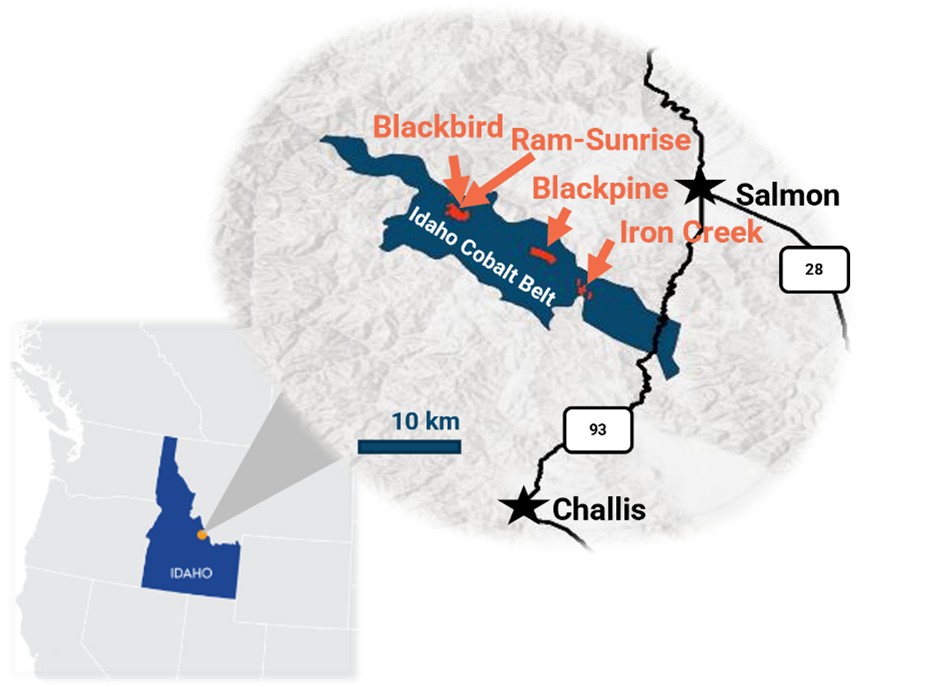
|
|
Specialized Skills and Knowledge
Successful exploration, development and operation of the Company’s cobalt projects will require access to personnel in a wide variety of disciplines, including engineers, geologists, geophysicists, drillers, managers, project managers, accounting, financial and administrative staff, and others. Since the project locations are also in jurisdictions familiar with and friendly to advanced manufacturing and resource extraction, management believes that the Company’s access to the skills and experience needed for success is sufficient.
Competitive Conditions
The Company’s activities are directed towards the potential recommissioning and expansion of the Refinery and the exploration, evaluation, and development of mineral deposits. There is no certainty that the expenditures to be made by the Company will result in the recommissioning and expansion of the Refinery or discoveries of commercial quantities of mineral deposits. There is aggressive competition within the mining industry for the discovery and acquisition of properties considered to have commercial potential. The Company will compete with other interests, many of which have greater financial resources than it will have, for the opportunity to participate in promising projects. Significant capital investment is required to achieve commercial production from successful exploration efforts, and the Company may not be able to successfully raise funds required for any such capital investment. See “Risk Factors – Competition” below.
Components
The Company’s Refinery expansion depends on the sourcing, pricing, and availability of mine production for refining. Most of the cobalt consumed today is mined in the Democratic Republic of the Congo (“DRC”) and then shipped to China for refining. There are no primary cobalt refining facilities operating in North America, which gives the Refinery a strategic advantage in the EV supply chain. The ability of the Refinery to produce battery grade cobalt sulfate using different types of feedstock will assist in diversifying sourcing of mine production for the Refinery.
Business Cycles
Refining battery materials is linked to the growth of the EV market, which has been expanding for the past five years and is projected to continue growing in the years ahead. Mining is a cyclical industry and commodity prices fluctuate according to global economic trends and conditions. If refining operations have contracts that are based prevailing commodity prices, the business would be similarly impacted by mining cycles. See “Risk Factors – Risk Related to the Cyclical Nature of the Mining Business” below.
Environmental Protection
The Company’s Refinery expansion and exploration activities are subject to various levels of federal, provincial, state, and local laws and regulations relating to the protection of the environment, including requirements for closure and reclamation of mining properties.
The Refinery has active permits and is subject to a reclamation bond and closure plan. The total provision for reclamation and closure cost obligations at December 31, 2024 was $2,841. The Company submitted an updated closure plan, which covers activities still to take place at site, with a total closure cost of $3,323. A surety bond for the closure activities for $3,450 remains deposited with the Province of Ontario.
The Iron Creek Project is located within Salmon National Forecast, under the administration of the United States Forest Service (“USFS”). The Company manages all activities on site to ensure all work is performed in compliance with existing environmental regulations. It is understood that water and particulates from any drilling or other work should be prevented from entering any body of water without first being treated so there is no sediment or other contaminants entering the water. Water quality of Iron Creek and its tributaries within the project are subject to the Idaho Department of Environmental Quality.
|
|
Environmental and Social Governance
The Company’s mission is to be one of the most sustainable producers of battery materials. Cobalt is a key element in fueling the lithium-ion batteries used in electric vehicles and for electric battery storage, both of which are essential technologies in the reduction of global carbon emissions.
The Company strives to be a leader amongst its peer group in Environmental and Social Governance (“ESG”). Cobalt is essential to the global transition to electric mobility and Electra is committed to sustainable production and employing industry leading ESG practices at its Refinery.
The Company will provide a clean and ethical supply of cobalt for the EV market from large, commercial mining operations that provide ethically sourced cobalt and the highest quality cobalt hydroxide globally. As a member of the Cobalt Institute, the Company will follow the Cobalt Industry Responsible Assessment Framework (CIRAF), an industry-wide risk management tool that helps cobalt supply chain players identify production and sourcing related risks. Electra also committed to the Responsible Minerals Initiative, which will include a third-party audit of the systems in place to responsibly source minerals in line with current global standards.
The Refinery is projected to have a lower quartile carbon intensity cobalt by virtue of hydro powered mining operations supplying its hydro powered refining operation. In October 2020, results were released from an independent Life Cycle Assessment (“LCA”) which affirmed the low carbon footprint of the Refinery. The report concluded that the environmental impacts associated with refining cobalt at the Refinery will be materially lower than the published impacts of a leading Chinese refiner.
The Company takes a proactive, risk-based approach to environmental management and human rights with robust measures intended to minimize the environmental impact of operations and prevent the use of child labor at any level in the supply chain. Electra believes that these and other ESG practices will help it establish a premium brand of cobalt sulfate for the electric vehicle market.
Employees
As of December 31, 2024, the Company had 23 staff members made up of full-time employees and contractors.
Reorganizations
There have been no reorganizations of the Company.
Foreign Operations
The Company’s Iron Creek Project is in Idaho, U.S. Mineral exploration and mining activities in the United States may be affected in varying degrees by government regulations to the mining industry. Any changes in regulations or shifts in political conditions may adversely affect the Company’s business. Operations may be affected in varying degrees by government restrictions on permitting, production, price controls, income taxes, expropriation of property, environmental legislation and mine safety. The Refinery is likely to also rely substantially on mine production from foreign jurisdictions. As such, the Company may indirectly be exposed to various levels of political, economic, and other risks and uncertainties associated with operations in a foreign jurisdiction.
REFINERY
The Refinery
The Refinery is wholly-owned by Cobalt Camp Refinery Limited (“CCRL”), a subsidiary of Electra. The Refinery is currently under development with permit amendments for full production capacity mostly complete. The refinery business plan involves modifying the existing flowsheet to treat cobalt hydroxide feed material to produce cobalt sulfate used in the manufacture of batteries for electric vehicles. The flowsheet changes from the feasibility study were supported by bench and pilot scale metallurgical test work. The Company intends to refurbish and expand the refinery to produce, first 5,000 tpa of production capacity of cobalt contained in cobalt sulfate before expanding to 6,500 tpa of production capacity.
|
|
Refinery Description and Location
The Refinery is located at approximately 47.40640° north and 79.62225° west in Lorrain Township near the town of North Cobalt, Ontario. The Refinery is located approximately 1.5 km east of the town of North Cobalt, along Highway 567, locally referred to as “Silver Centre Road”.
The facility was permitted in 1996 with a nominal throughput of 12 tpd and operated intermittently until 2015, producing a cobalt carbonate product along with nickel carbonate and silver precipitate. The facility is located on approximately 250 acres, with two settling ponds and an autoclave pond. The current footprint also includes a large warehouse building that once housed a conventional mill.
Infrastructure and Physiography
The Refinery is located near the town of North Cobalt and the city of Temiskaming Shores. Temiskaming Shores is an amalgamation of the towns of New Liskeard, Dymond, Haileybury and North Cobalt. Geographically, the Refinery is closest to the town of North Cobalt, approximately 140 km north of the city of North Bay. The Refinery is accessed from the town of North Cobalt via an all-weather road from Silver Centre Road (Highway 567).
Basic services are available locally in Temiskaming Shores, and further services are available in Sudbury. Sudbury is located 200 km by road southwest of the Refinery and is considered a world-class mining centre and major hub for retail, economic, health, and education sectors in Northern Ontario. Most of the resources for the restart of the Refinery will likely be provided from the local townships, Sudbury, and North Bay areas.
Power for the refinery is provided from the grid by Hydro One through 115 kV and 230 kV transmission lines. The feeder to the Refinery is 44 kV. Fresh water is sourced from the nearby Lake Timiskaming. Many roads, trails, and powerlines span the area. Ontario Northland Railway services the town of North Cobalt, linking North Bay with the rest of north-eastern Ontario. Ontario Northland’s rail line passes approximately 2 km west-northwest of the refinery road. An existing road provides access to the site.
The Refinery is located within a well-established site. Local topography is dominated by Lake Temiskaming and the Montreal River, both of which are within the Ottawa River watershed. Topography within the property boundaries of the refinery is generally flat. General physiography is typical of the Precambrian Shield in north-eastern Ontario, with rocky, rolling bedrock hills with locally steep ledges and cliffs, separated by valleys filled with clay, glacial material, swamps, and streams. Given the presence of the Clay Belt, some farms are present nearby. In this boreal region, coniferous and mixed-wood forests dominate. The main conifer species are black and white spruce, jack pine, balsam fir, tamarack and eastern white cedar. The predominant deciduous (hardwood) species are poplar and white birch. Swampy low-lying areas contain abundant tag alders.
|
|
History
In the 1980s, the location was the site of the Hellens-Eplett underground mine, which featured a traditional silver and cobalt mill that was quite common in the historic Cobalt Mining Camp. The property and mill were bought by Cobatec Ltd. in the 1990s and construction of the refinery took place in 1994 and 1995. The integrated mining, milling and refining operation processed ore from the mine in the mill to produce concentrate and then produce a refined cobalt and silver product from the concentrate in the Refinery. Initial start-up was in 1996. The Refinery was built with a nominal 12 tpd feed rate and made a cobalt-carbonate product from four feedstocks over different periods. Cobatec eventually shut down the Refinery on January 2, 1999. The Refinery was operational for approximately one of the three years between start-up and shutdown.
The Refinery was later owned and operated by several owners until Electra entered into a 50-50 joint venture with Australian-listed Cobalt One Limited to acquire the Refinery in 2017.
The previous owners included:
| · | 1999-2003: Canmine Resources Corporation |
| · | 2003-2012: Yukon Refinery AG |
| · | 2012-2015: United Commodities |
| · | 2015-2017: Yukon Refinery AG |
| · | 2017-present: Electra |
Metallurgical Testing
Phase I – Initial Testing
Metallurgical testing was completed at SGS Canada Inc. (“SGS”) between Q4 2018 and Q2 2020. The test work program was managed by Electra with input from Ausenco. For purposes of the Refinery Study, the initial phase of test work was conducted under 17070-01 and 17070-03 programs.
The programs evaluated different cobalt hydroxide feed materials and white metal alloy. The composition of each feed material is summarized in the table below.
Cobalt Hydroxide Feed Sample Analysis
| Program |
Co
%
|
Cu
%
|
Fe
%
|
Mn
%
|
Mg
%
|
Si
%
|
Zn
g/t
|
Ni
g/t
|
Al
g/t
|
Cr
g/t
|
| 17070-01 | 23.2 | 1.61 | 2.39 | 3.27 | 3.45 | 1.05 | 1920 | 3870 | 6390 | 52 |
| 17070-02 (WMA) | 17.8 | 11.2 | 66.4 | 0.003 | 0.22 | 0.38 | 2670 | 494 | 1840 | 755 |
The source of the 17070-01 was from an operation in the DRC, this sample had a lower cobalt content (23.2% dry weight (“w/w”)) compared to the samples received later for programs 17070-03 and 17070-05. Using this material in late 2018 and early 2019 bench scale tests on leaching, neutralisation and solvent extraction were conducted, the initial test results were encouraging and areas for improvement were identified. Using these bench scale test results preliminary Metsim modelling was conducted by Ausenco and a Solvay solvent extraction model was short listed for pilot studies. Leach tests under program 17070-02 were conducted on white metal alloy (WMA), even though the alloy was leached in acid the excessive dissolution of iron made the solution purification stage difficult.
|
|
In September 2019, program 17070-03 was commenced on a 570kg sample received from Glencore’s Mutanda operation in the DRC and several bench scale leach tests were conducted on this sample. Following which more samples were received from sources such as Katanga, ERG and IXM-Tenke. The head analysis of these samples is shown below, where the cobalt content of the samples received subsequently was found to be significantly higher compared to the initial Glencore’s mutanda sample.
| Program |
Co
%
|
Cu
%
|
Fe
%
|
Mn
%
|
Mg
%
|
Si
%
|
Zn
g/t
|
Ni
g/t
|
Al
g/t
|
Cr
g/t
|
| 17070-03 (Mutanda) | 29.2 | 0.46 | 0.12 | 4.85 | 5.67 | 0.77 | 403 | 9410 | 1200 | <100 |
| 17070-03 (Katanga) | 34.0 | 1.19 | 0.46 | 4.61 | 4.73 | - | 1620 | 3750 | 3480 | 36 |
|
17070-05 (blend of (Katanga, ERG, IXM) |
39.2 | 1.34 | 0.37 | 3.50 | 3.28 | - | 6410 | 1100 | 644 | 58 |
In November 2020, a continuous leach pilot plant was conducted at SGS on Katanga sample using the optimised leach test results obtained from the bench scale studies. The overall cobalt leach extraction was found to be 97%. During 2021, solvent extraction pilot and effluent treatment pilot studies were conducted using the leach liquor obtained from the leach pilot plant. Similarly in 2022, under campaign #17070-05, two more leach pilot campaigns were conducted at SGS on a blended feed sample consisting of 1/3rd each of Katanga, ERG and IXM-Tenke. The cobalt leach extractions of 96% from these leach pilots were found to be satisfactory and closely matched the previous pilot studies.
The purpose of the 17070-03 campaign was to demonstrate that battery-grade cobalt sulfate could be produced from a cobalt hydroxide feedstock using most of the current flowsheet at the refinery. The definition of a battery-grade cobalt sulfate product was based on specifications received by Electra from potential end users.
The program achieved a high purity cobalt sulfate product with a cobalt grade of 20.8%w/w, with impurity levels that were within the range of lithium-ion battery market specifications, with the exception of manganese, to address this issue the technical team is proposing to introduce manganese removal in the preliminary neutralisation step using either SO2/O2 or KMnO4. The pilot studies conducted in 2022 did successfully use SO2/O2 system to remove manganese, but KMnO4 appear to be a better reagent both from cost and chemical potency viewpoint.
The purpose of the 17070-03 program was to provide data for the Refinery Study, such as process conditions and operating targets for the various unit operations. The tests conducted included re-leaching and neutralisation, impurity solvent extraction (“ISX”), CoSX, solid/liquid separation testing, environmental and tailings testing.
Following the SX bench and pilot plant campaigns performed at SGS, METSIM™ modelling was conducted by HATCH, and the results were provided to Metso-Outotec to evaluate the SX processes on a continuous basis. The modelling results were incorporated into the basis of design.
Environmental testwork was also conducted to determine operating parameters for the effluent treatment circuit. Synthetic solutions were prepared based on compositions predicted in the METSIM™ model and were supplied to Story Environmental Inc. (“SEI”) for effluent treatment testing and Aquatox Testing and Consulting Inc. for toxicity testing.
|
|
Key results from the testwork program and Solvay modelling are listed in the table below:
Key Results from the 17070-03 Testwork Program & Solvay Modelling
| Description | Unit | Value |
| Cobalt Leach and Neutralisation recovery | % | 97 |
| Neutralisation pH | - | 4.70 to 4.80 |
| Average leach sulphuric acid (93%) addition | kg/t (dry basis) | 797 |
| Quicklime addition | kg/t (dry basis) | 0.54 |
| Acid consumption for SX | kg/t (dry basis) | 1811 |
| ISX configuration | extract / scrub / strip |
4 / 2 / 2 (SGS)
4 / 3 / 3 (Design)
|
| ISX extractant concentration | % | 10 |
| ISX cobalt recovery (to extraction raffinate) | % | 99.6 |
| CoSX configuration | extract / scrub / strip |
4 / 6 / 2 (SGS)
4 / 6 / 3 (Design)
|
| CoSX extractant concentration | % | 35 |
| CoSX cobalt recovery (to strip solution) | % | 99.6 |
| Effluent treatment final pH | - | 11.0 |
The solvent extraction pilot study resulted in removing the impurities from the leach liquor and generating a concentrated cobalt sulfate product solution that is used to produce battery grade cobalt sulfate crystals. The test work demonstrated that high-purity, battery-grade cobalt sulfate can be produced from the cobalt hydroxide samples that were processed. The overall cobalt recovery of the process will be close to 97% based on the test work and METSIM results. The final cobalt sulfate produced in this test work graded 22.3% cobalt, exceeding the minimum cobalt specification for battery grade cobalt sulfate.
The waste streams of the solvent extraction pilot were treated using lime in a separate continuous pilot run, and the effluent generated from this study was found to meet the discharge limits prescribed by the Ontario Ministry of Environment, Conservation and Parks. The gypsum residue generated as a solid waste will be stored in the on-site tailings storage facility.
Recovery Methods
The refinery takes in cobalt hydroxide feed containing anywhere from 30 to 50% of contained cobalt. The refinery uses sulfuric acid to leach the cobalt hydroxide material into solution. Following the leaching process the liquor is neutralized before being sent to solvent extraction circuits where further impurities are removed. The final liquid from solvent extraction contains a high percentage of cobalt and that product is put through a crystallization process where battery grade cobalt sulfate is produced as the plants final product which then goes to market.
The process design is consistent with other operations, including:
| · | Vale, Long Harbour: impurity SX followed by CoSX |
| · | WMC, Bulong Refinery: CoSX with Cyanex 272 followed by sulphide precipitation and impurity SX with D2EHPA |
| · | Finland, Terrafame: crystallisation of high purity cobalt sulfate heptahydrate |
Process Description
Cobalt hydroxide is received on site at moisture range of 20-66% w/w in one tonne bulk bags and stored in the warehouse. The bags are lifted by forklift and broken in a bag breaker before being fed into a storage bin by conveyors. The material is fed into a re-pulper where it is mixed with recycled water into a slurry and stored in a feed tank.
The slurry is pumped to a leach tank and leached with sulphuric acid to solubilise cobalt and other metals. The leach slurry then gravity flows to pre-neutralisation tanks where process steps such as a) water dilution and b) removal of impurities take place. The pre-neutralised slurry would then advance to thickeners and the thickener underflow is filtered using plate and frame filter presses. The leach thickener overflow and the leach filtrate would advance to secondary neutralisation stage.
The overflow of the neutralisation thickener is filtered to remove suspended solids. This filtrate is the feed stock for solvent extraction plant for further purification.
|
|
The solvent extraction step consists of two phases, the impurity solvent extraction (ISX) and cobalt solvent extraction (CoSX). The feed solution initially processed through ISX which consists of extraction, scrubbing, and stripping stages to separate various impurities. The cobalt-rich ISX raffinate reports to CoSX, while the impurities report to effluent treatment.
The ISX raffinate reports to CoSX and is processed through extraction, scrubbing and stripping stages to separate impurities from the cobalt. The CoSX raffinate is treated in the effluent treatment plant, while the cobalt-rich strip solution is sent to crystallisation.
The strip solution from CoSX reports to the forced circulation mechanical vapour recompression cobalt sulfate crystalliser. Cobalt sulfate is crystallised and subsequently dewatered in a thickener, centrifuge and fluid bed dryer. The dry product is then bagged and stored in the warehouse prior to shipment.
Some of the reagents used in the process include:
| · | flocculant, including a mixing and dosing system for the residue and effluent thickeners |
| · | organic solvents, |
| · | sulphuric acid, including a storage tank, dilution and dosing system |
| · | lime (CaO), including a storage silo, slaker and ring main |
| · | sodium hydroxide, including a heated storage tank, dilution and dosing system |
| · | SO2/O2 or KMnO4 for manganese removal |
Services supplied to the process include:
| · | filtered water |
| · | fire water and fire suppression systems |
| · | gland water |
| · | potable water |
| · | plant and instrument air |
| · | low pressure air |
| · | natural gas |
| · | steam from boiler |
Process Design Criteria
The design criteria are based on data supplied by Electra, bench and pilot test work, vendor data and modelling, industry standards and Hatch’s in-house database.
Site Infrastructure
The major project facilities include the existing refinery building with expanded facilities, a new SX building and three existing ponds.
Power to the Refinery is provided via an existing 44 kV feeder from the Hydro One grid. It is then stepped down via a 2.5 MVA 44kV/600V transformer for distribution throughout the facilities.
Fresh water is supplied to the refinery from Lake Timiskaming by an overland pipeline and pumping system. The pumphouse holds two freshwater pumps in a duty/standby configuration. Water is pumped 2.5 km through a buried pipeline, in an existing easement, to the Refinery site, where it is stored in the filtered water tank. The water is predominantly used for cooling and does not touch the process liquids. The warm water is returned to Lake Timiskaming through a similar buried pipeline along the same easement.
Market Studies and Commercial Contracts
Electra has retained numerous firms to provide market studies and battery metals industry outlooks and expertise. After the Refinery Study and in the normal course of business, Electra entered contracts for the purchase of cobalt hydroxide feedstock from Glencore and ERG, and a cobalt sulfate offtake agreement with LGES.
|
|
Demand
Cobalt is used in a range of applications, but the largest single market is lithium-ion (Li-ion) batteries. The three primary segments for Li-ion batteries are consumer electronic devices, electric vehicles and both stationary and grid energy storage. All three segments have a strong growth profile over the coming years and as such, the market for Li-ion batteries is expected to grow sharply. EVs are forecast to be the largest market for Li-ion batteries.
Growth in cobalt demand through 2040 will be almost entirely dominated by the battery sector, fuelled predominantly by increased EV penetration uptake. Demand growth is forecast to outpace the ability of suppliers to keep up by the mid-2020s. It should be expected that cobalt producers will not only be able to sell their products, but that strong prices should be able to be commanded due to the predicted shortfall.
Supply
Cobalt is mainly produced as a by-product from copper and nickel operations. Over 70% of mined cobalt originates from the copper operations of the African Copper Belt in the DRC. Much of that production is exported to China, which is responsible for the majority of global refined supply.
Cobalt refining typically takes place away from mine sites. Vale, Glencore and Sherritt are among some of the mining companies that refine cobalt from their own mining operations, but they produce metallic cobalt products. None of them refines cobalt sulfate, which is a key input for the battery market.
Besides Electra, to the Company’s knowledge, there are few plans for new cobalt sulfate refineries outside of China. However, with the current focus by governments and industry on the battery sector, supply chains are expected to develop outside of China.
Environmental Permits and Social or Community Impact
Electra has regularly kept local municipalities and Indigenous communities apprised of their activities. Local municipalities with an interest in the Refinery include the Township of Coleman, the Town of Cobalt and the City of Temiskaming Shores. Electra has engaged the following Indigenous communities to keep them informed and obtain their input on recommencing operations at the refinery, and the permits relating to the refinery:
| · | Matachewan First Nation (MFN) |
| · | Temagami First Nation (TemFN) |
| · | Timiskaming First Nation (TFN) |
| · | Métis Nation of Ontario (MNO) |
| · | Beaverhouse First Nation (BFN) |
Electra is committed to ongoing engagement and consultation activities with stakeholders and Indigenous communities. All engagement and consultation activities related to the Refinery will continue to be entered into the Record of Consultation.
The Refinery requires three key environmental permits to operate and an approved closure plan prior to certain construction aspects. The Company received final approved and acceptance of its closure plan by the Ministry of Northern Development, Mines, Natural Resources and Forestry in March 2022 and approval for an updated plan in November 2022.
The Company received new or amended environmental permits as follows:
|
|
| · | Permit to Take Water (PTTW) in July 2022 |
| · | Air and Noise Environmental Compliance Approval in October 2021 |
| · | Industrial Sewage Works Environmental Compliance Approval in February 2021 |
Capital and Operating Costs
Capital Costs
The capital cost estimate for the expansion of the refinery is expected to be between $155 and $167 million as reported on February 14, 2023, of which approximately $86.1 million had been capitalized as of December 31, 2024. The Company will need significant financing to complete construction.
Operating Costs
The refinery operating costs include the following:
| · | labour for operating, maintenance and supervision |
| · | fuels, reagents, consumables and maintenance materials |
| · | fuels, lubricants, tires and maintenance materials for operating and maintaining equipment |
| · | operating costs for the on-site laboratory |
| · | power supply costs |
| · | site G&A costs |
Excluding the cost of feedstock (cobalt hydroxide), reagents are expected to be the largest component of the Refinery’s operating costs under 100% operating capacity. Key reagents include sodium hydroxide, sulfuric acid, quicklime, and cyanex. The next largest costs are expected to be refinery labour, power and site G&A.
Refinery Updates
See “General Development of the Business – Three Year History” and “- Subsequent Events” above for additional Refinery updates.
IRON CREEK PROJECT
The Iron Creek Project is an advanced mineral exploration stage project containing cobalt and copper resources amenable to mining. The Company has explored the expansion of these resources as well as investigated other nearby areas for additional metal resources including gold.
The most recent technical report titled “NI 43-101 Technical Report and Mineral Resource Estimate for the Iron Creek Cobalt-Copper Property, Lemhi County, Idaho, USA” dated March 10, 2023 with an effective date of January 27, 2023. The Technical Report is available at www.sedarplus.com.
Introduction
The Company retained InnovExplo Inc. (“InnovExplo”) to prepare an updated mineral resource estimate for the Iron Creek Project located in Lemhi County, Idaho, USA, and a supporting Technical Report.
Project Description, Location and Access
Location and Means of Access
The Iron Creek Project is located about 18 miles or 30km southwest of Salmon, Idaho, USA, within the historic Blackbird cobalt-copper district of the Idaho Cobalt Belt. The center of the Iron Creek Project is located at approximately 44° 57′ 42″ North, and 114° 06′ 57″ West. Iron Creek is a tributary creek that drains from the Salmon River Mountains in the west into the Salmon River. The Iron Creek Project encompasses the North Fork of Iron Creek.
|
|
Access to the Iron Creek Project is via the paved, all-weather U.S. Highway 93, and County Road 45 located 23mi (37km) south of the town of Salmon, Idaho. County Road 45 accesses the Salmon-Challis National Forest with an extensive network of well-maintained gravel roads, accessible year-round.
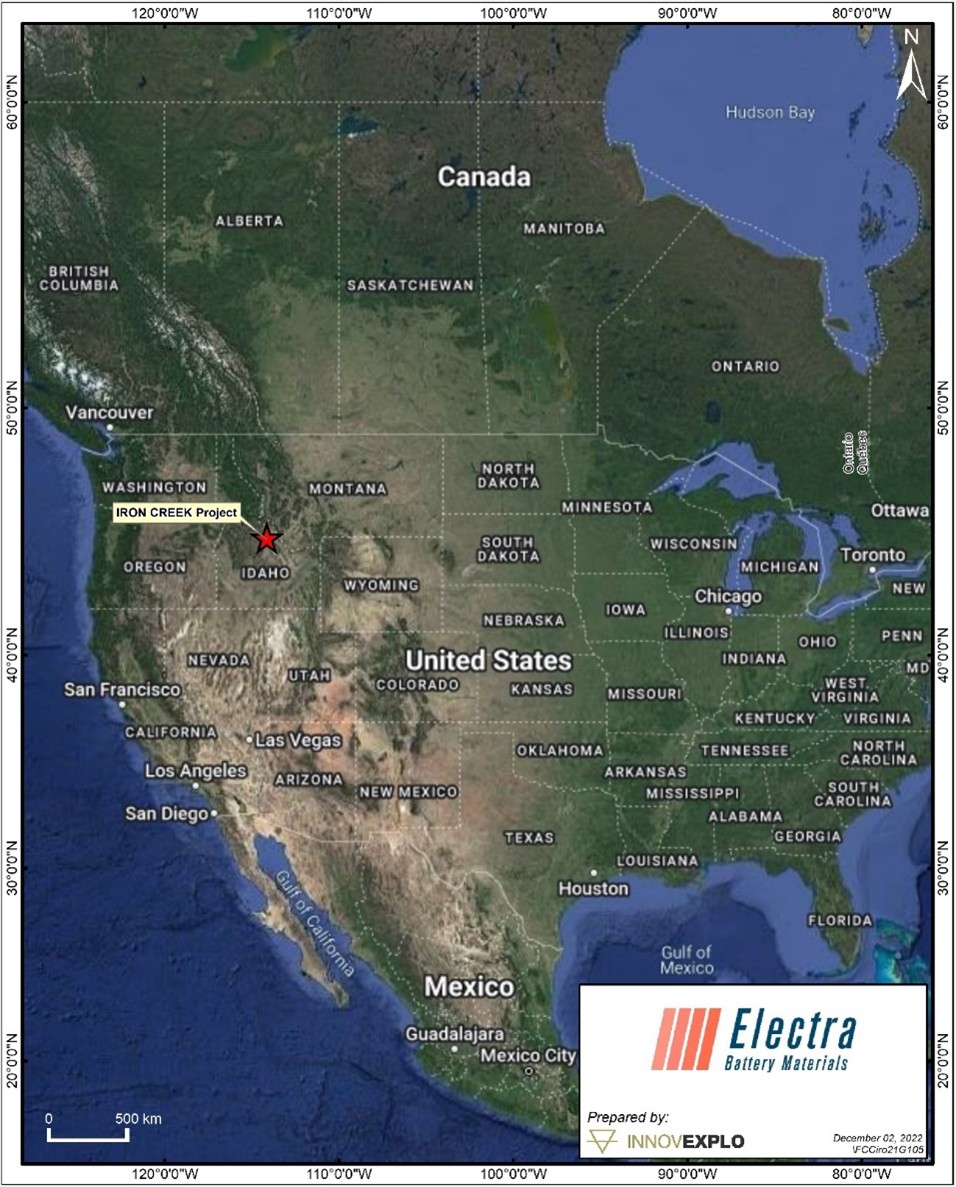
|
|
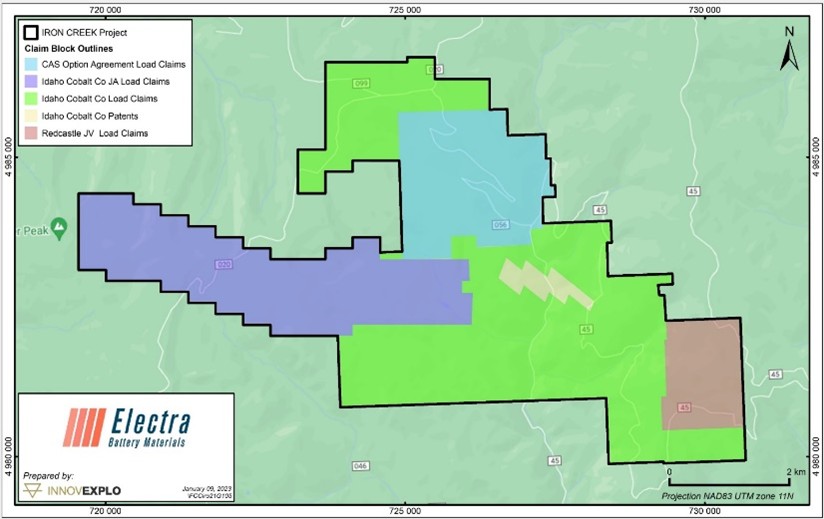
Title and Risks
The Iron Creek Project consists of seven patented lode mining claims that straddle Iron Creek, and a surrounding group of 416 unpatented lode mining claims. Together the patented and unpatented claims cover an area of 8,075 acres (32.68km2).
In 2021, The Company, through Idaho Cobalt, a wholly-owned subsidiary of the Company, purchased 100% of the JA1 to 103 unpatented mining claims from Arizona Lithium Company, who retained a 1.0% NSR royalty. The Company has the right to purchase 0.5% of the royalty for $750 and an unrestricted right of first refusal to acquire the remaining 0.5% of the NSR royalty. Idaho Cobalt also entered into a Property option agreement with Richard Fox in 2022 to acquire the CAS1-46, IRON1-7, IRON14-15 and IRON31-61 unpatented mining claims for US$1.5 million (“CAS”), payable over 10 years upon completion of specific milestones. Richard Fox retains a 1.5% NSR royalty which the Company may purchase for US$500 within one year of commercial production from the CAS property. The Fox agreement is subject to a mutual area of interest provision.
The Company, through Idaho Cobalt, entered into an earn-in and joint venture agreement with Borah Resources and Phoenix Copper for the SCOB1 to 30 unpatented mineral claims (“Redcastle”). Under the agreement, the Company may earn a 51% interest in Redcastle by investing US$1.5 million on or before the third anniversary of the effective date of the agreement. It may earn a 75% interest by investing an additional US$1.5 million on or before the by the fifth anniversary. If, after the joint venture is formed, the ownership interest of a party is reduced to 10% or below, such interest will be converted to a 2.5% NSR dilution royalty. The other party will have the right to buy-down the dilution royalty at a rate of US$500 per 0.5%, and shall retain a right of first refusal on any proposed sale of the dilution royalty to a third party. The Redcastle agreement is subject to a mutual area of interest provision.
The unpatented mining claims included within the Iron Creek Project have no expiration date if the annual claim maintenance fees are paid by August 31 of each year and remain in good standing as of the date of this publication. The Company does not know of any significant factors or risks that might affect access or title, or the right or ability to perform work on, the Iron Creek Project, including permitting and environmental liabilities to which the Iron Creek Project is subject.
History
The Iron Creek area was initially explored for iron in 1943, but copper and cobalt were subsequently found during construction of a logging road in 1967. In 1970, extensive exploration was conducted including mining from surface three underground drifts to characterize the mineralization for development. The Project was explored by several different companies, but no other mining or drilling were completed. US Cobalt Inc. acquired the Project in 2016 and commenced an extensive drilling program to re-assess the resource. In 2018, The Company acquired US Cobalt Inc.
|
|
Geological Setting, Mineralization and Deposit Types
The Iron Creek Project is situated in the Blackbird copper-cobalt and gold mining district, the Idaho Cobalt Belt (“ICB”), in the eastern part of the Salmon River Mountains, central Idaho. The host rocks to the ICB are part of the Belt-Purcell Supergroup, a Mesoproterozoic meta-sedimentary sequence extending across the Idaho-Montana border into southern Canada; known to host a number of metal resources that have been historically mined including the active silver, zinc, lead deposits in northern Idaho.
Mineralization at Iron Creek and other deposits within the ICB are stratabound; occurring at selective horizons within the sequence. Specifically at Iron Creek, mineralization consists of massive sulphides dominated by pyrite and chalcopyrite with secondary magnetite and pyrrhotite. Cobalt metal is contained within pyrite. Mineralization is accompanied by a hydrothermal alteration mineral assemblage characterized by clinochlore. The mineralized horizon at Iron Creek has been traced over 1200 metres along strike. Regional deformation of the metasedimentary rock sequence is relatively minor and the mineralized horizon is attenuated by shearing; although regional faulting may have locally offset the sequence by hundreds of metres in placesd. A second zone of mineralization containing cobalt has been identified over 2km east of Iron Creek, the Ruby Zone. Chalcopyrite is relatively sparse and magnetite is prevalent at Ruby that likely represents a separate horizon of mineralization apart from Iron Creek. Additionally, cobalt, copper and gold mineralization occurs at the CAS Zone, over 2km north of the Iron Creek deposit, confirmed by drilling in 2003 by a third party. Mineralization is vein-style, distinct from Iron Creek, but similar to others within the ICB.
Exploration
Since discovery in 1967, a series of geochemical and geophysical surveys were conducted at the Iron Creek project to guide further expansion of the cobalt and copper mineralized zones. The three underground workings validated the continuity of mineralization and concurrent drilling recognized the extent of the mineralized zone to approximately 1000 metres.
In 2017, a drilling program was undertaken to re-establish the extent of mineralization using compliant methods. In addition, a detailed, 200m line spacing, airborne magnetic geophysical survey was conducted in 2017 covering the majority of the Iron Creek Project properties. The mineralized horizon was highlighted to occur at a major magnetic transition that extends several kilometres from the Iron Creek deposit. In 2020 and in 2022, ground induced polarity and resistivity surveys were conducted over Iron Creek and the Ruby Zone detecting the mineralized horizons and potential extensions based on coincident low resistivity and high chargeability. Later drilling confirmed the geophysical signatures to be related to sulphide mineralization.
Drilling
In total, 171 drill holes have been completed to date at the Iron Creek Project. A significant proportion, 117 holes for approximately 30,000 metres, were completed by The Company between 2017 and 2019 to re-establish cobalt and copper resources at Iron Creek. In 2021, six holes were completed for over 2,700 metres expanding the zones of mineralization. In 2022, an additional six holes were drilled including three at the Ruby Zone totalling 1,674 metres.
Drilling at Iron Creek established a mineral resource estimate for copper and cobalt in 2018 and subsequently extended the estimates in 2019 and 2023. Based on the geological interpretations from bedrock mapping and geophysical surveys, mineralization is open along strike and down dip. Similarly at the Ruby Zone, the three completed drill holes intersected cobalt grades comparable to Iron Creek. Mineralization is open along strike for 500m west and may be terminated by a fault. The Ruby Zone is also open down dip.
|
|
Sampling, Analysis and Data Verification
Drill core from the Company’s 2017-2018 program were initially stored offsite in Challis, Idaho. Subsequently in 2021 the Company’s core storage facilities were moved to Salmon, Idaho. The drill core is now stored in locked sea containers at a secure private property maintaining the continuity of each drill hole. Drill core has been removed and returned to storage for re-logging and re-sampling purposes; therefore, also validating the integrity of the core.
For sampling, the Company follows industry best practices. Drill core are first inspected and validated at the drill site by contract geologists then transported to the Company core facility. Rock quality designation, recovery, magnetic susceptibility, and quick geological logs were performed either on site or at the core facility upon arrival. Whole core was cleaned then photographed. Detailed logging followed the core photography by a geologist. Sampling for geochemical analyses is conducted at the discretion of the logging geologist. Core length of samples are per the discretion of the logging geologist, but as per the Standard Operating Procedure are a minimum of 30 centimetres and maximum of 1.5 metres. Sample tags were inserted by the logging geologist and a cut sheet of sample intervals was recorded. Core was then cut into half core and sampled at the cutting station. Certified Reference Material, CRM, and blanks were inserted into the sample stream at the cut station. As per Company Standard Operating Procedure, one CRM, or coarse duplicate, or blank was inserted every 20 samples.
For the most recent drilling program in 2022, the Company began cutting one half of the core again to produce a quarter core sample for assay. The ¾ core sample was preserved in the box for additional analyses. Samples selected for analyses were bundled in rice sacks and loaded in crates at the core facility and then transported by contractors operating on behalf of the Company to the analytical preparation laboratory in Twin Falls, Idaho. The remaining core was transported to the sea container storage site in Salmon and placed in locked sea containers for future analyses.
Quality Controls and Data Verification
For the 2017 and 2018 drilling programs, sample preparation and geochemical analyses were conducted by American Assay Laboratories in Sparks, Nevada. In 2021 and 2022 drill core samples were sent to ALS Laboratory Group (“ALS”) in Twin Falls, Idaho for preparation and then shipped to Reno, Nevada for analyses. Lab duplicates of core samples were produced per analytical batch at both laboratories and resulting data are inspected by a registered Geochemist for validation.
For each Technical Report, the authors are generally of the opinion that the sample preparation, analysis, QA/QC, and security protocols for the Iron Creek Project follow generally accepted industry standards and that the data are valid. Data verification and the site visit demonstrated that the databases for the Iron Creek deposit are considered valid and of sufficient quality to be used for the mineral resource estimates.
Mineral Processing and Metallurgical Testing
McClelland Laboratories Inc. (“McClelland”) in Sparks, Nevada, was commissioned by the Company to undertake metallurgical testing commencing in 2018. The Company extracted two bulk samples each from Adit-1and one from Adit-2.
All three samples responded very well when subjected to rougher flotation using standard conditions at the natural pH of 6 to 8. More than 96% of the sulphide sulphur reported to the bulk concentrate and cobalt recovery also averaged over 96%. Copper recovery into the bulk concentrate averaged over 97% for the two high-grade samples and 92.5% for the low-grade sample.
An initial round of cleaner flotation tests was performed on the sulphide rougher concentrates. Optimum performance was achieved by regrinding the rougher concentrate and floating at pH 12 to depress the pyrite. For the two high-grade copper samples, 75% to 85% of the copper was recovered into copper concentrates that would be suitable for conventional copper smelting. The low-grade copper sample appears to need some further flotation optimization in order to produce acceptable smelter feed.
|
|
The cobalt was recovered in the pyrite product that represents the cleaner flotation tailings. For all three bulk samples, this product contained more than 90% of the cobalt at grades of 1.2% to 1.8% Co. Higher grades may be difficult to obtain using flotation, as the cobalt is bound up within the pyrite crystal structure.
In 2021 to 2023, further metallurgical testwork was conducted at the Colorado School of Mines resulting in improved cobalt recoveries; although further work is being evaluated to determine if the modified processes as viable at bulk scale.
Mineral Resource and Mineral Reserve Estimates
The updated mineral resource for the Iron Creek Project (the “2023 MRE”) was prepared by QPs Martin Perron, P.Eng. and Marc R. Beauvais, P.Eng. of InnovExplo, using all available information. The mineral resources herein are not mineral reserves as they do not have demonstrated economic viability. The result of this study is individual mineral resource estimates for the Iron Creek Project. The effective date of the 2023 MRE is January 27, 2023.
The 2023 MRE can be classified as Indicated and Inferred mineral resources based on geology, grade continuity, data density, search ellipse criteria, drill hole spacing and interpolation parameters. The requirement of reasonable prospects for eventual economic extraction has been met by having a minimum width for the modelling of the mineralization zones and a cut-off grade, using reasonable inputs, both for potential open pit and underground extraction scenarios, and constraints consisting of a surface shape for the open-pit scenario and mineable shapes for the underground scenario.
The following table contains the results of the 2023 MRE at official cut-off grades.
| Iron Creek Project | Mineral Resources | Tonnes (t) | Co (%) | Cu (%) | Lbs of Co | Lbs of Cu | NSR Value (US$) |
| Indicated | 4,451,000 | 0.19 | 0.73 | 18,364,000 | 71,535,000 | 123.65 | |
| Inferred | 1,231,000 | 0.08 | 1.34 | 2,068,000 | 36,485,000 | 118.48 |
Parameters used for the estimation:
| 1. | The 2023 MRE follows the CIM Standards. |
| 2. | These mineral resources are not mineral reserves, because they do not have demonstrated economic viability. The results are presented undiluted and are considered to have reasonable prospects of economic viability. |
| 3. | The estimate encompasses one large, mineralized envelope using the grade of the adjacent material when assayed or a value of zero when not assayed. Dilution zones encompassing all mineralized zones were created as part of the mineralized domain to reflect the dilution within the constraining shapes. |
| 4. | High-grade capping supported by statistical analysis was done on raw assay data before compositing and established on a per-metal basis, having a limitating value at 1% for cobalt and 10% for copper. Composites (1.5 m) were calculated within the zones using the grade of the adjacent material when assayed or a value of zero when not assayed. |
| 5. | The estimate was completed using a sub-block model in Surpac 2022. A 4m x 4m x 4m parent block size was used. |
| 6. | Grade interpolation was obtained by Inverse Distance Squared (ID2) using hard boundaries. Dynamic anisotropy was used for the interpolation of the mineralized domain. |
| 7. | A density value of 2.78 g/cm3 was assigned to the mineralized domain. |
| 8. | The mineral resource estimate is classified as Indicated and Inferred. The Inferred category is defined with a minimum of three (3) drill holes within the areas where the drill spacing shows reasonable geological and grade continuity at the maximum range of the modelized semi-variogram. The Indicated mineral resource category is defined with a minimum of three (3) drill holes within the areas where the drill spacing shows reasonable geological and grade continuity at half the range of the modelized semi-variogram. |
| 9. | The 2023 MRE is locally constrained within Deswik Stope Optimizer shapes using a minimal mining width of 2.0m for a potential underground LH. An NSR-based cut-off grade was calculated using the following parameters: mining cost = US$55.00/t; processing cost = US$22.00/t; G&A = US$10.00/t. The cut-off grade should be re-evaluated in light of future prevailing market conditions (metal prices, mining costs etc.). |
| 10. | The number of metric tonnes was rounded to the nearest thousand, following the recommendations in NI 43-101 and any discrepancies in the totals are due to rounding effects. The metal contents are presented in pounds of in-situ metal rounded to the nearest hundred. |
|
|
Recommendations for Future Work
The Company has outlined exploration plans to progress the Iron Creek project in the immediate future. Two separate programs address distinct areas of exploration:
| 1) | Brownfields Program |
| Exploration | Site | Activity | Outcome |
| Drill | Iron Creek Co Zone | 4 holes = 1600m | Expand resource |
| Drill | Ruby | 6 holes = 2100m | Test zone across strike |
| Drill | Iron Creek Cu Zone | 4 holes = 1800m | Expand resource |
| Geophysics | Magna | 4 x 1000m lines | Generate drill targets |
| Hyperspectral core logging | Iron Creek | 8 holes | Generate drill targets (Cu Zone) beyond resource |
| 2) | Greenfields Program |
| Exploration | Site | Activity | Outcome |
| Geophysics | CAS | 6 x 600m lines | Generate drill targets |
| Drill | CAS | 8 holes = 400m | Orientation of Au-Co Zone |
| Bedrock Mapping | CAS Property | 10 days | Validate extent of mineralization |
In addition, The Company continues to maintain baseline environmental impact studies at the Iron Creek project; specifically collecting air and water quality data.
RISK FACTORS
There are a number of risks that may have a material and adverse impact on the future operating and financial performance of the Company and could cause the Company’s operating and financial performance to differ materially from the estimates described in forward-looking statements relating to the Company. These include widespread risks associated with any form of business and specific risks associated with the Company’s business and its involvement in the cobalt exploration and development industry.
|
|
This section describes risk factors identified as being potentially significant to the Company and its material properties, the Refinery and the Iron Creek Project. Additional risk factors may be included in technical reports or other documents previously disclosed by the Company. In addition, other risks and uncertainties not discussed to date or not known to management could have material and adverse effects on the valuation of the Company’s securities, existing business activities, financial condition, results of operations, plans and prospects.
Risks Related to the Company’s Financial Position and the Need for Additional Capital
The Company a history of operating losses, which may continue for the foreseeable future and the Company’s auditors have indicated that there is a substantial doubt about the Company’s ability to continue as a going concern.
The Company has suffered recurring losses from operations, has a net working capital deficiency and will require additional financing to continue operations, complete the construction of the Refinery, advance its battery recycling strategy, purchase required feedstock before the Refinery enters its operating phase and remain in compliance with minimum liquidity covenant under the 2028 Notes. There can be no assurances that the Company will be able to obtain adequate financing in the future. This represents a material uncertainty that casts substantial doubt on the Company’s ability to continue as a going concern. The Company’s financial statements do not give effect to any adjustments relating to the carrying values and classification of assets and liabilities that would be necessary should the Company be unable to continue as a going concern.
The Company has not generated any revenue to date, has negative cash flow, and may never be profitable.
The Company is a pre-operations stage company with respect to the Refinery and an exploration stage company with respect to its mineral properties, and as a result has not to date generated cash flow from operations. The Company is devoting significant resources to the development of its assets, however there can be no assurance that it will generate positive cash flow from operations in the future. The Company expects to continue to incur negative consolidated operating cash flow and losses until such time as it achieves commercial production at a particular project.
The Company will require substantial additional funding, which may not be available to it on acceptable terms, or at all, and, if not available, may require us to delay, scale back, or cease the Company’s programs or operations.
Liquidity risk is the risk that the Company will not be able to meet its financial obligations as they fall due. The Company does not have sufficient financial resources necessary to complete the construction and final commissioning of the Refinery and the Company is going through a planning and budgeting process to update the capital estimates and completion schedule associated with the Refinery. The Company attempts to ensure there is sufficient access to funds to meet ongoing business requirements, considering its current cash position and potential funding sources.
Until the Company can generate a sufficient amount of revenue to finance the Company’s cash requirements, which it may never do, the Company expects to finance future cash needs primarily through a combination of public and private equity offerings. If sufficient funds on acceptable terms are not available when needed, or at all, the Company could be forced to significantly reduce operating expenses and delay, scale back or eliminate one or more of the Company’s programs or the Company’s business operation.
The Company is actively pursuing various alternatives including government grants, strategic partnerships, equity and debt financing to increase its liquidity and capital resources. The Company will require working capital to meet minimum liquidity requirements under the 2023 Note Offering. The Company will require additional financing to advance the Refinery, which is key to the Company’s long-term plans and financial success.
However, there can be no assurance that additional capital or other types of financing will be available when needed or that, if available, the terms of such financing will be acceptable to the Company. Failure to obtain sufficient financing when needed could result in the Company being unable to meet specified timelines for the advancement of the Refinery and may lead to the indefinite postponement of the advancement of the Refinery. The cost and terms of such financing may also significantly reduce the expected benefits from the Refinery or render the Refinery uneconomic.
|
|
The Company has future obligations to pay semi-annual interest payments and the principal upon maturity related to the convertible debt. Once construction is completed, repayment of the interest-free Government loan will begin in 19 equal installments starting on June 30, 2026. Upon the issuance of the 2028 Notes and retirement of the 2026 Notes in February 2023, the Company is subject to a minimum cash balance requirement of US$2,000.
Although the Company has historically been successful in obtaining financing, there can be no assurances that the Company will be able to obtain adequate financing in the future. This represents a material uncertainty that casts substantial doubt on the Company’s ability to continue as a going concern.
The Company’s ability to obtain financing and raise capital may be impacted by the Company’s operational results and general industry and macroeconomic trends beyond the Company’s control.
Historically, the Company’s capital requirements have been primarily funded through the sale of Common Shares and the issuance of the notes. Factors that could affect the availability of financing include the progress and results of refurbishment of the Refinery, levels of debts and security over the Company’s assets, customer arrangements, ongoing exploration at the Company’s mineral properties, the state of international debt and equity markets, and investor perceptions and expectations of the transition to EVs and the global cobalt markets generally. There can be no assurance that such financing will be available in the amount required at any time or for any period or, if available, that it can be obtained on terms satisfactory to the Company. Based on the amount of funding raised, the Company’s planned exploration or other work programs may be postponed, or otherwise revised, as necessary.
The Company may be unable to meet its debt service obligations.
The Company has debt service obligations arising from its convertible notes, which include ongoing coupon payments and payment of principal at maturity. In the event the refinery construction is not completed as planned or sufficient cash flow from refinery operations is note generated, there is a risk that the Company may not have sufficient available capital to meet its debt obligations. In this event, the assets pledged may be transferred to the lenders. There can be no assurance that refinery cash flows will be sufficient to meet future debt service obligations.
Raising additional capital may cause dilution to shareholders, restrict the Company’s operations or require it to relinquish substantial rights.
To the extent that the Company raises additional capital through the sale of equity or debt securities, including notes, its capital structure will be diluted, and the terms of these new securities may include liquidation or other preferences that adversely affect the rights of common shareholders. Debt financing, if available at all, may involve agreements that include covenants limiting or restricting the Company’s ability to take specific actions such as incurring additional debt, making capital expenditures, or declaring dividends. The Company cannot assure you that it will be able to obtain additional funding if and when necessary. If the Company is unable to obtain adequate financing on a timely basis, it could be required to delay, scale back or eliminate one or more of its programs or grant rights to develop and market product candidates that the Company would otherwise prefer to develop and market ourselves.
Commodity prices may not support corporate profit or operations.
The prices of commodities vary on a daily basis and is intensely competitive. Even if commercial quantities of minerals are discovered and developed, a profitable market will exist for the sale of same. Price volatility could have dramatic effects on the results of operations and the ability of the Company to execute its business plan. The price of cobalt materials may also be reduced by the discovery of new cobalt deposits, which could not only increase the overall supply of cobalt (causing downward pressure on its price), but could draw new firms into the cobalt industry which would compete with the Company. As the Company’s refinery business plan involves both buying cobalt products and selling cobalt products, its ultimate economics will be significantly impacted by market commodity prices.
|
|
Additionally, factors beyond the control of the Company may affect the marketability of any minerals discovered. The prices of natural resources are volatile over short periods of time and is affected by numerous factors beyond the control of the Company, including international economic and political trends, expectations of inflation, currency exchange fluctuations, interest rates and global or regional consumption patterns, speculative activities and increased production. If the Company is unable to economically produce minerals from its projects, it would have a negative effect on the Company’s financial condition or require the Company to cease operations altogether.
Cost estimates and predictions may prove inaccurate.
The Company prepares estimates of operating costs and/or capital costs for each operation and project. The Company’s actual costs are dependent on a number of factors, including royalties, the price of cobalt and by-product metals and the cost of inputs used in exploration activities.
The Company’s actual costs may vary from estimates for a variety of reasons, including labour and other input costs, commodity prices, general inflationary pressures and currency exchange rates. Failure to achieve cost estimates or material increases in costs could have an adverse impact on the Company’s future cash flows, profitability, results of operations and financial condition.
Risks Relating to the Company’s Operations
The Cobalt Supply Agreement is not a definitive agreement, and there is no guarantee the agreement will result in cobalt sales.
The Cobalt Supply Agreement is an agreement with respect to key commercial terms on which the parties intend to enter into a definitive supply agreement, not a definitive agreement with respect to the provision of cobalt to LG for cash. Until a definitive agreement exists, there is no enforceable or binding obligation on either party to purchase or deliver cobalt. Entering into a definitive agreement is subject to a number of conditions and factors, not all of which are in the Company’s control. If a definitive agreement is not entered into with respect to cobalt supply with LG on the terms described in the Cobalt Supply Agreement, or on terms different than those expressed therein, the Company will need to seek out additional customers for the purchase of cobalt sourced from the Refinery, and there may be other negative effects on the Company and on the value of Common Shares.
The Company’s ability to bring the Refinery online and the success of the Refinery is uncertain.
The Company’s strategic priority is the advancement of the Refinery, with significant metallurgical test work planned and a pilot plant work at third party facilities anticipated. There is no assurance that the outcomes of this test work and the results of the pilot plant work will be positive and that the Refinery will have the capabilities to produce specific end products. Furthermore, no assurance can be given that operating the Refinery will be economically viable. The Company will manage these risks through contracting technical experts on metallurgy and engineering to perform the required analysis and studies on the capability of the Refinery and its projected economics.
The success of the Company’s Refinery and long-term operations depends on the demand for Cobalt, which in turn is expected to be largely driven by consumer demand for electric vehicles and other applications in the transition from fossil-fuel based energy sources.
If the market for electric vehicles or other electronic consumer products that rely on cobalt does not develop as the Company expects, or develops more slowly than expected, or if current demand declines, the Company’s business prospects and economic outlook may be harmed. Additionally, demand for electric vehicles is driven by many factors outside of the company’s controls, including consumer sentiment and perceptions of the quality and value of electric vehicles compared to gasoline vehicles, competition among electric vehicle manufacturers and among other vehicle types, government regulations and economic incentives, and volatility in the cost of oil, gasoline, and industry.
The Company may not be able to insure itself against all operational risks.
The Company will be subject to a number of operational risks and may not be adequately insured for certain risks, including: environmental contamination, liabilities arising from historic operations, accidents or spills, industrial and transportation accidents, which may involve hazardous materials, labor disputes, catastrophic accidents, fires, blockades or other acts of social activism, changes in the regulatory environment, impact of non-compliance with laws and regulations, natural phenomena such as inclement weather conditions, floods, earthquakes, ground movements, cave-ins, and encountering unusual or unexpected geological conditions and technological failure of exploration methods.
|
|
There is no assurance that the foregoing risks and hazards will not result in damage to, or destruction of, the property of the Company, personal injury or death, environmental damage or, regarding the exploration or development activities of the Company, increased costs, monetary losses and potential legal liability and adverse governmental action. These factors could all have an adverse impact on the Company’s future cash flows, earnings, results of operations and financial condition.
No assurance can be given that insurance to cover the risks to which the Company’s activities are subject will be available at all or at commercially reasonable premiums. Additionally, the Company may be subject to liability or sustain loss for certain risks and hazards against which the Company cannot insure or which the Company may elect not to insure because of the cost. The Company is not currently covered by any form of environmental liability insurance, since insurance against environmental risks (including liability for pollution) or other hazards resulting from exploration and development activities is unavailable or prohibitively expensive. If the Company is unable to fully fund the cost of remedying an environmental problem, it might be required to suspend operations or enter into costly interim compliance measures pending completion of a permanent remedy. This lack of environmental liability insurance coverage could have an adverse impact on the Company’s future cash flows, earnings, results of operations and financial condition.
Additionally, the payment of any other liabilities for which the company is not insured, or underinsured, would reduce the funds available to the Company. This lack of insurance coverage could have an adverse impact on the Company’s future cash flows, earnings, results of operations and financial condition.
The Company may be subject to the risks associated with future acquisitions.
As part of its business strategy, the Company has sought and will continue to seek new operating, development and exploration opportunities in the mining industry. In pursuit of such opportunities, the Company may fail to select appropriate acquisition candidates or negotiate acceptable arrangements, including arrangements to finance acquisitions or integrate the acquired businesses and their personnel into the Company. The Company cannot assure you that it can complete any acquisition or business arrangement that it pursues, or is pursuing, on favourable terms, if at all, or that any acquisition or business arrangement completed will ultimately benefit its business. Such acquisitions may be significant in size, may change the scale of the Company’s business and may expose the Company to new geographic, political, operating, financial or geological risks. Further, any acquisition the Company makes will require a significant amount of time and attention of the Company’s management, as well as resources that otherwise could be spent on the operation and development of the Company’s existing business.
Any future acquisitions would be accompanied by risks, such as a significant decline in the relevant metal price after the Company commits to complete an acquisition on certain terms; the quality of the mineral deposit acquired proving to be lower than expected; the difficulty of assimilating the operations and personnel of any acquired companies; the potential disruption of the Company’s ongoing business; the inability of management to realize anticipated synergies and maximize the Company’s financial and strategic position; the failure to maintain uniform standards, controls, procedures and policies; the impairment of relationships with employees, customers and contractors as a result of any integration of new management personnel; and the potential for unknown or unanticipated liabilities associated with acquired assets and businesses, including tax, environmental or other liabilities. In addition, the Company may need additional capital to finance an acquisition. Debt financing related to any acquisition may expose the Company to risks related to increased leverage, while equity financing may cause existing shareholders to suffer dilution. There can be no assurance that any business or assets acquired in the future will prove to be profitable, that the Company will be able to integrate the acquired businesses or assets successfully or that it will identify all potential liabilities during the course of due diligence. Any of these factors could have a material adverse effect on the Company’s business, prospects, results of operations and financial condition.
|
|
The Company’s operations depend on its ability to access various consumables, and shortages or increases in such the prices of such could negatively impact the Company’s results of operations.
The Company’s planned exploration, development and operating activities, including the profitability thereof, will continue to be affected by the availability and costs of consumables used in connection with the Company’s activities. Of significance, this may include concrete, steel, copper, piping, diesel fuel and electricity and water. Other inputs such as labour, consultant fees and equipment components are also subject to availability and cost volatility. If inputs are unavailable at reasonable costs, this may delay or indefinitely postpone planned activities. Furthermore, many of the consumables and specialized equipment used in exploration, development and operating activities are subject to significant volatility. Market prices of input consumables and commodities can be subject to volatile price movements which can be material, occur over short periods of time and are affected by factors that are beyond the Company’s control, including global and regional supply and demand, political and economic conditions, and applicable regulatory regimes. There is no assurance that consumables will be available at all or at reasonable costs.
The Company’s titles to its properties may be contested or subject to the rights of various community stakeholders, including First Nations.
The Company has investigated its rights to explore and exploit its projects and, to the best of its knowledge, its rights in relation to lands covering the projects are in good standing. Nevertheless, no assurance can be given that such rights will not be revoked, or significantly altered, to the Company’s detriment. There can also be no assurance that the Company’s rights will not be challenged or impugned by third parties.
Although the Company is not aware of any existing title uncertainties with respect to lands covering material portions of its projects, there is no assurance that such uncertainties will not result in future losses or additional expenditures, which could have an adverse impact on the Company’s future cash flows, earnings, results of operations and financial condition.
Certain of the Company’s properties may be subject to the rights or the asserted rights of various community stakeholders, including First Nations and other indigenous peoples. The presence of community stakeholders may impact the Company’s ability to develop or operate its mining properties and its projects or to conduct exploration activities. Accordingly, the Company is subject to the risk that one or more groups may oppose the continued operation, further development or new development or exploration of the Company’s current or future mining properties and projects.
Such opposition may be directed through legal or administrative proceedings, or through protests or other campaigns against the Company’s activities.
Governments in many jurisdictions must consult with, or require the Company to consult with, indigenous peoples with respect to grants of mineral rights and the issuance or amendment of project authorizations. Consultation and other rights of indigenous peoples may require accommodation including undertakings regarding employment, royalty payments and other matters. This may affect the Company’s ability to acquire within a reasonable time frame effective mineral titles, permits or licenses in any jurisdictions in which title or other rights are claimed by First Nations and other indigenous peoples, and may affect the timetable and costs of development and operation of mineral properties in these jurisdictions. The risk of unforeseen title claims by indigenous peoples also could affect existing operations as well as development projects. These legal requirements may also affect the Company’s ability to expand or transfer existing operations or to develop new projects.
The Company faces reputational risks within the communities in which it operates.
The Company’s relationship with the host communities where it operates is critical to ensure the future success of its existing operations and the construction and development of its projects. There is an increasing level of public concern relating to the perceived effect of mining activities on the environment and on communities impacted by such activities. Certain non-governmental organizations (“NGOs”), some of which oppose globalization and resource development, are often vocal critics of the mining industry and its practices, including the use of cyanide and other hazardous substances in processing activities. Adverse publicity generated by such NGOs or others related to extractive industries generally, or the Company’s exploration or development activities specifically, could have an adverse effect on the Company’s reputation. Reputation loss may result in decreased investor confidence, increased challenges in developing and maintaining community relations and an impediment to the Company’s overall ability to advance its projects, which could have a material adverse impact on the Company’s results of operations, financial condition and prospects. While the Company is committed to operating in a socially responsible manner, there is no guarantee that the Company’s efforts in this respect will mitigate this potential risk.
|
|
Conflicts of interest may exist among the Company’s and its directors and officers.
The Company’s directors and officers are or may become directors or officers of other mineral resource companies or reporting issuers or may acquire or have significant shareholdings in other mineral resource companies and, to the extent that such other companies may participate in ventures in which the Company may, or may also wish to participate, the directors and officers of the Company may have a conflict of interest with respect to such opportunities or in negotiating and concluding terms respecting the extent of such participation.
The Company depends on key personnel, the loss of whom could negatively affect the Company’s results and operations.
The senior officers of the Company are critical to its success. In the event of the departure of a senior officer, the Company believes that it will be successful in attracting and retaining qualified successors, but there can be no assurance of such success. Recruiting qualified personnel as the Company grows is critical to its success. The number of persons skilled in the acquisition, exploration and development of mining properties is limited, and competition for such persons is intense. As the Company’s business activity grows, it will require additional key financial, administrative, engineering, geological and other personnel. If the Company is not successful in attracting and training qualified personnel, the efficiency of its operations could be affected, which could have an adverse impact on future cash flows, earnings, results of operations and the financial condition of the Company. The Company is particularly at risk at this state of its development as it relies on a small management team, the loss of any member of which could cause severe adverse consequences.
The Company’s properties may be subject to commitments that the Company may be unable to satisfy.
The Company’s mining properties may be subject to various land payments, royalties and/or work commitments. Failure by the Company to meet its payment obligations or otherwise fulfill its commitments under these agreements could result in the loss of related property interests.
The Company’s operations could be negatively affected by recent U.S. legislative and regulatory policies.
The recent election of President Trump may result in legislative and regulatory changes that could have an adverse effect on the Company and its financial condition. In particular, there is uncertainty regarding U.S. tariffs and support for existing treaty and trade relationships, including with Canada. Implementation by the U.S. government of new legislative or regulatory policies could impose additional costs on the Company, decrease U.S. demand for the Company’s products, or otherwise negatively impact the Company, which may have a material adverse effect on the Company’s business, financial condition and operations. In addition, this uncertainty may adversely impact: (i) the ability of companies to transact business with companies such as the Company; (ii) the Company’s profitability; (iii) regulation affecting the Canadian natural resources and mineral industry; (iv) global stock markets (including the TSXV); and (v) general global economic conditions. All of these factors are outside of the Company’s control, but may nonetheless lead the Company to adjust its strategy in order to compete effectively in global markets.
The Company’s operations could be negatively affected by global instability, negative macroeconomic trends, and other events outside of the Company’s control including health epidemics, wars, or natural disasters.
The past few years have been marked by political and economic instability brought about by a variety of factors, including the COVID-19 global pandemic, the Russian invasion of Ukraine, and the war in the Gaza Strip, banking failures, U.S. political instability, and natural disasters, among other factors. These factors have contributed to global supply chain volatility, unpredictable demands for consumer goods, rising inflation and interest rates, and general economic volatility, including volatility in stock markets. While the COVID-19 pandemic has subsided, the possibility that additional variants could revive containment measures or that future health pandemics or epidemics could arise remains. Such uncertainty and volatility has or could impact various other factors outside of the company’s control including, but not limited to currency exchange rates, trade tariff developments, transport availability and cost, including import-related taxes, transport security, sanctions, embargoes, expanded political conflict and violence, travel bans, stay-at-home orders, all of which have tickle-down impacts down effect on supply chains, commodity pricing and availability, the costs of capital and financing, and equipment and construction costs, all of which could impact the Company’s ability to both conduct its operations and access capital.
|
|
Inflationary pressures and rising interest rates could negatively affect the Company’s financial condition and results of operations.
Following the COVID-19 pandemic, recent global turmoil and other events, the global economy has faced significant instability marked by increased inflation, rising interest rates and supply chain volatility. Global economic conditions could further deteriorate, and the economy may contract and enter into a recession. Additionally, future economic shocks may be precipitated by a number of causes, including a rise in the price of oil, geopolitical instability, natural disasters and outbreaks of medical endemic or pandemic issues. Any sudden or rapid destabilization of global economic conditions could impact the Company’s ability to obtain equity or debt financing in the future on terms favourable to the Company. Additionally, any such occurrence could cause decreases in asset values that are deemed to be other than temporary, which may result in impairment charges. Further, in such an event, the Company’s operations and financial condition could be adversely impacted.
General inflationary pressures may affect labour and other costs, which could have a material adverse effect on the Company’s financial condition, results of operations and the capital expenditures required to advance the Company’s business plans. There can be no assurance that any governmental action taken to control inflationary or deflationary cycles will be effective or whether any governmental action may contribute to economic uncertainty. Governmental action to address inflation or deflation may also affect currency values. Accordingly, inflation and any governmental response thereto may have a material adverse effect on the Company’s business, results of operations, cash flow, financial condition and the price of the Company’s securities.
The Company faces risks related to its information technology systems and potential cyberattacks and security and privacy breaches.
The Company’s operations depend, in part, on how well it and its third-party service providers protect networks, equipment, information technology (“IT”) systems and software against damage from a number of threats, including, but not limited to, cable cuts, natural disasters, intentional damage and destruction, fire, power loss, hacking, computer viruses, vandalism and theft. The Company’s operations also depend on the timely maintenance, upgrade and replacement of networks, equipment, IT systems and software, as well as pre-emptive expenses to mitigate the risks of failures. Any of these and other events could result in information system failures, delays and/or increase in capital expenses. The failure of information systems or a component of information systems could, depending on the nature of any such failure, adversely impact the Company’s reputation and results of operations.
Recently, data security breaches suffered by well-known companies and institutions have attracted a substantial amount of media attention, prompting new foreign, federal, provincial and state laws and legislative proposals addressing data privacy and security. As a result, the Company may become subject to more extensive requirements to protect the customer information that it processes in connection with the purchase of its products, resulting in increased compliance costs.
The Company’s information technology systems and on-line activities, including its e-commerce websites, also may be subject to denial of service, malware or other forms of cyberattacks. While the Company has taken measures to protect against those types of attacks, those measures may not adequately protect its on-line activities from such attacks. If a denial-of-service attack or other cyber event were to affect the Company’s e-commerce sites or other information technology systems, its business could be disrupted, it may lose sales or valuable data, and its reputation may be adversely affected. The Company’s risk and exposure to these matters cannot be fully mitigated because of, among other things, the evolving nature of these threats. As a result, cyber security and the continued development and enhancement of controls, processes and practices designed to protect systems, computers, software, data and networks from attack, damage or unauthorized access is a priority. As cyber threats continue to evolve, the Company may be required to expend additional resources to continue to modify or enhance protective measures or to investigate and remediate any security vulnerabilities.
|
|
The Company is subject to risks relating to a changing climate.
Due to changes in local and global climatic conditions, many analysts and scientists predict an increase in the frequency of extreme weather events such as floods, droughts, forest and brush fires and extreme storms. Such events could materially disrupt the Company’s operations, particularly if they affect the Company’s sites, impact local infrastructure or threaten the health and safety of the Company’s employees, contractors and/or local communities.
The Company is focused on operating in a manner designed to minimize the environmental impacts of its activities; however, certain environmental impacts from mineral exploration and mining activities may be inevitable. Increased environmental regulation and/or the use of fiscal policy by regulators in response to concerns over climate change and other environmental impacts, such as additional taxes levied on activities deemed harmful to the environment, could have a material adverse effect on the Company’s financial condition or results of operations.
Risks Relating to Industry in which the Company Operates
The Company may be unable to exploit, expand, and replace its mineral reserves and mineral resources.
The Company’s mineral reserves and resources are by their nature, limited. Unless other mineral reserves or resources are discovered or acquired, The Company’s sources of future production for cobalt or other minerals will decrease over time if its current mineral reserves and mineral resources are exploited or otherwise depleted. There can be no assurance that the Company’s future exploration, development and acquisition efforts will be successful in replenishing its mineral reserves and resources. In addition, while the Company believes that many of its properties demonstrate development potential, there can be no assurance that they can or will be successfully developed and put into production in future years.
The Company’s ability to convert its mineral resources into mineral reserves is uncertain.
Mineral resources that are not mineral reserves do not have demonstrated economic viability. Due to the uncertainty which may attach to mineral resources, there can be no assurances that mineral resources will be upgraded to mineral reserves as a result of continued exploration or during operations.
There can be no assurances that any of the mineral resources stated in this AIF or published technical reports of the Company will be realized. Until a deposit is actually extracted and processed, the quantity of mineral resources or reserves, grades, recoveries and costs must be considered as estimates only. In addition, the quantity of mineral resources or reserves may vary depending on, among other things, product prices. Any material change in the quantity of mineral resources or reserves, grades, dilution occurring during mining operations, recoveries, costs or other factors may affect the economic viability of stated mineral resources or reserves. In addition, there is no assurance that mineral recoveries in limited, small scale laboratory tests or pilot plants will be duplicated by larger scale tests or during production. Fluctuations in cobalt prices, results of future drilling, metallurgical testing, actual mining and operating results, and other events subsequent to the date of stated mineral resources and reserves estimates may require revision of such estimates. Any material reductions in estimates of mineral resources or reserves could have a material adverse effect on the Company.
The exploration and development of mineral resources is speculative and there is no guarantee that the Company will be successful in developing its resources.
Resource exploration and development is a speculative business and involves a high degree of risk. There is no known body of commercial ore on any of the Company’s mineral properties. There is no certainty that the expenditures to be made by the Company in the exploration of its mineral properties otherwise will result in discoveries of commercial quantities of minerals. The marketability of natural resources which may be acquired or discovered by the Company will be affected by numerous factors beyond the control of the Company. These factors include market fluctuations, the proximity and capacity of natural resource markets and processing equipment, government regulations, including regulations relating to prices, taxes, royalties, land tenure, land use, importing and exporting of minerals and environmental protection. The exact effect of these factors cannot be accurately predicted, but the combination of these factors may result in the Company not receiving an adequate return on invested capital.
|
|
The mining business is subject to cyclical volatility.
The mining business and the marketability of the products that are produced are affected by worldwide economic cycles. At the present time, the significant demand for cobalt and other commodities in many countries is driving increased prices, but it is difficult to assess how long such demand may continue. Fluctuations in supply and demand in various regions throughout the world are common.
As the Company’s mining and exploration business is in the exploration stage and as the Company does not carry on production activities, its ability to fund ongoing exploration is affected by the availability of financing which is, in turn, affected by the strength of the economy and other general economic factors.
The Company’s industry is highly regulated, and the regulatory framework, together with any future legislative or regulatory changes, may have a materially adverse effect on the Company’s operations.
Mining operations and exploration activities are subject to extensive laws and regulations. Such regulations relate to production, development, exploration, exports, imports, taxes and royalties, labor standards, occupational health, waste disposal, protection, and remediation of the environment, mine decommissioning and reclamation, mine safety, toxic and radioactive substances, transportation safety and emergency response, and other matters. Compliance with such laws and regulations increases the costs of exploring, drilling, developing, constructing, operating and closing mines and refining and other facilities. It is possible that, in the future, the costs, delays and other effects associated with such laws and regulations may impact decisions of the Company with respect to the exploration and development of properties such as the Iron Creek Project, the Refinery or the Cobalt Camp, or any other properties in which the Company has an interest. The Company will be required to expend significant financial and managerial resources to comply with such laws and regulations. Since legal requirements change frequently, are subject to interpretation and may be enforced in varying degrees in practice, the Company is unable to predict the ultimate cost of compliance with these requirements or their effect on operations. Furthermore, future changes in governments, regulations and policies and practices, such as those affecting exploration and development of the Company’s properties could materially and adversely affect the results of operations and financial condition of the Company in a particular year or in its long-term business prospects.
The development of mines and related facilities is contingent upon governmental approvals, licenses and permits which are complex and time consuming to obtain and which, depending upon the location of the project, involve multiple governmental agencies. The receipt, duration and renewal of such approvals, licenses and permits are subject to many variables outside the control of the Company, including potential legal challenges from various stakeholders such as environmental groups or non-government organizations. Any significant delays in obtaining or renewing such approvals, licenses or permits could have a material adverse effect on the Company, including delays and cost increases in the advancement of the Iron Creek Project, the Refinery and the Cobalt Camp.
The Company may be unable to obtain the necessary permits to develop its properties or conduct its operations.
The Company’s operations, Refinery and exploration activities are subject to receiving and maintaining licenses, permits and approvals, including regulatory relief or amendments, (collectively, “permits”) from appropriate governmental authorities. Before any development on any of its properties the Company must receive numerous permits, and continued operations at the Company’s mines is also dependent on maintaining, complying with, and renewing required permits or obtaining additional permits.
The Company may be unable to obtain on a timely basis or maintain in the future all necessary permits required to explore and develop its properties, commence construction or operation of mining facilities and properties or maintain continued operations. Delays may occur in connection with obtaining necessary renewals of permits for the Company’s existing operations and activities, additional permits for existing or future operations or activities, or additional permits associated with new legislation. It is possible that previously issued permits may become suspended or revoked for a variety of reasons, including through government or court action.
|
|
Without adequate infrastructure, the Company may be unable to pursue development opportunities or carry on its operations.
Mining, processing, development, and exploration activities depend on adequate infrastructure. Reliable roads, bridges, power sources and water supply are important determinants which affect capital and operating costs. Unusual or infrequent weather phenomena, sabotage, or community, government or other interference in the maintenance or provision of such infrastructure could adversely affect the Company’s operations, financial condition, and results of operations.
The Company operates in a competitive market.
The Company faces strong competition from other mining companies in connection with the identification and acquisition of properties producing, or capable of producing, precious and base metals. Many of these companies have greater financial resources, operational experience, and technical capabilities than the Company. As a result of this competition, the Company may be unable to identify, maintain or acquire attractive mining properties on acceptable terms or at all. In addition, the Company faces competition sourcing mine production for the Refinery. The Company’s plans for the Refinery, in part, include diverting African mine production from China to North America. Most cobalt is currently mined in the DRC and shipped to China for refining. The Company faces significant competition in diverting mine production, particularly ethically sourced mine production, to the Refinery and as a result, may be unable to identify, maintain or acquire mine production for the Refinery on acceptable terms or at all. Consequently, the Company’s prospects, revenues, operations, and financial condition could be materially adversely affected.
Given the highly competitive nature of the international resources industries, the value of any future reserves discovered and developed by the Company may be limited by competition from other world resource mining companies, or from excess inventories. Existing international trade agreements and policies and any similar future agreements, governmental policies or trade restrictions are beyond the control of the Company and may affect the supply of and demand for minerals, including cobalt, around the world.
Decommissioning and Reclamation costs could be substantial.
Environmental regulators are increasingly requiring financial assurances to ensure that the cost of decommissioning and reclaiming sites is borne by the parties involved, and not by government. It is not possible to predict what level of decommissioning and reclamation (and financial assurances relating thereto) may be required in the future by regulators. The Company’s ability to advance its projects could be adversely affected by any inability on its part to obtain or maintain the required financial assurances.
The Company’s operations are subject to numerous environmental risks and related regulations.
All phases of mineral exploration and development businesses, including with respect to the Refinery, present environmental risks and hazards and are subject to environmental regulations. Environmental legislation provides for, among other things, restrictions and prohibitions on spills, releases or emissions of various substances used and or produced in association with natural resource exploration and production operations. The legislation also requires that facility sites be operated, maintained, abandoned, and reclaimed to the satisfaction of applicable regulatory authorities. Compliance with such legislation can require significant expenditures, and a breach may result in the imposition of fines and penalties, some of which may be material.
Environmental legislation is evolving in a manner expected to result in stricter standards and enforcement, larger fines and liability and potentially increased capital expenditures and operating costs. The discharge of pollutants into the air, soil or water may give rise to liabilities to foreign governments and third parties and may require the Company to incur costs to remedy such discharge. Based on risk assessments conducted by the Company, climate change is not an immediate material risk faced by the Company. However, no assurance can be given that the application of environmental laws to the business and operations of the Company will not result in a curtailment of production, or a material increase in the costs of production, development or exploration activities or otherwise adversely affect the Company’s financial condition, results of operations or prospects.
|
|
The Company is subject to regulations concerning its supply chain and mineral sources
Upon commencement of operations at the Refinery, the Company expects to source a material portion of feedstock for the Refinery from Glencore and Eurasian Resources Group S.A.R.L (“ERG”). The Company reasonably expects Glencore and ERG to source a majority, if not all, of the cobalt for such feedstock from their mineral projects located in the DRC. In the past, the DRC has imposed and/or threatened to impose, cobalt export bans, quotas or curtailments. These measures could lead to increased costs and difficulties importing feedstock for the Refinery and may result in a material adverse effect on the Company and its operations. On the Transparency International Corruption Perceptions Index, the DRC is ranked among the most highly corrupt countries in the world. Companies with operations or connections to the DRC have in the past and may in the future come under increased scrutiny from Canadian regulatory authorities with respect to the potential presence of forced labor in supply chains. While the Company does not currently, and do not expect to, have direct operations in the DRC, Canadian law nonetheless imposes due diligence obligations on an importer, which obligations include but are not limited to ensuring that imported goods are not produced in whole or in part through the use of forced labor. The consequences of the importation of goods that are produced with, or that contain any inputs that are produced with, forced labor include detention, seizure, forced destruction or re-exportation and/or forfeiture of the goods, administrative penalties, monetary penalties or criminal charges for the importer or its officers, directors or agents. The Company has taken reasonable steps to satisfy itself with respect to the origins of the Company’s feedstock in connection with the foregoing due diligence obligations, however any deemed failure by the Company to be deemed to have satisfied the onus of such due diligence obligations could have a material adverse effect on the Company and its operations. In addition, there have been recent unsuccessful attempts by legislators in Canada to pass legislation imposing greater obligations on companies to perform proactive supply chain due diligence in connection with forced labor. While the legislative efforts to this point have been unsuccessful, there can be no assurance that future efforts will continue to be unsuccessful. The passage of any such legislation could impose additional or enhanced due diligence obligations on the Company in connection with Electra’s supply chain, as well as enhanced penalties or enforcement measures, this may increase the time, effort and expense of conducting such due diligence investigations and in the event of any enforcement, result in a material adverse effect on the Company and its operations.
The Company’s construction projects are subject to time and cost overruns.
As a result of the substantial expenditures involved in development projects, developments are prone to material cost overruns versus budget, and actual time and costs may vary significantly from estimates for a variety of reasons, both within and beyond the control of the Company. The capital expenditures and time required to develop new mines are considerable and changes in cost or construction schedules can significantly increase both the time and capital required to build the project.
Construction costs and timelines can be impacted by a wide variety of factors, many of which are beyond the control of the Company. These include, but are not limited to, weather conditions, ground conditions, performance of the mining fleet and availability of appropriate rock and other material required for construction, availability and performance of contractors and suppliers, delivery and installation of equipment, design changes, accuracy of estimates and availability of accommodations for the workforce.
Project development schedules are also dependent on obtaining the governmental approvals necessary for the operation of a project. The timeline to obtain these government approvals is often beyond the control of the Company. A delay in start-up or commercial production would increase capital costs and delay receipt of revenues.
Failure to achieve time estimates and increases in costs may adversely affect the Company’s ability to continue exploration, develop the Iron Creek Project and the Refinery and ultimately generate sufficient cash flows. There is no assurance that the Company’s estimates of time and costs will be achievable.
Risks Related to an Investment in the Common Shares
The market price of the Common Shares is volatile.
Capital and securities markets have a high level of price and volume volatility, and the market price of the Company’s securities have experienced wide fluctuations in price which have not necessarily been related to the operating performance, underlying asset values or prospects of such companies. Factors unrelated to the financial performance or prospects of the Company include macroeconomic developments in North America and globally, and market perceptions of the attractiveness of particular industries or asset classes. There can be no assurance that continued fluctuations in mineral or commodity prices will not occur. As a result of any of these factors, the market price of the Common Shares of the Company at any given time may not accurately reflect the long-term value of the Company.
|
|
In the past, following periods of volatility in the market price of a company’s securities, shareholders have instituted class action securities litigation against them. Such litigation, if instituted, could result in substantial cost and diversion of management attention and resources, which could significantly harm profitability and the reputation of the Company.
The Company has not and does not plan to pay dividends in the future. As a result, any return on investment may be limited to the value of the Common Shares.
The Company has never paid cash dividends on the Common Shares and does not expect to pay any cash dividends in the future in favor of utilizing cash to support the development of the Company’s business. Any future determination relating to the Company’s dividend policy will be made at the discretion of the Company’s Board of Directors and will depend on a number of factors, including future operating results, capital requirements, financial condition and the terms of any credit facility or other financing arrangements the Company may obtain or enter into, future prospects and other factors the Company’s Board of Directors may deem relevant at the time such payment is considered.
As a result, shareholders will have to rely on capital appreciation, if any, to earn a return on their investment in the Common Shares for the foreseeable future. There can be no assurance regarding the amount of income to be generated by the Company and there can be no guarantee that an investment in the Common Shares will earn any positive return in the short term, long term, or at all. The market value of the Common Shares may deteriorate if the Company is unable to generate sufficient positive returns, and for macroeconomic and other factors that are outside the Company’s control. That deterioration may be significant. An investment in the common shares is appropriate only for investors who have the capacity to absorb a loss of some or all of their investment.
Future sales or issuances of equity securities or the conversion of the Company’s securities into Common Shares could decrease the value of the Common Shares, dilute investors’ voting power, and reduce earnings per share.
Company’s articles permit the issuance of an unlimited number of Common Shares, and shareholders will have no pre-emptive rights in connection with such further issuances. Sales of a substantial number of Common Shares or other equity-related securities in the public markets by the Company or its significant shareholders could depress the market price of the Common Shares and impair the Company’s ability to raise capital through the sale of additional equity securities. The Company cannot predict the effect that future sales of Common Shares or other equity-related securities would have on the market price of the Common Shares. The price of the Common Shares could be affected by possible sales of the Common Shares by hedging or arbitrage trading activity. Moreover, additional Common Shares may be issued by the Company on the exercise of options under the Company’s stock option plan and other equity compensation plans, and upon the exercise of outstanding warrants. If the Company raises additional funding by issuing additional equity securities, such financing may substantially dilute the interests of shareholders of the Company and reduce the value of their investment.
There may be difficulty in enforcing judgments and effecting service of process on the Company and its directors and officers that are not citizens of the United States.
The enforcement by investors of civil liabilities under the United States federal or state securities laws may be affected adversely by the fact that the Company is governed by the CBCA, that some of the Company’s officers and directors are not residents of the United States, and that all, or a substantial portion, of their assets and certain of the Company’s assets are located outside the United States. It may not be possible for investors to effect service of process within the United States on certain of its directors and officers or enforce judgments obtained in the United States courts against the Company or certain of the Company’s directors and officers based upon the civil liability provisions of United States federal securities laws or the securities laws of any state of the United States. There is some doubt as to whether a judgment of a United States court based solely upon the civil liability provisions of United States federal or state securities laws would be enforceable in Canada against the Company or its directors and officers. There is also doubt as to whether an original action could be brought in Canada against the Company or its directors and officers to enforce liabilities based solely upon United States federal or state securities laws.
|
|
If the Company is treated as a passive foreign investment company, United States shareholders may be subject to adverse U.S. federal income tax consequences.
A foreign corporation is classified as a passive foreign investment company (“PFIC”) for any taxable year if, after the application of certain look-through rules, either: (i) 75% or more of its gross income for such year is “passive income” as defined in the relevant provisions of the U.S. Internal Revenue Code of 1986, as amended, or (ii) 50% or more of the value of its assets, determined on the basis of a quarterly average, during such year is attributable to assets that produce or are held for the production of passive income. The Company believes that it may have been classified as a PFIC for prior taxable years and may continue to be classified as a PFIC for the current taxable year, but the Company expects that it may cease being classified as a PFIC once it begins to generate cash flow from operations. The Company’s status as a PFIC in any taxable year, however, requires a factual determination that depends on, among other things, the composition of the Company’s income, assets, and activities in each year, and can only be made annually after the close of each taxable year. Therefore, there can be no assurance as to whether the Company will be classified as a PFIC for the current taxable year or for any future taxable year. If the Company is treated as a PFIC for any taxable year during which a U.S. holder holds the Common Shares, the U.S. holder may be subject to material adverse tax consequences upon a sale, exchange, or other disposition of such Common Shares, or upon the receipt of distributions in respect of such Common Shares, unless certain elections are made. An investor is strongly urged to consult its own tax advisors regarding the application of these rules, along with the availability and advisability of any elections, to such investor’s particular circumstances.
As a Foreign Private Issuer, the Company is subject to different U.S. securities laws and rules than a domestic U.S. issuer, which may limit the information publicly available to its U.S. shareholders. Foreign Private Issuer Rules.
The Company is a “foreign private issuer” under applicable U.S. federal securities laws and, therefore, is not required to comply with all of the periodic disclosure and current reporting requirements of the U.S. Exchange Act and related rules and regulations. As a result, the Company does not file the same reports that a U.S. domestic issuer would file with the SEC, although it will be required to file with or furnish to the SEC the continuous disclosure documents that the Company is required to file in Canada under Canadian securities laws. In addition, the Company’s officers, directors and principal shareholders are exempt from the reporting and “short swing” profit recovery provisions of Section 16 of the U.S. Exchange Act. Therefore, the Company’s securityholders may not know on as timely a basis when its officers, directors and principal shareholders purchase or sell securities of the Company as the reporting periods under the corresponding Canadian insider reporting requirements are longer. In addition, as a foreign private issuer, the Company is exempt from the proxy rules under the U.S. Exchange Act.
The Company may lose foreign private issuer status in the future, which could result in significant additional costs and expenses.
In order to maintain its current status as a foreign private issuer, 50% or more of the Common Shares must be directly or indirectly owned of record by non-residents of the United States unless the Company also satisfies one of the additional requirements necessary to preserve this status, which require that the majority of both the Company’s directors and executive officers are not U.S. citizens or residents, a majority of the Company’s assets are located outside the United States, and that Electra’s business be principally administered outside the United States. The Company may in the future lose its foreign private issuer status if most of the Common Shares are owned of record in the United States and the Company fails to meet the additional requirements necessary to avoid loss of foreign private issuer status. The regulatory and compliance costs to the Company under U.S. federal securities laws as a U.S. domestic issuer may be significantly more than the costs the Company has historically incurred as a Canadian foreign private issuer eligible to use the MJDS. If the Company is not a foreign private issuer, it would not be eligible to use the MJDS or other foreign issuer forms and would be required to file periodic and current reports and registration statements on U.S. domestic issuer forms with the SEC, which are more detailed and extensive than the forms available to a foreign private issuer.
|
|
The Company is subject to risks related to foreign exchange rates.
The Company reports its consolidated financial statements in Canadian dollars; however, the Company has operations in the United States. Consequently, the financial results of the Company’s operations as reported in Canadian dollars are subject to changes in the value of the Canadian dollar relative to the U.S. dollar. Exploration and development activities in the U.S. are held in the Company’s U.S. subsidiaries and are primarily incurred in U.S. dollars. and translated into Canadian dollars within the consolidated financial statements. Given the time between initial recognition and settlement of payments, as such, the Company can be exposed to significant fluctuations in the exchange rate between the U.S. dollar and the Canadian dollar. In addition, a significant change in the exchange rate between the U.S. dollar and Canadian dollar can impact the Company’s available liquidity to perform exploration and development activities. The Company does not currently enter into any foreign exchange hedges to limit exposure to exchange rate fluctuations. The Board of Directors continually assesses the Company’s strategy toward its foreign exchange rate risk, depending on market conditions.
DIVIDENDS AND DISTRIBUTIONS
The Company has not, for any of the three most recently completed financial years or its current financial year, declared or paid any dividends on its Common Shares, and does not currently have a policy with respect to the payment of dividends. For the foreseeable future, the Company anticipates that it will not pay dividends but will retain future earnings and other cash resources for the operation and development of the Company’s business. The payment of dividends in the future will depend on the Company’s earnings, if any, the Company’s financial condition and such other factors as the Company’s directors consider appropriate.
CAPITAL STRUCTURE
Common Shares
The authorized share capital of the Company consists of an unlimited number of Common Shares. As of the date of this AIF, 14,836,173 Common Shares were issued and outstanding. In addition, as of the date of this AIF, there were 1,293,974 Common Shares issuable on the exercise of incentive stock options, 157,085 Common Shares issuable on the exercise of deferred share units, and 8,431,166 Common Shares issuable on the exercise of Common Share purchase warrants.
Holders of Common Shares are entitled to receive notice of any meeting of shareholders of the Company, to attend and to cast one vote per share at such meetings. Holders of Common Shares are also entitled to receive on a pro-rata basis such dividends, if any, as and when declared by the Board of Directors at its discretion from funds legally available therefor and upon the liquidation, dissolution or winding up of the Company are entitled to receive on a pro-rata basis, the net assets of the Company after payment of debts and other liabilities, in each case subject to the rights, privileges, restrictions and conditions attaching to any other series or class of shares ranking senior in priority. The Common Shares do not carry any pre-emptive, subscription, redemption, or conversion rights.
MARKET FOR SECURITIES
Trading Price and Volume
The Common Shares are listed for trading on the TSXV and Nasdaq under the trading symbol “ELBM”. The following table sets forth the high and low prices and total monthly volume of the Common Shares as traded on the TSXV for the periods indicated. All share prices are shown in Canadian dollars.
| Period | High | Low | Total Volume |
| January 2024 | $2.48 | $1.66 | 461,425 |
| February 2024 | $3.92 | $1.80 | 671,800 |
| March 2024 | $3.12 | $2.40 | 205,325 |
| April 2024 | $2.80 | $2.20 | 221,050 |
| May 2024 | $2.76 | $2.32 | 157,775 |
| June 2024 | $2.72 | $2.28 | 123,725 |
| July 2024 | $2.48 | $1.94 | 129,775 |
| August 2024 | $3.80 | $1.66 | 775,525 |
| September 2024 | $3.76 | $2.64 | 472,550 |
| October 2024 | $3.56 | $2.80 | 159,300 |
| November 2024 | $3.20 | $2.64 | 136,725 |
| December 2024 | $3.72 | $2.12 | 329,350 |
|
|
Prior Sales
The Company issued the following securities which are outstanding but not listed or quoted on a marketplace during the most recently completed financial year:
| Date | Class of Security | Amount Issued | Issue Price |
| January 15, 2024 | Options | 25,000 | $2.00 |
| February 12, 2024 | Options | 753,923 | $3.24 |
| February 12, 2024 | Restricted Share Units | 26,235 | $3.24 |
| August 28, 2024 | Options | 250,000 | $3.28 |
| September 9, 2024 | Deferred Share Units | 33,891 | $2.84 |
| November 27, 2024 | Senior secured convertible notes(1) | US$4,000 | - |
| November 27, 2024 | Warrants(1) | 1,136,364 | $4.00 |
| November 27, 2024 | Senior secured convertible notes(1) | US$6,521 | - |
Notes:
| (1) | Issued in connection with the 2027 Note Offering. |
Escrowed Securities and Securities Subject to Contractual Restrictions on Transfer
As of the date of this AIF, there are no securities held in escrow or subject to contractual restrictions on transfer.
DIRECTORS AND OFFICERS
Name, Province or State, Country of Residence and Offices Held
The following table sets forth the name of each of the Company’s directors and executive officers who served in such position during the Company’s financial year ended December 31, 2024 and as at the date hereof, their province or state and country of residence, their position(s) with the Company, their principal occupation during the preceding five years and the date they first became a director of the Company. Each director’s term will expire immediately prior to the following annual meeting of shareholders.
|
Name and Residence |
Position(s) with the Company |
Principal Occupation During Past Five Years |
Director Since |
|
Trent Mell(4) Toronto, Ontario, Canada |
President, Chief Executive Officer and Director | Current President & CEO of the Company | March 14, 2017 |
|
John Pollesel(1)(2)(3)(4) Sudbury, Ontario, Canada
|
Director | Retired | May 17, 2017 |
|
C.L. “Butch” Otter(1)(2)(3) Star, Idaho, USA |
Director | Retired Governor of Idaho | February 21, 2019 |
|
Susan Uthayakumar(1)(2) Miami, Florida, USA
|
Director | Current Chief Energy and Sustainability Officer at Prologis Inc.; former President Sustainability Business Division of Schneider Electric | October 1, 2019 |
|
|
|
Name and Residence |
Position(s) with the Company |
Principal Occupation During Past Five Years |
Director Since |
|
Alden Greenhouse(1)(2) Toronto, Ontario Canada |
Director | Current Vice President, Critical Metals at Agnico Eagle Mines Ltd. where he has been employed since 2013. | February 25, 2025 |
|
Marty Rendall(5) Puslinch, Ontario, Canada |
Chief Financial Officer | Current Chief Financial officer; former Chief Financial Officer at Victoria Gold | N/A |
|
David Allen(5) Oakville, Ontario, Canada |
Former Chief Financial Officer |
Former Chief Financial officer; Advisor with Hive Advisory Inc., former CFO of TAAL Distributed Information Technologies Inc. from December 2020 to December 2023, Self-employed July 2019 to November 2020 |
N/A |
|
Michael Insulan Luxembourg
|
Vice-President, Commercial | Current Vice President, Commercial of the Company; former Senior Market Analyst at Eurasian Resources Group | N/A |
|
Mark Trevisiol Sudbury, Ontario, Canada
|
Vice-President, Project Development | Current Vice President, Project Development of the Company; former Site Manager of Northern Sun Mining | N/A |
|
George Puvvada Marham, Ontario, Canada |
Vice-President, Metallurgy and Technology | Current Vice President, Technology of the Company and former Technical Manager since 2020, previously employed with Northern Sun Mining | N/A |
|
Heather Smiles Oakville, Ontario, Canada |
Vice-President, Investor Relations and Corporate Development | Current Vice President, Investor Relations and Corporate Development formerly employed by Baffinland Iron Mines | N/A |
|
Notes: (1) Independent Director (2) Member of the Audit Committee (3) Member of the Compensation, Governance and Nominating Committee (4) Member of the Technical and Sustainability Committee. (5) Marty Rendall was appointed CFO on January 1, 2025 following David Allen’s retirement. |
|||
|
|
Shareholdings of Directors and Officers
As the date of this AIF, the Company’s directors and executive officers beneficially own, control or direct, directly or indirectly, 195,899 Common Shares.
Cease Trade Orders, Bankruptcies, Penalties or Sanctions
Mr. Rendall served as Chief Financial Officer at Victoria Gold Corp., a TSX-listed gold mining and exploration company, from October 2007 to August 2024. On August 14, 2024, Victoria Gold Corp. was placed into receivership pursuant to an order of the Ontario Superior Court of Justice.
None of the Company’s directors or executive officers is, as at the date hereof, or was within 10 years before the date hereof, a director, chief executive officer or chief financial officer of any company (including the Company) that (a) was subject to a cease trade order, an order similar to a cease trade order or an order that denied the relevant issuer access to any exemption under securities legislation, that was in effect for a period or more than 30 consecutive days (a “Cease Trade Order”) that was issued while the director or executive officer was acting in the capacity as director, chief executive officer or chief financial officer of such issuer, or (b) was subject to a Cease Trade Order that was issued after the director or executive officer ceased to be a director, chief executive officer or chief financial officer and which resulted from an event that occurred while that person was acting in the capacity as director, chief executive officer or chief financial officer.
Except as disclosed herein, none of the Company’s directors or executive officers, nor, to the Company’s knowledge, any shareholder holding a sufficient number of the Company’s securities to affect materially the control of the Company (a) is, as at the date hereof, or has been within the 10 years before the date hereof, a director or executive officer of any company (including ours) that, while that person was acting in that capacity, or within a year of that person ceasing to act in that capacity, became bankrupt, made a proposal under any legislation relating to bankruptcy or insolvency or was subject to or instituted any proceedings, arrangement or compromise with creditors or had a receiver, receiver manager or trustee appointed to hold its assets, or (b) has, within the 10 years before the date hereof, become bankrupt, made a proposal under any legislation relating to bankruptcy or insolvency, or become subject to or instituted any proceedings, arrangement or compromise with creditors, or had a receiver, receiver manager or trustee appointed to hold the assets of such director, executive officer or shareholder.
None of the Company’s directors or executive officers, nor, to the Company’s knowledge, any shareholder holding a sufficient number of the Company’s securities to affect materially the control of the Company, has been subject to (a) any penalties or sanctions imposed by a court relating to securities legislation or by a securities regulatory authority or has entered into a settlement agreement with a securities regulatory authority, or (b) any other penalties or sanctions imposed by a court or regulatory body that would likely be considered important to a reasonable investor in making an investment decision.
Conflicts of Interest
Unless otherwise noted in this AIF, to the best of the Company’s knowledge, there are no known existing or potential material conflicts of interest between the Company or its subsidiaries and any of the Company’s directors or officers or a director or officer of the Company’s subsidiaries. However, certain of the Company’s directors and officers are, or may become, directors or officers of other companies, with businesses that may conflict with the Company’s business. Accordingly, conflicts of interest may arise which could influence these individuals in evaluating possible acquisitions or in generally acting on behalf of the Company. Pursuant to the CBCA, directors are required to act honestly and in good faith with a view to the best interests of the Company. As required under the CBCA and the Company’s Articles:
|
|
| · | A director or executive officer who holds any office or possesses any property, right or interest that could result, directly or indirectly, in the creation of a duty or interest that materially conflicts with that individual’s duty or interest as a director or executive officer of the Company, must promptly disclose the nature and extent of that conflict. |
| · | A director who holds a disclosable interest (as that term is used in the CBCA) in a contract or transaction into which the Company has entered or proposes to enter may generally not vote on any directors’ resolution to approve the contract or transaction. |
Generally, as a matter of practice, directors or executive officers who have disclosed a material interest in any transaction or agreement that the Board is considering will not take part in any Board of Directors discussion respecting that contract or transaction. If on occasion such directors do participate in the discussions, they will abstain from voting on any matters relating to matters in which they have disclosed a material interest. In appropriate cases, the Company will establish a special committee of independent directors to review a matter in which directors, or management, may have a conflict.
Management
Trent Mell, President, Chief Executive Officer & Director –Trent Mell, Founder & CEO of Electra Battery Materials, leads Electra’s mission to create a fully integrated, localized, and environmentally sustainable battery materials supply chain in North America. With 25 years of international business experience, Trent has orchestrated 100+ transactions, from multimillion-dollar to over $10 billion, securing over $2 billion in capital. As a natural resources executive, he has extensive experience in capital markets, project development, operations and mineral processing with various companies, including Barrick Gold, Sherritt International, and North American Palladium. Trent is also a Board member for the Toronto French School and previously served on the Boards of Toronto Hydro-Electric System Limited and Boost Child & Youth Advocacy Centre. Trent holds an EMBA from the Kellogg School of Management and Schulich School of Business, a LL.M from Osgoode Hall as well as a B.A., B.C.L. and LL.B. from McGill University.
Marty Rendall, Chief Financial Officer – Marty Rendall is a seasoned finance executive with extensive experience in the mining industry, spanning exploration, development, and operational stages across the Americas. Over his 17-year tenure as Chief Financial Officer at Victoria Gold, Marty played a pivotal role in transforming the organization from a small, early-stage exploration company into a leading Canadian gold producer with an enterprise value exceeding C$1 billion at its peak. He was instrumental in advancing Victoria’s flagship Eagle Gold Mine, from exploration through permitting, development, construction, and into operations. Under his leadership, major milestones included over C$1 billion in financings and executing two acquisitions of publicly listed companies. Marty holds a Chartered Financial Analyst designation with a proven track record in strategic planning, financial reporting, fundraising, and team development. His expertise includes leading diverse functions such as treasury, tax, IT, M&A, HR, and corporate governance. Marty is known for his ability to build dynamic and effective teams and for his strategic approach to adding value to the organizations he serves.
Michael Insulan, Vice President, Commercial – Michael Insulan has nearly 20 years of experience across oil and gas, bulk commodities, base and minor metals. He has worked for Royal Dutch Shell, CRU, and Eurasian Resources Group. Prior to Electra, Michael was primarily focused on the cobalt market where he has built a reputation as an industry expert. As Vice President, Commercial, Michael has overall responsibility for marketing of the Company’s refined cobalt sulfate production to electric vehicle (EV) manufacturers and battery cell makers. He will also be responsible for marketing recycled cobalt, nickel, lithium and other battery materials produced by Electra Battery Materials’ Canadian refinery under a proposed expansion to refine black mass recovered from end-of-life lithium-ion batteries. Michael holds a PhD in Economics, focused on the extractive industries.
Mark Trevisiol, Vice President, Project Development – Mr. Trevisiol is a professional engineer with 30 years of experience in mineral processing, mining, capital projects and executive management. Mr. Trevisiol spent over 20 years with Glencore predecessor companies Falconbridge Ltd. and Xstrata Nickel, where he was General Manager of Business Development and Strategy, General Manager of the Sudbury Smelter Business Unit, Manager of Smelter Operations and Superintendent of the Kidd Creek Zinc Plant. More recently, Mark held a number of executive leadership and board positions, including CEO positions at Crowflight Minerals and Silver Bear Resources. During his career, Mr. Trevisiol has had responsibility in mining and mineral processing for teams of up to 300 people, with responsibility for operations, safety & environment, custom feed, engineering, maintenance and technology. He has a demonstrated track record of increasing plant efficiency and margins, notably in treating third party feeds. With Falconbridge Ltd., Mr. Trevisiol championed a new recycling facility primarily designed to handle spent cobalt-based lithium batteries. He has worked across several commodities, including nickel, cobalt, zinc, copper, lithium, gold, and silver. Mr. Trevisiol holds an Engineering degree from the University of Waterloo.
|
|
George Puvvada, Vice President, Metallurgy and Technology – Dr. Puvvada is a highly qualified metallurgist with over 25 years of industrial metallurgical experience. Over his career, Dr. Puvvada built a reputation developing flowsheets for difficult ores and delivered projects for some of the world’s largest mining companies, including Vale, Xstrata and Barrick Gold. As Electra Battery Materials Vice President, Metallurgy and Technology, Dr. Puvvada will be a key member of the senior leadership team tasked with executing on Electra refinery expansion and commissioning strategy and qualifying the Company’s cobalt sulfate product for inclusion in Western automaker electric vehicle batteries. Prior to joining Electra, Dr. Puvvada was employed with Northern Sun Mining, overseeing all aspects of feed evaluation, metallurgical processing, lab supervision and project development. He previously spent several years as a metallurgist at the Peko Mine in Australia, testing, developing and piloting for the recovery of base and precious metals. Dr. Puvvada has also worked with some of the world’s leading metallurgical and engineering firms, including SNC Lavalin, Tetra Tech, Ortech and SGS. Dr. Puvvada holds a Bachelor’s Degree in Mineral Processing from Andhra University in India and a PhD in Extractive Metallurgy from the University of New South Wales in Australia.
Heather Smiles, Vice President, Investor Relations and Corporate Development – Ms. Smiles is a seasoned Investor Relations professional with nearly 15 years’ experience in investor relations, capital markets, strategic planning, and communications. Ms. Smiles has previously worked with global metals and mining companies including Electra, Baffinland Iron Mines, and Golden Star Resources. She has a proven track record working with boards, executive teams and operations, analyzing business situations to develop and implement practical investor and stakeholder programs and strategies. Ms. Smiles is responsible for building and maintaining a strategic investor relations program and contributing to the advancement of the Company’s vision of becoming the leading North American refinery for electric vehicle battery materials. Heather previously served as Director, Investor Relations for Electra until 2019.
Non-Executive Directors
John Pollesel, Chairman and Director – Mr. John Pollesel has over 35 years of experience in the mining and metals industry. Most recently he was Chief Executive Officer of Boreal Agrominerals Inc. and prior to this, he was Senior Vice President, Mining at Finning Canada. Mr. Pollesel previously served as Chief Operating Officer and Director of Base Metals Operations for Vale SA’s North Atlantic Operations, where he was responsible for the largest underground mining and metallurgical operations in Canada. Prior to this, he was Vice President and General Manager for Vale’s Ontario Operations. Mr. Pollesel also served as the Chief Financial Officer for Compania Minera Antamina in Peru, with executive management responsibilities for one of the largest copper-zinc mining and milling operations in the world. Mr. Pollesel holds an MBA from Laurentian University and is a FCPA.
C.L. “Butch” Otter, Director – Mr. Otter is an American businessman and politician. He held the longest serving consecutive terms as Governor of Idaho, a position he held from 2007 to 2019. Mr. Otter was also the longest serving Lieutenant Governor of Idaho with 14-year tenure from 1997 to 2001, before being elected to the U.S. Congress from 2001 to 2007. Butch spent 30 years working with J.R. Simplot Company, a privately-owned global food and agribusiness with interests in seed production, farming, fertilizer manufacturing, frozen-food processing, and food brands and distribution. He worked his way up from a Simplot Caldwell Potato Plant to the position of President of Simplot International, during which he traveled to nearly 80 countries to promote the company. Mr. Otter also served in the military from 1968 to 1973. He was part of the Idaho Army National Guard’s 116th Armored Cavalry.
|
|
Susan Uthayakumar, Director – Ms. Uthayakumar is a business executive with almost 25 years of experience in finance and executive management. Ms. Uthayakumar is the current Chief Energy and Sustainability Officer at Prologis Inc. Susan Uthayakumar leads the Prologis’ customer-focused sustainability and energy solutions business as Chief Energy and Sustainability Officer. In this capacity, she is responsible for evaluating and scaling both existing and emerging energy solutions across the Prologis platform. She also partners with Prologis’ environmental stewardship, social responsibility and governance (ESG) team on strategy, progress, stakeholder engagement and related initiatives. Prior to joining Prologis, Susan was president of Schneider Electric’s Sustainability Business Division. During her 16-year tenure with the company, she was instrumental in transforming Schneider Electric to a digital power and automation technology company by driving sustainability, efficiency and resiliency. Before that, she was CEO of Schneider Canada. Uthayakumar recently was recognized as a 2021 Environment+Energy Leader 100 Honoree for successfully delivering climate mitigation action to enterprise customers. Previously, Susan led strategy and M&A projects globally with McCain Foods Limited, an international leader in the frozen food industry, and held various leadership positions with Deloitte, a global advisory firm.
Alden Greenhouse, Director – Mr. Greenhouse has over 25 years of experience in mining and capital markets, currently holding the position of Vice President, Critical & Strategic Minerals for Agnico Eagle Mines Ltd. (“Agnico Eagle”). Prior to his current role Mr. Greenhouse held the position of Vice President Corporate Development and Business Strategy for Agnico Eagle, during which he was a key leader in the team that completed the US$24B merger between Agnico Eagle Mines and Kirkland Lake Gold. Prior to joining Agnico Eagle in 2013, Mr. Greenhouse was the CFO of a junior mining company and before that worked in various roles at RBC Capital Markets’ fixed income and currency trading floor. Mr. Greenhouse holds a Master of Science degree in Accounting and Finance from the London School of Economics and Political Science and an Honours Bachelor of Commerce from McMaster University. He also holds designations as a Certified Management Accountant (CMA - USA) and a Chartered Financial Analyst (CFA).
Promoters
During the fiscal years ended December 31, 2023 and 2024, no person or company has been a promoter of the Company or any subsidiary of the Company.
AUDIT COMMITTEE
Composition of the Audit Committee
The current members of the Audit Committee are Alden Greenhouse (Chair), Susan Uthayakumar, C.L. and John Pollesel. All the members of the Audit Committee are financially literate.
National Instrument 52-110 – Audit Committees (“NI 52-110”) provides that a member of an audit committee is “independent” if the member has no direct or indirect material relationship with the Company, which could, in the view of the Board of Directors, reasonably interfere with the exercise of the member’s independent judgment. All members of the Audit Committee are “independent” within the meaning of NI 52-110.
Relevant Education and Experience
The following sets out the Audit Committee members’ education and experience that is relevant to the performance of his responsibilities as an audit committee member.
Alden Greenhouse (Committee Chair) – Mr. Greenhouse has over 25 years of experience in mining and capital markets, currently holding the position of Vice President, Critical & Strategic Minerals for Agnico Eagle. Mr. Greenhouse holds a Master of Science degree in Accounting and Finance from the London School of Economics and Political Science and an Honours Bachelor of Commerce from McMaster University. He also holds designations as a Certified Management Accountant (CMA - USA) and a Chartered Financial Analyst (CFA).
|
|
Susan Uthayakumar – Ms. Uthayakumar has almost 25 years of experience in finance and executive management. Ms. Uthayakumar is the current Chief Energy and Sustainability Officer at Prologis Inc. Prior to joining Prologis, Ms. Uthayakumar was with Schneider Electric for 16 years, a global leader in energy management and automation. Ms. Uthayakumar is a CA and CPA and holds an Executive MBA from the Kellogg School of Management as well as a Bachelor of Arts and a Master of Accounting from the University of Waterloo.
John Pollesel – Mr. Pollesel has over 35 years of experience in the mining industry and has held senior management roles with several publicly listed companies. Mr. Pollesel holds an HBA and MBA from the University of Waterloo and Laurentian University, respectively. He is a FCPA.
Audit Committee Oversight
At no time since the commencement of the Company’s most recent completed financial year was a recommendation of the Audit Committee to nominate or compensate an external auditor not adopted by the Board of Directors.
Reliance on Certain Exemptions
At no time since the commencement of the Company’s most recently completed financial year has the Company relied on the exemption in Section 2.4 of NI 52-110 (De Minimis Non-audit Services), or an exemption from NI 52-110, in whole or in part, granted under Part 8 of NI 52-110.
The Company is relying upon the exemption in Section 6.1 of NI 52-110.
Pre-approval Policies and Procedures
See Schedule “A” – Audit Committee Mandate for specific policies and procedures for the engagement of non-audit services.
External Auditor Service Fees (by Category)
The aggregate fees billed by the Company’s external auditors in each of the last two fiscal years for audit fees are as follows:
| Fees in Canadian dollars3F4 | December 31, 2024 | December 31, 2023 |
|
Audit fees(1) Audit-related fees(2) Tax fees(3) All other fees
|
$675,105 $Nil $Nil $12,500 |
$710,222 $Nil $Nil $202,500 |
| Total | $687,605 | $912,722 |
Notes:
| (1) | The aggregate fees billed for audit services, including fees relating to the review of quarterly financial statements, statutory audits of the Company’s subsidiaries. |
| (2) | The aggregate fees billed for assurance and related services that are reasonably related to the performance of the audit or review of the Company’s financial statements and are not disclosed in the “Audit Fees” row. |
| (3) | The aggregate fees billed for tax compliance, tax advice and tax planning services. |
| (4) | For the fiscal years ended December 31, 2023 and December 31, 2024, none of the Company’s audit-related fees, tax fees or all other fees described in the table above made use of the de minimis exception to pre-approval provisions contained in Section 2.4 of NI 52-110. |
LEGAL PROCEEDINGS AND REGULATORY ACTIONS
There are no legal proceedings or regulatory actions material to us to which the Company are a party, or to which the Company has been a party since incorporation, or of which any property of the Company is or has been the subject matter of, since the beginning of the financial year ended December 31, 2024, and no such proceedings are known by us to be contemplated. There have been no penalties or sanctions imposed against us by a court relating to provincial or territorial securities legislation or by any securities regulatory authority, there have been no penalties or sanctions imposed by a court or regulatory body against us, and the Company has not entered into any settlement agreements before a court relating to provincial or territorial securities legislation or with any securities regulatory authority since incorporation.
|
|
INTEREST OF MANAGEMENT AND OTHERS IN MATERIAL TRANSACTIONS
Other than disclosed elsewhere in this AIF, no director, senior officer or principal shareholder of the Company and no associate or affiliate of the foregoing have had a material interest, direct or indirect, in any transaction in which the Company has participated within the three-year period prior to the date of this AIF or will have any material interest in any proposed transaction, which has materially affected or will materially affect the Company.
AUDITORS, TRANSFER AGENT AND REGISTRAR
Auditors
The auditors of the Company are MNP LLP, Chartered Professional Accountants, located in Toronto, Ontario. MNP was appointed as auditors of the Company effective September 18, 2023. MNP has advised the Company that they are independent within the meaning of the relevant rules and related interpretations prescribed by the relevant professional bodies in Canada and any applicable legislation or regulations and also that they are independent accountants with respect to the Company under all relevant United States professional and regulatory standards.
Transfer Agents, Registrars or Other Agents
The transfer agent and registrar for the Common Shares in Canada is TSX Trust Company at its principal offices located in Toronto, Ontario.
MATERIAL CONTRACTS
There have been no materials contracts entered into by the Company within the most recently completed financial year or before the most recently completed financial year that are still in effect, other than contracts made in the ordinary course of business.
INTEREST OF EXPERTS
Experts who have prepared or certified a report, valuation, statement or opinion described or included in a filing, or referred to in a filing, made under National Instrument 51-102 – Continuous Disclosure Obligations by the company during, or relating to, the Company’s financial year ending December 31, 2024 include the following:
MNP LLP, who prepared the auditors’ report accompanying the audited financial statements of the Company for Company’s financial years ending December 31, 2024 and 2023, have confirmed with respect to the Company that they are independent within the meaning of the relevant rules and related interpretations prescribed by the relevant professional bodies in Canada and any applicable legislation or regulations.
Martin Perron, P.Eng., Marc R. Beauvais, P. Eng, Pierre Roy, P. Eng. and Eric Kinnan, P.Geo., have acted as “Qualified Persons” under NI 43-101 in connection with the Iron Creek 2023 Technical Report and Mineral Resource Estimate.
All other scientific and technical information in this AIF has been reviewed and approved by Dr. Frank Santaguida, P.Geo., who is a Qualified Person as defined by National Instrument 43-101. Dr. Santaguida is employed as Lead Geoscientist by Electra.
|
|
None of the experts whom are named in this AIF as having prepared reports or having been responsible for reporting exploration results relating to the Company’s mineral properties and whose profession or business gives authority to such reports, or any director, officer, partner, or employee thereof, as applicable, received or has received a direct or indirect interest in the Company’s property or of any of the Company’s associates or affiliates. As at the date hereof, such persons, and the directors, officers, partners and employees, as applicable, of each of the experts beneficially own, directly or indirectly, in the aggregate, less than one percent of the securities of the Company and they did not receive any direct or indirect interest in any securities of the Company or of any associate or affiliate of the Company in connection with the preparation of such report.
None of such persons, or any director, officer or employee, as applicable, of any such companies or partnerships, is currently expected to be elected, appointed or employed as a director, officer or employee of the Company or of any associate or affiliate of the Company.
ADDITIONAL INFORMATION
Additional information relating to the Company may be found on SEDAR+ at www.sedarplus.com and on the EDGAR section of the SEC website at www.sec.gov. Additional information including directors’ and officers’ remuneration and indebtedness, principal holders of the Company’s securities, securities authorized for issuance under equity compensation plans and a statement as to the interest of insiders in material transactions, was contained in the management proxy circular for the annual and special meeting of shareholders held on August 13, 2024. Additional financial information is provided in the audited financial statements and management discussion and analysis for the most recent year-end. The foregoing additional information is available on SEDAR+ at www.sedarplus.com under the Company’s profile.
SCHEDULE “A”
Audit Committee Charter
Electra Battery Materials Corporation
Audit Committee Charter
Adopted April 8, 2022 (revised March 28, 2025)
| I. | PURPOSE |
The purpose of the Audit Committee (the “Committee”) of the Board of Directors (the “Board”) of Electra Battery Materials Corporation (the “Company”) is to oversee the accounting and financial reporting processes of the Company and its subsidiaries and the audits of the financial statements of the Company, as well as related disclosure, internal controls, regulatory compliance and risk management functions.
| II. | COMPOSITION |
The members of the Committee shall be appointed annually by the Board. The Chair shall be elected by the members of the Committee. The Committee shall consist of a minimum of three independent directors of the Company, and each member of the Committee shall be qualified to serve on the Committee pursuant to the requirements of the Nasdaq Stock Market (“Nasdaq”) and any additional requirements that the Board deems appropriate. In addition, at least one member of the Committee must be designated by the Board to be an “audit committee financial expert” as defined by the U.S. Securities and Exchange Commission (the “SEC”).
Independence is defined by, and subject to the exemptions and other provisions set out in, applicable laws, rules and regulations, as well as the rules of relevant stock exchanges (the “Applicable Laws”).
| III. | QUALIFICATIONS & EXPERIENCE |
Each member of the Committee must be financially literate, meaning that the director can read and understand a set of financial statements that present the breadth and level of complexity of accounting issues that can reasonably be expected to be raised by the Company’s financial statements.
At least one member of the Committee must be designated by the Board to be an “audit committee financial expert” as defined by the SEC and a “financial expert” within the meaning of Applicable Laws. The financial expert should have the following competencies:
| · | An understanding of financial statements and accounting principles used by the Company to prepare its financial statements. |
| · | The ability to assess the general application of such accounting principles in connection with the accounting for estimates, accruals and reserves; |
| · | Experience preparing, auditing, analyzing or evaluating financial statements that present a breadth and level of complexity comparable to the Company’s financial statements, or experience actively supervising one or more persons engaged in such activities; |
| · | An understanding of internal controls and procedures for financial reporting; and |
| · | An understanding of audit committee functions. |
| IV. | RISK OVERSIGHT |
In addition to the specific responsibilities enumerated below, the Committee shall be responsible for reviewing financial risks of the business and overseeing the implementation and evaluation of appropriate risk management practices. This will involve inquiring with management regarding how financial risks are managed and seeking opinions from management and the independent public accounting firm engaged for the purpose of preparing or issuing an auditor report for inclusion in the Company’s annual report or performing other audit, review or attest services for the Company (the “independent auditor”) regarding the adequacy of risk mitigation strategies.
| V. | COMMITTEE RESPONSIBILITIES |
In addition to such other duties as may be delegated by the Board, the Committee shall:
| · | Financial Statements: Review the Company’s interim and annual financial statements, MD&A and related press releases before the Company publicly discloses this information and recommend Board approval of such documents. The Committee shall also oversee procedures for the review of the Company’s public disclosure of financial information and shall periodically assess the adequacy of those procedures. |
| · | Variances: Obtain explanations from management for significant variances between comparative reporting periods and question management and the independent auditor regarding any significant financial reporting issues raised during the fiscal period and the method of resolution. |
| · | Internal Controls: Inquire as to the adequacy of the Company’s system of internal controls and review periodic reports from management regarding internal controls, which should include an assessment of risk with respect to financial reporting. |
| · | Auditor: Be directly responsible for the appointment, compensation, retention and oversight of the work of the Company’s independent auditor; ensure that the independent auditor reports directly to the Committee; and ensure that any disagreements between management and the independent auditor regarding financial reporting are resolved. |
| · | Auditor Performance and Independence Evaluation: Review the performance of the independent auditor, including the lead partner of the independent auditor. The Committee shall ensure its receipt from the independent auditor of a formal written statement delineating all relationships between the auditor and the Company, actively engage in a dialogue with the independent auditor with respect to any disclosed relationships or services that may impact the objectivity and independence of the auditor and take, or recommend that the full Board take, appropriate action to oversee the independence of the independent auditor. |
| · | Non-audit Services: Review and, in its sole discretion, approve in advance the independent auditor’s annual engagement letter and all audit and non-audit services to be provided to the Company and its subsidiaries by the independent auditor. In order to obtain pre-approval, management should detail the work to be performed by the independent auditor and obtain the assurance from the independent auditor that the proposed work will not impair their independence. |
| · | Whistleblower: Establish procedures for (i) the receipt, retention and treatment of complaints received by the Company regarding accounting, internal accounting controls or auditing matters, and (ii) the confidential, anonymous submission by employees of the Company of concerns regarding questionable accounting or auditing matters and other potential violations of the Company’s Code of Business Conduct and Ethics (the “Code”). |
| · | Hiring: Review and approve the Company’s policies regarding the hiring of current and past partners and employees of the Company’s present or former independent auditor. |
| · | Funding: Provide for appropriate funding, as determined by the Committee, in its capacity as a committee of the Board, for the payment of: |
| · | compensation to the independent auditor; |
| · | compensation to any advisors employed by the Committee; and |
| · | ordinary administrative expenses of the Committee that are necessary or appropriate in carrying out its duties. |
| · | Reporting: Report to the Board on a quarterly basis on the proceedings of Committee meetings. |
| · | Related Person Transactions: Oversee the Company’s related persons transactions policy and review proposed transactions or courses of dealings requiring approval or ratification under such policy. |
| · | Code of Conduct: Review the Company’s program to monitor compliance with the Code. The Committee shall also oversee the investigation of any alleged breach of the Code and the taking of appropriate corrective actions where a breach of the Code has occurred. |
| · | Miscellaneous: Perform such additional activities, and consider such other matters, within the scope of its responsibilities, as the Committee or the Board deems necessary or appropriate. |
| VI. | CHAIR RESPONSIBILITIES |
The Chair shall have the responsibilities and duties set out in the Position Description for the Chair of the Audit Committee.
| VII. | AUTHORITY |
The Committee has authority to:
| · | Appoint, compensate, and oversee the work of any registered public accounting firm retained by the Company. |
| · | Conduct or authorize investigations into or studies of matters within its scope of responsibility, including with respect to whistleblower submissions, and may retain, at the Company’s expense, independent legal, accounting or other advisors as it deems necessary to assist the Committee in carrying out its duties or to assist in the conduct of an investigation. |
| · | Meet with management, the independent auditor and other advisors, as necessary. |
| · | Obtain full access to the books, records, facilities and personnel of the Company and its subsidiaries. |
| · | Call a meeting of the Board to consider any matter of concern to the Committee. |
| VIII. | MEETINGS |
The Committee shall meet as often as it deems necessary, but not less frequently than quarterly. A quorum for the transaction of business at all meetings shall be a majority of members. Decisions shall be made by an affirmative vote of the majority of members in attendance and the Committee Chair shall not have a deciding or casting vote. An in-camera session of independent directors shall take place at least quarterly. The Committee should also meet separately on a periodic basis with (i) management, (ii) the director of the Company’s internal auditing department or other person responsible for the internal audit function, if applicable, and (iii) the Company’s independent auditor. The Committee may also request to meet separately with management, internal auditors, independent auditors or other advisors.
Meeting minutes shall be recorded and maintained, as directed by the Chair of the Committee.
| IX. | DELEGATION OF AUTHORITY |
The Committee may form subcommittees for any purpose that the Committee deems appropriate and may delegate to such subcommittees such power and authority as the Committee deems appropriate; provided, however, that no subcommittee shall consist of fewer than two members, and provided further that the Committee shall not delegate to a subcommittee any power or authority required by any law, regulation or listing standard to be exercised by the Committee as a whole.
| X. | LIMITATION ON COMMITTEE’S DUTIES |
The Committee shall discharge its responsibilities, and shall assess the information provided by the Company’s management and the external auditor, in accordance with its business judgment. Members of the Committee are not full-time employees of the Company and are not, and do not represent themselves to be, professional accountants or auditors. The authority and responsibilities set forth in this Charter do not reflect or create any duty or obligation of the Committee to (i) plan or conduct any audits; (ii) determine or certify that the Company’s financial statements are complete, accurate, fairly presented or in accordance with generally accepted accounting principles or applicable law; (iii) guarantee the external auditor’s reports; or (iv) provide any expert or special assurance as to the Company’s internal controls or management of risk. Members of the Committee are entitled to rely, absent knowledge to the contrary, on the integrity of the persons and organizations from whom they receive information, the accuracy and completeness of the information provided and representations made by management as to any audit or non-audit services provided by the external auditor.
Nothing in this Charter is intended or may be construed as imposing on any member of the Committee or the Board a standard of care or diligence that is in any way more onerous or extensive than the standard to which the directors are subject under applicable law. This Charter is not intended to change or interpret the constating documents of the Company or any federal, provincial, state or exchange law, regulation or rule to which the Company is subject, and this Charter should be interpreted in a manner consistent with the Applicable Laws. The Board may, from time to time, permit departures from the terms hereof, either prospectively or retrospectively, and no provision contained herein is intended to give rise to civil liability to shareholders, competitors, employees or other persons, or to any other liability whatsoever.
Any action that may or is to be taken by the Committee may, to the extent permitted by law or regulation, be taken directly by the Board.
| XI. | EVALUATION OF COMMITTEE |
The Committee shall, on an annual basis, review and evaluate its performance. In conducting this review, the Committee shall address such matters that the Committee considers relevant to its performance and evaluate whether this Charter appropriately addresses the matters that are or should be within its scope. The review and evaluation shall be conducted in such a manner as the Committee deems appropriate.
The Committee shall deliver to the Board a report, which may be oral, setting forth the results of its review and evaluation, including any recommended changes to this Charter and any recommended changes to the Company’s or the Board’s policies or procedures, as it deems necessary or appropriate.
Appendix A
Electra Battery Materials Corporation
POSITION DESCRIPTION FOR THE CHAIR OF THE AUDIT COMMITTEE
Adopted April 8, 2022 (revised March 28, 2025)
The board of directors (the “Board”) of Electra Battery Materials Corporation (the “Company”) shall select one of the members of the Board who meets the criteria for independence established by National Instrument 52-110 – Audit Committees, adopted by the Canadian securities administrators and by applicable United States securities laws and exchange requirements, to be appointed as Chair (the “Chair”) of the Audit Committee (the “Audit Committee”) of the Board.
| I. | DUTIES AND RESPONSIBILITIES OF THE CHAIR |
| (a) | Providing leadership to enable the Audit Committee to effectively carry out its duties and responsibilities as described in the Charter of the Audit Committee, and as may otherwise be appropriate. |
| (b) | Chairing meetings of the Audit Committee and encouraging a free and open discussion at the meetings. |
| (c) | Assisting the Audit Committee and the individual members of the Audit Committee in understanding and discharging their respective duties and responsibilities. |
| (d) | Ensuring the Audit Committee meets as necessary or appropriate to fulfill its mandate. |
| (e) | Ensuring there is an effective relationship between the senior executives (including internal auditors of the Company, if any), the external auditors of the Company and the members of the Audit Committee. |
| (f) | Acting as liaison between the Audit Committee and each of the Company’s management and external auditor. |
| (g) | Establishing and overseeing procedures to govern the work of the Audit Committee and the discharge of the duties of the Audit Committee, including procedures relating to: |
| (i) | the development of the agendas for meetings of the Audit Committee in consultation, as appropriate, with the Chair or lead director of the Board, the Chief Executive Officer and Chief Financial Officer of the Company and other senior executives of the Company; |
| (ii) | the receipt of appropriate information from senior executives of the Company to enable the Audit Committee to effectively exercise its duties; |
| (iii) | access to senior executives of the Company as the Audit Committee may require from time to time; |
| (iv) | the tabling of items requiring the approval of the Audit Committee or the review and recommendation of Audit Committee for approval by the Board; |
| (v) | the proper flow of information to the Audit Committee, including the adequacy and timing of information and materials that may be required by the Audit Committee; and |
| (vi) | the retention of appropriately qualified and independent external auditors, and other external advisors as appropriate and support of their independent functions. |
| (h) | Discussing as necessary with the Chair of the Compensation, Governance, and Nominating Committee the skills, experience and talents required for the members of the Audit Committee on an ongoing basis. |
| (i) | Overseeing the assessment of the performance of the Audit Committee. |
| (j) | Reporting to the Board, where appropriate, on matters reviewed and on any decisions or recommendations made by the Audit Committee. |
| (k) | Attending meetings of shareholders and responding to such questions from shareholders as may be put to the Chair. |
| (l) | Carrying such other duties as may be requested by the Board from time to time. |
Exhibit 99.4
Form 52-109F1
Certification of Annual Filings Full Certificate
I, Trent Mell, Chief Executive Officer of Electra Battery Materials Corporation, certify the following:
| 1. | Review: I have reviewed the AIF, if any, annual financial statements and annual MD&A, including, for greater certainty, all documents and information that are incorporated by reference in the AIF (together, the “annual filings”) of Electra Battery Materials Corporation (the “issuer”) for the financial year ended December 31, 2024. |
| 2. | No misrepresentations: Based on my knowledge, having exercised reasonable diligence, the annual filings do not contain any untrue statement of a material fact or omit to state a material fact required to be stated or that is necessary to make a statement not misleading in light of the circumstances under which it was made, for the period covered by the annual filings. |
| 3. | Fair presentation: Based on my knowledge, having exercised reasonable diligence, the annual financial statements together with the other financial information included in the annual filings fairly present in all material respects the financial condition, financial performance and cash flows of the issuer, as of the date of and for the periods presented in the annual filings. |
| 4. | Responsibility: The issuer’s other certifying officer(s) and I are responsible for establishing and maintaining disclosure controls and procedures (DC&P) and internal control over financial reporting (ICFR), as those terms are defined in National Instrument 52-109 Certification of Disclosure in Issuers’ Annual and Interim Filings, for the issuer. |
| 5. | Design: Subject to the limitations, if any, described in paragraphs 5.2 and 5.3, the issuer’s other certifying officer(s) and I have, as at the financial year end |
| (a) | designed DC&P, or caused it to be designed under our supervision, to provide reasonable assurance that |
| (i) | material information relating to the issuer is made known to us by others, particularly during the period in which the annual filings are being prepared; and |
| (ii) | information required to be disclosed by the issuer in its annual filings, interim filings or other reports filed or submitted by it under securities legislation is recorded, processed, summarized and reported within the time periods specified in securities legislation; and |
| (b) | designed ICFR, or caused it to be designed under our supervision, to provide reasonable assurance regarding the reliability of financial reporting and the preparation of financial statements for external purposes in accordance with the issuer’s GAAP. |
| 5.1 | Control framework: The control framework the issuer’s other certifying officer(s) and I used to design the issuer’s ICFR is Risk Management and Governance: Guidance on Control (COCO Framework), published by The Canadian Institute of Chartered Accountants. |
| 5.2 | ICFR – material weakness relating to design: “N/A” |
| 5.3 | Limitation on scope of design: “N/A” |
| 6. | Evaluation: The issuer’s other certifying officer(s) and I have |
| (a) | evaluated, or caused to be evaluated under our supervision, the effectiveness of the issuer’s DC&P at the financial year end and the issuer has disclosed in its annual MD&A our conclusions about the effectiveness of DC&P at the financial year end based on that evaluation; and |
| (b) | evaluated, or caused to be evaluated under our supervision, the effectiveness of the issuer’s ICFR at the financial year end and the issuer has disclosed in its annual MD&A |
| (i) | our conclusions about the effectiveness of ICFR at the financial year end based on that evaluation; and |
| (ii) | for each material weakness relating to operation existing at the financial year end |
| (A) | a description of the material weakness; |
| (B) | the impact of the material weakness on the issuer’s financial reporting and its ICFR; and |
| (C) | the issuer’s current plans, if any, or any actions already undertaken, for remediating the material weakness. |
| 7. | Reporting changes in ICFR: The issuer has disclosed in its annual MD&A any change in the issuer’s ICFR that occurred during the period beginning on January 1, 2024 and ended on December 31, 2024 that has materially affected, or is reasonably likely to materially affect, the issuer’s ICFR. |
| 8. | Reporting to the issuer’s auditors and board of directors or audit committee: The issuer’s other certifying officer(s) and I have disclosed, based on our most recent evaluation of ICFR, to the issuer’s auditors, and the board of directors or the audit committee of the board of directors any fraud that involves management or other employees who have a significant role in the issuer’s ICFR. |
Date: March 28, 2025
| /s/ “Trent Mell” | |
| Trent Mell | |
| Chief Executive Officer |
Exhibit 99.5
Form 52-109F1
Certification of Annual Filings Full Certificate
I, Marty Rendall, Chief Financial Officer of Electra Battery Materials Corporation, certify the following:
| 1. | Review: I have reviewed the AIF, if any, annual financial statements and annual MD&A, including, for greater certainty, all documents and information that are incorporated by reference in the AIF (together, the “annual filings”) of Electra Battery Materials Corporation (the “issuer”) for the financial year ended December 31, 2024. |
| 2. | No misrepresentations: Based on my knowledge, having exercised reasonable diligence, the annual filings do not contain any untrue statement of a material fact or omit to state a material fact required to be stated or that is necessary to make a statement not misleading in light of the circumstances under which it was made, for the period covered by the annual filings. |
| 3. | Fair presentation: Based on my knowledge, having exercised reasonable diligence, the annual financial statements together with the other financial information included in the annual filings fairly present in all material respects the financial condition, financial performance and cash flows of the issuer, as of the date of and for the periods presented in the annual filings. |
| 4. | Responsibility: The issuer’s other certifying officer(s) and I are responsible for establishing and maintaining disclosure controls and procedures (DC&P) and internal control over financial reporting (ICFR), as those terms are defined in National Instrument 52-109 Certification of Disclosure in Issuers’ Annual and Interim Filings, for the issuer. |
| 5. | Design: Subject to the limitations, if any, described in paragraphs 5.2 and 5.3, the issuer’s other certifying officer(s) and I have, as at the financial year end |
| (a) | designed DC&P, or caused it to be designed under our supervision, to provide reasonable assurance that |
| (i) | material information relating to the issuer is made known to us by others, particularly during the period in which the annual filings are being prepared; and |
| (ii) | information required to be disclosed by the issuer in its annual filings, interim filings or other reports filed or submitted by it under securities legislation is recorded, processed, summarized and reported within the time periods specified in securities legislation; and |
| (b) | designed ICFR, or caused it to be designed under our supervision, to provide reasonable assurance regarding the reliability of financial reporting and the preparation of financial statements for external purposes in accordance with the issuer’s GAAP. |
| 5.1 | Control framework: The control framework the issuer’s other certifying officer(s) and I used to design the issuer’s ICFR is Risk Management and Governance: Guidance on Control (COCO Framework), published by The Canadian Institute of Chartered Accountants. |
| 5.2 | ICFR – material weakness relating to design: “N/A” |
| 5.3 | Limitation on scope of design: “N/A” |
| 6. | Evaluation: The issuer’s other certifying officer(s) and I have |
| (a) | evaluated, or caused to be evaluated under our supervision, the effectiveness of the issuer’s DC&P at the financial year end and the issuer has disclosed in its annual MD&A our conclusions about the effectiveness of DC&P at the financial year end based on that evaluation; and |
| (b) | evaluated, or caused to be evaluated under our supervision, the effectiveness of the issuer’s ICFR at the financial year end and the issuer has disclosed in its annual MD&A |
| (i) | our conclusions about the effectiveness of ICFR at the financial year end based on that evaluation; and |
| (ii) | for each material weakness relating to operation existing at the financial year end |
| (A) | a description of the material weakness; |
| (B) | the impact of the material weakness on the issuer’s financial reporting and its ICFR; and |
| (C) | the issuer’s current plans, if any, or any actions already undertaken, for remediating the material weakness. |
| 7. | Reporting changes in ICFR: The issuer has disclosed in its annual MD&A any change in the issuer’s ICFR that occurred during the period beginning on January 1, 2024 and ended on December 31, 2024 that has materially affected, or is reasonably likely to materially affect, the issuer’s ICFR. |
| 8. | Reporting to the issuer’s auditors and board of directors or audit committee: The issuer’s other certifying officer(s) and I have disclosed, based on our most recent evaluation of ICFR, to the issuer’s auditors, and the board of directors or the audit committee of the board of directors any fraud that involves management or other employees who have a significant role in the issuer’s ICFR. |
Date: March 28, 2025
| /s/ “Marty Rendall” | |
| Marty Rendall | |
| Chief Financial Officer |