株探米国株
英語
エドガーで原本を確認する
6-K 1 ef20049603_6k.htm 6-K
UNITED STATES
SECURITIES AND EXCHANGE COMMISSION
Washington, D.C. 20549
 
FORM 6-K
 
REPORT OF FOREIGN PRIVATE ISSUER PURSUANT TO RULE 13a-16 OR 15d-16 UNDER
THE SECURITIES EXCHANGE ACT OF 1934

For the month of May, 2025.
 
Commission File Number: 001-40530

GH Research PLC
(Exact name of registrant as specified in its charter)

Joshua Dawson House
Dawson Street
Dublin 2
D02 RY95
Ireland
(Address of principal executive office)

Indicate by check mark whether the registrant files or will file annual reports under cover of
Form 20-F or Form 40-F:

Form 20-F
 
Form 40-F


INFORMATION CONTAINED IN THIS REPORT ON FORM 6-K

GH Research PLC (the “Company”) recently announced its attendance at the American Society of Clinical Psychopharmacology (“ASCP”) Annual Meeting, which is scheduled to take place from May 27-30, 2025, in Scottsdale, Arizona (the “Congress”).

The Company will deliver a presentation as part of the Pharmaceutical Pipeline session during the Congress.

A copy of the presentation to be delivered during the Pharmaceutical Pipeline session, presented by Michael E. Thase, is attached hereto as Exhibit 99.1.

1
EXHIBIT INDEX

Exhibit No.
Description
Presentation to be delivered by Michael E. Thase with Title: Safety and Efficacy of GH001 in Treatment-Resistant Depression: Results From a Phase 2b, Double-Blind, Randomized Controlled Trial

2
SIGNATURE

Pursuant to the requirements of the Securities Exchange Act of 1934, the registrant has duly caused this report to be signed on its behalf by the undersigned, thereunto duly authorized.
 
 
GH Research PLC
Date: May 27, 2025


By:
/s/ Julie Ryan
 
Name:
Julie Ryan
 
Title:
Vice President, Finance


3

EX-99.1 2 ef20049603_ex99-1.htm EXHIBIT 99.1
Exhibit 99.1

 Safety and Efficacy of GH001 in Treatment-Resistant Depression: Results From a Phase 2b, Double-Blind, Randomized Controlled Trial  Michael E. Thase, MD  Department of Psychiatry, University of Pennsylvania, and Corporal Michael J. Crescenz Veterans Affairs Medical Center, Philadelphia, PA  Coauthors: Bernhard T. Baune, Narcís Cardoner, Rosa Maria Dueñas Herrero, Luboš Janů, John R. Kelly, Shane J. McInerney, Alexander Nawka, Tomáš Páleníček, Andreas Reif, Víctor Pérez Sola, Madhukar H. Trivedi, Velichka Valcheva, Eduard Vieta, Wiesław J. Cubała 
 

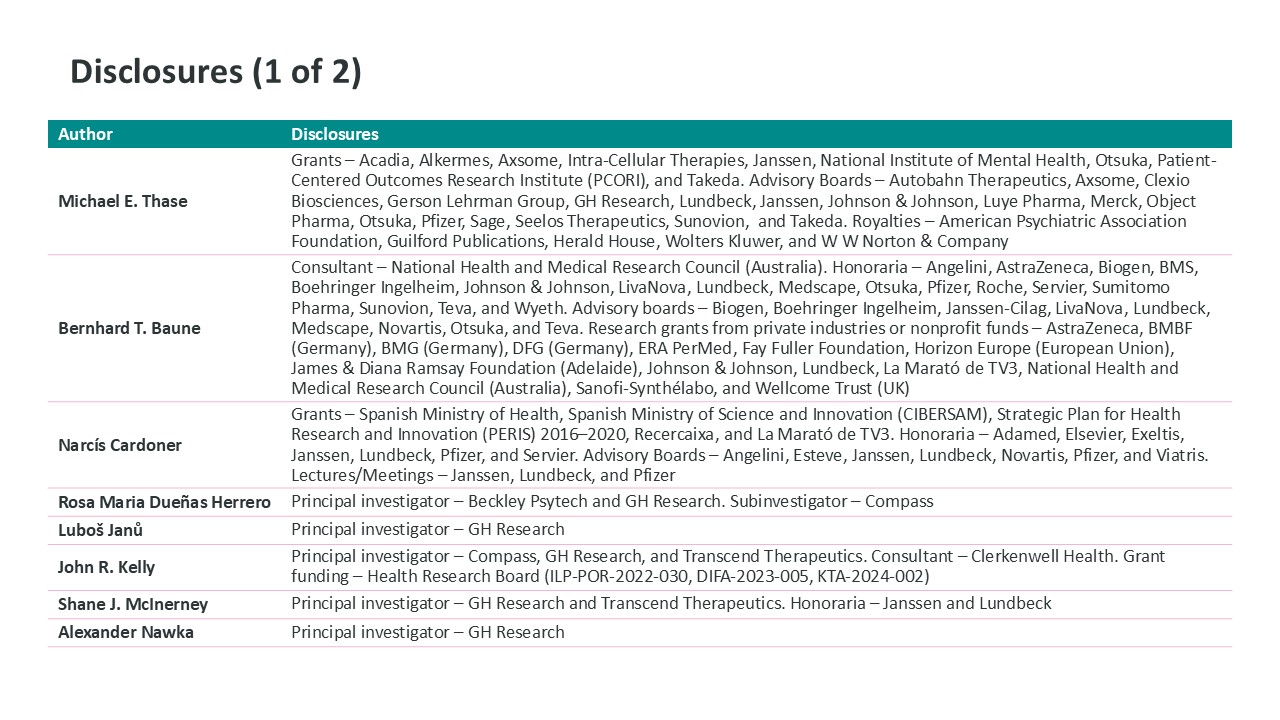
 Author  Disclosures  Michael E. Thase  Grants – Acadia, Alkermes, Axsome, Intra-Cellular Therapies, Janssen, National Institute of Mental Health, Otsuka, Patient-Centered Outcomes Research Institute (PCORI), and Takeda. Advisory Boards – Autobahn Therapeutics, Axsome, Clexio Biosciences, Gerson Lehrman Group, GH Research, Lundbeck, Janssen, Johnson & Johnson, Luye Pharma, Merck, Object Pharma, Otsuka, Pfizer, Sage, Seelos Therapeutics, Sunovion, and Takeda. Royalties – American Psychiatric Association Foundation, Guilford Publications, Herald House, Wolters Kluwer, and W W Norton & Company   Bernhard T. Baune  Consultant – National Health and Medical Research Council (Australia). Honoraria – Angelini, AstraZeneca, Biogen, BMS, Boehringer Ingelheim, Johnson & Johnson, LivaNova, Lundbeck, Medscape, Otsuka, Pfizer, Roche, Servier, Sumitomo Pharma, Sunovion, Teva, and Wyeth. Advisory boards – Biogen, Boehringer Ingelheim, Janssen-Cilag, LivaNova, Lundbeck, Medscape, Novartis, Otsuka, and Teva. Research grants from private industries or nonprofit funds – AstraZeneca, BMBF (Germany), BMG (Germany), DFG (Germany), ERA PerMed, Fay Fuller Foundation, Horizon Europe (European Union), James & Diana Ramsay Foundation (Adelaide), Johnson & Johnson, Lundbeck, La Marató de TV3, National Health and Medical Research Council (Australia), Sanofi-Synthélabo, and Wellcome Trust (UK)  Narcís Cardoner  Grants – Spanish Ministry of Health, Spanish Ministry of Science and Innovation (CIBERSAM), Strategic Plan for Health Research and Innovation (PERIS) 2016–2020, Recercaixa, and La Marató de TV3. Honoraria – Adamed, Elsevier, Exeltis, Janssen, Lundbeck, Pfizer, and Servier. Advisory Boards – Angelini, Esteve, Janssen, Lundbeck, Novartis, Pfizer, and Viatris. Lectures/Meetings – Janssen, Lundbeck, and Pfizer  Rosa Maria Dueñas Herrero  Principal investigator – Beckley Psytech and GH Research. Subinvestigator – Compass  Luboš Janů  Principal investigator – GH Research  John R. Kelly  Principal investigator – Compass, GH Research, and Transcend Therapeutics. Consultant – Clerkenwell Health. Grant funding – Health Research Board (ILP-POR-2022-030, DIFA-2023-005, KTA-2024-002)  Shane J. McInerney  Principal investigator – GH Research and Transcend Therapeutics. Honoraria – Janssen and Lundbeck  Alexander Nawka  Principal investigator – GH Research  Disclosures (1 of 2) 
 

 Author  Disclosures  Tomáš Páleníček  Principal investigator – Compass, GH Research, MAPS, and Ketabon. Shares – Psychedelická klinika s.r.o., Společnost pro podporu neurovědního výzkumu s.r.o., and AVI-X Aviation Experts s.r.o. Founder – PSYRES (Psychedelic Research Foundation). Consultant – CB21 Pharma and GH Research  Andreas Reif  Honoraria for lectures and/or advisory boards – AbbVie, Boehringer Ingelheim, Cyclerion, Compass, GH Research, Janssen, LivaNova, Medice, MSD, Newron, Sage/Biogen, and Shire/Takeda. Research grants – Medice and Janssen  Víctor Pérez Sola  Consultant, honoraria, or grants – AB-Biotics, AstraZeneca, Bristol Myers Squibb, CIBERSAM, FIS-ISCiii, Janssen Cilag, Lundbeck, Medtronic, Otsuka, and Servier  Madhukar H. Trivedi  Advisory boards – Alto Neuroscience and Base Point Health Management. Consultant – Axsome, Biogen, Daiichi Sankyo, GH Research, Legion Health, Neurocrine Biosciences, Otsuka Pharmaceutical Europe, Otsuka Pharmaceutical Development & Commercialization, Otsuka Pharmaceutical, PureTech, and Takeda. Advisor – Cerebral Therapeutics, Circular Genomics, and Seaport Therapeutics. Scientific advisor – GreenLight VitalSign6. Board of Directors – Charities2Love  Velichka Valcheva  Employee and stock option holder of GH Research  Eduard Vieta  Grants – AB-Biotics, AbbVie, Almirall, AstraZeneca, Boehringer Ingelheim, Bristol Myers Squibb, Celon, Cephalon, Dainippon Sumitomo Pharma, Elan, Ferrer, GH Research, GlaxoSmithKline, Janssen, Lilly, Lundbeck, Orion, Otsuka, Pfizer, Sanofi Aventis, Servier, Sunovion, and Takeda. Honoraria – Abbott, AbbVie, Angelini, AstraZeneca, Bristol Myers Squibb, Cambridge University Press, Elsevier, Farmindustria, Ferrer, Galenica, GlaxoSmithKline, Janssen, Johnson & Johnson, Lilly, Lundbeck, Oxford University Press, Otsuka, Pfizer, Sanofi Aventis, and Viatris. Advisory boards – AbbVie, Angelini, AstraZeneca, Biogen, Biohaven, Bristol Myers Squibb, Celon, Compass, Ferrer, GH Research, Gedeon Richter, HMNC, Idorsia, Janssen, Johnson & Johnson, Jazz, Lilly, Lundbeck, Merck Sharp & Dohme, Novartis, Organon, Otsuka, Pfizer, Roche, Sage, Sanofi Aventis, Servier, Shire, Sunovion, Takeda, and Teva  Wiesław J. Cubała  Grants – Acadia, Angelini, Beckley Psytech, GH Research, HMNC Brain Health, Intra-Cellular Therapies, Janssen, MSD, Neumora, Novartis, Otsuka, Recognify Life Sciences. Honoraria – Angelini, GH Research, Janssen, and Novartis. Advisory boards – Douglas Pharmaceuticals, GH Research, Janssen, MSD, and Novartis (relationships reported within the last three years)  Disclosures (2 of 2) 

 

 4  Background  TRD affects approximately 30% of patients treated for MDD1  Current therapies for TRD are limited and there is a large unmet need for treatments that offer rapid and sustained effects   Mebufotenin (5-methoxy-N,N-dimethyltryptamine [5-MeO-DMT]) is a non-selective serotonin (5-HT) agonist with high affinity for several receptor subtypes, including the 5-HT1A receptor2  GH001 is a synthetic form of mebufotenin for pulmonary inhalation3,4  Early-stage trials in healthy volunteers and patients with TRD suggest that GH001 is well tolerated and may have the potential to induce an ultra-rapid remission in depressive symptoms3,4  The aim of this double-blind, placebo-controlled trial was to investigate the safety and efficacy of GH001 in patients with TRD  MDD = Major depressive disorder; TRD = Treatment-resistant depression.   1. Kubitz N, et al. PLoS One. 2013;8(10):e76882. 2. Shen H, et al. Curr Drug Metab. 2010;11(8):659-66. 3. Reckweg J, et al. Front Pharmacol. 2021;12:760671. 4. Reckweg JT, et al. Front Psychiatry. 2023;14:1133414. 
 

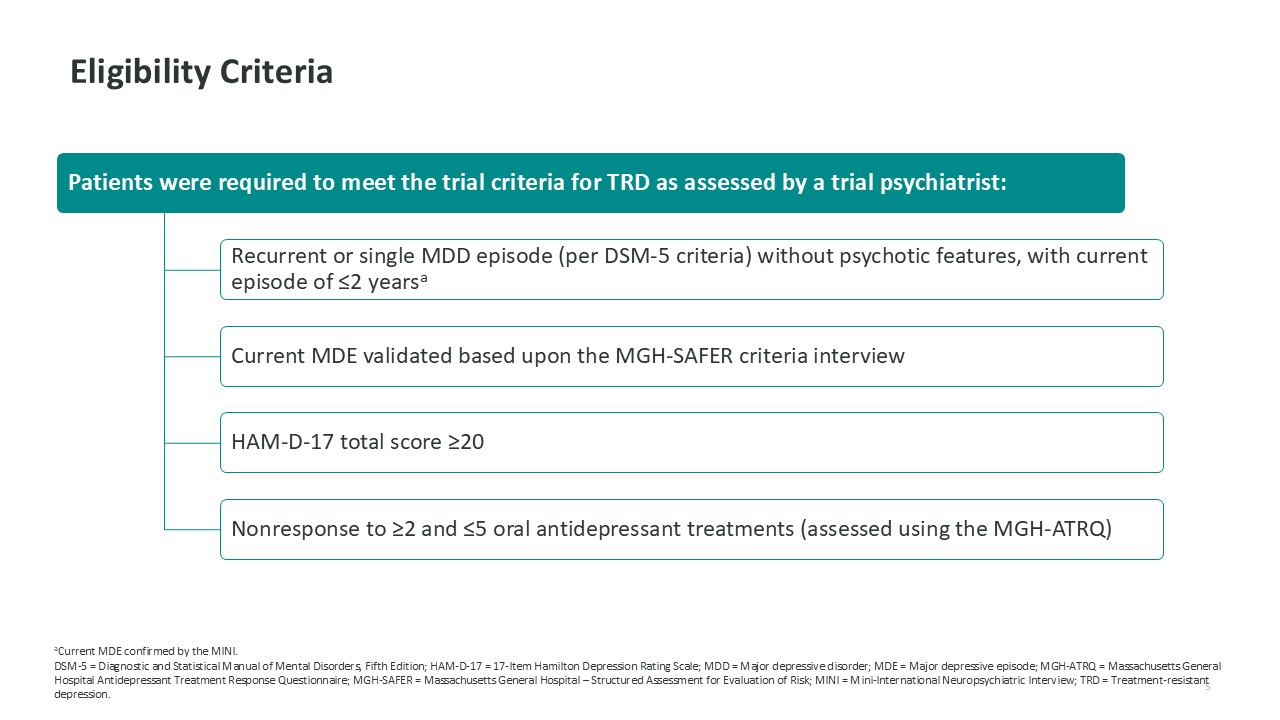
 5  Eligibility Criteria  aCurrent MDE confirmed by the MINI.   DSM-5 = Diagnostic and Statistical Manual of Mental Disorders, Fifth Edition; HAM-D-17 = 17-Item Hamilton Depression Rating Scale; MDD = Major depressive disorder; MDE = Major depressive episode; MGH-ATRQ = Massachusetts General Hospital Antidepressant Treatment Response Questionnaire; MGH-SAFER = Massachusetts General Hospital – Structured Assessment for Evaluation of Risk; MINI = Mini-International Neuropsychiatric Interview; TRD = Treatment-resistant depression. 
 

 For re-treatment (up to five GH001 IDRs), the patient must have met one of the following criteria:   MADRS score >18   MADRS score >10 and ≤18 and MADRS score ≤10 not observed at Day 8 of the prior treatment or at any visit since  MADRS score >10 and ≤18 and MADRS score >18 observed since the most recent observation of MADRS score ≤10  6  Trial Schematic  Open-Label Extension (OLE)  N=81  Randomization 1:1  GH001 IDR  Placebo IDR   BL  2h  Day 1  Primary endpoint   ΔMADRS  Day 8  During the OLE, patients attended visits at Day 15, Month 1, 2, 3, 4, 5 & 6a  Additional clinic visits could be scheduled if required for medical reasons  MADRS  assessment  Month 6  D2  Day 2  Double-Blind Part  This trial was conducted under the supervision of qualified healthcare professionals, providing psychological support per standard of care, but without any planned psychotherapeutic intervention before, during, or after dosing  aPatients also attended assessment visits on Day 2 (phone call) and Day 8 after each re-treatment.   BL = Baseline; D = Day; h = Hour; IDR = Individualized dosing regimen; MADRS = Montgomery–Åsberg Depression Rating Scale.   ClinicalTrials.gov. https://clinicaltrials.gov/study/NCT05800860, Accessed March 13, 2025.   All patients directly transitioned from the double-blind part to the OLE 
 

 7  Patient Disposition and Characteristics in the Double-Blind Part  aUp to three doses of GH001 or placebo were administered to each patient. bIncludes all patients who received respective dose of GH001 or placebo, irrespective of total dose.   BMI = Body mass index; HAM-D-17 = 17-Item Hamilton Depression Rating Scale; IDR = Individualized dosing regimen; MADRS = Montgomery-Åsberg Depression Rating Scale; MDE = Major depressive episode; PsE = Psychoactive effects; SD = Standard deviation.  GH001 (n=40)  Placebo (n=41)  Patient Disposition  Completed double-blind part, n (%)  40 (100)  41 (100)  Patient Demographics  Age, years, mean (SD)  41.6 (11.4)  43.9 (10.9)  Female, n (%)  24 (60.0)  22 (53.7)  Race, White, n (%)  40 (100)  41 (100)  BMI, kg/m2, mean (SD)   24.8 (4.3)  27.5 (6.3)  Previously used any psychedelic (lifetime), n (%)  4 (10.0)  5 (12.2)  Baseline Disease Characteristics  HAM-D-17 total score, mean (SD)  24.9 (2.7)  24.6 (2.3)  MADRS total score, mean (SD)  29 (5.4)  28.2 (4.6)  MDE History at Baseline  Number of MDEs  Mean (SD)  2.1 (1.4)  2.0 (1.1)  ≥3, n (%)  14 (35.0)  13 (31.7)  Time since first depressive episode, years, mean (SD)  11.3 (9.7)  12.2 (8.4)  Duration of current MDE, weeks, mean (SD)  50.8 (28.3)  63.3 (106.9)  Patients Receiving IDR Dosesa  First dose (6 mg GH001 or one placebo dose), n (%)  9 (22.5)  0 (0)  Second dose (6+12 mg GH001 or two placebo doses), n (%)  21 (52.5)  0 (0)  Third dose (6+12+18 mg GH001 or three placebo doses), n (%)  10 (25.0)  41 (100)  Duration of PsEb  6 mg (or placebo first dose), minutes, median (range)  9.0 (2−35)  0 (0−15)  12 mg (or placebo second dose), minutes, median (range)  14.0 (4−50)  0 (0−5)  18 mg (or placebo third dose), minutes, median (range)  11.5 (8−50)  0 (0−7) 
 

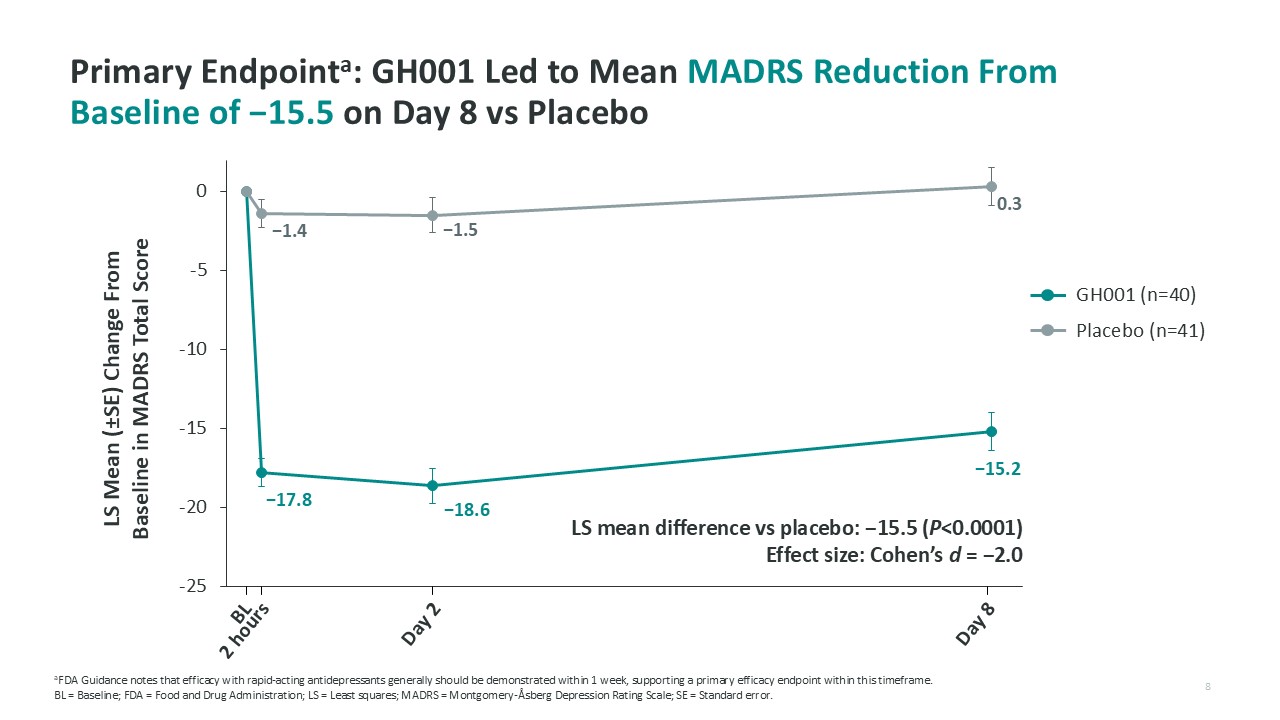
 Primary Endpointa: GH001 Led to Mean MADRS Reduction From Baseline of −15.5 on Day 8 vs Placebo  LS mean difference vs placebo: −15.5 (P<0.0001)  Effect size: Cohen’s d = −2.0  LS Mean (±SE) Change From Baseline in MADRS Total Score  aFDA Guidance notes that efficacy with rapid-acting antidepressants generally should be demonstrated within 1 week, supporting a primary efficacy endpoint within this timeframe.  BL = Baseline; FDA = Food and Drug Administration; LS = Least squares; MADRS = Montgomery-Åsberg Depression Rating Scale; SE = Standard error.  GH001 (n=40)  Placebo (n=41)  BL  2 hours  Day 2  Day 8  8 
 

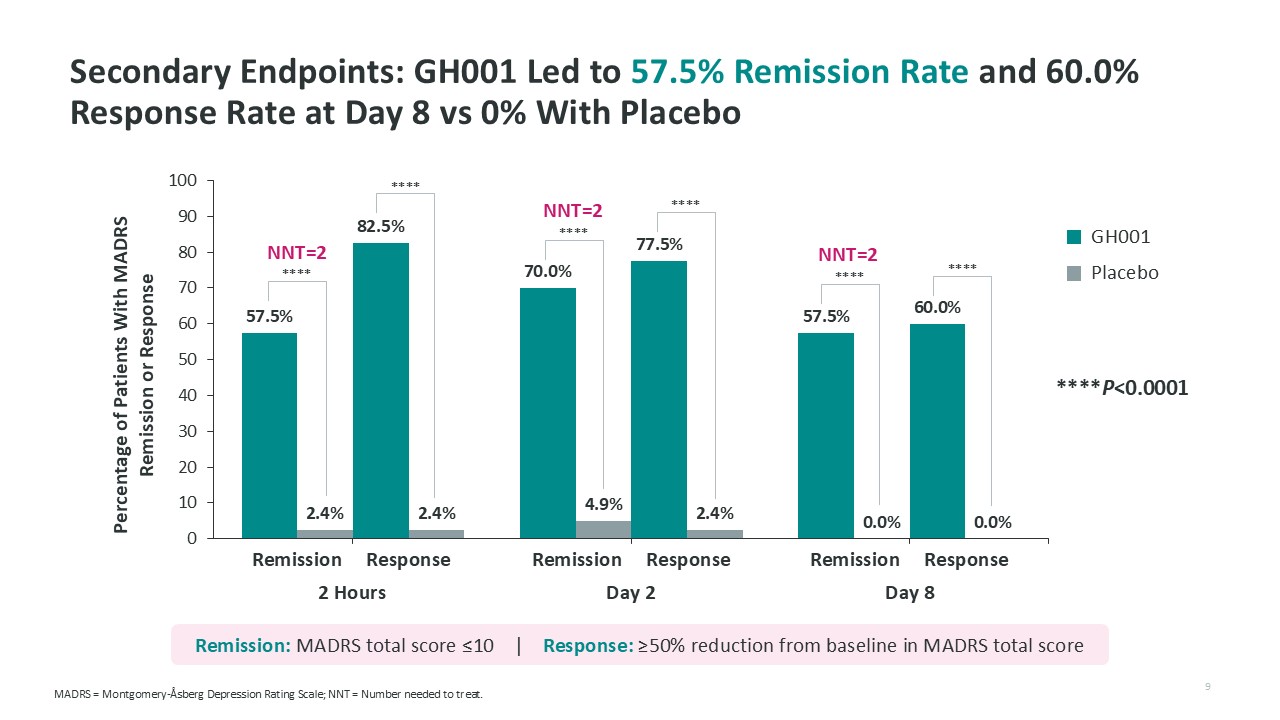
 9  Secondary Endpoints: GH001 Led to 57.5% Remission Rate and 60.0% Response Rate at Day 8 vs 0% With Placebo  MADRS = Montgomery-Åsberg Depression Rating Scale; NNT = Number needed to treat.   ****P<0.0001  Remission: MADRS total score ≤10 | Response: ≥50% reduction from baseline in MADRS total score  2 Hours  Day 2  Day 8  Remission Response  GH001  Placebo  ****  ****  ****  ****  ****  ****  Remission Response  Remission Response  NNT=2  NNT=2  NNT=2 
 

 10  Secondary Endpoints: GH001 Led to Improvements in Anxiety and Quality of Life vs Placebo at Day 8  HAM-A Total Score  Q-LES-Q-SF Total Score  HAM-A = Hamilton Anxiety Rating Scale; LS = Least squares; Q-LES-Q-SF = Quality of Life Enjoyment and Satisfaction Questionnaire – Short Form.  GH001  (n=40)  Placebo  (n=41)  GH001  (n=37)  Placebo  (n=39)  LS Mean Change From   Baseline at Day 8  LS mean difference vs placebo:  −10.0 (P<0.0001)  LS mean difference vs placebo:  21.5 (P<0.0001)  LS Mean Change From   Baseline at Day 8 
 

 11  More Patients Had Improvement in Global Illness Severity From Baseline at Day 8 With GH001 vs Placebo  Percentage of Patients in Each CGI-S Category at Day 8  Percentages are for each baseline category within treatment.   CGI-S = Clinical Global Impression – Severity; LS = Least squares; SE = Standard error.  GH001 (n=40)  Placebo (n=41)  LS Mean (SE) Change in CGI-S Score From Baseline at Day 8  GH001 (n=40)  Placebo (n=41)  −2.4 (0.2)  0.1 (0.2)  LS mean difference vs placebo:   −2.5 (P<0.0001) 
 

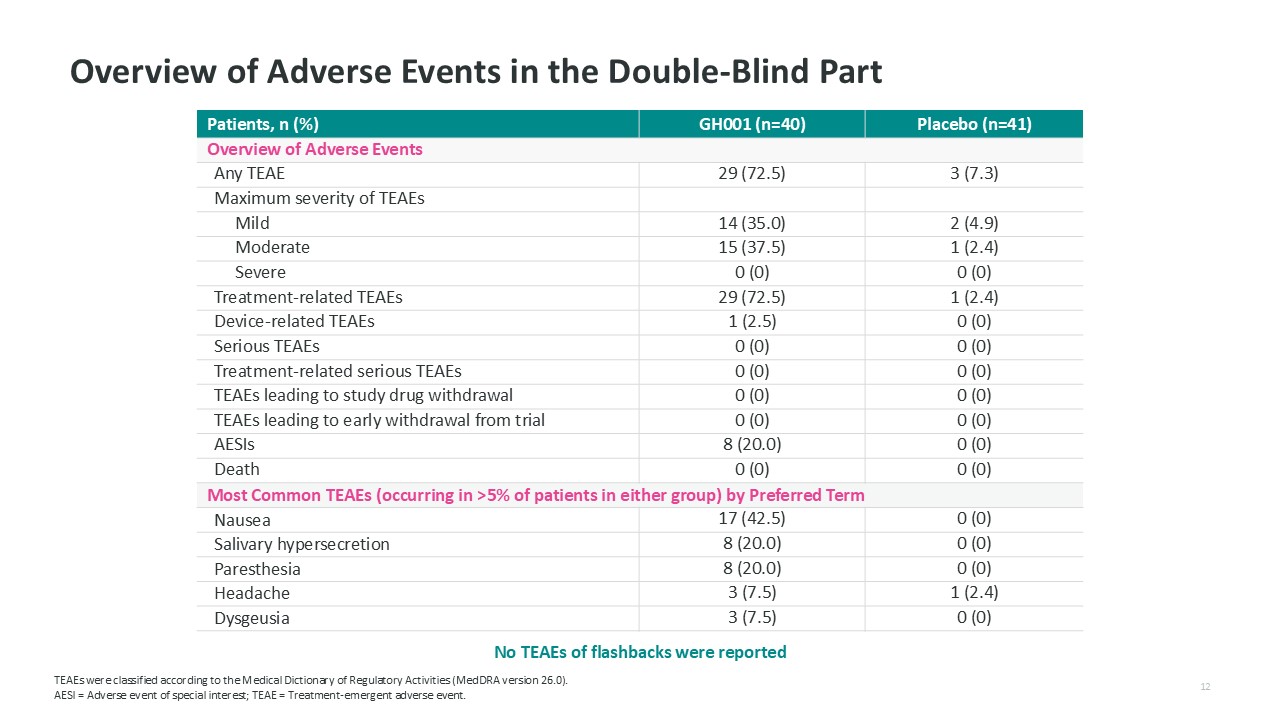
 12  Overview of Adverse Events in the Double-Blind Part  TEAEs were classified according to the Medical Dictionary of Regulatory Activities (MedDRA version 26.0).  AESI = Adverse event of special interest; TEAE = Treatment-emergent adverse event.  No TEAEs of flashbacks were reported  Patients, n (%)  GH001 (n=40)  Placebo (n=41)  Overview of Adverse Events  Any TEAE  29 (72.5)  3 (7.3)  Maximum severity of TEAEs   Mild  14 (35.0)  2 (4.9)   Moderate  15 (37.5)  1 (2.4)   Severe  0 (0)  0 (0)  Treatment-related TEAEs  29 (72.5)  1 (2.4)  Device-related TEAEs  1 (2.5)  0 (0)  Serious TEAEs  0 (0)  0 (0)  Treatment-related serious TEAEs  0 (0)  0 (0)  TEAEs leading to study drug withdrawal  0 (0)  0 (0)  TEAEs leading to early withdrawal from trial  0 (0)  0 (0)  AESIs  8 (20.0)  0 (0)  Death  0 (0)  0 (0)  Most Common TEAEs (occurring in >5% of patients in either group) by Preferred Term  Nausea  17 (42.5)  0 (0)  Salivary hypersecretion  8 (20.0)  0 (0)  Paresthesia  8 (20.0)  0 (0)  Headache  3 (7.5)  1 (2.4)  Dysgeusia  3 (7.5)  0 (0) 
 

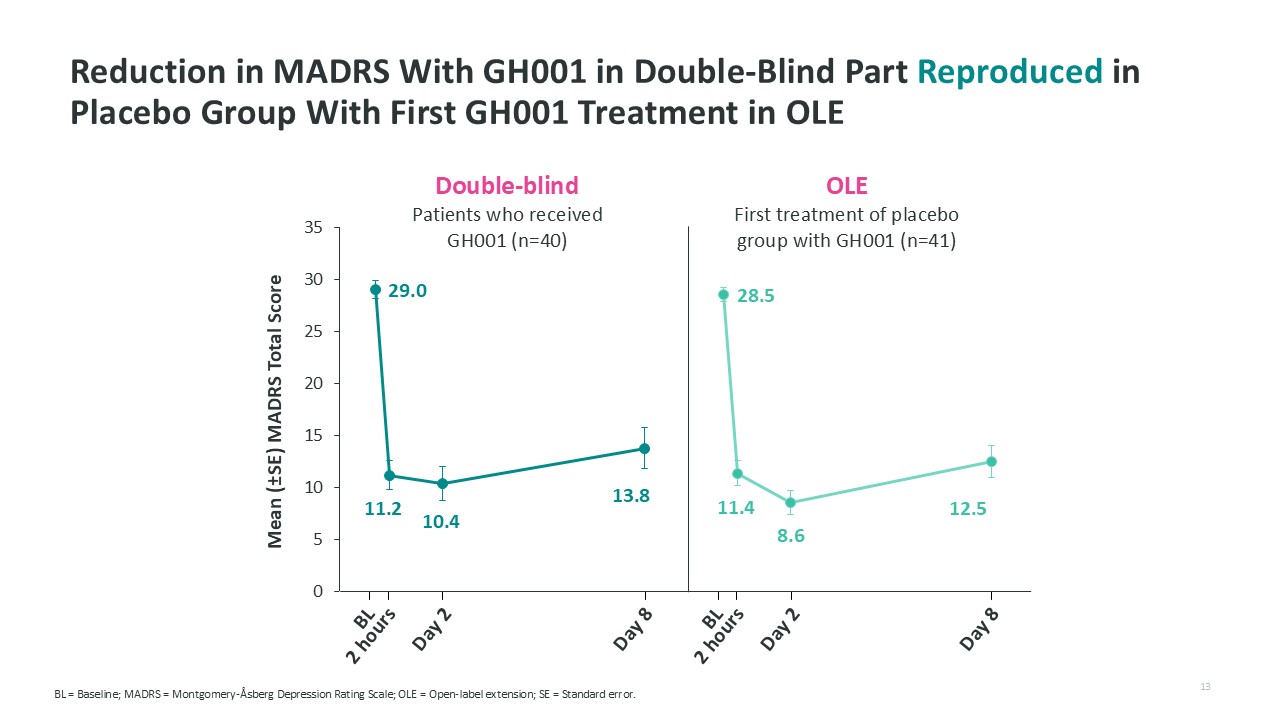
 13  Reduction in MADRS With GH001 in Double-Blind Part Reproduced in Placebo Group With First GH001 Treatment in OLE  BL = Baseline; MADRS = Montgomery-Åsberg Depression Rating Scale; OLE = Open-label extension; SE = Standard error.  Double-blind  Patients who received GH001 (n=40)  OLE  First treatment of placebo group with GH001 (n=41)  Mean (±SE) MADRS Total Score  BL  2 hours  Day 2  Day 8  BL  2 hours  Day 2  Day 8 
 

 14  73.0% Remission Rate at 6 Months in OLE Completers  The OLE was completed in Q1 2025  63 completed, 18 early terminations (n=1 due to TEAE)   For patients who completed the OLE:  73.0% (n=46) of patients were in remissionc at 6 months (79.4% with clinical response)d  Of the 46 patients in remission, 23 were randomized to GH001 and 23 were randomized to placebo in the double-blind part  Completers (n=63) had a mean MADRS total score of 9.4 at 6 months  63.5% (n=40) received 1−4 treatments with GH001  No drug-related serious TEAEs were reported in the OLE; one non-drug-related serious TEAE was reported during the OLEe  Note: data collection for the OLE has completed but data cleaning is ongoing. All analyses of OLE data are subject to change following database lock.  Double-blind  n=40 patients who received GH001  OLE  n=63 OLE completersa  Day 8  Month 6b  a63 patients who received active drug and completed the 6-month OLE per protocol (patients who terminated early are excluded). bApproximately 6 months post-study start (mean 168 days from Day 1 of double-blind period). cMADRS total score ≤10. d≥50% reduction from baseline in total MADRS score. eThe non-drug-related serious TEAE reported was preferred term status migrainosus. Onset was 73 days after the patients most recent administration of the GH001 IDR.  MADRS = Montgomery-Åsberg Depression Rating Scale; OLE = Open-label extension; TEAE = Treatment-emergent adverse event. 
 

 Double-Blind Part  The primary endpoint was met: GH001 administered as an IDR led to significant MADRS reductions from baseline to Day 8 (−15.5 vs placebo)  Secondary endpoints: Remission rate of 57.5% at Day 8 (placebo, 0%), and improvements in anxiety, global disease severity, and quality of life were observed  Safety: GH001 was well tolerated  Open-Label Extension  GH001 can maintain long-term remission in TRD, with 73.0% of patients who completed the OLE in remission at 6 months  Durable effects with relatively infrequent treatment visits and ultra-rapid MADRS reduction  No drug-related serious TEAEs were reported in the OLE  15  Conclusions  Data analysis has been completed for the OLE, but data cleaning is still ongoing.   IDR = Individualized dosing regimen; MADRS = Montgomery-Åsberg Depression Rating Scale; OLE = Open-label extension; TEAE = Treatment-emergent adverse event; TRD = Treatment-resistant depression. 
 

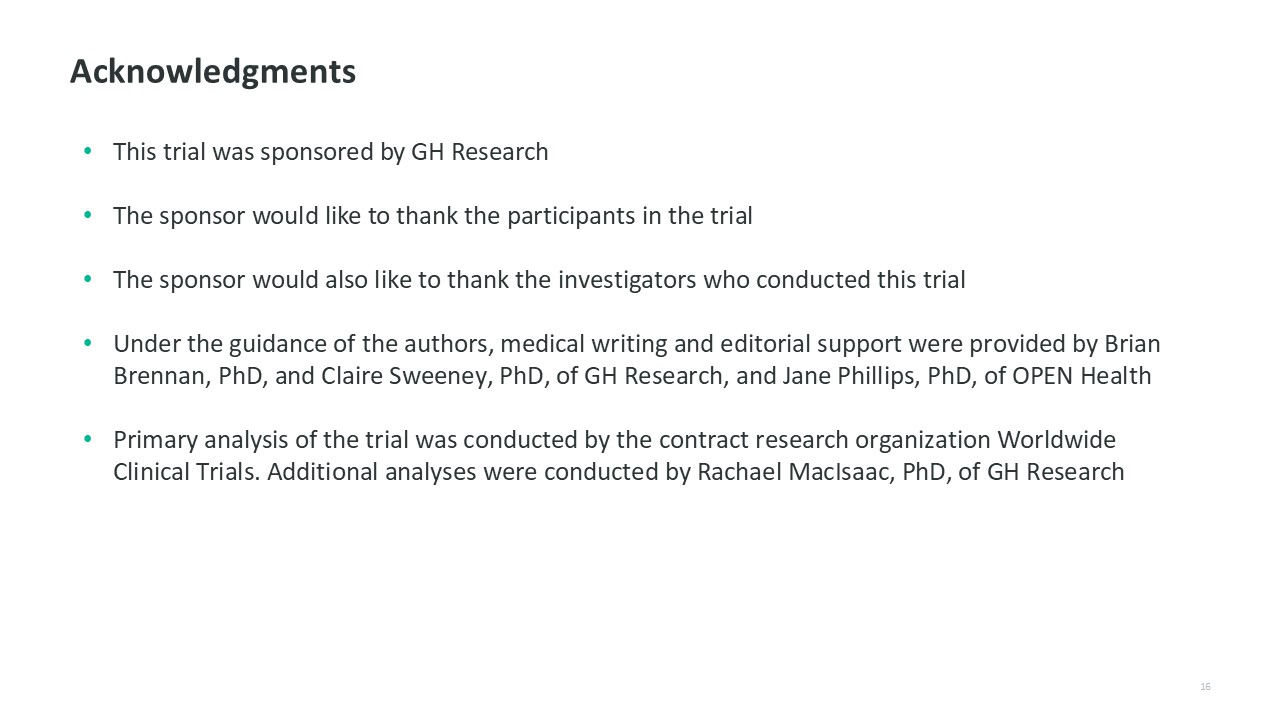
 16  Acknowledgments  This trial was sponsored by GH Research  The sponsor would like to thank the participants in the trial  The sponsor would also like to thank the investigators who conducted this trial  Under the guidance of the authors, medical writing and editorial support were provided by Brian Brennan, PhD, and Claire Sweeney, PhD, of GH Research, and Jane Phillips, PhD, of OPEN Health  Primary analysis of the trial was conducted by the contract research organization Worldwide Clinical Trials. Additional analyses were conducted by Rachael MacIsaac, PhD, of GH Research