 エドガーで原本を確認する
UNITED STATES
SECURITIES AND EXCHANGE COMMISSION
WASHINGTON, DC 20549
FORM 8-K
CURRENT REPORT PURSUANT
TO SECTION 13 OR 15(D) OF THE
SECURITIES EXCHANGE ACT OF 1934
Date of report (Date of earliest event reported): September 15, 2025
AMERICAN AXLE & MANUFACTURING HOLDINGS, INC.
(Exact Name of Registrant as Specified in Its Charter)
Delaware
(State or Other Jurisdiction of Incorporation)
| 1-14303 | 38-3161171 | |
| (Commission File Number) | (IRS Employer Identification No.) | |
| One Dauch Drive, Detroit, Michigan | 48211-1198 | |
| (Address of Principal Executive Offices) | (Zip Code) |
| (313) 758-2000 |
| (Registrant's Telephone Number, Including Area Code) |
| (Former Name or Former Address, if Changed Since Last Report) |
Check the appropriate box below if the Form 8-K filing is intended to simultaneously satisfy the filing obligation of the registrant under any of the following provisions (see General Instruction A.2. below):
¨ Written communications pursuant to Rule 425 under the Securities Act (17 CFR 230.425)
¨ Soliciting material pursuant to Rule 14a-12 under the Exchange Act (17 CFR 240.14a-12)
¨ Pre-commencement communications pursuant to Rule 14d-2(b) under the Exchange Act (17 CFR 240.14d-2(b))
¨ Pre-commencement communications pursuant to Rule 13e-4(c) under the Exchange Act (17 CFR 240.13e-4(c))
Securities registered pursuant to Section 12(b) of the Act:
| Title of each class | Trading Symbol(s) | Name of each exchange on which registered | ||
| Common Stock, par value $0.01 per share | AXL | The New York Stock Exchange |
Indicate by check mark whether the registrant is an emerging growth company as defined in Rule 405 of the Securities Act of 1933 (§230.405 of this chapter) or Rule 12b-2 of the Securities Exchange Act of 1934 (§240.12b-2 of this chapter).
Emerging growth company ¨
If an emerging growth company, indicate by check mark if the registrant has elected not to use the extended transition period for complying with any new or revised financial accounting standards provided pursuant to Section 13(a) of the Exchange Act. ¨
| Item 7.01. | Regulation FD Disclosure |
In connection with the proposed senior notes offering described in Item 8.01 below, American Axle & Manufacturing Holdings, Inc. (“AAM”) is providing potential investors with a preliminary offering memorandum, dated September 15, 2025 (the “Preliminary Offering Memorandum”). The Preliminary Offering Memorandum contains (i) certain information not previously disclosed by AAM; (ii) unaudited pro forma condensed combined financial information giving effect to AAM’s pending combination (the “Combination”) with Dowlais Group plc (“Dowlais”) as of and for the six months ended June 30, 2025 and for the year ended December 31, 2024 and the related notes thereto; (iii) the audited financial statements of Dowlais as of December 31, 2024 and 2023 and for the years then ended and the related notes thereto and (iv) the unaudited financial statements of Dowlais as of June 30, 2025 and for the six-month periods ended June 30, 2025 and 2024 and the related notes thereto. This information is included in Exhibits 99.1, 99.2, 99.3 and 99.4 attached to this Current Report on Form 8-K (the “Form 8-K”), respectively, and incorporated herein by reference.
The information in this Item 7.01 and the exhibits attached to this Form 8-K as Exhibits 99.1, 99.2, 99.3 and 99.4 are being furnished pursuant to Item 7.01 of Form 8-K and shall not be deemed “filed” for purposes of Section 18 of the Securities Act of 1934, as amended, or otherwise subject to the liabilities of that Section nor shall they be deemed incorporated by reference into any filing under the Securities Act of 1933, as amended (the “Securities Act”), or the Securities Exchange Act of 1934, as amended, except as shall be expressly stated by specific reference in such filing.
| Item 8.01. | Other Events |
On September 15, 2025, AAM announced that its wholly-owned subsidiary, American Axle & Manufacturing, Inc. (the “Issuer”), intends to offer, subject to market and other conditions, $843 million of senior secured notes due 2032 (the “Secured Notes”) and $600 million of senior unsecured notes due 2033 (the “Unsecured Notes,” and together with the Secured Notes, the “Notes”) in an offering that is exempt from the registration requirements of the Securities Act.
The Secured Notes will be secured by a first priority security interest in substantially all of the assets of the Issuer, AAM and AAM’s subsidiaries (other than the Issuer) that guarantee its existing credit agreement, subject to certain thresholds, exceptions and permitted liens. Such assets will also continue to secure borrowings under the Issuer’s existing credit agreement on a pari passu basis. The Secured Notes will be unconditionally guaranteed on a senior secured basis and the Unsecured Notes will be unconditionally guaranteed on a senior unsecured basis by AAM and its subsidiaries (other than the Issuer) that guarantee its existing credit agreement.
The Issuer intends to use the net proceeds from this offering, together with borrowings under its existing credit agreement and cash on hand, (i) to pay the cash consideration payable in connection with the Combination with Dowlais and related fees and expenses, (ii) to repay in full all outstanding borrowings under the existing credit facilities of Dowlais and to pay related fees, expenses and premiums, after which the existing credit facilities of Dowlais will be terminated, (iii) to fund a change of control offer for certain outstanding notes of Dowlais and (iv) the remainder, if any, for general corporate purposes, which may include, among other things, repayment of debt.
Unless the Combination is consummated concurrently with the closing of the offering of the Notes, the Issuer will deposit into segregated escrow accounts for each of the Secured Notes and the Unsecured Notes an amount of cash equal to (i) in the case of the escrow account for the Secured Notes, the gross proceeds from the sale of such series of Secured Notes, together with additional amounts on the issue date and from time to time to prefund interest on the Secured Notes and (ii) in the case of the escrow account for the Unsecured Notes, the gross proceeds from $600 million aggregate principal amount of Unsecured Notes, together with additional amounts on the issue date and from time to time to prefund interest on $600 million aggregate principal amount of Unsecured Notes, in each case, until the date that certain escrow release conditions, including the consummation of the Combination, have been satisfied or a special mandatory redemption has occurred. The Notes of each series will be secured by a first priority security interest in its respective escrow account and all funds deposited therein. The consummation of the Combination is subject to the satisfaction of customary closing conditions.
The Issuer may elect to increase the amount of the Unsecured Notes in order to fund the redemption or other repayment in full of its outstanding unsecured 6.50% Senior Notes due 2027 and related fees and expenses, in which case the Issuer would expect to increase the offering size of the Unsecured Notes by approximately $500 million to $1.1 billion. If more than $600 million aggregate principal amount of Unsecured Notes is issued in this offering, the escrow and special mandatory redemption provisions described above will only apply to $600 million aggregate principal amount of Unsecured Notes. This 8-K does not constitute a notice of redemption with respect to the Issuer’s outstanding unsecured 6.50% Senior Notes due 2027.
A copy of the press release of AAM is filed as Exhibit 99.5 hereto. The press release is incorporated herein by reference in its entirety.
This Form 8-K, including the exhibits attached hereto, does not constitute an offer to sell, or a solicitation of an offer to buy, any security. No offer, solicitation, or sale will be made in any jurisdiction in which such an offer, solicitation, or sale would be unlawful. The Notes will not be registered under the Securities Act or the securities laws of any state or other jurisdiction, and, unless so registered, may not be offered or sold in the United States absent registration or an applicable exemption from registration requirements.
Forward-Looking Statements
This report may contain statements concerning our expectations, beliefs, plans, objectives, goals, strategies, and future events or performance, including, but not limited to, the statements about the proposed offering of the Notes, our intention to issue the Notes, the expected use of proceeds and the Combination. Such statements are “forward-looking” statements within the meaning of the Private Securities Litigation Reform Act of 1995 and relate to trends and events that may affect our future financial position and operating results. The terms such as “will,” “may,” “could,” “would,” “plan,” “believe,” “expect,” “anticipate,” “intend,” “project,” “target,” and similar words or expressions, as well as statements in future tense, are intended to identify forward-looking statements. Forward-looking statements should not be read as a guarantee of future performance or results, and will not necessarily be accurate indications of the times at, or by, which such performance or results will be achieved. Forward-looking statements are based on information available at the time those statements are made and/or management’s good faith belief as of that time with respect to future events and are subject to risks and may differ materially from those expressed in or suggested by the forward-looking statements. These risks and uncertainties related to AAM include factors detailed in the reports AAM files with the Securities and Exchange Commission, including those described under “Risk Factors” in its most recent Annual Report on Form 10-K and its Quarterly Reports on Form 10-Q. It is not possible to foresee or identify all such factors and we make no commitment to update any forward-looking statement or to disclose any facts, events or circumstances after the date hereof that may affect the accuracy of any forward-looking statement.
| Item 9.01. | Financial Statements and Exhibits |
(d) Exhibits
SIGNATURES
Pursuant to the requirements of the Securities Exchange Act of 1934, as amended, the registrant has duly caused this report to be signed on its behalf by the undersigned, hereunto duly authorized.
| AMERICAN AXLE & MANUFACTURING HOLDINGS, INC. | |||
| Date: | September 15, 2025 | By: | /s/ Matthew K. Paroly |
| Matthew K. Paroly | |||
| Vice President, General Counsel & Secretary | |||
Exhibit 99.1
Basis of presentation
AAM Holdings’ historical financial statements have been prepared in accordance with accounting principles generally accepted in the United States of America (“GAAP”). AAM Holdings publishes its financial statements in U.S. Dollars. Dowlais’ historical financial statements included in this offering memorandum have been prepared in accordance with IFRS® Accounting Standards (“IFRS”) as issued by the International Accounting Standards Board (“IASB”). Dowlais publishes its financial statements in Pound Sterling. Certain financial information of Dowlais in this offering memorandum has been translated into U.S. Dollars for comparability and convenience purposes only. Unless otherwise indicated or the context otherwise requires, the rate used to translate Pound Sterling amounts to U.S. Dollars was 1.3574, which is the exchange rate reported by Bloomberg on September 11, 2025.
Prospective investors should consult their professional advisors for an understanding of: (i) any differences between GAAP, IFRS as issued by the IASB and other systems of generally accepted accounting principles and how these differences might affect the financial information included in this offering memorandum, and (ii) the impact that future additions to, or amendments of any such accounting principles may have on the results of operations and/or financial condition of AAM or Dowlais, as well as on the comparability of the prior periods.
This offering memorandum also includes certain financial and operating metrics for AAM Holdings and Dowlais combined as one company. These “combined” metrics are provided for illustrative purposes, are derived by combining the relevant historical financial or operating information of AAM Holdings and Dowlais and do not reflect pro forma adjustments and are not prepared in compliance with the requirements of Article 11 of Regulation S-X, as would be required if this offering of notes were registered with the SEC. These figures do not reflect what the Combined Group’s financial condition or results of operations would have been had the Transactions (as defined herein) occurred on or prior to the dates indicated. The Combined Group’s actual financial position and results of operations may differ significantly from the amounts reflected herein due to a variety of factors. See “Risk Factors—Risks Related to the Pending Combination with Dowlais.”
The statements and information included or incorporated by reference in this offering memorandum regarding synergies, cost savings and similar information were prepared by AAM Holdings and relate to the synergies and cost savings being targeted by AAM Holdings following the consummation of the Combination only, and are conditional upon the consummation of the Combination. Such statements and information are forward-looking statements subject to risks, and actual results may vary materially from such statements and information.
Unless otherwise stated herein, pro forma financial information gives effect to the Combination, anticipated incurrence of new indebtedness pursuant to the Second Amendment (as defined herein) and the Bridge Credit Agreements (as defined herein) and the use of proceeds therefrom (collectively, the “Transactions”), as described under “Unaudited Pro Forma Condensed Combined Financial Information.” References to financial or other data presented as “pro forma” or “on a pro forma basis” refer to a presentation that applies adjustments to give pro forma effect to the Transactions. The unaudited pro forma condensed combined financial information contained in this offering memorandum was calculated on the basis of assumptions made by the respective management of AAM Holdings and Dowlais at the time such information was prepared. For example, such unaudited pro forma condensed combined financial information reflects assumptions regarding the terms on which the Transactions will be completed and the terms of the indebtedness of the Combined Group that will be outstanding following completion of the Transactions. In particular, the unaudited pro forma condensed combined financial information contained in this offering memorandum does not give effect to any amendments to the Credit Agreement or the Co-operation Agreement or other modifications to the terms of the Transactions that may be agreed by the parties thereto and assumes the indebtedness incurred to fund the cash consideration payable in connection with the Combination and related fees and expenses and to repay certain existing indebtedness of Dowlais will be pursuant to the Second Amendment and the Bridge Credit Agreements rather than giving effect to this offering or to actual terms of the notes issued in this offering. See “Risk Factors—Risks Related to the Pending Combination with Dowlais—The unaudited pro forma financial information included in this offering memorandum may not be an indication of the Combined Group’s financial condition or results of operations following the Combination.”
The information included in this offering memorandum is not intended to, and does not, comply with all of the disclosure requirements of the SEC that would apply if this offering were being made pursuant to a registration statement filed with the SEC. Compliance with such requirements could require the modification or exclusion of certain financial measures and/or other information included in this offering memorandum and the inclusion of certain information not included in this offering memorandum. For example, the twelve months ended June 30, 2025 is not a fiscal period for us or Dowlais under GAAP or IFRS and, accordingly, the unaudited pro forma condensed combined financial information for the twelve months ended June 30, 2025 has not been prepared in compliance with the requirements of Article 11 of Regulation S-X, as would be required if this offering of notes were registered with the SEC. Similarly, certain “combined” metrics are derived by combining the relevant historical financial or operating information of AAM Holdings and Dowlais and do not reflect pro forma adjustments and are not prepared in compliance with the requirements of Article 11 of Regulation S-X, as would be required if this offering of notes were registered with the SEC.
Numerical figures included in this offering memorandum have been subject to rounding adjustments. Accordingly, numerical figures shown as totals in various tables may not be arithmetic aggregations of the figures that precede them.
In this offering memorandum, unless otherwise specified or the context otherwise requires:
| · | “Pound Sterling,” “Pounds,” “£,” “Pence” or “p” each refer to the lawful currency of the United Kingdom; and |
| · | “U.S. Dollars,” “Dollars,” “$” or “U.S.$” each refer to the lawful currency of the United States. |
Non-GAAP and non-IFRS financial measures
In addition to results reported in accordance with GAAP and IFRS as issued by the IASB in this offering memorandum, we have provided certain non-GAAP and non-IFRS financial measures such as EBITDA, Adjusted EBITDA, Segment Adjusted EBITDA, Adjusted Revenue, Free Cash Flow, Adjusted Free Cash Flow and Adjusted Operating Profit. Such information is reconciled to its closest GAAP or IFRS measure, as applicable, in accordance with SEC rules under “Summary—AAM Holdings Summary Consolidated Financial Data” and “Summary—Dowlais Summary Consolidated Financial Data.”
AAM Holdings defines EBITDA to be earnings before interest expense, income taxes, depreciation and amortization. AAM Holdings defines Adjusted EBITDA as EBITDA excluding the impact of restructuring and acquisition-related costs, debt refinancing and redemption costs, gains or losses on the derivative associated with the Combination, gains or losses on equity securities, pension curtailment and settlement charges, impairment charges and non-recurring items. AAM Holdings defines Segment Adjusted EBITDA as EBITDA for its reportable segments excluding the impact of restructuring and acquisition-related costs, debt refinancing and redemption costs, gains or losses on the derivative associated with the Combination, gains or losses on equity securities, pension curtailment and settlement charges, impairment charges and non-recurring items. AAM Holdings defines Free Cash Flow to be net cash provided by operating activities less capital expenditures net of proceeds from the sale of property, plant and equipment and from government grants. AAM Holdings defines Adjusted Free Cash Flow as Free Cash Flow excluding the impact of cash payments for restructuring and acquisition-related costs and cash payments related to the Malvern fire, including payments for capital expenditures, net of recoveries.
Dowlais defines Adjusted Revenue as external revenue including Dowlais’ share of revenue of equity accounted investments. Dowlais defines Adjusted Operating Profit as operating profit excluding items which are significant in size or volatility or by nature are non-trading or non-recurring and including the adjusted operating profit of equity accounted investments. Dowlais defines Adjusted EBITDA as Adjusted Operating Profit after adding back depreciation and impairment of property, plant and equipment and amortization of computer software and development costs, including that of equity accounted investments. Dowlais defines Free Cash Flow as cash generated after accounting for all trading costs, restructuring, pension contributions, and tax payments, but before any cash flows associated with financing activities (i.e. net cash from operating and investing activities). Dowlais defines Adjusted Free Cash Flow as Free Cash Flow adjusted for cash flows related to its demerger from Melrose Industries PLC, cash spend on AAM combination and net cash on business disposals.
We believe that EBITDA, Adjusted EBITDA, Segment Adjusted EBITDA, Adjusted Revenue, Free Cash Flow, Adjusted Free Cash Flow and Adjusted Operating Profit are meaningful measures of performance as they are commonly utilized by management and investors to analyze operating performance and entity valuation. Our management, the investment community and the banking institutions routinely use EBITDA and Adjusted EBITDA, together with other measures, to measure our operating performance relative to other Tier 1 automotive suppliers. We also use Segment Adjusted EBITDA as the measure of earnings to assess the performance of each segment and determine the resources to be allocated to the segments. We also believe Free Cash Flow and Adjusted Free Cash Flow are meaningful measures as they are commonly utilized by management and investors to assess our ability to generate cash flow from business operations to repay debt and return capital to our stockholders. EBITDA, Adjusted EBITDA, Free Cash Flow and Adjusted Free Cash Flow are also key metrics used in our calculation of incentive compensation. These non- GAAP and non-IFRS financial measures are not and should not be considered a substitute for any GAAP or IFRS measure. Additionally, non-GAAP and non-IFRS financial measures as presented may not be comparable to similarly titled measures reported by other companies.
Summary
The following summary is qualified in its entirety by, and should be read in conjunction with, the more detailed information and financial statements (including the notes thereto) appearing elsewhere or incorporated by reference in this offering memorandum. Because this is a summary it may not contain all the information that may be important to you. You should read the entire offering memorandum, including the information incorporated by reference herein, before making an investment decision. Some of the statements in this “Summary” are forward-looking statements. Please see “Forward-Looking Statements” for more information regarding these statements.
Our company
AAM is a leading global tier 1 automotive and mobility supplier that designs, engineers and manufactures driveline and metal forming technologies to support electric, hybrid and internal combustion vehicles. AAM has its principal executive office in Detroit Michigan and operates over 75 facilities in 15 countries across North America, Europe, Asia, and South America. AAM has approximately 19,000 associates globally.
AAM has established a broad product portfolio that is designed to improve axle efficiency and fuel economy through innovative product design technologies. Its portfolio includes highly engineered axles, aluminum axles and all-wheel-drive applications. AAM’s metal forming segment represents the largest automotive forging operation in the world, and provides engine, transmission, driveline and safety-critical components for light, commercial and industrial vehicles.
We have aligned our business strategy to build value for our key stakeholders. We accomplish our strategic objectives by capitalizing on our competitive strengths and continuing to diversify our customer, product and geographic sales mix, while providing exceptional value to our customers. We are focused on securing and enhancing our core business of manufacturing products that support internal combustion engine (ICE) vehicle programs by delivering operational excellence and quality products to our customers, while growing our hybrid and electric vehicle business, as end-user acceptance of these vehicle types is expected to grow in the future. We have delivered on our objective, securing substantially all of our core platforms lasting beyond 2030. We believe we are favorably positioned in North America.
For the year ended December 31, 2024, we generated total revenues of $6,125 million and net income and adjusted EBITDA of $35 million and $749 million, respectively. For the six months ended June 30, 2025, we generated total revenues of $2,948 million and net income and adjusted EBITDA of $46 million and $380 million, respectively. Adjusted EBITDA is a non-GAAP financial measure. See “—AAM Holdings Summary Historical and Pro Forma Consolidated Financial Data” for a discussion of our use of our non-GAAP financial measures in this offering memorandum, including the reasons that we believe this information is useful to management and to investors, and a reconciliation of these non-GAAP financial measures to the most directly comparable financial measure calculated in accordance with GAAP.
Dowlais
Dowlais is a specialist engineering group focused on the automotive sector. Dowlais develops and delivers precisely engineered solutions for the automotive industry through its two high- technology engineering businesses: GKN Automotive and GKN Powder Metallurgy. Dowlais is headquartered in the United Kingdom, and operates in 22 countries and in 100 locations across the Americas, Europe and Asia, with over 70 manufacturing facilities and seven global innovation centers. Dowlais employes over 29,000 employees globally, including as part of its joint ventures. Dowlais has relationships with over ninety percent of global original equipment manufacturers, which are typically light vehicle original equipment manufacturers, and its components are present in approximately 45% of light vehicles in use globally.
GKN Automotive is a global leader in the development and production of side-shafts, propshafts, AWD systems and advanced differentials and a trusted partner to automotive OEMs globally. Its products drive the wheels of light vehicles around the world, and it has been a pioneer in the development of eDrive systems, remaining at the forefront of electric vehicle powertrain technology.
GKN Powder Metallurgy is a global leader in the production of sintered metal products for the automotive and industrial sectors and a leading manufacturer of atomized metal powders. Its world-class engineering expertise and sustainable technology enables the design and production of parts with complex geometries, higher densities and improved physical properties. It serves more than 2,000 customers globally and produces approximately ten million components daily.
Dowlais has a robust powertrain-agnostic product portfolio. 80.1% of its adjusted revenue is derived from the GKN Automotive segment, where 49% of its adjusted revenue is attributed to its market-leading side-shaft products, where it is approximately twice as large as the next-largest global competitor. The side-shaft product also benefits from the global mix shift towards more electrified vehicles, with approximately 14% more side shafts in a battery electric vehicle on average as compared to a vehicle powered by an internal combustion engine. 20% of Dowlais revenue is generated from its GKN Powder Metallurgy segment across three production flows: sinter metals, powder and additive manufacturing. GKN Powder Metallurgy serves both the automotive and industrial end markets.
Transaction overview
On January 29, 2025, we announced the terms of an offer (the “Offer”) by AAM Holdings to acquire the entire issued and to be issued share capital of Dowlais. Under the terms of the Offer, shareholders of Dowlais will be entitled to receive, for each ordinary share of Dowlais (each, a “Dowlais Share” and, collectively, the “Dowlais Shares”), 43 pence per share in cash and 0.0881 new shares of common stock of AAM Holdings, par value $0.01 per share (each share, an “AAM Share” and, collectively, the “AAM Shares”). In addition to the consideration payable in connection with the Combination, shareholders of Dowlais also received the payment of a final cash dividend by Dowlais of 2.8 pence for each Dowlais Share paid on May 29, 2025 (the “FY24 Final Dividend”).
The Combination has been unanimously approved by the Boards of Directors of AAM Holdings and Dowlais and by both companies’ shareholders. Following the close of the transaction, the combined company will be headquartered in Detroit, Michigan and will be led by AAM’s Chairman and CEO. The transaction is expected to close by the end of 2025, subject to the receipt of regulatory approvals and satisfaction of customary closing conditions.
We intend to use the net proceeds from this offering, together with borrowings under the Credit Agreement and cash on hand, (i) to pay the cash consideration payable in connection with the Combination and related fees and expenses, (ii) to repay in full all outstanding borrowings under the Dowlais Credit Facilities and to pay related fees, expenses and premiums, after which Dowlais Credit Facilities will be terminated, (iii) to fund the Dowlais Notes Change of Control Offer and (iv) the remainder, if any, for general corporate purposes, which may include, among other things, repayment of debt. See “Use of Proceeds.”
Strategic rationale
AAM and Dowlais are leading global tier-one automotive suppliers specializing in driveline and metal forming technologies for internal combustion, electric and hybrid vehicles. The combination of AAM and Dowlais will create a leading global manufacturer with the scale, product portfolio, technology and global diversification required to lead and innovate in a transitioning business environment. The Combined Group is expected to have 48,000 associates and operate in 25 countries over 170 locations.
We believe that the Combined Group will benefit from a more diversified business model across both customers and geographies as well as the synergies expected to arise from the combination of AAM and Dowlais. This business will feature a robust cash-generative financial profile, a strong balance sheet, and a more competitive and margin enhancing position than the standalone businesses, enabling continued innovation, growth, and long-term value creation for shareholders as the industry transitions to alternate propulsion technologies.
The Combination will bring together two companies with highly complementary customer bases, geographic footprints, powertrain-agnostic product portfolios and manufacturing operations. It will benefit from an experienced management team and the significant leadership depth present in both organizations.
Leading global driveline and metal-forming supplier with significant size and scale: The Combined Group benefits from greater scale and diversification, leading to enhanced financial and operational resilience. We believe this greater scale enables the business to better adapt to demand fluctuations and macroeconomic events; strengthens relationships with customers and other industry stakeholders; provides a competitive cost base driven by economies of scale; greater sharing of resources for research, development and investment, including electric vehicle transition and new technologies; and increased agility and flexibility in a dynamic, fast-moving industry.
Comprehensive powertrain-agnostic product portfolio with leading technology: The Combination creates an industry-leading portfolio of products across a broad range of automotive segments supporting internal combustion engine, hybrid and electric powertrains. Our leading position in beam axles is complemented by Dowlais’ strong position in side-shafts, and the two together position us to better compete for business with our existing and new customers. The metal forming and powder metallurgy product groups provide vertical integration capabilities as well as enhanced diversification with attractive and growing non-automotive industrial end markets. The Combined Group also benefits from enhanced scale to fund investments in future innovation across its powertrain-agnostic product portfolio.
Diversified customer base with expanded and balanced geographic presence: The Combined Group is positioned to take advantage of global markets by serving a wide range of vehicles with a well-diversified and complementary customer base. As adjusted for the Combination, the top three customers of the Group would account for only 48% of revenue with General Motors, Stellantis and Ford each representing 27%, 11% and 10%, respectively, as compared to approximately 68% of revenue for AAM standalone in the year ended December 31, 2024. Toyota, Volkswagen and Renault-Nissan will be the fourth, fifth and sixth largest customers, each representing 5%, 4% and 3% of sales, respectively. Additionally, the Combined Group is expected to benefit from a more balanced regional presence. AAM’s position in pickup trucks and SUVs and Dowlais’ position across multiple other vehicle segments globally would create an attractive business portfolio. The combined business will also have a strong foundation to serve the large and growing Chinese vehicle market, in particular with emerging domestic Chinese OEMs that are positioned for global growth, while also remaining favorably exposed to the profitable North American automotive market. As adjusted for the Combination, North America is expected to account for 57% of revenue, while Europe will account for 23%, the Asia-Pacific region will account for 18% and South America will account for the remaining 1% each for the year ended December 31, 2024, including Dowlais’ joint venture operations Compelling industrial logic with approximately $300 million of expected synergies: The complementary nature of AAM’s and Dowlais’ businesses is expected to enable the creation of annual run rate cost synergies of approximately $300 million, expected to be substantially achieved by the end of the third year after consummation of the Combination.
We estimate the costs required to achieve our synergy plan are approximately equal to one year of savings. The AAM management team has a proven acquisition track record, having successfully integrated and delivered cost synergy value through the acquisitions of MPG and Tekfor Group. Additionally, the Dowlais management team has demonstrated a proven track record of restructuring resulting in operational improvements.
High margins, with strong earnings accretion, cash flow and balance sheet: The Combined Group’s enhanced customer, geographic, and product diversification supports a best-in-class financial profile and greater free cash flow generation relative to our standalone business, with combined revenue of approximately $12 billion (calculated based on the unaudited pro forma financial information for the year ended December 31, 2024 included in the section of this offering memorandum entitled “Unaudited Pro Forma Condensed Combined Financial Information”) and combined Adjusted EBITDA margin of approximately 14% (calculated based on AAM’s definition of Adjusted EBITDA, the unaudited pro forma financial information for the year ended December 31, 2024 included in the section of this offering memorandum entitled “Unaudited Pro Forma Condensed Combined Financial Information” and certain other financial information of both AAM and Dowlais and assuming the full $300 million of estimated run rate synergies were achieved at the beginning of the period). See Basis of Presentation” regarding “combined” metrics, “Forward-Looking Statements” regarding synergies and “—AAM Holdings Summary Historical and Pro Forma Consolidated Financial Data” for a reconciliation of Adjusted EBITDA and Adjusted EBITDA margins to the most directly comparable GAAP metrics. The Combination could illustratively generate approximately $575 million of annual Adjusted Free Cash Flow when combining AAM historical annual average 2023 and 2024 Adjusted Free Cash Flow of approximately $225 million, Dowlais historical annual average 2023 and 2024 Adjusted Free Cash Flow of approximately $175 million excluding restructuring payments, synergy implementation costs and other items as per AAM’s definition of Adjusted Free Cash Flow, and assuming full realization of annual run rate synergy potential of $300 million, and after giving effect to illustrative incremental interest expense and taxes of approximately $125 million. This illustrative free cash flow generation would represent approximately 5% of combined sales. In addition, we took a prudent approach to funding this acquisition through a combination of both cash and shares.
AAM’s capital allocation policy will prioritize debt repayment while supporting organic growth until our net leverage ratio (defined as net debt (defined as total debt, less cash and cash equivalents) divided by the trailing 12 months of Adjusted EBITDA) is below 2.5 times, at which point AAM would be open to a more balanced capital allocation strategy, while continuing to target further net leverage reductions.
Competitive strengths
Sustained operational excellence and focus on cost management
We deliver operational excellence by leveraging our global standards, policies and best practices across all disciplines through the use of the AAM Operating System, which includes, among other elements, our S4 (S-to-the-fourth) safety system, Q4 (Q-to-the-fourth) quality system and E4 (E-to-the-fourth) energy and environmental sustainability system. We use this system to focus on customer satisfaction, lean production and efficient cost management, which allows us to improve quality, eliminate waste, and reduce lead time and total costs globally.
We maintain a cost competitive, operationally flexible global manufacturing, engineering and sourcing footprint to compete in global growth markets, support global product development initiatives and maintain regional cost competitiveness and generally produce products in-region for- region to better serve our global OEM customers.
Our business is vertically integrated to reduce cost and mitigate risk. Our Metal Forming segment, in addition to supplying component parts to many external customers, is a key supplier to our Driveline segment, helping to ensure continuity of supply and high level of quality for parts to our largest manufacturing facilities.
During 2024, we launched 11 programs across our business units for our customers including GM, Stellantis, Mercedes-AMG and Audi. In the first half of 2025, we also announced a significant new business win with Volkswagen’s Scout brand for their electrified Traveler SUV and Terra pickup truck.
Delivering exceptional quality, which is the foundation of our products’ durability and reliability
AAM’s Q4 internal quality assurance system drives continuous improvement to meet and exceed the growing expectations of our OEM customers.
In 2024, five of our global facilities received the GM Supplier Quality Excellence Award for outstanding quality performance during the 2023 performance year.
AAM was also recognized in 2024 for quality by several other customers including the Paccar 10 PPM Quality Award at our Hausach, Germany facility, the Ashok Leyland Certificate of Appreciation for Consistent Quality Performance at our Chennai, India facility and Pune, India facility, the Chery Excellent Supplier Award at our Changshu, China facility and the Jaguar Land Rover Quality Award at our Eisenach, Germany facility.
For the 2024 performance year, AAM was recognized by Ford with the Q1 Quality Award at our Bluffton, Indiana facility and our Pyeongtaek, South Korea facility.
Achieving technology leadership by delivering innovative products that enhance our product portfolio while increasing our total global served market
We are focused on securing and enhancing our core business, as the cash flows generated from our existing programs and products contribute to our research and development (“R&D”) investments that are expected to bring the future of the automotive industry faster. We leverage the extensive capabilities of our Driveline and Metal Forming business units to serve the future platforms of our global OEM customers. Our e-beam axle design is well-positioned to compete in the electrified powertrains of the future, exemplified by the recent announcement of the Scout Terra and Scout Traveler programs, and showcase the innovative product design approach our customers rely upon. In addition, we are the named supplier for the Scout brand’s front electric drive unit, showcasing our ability to bring our diverse product offerings together to support global OEMs and provide an integrated solution for their propulsion needs at a compelling value.
Our strategy
Securing and enhancing our core business
AAM has established a high-efficiency product portfolio that is designed to improve axle efficiency and fuel economy through innovative product design technologies. As our customers focus on reducing weight through the use of aluminum and other lightweighting alternatives, AAM is well positioned to offer innovative, industry leading solutions. Our portfolio includes high-efficiency axles, aluminum axles and AWD applications. AAM’s lightweight axle technology features an innovative design, which offers significant mass reduction and increased fuel economy and efficiency that is scalable across multiple applications without the loss of performance or power.
We have secured our core business as we have been awarded multiple next-generation full-size pickup truck front and rear axle programs, sport utility vehicle programs and crossover vehicle programs with OEM customers, and by also being named as the axle supplier for GM’s Chevrolet Colorado and GMC Canyon mid-size pickup trucks. Collectively, these awards secure a large portion of our revenues through 2030 and beyond. In addition, we believe we are favorably positioned for resurging quoting activity for ICE and hybrid powertrain programs as a result of slowing electric vehicle penetration in North America.
Our Metal Forming segment represents the largest automotive forging operation in the world, and provides engine, transmission, driveline and safety-critical components for light, commercial and industrial vehicles. We have developed advanced forging and machining process technologies to manufacture lightweight, highly precise and power-dense products. During 2024, our Metal Forming segment was awarded multiple internal combustion engine vehicle component programs by global OEMs.
We continue to evaluate our existing product portfolio for areas that are not core to our business in order to enhance AAM’s ability to compete globally while remaining cost competitive. During 2024, we entered into a definitive agreement to sell our commercial vehicle axle business and related assets in India (AAM India Manufacturing Corporation Pvt., Ltd.) for a sales price of $65 million, subject to certain customary adjustments at closing. The sale closed on July 1, 2025. In addition, during the first quarter of 2025 we exited our 50% ownership of Hefei AAM and Liuzhou AAM in China and collected $30 million in proceeds as a result.
Bringing the future faster
AAM’s Advanced Technology Development Center (ATDC) at our Detroit campus, allows us to accelerate technological advancements. This state-of-the-art facility is our center for technology benchmarking, prototype development, advanced technology development, supplier collaboration, customer showcasing and associate training on our future products, processes, and systems. Our Rochester Hills Technical Center (RHTC) in Michigan works closely with the ATDC to test and validate new and advanced technologies focused on lightweighting, efficiency and vehicle performance using enhanced diagnostic and hardware assessment capabilities. Our European Headquarters and Engineering Center (EHEC) in Langen, Germany, serves as our center of excellence for research and development, product testing and prototype development in Europe, and our Innovation Center at the Richard E. Dauch Institute in Mexico is focused on identifying ways to improve productivity while implementing manufacturing solutions, as well as educating our associates on process optimization and technology advances.
AAM’s investment in R&D has resulted in the development of advanced technology products designed to assist our customers in meeting the market demands for vehicle electrification; advanced and sophisticated electronic controls; lower emissions; enhanced power density; improved ride and handling performance; and enhanced reliability and durability.
AAM’s electric drive technology is designed, engineered and manufactured to provide a diverse and scalable product portfolio of hybrid and electric driveline systems to our customers that range from low-cost value-oriented offerings to high-performance solutions. This includes our e-Beam axles which incorporate high-reduction gearboxes and highly-integrated inverters. These hybrid and electric driveline systems leverage AAM’s experience in power density, torque transfer, noise- vibration-harshness reduction, heat management and systems integration, and are designed to improve fuel efficiency, reduce CO2 emissions and provide AWD capability. Our e-drive technology is designed to be segment agnostic, enabling our products to support a variety of markets and vehicle types.
During 2024, AAM announced new business awards in the Chinese market to supply Xpeng with 3-in-1 electric drive units, and to supply e-Beam axles to Skywell which is expected to launch in 2025.
Also during 2024, AAM announced a new business award to supply components to a global OEM for its new modular platform that will support multiple propulsion systems, as well as new business awards to supply various electric vehicle components for multiple OEM customers, including electric drive gears for a European OEM.
We are focused on increasing our presence in global markets to support our customers’ platforms
As our customers design their products for global markets, they will continue to require global support from their suppliers. For this reason, it is critical that we maintain a global presence in these markets in order to remain competitive for new contracts. To expand our global capabilities, we have established business offices and engineering centers of excellence in research and development, product testing and prototype development in North America, Europe and Asia.
We continue to evaluate and consider strategic opportunities that will complement our core strengths, supplement our diversification strategies and increase our presence in global markets, while providing future, profitable growth prospects. On January 29, 2025, we announced that we had reached an agreement with the Board of Directors of Dowlais Group plc (Dowlais) on the terms of a recommended cash and share offer to be made by AAM to acquire the entire issued and to be issued ordinary share capital of Dowlais for approximately $1.44 billion in cash and AAM shares. Our pending combination with Dowlais is a key step in achieving our goals of customer, product and geographic diversification.
The transactions
The combination
On January 29, 2025, we announced the Offer by AAM Holdings to acquire the entire issued and to be issued share capital of Dowlais. Under the terms of the Offer, shareholders of Dowlais will be entitled to receive, for each Dowlais Share, 43 pence per share in cash and 0.0881 new AAM Shares. In addition to the consideration payable in connection with the Combination, shareholders of Dowlais also received the FY24 Final Dividend.
As of September 11, 2025, the terms of the Combination (including the FY24 Final Dividend) represent a total implied value of 85.1 pence per Dowlais Share, based on the closing share price of $6.05 for each AAM Share and the Pound Sterling to U.S. Dollars exchange rate included in this offering memorandum. See “Basis of Presentation”. Upon the closing of the Combination, stockholders of AAM Holdings and shareholders of Dowlais would be expected to own approximately 51% and 49%, respectively, of AAM Holdings.
Following the closing of the Combination, AAM Holdings will continue to be the ultimate parent of its subsidiaries and will become the direct parent of Dowlais and the ultimate parent of Dowlais’ subsidiaries. The Combined Group will be headquartered in Detroit, Michigan and will be led by AAM Holdings’ Chairman and CEO. Two directors of Dowlais are expected to join AAM Holdings’ board of directors and certain senior Dowlais executives will be invited to join the senior executive management team of the Combined Group, in roles to be confirmed. The transaction is expected to close by the end of 2025, subject to receipt of regulatory approvals and satisfaction of customary closing conditions.
On July 15, 2025, AAM Holdings’ stockholders approved all proposals relating to the Combination, including a charter amendment to increase the number of authorized AAM Shares and the issuance of additional AAM Shares to shareholders of Dowlais. On July 22, 2025, the requisite majority of scheme shareholders voted to approve the Scheme at the court meeting held by Dowlais and the requisite majority of Dowlais shareholders voted to approve the special resolution put forth at the general meeting held by Dowlais, each of which meetings was held in connection with the Combination. Following these approvals, the remaining conditions to closing of the Combination are:
| · | the sanction (which is incapable of being waived by either AAM or Dowlais) of the Scheme by the High Court of Justice in England and Wales (the “Court”) (without modification or with modification on terms agreed by AAM and Dowlais) and delivery of a copy of the Court Order sanctioning the Scheme to the Registrar of Companies in England and Wales; |
| · | the hearing of the Court at which Dowlais will seek an order sanctioning the Scheme (the “Sanction Hearing”) being held on or before the 22nd day after the expected date of the Sanction Hearing to be set out in due course in the scheme document sent to Dowlais shareholders describing the terms and conditions of the Scheme and notices of Dowlais meetings and the forms of proxy applicable to Dowlais (or such later date (a) as AAM and Dowlais may agree or (b) (in a competitive situation) as may be specified by AAM with the consent of the UK Panel on Takeovers and Mergers (the “Panel”), and in each case that, if so required, the Court may allow); |
| · | the Scheme becoming effective by June 29, 2026 (or such later date (if any) as AAM and Dowlais may agree, with the consent of the Panel and the Court may allow), which is incapable of being waived by either AAM or Dowlais; |
| · | confirmation having been received by AAM (which is incapable of being waived by either AAM or Dowlais) that the new shares of AAM issued pursuant to the Offer have been approved for listing, subject to official notice of issuance, on the NYSE; and |
| · | the receipt of certain required antitrust approvals as well as regulatory, foreign direct investment and other approvals, certain of which may be capable of being waived by AAM. |
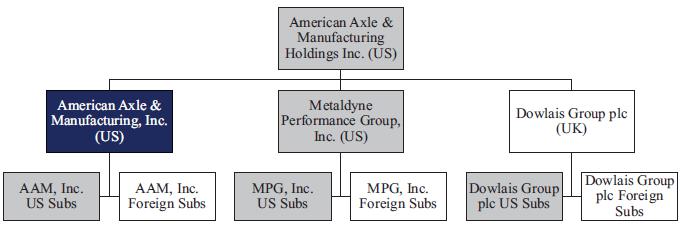
Pro forma organizational chart
The following chart provides a summary of our simplified corporate structure, as of June 30, 2025 on a pro forma as adjusted basis to give effect to the Transactions. This chart is provided for illustrative purposes only, and does not represent all legal entities affiliated with, or all obligations of, the Combined Group and does not distinguish between direct and indirect ownership. For example, not all subsidiaries of the Combined Group are depicted and not all depicted subsidiaries are wholly-owned subsidiaries.
The following chart should be read in conjunction with the other more detailed information appearing elsewhere or incorporated by reference into this offering memorandum.
 |
Issuer of the existing notes and the notes offered hereby and borrower under the Credit Agreement |
 |
Guarantors of the existing notes and the notes offered hereby and the Credit Agreement (including subsidiaries of Dowlais that will become guarantors of the existing notes and the notes offered hereby and the Credit Agreement, and, in each case, subject to certain exceptions) |
Financing related to the combination
AAM Holdings expects to fund the cash portion of the consideration in connection with the Combination and related transactions costs using $843.0 million principal amount of borrowings under an incremental Tranche C Term Facility (as defined herein) under the Credit Agreement, the proceeds from this issuance of notes and cash on hand. See “Use of Proceeds.”
This offering of notes is not contingent upon the completion of the Combination. As a result, we cannot assure you that the Combination will be consummated or, if consummated, that it will be consummated for the price, within the timeframe or on the terms and with the anticipated benefits we currently expect. However, in the event the Combination is not completed, the entire principal amount of secured notes and $600 million aggregate principal amount of unsecured notes, will be subject to a special mandatory redemption. See “Description of Secured Notes—Escrow of proceeds; Special Mandatory Redemption” and “Description of Unsecured Notes—Escrow of proceeds; Special Mandatory Redemption.”
Credit agreement amendment
AAM Holdings and AAM Inc. are parties to an amended and restated credit agreement that was entered into on March 11, 2022 and has been subsequently amended by the Second Amendment, as defined below (as may be amended from time to time, the “Credit Agreement”) which provides for a term loan A facility (the “Term Loan A Facility”), term loan B facility (the “Term Loan B Facility”), the incremental tranche C term facility (the “Tranche C Term Facility”) and a multi-currency revolving credit facility (the “Revolving Credit Facility”).
On February 24, 2025, AAM Holdings and AAM Inc. entered into the Second Amendment to the Amended and Restated Credit Facility and the Incremental Facility Agreement (the “Second Amendment”). The Second Amendment, among other things, (i) increased the maximum under the Revolving Credit Facility from $925.0 million to $1,495.0 million, effective upon closing of the Combination, (ii) provided for an $843.0 million incremental Tranche C Term Facility in connection with the Combination and (iii) extended the maturity of the Revolving Credit Facility and Term Loan A Facility for five years from the date of the Second Amendment, resetting for another five years upon the closing of the Combination.
Bridge facilities
On January 29, 2025, in connection with the announcement of the Combination, AAM Holdings and AAM Inc. entered into a First Lien Bridge Credit Agreement (the “First Lien Bridge Facility”), and a Second Lien Bridge Credit Agreement (the “Second Lien Bridge Facility” and together with the First Lien Bridge Facility, the “Bridge Facilities”).
Additionally, in connection with entry into the Second Amendment, on February 24, 2025, AAM Holdings and AAM Inc. entered into (i) an Amended and Restated First Lien Bridge Credit Agreement which will provide us with a $843.0 million interim loan facility in connection with the Combination (the “Amended and Restated First Lien Bridge Credit Agreement”) and (ii) an Amended and Restated Second Lien Bridge Credit Agreement which will provide us with a $500.0 million interim loan facility in connection with the Combination (the “Amended and Restated Second Lien Bridge Credit Agreement”, and together with the Amended and Restated First Lien Bridge Credit Agreement, the “Bridge Credit Agreements”).
The amounts available under the Bridge Credit Agreements will be reduced by, among other things, the net proceeds we receive from this offering. We currently expect that the net proceeds of this offering, along with borrowings under our Credit Agreement and cash on hand, will be sufficient to fund the cash consideration of the Combination. While not anticipated, if and to the extent we do not receive sufficient net proceeds in this offering, we may be required to borrow additional amounts under our Credit Agreement or under the Bridge Credit Agreements in order to finance the Combination. The funding of the Bridge Credit Agreements is contingent upon the satisfaction of customary conditions the consummation of the Combination.
Certain of the initial purchasers are lenders under our Credit Agreement. In addition, certain of the initial purchasers and/or their affiliates provided the committed financing under the Bridge Credit Agreements. See “Plan of Distribution.”
Transactions related to the outstanding debt of Dowlais
Repayment of the Dowlais Credit Facilities
In connection with the closing of the Combination, we intend to repay in full all outstanding borrowings of Dowlais under its £100 million and €100 million term loans as well as its £350 million, $660 million and €450 million revolving credit facilities (collectively, the “Dowlais Credit Facilities”) and to pay related fees, expenses and premiums. Following such repayment, the Dowlais Credit Facilities will be terminated. As of June 30, 2025, the aggregate principal amount outstanding under the Dowlais Credit Facilities was $1.29 billion (based on the exchange rate included in this offering memorandum. See “Basis of Presentation”).
Change of control offer for the Dowlais Notes
Following the closing of the Combination, AAM will be required to make a change of control offer for the outstanding Dowlais Notes (the “Dowlais Notes Change of Control Offer”). Pursuant to the terms of the note purchase agreement governing the Dowlais Notes (the “Note Purchase Agreement”), the consummation of the Combination will constitute a “Change of Control.” Under the terms of the Note Purchase Agreement, the holders of the Dowlais Notes will have the right to require Dowlais to repurchase all of the holders’ Dowlais Notes at a purchase price equal to 100% of the principal amount of the applicable Dowlais Notes, plus accrued and unpaid interest thereon to the repurchase date. Pursuant to the terms of the Note Purchase Agreement, the Dowlais Notes Change of Control Offer will be made within 15 business days after the closing of the Combination and the repurchase date will be not less than 30 days and not more than 60 days after the date on which we make the Dowlais Notes Change of Control Offer to the holders of the Dowlais Notes.
As of June 30, 2025, Dowlais had the following outstanding notes: (i) 5.77%. Series A Senior Notes due 2029, having the aggregate outstanding principal amount of $145,000,000, (ii) 5.97% Series B Senior Notes due 2031, having the aggregate outstanding principal amount of $48,000,000, (iii) 6.07% Series C Senior Notes due 2032, having the aggregate outstanding principal amount of $100,000,000, (iv) 6.26% Series D Senior Notes due 2034, having the aggregate outstanding principal amount of $102,000,000 and (v) 6.36% Series E Senior Notes due 2036, having the aggregate outstanding principal amount of $105,000,000, in each case, issued by GKN Industries Limited, a subsidiary of Dowlais, and guaranteed by Dowlais and certain of its subsidiaries (collectively, the “Dowlais Notes”). As of June 30, 2025, Dowlais had $500 million of Dowlais Notes outstanding.
The decision as to whether to tender the Dowlais Notes in the Dowlais Notes Change of Control Offer will be made by each holder of Dowlais Notes at their discretion and for this reason, we cannot accurately predict the outcome of the Dowlais Notes Change of Control Offer. Any remaining proceeds not used to fund the Dowlais Notes Change of Control Offer will be used for general corporate purposes, which may include, among other things, repayment of debt.
Transfer of U.S. subsidiaries of Dowlais to AAM and the related disposal offer
Following the closing of the Combination, Dowlais will consider selling to AAM all U.S. subsidiaries of Dowlais at fair value of the subsidiaries (the “Disposal”). AAM expects to fund the Disposal with cash on hand and, if needed, borrowings under the Revolving Credit Facility.
In accordance with the terms of the Notes Purchase Agreement, if this transaction occurs, Dowlais will be required to make a disposal offer (the “Disposal Offer”) to the holders of the Dowlais Notes to repurchase the Dowlais Notes with the net proceeds (defined as cash consideration for the Disposal less payments of certain expenses, taxes and pension contributions) from the Disposal, at a purchase price equal to 100% of the principal amount of the applicable Dowlais Notes, plus accrued and unpaid interest thereon to the repurchase date. The Disposal Offer would be made concurrently with the Dowlais Notes Change of Control Offer and Dowlais would repurchase any Dowlais Notes tendered pursuant to the Disposal Offer concurrently with the Dowlais Notes tendered for repurchase in connection with the Dowlais Notes Change of Control Offer.
The decision as to whether to tender the Dowlais Notes in the Disposal Offer will be made by each holder of Dowlais Notes at their discretion and for this reason, we cannot accurately predict the outcome of the Disposal Offer.
The completion of the Dowlais Notes Change of Control Offer or the Disposal Offer will not be a condition to closing of the Combination.
The notes will be structurally subordinated to any Dowlais Notes that remain outstanding following completion of the Dowlais Notes Change of Control Offer and the Disposal Offer. See “Risk Factors—If the Dowlais Notes Change of Control Offer and the Disposal Offer are not fully accepted, the notes will be structurally subordinated to the Dowlais Notes.”
Certain of the initial purchasers or their affiliates may be lenders under the Dowlais Credit Facilities or owners of the Dowlais Notes, in which case such initial purchasers or their affiliates may receive a portion of the net proceeds of this offering in connection with the repayment in full or in part of amounts outstanding under the Dowlais Credit Facilities or the Dowlais Notes following the Dowlais Notes Change of Control Offer (to the extent any such notes are tendered in the Dowlais Notes Change of Control Offer). See “Plan of Distribution.”
Escrow arrangements
The issuance of the notes may occur prior to the date on which a copy of the Court Order sanctioning the Scheme is duly filed on behalf of Dowlais with the Registrar of Companies in England and Wales and the Scheme becomes effective in accordance with section 899 of the Companies Act 2006 (the “Scheme Effective Date”). If so, on the issue date, pending the occurrence of the Scheme Effective Date, AAM Inc. will deposit into segregated escrow accounts for each of the secured notes and the unsecured notes (i) an amount of cash equal to (1) in the case of the escrow account for the secured notes, the gross proceeds from the sale of such series of secured notes in this offering and (2) in the case of the escrow account for the unsecured notes, the gross proceeds from $600 million aggregate principal amount of unsecured notes and (ii) an amount of cash equal to (1) in the case of the escrow account for the secured notes, the amount of interest that would accrue on the secured notes from and including the issue date to, but excluding October 31, 2025 and (2) in the case of the escrow account for the unsecured notes, the amount of interest that would accrue on $600 million aggregate principal amount of unsecured from and including the issue date to, but excluding October 31, 2025. Prior to the release of the proceeds from escrow, the respective escrow accounts and the funds therein will be pledged on a first- priority basis as collateral for the benefit of holders of the applicable series of notes. If neither the Escrow Release Date nor a special mandatory redemption has previously occurred, no later than three business days prior to the end of each month (commencing October 31, 2025) and ending with the Escrow Outside Date (as defined herein), AAM Inc. will deposit (or cause to be deposited) in each escrow account an amount of additional cash equal to the interest that would accrue on the applicable series of notes from and including the last day of the then-current month to, but excluding, the last day of the next succeeding month.
Upon delivery to the escrow agent, the Secured Notes Trustee (as defined herein) and the Unsecured Notes Trustee (as defined herein) of an officer’s certificate instructing the escrow agent to release the escrowed funds and certifying that (1) all conditions precedent to the Combination have been satisfied or waived in accordance with the terms of the Scheme documents as in effect on the date of this offering memorandum, without amendment or waiver in a manner that would be materially adverse to the holders of the secured notes, other than (A) the payment of the consideration to be paid for the Combination for which the escrowed funds are required (but subject to the payment of such consideration using the escrowed funds), and (B) such other conditions precedent that by their nature are to be satisfied at the time of completion of the Combination (but subject to the satisfaction or waiver of such conditions); (2) the Scheme Effective Date has occurred or substantially concurrently with the release of the escrowed funds will occur and (3) no Default or Event of Default has occurred and is continuing at the time of, or immediately after giving effect to, the Combination (clauses (1), (2) and (3), collectively, the “Escrow Conditions”), the escrowed funds will be released to AAM Inc. See “Description of Secured Notes—Escrow of proceeds; Special Mandatory Redemption” and “Description of Unsecured Notes—Escrow of proceeds; Special Mandatory Redemption.” In addition, if the Escrow Conditions are satisfied, a deferred discount will be paid to the initial purchasers in connection with this offering.
If the Escrow Conditions are not satisfied on or prior to the later of (i) June 29, 2026 and (ii) such later date (if any) as AAM Holdings and Dowlais may agree to extend the “Long Stop Date” (as defined in the Co-operation Agreement in accordance with the Co-operation Agreement) (such later date, the “Escrow Outside Date”), or such earlier date if AAM Inc. determines in its sole discretion that the Escrow Conditions cannot be satisfied or AAM Inc. notifies the escrow agent, the Secured Notes Trustee and the Unsecured Notes Trustee in writing that AAM Inc. will not pursue the consummation of the Combination and/or the Scheme lapses or is terminated (such earliest date, the “Special Termination Date”), AAM Inc. will be required to redeem all of the outstanding secured notes and $600 million aggregate principal amount of the unsecured notes on the third business day thereafter at a price equal to 100% of the initial issue price of such notes, together with accrued and unpaid interest on such notes, if any, to, but excluding, the date of such special mandatory redemption. Escrowed funds would be released and applied to pay for any such redemption. See “Description of Secured Notes—Escrow of proceeds; Special Mandatory Redemption” and “Description of Unsecured Notes—Escrow of proceeds; Special Mandatory Redemption.”
If the issuance of the notes occurs on or after the Scheme Effective Date, none of the escrow provisions described in this offering memorandum will be applicable, no proceeds of this offering will be deposited into the escrow accounts and all such proceeds will be provided to AAM Inc. on the issue date for use as described under “Use of Proceeds.” We may elect to increase the amount of unsecured notes being offered hereby in order to fund the redemption or other repayment in full of our outstanding unsecured 6.50% Senior Notes due 2027 and related fees and expenses, in which case we would expect to increase the offering size of the unsecured notes by approximately $500 million to $1.1 billion. Even if more than $600 million aggregate principal amount of unsecured notes is issued in this offering, the special mandatory redemption provisions described herein will only apply to $600 million aggregate principal amount of unsecured notes and the amount of proceeds from the unsecured notes that is deposited into escrow upon issuance will remain equal to the gross proceeds of $600 million aggregate principal amount of unsecured notes. See “Risk Factors—Risks Related to the Unsecured Notes—If we issue more than $600 million aggregate principal amount of unsecured notes in this offering, the special mandatory redemption provisions will only apply to $600 million aggregate principal amount of unsecured notes and will not apply to the entire aggregate principal amount of the unsecured notes.” and “Description of Notes—Escrow of Proceeds; Special Mandatory Redemption.”
References in this offering memorandum to the “Escrow Release Date” refer to (i) the issue date, if this offering closes on or after the Scheme Effective Date and (ii) otherwise, the date of release of the escrowed notes proceeds from escrow.
Sources and uses of funds
The following table sets forth the estimated sources and uses of funds in connection with the Transactions. The actual sources and uses of funds may vary from the estimated sources and uses of funds set forth below. The estimated sources and uses of funds presented below should be read in conjunction with the other information included or incorporated by reference herein, including “—The Transactions,” “Use of Proceeds,” “Capitalization” and “Unaudited Pro Forma Condensed Combined Financial Statements.”
| Sources of funds | Amount | |||
| (millions) | ||||
| Secured notes offered hereby(1) | $ | 843 | ||
| Unsecured notes offered hereby(2) | 600 | |||
| Incremental Tranche C Term Facility(3) | 843 | |||
| Total Sources | $ | 2,286 | ||
| Use of funds | Amount | |||
| (millions) | ||||
| Cash consideration for Combination(4) | $ | 717 | ||
| Refinancing of Dowlais Credit Facilities(5) | 920 | |||
| Estimated fees and expenses(6) | 340 | |||
| Cash to balance sheet | 309 | |||
| Total Uses(7) | $ | 2,286 | ||
(1) Represents the aggregate principal amount of secured notes offered hereby. Assumes the secured notes are issued at par.
(2) Represents the aggregate principal amount of unsecured notes offered hereby. Assumes the unsecured notes are issued at par.
(3) On February 24, 2025, AAM Holdings and AAM Inc. entered into the Second Amendment to the Amended and Restated Credit Facility and the Incremental Facility Agreement which, among other things, provided for an $843.0 million incremental Tranche C Term Facility in connection with the Combination.
(4) Reflects our estimate of the total cash consideration to be paid to holders of all issued and outstanding ordinary shares of Dowlais pursuant to the Offer.
(5) Reflects our estimate of amounts necessary to repay in full all outstanding borrowings under the Dowlais Credit Facilities and to pay related fees, expenses and premiums. Reflects the net debt of Dowlais as of June 30, 2025 (calculated as $1.29 billion outstanding under the Dowlais Credit Facilities less cash and cash equivalents of Dowlais).
(6) Represents our estimate of fees and expenses associated with the Transactions, including financing fees, original issue discounts, initial purchaser discounts, legal, advisory and professional fees and other transaction costs, such as printing and rating agency fees. To the extent any refinancing fees, original issue discounts and other fees and expenses exceed the estimated amounts, we expect to fund such amounts with cash on our balance sheet at the closing of the Transactions.
(7) We intend to use the net proceeds from this offering, together with cash on hand, to fund the Dowlais Notes Change of Control Offer for outstanding Dowlais Notes. However, the decision as to whether to tender the Dowlais Notes in the Dowlais Notes Change of Control Offer will be made by each holder of Dowlais Notes at their discretion and for this reason, we cannot accurately predict the outcome of the Dowlais Notes Change of Control Offer. For purposes of the table above, we have assumed that none of the Dowlais Notes will be tendered in the Dowlais Notes Change of Control Offer, and that none of the sources of funds will be used to fund the Dowlais Notes Change of Control Offer. To the extent any Dowlais Notes are tendered in the Dowlais Notes Change of Control Offer, we intend to use the amount shown above as “Cash to balance sheet” and, if needed, cash on hand to fund the Dowlais Notes Change of Control Offer. See “Use of Proceeds.”
On an actual basis and without giving effect to any of the Transactions (and, for the avoidance of doubt, excluding Dowlais and its subsidiaries), the non-guarantor Subsidiaries:
| · | as of June 30, 2025, had approximately $23.8 million of outstanding indebtedness and approximately $862.5 million of other liabilities (including trade payables); |
| · | for the six-months ended June 30, 2025, accounted for approximately $854.1 million, or 29%, of AAM Holdings’ consolidated total revenue, and approximately $77.2 million, or 79%, of AAM Holdings’ consolidated operating income; |
| · | for the year ended December 31, 2024, accounted for approximately $1.8 billion, or 30%, of AAM Holdings’ consolidated total revenue, and approximately $167.5 million, or 69%, of AAM Holdings’ consolidated operating income; and |
| · | as of June 30, 2025, had approximately $1.6 billion, or 30%, of AAM Holdings’ consolidated total assets, and $886.3 million, or 19%, of AAM Holdings’ consolidated total liabilities. |
On a pro forma as adjusted basis to give effect to the Transactions on the assumptions described in “Capitalization,” the non-guarantor Subsidiaries (including Dowlais and the subsidiaries of Dowlais that will not become Subsidiary Guarantors after the Scheme Effective Date):
| · | as of June 30, 2025, would have had approximately $524 million of outstanding indebtedness (including the Dowlais Notes) and approximately $2.7 billion of other liabilities (including trade payables); |
| · | for the six-months ended June 30, 2025, would have accounted for approximately $2.6 billion, or 45%, of AAM Holdings’ consolidated total revenue, and approximately $69 million, or 56%, of AAM Holdings’ consolidated operating income; |
| · | for the year ended December 31, 2024, would have accounted for approximately $5.2 billion, or 45%, of AAM Holdings’ consolidated total revenue, and approximately $30 million, or 31%, of AAM Holdings’ consolidated operating income; and |
| · | as of June 30, 2025, would have had approximately $6 billion, or 53%, of AAM Holdings’ consolidated total assets, and $3.3 billion, or 33%, of AAM Holdings’ consolidated total liabilities. |
AAM Holdings summary historical and pro forma consolidated financial data
The summary consolidated financial data of AAM Holdings for each of the years ended December 31, 2024, 2023 and 2022 and as of December 31, 2024 and 2023 have been derived from our audited consolidated financial statements included in our Annual Report on Form 10-K for the year ended December 31, 2024, which is incorporated by reference herein. The balance sheet data of AAM Holdings presented as of December 31, 2022 has been derived from AAM Holdings’ audited consolidated financial statements not incorporated by reference herein.
The summary consolidated financial data for AAM Holdings for the six months ended June 30, 2025 and 2024 have been derived from our unaudited consolidated financial statements incorporated by reference in this offering memorandum. The balance sheet data of AAM Holdings presented as of June 30, 2024 has been derived from AAM Holdings’ unaudited consolidated financial statements not incorporated by reference herein. The unaudited consolidated financial statements have been prepared on the same basis as the audited consolidated financial statements and, in the opinion of management, include all adjustments, consisting of normal recurring adjustments, necessary for a fair statement of the results for those periods.
The unaudited pro forma combined information for the twelve months ended June 30, 2025 gives effect to the Combination as if it had occurred on January 1, 2024. The unaudited pro forma condensed combined financial statements are based on the historical consolidated financial statements of AAM Holdings and Dowlais. The unaudited pro forma condensed combined financial statements reflect pro forma adjustments for: (i) reclassifications resulting from differences in AAM and Dowlais’ accounting policies or changes to financial statement presentation to conform the financial statements of AAM and Dowlais; (ii) adjustments to Dowlais financial statements for differences in accounting treatment and/or financial statement presentation between IFRS and GAAP; and (iii) to reflect the Combination and estimated transaction and financing costs anticipated to be incurred in connection with the Combination. The unaudited pro forma condensed combined statement of income for the twelve months ended June 30, 2025 has been calculated by subtracting the unaudited pro forma condensed consolidated statement of income data for the six months ended six months ended June 30, 2024 from the unaudited pro forma condensed combined statement of income for the twelve months ended December 31, 2024, and adding the unaudited pro forma condensed combined statement of income data for the six months ended June 30, 2025. The summary unaudited pro forma consolidated financial information is presented for illustrative purposes only and is not necessarily indicative of what the actual consolidated results of operations would have been had the Combination and related financings been completed on the date indicated or what such results would be for future periods. The summary historical and unaudited pro forma consolidated financial data presented below should be read in conjunction with the other information included or incorporated by reference herein, including the information included under the headings “The Transactions,” “Dowlais Summary Consolidated Financial Data,” “Capitalization,” “Unaudited Pro Forma Condensed Combined Financial Statements,” “Management’s Discussion and Analysis of Financial Condition and Results of Operations of Dowlais” as well as “Management’s Discussion and Analysis of Financial Condition and Results of Operations” in AAM Holdings’ Annual Report on Form 10-K for the fiscal year ended December 31, 2024 and Quarterly Report on Form 10-Q for the fiscal quarter ended June 30, 2025, which are incorporated by reference herein, and the audited consolidated financial statements and the unaudited consolidated financial statements and related notes thereto included or incorporated by reference in this offering memorandum.
| Pro forma | Historical | |||||||||||||||||||||||
| Twelve months ended June 30, |
Six months ended June 30, |
Twelve months ended December 31, |
||||||||||||||||||||||
|
(in millions, except per share data) |
2025 | 2025 | 2024 | 2024 | 2023 | 2022 | ||||||||||||||||||
| unaudited | unaudited | |||||||||||||||||||||||
| Statement of income data: | ||||||||||||||||||||||||
| Net sales | $ | 11,242.7 | $ | 2,947.5 | $ | 3,239.2 | $ | 6,124.9 | $ | 6,079.5 | $ | 5,802.4 | ||||||||||||
| Gross profit | 1,420.9 | 374.6 | 415.8 | 741.4 | 624.3 | 704.9 | ||||||||||||||||||
| Selling, general and administrative expenses | 856.5 | 191.7 | 203.5 | 387.1 | 366.9 | 345.1 | ||||||||||||||||||
| Impairment charge | 30.0 | 8.0 | — | 12.0 | — | — | ||||||||||||||||||
| Restructuring and acquisition-related costs | 237.5 | 36.2 | 7.5 | 18.0 | 25.2 | 30.2 | ||||||||||||||||||
| Operating income | 179.2 | 97.7 | 163.5 | 241.4 | 146.6 | 243.9 | ||||||||||||||||||
| Net interest expense | (343.0 | ) | (74.8 | ) | (82.5 | ) | (157.9 | ) | (175.5 | ) | (157.5 | ) | ||||||||||||
| Net income (loss) | (29.1 | ) | 46.4 | 38.7 | 35.0 | (33.6 | ) | 64.3 | ||||||||||||||||
| Diluted earnings (loss) per share | (0.12 | ) | $ | 0.38 | $ | 0.32 | $ | 0.29 | $ | (0.29 | ) | $ | 0.53 | |||||||||||
| Balance sheet data (at period end): | ||||||||||||||||||||||||
| Cash and cash equivalents | $ | 962.5 | $ | 586.5 | $ | 519.9 | $ | 552.9 | $ | 519.9 | $ | 511.5 | ||||||||||||
| Total assets | 11,398.3 | 5,273.6 | 5,336.7 | 5,059.9 | 5,356.3 | 5,469.4 | ||||||||||||||||||
| Long-term debt, net | 5,380.9 | 2,599.8 | 2,694.8 | 2,576.9 | 2,751.9 | 2,845.1 | ||||||||||||||||||
| Total stockholders’ equity | 1,394.4 | 673.0 | 609.6 | 562.8 | 604.9 | 627.3 | ||||||||||||||||||
| Statement of cash flows data: | ||||||||||||||||||||||||
| Net cash provided by operating activities | $ | 580.2 | $ | 147.8 | $ | 160.6 | $ | 455.4 | $ | 396.1 | $ | 448.9 | ||||||||||||
| Net cash used in investing activities | (98.6 | ) | (94.9 | ) | (254.8 | ) | (184.5 | ) | (243.0 | ) | ||||||||||||||
| Net cash used in financing activities | (30.0 | ) | (58.5 | ) | (156.2 | ) | (205.5 | ) | (217.2 | ) | ||||||||||||||
| Other data: | ||||||||||||||||||||||||
| Depreciation and amortization | $ | 844.8 | $ | 225.7 | $ | 237.4 | $ | 469.7 | $ | 487.2 | $ | 492.1 | ||||||||||||
| Purchases of property, plant and equipment | (520.0 | ) | (126.6 | ) | (96.8 | ) | (248.0 | ) | (194.6 | ) | (171.4 | ) | ||||||||||||
| Proceeds from government grants | — | — | 2.0 | 2.0 | — | — | ||||||||||||||||||
| Purchase buyouts of leases | $ | (3.1 | ) | (3.5 | ) | (1.9 | ) | (3.1 | ) | (2.1 | ) | (4.0 | ) | |||||||||||
EBITDA and adjusted EBITDA(a)
| Pro forma | Historical | |||||||||||||||||||||||
| Twelve months ended June 30, |
Six months ended June 30, |
Twelve months ended December 31, |
||||||||||||||||||||||
|
(in millions, except percentages) |
2025 | 2025 | 2024 | 2024 | 2023 | 2022 | ||||||||||||||||||
| Net income (loss) | $ | (29.1 | ) | $ | 46.4 | $ | 38.7 | $ | 35.0 | $ | (33.6 | ) | $ | 64.3 | ||||||||||
| Net Income Margin (% of net sales) | (0.3 | )% | 1.6 | % | 1.2 | % | 0.6 | % | (0.6 | )% | 1.1 | % | ||||||||||||
| Interest expense | 400.9 | 86.0 | 96.9 | 186.0 | 201.7 | 174.5 | ||||||||||||||||||
| Income tax expense | 25.8 | 42.1 | 33.1 | 27.8 | 9.1 | 2.0 | ||||||||||||||||||
| Depreciation and amortization | 844.8 | 225.7 | 237.4 | 469.7 | 487.2 | 492.1 | ||||||||||||||||||
| EBITDA | 1,242.4 | $ | 400.2 | $ | 406.1 | $ | 718.5 | $ | 664.4 | $ | 732.9 | |||||||||||||
| Restructuring and acquisition-related costs | 237.5 | 36.2 | 7.5 | 18.0 | 25.2 | 30.2 | ||||||||||||||||||
| Debt refinancing and redemption costs | 3.6 | 3.3 | 0.3 | 0.6 | 1.3 | 6.4 | ||||||||||||||||||
| Gain on Business Combination Derivative | (68.2 | ) | (68.2 | ) | — | — | — | — | ||||||||||||||||
| Impairment charge | 30.0 | 8.0 | — | 12.0 | — | — | ||||||||||||||||||
| Loss on equity securities | — | — | 0.1 | 0.1 | 1.1 | 25.5 | ||||||||||||||||||
| Pension curtailment and settlement charges | — | — | — | — | 1.3 | — | ||||||||||||||||||
| Non-recurring items: | ||||||||||||||||||||||||
| Malvern Fire insurance recoveries, net of charges | — | — | — | — | — | (39.1 | ) | |||||||||||||||||
| Gain on bargain purchase of business | — | — | — | — | — | (13.6 | ) | |||||||||||||||||
| Acquisition-related fair value inventory adjustment | — | — | — | — | — | 5.0 | ||||||||||||||||||
| Adjusted EBITDA | $ | 1,445.3 | $ | 379.5 | $ | 414.0 | $ | 749.2 | $ | 693.3 | $ | 747.3 | ||||||||||||
| Adj. EBITDA Margin (% of net sales) | 12.9 | % | 12.9 | % | 12.8 | % | 12.2 | % | 11.4 | % | 12.9 | % | ||||||||||||
| Capital Expenditures | $ | 520.0 | $ | 126.6 | $ | 96.8 | $ | 248.0 | $ | 194.6 | $ | 171.4 | ||||||||||||
(a) We define EBITDA to be earnings before interest expense, income taxes, depreciation and amortization. Adjusted EBITDA is defined as EBITDA excluding the impact of restructuring and acquisition-related costs, debt refinancing and redemption costs, gains or losses on the derivative associated with the Combination, gains or losses on equity securities, pension curtailment and settlement charges, impairment charges and non-recurring items. We believe that EBITDA and Adjusted EBITDA are meaningful measures of performance as they are commonly utilized by management and investors to analyze operating performance and entity valuation. Our management, the investment community and banking institutions routinely use EBITDA and Adjusted EBITDA, together with other measures, to measure our operating performance relative to other Tier 1 automotive suppliers and to assess the relative mix of Adjusted EBITDA by segment. We also believe that Adjusted EBITDA is a meaningful measure as it is used for operational planning and decision-making purposes. EBITDA and Adjusted EBITDA are also key metrics used in our calculation of incentive compensation. These non-GAAP financial measures are not and should not be considered a substitute for, and should not be considered in isolation from, any GAAP measure. Additionally, non-GAAP financial measures as presented by us may not be comparable to similarly titled measures reported by other companies.
Free cash flow and adjusted free cash flow(a)
| Historical | ||||||||||||||||||||
| Six Months Ended June 30, |
Twelve Months Ended December 31, |
|||||||||||||||||||
| (in millions, except percentages) | 2025 | 2024 | 2024 | 2023 | 2022 | |||||||||||||||
| Net cash provided by operating activities | $ | 147.8 | $ | 160.6 | $ | 455.4 | $ | 396.1 | $ | 448.9 | ||||||||||
| Less: Capital expenditures net of proceeds from the sale of property, plant and equipment and from government grants | (121.6 | ) | (91.5 | ) | (242.0 | ) | (193.7 | ) | (166.7 | ) | ||||||||||
| Free Cash Flow | $ | 26.2 | $ | 69.1 | $ | 213.4 | $ | 202.4 | $ | 282.2 | ||||||||||
| Cash payments for restructuring and acquisition- related costs | 18.6 | 7.4 | 16.9 | 23.6 | 27.8 | |||||||||||||||
| Insurance proceeds related to Malvern fire, net | — | — | — | (7.0 | ) | 3.0 | ||||||||||||||
| Adjusted Free Cash Flow | $ | 44.8 | $ | 76.5 | $ | 230.3 | $ | 219.0 | $ | 313.0 | ||||||||||
(a) We define Free Cash Flow to be net cash provided by operating activities less capital expenditures net of proceeds from the sale of property, plant and equipment. Adjusted Free Cash Flow is defined as Free Cash Flow excluding the impact of cash payments for restructuring and acquisition-related costs and cash payments related to the Malvern fire, including payments for capital expenditures, net of recoveries. We believe Free Cash Flow and Adjusted Free Cash Flow are meaningful measures as they are commonly utilized by management and investors to assess our ability to generate cash flow from business operations to repay debt and return capital to our stockholders. Free Cash Flow and Adjusted Free Cash Flow are also key metrics used in our calculation of incentive compensation. These non-GAAP financial measures are not and should not be considered a substitute for, and should not be considered in isolation from, any GAAP measure. Additionally, non-GAAP financial measures as presented by us may not be comparable to similarly titled measures reported by other companies.
Dowlais summary historical consolidated financial data
The summary consolidated financial data of Dowlais for each of the years ended December 31, 2024 and 2023 and as of December 31, 2024 and 2023 have been derived from the audited consolidated financial statements included in this offering memorandum.
The summary consolidated financial data for Dowlais for the six months ended June 30, 2025 and 2024 have been derived from its unaudited consolidated financial statements included in this offering memorandum. The unaudited consolidated financial statements have been prepared on the same basis as the audited consolidated financial statements and, in the opinion of management of Dowlais, include all adjustments, consisting of normal recurring adjustments, necessary for a fair statement of the results for those periods.
The summary historical consolidated financial data presented below should be read in conjunction with the other information included or incorporated by reference herein, including the information included under the headings “The Transactions,” “AAM Holdings Summary Historical and Pro Forma Consolidated Financial Data,” “Capitalization,” “Unaudited Pro Forma Condensed Combined Financial Statements,” “Management’s Discussion and Analysis of Financial Condition and Results of Operations of Dowlais” as well as “Management’s Discussion and Analysis of Financial Condition and Results of Operations” in AAM Holdings’ Annual Report on Form 10-K for the fiscal year ended December 31, 2024 and Quarterly Report on Form 10-Q for the fiscal quarter ended June 30, 2025, which are incorporated by reference herein, and the audited consolidated financial statements and the unaudited consolidated financial statements and related notes thereto included or incorporated by reference in this offering memorandum.
| Historical | ||||||||||||||
| Six months ended June 30, |
Twelve months ended December 31, |
|||||||||||||
| (in millions, except per share data) | 2025 | 2024 | 2024 | 2023 | ||||||||||
| unaudited | ||||||||||||||
| Statement of income data: | ||||||||||||||
| Revenue | £ | 2,181 | £ | 2,289 | £ | 4,337 | £ | 4,864 | ||||||
| Cost of sales | (1,866 | ) | (1,943 | ) | (3,691 | ) | (4,107 | ) | ||||||
| Gross profit | 315 | 346 | 646 | 757 | ||||||||||
| Selling, general and administrative expenses | (300 | ) | (432 | ) | (813 | ) | (1,258 | ) | ||||||
| Operating profit/(loss) | 15 | (86 | ) | (167 | ) | (501 | ) | |||||||
| Share of results of equity accounted investments, net of tax | 31 | 29 | 61 | 51 | ||||||||||
| Finance costs | (58 | ) | (68 | ) | (131 | ) | (101 | ) | ||||||
| Finance income | 6 | 2 | 22 | 29 | ||||||||||
| Loss after tax for the period | (11 | ) | (98 | ) | (168 | ) | (495 | ) | ||||||
| Earnings per share – Diluted | (1.1 | )p | (7.3 | )p | (12.6 | )p | (36.0 | )p | ||||||
| Balance sheet data (at period end): | ||||||||||||||
| Cash and cash equivalents | £ | 325 | £ | 336 | £ | 313 | ||||||||
| Total assets | 5,538 | 5,707 | 6,251 | |||||||||||
| Interest-bearing loans and borrowings | 1,359 | 1,304 | 1,160 | |||||||||||
| Total equity | 2,167 | 2,305 | 2,583 | |||||||||||
| Historical | ||||||||||||||||
| Six months ended June 30, |
Twelve
months ended December 31, |
|||||||||||||||
| (in millions, except per share data) | 2025 | 2024 | 2024 | 2023 | ||||||||||||
| unaudited | ||||||||||||||||
| Statement of cash flows data: | ||||||||||||||||
| Net cash from operating activities | £ | 11 | £ | 35 | £ | 120 | £ | 239 | ||||||||
| Net cash used in investing activities | (51 | ) | (29 | ) | (119 | ) | (194 | ) | ||||||||
| Net cash from/(used in) financing activities | 5 | (16 | ) | 17 | 23 | |||||||||||
| Other data: | ||||||||||||||||
| Depreciation & impairment of property, plant and equipment | £ | 120 | £ | 132 | £ | 275 | £ | 253 | ||||||||
| Amortisation & impairment of intangible assets acquired in business combinations | 92 | 96 | 191 | 646 | ||||||||||||
Adjusted revenue, adjusted operating profit, adjusted EBITDA, free cash flow and adjusted free cash flow(a)
| Six months ended June 30, |
Twelve months ended December 31, |
|||||||||||||||
| (in millions) | 2025 | 2024 | 2024 | 2023 | ||||||||||||
| Revenue | £ | 2,181 | £ | 2,285 | £ | 4,337 | £ | 4,864 | ||||||||
| Share of revenue of equity accounted investments | 283 | 282 | 600 | 625 | ||||||||||||
| Adjusted Revenue | £ | 2,464 | £ | 2,571 | £ | 4,937 | £ | 5,489 | ||||||||
| Operating profit (loss) | 15 | (86 | ) | (167 | ) | (501 | ) | |||||||||
| Amortization of intangible assets acquired in business combinations | 92 | 96 | 191 | 197 | ||||||||||||
| Restructuring Costs | 36 | 49 | 145 | 120 | ||||||||||||
| AAM combination costs | 16 | — | — | — | ||||||||||||
| Movement in derivatives and associated financial assets and liabilities |
(49 | ) | 35 | 71 | (16 | ) | ||||||||||
| Equity accounted investment adjustments | 44 | 43 | 89 | 81 | ||||||||||||
| Impairment of assets | — | 10 | 10 | — | ||||||||||||
| Business disposal related losses | — | — | 8 | — | ||||||||||||
| Litigation costs | — | 3 | 3 | — | ||||||||||||
| Demerger costs | — | 1 | 1 | 42 | ||||||||||||
| Impairment of goodwill | — | — | — | 449 | ||||||||||||
| Net release of certain fair value items | — | — | (27 | ) | (17 | ) | ||||||||||
| Adjusted Operating Profit | £ | 154 | £ | 151 | £ | 324 | £ | 355 | ||||||||
| Adjusted depreciation of property, plant and equipment and amortization of computer software and development costs | 137 | 140 | 276 | 284 | ||||||||||||
| Adjusted EBITDA | £ | 291 | £ | 291 | £ | 600 | £ | 639 | ||||||||
| Net cash from operating activities | 11 | 35 | 120 | 239 | ||||||||||||
| Net cash used in investing activities | (51 | ) | (29 | ) | (119 | ) | (194 | ) | ||||||||
| Free Cash Flow | £ | (40 | ) | £ | 6 | £ | 1 | £ | 45 | |||||||
| Demerger LTIP payments(b) | — | 3 | 3 | 37 | ||||||||||||
| Six months ended June 30, |
Twelve months ended December 31, |
|||||||||||||||
| (in millions) | 2025 | 2024 | 2024 | 2023 | ||||||||||||
| Other cash demerger items(c) | 4 | 1 | 1 | 11 | ||||||||||||
| Cash spend on AAM combination | 7 | — | — | — | ||||||||||||
| Cash on disposal of business | — | — | 10 | — | ||||||||||||
| Adjusted Free Cash Flow | £ | (29 | ) | £ | 10 | £ | 15 | £ | 93 | |||||||
| Capital Expenditures(d) | £ | 67 | £ | 113 | £ | 237 | £ | 262 | ||||||||
(a) Dowlais defines Adjusted Revenue as external revenue including Dowlais’ share of revenue of equity accounted investments. Dowlais defines Adjusted Operating Profit as operating profit excluding items which are significant in size or volatility or by nature are non-trading or non-recurring and including the adjusted operating profit of equity accounted investments. Dowlais defines Adjusted EBITDA as Adjusted Operating Profit after adding back depreciation and impairment of property, plant and equipment and amortization of computer software and development costs, including that of equity accounted investments. Dowlais defines Free Cash Flow as cash generated after accounting for all trading costs, restructuring, pension contributions, and tax payments, but before any cash flows associated with financing activities (i.e. net cash from operating and investing activities). Dowlais defines Adjusted Free Cash Flow as Free Cash Flow adjusted for cash flows related to its demerger from Melrose Industries PLC, cash spend on AAM combination and net cash on business disposals.
(b) Demerger LTIP payments relate to the cash payment of the divisional long-term incentive plans, which were put in place under management of Melrose Industries PLC and crystallised on demerger on April 20, 2023.
(c) Other cash demerger items in the current period relate to the payment of Real Estate Transfer Tax arising in Germany on the demerger from Melrose Industries PLC .
(d) Capital Expenditures are defined as additions to non-current assets including computer software and development costs, but excludinglease additions.
Capitalization
The following table sets forth our consolidated cash and cash equivalents and capitalization as of June 30, 2025 on (i) an actual basis and (ii) a pro forma as adjusted basis to give effect to the Transactions, including the borrowings under the Credit Agreement and the notes issued in this offering, on the assumptions described herein.
The historical balance sheet data in the “actual” column of the following table is derived from our unaudited consolidated financial statements incorporated by reference in this offering memorandum. The pro forma information presented in the “pro forma as adjusted” column below is derived from the “Unaudited Pro Forma Condensed Combined Financial Statements” that are included elsewhere in this offering memorandum, and has been adjusted to give effect to the Transactions on the assumptions described herein.
This table should be read in conjunction with the other information included or incorporated by reference herein, including under the headings “Presentation of Information,” “Summary—The Transactions,” “Use of Proceeds,” “Unaudited Pro Forma Condensed Combined Financial Statements” and “Management’s Discussion and Analysis of Financial Condition and Results of Operations of Dowlais,” Dowlais’ historical financial statements included in this offering memorandum and “Management’s Discussion and Analysis of Financial Condition and Results of Operations” and our historical financial statements included in our Annual Report on Form 10-K for the fiscal year ended December 31, 2024 and Quarterly Reports on Form 10-Q for the fiscal quarters ended March 31, 2025 and June 30, 2025, which are incorporated by reference herein.
Actual amounts may vary from the amounts included in the table below due to various factors, including, without limitation, the amount of our borrowings under the Credit Agreement at the closing of the Combination, the amount of borrowings outstanding under the Dowlais Credit Facilities at the closing of the Combination, the cash of AAM and Dowlais at the closing of the Combination, the amount of Dowlais Notes tendered in the Dowlais Notes Change of Control Offer and the accuracy of our estimates of fees and expenses. See “Use of Proceeds.”
| As of June 30, 2025 | ||||||||
| (Dollars in millions) | Actual | Pro forma as adjusted |
||||||
| Cash and cash equivalents(3) | $ | 586.5 | $ | |||||
| Long-term debt(1): | ||||||||
| Secured Revolving Credit Facility(2) | — | — | ||||||
| Secured Credit Agreement | ||||||||
| Term Loan A Facility | 484.3 | 484.3 | ||||||
| Term Loan B Facility | 648.0 | 648.0 | ||||||
| Tranche C Term Facility | — | 843.0 | ||||||
| Secured notes offered hereby | — | 843.0 | ||||||
| Unsecured 6.50% Senior Notes due 2027 | 500.0 | 500.0 | ||||||
| Unsecured 6.875% Senior Notes due 2028 | 400.0 | 400.0 | ||||||
| Unsecured 5.00% Senior Notes due 2029 | 600.0 | 600.0 | ||||||
| Dowlais Notes(3) | — | 500.0 | ||||||
| Unsecured notes offered hereby | — | 600.0 | ||||||
| Foreign and other debt agreements | 23.8 | 23.8 | ||||||
| Total long-term debt and capital lease obligations | 2,656.1 | 5,442.1 | ||||||
| As of June 30, 2025 | ||||||||
| (Dollars in millions) | Actual | Pro forma as adjusted |
||||||
| Stockholders’ equity: | ||||||||
| Common Stock; par value $.01 per share (Actual: 150.0 million shares authorized; 129.9 million shares issued; Pro Forma As Adjusted: 375.0 million shares authorized; 246.9 million shares issued) | 1.3 | 2.5 | ||||||
| Paid-in capital | 1,405.5 | 2,116.7 | ||||||
| Accumulated deficit | (201.8 | ) | (246.8 | ) | ||||
| Treasury stock at cost; (Actual: 11.3 million shares; Pro Forma As Adjusted: 11.3 million shares) |
(238.4 | ) | (238.4 | ) | ||||
| Accumulated other comprehensive loss, net of tax | (293.6 | ) | (293.6 | ) | ||||
| Noncontrolling interest in subsidiaries | — | 54.0 | ||||||
| Total stockholders’ equity | 673.0 | 1,394.4 | ||||||
| Total capitalization | $ | 3,329.1 | $ | 6,836.5 | ||||
(1) On January 29, 2025, in connection with the announcement of the Combination, AAM Holdings and AAM Inc. entered into the First Lien Bridge Facility and the Second Lien Bridge Facility. As of June 30, 2025, no amounts were outstanding under the Bridge Facilities. We currently expect that the net proceeds of this offering, along with borrowings under our Credit Agreement and cash on hand, will be sufficient to fund the cash consideration of the Combination. While not anticipated, if and to the extent we do not receive sufficient net proceeds in this offering, we may be required to borrow additional amounts under our Credit Agreement or under the Bridge Credit Agreements in order to finance the Combination.
(2) As of June 30, 2025, $897.1 million was available under the Revolving Credit Facility, which reflected a reduction of $27.9 million for standby letters of credit issued against the facility. As of June 30, 2025, after giving effect to the Transactions and the application of proceeds as described in “Use of Proceeds,” we would have had $1.5 billion available under the Revolving Credit Facility, which would reflect a reduction of $27.9 million for standby letters of credit issued against the facility.
(3) Pursuant to the terms of the Note Purchase Agreement, the Dowlais Notes Change of Control Offer will be made within 15 business days after the closing of the Combination and the repurchase date will be not less than 30 days and not more than 60 days after the date on which we make the Dowlais Notes Change of Control Offer to the holders of the Dowlais Notes. Pursuant to the terms of the Notes Purchase Agreement, if the Disposal occurs, Dowlais will be required to make the Disposal Offer to the holders of the Dowlais Notes to repurchase the Dowlais Notes with the net proceeds from the Disposal. If the Disposal occurs, Dowlais intends to make the Disposal Offer concurrently with the Dowlais Notes Change of Control Offer and repurchase any Dowlais Notes tendered pursuant to the Disposal Offer concurrently with the Dowlais Notes tendered for repurchase in connection with the Dowlais Notes Change of Control Offer. As of June 30, 2025, Dowlais had $500 million of Dowlais Notes outstanding and the fair value of the Dowlais Notes was $585 million. The decision as to whether to tender the Dowlais Notes in the Dowlais Notes Change of Control Offer or the Disposal Offer will be made by each holder of Dowlais Notes at their discretion and for this reason, we cannot accurately predict the outcome of the Dowlais Notes Change of Control Offer or the Disposal Offer. Any remaining proceeds not used to fund the Dowlais Notes Change of Control Offer will be used for general corporate purposes, which may include, among other things, repayment of debt. For purposes of the table above, we have assumed that none of the Dowlais Notes will be tendered in the Dowlais Notes Change of Control Offer or the Disposal Offer, and that none of the sources of funds will be used to fund the Dowlais Notes Change of Control Offer (and, accordingly, all such funds that may be used to fund the Dowlais Notes Change of Control Offer have been added to Cash and cash equivalents in the Pro Forma As Adjusted column). See “Summary—Transactions Related to the Outstanding Debt of Dowlais.”
Business of Dowlais
Dowlais is a specialist engineering group focused on the automotive sector. Dowlais develops and delivers precisely engineered solutions for the automotive industry through its two high- technology engineering businesses: GKN Automotive and GKN Powder Metallurgy. Dowlais is headquartered in the United Kingdom, and operates in 22 countries and in 100 locations across the Americas, Europe and Asia, with over 70 manufacturing facilities and seven global innovation centers. Dowlais employs over 29,000 employees globally, including as part of its joint ventures. Dowlais has relationships with over ninety percent of global original equipment manufacturers, which are typically light vehicle original equipment manufacturers, and its components are present in approximately 45% of light vehicles in use globally.
GKN Automotive is a global leader in the development and production of sideshafts, propshafts, AWD systems and advanced differentials and a trusted partner to automotive OEMs globally. Its products drive the wheels of light vehicles around the world, and it has been a pioneer in the development of eDrive systems, remaining at the forefront of electric vehicle powertrain technology.
GKN Powder Metallurgy is a global leader in the production of sintered metal products for the automotive and industrial sectors and a leading manufacturer of atomized metal powders. Its world-class engineering expertise and sustainable technology enables the design and production of parts with complex geometries, higher densities and improved physical properties. GKN Powder Metallurgy serves over 2,000 customers globally and produces approximately 10 million components per day. GKN Powder Metallurgy serves over 2,000 customers globally and produces approximately 10 million components per day.
In the financial year 2024, the Dowlais Group achieved adjusted revenue of £4,937 million and adjusted operating profit of £324 million as compared to £5,489 million and £355 million in the financial year 2023, respectively.
In the financial year 2024, the Americas region accounted for 42% of Dowlais’ adjusted revenue, the Asia Pacific region accounted for 26% and Europe, Middle East and Africa accounted for 32%. GKN Automotive accounted for 80.1% of Dowlais’ adjusted revenue, whereas GKN Powder Metallurgy accounted for 19.9%.
In the financial year 2024, sideshafts accounted for 49% of GKN Automotive’s adjusted revenue, and propshafts, AWD Systems, ePowertrain components and eDrive Systems accounted for 9%, 15%, 11% and 1% in the financial year 2024, respectively. Sintered metal components accounted for 76% of GKN Powder Metallurgy’s adjusted revenue in the financial year 2024, with metal powders and additive manufactured components accounted for 21% and 3%, respectively.
Dowlais’ sideshaft business benefits from global, vertically integrated scale. Dowlais is a pioneer of the Auto Constant Velocity joint and produces over 100 joint types and sizes. With respect to its sideshafts business, Dowlais holds approximately 400 active patents and employs approximately 500 engineers across 18 sites. Dowlais’ market share in sideshafts is approximately twice that of its nearest competitor.
Sales to GM accounted for 10% of Dowlais’ adjusted revenue for 2024, with sales to Stellantis, Ford, Volkswagen Group, Toyota and Renault-Nissan accounting for 9%, 6%, 8%, 9% and 6% of adjusted revenue respectively, and the remaining 52% of adjusted revenue was attributable to other customers.
Revenue from Dowlais’ joint ventures amounted to £600 million in 2024, with adjusted operating profit of £89 million, adjusted operating profit margin of 15%, net income of £61 million and dividends to Dowlais of $70 million.
Dowlais is a public company incorporated and registered in England and Wales, whose shares are traded on the Main Market of the London Stock Exchange (the “LSE”). Dowlais is the ultimate parent company of the companies in the Dowlais Group. Dowlais’ Legal Entity Identifier (LEI) is 213800XM8WOFLY6VPC92. Its registered address is 2nd Floor, Nova North, 11 Bressenden Place, London SW1E 5BY and its telephone number at that address is +44 (0)204 551 3383. Dowlais’ website is accessible at www.dowlais.com. Neither the content of this website nor the content of any other website (including any other website accessible from hyperlinks on this website) is incorporated into, or forms part of, this offering memorandum.
History
Dowlais was incorporated on January 13, 2023 under the Companies Act 2006 as a public company limited by shares under the name Dowlais Group Headquarters PLC with registered number 14591224. On February 3, 2023, Dowlais changed its name to its current name, Dowlais Group plc. On April 20, 2023, Dowlais demerged from Melrose Industries PLC.
Business activities
Dowlais develops and delivers precisely engineered solutions for the automotive industry through its two high-technology engineering businesses: GKN Automotive and GKN Powder Metallurgy.
GKN automotive
GKN Automotive is a global leader in the development and production of sideshafts, proposhafts, AWD systems and advanced differentials and a trusted partner to automotive OEMs globally. Its products drive the wheels of light vehicles around the world and it has been a pioneer in the development of eDrive systems, remaining at the forefront of electric vehicle powertrain technology. While its core Driveline product group works with all types of powertrains, including electric, hybrid and traditional engines, its ePowertrain product group has potential for growth with new EV platforms. As more vehicles adopt electric powertrains, demand for larger joints and higher installation rates present a growth opportunity. Additionally, its strong market position in China, via joint venture SDS with local partner HUAYU Automotive Systems Co. Ltd (“HASCO”), gives GKN Automotive a unique advantage in expanding alongside the fast-growing Chinese OEM Market. SDS is the leading supplier of driveline products to the Chinese market, supplying 9 of the top 10 OEMs in China, with ten manufacturing facilities located in the country. SDS’ share with local Chinese OEMs continues to grow. As of June 30, 2025, Dowlais’ has received £178 million in cumulative dividends from JV operations since 2023. In 2024, 42% of SDS revenue came from Chinese OEMs.
GKN Automotive operates 48 manufacturing locations across Europe, the Americas, Asia Pacific and China, as well as five technology and innovation centers, with around 24,000 employees globally (including joint ventures).
GKN powder metallurgy
GKN Powder Metallurgy is a global leader in the production of sintered metal products for the automotive and industrial sectors and a world-class manufacturer of atomised metal powders. Its world-class engineering expertise and sustainable technology enables the design and production of parts with complex geometries, higher densities and improved physical properties.
Strategic goals
The Dowlais Group’s purpose is engineering transformation for a sustainable world. This forms part of the Dowlais Group’s wider strategic framework within which its purpose, its strategy and its values of agility, accountability and ambition are all aligned.
The Dowlais Group’s overall strategy is focused on three pillars:
| · | Lead: The Dowlais Group aims to lead in both market position and financial performance by consistently prioritising operational excellence. This is achieved through implementing best in class manufacturing, commercial and procurement processes, as well as maintaining strict discipline in managing working capital. |
| · | Transform: Continuous improvement and agility are central to the Dowlais Group’s operations. It is digitising and optimising manufacturing processes, improving their production footprint to enhance competitiveness, and driving innovation in its product portfolio to support the transition to electrified mobility. |
| · | Accelerate: The Dowlais Group is positioned for organic growth while remaining open to value- accretive M&A opportunities at the appropriate time. Its approach is prudent and disciplined, targeting opportunities that align with its portfolio strategy and deliver shareholder value. |
Lead
The Dowlais Group continues to build on its position as a portfolio of market-leading, high- technology engineering businesses, with a clear focus on delivering industry-leading financial performance and shareholder value. The Dowlais Group delivered a 0.1% adjusted operating margin expansion in 2024, despite a 6.4% year-on-year decline in adjusted revenue, demonstrating resilience and operational agility in a volatile market environment. In Powder Metallurgy, 56% of new business wins were attributed to EV or propulsion-agnostic products, demonstrating the business’s alignment with evolving market demands and its strategic focus on supporting the electrification transition.
Transform
The Dowlais Group continues to take a disciplined approach to investing in its portfolio, with a focus on transitioning to a powertrain-agnostic business model that is resilient to global market fluctuations and well-positioned to deliver sustainable, profitable growth and cash generation. In 2024, the Dowlais Group made the decision to right size engineering investment in the business’ eDrive systems product line to optimize capital allocation, with gross engineering spend on the ePowertrain product line totaling £95.8 million, expected to reduce to approximately £60 million by the end of 2025. This proactive step reflects its strategy of balancing disciplined investment with long-term profitability, ensuring that it is better positions to navigate the increasing volatility in the battery electric vehicle market.
In Powder Metallurgy, the order book grew by 2% in 2024, with 56% of new business wins attributed to EV or propulsion-agnostic products, reinforcing its strategic focus on supporting the electrification transition. The Dowlais Group has continued to expand production capacity in Mexico and relocating production from its Mosel plant in Germany to its newly opened facility in Hungary, enhancing regional competitiveness and operational efficiency.
Accelerate
At the start of 2024, GKN Powder Metallurgy established a new leadership team and developed a clear strategic and commercial plan to accelerate a range of options including a potential sale. The Dowlais Group also disposed of its entire interest in its GKN Hydrogen business to Langley Holdings plc, eliminating future cash losses associated with the funding of the Hydrogen operations. The Combination with AAM is expected to accelerate the realization of shareholder value through the establishment of a global automotive supplier with market-leading capabilities, better positioned together to navigate both the short-term challenges and long-term market dynamics in the automotive sector.
Regulatory environment
The Dowlais Group is subject to regulation from national and international regulatory authorities concerning, among other things: (i) working conditions of employees, in particular in connection with environmental hazards in the workplace; (ii) restrictions arising from economic sanctions, export controls and customs; (iii) product liability claims, in particular in connection with products supplied to global production programs or to consumer end-markets; and (iv) compliance with anti- bribery, anti-corruption and anti-money laundering legislation.
In order to ensure compliance with these regulations, the Dowlais Group regularly monitors existing legal and regulatory matters, both at the group-wide and operating segment levels. The Dowlais Group has a robust control framework in place in order to identify and assess principal risks, underpinned by comprehensive corporate governance and compliance procedures which are periodically reviewed and updated as needed, in line with best practice. Furthermore, the Dowlais Group also maintains insurance coverage for the risks associated with the operations of its businesses, and conducts diligence before purchasing strategic and value enhancing targets to ensure compliance with applicable regulations. The Dowlais Group’s businesses have received certification in respect of quality management, environmental management and health and safety procedures from the International Organisation for Standardisation.
Environmental, tax and health and safety regulations
The Dowlais Group operates global facilities that are subject to a broad array of environmental laws and regulations relating to pollution, the health and safety of employees, protection of the public, protection of the environment, the storage and handling of hazardous substances and waste materials and the clean-up of contaminated properties. It is the policy of the Dowlais Group to comply with all relevant laws and regulations. The Dowlais Group actively manages these risks through regular compliance and performance improvement assessments and key performance indicators and the engagement of competent health, safety and environmental coordinators at each of its sites. However, violations of applicable laws and regulations, in particular provisions of environmental and health and safety laws, or changes in such laws and regulations (such as the imposition of more stringent standards for discharges into the environment), could result in litigation and damage to the reputation of the Dowlais Group as above, temporary or permanent restrictions on the operations of the facilities of the Dowlais Group, damages, fines, clean-up costs or other civil or criminal sanctions and/or increased costs of compliance (including capital expenditures).
As an organization with global operations, the Dowlais Group will conduct business in countries subject to complex tax rules, which may be interpreted in different ways. Changes in tax law could result in higher tax expense and payments.
The nature of the Dowlais Group’s operating activities exposes the Dowlais Group to a range of health and safety risks if such operations are not properly managed and conducted. Dowlais’ employees work in environments where maintaining the highest standards of operational health and safety is critical.
Product liability
As a supplier to major vehicle manufacturers and other customers, it is imperative that Dowlais’ products are safe to use and meet quality requirements. A defect in the design or manufacturing process, a failure of controls, or the inadequate performance of Dowlais’ suppliers could result in Dowlais supplying products that are unsafe or of inadequate quality. Many of Dowlais’ automotive products are considered safety critical and are the subject of vehicle safety and industry regulations.
Anti-corruption and sanction regulation
Conducting business on a worldwide basis requires the Dowlais Group to comply with anti- corruption laws and regulations such as the US Foreign Corrupt Practices Act of 1977 and the UK Bribery Act 2010. Additionally, as a result of conducting business in foreign countries, the Dowlais Group will be exposed to a risk of violating anti-corruption laws and sanctions regulations applicable in those countries where it, its partners or agents operate.
While the Dowlais Group has policies and procedures designed to assist its compliance with applicable anti-corruption laws and sanctions regulations, it seeks to continuously improve its systems of internal controls, to remedy any weaknesses that are identified through appropriate corrective action depending on the circumstances, including additional training, improvement of internal controls and oversight and deployment of additional resources. The Dowlais Group also takes appropriate action in case of any breach of the Dowlais Group’s rules and procedures which might include disciplinary measures, suspensions of employees and ultimately termination of such employees.
Governmental, legal or arbitration proceedings
In the ordinary course of its business, Dowlais may, at any given time, be involved in various inquiries, administrative proceedings and litigation relation to environmental and safety matters, personal injury, product liability, labor and employment, contracts, sale of property, intellectual property, tax, and other matters, some of which may allege substantial monetary damages. These matters are managed internally by the Dowlais Group and, where appropriate, may involve the assistance of external advisers. Assessments of lawsuits and claims can involve a series of complex judgments about future events, can rely heavily on estimates and assumptions, and are otherwise subject to significant uncertainties. As a result, there can be no certainty that the Dowlais Group will not ultimately incur charges in excess of presently recorded liabilities. The inherent uncertainties involved in pending or threatened legal matters, some of which are beyond the Dowlais Group’s control, and the large or indeterminate damages sought in some of these matters are such that an adverse ruling, settlement, unfavorable development or increase in accruals with respect to these matters could result in future charges that could be material to the Dowlais Group’s result of operations or cash flows in any particular reporting period.
Management’s discussion and analysis of financial condition and results of operations of Dowlais
Introduction
The following discussion and analysis should be read in conjunction with the financial information of Dowlais Group plc set out in the section of this offering memorandum entitled “Index to Dowlais Consolidated Financial Statements”. The financial information included in this section has been extracted without material adjustment from the financial information in the section of this offering memorandum entitled “Index to Dowlais Consolidated Financial Statements” or has been extracted without material adjustment from the Dowlais Group’s accounting records, which formed the underlying basis of the financial information referred to in the financial information of the Dowlais Group set out in the section of this offering memorandum entitled “Index to Dowlais Consolidated Financial Statements.”
The Dowlais Group’s consolidated financial statements were historically prepared in accordance with IFRS whereas AAM’s consolidated financial statements were historically and are expected to continue to be prepared in accordance with U.S. GAAP. U.S. GAAP differs from IFRS in a number of significant respects. AAM has not prepared, and does not currently intend to prepare, its financial statements or the financial statements of the Combined Group in, or reconcile them to, IFRS and hence has not quantified these differences for prospective investors. In making an investment decision, prospective investors must rely on their own examination of the AAM group, the terms of the Combination and the financial information contained in this offering memorandum. Prospective investors should consult their own professional advisors for an understanding of the differences between IFRS and U.S. GAAP.
Dowlais’s business
Dowlais is a specialist engineering group focused on the automotive sector, generating growth through a portfolio of transformative and innovative businesses that advance the world’s transition to sustainable vehicles. The Dowlais Group comprises of the GKN Automotive and GKN Powder Metallurgy businesses.
GKN Automotive is a global technology and systems engineer which designs, develops, manufactures and integrates an extensive range of driveline technologies, including electric vehicle (“EV”) components with 48 manufacturing facilities in 18 countries. While its core Driveline product group works with all types of powertrains, including electric, hybrid, and traditional engines, its ePowertrain product group has potential for growth with new EV platforms. As more vehicles adopt electric powertrains, demand for larger joints and higher installation rates presents a growth opportunity. Additionally, its strong market position in China, via the joint venture SDS with HASCO, gives GKN Automotive a unique advantage in expanding alongside the fast- growing Chinese OEM market.
GKN Powder Metallurgy is a global leader in precision powder metal parts for the automotive and industrial sectors, as well as the production of powder metal. The business has a strong and diversified core portfolio, serving both industrial and automotive markets. It has also developed significant opportunities to generate incremental growth, including expanding into high-potential EV-ready product categories, such as iron powder for LFP batteries and sintered magnets for electric motors. GKN Powder Metallurgy operates globally with 31 manufacturing plants and two technology centers across 11 countries.
GKN Hydrogen formed part of the Dowlais Group, offering reliable and secure hydrogen storage solutions, until its sale on 29 July 2024.
Industry trends
The vast majority of components supplied by GKN Automotive and GKN Powder Metallurgy are for light vehicles, which comprise passenger cars and light trucks weighing up to 6 tons.
Global light vehicle production (“GLVP”) in H1 2025 was estimated at 44.9 million units, representing a year-on-year increase of approximately 3.1%. However, excluding China, GLVP declined by 0.7% over the same period. Market conditions remained volatile, particularly due to trade tensions and the imposition of import tariffs by the United States. Tariffs announced by the US administration in April 2025, along with additional measures on imports from Mexico and Canada, disrupted production flows and weighed on the near to medium term outlook for GLVP. In July 2025, the US administration announced a further wave of tariffs targeting imports from the European Union, Canada, Japan and Korea, amongst others, adding to the macroeconomic uncertainty for the remainder of the year.
In H1 2025, regionally, Asia continued to lead global production, with China producing 14.8 million vehicles and the rest of Asia contributing 11.0 million vehicles. EMEA accounted for 9.9 million vehicles, followed by the Americas at 9.2 million vehicles. China had strong momentum in the first half of the year as production grew by 11.7% year-on-year, followed by the rest of Asia where production grew by 3.1%. In contrast, production declined by 3.1% and 2.4% in EMEA and the Americas respectively.
In 2024, GLVP was estimated at 89.5 million units, reflecting a 1.1% decline year-on-year, per S&P Global Mobility. GLVP has faced significant headwinds in recent years. From 2022 to 2023, GLVP grew by approximately 10%, this momentum reversed in 2024 as inventory replenishment neared completion, consumer demand softened due to high interest rates and inflation, and battery electric vehicle (“BEV”) penetration slowed amid the withdrawal of government subsidies.
In 2024, Asia remained the largest producer of light vehicles regionally, with China producing 30.1 million vehicles and the rest of Asia 21.6 million vehicles. EMEA produced 19.4 million vehicles, followed by the Americas at 18.4 million vehicles. While China’s production grew 3.6% year-on- year, production declined by 4.1%, 4.5% and 1.0% in EMEA, the rest of Asia and the Americas, respectively.
GLVP forecasts have remained volatile throughout the first half of the year. In 2024, volatilities in the global transition to EVs saw significant drops in production volumes across a number of the Dowlais Group’s customers’ vehicle platforms. This volatility significantly impacted the ePowertrain product group, where high-value content on a small number of vehicle platforms created a significant revenue headwind. While the Dowlais Group remains committed to the transition to BEV, the pace of change is expected to be slower than initially anticipated. As BEV adoption slows, hybrids—both Hybrid Electric Vehicles and Plug-in Hybrid Electric Vehicles—are increasingly being used as transitional technologies. Governments and consumers view hybrids as a compromise that reduce emissions without the charging infrastructure challenges associated with BEVs. The Dowlais Group’s powertrain-agnostic products, such as sideshafts and ePowertrain components, are compatible with hybrids, allowing Dowlais to benefit from this transitional phase.
Since March 2025, the U.S. administration has announced several new tariffs, including a 10% universal base tariff, sector-specific tariffs on automotive imports, and additional reciprocal tariffs targeting individual countries. While the reciprocal tariffs have been temporarily paused until July 26, concerns about their potential impact on consumer demand have already led to downward revisions in industry forecasts. However, a subsequent pause in implementation and exemption for USMCA compliant goods helped improve market sentiment.
In April, S&P revised its 2025 industry outlook. In March, it had projected GLVP at 89.5 million units, but this was revised down to 87.9 million units in April—a year-over- year decline of 1.7%, or 3.3% when excluding China. The revisions reflect more cautious expectations for North America, where production is forecast to fall by 9.3%, and for Europe, which is expected to decline by 3.1%. Given the ongoing uncertainty around tariffs, forecasts remain volatile, and further revisions appear likely.
As of its latest forecast, S&P now projects 2025 GLVP at 89.9 million units, implying modest year- on-year growth of 0.4%. Excluding China, a decline of 1.3% is anticipated. For H2 2025, S&P forecasts a 2.2% decline in production compared to the same period in 2024, with China expected to contract by 2.4%, a reversal from the strong growth seen in the first half.
Looking further ahead, 2026 forecasts have also been revised downward, with GLVP growth now expected at 1.1%, down from the previously projected 2.0%.
In the medium term, S&P expects GLVP to grow at a CAGR of approximately 1% and reach around 95 million units by 2030.
Recent transactions and events
On February 28, 2023, Melrose Industries PLC (“Melrose”) transferred the entire shareholding of GKN Industries Limited and GKN Powder Metallurgy Holdings Limited to Dowlais such that all the related entities became owned directly or indirectly by Dowlais.
On April 20, 2023, Melrose made a distribution to its shareholders of Dowlais shares with one Dowlais share issued for every Melrose share held. Prior to April 20, 2023, the ultimate parent company and controlling party of the Dowlais Group was Melrose Industries PLC, a public company limited by shares and incorporated in England & Wales.
In early 2024 the Dowlais Group started a process to identify suitable investment partners for the Hydrogen business. On July 29, 2024, the Dowlais Group disposed of its entire interest in its GKN Hydrogen business to Langley Holdings plc, for nominal consideration. This disposal aligns with the Dowlais Group’s strategy to focus on businesses where it can add most value through operational improvement initiatives while ensuring fair treatment for all stakeholders involved throughout this process.
Further to the announcement on March 21, 2024, the Dowlais Group commenced a share buyback program on April 4, 2024 of its ordinary shares for up to a maximum aggregate consideration of £50 million, of which £32 million was completed as of June 30, 2025 (as noted below, the share buyback program was discontinued). The purpose of the share buyback program was to reduce the Dowlais Group’s share capital and therefore the shares purchased under the program have been cancelled. Following the announcement regarding the recommended combination with AAM on January 29, 2025, the Dowlais Group cancelled the share buyback program with immediate effect.
In the last quarter of 2024, the Dowlais Group successfully refinanced part of its term loan debt through the issuance of US$500 million of notes in the US private placement market. The notes have maturities in the range of 5 – 12 years. Following the note issuance, the notes were repaid in full, with the full $400 million of the term loan debt having been repaid as of June 30, 2025. Post refinancing, the Dowlais Group continues to be funded through two core banking facilities comprised of a multi-currency revolving credit facility and term loan facility, and the US private placement notes resulting in combined debt facilities of £1,831 million. The revolving credit and term loan facilities have an initial maturity date of April 20, 2026, and the Dowlais Group has the option to extend the maturity of the revolving credit facility by up to two years, at its sole discretion.
Overview of segments
As described above, the Dowlais Group’s business is organized into Automotive and Powder Metallurgy (and previously Hydrogen until its disposal in July 2024) segments. These comprise the Dowlais Group’s reportable segments and their results are regularly reviewed by the Dowlais Board of Directors.
Results of operations
Six months ended June 30, 2025 versus the six months ended June 30, 2024
The table below sets out the results of operations of the Dowlais Group for the six months ended June 30, 2025 and June 30, 2024:
| For the six months ended June 30, |
Change % | |||||||||||
| 2025 | 2024 | 2025 vs 2024 | ||||||||||
| £ million | ||||||||||||
| Revenue | 2,181 | 2,289 | -4.7 | |||||||||
| Cost of sales | (1,866 | ) | (1,943 | ) | 4.0 | |||||||
| Gross profit | 315 | 346 | -9.0 | |||||||||
| Selling, general and administrative expenses | (300 | ) | (432 | ) | 30.6 | |||||||
| Operating profit/(loss) | 15 | (86 | ) | 117.4 | ||||||||
| Share of results of equity accounted investments, net of tax | 31 | 29 | 6.9 | |||||||||
| Finance costs | (58 | ) | (68 | ) | 14.7 | |||||||
| Finance income | 6 | 2 | 200.0 | |||||||||
| Loss before tax | (6 | ) | (123 | ) | -95.1 | |||||||
| Tax | (5 | ) | 25 | -120.0 | ||||||||
| Loss after tax for the period | (11 | ) | (98 | ) | 88.80 | |||||||
| Loss for the period attributable to: | ||||||||||||
| Owners of the parent | (14 | ) | (101 | ) | 98.0 | |||||||
| Non-controlling interests | 3 | 3 | 0.0 | |||||||||
Revenue
The following table sets out the revenue by segment for the periods indicated:
| For the six months ended June 30, |
Change % | |||||||||||
| 2025 | 2024 | 2025 vs 2024 | ||||||||||
| £ million | ||||||||||||
| Revenue | 2,181 | 2,289 | -4.7 | |||||||||
| GKN Automotive | 1,710 | 1,780 | -3.9 | |||||||||
| Driveline | 1,112 | 1,204 | -7.6 | |||||||||
| ePowertrain | 560 | 538 | 4.1 | |||||||||
| Other | 38 | 38 | — | |||||||||
| GKN Powder Metallurgy | 471 | 509 | -7.5 | |||||||||
| Sinter | 355 | 379 | -6.3 | |||||||||
| Powder | 80 | 95 | -15.8 | |||||||||
| Acceleration Platforms | 36 | 35 | 2.9 | |||||||||
Revenue was £2,181 million for the six months ended June 30, 2025, a decrease of £108 million, or 4.7%, from £2,289 million in the six months ended June 30, 2024. Of this decrease, 2.5% was due to the impact of changes in translational foreign exchange rates compared to the prior year. In addition, the following impacted each of the segments:
| · | GKN Automotive: Revenue declined 3.9% year-on-year to £1,710 million, primarily driven by a 7.6% decrease in Driveline revenue. Driveline revenues declined 7.6%, of which 2.9% related to the impact of foreign exchange movements, compared to a 0.7% decline in light vehicle production volumes outside China, largely due to adverse customer mix and timing, as the phasing out of older programs was not fully compensated by new platform ramp-ups, which are expected to be more second-half weighted. Revenue from the ePowertrain product line grew 4.1% year-on-year, net of a 0.9% decline due to the impact of foreign exchange movements. This was largely due to a lower comparison base in H1 2024 and a recovery in volume on an AWD platform previously impacted by production delays. |
| · | GKN Powder Metallurgy: Revenue declined 7.5% year-on-year to £471 million. The impact of changes in foreign exchange rates made up 3.0% of this decrease, with the remaining 4.4% decline largely driven by lower volumes in in Europe and North America, partially offset by volume growth in China. Revenue in the Sinter product line declined by 6.3%, of which foreign exchange rates accounted for a decrease of 3.3%, and the Powder product line was 15.8% lower compared to prior year mainly as result of customer/platform mix and a 2.3% reduction due to foreign exchange movements. The Acceleration Platforms product line performed strongly during the period with significant growth in metallic products resulting in growth of 2.9%, in particular due to revenue growth in thermal management products for AI infrastructure customers, which was offset by negative changes of 1.8% in foreign exchange rates. |
Cost of sales
Cost of sales was £1,866 million for the six months ended June 30, 2025, a decrease of £77 million, or 4.0%, from £1,943 million in the six months ended June 30, 2024. Changes in foreign exchange rates made up 2.5% of the 4.0% decrease, with the remaining 1.5% reflecting the decline in sales volumes during the first six months of 2025.
Selling, general and administrative expenses (SG&A expenses)
SG&A expenses were £300 million for the six months ended June 30, 2025, a decrease of £132 million, or 30.6%, from £432 million in the six months ended June 30, 2024. The decrease in SG&A includes a £22 million decrease in R&D overhead costs following the Group’s strategic decision to right size its engineering investment in the ePowertrain product line, and a decrease of £85 million in relation to the following items:
| · | Restructuring costs of £36 million were included in SG&A expenses for the six months ended June 30, 2025, a decrease of £13 million from £49 million in the six months ended June 30, 2024. This included £27 million of restructuring costs recorded in the GKN Automotive segment, compared with a charge of £43 million in the six months ended June 30, 2024, primarily relating to footprint consolidation actions as the business continues to address its cost base and deliver transformational programs. Costs incurred in the six months ended June 30, 2025 include direct costs relating to the closure of GKN Automotive plants in Köping, Sweden and Roxboro, North Carolina together with direct costs of expansion of the Group’s production capacity in Mexico, and continued transfer of manufacturing from Mosel, Germany to Miskolc, Hungary. Restructuring costs also included a charge of £7 million recorded in the Powder Metallurgy segment relating to the optimization of headcount and reorganization of activities under the new commercial strategy, compared with a charge of £4 million in the six months ended June 30, 2024. |
| · | Credits related to unrealized gains on derivatives and associated financial assets and liabilities of £49 million were recorded in SG&A expenses in the six months ended June 30, 2025, compared with charges related to losses of £35 million in the six months ended June 30, 2024. These are primarily forward foreign currency exchange contracts where hedge accounting is not applied and are entered into to mitigate the potential volatility of future cash flows, on long-term foreign currency customer and supplier contracts, including foreign exchange movements on the associated financial liabilities. |
| · | SG&A expenses in the six months ended June 30, 2025 also included (i) a charge of £92 million related to amortization of intangible assets acquired in business combinations, compared to a charge of £96 million in the six months ended June 30, 2024; and (ii) costs of £16 million incurred in relation to the proposed combination with AAM. |
Share of result of equity accounted investments, net of tax
The share of results of equity accounted investments, net of tax was £31 million for the six months ended June 30, 2025, an increase of £2 million, or 6.9%, from £29 million in the six months ended June 30, 2024. This increase was primarily due to stronger performance in the largest of the Dowlais Group’s equity accounted investments, based in China.
Finance costs
Finance costs were £58 million for the six months ended June 30, 2025, a decrease of £11 million, or 14.7%, from £68 million in the six months ended June 30, 2024. The decrease primarily relates to fair value changes on other financial assets, which decreased from a charge of £9 million in the six months ended June 30, 2024 to a charge of £nil in 2025.
Finance income
Finance income was £6 million for the six months ended June 30, 2025, an increase of £4 million, or 200.0%, from £2 million in the six months ended June 30, 2024, reflecting increased bank interest receivable.
Tax
The Group’s tax charge was £5 million for the six months ended June 30, 2025, compared with a tax credit of £25 million in the six months ended June 30, 2024, reflecting a £24 million reduction in deferred tax credit.
Year ended December 31, 2024 versus year ended December 31, 2023
The table below sets out the results of operations of the Dowlais Group for the financial years 2024 and 2023:
| For the year ended December 31, |
Change % | |||||||||||
| 2024 | 2023 | 2024 vs 2023 | ||||||||||
| £ million | ||||||||||||
| Revenue | 4,337 | 4,864 | -10.8 | |||||||||
| Cost of sales | (3,691 | ) | (4,107 | ) | 10.1 | |||||||
| Gross profit | 646 | 757 | -14.7 | |||||||||
| Selling, general and administrative expenses | (813 | ) | (1,258 | ) | 35.4 | |||||||
| Operating loss | (167 | ) | (501 | ) | -66.7 | |||||||
| Share of results of equity accounted investments, net of tax | 61 | 51 | 19.6 | |||||||||
| For the year ended December 31, |
Change % | |||||||||||
| 2024 | 2023 | 2024 vs 2023 | ||||||||||
| £ million | ||||||||||||
| Finance costs | (131 | ) | (101 | ) | -29.7 | |||||||
| Finance income | 22 | 29 | -24.1 | |||||||||
| Loss before tax | (215 | ) | (522 | ) | 58.8 | |||||||
| Tax | 47 | 27 | 74.1 | |||||||||
| Loss after tax for the year | (168 | ) | (495 | ) | 66.1 | |||||||
| Loss for the year attributable to: | ||||||||||||
| Owners of the parent | (173 | ) | (501 | ) | 65.5 | |||||||
| Non-controlling interests | 5 | 6 | -16.7 | |||||||||
Revenue
The following table sets out the revenue by segment for the periods indicated:
| For the year ended December 31, |
Change % | |||||||||||
| 2024 | 2023 | 2024 vs 2023 | ||||||||||
| £ million | ||||||||||||
| Revenue | 4,337 | 4,864 | -10.8 | |||||||||
| GKN Automotive | 3,391 | 3,843 | -11.8 | |||||||||
| Driveline | 2,268 | 2,436 | -6.9 | |||||||||
| ePowertrain | 1,049 | 1,329 | -21.1 | |||||||||
| Other | 74 | 78 | -5.1 | |||||||||
| GKN Powder Metallurgy | 946 | 1,016 | -6.9 | |||||||||
| Sinter | 744 | 800 | -7.0 | |||||||||
| Additive | 30 | 26 | 15.4 | |||||||||
| Powder | 172 | 190 | -9.5 | |||||||||
| GKN Hydrogen | — | 5 | n.a | |||||||||
Revenue was £4,337 million in the financial year 2024, a decrease of £527 million, or 10.8%, from £4,864 million in the financial year 2023. Of this decrease, 3.4% was due to the impact of changes in translational foreign exchange rates compared to the prior year, with the British pound sterling strengthening against several currencies (at average exchange rates), particularly the US Dollar and the Euro. In addition, the following impacted each of the segments:
| · | GKN Automotive: Revenue declined 11.8% year-on-year to £3,391 million largely due to the impact of lower volumes and product mix in the ePowertrain product line, which continued to be impacted by volatility in BEV production volumes, driven by low double-digit decline in AWD systems, high single-digit decline in ePowertrain components and significant decline in eDrive systems. Driveline revenues declined 3.2% before considering the foreign exchange impact mentioned above, slightly outperforming a declining GLVP outside China of 3.3%, as it continued to demonstrate the resilience of its broad portfolio and scale across customers, platforms and geographies. |
| · | GKN Powder Metallurgy: Revenue declined 6.9% year-on-year to £946 million. Of this decrease, 3.1% was due to customer/platform mix in the North American Sinter business, and 3.3% was due to the impact of changes in foreign exchange rates. |
Cost of sales
Cost of sales was £3,691 million in the financial year 2024, a decrease of £416 million, or 10.1%, from £4,107 million in the financial year 2023. This decrease mostly reflected the decline in sales volumes during the financial year 2024.
Selling, general and administrative expenses (SG&A expenses)
SG&A expenses were £813 million in the financial year 2024, a decrease of £445 million, or 35.4%, from £1,258 million in the financial year 2023. This decrease was primarily due to the £449 million goodwill impairment charge recorded in the financial year 2023 relating to the Powder Metallurgy segment. The remaining £4 million increase in SG&A included a decrease of £69 million reflecting the impact of changes in foreign exchange rates and a reduction in spend in administrative expenses, offset by an increase of £73 million in relation to the following items:
| · | Restructuring costs of £145 million were included in SG&A expenses in the financial year 2024, an increase of £25 million from £120 million in the financial year 2023. This included £125 million of restructuring costs recorded in the GKN Automotive segment, compared with a charge of £109 million in the financial year 2023, primarily relating to significant footprint consolidation actions as the business continues to address its cost base and deliver transformational programs. Significant costs incurred in the year ended December 31, 2024 include direct costs relating to the closure of a GKN Automotive plant in Roxboro, North Carolina and direct costs of expansion in Mexico as new product lines are added to the facility, and continued transfer of manufacturing from Mosel, Germany to Miskolc, Hungary. Further costs have also been incurred reflecting the Dowlais Group’s strategic decision to right size its engineering investment in the ePowertrain product line, with a primary focus on eDrive systems, to optimize capital allocation. Restructuring costs also included a charge of £17 million recorded in the Powder Metallurgy segment relating to the optimization of headcount and reorganization of activities under the new commercial strategy, compared with a charge of £10 million in the financial year 2023. |
| · | Charges related to unrealized losses on derivatives and associated financial assets and liabilities of £71 million were recorded in SG&A expenses in the financial year 2024, compared with a credit related to gains of £16 million in the financial year 2023. These are primarily forward foreign currency exchange contracts where hedge accounting is not applied and are entered into to mitigate the potential volatility of future cash flows, on long-term foreign currency customer and supplier contracts, including foreign exchange movements on the associated financial liabilities. |
| · | SG&A expenses in the financial year 2024 also included (i) a charge of £191 million related to amortization of intangible assets acquired in business combinations, compared to a charge of £197 million in the financial year 2023; (ii) a loss of £8 million relating to the disposal of the Hydrogen business on 29 July 2024 for nominal consideration (2023: £nil); (iii) a credit of £27 million recorded on the release of a warranty provision originally recognized as a fair value item on historical acquisitions. In the financial year 2023, a credit of £17 million was recognized relating to loss making contracts (previously recognized as a fair value item on historical acquisitions); and (iv) a charge of £1 million related to demerger costs (2023: £42 million). |
Share of result of equity accounted investments, net of tax
The share of results of equity accounted investments, net of tax was £61 million in the financial year 2024, an increase of £10 million, or 19.6%, from £51 million in the financial year 2023. This increase was primarily due to consistent stronger performance in the largest of the Dowlais Group’s equity accounted investments, based in China.
Finance costs
Finance costs were £131 million in the financial year 2024, an increase of £30 million, or 29.7%, from £101 million in the financial year 2023. The main driver of the increase was interest charges on bank loans and overdrafts, which were £26 million higher compared to the preceding year due to a full-year impact of the post demerger capital structure and draw-down on the revolving credit facility in the year.
Finance income
Finance income was £22 million in the financial year 2024, a decrease of £7 million, or 24.1%, from £29 million in the financial year 2023. In the prior year, finance income included the benefit of one-off foreign exchange gains of £22 million on loans with the Melrose Group up to the date of demerger. Offsetting this reduction was an £11 million release of accrued interest relating to a settlement agreement reached with German tax authorities in respect of prior years.
Tax
The tax credit was £47 million in the financial year 2024 compared to a tax credit of £27 million in the financial year 2023. The increased credit reflects the increase in loss before tax after adjusting for disallowable expenses, which included a £45 million credit related to a settlement agreement reached with German tax authorities in respect of the years 2010 to 2021.
Cash flows
Six months ended June 30, 2025 versus the six months ended June 30, 2024
The following table sets out financial information extracted from the cash flow statement for the six months ended June 30, 2025 and June 30, 2024:
| For the six months ended June 30, |
||||||||
| 2025 | 2024 | |||||||
| £ million | ||||||||
| Net cash generated from operating activities | 11 | 35 | ||||||
| Net cash used in investing activities | (51 | ) | (29 | ) | ||||
| Net cash generated from/(used in) financing activities | 5 | (16 | ) | |||||
| Net decrease in cash and cash equivalents, net of bank overdrafts | (35 | ) | (10 | ) | ||||
Net cash from operating activities
Net cash from operating activities was £11 million for the six months ended June 30, 2025, compared to £35 million in the six months ended June 30, 2024. The reduction of £24 million primarily reflects adverse working capital movement of £3 million compared with the six months ended June 30, 2024, restructuring cash payments of £63 million being £12 million higher than the six months ended June 30, 2024, in support of ongoing performance improvement and footprint rationalization efforts, cash paid in 2025 relating to the AAM combination of £7 million, and an increase in tax paid of £5 million.
Net cash used in investing activities
Net cash used in investing activities was £51 million for the six months ended June 30, 2025, compared to £29 million in the six months ended June 30, 2024. The increase of £22 million primarily reflects lower dividends received from equity accounted investments of £45 million in 2025 compared with £70 million received in the six months ended June 30, 2024.
Net cash from/(used in) financing activities
Net cash from financing activities was £5 million for the six months ended June 30, 2025, compared to cash used in financing activities of £16 million in the six months ended June 30, 2024, with the difference reflecting increased net drawings on borrowing facilities of £62 million in 2025 compared with £44 million in the six months ended June 30, 2024.
Year ended December 31, 2024 versus year ended December 31, 2023
The following table sets out financial information extracted from the cash flow statements for the financial years 2024 and 2023.
| For the year ended December 31, |
||||||||
| 2024 | 2023 | |||||||
| £ million | ||||||||
| Net cash generated from operating activities | 120 | 239 | ||||||
| Net cash used in investing activities | (119 | ) | (194 | ) | ||||
| Net cash generated from/(used in) financing activities | 17 | 23 | ||||||
| Net increase/(decrease) in cash and cash equivalents, net of bank overdrafts | 18 | 68 | ||||||
Net cash from operating activities
Net cash from operating activities was £120 million in the financial year 2024, compared to £239 million in the financial year 2023. The reduction of £119 million includes adverse working capital movement of £53 million, an increase in restructuring costs of £35 million and increased interest paid of £28 million. This was partially offset by demerger cash costs of £4 million, being £44 million lower than the preceding year (£48 million).
Net cash used in investing activities
Net cash used in investing activities was £119 million in the financial year 2024, compared to cash used in investing activities of £194 million in the financial year 2023. This was mainly due to lower capital expenditure of £191 million in the financial year 2024, a decrease of £104 million compared to £295 million in the financial year 2023, as it was adjusted to align with lower volumes and no material expenditure was incurred on new production facilities, primarily associated with footprint restructuring initiatives. This was partially offset by lower proceeds received from disposal of property, plant and equipment of £4 million, compared with £33 million in the financial year 2023.
Net cash from/(used in) financing activities
Net cash from financing activities was £17 million in the financial year 2024, compared to cash from financing activities of £23 million in the financial year 2023. The Dowlais Group implemented a share buy-back scheme in the financial year 2024, acquiring shares worth £26 million during the year. The Dowlais Group paid an interim and final dividend to equity shareholders in 2024, totaling £58 million. In the financial year 2023 the Dowlais Group paid an interim dividend of £19 million, but no final dividend as Dowlais Group plc did not exist at December 31, 2022. These reductions were offset by net drawings and repayments on borrowing facilities and cash settlements with related parties increasing to £129 million in the financial year 2024, compared with £93 million in the financial year 2023.
Liquidity and capital resources
Available cash and cash equivalents and debt facilities are reviewed regularly to ensure sufficient funds are available to support the Dowlais Group’s activities.
The Dowlais Group’s primary sources of liquidity are cash generated from operating activities and funds available under its multi-currency term loan, revolving credit facility and US private placement notes. At June 30, 2025, the Dowlais Group’s cash and cash equivalents balance, net of overdrafts was £267 million (December 31, 2024: £323 million and December 31, 2023: £313 million), and a further £462 million (December 31, 2024: £534 million and December 31, 2023: £590 million) was available under the revolving credit facility, translating to a total liquidity position of £729 million (December 31, 2024: £857 million and December 31, 2023: £903 million).
As of June 30, 2025, the Dowlais Group’s net indebtedness was £1,034 million, comprising:
| (i) | cash and cash equivalents of £325 million; |
| (ii) | net of bank overdrafts of £58 million, current interest-bearing loans and borrowings of £185 million and non-current interest-bearing loans and borrowings of £1,116 million. |
As of December 31, 2024, the Dowlais Group’s net indebtedness was £968 million, comprising:
| (i) | cash and cash equivalents of £336 million; |
| (ii) | net of bank overdrafts of £13 million and non-current interest-bearing loans and borrowings of £1,291 million. |
In addition to the above, the Dowlais Group continues to be funded by its committed bank facility that includes a multi-currency denominated term loan of £100 million and €100 million as well as a multi-currency denominated revolving credit facility of £350 million, US$660 million and €450 million. The revolving credit and term loan facilities have an initial maturity date of April 20, 2026, however the Dowlais Group has the option to extend the maturity of the revolving credit facility by up to two years, at its sole discretion.
As of June 30, 2025, the Dowlais Group had 35% of its drawn debt at fixed interest rate. This is made up of the US private placement notes and interest rate swaps. The maturity dates of the interest rate swaps are aligned with those of the underlying debt facilities. The Dowlais Group’s effective interest rate was 6.3%, in line with prior years.
As of December 31, 2024, the Dowlais Group had 46% of its drawn debt at fixed interest rates. The average interest rate payable on the Dowlais Credit Facilities and Dowlais Notes, net of the impact of interest rate hedging, was 6.3% for the year ended December 31, 2024.
Loans drawn under these facilities are guaranteed by Dowlais Group plc and certain of its subsidiaries. There is no security over any of the Dowlais Group’s assets in respect of these facilities.
Working capital
The Dowlais Group has a small number of uncommitted working capital programs, which provide favorable financing terms on eligible customer receipts and competitive financing terms to suppliers on eligible supplier payments.
Businesses that participate in these customer-related finance programs have the ability to choose whether to receive payment earlier than the normal due date, for specific customers on a non- recourse basis.
Some suppliers may utilize the Dowlais Group’s supplier finance programs, which are provided by a limited number of the Dowlais Group’s relationship banks. There is no cost to the Dowlais Group for providing these programs to its suppliers. These arrangements do not change the date suppliers are due to be paid by Dowlais, and therefore there is no additional impact on the Dowlais Group’s liquidity.
Capital commitments
At June 30, 2025, the Dowlais Group had committed expenditure of £23 million relating to the acquisition of new plant and machinery.
At December 31, 2024, the Dowlais Group had committed expenditure of £26 million (2023: £42 million) relating to the acquisition of new plant and machinery.
Off-balance sheet arrangements
As of June 30, 2025 and December 31, 2024, the Dowlais Group had no off-balance sheet arrangements other than its working capital facilities and capital commitments discussed above.
Critical accounting policies
The preparation of financial statements requires management to exercise judgment in applying the Dowlais Group’s accounting policies. It also requires the use of certain critical accounting estimates and assumptions that affect the reported amounts of assets, liabilities, income and expenses. Actual results may differ from these estimates. The estimates and underlying assumptions are reviewed on an ongoing basis. Revisions to accounting estimates are recognized in the period in which the estimate is revised and in any affected future periods. There were no critical judgments made by management, however key sources of estimation uncertainty were identified in respect of key assumptions underpinning value in use calculations in goodwill impairment tests and assumptions applied in calculating the accounting values for retirement benefit obligations.
Further discussion of the critical accounting policies that are relevant to included in Note 2 to the financial information of the Dowlais Group in the section of this offering memorandum entitled “Index to Dowlais Consolidated Financial Statements.”
Quantitative and qualitative disclosure about market risk
The Dowlais Group is exposed to market risks in the ordinary course of business. These risks primarily include interest rate risk, liquidity, credit risk, market risk and foreign currency risk. See Note 24 to the financial information of the Dowlais Group in the section of this offering memorandum entitled “Index to Dowlais Consolidated Financial Statements.”
Recent accounting pronouncements
A list of recently issued accounting pronouncements that are relevant to the Dowlais Group is included in Note 1 to the consolidated financial statements.
Exhibit 99.2
Unaudited pro forma condensed combined financial information
(in millions, except per share amounts)
On January 29, 2025, AAM issued the Offer Announcement pursuant to Rule 2.7 of the Takeover Code, disclosing the terms of our Offer to acquire the entire issued and to be issued share capital of Dowlais. Under the terms of the Offer, Dowlais Shareholders will be entitled to receive, for each Dowlais Share held by such shareholder, 43 pence per share in cash and 0.0881 New AAM Shares. In addition, in connection with the Combination, AAM expects to incur additional debt (including pursuant to this offering) that will be used, in part, to fund the cash consideration payable in connection with the Combination, related fees and expenses, and repay certain existing indebtedness of Dowlais.
The following unaudited pro forma condensed combined financial information (comprised of the unaudited pro forma condensed combined balance sheet, unaudited pro forma condensed combined statements of income and the related notes, and referred to within this offering memorandum as the pro forma financial statements) gives effect to the Combination and related financing (based on the assumptions described in the notes thereto), which includes adjustments for the following:
| · | the conversion of Dowlais’ historical financial statements from Pound Sterling to U.S. Dollars; |
| · | certain reclassifications to conform Dowlais’ historical financial statement presentation to AAM’s presentation; |
| · | the conversion of Dowlais’ historical financial statements prepared in accordance with IFRS, as issued by the International Accounting Standards Board (“IASB”), to U.S. GAAP; |
| · | application of the acquisition method of accounting under the provisions of Accounting Standards Codification 805, “Business Combinations” (“ASC 805”), and to reflect consideration transferred in exchange for 100% of all outstanding Dowlais Shares; and |
| · | estimated transaction and financing costs to be incurred in connection with the Combination. |
The pro forma financial statements assume the debt incurred to fund the cash consideration payable in connection with the Combination, related fees and expenses, and repay certain existing indebtedness of Dowlais will be pursuant to the Second Amendment and the Bridge Credit Agreements (the “credit facilities”), and do not give effect to this offering or to actual terms of the notes issued in this offering.
The pro forma financial statements are based on, and should be read in conjunction with, the following:
(i) the historical consolidated financial statements of AAM and the related notes included in AAM’s Annual Report on Form 10-K for the year ended December 31, 2024, which was filed with the SEC on February 14, 2025, and the historical unaudited consolidated financial statements of AAM and the related notes included in AAM’s Quarterly Report on Form 10-Q for the period ended June 30, 2025, which was filed with the SEC on August 8, 2025; and
(ii) the consolidated financial statements of Dowlais for the year ended December 31, 2024 and the related notes which are included in this offering memorandum. See the section of this offering memorandum entitled “Dowlais Consolidated Financial Statements” for further information.
The unaudited pro forma condensed combined statements of income for the six months ended June 30, 2025 and the year ended December 31, 2024 combine the historical consolidated statements of income of AAM and Dowlais, giving effect to the Combination as if it had been completed on January 1, 2024. The accompanying unaudited pro forma condensed combined balance sheet as of June 30, 2025 combines the historical consolidated balance sheets of AAM and Dowlais, giving effect to the Combination as if it had been completed on June 30, 2025.
The accompanying pro forma financial statements do not reflect the costs of any integration activities or benefits that may result from the realization of future cost savings from operating efficiencies, or any other synergies that may result from the Combination. The pro forma financial statements are provided for informational purposes only and do not purport to indicate the results that would actually have been obtained had the Combination been completed on the assumed date or for the periods presented, or which may be realized in the future.
To produce the pro forma financial statements, AAM adjusted Dowlais’ assets and liabilities to their estimated fair values. As of the date of this offering memorandum, AAM has not completed the detailed valuation analysis necessary to arrive at the required estimates of the fair value of the Dowlais assets to be acquired and the liabilities to be assumed and the related allocation of purchase price, nor has it identified all adjustments necessary to conform Dowlais’ accounting policies to AAM’s accounting policies. A final determination of the fair value of Dowlais’ assets and liabilities will be based on the actual net tangible and intangible assets and liabilities of Dowlais that exist as of the date of completion of the Combination.
Additionally, the value of the stock consideration in the Combination will be determined based on the trading price of AAM Shares at the time of the completion of the Combination. Accordingly, the accompanying unaudited pro forma purchase price allocation is preliminary and is subject to further adjustments as additional information becomes available and as additional analysis is performed. The preliminary unaudited pro forma purchase price allocation has been made solely for the purpose of preparing the accompanying pro forma financial statements. The preliminary purchase price allocation was based on reviews of publicly disclosed allocations for other acquisitions in the automotive supplier industry, AAM’s historical experience, data that was available through the public domain and AAM’s due diligence review of Dowlais’ business. Until the Combination is completed, both companies are limited in their ability to share information with each other. Upon completion of the Combination, additional valuation analysis will be performed and any increases or decreases in the fair value of relevant balance sheet amounts will result in adjustments to the balance sheet and/or statement of income until the purchase price allocation is finalized. There can be no assurance that such finalization will not result in material changes from the preliminary purchase price allocation included in the accompanying pro forma financial statements.
Unaudited pro forma condensed combined balance sheet
As of June 30, 2025
| in $ millions | AAM (U.S. GAAP) Note 1 |
Dowlais (IFRS) Notes 1 and 7 |
Reclassification adjustments Note 2 |
IFRS
to U.S. GAAP adjustments Note 3 |
Notes | Transaction adjustments Note 5 |
Notes | Pro
forma condensed combined (U.S. GAAP) |
|||||||||||||||
| Assets | |||||||||||||||||||||||
| Current assets | |||||||||||||||||||||||
| Cash and cash equivalents | $ | 586.5 | $ | 446.0 | $ | — | $ | — | $ | (70.0 | ) | 5a | $ | 962.5 | |||||||||
| Accounts receivable, net | 844.5 | 824.0 | (107.5 | ) | — | (12.8 | ) | 5b | 1,548.2 | ||||||||||||||
| Inventories, net | 449.1 | 600.0 | (59.6 | ) | — | 37.0 | 5c | 1,026.5 | |||||||||||||||
| Prepaid expenses and other | 230.8 | — | 182.3 | — | — | 413.1 | |||||||||||||||||
| Derivative financial assets | — | 26.0 | (26.0 | ) | — | — | — | ||||||||||||||||
| Current tax assets | — | 52.0 | (52.0 | ) | — | — | — | ||||||||||||||||
| Current assets held-for-sale | 61.0 | — | — | — | — | 61.0 | |||||||||||||||||
| Total current assets | 2,171.9 | 1,948.0 | (62.8 | ) | — | (45.8 | ) | 4,011.3 | |||||||||||||||
| Property, plant and equipment, net | 1,624.0 | 2,177.0 | — | (135.2 | ) | 3a | 538.3 | 5d | 4,204.1 | ||||||||||||||
| Deferred income taxes | 190.6 | 200.0 | — | — | 25.2 | 5e | 415.8 | ||||||||||||||||
| Goodwill | 174.8 | — | 1,472.0 | — | (1,177.6 | ) | 5f | 469.2 | |||||||||||||||
| Other intangible assets, net | 415.9 | — | 1,223.6 | — | (817.4 | ) | 5g | 822.1 | |||||||||||||||
| Goodwill and other intangible assets | — | 2,734.0 | (2,734.0 | ) | — | — | — | ||||||||||||||||
| GM postretirement cost sharing asset | 114.4 | — | — | — | — | 114.4 | |||||||||||||||||
| Operating lease right-of-use assets | 106.4 | — | — | 135.2 | 3a | — | 241.6 | ||||||||||||||||
| Other assets and deferred charges | 475.6 | — | 644.2 | — | — | 1,119.8 | |||||||||||||||||
| Interests in equity accounted investments | — | 446.0 | (446.0 | ) | — | — | — | ||||||||||||||||
| Derivative financial assets | — | 15.0 | (15.0 | ) | — | — | — | ||||||||||||||||
| Retirement benefit surplus | — | 63.0 | (63.0 | ) | — | — | — | ||||||||||||||||
| Other receivables | — | 19.0 | (19.0 | ) | — | — | — | ||||||||||||||||
| Total assets | $ | 5,273.6 | $ | 7,602.0 | $ | — | $ | — | $ | (1,477.3 | ) | $ | 11,398.3 | ||||||||||
| Liabilities and Stockholders’ Equity | |||||||||||||||||||||||
| Current liabilities | |||||||||||||||||||||||
| Current portion of long-term debt | $ | 21.9 | $ | 334.0 | $ | — | $ | — | $ | (334.0 | ) | 5i | $ | 21.9 | |||||||||
| Accounts payable | 771.8 | — | 1,035.3 | — | (12.8 | ) | 5h | 1,794.3 | |||||||||||||||
| Accrued compensation and benefits | 185.3 | — | 273.4 | — | — | 458.7 | |||||||||||||||||
| Trade and other payables | — | 1,345.0 | (1,345.0 | ) | — | — | — | ||||||||||||||||
| Deferred revenue | 27.4 | — | 16.5 | — | — | 43.9 | |||||||||||||||||
| Current portion of operating lease liabilities | 23.0 | — | — | 29.1 | 3a | — | 52.1 | ||||||||||||||||
| Accrued expenses and other | 167.6 | — | 319.8 | (66.1 | ) | 3a, 3b, 3c | (54.6 | ) | 5k | 366.7 | |||||||||||||
| Lease obligations | — | 32.0 | (32.0 | ) | — | — | — | ||||||||||||||||
| Derivative financial liabilities | — | 10.0 | (10.0 | ) | — | — | — | ||||||||||||||||
| Current tax liabilities | — | 78.0 | (78.0 | ) | — | — | — | ||||||||||||||||
| Provisions | — | 180.0 | (180.0 | ) | — | — | — | ||||||||||||||||
| Current liabilities held-for-sale | 30.4 | — | — | — | — | 30.4 | |||||||||||||||||
| Total current liabilities | 1,227.4 | 1,979.0 | — | (37.0 | ) | (401.4 | ) | 2,768.0 | |||||||||||||||
| Long-term debt, net | 2,599.8 | 1,532.0 | — | — | 1,249.1 | 5i | 5,380.9 | ||||||||||||||||
| Deferred revenue | 38.4 | — | 11.0 | — | — | 49.4 | |||||||||||||||||
| Deferred income taxes | 13.5 | 261.0 | — | — | (60.5 | ) | 5j | 214.0 | |||||||||||||||
| in $ millions | AAM (U.S. GAAP) Note 1 |
Dowlais (IFRS) Notes 1 and 7 |
Reclassification adjustments Note 2 |
IFRS
to U.S. GAAP adjustments Note 3 |
Notes | Transaction adjustments Note 5 |
Notes | Pro
forma condensed combined (U.S. GAAP) |
|||||||||||||||
| Long-term portion of operating lease liabilities | 85.8 | — | — | 127.8 | 3a | — | 213.6 | ||||||||||||||||
| Postretirement benefits and other long-term liabilities | 635.7 | — | 844.0 | (101.7 | ) | 3a, 3b 3c | — | 1,378.0 | |||||||||||||||
| Other payables | — | 31.0 | (31.0 | ) | — | — | — | ||||||||||||||||
| Lease obligations | — | 139.0 | (139.0 | ) | — | — | — | ||||||||||||||||
| Derivative financial liabilities | — | 3.0 | (3.0 | ) | — | — | — | ||||||||||||||||
| Retirement benefit obligations | — | 560.0 | (560.0 | ) | — | — | — | ||||||||||||||||
| Provisions | — | 122.0 | (122.0 | ) | — | — | — | ||||||||||||||||
| Total liabilities | 4,600.6 | 4,627.0 | — | (10.9 | ) | 787.2 | 10,003.9 | ||||||||||||||||
| Stockholders’ equity | |||||||||||||||||||||||
| Preferred stock | — | — | — | — | — | — | |||||||||||||||||
| Series common stock | — | — | — | — | — | — | |||||||||||||||||
| Common stock | 1.3 | 18.0 | — | — | (16.8 | ) | 5k | 2.5 | |||||||||||||||
| Paid-in capital | 1,405.5 | — | — | — | 711.2 | 5k | 2,116.7 | ||||||||||||||||
| Capital redemption reserve | — | 1.0 | — | — | (1.0 | ) | 5k | — | |||||||||||||||
| Accumulated earnings (deficit) | (201.8 | ) | 3,205.0 | — | 10.9 | 3b | (3,260.9 | ) | 5k | (246.8 | ) | ||||||||||||
| Treasury stock at cost | (238.4 | ) | (10.0 | ) | — | — | 10.0 | 5k | (238.4 | ) | |||||||||||||
| Accumulated other comprehensive income (loss) | |||||||||||||||||||||||
| Defined benefit plans, net of tax | (157.7 | ) | — | — | — | — | (157.7 | ) | |||||||||||||||
| Foreign currency translation adjustments | (138.9 | ) | (292.0 | ) | — | — | 292.0 | 5k | (138.9 | ) | |||||||||||||
| Unrecognized gain (loss) on hedges, net of tax | 3.0 | (1.0 | ) | — | — | 1.0 | 5k | 3.0 | |||||||||||||||
| Equity attributable to owners of the parent | 673.0 | 2,921.0 | — | 10.9 | (2,264.5 | ) | 1,340.4 | ||||||||||||||||
| Noncontrolling interests in subsidiaries | — | 54.0 | — | — | — | 54.0 | |||||||||||||||||
| Total stockholders’ equity | 673.0 | 2,975.0 | — | 10.9 | (2,264.5 | ) | 1,394.4 | ||||||||||||||||
| Total liabilities and stockholders’ equity | $ | 5,273.6 | $ | 7,602.0 | $ | — | $ | — | $ | (1,477.3 | ) | $ | 11,398.3 | ||||||||||
See the accompanying notes to the pro forma financial statements.
Unaudited pro forma condensed combined statement of income
Six months ended June 30, 2025
| in $ millions | AAM (U.S. GAAP) Note 1 |
Dowlais (IFRS) Notes 1 and 7 |
Reclassification adjustments Note 2 |
IFRS
to U.S. GAAP adjustments Note 3 |
Notes | Transaction adjustments Note 6 |
Notes | Pro
Forma condensed combined (U.S. GAAP) |
|||||||||||||||
| Net sales | $ | 2,947.5 | $ | 2,831.0 | $ | — | $ | — | $ | (29.3 | ) | 6a | $ | 5,749.2 | |||||||||
| Cost of goods sold | 2,572.9 | 2,422.0 | — | 2.9 | 3a | 5.7 | 6b, 6c, 6e | 5,003.5 | |||||||||||||||
| Gross profit | 374.6 | 409.0 | — | (2.9 | ) | (35.0 | ) | 745.7 | |||||||||||||||
| Selling, general and administrative expenses | 191.7 | 390.0 | (128.9 | ) | 0.8 | 3a | — | 453.6 | |||||||||||||||
| Amortization of intangible assets | 41.0 | — | 125.0 | — | (107.4 | ) | 6d | 58.6 | |||||||||||||||
| Impairment charge | 8.0 | — | — | — | — | 8.0 | |||||||||||||||||
| Restructuring and acquisition-related costs | 36.2 | — | 67.5 | — | — | 103.7 | |||||||||||||||||
| Operating income | 97.7 | 19.0 | (63.6 | ) | (3.7 | ) | 72.4 | 121.8 | |||||||||||||||
| Interest expense | (86.0 | ) | — | (74.0 | ) | 12.7 | 3a, 3d | (51.9 | ) | 6f | (199.2 | ) | |||||||||||
| Finance costs | — | (75.0 | ) | 75.0 | — | — | — | ||||||||||||||||
| Interest income | 11.2 | 8.0 | — | — | — | 19.2 | |||||||||||||||||
| Other income (expense) | |||||||||||||||||||||||
| Debt refinancing and redemption costs | (3.3 | ) | — | — | — | — | (3.3 | ) | |||||||||||||||
| Gain on Business Combination Derivative | 68.2 | — | — | — | — | 68.2 | |||||||||||||||||
| Share of results of equity accounted investments | — | 40.0 | (40.0 | ) | — | — | — | ||||||||||||||||
| Other income (expense), net | 0.7 | — | 102.6 | (9.0 | ) | 3d | — | 94.3 | |||||||||||||||
| Income (loss) before income taxes | 88.5 | (8.0 | ) | — | — | 20.5 | 101.0 | ||||||||||||||||
| Income tax expense | 42.1 | 6.0 | — | — | 5.1 | 6h | 53.2 | ||||||||||||||||
| Net income (loss) | $ | 46.4 | $ | (14.0 | ) | $ | — | $ | — | $ | 15.4 | $ | 47.8 | ||||||||||
| Basic earnings (loss) per share | $ | 0.38 | $ | (0.01 | ) | 6i | $ | 0.20 | |||||||||||||||
| Diluted earnings (loss) per share | $ | 0.38 | $ | (0.01 | ) | 6i | $ | 0.20 | |||||||||||||||
See the accompanying notes to the pro forma financial statements.
Unaudited pro forma condensed combined statement of income
Year ended December 31, 2024
| in $ millions | AAM (U.S. GAAP) Note 1 |
Dowlais (IFRS) Notes 1 and 7 |
Reclassification adjustments Note 2 |
IFRS
to U.S. GAAP adjustments Note 3 |
Notes | Transaction adjustments Note 6 |
Notes | Pro
Forma condensed combined (U.S. GAAP) |
|||||||||||||||
| Net sales | $ | 6,124.9 | $ | 5,542.0 | $ | — | $ | — | $ | (103.1 | ) | 6a | $ | 11,563.8 | |||||||||
| Cost of goods sold | 5,383.5 | 4,717.0 | — | 5.4 | 3a | 19.7 | 6b, 6c, 6e | 10,125.6 | |||||||||||||||
| Gross profit | 741.4 | 825.0 | — | (5.4 | ) | (122.8 | ) | 1,438.2 | |||||||||||||||
| Selling, general and administrative expenses | 387.1 | 1,038.0 | (516.5 | ) | 1.6 | 3a | — | 910.2 | |||||||||||||||
| Amortization of intangible assets | 82.9 | — | 252.0 | — | (216.8 | ) | 6d | 118.1 | |||||||||||||||
| Impairment charge | 12.0 | — | 23.0 | — | — | 35.0 | |||||||||||||||||
| Restructuring and acquisition-related costs | 18.0 | — | 185.3 | — | 74.5 | 6g | 277.8 | ||||||||||||||||
| Operating income (loss) | 241.4 | (213.0 | ) | 56.2 | (7.0 | ) | 19.5 | 97.1 | |||||||||||||||
| Interest expense | (186.0 | ) | — | (148.0 | ) | 26.0 | 3a, 3d | (103.7 | ) | 6f | (411.7 | ) | |||||||||||
| Finance costs | — | (168.0 | ) | 168.0 | — | — | — | ||||||||||||||||
| Interest income | 28.1 | 28.0 | — | — | — | 56.1 | |||||||||||||||||
| Other income (expense) | |||||||||||||||||||||||
| Debt refinancing and redemption costs | (0.6 | ) | — | — | — | — | (0.6 | ) | |||||||||||||||
| Share of results of equity accounted investments | — | 78.0 | (78.0 | ) | — | — | — | ||||||||||||||||
| Loss on equity securities | (0.1 | ) | — | — | — | — | (0.1 | ) | |||||||||||||||
| Other income (expense), net | (20.0 | ) | — | 1.8 | (19.0 | ) | 3d | — | (37.2 | ) | |||||||||||||
| Income (loss) before income taxes | 62.8 | (275.0 | ) | — | — | (84.2 | ) | (296.4 | ) | ||||||||||||||
| Income tax expense (benefit) | 27.8 | (60.0 | ) | — | — | (21.1 | ) | 6h | (53.3 | ) | |||||||||||||
| Net income (loss) | $ | 35.0 | $ | (215.0 | ) | $ | — | $ | — | $ | (63.1 | ) | $ | (243.1 | ) | ||||||||
| Basic earnings (loss) per share | $ | 0.29 | $ | (0.16 | ) | 6i | $ | (1.04 | ) | ||||||||||||||
| Diluted earnings (loss) per share | $ | 0.29 | $ | (0.16 | ) | 6i | $ | (1.04 | ) | ||||||||||||||
See the accompanying notes to the pro forma financial statements.
Notes to the unaudited pro forma condensed combined financial information
1. Basis of pro forma presentation
The accompanying pro forma financial statements were prepared in accordance with Article 11 of Regulation S-X, as adopted by the SEC, and are based on the historical consolidated financial statements of AAM and Dowlais. AAM’s historical financial statements were prepared in accordance with U.S. GAAP and presented in U.S. Dollars. Dowlais’ historical financial statements were prepared in accordance with IFRS as issued by the IASB and presented in Pound Sterling. The historical Dowlais financial statements have been translated to U.S. Dollars as discussed in Note 7.
The pro forma financial statements reflect pro forma adjustments for:
(i) reclassifications resulting from differences in AAM and Dowlais’ accounting policies or changes to financial statement presentation to conform the financial statements of AAM and Dowlais (Note 2—Effect of Reclassification Adjustments);
(ii) adjustments to Dowlais financial statements for differences in accounting treatment and/or financial statement presentation between IFRS and U.S. GAAP (Note 3—IFRS to U.S. GAAP Adjustments); and
(iii) adjustments to reflect the consideration transferred in exchange for 100% of all outstanding Dowlais Shares and the resulting application of the acquisition method of accounting under ASC 805, as well as estimated transaction and financing costs anticipated to be incurred in connection with the Combination (Note 4—Preliminary Consideration, Note 5—Adjustments to the Unaudited Pro Forma Condensed Combined Balance Sheet and Note 6—Adjustments to the Unaudited Pro Forma Condensed Combined Statements of Income).
The pro forma balance sheet has been prepared as if the Combination occurred on June 30, 2025, which is AAM’s most recent balance sheet date prior to this offering memorandum. The pro forma statements of income have been prepared as if the Combination occurred on January 1, 2024.
The accompanying pro forma financial statements were prepared using the acquisition method of accounting under the provisions of ASC 805 with AAM considered the acquirer of Dowlais. The acquisition method generally requires the acquirer to allocate the purchase price to the identifiable assets and liabilities of the acquired entity based on the acquisition-date fair values of the assets and liabilities, with certain exceptions.
For purposes of preparing the pro forma financial statements, AAM has calculated the estimated purchase price (Note 4—Preliminary Consideration) and has allocated the estimated purchase price to the identifiable tangible and intangible assets acquired and liabilities assumed based on preliminary estimates of their respective fair values, where applicable. These estimates are based on certain assumptions related to the Combination and are subject to change as additional information becomes available. The final amounts will be based on the fair value of the identifiable tangible and intangible assets and liabilities of Dowlais as of the effective date of the Combination and may differ materially from the information included herein.
The following table represents the exchange rates used throughout the pro forma financial statements. Dowlais’ historical financial statements and pro forma adjustments were translated from Pound Sterling to U.S. Dollars using the period-end rate for the pro forma balance sheet as of June 30, 2025 and a historical average rate during the periods for the pro forma statements of income for the six months ended June 30, 2025 and the year ended December 31, 2024.
| Period ended June 30, 2025 | Average spot rate | $1.2978/£ | ||
| Year ended December 31, 2024 | Average spot rate | $1.2778/£ | ||
| June 30, 2025 | Period-end spot rate | $1.3727/£ |
Source: Bloomberg
2. Effect of reclassification adjustments
During the preparation of the pro forma financial statements, AAM performed certain procedures to identify pro forma accounting adjustments to be made as a result of material differences in the significant accounting policies or financial statement presentation of AAM and Dowlais. These procedures included a review of Dowlais significant accounting policies, as well as discussions between AAM management and Dowlais management regarding their significant accounting policies. At the time of preparing the pro forma financial statements, AAM has included all material reclassifications identified during these procedures. The adjustments below represent AAM’s best estimates based upon the information currently available to AAM and could be subject to change once more detailed information is available.
The table below represents a summary of reclassification adjustments made to conform the presentation of Dowlais’ balance sheet as of June 30, 2025 to that of AAM:
| Balance
sheet as of June 30, 2025 in $ millions |
(a) | (b) | (c) | (d) | (e) | Pro
forma Dowlais reclassification adjustments |
|||||||||||||||
| Assets | |||||||||||||||||||||
| Current assets | |||||||||||||||||||||
| Accounts receivable, net | $ | — | $ | (104.3 | ) | $ | (3.2 | ) | $ | — | $ | — | $ | (107.5 | ) | ||||||
| Inventories, net | — | — | (59.6 | ) | — | — | (59.6 | ) | |||||||||||||
| Prepaid expenses and other | 78.0 | i | 104.3 | — | — | — | 182.3 | ||||||||||||||
| Derivative financial assets | (26.0 | ) | i | — | — | — | — | (26.0 | ) | ||||||||||||
| Current tax assets | (52.0 | ) | i | — | — | — | — | (52.0 | ) | ||||||||||||
| Non-current assets | |||||||||||||||||||||
| Goodwill | 1,472.0 | ii | — | — | — | — | 1,472.0 | ||||||||||||||
| Other intangible assets, net | 1,262.0 | ii | — | — | (38.4 | ) | — | 1,223.6 | |||||||||||||
| Goodwill and other intangible assets | (2,734.0 | ) | ii | — | — | — | — | (2,734.0 | ) | ||||||||||||
| Other assets and deferred charges | 543.0 | iii | — | 62.8 | 38.4 | — | 644.2 | ||||||||||||||
| Interests in equity accounted investments | (446.0 | ) | iii | — | — | — | — | (446.0 | ) | ||||||||||||
| Derivative financial assets | (15.0 | ) | iii | — | — | — | — | (15.0 | ) | ||||||||||||
| Retirement benefit surplus | (63.0 | ) | iii | — | — | — | — | (63.0 | ) | ||||||||||||
| Other receivables | (19.0 | ) | iii | — | — | — | — | (19.0 | ) | ||||||||||||
| Liabilities | |||||||||||||||||||||
| Current liabilities | |||||||||||||||||||||
| Accounts payable | 1,345.0 | iv | — | — | — | (309.7 | ) | 1,035.3 | |||||||||||||
| Accrued compensation and benefits | — | — | — | — | 273.4 | 273.4 | |||||||||||||||
| Balance
sheet as of June 30, 2025 in $ millions |
(a) | (b) | (c) | (d) | (e) | Pro
forma Dowlais reclassification adjustments |
|||||||||||||||
| Trade and other payables | (1,345.0 | ) | iv | — | — | — | — | (1,345.0 | ) | ||||||||||||
| Deferred revenue | — | — | — | — | 16.5 | 16.5 | |||||||||||||||
| Accrued expenses and other | 300.0 | v | — | — | — | 19.8 | 319.8 | ||||||||||||||
| Lease obligations | (32.0 | ) | v | — | — | — | — | (32.0 | ) | ||||||||||||
| Derivative financial liabilities | (10.0 | ) | v | — | — | — | — | (10.0 | ) | ||||||||||||
| Current tax liabilities | (78.0 | ) | v | — | — | — | — | (78.0 | ) | ||||||||||||
| Provisions | (180.0 | ) | v | — | — | — | — | (180.0 | ) | ||||||||||||
| Non-current liabilities | |||||||||||||||||||||
| Deferred revenue | 11.0 | vi | — | — | — | — | 11.0 | ||||||||||||||
| Post-retirement benefits and other long-term liabilities | 844.0 | vi | — | — | — | — | 844.0 | ||||||||||||||
| Other payables | (31.0 | ) | vi | — | — | — | — | (31.0 | ) | ||||||||||||
| Lease obligations | (139.0 | ) | vi | — | — | — | — | (139.0 | ) | ||||||||||||
| Derivative financial liabilities | (3.0 | ) | vi | — | — | — | — | (3.0 | ) | ||||||||||||
| Retirement benefit obligations | (560.0 | ) | vi | — | — | — | — | (560.0 | ) | ||||||||||||
| Provisions | (122.0 | ) | vi | — | — | — | — | (122.0 | ) | ||||||||||||
(a) Represents the reclassification of certain balances from Dowlais’ balance sheet to conform its presentation with that of AAM.
(b) Represents the reclassification from Accounts receivable, net to Prepaid expenses and other of Dowlais’ income and other tax receivables, prepayments, and participation fees previously paid to customers related to long-term agreements.
(c) Represents the reclassification of certain items presented by Dowlais within Inventories, net that are presented in other line items in AAM’s balance sheet, as follows: 1) $3.2 million of customer-owned tooling recoveries that has been reclassified to Accounts receivable, net; and 2) $62.8 million of equipment spare parts that have been reclassified to Other assets and deferred charges.
(d) Represents the reclassification of Dowlais engineering, design and development costs from Other intangible assets to Other assets and deferred charges.
(e) Represents the reclassification of certain items presented by Dowlais within Accounts Payable that are presented in other line items in AAM’s balance sheet.
Refer to the table below for a summary of reclassification adjustments made to conform Dowlais’ statement of income for the six months ended June 30, 2025 to that of AAM:
| Statement of
income for the six months ended June 30, 2025 in $ millions |
(f) | (g) | (h) | Pro
forma Dowlais reclassification adjustments |
||||||||||||
| Selling, general and administrative expenses | $ | (125.0 | ) | $ | (67.5 | ) | $ | 63.6 | $ | (128.9 | ) | |||||
| Amortization of intangible assets | 125.0 | — | — | 125.0 | ||||||||||||
| Restructuring and acquisition-related costs | — | 67.5 | — | 67.5 | ||||||||||||
| Interest expense | (74.0 | ) | — | — | (74.0 | ) | ||||||||||
| Finance costs | 75.0 | — | — | 75.0 | ||||||||||||
| Share of results of equity accounted investments | (40.0 | ) | — | — | (40.0 | ) | ||||||||||
| Other income (expense), net | 39.0 | — | 63.6 | 102.6 | ||||||||||||
(f) Represents the reclassification of certain balances from Dowlais’ statement of income to conform its presentation with that of AAM. The reclassification of Finance costs from Dowlais’ statement of income was divided, with $74.0 million reclassified to Interest expense and $1.0 million reclassified to Other income (expense), net based on the nature of the underlying items.
(g) Represents the reclassification of Dowlais restructuring costs from Selling, general and administrative expenses (SG&A) to Restructuring and acquisition-related costs.
(h) Represents the reclassification of unrealized gains and losses on foreign currency derivative contracts from SG&A to Other income (expense), net.
Refer to the table below for a summary of reclassification adjustments made to conform Dowlais’ statement of income for the year ended December 31, 2024 to that of AAM:
| Statement of income for the year ended December 31, 2024 in $ millions |
(i) | (j) | (k) | (l) | (m) | Pro forma Dowlais reclassification adjustments |
|||||||||||||
| Selling, general and administrative expenses | $ | (252.0 | ) | $ | (185.3 | ) | $ | (23.0 | ) | $ | (90.7 | ) | $ | 34.5 | $ | (516.5 | ) | ||
| Amortization of intangible assets | 252.0 | — | — | — | — | 252.0 | |||||||||||||
| Impairment charge | — | — | 23.0 | — | — | 23.0 | |||||||||||||
| Restructuring and acquisition-related costs | — | 185.3 | — | — | — | 185.3 | |||||||||||||
| Interest expense | (148.0 | ) | — | — | — | — | (148.0 | ) | |||||||||||
| Finance costs | 168.0 | — | — | — | — | 168.0 | |||||||||||||
| Share of results of equity accounted investments | (78.0 | ) | — | — | — | — | (78.0 | ) | |||||||||||
| Other income (expense), net | 58.0 | — | — | (90.7 | ) | 34.5 | 1.8 | ||||||||||||
(i) Represents the reclassification of certain balances from Dowlais’ statement of income to conform its presentation with that of AAM. The reclassification of Finance costs from Dowlais’ statement of income was divided, with $148.0 million reclassified to Interest expense and $20.0 million reclassified to Other income (expense), net based on the nature of the underlying items.
(j) Represents the reclassification of Dowlais restructuring costs from SG&A to Restructuring and acquisition-related costs.
(k) Represents the reclassification from SG&A to Impairment charge of costs associated with Dowlais’ disposal of its Hydrogen business in 2024.
(l) Represents the reclassification of unrealized gains and losses on foreign currency derivative contracts from SG&A to Other income (expense), net.
(m) Represents the reclassification from SG&A to Other income (expense), net of certain items previously recorded as fair value items on historical acquisitions that were resolved for more favorable amounts than first anticipated and resulted in a one-time gain.
3. IFRS to U.S. GAAP adjustments
The historical consolidated financial statements of Dowlais have been prepared under IFRS accounting standards. The IFRS to U.S. GAAP adjustments outlined below represent conforming adjustments to present Dowlais’ financial statements under U.S. GAAP. These adjustments are preliminary and are subject to change as additional information becomes available and additional analysis is performed.
a. Leases
Dowlais, in its capacity as a lessee, accounts for all leases under one accounting model, which is effectively equivalent to that of a finance lease under U.S. GAAP. Based on a preliminary assessment, AAM believes the majority of Dowlais’ leases will be classified as operating leases based on their contractual terms. The primary difference in the two models is the classification of lease expense where Dowlais’ currently records a portion of lease expense to depreciation expense and a portion to interest expense. Under U.S. GAAP, operating leases are recorded on a straight-line basis to operating lease expense, which is not classified as depreciation or interest.
The following adjustments have been made for Dowlais’ leases under U.S. GAAP:
(i) Unaudited Pro Forma Condensed Combined Balance Sheet impact:
Leases classified as operating leases are reclassified to Operating lease right-of-use assets from Property, plant and equipment, net and their corresponding lease liabilities to Current portion of operating lease liabilities and Long-term portion of operating lease liabilities for the current and non-current portion, respectively. This adjustment reclassifies $135.2 million of operating lease right-of-use assets from Property, plant and equipment, net to Operating lease right-of-use assets, reclassifies $29.1 million from Accrued expenses and other to Current portion of operating lease liabilities and reclassifies $127.8 million from Postretirement benefits and other long-term liabilities to Long-term portion of operating lease liabilities.
(ii) Unaudited Pro Forma Condensed Combined Statement of Income impact:
Under IFRS, finance lease expenses are classified as depreciation and interest whereas under U.S. GAAP operating leases are recorded as lease expense on a straight-line basis. For the six months ended June 30, 2025 and the year ended December 31, 2024, this adjustment reclassifies $2.9 million and $5.4 million, respectively, of previously recognized interest expense to Cost of goods sold and reclassifies $0.8 million and $1.6 million, respectively, of previously recognized interest expense to SG&A for the leases that are expected to be classified as operating leases under U.S. GAAP. The interest expense was reclassified proportionally based on an approximation of Dowlais’ current expense recognition for leases between Cost of goods sold and SG&A.
b. Provisions for loss-making contracts
Under IFRS, Dowlais has recorded provisions for loss-making (onerous) contracts. IFRS provides for a more broadly applicable principle to be applied to contracts that are determined to be onerous, while U.S. GAAP requires that provisions be recorded for onerous contracts in certain limited circumstances under ASC 605, primarily when the contracts are construction-type or production-type contracts. Dowlais does not have contracts that qualify as construction-type or production-type contracts. This adjustment removes $8.2 million from Accrued expenses and other and $2.7 million from Postretirement benefits and other long-term liabilities associated with Dowlais’ provision for loss-making contracts as AAM does not believe that the contracts would meet the requirements for provision under U.S. GAAP. There was no expense associated with loss-making contracts in the six months ended June 30, 2025 or the year ended December 31, 2024 and thus no adjustment to the unaudited pro forma condensed combined statements of income.
c. Income tax liabilities
Under IFRS, Dowlais records a portion of uncertain tax positions (“UTPs”) within current liabilities. Under U.S. GAAP, UTPs are classified as non-current liabilities unless the amounts are expected to be paid within the next 12 months. This adjustment reclassifies $28.8 million of the long-term portion of the UTP liability from Accrued expenses and other to Postretirement benefits and other long-term liabilities. For this portion of the UTPs, there is no indication at this time that the payment will be made within the next 12 months and therefore under U.S. GAAP such portion is recorded as long-term.
d. Pension interest
Under IFRS, Dowlais presents its net interest cost on pensions as a component of Interest expense. AAM presents all components of net periodic pension and postretirement benefit costs other than service costs in Other income (expense), net. For the six months ended June 30, 2025 and the year ended December 31, 2024, this adjustment reclassifies $9.0 million and $19.0 million, respectively, of Dowlais’ net interest cost on pensions from Interest expense to Other income (expense), net.
4. Preliminary consideration to be transferred
a. Preliminary purchase price
The following table represents the preliminary calculation of consideration transferred under the Combination:
| Note | June 30, 2025 | ||||||
| (in millions except share data) |
|||||||
| Calculation of share consideration | |||||||
| Number of Dowlais Shares issued and outstanding as of September 8,2025 (in thousands) | (i) | 1,327,841 | |||||
| Exchange ratio | (i) | 0.0881 | |||||
| Estimated number of AAM Shares to be issued in the Combination (in thousands) | 116,983 | ||||||
| Price per AAM Share as of September 8, 2025 | (i) | $ | 6.09 | ||||
| Estimated fair value of AAM Shares issued | 712.4 | ||||||
| Estimated cash consideration | (ii) | 793.4 | |||||
| Settlement of existing payables and receivables between AAM and Dowlais | (iii) | (9.7 | ) | ||||
| Estimated fair value of preliminary consideration transferred | $ | 1,496.1 | |||||
(i) The Co-operation Agreement provides that Dowlais Shareholders will receive 0.0881 AAM Shares for each Dowlais Share held. ASC 805 requires the calculation of consideration be performed as of the closing date of the Combination, however, for purposes of the pro forma financial statements, the closing share price of AAM Shares as of September 8, 2025 was used. The number of Dowlais Shares issued and outstanding includes approximately 11 million shares associated with unvested Dowlais outstanding share awards that were accelerated pursuant to the Co-operation Agreement and are attributable to pre-Combination service.
(ii) The Co-operation Agreement provides that Dowlais Shareholders will receive 43 pence per share in cash for each Dowlais Share held, which translated to $0.59 per Dowlais Share at the June 30, 2025 exchange rate as included in Note 1—Basis of Pro Forma Presentation. This amount also includes approximately $10.0 million for unvested Dowlais outstanding share awards that were accelerated pursuant to the Co-operation Agreement and are attributable to pre-Combination service.
(iii) AAM and Dowlais had existing accounts payable balances of $9.7 million as of June 30, 2025. As a result of the Combination, the pre-existing accounts payable balances were treated as if they were effectively settled and AAM accounted for this settlement separately from the Combination. This resulted in a $9.7 million reduction in the consideration transferred.
The final value of the share consideration in the Combination will be determined based on the actual number of AAM Shares issued and the market price of AAM Shares at the closing date of the Combination. The preliminary estimated share consideration reflected in the pro forma financial statements could differ materially due to movements in the price per share of AAM Shares up to the closing date of the Combination. A sensitivity analysis related to the fluctuation in the price per share of AAM Shares was performed to assess the impact of a hypothetical change of 10% to the closing price on September 8, 2025.
| Stock price | Total estimated consideration |
||||||
| (in millions) | |||||||
| 10% increase | $ | 6.70 | $ | 1,567.5 | |||
| 10% decrease | $ | 5.48 | $ | 1,424.8 | |||
b. Allocation of preliminary purchase price
The preliminary purchase price as shown in the table above is allocated to the tangible and intangible assets acquired and liabilities assumed of Dowlais based on their preliminary estimated fair values. As further discussed in Note 1—Basis of Pro Forma Presentation, the fair value assessments are preliminary and are based upon available information and certain assumptions which AAM believes are reasonable. Actual results may differ materially from the assumptions used within the pro forma financial statements.
| Description | June 30, 2025 | |||
| (in millions) | ||||
| Total estimated consideration transferred | $ | 1,496.1 | ||
| Estimated fair value of Dowlais noncontrolling interest | 54.0 | |||
| Estimated Dowlais fair value | 1,550.1 | |||
| Cash and cash equivalents | 446.0 | |||
| Inventories | 577.4 | |||
| Other current assets | 889.1 | |||
| Property, plant and equipment | 2,580.1 | |||
| Identified intangible assets | 406.2 | |||
| Other non-current assets | 1,002.7 | |||
| Total assets | 5,901.5 | |||
| Accounts payable | 1,032.2 | |||
| Other current liabilities | 906.7 | |||
| Long-term debt | 1,625.3 | |||
| Other non-current liabilities | 1,081.6 | |||
| Net assets to be acquired | 1,255.7 | |||
| Preliminary goodwill | $ | 294.4 | ||
5. Adjustments to the unaudited pro forma condensed combined balance sheet
The items below represent pro forma adjustments reflected in the Transaction Adjustments column of the pro forma balance sheet:
a. Reflects the sources and uses of funds relating to the Combination, as follows:
| Description | Note | June 30, 2025 | |||||
| (in millions) | |||||||
| Sources (Uses) | |||||||
| AAM expected borrowings under credit facilities | (i) | $ | 2,286.0 | ||||
| Cash paid for debt issuance costs associated with AAM expected borrowings under credit facilities | (i) | (90.0 | ) | ||||
| Cash portion of consideration related to the Combination | (ii) | (793.4 | ) | ||||
| Cash paid for transaction costs | (iii) | (58.4 | ) | ||||
| Cash paid to repay certain Dowlais’ indebtedness | (i) | (1,374.2 | ) | ||||
| Estimated cash paid for Dowlais’ share-based awards attributable to post-Combination service and retention awards | (iv) | (40.0 | ) | ||||
| Pro forma adjustment to cash and cash equivalents | $ | (70.0 | ) | ||||
(i) Reflects assumed financing activities associated with the Combination as further described in Note 5i below.
(ii) Reflects the cash consideration expected to be paid by AAM to effect the Combination, including payment of the cash portion associated with unvested Dowlais outstanding share awards that were accelerated pursuant to the Co-operation Agreement and are attributable to pre-Combination service.
(iii) Reflects the payment of non-recurring banking, legal, financial advisory, accounting, consulting and other directly related transaction costs expected to be incurred by AAM in conjunction with the Combination. Total non-recurring transaction costs are currently estimated to be approximately $70.0 million, of which $11.6 million was paid by AAM during the first six months of 2025. See Note 5k and Note 6g for the corresponding adjustments to pro forma stockholders’ equity and the pro forma statement of income, respectively.
(iv) Reflects estimated cash paid for Dowlais share-based compensation attributable to post-Combination service and retention awards, which were recognized as expense by AAM in the pro forma statement of income. See further discussion in Note 6g.
b. Reflects the adjustment to eliminate trade and other receivables between AAM and Dowlais:
| Description | June 30, 2025 | |||
| (in millions) | ||||
| Elimination of AAM receivables from Dowlais | $ | (3.1 | ) | |
| Elimination of Dowlais receivables from AAM | (9.7 | ) | ||
| Pro forma adjustment to Accounts receivable, net | $ | (12.8 | ) | |
c. Reflects the adjustment to inventories based on the preliminary fair value assessment:
| Description | Note | June 30, 2025 | |||||
| (in millions) | |||||||
| Estimated fair value of inventories | (i) | $ | 593.3 | ||||
| Dowlais historical net book value of inventories after Reclassification Adjustments | 540.4 | ||||||
| Fair value step-up | 52.9 | ||||||
| Less: Inventories capitalized by Dowlais that are not capitalized by AAM | (ii) | (15.9 | ) | ||||
| Adjustment to pro forma Inventories, net | $ | 37.0 | |||||
(i) Raw materials inventory was not adjusted as the carrying value of raw materials is assumed to represent fair value. The portion of the preliminary adjustment that relates to finished goods is based on the estimated selling price of the inventory less costs to sell the inventory and a reasonable profit margin on the sale. The portion of the preliminary adjustment associated with work-in-progress inventory includes estimated costs to complete the inventory and also includes a reasonable profit margin. Changes in these inputs could have a significant impact on the valuation of inventories. See Note 6e for the associated impact on Cost of goods sold.
(ii) Dowlais capitalizes into inventories certain non-productive materials that are consumed in the manufacturing process but are not included in the finished goods sold to customers. AAM does not capitalize these items into inventories but instead expenses these materials when purchased, thus this adjustment removes these inventories from the pro forma balance sheet as they will not be recognized by AAM as an asset in purchase accounting.
d. Reflects the adjustment to property, plant and equipment, net based on a preliminary fair value assessment:
| Description | June 30, 2025 | |||
| (in millions) | ||||
| Estimated fair value of Property, plant and equipment, net | $ | 2,580.1 | ||
| Less: Dowlais’ historical net book value of Property, plant and equipment after IFRS to U.S. GAAP adjustments | (2,041.8 | ) | ||
| Pro forma adjustment to Property, plant and equipment, net | $ | 538.3 | ||
e. Reflects the adjustment to deferred tax assets associated with the incremental differences in the book and tax basis created from the Combination:
| Description | Note | Fair value adjustment |
Impact to deferred taxes June 30, 2025 |
||||||||
| (in millions) | (in millions) | ||||||||||
| Impact of accelerating the vesting of Dowlais’ share-based compensation | (i) | $ | — | $ | 1.9 | ||||||
| Adjustment to Long-term debt, net | (i) | 93.3 | 23.3 | ||||||||
| Total Transaction Adjustments to Deferred tax assets | $ | 93.3 | $ | 25.2 | |||||||
(i) These adjustments were based on the statutory tax rate in the U.K. of 25%. The effective tax rate of the Combined Group could be significantly different (either higher or lower) depending on post-closing Combination activities, including cash needs, the geographical mix of income and changes in tax laws. Because the tax rate used for the unaudited condensed combined pro forma financial information is estimated, the rate will likely vary from the actual effective rate in periods subsequent to the closing of the Combination. The determination is preliminary and subject to change based upon the final determination of the fair value of the acquired assets and assumed liabilities.
f. Reflects the adjustment to goodwill based on the preliminary purchase price allocation:
| Description | Note | June 30, 2025 | |||||
| (in millions) | |||||||
| Preliminary goodwill | (i) | $ | 294.4 | ||||
| Less: Dowlais’ historical net book value of goodwill after Reclassification Adjustments | (1,472.0 | ) | |||||
| Pro forma adjustment to Goodwill | $ | (1,177.6 | ) | ||||
(i) Goodwill represents the excess of preliminary purchase price over the preliminary fair value of the underlying net tangible and intangible assets acquired and liabilities assumed. Refer to the preliminary purchase price allocation in Note 4b above for more details.
g. Reflects the adjustment to intangible assets based on a preliminary fair value assessment:
| Description | Note | June 30, 2025 | |||||
| (in millions) | |||||||
| Fair value of intangible assets acquired | (i) | $ | 406.2 | ||||
| Less: Dowlais’ historical net book value of other intangible assets after Reclassification Adjustments | (1,223.6 | ) | |||||
| Pro forma adjustment to Other intangible assets, net | $ | (817.4 | ) | ||||
(i) The intangible assets identified were customer platforms, customer relationships and certain technology of Dowlais. These intangible assets will be amortized on a straight-line basis over their estimated useful lives as further detailed in Note 6d.
h. Reflects the adjustment to eliminate trade and other payables between AAM and Dowlais:
| Description | June 30, 2025 | |||
| (in millions) | ||||
| Elimination of AAM to Dowlais payables | $ | (9.7 | ) | |
| Elimination of Dowlais to AAM payables | (3.1 | ) | ||
| Pro forma adjustment to Accounts payable | $ | (12.8 | ) | |
| i. | In connection with the Combination, AAM expects to incur additional debt that will be used, in part, to fund the cash consideration payable in connection with the Combination, related fees and expenses, and repay certain existing indebtedness of Dowlais. This adjustment to Long-term debt, net reflects the incremental borrowings under AAM’s credit facilities and repayment of certain of Dowlais’ existing indebtedness at fair value expected to be assumed as part of the Combination, in each case, based on the assumptions further described in Note 6f: |
| Description | June 30, 2025 | |||
| (in millions) | ||||
| AAM expected borrowings under credit facilities | $ | 2,286.0 | ||
| Fair value adjustment to Dowlais’ long-term debt | 93.3 | |||
| AAM estimated debt issuance costs associated with expected borrowings under credit facilities | (90.0 | ) | ||
| Elimination of certain of Dowlais’ long-term debt at fair value | (1,040.2 | ) | ||
| Pro forma adjustment to Long-term debt, net | $ | 1,249.1 | ||
| Elimination of current portion of Dowlais’ existing debt at fair value | $ | (334.0 | ) | |
| j. | Reflects the adjustment to deferred tax liability associated with the incremental differences in the book and tax basis created from the preliminary purchase allocation: |
| Description | Note | Fair value adjustment |
Impact to deferred taxes June 30, 2025 |
|||||||||
| (in millions) | (in millions) | |||||||||||
| Adjustment to Inventories, net | (i) | $ | 37.0 | $ | 9.3 | |||||||
| Adjustment to Property, plant and equipment, net | (i) | 538.3 | 134.6 | |||||||||
| Adjustment to Other intangible assets, net | (i) | (817.4 | ) | (204.4 | ) | |||||||
| Pro forma adjustment to Deferred income taxes | (i) | $ | (242.1 | ) | $ | (60.5 | ) | |||||
(i) The adjustment to Deferred income taxes arises from the preliminary fair values of inventories, property plant and equipment, and other intangible assets due to the transaction. These adjustments were based on the statutory tax rate in the U.K. of 25% applied to the associated adjustments to fair value. The effective tax rate of the Combined Group could be significantly different (either higher or lower) depending on post-closing Combination activities, including cash needs, the geographical mix of income and changes in tax law. Because the tax rate used for the unaudited condensed combined pro forma financial information is estimated, the rate will likely vary from the actual effective rate in periods subsequent to the closing of the Combination. The determination is preliminary and subject to change based upon the final determination of the fair value of the acquired assets and assumed liabilities.
k. Reflects the adjustment to AAM and Dowlais equity based on the following:
| (in millions) | Eliminate Dowlais’ historical equity |
Estimated value of shares issued to Dowlais shareholders (i) |
Estimated acceleration expense of Dowlais share awards, net of tax (ii) |
Estimated transaction costs, net of tax (iii) |
Total adjustments to equity |
|||||||||||||||
| Common stock | $ | (18.0 | ) | $ | 1.2 | $ | — | $ | — | $ | (16.8 | ) | ||||||||
| Paid-in capital | — | 711.2 | — | — | 711.2 | |||||||||||||||
| Capital redemption reserve | (1.0 | ) | — | — | — | (1.0 | ) | |||||||||||||
| Retained earnings | (3,205.0 | ) | — | (30.0 | ) | (25.9 | ) | (3,260.9 | ) | |||||||||||
| Common stock held in treasury, at cost | 10.0 | — | — | — | 10.0 | |||||||||||||||
| Foreign currency translation adjustments | 292.0 | — | — | — | 292.0 | |||||||||||||||
| Unrecognized loss on hedges, net of tax | 1.0 | — | — | — | 1.0 | |||||||||||||||
| $ | (2,921.0 | ) | $ | 712.4 | $ | (30.0 | ) | $ | (25.9 | ) | $ | (2,264.5 | ) | |||||||
(i) Reflects the issuance of AAM Shares in connection with the Combination.
(ii) Reflects one-time incremental compensation costs ($40.0 million pre-tax and $30.0 million net of tax) related to the acceleration and settlement of the post-Combination service associated with certain Dowlais share awards, as well as retention awards related to the Combination. The corresponding tax effect has increased Deferred tax assets by $1.9 million (See Note 5e) for the portion associated with Dowlais’ share awards and has reduced income taxes payable within Accrued expenses and other by $8.1 million for the portion associated with the retention awards. See Note 5a and Note 6g for additional detail.
(iii) AAM expects to incur approximately $70.0 million of total transaction costs associated with the Combination, of which $5.7 million were incurred in the year ended December 31, 2024 and $29.8 million were incurred in the six months ended June 30, 2025 and are reflected in the historical consolidated financial statements of AAM. This adjustment reflects the additional charge for transaction costs ($34.5 million pre-tax and $25.9 million net of tax) not yet incurred and not previously reflected in the historical financial statements of AAM.
A corresponding impact has been recorded within Cash and cash equivalents of $58.4 million, which represents the total expected cash payments for transaction costs of $70.0 million less $11.6 million paid by AAM in the first six months of 2025. This adjustment also resulted in a reduction of income taxes payable of $8.6 million for the corresponding tax effect and an adjustment of $23.9 million for accrued transaction costs incurred but not yet paid that were presented in Accrued expenses and other in AAM’s historical balance sheet as of June 30, 2025. In addition, $34.5 million has been recorded within Restructuring and acquisition-related costs in the pro forma statement of income for the year ended December 31, 2024. See Note 5a and Note 6g for additional detail.
6. Adjustments to the unaudited pro forma condensed combined statements of income
The items below represent pro forma adjustments reflected in the Transaction Adjustments column of the pro forma statements of income and are expected to have a continuing impact on the Combined Group unless stated otherwise.
a. Reflects the pro forma adjustment to Net sales to eliminate sales between AAM and Dowlais:
| Description | Six months ended June 30, 2025 |
Year ended December 31, 2024 |
||||||
| (in millions) | (in millions) | |||||||
| Elimination of AAM to Dowlais revenue | $ | (4.0 | ) | $ | (17.4 | ) | ||
| Elimination of Dowlais to AAM revenue | (25.3 | ) | (85.7 | ) | ||||
| Pro forma adjustment to Net sales | $ | (29.3 | ) | $ | (103.1 | ) | ||
b. Reflects the pro forma adjustment to Cost of goods sold associated with the eliminated sales between AAM and Dowlais:
| Description | Six months ended June 30, 2025 |
Year ended December 31, 2024 |
||||||
| (in millions) | (in millions) | |||||||
| Elimination of costs associated with AAM to Dowlais revenue | $ | (4.0 | ) | $ | (17.4 | ) | ||
| Elimination of costs associated with Dowlais to AAM revenue | (25.3 | ) | (85.7 | ) | ||||
| Pro forma adjustment to Cost of goods sold | $ | (29.3 | ) | $ | (103.1 | ) | ||
| c. | Reflects the pro forma adjustment to depreciation expense for acquired property, plant and equipment, which will be depreciated on a straight-line basis over their expected useful lives. The adjustment represents incremental depreciation expense based on the estimated preliminary fair values and useful lives of the property, plant and equipment, as follows: |
| Incremental fair value |
Estimated life (years) |
Six months ended June 30, 2025 |
Year ended December 31, 2024 |
||||||||||||
| (in millions) | (in millions) | (in millions) | |||||||||||||
| Land | $ | 65.3 | Indefinite | $ | — | $ | — | ||||||||
| Buildings and site improvements | 185.1 | 15 | 6.2 | 12.3 | |||||||||||
| Machinery and equipment | 287.9 | 5 | 28.8 | 57.6 | |||||||||||
| Incremental depreciation of property, plant and equipment | $ | 538.3 | $ | 35.0 | $ | 69.9 | |||||||||
| d. | Acquired intangible assets are expected to consist of customer platforms, customer relationships and certain technology of Dowlais. These intangible assets will be amortized on a straight-line basis over their expected useful lives. The net adjustment to amortization expense in the table below removes Dowlais’ historical amortization expense on previously recognized intangible assets and includes estimated amortization expense for the newly identified intangible assets expected to result from the Combination. AAM will continue to evaluate the fair value of other intangible assets through completion of the Combination. Any change in fair value of other intangible assets would have a direct impact on future earnings through amortization expense. |
| Fair value | Estimated life (years) |
Six months ended June 30, 2025 |
Year ended December 31, 2024 |
||||||||||||
| (in millions) | (in millions) | (in millions) | |||||||||||||
| Customer platforms | $ | 243.7 | 12 | $ | 10.1 | $ | 20.3 | ||||||||
| Technology | 121.9 | 10 | 6.1 | 12.2 | |||||||||||
| Customer relationships | 40.6 | 15 | 1.4 | 2.7 | |||||||||||
| Less: Historical amortization of Dowlais | (125.0 | ) | (252.0 | ) | |||||||||||
| Net adjustment to amortization | $ | 406.2 | $ | (107.4 | ) | $ | (216.8 | ) | |||||||
| e. | Reflects the non-recurring adjustment to Cost of goods sold for the first year following the Combination to reflect the step-up in fair value of acquired inventories which is higher than Dowlais historical cost. See Note 5c for additional detail. |
| Year ended December 31, 2024 |
||||
| (in millions) | ||||
| Acquisition-related fair value inventory adjustment | $ | 52.9 | ||
| f. | As discussed in Note 5—Adjustments to the Unaudited Pro Forma Condensed Combined Balance Sheet, AAM expects to incur new debt as result of the Combination that will be used, in part, to fund the cash consideration payable in connection with the Combination, related fees and expenses, and repay certain existing indebtedness of Dowlais. AAM expects to incur $2,286.0 million of additional debt, with maturities approximating seven years and an estimated weighted average interest rate of 8.0%, plus the amortization of debt issuance costs, based on market conditions as of the last practicable date prior to the filing of this offering memorandum. The following calculation represents the preliminary estimate of the impact on Interest expense as a result of the new borrowings and repayment of certain existing long-term indebtedness of Dowlais. The following calculation assumes such new borrowings will be pursuant to the Second Amendment and the Bridge Credit Agreements, and does not give effect to this offering (including any potential increase to the offering size of the unsecured notes) or to actual terms of the notes issued in this offering. |
| Six months ended June 30, 2025 |
Year ended December 31, 2024 |
|||||||
| (in millions) | (in millions) | |||||||
| Estimated interest expense on AAM expected borrowings under credit facilities | $ | 91.4 | $ | 182.9 | ||||
| Amortization of debt issuance costs | 6.4 | 12.9 | ||||||
| Elimination of Dowlais’ historical interest expense | (45.9 | ) | (92.1 | ) | ||||
| Adjustment to Interest expense | $ | 51.9 | $ | 103.7 | ||||
AAM expects to incur approximately $90.0 million in debt issuance costs associated with the new borrowings, which has been recorded as a reduction of Long-term debt, net on the pro forma balance sheet and will be amortized into Interest expense over the life of the borrowings. The impact of a 1/8% (12.5 basis points) change in the interest rate would result in a change of approximately $2.9 million in Interest expense on an annual basis.
g. Reflects the adjustment for transaction costs associated with the Combination, as follows:
| Note | Year ended December 31, 2024 |
||||||
| (in millions) | |||||||
| Expected transaction costs | (i) | $ | 34.5 | ||||
| Estimated expense for Dowlais’ share-based awards attributable to post-Combination service and retention awards | (ii) | 40.0 | |||||
| Total | $ | 74.5 | |||||
(i) Represents estimated transaction costs directly attributable to the Combination that are expected to be incurred and are not recorded within the historical consolidated statements of income of AAM. These costs are assumed to be settled in cash in the pro forma balance sheet (see Note 5a). Transaction costs are non-recurring and not expected to be incurred in any period beyond 12 months from the closing date of the Combination. The pro forma statement of income for the year ended December 31, 2024 reflects $34.5 million ($25.9 million net of tax) of non-recurring transaction costs as if those costs were incurred on January 1, 2024. See Note 5k for additional detail.
(ii) Represents $40.0 million ($30.0 million net of tax) of estimated expense related to Dowlais’ share-based awards attributable to post-Combination service and retention payments to Dowlais employees following the Combination with certain future service requirements. These costs are not recorded within the historical consolidated statements of income of Dowlais and are assumed to have been settled in cash in the pro forma balance sheet (see Note 5a).
| h. | To record the income tax impact of the pro forma adjustments utilizing the statutory income tax rate in the U.K. of 25% for the six months ended June 30, 2025 and the year ended December 31, 2024. The effective tax rate of the Combined Group could be significantly different (higher or lower) depending on post-closing Combination activities, including cash needs, the geographical mix of income and changes in tax laws. Because the tax rate used for the pro forma financial statements is estimated, the rate will likely vary from the actual effective rate in periods subsequent to the Combination. This determination is preliminary and subject to change based upon, among other factors, the final determination of the fair value of the assets acquired and liabilities assumed. |
| i. | The pro forma basic and diluted weighted average shares outstanding are a combination of AAM’s historical weighted average AAM Shares and the share impact as a result of the Combination. The pro forma basic and diluted earnings per share calculations are based on the adjusted basic and diluted weighted average shares following the Combination. The basic and diluted loss per share are the same for the year ended December 31, 2024 as the impact of potentially dilutive share-based compensation would have been antidilutive. |
The calculation of pro forma income (loss) per share is as follows:
| Note | Six months ended June 30, 2025 |
Year ended December 31, 2024 |
||||||||
| (in millions, except per share data) |
(in millions, except per share data) |
|||||||||
| Pro forma net income (loss) | $ | 47.8 | $ | (243.1 | ) | |||||
| Historical weighted average number of AAM Shares outstanding | ||||||||||
| Basic | 118.2 | 117.5 | ||||||||
| Diluted | 118.3 | 117.5 | ||||||||
| Impact of the Combination on weighted average number of AAM Shares outstanding | (i) | 117.0 | 117.0 | |||||||
| Note | Six months ended June 30, 2025 |
Year ended December 31, 2024 |
||||||||
| (in millions, except per share data) |
(in millions, except per share data) |
|||||||||
| Pro forma weighted average number of AAM Shares outstanding | ||||||||||
| Basic | 235.2 | 234.5 | ||||||||
| Diluted | 235.3 | 234.5 | ||||||||
| Pro forma income (loss) per AAM Share | ||||||||||
| Basic | $ | 0.20 | $ | (1.04 | ) | |||||
| Diluted | $ | 0.20 | $ | (1.04 | ) | |||||
(i) Reflects the issuance of AAM Shares in connection with the Combination. See Note 4—Preliminary Consideration.
7. Translation of Dowlais historical financial statements
Dowlais’ historical financial statements were presented in millions of Pound Sterling. In order to align the presentation with that of AAM, the Dowlais balance sheet was translated into millions of U.S. Dollars using the period-end spot rate of $1.3727 to £1.00 as of June 30, 2025.
| Consolidated balance sheet | IFRS June 30, 2025 |
IFRS June 30, 2025 |
||||||
| (£ in millions) | ($ in millions) | |||||||
| Non-current assets | ||||||||
| Goodwill and other intangible assets | £ | 1,992 | $ | 2,734 | ||||
| Property, plant and equipment | 1,586 | 2,177 | ||||||
| Interests in equity accounted investments | 325 | 446 | ||||||
| Deferred tax assets | 146 | 200 | ||||||
| Derivative financial assets | 11 | 15 | ||||||
| Retirement benefit surplus | 46 | 63 | ||||||
| Other receivables | 13 | 19 | ||||||
| Total non-current assets | 4,119 | 5,654 | ||||||
| Current assets | ||||||||
| Inventories | 437 | 600 | ||||||
| Trade and other receivables | 600 | 824 | ||||||
| Derivative financial assets | 19 | 26 | ||||||
| Current tax assets | 38 | 52 | ||||||
| Cash and cash equivalents | 325 | 446 | ||||||
| Total current assets | 1,419 | 1,948 | ||||||
| Total assets | £ | 5,538 | $ | 7,602 | ||||
| Current liabilities | ||||||||
| Trade and other payables | £ | 981 | $ | 1,345 | ||||
| Interest-bearing loans and borrowings | 243 | 334 | ||||||
| Lease obligations | 23 | 32 | ||||||
| Derivative financial liabilities | 7 | 10 | ||||||
| Current tax liabilities | 57 | 78 | ||||||
| Provisions | 131 | 180 | ||||||
| Consolidated balance sheet | IFRS June 30, 2025 |
IFRS June 30, 2025 |
||||||
| (£ in millions) | ($ in millions) | |||||||
| Total current liabilities | 1,442 | 1,979 | ||||||
| Non-current liabilities | ||||||||
| Other payables | 23 | 31 | ||||||
| Interest-bearing loans and borrowings | 1,116 | 1,532 | ||||||
| Lease obligations | 101 | 139 | ||||||
| Derivative financial liabilities | 2 | 3 | ||||||
| Deferred tax liabilities | 190 | 261 | ||||||
| Retirement benefit obligations | 408 | 560 | ||||||
| Provisions | 89 | 122 | ||||||
| Total non-current liabilities | 1,929 | 2,648 | ||||||
| Total liabilities | 3,371 | 4,627 | ||||||
| Equity | ||||||||
| Issued share capital | 13 | 18 | ||||||
| Capital redemption reserve | 1 | 1 | ||||||
| Own shares | (7 | ) | (10 | ) | ||||
| Translation reserve | (213 | ) | (292 | ) | ||||
| Hedging reserve | (1 | ) | (1 | ) | ||||
| Retained earnings | 2,335 | 3,205 | ||||||
| Equity attributable to owners of the parent | 2,128 | 2,921 | ||||||
| Non-controlling interests | 39 | 54 | ||||||
| Total equity | 2,167 | 2,975 | ||||||
| Total liabilities and equity | £ | 5,538 | $ | 7,602 | ||||
The Dowlais statement of income was translated into millions of U.S. Dollars using an average spot rate of $1.2978 to £1.00 for the six months ended June 30, 2025. The Dowlais historical statement of income was presented with brackets around all expense items. The use of brackets in the presentation below have been adjusted to align with that of AAM.
| Consolidated statement of income | IFRS six months ended June 30, 2025 |
IFRS six months ended June 30, 2025 |
||||||
| (£ in millions) | ($ in millions) | |||||||
| Revenue | £ | 2,181 | $ | 2,831 | ||||
| Cost of sales | 1,866 | 2,422 | ||||||
| Gross profit | 315 | 409 | ||||||
| Selling, general and administrative expenses | 300 | 390 | ||||||
| Operating income | 15 | 19 | ||||||
| Share of results of equity accounted investments, net of tax | 31 | 40 | ||||||
| Finance costs | (58 | ) | (75 | ) | ||||
| Finance income | 6 | 8 | ||||||
| Loss before tax | (6 | ) | (8 | ) | ||||
| Tax | 5 | 6 | ||||||
| Consolidated statement of income | IFRS six months ended June 30, 2025 |
IFRS six months ended June 30, 2025 |
||||||
| (£ in millions) | ($ in millions) | |||||||
| Loss after tax for the period | £ | (11 | ) | $ | (14 | ) | ||
| Attributable to: | ||||||||
| Owners of the parent | £ | (14 | ) | $ | (18 | ) | ||
| Non-controlling interests | 3 | 4 | ||||||
| £ | (11 | ) | $ | (14 | ) | |||
| Loss per share | ||||||||
| Basic | £ | (0.011 | ) | $ | (0.014 | ) | ||
| Diluted | £ | (0.011 | ) | $ | (0.014 | ) | ||
The Dowlais statement of income was translated into millions of U.S. Dollars using an average spot rate of $1.2778 to £1.00 for the year ended December 31, 2024. The Dowlais historical statement of income was presented with brackets around all expense items. The use of brackets in the presentation below have been adjusted to align with that of AAM.
| Consolidated statement of income | IFRS year ended December 31, 2024 |
IFRS year ended December 31, 2024 |
||||||
| (£ in millions) | ($ in millions) | |||||||
| Revenue | £ | 4,337 | $ | 5,542 | ||||
| Cost of sales | 3,691 | 4,717 | ||||||
| Gross profit | 646 | 825 | ||||||
| Selling, general and administrative expenses | 813 | 1,038 | ||||||
| Operating loss | (167 | ) | (213 | ) | ||||
| Share of results of equity accounted investments, net of tax | 61 | 78 | ||||||
| Finance costs | (131 | ) | (168 | ) | ||||
| Finance income | 22 | 28 | ||||||
| Loss before tax | (215 | ) | (275 | ) | ||||
| Tax | (47 | ) | (60 | ) | ||||
| Loss after tax for the year | £ | (168 | ) | $ | (215 | ) | ||
| Attributable to: | ||||||||
| Owners of the parent | £ | (173 | ) | $ | (221 | ) | ||
| Non-controlling interests | 5 | 6 | ||||||
| £ | (168 | ) | $ | (215 | ) | |||
| Loss per share | ||||||||
| Basic | £ | (0.126 | ) | $ | (0.161 | ) | ||
| Diluted | £ | (0.126 | ) | $ | (0.161 | ) | ||
Exhibit 99.3
Consolidated Financial Statements
Dowlais Group plc
For the years ended December 30, 2024 and 2023

Independent auditor’s report
To the Members of Dowlais Group Plc
Opinion
We have audited the consolidated financial statements of Dowlais Group plc and subsidiaries (the “Company”), which comprise the consolidated balance sheets as of December 31, 2024 and 2023, and the related consolidated income statements, statements of comprehensive income, statements of changes in equity, and statements of cash flows for the years then ended, and the related notes to the consolidated financial statements (collectively referred to as the ‘financial statements’).
In our opinion, the accompanying financial statements present fairly, in all material respects, the financial position of the Company as of December 31, 2024 and 2023, and the results of its operations and its cash flows for the years then ended in accordance with IFRS Accounting Standards as issued by the International Accounting Standards Board (“IASB”).
Basis for opinion
We conducted our audit in accordance with auditing standards generally accepted in the United States of America (GAAS). Our responsibilities under those standards are further described in the Auditor’s Responsibilities for the Audit of the Financial Statements section of our report. We are required to be independent of the Company and to meet our other ethical responsibilities, in accordance with the relevant ethical requirements relating to our audit. We believe that the audit evidence we have obtained is sufficient and appropriate to provide a basis for our audit opinion.
Restatement of the 2024 and 2023 financial statements
As discussed in Note 1 to the financial statements, the accompanying 2024 and 2023 financial statements have been restated to correct misstatements. Our opinion is not modified with respect to this matter.
Responsibilities of management for the financial statements
Management is responsible for the preparation and fair presentation of the financial statements in accordance with IFRS Accounting Standards as issued by the IASB, and for the design, implementation, and maintenance of internal control relevant to the preparation and fair presentation of financial statements that are free from material misstatement, whether due to fraud or error.
In preparing the financial statements, management is responsible for assessing the Company’s ability to continue as a going concern at least, but not limited to, twelve months from the end of the reporting period, disclosing, as applicable, matters related to going concern and using the going concern basis of accounting unless management either intends to liquidate the Company or to cease operations, or has no realistic alternative but to do so.
Auditor’s responsibilities for the audit of the financial statements
Our objectives are to obtain reasonable assurance about whether the financial statements as a whole are free from material misstatement, whether due to fraud or error, and to issue an auditor’s report that includes our opinion. Reasonable assurance is a high level of assurance but is not absolute assurance and therefore is not a guarantee that an audit conducted in accordance with GAAS will always detect a material misstatement when it exists. The risk of not detecting a material misstatement resulting from fraud is higher than for one resulting from error, as fraud may involve collusion, forgery, intentional omissions, misrepresentations, or the override of internal control. Misstatements are considered material if there is a substantial likelihood that, individually or in the aggregate, they would influence the judgment made by a reasonable user based on the financial statements.
In performing an audit in accordance with GAAS, we:
| · | Exercise professional judgment and maintain professional skepticism throughout the audit. |
| · | Identify and assess the risks of material misstatement of the financial statements, whether due to fraud or error, and design and perform audit procedures responsive to those risks. Such procedures include examining, on a test basis, evidence regarding the amounts and disclosures in the financial statements. |
| · | Obtain an understanding of internal control relevant to the audit in order to design audit procedures that are appropriate in the circumstances, but not for the purpose of expressing an opinion on the effectiveness of the Company’s internal control. Accordingly, no such opinion is expressed. |
| · | Evaluate the appropriateness of accounting policies used and the reasonableness of significant accounting estimates made by management, as well as evaluate the overall presentation of the financial statements. |
| · | Conclude whether, in our judgment, there are conditions or events, considered in the aggregate, that raise substantial doubt about the Company’s ability to continue as a going concern for a reasonable period of time. |
We are required to communicate with those charged with governance regarding, among other matters, the planned scope and timing of the audit, significant audit findings, and certain internal control-related matters that we identified during the audit.
/s/ Deloitte LLP
London, United Kingdom
15 September 2025
Consolidated income statement
| Notes | Year ended 31 December 2024(1) |
Year ended 31 December 2023(1) |
||||||||||
| £m | £m | |||||||||||
| Revenue | 4,5 | 4,337 | 4,864 | |||||||||
| Cost of sales | (3,691 | ) | (4,107 | ) | ||||||||
| Gross profit | 646 | 757 | ||||||||||
| Selling, general and administrative expenses | (813 | ) | (1,258 | ) | ||||||||
| Operating loss | (167 | ) | (501 | ) | ||||||||
| Share of results of equity accounted investments, net of tax | 13 | 61 | 51 | |||||||||
| Finance costs | 7 | (131 | ) | (101 | ) | |||||||
| Finance income | 7 | 22 | 29 | |||||||||
| Loss before tax | (215 | ) | (522 | ) | ||||||||
| Tax | 8 | 47 | 27 | |||||||||
| Loss after tax for the year | (168 | ) | (495 | ) | ||||||||
| Attributable to: | ||||||||||||
| Owners of the parent | (173 | ) | (501 | ) | ||||||||
| Non-controlling interests | 5 | 6 | ||||||||||
| (168 | ) | (495 | ) | |||||||||
| Earnings per share | ||||||||||||
| – Basic | 10 | (12.6 | )p | (36.0 | )p | |||||||
| – Diluted | 10 | (12.6 | )p | (36.0 | )p | |||||||
(1) In consideration of SEC reporting requirements, the presentation of the Consolidated Income Statement has been restated from that included in the Company’s previously published UK Annual Reports. Further details are set out in Note 1.2.
Consolidated statement of comprehensive income
| Notes | Year ended 31 December 2024 |
Year ended 31 December 2023 |
||||||||||
| £m | £m | |||||||||||
| Loss after tax for the year | (168 | ) | (495 | ) | ||||||||
| Items that will not be reclassified subsequently to the Income Statement: | ||||||||||||
| Net remeasurement gain/(loss) on retirement benefit obligations | 23 | 37 | (22 | ) | ||||||||
| Income tax (charge)/credit relating to items that will not be reclassified | 8 | (9 | ) | 4 | ||||||||
| 28 | (18 | ) | ||||||||||
| Items that may be reclassified subsequently to the Income Statement: | ||||||||||||
| Currency translation | (68 | ) | (152 | ) | ||||||||
| Impact of hyperinflationary economies | 9 | 8 | ||||||||||
| Share of other comprehensive expense from equity accounted investments | 13 | (3 | ) | (32 | ) | |||||||
| Gain arising on hedging instruments designated as hedge of net investment | 24 | 4 | 20 | |||||||||
| Fair value gain on hedging instruments designated as cash flow hedges | 24 | 2 | 1 | |||||||||
| Cumulative gain on hedging instruments reclassified to the Income Statement | 24 | (3 | ) | — | ||||||||
| Income tax credit relating to items that may be reclassified | 8 | 6 | 4 | |||||||||
| (53 | ) | (151 | ) | |||||||||
| Other comprehensive expense for the year | (25 | ) | (169 | ) | ||||||||
| Total comprehensive expense for the year | (193 | ) | (664 | ) | ||||||||
| Attributable to: | ||||||||||||
| Owners of the parent | (198 | ) | (668 | ) | ||||||||
| Non-controlling interests | 5 | 4 | ||||||||||
| (193 | ) | (664 | ) | |||||||||
Consolidated statement of cash flows
| Notes | Year ended 31 December 2024 |
Year ended 31 December 2023 |
||||||||||
| £m | £m | |||||||||||
| Net cash from operating activities | 26 | 120 | 239 | |||||||||
| Investing activities | ||||||||||||
| Purchase of property, plant and equipment | (188 | ) | (279 | ) | ||||||||
| Proceeds from disposal of property, plant and equipment | 4 | 33 | ||||||||||
| Purchase of computer software and capitalised development costs | (3 | ) | (16 | ) | ||||||||
| Disposal of business, net of cash disposed | (10 | ) | — | |||||||||
| Dividends received from equity accounted investments | 13 | 70 | 63 | |||||||||
| Interest received | 8 | 5 | ||||||||||
| Net cash used in investing activities | (119 | ) | (194 | ) | ||||||||
| Financing activities | ||||||||||||
| Cash settlements with Related Parties(1) | — | (1,096 | ) | |||||||||
| Drawings on borrowings facilities | 921 | 1,313 | ||||||||||
| Repayment of borrowing facilities | (792 | ) | (124 | ) | ||||||||
| Costs of raising debt finance | (2 | ) | (12 | ) | ||||||||
| Repayment of principal under lease obligations | 27 | (24 | ) | (25 | ) | |||||||
| Purchase of own shares under share buy-back | 25 | (26 | ) | — | ||||||||
| Purchase of own shares by Employee Benefit Trust | 25 | — | (7 | ) | ||||||||
| Dividends paid to non-controlling interests | (2 | ) | (7 | ) | ||||||||
| Dividends paid to equity shareholders | 9 | (58 | ) | (19 | ) | |||||||
| Net cash from financing activities | 17 | 23 | ||||||||||
| Net increase in cash and cash equivalents, net of bank overdrafts | 18 | 68 | ||||||||||
| Cash and cash equivalents, net of bank overdrafts at the beginning of the year(2) | 26 | 313 | 263 | |||||||||
| Effect of foreign exchange rate changes | 26 | (8 | ) | (18 | ) | |||||||
| Cash and cash equivalents, net of bank overdrafts at the end of the year | 26 | 323 | 313 | |||||||||
(1) Related Parties comprised Melrose Industries PLC, the ultimate parent company prior to demerger on the 20 April 2023 and other non-Group entities controlled by Melrose Industries PLC.
(2) Cash and cash equivalents, net of overdrafts at 1 January 2023 includes a £7 million bank overdraft presented in loans payable to Related Parties.
Consolidated balance sheet
| Notes | 31 December 2024 |
31 December 2023(1) |
||||||||||
| £m | £m | |||||||||||
| Non-current assets | ||||||||||||
| Goodwill and other intangible assets | 11 | 2,129 | 2,365 | |||||||||
| Property, plant and equipment | 12 | 1,676 | 1,751 | |||||||||
| Interests in equity accounted investments(1) | 13 | 385 | 397 | |||||||||
| Deferred tax assets | 21 | 157 | 146 | |||||||||
| Derivative financial assets | 24 | 9 | 8 | |||||||||
| Other financial assets | 24 | — | 28 | |||||||||
| Retirement benefit surplus | 23 | 34 | 27 | |||||||||
| Other receivables | 16 | 13 | 12 | |||||||||
| 4,403 | 4,734 | |||||||||||
| Current assets | ||||||||||||
| Inventories | 15 | 431 | 510 | |||||||||
| Trade and other receivables | 16 | 485 | 628 | |||||||||
| Derivative financial assets | 24 | 9 | 45 | |||||||||
| Current tax assets | 25 | 21 | ||||||||||
| Other financial assets | 24 | 18 | — | |||||||||
| Cash and cash equivalents | 17 | 336 | 313 | |||||||||
| 1,304 | 1,517 | |||||||||||
| Total assets | 5 | 5,707 | 6,251 | |||||||||
| Current liabilities | ||||||||||||
| Trade and other payables | 18 | 961 | 1,179 | |||||||||
| Interest-bearing loans and borrowings | 19 | 13 | 2 | |||||||||
| Lease obligations | 27 | 29 | 25 | |||||||||
| Derivative financial liabilities | 24 | 32 | 4 | |||||||||
| Current tax liabilities | 65 | 100 | ||||||||||
| Provisions | 20 | 142 | 136 | |||||||||
| 1,242 | 1,446 | |||||||||||
| Non-current liabilities | ||||||||||||
| Other payables | 18 | 18 | 18 | |||||||||
| Interest-bearing loans and borrowings | 19 | 1,291 | 1,158 | |||||||||
| Lease obligations | 27 | 103 | 126 | |||||||||
| Derivative financial liabilities | 24 | 14 | 4 | |||||||||
| Deferred tax liabilities | 21 | 199 | 248 | |||||||||
| Retirement benefit obligations | 23 | 418 | 486 | |||||||||
| Provisions | 20 | 117 | 182 | |||||||||
| 2,160 | 2,222 | |||||||||||
| Total liabilities | 5 | 3,402 | 3,668 | |||||||||
| Equity | ||||||||||||
| Issued share capital | 25 | 14 | 14 | |||||||||
| Own Shares | 25 | (7 | ) | (7 | ) | |||||||
| Translation reserve | 25 | (133 | ) | (81 | ) | |||||||
| Hedging reserve | 25 | — | 1 | |||||||||
| Retained earnings(1) | 2,392 | 2,620 | ||||||||||
| Equity attributable to owners of the parent | 2,266 | 2,547 | ||||||||||
| Non-controlling interests | 39 | 36 | ||||||||||
| Total equity | 2,305 | 2,583 | ||||||||||
| Total liabilities and equity | 5,707 | 6,251 | ||||||||||
(1) Interests in equity accounted investments and retained earnings at 31 December 2023 have been restated to reflect a previously unidentified omission in the acquisition accounting of an equity accounted investment. Further details are set out in Note 1.3.
Consolidated statement of changes in equity
| Issued share capital |
Share premium account |
Own shares |
Translation reserve |
Hedging reserve |
Retained earnings |
Equity attributable to owners of the parent |
Non- controlling interests |
Total equity |
||||||||||||||||||||||||||||
| £m | £m | £m | £m | £m | £m | £m | £m | £m | ||||||||||||||||||||||||||||
| At 31 December 2022 (as restated)(1) | — | — | — | 69 | — | 4,902 | 4,971 | 39 | 5,010 | |||||||||||||||||||||||||||
| Loss for the year | — | — | — | — | — | (501 | ) | (501 | ) | 6 | (495 | ) | ||||||||||||||||||||||||
| Other comprehensive (expense)/income | — | — | — | (150 | ) | 1 | (18 | ) | (167 | ) | (2 | ) | (169 | ) | ||||||||||||||||||||||
| Total comprehensive (expense)/income | — | — | — | (150 | ) | 1 | (519 | ) | (668 | ) | 4 | (664 | ) | |||||||||||||||||||||||
| Dividends paid to Related Parties(2) | — | — | — | — | — | (1,675 | ) | (1,675 | ) | — | (1,675 | ) | ||||||||||||||||||||||||
| Transactions with Related Parties(2) | — | — | — | — | — | (57 | ) | (57 | ) | — | (57 | ) | ||||||||||||||||||||||||
| Effect of change of ultimate holding company(3) | 14 | 1,070 | — | — | — | (1,084 | ) | — | — | — | ||||||||||||||||||||||||||
| Purchase of own shares by Employee Benefit Trust(4) | — | — | (7 | ) | — | — | — | (7 | ) | — | (7 | ) | ||||||||||||||||||||||||
| Capital reduction | — | (1,070 | ) | — | — | — | 1,070 | — | — | |||||||||||||||||||||||||||
| Dividends paid to equity shareholders | — | — | — | — | — | (19 | ) | (19 | ) | (7 | ) | (26 | ) | |||||||||||||||||||||||
| Equity-settled share-based payments | — | — | — | — | — | 2 | 2 | — | 2 | |||||||||||||||||||||||||||
| At 31 December 2023 (as restated) | 14 | — | (7 | ) | (81 | ) | 1 | 2,620 | 2,547 | 36 | 2,583 | |||||||||||||||||||||||||
| Loss for the year | — | — | — | — | — | (173 | ) | (173 | ) | 5 | (168 | ) | ||||||||||||||||||||||||
| Other comprehensive (expense)/income | — | — | — | (52 | ) | (1 | ) | 28 | (25 | ) | — | (25 | ) | |||||||||||||||||||||||
| Total comprehensive (expense)/income | — | — | — | (52 | ) | (1 | ) | (145 | ) | (198 | ) | 5 | (193 | ) | ||||||||||||||||||||||
| Dividends paid to equity shareholders | — | — | — | — | — | (58 | ) | (58 | ) | (2 | ) | (60 | ) | |||||||||||||||||||||||
| Purchase of own shares under share buy- back(5) | — | — | — | — | — | (26 | ) | (26 | ) | — | (26 | ) | ||||||||||||||||||||||||
| Equity-settled
share-based payments |
— | — | — | — | — | 1 | 1 | — | 1 | |||||||||||||||||||||||||||
| At 31 December 2024 | 14 | — | (7 | ) | (133 | ) | — | 2,392 | 2,266 | 39 | 2,305 | |||||||||||||||||||||||||
(1) Retained earnings at 1 January 2023 has been restated to reflect a previously unidentified omission in the acquisition accounting of an equity accounted investment. Further details are set out in Note 1.3.
(2) Related Parties comprised Melrose Industries PLC, the ultimate parent company prior to demerger on 20 April 2023 and other non-Group entities controlled by Melrose Industries PLC.
(3) Following the demerger, the issued share capital and share premium account of Dowlais Group plc were recognised in the Consolidated Financial Statements. Further details are set out in Note 2.
(4) On 31 May 2023 an Employee Benefit Trust (EBT) established for the benefit of certain employees of the Group purchased shares in the capital of the Company to be held for the purpose of settling awards vesting under the Group’s share incentive schemes.
(5) On 4 April 2024 the Group commenced a share buy-back programme under which shares in the capital of the Company totalling £26 million (2023: £nil) have been purchased. All shares purchased under this programme have been cancelled.
Further information on issued share capital and reserves is set out in Note 25.
Notes to the consolidated financial statements
1. Corporate information
Dowlais Group plc (the “Company”) comprises the GKN Automotive and GKN Powder Metallurgy businesses along with certain Corporate functions, together referred to as the “Group”. GKN Automotive is a global technology and systems engineer which designs, develops, manufactures and integrates an extensive range of driveline technologies, including electric vehicle components. GKN Powder Metallurgy is a global leader in precision powder metal parts for the automotive and industrial sectors, as well as the production of powder metal. GKN Hydrogen formed part of the Group, offering reliable and secure hydrogen storage solutions, until its sale on 29 July 2024 to Langley Holdings plc.
These consolidated financial statements were approved by the Group’s Board of Directors and authorised for issue on 15 September 2025.
1.1 Corporate structure
Dowlais Group plc was incorporated as a public company limited by shares in the United Kingdom on 13 January 2023 and is registered in England & Wales. On 28 February 2023, Melrose Industries PLC (“Melrose”) transferred the entire shareholding of GKN Industries Limited and GKN Powder Metallurgy Holdings Limited to Dowlais Group plc such that all the entities within the Group became owned directly or indirectly by Dowlais Group plc.
On 20 April 2023, Melrose made a distribution to its shareholders of Dowlais Group plc shares with one Dowlais share issued for every Melrose share held. On the same day, Dowlais Group plc shares were admitted to the premium listing segment of the Official List of the Financial Conduct Authority (FCA) and to trading on the London Stock Exchange’s main market for listed securities.
Prior to 20 April 2023, the ultimate parent company and controlling party of the Group was Melrose Industries PLC, a public company limited by shares and incorporated in England & Wales.
Subsidiaries of Melrose Industries PLC prior to the date of the demerger which do not form part of the Dowlais Group are considered non-Group entities. Melrose Industries PLC and other non-Group entities controlled by Melrose Industries PLC are Related Parties of the Group up to the date of the demerger on 20 April 2023.
1.2 Basis of preparation
The Consolidated Financial Statements have been prepared in accordance with IFRS Accounting Standards® (IFRS) as issued by the International Accounting Standards Board (IASB). The Consolidated Financial Statements are presented in pounds Sterling and, unless stated otherwise, rounded to the nearest million. They have been prepared under the historical cost convention, as modified by the revaluation of certain financial assets and financial liabilities (including derivative instruments).
The comparative information presented for results up to 28 February 2023 in this set of accounts show an aggregation of the GKN Automotive, GKN Powder Metallurgy and GKN Hydrogen businesses along with certain Corporate functions, which formed the operating segments of the Group. The aggregation has been prepared as though the post-demerger legal structure of the Group was in place at the beginning of the comparative period as described in Note 2.
As part of the preparation of these Consolidated Financial Statements, and in consideration of SEC reporting requirements, the presentation of the Consolidated Income Statement has been re-evaluated and amended from that included in the Company’s previously published UK Annual Reports. Operating expenses has been renamed to selling, general and administrative expenses. To more appropriately reflect the functional analysis of costs within our business, impairment of goodwill of £nil (2023: £449 million) has been presented within selling, general and administrative expenses. The share of results of equity accounted investments of £61 million (2023: £51 million) has been presented after operating (loss)/profit. These changes had no impact on revenue, loss before tax or loss after tax for the years ended 31 December 2023 and 2024.
1.3 Restatement of equity accounted investments
During the year, a previously unidentified omission was noted with respect to the acquisition accounting for the Group’s investment in Shanghai GKN HUAYU Driveline Systems (“SDS”). SDS was acquired in 2018 and is held as an equity accounted investment. At the time of acquisition, intangible assets relating to customer programmes were identified and recorded as part of the carrying value of the investment as required by IAS 28 Investments in Associates and Joint Ventures, however no corresponding deferred tax liability was recorded. Had the deferred tax liability been recorded at the time of acquisition, this would have had no effect on the fair value of the investment initially recorded on acquisition. Due to the unwind of the underlying deferred tax liability, reflecting the amortisation of the related intangible assets, this would have increased the share of profits of equity accounted investments by £3 million each year since then, with a corresponding increase to the investment in equity accounted investments. As the cumulative effect of this on the opening balance sheet in 2022 is considered material, it has been restated. As a result, interests in equity accounted investments have increased by £17 million being the net impact of the increase to goodwill of £36 million and the remaining deferred tax liability of £19 million, with a corresponding credit to retained earnings. The Income Statements for comparative periods have not been restated on the basis the impact is not considered to be material to the results reported for the comparative periods. The impact of the restatement on the Consolidated Financial Statements is set out in the table below.
| As reported | Adjustment | As restated |
||||||||||
| 31 December 2023 | ||||||||||||
| Interests in equity accounted investments | 380 | 17 | 397 | |||||||||
| Retained earnings | (2,603 | ) | (17 | ) | (2,620 | ) | ||||||
1.4 New standards, amendments and Interpretations affecting amounts, presentation or disclosure reported in the current year
The following amendments to IFRS Accounting Standards have been applied for the first time by the Group. Their adoption has not had any material impact on the disclosures or on the required amounts reported in these Consolidated Financial Statements, except as noted below:
| · | Amendments to IAS 1 Classification of Liabilities as Current or Non-current |
| · | Amendments to IAS 1 Non-current Liabilities with Covenants | |
| · | Amendments to IAS 7 and IFRS 7 Supplier Finance Arrangements- The Group has provided the required disclosures around the effects of supplier finance arrangements on the entity’s liabilities and cash flows and any exposure to the Group’s concentration of liquidity risk as a result of being party to such arrangements in Note 24. |
| · | Amendments to IFRS 16 Lease Liability in a Sale and Leaseback |
1.5 New and revised IFRS accounting standards in issue but not yet effective
At the date of authorisation of these financial statements, the Group has not applied the following new and revised IFRS Accounting Standards that have been issued but are not yet effective:
| · | Amendments to IFRS 10 and IAS 28 Sale or Contribution of Assets between an Investor and its Associate or Joint Venture |
| · | Amendments to IAS 21 Lack of Exchangeability |
| · | Amendments to IFRS 9 Amendments to the Classification and Measurement of Financial Instruments |
| · | IFRS 18 Presentation and Disclosures in Financial Statements |
The Directors do not expect that the adoption of the Standards listed above will have a material impact on the financial statements of the Group in future periods, except for presentation and disclosure changes that may arise on the adoption of IFRS 18.
2. Summary of material accounting policies
Comparative information
As set out in Note 1.1 above, the Group was separated from Melrose during the prior year. The demerger took place while the business was under Melrose ownership and therefore the Directors assessed that the transaction was under common control and outside of the scope of IFRS 3 Business Combinations.
IFRS is not prescriptive as to the accounting for such transactions, and under IAS 8 Accounting Polices, Changes in Accounting Estimates and Errors, the Directors accounted for the demerger in the Consolidated Financial Statements as follows:
| · | The value of the assets and liabilities of the business were transferred to the Group at book value on the date of the transaction with no adjustments required to estimate fair value. |
| · | The results of the Group for the year ended 31 December 2023 have been presented for a continuous period to include both pre- and post-demerger activities. |
| · | Pre demerger reserves are presented as a translation reserve and a single remaining balance of retained earnings. |
| · | The comparative for Earnings Per Share has been calculated as if the current share structure has always existed in accordance with IAS 33.26. |
| · | Costs relating to the demerger are charged to the Income Statement. |
Going concern
The Consolidated Financial Statements have been prepared on a going concern basis as the Directors consider that adequate resources exist for the Company to continue in operational existence for a period of not less than 12 months from the date of this report.
In reaching this conclusion, the Directors have also considered the implications in a going concern context of the proposed acquisition of the Group by American Axle & Manufacturing Holdings, Inc (AAM) which was announced on 29 January 2025. The Directors believe that the proposed combination with AAM is an attractive opportunity to accelerate the realisation of shareholder value through the establishment of a global, automotive supplier with market-leading capabilities, better-positioned together to navigate both the short-term challenges and long-term market dynamics in the automotive sector. On that basis, the Directors believe this supports its going concern assessment, in the event the combination proceeds. The combination is expected to close during the fourth quarter of 2025, subject to the approval and availability of the Court, as well as customary closing conditions, including regulatory clearances.
At 31 December 2024, the Group had undrawn facilities of £0.5 billion and cash on the Balance Sheet of £0.3 billion.
Testing
In concluding that the going concern basis is appropriate, the Directors have modelled the impact of a ‘worst case scenario’ to the ‘base case’ by including an aggregation of three plausible but severe downside risks. The scenarios modelled were based on the Group remaining an independent entity and, therefore, remain appropriate should the proposed combination not proceed.
The base case is prepared from the Group’s latest forecast and takes into account the estimated impact of end market and operational factors, including supply chain and inflationary challenges and the Group’s latest estimate of the impact of US tariffs throughout the going concern period. Climate related risks have also been considered, including estimating the expected transition from internal combustion engines to electric vehicles and considering potential risks to the Group’s infrastructure resulting from extreme weather or climate events.
The three downside scenarios modelled were (i) economic shock/downturn, (ii) losing a key market, product or customer and (iii) significant contract delivery issues, including a cyber attack scenario.
Throughout the period covered, after applying the ‘worst case scenario’, and after considering the repayment of the £100 million and €100 million tranches of the term loan due in April 2026, the Group would comfortably remain within covenant limits and retain sufficient headroom on available facilities. Finally, a reverse stress test was performed which demonstrated that a significant reduction in revenue and operating profit in the second half of 2025, and/or the first half of 2026, still assuming no mitigating actions, would be required before the Group breached its leverage and interest covenants.
Even after applying significant downside risk scenarios in aggregation under the ‘worst case scenario’, no covenant is forecast to be breached at the relevant testing dates being 31 December 2025 and 30 June 2026, and the Group would not expect to require any additional sources of finance.
Consideration of climate change
In preparing the financial statements, the Directors have considered the impact of climate change, particularly TCFD recommended risks. There has been no material impact identified on the financial reporting judgements and estimates. In particular, the Directors considered the impact of climate change in respect of the following areas:
| · | going concern and viability of the Group over the next three years; |
| · | cash flow forecasts used in the impairment assessments of non-current assets including goodwill and other intangible assets; and |
| · | the carrying value and useful economic lives of property, plant and equipment. |
Whilst there is currently no medium-term impact expected from climate change, the Directors are aware of the ever-changing risks that may result from climate change and will regularly assess these risks against judgements and estimates made in preparation of the Group’s financial statements.
Business combinations and goodwill
The acquisition of subsidiaries is accounted for using the acquisition method. The cost of acquisition is measured at the fair value of assets transferred, the liabilities incurred or assumed at the date of exchange of control and equity instruments issued by the Group in exchange for control of the acquiree. Control is achieved where the Group has the power to govern the financial and operating policies of an investee entity so as to obtain benefits from its activities. Costs directly attributable to business combinations are recognised as an expense in the Income Statement as incurred.
The acquired identifiable assets and liabilities are measured at their fair value at the date of acquisition except those where specific guidance is provided by IFRS.
Any excess of the cost of the acquisition over the fair values of the identifiable net assets acquired is recognised as goodwill. If the initial accounting for a business combination is incomplete by the end of the reporting period in which the combination occurs, the Group reports provisional amounts where appropriate. Those provisional amounts are adjusted during the measurement period, or additional assets or liabilities recognised, to reflect new information obtained about facts and circumstances that existed as of the acquisition date that, if known, would have affected the amounts recognised at that date.
The measurement period is the period from the date of acquisition to the date the Group obtains complete information about facts and circumstances that existed as of the acquisition date and is subject to a maximum period of one year.
Goodwill on acquisition is initially measured at cost, being the excess of the sum of the consideration transferred, the amount of any non-controlling interest in the acquiree and the fair value of the acquirer’s previously held equity interest in the acquiree over the acquirer’s interest in the net fair value of the identifiable assets, liabilities and contingent liabilities. Following initial recognition, goodwill is measured at cost less any accumulated impairment losses. Goodwill is reviewed for impairment annually or more frequently if events or changes in circumstances indicate that the carrying value may be impaired.
If, after reassessment, the Group’s interest in the fair value of the acquiree’s identifiable net assets exceeds the sum of the consideration transferred, the amount of any non-controlling interest in the acquiree and the fair value of the acquirer’s previously held equity interest in the acquiree, the excess is recognised immediately in profit or loss as a bargain purchase gain.
As at the acquisition date, any goodwill acquired is allocated to the cash-generating units acquired. Impairment is determined by assessing the recoverable amount of the cash-generating units, or group of cash-generating units, to which goodwill relates. Where the recoverable amount of the cash-generating unit is less than the carrying amount, an impairment loss is recognised in the Income Statement and is not subsequently reversed. When there is a disposal of a cash-generating unit, goodwill relating to the operation disposed of is taken into account in determining the gain or loss on disposal of that operation. The amount of goodwill allocated to a partial disposal is measured on the basis of the relative values of the operation disposed of and the operation retained.
Equity accounted investments
A joint venture is an entity which is not a subsidiary undertaking but where the interest of the Group is that of a partner in a business over which the Group exercises joint control with its partners over the financial and operating policies. In all cases voting rights are 50% or lower.
Associated undertakings are entities that are neither a subsidiary nor a joint venture, but where the Group has a significant influence.
The results, assets and liabilities of equity accounted investments are accounted for by applying the equity method of accounting. The Group’s share of equity includes goodwill arising on acquisition.
When a Group entity transacts with an equity accounted investment of the Group, profits and losses resulting from the transactions with the equity accounted investments are recognised in the Income Statement only to the extent of interests in equity accounted investments that are not related to the Group.
Revenue
Revenues are recognised at the point of transfer of control of goods, as the Group does not currently generate any revenue that qualifies to be recognised over time.
The nature of contracts into which the Group enters means that certain of the Group’s arrangements with its customers have multiple elements that can include a combination of:
| · | Sale of products; and |
| · | Design and build. |
Contracts are reviewed to identify each performance obligation relating to distinct goods and the associated consideration. The Group allocates revenue to multiple element arrangements based on the identified performance obligations within the contracts in line with the policies below. A performance obligation, which generally relates to the manufacture and supply of products for use in our customers’ operations, is identified if the customer can benefit from the goods on their own or together with other readily available resources, and it can be separately identified within the contract. This review is performed by reference to the specific contract terms.
Sale of products
This revenue stream accounts for the majority of Group sales.
Invoices for goods are raised and revenue is recognised when control of the goods is transferred to the customer. Dependent upon contractual terms this may be at the point of despatch or acceptance by the customer. Revenue recognised is the transaction price as it is the observable selling price per product.
Cash discounts, volume rebates and other customer incentive programmes are based on certain percentages agreed with the Group’s customers, which are typically earned by the customer over an annual period. These are allocated to performance obligations and are recorded as a reduction in revenue at the point of sale based on the estimated future outcome. Due to the nature of these arrangements an estimate is made based on historical results to date, estimated future results across the contract period and the contractual provisions of the customer contract.
Certain of the Group’s Automotive and Powder Metallurgy businesses recognise an element of revenue via a surcharge or similar raw material cost recovery mechanism. The surcharge is generally based on prior period movement in raw material price indices applied to current period deliveries.
Participation fees are payments made to original equipment manufacturers relating to long-term contracts. They are recognised as contract assets to the extent that they can be recovered from future sales over the lives of the contracts, generally up to seven years.
Design and build
This revenue stream affects a discrete number of Automotive businesses. Generally, revenue is only recognised on the sale of product as detailed above, however, on occasions cash is received in advance of work performed to compensate the Group for costs incurred in design and development activities. The Group performs an assessment of its performance obligations to understand multiple elements. As there is generally only one performance obligation, any cash received in advance is deferred on the Balance Sheet and recognised at a point in time as deliveries are made under the contract.
Finance costs
Issue costs of loans
The finance cost recognised in the Income Statement in respect of the issue costs of borrowings is allocated to periods over the terms of the instrument using the effective interest rate method.
Borrowing costs
Borrowing costs directly attributable to the acquisition, construction or production of qualifying assets, which are assets that necessarily take a substantial period of time to get ready for their intended use or sale, are added to the cost of those assets, until such time as the assets are substantially ready for their intended use or sale. Investment income earned on the temporary investment of specific borrowings pending their expenditure on qualifying assets is deducted from the borrowing costs eligible for capitalisation.
All other borrowing costs are recognised in the Income Statement in the period in which they are incurred and accrued on a time basis, by reference to the principal outstanding and the effective interest rate applicable.
Finance income
Finance income is recognised when it is probable that the economic benefits will flow to the Group and the amount of income can be measured reliably. Finance income is accrued on a time basis, by reference to the principal outstanding and the effective interest rate applicable.
Property, plant and equipment
Property, plant and equipment is stated at cost less accumulated depreciation and any impairment in value.
The initial cost of an asset comprises its purchase price or construction cost, any costs directly attributable to bring the asset into operation, and any material borrowing costs on qualifying assets. Qualifying assets are defined as an asset or programme where the period of capitalisation is more than 12 months. Purchase price or construction cost is the aggregate amount paid and the fair value of any other consideration given to acquire the asset.
Where assets are in the course of construction at the balance sheet date, they are classified as capital work-in-progress and presented within Plant and equipment. Transfers are made to other asset categories when they are available for use, at which point depreciation commences.
Right-of-use assets arise under IFRS 16 Leases and are depreciated over the shorter of the estimated life or the lease term.
Depreciation is calculated on a straight-line basis over the estimated useful life of the asset as follows:
| Freehold buildings and long leasehold property | over expected economic life not exceeding 50 years |
| Short leasehold property and equipment | over the term of the lease |
| Plant and equipment | 3 – 15 years |
The estimated useful lives of property, plant and equipment are reviewed on an annual basis and, if necessary, changes in useful lives are accounted for prospectively. No depreciation is charged on freehold land.
The carrying values of property, plant and equipment are reviewed annually for indicators of impairment, or if events or changes in circumstances indicate that the carrying value may not be recoverable. If such indication exists an impairment test is performed and, where the carrying values exceed the estimated recoverable amount, the assets are written down to their recoverable amount. The recoverable amount of property, plant and equipment is the greater of net selling price and value in use. In assessing value in use, estimated future cash flows are discounted to their present value using a pre-tax discount rate that reflects current market assessments of the time value of money and the risks specific to the asset. For an asset that does not generate largely independent cash inflows, the recoverable amount is determined for the cash-generating unit to which the asset belongs.
An item of property, plant and equipment is derecognised upon disposal or when no future economic benefits are expected to arise from the continued use of the asset. Any gain or loss arising on derecognition of the asset (calculated as the difference between the net disposal proceeds or costs and the carrying amount of the item) is included in the Income Statement in the period that the item is derecognised.
Intangible assets
Intangible assets, with a finite useful life, are stated at cost less accumulated amortisation and accumulated impairment losses.
On acquisition of businesses, separately identifiable intangible assets are initially recorded at their fair value at the acquisition date.
Access to the use of brands and intellectual property are valued using a “relief from royalty” method which determines the net present value of future additional cash flows arising from the use of the intangible asset.
Customer relationships and contracts are valued on the basis of the net present value of the future additional cash flows arising from customer relationships with appropriate allowance for attrition of customers.
Technology assets are valued using a replacement cost approach, or a “relief from royalty” method.
Amortisation of intangible assets is recorded in the Income Statement and is calculated on a straight-line basis over the estimated useful lives of the asset as follows:
| Customer relationships and contracts | 20 years or less |
| Brands and intellectual property | 20 years or less |
| Technology | 9 years or less |
| Computer software | 5 years or less |
| Development costs | 6 years or less |
Where computer software is not integral to an item of property, plant or equipment, its costs are capitalised and categorised as intangible assets. Computer software is initially recorded at cost. Where these assets have been acquired through a business combination, this will be the fair value allocated in the acquisition accounting. Where these have been acquired other than through a business combination, the initial cost is the aggregate amount paid and the fair value of any other consideration given to acquire the asset.
Intangible assets (other than computer software and development costs) are tested for impairment annually or more frequently whenever events or changes in circumstances indicate that the carrying value may not be recoverable. Impairment losses are measured on a similar basis to property, plant and equipment. Useful lives are also examined on an annual basis and adjustments, where applicable, are made on a prospective basis.
Research and development costs
Research costs are expensed as incurred.
Costs relating to clearly defined and identifiable development projects are capitalised when there is a technical degree of exploitation, adequacy of resources and a potential market or development possibility in the undertaking that are recognisable; and where it is the intention to produce, market or execute the project. A correlation must also exist between the costs incurred and future benefits and those costs must be able to be measured reliably. Capitalised costs are expensed on a straight-line basis over their useful lives of 6 years or less. Costs not meeting such criteria are expensed as incurred.
Research and development activities generally relate to enhancing the engineering, design or manufacturing processes of our products, particularly in relation to electric vehicles and propulsion source agnostic components.
In 2024, research and development costs of £126 million (2023: £151 million) were recorded in selling, general and administrative expenses.
Inventories
Inventories are valued at the lower of cost and net realisable value and are measured using a first in, first out or weighted average cost basis. Cost includes all direct expenditure and appropriate production overhead expenditure incurred in bringing goods to their current state based on normal operating conditions. Net realisable value is based on estimated selling price less costs expected to be incurred to completion and disposal. Provisions are made for obsolescence or other expected losses where considered necessary.
Cash and cash equivalents
Cash and cash equivalents may comprise cash in hand, balances with banks and similar institutions, and short-term deposits which are readily convertible to cash and are subject to insignificant risks of changes in value.
For the purpose of the Statement of Cash Flows, cash and cash equivalents consist of cash and cash equivalents as defined above, net of outstanding bank overdrafts.
Leases
Where a lease arrangement is identified, a liability to the lessor is included in the Balance Sheet as a lease obligation calculated at the present value of minimum lease payments. A corresponding right-of-use asset is recorded in property, plant and equipment. The discount rate used to calculate the lease liability is the Group’s incremental borrowing rate, unless the rate implicit in the lease is reasonably determinable. The incremental borrowing rate is used for the majority of leases. Incremental borrowing rates are based on the term, currency, country and start date of the lease and reflect the rate the Group would pay for a loan with similar terms and security.
Following initial recognition, the lease liability is measured at amortised cost using the effective interest rate method. Where there is a change in future lease payments due to a rent review, change in index or rate, or a change in the Group’s assessment of whether it is reasonably certain to exercise a purchase, extension or break option, the lease obligation is remeasured. A corresponding adjustment is made to the associated right-of-use asset. Right-of-use assets are depreciated over the shorter of the estimated useful life of the asset and the lease term.
Lease payments are apportioned between finance costs and a reduction in the lease obligation so as to reflect the interest on the remaining balance of the obligation. Finance charges are recorded in the Income Statement within finance costs.
Leases with a term of 12 months or less and leases for low value are not recorded on the Balance Sheet. Lease payments for these leases are recognised as an expense in the Income Statement on a straight-line basis over the lease term. Expenses relating to variable lease payments which are not included in the lease liability, due to being based on a variable other than an index or rate, are recognised as an expense in the Income Statement when incurred.
Financial instruments—assets
Classification and measurement
All financial assets are classified as either those which are measured at fair value, through profit or loss or other comprehensive income, and those measured at amortised cost.
Financial assets are initially recognised at fair value. For those which are not subsequently measured at fair value through profit or loss, this includes directly attributable transaction costs. Trade and other receivables, contract assets and amounts due from equity accounted investments are subsequently measured at amortised cost.
Recognition and derecognition of financial assets
Financial assets are recognised in the Balance Sheet when the Group becomes a party to the contractual provisions of the instrument. Financial assets are derecognised when, and only when, a) the contractual rights to the cash flows from the financial asset expire or are settled, b) the Group transfers to another party substantially all of the risks and rewards of ownership of the financial asset, or c) the Group, despite having retained some, but not all, significant risks and rewards of ownership, has transferred control of the asset to another party.
Impairment of financial assets
For trade receivables and contract assets, the simplified approach permitted under IFRS 9 Financial Instruments is applied. The simplified approach requires that at the point of initial recognition the expected credit loss across the life of the receivable must be recognised. As these balances do not contain a significant financing element, the simplified approach relating to expected lifetime losses is applicable under IFRS 9.
Derivatives over own equity
The Group holds a derivative asset over its own equity as a result of a contract for its own shares to be returned to it at nil cost under certain circumstances dependent on the Company’s share price at a future date. As a transaction with a shareholder, the asset was initially recognised directly in equity at the fair value of the shares expected to be returned. Following initial recognition, the derivative asset is held on the Balance Sheet at fair value. Gains and losses arising on the remeasurement of the asset are recognised immediately in the Income Statement.
Trade and other receivables
Trade and other receivables that are held within a business model whose objective is to hold the receivables in order to collect contractual cash flows, and where the contractual terms of the receivables give rise to cash flows that are solely payments of principal and interest on the principal amount outstanding, are measured and carried at amortised cost using the effective interest method, less any impairment. For trade receivables, the carrying amount is reduced by a loss allowance for expected credit losses. Subsequent recoveries of amounts previously written off are credited against the allowance account and changes in the carrying amount of the allowance account are recognised in the Income Statement.
Trade receivables that are assessed not to be impaired individually are also assessed for impairment on a collective basis. In measuring the expected credit losses, the Group considers all reasonable and supportable information such as the Group’s past experience at collecting receipts, any increase in the number of delayed receipts in the portfolio past the average credit period, and forward looking information such as forecasts of future economic decisions.
Other receivables are also considered for impairment. The Group recognises the expected lifetime credit loss when there has been a significant increase in credit risk (such as changes to credit ratings or when the contractual payments are overdue by more than 30 days) since initial recognition. However, if the credit risk has not increased significantly since initial recognition, the Group measures the loss allowance at an amount equal to the 12-month expected credit loss. The carrying amount is reduced by any loss arising which is recorded in the Income Statement.
Financial instruments—liabilities
Recognition and derecognition of financial liabilities
Financial liabilities are recognised in the Balance Sheet when the Group becomes a party to the contractual provisions of the instruments and are initially measured at fair value, net of transaction costs. The Group derecognises financial liabilities when the Group’s obligations are discharged, significantly modified, cancelled or they expire.
Classification and measurement
Non-derivative financial liabilities are subsequently measured at amortised cost using the effective interest method, with interest expense recognised on an effective interest rate basis. The effective interest method is a method of calculating the amortised cost of a financial liability and of allocating interest expense over the relevant periods. The effective interest rate is the rate that discounts estimated future cash payments throughout the expected life of the financial liability, or, where appropriate, a shorter period to the gross carrying amount of the financial liability.
Interest bearing loans and borrowings
All loans and borrowings are initially recognised at fair value of the consideration received net of associated issue costs. After initial recognition, interest-bearing loans and borrowings are subsequently measured at amortised cost using the effective interest rate method.
Derivative financial instruments
The Group uses derivative financial instruments to manage its exposure to interest rate, foreign exchange rate and commodity risks, arising from operating and financing activities. The Group does not hold or issue derivative financial instruments for speculative trading purposes. Derivative financial instruments are recognised and stated at fair value in the Balance Sheet. Their fair value is recalculated at each reporting date. The accounting treatment for the resulting gain or loss will depend on whether the derivative meets the criteria to qualify for hedge accounting and are designated as such.
Where derivatives do not meet the criteria to qualify for hedge accounting, any gains or losses on the revaluation to fair value at the period end are recognised immediately in the Income Statement. Where derivatives do meet the criteria to qualify for hedge accounting, recognition of any resulting gain or loss on revaluation depends on the nature of the hedge relationship and the item being hedged.
Derivative financial instruments with maturity dates of less than one year from the period end date are classified as current in the Balance Sheet. Derivatives embedded in non-derivative host contracts are recognised at their fair value in the Balance Sheet when the nature, characteristics and risks of the derivative are not closely related to the host contract. Gains and losses arising on the remeasurement of these embedded derivatives at each balance sheet date are recognised in the Income Statement.
Hedge accounting
In order to qualify for hedge accounting, the Group is required to document from inception the relationship between the item being hedged and the hedging instrument, along with its risk management objectives and its strategy for undertaking various hedge transactions. Furthermore, at the inception of the hedge and on an ongoing basis, the Group documents that the hedge will be highly effective, which is when the hedging relationships meet all of the following hedge effectiveness requirements:
| · | there is an economic relationship between the hedged item and the hedging instrument; |
| · | the effect of credit risk does not dominate the value changes that result from that economic relationship; and |
| · | the hedge ratio of the hedging relationship is the same as that resulting from the quantity of the hedged item that the Group actually hedges and the quantity of the hedging instrument that the Group actually uses to hedge that quantity of hedged item. |
The Group discontinues hedge accounting only when the hedging relationship (or a part thereof) ceases to meet the qualifying criteria (after rebalancing, if applicable). This includes instances when the hedging instrument expires or is sold, terminated or exercised. The discontinuation is accounted for prospectively. The Group designates certain hedging instruments as either cash flow hedges or hedges of net investments in foreign operations. No hedge accounting was in place within the Group prior to the demerger from the Melrose Industries PLC group.
Cash flow hedges
Derivative financial instruments are classified as cash flow hedges when they hedge the Group’s exposure to the variability in cash flows that are either attributable to a particular risk associated with a recognised asset or liability, or a highly probable forecasted cash flow.
The Group designates the full change in the fair value of interest rate swap contracts as the hedging instrument for variable interest rate exposure on debt. The effective portion of any gain or loss from revaluing the derivative financial instrument is recognised in the Statement of Comprehensive Income and accumulated in equity. The gain or loss relating to the ineffective portion is recognised immediately in the Income Statement.
Amounts previously recognised in the Statement of Comprehensive Income and accumulated in equity are recycled to the Income Statement in the periods when the hedged item is recognised in the Income Statement or when the forecast transaction is no longer expected to occur.
Hedges of net investments in foreign operations
Debt financial instruments are classified as net investment hedges when they hedge the Group’s net investment in foreign operations. The effective element of any foreign exchange gain or loss from revaluing the debt at a reporting period end is recognised in the Statement of Comprehensive Income. Any ineffective element is recognised immediately in the Income Statement.
Gains and losses accumulated in equity are recognised immediately in the Income Statement when the foreign operation is disposed.
Provisions
Provisions are recognised when the Group has a present obligation (legal or constructive) as a result of a past event, it is probable that an outflow of resources embodying economic benefits will be required to settle the obligation and a reliable estimate can be made of the amount of the obligation. If the effect of the time value of money is material, provisions are determined by discounting the expected future cash flows at a rate that reflects the current market assessment of the time value of money and, where appropriate, the risks specific to the liability. Where discounting is used, the increase in the provision due to the passage of time is recognised as a finance cost.
Pensions and other retirement benefits
The Group operates defined benefit pension plans and defined contribution plans, some of which require contributions to be made to administered funds separate from the Group.
For the defined benefit pension and retirement benefit plans, plan assets are measured at fair value and plan liabilities are measured on an actuarial basis and discounted at an interest rate equivalent to the current rate of return on a high-quality corporate bond of equivalent currency and term to the plan liabilities. Any assets resulting from this calculation are limited to past service cost plus the present value of available refunds and reductions in future contributions to the plan. The present value of the defined benefit obligation, and the related current service cost and past service cost, are measured using the projected unit credit method.
The service cost of providing pension and other retirement benefits to employees for the period is charged to the Income Statement.
Net interest expense on net defined benefit obligations is determined by applying discount rates used to measure defined benefit obligations at the beginning of the year to net defined benefit obligations at the beginning of the year. The net interest expense is recognised within finance costs.
Remeasurement gains and losses comprise actuarial gains and losses, the effect of the asset ceiling (if applicable) and the return on plan assets (excluding interest). Remeasurement gains and losses, and taxation thereon, are recognised in full in the Statement of Comprehensive Income in the period in which they occur and are not subsequently recycled.
Actuarial gains and losses may result from differences between the actuarial assumptions underlying the plan obligations and actual experience during the period or changes in the actuarial assumptions used in the valuation of the plan obligations.
For defined contribution plans, contributions payable are charged to the Income Statement as an operating expense when employees have rendered services entitling them to the contributions.
Foreign currencies
The individual financial statements of each Group company are presented in the currency of the primary economic environment in which it operates (its functional currency). For the purpose of the Group’s Consolidated Financial Statements, the results and financial position of each Group company are expressed in pounds Sterling, which is also the presentation currency.
In preparing the financial statements of the individual companies, transactions in currencies other than the entity’s functional currency (foreign currencies) are recorded at the rates of exchange prevailing on the dates of the transactions. At each balance sheet date, monetary assets and liabilities that are denominated in foreign currencies are retranslated at the rates prevailing on the balance sheet date. Non-monetary items carried at fair value that are denominated in foreign currencies are translated at the rates prevailing at the date when the fair value was determined. Non-monetary items that are measured in terms of historical cost in a foreign currency are not retranslated.
Exchange differences arising on the settlement of monetary items, and on the retranslation of monetary items, are included in the Income Statement for the period. Exchange differences arising on the retranslation of non-monetary items carried at fair value are included in the Income Statement for the period except for differences arising on the retranslation of non-monetary items in respect of which gains and losses are recognised directly in equity. For such non-monetary items, any exchange component of that gain or loss is also recognised directly in equity.
For the purpose of presenting the Group’s Consolidated Financial Statements, the assets and liabilities of the Group’s foreign operations are translated at exchange rates prevailing on the balance sheet date. Income and expense items are translated at the average exchange rates for the period, unless exchange rates fluctuate significantly during that period, in which case the exchange rates at the date of transactions are used. Exchange differences arising, if any, are recognised in the Statement of Comprehensive Income and accumulated in equity (attributed to non-controlling interests as appropriate). Such translation differences are recognised as income or as expenses in the period in which the related operation is disposed of. Any exchange differences that have previously been attributed to non-controlling interests are derecognised but they are not reclassified to the Income Statement.
Goodwill and fair value adjustments arising on the acquisition of a foreign entity are treated as assets and liabilities of the foreign entity and translated at the rate prevailing at the balance sheet date.
Hyperinflation
During 2022, Turkey’s economy became hyperinflationary. IAS 29 Financial Reporting in Hyperinflationary Economies requires affected entities to present their financial statements reflecting the general purchasing power of the relevant functional currency in terms of the measuring unit current at the end of the reporting period. The Group applies the Turkey Domestic Producer Price Index (D-PPI), which was 3,747 (31 December 2023: 2,915) as at the end of the year, to the results of the Group’s operations in Turkey whose functional currency is the Turkish Lira.
Taxation
The tax expense is based on the taxable profits for the period and represents the sum of the tax paid or currently payable and deferred tax.
Taxable profit differs from net profit as reported in the Income Statement because it excludes items of income or expense that are taxable or deductible in other years and it further excludes items that are never taxable or deductible. The Group’s liability for current tax is calculated using tax rates and tax laws that have been enacted or substantively enacted by the balance sheet date.
A tax provision is recognised for those matters for which the tax determination is uncertain but it is considered probable that there will be a future outflow of funds to a tax authority. The provisions are measured at the best estimate of the amount expected to become payable. The assessment is based on the judgement of tax professionals within the Group supported by previous experience in respect of such activities and in certain cases based on specialist independent advice.
Deferred tax is provided, using the liability method, on all temporary differences at the balance sheet date between the tax bases of assets and liabilities and their carrying amounts for financial reporting purposes.
Deferred tax liabilities are recognised for all taxable temporary differences except:
| · | where the deferred tax liability arises on the initial recognition of goodwill or an asset or liability in a transaction that is not a business combination and, at the time of the transaction, affects neither the accounting profit nor taxable profit or loss; and |
| · | where the timing of the reversal of the temporary differences associated with investments in subsidiaries and interests in equity accounted investments can be controlled and it is probable that the temporary differences will not reverse in the foreseeable future. |
Deferred tax assets are recognised for all deductible temporary differences, carry-forward of unused tax assets and unused tax losses, to the extent that it is probable that taxable profit will be available against which the deductible temporary differences, and carry-forward of unused tax assets and unused tax losses can be utilised except:
| · | where the deferred tax asset arises from the initial recognition of an asset or liability in a transaction that is not a business combination and, at the time of the transaction, affects neither the accounting profit nor taxable profit or loss; and |
| · | in respect of deductible temporary differences associated with investments in subsidiaries and interests in equity accounted investments, deferred tax assets are only recognised to the extent that it is probable that the temporary differences will reverse in the foreseeable future and taxable profit will be available against which the temporary differences can be utilised. |
The carrying amount of deferred tax assets is reviewed at each balance sheet date and reduced to the extent that it is no longer probable that sufficient taxable profit will be available to allow all or part of the deferred tax asset to be utilised.
Deferred tax assets and liabilities are measured at the tax rates that are expected to apply to the year when the asset is realised or the liability is settled, based on tax rates and tax laws that have been enacted or substantively enacted at the relevant balance sheet date.
Deferred tax assets and liabilities are offset when there is a legally enforceable right to set off current tax assets against current tax liabilities and when they relate to income taxes levied by the same taxation authority and the Group intends to settle its current tax assets and liabilities on a net basis.
Tax relating to items recognised directly in other comprehensive income is recognised in the Statement of Comprehensive Income and not in the Income Statement.
Revenues, expenses and assets are recognised net of the amount of sales tax except:
| · | where the sales tax incurred on a purchase of goods and services is not recoverable from the taxation authority, in which case the sales tax is recognised as part of the cost of acquisition of the asset or as part of the expense item as applicable; and |
| · | where receivables and payables are stated with the amount of sales tax included. |
The net amount of sales tax recoverable from, or payable to, the taxation authority is included as part of receivables or payables in the Balance Sheet.
Share-based payments
The Group has applied the requirements of IFRS 2 Share-based payment. The Group issues equity-settled share-based payments to certain employees. Equity-settled share-based payments are measured at fair value of the equity instrument excluding the effect of non-market based vesting conditions at the date of grant. The fair value determined at the grant date of the equity-settled share-based payments is expensed on a straight-line basis over the vesting period, based on the Group’s estimate of shares that will eventually vest and adjusted for the effect of non-market based vesting conditions. Fair value is measured by use of a Monte Carlo pricing model.
Government grants
Government grants are not recognised in the Income Statement until there is reasonable assurance that the Group will comply with the conditions attached to them and that the grants will be received. Government grants are recognised in the Income Statement on a systematic basis over the periods in which the Group recognises the related costs for which the grants are intended to compensate.
Specifically, government grants where the primary condition is that the Group should purchase, construct or otherwise acquire non-current assets (including property, plant and equipment) are recognised as deferred government grants in the Balance Sheet and transferred to the Income Statement on a systematic and rational basis over the useful lives of the related assets.
Government grants that are receivable as compensation for expenses or losses already incurred or for the purpose of giving immediate financial support to the Group with no future related costs are recognised in the Income Statement in the period in which they become receivable.
3. Critical accounting judgements and key sources of estimation uncertainty
In the application of the Group’s accounting policies, which are described in Note 2, the Directors are required to make judgements, estimates and assumptions about the carrying amounts of assets and liabilities that are not readily apparent from other sources. The estimates and associated assumptions are based on historical experiences and other factors that are considered to be relevant. Actual results may differ from these estimates.
The estimates and underlying assumptions are reviewed on an ongoing basis. Revisions to accounting estimates are recognised in the period in which the estimate is revised if the revision affects only that period, or in the period of revision and future periods if the revision affects both current and future periods.
Critical accounting judgements
No critical accounting judgements have been identified.
Key sources of estimation uncertainty
Assumptions concerning the future and other key sources of estimation uncertainty at the balance sheet date, that may have a significant risk of causing a material adjustment to the carrying amounts of assets and liabilities within the next financial year, are discussed below.
Assumptions used to determine the recoverable amount of goodwill and other assets
Determining whether the goodwill of groups of cash-generating units (“CGUs”) is impaired requires an estimation of its recoverable amount which is compared against the carrying value.
The recoverable amount is deemed to be the higher of the value in use and fair value less costs to sell. For the year ended 31 December 2024, impairment testing has been performed for each group of CGUs using the value in use method based on estimated discounted cash flows.
The impairment tests concluded that there was headroom of £363 million for the Automotive group of CGUs, and headroom of £41 million for the Powder Metallurgy group of CGUs.
The models used to calculate value in use for each group of CGUs are particularly sensitive to key assumptions around discount rates, long-term growth rates and underlying assumptions underpinning forecasts including the impact of macroeconomic conditions such as interest rates and inflation on future sales and input prices which drive forecast operating margins and ultimately cash flows.
Details of the key assumptions supporting the impairment tests, together with sensitivity analysis in respect of those key assumptions, are set out in Note 11. Whilst actual movements might be different to sensitivities shown, these are considered to reflect a reasonably possible change that could occur.
Assumptions used to determine the carrying amount of the group’s net retirement benefit obligations
The Group’s pension plans are significant in size. The defined benefit obligations in respect of the plans are discounted at rates set by reference to market yields on high quality corporate bonds. Estimation is required when setting the criteria for bonds to be included in the population from which the yield curve is derived. The most significant criteria considered for the selection of bonds to include are the issue size of the corporate bonds, quality of the bonds and the identification of outliers which are excluded. In addition, assumptions are made in determining mortality and inflation rates to be used when valuing the plan’s defined benefit obligations. At 31 December 2024, the retirement benefit obligation was a net deficit of £384 million (2023: £459 million).
Further details of the assumptions applied and a sensitivity analysis on the principal assumptions used to determine the defined benefit liabilities of the Group’s obligations are shown in Note 23. Whilst actual movements might be different to sensitivities shown, these are considered to reflect a reasonably possible change that could occur.
4. Revenue
An analysis of the Group’s revenue, presented by destination (i.e. by the location of the external customer), is as follows:
| Year ended 31 December 2024 | Automotive | Powder metallurgy |
Hydrogen | Total | ||||||||||||
| £m | £m | £m | £m | |||||||||||||
| UK | 196 | 13 | — | 209 | ||||||||||||
| Rest of Europe | 993 | 339 | — | 1,332 | ||||||||||||
| North America | 1,495 | 406 | — | 1,901 | ||||||||||||
| South America | 176 | 16 | — | 192 | ||||||||||||
| Asia | 516 | 170 | — | 686 | ||||||||||||
| Africa | 15 | 2 | — | 17 | ||||||||||||
| Revenue | 3,391 | 946 | — | 4,337 | ||||||||||||
| Year ended 31 December 2023 | Automotive | Powder metallurgy |
Hydrogen | Total | ||||||||||||
| £m | £m | £m | £m | |||||||||||||
| UK | 180 | 12 | — | 192 | ||||||||||||
| Rest of Europe | 1,312 | 360 | 4 | 1,676 | ||||||||||||
| North America | 1,606 | 446 | 1 | 2,053 | ||||||||||||
| South America | 144 | 17 | — | 161 | ||||||||||||
| Asia | 588 | 180 | — | 768 | ||||||||||||
| Africa | 13 | 1 | — | 14 | ||||||||||||
| Revenue | 3,843 | 1,016 | 5 | 4,864 | ||||||||||||
Revenue can also be disaggregated by product line as follows:
| Year ended 31 December 2024 |
Year ended 31 December 2023 |
|||||||
| £m | £m | |||||||
| Automotive | ||||||||
| Driveline | 2,268 | 2,436 | ||||||
| ePowertrain | 1,049 | 1,329 | ||||||
| Other | 74 | 78 | ||||||
| 3,391 | 3,843 | |||||||
| Year ended 31 December 2024 |
Year ended 31 December 2023 |
|||||||
| £m | £m | |||||||
| Powder Metallurgy | ||||||||
| Sinter | 744 | 800 | ||||||
| Powder | 172 | 190 | ||||||
| Additive | 30 | 26 | ||||||
| 946 | 1,016 | |||||||
| Hydrogen | — | 5 | ||||||
The Group derives its revenue from the transfer of goods at a point in time.
For the year ended 31 December 2024, the Group has identified two major customers (defined as customers that individually contributed at least 10% of the Group’s revenue) primarily reported within the Automotive segment that accounted for approximately 11% and 10% of the Group’s total revenue recognised in the year (2023: two customers that accounted for approximately 12% and 14% of the Group’s total revenue for 2023).
5. Segment information
Segment information is presented in accordance with IFRS 8 Operating Segments which requires operating segments to be identified on the basis of internal reports about components of the Group that are regularly reported to the Group’s Chief Operating Decision Maker (“CODM”), which has been deemed to be the Group’s Board of Directors, in order to allocate resources to the segments and assess their performance.
The operating segments are as follows:
Automotive—a global technology and systems engineer which designs, develops, manufactures and integrates an extensive range of driveline technologies, including electric vehicle components.
Powder metallurgy—a global leader in precision powder metal parts for the automotive and industrial sectors, as well as the production of powder metal.
Hydrogen—offering reliable and secure hydrogen storage solutions, the business was sold on 29 July 2024.
In addition, central corporate cost centres are also reported to the Board. The central corporate cost centres contain the Group head office costs and charges related to the divisional management long-term incentive plans.
No operating segments have been aggregated to form the reportable segments.
Reportable segment results include items directly attributable to a segment as well as those which can be allocated on a reasonable basis. Inter-segment pricing is determined on an arm’s length basis, in a manner similar to transactions with third parties.
The Group’s geographical segments are determined by the location of the Group’s non-current assets and, for revenue, the location of external customers. Inter-segment sales are not material and have not been disclosed.
The following tables present the segment revenues and operating profits as regularly reported to the CODM, as well as certain asset and liability information regarding the Group’s operating segments and central cost centres.
a) Segment revenues
The Group has assessed that the disaggregation of revenue recognised from contracts with customers by operating segment is appropriate as this is the information regularly reviewed by the CODM in evaluating financial performance.
| Year ended 31 December 2024 | Notes | Automotive | Powder metallurgy |
Hydrogen | Total | |||||||||||||||
| £m | £m | £m | £m | |||||||||||||||||
| Adjusted revenue | 3,954 | 983 | — | 4,937 | ||||||||||||||||
| Equity accounted investments | 13 | (600 | ) | |||||||||||||||||
| Revenue | 4 | 4,337 | ||||||||||||||||||
| Year ended 31 December 2023 | Notes | Automotive | Powder metallurgy |
Hydrogen | Total | |||||||||||||||
| £m | £m | £m | £m | |||||||||||||||||
| Adjusted revenue | 4,437 | 1,047 | 5 | 5,489 | ||||||||||||||||
| Equity accounted investments | 13 | (625 | ) | |||||||||||||||||
| Revenue | 4 | 4,864 | ||||||||||||||||||
b) Segment operating profit
| Year ended 31 December 2024 |
Year ended 31 December 2023 |
|||||||
| £m | £m | |||||||
| Adjusted operating profit/(loss): | ||||||||
| Automotive | 268 | 306 | ||||||
| Powder Metallurgy | 89 | 96 | ||||||
| Hydrogen | (9 | ) | (15 | ) | ||||
| Total | 348 | 387 | ||||||
| Corporate costs(1) | (24 | ) | (32 | ) | ||||
| Unallocated items: | ||||||||
| Restructuring costs(2) | (145 | ) | (120 | ) | ||||
| Impairment of goodwill | — | (449 | ) | |||||
| Amortisation of intangible assets acquired in business combinations | (191 | ) | (197 | ) | ||||
| Movement in derivatives and associated financial assets and liabilities | (71 | ) | 16 | |||||
| Impairment of assets | (10 | ) | — | |||||
| Business disposal related losses | (8 | ) | — | |||||
| Litigation costs | (3 | ) | — | |||||
| Demerger costs | (1 | ) | (42 | ) | ||||
| Net release of certain fair value items | 27 | 17 | ||||||
| Adjusted operating profit of equity accounted investments(3) | (89 | ) | (81 | ) | ||||
| Operating (loss)/profit | (167 | ) | (501 | ) | ||||
| Share of results of equity accounted investments, net of tax | 61 | 51 | ||||||
| Finance costs | (131 | ) | (101 | ) | ||||
| Finance income | 22 | 29 | ||||||
| Loss before tax | (215 | ) | (522 | ) | ||||
(1) Corporate adjusted operating loss includes a charge of £nil (2023: £8 million) in respect of divisional management long-term incentive plans.
(2) Costs associated with restructuring projects included:
(a) A charge of £125 million (2023: £109 million) within the Automotive segment, primarily relating to significant footprint consolidation actions as the business continues to address its cost base and deliver transformational programmes. Significant costs incurred include direct costs relating to the closure of an Automotive plant in Roxboro, North Carolina and direct costs of expansion in Mexico as new product lines are added to the facility, and continued transfer of manufacturing from Mosel, Germany to Miskolc, Hungary. Further costs have also been incurred in 2024 reflecting the Group’s strategic decision to right size its engineering investment in the ePowertrain product line, with a primary focus on eDrive systems, to optimise capital allocation.
(b) A charge of £17 million (2023: £10 million) within the Powder Metallurgy segment relating to the optimisation of headcount and reorganisation of activities under the new commercial strategy. In 2023, a charge of £1 million was recorded within the Hydrogen segment.
(3) Segmental adjusted operating profit includes the Group’s share of operating profit of equity accounted investments, excluding any amortisation of intangible assets acquired in business combinations, which is not included in the Group’s operating profit/(loss).
c) Segment total assets and liabilities
| Total assets | Total liabilities | |||||||||||||||
| 31 December 2024 |
31 December 2023(1) |
31 December 2024 |
31 December 2023 |
|||||||||||||
| £m | £m | £m | £m | |||||||||||||
| Automotive | 4,123 | 4,578 | 1,655 | 2,059 | ||||||||||||
| Powder Metallurgy | 1,185 | 1,268 | 373 | 404 | ||||||||||||
| Hydrogen | — | 14 | — | 6 | ||||||||||||
| Total segmental assets/liabilities | 5,308 | 5,860 | 2,028 | 2,469 | ||||||||||||
| Corporate | 399 | 391 | 1,374 | 1,199 | ||||||||||||
| Total Group assets/liabilities | 5,707 | 6,251 | 3,402 | 3,668 | ||||||||||||
(1) Interests in equity accounted investments at 31 December 2023 have been restated to reflect a previously unidentified omission in the acquisition accounting of an equity accounted investment. Further details are set out in Note 1.3.
d) Segment additions to non-current assets and depreciation
| Additions to non-current assets | ||||||||
| Year ended 31 December 2024 |
Year ended 31 December 2023 |
|||||||
| £m | £m | |||||||
| Automotive | 194 | 217 | ||||||
| Powder Metallurgy | 43 | 42 | ||||||
| Hydrogen | — | 3 | ||||||
| Total | 237 | 262 | ||||||
Additions to non-current assets excludes lease additions.
| Depreciation of owned assets | Depreciation of leased assets | |||||||||||||||
| Year ended 31 December 2024 |
Year ended 31 December 2023 |
Year ended 31 December 2024 |
Year ended 31 December 2023 |
|||||||||||||
| £m | £m | £m | £m | |||||||||||||
| Automotive | 187 | 187 | 14 | 15 | ||||||||||||
| Powder Metallurgy | 46 | 50 | 11 | 10 | ||||||||||||
| Hydrogen | — | — | — | |||||||||||||
| Total | 233 | 237 | 25 | 25 | ||||||||||||
e) Geographical information
The Group operates in various geographical areas around the world. The parent company’s country of domicile is the UK and the Group’s revenues and non-current assets in the rest of Europe and North America are also considered to be material.
The Group’s revenue from external customers and information about specific segment assets (noncurrent assets excluding deferred tax assets, non-current derivative financial assets, other financial assets, retirement benefit surplus and non-current other receivables) by geographical location are detailed in the following tables:
| Segment assets | ||||||||
| 31 December 2024 |
31 December 2023(1) |
|||||||
| £m | £m | |||||||
| UK | 520 | 633 | ||||||
| Rest of Europe | 1,521 | 1,637 | ||||||
| North America | 1,285 | 1,298 | ||||||
| Other | 864 | 945 | ||||||
| Total | 4,190 | 4,513 | ||||||
(1) Interests in equity accounted investments at 31 December 2023 have been restated to reflect a previously unidentified omission in the acquisition accounting of an equity accounted investment. Further details are set out in Note 1.3.
| Revenue(1) from external customers | ||||||||
| Year ended 31 December 2024 |
Year ended 31 December 2023 |
|||||||
| £m | £m | |||||||
| UK | 209 | 192 | ||||||
| Rest of Europe | 1,332 | 1,676 | ||||||
| North America | 1,901 | 2,053 | ||||||
| Other | 895 | 943 | ||||||
| Total | 4,337 | 4,864 | ||||||
(1) Revenue is presented by destination.
Total revenue includes revenue from customers located in the United States of £1,322 million (2023: 1,483 million), in Mexico of £514 million (2023: £484 million) and Germany of £474 million (2023: £551 million) which are considered individually material.
6. Staff costs
An analysis of staff costs is as follows:
| Year ended 31 December 2024 |
Year ended 31 December 2023 |
|||||||
| £m | £m | |||||||
| Staff costs during the year (including Executive Directors) | ||||||||
| Wages and salaries | 878 | 985 | ||||||
| Social security costs | 190 | 202 | ||||||
| Pension costs (Note 23) | ||||||||
| – defined benefit plans | 6 | 6 | ||||||
| – defined contribution plans | 14 | 12 | ||||||
| Share-based compensation expense (Note 22) | 1 | 1 | ||||||
| Total staff costs | 1,089 | 1,206 | ||||||
7. Finance costs and finance income
An analysis of finance costs and income is as follows:
| Year ended 31 December 2024 |
Year ended 31 December 2023 |
|||||||
| £m | £m | |||||||
| Finance costs and income | ||||||||
| Interest on bank loans and overdrafts | (89 | ) | (63 | ) | ||||
| Interest on loans due to Related Parties(1) | — | (8 | ) | |||||
| Amortisation of costs of raising finance | (5 | ) | (3 | ) | ||||
| Net interest cost on pensions | (15 | ) | (17 | ) | ||||
| Lease interest | (6 | ) | (6 | ) | ||||
| Unwind of discount on provisions | (1 | ) | — | |||||
| Fair value changes on other financial assets | (10 | ) | (1 | ) | ||||
| Other finance costs | (5 | ) | (3 | ) | ||||
| Finance costs | (131 | ) | (101 | ) | ||||
| Foreign exchange movements on loans with Related Parties(1) | — | 22 | ||||||
| Other finance income | 22 | 7 | ||||||
| Finance income | 22 | 29 | ||||||
(1) Related Parties comprised Melrose Industries PLC, the ultimate parent company prior to demerger on 20 April 2023 and other non-Group entities controlled by Melrose Industries PLC.
8. Tax
| Year ended 31 December 2024 |
Year ended 31 December 2023 |
|||||||
| £m | £m | |||||||
| Analysis of tax credit in the year: | ||||||||
| Current tax | ||||||||
| Current year tax charge | 19 | 55 | ||||||
| Adjustments in respect of prior years | — | (2 | ) | |||||
| Total current tax charge | 19 | 53 | ||||||
| Deferred tax | ||||||||
| Origination and reversal of temporary differences | (62 | ) | (111 | ) | ||||
| Adjustments in respect of prior years | 22 | 27 | ||||||
| Tax on the change in value of derivative financial instruments | (14 | ) | — | |||||
| Adjustments to deferred tax attributable to changes in tax rates | — | 1 | ||||||
| Recognition of previously unrecognised deferred tax assets | (6 | ) | — | |||||
| Non-recognition of deferred tax | (6 | ) | 3 | |||||
| Total deferred tax credit | (66 | ) | (80 | ) | ||||
| Tax credit for the year | (47 | ) | (27 | ) | ||||
The United Kingdom’s Finance (No.2) Act 2023 (as amended by Schedule 12 Finance Act 2024) legislates for the UK’s application of the Organisation for Economic Co-operation and Development’s Global Anti-Base Erosion Model Rules (Pillar Two), in general to accounting periods beginning on or after 31 December 2023. However, specific provisions of the UK’s Pillar Two legislation interact with the date of the Group’s demerger from Melrose Industries PLC (20 April 2023), such that Pillar Two will not apply to the Group until the accounting period beginning 1 January 2025. The Group’s effective tax rate may be impacted, from 2025 onwards, by Pillar Two. Upon a review of the Group’s results for the year ended 31 December 2024 and their interaction with the Pillar Two rules (had they been in force in relation to the Group for that year), the Group currently considers that the impact of Pillar Two on its 2025 global tax position will not be material.
The tax credit for the year can be reconciled to the loss before tax per the Income Statement as follows:
| Year ended 31 December 2024 |
Year ended 31 December 2023 |
|||||||
| £m | £m | |||||||
| Loss before tax: | (215 | ) | (522 | ) | ||||
| Tax credit on loss before tax at the weighted average rate of 19% (2023: 25%) | (41 | ) | (131 | ) | ||||
| Tax effect of: | ||||||||
| Disallowable expenses and other permanent differences(1) | (10 | ) | 86 | |||||
| Temporary differences not recognised in deferred tax | (6 | ) | 3 | |||||
| Recognition of previously unrecognised deferred tax assets | (6 | ) | — | |||||
| Tax credits, withholding taxes and other rate differences | (6 | ) | (7 | ) | ||||
| Adjustments in respect of prior years | 22 | 25 | ||||||
| Effect of changes in tax rates | — | (3 | ) | |||||
| Total tax credit for the year | (47 | ) | (27 | ) | ||||
(1) Disallowable expenses and other permanent differences for the year ended 31 December 2024 include a £45 million provision release following the settlement of a German tax audit relating to the years 2010 to 2021.
The reconciliation has been performed at a blended Group tax rate of 19% (2023: 25%) which represents the weighted average of the tax rates applying to profits and losses in the jurisdictions in which those results arose in the year.
Tax charges/(credits) included in other comprehensive income are as follows:
| Year ended 31 December 2024 |
Year ended 31 December 2023 |
|||||||
| £m | £m | |||||||
| Deferred tax on retirement benefit obligations | 9 | (4 | ) | |||||
| Deferred tax on foreign exchange gains and losses | (6 | ) | (4 | ) | ||||
| Total charge/(credit) for the year | 3 | (8 | ) | |||||
9. Dividends
| Year ended 31 December 2024 |
Year ended 31 December 2023 |
|||||||
| £m | £m | |||||||
| Interim dividend | 19 | 19 | ||||||
| Final dividend | 39 | — | ||||||
| Dividends paid to Related Parties | — | 1,675 | ||||||
| 58 | 1,694 | |||||||
An interim dividend of 1.4 pence per ordinary share (2023: 1.4 pence) was declared by the Board on 13 August 2024 and paid on 4 October 2024, totalling £19 million (2023: £19 million).
A final dividend of 2.8 pence per ordinary share (2023: 2.8 pence) is proposed by the Board, totalling £38 million (2023: £39 million).
On 23 February 2023, prior to the demerger, GKN Industries Limited declared a dividend of £1,675 million (72.83 pence per ordinary share) in favour of its immediate parent undertaking GKN Enterprise Limited, a member of the Melrose Industries PLC group. The dividend was credited to the loan balance with Related Parties which was subsequently cash settled at the date of demerger.
During the current year, the Group commenced a share buy-back programme under which £26 million of cash has been used to acquire shares in the Company. All shares acquired in this way have been cancelled.
10. Earnings per share
| Earnings attributable to owners of the parent | Year ended 31 December 2024 |
Year ended 31 December 2023 |
||||||
| £m | £m | |||||||
| Net loss attributable to shareholders | (173 | ) | (501 | ) | ||||
| Adjustments for earnings attributable to shares subject to recall | 4 | 10 | ||||||
| Earnings for basis of earnings per share | (169 | ) | (491 | ) | ||||
| Year ended 31 December 2024 number |
Year ended 31 December 2023 number |
|||||||
| Weighted average number of ordinary shares (million) | 1,373 | 1,390 | ||||||
| Adjustment for shares subject to recall (million) | (28 | ) | (28 | ) | ||||
| Weighted average number of ordinary shares for the purposes of basic earnings per share (million) | 1,345 | 1,362 | ||||||
| Weighted average number of ordinary shares for the purposes of diluted earnings per share (million) | 1,345 | 1,362 | ||||||
On 3 April 2024, the Group commenced a share buy-back programme, with 41 million shares purchased and cancelled by 31 December 2024 at a total cost of £26 million.
| Earnings per share | Year ended 31 December 2024 pence |
Year ended 31 December 2023 pence |
||||||
| Basic earnings per share | (12.6 | ) | (36.0 | ) | ||||
| Diluted earnings per share | (12.6 | ) | (36.0 | ) | ||||
11. Goodwill and other intangible assets
| Goodwill | Customer relationships and contracts |
Brands and intellectual property |
Technology | Computer software |
Development costs |
Total | ||||||||||||||||||||||
| £m | £m | £m | £m | £m | £m | £m | ||||||||||||||||||||||
| Cost | ||||||||||||||||||||||||||||
| At 1 January 2023 | 1,605 | 1,789 | 183 | 404 | 98 | 112 | 4,191 | |||||||||||||||||||||
| Additions | — | — | — | — | 12 | 4 | 16 | |||||||||||||||||||||
| Disposals | — | — | — | — | (5 | ) | — | (5 | ) | |||||||||||||||||||
| Impact of hyperinflationary economies | 2 | 3 | — | — | — | — | 5 | |||||||||||||||||||||
| Reclassification | — | — | — | — | 3 | (3 | ) | — | ||||||||||||||||||||
| Exchange adjustments | (51 | ) | (73 | ) | — | (2 | ) | (2 | ) | (4 | ) | (132 | ) | |||||||||||||||
| At 31 December 2023 | 1,556 | 1,719 | 183 | 402 | 106 | 109 | 4,075 | |||||||||||||||||||||
| Additions | — | — | — | — | — | 3 | 3 | |||||||||||||||||||||
| Disposals | — | — | — | — | (19 | ) | (2 | ) | (21 | ) | ||||||||||||||||||
| Impact of hyperinflationary economies | 1 | 3 | — | — | — | — | 4 | |||||||||||||||||||||
| Exchange adjustments | (27 | ) | (36 | ) | — | (1 | ) | (2 | ) | — | (66 | ) | ||||||||||||||||
| At 31 December 2024 | 1,530 | 1,686 | 183 | 401 | 85 | 110 | 3,995 | |||||||||||||||||||||
| Amortisation and impairment | ||||||||||||||||||||||||||||
| At 1 January 2023 | — | (672 | ) | (44 | ) | (226 | ) | (84 | ) | (70 | ) | (1,096 | ) | |||||||||||||||
| Charge for the year | — | (140 | ) | (9 | ) | (48 | ) | (5 | ) | (5 | ) | (207 | ) | |||||||||||||||
| Impairments | (449 | ) | — | — | — | — | — | (449 | ) | |||||||||||||||||||
| Disposals | — | — | — | — | 5 | — | 5 | |||||||||||||||||||||
| Reclassification | — | — | — | — | (1 | ) | 1 | — | ||||||||||||||||||||
| Exchange adjustments | — | 30 | — | 2 | 3 | 2 | 37 | |||||||||||||||||||||
| At 31 December 2023 | (449 | ) | (782 | ) | (53 | ) | (272 | ) | (82 | ) | (72 | ) | (1,710 | ) | ||||||||||||||
| Charge for the year | — | (136 | ) | (8 | ) | (47 | ) | (6 | ) | (8 | ) | (205 | ) | |||||||||||||||
| Disposals | — | — | — | — | 19 | 2 | 21 | |||||||||||||||||||||
| Exchange adjustments | 12 | 14 | — | 1 | 1 | — | 28 | |||||||||||||||||||||
| At 31 December 2024 | (437 | ) | (904 | ) | (61 | ) | (318 | ) | (68 | ) | (78 | ) | (1,866 | ) | ||||||||||||||
| Net book value | ||||||||||||||||||||||||||||
| At 31 December 2024 | 1,093 | 782 | 122 | 83 | 17 | 32 | 2,129 | |||||||||||||||||||||
| At 31 December 2023 | 1,107 | 937 | 130 | 130 | 24 | 37 | 2,365 | |||||||||||||||||||||
| At 1 January 2023 | 1,605 | 1,117 | 139 | 178 | 14 | 42 | 3,095 | |||||||||||||||||||||
Amortisation expense of £7 million (2023: £5 million) and £198 million (2023: £202 million) is included within costs of sales and selling, general and administrative expenses, respectively.
Impairments of £nil (2023: £449 million) are included in selling, general and administrative expenses. The goodwill generated as a result of acquisitions represents the premium paid in excess of the fair value of all net assets, including intangible assets identified at the point of acquisition. On demerger of the Group from Melrose, goodwill relating to historical acquisitions was transferred at book value based on the goodwill that arose on the original acquisition. No additional goodwill was created as a result of the demerger. Further details are set out in Note 2.
Goodwill acquired in business combinations, net of impairment, has been allocated to the businesses, each of which comprises several cash-generating units (“CGUs”). Goodwill is allocated to CGUs, or groups of CGUs, that are expected to benefit from the synergies of the acquisition. Goodwill is allocated to the Automotive and Powder Metallurgy groups of CGUs, which each represent reportable segments, as this is the lowest level within the Company at which the goodwill is monitored for internal management purposes.
| Goodwill | 31 December 2024 |
31 December 2023 |
||||||
| £m | £m | |||||||
| Automotive | 1,014 | 1,028 | ||||||
| Powder Metallurgy | 79 | 79 | ||||||
| Total | 1,093 | 1,107 | ||||||
Impairment testing
The Group tests goodwill annually or more frequently if there are indications that goodwill might be impaired. The date of the annual impairment test is 31 October, aligned with internal forecasting and review processes. In accordance with IAS 36 Impairment of Assets, the Group values goodwill at the recoverable amount, being the higher of the value in use or fair value less costs to sell. For the current year, impairment tests for both groups of CGUs were performed by applying a value in use approach (2023: value in use).
Based on impairment testing completed for the year ended 31 December 2024 no impairment was identified in respect of either the Automotive or the Powder Metallurgy group of CGUs (2023: no impairment identified in respect of the Automotive group of CGUs, however an impairment of £449 million was identified with respect to the Powder Metallurgy group of CGUs).
Significant assumptions and estimates
The basis of the impairment tests and the key assumptions are set out in the tables below:
| 2024 | 2023 | |||||||||||||||||||||||
| Groups of CGUs | Pre-tax discount rates |
Long-term growth rates |
Years in forecast |
Pre-tax discount rates |
Long-term growth rates |
Years in forecast |
||||||||||||||||||
| Automotive | 12.5 | % | 3.5 | % | 5 | 13.3 | % | 3.3 | % | 5 | ||||||||||||||
| Powder Metallurgy | 12.6 | % | 3.5 | % | 5 | 13.4 | % | 3.3 | % | 5 | ||||||||||||||
Risk adjusted discount rates
Cash flows within the groups of CGUs are discounted using a post-tax discount rate specific to each group of CGUs. Discount rates reflect the current market assessments of the time value of money and the territories in which the group of CGUs operates. In determining the cost of equity, the Capital Asset Pricing Model (“CAPM”) has been used. Under CAPM, the cost of equity is determined by adding a risk premium, based on an industry adjustment (“Beta”), to the expected return of the equity market above the risk-free return. The relative risk adjustment reflects the risk inherent in each group of CGUs relative to all other sectors and geographies on average.
The cost of debt is determined using a risk-free rate based on the cost of government bonds and an interest rate premium equivalent to a corporate bond with a credit rating similar to the rating of the Group.
The pre-tax discount rate for each group of CGUs is derived such that when applied to pre-tax cash flows it gives the same result as when the observable post-tax weighted average cost of capital is applied to post-tax cash flows.
Assumptions applied in financial forecasts
The Group prepares five-year cash flow forecasts derived from financial budgets and medium-term forecasts. Each forecast has been prepared using a cash flow period deemed most appropriate by management, considering the nature of each group of CGUs. The key assumptions used in forecasting cash flows relate to future budgeted revenue and operating margins likely to be achieved and the expected rates of long-term growth by market sector. Underlying factors in determining the values assigned to each key assumption are shown below.
Revenue growth and operating margins
Revenue growth assumptions in the forecast period are based on financial budgets and medium-term forecasts by management, taking into account industry growth rates and management’s historical experience in the context of wider industry and economic conditions. Projected sales are built up with reference to markets and product categories. They incorporate past performance, historical growth rates, projections of developments in key markets, secured orders and orders forecast to be achieved in the short to medium-term given trends in the relevant market sector. Revenue assumptions take account of relevant external market data, where available, and also consider the potential continued impact of recent macroeconomic and political instability.
Operating margins have been forecast based on historical levels achieved considering the likely impact of changing economic environments and competitive landscapes on volumes and revenues and the impact of management actions on costs. Projected margins reflect the impact of all committed and initiated projects to improve operational efficiency and leverage scale.
Forecasts for other operating costs are based on inflation forecasts and supply and demand factors, which take account of climate change implications for affected markets. Overall, climate risk exposure is considered to be relatively low across the divisions in the short and medium-term but starts to increase in the longer-term, for example through increasing likelihood of flooding risk or increasing wildfire risk. Impairment testing includes short to medium-term planning (five years) for each of the groups of CGUs, which addresses known risks from climate change and other environmental factors impacting forecast costs as well as the opportunities in associated markets as they prepare for change, for example, transition to electrification in Automotive which is expected to impact revenues.
Across the Group, the key driver for growth in operating margin is the Group’s ability to optimise performance. This includes manufacturing optimisation and automation, making supply chain savings, commercial activities to align sales prices with inflationary pressures, and restructuring activities to ensure the Group is operating an efficient cost base.
For Automotive, sector growth is driven by global demand for a large range of cars, ranging from smaller low-cost cars to larger premium vehicles. Demand is influenced by technological advancements, particularly in electric and full hybrid vehicles, market expectations for global vehicle production requirements, fuel prices, raw material input costs and expectations of their recovery, consumer spending, credit availability, and other macroeconomic factors.
For Powder Metallurgy, growth is dependent on trends in the automotive and industrial markets. Market expectations for global light vehicle production requirements, raw material input costs and technological advancements, particularly in additive manufacturing, influence demand for these products along with other macroeconomic factors.
Long-term growth rates
Long-term growth rates are based on long-term forecasts for growth in the sectors and geographies in which the group of CGUs operates. These rates are determined using forecasts that reflect the international presence and the markets in which each business operates. The rates are applied to calculate a terminal value for cash flows after the five-year period covered by management forecasts.
Sensitivity analysis
The models used to calculate value in use for each group of CGUs are particularly sensitive to key assumptions around discount rates, long-term growth rates and underlying assumptions underpinning forecasts including the impact of macroeconomic conditions such as interest rates and inflation on future sales and input prices which drive forecast operating margins and ultimately cash flows.
Automotive group of CGUs—sensitivity analysis
At 31 December 2024, forecasts result in headroom of £363 million above the carrying amount for the Automotive group of CGUs. Sensitivity analysis has been carried out and a reasonably possible increase in the discount rate from 12.5% to 13.8%, would reduce headroom to £nil. Further increases in the discount rate to 14.2% would result in an impairment charge of c.£90 million.
Management does not believe reasonably possible changes in the long-term growth rate of 3.5% would result in headroom being eroded to £nil, however for indication purposes, a decrease in the long-term growth rate to 2.5% would result in a reduction of headroom by £200 million. Operating margin assumptions are a key driver of business value and a 17% reduction in the terminal operating profit would reduce operating profit margin by 1.4 percentage points, resulting in headroom of £nil. An additional reduction in the terminal operating profit, representing a total reduction of 20%, would reduce operating profit margin by 1.7 percentage points, resulting in an impairment charge of c.£80 million.
Powder Metallurgy group of CGUs—sensitivity analysis
At 31 December 2024, forecasts result in headroom of £41 million above the carrying amount for the Powder Metallurgy group of CGUs. Sensitivity analysis has been carried out and a reasonably possible increase in the discount rate from 12.6% to 13.1%, would reduce headroom to £nil. Further increases in the discount rate to 13.6% would result in an impairment charge of c.£39 million.
The value of the Powder Metallurgy group of CGUs remains sensitive to and dependent upon the underlying forecast and financial assumptions in the future. Operating margin assumptions are a key driver of business value and a reduction in the terminal operating profit by 6% would reduce the operating margin by 0.5 percentage points, resulting in headroom of £nil. An additional reduction in the terminal operating profit, representing a total reduction of 12%, would reduce operating profit margin by 1.0 percentage points, resulting in an impairment charge of c.£38 million in 2025. A reasonably possible decrease in long-term growth rates from 3.5% to 2.8% would result in headroom of £nil. A further decrease in the long-term growth rate to 2.0% would result in an impairment charge of c.£37 million being incurred.
For all sensitivities, it is assumed that all other variables remain unchanged.
Allocation of significant intangible assets
The allocation of significant customer relationships and contracts, brands, intellectual property and technology is as follows:
| Customer relationships and contracts | ||||||||||||||||
| Remaining amortisation period | Net book value | |||||||||||||||
| 31 December 2024 Years |
31 December 2023 Years |
31 December 2024 |
31 December 2023 |
|||||||||||||
| £m | £m | |||||||||||||||
| Automotive | 6 | 7 | 396 | 501 | ||||||||||||
| Powder Metallurgy | 11 | 12 | 386 | 436 | ||||||||||||
| Total | 782 | 937 | ||||||||||||||
| Brands, intellectual property and technology | ||||||||||||||||
| Remaining amortisation period | Net book value | |||||||||||||||
| 31 December 2024 Years |
31 December 2023 Years |
31 December 2024 |
31 December 2023 |
|||||||||||||
| £m | £m | |||||||||||||||
| Automotive | 14 | 15 | 166 | 214 | ||||||||||||
| Powder Metallurgy | 14 | 15 | 39 | 46 | ||||||||||||
| Total | 205 | 260 | ||||||||||||||
12. Property, plant and equipment
| Land and buildings |
Plant and equipment |
Total | ||||||||||
| £m | £m | £m | ||||||||||
| Cost | ||||||||||||
| At 1 January 2023 | 659 | 2,005 | 2,664 | |||||||||
| Additions | 10 | 263 | 273 | |||||||||
| Disposals | (24 | ) | (40 | ) | (64 | ) | ||||||
| Transfer | 71 | (71 | ) | — | ||||||||
| Impact of hyperinflationary economies | 1 | 2 | 3 | |||||||||
| Exchange adjustments | (30 | ) | (88 | ) | (118 | ) | ||||||
| At 31 December 2023 | 687 | 2,071 | 2,758 | |||||||||
| Additions | 15 | 242 | 257 | |||||||||
| Disposals | (13 | ) | (33 | ) | (46 | ) | ||||||
| Disposal of business | (2 | ) | (5 | ) | (7 | ) | ||||||
| Transfer | 50 | (50 | ) | — | ||||||||
| Lease reassessments | (11 | ) | 1 | (10 | ) | |||||||
| Impact of hyperinflationary economies | 4 | 8 | 12 | |||||||||
| Land and buildings |
Plant and equipment |
Total | ||||||||||
| £m | £m | £m | ||||||||||
| Exchange adjustments | (26 | ) | (55 | ) | (81 | ) | ||||||
| At 31 December 2024 | 704 | 2,179 | 2,883 | |||||||||
| Accumulated depreciation and impairment | ||||||||||||
| At 1 January 2023 | (121 | ) | (722 | ) | (843 | ) | ||||||
| Charge for the year | (30 | ) | (222 | ) | (252 | ) | ||||||
| Disposals | 10 | 38 | 48 | |||||||||
| Impairments | (1 | ) | — | (1 | ) | |||||||
| Exchange adjustments | 6 | 35 | 41 | |||||||||
| At 31 December 2023 | (136 | ) | (871 | ) | (1,007 | ) | ||||||
| Charge for the year | (30 | ) | (214 | ) | (244 | ) | ||||||
| Disposals | 10 | 32 | 42 | |||||||||
| Disposal of business | 2 | 5 | 7 | |||||||||
| Impairments | (9 | ) | (22 | ) | (31 | ) | ||||||
| Impact of hyperinflationary economies | (3 | ) | (4 | ) | (7 | ) | ||||||
| Exchange adjustments | 5 | 28 | 33 | |||||||||
| At 31 December 2024 | (161 | ) | (1,046 | ) | (1,207 | ) | ||||||
| Net book value | ||||||||||||
| At 31 December 2024 | 543 | 1,133 | 1,676 | |||||||||
| At 31 December 2023 | 551 | 1,200 | 1,751 | |||||||||
| At 1 January 2023 | 538 | 1,283 | 1,821 | |||||||||
Depreciation expense of £227 million (2023: £233 million) and £17 million (2023: £19 million) of depreciation expense is included within costs of sales and selling, general and administrative expenses, respectively. Impairments of £31 million (2023: £1 million) are included in selling, general and administrative expenses. Assets under the course of construction at 31 December 2024 totalled £176 million (31 December 2023: £158 million). Assets under the course of construction are presented as plant and equipment until the point at which the asset is ready for use. Transfers of £50 million (2023: £71 million) between asset classes were recorded on completion of construction projects.
The basis of testing for impaired assets, which resulted in a charge totalling £31 million (2023: £1 million), primarily used fair value less costs to sell methodology which was classified as a level 3 fair value under the IFRS 13 fair value hierarchy.
Property, plant and equipment includes the net book value of right-of-use assets as follows:
| Right-of-use asset | Land and buildings |
Plant and equipment |
Total | |||||||||
| £m | £m | £m | ||||||||||
| At 1 January 2023 | 114 | 30 | 144 | |||||||||
| Additions | 9 | 18 | 27 | |||||||||
| Depreciation | (14 | ) | (11 | ) | (25 | ) | ||||||
| Disposals | (1 | ) | — | (1 | ) | |||||||
| Exchange adjustments | (6 | ) | (2 | ) | (8 | ) | ||||||
| At 31 December 2023 | 102 | 35 | 137 | |||||||||
| Right-of-use asset | Land and buildings |
Plant and equipment |
Total | |||||||||
| £m | £m | £m | ||||||||||
| Additions | 10 | 13 | 23 | |||||||||
| Depreciation | (13 | ) | (12 | ) | (25 | ) | ||||||
| Reassessments | (11 | ) | 1 | (10 | ) | |||||||
| Impairments | (5 | ) | — | (5 | ) | |||||||
| Impact of hyperinflationary economies | 2 | — | 2 | |||||||||
| Exchange adjustments | (7 | ) | (1 | ) | (8 | ) | ||||||
| At 31 December 2024 | 78 | 36 | 114 | |||||||||
13. Equity accounted investments
| 31 December 2024 |
31 December 2023(1) |
|||||||
| £m | £m | |||||||
| Aggregated amounts relating to equity accounted investments: | ||||||||
| Share of non-current assets | 256 | 291 | ||||||
| Share of current assets | 445 | 453 | ||||||
| Share of current liabilities | (288 | ) | (298 | ) | ||||
| Share of non-current liabilities | (28 | ) | (49 | ) | ||||
| Interests in equity accounted investments | 385 | 397 | ||||||
(1) Interests in equity accounted investments at 31 December 2023 have been restated to reflect a previously unidentified omission in the acquisition accounting of an equity accounted investment. Further details are set out in Note 1.3.
| Group share of results | Year ended 31 December 2024 |
Year ended 31 December 2023 |
||||||
| £m | £m | |||||||
| Revenue | 600 | 625 | ||||||
| Selling, general and administrative expenses | (531 | ) | (565 | ) | ||||
| Operating profit | 69 | 60 | ||||||
| Net finance income | 1 | 2 | ||||||
| Profit before tax | 70 | 62 | ||||||
| Tax | (9 | ) | (11 | ) | ||||
| Share of results of equity accounted investments | 61 | 51 | ||||||
| Group share of equity accounted investments | Year ended 31 December 2024 |
Year ended 31 December 2023 |
||||||
| £m | £m | |||||||
| At 1 January | 397 | 441 | ||||||
| Share of results of equity accounted investments | 61 | 51 | ||||||
| Dividends paid to the Group | (70 | ) | (63 | ) | ||||
| Exchange adjustments | (3 | ) | (32 | ) | ||||
| At 31 December | 385 | 397 | ||||||
(1) Interests in equity accounted investments at 31 December 2023 have been restated to reflect a previously unidentified omission in the acquisition accounting of an equity accounted investment. Further details are set out in Note 1.3.
Within the Group’s share of equity accounted investments there is one significant joint venture, held within the Automotive segment, Shanghai GKN HUAYU Driveline Systems Co Limited (“SDS”).
| Shanghai GKN HUAYU Driveline Systems Co Limited |
Group 50% share of SDS |
Amortisation of acquisition intangibles |
Intra-Group sales elimination |
Total Group share of SDS |
||||||||||||||||
| £m | £m | £m | £m | £m | ||||||||||||||||
| Year ended 31 December 2024 | ||||||||||||||||||||
| Revenue | 1,102 | 551 | — | (37 | ) | 514 | ||||||||||||||
| Operating profit | 138 | 69 | (20 | ) | — | 49 | ||||||||||||||
| Interest income | 4 | 2 | — | — | 2 | |||||||||||||||
| Tax | (18 | ) | (9 | ) | 3 | — | (6 | ) | ||||||||||||
| Profit after tax | 124 | 62 | (17 | ) | — | 45 | ||||||||||||||
| Year ended 31 December 2023 | ||||||||||||||||||||
| Revenue | 1,188 | 594 | — | (38 | ) | 556 | ||||||||||||||
| Operating profit | 142 | 71 | (21 | ) | — | 50 | ||||||||||||||
| Interest income | 6 | 3 | — | — | 3 | |||||||||||||||
| Tax | (20 | ) | (10 | ) | — | — | (10 | ) | ||||||||||||
| Profit after tax | 128 | 64 | (21 | ) | — | 43 | ||||||||||||||
| Shanghai GKN HUAYU Driveline Systems Co Limited |
Group 50% share of SDS |
Fair value adjustments |
Total Group share of SDS |
|||||||||||||
| £m | £m | £m | £m | |||||||||||||
| 31 December 2024 | ||||||||||||||||
| Non-current assets | 138 | 69 | 163 | 232 | ||||||||||||
| Current assets | 734 | 367 | — | 367 | ||||||||||||
| Current liabilities | (472 | ) | (236 | ) | — | (236 | ) | |||||||||
| Non-current liabilities | (8 | ) | (4 | ) | (16 | ) | (20 | ) | ||||||||
| Net assets | 392 | 196 | 147 | 343 | ||||||||||||
| 31 December 2023 | ||||||||||||||||
| Non-current assets | 152 | 76 | 184 | 260 | ||||||||||||
| Current assets | 796 | 398 | — | 398 | ||||||||||||
| Current liabilities | (506 | ) | (253 | ) | — | (253 | ) | |||||||||
| Non-current liabilities | (44 | ) | (22 | ) | (19 | ) | (41 | ) | ||||||||
| Net assets | 398 | 199 | 165 | 364 | ||||||||||||
14. Disposals
On 29 July 2024, the Group completed the disposal of the GKN Hydrogen business to Langley Holdings plc, for nominal consideration.
Classes of assets and liabilities disposed of as a result of the Hydrogen disposal were as follows:
| Hydrogen disposal | ||||
| £m | ||||
| Trade and other receivables | 3 | |||
| Cash and cash equivalents | 9 | |||
| Total assets | 12 | |||
| Trade and other payables | 4 | |||
| Lease obligations | 1 | |||
| Total liabilities | 5 | |||
| Net assets | 7 | |||
An impairment charge totalling £10 million (2023: £nil) was recorded against the value of inventory and property, plant and equipment held by the Hydrogen division to write down the assets to £nil reflecting their anticipated recoverable value, following the decision made in June 2024 to close or dispose of the business.
| Year ended 31 December 2024 |
||||
| £m | ||||
| Proceeds received on disposal | — | |||
| Net assets disposed of | 7 | |||
| Disposal transaction costs | 1 | |||
| Loss on disposal of business | 8 | |||
15. Inventories
| 31 December 2024 |
31 December 2023 |
|||||||
| £m | £m | |||||||
| Raw materials | 240 | 288 | ||||||
| Work in progress | 105 | 123 | ||||||
| Finished goods | 86 | 99 | ||||||
| 431 | 510 | |||||||
In 2024 the write down of inventories to net realisable value amounted to £19 million (2023: £15 million). The reversal of write downs amounted to £9 million (2023: £8 million). Write downs and reversals in both years relate to ongoing assessments of inventory obsolescence, excess inventory holding and inventory resale values across all of the Group’s businesses.
The cost of inventory recognised as an expense during the year ended 31 December 2024 totalled £3,691 million (2023: £4,107 million).
16. Trade and other receivables
| Current | 31 December 2024 |
31 December 2023 |
||||||
| £m | £m | |||||||
| Trade receivables, gross | 384 | 476 | ||||||
| Allowance for expected credit loss | (15 | ) | (16 | ) | ||||
| Trade receivables | 369 | 460 | ||||||
| Other receivables | 82 | 151 | ||||||
| Prepayments | 25 | 10 | ||||||
| Contract assets | 9 | 7 | ||||||
| 485 | 628 | |||||||
Trade receivables are non interest-bearing. Credit terms offered to customers vary upon the country of operation but are generally between 30 and 90 days.
| Non-current | 31 December 2024 |
31 December 2023 |
||||||
| £m | £m | |||||||
| Other receivables | 8 | 6 | ||||||
| Contract assets | 5 | 6 | ||||||
| 13 | 12 | |||||||
As described in Note 24, certain businesses participate in receivables working capital programmes and have the ability to choose whether to receive payment earlier than the normal due date, for specific customers on a non-recourse basis. As at 31 December 2024, eligible receivables under these programmes have been factored and derecognised in line with the derecognition criteria of IFRS 9 Financial Instruments.
An allowance has been made for expected lifetime credit losses with reference to past default experience and management’s assessment of credit worthiness over trade receivables, an analysis of which is as follows:
| Total | ||||
| £m | ||||
| At 31 December 2023 | 16 | |||
| Impairment recognised on trade receivables | ||||
| Impairment reversed on trade receivables | (4 | ) | ||
| Exchange adjustments | ||||
| At 31 December 2024 | 15 | |||
The concentration of credit risk is limited due to the large number of unrelated customers. Credit control procedures are implemented to ensure that sales are only made to organisations that are willing and able to pay for them. Such procedures include the establishment and review of customer credit limits and terms. The Group does not hold any collateral or any other credit enhancements over any of its trade receivables nor does it have a legal right of offset against any amounts owed by the Group to the counterparty.
The ageing of impaired trade receivables past due, allowance for expected credit losses and recoverable amounts are as follows:
| 31 December 2024 | Gross | Loss allowance | Recoverable | |||||||||
| £m | £m | £m | ||||||||||
| Current | 348 | — | 348 | |||||||||
| 0 – 30 days | 19 | (8 | ) | 11 | ||||||||
| 31 – 60 days | 4 | — | 4 | |||||||||
| 60+ days | 13 | (7 | ) | 6 | ||||||||
| 384 | (15 | ) | 369 | |||||||||
| 31 December 2023 | Gross | Loss allowance |
Recoverable | |||||||||
| £m | £m | £m | ||||||||||
| Current | 444 | — | 444 | |||||||||
| 0 – 30 days | 21 | (9 | ) | 12 | ||||||||
| 31 – 60 days | 4 | — | 4 | |||||||||
| 60+ days | 7 | (7 | ) | — | ||||||||
| 476 | (16 | ) | 460 | |||||||||
The Directors consider that the carrying amount of trade and other receivables approximates to their fair value.
The Group’s contract assets comprise the following:
| Participation fees |
Other | Total | ||||||||||
| £m | £m | £m | ||||||||||
| At 1 January 2023 | 10 | 10 | 20 | |||||||||
| Additions | — | 1 | 1 | |||||||||
| Reclassification | — | (3 | ) | (3 | ) | |||||||
| Utilised | (1 | ) | (3 | ) | (4 | ) | ||||||
| Exchange adjustments | (1 | ) | — | (1 | ) | |||||||
| At 31 December 2023 | 8 | 5 | 13 | |||||||||
| Additions | 5 | — | 5 | |||||||||
| Utilised | (1 | ) | (2 | ) | (3 | ) | ||||||
| Exchange adjustments | — | (1 | ) | (1 | ) | |||||||
| At 31 December 2024 | 12 | 2 | 14 | |||||||||
An assessment for impairment of contract assets has been performed in accordance with policies described in Note 2. No such impairment has been recorded.
Participation fees
Participation fees are described in the accounting policies in Note 2 and are considered to be a reduction in revenue for the related customer contract. Amounts are capitalised and ‘amortised’ to match to the related performance obligation.
17. Cash and cash equivalents
| 31 December 2024 |
31 December 2023 |
|||||||
| £m | £m | |||||||
| Cash and cash equivalents | 336 | 313 | ||||||
Cash and cash equivalents comprises cash at bank and in hand which earns interest at floating rates based on daily bank deposit rates. The carrying amount of these assets is considered to be equal to their fair value.
18. Trade and other payables
| Current | 31 December 2024 |
31 December 2023 |
||||||
| £m | £m | |||||||
| Trade payables | 577 | 698 | ||||||
| Accruals and other payables | 325 | 440 | ||||||
| Customer advances and contract liabilities | 11 | 4 | ||||||
| Other taxes and social security | 47 | 33 | ||||||
| Deferred government grants | 1 | 4 | ||||||
| 961 | 1,179 | |||||||
As at 31 December 2024, and as described in Note 24, included within trade payables were invoices on supplier finance facilities of £148 million (2023: £106 million).
Trade payables are non-interest-bearing. Normal settlement terms vary by country and the average credit period taken for trade payables is 85 days (2023: 89 days).
| Non-current | 31 December 2024 |
31 December 2023 |
||||||
| £m | £m | |||||||
| Other payables | 9 | 13 | ||||||
| Customer advances and contract liabilities | 9 | 5 | ||||||
| 18 | 18 | |||||||
The Directors consider that the carrying amount of trade and other payables approximates to their fair value. Non-current other payables fall due for payment within one to two years.
19. Interest-bearing loans and borrowings
This note provides information about the contractual terms of the Group’s interest-bearing loans and borrowings. Details of the Group’s exposure to credit, liquidity, interest rate and foreign currency risk are included in Note 24.
| Current | Non-current | Total | ||||||||||||||||||||||
| 31 December 2024 |
31 December 2023 |
31 December 2024 |
31 December 2023 |
31 December 2024 |
31 December 2023 |
|||||||||||||||||||
| £m | £m | £m | £m | £m | £m | |||||||||||||||||||
| Floating rate obligations | ||||||||||||||||||||||||
| Bank borrowings – US Dollar loan | — | — | 319 | 584 | 319 | 584 | ||||||||||||||||||
| Bank borrowings – Sterling loan | — | — | 240 | 285 | 240 | 285 | ||||||||||||||||||
| Bank borrowings – Euro loan | — | — | 339 | 298 | 339 | 298 | ||||||||||||||||||
| Unamortised finance costs | — | — | (4 | ) | (9 | ) | (4 | ) | (9 | ) | ||||||||||||||
| Other loans and bank overdrafts | 13 | 2 | — | — | 13 | 2 | ||||||||||||||||||
| Fixed rate obligations | ||||||||||||||||||||||||
| US Private Placement | — | — | 399 | — | 399 | — | ||||||||||||||||||
| Unamortised finance costs | — | — | (2 | ) | — | (2 | ) | — | ||||||||||||||||
| Total interest- bearing loans and borrowings | 13 | 2 | 1,291 | 1,158 | 1,304 | 1,160 | ||||||||||||||||||
At 31 December 2024, the Group’s committed bank facility includes a multi-currency denominated term loan comprised of a tranche of £100 million and a tranche of €100 million as well as a multi-currency denominated revolving credit facility comprised of a tranche of £350 million, a tranche of US$660 million and a tranche of €450 million.
During the year, the third tranche of the original bank facility’s term loan of US$400 million was repaid.
In addition, the Group issued US$500 million through US Private Placement (USPP) of fixed interest rate notes with tranches maturing between 5 and 12 years.
The current bank facilities and USPP have two financial covenants being a net debt to adjusted EBITDA covenant and an interest cover covenant, both of which are tested half yearly, in June and December. Further details on the covenants and covenant compliance for the year ended 31 December 2024 are contained in Note 24. The bank facilities and USPP are guaranteed by Dowlais Group plc and certain of its subsidiaries. There is no security over any of the Group’s assets in respect of these facilities.
At 31 December 2024, the term loans were fully drawn at £100 million and €100 million (2023: fully drawn at £100 million and €100 million and US$400 million). A further £140 million (2023: £185 million), US$400 million (2023: US$345 million) and €310 million (2023: €244 million) were drawn on the multi-currency revolving credit facility. There are also a number of uncommitted overdraft, guarantee and borrowing facilities made available to the Group.
The bank margin on the bank facility depends on the Group’s leverage. The average interest rate payable on the debt facilities, net of the impact of interest rate hedging, was 6.32% for the year (2023: 6.38% for the period from the initial drawdown of the debt facilities to 31 December 2023).
20. Provisions
| Loss-making contracts |
Property related costs |
Environmental and litigation |
Warranty related costs |
Restructuring | Other | Total | ||||||||||||||||||||||
| £m | £m | £m | £m | £m | £m | £m | ||||||||||||||||||||||
| At 1 January 2024 | 17 | 5 | 46 | 141 | 78 | 31 | 318 | |||||||||||||||||||||
| Utilised | (6 | ) | — | (5 | ) | (19 | ) | (105 | ) | (7 | ) | (142 | ) | |||||||||||||||
| Charge to operating profit | — | — | 5 | 19 | 122 | 2 | 148 | |||||||||||||||||||||
| Release to operating profit | — | — | (6 | ) | (52 | ) | (7 | ) | (3 | ) | (68 | ) | ||||||||||||||||
| Unwind of discount | — | — | — | — | 1 | — | 1 | |||||||||||||||||||||
| Transfers | — | — | 1 | 5 | 5 | 1 | 12 | |||||||||||||||||||||
| Exchange adjustments | (1 | ) | (1 | ) | (1 | ) | (3 | ) | (4 | ) | — | (10 | ) | |||||||||||||||
| 31 December 2024 | 10 | 4 | 40 | 91 | 90 | 24 | 259 | |||||||||||||||||||||
| Current | 3 | 1 | 18 | 41 | 66 | 13 | 142 | |||||||||||||||||||||
| Non-current | 7 | 3 | 22 | 50 | 24 | 11 | 117 | |||||||||||||||||||||
Loss-making contracts
Provisions for loss-making contracts are considered to exist where the Group has a contract under which the unavoidable costs of meeting the obligations exceed the economic benefits expected to be received under it. This obligation has been discounted and will be utilised over the period of the respective contracts, which is up to five years.
Calculation of loss-making contract provisions is based on contract documentation and delivery expectations, along with an estimate of directly attributable costs and represents management’s best estimate of the unavoidable costs of fulfilling the contract.
Property related costs
The provision for property related costs represents dilapidation costs for ongoing leases and is expected to result in cash expenditure over the next six years. Calculation of dilapidation obligations are based on lease agreements with landlords and external quotes or, in the absence of specific documentation, management’s best estimate of the costs required to fulfil obligations.
Environmental and litigation
Environmental provisions relate to the estimated remediation costs of pollution, soil and groundwater contamination at certain sites and amounted to £15 million (2023: £16 million). Liabilities for environmental costs are recognised when environmental remediation works are probable and the associated costs can be reasonably estimated. The majority of the provision is anticipated to be utilised over the next 13 years.
Litigation provisions amounting to £25 million (2023: £30 million) relate to estimated future costs and settlements in relation to legal claims and associated insurance obligations. The Group has on occasion been required to take legal or other actions to defend itself against proceedings brought by other parties. Provisions are made for the expected costs associated with such matters, based on past experience of similar items and other known factors, considering professional advice received. This represents management’s best estimate of the likely outcome. The timing of utilisation of these provisions is frequently uncertain, reflecting the complexity of issues and the outcome of various court proceedings and negotiations. Contractual and other provisions represent management’s best estimate of the cost of settling future obligations and reflect management’s assessment of the likely settlement method, which may change over time. However, no provision is made for proceedings which have been, or might be, brought by other parties against Group companies unless management, considering professional advice received, assess that it is more likely than not that such proceedings may be successful.
Warranty related costs
Provisions for the expected cost of warranty obligations under local sale of goods legislation are recognised at the date of sale of the relevant products and subsequently updated for changes in estimates as necessary. The provision for warranty related costs represents the best estimate of the expenditure required to settle the Group’s obligations, based on past experience, recent claims and current estimates of costs relating to specific claims. Warranty terms are, on average, between one and five years.
During the year, a warranty provision recorded as a fair value item on historical acquisitions, was resolved for a more favourable amount than first anticipated. The related release of £27 million was recognised in operating loss.
Restructuring
Restructuring provisions relate to committed costs in respect of restructuring programmes, usually resulting in cash spend within three years. A restructuring provision is recognised when the Group has developed a detailed formal plan for the restructuring and has raised a valid expectation in those affected that it will carry out the restructuring by either starting to implement the plan or by announcing its main features to those affected by it. The measurement of a restructuring provision includes only the direct expenditures arising from the restructuring, which are those amounts that are necessarily entailed by the restructuring programmes.
Other
Other provisions include long-term incentive plans for senior management and the employer tax on equity-settled incentive schemes which are expected to result in cash expenditure over the next one to five years.
Where appropriate, provisions have been discounted using discount rates depending on the territory in which the provision resides and the length of its expected utilisation.
21. Deferred tax
The following are the major deferred tax assets and liabilities recognised by the Group and movements thereon during the current and prior year.
| Deferred tax assets |
Deferred tax liabilities |
|||||||||||||||||||
| Tax losses and other assets |
Accelerated capital allowances and other liabilities |
Deferred tax on intangible assets |
Total deferred tax liabilities |
Total net deferred tax |
||||||||||||||||
| £m | £m | £m | £m | £m | ||||||||||||||||
| At 1 January 2023 | 300 | (131 | ) | (363 | ) | (494 | ) | (194 | ) | |||||||||||
| Credit to Income Statement | 15 | 16 | 49 | 65 | 80 | |||||||||||||||
| Credit to equity | — | 8 | — | 8 | 8 | |||||||||||||||
| Exchange adjustments | (12 | ) | 5 | 11 | 16 | 4 | ||||||||||||||
| At 31 December 2023 | 303 | (102 | ) | (303 | ) | (405 | ) | (102 | ) | |||||||||||
| (Charge)/credit to Income Statement | (13 | ) | 30 | 49 | 79 | 66 | ||||||||||||||
| Charge to equity | — | (3 | ) | — | (3 | ) | (3 | ) | ||||||||||||
| Exchange adjustments | (9 | ) | 2 | 4 | 6 | (3 | ) | |||||||||||||
| At 31 December 2024 | 281 | (73 | ) | (250 | ) | (323 | ) | (42 | ) | |||||||||||
Deferred tax assets and liabilities are recognised on the Balance Sheet, after offset of balances within territories in accordance with IAS 12, as follows:
| 31 December 2024 |
31 December 2023 |
|||||||
| £m | £m | |||||||
| Deferred tax asset | 157 | 146 | ||||||
| Deferred tax liability | (199 | ) | (248 | ) | ||||
| (42 | ) | (102 | ) | |||||
A deferred tax asset of £63 million (2023: £72 million) has been recognised in respect of £209 million (2023: £234 million) of tax losses. No asset has been recognised in respect of the remaining losses of £424 million (2023: £382 million) due to the divisional and geographic split of anticipated future profit streams. Most of these losses may be carried forward indefinitely subject to certain continuity of business requirements. Where losses are subject to time expiry, a deferred tax asset is recognised to the extent that sufficient future profits are anticipated to utilise these losses. In addition to the corporate income tax losses included above, a deferred tax asset of £27 million (2023: £24 million) has been recognised on tax credits (primarily US) and US state tax losses.
Deferred tax assets have also been recognised on Group retirement benefit obligations at £54 million (2023: £53 million).
There are no material unrecognised deferred tax assets at 31 December 2024 (2023: £nil), other than the losses referred to above. No deferred tax is recognised on the unremitted earnings of overseas subsidiaries except where the distribution of such profits is planned. If these earnings were remitted in full, tax of £56 million (2023: £59 million) would be payable.
22. Share-based payments
During the year, the Company recognised a charge of £1 million (2023: £1 million) in respect of the Group’s share incentive schemes.
The share-based payment arrangements are as follows:
2023 Performance Share Plan (PSP)
| Date of grants | 2 May 2023, 10 October 2023, 15 November 2023 |
| Number of share awards granted | 6,223,292 |
| Contractual life | 3 years |
| Vesting condition | Three years’ service, achievement of target growth in earnings per share and achievement of a total shareholder return ranking against comparator group. |
Each employee share award converts into one ordinary share of the Company on vesting. No amounts are paid or payable by recipient on receipt of the award. The awards carry neither rights to dividends nor voting rights. Awards are forfeited if the employee leaves the Company before the share awards vest.
Details of the share options outstanding during the year are as follows:
| Number of share awards | 31 December 2024 |
31 December 2023 |
||||||
| Outstanding at the beginning of the year | 6,149,660 | — | ||||||
| Granted during the year | — | 6,223,292 | ||||||
| Forfeited during the year | (377,297 | ) | (73,632 | ) | ||||
| Outstanding at the end of the year | 5,772,363 | 6,149,660 | ||||||
Fair value of share awards and assumptions
The inputs into the Monte Carlo pricing model that were used to fair value the share awards s at the grant dates were as follows:
| Valuation assumptions |
||||
| Weighted average share price | £1.31 | |||
| Weighted average exercise price | nil | |||
| Expected volatility | 38.65 | % | ||
| Expected life at inception | 3 years | |||
| Risk free interest rate | 3.78 | % | ||
| Expected dividend yield | 3.2 | % | ||
2024 Omnibus Share Plan (OSP)
| Date of grants | 24 May 2024 |
| Number of share awards granted | 9,921,488 |
| Contractual life | 3 years |
| Vesting condition | Three years’ service, achievement of target growth in earnings per share and achievement of a total shareholder return ranking against comparator group. |
Each employee share award converts into one ordinary share of the Company on vesting. No amounts are paid or payable by recipient on receipt of the award. The awards accrue dividend equivalents but do not carry voting rights. Awards are forfeited if the employee leaves the Company before the share awards vest.
Details of the share awards outstanding during the year are as follows:
| Number of share awards | 31 December 2024 |
31 December 2023 |
||||||
| Outstanding at the beginning of the year | — | — | ||||||
| Granted during the year | 9,921,488 | — | ||||||
| Forfeited during the year | — | — | ||||||
| Outstanding at the end of the year | 9,921,488 | — | ||||||
Fair value of share awards and assumptions
The inputs into the Monte Carlo pricing model that were used to fair value the share awards at the grant dates were as follows:
| Valuation assumptions |
||||
| Weighted average share price | £0.72 | |||
| Weighted average exercise price | nil | |||
| Expected volatility | 33.67 | % | ||
| Expected life at inception | 3 years | |||
| Risk free interest rate | 4.37 | % | ||
| Expected dividend yield | n/a | |||
Due to the short listing period of the Company’s shares, expected volatility was determined using an average of the historic volatility of the Company’s peer group share prices.
Other share-based payment arrangements
Since April 2023, the Company has received services from Melrose Industries PLC under a Transitional Service Agreement (TSA) as part of the demerger process for which consideration was settled in shares of the Company. A charge of £1 million in respect of these services was recognised in the prior year, equivalent to the value of services rendered. Certain services under the TSA have ceased during the current year resulting in a current year charge of £nil.
23. Retirement benefit obligations
Defined contribution plans
The Group operates defined contribution plans for qualifying employees across several jurisdictions. The assets of the plans are held separately from those of the Group in funds under the control of Trustees.
The total costs charged during the year of £14 million (2023: £12 million) represent contributions payable to these plans by the Group at rates specified in the rules of the plans.
Defined benefit plans
The Group sponsors defined benefit plans for qualifying employees of certain subsidiaries. The funded defined benefit plans are administered by separate funds that are legally separated from the Group. The Trustees of the funds are required by law to act in the interest of the fund and of all relevant stakeholders in the plans. The Trustees of the pension funds are responsible for the investment policy with regard to the assets of the fund.
The most significant defined benefit pension plans in the Group at 31 December 2024 were:
UK: GKN Group Pension Schemes (No.2 and No.3)
The GKN Group Pension Schemes (Numbers 2 and 3) are disclosed within the Automotive segment. These schemes are funded, closed to new members and were closed to future accrual in 2017. The valuation of the schemes was based on the latest triennial statutory actuarial valuation as of 5 April 2022, updated to 31 December 2024 by independent actuaries. The next triennial valuation of the schemes will take place during 2025.
US: GKN Automotive and GKN Powder Coatings Pension Plans
The GKN Automotive and GKN Powder Coatings Pension Plans are funded plans, closed to new members and closed to future accrual. The valuation of these plans was based on a full actuarial valuation as of 1 January 2024, updated to 31 December 2024 by independent actuaries.
Germany: GKN Germany Pension Plans
The GKN Germany Pension Plans provide benefits dependent on final salary and service with the Company. The plans are generally unfunded and closed to new members.
Other plans include a number of funded and unfunded defined benefit arrangements and retiree medical insurance plans, predominantly in the US and Europe.
The cost of the Group’s defined benefit plans is determined in accordance with IAS 19 (revised 2011) Employee Benefits, using the advice of independent professionally qualified actuaries on the basis of formal actuarial valuations and using the projected unit credit method. In line with normal practice, statutory scheme valuations are undertaken triennially in the UK and annually in the US and Germany.
Contributions
The Group contributed £44 million (2023: £39 million, £40 million) to defined benefit pension plans and post-employment plans in the year ended 31 December 2024. In 2025, the Group expects to contribute c.£36 million to the plans including a deficit reduction payment of c.£7 million related to the GKN Group Pension Scheme No. 3. The annual deficit reduction payment is of a variable amount contingent on the funding valuation of the scheme at 31 December and is capped at the lower of £15 million or the deficit on the scheme.
Actuarial assumptions
The major assumptions used by the actuaries in calculating the Group’s pension liabilities are as set out below:
| Rate of increase of pensions in payment % per annum |
Discount rate % |
Price inflation (RPI/CPI) % |
||||||||||
| 31 December 2024 | ||||||||||||
| GKN Group Pension Schemes (No.2 – No.3) | 2.5 | 5.5 | 3.0 /2.7 | |||||||||
| GKN US plans | n/a | 5.5 | n/a | |||||||||
| GKN Europe plans | 2.0 | 3.4 | 2.0 /2.0 | |||||||||
| 31 December 2023 | ||||||||||||
| GKN Group Pension Schemes (No.2 – No.3) | 2.5 | 4.5 | 3.0 /2.6 | |||||||||
| GKN US plans | n/a | 4.8 | n/a | |||||||||
| GKN Europe plans | 2.1 | 3.3 | 2.1 /2.1 | |||||||||
Mortality
GKN Group Pension Schemes (No.2 – No.3)
The GKN Group Pension Schemes (No.2 – No.3) use the SAPS “S3PA” base tables with scheme-specific adjustments. The base table mortality assumption for each of the UK schemes reflects best estimate results from the most recent mortality experience analyses for each scheme. Weighting factors vary by scheme.
Future improvements for all UK plans are in line with the 2023 Continuous Mortality Investigation (“CMI”) core projection model (SK = 7.0, A = 0%, w2022 =w2023= 15%) with a long-term rate of improvement of 1.25% p.a. for both males and females.
GKN US Consolidated Pension Plan
GKN US Pension and Medical Plans use base mortality tables (PRI 2012) as used in the 2024 funding valuation. Future improvements for all US plans are in line with MP2021.
GKN Germany Pension Plans
All German plans use the Richttafeln 2018 G tables, with no adjustment.
The following table shows the future life expectancy of individuals aged 65 at the year end and the future life expectancy of individuals aged 65 in 20 years’ time.
| GKN Group Pension Schemes (No. 2 – No. 3) years |
GKN US Consolidated Pension Plan years |
GKN Germany Pension Plans years |
||||||||||
| Male today | 20.9 | 19.7 | 20.9 | |||||||||
| Female today | 23.2 | 21.7 | 24.3 | |||||||||
| Male in 20 years’ time | 21.9 | 21.2 | 23.6 | |||||||||
| Female in 20 years’ time | 24.5 | 23.1 | 26.5 | |||||||||
Balance Sheet disclosures
The amounts recognised in the Consolidated Balance Sheet in respect of defined benefit plans were as follows:
| 31 December 2024 |
31 December 2023 |
|||||||
| £m | £m | |||||||
| Present value of funded defined benefit obligations | (686 | ) | (786 | ) | ||||
| Fair value of plan assets | 717 | 775 | ||||||
| Funded status | 31 | (11 | ) | |||||
| Present value of unfunded defined benefit obligations | (415 | ) | (446 | ) | ||||
| Asset ceiling | — | (2 | ) | |||||
| Net liabilities | (384 | ) | (459 | ) | ||||
| Analysed as: | ||||||||
| Retirement benefit surplus (non-current assets)(1) | 34 | 27 | ||||||
| Retirement benefit obligations (non-current liabilities) | (418 | ) | (486 | ) | ||||
| Net liabilities | (384 | ) | (459 | ) | ||||
(1) Includes a surplus relating to the GKN Group Pension Scheme (No.2) of £33 million (2023: £25 million) and the Japan Employee plan of £1 million (2023: £2 million).
A retirement benefit surplus is recognised in relation to the GKN Group Pension Scheme (No.2) as the Group has an unconditional right to a refund of surplus assets when there are no remaining members of the scheme.
The net retirement benefit obligation is attributable to Automotive: liability of £360 million (2023: £430 million) and Powder Metallurgy: liability of £24 million (2023: £29 million).
The plan assets and liabilities at the year end were as follows:
| 31 December 2024 | UK Plans | US Plans | European Plans |
Other Plans | Total | |||||||||||||||
| £m | £m | £m | £m | £m | ||||||||||||||||
| Plan assets | 613 | 76 | 16 | 12 | 717 | |||||||||||||||
| Plan liabilities | (584 | ) | (111 | ) | (385 | ) | (21 | ) | (1,101 | ) | ||||||||||
| Net assets/(liabilities) | 29 | (35 | ) | (369 | ) | (9 | ) | (384 | ) | |||||||||||
The plan assets and liabilities at the previous year end were as follows:
| 31 December 2023 | UK Plans | US Plans | European Plans |
Other Plans | Total | |||||||||||||||
| £m | £m | £m | £m | £m | ||||||||||||||||
| Plan assets | 665 | 73 | 16 | 21 | 775 | |||||||||||||||
| Plan liabilities | (672 | ) | (118 | ) | (416 | ) | (26 | ) | (1,232 | ) | ||||||||||
| Asset ceiling | — | — | — | (2 | ) | (2 | ) | |||||||||||||
| Net liabilities | (7 | ) | (45 | ) | (400 | ) | (7 | ) | (459 | ) | ||||||||||
The major categories and fair values of plan assets at the end of the year for each category were as follows:
| 31 December 2024 |
31 December 2023 |
|||||||
| £m | £m | |||||||
| Equities | 28 | 56 | ||||||
| Government bonds | 339 | 404 | ||||||
| Corporate bonds | 112 | 85 | ||||||
| Property | 5 | 7 | ||||||
| Insurance contracts | 11 | 13 | ||||||
| Multi-strategy/Diversified growth funds | 182 | 116 | ||||||
| Private equity | 9 | 15 | ||||||
| Other(1) | 31 | 79 | ||||||
| Total | 717 | 775 | ||||||
(1) Primarily consists of cash collateral and other assets associated with liability driven investments in the UK schemes.
The assets were well diversified and the majority of plan assets had quoted prices in active markets. All government bonds were issued by reputable governments and were generally AA rated or higher. Interest rate and inflation rate swaps were also employed to complement the role of fixed and index-linked bond holdings for liability risk management.
The Trustees continually review whether the chosen investment strategy is appropriate with a view to providing the pension benefits and to ensure appropriate matching of risk and return profiles. The main strategic policies included maintaining an appropriate asset mix, managing interest rate sensitivity and maintaining an appropriate equity buffer. Investment results are regularly reviewed.
Movements in the present value of defined benefit obligations during the year:
| Year ended 31 December 2024 |
Year ended 31 December 2023 |
|||||||
| £m | £m | |||||||
| At 1 January | 1,232 | 1,240 | ||||||
| Current service cost | 6 | 6 | ||||||
| Interest cost on obligations | 49 | 53 | ||||||
| Remeasurement gains-demographic | (6 | ) | — | |||||
| Remeasurement (gains)/losses-financial | (89 | ) | 18 | |||||
| Remeasurement losses-experience | — | 1 | ||||||
| Benefits paid out of plan assets | (68 | ) | (67 | ) | ||||
| Curtailments | 1 | — | ||||||
| Settlements | (5 | ) | — | |||||
| Past service cost | 1 | — | ||||||
| Exchange adjustments | (20 | ) | (19 | ) | ||||
| At 31 December | 1,101 | 1,232 | ||||||
The defined benefit plan liabilities were 17% (2023: 17%) in respect of active plan participants, 22% (2023: 23%) in respect of deferred plan participants and 61% (2023: 60%) in respect of pensioners.
The weighted average duration of the defined benefit plan liabilities at 31 December 2024 was 12 years (31 December 2023: 13 years).
Movements in the fair value of plan assets during the year:
| Year ended 31 December 2024 |
Year ended 31 December 2023 |
|||||||
| £m | £m | |||||||
| At 1 January | 775 | 779 | ||||||
| Interest income on plan assets | 34 | 36 | ||||||
| Loss on plan assets, excluding interest income | (60 | ) | (3 | ) | ||||
| Contributions | 44 | 39 | ||||||
| Benefits paid out of plan assets | (68 | ) | (67 | ) | ||||
| Plan administrative costs | (2 | ) | (3 | ) | ||||
| Settlements | (5 | ) | — | |||||
| Exchange adjustments | (1 | ) | (6 | ) | ||||
| At 31 December | 717 | 775 | ||||||
The actual return on plan assets was a loss of £26 million (2023: gain of £33 million).
Income statement disclosures
Amounts recognised in the Income Statement in respect of these defined benefit plans were as follows:
| Year ended 31 December 2024 |
Year ended 31 December 2023 |
|||||||
| £m | £m | |||||||
| Included within operating loss: | ||||||||
| – current service cost | 6 | 6 | ||||||
| – plan administrative costs | 2 | 3 | ||||||
| – curtailments and past service cost(1) | 2 | — | ||||||
| Included net within finance costs: | ||||||||
| – interest cost on defined benefit obligations | 49 | 53 | ||||||
| – interest income on plan assets | (34 | ) | (36 | ) | ||||
(1) Curtailments and past service costs relate to benefits provided as a result of redundancies and a pension scheme wind up following site closures.
Statement of comprehensive income disclosures
Amounts recognised in the Consolidated Statement of Comprehensive Income in respect of these defined benefit plans were as follows:
| Year ended 31 December 2024 |
Year ended 31 December 2023 |
|||||||
| £m | £m | |||||||
| Loss on plan assets, excluding interest income | (60 | ) | (3 | ) | ||||
| Remeasurement gains/(losses) arising from changes in demographic assumptions | 6 | — | ||||||
| Remeasurement gains/(losses) arising from changes in financial assumptions | 89 | (18 | ) | |||||
| Year ended 31 December 2024 |
Year ended 31 December 2023 |
|||||||
| £m | £m | |||||||
| Change in unrecognised asset due to asset ceiling | 2 | — | ||||||
| Remeasurement losses arising from experience adjustments | — | (1 | ) | |||||
| Net remeasurement gain/(loss) on retirement benefit obligations | 37 | (22 | ) | |||||
Risks and sensitivities
The defined benefit plans expose the Group to actuarial risks, such as longevity risk, inflation risk, interest rate risk and market (investment) risk. The Group is not exposed to any unusual, entity specific or plan specific risks.
A sensitivity analysis on the principal assumptions used to measure the plan liabilities at the year end was as follows:
| Change in assumption |
Decrease/(increase) to plan liabilities |
Increase/(decrease) to profit before tax |
||||||||
| £m | £m | |||||||||
| Discount rate | Increase by 0.5 ppts | 61 | 2 | |||||||
| Decrease by 0.5 ppts | (67 | ) | (1 | ) | ||||||
| Inflation assumption(1) | Increase by 0.5 ppts | (43 | ) | n/a | ||||||
| Decrease by 0.5 ppts | 40 | n/a | ||||||||
| Assumed life expectancy at age 65 (rate of mortality) | Increase by 1 year | (39 | ) | n/a | ||||||
| Decrease by 1 year | 38 | n/a | ||||||||
(1) The inflation sensitivity encompasses the impact on pension increases and salary increases, where applicable.
The sensitivity analysis above was determined based on reasonably possible changes to the respective assumptions, while holding all other assumptions constant. There has been no change in the methods or assumptions used in preparing the sensitivity analysis from prior years. Sensitivities are based on the relevant assumptions and membership profile as at 31 December 2024 and are applied to obligations at the end of the reporting period. Whilst the analysis does not take account of the full distribution of cash flows expected, it does provide an approximation to the sensitivity of assumptions shown. Extrapolation of these results beyond the sensitivity figures shown may not be appropriate and the sensitivity analysis presented may not be representative of the actual change in the defined benefit obligation as it is unlikely that the change in assumptions would occur in isolation of one another as some of the assumptions may be correlated.
The Group is aware of the 2023 ruling in the Virgin Media vs NTL Pension Trustee case, including the 2024 court of appeal ruling published on 25 July 2024, which ruled that certain amendments made to the NTL Pension Plan were invalid because they were not accompanied by the correct actuarial confirmation. The trustees, having reviewed the relevant amendments, do not consider it necessary to make any adjustments as a result of the Virgin Media case.
24. Financial instruments and risk management
The table below sets out the Group’s accounting classification of each category of financial assets and liabilities and their carrying values at 31 December 2024 and 31 December 2023:
| Current | Non-current | Total | ||||||||||
| £m | £m | £m | ||||||||||
| 31 December 2024 | ||||||||||||
| Financial assets | ||||||||||||
| Classified as amortised cost: | ||||||||||||
| Cash and cash equivalents | 336 | — | 336 | |||||||||
| Net trade receivables | 369 | — | 369 | |||||||||
| Classified as fair value: | ||||||||||||
| Derivative over own equity(1) | 18 | — | 18 | |||||||||
| Derivative financial assets | ||||||||||||
| Foreign currency forward contracts | 9 | 6 | 15 | |||||||||
| Interest rate swaps | — | 3 | 3 | |||||||||
| Financial liabilities | ||||||||||||
| Classified as amortised cost: | ||||||||||||
| Interest-bearing loans and borrowings | (13 | ) | (1,291 | ) | (1,304 | ) | ||||||
| Lease obligations | (29 | ) | (103 | ) | (132 | ) | ||||||
| Other financial liabilities | (778 | ) | (8 | ) | (786 | ) | ||||||
| Classified as fair value: | ||||||||||||
| Derivative financial liabilities | ||||||||||||
| Foreign currency forward contracts | (32 | ) | (14 | ) | (46 | ) | ||||||
(1) Included within other financial assets.
| Current | Non-current | Total | ||||||||||
| £m | £m | £m | ||||||||||
| 31 December 2023 | ||||||||||||
| Financial assets | ||||||||||||
| Classified as amortised cost: | ||||||||||||
| Cash and cash equivalents | 313 | — | 313 | |||||||||
| Net trade receivables | 460 | — | 460 | |||||||||
| Classified as fair value: | ||||||||||||
| Derivative over own equity(1) | — | 28 | 28 | |||||||||
| Derivative financial assets | ||||||||||||
| Foreign currency forward contracts | 43 | 4 | 47 | |||||||||
| Interest rate swaps | 2 | 4 | 6 | |||||||||
| Financial liabilities | ||||||||||||
| Classified as amortised cost: | ||||||||||||
| Interest-bearing loans and borrowings | (2 | ) | (1,158 | ) | (1,160 | ) | ||||||
| Lease obligations | (25 | ) | (126 | ) | (151 | ) | ||||||
| Other financial liabilities | (1,063 | ) | (11 | ) | (1,074 | ) | ||||||
| Classified as fair value: | ||||||||||||
| Derivative financial liabilities | ||||||||||||
| Foreign currency forward contracts | (4 | ) | (1 | ) | (5 | ) | ||||||
| Interest rate swaps | — | (3 | ) | (3 | ) | |||||||
The fair value of the derivative financial instruments is derived from inputs other than quoted prices that are observable for the asset or liability, either directly (i.e. as prices) or indirectly (i.e. derived from prices) and they are therefore categorised within level 2 of the fair value hierarchy set out in IFRS 13 Fair Value Measurement. The Group’s policy is to recognise transfers into and out of the different fair value hierarchy levels at the date of the event or change in circumstances that caused the transfer to occur. There have been no transfers between levels during the current year.
The fair value of the derivative over own equity is derived from unobservable inputs and as such is classified as level 3 of the fair value hierarchy set out in IFRS 13. Inputs to the valuation include the terms of the contract under which the asset arises, the Company’s current share price and expected volatility in the share price. The asset value is most sensitive to movements in the Company’s share price. A 10% reduction in the Company’s share price would result in a £2 million reduction in the fair value of the asset.
As detailed in the accounting policies (Note 2) the asset was initially recorded directly in equity in the prior year with subsequent revaluations recognised in the Income Statement. In the current year a loss of £10 million (2023: £1 million) was presented within interest expense in relation to fair value changes on the derivative. The asset is expected to be settled by receipt of the Company’s shares during 2025.
Fair values
Set out below is a comparison of the carrying amounts and fair values of the Group’s non-current interest-bearing loans and borrowings.
| Carrying amount |
Fair value | |||||||
| £m | £m | |||||||
| Floating rate obligations | 894 | 901 | ||||||
| Fixed rate obligations | 397 | 455 | ||||||
Management consider all other financial assets and liabilities to have carrying values that are reasonable approximations of their fair values. In the prior year, management considered all financial assets and liabilities to have a carrying value which approximated fair value.
Credit risk
The Group’s principal financial assets are cash and cash equivalents, trade receivables and derivative financial assets which represent the Group’s maximum exposure to credit risk in relation to financial assets.
The Group’s credit risk on cash and cash equivalents and derivative financial assets is limited because the ultimate counterparties are banks with investment grade credit ratings assigned by international credit rating agencies. Exposure is managed on the basis of risk rating and counterparty limits. The value of credit risk in derivative assets is modelled using publicly available inputs as part of their fair value.
The Group’s credit risk is therefore primarily attributable to its trade receivables. The amounts presented in the Consolidated Balance Sheet are net of an allowance for expected credit losses, estimated by the Group’s management based on prior experience and their assessment of the current economic environment. Note 16 provides further details regarding the recovery of trade receivables.
Capital risk
The Group manages its capital to ensure that entities in the Group will be able to continue as a going concern. The capital structure of the Group consists of interest-bearing loans and borrowings less cash and cash equivalents as disclosed in the Consolidated Balance Sheet, and equity attributable to the owners of the parent, comprising issued share capital, reserves and retained earnings as disclosed in the Consolidated Statement of Changes in Equity.
Liquidity risk management
Overview of banking facilities
As at 31 December 2024, the Group’s committed bank facilities include a multi-currency denominated term loan comprised of a £100 million tranche and a €100 million tranche as well as a multi-currency denominated revolving credit facility comprised of a £350 million tranche, a US$660 million tranche and a €450 million tranche. Details of amounts drawn under these facilities at year end are included in Note 19.
The revolving credit and term loan facilities have an initial maturity date of 20 April 2026, the Group has the option to extend the maturity of the revolving credit facility by up to two years, at its sole discretion.
During the year, the third tranche of the original bank facility’s term loan of US$400 million was repaid. In addition, the Group issued US$500 million through a US Private Placement (USPP) of fixed interest rate notes with tranches maturing between 5 and 12 years.
Loans drawn under the bank facilities and USPP are guaranteed by Dowlais Group plc and certain of its subsidiaries. There is no security over any of the Group’s assets in respect of these.
Cash amounted to £336 million at year end (2023: £313 million) and is offset against interest-bearing loans and borrowings of £1,304 million (2023: £1,160 million). The combination of this cash and the headroom on the revolving credit facility allows the Directors to consider that the Group has sufficient access to liquidity for its current needs. The Board takes careful consideration of counterparty risk with banks when deciding where to place cash on deposit.
The committed bank funding and USPP have two financial covenants, both of which are tested half-yearly in June and December.
Interest rates on the USPP are fixed subject to the Group maintaining an investment grade credit rating. Should the credit rating of the Group fall below investment grade, an additional 1% is added to the interest rate until the Group’s credit rating returns to investment grade.
Maturity of financial liabilities (excluding currency contracts)
The table below shows the maturity profile of anticipated future cash flows, including interest, on an undiscounted basis in relation to the Group’s financial liabilities. The amounts shown therefore differ from the carrying value and fair value of the Group’s financial liabilities.
| Interest- bearing loans and borrowings |
Interest rate derivative financial liabilities |
Finance lease obligations |
Other financial liabilities |
Total financial liabilities |
||||||||||||||||
| £m | £m | £m | £m | £m | ||||||||||||||||
| Within one year | 90 | — | 35 | 778 | 903 | |||||||||||||||
| In one to two years | 944 | — | 27 | 8 | 979 | |||||||||||||||
| In two to five years | 189 | — | 47 | — | 236 | |||||||||||||||
| After five years | 365 | — | 54 | — | 419 | |||||||||||||||
| Total anticipated cash flows | 1,588 | — | 163 | 786 | 2,537 | |||||||||||||||
| Effect of financing | (284 | ) | — | (31 | ) | — | (315 | ) | ||||||||||||
| 31 December 2024 | 1,304 | — | 132 | 786 | 2,222 | |||||||||||||||
| Within one year | 78 | — | 31 | 1,063 | 1,172 | |||||||||||||||
| In one to two years | 76 | 2 | 26 | 11 | 115 | |||||||||||||||
| In two to five years | 1,279 | 1 | 47 | — | 1,327 | |||||||||||||||
| After five years | — | — | 92 | — | 92 | |||||||||||||||
| Total anticipated cash flows | 1,433 | 3 | 196 | 1,074 | 2,706 | |||||||||||||||
| Effect of financing | (273 | ) | — | (45 | ) | — | (318 | ) | ||||||||||||
| 31 December 2023 | 1,160 | 3 | 151 | 1,074 | 2,388 | |||||||||||||||
Working capital
The Group has a small number of uncommitted working capital programmes, which provide favourable financing terms on eligible customer receipts and competitive financing terms to suppliers on eligible supplier payments.
Businesses that participate in these customer related finance programmes have the ability to choose whether to receive payment earlier than the normal due date, for specific customers on a non-recourse basis. As at 31 December 2024, the drawings on these facilities were £168 million (2023: £178 million).
Some suppliers may utilise the Group’s supplier finance programmes, which are provided by a limited number of the Group’s relationship banks. There is no cost to the Group for providing these programmes to its suppliers. These arrangements do not change the date suppliers are due to be paid by the Group, and therefore there is no additional impact on the Group’s liquidity. These programmes allow suppliers to choose, at their sole discretion, whether they want to accelerate the payment of their invoices, by the financing banks, for an interest cost which is competitive and based on the credit rating of the Group as determined by the financing banks funding each programme. The amounts owed by the Group to the banks in relation to amounts suppliers have drawn under these programmes are included in trade payables on the Balance Sheet and the cash flows are presented in cash flows from operating activities. The arrangements do not change the timing of the Group’s cash outflows.
Payment dates for trade payables under supplier finance arrangements, and comparable trade payables which are not financed, are generally between 60 and 120 days. Payment terms vary across the Group depending on individual supplier agreements and the jurisdictions under which the purchases are made. The total of supplier invoices under these facilities as at 31 December 2024 was £148 million (2023: £106 million). Movement on this balance in the year includes a £7 million non-cash increase due to exchange rate movements. Of the balance at 31 December 2024, £79 million had been paid by the facilitating banks to suppliers.
Finance cost risk management
The bank margin on the bank facility depends on the Group’s leverage. Management performs periodic reviews of the Group’s interest rate exposure and fix a proportion of the exposure as deemed necessary at that time. As at 31 December 2024, 46% of the Group’s interest exposure was fixed (2023: 55%).
Interest rate risk
Cash flow hedges
Interest rate swaps are designated as cash flow hedges and are used to hedge against the risk of interest rate fluctuation on the floating rate debt. The fair value of the interest rate swaps as at 31 December 2024, was an asset of £3 million (31 December 2023: net asset of £3 million). During the year movements on the interest rate swaps comprised a credit of £2 million (2023: £1 million) booked to derivatives gains on hedge relationships within other comprehensive income, £8 million credit (2023: £6 million) booked to interest in the Income Statement, and a cash inflow of £10 million (2023: £4 million).
There is an economic relationship between the hedged item and the hedging instrument in relation to SOFR and EURIBOR interest cash flows. The Group has established a hedge ratio of 1:1 for the hedging relationships based on the notional of the hedging instrument and the hedged item. Group management performs periodic prospective effectiveness assessments to determine hedge effectiveness.
Hedge ineffectiveness may occur due to:
● Differences in the timing of the cash flows of the hedged items and the hedging instruments;
● The counterparties’ credit risk differently impacting the fair value movements of the hedging instruments and hedged items;
● Changes to the forecasted amount of cash flows of hedged items and hedging instruments; or
● Mismatches in payment frequency and/or reset dates.
During the year ended 31 December 2024, some of the critical terms of the interest rate swaps and the hedged items were not perfectly matched; however, this did not give rise to any ineffectiveness through the Income Statement in the year (2023: £nil).
Interest rate sensitivity analysis
Assuming the net debt, inclusive of interest rate swaps, held as at the balance sheet date was outstanding for the whole year, a one percentage point rise in market interest rates for all currencies would decrease profit before tax by the following amounts:
| Year ended 31 December 2024 |
Year ended 31 December 2023 |
|||||||
| £m | £m | |||||||
| Sterling | 3 | 3 | ||||||
| US Dollar | 1 | 1 | ||||||
| Euro | 3 | 1 | ||||||
On the basis of the floating-to-fixed interest rate swaps in place at the balance sheet date, a one percentage point fall in market interest rates for all currencies would have a pre-tax impact of decreasing Group equity by £4 million (2023: £18 million).
Exchange rate risk management
The Group trades in various countries around the world and is exposed to movements in a number of foreign currencies. The Group therefore carries exchange rate risk that can be categorised into three types: transaction, translation and disposal related risk as described in the paragraphs below. The Group’s policy is designed to protect against the majority of the cash risks but not the non-cash risks.
The most common exchange rate risk is the transaction risk the Group takes when it invoices a customer or purchases from suppliers in a different currency to the underlying functional currency of the relevant business. The Group’s policy is to review transactional foreign exchange exposures, and place appropriate hedging contracts, quarterly on a rolling basis. To the extent the cash flows associated with a transactional foreign exchange risk are committed, the Group will hedge up to 100% at the time that the cash flow becomes committed. For forecast and variable material cash flows, the Group hedges a proportion of the expected cash flows on a phased basis over a time horizon of up to two years in accordance with the Group’s treasury policy.
The average time horizons for GKN Automotive and GKN Powder Metallurgy reflect the long-term nature of the contracts within these divisions. Typically, in total the Group hedges a minimum of 70% of foreign exchange exposures expected over the following year, and 40% to 60% of exposures between one and two years. This policy reduces, but does not eliminate, the cash risk.
The translation rate risk is the effect on the Group’s results in the year due to the movement in exchange rates used to translate results in foreign currencies into Sterling from one period to the next. No specific exchange instruments are used to protect against the translation risk because until foreign currency is converted to Sterling, this is a non-cash risk to the Group.
Finally, exchange rate risk arises when a business that reports in a currency, other than Sterling, is sold. The proceeds for those businesses may be received in a foreign currency and therefore an exchange rate risk may arise on conversion of the foreign currency proceeds into Sterling. Protection against this risk is considered on a case-by-case basis and, if appropriate, hedged at that time.
As at 31 December 2024, the Group held foreign exchange forward and swap contracts to mitigate expected exchange rate fluctuations on future cash flows from sales to customers and purchases from suppliers. The fair value of all foreign exchange forward and swap contracts across the Group was a net liability at 31 December 2024 of £31 million (2023: net asset of £42 million).
The following table shows the maturity profile of undiscounted contracted gross cash flows of derivative financial liabilities used to manage currency risk:
| Cash inflows |
Cash outflows |
Total | ||||||||||
| £m | £m | £m | ||||||||||
| Year ended 31 December 2024 | ||||||||||||
| Within 1 year | ||||||||||||
| Foreign exchange forward contracts | 319 | (347 | ) | (28 | ) | |||||||
| Foreign exchange swap contracts | 1 | (1 | ) | — | ||||||||
| In one to two years | ||||||||||||
| Foreign exchange forward contracts | 189 | (195 | ) | (6 | ) | |||||||
| Year ended 31 December 2023 | ||||||||||||
| Within 1 year | ||||||||||||
| Foreign exchange forward contracts | 72 | (74 | ) | (2 | ) | |||||||
| Foreign exchange swap contracts | 9 | (9 | ) | — | ||||||||
| In one to two years | ||||||||||||
| Foreign exchange forward contracts | 54 | (54 | ) | — | ||||||||
Hedge of net investment in foreign operations
The interest-bearing loans as at 31 December 2024 (Note 19) include US Dollar borrowings of US$900 million (2023: US$745 million) and Euro borrowings of €410 million (2023: €344 million), which have been designated as hedges of the Group’s net investments in US Dollar and Euro denominated subsidiaries respectively. These borrowings are used to hedge the Group’s exposure to the foreign exchange risk on these investments. Gains or losses on the retranslation of these borrowing are recorded in other comprehensive income to offset any gains or losses on translation of the net investments in the subsidiaries.
There is an economic relationship between the hedged item and the hedging instrument as the net investment creates a translation risk that matches the risks of foreign exchange fluctuation on the borrowings. The Group has established a hedge ratio of 1:1 as the underlying risk of the hedging instrument is identical to the hedged risk component. The Group performs periodic prospective effectiveness assessments to determine hedge effectiveness.
Foreign currency sensitivity analysis
Currency risks are defined by IFRS 7 Financial instruments: Disclosures as the risk that the fair value or future cash flows of a financial asset or liability will fluctuate because of changes in foreign exchange rates.
The following table details the transactional impact of hypothetical changes in foreign exchange rates on financial assets and liabilities at the balance sheet date, illustrating the increase in Group operating profit caused by a 10% strengthening of the US Dollar, Euro and Mexican Peso against Sterling compared to the year-end spot rate. The analysis assumes that all other variables, in particular other foreign currency exchange rates, remain constant. The Group operates in a range of different currencies, and those with a notable impact are shown below:
| Year ended 31 December 2024 |
Year ended 31 December 2023 |
|||||||
| £m | £m | |||||||
| US Dollar | 1 | 3 | ||||||
| Euro | (2 | ) | 1 | |||||
| Mexican Peso | 4 | 4 | ||||||
The following table details the impact of hypothetical changes in foreign exchange rates on financial assets and liabilities at the balance sheet date, illustrating the decrease in the Group’s equity caused by a 10% strengthening of the US Dollar and Euro against Sterling. The analysis assumes that all other variables, in particular other foreign currency exchange rates, remain constant.
| 31 December 2024 |
31 December 2023 |
|||||||
| £m | £m | |||||||
| US Dollar | (12 | ) | (12 | ) | ||||
| Euro | (7 | ) | (11 | ) | ||||
In addition, the change in equity due to a 10% strengthening of the US Dollar against Sterling for the translation of net investment hedging instruments would be a decrease of £71 million (2023: decrease of £58 million) and for the Euro, a decrease of £34 million (2023: decrease of £30 million). However, there would be no overall effect on equity because there would be an offset in the currency translation of the foreign operations.
Fair value measurements recognised in the balance sheet
Foreign currency forward contracts are measured using quoted forward exchange rates and yield curves derived from quoted interest rates matching the maturities of the contracts.
Interest rate swap contracts are measured using yield curves derived from quoted interest and foreign exchange rates.
Derivative financial assets and liabilities are presented within the Balance Sheet as:
| 31 December 2024 |
31 December 2023 |
|||||||
| £m | £m | |||||||
| Non-current assets | 9 | 8 | ||||||
| Current assets | 9 | 45 | ||||||
| Current liabilities | (32 | ) | (4 | ) | ||||
| Non-current liabilities | (14 | ) | (4 | ) | ||||
Hedge accounted derivatives
The following table sets out details of the Group’s material cash flow hedging instruments where hedge accounting is applied at the balance sheet date:
| Average fixed rate | Notional principal | Fair value of assets/(liabilities) |
||||||||||||||||||||||
| Cash flow hedging Instruments | 31 December 2024 |
31 December 2023 |
31 December 2024 |
31 December 2023 |
31 December 2024 |
31 December 2023 |
||||||||||||||||||
| % | % | £m | £m | £m | £m | |||||||||||||||||||
| Cash flow hedge – Interest rate risk | ||||||||||||||||||||||||
| Pay fixed, receive floating interest rate swaps | ||||||||||||||||||||||||
| USD Interest rate swaps | ||||||||||||||||||||||||
| Within one year | — | — | — | — | — | 2 | ||||||||||||||||||
| In two to five years | 3.48 | % | 3.43 | % | 200 | 470 | 3 | 3 | ||||||||||||||||
| EUR interest rate swaps | ||||||||||||||||||||||||
| In two to five years | — | 3.48 | % | — | 174 | — | (2 | ) | ||||||||||||||||
| Total | 200 | 644 | 3 | 3 | ||||||||||||||||||||
All cash flow hedging instruments are booked in the Balance Sheet as derivative financial assets or derivative financial liabilities.
The fair value of derivative financial instruments is derived from inputs other than quoted prices that are observable for the asset or liability, either directly (i.e. as prices) or indirectly (i.e. derived from prices) and they are therefore categorised within Level 2 of the fair value hierarchy set out in IFRS 13. The Group’s policy is to recognise transfers into and out of the different fair value hierarchy levels at the date the event or change in circumstances that caused the transfer to occur. There have been no transfers between levels in the year.
The following table sets out details of the Group’s material hedging relationships at the balance sheet date where hedge accounting is applied:
| Change in fair value for calculating ineffectiveness |
Balance in hedging and translation reserves for continuing hedges |
Balance in hedging and translation reserves for discontinued hedges |
||||||||||||||||||||||
| 31 December 2024 |
31 December 2023 |
31 December 2024 |
31 December 2023 |
31 December 2024 |
31 December 2023 |
|||||||||||||||||||
| £m | £m | £m | £m | £m | £m | |||||||||||||||||||
| Cash flow hedge – interest rate risk | ||||||||||||||||||||||||
| Hedged items | ||||||||||||||||||||||||
| Floating rate borrowings | (2 | ) | (1 | ) | n/a | n/a | n/a | n/a | ||||||||||||||||
| Hedging instruments | ||||||||||||||||||||||||
| US Dollar Interest rate swaps | 1 | 4 | 2 | 4 | — | — | ||||||||||||||||||
| Euro Interest rate swaps | 1 | (3 | ) | — | (3 | ) | (2 | ) | — | |||||||||||||||
| Net investment hedge | ||||||||||||||||||||||||
| Hedged items | ||||||||||||||||||||||||
| Net assets of designated investments | (4 | ) | (20 | ) | (24 | ) | (20 | ) | — | — | ||||||||||||||
| Hedging instruments | ||||||||||||||||||||||||
| US Dollar debt | (13 | ) | 15 | 2 | 15 | — | — | |||||||||||||||||
| Euro debt | 17 | 5 | 22 | 5 | — | — | ||||||||||||||||||
A debit balance of £2 million (2023: £nil) is held in the cash flow hedge reserve relating to the discontinued hedges of Euro interest rate swaps which were closed out during the year. This amount will be charged to the income statement over the remainder of the cash flows of the hedged item until 2026.
Impact of hedging on equity
The following table sets out the reconciliation for each component of the hedging reserve and the analysis of associated other comprehensive income.
| Cash flow hedge reserve |
Net investment hedge reserve |
Total hedging recognised in equity |
||||||||||
| £m | £m | £m | ||||||||||
| At 1 January 2024 | 1 | 15 | 16 | |||||||||
| Effective portion of changes in fair value arising from: | ||||||||||||
| Fair value gain on interest rate swaps | 2 | — | 2 | |||||||||
| Foreign currency revaluation of the US Dollar debt | — | (13 | ) | (13 | ) | |||||||
| Foreign currency revaluation of the Euro debt | — | 17 | 17 | |||||||||
| Cumulative gain on interest rate swaps reclassified to the Income Statement | (3 | ) | — | (3 | ) | |||||||
| Tax impact | — | (1 | ) | (1 | ) | |||||||
| At 31 December 2024 | — | 18 | 18 | |||||||||
Amounts reclassified to other finance income in the Income Statement of £3 million (2023: £nil) relate to the settlement of US Dollar interest rate swaps where the hedged item was no longer expected to occur as a result of replacing floating rate US Dollar debt with fixed rate USPP.
25. Issued share capital and reserves
Share capital
| Share Capital | 31 December 2024 |
31 December 2023 |
||||||
| £m | £m | |||||||
| Allotted, called-up and fully paid 1,352,695,566 (2023: 1,393,273,527) ordinary shares of 1p each | 14 | 14 | ||||||
| 14 | 14 | |||||||
On 3 April 2024, the Group commenced a share buy-back programme, under which 40,577,961 of the Company’s shares have been purchased and cancelled as at 31 December 2024 at a total cost of £26 million.
On 13 January 2023, the Company was incorporated with an initial share capital of one ordinary £1 share issued at par. A further 49,999 ordinary £1 shares were issued at par on 19 January 2023 for cash consideration.
On 28 February 2023, the Company subdivided the 50,000 issued £1 ordinary shares into 5,000,000 ordinary shares of £0.01 (one pence) each.
On 28 February 2023, the Company issued 1,388,273,527 ordinary shares of £0.01 each to Melrose Industries PLC (“Melrose”) in consideration for the entire shareholding of GKN Industries Limited and GKN Powder Metallurgy Holdings Limited. This resulted in a total issued share capital of 1,393,273,527 ordinary shares of £0.01 each.
As permitted under sections 611(4) and 615 of the Companies Act 2006, the issue of ordinary shares and the cost of investments in GKN Industries Limited and GKN Powder Metallurgy Holdings Limited was measured at the cost of those investments in the transferor company (Melrose). The value of the consideration for the shares allotted was the amount by which the value of the assets transferred exceeds the value of any liabilities assumed by the Company as part of the consideration for the assets transferred. The value of the GKN Industries Limited and GKN Powder Metallurgy Holdings Limited was £1,084 million and this was initially recognised as share capital of £14 million and share premium of £1,070 million.
On 20 April 2023, Melrose made a distribution to its shareholders of the Company’s shares with one Dowlais share issued for every Melrose share held. On the same day, the Company’s shares were admitted to the premium listing segment of the Official List of the Financial Conduct Authority (FCA) and to trading on the London Stock Exchange’s main market for listed securities.
Share premium
On 1 August 2023, the Company undertook a court-approved capital reduction in accordance with section 645 of the Companies Act 2006, through which the Company’s share premium of £1,070 million was cancelled in full. The Order of the High Court of Justice, Chancery Division, was registered at Companies House and became effective from 3 August 2023. In accordance with IS 2008 No 1915 The Companies (Reduction of Share Capital) Order 2008 this resulted in a credit to the distributable reserves of the Company of £1,070 million.
Own shares
On 31 May 2023, an Employee Benefit Trust (EBT) established for the benefit of certain employees of the Group purchased 5,575,630 shares in the capital of the Company at a cost of £7 million to be held for the purpose of settling awards vesting under the Group’s share incentive schemes.
In the current year, 52,559 shares were issued by the EBT to employees under the Restricted Share Award section of the Performance Share Plan (PSP). No shares were purchased by the EBT in the current year. At the year-end, 5,523,071 (2023: 5,575,630) shares were held by the EBT.
Translation reserve
The translation reserve contains exchange differences on the translation of subsidiaries with a functional currency other than pound Sterling together with exchange differences arising on debt financial instruments which have been designated as hedges of net investment.
Hedging reserve
The hedging reserve contains the effective portion of any gains or losses from revaluation of interest rate swap contracts which have been designated as cash flow hedging instruments.
26. Cash flow statement
Reconciliation of loss after tax to net cash from operating activities:
| Notes | Year ended 31 December 2024 |
Year ended 31 December 2023 |
|||||||||
| £m | £m | ||||||||||
| Loss after tax | (168 | ) | (495 | ) | |||||||
| Finance costs | 131 | 101 | |||||||||
| Finance income | (22 | ) | (29 | ) | |||||||
| Tax | (47 | ) | (27 | ) | |||||||
| Adjustments for: | |||||||||||
| Depreciation & impairment of property, plant and equipment | 275 | 253 | |||||||||
| Amortisation of computer software and development costs | 14 | 10 | |||||||||
| Amortisation & impairment of intangible assets acquired in business combinations | 191 | 646 | |||||||||
| Profit after tax of equity accounted investments | (61 | ) | (51 | ) | |||||||
| Gain on disposal of non-current assets | — | (18 | ) | ||||||||
| Loss on disposal of business | 8 | — | |||||||||
| Share-based payment expense | 1 | 2 | |||||||||
| Unrealised loss/(gain) on derivatives | 73 | (21 | ) | ||||||||
| Other non-cash add back | (2 | ) | — | ||||||||
| Movements in provisions | (62 | ) | 1 | ||||||||
| Defined benefit pension costs charged | 10 | 9 | |||||||||
| Defined benefit pension contributions paid | (44 | ) | (39 | ) | |||||||
| Change in inventories | 66 | (36 | ) | ||||||||
| Change in receivables | 85 | 6 | |||||||||
| Change in payables | (178 | ) | 56 | ||||||||
| Tax paid | (56 | ) | (61 | ) | |||||||
| Interest paid on loans and borrowings | (88 | ) | (62 | ) | |||||||
| Interest paid on lease liabilities | (6 | ) | (6 | ) | |||||||
| Net cash from operating activities | 120 | 239 | |||||||||
Reconciliation of cash and cash equivalents, net of bank overdrafts
| 31 December 2024 |
31 December 2023 |
|||||||
| £m | £m | |||||||
| Cash and cash equivalents per Balance Sheet | 336 | 313 | ||||||
| Bank overdrafts | (13 | ) | — | |||||
| Cash and cash equivalents, net of bank overdrafts per Statement of Cash Flows | 323 | 313 | ||||||
Reconciliation of liabilities arising from financing activities
As at 31 December 2023, liabilities arising from financing activities, as defined by IAS 7 Statement of Cash Flows, totalled £1,311 million comprising; interest-bearing loans and borrowings of £1,160 million and lease obligations of £151 million.
During the year, cash transactions on financing balances totalled a net cash inflow £103 million. This comprised net drawdowns on external debt facilities of £129 million, a cash outflow of £2 million relating to the costs of raising debt finance and the repayment of finance lease principal of £24 million.
Non-cash transactions included a £6 million reduction in liabilities due to foreign exchange movements, £5 million increase in liabilities due to the amortisation of debt issue costs, £11 million increase in lease liabilities due to new leases and the reassessment of existing lease liabilities, and a £1m reduction in lease liabilities due to the disposal of the Hydrogen business.
As at 31 December 2024, liabilities arising from financing activities, as defined by IAS 7, totalled £1,423 million comprising interest-bearing loans and borrowings of £1,291 million and lease obligations of £132 million.
27. Commitments
Amounts payable under lease obligations:
| Minimum lease payments | 31 December 2024 |
31 December 2023 |
||||||
| £m | £m | |||||||
| Amounts payable: | ||||||||
| Within one year | 35 | 31 | ||||||
| After one year but within five years | 74 | 73 | ||||||
| Over five years | 54 | 92 | ||||||
| Less: future finance charges | (31 | ) | (45 | ) | ||||
| Present value of lease obligations | 132 | 151 | ||||||
| Analysed as: | ||||||||
| Amounts due for settlement within one year | 29 | 25 | ||||||
| Amount due for settlement after one year | 103 | 126 | ||||||
| Present value of lease obligations | 132 | 151 | ||||||
It is the Group’s policy to lease certain of its property, plant and equipment. The average lease term is ten years. Interest rates are fixed at the contract date. All leases are on a fixed repayment basis and no arrangements have been entered into for contingent rental payments.
The Group’s obligations under lease arrangements are secured by the lessors’ rights over the leased assets.
The table below shows the key components in the movement in lease obligations.
| Year ended 31 December 2024 |
Year ended 31 December 2023 |
|||||||
| £m | £m | |||||||
| At 1 January | 151 | 159 | ||||||
| Additions | 23 | 27 | ||||||
| Interest charge | 6 | 6 | ||||||
| Reassessment of lease obligation | (12 | ) | (1 | ) | ||||
| Payment of principal | (24 | ) | (25 | ) | ||||
| Payment of interest | (6 | ) | (6 | ) | ||||
| Disposal of business | (1 | ) | — | |||||
| Exchange adjustments | (5 | ) | (9 | ) | ||||
| At 31 December | 132 | 151 | ||||||
The expense related to short-term leases in the year was £1 million (2023: £1 million).
Capital commitments
At 31 December 2024, the Group had committed expenditure of £26 million (2023: £42 million) relating to the acquisition of new plant and machinery.
28. Related Parties
Remuneration of key management personnel
The remuneration of the Directors, who are the key management personnel of the Group, is set out below in aggregate for each of the categories specified in IAS 24 Related Party Disclosures:
| Year ended 31 December 2024 |
Year ended 31 December 2023 |
|||||||
| £m | £m | |||||||
| Short-term employee benefits | 3 | 19 | ||||||
| Share-based payments | — | 1 | ||||||
| 3 | 20 | |||||||
Transactions between companies within the Group, which are Related Parties, have been eliminated on consolidation and are not disclosed in this note.
In the ordinary course of business, sales and purchases of goods take place between subsidiaries and equity accounted investment companies priced on an arm’s length basis. Sales by subsidiaries to equity accounted investments in the year totalled £7 million (2023: £9 million). Purchases by subsidiaries from equity accounted investments totalled £12 million (2023: £10 million). At 31 December 2024, there were no amounts receivable from equity accounted investments (2023: £nil) and amounts payable to equity accounted investments totalled £3 million (2023: £2 million).
Transactions and balances between the Group and Melrose Industries PLC, the ultimate parent company prior to demerger on 20 April 2023, and other non-Group entities controlled by Melrose Industries PLC, were classified as Related Party transactions up until the date of demerger. In the prior year Income Statement, an interest expense of £8 million, and other charges of £nil, was recorded in respect of these Related Party transactions. A further charge of £57 million was recognised in the Statement of Changes in Equity relating to reorganisation in respect of Related Parties. This charge included the initial recognition of a derivative over own equity of £29 million, reorganisational steps taken as part of the demerger, as well as other income and charges with entities in the Melrose Industries PLC group prior to the demerger on 20 April 2023.
Dividends of £1,675 million were paid to GKN Enterprise Limited, a member of the Melrose Industries PLC Group on 23 February 2023 (Note 9).
29. Contingent liabilities
As a result of historical acquisitions, certain contingent legal and warranty liabilities were identified as part of the fair value review of these acquisition balance sheets. Whilst it is difficult to reasonably estimate the timing and ultimate outcome of these claims, the Directors’ best estimate has been included in the Consolidated Balance Sheet where they existed at the time of acquisition and hence were recognised in accordance with IFRS 3 Business combinations. Where a provision has been recognised, information regarding the different categories of such liabilities and the amount and timing of outflows is included within Note 20.
Given the nature of the Group’s business many of the Group’s products have a large installed base, and any recalls or reworks related to such products could be particularly costly. The costs of product recalls or reworks are not always covered by insurance. Recalls or reworks may have a material adverse effect on the Group’s financial condition, results of operations and cash flows.
The Group has contingent liabilities representing guarantees and contract bonds given in the ordinary course of business on behalf of trading subsidiaries. No losses are anticipated to arise on these contingent liabilities. The Group does not have any other significant contingent liabilities.
30. Post balance sheet events
On 29 January 2025, the Boards of Dowlais and American Axle & Manufacturing Holdings, Inc. (AAM) reached an agreement and recommended the share and cash combination of the Company with AAM. The transaction is expected to close during the fourth quarter of 2025, subject to customary closing conditions, including regulatory clearances. As a result of the recommended combination, the Group’s share buy-back programme has been terminated.
Exhibit 99.4
Interim Condensed Consolidated Financial Statements
Dowlais Group plc
For the six months ended June 30, 2025 and 2024
(unaudited)
Dowlais group plc
Condensed consolidated income statement
unaudited
| Notes | 6 months ended 30 June 2025 |
6 months ended 30 June 2024 |
||||||||
| £m | £m | |||||||||
| Revenue | 3,4 | 2,181 | 2,289 | |||||||
| Cost of sales | (1,866 | ) | (1,943 | ) | ||||||
| Gross profit | 315 | 346 | ||||||||
| Selling, general and administrative expenses | (300 | ) | (432 | ) | ||||||
| Operating profit/(loss) | 4 | 15 | (86 | ) | ||||||
| Share of results of equity accounted investments, net of tax | 9 | 31 | 29 | |||||||
| Finance costs | 5 | (58 | ) | (68 | ) | |||||
| Finance income | 5 | 6 | 2 | |||||||
| Loss before tax | (6 | ) | (123 | ) | ||||||
| Tax | 6 | (5 | ) | 25 | ||||||
| Loss after tax for the period | (11 | ) | (98 | ) | ||||||
| Attributable to: | ||||||||||
| Owners of the parent | (14 | ) | (101 | ) | ||||||
| Non-controlling interests | 3 | 3 | ||||||||
| (11 | ) | (98 | ) | |||||||
| Earnings per share | ||||||||||
| Basic | 8 | (1.1 | )p | (7.3 | )p | |||||
| Diluted | 8 | (1.1 | )p | (7.3 | )p | |||||
Dowlais group
plc
Condensed consolidated statement of comprehensive income
unaudited
| Notes | 6 months ended 30 June 2025 |
6 months ended 30 June 2024 |
||||||||
| £m | £m | |||||||||
| Loss after tax for the period | (11 | ) | (98 | ) | ||||||
| Items that will not be reclassified subsequently to the Income Statement: | ||||||||||
| Net remeasurement gain on retirement benefit obligations | 25 | 31 | ||||||||
| Income tax charge relating to items that will not be reclassified | 6 | (7 | ) | (8 | ) | |||||
| 18 | 23 | |||||||||
| Items that may be reclassified subsequently to the Income Statement: | ||||||||||
| Currency translation | (112 | ) | (52 | ) | ||||||
| Impact of hyperinflationary economies | 1 | 7 | ||||||||
| Share of other comprehensive expense from equity accounted investments | (25 | ) | (5 | ) | ||||||
| Gain arising on hedging instruments designated as hedge of net investment | 54 | 2 | ||||||||
| Fair value (loss)/gain on hedging instruments designated as cash flow hedges | (2 | ) | 10 | |||||||
| Cumulative loss on hedging instruments reclassified to the Income Statement | 1 | — | ||||||||
| Income tax charge relating to items that may be reclassified | 6 | (1 | ) | (1 | ) | |||||
| (84 | ) | (39 | ) | |||||||
| Other comprehensive expense for the period | (66 | ) | (16 | ) | ||||||
| Total comprehensive expense for the period | (77 | ) | (114 | ) | ||||||
| Attributable to: | ||||||||||
| Owners of the parent | (77 | ) | (112 | ) | ||||||
| Non-controlling interests | — | (2 | ) | |||||||
| (77 | ) | (114 | ) | |||||||
Dowlais group
plc
Condensed consolidated statement of cash flows
unaudited
| Notes | 6 months ended 30 June 2025 |
6 months ended 30 June 2024 |
||||||||
| £m | £m | |||||||||
| Net cash from operating activities | 13 | 11 | 35 | |||||||
| Investing activities | ||||||||||
| Purchase of property, plant and equipment | (99 | ) | (100 | ) | ||||||
| Proceeds from disposal of property, plant and equipment | 1 | 2 | ||||||||
| Purchase of computer software and capitalised development costs | (3 | ) | (3 | ) | ||||||
| Dividends received from equity accounted investments | 45 | 70 | ||||||||
| Interest received | 5 | 2 | ||||||||
| Net cash used in investing activities | (51 | ) | (29 | ) | ||||||
| Financing activities | ||||||||||
| Drawings on borrowing facilities | 198 | 190 | ||||||||
| Repayment of borrowing facilities | (136 | ) | (146 | ) | ||||||
| Repayment of principal under lease obligations | (13 | ) | (12 | ) | ||||||
| Purchase of own shares under share buy-back | (6 | ) | (9 | ) | ||||||
| Dividends paid to equity shareholders | 7 | (38 | ) | (39 | ) | |||||
| Net cash from/(used in) financing activities | 5 | (16 | ) | |||||||
| Net decrease in cash and cash equivalents, net of bank overdrafts | (35 | ) | (10 | ) | ||||||
| Cash and cash equivalents, net of bank overdrafts at the beginning of the period | 13 | 323 | 313 | |||||||
| Effect of foreign exchange rate changes | (21 | ) | (14 | ) | ||||||
| Cash and cash equivalents, net of bank overdrafts at the end of the period | 13 | 267 | 289 | |||||||
Dowlais group plc
Condensed consolidated balance sheet
unaudited
| Notes | 30 June 2025 |
31 December 2024 |
||||||||
| £m | £m | |||||||||
| Non-current assets | ||||||||||
| Goodwill and other intangible assets | 1,992 | 2,129 | ||||||||
| Property, plant and equipment | 1,586 | 1,676 | ||||||||
| Interests in equity accounted investments | 9 | 325 | 385 | |||||||
| Deferred tax assets | 146 | 157 | ||||||||
| Derivative financial assets | 11 | 9 | ||||||||
| Retirement benefit surplus | 12 | 46 | 34 | |||||||
| Other receivables | 13 | 13 | ||||||||
| 4,119 | 4,403 | |||||||||
| Current assets | ||||||||||
| Inventories | 437 | 431 | ||||||||
| Trade and other receivables | 600 | 485 | ||||||||
| Derivative financial assets | 19 | 9 | ||||||||
| Other financial assets | — | 18 | ||||||||
| Current tax assets | 38 | 25 | ||||||||
| Cash and cash equivalents | 13 | 325 | 336 | |||||||
| 1,419 | 1,304 | |||||||||
| Total assets | 4 | 5,538 | 5,707 | |||||||
| Current liabilities | ||||||||||
| Trade and other payables | 981 | 961 | ||||||||
| Interest-bearing loans and borrowings | 13 | 243 | 13 | |||||||
| Lease obligations | 14 | 23 | 29 | |||||||
| Derivative financial liabilities | 7 | 32 | ||||||||
| Current tax liabilities | 57 | 65 | ||||||||
| Provisions | 10 | 131 | 142 | |||||||
| 1,442 | 1,242 | |||||||||
| Non-current liabilities | ||||||||||
| Other payables | 23 | 18 | ||||||||
| Interest-bearing loans and borrowings | 13 | 1,116 | 1,291 | |||||||
| Lease obligations | 14 | 101 | 103 | |||||||
| Derivative financial liabilities | 2 | 14 | ||||||||
| Deferred tax liabilities | 190 | 199 | ||||||||
| Retirement benefit obligations | 12 | 408 | 418 | |||||||
| Provisions | 10 | 89 | 117 | |||||||
| 1,929 | 2,160 | |||||||||
| Total liabilities | 4 | 3,371 | 3,402 | |||||||
| Equity | ||||||||||
| Issued share capital | 13 | 14 | ||||||||
| Capital redemption reserve | 1 | — | ||||||||
| Own shares | (7 | ) | (7 | ) | ||||||
| Translation reserve | (213 | ) | (133 | ) | ||||||
| Hedging reserve | (1 | ) | — | |||||||
| Retained earnings | 2,335 | 2,392 | ||||||||
| Equity attributable to owners of the parent | 2,128 | 2,266 | ||||||||
| Non-controlling interests | 39 | 39 | ||||||||
| Total equity | 2,167 | 2,305 | ||||||||
| Total liabilities and equity | 5,538 | 5,707 | ||||||||
Dowlais
group plc
Condensed consolidated statement of changes in equity
unaudited
| Issued share capital |
Capital redemption reserve |
Own shares |
Translation reserve |
Hedging reserve |
Retained earnings |
Equity attributable to owners of the parent |
Non- controlling interests |
Total equity |
||||||||||||||||||||||||||||
| £m | £m | £m | £m | £m | £m | £m | £m | £m | ||||||||||||||||||||||||||||
| At 1 January 2024 | 14 | — | (7 | ) | (81 | ) | 1 | 2,620 | 2,547 | 36 | 2,583 | |||||||||||||||||||||||||
| (Loss)/profit for the period | — | — | — | — | — | (101 | ) | (101 | ) | 3 | (98 | ) | ||||||||||||||||||||||||
| Other comprehensive (expense)/income | — | — | — | (42 | ) | 8 | 23 | (11 | ) | (5 | ) | (16 | ) | |||||||||||||||||||||||
| Total comprehensive (expense)/income | — | — | — | (42 | ) | 8 | (78 | ) | (112 | ) | (2 | ) | (114 | ) | ||||||||||||||||||||||
| Dividends paid to equity shareholders | — | — | — | — | — | (39 | ) | (39 | ) | — | (39 | ) | ||||||||||||||||||||||||
| Equity-settled share-based payments | — | — | — | — | — | 1 | 1 | — | 1 | |||||||||||||||||||||||||||
| Purchase of own shares(1) | — | — | — | — | — | (9 | ) | (9 | ) | — | (9 | ) | ||||||||||||||||||||||||
| At 30 June 2024 | 14 | — | (7 | ) | (123 | ) | 9 | 2,495 | 2,388 | 34 | 2,422 | |||||||||||||||||||||||||
| At 1 January 2025 | 14 | — | (7 | ) | (133 | ) | — | 2,392 | 2,266 | 39 | 2,305 | |||||||||||||||||||||||||
| (Loss)/profit for the period | — | — | — | — | — | (14 | ) | (14 | ) | 3 | (11 | ) | ||||||||||||||||||||||||
| Other comprehensive (expense)/income | — | — | — | (80 | ) | (1 | ) | 18 | (63 | ) | (3 | ) | (66 | ) | ||||||||||||||||||||||
| Total comprehensive (expense)/income | — | — | — | (80 | ) | (1 | ) | 4 | (77 | ) | — | (77 | ) | |||||||||||||||||||||||
| Dividends paid to equity shareholders | — | — | — | — | — | (38 | ) | (38 | ) | — | (38 | ) | ||||||||||||||||||||||||
| Equity-settled share-based payments | — | — | — | — | — | 1 | 1 | — | 1 | |||||||||||||||||||||||||||
| Purchase of own shares(1) | — | — | — | — | — | (6 | ) | (6 | ) | — | (6 | ) | ||||||||||||||||||||||||
| Transaction with shareholder(2) | — | — | — | — | — | (18 | ) | (18 | ) | — | (18 | ) | ||||||||||||||||||||||||
| Cancellation of shares | (1 | ) | 1 | — | — | — | — | — | — | — | ||||||||||||||||||||||||||
| At 30 June 2025 | 13 | 1 | (7 | ) | (213 | ) | (1 | ) | 2,335 | 2,128 | 39 | 2,167 | ||||||||||||||||||||||||
(1) On 4 April 2024 the Group commenced a share buy-back programme under which shares in the capital of the Company have been purchased. As a result of the recommended combination with AAM, the Group’s share buy-back programme was terminated on 29 January 2025. Shares purchased totalling £32 million were cancelled under the programme.
(2) During the period a charge of £18 million has been recognised directly in equity relating to the settlement of a derivative over the Company’s own shares following a return of capital from Melrose Industries PLC.
Notes to the condensed consolidated interim financial statements
1. Corporate information
Dowlais Group plc comprises the GKN Automotive and GKN Powder Metallurgy businesses along with certain Corporate functions, together referred to as the “Group”. GKN Automotive is a global technology and systems engineer which designs, develops, manufactures and integrates an extensive range of driveline technologies, including electric vehicle components. GKN Powder Metallurgy is a global leader in precision powder metal parts for the automotive and industrial sectors, as well as the production of powder metal. GKN Hydrogen also formed part of the Group, offering reliable and secure hydrogen storage solutions, until its sale on 29 July 2024 to Langley Holdings plc.
1.1 Basis of preparation
The unaudited condensed consolidated set of Interim Financial Statements included in this report have been prepared in accordance with IAS 34: “Interim Financial Reporting” as issued by the International Accounting Standards Board (IASB).
1.2 New standards, amendments and interpretations affecting amounts, presentation or disclosure reported in the current period
The following amendments to IFRS Accounting Standards® (IFRS) have been applied for the first time by the Group. Their adoption has not had any material impact on the amounts reported or the disclosures or on the required amounts reported in these Condensed Interim Financial Statements:
| · | Amendments to IAS 21 Lack of Exchangeability |
1.3 New and revised IFRS accounting standards in issue but not yet effective
At the date of authorisation of these interim financial statements, the Group has not applied the following new and revised IFRS Accounting Standards that have been issued but are not yet effective:
| · | Amendments to IFRS 10 and IAS 28 Sale or Contribution of Assets between an Investor and its Associate or Joint Venture |
| · | Amendments to IFRS 7 and IFRS 9 Amendments to the Classification and Measurement of Financial Instruments |
| · | Amendments to IFRS 18 Presentation and Disclosure in Financial Statements. |
With the exception of IFRS 18, the Directors do not expect that the adoption of the Standards listed above will have a material impact on the financial statements of the Group in future periods. The impact of IFRS 18 is under assessment and although it will not change how items are recognised and measured, there is likely to be a material impact on the Group’s presentation and classification of the Condensed Consolidated Income Statement and reporting of financial performance.
2. Summary of material accounting policies
Material accounting policies applied in preparing the Condensed Interim Financial Statements are consistent with those detailed in the Group’s audited Consolidated Financial Statements for the year ended 31 December 2024.
Going concern
The Condensed Interim Financial Statements have been prepared on a going concern basis as the Directors consider that adequate resources exist for the Company to continue in operational existence on a stand-alone basis at least for the period up to 30 September 2026.
In reaching this conclusion, the Directors have also considered the implications in a going concern context of the proposed acquisition of the Group by AAM which was announced on 29 January 2025. The Directors believe that the proposed combination with AAM is an attractive opportunity to accelerate the realisation of shareholder value through the establishment of a global, automotive supplier with market-leading capabilities, better-positioned together to navigate both the short-term challenges and long-term market dynamics in the automotive sector. On that basis, the Directors believe this supports its going concern assessment, in the event the combination proceeds. The combination is expected to close during the fourth quarter of 2025, subject to the approval and availability of the Court, as well as customary closing conditions, including regulatory clearances.
At 30 June 2025, the Group had undrawn facilities of £0.5 billion (31 December 2024: £0.5 billion) and cash and cash equivalents on the Condensed Consolidated Balance Sheet of £0.3 billion (31 December 2024: £0.3 billion).
Testing
In concluding that the going concern basis is appropriate, the Directors have prepared a working capital model on a stand-alone basis with a ‘base case’ scenario supported by the Group’s latest internal forecasts to 30 September 2026. The forecasts include the estimated impact of end market and operational factors, including supply chain and inflationary challenges and the Group’s latest estimate of the impact of US tariffs throughout the going concern period. Climate related risks have also been considered, including estimating the expected transition from internal combustion engines to electric vehicles and considering potential risks to the Group’s infrastructure resulting from extreme weather or climate events.
The Directors have also modelled the impact of a ‘worst case’ scenario to the ‘base case’ by including an aggregation of three plausible but severe downside risks. The scenarios modelled were based on the Group remaining an independent entity and, therefore, remain appropriate should the proposed combination not proceed.
The three downside scenarios modelled were (i) economic shock/downturn; (ii) losing a key market, product or customer; and (iii) significant contract delivery issues, including a cyber attack scenario.
Throughout the period covered, after applying the ‘worst case’ scenario, and after considering the repayment of the £100 million and €100 million tranches of the term loan due in April 2026, the model demonstrated that the Group would remain within covenant limits and retain sufficient headroom on available facilities.
Finally, a reverse stress test was performed which demonstrated that a significant additional reduction in revenue and operating profit over the ‘worse case’ scenario in the second half of 2025, and/or the first half of 2026, still assuming no mitigating actions, would be required before the Group breached its leverage and/or interest covenants.
Even after applying significant downside risk scenarios in aggregation under the ‘worst case’ scenario, no covenant is forecast to be breached during the 12 month going concern period until 30 September 2026, including at the relevant testing dates being 31 December 2025 and 30 June 2026, and the Group would not expect to require any additional sources of finance.
Critical accounting judgements and key sources of estimation uncertainty
The Group’s critical accounting judgements and key sources of estimation uncertainty remain unchanged since the year-end and are set out on Note 3 of the Group’s audited consolidated Financial Statements for the year ended 31 December 2024. Where relevant, updates are provided below.
Key sources of estimation uncertainty
Assumptions used to determine the recoverable amount of goodwill and other intangible assets
In accordance with IAS 36, the Group assesses its goodwill and other intangible assets for impairment formally each year, at the testing date of 31 October. An impairment indicator assessment was performed at 30 June 2025 for both of the Group’s cash generating units (“CGUs”), being the Automotive and Powder Metallurgy divisions.
The assessment identified indicators of impairment with respect to both CGUs following the introduction of new international tariffs, including specific tariffs on the automotive sector. The tariffs are anticipated to have both a direct impact through the tariffs incurred by Dowlais and its suppliers, and an indirect impact on demand and customer volumes. The expected impact of tariffs on customer demand led to reductions in industry forecasts for light vehicle production, a key market for both Automotive and Powder Metallurgy divisions. Accordingly, an impairment test was performed for both CGUs to estimate their recoverable amount which, in accordance with IAS 36, is the higher of value in use or fair value less costs to sell. For the six months ended 30 June 2025, impairment testing has been performed for each CGU using the value in use method based on estimated discounted cash flows (31 December 2024: value in use approach used for both CGUs).
As at 30 June 2025, the impairment test for the Automotive CGU determined that headroom of £134 million existed over the carrying value of net assets of £2,068 million (31 December 2024: headroom of £363 million over the carrying value of £2,040 million).
The estimated recoverable amount of the Automotive CGU is sensitive to a change in key assumptions and estimates, and in order for a material impairment charge to be recorded in the 12 months from 30 June 2025, the following reasonably possible changes in key assumptions would need to occur:
| · | A reasonably possible change in the post-tax discount rate and long-term growth rate from 10.0% to 10.4% or from 3.3% to 2.8% respectively would reduce headroom to £nil. Further changes in discount rates and long-term growth rates to 10.6% and 2.5% respectively, would result in an impairment of £79 million and £80 million. |
| · | Operating margin assumptions, supported by the success of anticipated restructuring programmes and achieving forecast sales volumes, are key to the estimated valuation. A reduction in the terminal operating profit of 6% would reduce the terminal operating margin by 0.5 percentage points reducing headroom to £nil. A total reduction in the terminal operating profit of 10% would reduce the terminal operating margin by 0.8 percentage points resulting in an impairment of £88 million. |
As at 30 June 2025, the impairment test for the Powder Metallurgy CGU determined that headroom of £18 million existed over the carrying value of net assets of £783 million (31 December 2024: headroom of £41 million over the carrying value of £799 million).
The estimated recoverable amount of the Powder Metallurgy CGU is also sensitive to a change in key assumptions and estimates, and in order for a material impairment charge to be recorded in the 12 months from 30 June 2025, the following reasonably possible changes in key assumptions would need to occur:
| · | A reasonably possible change in the post-tax discount rate and long-term growth rate from 10.0% to 10.2% or from 3.5% to 3.3% respectively would reduce headroom to £nil. Further changes in discount rates and long-term growth rates to 10.6% and 2.7% respectively, would result in an impairment of £50 million and £47 million. |
| · | Operating margin assumptions are a key driver of business value and a reduction in the terminal operating profit by 3% would reduce the operating margin by 0.2 percentage points, reducing headroom to £nil. A total reduction in the terminal operating profit of 9% would reduce the terminal operating margin by 0.8 percentage points resulting in an impairment charge of £46 million. |
For all sensitivities, it is assumed that all other variables remain unchanged.
Assumptions used to determine the carrying amount of the group’s net retirement benefit obligations
The Group’s pension plans are significant in size. The defined benefit obligations in respect of the plans are discounted at rates set by reference to market yields on high quality corporate bonds. Significant estimation is required when setting the criteria for bonds to be included in the population from which the yield curve is derived. The most significant criteria considered for the selection of bonds to include are the issue size of the corporate bonds, quality of the bonds and the identification of outliers which are excluded. In addition, assumptions are made in determining mortality and inflation rates to be used when valuing the plan’s defined benefit obligations. At 30 June 2025, the retirement benefit obligation was a net deficit of £362 million (31 December 2024: £384 million). For further details see Note 12.
3. Revenue
An analysis of the Group’s revenue, presented by product line is as follows:
| 6 months ended 30 June 2025 |
6 months ended 30 June 2024 |
|||||||
| £m | £m | |||||||
| Automotive | ||||||||
| Driveline | 1,112 | 1,204 | ||||||
| ePowertrain | 560 | 538 | ||||||
| Other | 38 | 38 | ||||||
| 1,710 | 1,780 | |||||||
| Powder Metallurgy | ||||||||
| Sinter | 355 | 379 | ||||||
| Powder | 80 | 95 | ||||||
| Acceleration Platforms | 36 | 35 | ||||||
| 471 | 509 | |||||||
| Revenue | 2,181 | 2,289 | ||||||
The disaggregation of revenue for Powder Metallurgy for 2024 has been re-presented to reflect a change in the way management report on the business.
An analysis of the Group’s revenue, presented by destination (i.e. by the location of the external customer), is as follows:
| 6 months ended 30 June 2025 | Automotive | Powder metallurgy |
Total | |||||||||
| £m | £m | £m | ||||||||||
| UK | 84 | 8 | 92 | |||||||||
| Rest of Europe | 516 | 179 | 695 | |||||||||
| North America | 746 | 206 | 952 | |||||||||
| South America | 96 | 8 | 104 | |||||||||
| Asia | 267 | 69 | 336 | |||||||||
| Africa | 1 | 1 | 2 | |||||||||
| Revenue | 1,710 | 471 | 2,181 | |||||||||
| 6 months ended 30 June 2024 | Automotive | Powder metallurgy |
Total | |||||||||
| £m | £m | £m | ||||||||||
| UK | 101 | 7 | 108 | |||||||||
| Rest of Europe | 560 | 175 | 735 | |||||||||
| North America | 774 | 216 | 990 | |||||||||
| South America | 82 | 8 | 90 | |||||||||
| Asia | 257 | 102 | 359 | |||||||||
| Africa | 6 | 1 | 7 | |||||||||
| Revenue | 1,780 | 509 | 2,289 | |||||||||
The Group derives its revenue from the transfer of goods at a point in time.
4. Segment information
Segment information is presented in accordance with IFRS 8 Operating Segments which requires operating segments to be identified on the basis of internal reports about components of the Group that are regularly reported to the Group’s Chief Operating Decision Maker (“CODM”), which has been deemed to be the Group’s Board, in order to allocate resources to the segments and assess their performance.
The operating segments are as follows:
Automotive—a global technology and systems engineer which designs, develops, manufactures and integrates an extensive range of driveline technologies, including electric vehicle components.
Powder Metallurgy—a global leader in precision powder metal parts for the automotive and industrial sectors, as well as the production of powder metal.
The Group’s Hydrogen business was sold on 29 July 2024 and offered reliable and secure hydrogen storage solutions.
In addition, central corporate cost centres are also reported to the Board. The central corporate cost centres contain the Group head office costs and charges related to the divisional management long-term incentive plans.
No operating segments have been aggregated to form the reportable segments.
Reportable segment results include items directly attributable to a segment as well as those which can be allocated on a reasonable basis. Inter-segment pricing is determined on an arm’s length basis, in a manner similar to transactions with third parties.
The Group’s geographical segments are determined by the location of the Group’s non-current assets and, for revenue, the location of external customers. Inter-segment sales are not material and have not been disclosed.
The following tables present the segment revenues and operating profits as regularly reported to the CODM, as well as certain asset and liability information regarding the Group’s operating segments and central cost centres.
a) Segment revenues
| 6 months ended 30 June 2025 | Notes | Automotive | Powder metallurgy |
Total | |||||||||||
| £m | £m | £m | |||||||||||||
| Adjusted revenue | 1,975 | 489 | 2,464 | ||||||||||||
| Equity accounted investments | 9 | (283 | ) | ||||||||||||
| Revenue | 2,181 | ||||||||||||||
| 6 months ended 30 June 2024 | Notes | Automotive | Powder metallurgy |
Total | |||||||||||
| £m | £m | £m | |||||||||||||
| Adjusted revenue | 2,044 | 527 | 2,571 | ||||||||||||
| Equity accounted investments | 9 | (282 | ) | ||||||||||||
| Revenue | 2,289 | ||||||||||||||
b) Segment operating profit
| 6 months ended 30 June 2025 |
6 months ended 30 June 2024 |
|||||||
| £m | £m | |||||||
| Adjusted operating profit/(loss): | ||||||||
| Automotive | 132 | 122 | ||||||
| Powder Metallurgy | 41 | 50 | ||||||
| Hydrogen | — | (7 | ) | |||||
| Total | 173 | 165 | ||||||
| Corporate costs(1) | (19 | ) | (14 | ) | ||||
| Unallocated items: | ||||||||
| Amortisation of intangible assets acquired in business combinations | (92 | ) | (96 | ) | ||||
| Equity accounted investments adjustments(2) | (44 | ) | (43 | ) | ||||
| Restructuring costs(3) | (36 | ) | (49 | ) | ||||
| AAM combination costs | (16 | ) | — | |||||
| Movement in derivatives and associated financial assets and liabilities | 49 | (35 | ) | |||||
| Impairment of assets | — | (10 | ) | |||||
| Litigation costs | — | (3 | ) | |||||
| Demerger costs | — | (1 | ) | |||||
| Operating profit/(loss) | 15 | (86 | ) | |||||
| Share of results of equity accounted investments, net of tax | 31 | 29 | ||||||
| 6 months ended 30 June 2025 |
6 months ended 30 June 2024 |
|||||||
| £m | £m | |||||||
| Finance costs | (58 | ) | (68 | ) | ||||
| Finance income | 6 | 2 | ||||||
| Loss before tax | (6 | ) | (123 | ) | ||||
| Tax | (5 | ) | 25 | |||||
| Loss after tax for the period | (11 | ) | (98 | ) | ||||
(1) Corporate costs include a charge of £4 million (2024: credit of £2 million) in respect of divisional management long-term incentive plans.
(2) Segmental adjusted operating profit includes the Group’s share of operating profit of equity accounted investments, excluding any amortisation of intangible assets acquired in business combinations, which is not included in the Group’s operating profit/(loss).
(3) Costs associated with restructuring projects in the period included:
A charge of £27 million (2024: £43 million) within the Automotive division, primarily relating to footprint consolidation actions as the business continues to address its cost base and deliver transformational programmes. Costs incurred include direct costs relating to the closure of Automotive plants in Köping, Sweden and Roxboro, North Carolina together with direct costs of expansion of the Group’s production capacity in Mexico, and continued transfer of manufacturing from Mosel, Germany to Miskolc, Hungary.
A charge of £7 million (2024: £4 million) within the Powder Metallurgy division relating to the optimisation of headcount and £2 million (2024: £2 million) of corporate costs.
c) Segment total assets and liabilities
| Total assets | Total liabilities | |||||||||||||||
| 30 June 2025 |
31 December 2024 |
30 June 2025 |
31 December 2024 |
|||||||||||||
| £m | £m | £m | £m | |||||||||||||
| Automotive | 4,029 | 4,123 | 1,620 | 1,655 | ||||||||||||
| Powder Metallurgy | 1,144 | 1,185 | 342 | 373 | ||||||||||||
| Hydrogen | — | — | — | — | ||||||||||||
| Corporate | 365 | 399 | 1,409 | 1,374 | ||||||||||||
| Total | 5,538 | 5,707 | 3,371 | 3,402 | ||||||||||||
d) Segment additions to non-current assets and depreciation
| Additions to non-current assets(1) |
Depreciation of owned assets(1) |
Depreciation of leased assets |
||||||||||||||||||||||
| 6 months ended 30 June 2025 |
6 months ended 30 June 2024 |
6 months ended 30 June 2025 |
6 months ended 30 June 2024 |
6 months ended 30 June 2025 |
6 months ended 30 June 2024 |
|||||||||||||||||||
| £m | £m | £m | £m | £m | £m | |||||||||||||||||||
| Automotive | 52 | 92 | 93 | 94 | 6 | 7 | ||||||||||||||||||
| Powder Metallurgy | 15 | 21 | 23 | 24 | 6 | 5 | ||||||||||||||||||
| Total | 67 | 113 | 116 | 118 | 12 | 12 | ||||||||||||||||||
(1) Includes computer software and development costs. Additions to non-current assets excludes lease additions.
e) Geographical information
The Group operates in various geographical areas around the world. The parent company’s country of domicile is the UK and the Group’s revenues and non-current assets in the rest of Europe and North America are also considered to be material.
The Group’s revenue from external customers and information about specific segment assets (non-current assets excluding deferred tax assets, non-current derivative financial assets, retirement benefit surplus and non-current other receivables) by geographical location are detailed below:
| Revenue(1) from external customers |
Segment assets | |||||||||||||||
| 6 months ended 30 June 2025 |
6 months ended 30 June 2024 |
30 June 2025 |
31 December 2024 |
|||||||||||||
| £m | £m | £m | £m | |||||||||||||
| UK | 92 | 108 | 488 | 520 | ||||||||||||
| Rest of Europe | 695 | 749 | 1,499 | 1,521 | ||||||||||||
| North America | 952 | 990 | 1,150 | 1,285 | ||||||||||||
| Other | 442 | 442 | 766 | 864 | ||||||||||||
| Total | 2,181 | 2,289 | 3,903 | 4,190 | ||||||||||||
(1) Revenue is presented by destination.
5. Finance costs and finance income
| 6 months ended 30 June 2025 |
6 months ended 30 June 2024 |
|||||||
| £m | £m | |||||||
| Interest on bank loans and overdrafts | (45 | ) | (45 | ) | ||||
| Amortisation of costs of raising finance | (2 | ) | (2 | ) | ||||
| Net interest cost on pensions | (7 | ) | (8 | ) | ||||
| Lease interest | (3 | ) | (3 | ) | ||||
| Unwind of discount on provisions | — | — | ||||||
| Fair value changes on other financial assets | — | (9 | ) | |||||
| Other finance costs | (1 | ) | (1 | ) | ||||
| Finance costs | (58 | ) | (68 | ) | ||||
| Finance income | 6 | 2 | ||||||
| Finance income | 6 | 2 | ||||||
6. Tax
| Analysis of the charge/(credit) in the period: | 6 months ended 30 June 2025 |
6 months ended 30 June 2024 |
||||||
| £m | £m | |||||||
| Current tax | 8 | 2 | ||||||
| Deferred tax | (3 | ) | (27 | ) | ||||
| Total tax charge/(credit) | 5 | (25 | ) | |||||
In addition to the amounts in the Condensed Consolidated Income Statement, a charge of £8 million (2024: £9 million) has been recognised directly in the Condensed Consolidated Statement of Comprehensive Income. This represents a tax charge of £7 million (2024: £8 million) in respect of the remeasurement of retirement benefit obligations and a tax charge of £1 million (2024: £1 million) in respect of movements on hedge relationships and translation differences.
The Group’s effective tax rate may be impacted, from 2025 onwards, by the UK’s substantive enactment of the Organisation for Economic Co-operation and Development’s Global Anti-Base Erosion Model Rules (Pillar Two). The impact of Pillar 2 on the Group’s tax position for the period was immaterial.
7. Dividends
| 6 months ended 30 June 2025 |
6 months ended 30 June 2024 |
|||||||
| £m | £m | |||||||
| Final dividend | 38 | 39 | ||||||
| Total dividends paid | 38 | 39 | ||||||
No interim dividend has been proposed by the Board for the year ended 31 December 2025 in accordance with the terms of the proposed combination with AAM.
8. Earnings per share
| Earnings attributable to owners of the parent | 6 months ended 30 June 2025 |
6 months ended 30 June 2024 |
||||||
| £m | £m | |||||||
| Net loss attributable to shareholders | (14 | ) | (101 | ) | ||||
| Adjustment for earnings attributable to shares subject to recall | — | 2 | ||||||
| Earnings for basis of earnings per share | (14 | ) | (99 | ) | ||||
| 6 months ended 30 June 2025 Number |
6 months ended 30 June 2024 Number |
|||||||
| Weighted average number of ordinary shares (million) | 1,335 | 1,385 | ||||||
| Adjustment for shares subject to recall (million) | (23 | ) | (28 | ) | ||||
| Weighted average number of ordinary shares for the purposes of basic earnings per share (million) | 1,312 | 1,357 | ||||||
| Weighted average number of ordinary shares for the purposes of diluted earnings per share (million) | 1,312 | 1,357 | ||||||
| Earnings per share | 6 months ended 30 June 2025 Pence |
6 months ended 30 June 2024 Pence |
||||||
| Basic earnings per share | (1.1 | ) | (7.3 | ) | ||||
| Diluted earnings per share | (1.1 | ) | (7.3 | ) | ||||
9. Share of results of equity accounted investments
Summary information for the Group’s equity accounted investments is as follows:
| 6 months ended 30 June 2025 |
6 months ended 30 June 2024 |
|||||||
| £m | £m | |||||||
| Revenue | 283 | 282 | ||||||
| Selling, general and administrative expenses | (249 | ) | (249 | ) | ||||
| Operating profit(1) | 34 | 33 | ||||||
| Net finance income | 2 | 1 | ||||||
| Profit before tax | 36 | 34 | ||||||
| Tax | (5 | ) | (5 | ) | ||||
| Share of results of equity accounted investments | 31 | 29 | ||||||
(1) Operating profit includes a £10 million (2024: £10 million) amortisation charge in respect of intangible assets acquired in business combinations.
| 30 June 2025 | 31 December 2024 | |||||||
| £m | £m | |||||||
| Aggregated amounts relating to equity accounted investments: | ||||||||
| Share of non-current assets | 219 | 445 | ||||||
| Share of current assets | 393 | 256 | ||||||
| Share of current liabilities | (264 | ) | (288 | ) | ||||
| Share of non-current liabilities | (23 | ) | (28 | ) | ||||
| Interests in equity accounted investments | 325 | 385 | ||||||
At 30 June 2025, dividends receivable from equity accounted investments of £19 million are recorded in trade and other receivables (2024: £nil).
10. Provisions
| Loss- making contracts |
Property related costs |
Environmental and litigation |
Warranty related costs |
Restructuring | Other | Total | ||||||||||||||||||||||
| £m | £m | £m | £m | £m | £m | £m | ||||||||||||||||||||||
| At 1 January 2025 | 10 | 4 | 40 | 91 | 90 | 24 | 259 | |||||||||||||||||||||
| Utilised | (2 | ) | — | (2 | ) | (6 | ) | (63 | ) | (6 | ) | (79 | ) | |||||||||||||||
| Charge to operating profit | — | — | 2 | 16 | 36 | 4 | 58 | |||||||||||||||||||||
| Release to operating profit | — | — | (3 | ) | (9 | ) | (4 | ) | (1 | ) | (17 | ) | ||||||||||||||||
| Exchange adjustments | — | — | (1 | ) | (3 | ) | 3 | — | (1 | ) | ||||||||||||||||||
| At 30 June 2025 | 8 | 4 | 36 | 89 | 62 | 21 | 220 | |||||||||||||||||||||
| Current | 6 | 1 | 15 | 50 | 47 | 12 | 131 | |||||||||||||||||||||
| Non-current | 2 | 3 | 21 | 39 | 15 | 9 | 89 | |||||||||||||||||||||
| 8 | 4 | 36 | 89 | 62 | 21 | 220 | ||||||||||||||||||||||
Provisions for loss-making contracts are considered to exist where the Group has a contract under which the unavoidable costs of meeting the obligations exceed the economic benefits expected to be received under it. This obligation has been discounted and will be utilised over the period of the respective contracts, which is up to five years.
The provision for property related costs represents dilapidation costs for ongoing leases and is expected to result in cash expenditure over the next five years.
Environmental provisions relate to the estimated remediation costs of pollution, soil and groundwater contamination at certain sites and at 30 June 2025 amounted to £14 million (31 December 2024: £15 million). Litigation provisions amounting to £22 million (31 December 2024: £25 million) relate to estimated future costs and settlements in relation to legal claims and associated insurance obligations. Due to their nature, it is not possible to predict precisely when these provisions will be utilised.
Provisions for the expected cost of warranty obligations under local sale of goods legislation are recognised at the date of sale of the relevant products and subsequently updated for changes in estimates as necessary. Warranty terms are, on average, between one and five years.
Restructuring provisions relate to committed costs in respect of restructuring programmes (as described in Note 4), usually resulting in cash spend within three years.
Other provisions include long-term incentive plans for senior management and the employer tax on equity-settled incentive schemes which are expected to result in cash expenditure over the next one to two years.
11. Financial instruments and risk management
The table below sets out the Group’s accounting classification of each category of financial assets and liabilities and their fair values as at 30 June 2025 and 31 December 2024:
| Current | Non-current | Total | ||||||||||
| £m | £m | £m | ||||||||||
| 30 June 2025 | ||||||||||||
| Financial assets | ||||||||||||
| Classified as amortised cost: | ||||||||||||
| Cash and cash equivalents | 325 | — | 325 | |||||||||
| Net trade receivables(1) | 465 | — | 465 | |||||||||
| Classified as fair value: | ||||||||||||
| Derivative financial assets: | ||||||||||||
| Foreign currency forward contracts | 19 | 11 | 30 | |||||||||
| Financial liabilities | ||||||||||||
| Classified as amortised cost: | ||||||||||||
| Interest-bearing loans and borrowings | (243 | ) | (1,116 | ) | (1,359 | ) | ||||||
| Lease obligations | (23 | ) | (101 | ) | (124 | ) | ||||||
| Other financial liabilities(2) | (770 | ) | (6 | ) | (776 | ) | ||||||
| Classified as fair value: | ||||||||||||
| Derivative financial liabilities | ||||||||||||
| Foreign currency forward contracts | (7 | ) | — | (7 | ) | |||||||
| Other derivatives | — | (2 | ) | (2 | ) | |||||||
| Current | Non-current | Total | ||||||||||
| £m | £m | £m | ||||||||||
| 31 December 2024 | ||||||||||||
| Financial assets | ||||||||||||
| Classified as amortised cost: | ||||||||||||
| Cash and cash equivalents | 336 | — | 336 | |||||||||
| Net trade receivables(1) | 369 | — | 369 | |||||||||
| Classified as fair value: | ||||||||||||
| Derivative over own equity(3) | 18 | — | 18 | |||||||||
| Derivative financial assets: | ||||||||||||
| Foreign currency forward contracts | 9 | 6 | 15 | |||||||||
| Interest rate swaps | — | 3 | 3 | |||||||||
| Financial liabilities | ||||||||||||
| Classified as amortised cost: | ||||||||||||
| Interest-bearing loans and borrowings | (13 | ) | (1,291 | ) | (1,304 | ) | ||||||
| Lease obligations | (29 | ) | (103 | ) | (132 | ) | ||||||
| Other financial liabilities(2) | (778 | ) | (8 | ) | (786 | ) | ||||||
| Classified as fair value: | ||||||||||||
| Derivative financial liabilities | ||||||||||||
| Foreign currency forward contracts | (32 | ) | (14 | ) | (46 | ) | ||||||
(1) Net trade receivables are presented net of an allowance for expected lifetime credit losses of £10 million (31 December 2024: £15 million).
(2) Other financial liabilities comprise trade and other payables which meet the definition of a financial liability under IFRS 9 Financial Instruments.
(3) Included within other financial assets.
The Director’s consider that the carrying amount of financial assets and liabilities classified as amortised cost approximates to their fair value.
The fair value of the derivative financial instruments is derived from inputs other than quoted prices that are observable for the asset or liability, either directly (i.e. as prices) or indirectly (i.e. derived from prices) and they are therefore categorised within level 2 of the fair value hierarchy set out in IFRS 13 Fair value measurement. The Group’s policy is to recognise transfers into and out of the different fair value hierarchy levels at the date of the event or change in circumstances that caused the transfer to occur. There have been no transfers between levels during the current period.
During the period, the derivative over own equity was settled with the Company receiving and cancelling 27,865,471 of its own shares. In line with the initial recognition, the £18 million charge recognised on settlement of the derivative has been recorded directly in equity based on the market value of the shares returned.
12. Retirement benefit obligations
The Group sponsors defined benefit plans for qualifying employees of certain subsidiaries. The funded defined benefit plans are administered by separate funds that are legally separated from the Group. The Trustees of the funds are required by law to act in the interest of the fund and of all relevant stakeholders in the plans. The Trustees of the pension funds are responsible for the investment policy with regard to the assets of the fund.
The most significant defined benefit pension plans in the Group at 30 June 2025 were:
UK: GKN Group Pension Schemes No.2 and No.3
The GKN Group Pension Schemes No.2 and No.3 are funded plans, closed to new members and were closed to future accrual in 2017. The valuation of the schemes was based on the most recent triennial statutory actuarial valuation as of 5 April 2022, updated to 30 June 2025 by independent actuaries.
US: GKN Automotive and GKN Powder Coatings Pension Plans
The GKN Automotive and GKN Powder Coatings Pension Plans are funded plans, closed to new members and closed to future accrual. The US Pension Plan valuation was based on the most recent triennial statutory actuarial valuation as of 1 January 2024, updated to 30 June 2025 by independent actuaries.
Germany: GKN Germany Pension Plans
The GKN Germany Pension Plans provide benefits dependent on final salary and service with the Company. The plans are generally unfunded and closed to new members.
The Group also has a number of other funded and unfunded defined benefit arrangements and retiree medical insurance plans, predominantly in the US and Europe.
The cost of the Group’s defined benefit plans is determined in accordance with IAS 19 (revised 2011) Employee Benefits, using the advice of independent professionally qualified actuaries on the basis of formal actuarial valuations and using the projected unit credit method. In line with normal practice, these valuations are undertaken triennially in the UK and annually in the US and Germany.
The amount recognised in the Balance Sheet in respect of defined benefit plans was as follows:
| 30 June 2025 | UK plans | US plans | European plans |
Other plans |
Total | |||||||||||||||
| £m | £m | £m | £m | £m | ||||||||||||||||
| Plan assets | 612 | 72 | 16 | 12 | 712 | |||||||||||||||
| Plan liabilities | (570 | ) | (102 | ) | (380 | ) | (22 | ) | (1,074 | ) | ||||||||||
| Net assets/(liabilities) | 42 | (30 | ) | (364 | ) | (10 | ) | (362 | ) | |||||||||||
| Analysed as: | ||||||||||||||||||||
| Retirement benefit surplus(1) | 46 | |||||||||||||||||||
| Retirement benefit obligations | (408 | ) | ||||||||||||||||||
| Net liabilities | (362 | ) | ||||||||||||||||||
(1) Includes a surplus relating to the GKN Group Pension Scheme No.2 of £35 million, GKN Group Pension Scheme No.3 of £9 million and the Japan employee plan of £2 million.
| 31 December 2024 | UK plans | US plans | European plans |
Other plans |
Total | |||||||||||||||
| £m | £m | £m | £m | £m | ||||||||||||||||
| Plan assets | 613 | 76 | 16 | 12 | 717 | |||||||||||||||
| Plan liabilities | (584 | ) | (111 | ) | (385 | ) | (21 | ) | (1,101 | ) | ||||||||||
| Net liabilities | 29 | (35 | ) | (369 | ) | (9 | ) | (384 | ) | |||||||||||
| Analysed as: | ||||||||||||||||||||
| Retirement benefit surplus(1) | 34 | |||||||||||||||||||
| Retirement benefit obligations | (418 | ) | ||||||||||||||||||
| Net liabilities | (384 | ) | ||||||||||||||||||
(1) Includes a surplus relating to the GKN Group Pension Scheme No.2 of £33 million and the Japan employee plan of £1 million.
Valuations of material plans have been updated at 30 June 2025 by independent actuaries to reflect updated assumptions regarding discount rates, inflation rates and asset values. The major assumptions were as follows:
| Rate of increase of pensions in payment % p.a. |
Discount rate % |
Price inflation % (RPI/CPI) |
|||||||||
| 30 June 2025 | |||||||||||
| GKN UK—Group Pension Schemes (No.2 and No.3) | 2.4 | 5.6 | 2.8/2.5 | ||||||||
| GKN US plans | n/a | 5.3 | n/a | ||||||||
| GKN Europe plans | 2.1 | 3.9 | 2.1/2.1 | ||||||||
| 31 December 2024 | |||||||||||
| GKN UK—Group Pension Schemes (No.2 and No.3) | 2.5 | 5.5 | 3.0/2.7 | ||||||||
| GKN US plans | n/a | 5.5 | n/a | ||||||||
| GKN Europe plans | 2.0 | 3.4 | 2.0/2.0 | ||||||||
In addition, the defined benefit plan assets and liabilities have been updated to reflect the contributions made to the defined benefit plans and the benefits earned during the period to 30 June 2025.
13. Notes to the cash flow statement
| Reconciliation of loss after tax to net cash from operating activities | Notes | 6 months ended 30 June 2025 |
6 months ended 30 June 2024 |
|||||||
| £m | £m | |||||||||
| Loss after tax | (11 | ) | (98 | ) | ||||||
| Finance costs | 58 | 68 | ||||||||
| Finance income | (6 | ) | (2 | ) | ||||||
| Tax | 5 | (25 | ) | |||||||
| Adjustments for: | ||||||||||
| Depreciation & impairment of property, plant and equipment | 120 | 132 | ||||||||
| Amortisation of computer software and development costs | 8 | 6 | ||||||||
| Amortisation of intangible assets acquired in business combinations | 92 | 96 | ||||||||
| Share of results of equity accounted investments, net of tax | 10 | (31 | ) | (29 | ) | |||||
| Share-based payment expense | 1 | 1 | ||||||||
| Unrealised (gain)/loss on derivatives | (51 | ) | 34 | |||||||
| Other non-cash add back | 2 | 2 | ||||||||
| Movements in provisions | (38 | ) | (23 | ) | ||||||
| Defined benefit pension costs charged | 4 | 4 | ||||||||
| Defined benefit pension contributions paid | (18 | ) | (13 | ) | ||||||
| Change in inventories | (17 | ) | 21 | |||||||
| Change in receivables | (100 | ) | (37 | ) | ||||||
| Change in payables | 71 | (27 | ) | |||||||
| Corporation tax paid | (31 | ) | (26 | ) | ||||||
| Reconciliation of loss after tax to net cash from operating activities | Notes | 6 months ended 30 June 2025 |
6 months ended 30 June 2024 |
|||||||
| £m | £m | |||||||||
| Interest paid on loans and borrowings | (44 | ) | (46 | ) | ||||||
| Interest paid on lease obligations | (3 | ) | (3 | ) | ||||||
| Net cash from operating activities | 11 | 35 | ||||||||
| Reconciliation of cash and cash equivalents, net of bank overdrafts | 30 June 2025 |
31 December 2024 |
||||||
| £m | £m | |||||||
| Cash and cash equivalents per Balance Sheet | 325 | 336 | ||||||
| Bank overdrafts | (58 | ) | (13 | ) | ||||
| Cash and cash equivalents, net of bank overdrafts per Statement of Cash Flows | 267 | 323 | ||||||
Interest-bearing loans and borrowings
The Group’s committed bank facilities include a multi-currency denominated term loan comprised of a tranche of £100 million and a tranche of €100 million as well as a multi-currency denominated revolving credit facility comprised of a tranche of £350 million, a tranche of US$660 million and a tranche of €450 million. Loans drawn under this facility are guaranteed by Dowlais Group plc and certain of its subsidiaries. There is no security over any of the Group’s assets in respect of these facilities.
In addition, the Group issued US$500 million through US Private Placement (USPP) of fixed interest rate notes during the year ended 31 December 2024 with tranches maturing between 5 and 12 years.
At 30 June 2025, the term loans were fully drawn at £100 million and €100 million (31 December 2024: fully drawn at £100 million and €100 million) and £155 million (31 December 2024: £140 million), US$400 million (31 December 2024: US$400 million) and €360 million (31 December 2024: €310 million) were drawn on the multi-currency revolving credit facility. There are also a number of uncommitted overdraft, guarantee and borrowing facilities made available to the Group.
| Current | Non-current | Total | ||||||||||||||||||||||
| 30 June 2025 |
31 December 2024 |
30 June 2025 |
31 December 2024 |
30 June 2025 |
31 December 2024 |
|||||||||||||||||||
| £m | £m | £m | £m | £m | £m | |||||||||||||||||||
| Floating rate obligations | ||||||||||||||||||||||||
| Bank borrowings – US Dollar loan | — | — | 292 | 319 | 292 | 319 | ||||||||||||||||||
| Bank borrowings – Sterling loan | 100 | — | 155 | 240 | 255 | 240 | ||||||||||||||||||
| Bank borrowings – Euro loan | 85 | — | 310 | 339 | 395 | 339 | ||||||||||||||||||
| Other loans and bank overdrafts | 58 | 13 | — | — | 58 | 13 | ||||||||||||||||||
| Unamortised finance costs | — | — | (3 | ) | (4 | ) | (3 | ) | (4 | ) | ||||||||||||||
| Current | Non-current | Total | ||||||||||||||||||||||
| 30 June 2025 |
31 December 2024 |
30 June 2025 |
31 December 2024 |
30 June 2025 |
31 December 2024 |
|||||||||||||||||||
| £m | £m | £m | £m | £m | £m | |||||||||||||||||||
| Fixed rate obligations | ||||||||||||||||||||||||
| US Private Placement | — | — | 364 | 399 | 364 | 399 | ||||||||||||||||||
| Unamortised finance costs | — | — | (2 | ) | (2 | ) | (2 | ) | (2 | ) | ||||||||||||||
| Total interest-bearing loans and borrowings | 243 | 13 | 1,116 | 1,291 | 1,359 | 1,304 | ||||||||||||||||||
14. Lease obligations
Amounts payable under lease obligations:
| Minimum lease payments | 30 June 2025 | 31 December 2024 | ||||||
| £m | £m | |||||||
| Amounts payable: | ||||||||
| Within one year | 29 | 35 | ||||||
| After one year but within five years | 72 | 74 | ||||||
| Over five years | 52 | 54 | ||||||
| Less: future finance charges | (29 | ) | (31 | ) | ||||
| Present value of lease obligations | 124 | 132 | ||||||
| Analysed as: | ||||||||
| Amounts due for settlement within one year | 23 | 29 | ||||||
| Amounts due for settlement after one year | 101 | 103 | ||||||
| Present value of lease obligations | 124 | 132 | ||||||
It is the Group’s policy to lease certain of its property, plant and equipment. The average lease term is ten years. Interest rates are fixed at the contract date.
15. Post balance sheet events
On 22 July 2025, Dowlais announced the results of the Court Meeting and General Meeting held in connection with the proposed combination with American Axle & Manufacturing Holdings, Inc. (“AAM”). The requisite majority of Scheme Shareholders voted in favour of the Scheme at the Court Meeting, and the requisite majority of Dowlais Shareholders passed the Special Resolution at the General Meeting to approve and implement the Scheme, including the amendment of Dowlais’ Articles of Association. Dowlais was also informed that, at a special meeting of AAM shareholders held on 15 July 2025, the requisite majority of AAM shareholders voted to approve the combination and related proposals. The Scheme remains subject to the sanction of the Court and the satisfaction or waiver of the remaining Conditions set out in the Scheme Document.
Exhibit 99.5

AAM Announces Proposed Private Offering of Senior Secured Notes and Senior Unsecured Notes
DETROIT, September 15, 2025 - American Axle & Manufacturing Holdings, Inc. (NYSE: AXL) (“AAM”) announced today that its wholly-owned subsidiary, American Axle & Manufacturing, Inc. (the “Issuer”), intends to offer, subject to market and other conditions, $843 million of senior secured notes due 2032 (the “Secured Notes”) and $600 million of senior unsecured notes due 2033 (the “Unsecured Notes,” and together with the Secured Notes, the “Notes”).
The Secured Notes will be secured by a first priority security interest in substantially all of the assets of the Issuer, AAM and AAM’s subsidiaries (other than the Issuer) that guarantee its existing credit agreement, subject to certain thresholds, exceptions and permitted liens. Such assets will also continue to secure borrowings under the Issuer’s existing credit agreement on a pari passu basis. The Secured Notes will be unconditionally guaranteed on a senior secured basis and the Unsecured Notes will be unconditionally guaranteed on a senior unsecured basis by AAM and its subsidiaries (other than the Issuer) that guarantee its existing credit agreement.
The Issuer intends to use the net proceeds from this offering, together with borrowings under its existing credit agreement and cash on hand, (i) to pay the cash consideration payable in connection with the pending business combination (the “Combination”) with Dowlais Group plc (“Dowlais”) and related fees and expenses, (ii) to repay in full all outstanding borrowings under the existing credit facilities of Dowlais and to pay related fees, expenses and premiums, after which the existing credit facilities of Dowlais will be terminated, (iii) to fund a change of control offer for certain outstanding notes of Dowlais and (iv) the remainder, if any, for general corporate purposes, which may include, among other things, repayment of debt.
Unless the Combination is consummated concurrently with the closing of the offering of the Notes, the Issuer will deposit into segregated escrow accounts for each of the Secured Notes and the Unsecured Notes an amount of cash equal to (i) in the case of the escrow account for the Secured Notes, the gross proceeds from the sale of such series of Secured Notes, together with additional amounts on the issue date and from time to time to prefund interest on the Secured Notes and (ii) in the case of the escrow account for the Unsecured Notes, the gross proceeds from $600 million aggregate principal amount of Unsecured Notes, together with additional amounts on the issue date and from time to time to prefund interest on $600 million aggregate principal amount of Unsecured Notes, in each case, until the date that certain escrow release conditions, including the consummation of the Combination, have been satisfied or a special mandatory redemption has occurred. The Notes of each series will be secured by a first priority security interest in its respective escrow account and all funds deposited therein. The consummation of the Combination is subject to the satisfaction of customary closing conditions.
The Issuer may elect to increase the amount of the Unsecured Notes in order to fund the redemption or other repayment in full of its outstanding unsecured 6.50% Senior Notes due 2027 and related fees and expenses, in which case the Issuer would expect to increase the offering size of the Unsecured Notes by approximately $500 million to $1.1 billion. If more than $600 million aggregate principal amount of Unsecured Notes is issued in this offering, the escrow and special mandatory redemption provisions described above will only apply to $600 million aggregate principal amount of Unsecured Notes. This press release does not constitute a notice of redemption with respect to the Issuer’s outstanding unsecured 6.50% Senior Notes due 2027.
The Notes will not be registered under the Securities Act of 1933, as amended (the “Securities Act”), or any state or other securities laws and may not be offered or sold in the United States absent an effective registration statement or an applicable exemption from the registration requirements of or in a transaction not subject to the Securities Act and any state or other applicable securities laws. Accordingly, the offering is available only to persons who are either (1) reasonably believed to be “qualified institutional buyers” as defined in Rule 144A under the Securities Act or (2) non-U.S. persons outside the United States pursuant to Regulation S under the Securities Act. The Notes will be subject to restrictions on transferability and resale and may not be transferred or resold except in compliance with the registration requirements of the Securities Act or pursuant to an exemption therefrom and in compliance with any state or other applicable securities laws.
This press release shall not constitute an offer to sell or a solicitation of an offer to purchase any securities and shall not constitute an offer, solicitation or sale in any state or jurisdiction in which such an offer, solicitation or sale would be unlawful. This offering of the Notes may be made only by means of an offering memorandum.
Forward-Looking Statements
In this press release, we make statements concerning our expectations, beliefs, plans, objectives, goals, strategies, and future events or performance, including, but not limited to, the statements about the proposed offering of the Notes, our intention to issue the Notes, the expected use of proceeds and the Combination. Such statements are “forward-looking” statements within the meaning of the Private Securities Litigation Reform Act of 1995 and relate to trends and events that may affect our future financial position and operating results. The terms such as “will,” “may,” “could,” “would,” “plan,” “believe,” “expect,” “anticipate,” “intend,” “project,” “target,” and similar words or expressions, as well as statements in future tense, are intended to identify forward-looking statements. Forward-looking statements should not be read as a guarantee of future performance or results, and will not necessarily be accurate indications of the times at, or by, which such performance or results will be achieved. Forward-looking statements are based on information available at the time those statements are made and/or management’s good faith belief as of that time with respect to future events and are subject to risks and may differ materially from those expressed in or suggested by the forward-looking statements. Important factors that could cause such differences include, but are not limited to: global economic conditions, including the impact of inflation, recession or recessionary concerns, or slower growth in the markets in which we operate; reduced purchases of our products by General Motors Company (“GM”), Stellantis N.V. (“Stellantis”), Ford Motor Company (“Ford”) or other customers; our ability to respond to changes in technology, increased competition or pricing pressures; our ability to develop and produce new products that reflect market demand; lower-than-anticipated market acceptance of new or existing products; our ability to attract new customers and programs for new products; reduced demand for our customers’ products (particularly light trucks and sport utility vehicles produced by GM, Stellantis and Ford); our ability to consummate strategic initiatives and successfully integrate acquisitions and joint ventures; risks inherent in our global operations (including tariffs and the potential consequences thereof to us, our suppliers, and our customers and their suppliers, adverse changes in trade agreements, such as the United States-Mexico-Canada Agreement, compliance with customs and trade regulations, immigration policies, political stability or geopolitical conflicts, taxes and other law changes, potential disruptions of production and supply, and currency rate fluctuations); supply shortages and the availability of natural gas or other fuel and utility sources in certain regions, labor shortages, including increased labor costs, or price increases in raw material and/or freight, utilities or other operating supplies for us or our customers as a result of pandemic or epidemic illness, geopolitical conflicts, natural disasters or otherwise; a significant disruption in operations at one or more of our key manufacturing facilities; risks inherent in transitioning our business from internal combustion engine vehicle products to hybrid and electric vehicle products; our ability to realize the expected revenues from our new and incremental business backlog; negative or unexpected tax consequences, including those resulting from tax litigation; risks related to a failure of our information technology systems and networks, including cloud-based applications, and risks associated with current and emerging technology threats and damage from computer viruses, unauthorized access, cyber attacks, including increasingly sophisticated cyber attacks incorporating use of artificial intelligence, and other similar disruptions; our suppliers’, our customers’ and their suppliers’ ability to maintain satisfactory labor relations and avoid or minimize work stoppages; cost or availability of financing for working capital, capital expenditures, research and development (“R&D”) or other general corporate purposes including acquisitions, as well as our ability to comply with financial covenants; our customers’ and suppliers’ availability of financing for working capital, capital expenditures, R&D or other general corporate purposes; an impairment of our goodwill, other intangible assets, or long-lived assets if our business or market conditions indicate that the carrying values of those assets exceed their fair values; liabilities arising from warranty claims, product recall or field actions, product liability and legal proceedings to which we are or may become a party, or the impact of product recall or field actions on our customers; our ability or our customers’ and suppliers’ ability to successfully launch new product programs on a timely basis; risks of environmental issues, including impacts of climate-related events, that could result in unforeseen issues or costs at our facilities, or risks of noncompliance with environmental laws and regulations, including reputational damage; our ability to maintain satisfactory labor relations and avoid work stoppages; our ability to achieve the level of cost reductions required to sustain global cost competitiveness or our ability to recover certain cost increases from our customers; price volatility in, or reduced availability of, fuel; our ability to protect our intellectual property and successfully defend against assertions made against us; adverse changes in laws, government regulations or market conditions affecting our products or our customers’ products; our ability or our customers’ and suppliers’ ability to comply with regulatory requirements and the potential costs of such compliance; changes in liabilities arising from pension and other postretirement benefit obligations; our ability to attract and retain qualified personnel in key positions and functions; and other unanticipated events and conditions that may hinder our ability to compete. These risks and uncertainties related to AAM include factors detailed in the reports AAM files with the Securities and Exchange Commission, including those described under “Risk Factors” in its most recent Annual Report on Form 10-K and its Quarterly Reports on Form 10-Q. It is not possible to foresee or identify all such factors and we make no commitment to update any forward-looking statement or to disclose any facts, events or circumstances after the date hereof that may affect the accuracy of any forward-looking statement.
For more information:
Investor Contact:
David H. Lim
Head of Investor Relations
(313) 758-2006
david.lim@aam.com
Media Contact:
Christopher M. Son
Vice President, Marketing & Communications
(313) 758-4814
chris.son@aam.com