 エドガーで原本を確認する
on
UNITED STATES
SECURITIES AND EXCHANGE COMMISSION
Washington, D.C. 20549
Form 10-K
(Mark One)
☒ ANNUAL REPORT PURSUANT TO SECTION 13 OR 15(d) OF THE SECURITIES EXCHANGE ACT OF 1934
For the fiscal year ended December 31, 2024
OR
☐ TRANSITION REPORT PURSUANT TO SECTION 13 OR 15(d) OF THE SECURITIES EXCHANGE ACT OF 1934
For the transition period from to
Commission file number
001-36620
ELEDON PHARMACEUTICALS, INC.
(Exact name of registrant as specified in its charter)
Delaware |
20-1000967 |
|
(State or other jurisdiction of incorporation or organization) |
(I.R.S. Employer Identification No.) |
|
19800 MacArthur Boulevard, Suite 250 Irvine, California |
92612 |
(Address of principal executive offices) |
(Zip code) |
(949) 238-8090
(Registrant’s telephone number, including area code)
Securities registered pursuant to Section 12(b) of the Act:
Title of Class |
|
Trading Symbol(s) |
|
Name of Exchange on Which Registered |
Common Stock, $0.001 par value |
|
ELDN |
|
Nasdaq Capital Market |
Securities registered pursuant to Section 12(g) of the Act:
None.
Indicate by check mark if the registrant is a well-known seasoned issuer, as defined in Rule 405 of the Securities Act. Yes ☐ No ☒
Indicate by check mark if the registrant is not required to file reports pursuant to Section 13 or Section 15(d) of the Act. Yes ☐ No ☒
Indicate by check mark whether the registrant: (1) has filed all reports required to be filed by Section 13 or 15(d) of the Securities Exchange Act of 1934 during the preceding 12 months (or for such shorter period that the registrant was required to file such reports), and (2) has been subject to such filing requirements for the past 90 days. Yes ☒ No ☐
Indicate by check mark whether the registrant has submitted electronically every Interactive Data File required to be submitted pursuant to Rule 405 of Regulation S-T during the preceding 12 months (or for such shorter period that the registrant was required to submit such files). Yes ☒ No ☐
Indicate by check mark whether the registrant is a large accelerated filer, an accelerated filer, a non-accelerated filer, a smaller reporting company, or an emerging growth company. See the definitions of “large accelerated filer,” “accelerated filer,” “smaller reporting company,” and “emerging growth company” in Rule 12b-2 of the Exchange Act.
Large accelerated filer |
☐ |
|
Accelerated filer |
☐ |
Non-accelerated filer |
☒ |
|
Smaller reporting company |
☒ |
|
|
|
Emerging growth company |
☐ |
If an emerging growth company, indicate by check mark if the registrant has elected not to use the extended transition period for complying with any new or revised financial accounting standards provided pursuant to Section 13(a) of the Exchange Act. ☐
Indicate by check mark whether the registrant has filed a report on and attestation of the effectiveness of its internal control over financial reporting under Section 404(b) of Sarbanes-Oxley Act (15 U.S.C. 7262(b)) by registered public accounting firm that prepared or issued its audit report ☐
If securities are registered pursuant to Section 12(b) of the Act, indicate by check mark whether the financial statements of the registrant included in the filing reflect the correction of an error to previously issued financial statements ☐
Indicate by check mark whether any of those error corrections are restatements that required a recovery analysis of incentive-based compensation received by any of the registrant’s executive officers during the relevant recovery period pursuant to §240.10D-1(b). ☐
Indicate by check mark whether the registrant is a shell company (as defined in Rule 12b-2 of the Exchange Act). Yes ☐ No ☒
As of June 30, 2024, the last business day of the registrant’s most recently completed second fiscal quarter, the aggregate market value of the registrant’s common stock held by non-affiliates was $64,885,717, based on the last reported sale price of such stock on the Nasdaq Global Market as of such date.
As of March 17, 2025, the registrant had 59,881,775, shares of Common Stock, $0.001 par value per share, outstanding.
DOCUMENTS INCORPORATED BY REFERENCE
Portions of the registrant’s definitive proxy statement for its 2025 Annual Meeting of Stockholders, which the registrant intends to file pursuant to Regulation 14A with the Securities and Exchange Commission not later than 120 days after the registrant’s fiscal year ended December 31, 2024, are incorporated by reference into Items 10, 11, 12, 13 and 14 of Part III of this Annual Report on Form 10-K.
INDEX
|
|
|
|
Page Number |
|
|
|
|
|
ITEM 1. |
|
|
6 |
|
ITEM 1A. |
|
|
25 |
|
ITEM 1B. |
|
|
47 |
|
ITEM 1C. |
|
|
47 |
|
ITEM 2. |
|
|
48 |
|
ITEM 3. |
|
|
48 |
|
ITEM 4. |
|
|
48 |
|
|
|
|
|
|
|
|
|
|
|
ITEM 5. |
|
|
49 |
|
ITEM 6. |
|
|
49 |
|
ITEM 7. |
|
Management’s Discussion and Analysis of Financial Condition and Results of Operations |
|
50 |
ITEM 7A. |
|
|
60 |
|
ITEM 8. |
|
|
60 |
|
ITEM 9. |
|
Changes in and Disagreements with Accountants on Accounting and Financial Disclosure |
|
60 |
ITEM 9A. |
|
|
60 |
|
ITEM 9B. |
|
|
62 |
|
ITEM 9C. |
|
Disclosure Regarding Foreign Jurisdictions that Prevent Inspection |
|
62 |
|
|
|
|
|
|
|
|
|
|
ITEM 10. |
|
|
63 |
|
ITEM 11. |
|
|
63 |
|
ITEM 12. |
|
Security Ownership of Certain Beneficial Owners and Management and Related Stockholder Matters |
|
63 |
ITEM 13. |
|
Certain Relationships and Related Transactions, and Director Independence |
|
63 |
ITEM 14. |
|
|
63 |
|
|
|
|
|
|
|
|
|
|
|
ITEM 15. |
|
|
64 |
|
ITEM 16. |
|
|
68 |
|
|
|
|
69 |
|
|
|
|
F-1 |
2
In this Annual Report on Form 10-K, Annual Report, unless the context requires otherwise, “Eledon”, the “Company”, “we”, “our”, and “us” means Eledon Pharmaceuticals, Inc. (formerly Novus Therapeutics, Inc.) and all wholly owned subsidiaries.
Special Note Regarding Forward-Looking Statements
This Annual Report on Form 10-K contains “forward-looking statements” as defined by the Private Securities Litigation Reform Act of 1995, which statements involve substantial risks and uncertainties. Any statements other than statements of historical or current fact in this Annual Report on Form 10-K are forward looking statements. In some instances, you can identify forward-looking statements by the use of words such as “believes,” “anticipates,” “plans,” “expects,” “estimates,” “intends,” “predicts,” “projects,” “targets,” “could,” “may,” “will,” and similar expressions, although not all forward-looking statements include such identifying words. Forward-looking statements include, but are not limited to statements regarding:
Although we believe that we have a reasonable basis for each forward looking statement contained in this Annual Report on Form 10-K, actual results may differ materially from those indicated by such forward-looking statements as a result of various factors, including the factors listed under “Risk Factor Summary” below. These risks and uncertainties, as well as other risks and uncertainties that could cause the Company’s actual results to differ significantly from the forward-looking statements contained herein, are described in greater detail in Part I, Item 1A. Risk Factors in this Annual Report on Form 10-K.
Forward-looking statements contained in this Annual Report on Form 10-K are based on our current beliefs, assumptions, expectations, estimates and projections, which may be impacted by known or unknown factors. Any forward-looking statements contained in this Annual Report on Form 10-K speak only as of the date hereof and not as of any future date, and the Company expressly disclaims any intent to update any forward-looking statements, whether as a result of new information, future events or otherwise. You are therefore cautioned not to place undue reliance on the forward-looking statements included in this Annual Report on Form 10-K.
The market data and certain other statistical information used in this Annual Report on Form 10-K are based on independent industry publications, governmental publications, reports by market research firms or other independent sources. Some data are also based on our good faith estimates. Information that is based on estimates, forecasts, projections, market research or similar methodologies is inherently subject to uncertainties and actual events or circumstances may differ materially from events and circumstances reflected in this information.
3
RISK FACTOR SUMMARY
The following summarizes the principal factors that make an investment in the Company speculative or risky, all of which are more fully described in Part I, Item 1A, Risk Factors in this Annual Report on Form 10-K. This summary should be read in conjunction with the Risk Factors section and should not be relied upon as an exhaustive summary of the material risks facing our business. The occurrence of any of these risks could harm our business, financial condition, results of operations and/or growth prospects or cause our actual results to differ materially from those contained in forward-looking statements we have made in this report and those we may make from time to time. You should consider all of the risk factors described in our public filings when evaluating our business.
4
WEBSITE REFERENCES
In this Annual Report on Form 10-K, we make references to our website at www.eledon.com. References to our website through this Form 10-K are provided for convenience only and the content on our website does not constitute a part of, and shall not be deemed incorporated by reference into, this Annual Report on Form 10-K.
5
PART I
Item 1. Business.
Overview
Eledon is a clinical stage biotechnology company using our immunology expertise in targeting the CD40 Ligand (“CD40L”) pathway to develop therapies to protect transplanted organs and prevent rejection, and to treat amyotrophic lateral sclerosis (“ALS”). Our lead compound in development is tegoprubart, an IgG1, anti-CD40L antibody with high affinity for the CD40 Ligand, a well-validated biological target that we believe has broad therapeutic potential. We believe the central role of CD40L signaling in both adaptive and innate immune cell activation and function positions it as an attractive target for non-lymphocyte depleting, immunomodulatory therapeutic intervention.
Tegoprubart is engineered to potentially both improve safety and provide pharmacokinetic, pharmacodynamic, and dosing advantages compared to other anti-CD40 approaches. The CD40L/CD40 pathway is recognized for its prominent role in immune regulation. CD40L is primarily expressed on activated CD4+ T cells, platelets and endothelial cells while the CD40 receptor is constitutively expressed on antigen presenting cells such as macrophages and dendritic cells, as well as B cells. By blocking CD40L and not the CD40 receptor, tegoprubart inhibits both the CD40 and CD11 costimulatory signaling pathways, providing the potential for improved efficacy compared to anti-CD40 receptor approaches. Blocking CD40L also increases polarization of CD4+ lymphocytes to Tregs, a specialized subpopulation of T cells that act to suppress an immune response, thus creating a more tolerogenic environment, which may play a therapeutic role in autoimmune diseases and in the prevention of allograft rejection after solid organ transplantation.
Tegoprubart is designed to negate the risk of thrombolytic events seen in the first generation of anti-CD40L antibodies by introducing structural modifications that have been shown in preclinical models to eliminate binding to the Fcγ receptors associated with platelet activation without altering the binding of tegoprubart to CD40L. In non-human primate studies, dosing of tegoprubart up to 200 mg/kg per week for 26 weeks, demonstrated no adverse events regarding coagulation, platelet activation or thromboembolism.
Figure 1: Mechanism overview of CD40L inflammatory signaling and tegoprubart site of action

Figure 1: Interaction of CD40 with CD40L on immune cells mediates activation of the co-stimulatory immune pathway, controlling “cross talk” between the adaptive and innate immune systems. Blocking CD40L shifts polarization away from pro-inflammatory signaling to T-cell anergy, apoptosis, and polarization to a “T-reg” environment. (Source: Adapted from Kant et al., Principles of Immunosuppression in the Management of Kidney Disease: Core Curriculum 2022, AJKD.)
6
Strategy
Our business strategy is to optimize the clinical and commercial value of tegoprubart and become a global biopharmaceutical company with a focused immunology franchise. Our strategy is to develop tegoprubart for the prevention of rejection of allograft (i.e., transplanting an organ from one human to another) and xenograft (i.e., transplanting an organ from an animal to a human) organs and cells, and for the treatment of ALS. We selected our indications based on preclinical and clinical data that was generated with either tegoprubart or historical anti-CD40L molecules. In January 2023, we announced plans to prioritize and focus resources on our kidney transplantation programs, discontinue the Company funded islet cell transplantation program and the IgAN program. We also remain committed to further progressing ALS clinical development and are working with key stakeholders on potential next steps to do so. However, we are unable to continue our clinical development of tegoprubart for people with ALS without additional financing.
The following chart summarizes the status of our current clinical development programs. Details for each program are outlined below.

Acquisition
In September 2020, we acquired Anelixis Therapeutics, Inc. (“Anelixis”), the company that owned and controlled the intellectual property related to tegoprubart. See Note 6. Commitments and Contingencies of the Notes to Financial Statements included in this Annual Report on Form 10-K, for further details of grants and licenses related to this acquisition.
Prior to our acquisition of Anelixis, we focused on developing medicines for patients with disorders of the ear, nose, and throat (“ENT”). In June 2020, we announced that our lead program did not achieve statistical significance for the primary efficacy endpoints in the treatment of acute otitis media. As a result of this failure to achieve the primary study endpoint, we suspended the clinical development of our legacy ENT assets while we assessed potential development strategies. Following the June 2020 announcement, we significantly curtailed development expenses as we sought to identify strategic alternatives that would maximize stockholder value. As a result of these activities, we acquired Anelixis and raised additional capital in September 2020, as described above. After acquiring Anelixis, we terminated our ENT activities and returned our product rights to the original license holders in July 2021.
Clinical Development of Tegoprubart for the Prevention of Allograft Rejection in Kidney Transplantation
In January 2023, we announced plans to prioritize and focus resources on our kidney transplantation programs. We are first focusing on kidney transplantation as this is the most common type of solid organ transplantation in the U.S. with an estimated 260,000 Americans living with a transplanted kidney. There are an estimated 27,000 kidneys transplanted annually in the U.S. Approximately 100,000 people in the U.S. are on a waiting list where they typically wait an average 3-5 years for a kidney transplant while about 5,000 people in the U.S. in need of a kidney transplant die each year waiting for a suitable kidney. Approximately 11% of U.S. people on the waiting list are waiting for a repeat transplant. There remains a critical shortage of kidneys and other organs available for transplantation.
7
There has been little innovation in immunosuppression therapy for organ transplant patients over the past 30 years. The standard of care immunosuppressive drugs used post-transplant have been shown to reduce the risk of organ rejection, but they are also associated with potentially toxic side effects. Organ transplant recipients require immunosuppression on a lifelong basis, and any disruption in the immunosuppression therapy can trigger transplant rejection. Calcineurin inhibitors (“CNI”s) are a critical component of most immunosuppressive regimens to prevent acute and long-term kidney transplant rejection. However, chronic exposure to CNIs (tacrolimus is the drug most commonly used) is associated with nephrotoxicity, hypertension, new onset diabetes due to pancreatic beta cell toxicity, as well as central nervous system (“CNS”) side effects, like tremor. Over time, these CNI side effects may significantly damage the transplanted kidneys or result in a requirement for reduced exposures to CNIs which can lead to an increased risk of rejection. Moreover, CNS side effects like tremors may result in patients decreasing their adherence to their medicines. Today, an implanted kidney is expected to fail within 10-15 years on average using currently available immunosuppression options. The fact that American transplant patients are on average in their 50s means that many of them will ultimately need a second or even third transplant procedure during their lifetime or a return to dialysis.
The central role of CD40L signaling in generating pro-inflammatory responses makes it a highly attractive candidate for therapeutic intervention in the protection of transplanted organs and prevention of transplant rejection. Results from prior studies demonstrate that targeting and blocking CD40L has the potential for better efficacy and improved safety, including reduced risk of nephrotoxicity, diabetes, hypertension, and other side effects associated with standard-of-care CNIs such as tacrolimus.
Tegoprubart seeks to address challenges associated with current immunosuppressive transplantation regimens using CNI-based therapies. The ability to prevent acute and chronic transplant rejection without the need for CNIs has the potential to transform the clinical management of preventing graft rejection by mitigating the adverse events associated with CNIs and improving long-term graft survival, thus potentially decreasing the need for repeat kidney transplants and increasing organ availability for other patients on the wait list. By identifying and advancing novel strategies in immunosuppression including targeting the CD40L pathway, we may be able to help organs remain functional for longer and potentially throughout the natural lifespan of each recipient.
In aggregated data from the published studies referenced in Figure 1 below, non-human primates undergoing allograft renal transplantation receiving anti-CD40L monotherapy (e.g., 5c8, AI794, IDEC-131) had longer average survival than both those receiving anti-CD40 monotherapy (e.g., 4D11, cH5D12, Chi220, ASKP1240), tacrolimus monotherapy or untreated controls (Figure 2).
Figure 2: Inhibition of CD40L improved survival vs. CD40 inhibition in non-human primate kidney transplantation monotherapy studies

8
Figure 2: Kaplan-Meir estimates of the probability of rejection free survival by treatment group from eleven published studies of allograft kidney transplant in non-human primates. Sources: Perrin, 2022; Song, 2014; Song, 2016; Duan, 2017. Note: In aggregated data from published studies, NHPs receiving anti-CD40L (e.g., 5c8, AI794, IDEC-131) immunomodulation monotherapy post kidney transplantation had longer average survival than those receiving anti-CD40 monotherapy (e.g., 4D11, cH5D12, Chi220, ASKP1240), tacrolimus monotherapy or untreated controls. Tac = tacrolimus. Meta-analysis is not based on head-to-head studies. Differences between any individual programs may vary.
We have received regulatory approvals in the United States, Canada, the United Kingdom and Australia, for a Phase 1b clinical trial of tegoprubart in up to 36 subjects, replacing tacrolimus as an immunosuppressive regimen component in patients undergoing de novo kidney transplantation. Each participant will receive rabbit antithymocyte globulin induction and a maintenance regimen consisting of tegoprubart, mycophenolate mofetil, and corticosteroids. The primary endpoint of the study is safety. Other endpoints include glomerular filtration rate (“eGFR”), characterizing the pharmacokinetic profile of tegoprubart, and the incidence of biopsy proven rejection. The first subject in the Phase 1b study was dosed in July 2022.
Better graft function as assessed by eGFR has been associated with improved long-term patient and graft survival and is an early predictor of future graft failure. Historical studies have reported average eGFRs generally in the low 50 mL/min/1.73m2 range during the first year after kidney transplant using current standard of care immunosuppression. An eGFR of 50 mL/min/1.73m2 or below indicates chronic kidney disease.
We reported interim safety and efficacy results from the Phase 1b clinical trial in March 2023, and provided updated data in November 2023 and June 2024. At the time of the June 2024 update, which reported data as of April 3, 2024, results from the 13 participants in the Phase 1b trial support tegoprubart’s potential to protect organs from rejection while improving renal function in patients undergoing kidney transplantation. As mentioned above, data from historical studies using standard of care, calcineurin inhibitor-based, immunosuppression therapy typically report aggregate mean estimated eGFRs of approximately 53 mL/min/1.73m² during the first year after kidney transplant. In the ongoing Phase 1b trial, as of April 3, 2024, mean eGFR was above 60 mL/min/1.73m² at each reported time points after day 30, with an overall mean eGFR of 70.5 mL/min/1.73m² for all the reported time points after day 30 post-transplant. Two participants completed 12 months on therapy post-transplant, and both demonstrated mean eGFRs above 90 mL/min/1.73m² at one-year post-transplant. The interim results demonstrated that tegoprubart is generally safe and well tolerated in patients undergoing de novo kidney transplantation. As of April 3, 2024, three subjects have discontinued the study due to hair loss and fatigue, viral infection, and rejection, respectively. There have been no cases of hyperglycemia, new onset diabetes, or tremor, all of which are side effects often associated with standard of care immunosuppression therapy. There have been no cases of graft loss or death.
In July 2022, we received Investigational New Drug (“IND”) application clearance from the FDA for our controlled, Phase 2 BESTOW trial of tegoprubart for the prevention of transplant rejection in persons receiving a kidney transplant. The BESTOW study is a multi-center, two-arm, active comparator, head-to-head superiority clinical study, and will enroll approximately 120 participants undergoing kidney transplantation in the U.S. and other countries to evaluate the safety, pharmacokinetics, and efficacy of tegoprubart compared to the calcineurin inhibitor tacrolimus. The study’s primary objective is to assess graft function as measured by estimated eGFR at 12 months post-transplant in participants treated with tegoprubart compared to tacrolimus. Secondary objectives will include assessment of graft survival, biopsy-proven acute rejection, and the incidence of new onset diabetes mellitus after transplant. The BESTOW study is running in parallel to the ongoing Phase 1b clinical trial of tegoprubart in kidney transplantation. The first subject in the BESTOW study was dosed in August 2023. On September 4, 2024, we announced the completion of enrollment in the BESTOW study.
In October 2023, we enrolled the first participant in a Phase 2 open-label extension study which is designed to evaluate the long-term safety, pharmacokinetics, and efficacy of tegoprubart in participants who have completed one year of treatment in either the ongoing Phase 1b study or the Phase 2 BESTOW study.
Clinical Development of tegoprubart for the Prevention of Allograft Rejection in Xenotransplantation
While inhibition of CD40L has shown it may play an important role in immunosuppression in allograft kidney transplantation, this mechanism of action has also demonstrated that it may be a promising option in xenotransplantation (i.e., transplanting an organ from an animal to a human).
In January 2023, we entered into a non-exclusive collaborative research agreement with eGenesis, Inc., (“eGenesis”), under which eGenesis gained access to tegoprubart for preclinical and clinical xenotransplantation studies in support of eGenesis’ kidney, heart and islet cell xenotransplantation programs.
9
Clinical Development of tegoprubart for the Prevention of Allograft Rejection in Islet Cell Transplantation (“ICT”)
Type 1 diabetes (“T1D”) is a T cell mediated autoimmune disease with progressive loss of insulin producing pancreatic beta cells and affects approximately 2 million persons in the United States. Approximately 33% of people with T1D report impaired awareness of hypoglycemia regardless of continuous glucose monitoring or automated insulin usage. Approximately 12% of people with T1D experience recurrent severe hypoglycemic events annually, putting them at higher risk for adverse outcomes. Approximately 5% to 8% of adults with T1D experience diabetic ketoacidosis annually, often as a result of poor glycemic control. ICT is gaining attention as a therapeutic option for T1D because it can restore physiological insulin secretion, minimize the risk of hypoglycemic unawareness, and reduce the risk of death due to severe hypoglycemia. The advances made in this field over the past decade have improved patient outcomes, and the procedure has been evolving from an experimental treatment to a clinical treatment option.
A number of issues are believed to continue to hamper the overall success of ICT and to need to be addressed in order for there to be widespread clinical acceptance. These include the acute loss of transplanted islets with current immunosuppressive treatments, particularly those with CNI-based therapies, due to islet cell toxicity and alloreactive immunologic responses to transplanted islets. Over time, the progressive loss of islet cells and decline in islet cell function can lead to the need for multiple transplants in order for T1D patients to have optimal response to blood glucose levels and possibly achieve insulin independence. Tegoprubart seeks to address the challenges associated with current ICT immunosuppressive regimens using CNI-based therapies, by replacing the CNIs with tegoprubart to prevent rejection and protect the transplanted cells. We believe that tegoprubart may unlock the ICT market by potentially improving islet cell graft survival and reduce the side effects associated with standard of care regimens.
Historical studies in nonhuman primate models of ICT have demonstrated that treatment with anti-CD40L antibodies induces long term islet cell function and graft survival, even as a monotherapy. Tegoprubart has shown pre-clinical, proof-of-concept efficacy in a non-human primate model of T1D, where animals undergoing ICT maintained glucose control and sustained levels of C-peptide with chronic tegoprubart treatment for up to a year. Compared to combination immunosuppressive therapy including CNIs, tegoprubart monotherapy was more effective in preventing long term islet cell rejection, associated with better graft function, and showed an improved safety profile.
In 2022, the FDA granted orphan designation to tegoprubart for the prevention of allograft rejection in pancreatic islet cell transplantation.
In January 2024, we announced that tegoprubart would be utilized in an investigator-initiated trial, conducted at the University of Chicago Medicine's Transplantation Institute. This pilot study is assessing the safety of using a monoclonal antibody against CD40 ligand to achieve a calcineurin inhibitor-free immunosuppression regimen in patients with T1D mellitus undergoing islet cell transplantation. The Company is not funding this trial but is providing tegoprubart for use in the study.
On October 29, 2024, positive data were reported for the first three islet transplant recipients in the study, potentially demonstrating the first human cases of insulin independence achieved using an anti-CD40L monoclonal antibody therapy without the use of tacrolimus. The first two subjects achieved insulin independence and normal hemoglobin A1C (HbA1c) levels, a measure of average blood glucose, post-transplant. The third subject, decreased insulin use by more than 60% three days following the procedure and continues on insulin independence trajectory typically observed one-to-two months post-transplant. Subjects in the study received islet transplants combined with induction therapy and for chronic maintenance therapy, mycophenolate mofetil plus tegoprubart given every third week by intravenous infusion. The first two subjects achieved insulin independence and presented stable islet graft function at approximately three months and six months post-transplant, respectively. Islet engraftment, measured by graft function standardized to the number of islets infused, was three to five times higher than three comparable subjects who received tacrolimus-based immunosuppression, suggesting treatment with tegoprubart results is less toxic to transplanted islet cells resulting in improved graft survival and function. Treatment was generally well tolerated in all subjects with no unexpected adverse events or hypoglycemic episodes. After initial islet transplant, the first participant reduced insulin requirements by over 60% and normalized blood glucose control. As of October 29, 2024, the first patient had achieved insulin independence within approximately a week after a second islet transplantation procedure.
Clinical Development of Tegoprubart for ALS
ALS is a progressive, paralytic disorder characterized by degeneration of motor neurons in the brain and spinal cord. In the U.S., the incidence is estimated at approximately 5,000 cases per year with a prevalence of approximately 30,000 cases overall.
10
Despite 3 approved drugs, in most cases, death from respiratory failure occurs between 3 to 5 years from diagnosis, with 50% of patients living at least 3 years from diagnosis and only 20% of patients living at least 5 years from diagnosis.
While the exact pathogenic mechanism of ALS is still not fully understood, there is strong evidence indicating that neuroinflammation plays an important role in the disease’s pathogenesis. Neuroinflammation in ALS is characterized by the infiltration of lymphocytes and macrophages into the central nervous system, and the activation of microglia and reactive astrocytes. Reactive astrocytes and microglia as well as infiltrating lymphocytes, dendritic cells, monocytes, macrophages and immune complexes have been identified in cerebrospinal fluid and neural tissues in both animal models of ALS and at autopsy in ALS patients.
Tegoprubart is designed to block CD40L binding to CD40, thereby potentially inhibiting neuroinflammatory pathways leading to disease progression in ALS. In vitro proof-of-concept studies have shown that tegoprubart binds to CD40L in human cells and blocks CD40L binding on antigen presenting cells and activated T cells. The potential for therapeutic benefit of CD40L blockage in treating ALS has been demonstrated in a SOD1 mouse model of ALS, where a murine anti-CD40L antibody, MR1 (as defined below), prolonged survival and delayed the onset of neurological disease progression. These pathophysiological manifestations are believed to be due to reduced immune cell infiltration of macrophages into skeletal muscle and their destroying denervated nerves. The plasticity of the nervous system to repair itself in the absence of this immune cell attack is believed to result in improved neuromuscular junction occupancy and improved muscle function. Blocking CD40L signaling also prevents pro-inflammatory polarization of lymphocytes, reduced neuroinflammation and improved motor neuron survival in rodent ALS models (Figure 3).
Figure 3: Blocking CD40L Improves Survival and Pathophysiology Associated with ALS
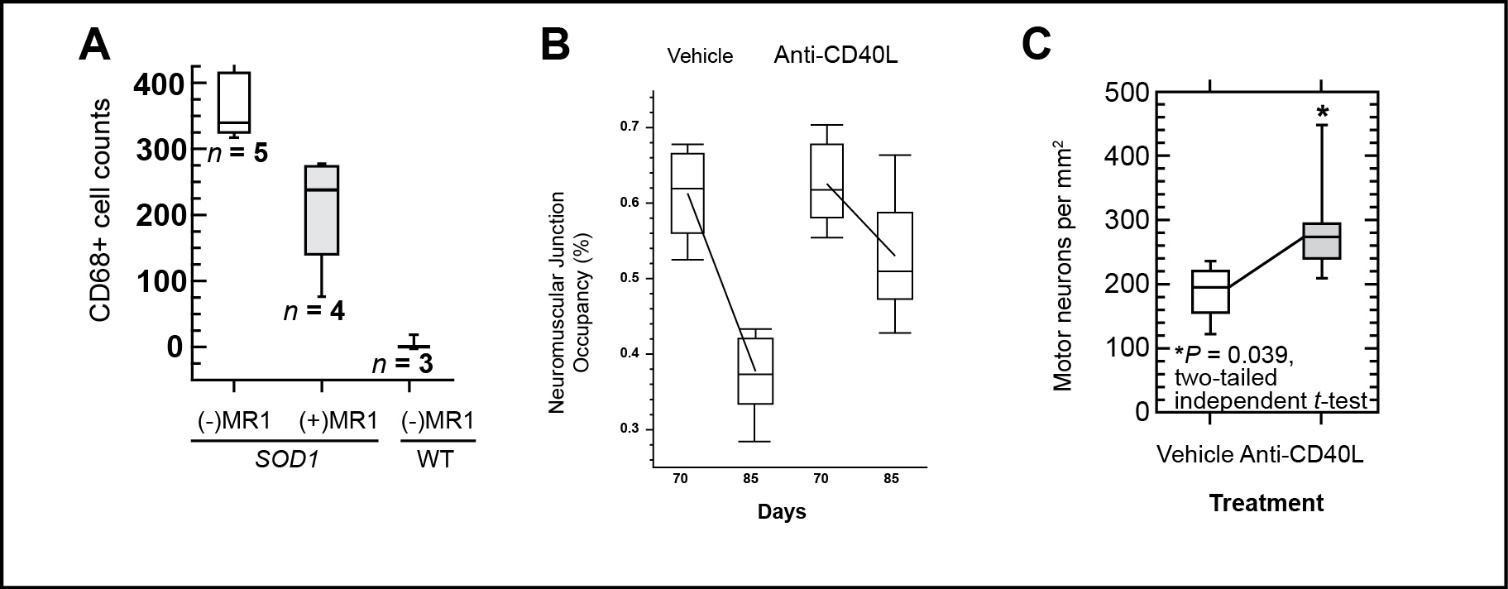
Figure 3: Anti-CD40L (“MR1”) treatment decreases CD68+ macrophages, improves neuromuscular junction occupancy and improves motor neuron survival. (A) Quantification of reduction of CD68+ macrophages by anti-CD40L treatment at day 100. (White bar, control IgG); gray bar (anti-CD40L–treatment); black bar (untreated age-matched non-transgenic mice) (B) Quantification of neuromuscular occupancy in SOD1 mice prior to overt symptoms (day 70) versus after symptom onset (day 85) treated with an IgG control antibody (vehicle) or anti-CD40L antibody. (C) Quantitative comparison of lumbar spinal cord motor neuron counts per mm2 in IgG vehicle control (White bar) versus anti-CD40L treated mice (grey bar) at day 100 (Lincecum, 2010).
In 2018, the FDA granted orphan drug designation to tegoprubart for ALS. In 2019, we completed a single ascending dose Phase 1 study of tegoprubart in healthy volunteers and people with ALS. In this study, the doses of tegoprubart studied were well tolerated in healthy adult subjects and adults with ALS. Tegoprubart demonstrated low anti-drug antibody responses that were not dose related, linear dose proportionality across the dose ranges, and a half-life of up to 26 days.
In October 2020, we initiated a Phase 2a, open-label, multi-center study to evaluate the safety and tolerability of multiple doses of tegoprubart in adult subjects with ALS. Fifty-four subjects with ALS were enrolled into the study in the United States and Canada at 13 ALS treatment sites. Ascending doses of tegoprubart were administered as IV infusions to four sequentially enrolling cohorts.
11
The first two cohorts consisted of nine participants, and the last two cohorts of 18 participants each. All enrolled subjects received six infusions of tegoprubart over a 12-week period. Blood samples for target engagement, and exploratory biomarkers for inflammation and neurodegeneration were taken and analyzed. Participant-focused clinical outcomes were also assessed. In May 2022, we completed the Phase 2a study and released positive topline results. Tegoprubart successfully met the primary endpoints of safety and tolerability. Fifty of the fifty-four subjects completed all six study infusions, and adverse events were typical of an ALS patient population. Tegoprubart was well-tolerated, and no drug-related serious adverse events were observed. No new safety signals emerged. Anti-drug antibodies (“ADAs”) were present in less than 5 percent of samples. All ADAs were of low titer and did not impact tegoprubart drug levels. Tegoprubart target engagement was demonstrated in all dose cohorts with increasing target engagement in a dose-dependent manner, plateauing at the 4 and 8 mg / kg dosing levels using CD40L and CXCL13 biomarkers related to T cell and B cell function, respectively. Tegoprubart exposure decreased inflammatory biomarker levels, in a dose dependent manner, in 20 of 32 pro-inflammatory proteins. Pro-inflammatory biomarkers reduced included biomarkers also associated with IgA nephropathy and kidney transplant rejection, such as IgA, IgE, IgM, C3, CXCL9, and CXCL10.
We are seeking to further progress ALS clinical development and plan to work with key stakeholders on potential next steps to do so. However, we will be unable to continue our clinical development of tegoprubart for people with ALS without additional financing specific for our ALS program, and we can provide no assurances that we will be able to obtain financing on acceptable terms or at all.
Clinical Development of Tegoprubart for IgA Nephropathy
In January 2023, the Company announced the deprioritization of its IgAN program and all IgAN clinical development activities were discontinued in 2023. IgAN is the leading cause of chronic glomerulonephritis, a state of inflammation producing damage to the filtering part of the kidney. Disease manifestation and clinical presentation involves renal dysfunction characterized by proteinuria with a slow relentless course. Approximately 30%-40% of persons living with IgAN ultimately reach end stage renal disease (“ESRD”). The standard of care for ESRD is dialysis or kidney transplant, which represents a significant economic burden as well as a major impact on a patient’s quality of life. With an estimated prevalence of approximately 150,000 persons in the United States, IgAN is one of the most common autoimmune glomerulonephropathies. In the United States, oral budesonide Tarpeyo was approved for use in IgAN by the FDA in December 2021 and Kinpeygo received conditional approval by the European Medicines Agency (“EMA”) in July 2022.
In August 2022, we received IND clearance from the FDA to evaluate tegoprubart for the treatment of IgAN. The Phase 2 global study was a 96-week open-label, dose ranging trial, and included both a high dose and a low dose cohort. The primary endpoint was change in urinary protein:creatinine ratio at week twenty-four. Secondary endpoints included change in estimated eGFR at week 96 as well as safety and tolerability. The first subject was dosed in May 2022. We reported interim safety data from the Phase 2 high dose cohort in March 2023.
Intellectual Property
Eledon’s success depends in part on our ability to obtain and maintain proprietary protection for our product candidates, novel discoveries, product technologies and other know-how, to operate without infringing on the proprietary rights of others and to prevent others from infringing our proprietary rights. We seek to protect our product candidates by, among other methods, filing U.S. and foreign patent applications related to our proprietary technology, inventions and improvements that are important to the development and implementation of our business. We also rely on trademarks, trade secrets, know-how, continuing technological innovation and potential in-licensing opportunities to develop and maintain proprietary protection for our product candidates.
Our intellectual property portfolio includes issued patents and pending patent applications directed toward (i) isolated antibodies and (ii) methods of treatment using the isolated antibodies that block the interaction of CD40L and CD40 to treat CD40L-related diseases or disorders. We own and have exclusive rights to six active patent families, of which three families are exclusively licensed and the rest are wholly-owned by Eledon. The first exclusively-licensed family is directed to methods for treating amyotrophic lateral sclerosis with antibodies and includes two issued United States patents and 14 issued foreign patents (Japan, Hong Kong, Belgium, Germany, Denmark, Spain, Finland, France, Great Britain, Ireland, Italy, the Netherlands, Sweden, and Switzerland). Absent any patent term adjustments or extensions, patents in this family expire in December 2029. The second exclusively-licensed family is directed to tegoprubart, with 13 pending applications, and issued patents including four issued United States patents and 23 issued foreign patents (Australia, Belgium, Switzerland, China, Germany, Denmark, France, Great Britain, Hong Kong, Ireland, Israel, India, Italy, Japan, South Korea, Mexico, the Netherlands, New Zealand, Russia, Sweden, Singapore). Absent any term adjustments or extensions, patents in this family expire in February 2036.
12
The third exclusively-licensed family is directed to tegoprubart, with 17 pending applications, including one pending United States patent application, and issued patents, including one issued United States patent and four issued foreign patents (China, Hong Kong, Mexico, Russia). Absent any term adjustments or extensions, patents in this family expire in May 2038. Our Eledon-owned patent families are directed to methods for treating neurodegenerative disorders, kidney disorders, and transplant rejection. We have recently nationalized two of our Eledon-owned patent families in the United States, Europe, Australia, Canada, China, Japan, South Korea, Mexico, and Singapore, and one of our Eledon-owned patent families is at the Patent Cooperation Treaty stage. Absent any term adjustments or extensions, any patents to issue from the pending applications in these patent families would expire in May 2043, and November 2044, respectively.
Subsequent to our acquisition of Anelixis, we undertook a strategic review of the legacy ENT assets. We concluded this review and determined that the best path forward was to terminate license agreements associated with these ENT assets and return the rights to the original license holders, which we did in July 2021. There was no financial impact to returning these assets.
Patents extend for varying periods according to the date of patent filing or grant and the legal term of patents in various countries where patent protection is obtained. The actual protection afforded by a patent, which can vary from country to country, depends on the type of patent, the scope of its coverage and the availability of legal remedies in the country.
Eledon also protects its proprietary information by requiring its employees, consultants, contractors, and other advisors to execute nondisclosure and assignment of invention agreements upon commencement of their respective employment or engagement. In addition, Eledon also requires confidentiality or service agreements from third parties that receive confidential information or materials.
See Note 6. Commitments and Contingencies of the Notes to Financial Statements included in this Annual Report on Form 10-K under the caption “Grants and Licenses” for further information about the Company’s intellectual property.
Competition
The biotechnology and pharmaceutical industries are characterized by continuing technological advancement and significant competition. While we believe that our product candidates, technology, knowledge, experience and scientific resources provide us with competitive advantages, we face competition from major pharmaceutical and biotechnology companies, academic institutions, governmental agencies and public and private research institutions, among others. Any product candidates that we successfully develop and commercialize will compete with existing therapies and new therapies that may become available in the future. Key product features that would affect our ability to effectively compete with other therapeutics include the efficacy, safety and convenience of our products. The availability of reimbursement from the government and other third-party payors will also significantly affect the pricing and competitiveness of our products. Our competitors also may obtain FDA or other regulatory approval for their products more rapidly than we may obtain approval for ours, which could result in our competitors establishing a strong market position before we are able to enter the market.
Many of the companies against which we may compete have significantly greater financial resources and expertise in research and development, manufacturing, preclinical testing, conducting clinical studies, obtaining regulatory approvals and marketing approved products than we do. Smaller or early-stage companies may also prove to be significant competitors, particularly through collaborative arrangements with large and established companies. These competitors also compete with us in recruiting and retaining qualified scientific and management personnel and establishing clinical study sites and patient registration for clinical studies, as well as in acquiring technologies complementary to, or necessary for, our programs.
The competitive conditions faced by the Company are also described in greater detail in Part I, Item 1A. Risk Factors in this Annual Report on Form 10-K under the caption “We face substantial competition, which may result in others discovering, developing or commercializing competing products before or more successfully than we do.”
Manufacturing
We do not own or operate manufacturing facilities for the production of tegoprubart or any future product candidates, nor do we have plans to develop our own manufacturing operations in the foreseeable future. We currently rely on third parties for raw materials and the manufacturing of drug substance and drug product for non-clinical and clinical activities. As of the date of this Annual Report, we have not experienced any difficulty in obtaining raw materials required with respect to the manufacturing of tegoprubart.
13
We believe we have enough drug substance and drug product on hand and manufacturing capacity with our third-party manufacturing providers to meet forecasted clinical trial demand.
We also rely on third parties to label, store and distribute drug product for our non-clinical and clinical trials.
Government Regulation
Government authorities in the United States, including federal, state, and local authorities, and in other countries, extensively regulate, among other things, the manufacturing, research and clinical development, marketing, labeling, and packaging, storage, distribution, post-approval monitoring and reporting, advertising and promotion, and export and import of pharmaceutical and biological products, such as those we are developing. Pricing of such products is also subject to regulation in many countries. The process of obtaining regulatory approvals and the subsequent compliance with appropriate federal, state, local, and foreign statutes and regulations require the expenditure of substantial time and financial resources.
U.S. Government Regulation
The FDA regulates drugs under the Federal Food, Drug, and Cosmetic Act (“FDCA”) and its implementing regulations, and biologics under the FDCA and the Public Health Service Act (“PHSA”) and its implementing regulations. FDA approval is required before any new unapproved drug or biologic or dosage form, including a new use of a previously approved drug, can be marketed in the U.S. Drugs and biologics are also subject to other federal, state, and local statutes and regulations. If we fail to comply with applicable FDA or other requirements at any time during the product development process, clinical testing, approval process or after approval, we may become subject to administrative or judicial sanctions. These sanctions could include the FDA’s refusal to approve pending applications, license suspension or revocation, withdrawal of an approval, untitled or warning letters, product recalls, product seizures, total or partial suspension of production or distribution, injunctions, fines, civil penalties or criminal prosecution. Any FDA enforcement action could have a material adverse effect on us.
The process required by the FDA before product candidates may be marketed in the United States generally involves the following:
The preclinical and clinical testing and approval process requires substantial time, effort, and financial resources, and we cannot be certain that any approvals for our product candidates will be granted on a timely basis, if at all.
14
An IND is a request for authorization from the FDA to administer an investigational new drug product to humans in clinical trials. The central focus of an IND submission is on the general investigational plan and the protocol(s) for human trials. The IND also includes results of animal and in vitro studies assessing the toxicology, pharmacokinetics, pharmacology, and pharmacodynamic characteristics of the product; chemistry, manufacturing, and controls information; and any available human data or literature to support the use of the investigational new drug. An IND must become effective before human clinical trials may begin. An IND will automatically become effective 30 days after receipt by the FDA, unless before that time the FDA raises concerns or questions related to the proposed clinical trials. In such a case, the IND may be placed on clinical hold and the IND sponsor and the FDA must resolve any outstanding concerns or questions before clinical trials can begin. Accordingly, submission of an IND may or may not result in the FDA allowing clinical trials to commence. The FDA may impose a clinical hold at any time during clinical trials and may impose a partial clinical hold that would limit trials, for example, to certain doses or for a certain length of time.
Clinical Trials
Clinical trials involve the administration of the investigational new drug to human subjects under the supervision of qualified investigators in accordance with Good Clinical Practices (“GCPs”) which include the requirement that all research subjects provide their informed consent for their participation in any clinical trial. Clinical trials are conducted under protocols detailing, among other things, the objectives of the study, the parameters to be used in monitoring safety, and the efficacy criteria to be evaluated. A protocol for each clinical trial and any subsequent protocol amendments must be submitted to the FDA as part of the IND. Additionally, approval must also be obtained from each clinical trial site’s IRB before the trials may be initiated, and the IRB must monitor the trial until completed. There are also requirements governing the reporting of ongoing clinical trials and clinical trial results to public registries.
The clinical investigation of a drug is generally divided into three phases. Although the phases are usually conducted sequentially, they may overlap or be combined.
In some cases, the FDA may condition approval of a BLA or NDA for a product candidate on the sponsor’s agreement to conduct additional clinical trials after approval. In other cases, a sponsor may voluntarily conduct additional clinical trials after approval to gain more information about the drug. Such post-approval studies are typically referred to as Phase 4 clinical trials.
Sponsors must also report to the FDA, within certain timeframes, serious and unexpected adverse reactions, any clinically important increase in the rate of a serious suspected adverse reaction over that listed in the protocol or investigator’s brochure, or any findings from other studies or animal or in vitro testing that suggest a significant risk in humans exposed to the product candidate. The FDA, the IRB, or the clinical trial sponsor may suspend or terminate a clinical trial at any time on various grounds, including a finding that the research subjects are being exposed to an unacceptable health risk. Additionally, some clinical trials are overseen by an independent group of qualified experts organized by the clinical trial sponsor, known as a data safety monitoring board or committee. This group provides authorization for whether or not a trial may move forward at designated check points based on access to certain data from the trial. We may also suspend or terminate a clinical trial based on evolving business objectives or competitive climate.
The clinical trial process can take three to ten years or more to complete, and there can be no assurance that the data collected will support FDA approval or licensure of the product. Results from one trial are not necessarily predictive of results from later trials.
15
A drug being studied in clinical trials may be made available to individual patients in certain circumstances. Pursuant to the 21st Century Cures Act (“Cures Act”) which was signed into law in December 2016, the manufacturer of an investigational drug for a serious disease or condition is required to make available, such as by posting on its website, its policy on evaluating and responding to requests for individual patient access to such investigational drug (compassionate use). This requirement applies on the later of 60 calendar days after the date of enactment of the Cures Act or the first initiation of a Phase 2 or Phase 3 trial of the investigational drug. At this time, Eledon does not have a program for the compassionate use of an investigational product outside of a clinical trial as it is not applicable to our investigational products.
Submission of a BLA or NDA to the FDA
Assuming successful completion of all required testing (e.g., completion of pivotal clinical trials) in accordance with all applicable regulatory requirements, detailed investigational new drug product information is submitted to the FDA in the form of a BLA or NDA requesting approval to market the product for one or more indications. Under federal law, the submission of most BLAs and NDAs is subject to an application user fee and these fees are typically increased on an annual basis. Applications for orphan drug products are exempted from the BLA and NDA user fees and may be exempted from product and establishment user fees, unless the application includes an indication for other than a rare disease or condition. No application user fees were paid for tegoprubart in calendar 2024.
A BLA or NDA for a new molecular entity must include all relevant data available from pertinent preclinical studies and clinical trials, including negative or ambiguous results as well as positive findings, together with detailed information relating to the product’s chemistry, manufacturing, controls, and proposed labeling, among other things. Data can come from company-sponsored clinical trials intended to test the safety and effectiveness of a use of a product, or from several alternative sources, including investigator-initiated trials that are not sponsored by Eledon. To support marketing approval, the data submitted must be sufficient in quality and quantity to establish the safety and effectiveness of the investigational new drug product to the satisfaction of the FDA.
Once a BLA or NDA for a new molecular entity has been submitted, the FDA’s goal is to review the application within ten months after it accepts the application for filing, or, if the application relates to an unmet medical need in a serious or life-threatening indication, six months after the FDA accepts the application for filing. The review process is often significantly extended by the FDA’s requests for additional information or clarification.
Before approving a BLA or NDA, the FDA typically will inspect the facility or facilities where the product is manufactured. The FDA will not approve an application unless it determines that the manufacturing processes and facilities are in compliance with cGMP requirements and adequate to assure consistent production of the product within required specifications. Additionally, before approving a BLA or NDA, the FDA will typically inspect one or more clinical sites to assure compliance with GCP.
The FDA is required to refer an application for a novel drug to an advisory committee or explain why such referral was not made. Typically, an advisory committee is a panel of independent experts, including clinicians and other scientific experts, that reviews, evaluates and provides a recommendation as to whether the application should be approved and under what conditions. The FDA is not bound by the recommendations of an advisory committee, but it considers such recommendations carefully when making decisions.
The FDA’s Decision on a BLA or NDA
The FDA evaluates a BLA to determine whether the data demonstrate that the biologic is safe, pure, and potent, or effective, and an NDA to determine whether the drug is safe and effective. After the FDA evaluates the BLA or NDA and conducts inspections of manufacturing facilities where the product will be produced, it may issue an approval letter or a Complete Response Letter. An approval letter authorizes commercial marketing of the drug with specific prescribing information for specific indications. A Complete Response Letter indicates that the review cycle of the application is complete, and the application is not ready for approval. A Complete Response Letter may require additional clinical data or an additional pivotal Phase 3 clinical trial(s), or other significant, expensive and time-consuming requirements related to clinical trials, preclinical studies or manufacturing. Even if such additional information is submitted, the FDA may ultimately decide that the BLA or NDA does not satisfy the criteria for approval and issue a denial. The FDA could also approve the BLA or NDA with a Risk Evaluation and Mitigation Strategy (“REMS”) plan to mitigate risks, which could include medication guides, physician communication plans, or elements to assure safe use, such as restricted distribution methods, patient registries and other risk minimization tools. The FDA also may condition approval on, among other things, changes to proposed labeling, development of adequate controls and specifications, or a commitment to conduct one or more post-market studies or clinical trials.
16
Such post-market testing may include Phase 4 clinical trials and surveillance to further assess and monitor the product’s safety and effectiveness after commercialization. Also, new government requirements, including those resulting from new legislation, may be established, or the FDA’s policies may change, which could delay or prevent regulatory approval of our products under development.
Pediatric Trials and Exclusivity
Under the Pediatric Research Equity Act of 2003 (“PREA”) as amended, BLAs and NDAs must contain data to assess the safety and effectiveness of an investigational new drug product for the claimed indications in all relevant pediatric populations and to support dosing and administration for each pediatric subpopulation for which the drug is safe and effective. A sponsor who is planning to submit a marketing application for a drug product that includes a new active ingredient, new indication, new dosage form, new dosing regimen or new route of administration must submit an initial Pediatric Study Plan (“PSP”) within sixty days of an end-of-phase 2 meeting or as may be agreed between the sponsor and the FDA. The initial PSP must include an outline of the pediatric study or studies that the sponsor plans to conduct, including study objectives and design, age groups, relevant endpoints and statistical approach, or a justification for not including such detailed information, and any request for a deferral of pediatric assessments or a full or partial waiver of the requirement to provide data from pediatric studies along with supporting information. The FDA may, on its own initiative or at the request of the applicant, grant deferrals for submission of some or all pediatric data until after approval of the product for use in adults or full or partial waivers if certain criteria are met. The FDA and the sponsor must reach agreement on the PSP. A sponsor can submit amendments to an agreed-upon initial PSP at any time if changes to the pediatric plan need to be considered based on data collected from preclinical studies, early phase clinical trials, and/or other clinical development programs. The requirements for pediatric data do not apply to any drug for an indication for which orphan designation has been granted. In the future we may seek pediatric approval for tegoprubart applications in connection with renal and islet cell transplantations, which may require the submission of a PSP.
Pediatric exclusivity is another type of non-patent exclusivity in the United States and, if granted, provides for the attachment of an additional six months of marketing protection to the term of any existing regulatory exclusivity, including the five-year and three-year non-patent and orphan exclusivity. This six-month exclusivity may be granted if a BLA or NDA sponsor submits pediatric data that fairly respond to a written request from the FDA for such data. The data do not need to show the product to be effective in the pediatric population studied; rather, if the clinical trial is deemed to fairly respond to the FDA’s request, the additional protection is granted. If reports of FDA-requested pediatric trials are submitted to and accepted by the FDA within the statutory time limits, whatever statutory or regulatory periods of exclusivity or patent protection covering the product are extended by six months. This is not a patent term extension, but it effectively extends the regulatory period during which the FDA cannot accept or approve another application relying on the BLA or NDA sponsor’s data.
Post-Approval Requirements
Drugs manufactured or distributed pursuant to FDA approvals are subject to pervasive and continuing regulation by the FDA, including, among other things, requirements relating to recordkeeping, periodic reporting, product sampling and distribution, advertising and promotion and reporting of adverse experiences with the product. After approval, most changes to the approved product, such as adding new indications or other labeling claims, are subject to prior FDA review and approval. There also are continuing, annual user fee requirements for any marketed products and the establishments at which such products are manufactured, as well as new application fees for supplemental applications with clinical data.
Drug manufacturers are subject to periodic unannounced inspections by the FDA and state agencies for compliance with cGMP requirements. Changes to the manufacturing process are strictly regulated, and, depending on the significance of the change, may require prior FDA approval before being implemented. FDA regulations also require investigation and correction of any deviations from cGMP and impose reporting and documentation requirements upon us and any third-party manufacturers that we may decide to use. Accordingly, manufacturers must continue to expend time, money and effort in the area of production and quality control to maintain compliance with cGMP and other aspects of regulatory compliance.
We rely, and expect to continue to rely, on third parties for the production of clinical quantities of our product candidates and expect to rely in the future on third parties for the production of commercial quantities. Future FDA and state inspections may identify compliance issues at our facilities or at the facilities of our contract manufacturers that may disrupt production, distribution, or require substantial resources to correct. In addition, discovery of previously unknown problems with a product or the failure to comply with applicable requirements may result in restrictions on a product, manufacturer or holder of an approved BLA or NDA, including withdrawal or recall of the product from the market or other voluntary, FDA-initiated or judicial action that could delay or prohibit further marketing.
17
Also, new government requirements, including those resulting from new legislation, may be established, or the FDA’s policies may change, which could delay or prevent regulatory approval of our products under development.
The FDA may withdraw approval if compliance with regulatory requirements and standards is not maintained or if problems occur after the product reaches the market. Later discovery of previously unknown problems with a product, including adverse events of unanticipated severity or frequency, or with manufacturing processes, or failure to comply with regulatory requirements, may result in revisions to the approved labeling to add new safety information; imposition of post-market studies or clinical trials to assess new safety risks; or imposition of distribution restrictions or other restrictions under a REMS program. Other potential consequences include, among other things:
The FDA strictly regulates marketing, labeling, advertising, and promotion of products that are placed on the market. Drugs may be promoted only for the approved indications and in accordance with the provisions of the approved label. The FDA and other agencies actively enforce the laws and regulations prohibiting the promotion of off-label uses, and a company that is found to have improperly promoted off-label uses may be subject to significant liability.
Orphan Designation and Exclusivity
The FDA may grant orphan drug designation to drugs intended to treat a rare disease or condition that affects fewer than 200,000 individuals in the United States, or if it affects more than 200,000 individuals in the United States, there is no reasonable expectation that the cost of developing and making the drug for this type of disease or condition will be recovered from sales in the United States.
Orphan drug designation entitles a party to financial incentives such as opportunities for grant funding towards clinical trial costs, tax advantages, and user-fee waivers. In addition, if a product is the first to receive FDA approval for the indication for which it has orphan designation, the product is entitled to orphan drug exclusivity, which means the FDA may not approve any other application to market the same drug for the same indication for a period of seven years, except in limited circumstances, such as a showing of clinical superiority over the product with orphan exclusivity. The Company received orphan drug designations for tegoprubart for the treatment of ALS and prevention of allograft rejection in pancreatic islet cell transplantation.
Patent Term Restoration
Depending upon the timing, duration, and specifics of the FDA approval of the use of our product candidates, some of our U.S. patents may be eligible for limited patent term extension under the Drug Price Competition and Patent Term Restoration Act of 1984, commonly referred to as the Hatch-Waxman Amendments. The Hatch-Waxman Amendments permit a patent restoration term of up to five years as compensation for patent term lost during product development and the FDA regulatory review process. However, patent term restoration cannot extend the remaining term of a patent beyond a total of 14 years from the product’s approval date. The patent term restoration period is generally one-half the time between the effective date of an IND and the submission date of a BLA or NDA, plus the time between the submission date and the approval of that application, except that the review period is reduced by any time during which the applicant failed to exercise due diligence. Only one patent applicable to an approved product is eligible for the extension and the application for the extension must be submitted prior to the expiration of the patent and within 60 days of the product’s approval. The U.S. Patent and Trademark Office, in consultation with the FDA, reviews and approves the application for any patent term extension or restoration. In the future, we may apply for restoration of the patent term for one of our currently owned or licensed patents to add patent life beyond its current expiration date, depending on the expected length of the clinical trials and other factors involved in the filing of the relevant BLA or NDA.
18
Abbreviated New Drug Applications for Generic Drugs
In 1984, with passage of the Hatch-Waxman Amendments, Congress authorized the FDA to approve generic drugs that are the same as drugs previously approved by the FDA under the NDA provisions of the statute. To obtain approval of a generic drug, an applicant must submit an abbreviated new drug application (“ANDA”) to the agency. In support of such applications, a generic manufacturer may rely on the preclinical and clinical testing previously conducted for a drug product previously approved under an NDA, known as the reference listed drug (“RLD”).
Specifically, in order for an ANDA to be approved, the FDA must find that the generic version is identical to the RLD with respect to the active ingredients, the route of administration, the dosage form, and the strength of the drug. At the same time, the FDA must also determine that the generic drug is “bioequivalent” to the innovator drug. Under the statute, a generic drug is bioequivalent to an RLD if “the rate and extent of absorption of the generic drug do not show a significant difference from the rate and extent of absorption of the listed drug.”
Upon approval of an ANDA, the FDA indicates that the generic product is “therapeutically equivalent” to the RLD and it assigns a therapeutic equivalence rating to the approved generic drug in its publication “Approved Drug Products with Therapeutic Equivalence Evaluations,” also referred to as the “Orange Book.” Physicians and pharmacists consider an “AB” therapeutic equivalence rating to mean that a generic drug is fully substitutable for the RLD. In addition, by operation of certain state laws and numerous health insurance programs, the FDA’s designation of an “AB” rating often results in substitution of the generic drug without the knowledge or consent of either the prescribing physician or patient.
The FDCA provides a period of five years of non-patent exclusivity for a new drug containing a new chemical entity. In cases where such exclusivity has been granted, an ANDA may not be filed with the FDA until the expiration of five years unless the submission is accompanied by a Paragraph IV certification, in which case the applicant may submit its application four years following the original product approval. The FDCA also provides for a period of three years of exclusivity if the NDA includes reports of one or more new clinical investigations, other than bioavailability or bioequivalence studies, that were conducted by or for the applicant and are essential to the approval of the application. This three-year exclusivity period often protects changes to a previously approved drug product, such as a new dosage form, route of administration, combination or indication.
Hatch-Waxman Patent Certification and the 30-Month Stay
Upon approval of an NDA or a supplement thereto, NDA sponsors are required to list with the FDA each patent with claims that cover the applicant’s product or a method of using the product. Each of the patents listed by the NDA sponsor is published in the Orange Book. When an ANDA applicant files its application with the FDA, the applicant is required to certify to the FDA concerning any patents listed for the reference product in the Orange Book, except for patents covering methods of use for which the ANDA applicant is not seeking approval.
Specifically, the applicant must certify with respect to each patent that:
A certification that the new product will not infringe the already approved product’s listed patents or that such patents are invalid or unenforceable is called a Paragraph IV certification. If the applicant does not challenge the listed patents or indicates that it is not seeking approval of a patented method of use, the ANDA application will not be approved until all the listed patents claiming the referenced product have expired.
If the ANDA applicant has provided a Paragraph IV certification to the FDA, the applicant must also send notice of the Paragraph IV certification to the NDA and patent holders once the ANDA has been accepted for filing by the FDA. The NDA and patent holders may then initiate a patent infringement lawsuit in response to the notice of the Paragraph IV certification. The filing of a patent infringement lawsuit within 45 days after the receipt of a Paragraph IV certification automatically prevents the FDA from approving the ANDA until the earlier of 30 months after the receipt of the Paragraph IV notice, expiration of the patent, or a decision in the infringement case that is favorable to the ANDA applicant.
19
European Union/Rest of World Government Regulation
In addition to regulations in the United States, we will be subject to a variety of regulations in other jurisdictions governing, among other things, clinical trials and any commercial sales and distribution of our products. The cost of establishing a regulatory compliance system for numerous varying jurisdictions can be very significant. Although many of the issues discussed above with respect to the United States apply similarly in the context of the European Union (“EU”) and in other jurisdictions, the approval process varies between countries and jurisdictions and can involve additional product testing and additional administrative review periods. The time required to obtain approval in other countries and jurisdictions might differ from and be longer than that required to obtain FDA approval. Regulatory approval in one country or jurisdiction does not ensure regulatory approval in another, but a failure or delay in obtaining regulatory approval in one country or jurisdiction may negatively impact the regulatory process in others.
Whether or not we obtain FDA approval for a product candidate, we must obtain the requisite approvals from regulatory authorities in foreign countries prior to the commencement of clinical trials or marketing of the product in those countries. Certain countries outside of the United States have a similar process that requires the submission of a clinical trial application much like the IND prior to the commencement of human clinical trials. In the EU, for example, a clinical trial authorization application (“CTA”) must be submitted for each clinical protocol to each country’s national health authority and an independent ethics committee, much like the FDA and IRB, respectively. Once the CTA is accepted in accordance with a country’s requirements, the clinical trial may proceed.
The requirements and process governing the conduct of clinical trials vary from country to country. In all cases, the clinical trials are conducted in accordance with GCP the applicable regulatory requirements, and the ethical principles that have their origin in the Declaration of Helsinki.
To obtain regulatory approval of an investigational medicinal product under EU regulatory systems, we must submit a marketing authorization application. The content of the BLA or NDA filed in the United States is like that required in the EU, except, among other things, country-specific document requirements.
For other countries outside of the EU, such as countries in Eastern Europe, Latin America or Asia, the requirements governing product licensing, pricing, and reimbursement vary from country to country.
Countries that are part of the EU, as well as countries outside of the European Union, have their own governing bodies, requirements, and processes with respect to the approval of pharmaceutical and biologic products. If we fail to comply with applicable foreign regulatory requirements, we may be subject to, among other things, fines, suspension or withdrawal of regulatory approvals, product recalls, seizure of products, operating restrictions and criminal prosecution.
Authorization Procedures in the EU
Medicines can be authorized in the EU by using either the centralized authorization procedure or national authorization procedures.
20
In some cases, a Pediatric Investigation Plan (“PIP”) or a request for waiver or deferral, is required for submission prior to submitting a marketing authorization application. A PIP describes, among other things, proposed pediatric trials and their timing relative to clinical trials in adults. A PIP will be submitted to EMA and other EU countries, as required. The PIP will need to be submitted early during product development before marketing authorization applications are submitted. The timing of PIP submission cannot be after initiation of pivotal trials or confirmatory (phase 3) trials. In the future we may seek pediatric approval for tegoprubart applications in connection with renal and islet cell transplantations, which may require the submission of a PIP.
Exclusivity of New Chemical Entities and New Fixed Dose Combinations
In the EU, new chemical entities, sometimes referred to as new active substances as well as new fixed dose combinations, qualify for eight years of data exclusivity upon marketing authorization and an additional two years of market exclusivity. This data exclusivity, if granted, prevents regulatory authorities in the EU from referencing the innovator’s data to assess a generic (abbreviated) application for eight years, after which a generic application can be submitted, and the innovator’s data may be referenced, but not approved for two years. The overall ten-year period will be extended to a maximum of eleven years if, during the first eight years of those ten years, the marketing authorization holder obtains an authorization for one or more new therapeutic indications which, during the scientific evaluation prior to their authorization, are held to bring a significant clinical benefit in comparison with existing therapies.
Exceptional Circumstances/Conditional Approval
Orphan drugs or drugs with unmet medical needs may be eligible for EU approval under exceptional circumstances or with conditional approval. Approval under exceptional circumstances may be applicable to orphan products and is used when an applicant is unable to provide comprehensive data on the efficacy and safety under normal conditions of use because the indication for which the product is intended is encountered so rarely that the applicant cannot reasonably be expected to provide comprehensive evidence, when the present state of scientific knowledge does not allow comprehensive information to be provided, or when it is medically unethical to collect such information. Conditional marketing authorization may be applicable to orphan medicinal products, medicinal products for seriously debilitating or life-threatening diseases, or medicinal products to be used in emergency situations in response to recognized public threats. Conditional marketing authorization can be granted on the basis of less complete data than is normally required in order to meet unmet medical needs and in the interest of public health, provided the risk-benefit balance is positive, it is likely that the applicant will be able to provide the comprehensive clinical data, and unmet medical needs will be fulfilled. Conditional marketing authorization is subject to certain specific obligations to be reviewed annually.
Accelerated Review
Under the centralized procedure in the EU, the maximum timeframe for the evaluation of a marketing authorization application is 210 days (excluding clock stops, when additional written or oral information is to be provided by the applicant in response to questions asked by the EMA’s Committee for Medicinal Products for Human Use, or CHMP). Accelerated evaluation might be granted by the CHMP in exceptional cases, when a medicinal product is expected to be of a major public health interest, particularly from the point of view of therapeutic innovation. In this circumstance, EMA ensures that the opinion of the CHMP is given within 150 days, excluding clock stops.
21
Pharmaceutical Coverage, Pricing and Reimbursement
Significant uncertainty exists as to the coverage and reimbursement status of any products for which we obtain regulatory approval. In the United States and in other countries, sales of any products for which we receive regulatory approval for commercial sale will depend in part on the availability of coverage and reimbursement from third-party payors. Third-party payors include government authorities, managed care providers, private health insurers and other organizations. The process for determining whether a payor will provide coverage for a product may be separate from the process for setting the reimbursement rate that the payor will pay for the product. Third-party payors may limit coverage to specific products on an approved list, or formulary, which might not include all of the FDA-approved products for a particular indication. Moreover, a payor’s decision to provide coverage for a drug product does not imply that an adequate reimbursement rate will be approved. Adequate third-party reimbursement may not be available to enable us to maintain price levels sufficient to realize an appropriate return on our investment in product development.
Third-party payors are increasingly challenging the price and examining the medical necessity and cost-effectiveness of medical products and services, in addition to their safety and efficacy. In order to obtain coverage and reimbursement for any product that might be approved for sale, we may need to conduct expensive pharmacoeconomic studies in order to demonstrate the medical necessity and cost-effectiveness of our products, in addition to the costs required to obtain regulatory approvals. Our product candidates may not be considered medically necessary or cost-effective. If third-party payors do not consider a product to be cost-effective compared to other available therapies, they may not cover the product after approval as a benefit under their plans or, if they do, the level of payment may not be sufficient to allow a company to sell its products at a profit.
The U.S. government, state legislatures and foreign governments have shown significant interest in implementing cost containment programs to limit the growth of government-paid healthcare costs, including price controls, restrictions on reimbursement and requirements for substitution of generic products for branded prescription drugs. By way of example, the Patient Protection and Affordable Care Act, as amended by the Health Care and Education Reconciliation Act of 2010, collectively (the “Affordable Care Act”), contains provisions that may reduce the profitability of drug products, including, for example, increased rebates for drugs sold to Medicaid programs, extension of Medicaid rebates to Medicaid managed care plans, mandatory discounts for certain Medicare Part D beneficiaries and annual fees based on pharmaceutical companies’ share of sales to federal healthcare programs. Since its enactment, there have been several judicial, administrative, executive and congressional challenges to certain aspects of the Affordable Care Act. In addition, other legislative changes have been proposed and adopted in the United States since the Affordable Care Act was enacted. For example, the American Rescue Plan Act of 2021 eliminates the statutory Medicaid drug rebate cap, for single source and innovator multiple source drugs, beginning in January 2024.
Additionally, The Inflation Reduction Act of 2022, (the “IRA”), includes several provisions that may impact our business to varying degrees, including provisions that reduce the out-of-pocket cap for Medicare Part D beneficiaries to $2,000 starting in 2025; impose new manufacturer financial liability on certain drugs under Medicare Part D; allow the U.S. government to negotiate Medicare Part B and Part D price caps for certain high-cost drugs without generic competition; require companies to pay rebates to Medicare for certain drug prices that increase faster than inflation; and delay until January 1, 2032 the rebate rule that would limit the fees that pharmacy benefit managers can charge. Further, under the IRA, orphan drugs are exempted from the Medicare drug price negotiation program, but only if they have one orphan designation and for which the only approved indication is for that disease or condition. If a product receives multiple orphan designations or has multiple approved indications, it may not qualify for the orphan drug exemption. Further, judicial challenges to the IRA may have an impact on the implementation of the IRA’s provisions; and the overall effects of the IRA on our business and the healthcare industry in general is not yet known. Adoption of further government controls, measures and tightening of restrictive policies in jurisdictions with existing controls and measures could limit payments for pharmaceuticals.
In European countries, governments influence the price of pharmaceutical products through their pricing and reimbursement rules and control of national healthcare systems that fund a large part of the cost of those products to consumers. Some jurisdictions operate positive and negative list systems under which products may only be marketed once a reimbursement price has been agreed to by the government. To obtain reimbursement or pricing approval, some of these countries may require the completion of clinical trials that compare the cost-effectiveness of a product candidate to currently available therapies. Other member states allow companies to fix their own prices for medicines but monitor and control company profits. The downward pressure on healthcare costs in general, particularly prescription drugs, has become very intense. As a result, increasingly high barriers are being erected to the entry of new products. In addition, in some countries, cross-border imports from low-priced markets exert commercial pressure on pricing within a country.
22
The marketability of any products for which we receive regulatory approval for commercial sale may suffer if the government and third-party payors fail to provide adequate coverage and reimbursement. In addition, the emphasis on cost containment measures in the United States and other countries has increased, and we expect will continue to increase the pressure on pharmaceutical pricing. Coverage policies and third-party reimbursement rates may change at any time. Even if favorable coverage and reimbursement status is attained for one or more products for which we receive regulatory approval, less favorable coverage policies and reimbursement rates may be implemented in the future.
Other Healthcare Laws and Compliance Requirements
If we obtain regulatory approval for any of our product candidates, we may be subject to various federal and state laws targeting fraud and abuse in the healthcare industry. These laws may impact, among other things, our proposed sales, marketing and education programs. In addition, we may be subject to patient privacy regulation by both the federal government and the states in which we conduct our business. The laws that may affect our ability to operate include:
The Affordable Care Act broadened the reach of the fraud and abuse laws by, among other things, amending the intent requirement of the federal Anti-Kickback Statute and the applicable criminal healthcare fraud statutes contained within 42 U.S.C. § 1320a-7b. Pursuant to the statutory amendment, a person or entity no longer needs to have actual knowledge of this statute or specific intent to violate it in order to have committed a violation. In addition, the Affordable Care Act provides that the government may assert that a claim including items or services resulting from a violation of the federal Anti-Kickback Statute constitutes a false or fraudulent claim for purposes of the civil False Claims Act or the civil monetary penalties statute. Many states have adopted laws similar to the federal Anti-Kickback Statute, some of which apply to the referral of patients for healthcare items or services reimbursed by any source, not only the Medicare and Medicaid programs.
We are also subject to the U.S. Foreign Corrupt Practices Act (“FCPA”) which prohibits improper payments or offers of payments to foreign governments and their officials for the purpose of obtaining or retaining business. Safeguards we implement to discourage improper payments or offers of payments by our employees, consultants, and others may be ineffective, and violations of the FCPA and similar laws may result in severe criminal or civil sanctions, or other liabilities or proceedings against us, any of which would likely harm our reputation, business, financial condition and result of operations.
If our operations are found to be in violation of any of the laws described above or any other governmental regulations that apply to us, we may be subject to penalties, including civil and criminal penalties, exclusion from participation in government healthcare programs, such as Medicare and Medicaid and imprisonment, damages, fines and the curtailment or restructuring of our operations, any of which could adversely affect our ability to operate our business and our results of operations.
23
Employees
As of March 20, 2025, Eledon had 31 employees, all of whom are full-time. None of our employees are represented by labor unions or covered by collective bargaining agreements. We consider our relationship with our employees to be good.
Corporate Information
Otic Pharma, Ltd. (“Otic”) was founded in the State of Israel in 2008. In 2015, Otic established U.S. operations and moved its corporate headquarters to Irvine, California. In 2017, Otic consummated a reverse merger with Tokai Pharmaceuticals, Inc. (“Tokai”), a Delaware corporation that was incorporated on March 26, 2004, pursuant to which, among other things, Tokai purchased from Otic and its stockholders all of the common and preferred shares of Otic in exchange for the issuance of a certain number of shares of common stock of Tokai (the “Reverse Merger”). Following the Reverse Merger, Tokai changed its name to Novus Therapeutics, Inc. On September 14, 2020, the Company acquired Anelixis Therapeutics, Inc. (“Anelixis”), a Delaware Corporation, after which Anelixis became a wholly owned subsidiary of the Company. On January 4, 2021, the Company changed its name from Novus Therapeutics, Inc. to Eledon Pharmaceuticals, Inc.
Our executive offices are located at 19800 MacArthur Boulevard, Suite 250, Irvine, California 92612. The Company also has a research and development office in Burlington, Massachusetts. Our telephone number is (949) 238-8090 and our website is www.eledon.com.
You are advised to read this Annual Report on Form 10-K in conjunction with other reports and documents that we file from time to time with the Securities and Exchange Commission (“SEC”). In particular, please read our definitive proxy statement, which will be filed with the SEC in connection with our 2025 annual meeting of stockholders, our quarterly reports on Form 10-Q and any current reports on Form 8-K that we may file from time to time. You may obtain copies of these reports after the date of this annual report directly from us or from the SEC at its website at www.sec.gov. We make our periodic and current reports available on our internet website, free of charge, as soon as reasonably practicable after such material is electronically filed with, or furnished to, the SEC.
24
Item 1A. Risk Factors.
An investment in shares of our common stock involves a high degree of risk. You should carefully consider the following risk factors, as well as the other information in this Annual Report on Form 10-K and in our other public filings. The occurrence of any of these risks could harm our business, financial condition, results of operations and/or growth prospects or cause our actual results to differ materially from those contained in forward-looking statements we have made in this report and those we may make from time to time. You should consider all of the risk factors described in our public filings when evaluating our business.
Risks Related to Our Operations
Our short operating history and shifts in our business strategy may make it difficult to evaluate the success of our business to date and to assess our future viability.
We are a clinical stage biopharmaceutical company. Our ongoing operations to date have been limited to organizing and staffing the Company, business planning, raising capital, acquiring and developing technology, identifying potential product candidates and pursuing non-clinical and clinical trials. We have not yet demonstrated our ability to successfully manufacture drug product in large enough quantities and with stability to support additional clinical trials, execute pivotal clinical trials, obtain marketing approvals, manufacture a commercial scale product or arrange for a third party to do so on our behalf, or conduct sales and marketing activities necessary for successful product commercialization. It can take many years to develop a new medicine from the time it is discovered to when it is available for treating patients. Consequently, any predictions made about our future success or viability based on our short operating history to date may not be as accurate as they could be if we had a longer operating history. In addition, as a result of the acquisition of Anelixis and our decision to discontinue our Company funding of the islet cell transplantation program and the IgAN program, our future business, prospects, financial position and operating results could be significantly different than those in historical periods or previously projected by our management.
In addition, as an early-stage business, we may encounter unforeseen expenses, difficulties, complications, delays and other known and unknown factors. To successfully market any of our current or future product candidates, we will need to transition from a company with a clinical development focus to a company capable of supporting commercial activities. We may not be successful in such a transition.
We have incurred significant operating losses since our inception and expect that we will continue to incur losses over the next several years and may never achieve or maintain profitability.
We have incurred significant annual net operating losses in every year since our inception. We have no products approved for commercial sale and have not generated any revenue from product sales to date, and we continue to incur significant research and development and other general and administrative expenses related to our ongoing operations. If tegoprubart or any future product candidates we develop are not successfully developed and approved, we may never generate any revenue from sales of products. The Company has experienced recurring net losses and negative cash flows from operating activities since its inception. The Company’s net loss for the year ended December 31, 2024 is $36.2 million. As of December 31, 2024, the Company had cash and cash equivalents and short-term investments of $140.2 million, working capital of $132.2 million and an accumulated deficit of $355.6 million. We have not generated any revenues from product sales, have not completed the development of any product candidate and may never have a product candidate approved for commercialization. We expect it will be several years, if ever, before we have a product candidate ready for commercialization. We have financed our operations to date primarily through the sale of preferred and common stock, and the sale of warrants and have devoted substantially all of our financial resources and efforts to research and development, including preclinical studies and our clinical trials. Our net losses may fluctuate significantly from quarter to quarter and year to year and will depend, in part, on the rate at which we incur expenses and our ability to generate revenue. Net losses and negative cash flows have had, and will continue to have, an adverse effect on our stockholders’ equity and working capital.
We anticipate that we will continue to incur significant expenses as we:
25
To become and remain profitable, we must develop and eventually commercialize a product or products with significant market potential. This will require us to be successful in a range of challenging activities, including completing clinical trials of our product candidates, obtaining marketing approval for these product candidates and manufacturing, marketing and selling those products for which we obtain marketing approval. We may never succeed in these activities, including if we do not have available financial resources to allow us to pursue clinical trials and other clinical development activities, and, even if we are successful, we may never generate revenues that are significant or large enough to achieve profitability. If we do achieve profitability, we may not be able to sustain or increase profitability on a quarterly or annual basis. Our failure to become and remain profitable would decrease the value of the Company, could impair our ability to raise capital, maintain our non-clinical and clinical development efforts, and expand our business or continue our operations and may require us to raise additional capital that may dilute the ownership interest of common stockholders. A decline in the value of the Company could also cause stockholders to lose all or part of their investment.
We will require additional funding to be able to complete the development of our lead drug candidate. If we are unable to raise capital, we will be forced to significantly alter our business strategy, substantially curtail our current operations, or liquidate and cease operations altogether.
In view of our expectation to incur significant losses for the foreseeable future, we will be required to raise additional capital resources in the future in order to fund our operations. We can also provide no assurance that other funding will be available to us, will be obtained on terms favorable to us or will provide us with sufficient funds to meet our objectives. If we are unable to raise such capital, or if we are unable to do so on acceptable terms, we will be forced to significantly alter our business strategy, substantially curtail our current operations, or liquidate and cease operations altogether. For example, we are currently unable to continue our clinical development of tegoprubart for people with ALS without additional financing, and we can provide no assurances that we will be able to obtain financing on acceptable terms or at all.
Our funding needs may fluctuate significantly based on a number of factors, such as:
Identifying potential product candidates and conducting formulation development, non-clinical testing and clinical trials is a time-consuming, expensive and uncertain process that takes years to complete, and we may never generate the necessary data or results required to obtain marketing approval and achieve product sales. In addition, our product candidates, if approved, may not achieve commercial success.
26
Our commercial revenues, if any, will be derived from sales of products that we do not expect to be commercially available for several years, if at all. Accordingly, we will need to continue to rely on additional financing to achieve our business objectives. Even if we generate positive clinical data or are able to successfully commercialize one or more of our product candidates, additional financing may not be available to us on acceptable terms, or at all.
In addition to the dilution of our current stockholders’ ownership as a result of the 2023 Private Placement, the 2024 Private Placement and the 2024 Underwritten Offering, we currently have a significant number of securities outstanding that are exercisable for our common stock, which could result in significant additional dilution and downward pressure on our stock price. Future issuances of our common stock, including common stock that may be issuable pursuant to outstanding warrants or other convertible securities, could result in additional dilution of the percentage ownership of our stockholders and could cause our stock price to fall.
As of December 31, 2024, there were 59,789,275 shares of our common stock outstanding and warrants to purchase 33,052,744 shares of our common stock outstanding. The issuance of shares of common stock in the 2023 Private Placement, the 2024 Private Placement and the 2024 Underwritten Offering (each as defined and described in Part II, Item 7. Management’s Discussion and Analysis of Financial Condition and Results of Operations), diluted the ownership interests of our existing stockholders. The issuance of shares of common stock pursuant to our “at-the-market” equity offering program or upon exercise of pre-funded warrants or common warrants issued in the initial closing of the 2023 Private Placement, the pre-funded warrants issued in the 2024 Private Placement and the pre-funded warrants issued in the 2024 Underwritten Offering would result in significant additional dilution to our current stockholders, which could adversely affect the price of our common stock and the terms on which we could raise additional capital. If we sell additional shares of common stock, convertible securities or other equity securities, investors may be materially diluted by subsequent sales. Such sales may also result in material dilution to our existing stockholders, and new investors could gain rights, preferences and privileges senior to the holders of our common stock.
Our product candidates are in the early stages of clinical development and may not be successfully developed. If we are unable to successfully develop and commercialize these or any other product candidate, or if we experience significant delays in doing so, our business will be materially harmed.
We currently do not have any products that have gained regulatory approval. We have invested substantially all of our efforts and financial resources in the development of our lead drug candidate tegoprubart, including funding non-clinical studies, clinical trials, drug formulation and the manufacturing of clinical trial materials. Our ability to generate product revenues, which we do not expect will occur for several years, if ever, will depend heavily on the successful development and eventual commercialization of one or more drug candidates. As a result, our business is substantially depending on our ability to successfully complete the development of and obtain approval for one of our potential future additional product candidates.
We have not yet demonstrated an ability to successfully overcome many of the risks and uncertainties frequently encountered by companies in new and rapidly evolving fields, particularly in the pharmaceutical area. For example, to execute our business plan, we will need to successfully:
27
If we are unsuccessful in accomplishing these objectives, we may not be able to successfully develop and commercialize our or other product candidates, and our business will suffer.
Public health crises, including pandemics or epidemics could adversely affect our business.
Our business and operations, including but not limited to ongoing or planned research and development activities may be impacted by public health crises. For example, our business was adversely affected by the COVID-19 pandemic, which also caused significant disruption in the operations of third parties upon whom we rely. Other future public health crises, including any future pandemics or epidemics could have a similar impact on our business. We may experience, as we did with the COVID-19 pandemic, disruptions as a result of future public health crisis, such as a future pandemic or epidemic, that could severely impact our operations and development activities, including, but not limited to:
Any of the foregoing factors, or other effects of any public health crisis, including any future pandemic or epidemic, could materially affect our business, possibly to a significant degree. The severity and duration of any such impacts cannot be predicted.
Unfavorable global economic conditions could adversely affect our business, financial condition and results of operations
The global economy, including the financial and credit markets, continues to experience extreme volatility and disruptions, including severely diminished liquidity and credit availability, declines in consumer confidence, declines in economic growth, increases in unemployment rates, increases in inflation rates, elevated interest rates and uncertainty about economic stability. Likewise, the current conflicts in Ukraine and the Middle East have created extreme volatility in the global capital markets and global economic consequences, including disruptions of the global supply chain and energy markets. A severe or prolonged economic downturn or continued volatility in the financial and credit markets could negatively impact our ability to obtain necessary debt or equity financing in a timely manner or on favorable terms, if at all. The severity and duration of any such impacts cannot be predicted. Any such failure to raise capital as and when needed could have a negative impact on our financial condition and on our ability to pursue our business plans and strategies or cause us to delay our clinical development plans, research and development programs or commercialization efforts, out-license intellectual property rights to our product candidates or sell unsecured assets, or a combination of the above. Any of these actions could materially harm our business. For example, we do not currently have sufficient liquidity to fund the continued clinical development of tegoprubart for people with ALS without additional financing, notwithstanding the positive topline results of our Phase 2a study of tegoprubart for adult subjects with ALS.
28
In addition, inflation has increased throughout the U.S. economy in the past few years. As a result of inflation, we have experienced and may continue to experience cost increases, including costs of clinical trials and research and development of our product candidates, production costs, the price of labor, administration and other costs of doing business. Although we may continue to take measures to mitigate the impact of this inflation, if these measures are not effective, our business, financial condition, results of operations and liquidity could be materially adversely affected. Further, in an inflationary environment, cost increases may outpace our expectations, causing us to use our cash and other liquid assets faster than forecasted. If this happens, we may need to raise more capital to fund our operations than expected, and such capital may not be available in sufficient amounts or on reasonable terms, if at all.
Adverse conditions in the financial markets, including bank failures, could adversely affect our liquidity and financial performance.
We currently maintain domestic cash deposits, for short term operating requirements, in Federal Deposit Insurance Corporation (“FDIC”) insured banks, which exceed the FDIC insurance limits. Our additional cash and cash equivalents are held in accounts managed by third‑party financial institutions and consist primarily of cash invested in money market funds and government bonds. Bank failures, events involving limited liquidity, defaults, non-performance or other adverse developments that affect financial institutions, or concerns or rumors about such events, may lead to widespread demands for customer withdrawals and liquidity constraints that may result in market-wide liquidity problems. For example, on March 10, 2023, Silicon Valley Bank failed and was taken into receivership by the FDIC. At that time, we maintained deposits amounting to approximately 78% of our total cash at Silicon Valley Bank. On March 26, 2023, the assets, deposits and loans of Silicon Valley Bank were acquired by First-Citizens Bank & Trust Company. In response to the failure of Silicon Valley Bank, we diversified our cash deposits into money market funds, U.S. treasuries and U.S. government agency securities and, as of the date of this report, our total cash maintained in FDIC insured banking accounts is less than 3% of our total cash and cash equivalents and short-term investments. The failure of a bank, or other adverse conditions in the financial or credit markets impacting financial institutions at which we maintain balances, could adversely impact our liquidity and financial performance. There can be no assurance that our deposits in excess of the FDIC or other comparable insurance limits will be backstopped by the U.S. or any applicable foreign government in the future or that any bank or financial institution with which we do business will be able to obtain needed liquidity from other banks, government institutions or by acquisition in the event of a future failure or liquidity crisis. Additionally, our cash investments outside of FDIC insured bank accounts are subject to general credit, liquidity, market, and interest rate risks. If the carrying value of an investment exceeds the fair value, and the decline in fair value is deemed to be other-than-temporary, we are required to write down the value of the investment, which could materially harm our results of operations and financial condition and could limit our access to liquidity.
Drug development involves a lengthy and expensive process with an uncertain outcome, including failure to demonstrate safety and efficacy to the satisfaction of the FDA or similar regulatory authorities outside the United States. We may incur additional costs or experience delays in completing, or ultimately be unable to complete, the formulation and commercialization of our product candidates.
Given the early stage of development for our product candidates, the risk of failure is high. Before obtaining marketing approval from regulatory authorities for the sale of any product candidate, we must conduct non-clinical trials and then conduct extensive clinical trials to demonstrate the safety and efficacy of our product candidates in humans. Formulation and device development, non-clinical and clinical testing are all expensive activities, difficult to design and implement, and can take years to complete. Failure can occur at any time during the development program, including during the clinical trial process. Further, the results of non-clinical studies and early clinical trials of our product candidates, as well as earlier generation formulations may not be predictive of the results of later-stage clinical trials. Interim results of a clinical trial do not necessarily predict final results. Moreover, non-clinical and clinical data are often susceptible to varying interpretations and analyses, and many companies that have believed their product candidates performed satisfactorily in non-clinical and clinical trials have nonetheless failed to obtain marketing approval of their products. There is a risk that additional non-clinical and/or clinical safety studies will be required by the FDA or similar regulatory authorities outside the United States and/or that subsequent studies will not match results seen in prior studies. It is impossible to predict when or if any of our product candidates will prove effective, safe and well-tolerated in humans or will receive regulatory approval.
We may experience delays in our clinical trials, and we do not know whether planned clinical trials will begin or enroll subjects on time, need to be redesigned or be completed on schedule, if at all. There can be no assurance that the FDA or equivalent foreign regulatory bodies will approve investigational new drug applications and allow us to start clinical trials for any of our product candidates in the future, including for islet cell transplant. Once a clinical trial has commenced, there is also no assurance that the FDA or equivalent foreign regulatory body will not put any of our product candidates on clinical hold.
29
We may experience numerous unforeseen events during, or as a result of, clinical trials that could delay or prevent our ability to receive marketing approval or commercialize our product candidates. Clinical trials may be delayed, suspended or prematurely terminated for a variety of reasons, such as:
30
If we are required to conduct additional clinical trials or other testing of our product candidates beyond those that we currently contemplate, if we are unable to successfully complete clinical trials of our product candidates or other testing, if the results of these trials or tests are not positive or are only modestly positive, or if there are safety concerns, we may:
Our product development costs will also increase if we experience delays in testing or marketing approvals. We do not know whether any of our non-clinical studies or clinical trials will need to be restructured or will be completed on schedule, or at all. Significant non-clinical or clinical trial delays also could shorten any periods during which we may have the exclusive right to commercialize our product candidates or may allow our competitors to bring products to market before we do and impair our ability to successfully commercialize our product candidates and may harm our business and results of operations.
If we experience delays or difficulties in the enrollment of patients in clinical trials, our receipt of necessary regulatory approvals could be delayed or prevented and expenses for the development of our product candidates could increase.
We may not be able to initiate or continue clinical trials for our product candidates if we are unable to locate and enroll a sufficient number of eligible patients to participate in these trials to demonstrate safety and efficacy. We do not know whether the ongoing or planned clinical trials will enroll subjects in a timely fashion, require redesign of essential trial elements or be completed on its projected schedule. In addition, competitors may have ongoing clinical trials for product candidates that treat related or the same indications as our product candidates, and patients who would otherwise be eligible for our clinical trials may instead enroll in clinical trials of our competitors’ product candidates. Our inability to enroll a sufficient number of patients for our clinical trials would result in significant delays and could require us to abandon one or more clinical trials altogether.
Patient enrollment is affected by other factors including:
Enrollment delays in our clinical trials may result in increased development costs for our product candidates, which would cause the value of the Company to decline and limit our ability to obtain additional financing.
31
Our ability to conduct clinical trials in some jurisdictions outside of the United States may be adversely affected.
We currently have clinical trial sites in regions outside the United States, including Asia, the European Union and the United Kingdom, and we will continue to conduct future clinical trials in these markets. Our ability to conduct clinical trials at sites located outside the United States is subject to numerous risks unique to conducting business in jurisdictions outside the United States, including:
The ongoing conflict in Ukraine and the resulting imposition of economic and other sanctions by the United States, European Union and many other nations on Russia, individuals in Russia, Russian businesses and the Russian central bank, or any escalation of tensions in the region, could have a broader impact that expands into other countries. The ongoing conflict in the Middle East could have similar impacts. Although the length and impact of any military action and expansion of the conflict into other countries are highly unpredictable, if either conflict spreads or has effects on additional countries, we may experience disruptions or delays in our plans to conduct clinical trial activities in affected regions outside the United States.
If severe adverse events or unacceptable side effects are identified during the development of our product candidates, we may need to abandon or limit our development of some of our product candidates.
If our product candidates are associated with severe adverse events or unacceptable side effects in non-clinical or clinical trials or have characteristics that are unexpected, we may need to interrupt, delay or abandon their development or limit development to more narrow uses or subpopulations in which the adverse event or undesirable side effects or other characteristics are less prevalent, less severe or more acceptable from a risk-benefit perspective. Any occurrences of clinically significant adverse events or unacceptable side effects with our product candidates may harm our business, financial condition and prospects significantly.
Tegoprubart is an early‑product candidate, and the side effect profile in humans has not been fully established. Currently unknown, drug-related side effects may be identified through ongoing and future clinical trials and, as such, these possible drug-related side effects could affect patient recruitment, the ability of enrolled subjects to complete the trial, or result in potential product liability claims.
Our future success depends on our ability to retain executives and key employees and to attract, retain and motivate qualified personnel in the future.
We are highly dependent on the product development, clinical and business development expertise of the principal members of our management, scientific and clinical team. Although we have entered into employment agreements with our executives and key employees, each of them may terminate their employment with us at any time. We do not maintain “key person” insurance for any of our executives or other employees. Our recent decision to discontinue the islet cell transplantation program and IgAN program and uncertainties regarding our financial condition may increase the likelihood that employees depart in the foreseeable future.
32
Recruiting and retaining qualified scientific, clinical, manufacturing, sales and marketing personnel is critical to our success. Due to the small size of the Company and the limited number of employees, each of our executives and key employees serves in a critical role. The loss of the services of our executive officers or other key employees could impede the achievement of our development and commercialization objectives and seriously harm our ability to successfully implement our business strategy. Furthermore, replacing executive officers and key employees may be difficult and may take an extended period of time because of the limited number of individuals in our industry with the breadth of skills and experience required to successfully develop, gain regulatory approval of, and commercialize products. Competition to hire from this limited pool is intense, and we may be unable to hire, train, retain or motivate these key personnel on acceptable terms given the competition among numerous pharmaceutical and biotechnology companies for similar personnel. We also experience competition for the hiring of scientific and clinical personnel from universities and research institutions. In addition, we rely on consultants and advisors, including scientific and clinical advisors, to assist us in formulating drug product, non-clinical development, clinical development, regulatory strategy, and commercial strategy. Our consultants and advisors may be employed by employers other than us and may have commitments under consulting or advisory contracts with other entities that may limit their availability to provide services to us. If we are unable to continue to attract and retain high quality personnel, our ability to pursue our growth strategy will be limited.
Risks Related to Regulatory Approval of Our Product Candidates and Other Compliance Matters
If we are not able to obtain, or if there are delays in obtaining, required regulatory approvals, or the approvals may be for a narrow indication, we may not be able to commercialize our product candidates, and our ability to generate revenue may be materially impaired.
Our product candidates must be approved by the FDA pursuant to a new drug application in the United States and by other regulatory authorities outside the United States prior to commercialization in the respective regions. The process of obtaining marketing approvals, both in the United States and outside the United States, is expensive and takes several years, if approval is obtained at all, and can vary substantially based upon a variety of factors, including the type, complexity and novelty of the product candidates involved. Failure to obtain marketing approval for a product candidate will prevent us from commercializing the product candidate. We have not received approval to market any of our product candidates from regulatory authorities in any country. We have no experience in filing and supporting the applications necessary to gain marketing approvals for our products and may engage third-party consultants to assist in this process. Securing marketing approval requires the submission of extensive non-clinical and clinical data, and other supporting information to regulatory authorities for each therapeutic indication to establish the product candidate’s safety and efficacy. Securing marketing approval also requires the submission of information about the product formulation and manufacturing process to, and inspection of manufacturing facilities by, the regulatory authorities. Our product candidates may not be effective, may be only moderately effective or may prove to have undesirable or unintended side effects, toxicities or other characteristics that may preclude our obtaining marketing approval or prevent or limit commercial use. Regulatory authorities have substantial discretion in the approval process and may refuse to accept any application or may decide that our data are insufficient for approval and require additional non-clinical, clinical or other data. In addition, varying interpretations of the data obtained from non-clinical and clinical trials could delay, limit or prevent marketing approval of a product candidate. Changes in marketing approval policies during the development period, changes in or the enactment of additional statutes or regulations, or changes in regulatory review for each submitted product application, may also cause delays in or prevent the approval of an application.
Any marketing approval we ultimately obtain may be for fewer or more limited indications than requested or subject to restrictions or post-approval commitments that render the approved product not commercially viable or its market potential significantly impaired. In addition, regulatory agencies may not approve the labeling claims that are necessary or desirable for the successful commercialization of our product candidates.
In order to market and sell our products in the EU and other international jurisdictions outside of the United States, we or our third-party collaborators must obtain separate marketing approvals and comply with numerous and varying regulatory requirements. The approval procedure varies among countries and may require additional non-clinical, clinical or health outcome data. In addition, the time required to obtain approval may differ substantially amongst international jurisdictions. The regulatory approval process outside the United States generally includes all the risks associated with obtaining FDA approval. In addition to regulatory approval, in many countries outside the United States, it is required that the product be approved for reimbursement before the product can be approved for sale in that country.
If we experience delays in obtaining approval or if we fail to obtain approval of our product candidates, the commercial prospects for our product candidates may be harmed and our ability to generate revenues will be materially impaired.
33
Any product candidate for which we obtain marketing approval will be subject to extensive post-marketing regulatory requirements and could be subject to post-marketing restrictions or withdrawal from the market, and we may be subject to penalties if we fail to comply with regulatory requirements or if we experience unanticipated problems with our products, when and if any of them are approved.
Our product candidates and the activities associated with their development and commercialization, including their testing, manufacture, recordkeeping, labeling, storage, approval, advertising, promotion, sale and distribution, are subject to comprehensive regulations that are specific to those defined by regulatory authorities in the countries where the product is approved. In the United States and other countries that follow the International Conference on Harmonization, these requirements include submissions of safety and other post-marketing information and reports, registration and listing requirements, cGMP requirements relating to manufacturing, quality control, quality assurance and corresponding maintenance of records and documents, including periodic inspections by the FDA and other regulatory authorities, requirements regarding the distribution of samples to physicians and recordkeeping.
The FDA, or other regulatory authorities, may also impose requirements for costly post-marketing studies or clinical trials and surveillance to monitor the safety or efficacy of the product. The FDA closely regulates the post-approval marketing and promotion of drugs to ensure drugs are marketed only for the approved indications and in accordance with the provisions of the approved labeling. The FDA imposes stringent restrictions on manufacturers’ communications regarding use of their products and if we promote our products beyond their approved indications, we may be subject to enforcement action for off-label promotion. Violations of the FDCA relating to the promotion of prescription drugs may lead to investigations alleging violations of federal and state healthcare fraud and abuse laws, as well as state consumer protection laws.
In addition, later discovery of previously unknown adverse events or other problems with our products, manufacturers or manufacturing processes, or failure to comply with regulatory requirements, may yield various results, including:
Non-compliance with EU requirements regarding safety monitoring or pharmacovigilance, and with requirements related to the development of products for the pediatric population, can also result in significant financial penalties. Similarly, failure to comply with the EU’s requirements regarding the protection of personal information can also lead to significant penalties and sanctions.
Legislation regulating the pharmaceutical and healthcare industries may increase the difficulty and cost for us to obtain marketing approval of and commercialize our product candidates and affect the prices we may obtain.
In the United States and some foreign jurisdictions, there have been a number of legislative and regulatory changes and proposed changes intended to contain healthcare costs and modify the regulation of drug and biologic products. These and other regulatory changes could prevent or delay marketing approval of our product candidates, restrict or regulate post-approval activities and affect our ability to profitably sell any product candidates for which we obtain marketing approval.
34
For example, on August 16, 2022, the U.S. government enacted the Inflation Reduction Act of 2022, which, among other things, includes policies that are designed to have a direct impact on drug prices and reduce drug spending by the federal government, which took effect in 2023. The Inflation Reduction Act of 2022 requires drug manufacturers to pay rebates to Medicare if they increase prices faster than inflation for certain drugs used by Medicare beneficiaries. The mechanics of the rebate calculation would mimic those of the Medicaid rebate, but the expansion of inflation-based rebates may further complicate pricing strategies. The Inflation Reduction Act of 2022 or other similar legislation could have the effect of reducing the prices we can charge and reimbursement we receive for our products, thereby reducing our profitability.
We expect that additional state and federal healthcare reform measures and regulations will be adopted in the future. Any of these measures and regulations could limit the amounts that federal and state governments will pay for healthcare products and services, result in reduced demand for our product candidates or additional pricing pressures and affect our product development, testing, marketing approvals and post-market activities.
Recent administrative law cases decided by the U.S. Supreme Court in 2024 may create uncertainty with respect to actions taken by regulatory agencies to interpret, implement and enforce federal legislation. For example, in its June 2024 decision in Loper Bright Enterprises v. Raimondo (the “Loper ”), the U.S. Supreme Court overturned the longstanding Chevron doctrine, under which courts were required to give deference to regulatory agencies’ reasonable interpretations of ambiguous federal statutes. The Loper decision could result in legal challenges to regulations and guidance issued by federal agencies that are currently applicable to or will be applicable to our business, including those issued by the FDA and the Centers for Medicare and Medicaid Services (“CMS”). Further, the Loper decision may result in increased regulatory uncertainty, inconsistent judicial interpretations and delays in or other impacts to the agency rulemaking process, which could have a material adverse effect on our business, financial condition and results of operations.
Laws, restrictions, and other regulatory measures are also imposed by healthcare laws and regulations in international jurisdictions and in those jurisdictions we face the same issues as in the United States regarding difficulty and cost for us to obtain marketing approval and commercialization of our product candidates and which may affect the prices we may obtain.
In some countries, particularly the countries of the EU, the pricing of prescription pharmaceuticals is subject to governmental control. In these countries, pricing negotiations with governmental authorities can take considerable time after the receipt of marketing approval for a product. To obtain reimbursement or pricing approval in some countries, we may be required to conduct a clinical trial that compares the cost-effectiveness of our product candidate to other available therapies. If reimbursement of our products is unavailable or limited in scope or amount, or if pricing is set at unsatisfactory levels, our business could be harmed, possibly materially.
Our business operations and relationships with healthcare providers, physicians, third-party payers, and customers will be subject to applicable anti-kickback, fraud and abuse and other broadly applicable healthcare laws, which could expose us to criminal sanctions, civil penalties, program exclusion, contractual damages, reputational harm and diminished profits and future earnings.
Healthcare providers, physicians and third-party payers will play a primary role in the recommendation and prescription of any product candidates for which we receive marketing approval. Our current and future arrangements may expose us to broadly applicable fraud and abuse and other healthcare laws that may constrain the business or financial arrangements and relationships through which we would market, sell and distribute the products for which we receive marketing approval. Even though we will not control referrals of healthcare services or bill directly to Medicare, Medicaid or other third-party payers, federal and state healthcare laws are and will be applicable to our business. Such laws include, but are not limited to federal false claims, false statements and civil monetary penalties laws, including the federal civil False Claims Act (“FCA”), the federal Anti-Kickback Statute, the federal Health Insurance Portability and Accountability Act of 1996 (“HIPAA”), patient data privacy and security regulation, including, in the United States, HIPAA, as amended by the Health Information Technology for Clinical Health Act of 2009 (“HITECH”), the federal transparency requirements under the Physician Payments Sunshine Act, and analogous state, local or foreign law.
Pharmaceutical and other healthcare companies have been prosecuted under these laws for a variety of promotional and marketing activities, such as: providing free trips, free goods, sham consulting fees and grants and other monetary benefits to prescribers; reporting to pricing services inflated average wholesale prices that were then used by federal programs to set reimbursement rates; engaging in off-label promotion; and submitting inflated best price information to the Medicaid Rebate Program to reduce liability for Medicaid rebates. Efforts to ensure that our business arrangements with third parties will comply with applicable healthcare laws and regulations will involve substantial costs. It is possible that governmental authorities will conclude that our business practices may not comply with current or future statutes, regulations or case law involving applicable fraud and abuse or other healthcare laws and regulations.
35
If our operations are found to be in violation of any of these laws or any other governmental regulations that may apply to us, we may be subject to significant civil, criminal and administrative penalties, damages, disgorgement, fines, imprisonment, exclusion from government funded healthcare programs, such as Medicare and Medicaid, additional oversight and reporting obligations, contractual damages, reputational harm, diminished profits and future earnings, and the curtailment or restructuring of our operations. If any of the physicians or other healthcare providers or entities with whom we expect to do business are found to be not in compliance with applicable laws, that person or entity may be subject to criminal, civil or administrative sanctions, including exclusions from government funded healthcare programs.
Laws, restrictions, and other regulatory measures are also imposed by anti-kickback, fraud and abuse, and other healthcare laws and regulations in international jurisdictions, and in those jurisdictions we face the same issues as in the United State regarding exposure to criminal sanctions, civil penalties, program exclusion, contractual damages, reputational harm, and diminished profits and future earnings.
We depend on our information systems and those of our third-party collaborators, service providers, contractors or consultants, which may fail or suffer cybersecurity incidents that could result in a material disruption of our development programs or loss of data and have a material adverse effect on our reputation, business, financial condition or results of operations.
We rely on our information systems and infrastructure to effectively manage our business, including our clinical trials and studies. Our information systems and infrastructure, and those of our current or future third-party collaborators, service providers, contractors and consultants are vulnerable to damage from cybersecurity incidents, including computer viruses, denial-of-service attacks, hacking, phishing and other social engineering attacks, unauthorized access or use resulting from malware, as well as disruptions due to natural disasters, terrorism, war, mistakes or technical errors, including due to software updates and telecommunication and electrical failures. We may also experience cybersecurity incidents stemming from persons inside our organizations (including employees or contractors), or other persons with access to information systems inside our organization. Attacks on information systems are increasing in their frequency, levels of persistence, sophistication and intensity, and they are being conducted by increasingly sophisticated and organized foreign governments, groups and individuals with a wide range of motives and expertise. Further, cybersecurity threats and the techniques used in cyberattacks change, develop and evolve rapidly, including from emerging technologies, such as advanced forms of artificial intelligence and quantum computing. In addition to extracting or accessing sensitive information, such attacks could include the deployment of harmful malware, ransomware, denial-of-service attacks, social engineering and other means to affect service reliability and threaten the security, confidentiality, integrity and availability of information. The prevalent use of mobile devices that access sensitive information also increases the risk of data security incidents which could lead to the loss of confidential information or other intellectual property. Information system disruptions, even if inadvertent, may limit or disable our access or important third parties’ access to our systems. While to our knowledge none of the cybersecurity incidents we have experienced to date have had a material adverse impact on our business, financial condition or operations, if such an event were to occur and cause interruptions in our operations or the operations of third-party collaborators, service providers, contractors or consultants, it could result in a material disruption of our development programs and significant reputational, financial, legal, regulatory, business or operational harm. The costs to us to mitigate, investigate and respond to potential security incidents, breaches, disruptions, network security problems, bugs, viruses, worms, malicious software programs and security vulnerabilities could be significant, and while we have implemented security measures to protect our data security and information systems, our efforts to address these problems may not be successful, and these problems could result in unexpected interruptions, delays, cessation of service and other harm to our business and our competitive position. Moreover, data security incidents and other security breaches can be difficult to detect, and any delay in identifying them may lead to increased harm.
The compromise of privacy, security, integrity or confidentiality of sensitive information related to our business or failure to comply with confidentiality and data privacy obligations could have a material adverse effect on our business.
In the ordinary course of our business, we collect, store and transmit large amounts of confidential information, including intellectual property, proprietary business information and personal information. For example, the loss of clinical trial data from completed, ongoing or planned clinical trials for our product candidates could result in delays in our regulatory approval efforts and significantly increase our costs to recover or reproduce the data.
36
To the extent that any real or perceived security breach affects our information systems (or those of our third-party collaborators, service providers, contractors or consultants), or results in the loss of or accidental, unlawful or unauthorized access to, use of, release of, or other processing of personally identifiable information or damage to our data or applications or other data or applications relating to our technology or product candidates, or inappropriate disclosure of confidential or proprietary information, we could be found to have violated applicable U.S. and international privacy, data protection and other laws, which could subject us to litigation and governmental investigations and proceedings by federal, state and local regulatory entities in the U.S. and by international regulatory entities, resulting in exposure to material civil and/or criminal liability. and the further development of our product candidates could be delayed. Such a breach may require notification to governmental agencies, the media or individuals pursuant to various foreign, domestic (federal and state) privacy and security laws, if applicable, including HIPAA, as amended by HITECH, and its implementing rules and regulations, as well as regulations promulgated by the Federal Trade Commission and state breach notification laws. In addition, our liability insurance may not be sufficient in type or amount to cover us against claims related to cybersecurity incidents.
Any failure or perceived failure by us or any third-party collaborators, service providers, contractors or consultants to comply with our privacy, confidentiality, data security or similar obligations, or any data security incidents or other security breaches that result in the accidental, unlawful or unauthorized access to, use of, release of, processing of, or transfer of sensitive information, including personally identifiable information, may result in negative publicity, harm to our reputation, governmental investigations, enforcement actions, regulatory fines, litigation or public statements against us, could cause third parties to lose trust in us or could result in claims by third parties, including those that assert that we have breached our privacy, confidentiality, data security or similar obligations, any of which could have a material adverse effect on our reputation, business, financial condition or results of operations. To the extent we maintain individually identifiable health information, we could be subject to fines and penalties (including civil and criminal) under HIPAA for any failure by us or our business associates to comply with HIPAA’s requirements.
European data collection is governed by restrictive regulations governing the collection, use, processing and cross-border transfer of personal information.
We may collect, process, use or transfer personal information from individuals located in the European Economic Area in connection with our business, including in connection with conducting clinical trials in the EEA. Additionally, if any of our product candidates are approved, we may seek to commercialize those products in the EEA. The collection and use of personal health data in the EEA is governed by the provisions of the General Data Protection Regulation ((EU) 2016/679) (the “GDPR”), along with other European Union and country-specific laws and regulations. The United Kingdom and Switzerland have also adopted data protection laws and regulations. These legislative acts (together with regulations and guidelines) impose requirements relating to having legal bases for processing personal data relating to identifiable individuals and transferring such data outside of the EEA, including to the United States, providing details to those individuals regarding the processing of their personal data, keeping personal data secure, having data processing agreements with third parties who process personal data, responding to individuals’ requests to exercise their rights in respect of their personal data, reporting security breaches involving personal data to the competent national data protection authority and affected individuals, appointing data protection officers or corporate representatives, conducting data protection impact assessments and record-keeping. The GDPR imposes additional responsibilities and liabilities in relation to personal data that we process, and we may be required to put in place additional mechanisms ensuring compliance with the new data protection rules. Failure to comply with the requirements of the GDPR and related national data protection laws of the member states of the European Economic Area and other states in the European Economic Area may result in substantial fines, other administrative penalties and civil claims being brought against us, which could have a material adverse effect on our business, financial condition and results of operations. European data protection authorities may interpret the GDPR and national laws differently and may impose additional requirements, which adds to the complexity of processing personal data in or from the EEA or United Kingdom. Guidance on implementation and compliance practices are often updated or otherwise revised.
If we fail to comply with environmental, health and safety laws and regulations, we could become subject to fines or penalties or incur costs that could harm our business.
We may incur substantial costs in order to comply with current or future environmental, health and safety laws and regulations. These current or future laws and regulations may impair our non-clinical or clinical development or production efforts. Our failure to comply with these laws and regulations also may result in substantial fines, penalties or other sanctions.
37
Risks Related to the Commercialization of Our Product Candidates
Even if any of our product candidates receives marketing approval, we may fail to achieve the degree of market acceptance by physicians, patients, third-party payers and others in the medical community necessary for commercial success.
If any of our product candidates receives marketing approval, we may nonetheless fail to gain sufficient market acceptance by physicians, patients, third-party payers and others in the medical community. In addition, physicians, patients and third-party payers may prefer other novel products to ours. If our product candidates do not achieve an adequate level of acceptance, we may not generate significant product revenues and we may not become profitable. The degree of market acceptance of our product candidates, if approved for commercial sale, will depend on a number of factors, including:
If our current product candidates, or a future product candidate receives marketing approval and we, or others, later discover that the product is less effective than previously believed or causes undesirable side effects that were not previously identified, the ability to market the product could be compromised.
Clinical trials are conducted in carefully defined subsets of patients who have agreed to enter into clinical trials. Consequently, it is possible that our clinical trials may indicate an apparent beneficial effect of a product candidate that is greater than the actual positive effect in a broader patient population or alternatively fail to identify undesirable side effects. If, following approval of a product candidate, we, or others, discover that the product is less effective than previously believed or causes undesirable side effects that were not previously identified, any of the following events could occur:
Any of these events could have a material and adverse effect on our operations and business. The commercial prospects for our product candidates may be harmed and our ability to generate revenues will be materially impaired.
38
We currently have no marketing and sales force. If we are unable to establish effective marketing and sales capabilities or enter into agreements with third parties to market and sell our product candidates, we may not be able to effectively market and sell our product candidates, if approved, or generate product revenues.
We currently do not have a marketing or sales team for the marketing, sales and distribution of any of our product candidates that are able to obtain regulatory approval. In order to commercialize any product candidates, we must build on a territory-by-territory basis marketing, sales, distribution, managerial and other non-technical capabilities or make arrangements with third parties to perform these services, and we may not be successful in doing so. If our product candidates receive regulatory approval, we intend to establish an internal sales and marketing team with technical expertise and supporting distribution capabilities to commercialize our product candidates, which will be expensive and time-consuming, will require significant attention of our executive officers to manage and may nonetheless fail to effectively market and sell our product candidates. Any failure or delay in the development of our internal sales, marketing and distribution capabilities would adversely impact the commercialization of any of our products that we obtain approval to market. With respect to the commercialization of all or certain of our product candidates, we may choose to collaborate, either globally or on a territory-by-territory basis, with third parties that have direct sales forces and established distribution systems, either to augment our own sales force and distribution systems or in lieu of our own sales force and distribution systems. If we are unable to enter into such arrangements when needed on acceptable terms or at all, we may not be able to successfully commercialize any of our product candidates that receive regulatory approval, or any such commercialization may experience delays or limitations. If we are not successful in commercializing our product candidates, either on our own or through collaborations with one or more third parties, our future product revenue will suffer, and we may incur significant additional losses.
We face substantial competition, which may result in others discovering, developing or commercializing competing products before or more successfully than we do.
The development and commercialization of new drug products is highly competitive. We face competition with respect to our current product candidates and will face competition with respect to any product candidates that we may seek to develop or commercialize in the future, from major pharmaceutical companies, specialty pharmaceutical companies and biotechnology companies worldwide. There are several large pharmaceutical and biotechnology companies that currently market and sell products or are pursuing the development of products for the treatment of the disease indications for which we are developing our product candidates. Some of these competitive products and therapies are based on scientific approaches that are the same as or similar to our approach, and others are based on entirely different approaches. Potential competitors also include academic institutions, government agencies and other public and private research organizations that conduct research, seek patent protection and establish collaborative arrangements for research, development, manufacturing and commercialization.
Specifically, there are a number of companies developing competing anti-CD40 and anti-CD40L therapeutics in clinical trials for transplant, autoimmune or central nervous system indications, including: Novartis, Sanofi, UCB, Amgen (post-acquisition of Horizon Therapeutics), Bristol Myers Squibb, Tonix Pharmaceuticals and Kiniksa Pharmaceuticals. Most of these companies are larger than Eledon and have significantly greater resources to develop their drug candidates.
If approved, we expect that tegoprubart will face competition from numerous FDA-approved therapeutics for the prevention of transplant rejection, including PROGRAF®, ASTAGRAF XL®, ENVARSUS XR®, NULOJIX®, CELLCEPT®, MYFORTIC®, and numerous other branded and generic immunosuppressive agents. Multiple companies are working on islet cell and kidney transplant solutions that may ultimately potentially negate the need for immunosuppressive agents in these indications altogether.
We expect that tegoprubart will face competition from FDA-approved therapeutics for the treatment of ALS including RADICAVA®, riluzole, and numerous other branded and generic immunosuppressive agents. Multiple pharmaceutical and biotechnology companies, including but not limited to Biogen, Ionis Pharmaceuticals, Alexion Pharmaceuticals, Orion Pharma, Orphazyme, AZTherapies, Voyager Therapeutics, Apic Bio, Brainstorm Cell Therapeutics, and Cytokinetics, are also working on competing ALS pharmaceutical, gene therapy and cell therapy approaches.
Our commercial opportunity could be reduced or eliminated if our competitors develop and commercialize products that are safer, more effective, have fewer or less severe side effects, are more convenient or are less expensive than any products that we may develop. In addition, our ability to compete may be affected in many cases by insurers or other third-party payers seeking to encourage the use of generic products.
39
Generic products are currently available, with additional generic products expected to become available over the coming years, potentially creating pricing pressure. If our product candidates achieve marketing approval, we expect that they will be priced at a significant premium over competitive generic products.
Many of the companies against which we are competing or against which we may compete in the future have significantly greater financial resources and expertise in research and development, manufacturing, conducting non-clinical studies, conducting clinical trials, obtaining regulatory approvals and marketing approved products than we do. Mergers and acquisitions in the pharmaceutical and biotechnology industries may result in even more resources being concentrated among a smaller number of our competitors. Smaller and other early-stage companies may also prove to be significant competitors, particularly through collaborative arrangements with large and established companies. These third parties compete with us in recruiting and retaining qualified scientific and management personnel, establishing clinical trial sites and patient registration for clinical trials, as well as in acquiring technologies complementary to, or necessary for, our programs.
The insurance coverage and reimbursement status of newly approved products is uncertain. Failure to obtain or maintain adequate coverage and reimbursement for new or current products could limit our ability to market those products and decrease our ability to generate revenue.
The availability and extent of reimbursement by governmental and private payers is essential for most patients to be able to afford expensive treatments. Sales of our product candidates will depend substantially, both domestically and internationally, on the extent to which the costs of our product candidates will be paid by health maintenance, managed care, pharmacy benefit and similar healthcare management organizations, or reimbursed by government health administration authorities, private health coverage insurers and other third-party payers. If reimbursement is not available, or is available only to limited levels, we may not be able to successfully commercialize our product candidates. Even if coverage is provided, the approved reimbursement amount may not be high enough to allow us to establish or maintain pricing sufficient to realize a sufficient return on our investment.
There is significant uncertainty related to the insurance coverage and reimbursement of newly approved products. In the United States, the principal decisions about reimbursement for new medicines are typically made by CMS, as CMS decides whether and to what extent a new medicine will be covered and reimbursed under Medicare. Private payers tend to follow CMS to a substantial degree. It is difficult to predict what CMS will decide with respect to reimbursement for fundamentally novel products such as ours, as there is no body of established practices and precedents for these new products. Reimbursement agencies in Europe may be more conservative than CMS. Outside the United States, international operations are generally subject to extensive governmental price controls and other market regulations, and we believe the increasing emphasis on cost-containment initiatives in Europe, Canada, and other countries has and will continue to put pressure on the pricing and usage of our product candidates. In many countries, the prices of medical products are subject to varying price control mechanisms as part of national health systems. In general, the prices of medicines under such systems are substantially lower than in the United States. Other countries allow companies to fix their own prices for medicines but monitor and control company profits. Additional foreign price controls or other changes in pricing regulation could restrict the amount that we are able to charge for our product candidates. Accordingly, in markets outside the United States, the reimbursement for our products may be reduced compared with the United States and may be insufficient to generate commercially reasonable revenues and profits.
Moreover, increasing efforts by governmental and third-party payers, in the United States and internationally, to cap or reduce healthcare costs may cause such organizations to limit both coverage and level of reimbursement for new products approved and, as a result, they may not cover or provide adequate payment for our product candidates. Increased expense is incurred to cover costs of health outcome focused research used to generate data necessary to justify the value of our products in order to secure reimbursement. We expect to experience pricing pressures in connection with the sale of any of our product candidates, due to the trend toward managed healthcare, the increasing influence of health maintenance organizations and additional legislative changes. The downward pressure on healthcare costs in general, particularly prescription drugs and surgical procedures and other treatments, has become very intense. As a result, increasingly high barriers are being erected to the entry of new products into the healthcare market.
In addition, many private payers contract with commercial vendors who sell software that provide guidelines that attempt to limit utilization of, and therefore reimbursement for, certain products deemed to provide limited benefit to existing alternatives. Such organizations may set guidelines that limit reimbursement or utilization of our products.
40
Product liability lawsuits against us could cause us to incur substantial liabilities and to limit commercialization of any products that we may develop.
We face an inherent risk of product liability exposure related to the testing of our product candidates in human clinical trials and will face an even greater risk if we commercially sell any products that we may develop. If we cannot successfully defend against claims that our product candidates or products caused injuries, we will incur substantial liabilities. Regardless of merit or eventual outcome, liability claims may result in decreased demand for any product candidates or products that we may develop; injury to our reputation and significant negative media attention; withdrawal of clinical trial participants; significant costs to defend the related litigation; substantial monetary awards to trial participants or patients; loss of revenue; reduced resources of our management to pursue our business strategy; and the inability to commercialize any products that we may develop.
We currently hold $10.0 million in product liability insurance coverage in the aggregate, with a per incident limit of $10.0 million, which may not be adequate to cover all liabilities that we may incur. We may need to increase our insurance coverage as we expand our clinical trials or if we commence commercialization of our product candidates. Insurance coverage is increasingly expensive. We may not be able to maintain insurance coverage at a reasonable cost or in an amount adequate to satisfy any liability that may arise.
Risks Related to Our Dependence on Third Parties
We contract with third parties for the manufacture of our product candidates for non-clinical and clinical trials and expect to continue to do so for commercialization. This reliance on third parties increases the risk that we will not have sufficient quantities of our product candidates or products at an acceptable cost and quality, which could delay, prevent or impair our development or commercialization efforts.
We have utilized, and intend to continue utilizing, third parties to formulate, manufacture, package, and distribute clinical supplies of our drug candidates. We have no experience in manufacturing and do not have any manufacturing facilities. Currently, we rely on third parties for the manufacturing of drug substance and drug product for non-clinical and clinical activities. Our manufacturing vendors utilize proprietary cell culture media, cell lines, buffers, manufacturing equipment, manufacturing supplies, and storage buffers for the manufacturing of tegoprubart and other product candidates. These materials are custom-made and available from only a limited number of sources. Although we believe that our third-party suppliers maintain a significant supply of these materials and equipment on hand, any sustained disruption in this supply, could adversely affect our operations. We do not have any long-term agreements in place with our current suppliers. If we are required to change manufacturers, we may experience delays associated with finding an alternate manufacturer that is properly qualified to produce supplies of our products and product candidates in accordance with regulatory requirements and our specifications. Any delays or difficulties in obtaining or in manufacturing, packaging or distributing approved product candidates could negatively impact our clinical trials.
We expect to rely on third-party manufacturers or third-party collaborators for the manufacture of commercial supply of any other product candidates for which our collaborators or we obtain marketing approval. Despite drug substance and product risk management, this reliance on third parties presents a risk that we will not have sufficient quantities of our product candidates or products or such quantities at an acceptable cost or quality, which could delay, prevent or impair our development or commercialization efforts. For example, these third parties experienced disruptions in their operations in conjunction with the COVID-19 pandemic. Any delay or performance failure on the part of our existing or future manufacturers of drug substance or drug products could delay clinical development or marketing approval. We do not currently have arrangements in place for redundant supply. If suppliers cannot supply us with our requirements, we may be required to identify alternative manufacturers, which would lead us to incur added costs and delays in identifying and qualifying any such replacement.
Formulations and devices used in early studies are not final formulations and devices for commercialization. Additional changes may be required by the FDA or other regulatory authorities on specifications and storage conditions. These may require additional studies and may result in a delay in our clinical trials and commercialization activities.
We also expect to rely on other third parties to label, store, and distribute drug supplies for our clinical trials. Any performance failure on the part of our distributors could delay clinical development or marketing approval of our product candidates or commercialization of our products, producing additional losses and depriving us of potential product revenue.
41
We may be unable to establish any agreements with third-party manufacturers or to do so on acceptable terms. Even if we are able to establish agreements with third-party manufacturers, reliance on third-party manufacturers entails additional risks, including:
The third parties we rely on for manufacturing and packaging are also subject to regulatory review, and any regulatory compliance problems with these third parties could significantly delay or disrupt our clinical or commercialization activities. Third-party manufacturers may not be able to comply with cGMP regulations or similar regulatory requirements outside the United States. Our failure, or the failure of our third-party manufacturers, to comply with applicable regulations could result in sanctions being imposed on us, including clinical holds, fines, injunctions, civil penalties, delays, suspension or withdrawal of approvals, license revocation, seizures or recalls of product candidates or products, operating restrictions and criminal prosecutions, any of which could significantly and adversely affect supplies of our products. Additionally, macro-economic conditions may adversely affect these third parties, causing them to suffer liquidity or operational problems. If a key third-party vendor becomes insolvent or is forced to lay off workers assisting with our projects, our results and development timing could suffer.
Our product candidates and any products that we may develop may compete with other product candidates and products for access to manufacturing facilities. There are a limited number of manufacturers that operate under cGMP regulations and that might be capable of manufacturing for us.
Our current and anticipated future dependence upon others for the manufacture of our product candidates or products may adversely affect our future profit margins and our ability to commercialize any products that receive marketing approval on a timely and competitive basis.
We depend on CROs and other contracted third parties to perform non-clinical and clinical testing and certain other research and development activities. As a result, the outcomes of the activities performed by these organizations will be, to a certain extent, beyond our control.
The nature of outsourcing a substantial portion of our business will require that we rely on CROs and other contractors to assist us with research and development, clinical testing activities, patient enrollment, data collection, and regulatory submissions to the FDA or other regulatory bodies. As a result, our success will depend partially on the success of these third parties in performing their responsibilities. Although we intend to pre-qualify our CROs and other contractors and we believe that the contractors selected will be fully capable of performing their contractual obligations, we cannot directly control the adequacy and timeliness of the resources and expertise that they apply to these activities. Additionally, macro-economic conditions may affect our development partners and vendors, which could adversely affect their ability to timely perform their tasks. If our contractors do not perform their obligations in an adequate and timely manner, the pace of clinical development, regulatory approval and commercialization of our drug candidates could be significantly delayed, and our prospects could be adversely affected.
Risks Related to Our Intellectual Property
If we are unable to obtain and maintain intellectual property protection for our technology and products or if the scope of the intellectual property protection obtained is not sufficiently broad, our competitors could develop and commercialize technology and products similar or identical to ours, and our ability to successfully commercialize our technology and products may be impaired.
Our success depends in large part on our ability to obtain and maintain patent protection in relevant countries with respect to our proprietary technology and products. We seek to protect our proprietary position by filing patent applications in the United States and internationally that are related to our novel technologies and product candidates. This patent portfolio includes issued patents and pending patent applications covering pharmaceutical compositions and methods of use.
42
The patent prosecution process is expensive and time-consuming, and we may not be able to file and prosecute all necessary or desirable patent applications at a reasonable cost or in a timely manner. We may choose not to seek patent protection for certain innovations and may choose not to pursue patent protection in certain jurisdictions, and under the laws of certain jurisdictions, patents or other intellectual property rights may be unavailable or limited in scope. It is also possible that we will fail to identify patentable aspects of our discovery and non-clinical development output before it is too late to obtain patent protection. Moreover, in some circumstances, we may not have the right to control the preparation, filing and prosecution of patent applications, or to maintain the patents, covering technology that we license from third parties. Therefore, these patents and applications may not be prosecuted and enforced in a manner consistent with the best interests of our business.
The patent position of biotechnology and pharmaceutical companies generally is highly uncertain, involves complex legal and factual questions and has in recent years been the subject of much litigation. In addition, the laws of foreign countries may not protect our rights to the same extent as the laws of the United States. For example, India and China do not allow patents for methods of treating the human body. Publications of discoveries in the scientific literature often lag behind the actual discoveries, and patent applications in the United States and other jurisdictions are typically not published until 18 months after filing, or in some cases not at all. Therefore, we cannot know with certainty whether we were the first to make the inventions claimed in our owned or licensed patents or pending patent applications, or that we were the first to file for patent protection of such inventions. As a result, the issuance, scope, validity, enforceability and commercial value of our patent rights are highly uncertain. Our pending and future patent applications may not result in patents being issued which protect our technology or products, in whole or in part, or which effectively prevent others from commercializing competitive technologies and products. Changes in either the patent laws or interpretation of the patent laws in the EU, the United States and other countries may diminish the value of our patents or narrow the scope of our patent protection.
The risks described pertaining to our patents and other intellectual property rights also apply to the intellectual property rights that we license, and any failure to obtain, maintain and enforce these rights could have a material adverse effect on our business. In some cases, we may not have control over the prosecution, maintenance or enforcement of the patents that we license, and our licensors may fail to take the steps that we believe are necessary or desirable in order to obtain, maintain and enforce the licensed patents. Any inability on our part to protect adequately our intellectual property may have a material adverse effect on our business, operating results and financial position.
The United States Patent and Trademark Office (“USPTO”) and various non-U.S. governmental patent agencies require compliance with several procedural, documentary, fee payment and other similar provisions during the patent application process. In certain situations, non-compliance can result in abandonment or lapse of the patent or patent application, resulting in partial or complete loss of patent rights in the relevant jurisdiction. In such an event, our competitors might be able to enter the market and this circumstance would have a material adverse effect on our business.
In addition, we have acquired rights to tegoprubart and other product candidates through a license agreement with The ALS Therapy Development Institute, and may in the future enter into other license agreements with third parties for other intellectual property rights or assets. These license agreements may impose various diligence, milestone payment, royalty, and other obligations on us. If we fail to comply with our obligations under these agreements, or we are subject to a bankruptcy, we may be required to make certain payments to the licensor, we may lose the exclusivity of our license, or the licensor may have the right to terminate the license, in which event we would not be able to develop or market products covered by the license. Additionally, the milestone and other payments associated with these licenses will make it less profitable for us to develop our drug candidates than if we had developed the licensed technology internally.
In some cases, patent prosecution of our licensed technology may be controlled solely by the licensor. If our licensors fail to obtain and maintain patent or other protection for the proprietary intellectual property we license from them, we could lose our rights to the intellectual property or our exclusivity with respect to those rights, and our competitors could market competing products using the intellectual property. In certain cases, we may control the prosecution of patents resulting from licensed technology. In the event we breach any of our obligations related to such prosecution, we may incur significant liability to our licensing partners. If disputes over intellectual property and other rights that we have licensed prevent or impair our ability to maintain our current licensing arrangements on acceptable terms, we may be unable to successfully develop and commercialize the affected product candidates.
43
We may become involved in lawsuits to protect or enforce our patents or other intellectual property, which could be expensive, time-consuming and unsuccessful.
Our commercial success depends upon our ability, and the ability of our collaborators, to develop, manufacture, market and sell our product candidates and use our proprietary technologies without infringing the proprietary rights of third parties. There is considerable intellectual property litigation in the biotechnology and pharmaceutical industries. We may become party to, or threatened with, future adversarial proceedings or litigation regarding intellectual property rights with respect to our products and technology, including interference or derivation proceedings before the USPTO. Third parties may assert infringement claims against us based on existing patents or patents that may be granted in the future.
If we are found to infringe a third party’s intellectual property rights, we could be required to obtain a license from such third party to continue developing and marketing our products and technology. However, we may not be able to obtain any required license on commercially reasonable terms or at all. Even if we were able to obtain a license, it could be non-exclusive, thereby giving our competitors access to the same technologies licensed to us. We could be forced, including by court order, to cease commercializing the infringing technology or product. In addition, we could be found liable for monetary damages, including treble damages and attorneys’ fees if we are found to have willfully infringed a patent. A finding of infringement could prevent us from commercializing our product candidates or force us to cease some of our business operations, which could materially harm our business. Claims that we have misappropriated the confidential information or trade secrets of third parties could have a similar negative impact on our business.
Because competition in our industry is intense, competitors may infringe or otherwise violate our issued patents, patents of our licensors or other intellectual property. To counter infringement or unauthorized use, we may be required to file infringement claims, which can be expensive and time-consuming. Any claims we assert against perceived infringers could provoke these parties to assert counterclaims against us alleging that we infringe their patents. In addition, in a patent infringement proceeding, a court may decide that a patent of ours is invalid or unenforceable, in whole or in part, construe the patent’s claims narrowly, or refuse to stop the other party from using the technology at issue on the grounds that our patents do not cover the technology in question. An adverse result in any litigation proceeding could put one or more of our patents at risk of being invalidated or interpreted narrowly. We may also elect to enter into license agreements in order to settle patent infringement claims or to resolve disputes prior to litigation, and any such license agreements may require us to pay royalties and other fees that could be significant. Furthermore, because of the substantial amount of discovery required in connection with intellectual property litigation, there is a risk that some of our confidential information could be compromised by disclosure.
We may need to license certain intellectual property from third parties, and such licenses may not be available or may not be available on commercially reasonable terms.
A third party may hold intellectual property, including patent rights, that are important or necessary to the development of our products. It may be necessary for us to use the patented or proprietary technology of third parties to commercialize our products, in which case we would be required to obtain a license from these third parties on commercially reasonable terms, or our business could be harmed, possibly materially. If we were not able to obtain a license or are not able to obtain a license on commercially reasonable terms, our business could be harmed, possibly materially.
If we are unable to protect the confidentiality of our trade secrets, our business and competitive position would be harmed.
In addition to seeking patents for some of our technology and product candidates, we also rely on trade secrets, including unpatented know-how, technology and other proprietary information, to maintain our competitive position. Any NDAs or similar agreements entered into by the Company may not be with all relevant parties, or adequately protect the confidentiality of our trade secrets. Moreover, to the extent we enter into such agreements, any of these parties may breach the agreements and disclose our proprietary information, including our trade secrets, and we may not be able to obtain adequate remedies for such breaches. Enforcing a claim that a party illegally disclosed or misappropriated a trade secret is difficult, expensive and time-consuming, and the outcome is unpredictable. In addition, some courts inside and outside the United States are less willing or unwilling to protect trade secrets. If any of our trade secrets were to be lawfully obtained or independently developed by a competitor, we would have no right to prevent them, or those to whom they communicate them, from using that technology or information to compete with us. If any of our trade secrets were to be disclosed to or independently developed by a competitor, our competitive position would be harmed.
44
We may be subject to claims of misappropriation of trade secrets from former employers of Company personnel.
Many of our employees and certain of our directors were previously employed at or affiliated with research foundations or other biotechnology or pharmaceutical companies. Although we try to ensure that our employees and directors do not use the proprietary information or know-how of others in their work for us, we may be subject to claims that we or these employees or directors have used or disclosed intellectual property, including trade secrets or other proprietary information, of any such employee’s or director’s former employer. Litigation may be necessary to defend against these claims. If we fail in defending any such claims, in addition to paying monetary damages, we may lose valuable intellectual property rights or personnel. Even if we are successful in defending against such claims, litigation could result in substantial costs and be a distraction to management.
Risks Related to Our Common Stock
We expect our stock price to be volatile, and the market price of our common stock may drop unexpectedly.
The market price of our common stock could be subject to significant fluctuations. Market prices for securities of early-stage pharmaceutical, biopharmaceutical, and other life sciences companies have historically been particularly volatile. Some of the factors that may cause the market price of our common stock to fluctuate include:
Moreover, the stock markets in general have experienced substantial volatility that has often been unrelated to the operating performance of individual companies. These broad market fluctuations may also adversely affect the trading price of our common stock.
In the past, following periods of volatility in the market price of a company’s securities, stockholders have often instituted class action securities litigation against those companies. Such litigation, if instituted, could result in substantial costs and diversion of management attention and resources, which could significantly harm our profitability and reputation.
45
We have previously identified and remediated a material weakness in our internal control over financial reporting. If we fail to maintain effective internal controls, we may conclude that our internal control over financial reporting is not effective, which could adversely affect our ability to report our results of operations and financial condition accurately and in a timely manner.
We have previously identified and remediated a material weakness in our internal control over financial reporting. If we fail to maintain effective internal controls, we may conclude that our internal control over financial reporting is not effective, which could adversely affect our ability to report our results of operations and financial condition accurately and in a timely manner. Our management is responsible for establishing and maintaining adequate internal control over financial reporting designed to provide reasonable assurance regarding the reliability of financial reporting and the preparation of financial statements for external purposes in accordance with U.S. generally accepted accounting principles (“GAAP”). Our management is likewise required, on a quarterly basis, to evaluate the effectiveness of our internal controls and to disclose any changes and material weaknesses identified through such evaluation in those internal controls.
As described Part II Item 9A. Controls and Procedures of this Annual Report on Form 10-K, a material weakness in our internal control over financial reporting existed previously which was initially disclosed as of June 30, 2024. A material weakness is a deficiency, or a combination of deficiencies, in internal control over financial reporting, such that there is a reasonable possibility that a material misstatement of a company’s annual or interim financial statements will not be prevented or detected on a timely basis. The Company identified and implemented a number of actions that effectively remediated the previously disclosed material weakness and concluded that as of December 31, 2024 its internal control over financial reporting was effective. However, the Company cannot provide assurances that the remediated material weakness will not reoccur, or that a new material weakness will not occur in the future. The existence of any material weakness could require management to devote significant time and incur significant expense to remediate any such material weakness and management may not be able to remediate any such material weakness in a timely manner. If such material weakness is not remediated effectively or in a sufficient amount time, we could be impacted by a material misstatement of our annual or interim financial statements that was not prevented or detected on a timely basis, which could have a negative effect on our results of operations and/or the trading price of our securities.
Provisions in our corporate charter documents and under Delaware law could make an acquisition of the Company, which may be beneficial to our stockholders, more difficult and may prevent attempts by our stockholders to replace or remove our current management.
Provisions in our corporate charter and bylaws may discourage, delay or prevent a merger, acquisition or other change in control of the Company that stockholders may consider favorable, including transactions in which our stockholders might otherwise receive a premium for their shares. These provisions could also limit the price that investors might be willing to pay in the future for shares of our common stock, thereby depressing the market price of our common stock. In addition, because our Board is responsible for appointing the members of our management team, these provisions may frustrate or prevent any attempts by stockholders to replace or remove the current management by making it more difficult for stockholders to replace members of our Board. Among other things, these provisions:
46
We do not expect to pay any cash dividends in the foreseeable future.
We expect to retain our future earnings to fund the development and growth of our business. As a result, capital appreciation, if any, of our common stock will be the sole source of gain, if any, for any stockholders for the foreseeable future.
Item 1B. Unresolved Staff Comments.
Not applicable.
Item 1C. Cybersecurity.
Strategy and Oversight
We have implemented and maintain various information security processes designed to identify, assess and manage material risks from cybersecurity threats to our critical computer networks, third party hosted services, communications systems, hardware and software, and our critical data, including intellectual property, confidential information that is proprietary, strategic or competitive in nature, and data related to our clinical studies and employees, or our information systems and the data contained therein.
We retain a Chief Information Consultant to collaborate with the company, including the Chief Financial Officer, and Executive Leadership Team, to help identify, assess and manage the company’s cybersecurity threats and risks. This group identifies and assesses risks from cybersecurity threats by monitoring and evaluating our threat environment using various methods including, for example, automated tools, subscribing to reports and services that identify cybersecurity threats, analyzing reports of threats and actors, and evaluating threats reported to us. We also use a third-party security management vendor to assist us from time to time to identify, assess, and manage material risks from cybersecurity threats.
Depending on the environment, we implement and maintain various technical, physical, and organizational measures, processes, standards and policies designed to manage and mitigate material risks from cybersecurity threats to our information systems, including, for example, incident detection and response policy, route risk assessments, data encryption, network security controls, data segregation, access controls, physical security, asset management, tracking and disposal, systems monitoring, penetration testing, and cybersecurity insurance. As part of our information security program, we provide mandatory periodic training for all employees on how to identify potential cybersecurity risks and protect our resources and information. This training is supplemented by firmwide testing initiatives, including periodic phishing tests.
Our assessment and management of material risks from cybersecurity threats are integrated into our overall risk management processes. For example, the Chief Information Consultant works with management to prioritize our risk management processes and mitigate cybersecurity threats that are more likely to lead to a material impact to our business. In addition, our Chief Financial Officer evaluates material risks from cybersecurity threats and, as appropriate, reports to the Audit Committee of the Board of Directors, which evaluates our overall enterprise risk.
To date, we do not believe that known risks from cybersecurity threats, including as a result of any previous cybersecurity incidents that we are aware of, have materially affected or are reasonably likely to materially affect us, including our business strategy, results of operations or financial condition. However, we can give no assurance that we have detected or protected against all such cybersecurity incidents or threats. For a description of the risks from cybersecurity threats that may materially affect us and how they may do so, see our risk factors under Part I. Item 1A. Risk Factors in this Annual Report on Form 10-K, including the risk factor titled “We depend on our information systems and those of our third-party collaborators, service providers, contractors or consultants, which may fail or suffer cybersecurity incidents that could result in a material disruption of our development programs or loss of data and have a material adverse effect on our reputation, business, financial condition or results of operations.”
Governance
Our Board addresses our cybersecurity risk management as part of its general oversight function. The Audit Committee is responsible for overseeing our cybersecurity risk management processes, including oversight and mitigation of risks from cybersecurity threats. Our cybersecurity risk assessment and management processes are implemented and maintained by our Chief Financial Officer who oversees the work performed by our Chief Information Consultant.
47
Our Chief Financial Officer is responsible for hiring appropriate consultants, helping to integrate cybersecurity risk considerations into our overall risk management strategy and communicating key priorities to relevant personnel. Our Chief Financial Officer, with support from our Chief Information Consultant, is responsible for approving budgets, helping prepare for cybersecurity incidents, approving cybersecurity processes, and reviewing security assessments and other security-related reports.
The Audit Committee receives periodic reports from our Chief Financial Officer concerning our significant cybersecurity threats and risks and the processes we have implemented to address them. The Audit Committee also receives various reports, summaries or presentations related to cybersecurity threats, risk and mitigation. The Chief Financial Officer also promptly informs and updates the Board about any information security incidents that may pose significant risk to our Company.
The Chief Financial Officer has over 20 years of operations and leadership experience, including experience in information technology strategy and execution. The Chief Information Consultant has over 20 years of experience managing and securing technology infrastructure.
Item 2. Properties.
Our executive offices are located in Irvine, California. We lease approximately 5,817 square feet of office space under an operating lease that expires on June 30, 2027. Additionally, we have an operating lease for approximately 6,138 square feet of office space in Burlington, Massachusetts, that expires on November 21, 2027.
Item 3. Legal Proceedings.
Neither we nor any of our subsidiaries is a party to, and none of their respective property is the subject of, any material legal proceeding, although we are from time-to-time party to legal proceedings that arise in the ordinary course of our business.
Item 4. Mine Safety Disclosures.
Not applicable.
48
PART II
Item 5. Market for Registrant’s Common Equity, Related Stockholder Matters and Issuer Purchases of Equity Securities.
Market Information
Our common stock is traded on the Nasdaq Capital Market under the symbol “ELDN”.
As of March 17, 2025, there were approximately 48 stockholders of record of our common stock.
Dividends
We have never declared or paid, and do not anticipate declaring or paying in the foreseeable future, any cash dividends on our common stock. Future determination as to the declaration and payment of dividends, if any, will be at the discretion of our Board and will depend on then existing conditions, including our operating results, financial condition, contractual restrictions, capital requirements, business prospects and other factors that our Board may deem relevant.
Item 6. [Reserved.]
49
Item 7. Management’s Discussion and Analysis of Financial Condition and Results of Operations.
Management’s Discussion and Analysis of Financial Condition and Results of Operations is intended to help the reader understand the results of operations and financial condition of the Company. The Management’s Discussion and Analysis of Financial Condition and Results of Operations should be read in conjunction with our audited consolidated financial statements and notes thereto for the year ended December 31, 2024. In addition to historical information, this Annual Report on Form 10-K contains forward-looking statements within the meaning of Section 27A of the Securities Act of 1933, as amended, and Section 21E of the Securities Exchange Act of 1934, as amended, which are intended to be covered by the safe harbors created thereby. See “Special Note Regarding Forward-Looking Statements” in this Annual Report on Form 10-K. Our actual results and the timing of events could differ materially from those discussed in our forward-looking statements as a result of many factors, including those set forth under the Part I, Item 1A. Risk Factors section and elsewhere in this report, as well as, in other reports and documents we file with the Securities and Exchange Commission from time to time. Except as required by law, we undertake no obligation to update any forward-looking statements to reflect events or circumstances occurring after the date of this Annual Report on Form 10-K.
RECENT DEVELOPMENTS
Overview
Our business strategy is to optimize the clinical and commercial value of tegoprubart and become a global biopharmaceutical company with a focused immunology franchise. Tegoprubart targets the CD40 ligand (also known as CD40L). Blocking CD40L has been shown to inhibit multiple costimulatory receptors including CD40 and CD11, key components of how immune cells communicate with one another. Blocking CD40L also increases polarization of lymphocytes into Tregs, a specialized subpopulation of T cells that act to suppress immune response.
We believe the central role of CD40L signaling in generating pro-inflammatory responses makes it an attractive candidate for therapeutic intervention in the protection of transplanted organs and the prevention of transplant rejection, as well as modulating immune responses in autoimmune disease, and in neuroinflammation. Blocking the activation of the CD40L pathway has been shown to slow disease progression and pathology in preclinical models of autoimmunity and neurodegeneration, and to prevent acute and long-term allograft transplant rejection in multiple animal species.
We continue to focus on the development of tegoprubart for the prevention of rejection of allograft (i.e., transplanting an organ from one human to another) and xenograft (i.e., transplanting an organ from an animal to a human) organs and cells. Our mission is to both extend the functional life of transplanted organ and reduce side effect of current immunosuppressive treatments such as kidney toxicity, high blood pressure, and tremor.
Tegoprubart is being evaluated in multiple kidney transplantation studies, including a Phase 1b trial, the Phase 2 BESTOW trial, and a Phase 2 open-label extension study, all designed to assess safety, pharmacokinetics, and efficacy compared to standard-of-care immunosuppression. Interim data suggest improved renal function and reduced immunosuppressive-related adverse events. Additionally, an investigator-initiated islet cell transplantation study has shown potential in achieving insulin independence without the use of calcineurin inhibitors, supporting further exploration in Type 1 diabetes. We also continue to explore xenotransplantation applications, an emerging area of scientific and commercial interest. Our collaboration with eGenesis, Inc. supports preclinical and clinical studies in kidney, heart, and islet cell transplantation.
Strategic Update
In January 2023, we announced our decision to prioritize resources on our kidney transplantation programs, discontinue the Company funded islet cell transplantation program and the IgAN program. We also remain committed to further progressing ALS clinical development and are working with key stakeholders on potential next steps to do so. However, we are unable to continue our clinical development of tegoprubart for people with ALS without additional financing.
50
Financing Activities
2022 Exchange Agreement
On January 11, 2022, we entered into an exchange agreement (the “Series X1 Exchange Agreement”) with Biotechnology Value Fund, L.P., Biotechnology Value Fund II, L.P., Biotechnology Value Trading Fund OS, L.P., MSI BVF SPV, L.L.C. (collectively, the “BVF Exchanging Stockholders”), pursuant to which the Series X1 Exchanging Stockholders exchanged (the “Series X1 Exchange”) 550,000 shares of our common stock for 9,899.99 shares of Series X1 Non-Voting Convertible Preferred Stock. For information regarding the terms of our Series X1 Non-Voting Convertible Preferred Stock, see Note 8. Stockholders’ Equity of the Notes to Financial Statements included in this Annual Report on Form 10-K.
2023 Securities Purchase Agreement
On April 28, 2023, we entered into a Securities Purchase Agreement (the “2023 Securities Purchase Agreement”) with certain institutional and accredited investors, pursuant to which we agreed to issue and sell to the investors in a private placement (the “2023 Private Placement”) (i) in an initial closing, (a) an aggregate of 15,151,518 shares (the “Shares”) of our common stock, $0.001 par value per share, or pre-funded warrants in lieu thereof (the “Pre-Funded Warrants”), and (b) common stock warrants exercisable into an aggregate of 15,151,518 shares of common stock (or Pre-Funded Warrants in lieu thereof) (the “Common Warrants” and, together with the Pre-Funded Warrants, the “Warrants”); (ii) in a second closing (the “Second Closing”), upon the satisfaction or waiver of specified conditions set forth in the 2023 Securities Purchase Agreement, an aggregate of 20,202,024 shares of common stock (or Pre-Funded Warrants); and (iii) in a third closing (the “Third Closing”), upon the satisfaction or waiver of specified conditions set forth in the 2023 Securities Purchase Agreement, an aggregate of 25,252,530 shares of common stock (or Pre-Funded Warrants), in each case subject to customary adjustments as provided in the 2023 Securities Purchase Agreement, Pre-Funded Warrant or Common Warrant, as applicable. Each Common Warrant has an exercise price of $3.00 per share and expires five years after issuance. The Pre-Funded Warrants are exercisable immediately and until exercised in full, with an exercise price of $0.001 per share. The Pre-Funded Warrants and Common Warrants are subject to specified beneficial ownership limitations, which are generally set at 9.99% of the total common stock then issued and outstanding immediately following the exercise of such warrants, and provided that any beneficial ownership limitation may not exceed 19.99% unless otherwise permitted. The Shares, the Warrants, and the shares of common stock issuable upon the exercise of the Warrants, have not been registered under the Securities Act of 1933, as amended, and were offered pursuant to the exemption from registration provided in Section 4(a)(2) under the Securities Act of 1933, as amended, and Rule 506(b) promulgated thereunder.
On April 28, 2023, the initial closing occurred, and we received gross proceeds of $35.0 million, or net proceeds of approximately $33.0 million after deducting underwriting discounts and commissions and offering expenses, in exchange for 8,730,168 shares of common stock and Pre-Funded Warrants to purchase 6,421,350 shares of common stock.
On July 8, 2024, the Second Closing occurred, and the Company received gross proceeds of $2.1 million, or net proceeds of approximately $2.0 million after deducting underwriting discounts and commissions and offering expenses, in exchange for 909,088 shares of common stock.
On September 30, 2024, and October 1, 2024, the Third Closing occurred, and the Company received gross proceeds of $4.0 million, or net proceeds of approximately $3.8 million after deducting underwriting discounts and commissions and offering expenses, in exchange for 1,727,400 shares of common stock.
In connection with the 2023 Private Placement, the Company filed on May 18, 2023, a registration statement on Form S-3 (the “2023 Registration Statement”) with the SEC to register for resale the Shares and the shares of common stock issuable upon the exercise of the Warrants. The 2023 Registration Statement became effective on June 2, 2023.
2023 Conversion Agreement of Non-Voting Convertible Preferred Stock
On May 16, 2023, Cormorant Global Healthcare Master Fund LP provided us notice of its intention to convert (i) 1,782 shares of Series X Non-Voting Convertible Preferred Stock for 99,000 shares of common stock in accordance with the Certificate of Designation of Preferences, Rights and Limitations of the Series X Non-Voting Convertible Preferred Stock, and (ii) 7,883.586 shares of Series X1 Non-Voting Convertible Preferred Stock for 437,977 shares of common stock in accordance with the Certificate of Designation of Preferences, Rights and Limitations of the Series X1 Non-Voting Convertible Preferred Stock. The conversion was completed on May 23, 2023. For information regarding the terms of our Series X and Series X1 Non-Voting Convertible Preferred Stock, see Note 8. Stockholders’ Equity of the Notes to Financial Statements included in this Annual Report on Form 10-K.
51
Exercise of Pre-Funded Warrants from 2023 Securities Purchase Agreement
On July 10, 2023, Armistice Capital Master Fund Ltd. (the “Exercising Stockholder”) exercised Pre-Funded Warrants to purchase 501,197 shares of common stock at an exercise price of $0.001 per share, which were issued in conjunction with the 2023 Securities Purchase Agreement. On July 14, 2023, the Company issued 501,197 shares of common stock to the Exercising Stockholder in accordance with such exercise.
On November 2, 2023, the Exercising Stockholder exercised Pre-Funded Warrants to purchase 653,000 shares of common stock at an exercise price of $0.001 per share, which were issued in conjunction with the 2023 Securities Purchase Agreement. On November 6, 2023, the Company issued 653,000 shares of common stock to the Exercising Stockholder in accordance with such exercise.
On January 30, 2024, the Exercising Stockholder exercised Pre-Funded Warrants to purchase 600,000 shares of common stock at an exercise price of $0.001 per share, which were issued in conjunction with the 2023 Securities Purchase Agreement. On January 30, 2024, the Company issued 600,000 shares of common stock to the Exercising Stockholder in accordance with such exercise.
On May 7, 2024, the Exercising Stockholder exercised Pre-Funded Warrants to purchase 583,000 shares of common stock at an exercise price of $0.001 per share, which were issued in conjunction with the 2023 Securities Purchase Agreement. On May 9, 2024, the Company issued 583,000 shares of common stock to the Exercising Stockholder in accordance with such exercise.
On July 11, 2024, the Exercising Stockholder exercised their remaining Pre-Funded Warrants to purchase 240,000 shares of common stock at an exercise price of $0.001 per share, which were issued in conjunction with the 2023 Securities Purchase Agreement. On July 11, 2024, the Company issued 240,000 shares of common stock to the Exercising Stockholder in accordance with such exercise.
2024 Securities Purchase Agreement
On May 6, 2024, we entered into a Securities Purchase Agreement (the “2024 Securities Purchase Agreement”) with certain institutional and accredited investors, pursuant to which we agreed to issue and sell to the investors in a private placement (the “2024 Private Placement”) an aggregate of 13,110,484 shares (the “2024 Shares”) of our common stock at a price of $2.37 per share, and pre-funded warrants (the “2024 Pre-Funded Warrants”) at a price of $2.369 per underlying share, which are exercisable to purchase 7,989,516 shares of common stock at an exercise price of $0.001 per share. The 2024 Pre-Funded Warrants were issued in lieu of shares of common stock and are exercisable immediately and until exercised in full. The 2024 Pre-Funded Warrants are subject to specified beneficial ownership limitations (equal to 4.99% or 9.99% as determined by holder of each such warrant) of the total common stock then issued and outstanding immediately following the exercise of such warrants, and provided that any beneficial ownership limitation may not exceed 19.99% unless otherwise permitted. The 2024 Shares, the 2024 Pre-Funded Warrants, and the shares of common stock issuable upon the exercise of the 2024 Pre-Funded Warrants, have not been registered under the Securities Act of 1933, as amended, and were offered pursuant to the exemption from registration provided in Section 4(a)(2) under the Securities Act of 1933, as amended, and Rule 506(b) promulgated thereunder.
The 2024 Private Placement resulted in gross proceeds to the Company of $50.0 million, or net proceeds of approximately $48.1 million after deducting offering costs.
In connection with the 2024 Private Placement, on May 24, 2024, we filed a registration statement on Form S-3 (the “2024 Registration Statement”) with the SEC to register for resale the 2024 Shares and the shares of common stock issuable upon the exercise of the 2024 Pre-Funded Warrants. The 2024 Registration Statement became effective on June 5, 2024.
2024 Equity Distribution Agreement
On September 20, 2024, we entered into an Open Market Sale Agreement (the “Sales Agreement”) with Guggenheim Securities, LLC (“Guggenheim Securities”) to sell shares of our common stock, having aggregate sales proceeds of up to $75.0 million, from time to time, through an “at the market” equity offering program under which Guggenheim Securities will act as sales agent. In connection with the Sales Agreement, we filed on September 20, 2024 a registration statement on Form S-3 containing a prospectus and prospectus supplement (the “Shelf Registration Statement”) with the SEC. The Shelf Registration Statement became effective on October 2, 2024. As of December 31, 2024, we have not sold any shares under the Sales Agreement.
52
2024 Underwritten Offering
On October 29, 2024, we entered into an underwriting agreement with Leerink Partners, LLC, as representative of the several underwriters named therein (the “Underwriters”) in connection with the underwritten offering, issuance and sale by the Company (the “2024 Underwritten Offering”) of 18,356,173 shares of our common stock, at an offering price of $3.65 per share, and pre-funded warrants at a price of $3.649 per pre-funded warrant, which are exercisable to purchase 4,931,507 shares of our common stock at an exercise price of $0.001 per share (the “Offering Pre-Funded Warrants”).
The 2024 Underwritten Offering closed on October 30, 2024 and resulted in gross proceeds of $85 million, or net proceeds of approximately $79.5 million after deducting underwriting discounts and commissions and offering expenses. The 2024 Underwritten Offering was made pursuant to the Shelf Registration Statement and a prospectus supplement relating to the 2024 Underwritten Offering dated October 29, 2024.
A holder of the Offering Pre-Funded Warrants (together with its affiliates) may not exercise any portion of an Offering Pre-Funded Warrant to the extent that the that, after giving effect to such exercise, the holder (together with the holder’s affiliates, and any other persons acting as a group together with the holder or any of the holder’s affiliates) would beneficially own in excess of 4.99% (or, at the holder’s option upon issuance, 9.99%) of the number of shares of the our common stock outstanding immediately after giving effect to the issuance of shares of common stock issuable upon exercise of such Offering Pre-Funded Warrants.
Common Stock Warrants
As of December 31, 2024, 33,052,744 warrants were exercisable into common stock (after rounding for fractional shares and subject to beneficial ownership conversion blockers). The shares of common stock underlying the registered direct and private placement warrants are registered for offer and sale under the Securities Act of 1933, as amended (the “Securities Act”), pursuant to our effective registration statements on Forms S-1.
Series X1 Preferred Stock Warrants
As of December 31, 2024, 50,207.419 warrants were exercisable into Series X1 Non-Voting Convertible Preferred Stock which are convertible into 2,789,301 shares of common stock (after rounding for fractional shares and subject to beneficial ownership conversion blockers). For information regarding the terms of our Series X1 Non-Voting Convertible Preferred Stock, see Note 8. Stockholders' Equity of the Notes to Financial Statements included in this Annual Report on Form 10-K.
Financial Operations Overview
Operating Expenses
Our operating expenses consist primarily of costs associated with research and development activities and general and administrative activities.
Research and Development Expenses
Research and development expenses, which consist primarily of costs associated with our product research and development efforts, are expensed as incurred. Research and development expenses consist primarily of:
53
General and Administrative Expenses
General and administrative expenses consist primarily of personnel costs that include salaries, benefits and travel expenses for our executive, finance, and other administrative functions, and stock-based compensation expense. General and administrative expenses also include professional fees for expenses incurred under agreements with third parties relating to public relations, audit, tax and legal services, including legal expenses to pursue patent protection of our intellectual property; and our information technology, facilities and other related expenses, including rent, maintenance of facilities, insurance and supplies.
Change in fair value of warrant liabilities and fair value of financial instruments issued in excess of proceeds
Change in fair value of warrant liabilities and fair value of financial instruments issued in excess of proceeds represents the initial recognition of warrant liabilities at fair value in excess of proceeds received, as well as subsequent period remeasurements of these warrant liabilities at fair value. These remeasurements reflect changes in market conditions, such as fluctuations in stock price, volatility, interest rates, and other valuation inputs that impact the fair value of the liability.
CRITICAL ACCOUNTING POLICIES AND SIGNIFICANT JUDGMENTS AND ESTIMATES
Our management’s discussion and analysis of our financial condition and results of operations are based on our consolidated financial statements, which have been prepared in accordance with accounting principles generally accepted in the United States (“GAAP”). The preparation of these financial statements requires us to make estimates and judgments that affect the reported amount of assets, liabilities, and expenses and the disclosure of contingent assets and liabilities as of the date of the financial statements. On an ongoing basis, we evaluate our estimates and judgments. We base our estimates on historical experience, known trends and events, and various other factors that are believed to be reasonable under the circumstances, the results of which form the basis for making judgments about the carrying value of assets and liabilities that are not readily apparent from other sources. Actual results may differ materially from these estimates under different assumptions or conditions.
Accrued Research and Development Expenses
As part of the process of preparing our consolidated financial statements, we are required to estimate our accrued research and development expenses. This process involves reviewing open contracts, communicating with our personnel and vendors to identify services that have been performed on our behalf and estimating the level of service performed and the associated costs incurred for the services when we have not yet been invoiced or otherwise notified of the actual costs. The majority of our service providers invoice us in arrears for services performed, on a pre-determined schedule or when contractual milestones are met; however, some require advance payments. We make estimates of our accrued expenses as of each balance sheet date in our consolidated financial statements based on facts and circumstances known to us at that time. Examples of estimated accrued research and development expenses include fees paid to:
We base our expenses related to clinical trials on our estimates of the services received and efforts expended pursuant to contracts with multiple CROs that conduct and manage clinical trials on our behalf. The financial terms of these agreements vary from contract to contract and may result in uneven payment flows. There may be instances in which payments made to our vendors will exceed the level of services provided and result in a prepayment of the clinical expense. Payments under some of these contracts depend on factors such as the successful enrollment of patients and the completion of clinical trial milestones. When determining accruals, we estimate the time period over which services will be performed, enrollment of patients, number of sites activated and level of effort to be expended in each period. If the actual timing of the performance of services or the level of effort varies from our estimate, we adjust the accrual or prepaid accordingly. Although we do not expect our estimates to be materially different from amounts actually incurred, our understanding of the status and timing of services performed relative to the actual status and timing of services performed may vary and may result in reporting expenses that are too high or too low in any particular period.
54
To date, we have not made any material adjustments to our prior estimates of accrued research and development expenses.
Stock-Based Compensation
The Company recognizes compensation expense for all stock-based awards based on the grant-date estimated fair value.
The fair value of stock options is determined using the Black-Scholes option pricing model, using assumptions which are subjective and require significant judgment and estimation by management. The risk-free rate assumption was based on observed yields from governmental zero-coupon bonds with an equivalent term. The expected volatility assumption was based on historical volatilities of a group of comparable industry companies whose share prices are publicly available. The peer group was developed based on companies in the pharmaceutical industry. The expected term of stock options represents the weighted-average period that the stock options are expected to be outstanding. Because the Company does not have historical exercise behavior, the Company determined the expected life assumption using the simplified method for stock options granted to employees, which is an average of the options ordinary vesting period and the contractual term. The expected dividend assumption was based on the Company’s history and expectation of dividend payouts. The Company has not paid and does not expect to pay dividends at any time in the foreseeable future. The Company recognizes forfeitures on an actual basis and as such did not estimate forfeitures to calculate stock-based compensation.
Restricted Stock Units (“RSU”) are measured and recognized based on the quoted market price of our common stock on the date of grant.
Warrant Liabilities
Warrants are accounted for as either derivative liabilities or as equity instruments depending on the specific terms of the underlying agreement. Warrants that are equity-classified instruments and recorded in additional paid-in capital at issuance are not subject to remeasurement. The Common Warrants and the Subsequent Closing Warrants (as defined in Note 8. Stockholder’s Equity of the Notes to Financial Statements) issued in the 2023 Private Placement are liability classified and recorded at fair value using the Black-Scholes option-pricing model at issuance, with any subsequent changes in fair value recognized in the consolidated statements of operations. We periodically evaluate changes in facts and circumstances that could impact the classification of warrants. As of December 31, 2024, the Subsequent Closing Warrants were settled or expired and only the Common Warrants remain.
In-Process Research and Development
Amounts allocated to in-process research and development (“IPR&D”) in connection with a business combination are recorded at fair value and are considered indefinite-lived intangible assets until completion or abandonment of the associated research and development efforts. If and when development is complete, which generally occurs when regulatory approval to market a product is obtained, the associated assets are deemed finite-lived and amortized over a period that best reflects the economic benefits provided by these assets. During the period the assets are considered indefinite-lived, they will not be amortized but will be tested annually for impairment or more frequently if indicators of impairment exist.
We first assess qualitative factors to determine whether it is more likely than not that the fair value of the IPR&D is less than its carrying amount as a basis for determining whether it is necessary to perform a quantitative assessment. If, after assessing qualitative factors, we determine it is not more likely than not that the fair value is less than its carrying amount, then a quantitative assessment is unnecessary. If the quantitative assessment is deemed necessary, the excess of the carrying value over fair value will be recorded as an impairment. The qualitative assessment focuses on the key inputs, assumptions and rationale utilized in the establishment of the carrying value and related changes since the last quantitative assessment. Based on the results of our annual qualitative assessment, we concluded that it is not more likely than not that IPR&D was impaired for any of the periods presented.
Recently Issued Accounting Pronouncements
A description of recently issued accounting pronouncements that may potentially impact our financial position and results of operations is set forth in Note 2. Summary of Significant Accounting Policies, of the Notes to Financial Statements included in this Annual Report on Form 10-K.
55
RESULTS OF OPERATIONS
Comparison of the Years Ended December 31, 2024 and 2023
The following table provides comparative results of operations for the years ended December 31, 2024 and 2023 (in thousands):
|
|
Year Ended |
|
|
|
|
|
|
|
|||||||
|
|
2024 |
|
|
2023 |
|
|
$ Variance |
|
|
% Variance |
|
||||
|
|
|
|
|
|
|
|
|
|
|
|
|
||||
Operating expenses: |
|
|
|
|
|
|
|
|
|
|
|
|
||||
Research and development |
|
$ |
51,964 |
|
|
$ |
30,312 |
|
|
$ |
21,652 |
|
|
|
71 |
% |
General and administrative |
|
|
18,613 |
|
|
|
12,688 |
|
|
|
5,925 |
|
|
|
47 |
% |
Total operating expenses |
|
|
70,577 |
|
|
|
43,000 |
|
|
|
27,577 |
|
|
|
64 |
% |
Loss from operations |
|
|
(70,577 |
) |
|
|
(43,000 |
) |
|
|
(27,577 |
) |
|
|
-64 |
% |
Other income, net |
|
|
3,924 |
|
|
|
2,674 |
|
|
|
1,250 |
|
|
|
47 |
% |
Change in fair value of warrant liabilities and fair value of financial instruments issued in excess of proceeds |
|
|
30,900 |
|
|
|
(76,211 |
) |
|
|
107,111 |
|
|
|
141 |
% |
Loss before income taxes |
|
|
(35,753 |
) |
|
|
(116,537 |
) |
|
|
80,784 |
|
|
|
69 |
% |
Provision for income taxes |
|
|
(431 |
) |
|
|
— |
|
|
|
(431 |
) |
|
|
-100 |
% |
Net loss and comprehensive loss |
|
$ |
(36,184 |
) |
|
$ |
(116,537 |
) |
|
$ |
80,353 |
|
|
|
69 |
% |
Research and Development Expenses
The following table summarizes the period-over-period changes in research and development expenses for the periods presented (in thousands):
|
|
Year Ended |
|
|
|
|
||||||
|
|
2024 |
|
|
2023 |
|
|
Change |
|
|||
|
|
|
|
|
|
|
|
|
|
|||
Tegoprubart - kidney transplantation programs |
|
$ |
27,452 |
|
|
$ |
11,940 |
|
|
$ |
15,512 |
|
Tegoprubart - other development programs |
|
|
306 |
|
|
|
3,186 |
|
|
|
(2,880 |
) |
Manufacturing |
|
|
12,448 |
|
|
|
8,048 |
|
|
|
4,400 |
|
Personnel-related |
|
|
7,292 |
|
|
|
5,512 |
|
|
|
1,780 |
|
Stock-based compensation |
|
|
4,277 |
|
|
|
1,491 |
|
|
|
2,786 |
|
Other expenses |
|
|
189 |
|
|
|
135 |
|
|
|
54 |
|
Total research and development expenses |
|
$ |
51,964 |
|
|
$ |
30,312 |
|
|
$ |
21,652 |
|
Research and development expenses increased $21.7 million for the year ended December 31, 2024, compared to the year ended December 31, 2023. The increase was primarily due to the following:
56
General and Administrative Expenses
The following table summarizes the period-over-period changes in general and administrative expenses for the periods presented (in thousands):
|
|
Year Ended |
|
|
|
|
||||||
|
|
2024 |
|
|
2023 |
|
|
Change |
|
|||
|
|
|
|
|
|
|
|
|
|
|||
Professional Fees |
|
$ |
4,212 |
|
|
$ |
2,680 |
|
|
$ |
1,532 |
|
Personnel-related |
|
|
3,414 |
|
|
|
2,839 |
|
|
|
575 |
|
Stock-based compensation |
|
|
8,845 |
|
|
|
5,054 |
|
|
|
3,791 |
|
Other expenses |
|
|
2,142 |
|
|
|
2,115 |
|
|
|
27 |
|
Total general and administrative expenses |
|
$ |
18,613 |
|
|
$ |
12,688 |
|
|
$ |
5,925 |
|
General and administrative expenses increased $5.9 million for the year ended December 31, 2024, compared to the year ended December 31, 2023. The increase was primarily due to the following:
Other Income, Net
The $1.3 million increase in other income, net was primarily due to an increase in interest income, driven by higher balances of our cash and cash equivalents and short-term investments during the year ended December 31, 2024 as compared to the year ended December 31, 2023.
Change in fair value of warrant liabilities and fair value of financial instruments issued in excess of proceeds
For the year ended December 31, 2024, the fair value of warrant liabilities and fair value of financial instruments issued in excess of proceeds increased by $107.1 million to $30.9 million. The change was primarily due to the reversal of $59.1 million in warrant liabilities associated with the Subsequent Closing Warrants, which were settled or expired in 2024, partially offset by increase in the fair value of Common Warrants of $27.8 million. This is compared to $76.2 million in fair value of the Common Warrants and the Subsequent Closing Warrants for the year ended December 31, 2023.
Provision for Income Taxes
The $0.4 million provision for income taxes for the year ended December 31, 2024, is the result of a change in the effective state tax rate used to remeasure deferred tax liability related to indefinite-lived assets.
LIQUIDITY AND CAPITAL RESOURCES
Sources of Liquidity
As of December 31, 2024, the Company had cash and cash equivalents and short-term investments of $140.2 million, working capital of $132.2 million and an accumulated deficit of $355.6 million.
We do not have any approved products for commercial sale and have never generated revenue from product sales and have incurred significant net losses since our inception and expect to continue to incur net operating losses for the foreseeable future. We do not expect to receive any revenue from any product candidates that we develop unless and until we obtain regulatory approval and commercialize our product candidates or enter into collaborative arrangements with third parties. We currently have no credit facility or committed sources of capital. To date, our operations have been financed primarily by net proceeds from the sale of preferred and common stock, and the sale of warrants.
57
Additionally, in view of our expectation to incur significant losses for the foreseeable future we will be required to raise additional capital resources in the future in order to fund our operations, although the availability of, and our access to, such resources is not assured.
We have based this estimate on assumptions that may prove to be incorrect, and we could utilize our available resources sooner than we currently expect. To finance our operations beyond that point we will need to raise additional capital, which cannot be assured. Further, from time to time, our operating plans may change, and we may need additional funds to meet operational needs for clinical studies sooner than planned or to fund additional clinical studies. For example, we do not currently have sufficient liquidity to fund the continued clinical development of tegoprubart for people with ALS without additional financing. We will continue to monitor our liquidity position in light of various financing alternatives and may pursue additional financing or other alternatives to allow us to continue our product development. However, there can be no assurance such financing or other alternatives will be available to us on acceptable terms, or at all, which could force us to significantly alter our business strategy, substantially curtail our current operations, or liquidate and cease operations altogether.
Material Cash Requirements
Our primary use of cash is to fund operating expenses, which consist of clinical research and development expenses, manufacturing expenses, legal and compliance expenses, compensation and related expenses, and general overhead costs. Cash used to fund operating expenses is impacted by the timing of when we pay or prepay these expenses.
We expect our expenses to increase in connection with our ongoing activities, particularly as we expand our clinical program with tegoprubart, continue the research and development of, and seek marketing approval for, our product candidates. In addition, if we obtain marketing approval for any of our product candidates, we expect to incur significant commercialization expenses related to product sales, marketing, manufacturing and distribution.
We will continue to require additional financing in order to advance our drug product through clinical development, to manufacture, obtain regulatory approval for and to commercialize our product candidates, to develop, acquire or in-license other potential product candidates, and to fund operations for the foreseeable future. Therefore, we will seek to raise additional capital through equity offerings, debt financings or other capital sources, including potentially collaborations, licenses and other similar arrangements. The ability to raise substantial additional capital will depend on many factors, including:
58
Conditions in the financial and credit markets may also limit the availability of funding or increase the cost of funding. As a result of any of the foregoing factors, adequate additional funding may not be available to us on acceptable terms on a timely basis, or at all. The severity and duration of any such impacts cannot be predicted. Any such failure to raise capital as and when needed could have a negative impact on our financial condition and on our ability to pursue our business plans and strategies or cause us to delay our clinical development plans, research and development programs or commercialization efforts, out-license intellectual property rights to our product candidates or sell unsecured assets, or a combination of the above. Any of these actions could materially harm our business. The issuance of shares of common stock in the 2023 Private Placement, the 2024 Private Placement and the 2024 Underwritten Offering diluted the ownership interests of our existing stockholders, and to the extent that we raise additional capital through the sale of additional equity, including through our “at the market” equity offering program, or convertible debt securities in the future, our stockholders’ ownership interests may be further diluted, and the terms of these securities may also include liquidation or other preferences that adversely affect our stockholders’ rights. Debt financing, if available, would result in fixed payment obligations and may involve agreements that include restrictive covenants that limit our ability to take specific actions, such as incurring additional debt, making capital expenditures or declaring dividends, that could adversely impact our ability to conduct our business. If we raise funds through collaborations, licenses and other similar arrangements with third parties, we may have to relinquish valuable rights to our technologies, future revenue streams, research programs or product candidates or to grant licenses on terms that may not be favorable to us. Please see Part I, Item 1A. Risk Factors of this Annual Report on Form 10-K for additional risks associated with our substantial capital requirements and the challenges we may face in raising capital.
We lease our office facilities in Irvine, California and Burlington, Massachusetts under non-cancelable operating leases that expire in June 2027 and November 2027, respectively. As of December 31, 2024, we expect to make total lease payments of $1.1 million through November 2027.
We enter into contracts in the normal course of business with third-party contract organizations for preclinical and clinical studies, manufacture and supply of our preclinical and clinical materials and providing other services and products for operating purposes. Contracts for preclinical and clinical studies and other services generally provide for termination following a certain period after notice, and therefore we believe that our non-cancelable obligations under these agreements are not material. We do not have any long-term manufacturing and supply agreements with our third-party contract manufacturers but enter into specific contracts on an as needed basis for individual batch production runs.
Cash Flows
The following table provides a summary of our net cash flow activity for the years ended December 31, 2024 and 2023 (in thousands):
|
|
Year Ended |
|
|||||
|
|
2024 |
|
|
2023 |
|
||
|
|
|
|
|
|
|
||
Net cash used in operating activities |
|
$ |
(47,271 |
) |
|
$ |
(39,527 |
) |
Net cash used in investing activities |
|
|
(70,314 |
) |
|
|
(45,287 |
) |
Net cash provided by financing activities |
|
|
133,522 |
|
|
|
33,017 |
|
Net change in cash and cash equivalents |
|
$ |
15,937 |
|
|
$ |
(51,797 |
) |
Operating Activities
For the year ended December 31, 2024, operating activities used $47.3 million of cash, which primarily consisted of our net loss of $36.2 million. Operating activities include adjustments for certain non-cash charges including $30.9 million due to a change in fair value of warrant liabilities and fair value of financial instruments issued in excess of proceeds, accretion of investment discounts of $2.8 million, partially offset by $13.1 million of stock-based compensation, $0.4 million of operating lease amortization, and $0.4 million of deferred tax provision. Net operating assets and liabilities changed by $8.7 million, primarily driven by an increase in accounts payable and accrued expenses of $7.7 million and a decrease in prepaid expenses and other assets of $1.3 million.
For the year ended December 31, 2023, operating activities used $39.5 million of cash, which resulted from our net loss of $116.5 million and the changes in operating activities described below. Operating activities include adjustments for certain non-cash charges including $76.2 million due to a change in fair value of warrant liabilities and fair value of financial instruments issued in excess of proceeds, $6.5 million of stock-based compensation, and $0.4 million of operating lease amortization, partially offset by accretion of investment discounts of $1.2 million.
59
Net operating assets and liabilities changed by $4.9 million, primarily driven by a decrease in accounts payable and accrued expenses of $2.6 million, a decrease in operating lease liability of $0.4 million and an increase in prepaid expenses and other assets of $2.0 million.
Investing Activities
Net cash used in investing activities for the year ended December 31, 2024 was $70.3 million. We purchased $156.1 million of short-term investments, which was partially offset by the maturing of $85.8 million of our short-term investments during the year.
Net cash used in investing activities for the year ended December 31, 2023 was $45.3 million. We purchased $78.3 million of short-term investments, which was partially offset by the maturing of $33.0 million of our short-term investments during the year.
Financing Activities
Net cash provided by financing activities for the year ended December 31, 2024 consisted of the following: $79.5 million in net proceeds from the 2024 Underwritten Offering, involving the sale of 18.4 million shares of the common stock and pre-funded warrants to purchase 4.9 million shares of common stock; $48.1 million in net proceeds from the 2024 Private Placement, involving the sale of 13.1 million shares of common stock and pre-funded warrants to purchase 8.0 million shares of common stock; $1.9 million in net proceeds from the Second Closing, involving the sale of 0.9 million shares of common stock; $3.8 million in net proceeds from the Third Closing, involving the sale of 1.7 million shares of common stock; and $0.2 million from exercise of stock options.
Net cash provided by financing activities for the year ended December 31, 2023 consisted of the 2023 Private Placement, totaling $33.0 million in net proceeds from the sale of 8.7 million shares of common stock and pre-funded warrants to purchase 6.4 million shares of common stock.
Item 7A. Quantitative and Qualitative Disclosures About Market Risk.
Per §229.305 of Regulation S-K, the Company, designated a Smaller Reporting Company as defined in §229.10(f)(1) of Regulation S-K, is not required to provide the disclosure required by this Item.
Item 8. Financial Statements and Supplementary Data.
The Report of Independent Registered Public Accounting Firm, our consolidated financial statements and accompanying notes listed under Part IV, Item 15. Exhibits, Financial Statement Schedules of this Annual Report on Form 10-K are set forth beginning on page F-1 immediately following the signature page hereof and incorporated by reference herein.
Item 9. Changes in and Disagreements with Accountants on Accounting and Financial Disclosure.
Not applicable
Item 9A. Controls and Procedures.
Evaluation of Disclosure Controls and Procedures
As of the end of the period covered by this Annual Report on Form 10-K, our management, with the participation of our principal executive officer and principal financial officer, evaluated the effectiveness of our disclosure controls and procedures. The term “disclosure controls and procedures,” as defined in Rules 13a-15(e) and 15d-15(e) under the Exchange Act, means controls and other procedures of a company that are designed to ensure that information required to be disclosed by a company in the reports that it files or submits under the Exchange Act is recorded, processed, summarized and reported, within the time periods specified in the SEC’s rules and forms. Disclosure controls and procedures include, without limitation, controls and procedures designed to ensure that information required to be disclosed by a company in the reports that it files or submits under the Exchange Act is accumulated and communicated to the Company’s management, including its principal executive and principal financial officers, as appropriate to allow timely decisions regarding required disclosure. Management recognizes that any controls and procedures, no matter how well designed and operated, can provide only reasonable assurance of achieving their objectives and management necessarily applies its judgment in evaluating the cost benefit relationship of possible controls and procedures.
60
Based on this evaluation, management concluded that our disclosure controls and procedures were effective at the reasonable assurance level, as of December 31, 2024.
Internal Control Over Financial Reporting
Management’s Report on Internal Control Over Financial Reporting
Our management is responsible for establishing and maintaining adequate internal control over financial reporting as defined in Rules 13a-15(f) and 15d-15(f) under the Exchange Act. Our internal control system is designed to provide reasonable assurance to our management and Board regarding the preparation and fair presentation of published financial statements. All internal control systems, no matter how well designed, have inherent limitations. Therefore, even those systems determined to be effective can provide only reasonable assurance with respect to financial statement preparation and presentation.
Our management has assessed the effectiveness of our internal control over financial reporting as of December 31, 2024. In making this assessment, management used the criteria set forth by the Committee of Sponsoring Organizations of the Treadway Commission (“COSO Framework”) in its 2013 Internal Control—Integrated Framework. Management believes that the COSO Framework is a suitable framework for its evaluation of financial reporting because it is free from bias, permits reasonably consistent qualitative and quantitative measurements of our internal control over financial reporting, is sufficiently complete so that those relevant factors that would alter a conclusion about the effectiveness of our internal control over financial reporting are not omitted and is relevant to an evaluation of internal control over financial reporting.
Completed Remediation of Prior Years’ Material Weakness
In the course of preparing our unaudited condensed consolidated financial statements as of and for the three and six months ended June 30, 2024, our management concluded that the Common Warrants and Subsequent Closing Warrants do not meet the conditions to be classified as equity instruments under ASC 815-40, “Derivatives and Hedging - Contracts in Entity’s Own Equity,” and must instead be recorded as liabilities on our consolidated balance sheet at their fair value and remeasured at fair value for each subsequent reporting period. In light of this determination, on August 13, 2024, management and the Audit Committee of our Board together concluded that our previously issued (i) audited consolidated financial statements as of and for the year ended December 31, 2023 included in our Annual Report on Form 10-K filed with the SEC on March 28, 2024 and (ii) unaudited condensed consolidated financial statements as of and for (a) the three months ended March 31, 2024 included in our Quarterly Report on Form 10-Q filed with the SEC on May 15, 2024, (b) the three and nine months ended September 30, 2023 included in our Quarterly Report on Form 10-Q filed with the SEC on November 9, 2023 and (c) the three and six months ended June 30, 2023 included in our Quarterly Report on Form 10-Q filed with the SEC on August 10, 2023 (together, the “Impacted Reports”) were each materially misstated.
As a result, our management, including our principal executive officer and principal financial officer, determined that there existed a material weakness identified in our internal control over financial reporting related to our accounting for equity instruments for the periods covered by each of the Impacted Reports. A material weakness is a deficiency, or a combination of deficiencies, in the internal control over financial reporting, such that there is a reasonable possibility that a material misstatement of our annual or interim consolidated financial statements will not be prevented or detected on a timely basis. Specifically, our management determined that we did not maintain effective controls to timely identify and account for complex derivative type financial instruments. This material weakness resulted in the material misstatement of each of the Impacted Reports.
As previously disclosed, in August 2024, the Company immediately implemented a plan to address and remediate the material weakness described above and to improve our internal control over financial reporting. As part of the remediation plan, management identified and implemented a number of actions including, but not limited to, the following actions:
61
During the fourth quarter of the year ended December 31, 2024, we successfully completed the testing necessary to conclude that the material weakness has been remediated. As such, management, including our principal executive officer and principal financial officer have concluded that the plan and actions described above were satisfactorily executed and the related policies, procedures and controls have been implemented, operated effectively and tested satisfactorily for a sufficient period of time to demonstrate that the previously identified material weakness has been remediated as of December 31, 2024. The Company is committed to evaluating and monitoring adherence to the established policies and procedures listed above.
As a non-accelerated filer, we are not required to provide an attestation report on our internal control over financial reporting issued by the Company’s independent registered public accounting firm.
Changes in Internal Control over Financial Reporting
Other than as described above, there have been no changes in our internal control over financial reporting (as defined in Rules 13a-15(f) or 15d-15(f) of the Exchange Act) during the quarter ended December 31, 2024, that have materially affected, or are reasonably likely to materially affect, our internal control over financial reporting.
Item 9B. Other Information.
Insider Trading Arrangements
None.
Item 9C. Disclosure Regarding Foreign Jurisdictions that Prevent Inspection.
Not applicable.
62
PART III
Item 10. Directors, Executive Officers and Corporate Governance.
The information required by this Item 10 is incorporated herein by reference to information in our proxy statement for our 2025 Annual Meeting of Stockholders (the “2025 Proxy Statement”), which we expect to be filed with the SEC within 120 days of the end of our fiscal year ended December 31, 2024, including under headings “Board of Directors and Corporate Governance—Election of Directors,” “Executive Officers and Executive Compensation—Executive Officers,” “Board of Directors and Corporate Governance—Director Nomination Process,” “Board of Directors and Corporate Governance— Committees of the Board of Directors” and “Board of Directors and Corporate Governance—Insider Trading Policy.”
We have adopted a written code of business conduct and ethics that applies to our directors, officers and employees, including our principal executive officer, principal financial officer, principal accounting officer or controller, or persons performing similar functions. A copy of the code is available on the Corporate Governance section of our website, which is located at http://ir.eledon.com/corporate-governance/governance-overview. We intend to disclose on our website any amendments to, or waivers from, the code of business conduct and ethics that are required to be disclosed pursuant to the disclosure requirements of Item 5.05 of Form 8-K within four business days following the date of the amendment or waiver.
Item 11. Executive Compensation.
The information required by this Item 11 is incorporated herein by reference to information in our 2025 Proxy Statement, including under headings “Executive Compensation,” “Director Compensation,” and “Board of Directors and Corporate Governance—Compensation Committee Interlocks and Insider Participation”.
Item 12. Security Ownership of Certain Beneficial Owners and Management and Related Stockholder Matters.
The information required by this Item 12 is incorporated herein by reference to information in our 2025 Proxy Statement, including under headings “Security Ownership of Certain Beneficial Owners and Management” and “Securities Authorized for Issuance Under Equity Compensation Plans”.
The information required by this Item 13 is incorporated herein by reference to information in our 2025 Proxy Statement, including under headings “Board of Directors and Corporate Governance—Related Person Transactions,” “Board of Directors and Corporate Governance,” and “Board of Directors and Corporate Governance—Committees of the Board of Directors”.
Item 14. Principal Accountant Fees and Services.
The information required by this Item 14 is incorporated herein by reference to information in our 2025 Proxy Statement, including under headings “Matters to be Voted—on Proposal No. 2—Ratification of the Appointment of Independent Registered Public Accounting Firm”.
63
PART IV
Item 15. Exhibits, Financial Statement Schedules.
The Report of Independent Registered Public Accounting Firm, our consolidated financial statements and accompanying notes are set forth beginning on page F-1 immediately following the signature page of this Annual Report on Form 10-K.
The financial statement schedules are omitted as they are either not applicable or the information required is presented in the financial statements and notes thereto under Part II, Item 8. Financial Statements and Supplementary Data.
|
|
|
|
|
|
|
|
|
|
|
|
|
|
Exhibit |
|
|
|
Incorporated by Reference |
|
|
|
|
Filed |
||||
Number |
|
Exhibit Description |
|
Form |
|
File No. |
|
Exhibit |
|
Filing Date |
|
|
Herewith |
|
|
|
|
|
|
|
|
|
|
|
|
|
|
2.1 |
|
|
8-K |
|
001-36620 |
|
2.1 |
|
September 15, 2020 |
|
|
|
|
|
|
|
|
|
|
|
|
|
|
|
|
|
|
3.1 |
|
|
8-K |
|
001-36620 |
|
3.1 |
|
September 26, 2014 |
|
|
|
|
|
|
|
|
|
|
|
|
|
|
|
|
|
|
3.2 |
|
|
8-K |
|
001-36620 |
|
3.1 |
|
May 15, 2017 |
|
|
|
|
|
|
|
|
|
|
|
|
|
|
|
|
|
|
3.3 |
|
|
8-K |
|
001-36620 |
|
3.2 |
|
May 15, 2017 |
|
|
|
|
|
|
|
|
|
|
|
|
|
|
|
|
|
|
3.4 |
|
|
8-K |
|
001-36620 |
|
3.1 |
|
October 6, 2020 |
|
|
|
|
|
|
|
|
|
|
|
|
|
|
|
|
|
|
64
3.5 |
|
|
8-K |
|
001-36620 |
|
3.1 |
|
January 5, 2021 |
|
|
|
|
|
|
|
|
|
|
|
|
|
|
|
|
|
|
3.6 |
|
|
8-K |
|
001-36620 |
|
3.4 |
|
January 5, 2021 |
|
|
|
|
|
|
|
|
|
|
|
|
|
|
|
|
|
|
3.7 |
|
Certificate of Designations of Series X Convertible Preferred Stock |
|
8-K |
|
001-36620 |
|
3.1 |
|
February 19, 2020 |
|
|
|
|
|
|
|
|
|
|
|
|
|
|
|
|
|
3.8 |
|
Certificate of Designations of Series X1 Convertible Preferred Stock |
|
8-K |
|
001-36620 |
|
3.1 |
|
September 15, 2020 |
|
|
|
|
|
|
|
|
|
|
|
|
|
|
|
|
|
4.1 |
|
|
8-A/A |
|
001-36620 |
|
4.1 |
|
June 23, 2017 |
|
|
|
|
|
|
|
|
|
|
|
|
|
|
|
|
|
|
4.2 |
|
|
8-K |
|
001-36620 |
|
4.1 |
|
May 2, 2019 |
|
|
|
|
|
|
|
|
|
|
|
|
|
|
|
|
|
|
4.3 |
|
|
8-K |
|
001-36620 |
|
4.2 |
|
May 2, 2019 |
|
|
|
|
|
|
|
|
|
|
|
|
|
|
|
|
|
|
4.4 |
|
|
8-K |
|
001-36620 |
|
4.1 |
|
January 16, 2020 |
|
|
|
|
|
|
|
|
|
|
|
|
|
|
|
|
|
|
4.5 |
|
|
10-K |
|
001-36620 |
|
4.5 |
|
March 31, 2021 |
|
|
|
|
|
|
|
|
|
|
|
|
|
|
|
|
|
|
4.6 |
|
|
8-K |
|
001-36620 |
|
4.1 |
|
May 1, 2023 |
|
|
|
|
|
|
|
|
|
|
|
|
|
|
|
|
|
|
4.7 |
|
Form of Tranche A Warrant to Purchase Common Stock or Pre-Funded Warrants |
|
8-K |
|
001-36620 |
|
4.2 |
|
May 1, 2023 |
|
|
|
|
|
|
|
|
|
|
|
|
|
|
|
|
|
4.8 |
|
|
8-K |
|
001-36620 |
|
4.1 |
|
May 7, 2024 |
|
|
|
|
|
|
|
|
|
|
|
|
|
|
|
|
|
|
4.9 |
|
|
8-K |
|
001-36620 |
|
4.1 |
|
October 30, 2024 |
|
|
|
|
|
|
|
|
|
|
|
|
|
|
|
|
|
|
10.1 |
|
|
S-3 |
|
333-282260 |
|
1.2 |
|
September 20, 2024 |
|
|
|
|
|
|
|
|
|
|
|
|
|
|
|
|
|
|
10.2 |
|
|
8-K |
|
001-36620 |
|
10.1 |
|
May 1, 2023 |
|
|
|
|
|
|
|
|
|
|
|
|
|
|
|
|
|
|
10.3 |
|
|
8-K |
|
001-36620 |
|
10.2 |
|
May 1, 2023 |
|
|
|
|
|
|
|
|
|
|
|
|
|
|
|
|
|
|
10.4 |
|
|
8-K |
|
001-36620 |
|
10.1 |
|
May 7, 2024 |
|
|
|
|
|
|
|
|
|
|
|
|
|
|
|
|
|
|
10.5 |
|
|
8-K |
|
001-36620 |
|
10.2 |
|
May 7, 2024 |
|
|
|
|
|
|
|
|
|
|
|
|
|
|
|
|
|
|
10.6* |
|
|
8-K |
|
001-36620 |
|
10.1 |
|
September 21, 2023 |
|
|
|
|
|
|
|
|
|
|
|
|
|
|
|
|
|
|
10.7 |
|
|
|
|
|
|
|
|
|
|
|
X |
65
|
|
|
|
|
|
|
|
|
|
|
|
|
|
10.8 |
|
|
|
|
|
|
|
|
|
|
|
X |
|
|
|
|
|
|
|
|
|
|
|
|
|
|
|
10.9* |
|
|
10-K |
|
001-36620 |
|
10.11 |
|
April 2, 2018 |
|
|
|
|
|
|
|
|
|
|
|
|
|
|
|
|
|
|
10.10* |
|
|
10-Q |
|
001-36620 |
|
10.2 |
|
August 7, 2018 |
|
|
|
|
|
|
|
|
|
|
|
|
|
|
|
|
|
|
10.11* |
|
|
10-Q |
|
001-36620 |
|
10.3 |
|
August 7, 2018 |
|
|
|
|
|
|
|
|
|
|
|
|
|
|
|
|
|
|
10.12* |
|
|
10-K |
|
001-36620 |
|
10.8 |
|
March 31, 2021 |
|
|
|
|
|
|
|
|
|
|
|
|
|
|
|
|
|
|
10.13* |
|
David-Alexandre Gros, M.D. Letter Agreement, dated April 27, 2023 |
|
8-K |
|
001-36620 |
|
10.3 |
|
May 1, 2023 |
|
|
|
|
|
|
|
|
|
|
|
|
|
|
|
|
|
10.14* |
|
David-Alexandre Gros, M.D. Letter Agreement, dated December 16, 2024 |
|
|
|
|
|
|
|
|
|
|
X |
|
|
|
|
|
|
|
|
|
|
|
|
|
|
10.15* |
|
|
10-K |
|
001-36620 |
|
10.10 |
|
March 31, 2021 |
|
|
|
|
|
|
|
|
|
|
|
|
|
|
|
|
|
|
10.16* |
|
|
8-K |
|
001-36620 |
|
10.4 |
|
May 1, 2023 |
|
|
|
|
|
|
|
|
|
|
|
|
|
|
|
|
|
|
10.17* |
|
|
10-K |
|
001-36620 |
|
10.11 |
|
March 31, 2021 |
|
|
|
|
|
|
|
|
|
|
|
|
|
|
|
|
|
|
10.18* |
|
Eledon Pharmaceuticals, Inc. 2020 Long Term Incentive Plan, as amended |
|
8-K |
|
001-36620 |
|
10.1 |
|
July 10, 2024 |
|
|
|
|
|
|
|
|
|
|
|
|
|
|
|
|
|
10.19* |
|
|
10-K |
|
001-36620 |
|
10.12 |
|
March 24, 2022 |
|
|
|
|
|
|
|
|
|
|
|
|
|
|
|
|
|
|
10.20 |
|
|
10-Q |
|
001-36620 |
|
10.1 |
|
August 11, 2022 |
|
|
|
|
|
|
|
|
|
|
|
|
|
|
|
|
|
|
10.21 |
|
|
10-Q |
|
001-36620 |
|
10.2 |
|
August 11, 2022 |
|
|
|
|
|
|
|
|
|
|
|
|
|
|
|
|
|
|
10.22 |
|
License Agreement between Lonza Sales AG and Anelixis Therapeutics, LLC, dated September 11, 2018 |
|
10-Q |
|
001-36620 |
|
10.3 |
|
August 11, 2022 |
|
|
|
|
|
|
|
|
|
|
|
|
|
|
|
|
|
66
10.23* |
|
|
10-K |
|
001-36620 |
|
10.22 |
|
March 28, 2024 |
|
|
|
|
|
|
|
|
|
|
|
|
|
|
|
|
|
|
10.24* |
|
|
10-K |
|
001-36620 |
|
10.23 |
|
March 28, 2024 |
|
|
|
|
|
|
|
|
|
|
|
|
|
|
|
|
|
|
10.25* |
|
|
|
|
|
|
|
|
|
|
|
X |
|
|
|
|
|
|
|
|
|
|
|
|
|
|
|
10.26* |
|
|
|
|
|
|
|
|
|
|
|
X |
|
|
|
|
|
|
|
|
|
|
|
|
|
|
|
19.1 |
|
|
|
|
|
|
|
|
|
|
|
X |
|
|
|
|
|
|
|
|
|
|
|
|
|
|
|
21.1 |
|
|
10-K |
|
001-36620 |
|
21.1 |
|
March 17, 2020 |
|
|
|
|
|
|
|
|
|
|
|
|
|
|
|
|
|
|
23.1 |
|
Consent of Crowe LLP, independent registered public accounting firm |
|
|
|
|
|
|
|
|
|
|
X |
|
|
|
|
|
|
|
|
|
|
|
|
|
|
23.2 |
|
Consent of KMJ Corbin & Company LLP, independent registered public accounting firm |
|
|
|
|
|
|
|
|
|
|
X |
|
|
|
|
|
|
|
|
|
|
|
|
|
|
31.1 |
|
|
|
|
|
|
|
|
|
|
|
X |
|
|
|
|
|
|
|
|
|
|
|
|
|
|
|
31.2 |
|
|
|
|
|
|
|
|
|
|
|
X |
|
|
|
|
|
|
|
|
|
|
|
|
|
|
|
32.1# |
|
|
|
|
|
|
|
|
|
|
|
X |
|
|
|
|
|
|
|
|
|
|
|
|
|
|
|
67
32.2# |
|
|
|
|
|
|
|
|
|
|
|
X |
|
|
|
|
|
|
|
|
|
|
|
|
|
|
|
97.1* |
|
|
10-K |
|
001-36620 |
|
97.1 |
|
March 28, 2024 |
|
|
|
|
|
|
|
|
|
|
|
|
|
|
|
|
|
|
101.INS |
|
INLINE XBRL Instance Document - the instance document does not appear in the Interactive Data File because its XBRL tags are embedded within the Inline XBRL document |
|
|
|
|
|
|
|
|
|
|
X |
|
|
|
|
|
|
|
|
|
|
|
|
|
|
101.SCH |
|
INLINE XBRL Taxonomy Extension Schema with Embedded Linkbase Documents |
|
|
|
|
|
|
|
|
|
|
X |
|
|
|
|
|
|
|
|
|
|
|
|
|
|
104 |
|
Cover page formatted as INLINE XBRL and contained in Exhibit 101 |
|
|
|
|
|
|
|
|
|
|
X |
|
|
|
|
|
|
|
|
|
|
|
|
|
|
* |
|
Indicates a management contract or compensatory plan |
|
|
|
|
|
|
|
|
|
|
|
|
|
|
|
|
|
|
|
|
|
|
|
|
|
# |
|
These certifications are not deemed filed by the SEC and are not to be incorporated by reference in any filing we make under the Securities Act of 1933 or the Securities Exchange Act of 1934, irrespective of any general incorporation language in any filings. |
|
|
|
|
|
|
|
|
|
|
|
Item 16. Form 10-K Summary.
None.
68
SIGNATURES
Pursuant to the requirements of the Securities Exchange Act of 1934, the registrant has duly caused this report to be signed on its behalf by the undersigned, thereunto duly authorized.
|
|
Eledon Pharmaceuticals, Inc.
|
Date: March 20, 2025 |
By: |
/s/ David-Alexandre C. Gros, M.D. |
|
|
David-Alexandre C. Gros, M.D. |
|
|
Chief Executive Officer and Director (Principal Executive Officer and Duly Authorized Officer) |
|
|
|
Date: March 20, 2025 |
By: |
/s/ Paul Little |
|
|
Paul Little |
|
|
Chief Financial Officer (Principal Financial and Accounting Officer) |
Pursuant to the requirements of the Securities Exchange Act of 1934, as amended, this Report has been signed below by the following persons on behalf of the Registrant in the capacities and on the dates indicated.
Name |
|
Title |
|
Date |
/s/ David-Alexandre C. Gros, M.D. |
|
Chief Executive Officer and Director |
|
March 20, 2025 |
David-Alexandre C. Gros, M.D. |
|
(Principal Executive Officer) |
|
|
|
|
|
|
|
/s/ Paul Little |
|
Chief Financial Officer |
|
March 20, 2025 |
Paul Little |
|
(Principal Financial and Accounting Officer) |
|
|
|
|
|
|
|
/s/ Keith A. Katkin |
|
Chairman of the Board of Directors |
|
March 20, 2025 |
Keith A. Katkin |
|
|
|
|
|
|
|
|
|
/s/ Jan Hillson, M.D. |
|
Director |
|
March 20, 2025 |
Jan Hillson, M.D. |
|
|
|
|
|
|
|
|
|
/s/ James Robinson |
|
Director |
|
March 20, 2025 |
James Robinson |
|
|
|
|
|
|
|
|
|
/s/ Allan Kirk, M.D. |
|
Director |
|
March 20, 2025 |
Allan Kirk, M.D. |
|
|
|
|
|
|
|
|
|
/s/ John S. McBride |
|
Director |
|
March 20, 2025 |
John S. McBride |
|
|
|
|
|
|
|
|
|
/s/ June Lee, M.D. |
|
Director |
|
March 20, 2025 |
June Lee, M.D. |
|
|
|
|
|
|
|
|
|
/s/ Steven Perrin |
|
President, Director |
|
March 20, 2025 |
Steven Perrin |
|
|
|
|
|
|
|
|
|
69
ELEDON PHARMACEUTICALS, INC.
INDEX TO CONSOLIDATED FINANCIAL STATEMENTS
F-1
REPORT OF INDEPENDENT REGISTERED PUBLIC ACCOUNTING FIRM
To the Board of Directors and Stockholders of
Eledon Pharmaceuticals, Inc.
Opinion on the Financial Statements
We have audited the accompanying consolidated balance sheets of Issuer (the "Company") as of December 31, 2024, the related consolidated statements of operations and comprehensive loss, stockholders’ equity, and cash flows, and the related notes (collectively referred to as the "financial statements"). In our opinion, the financial statements present fairly, in all material respects, the financial position of the Company as of December 31, 2024, and the results of its operations and its cash flows for the year then ended, in conformity with accounting principles generally accepted in the United States of America.
The financial statements of the Company as of December 31, 2023, were audited by other auditors whose report dated March 28, 2024, except for the effects of the Restatement disclosed in Note 13, as to which the date is August 19, 2024, expressed an unqualified opinion on those statements.
Basis for Opinion
These financial statements are the responsibility of the Company's management. Our responsibility is to express an opinion on the Company's financial statements based on our audit. We are a public accounting firm registered with the Public Company Accounting Oversight Board (United States) ("PCAOB") and are required to be independent with respect to the Company in accordance with the U.S. federal securities laws and the applicable rules and regulations of the Securities and Exchange Commission and the PCAOB.
We conducted our audit in accordance with the standards of the PCAOB. Those standards require that we plan and perform the audit to obtain reasonable assurance about whether the financial statements are free of material misstatement, whether due to error or fraud. The Company is not required to have, nor were we engaged to perform, an audit of its internal control over financial reporting. As part of our audit we are required to obtain an understanding of internal control over financial reporting but not for the purpose of expressing an opinion on the effectiveness of the Company's internal control over financial reporting. Accordingly, we express no such opinion.
Our audit included performing procedures to assess the risks of material misstatement of the financial statements, whether due to error or fraud, and performing procedures that respond to those risks. Such procedures included examining, on a test basis, evidence regarding the amounts and disclosures in the financial statements. Our audit also included evaluating the accounting principles used and significant estimates made by management, as well as evaluating the overall presentation of the financial statements. We believe that our audit provided a reasonable basis for our opinion.
Critical Audit Matter
The critical audit matter communicated below is a matter arising from the current period audit of the financial statements that was communicated or required to be communicated to the audit committee and that: (1) relates to accounts or disclosures that are material to the financial statements and (2) involved our especially challenging, subjective, or complex judgments. The communication of the critical audit matter does not alter in any way our opinion on the financial statements, taken as a whole, and we are not, by communicating the critical audit matter below, providing a separate opinion on the critical audit matter or on the accounts or disclosures to which it relates.
Classification and Valuation of Pre-Funded Warrants
As described in Note 2, Summary of Significant Accounting Policies, and Note 8, Stockholder’s Equity, to the consolidated financial statements, the Company accounts for issued pre-funded warrants either as a liability or equity in accordance with ASC 815-40, Derivatives and Hedging - Contracts in Entity’s Own Equity. Liability-classified warrants are measured at fair value on the issuance date and at the end of each reporting period with any change in the fair value of the warrants recorded in the consolidated statements of operations and comprehensive loss as a gain or loss. The Common Warrants and the Subsequent Closing Warrants (as defined in Note 8) issued in the 2023 Private Placement are liability classified and recorded at fair value using the Black-Scholes option-pricing model at issuance, with any subsequent changes in fair value recognized in the consolidated statements of operations.
F-2
Determining the proper classification of pre-funded warrants as either a derivative liability or as equity instruments requires significant management judgment in assessing the specific terms and conditions. The valuation of the derivative liability for liability classified pre-funded warrants also requires management judgment in determining the fair value.
The classification and valuation of warrants was determined to be a critical audit matter because of the complexity and significant judgment involved in determining the accounting for the pre-funded warrants and the significant audit effort, including the use of specialists, in assessing management’s conclusions and inputs to its calculation of fair value.
Our audit procedures to evaluate the classification and fair market value of the pre-funded warrants included:
Developing an independent expectation of the valuation of the liability-classified warrants to compare to management’s valuation.
/s/ Crowe LLP
We have served as the Company's auditor since 2024.
Los Angeles, CA
March 20, 2025
F-3
REPORT OF INDEPENDENT REGISTERED PUBLIC ACCOUNTING FIRM
To the Board of Directors and Stockholders of
Eledon Pharmaceuticals, Inc.
Opinion on the Consolidated Financial Statements
We have audited the accompanying consolidated balance sheet of Eledon Pharmaceuticals, Inc. (the “Company”) as of December 31, 2023, the related consolidated statements of operations and comprehensive loss, stockholders’ equity and cash flows for the year then ended, and the related notes (collectively referred to as the “consolidated financial statements”). In our opinion, the consolidated financial statements present fairly, in all material respects, the financial position of the Company as of December 31, 2023, and the results of its operations and its cash flows for the years then ended, in conformity with accounting principles generally accepted in the United States of America.
Basis for Opinion
These consolidated financial statements are the responsibility of the Company’s management. Our responsibility is to express an opinion on these consolidated financial statements based on our audit. We are a public accounting firm registered with the Public Company Accounting Oversight Board (United States) (“PCAOB”) and are required to be independent with respect to the Company in accordance with the U.S. federal securities laws and the applicable rules and regulations of the Securities and Exchange Commission and the PCAOB.
We conducted our audit in accordance with the standards of the PCAOB. Those standards require that we plan and perform the audit to obtain reasonable assurance about whether the consolidated financial statements are free of material misstatement, whether due to error or fraud. The Company is not required to have, nor were we engaged to perform, an audit of its internal control over financial reporting. As part of our audit, we are required to obtain an understanding of internal control over financial reporting but not for the purpose of expressing an opinion on the effectiveness of the Company’s internal control over financial reporting. Accordingly, we express no such opinion.
Our audit included performing procedures to assess the risks of material misstatement of the consolidated financial statements, whether due to error or fraud, and performing procedures that respond to those risks. Such procedures included examining, on a test basis, evidence regarding the amounts and disclosures in the consolidated financial statements. Our audit also included evaluating the accounting principles used and significant estimates made by management, as well as evaluating the overall presentation of the consolidated financial statements. We believe that our audit provide a reasonable basis for our opinion.
/s/ KMJ Corbin & Company LLP
We served as the Company's auditor from 2019 to 2024.
Glendora, California
March 28, 2024 (except for previously disclosed adjustments to 2023, as to which the date is August 19, 2024 and Note 10, as to which the date is March 20, 2025)
F-4
ELEDON PHARMACEUTICALS, INC.
CONSOLIDATED BALANCE SHEETS
(In thousands, except share and per share data)
|
|
December 31, |
|
|||||
|
|
2024 |
|
|
2023 |
|
||
|
|
|
|
|
|
|
||
ASSETS |
|
|
|
|
|
|
||
Current assets: |
|
|
|
|
|
|
||
Cash and cash equivalents |
|
$ |
20,549 |
|
|
$ |
4,612 |
|
Short-term investments |
|
|
119,629 |
|
|
|
46,490 |
|
Prepaid expenses and other current assets |
|
|
3,552 |
|
|
|
5,027 |
|
Total current assets |
|
|
143,730 |
|
|
|
56,129 |
|
Operating lease right-of-use asset, net |
|
|
926 |
|
|
|
365 |
|
In-process research and development |
|
|
32,386 |
|
|
|
32,386 |
|
Other assets |
|
|
363 |
|
|
|
186 |
|
Total assets |
|
$ |
177,405 |
|
|
$ |
89,066 |
|
LIABILITIES AND STOCKHOLDERS’ EQUITY |
|
|
|
|
|
|
||
Current liabilities: |
|
|
|
|
|
|
||
Accounts payable |
|
$ |
5,833 |
|
|
$ |
967 |
|
Current operating lease liability |
|
|
314 |
|
|
|
383 |
|
Accrued expenses and other liabilities |
|
|
5,430 |
|
|
|
2,545 |
|
Total current liabilities |
|
|
11,577 |
|
|
|
3,895 |
|
Deferred tax liability |
|
|
2,183 |
|
|
|
1,752 |
|
Non-current operating lease liability |
|
|
640 |
|
|
|
— |
|
Warrant liabilities |
|
|
44,865 |
|
|
|
76,211 |
|
Total liabilities |
|
|
59,265 |
|
|
|
81,858 |
|
|
|
|
|
|
|
|
||
Commitments and contingencies (Note 6) |
|
|
— |
|
|
|
— |
|
|
|
|
|
|
|
|
||
Stockholders’ equity: |
|
|
|
|
|
|
||
Preferred stock, $0.001 par value, 5,000,000 shares authorized at December 31, |
|
|
|
|
|
|
||
Series X1 non-voting convertible preferred stock, $0.001 par value, 515,000 |
|
|
— |
|
|
|
— |
|
Series X non-voting convertible preferred stock, $0.001 par value, 10,000 |
|
|
— |
|
|
|
— |
|
Common stock, $0.001 par value, 200,000,000 shares authorized at |
|
|
60 |
|
|
|
24 |
|
Additional paid-in capital |
|
|
473,640 |
|
|
|
326,586 |
|
Accumulated other comprehensive income |
|
|
26 |
|
|
|
— |
|
Accumulated deficit |
|
|
(355,586 |
) |
|
|
(319,402 |
) |
Total stockholders’ equity |
|
|
118,140 |
|
|
|
7,208 |
|
Total liabilities and stockholders’ equity |
|
$ |
177,405 |
|
|
$ |
89,066 |
|
See accompanying notes to consolidated financial statements.
F-5
ELEDON PHARMACEUTICALS, INC.
CONSOLIDATED STATEMENTS OF OPERATIONS AND COMPREHENSIVE LOSS
(In thousands, except share and per share data)
|
|
Year Ended |
|
|||||
|
|
2024 |
|
|
2023 |
|
||
|
|
|
|
|
|
|
||
Operating expenses |
|
|
|
|
|
|
||
Research and development |
|
$ |
51,964 |
|
|
$ |
30,312 |
|
General and administrative |
|
|
18,613 |
|
|
|
12,688 |
|
Total operating expenses |
|
|
70,577 |
|
|
|
43,000 |
|
Other income, net |
|
|
3,924 |
|
|
|
2,674 |
|
Change in fair value of warrant liabilities and fair value of financial instruments issued in excess of proceeds |
|
|
30,900 |
|
|
|
(76,211 |
) |
Loss before income taxes |
|
|
(35,753 |
) |
|
|
(116,537 |
) |
Provision for income taxes |
|
|
(431 |
) |
|
|
— |
|
Net loss and comprehensive loss |
|
$ |
(36,184 |
) |
|
$ |
(116,537 |
) |
Net loss per share, basic and diluted |
|
$ |
(0.75 |
) |
|
$ |
(4.73 |
) |
Weighted-average common shares outstanding, basic and diluted |
|
|
48,543,787 |
|
|
|
24,619,197 |
|
See accompanying notes to consolidated financial statements.
F-6
ELEDON PHARMACEUTICALS, INC.
CONSOLIDATED STATEMENTS OF STOCKHOLDERS’ EQUITY
(In thousands, except share data)
|
|
Series X1 Non-Voting Convertible |
|
|
Series X Non-Voting Convertible Preferred Stock |
|
|
Common Stock |
|
|
Additional |
|
|
Accumulated Other Comprehensive |
|
|
Accumulated |
|
|
Total Stockholders' |
|
|||||||||||||||||||
|
|
Shares |
|
|
Amount |
|
|
Shares |
|
|
Amount |
|
|
Shares |
|
|
Amount |
|
|
Capital |
|
|
Income |
|
|
Deficit |
|
|
Equity |
|
||||||||||
Balance as of December 31, 2022 |
|
|
117,970 |
|
|
$ |
— |
|
|
|
6,204 |
|
|
$ |
— |
|
|
|
13,776,788 |
|
|
$ |
14 |
|
|
$ |
287,034 |
|
|
$ |
— |
|
|
$ |
(202,865 |
) |
|
$ |
84,183 |
|
Issuance of common stock and pre-funded warrants in connection with the 2023 Securities Purchase Agreement, net of issuance costs |
|
|
— |
|
|
|
— |
|
|
|
— |
|
|
|
— |
|
|
|
8,730,168 |
|
|
|
9 |
|
|
|
33,008 |
|
|
|
— |
|
|
|
— |
|
|
|
33,017 |
|
Issuance of common stock in connection with conversion of X non-voting convertible preferred stock |
|
|
— |
|
|
|
— |
|
|
|
(1,782 |
) |
|
|
— |
|
|
|
99,000 |
|
|
|
— |
|
|
|
— |
|
|
|
— |
|
|
|
— |
|
|
|
— |
|
Issuance of common stock in connection with conversion of X1 non-voting convertible preferred stock |
|
|
(7,884 |
) |
|
|
— |
|
|
|
— |
|
|
|
— |
|
|
|
437,977 |
|
|
|
— |
|
|
|
(1 |
) |
|
|
— |
|
|
|
— |
|
|
|
(1 |
) |
Issuance of common stock in connection with exercise of pre-funded warrants |
|
|
— |
|
|
|
— |
|
|
|
— |
|
|
|
— |
|
|
|
1,154,197 |
|
|
|
1 |
|
|
|
— |
|
|
|
— |
|
|
|
— |
|
|
|
1 |
|
Issuance of common stock in connection with vesting of restricted stock units |
|
|
— |
|
|
|
— |
|
|
|
— |
|
|
|
— |
|
|
|
15,000 |
|
|
|
— |
|
|
|
— |
|
|
|
— |
|
|
|
— |
|
|
|
— |
|
Stock-based compensation |
|
|
— |
|
|
|
— |
|
|
|
— |
|
|
|
— |
|
|
|
— |
|
|
|
— |
|
|
|
6,545 |
|
|
|
— |
|
|
|
— |
|
|
|
6,545 |
|
Net loss and comprehensive loss |
|
|
— |
|
|
|
— |
|
|
|
— |
|
|
|
— |
|
|
|
— |
|
|
|
— |
|
|
|
— |
|
|
|
— |
|
|
|
(116,537 |
) |
|
|
(116,537 |
) |
Balance as of December 31, 2023 |
|
|
110,086 |
|
|
$ |
— |
|
|
|
4,422 |
|
|
$ |
— |
|
|
|
24,213,130 |
|
|
$ |
24 |
|
|
$ |
326,586 |
|
|
$ |
— |
|
|
$ |
(319,402 |
) |
|
$ |
7,208 |
|
Issuance of common stock and pre-funded warrants in connection with the 2024 Securities Purchase Agreement, net of issuance costs |
|
|
— |
|
|
|
— |
|
|
|
— |
|
|
|
— |
|
|
|
13,110,484 |
|
|
|
13 |
|
|
|
48,051 |
|
|
|
— |
|
|
|
— |
|
|
|
48,064 |
|
Issuance of common stock with the completion of the Second Closing and Third Closing in connection with 2023 Securities Purchase Agreement, net of issuance costs |
|
|
— |
|
|
|
— |
|
|
|
— |
|
|
|
— |
|
|
|
2,636,488 |
|
|
|
3 |
|
|
|
6,152 |
|
|
|
— |
|
|
|
— |
|
|
|
6,155 |
|
Issuance of common stock in connection with exercise of pre-funded warrants |
|
|
— |
|
|
|
— |
|
|
|
— |
|
|
|
— |
|
|
|
1,423,000 |
|
|
|
1 |
|
|
|
— |
|
|
|
— |
|
|
|
— |
|
|
|
1 |
|
Issuance of common stock and pre-funded warrants in connection with 2024 Underwritten Offering, net of issuance costs. |
|
|
— |
|
|
|
— |
|
|
|
— |
|
|
|
— |
|
|
|
18,356,173 |
|
|
|
18 |
|
|
|
79,515 |
|
|
|
— |
|
|
|
— |
|
|
|
79,533 |
|
Stock Option Exercise |
|
|
— |
|
|
|
— |
|
|
|
— |
|
|
|
— |
|
|
|
50,000 |
|
|
|
1 |
|
|
|
214 |
|
|
|
— |
|
|
|
— |
|
|
|
215 |
|
Share based compensation |
|
|
— |
|
|
|
— |
|
|
|
— |
|
|
|
— |
|
|
|
— |
|
|
|
— |
|
|
|
13,122 |
|
|
|
— |
|
|
|
— |
|
|
|
13,122 |
|
Accumulated other comprehensive loss |
|
|
— |
|
|
|
— |
|
|
|
— |
|
|
|
— |
|
|
|
— |
|
|
|
— |
|
|
|
— |
|
|
|
26 |
|
|
|
— |
|
|
|
26 |
|
Net loss |
|
|
— |
|
|
|
— |
|
|
|
— |
|
|
|
— |
|
|
|
— |
|
|
|
— |
|
|
|
— |
|
|
|
— |
|
|
|
(36,184 |
) |
|
|
(36,184 |
) |
Balance as of December 31, 2024 |
|
|
110,086 |
|
|
$ |
— |
|
|
|
4,422 |
|
|
$ |
— |
|
|
|
59,789,275 |
|
|
$ |
60 |
|
|
$ |
473,640 |
|
|
$ |
26 |
|
|
$ |
(355,586 |
) |
|
$ |
118,140 |
|
See accompanying notes to consolidated financial statements.
F-7
ELEDON PHARMACEUTICALS, INC.
CONSOLIDATED STATEMENTS OF CASH FLOWS
(In thousands)
|
|
Year Ended |
|
|||||
|
|
2024 |
|
|
2023 |
|
||
|
|
|
|
|
|
|
||
Cash flows used in operating activities: |
|
|
|
|
|
|
||
Net loss |
|
$ |
(36,184 |
) |
|
$ |
(116,537 |
) |
Adjustments to reconcile net loss to net cash used in operating activities: |
|
|
|
|
|
|
||
Gain on lease termination |
|
|
(10 |
) |
|
|
— |
|
Amortization of operating lease right-of-use asset |
|
|
359 |
|
|
|
374 |
|
Accretion of investment discounts |
|
|
(2,799 |
) |
|
|
(1,203 |
) |
Stock-based compensation |
|
|
13,122 |
|
|
|
6,545 |
|
Change in fair value of warrant liabilities and fair value of financial instruments issued in excess of proceeds |
|
|
(30,900 |
) |
|
|
76,211 |
|
Deferred tax provision |
|
|
431 |
|
|
|
— |
|
Changes in operating assets and liabilities: |
|
|
|
|
|
|
||
Prepaid expenses and other assets |
|
|
1,298 |
|
|
|
(1,954 |
) |
Accounts payable, accrued expenses and other liabilities |
|
|
7,751 |
|
|
|
(2,600 |
) |
Operating lease liabilities |
|
|
(339 |
) |
|
|
(363 |
) |
Net cash used in operating activities |
|
|
(47,271 |
) |
|
|
(39,527 |
) |
Cash flows from investing activities: |
|
|
|
|
|
|
||
Purchase of available-for-sale short-term investments |
|
|
(156,131 |
) |
|
|
(78,287 |
) |
Proceeds from maturities of available-for-sale short-term investments |
|
|
85,817 |
|
|
|
33,000 |
|
Net cash used in investing activities |
|
|
(70,314 |
) |
|
|
(45,287 |
) |
Cash flows from financing activities: |
|
|
|
|
|
|
||
Proceeds from issuances of common stock and pre-funded warrants, net |
|
|
133,307 |
|
|
|
33,017 |
|
Proceeds from exercise of stock options |
|
|
215 |
|
|
|
— |
|
Net cash provided by financing activities |
|
|
133,522 |
|
|
|
33,017 |
|
Net change in cash and cash equivalents |
|
|
15,937 |
|
|
|
(51,797 |
) |
Cash and cash equivalents at beginning of year |
|
|
4,612 |
|
|
|
56,409 |
|
Cash and cash equivalents at end of year |
|
$ |
20,549 |
|
|
$ |
4,612 |
|
Supplemental disclosure of non-cash investing and financing activities |
|
|
|
|
|
|
||
Non-cash activities: |
|
|
|
|
|
|
||
Common stock exchanged for X and X1 non-voting convertible preferred stock |
|
$ |
— |
|
|
$ |
1 |
|
Unrealized gain on available-for-sale securities |
|
$ |
26 |
|
|
$ |
— |
|
Increase in operating right-of-use lease asset and liability due to new lease |
|
$ |
920 |
|
|
$ |
— |
|
Settlement of warrant liability into common stock due to exercise |
|
$ |
446 |
|
|
$ |
— |
|
See accompanying notes to consolidated financial statements.
F-8
ELEDON PHARMACEUTICALS, INC.
NOTES TO CONSOLIDATED FINANCIAL STATEMENTS
Note 1. Description of Business
Eledon Pharmaceuticals, Inc. is a clinical stage biotechnology company using its immunology expertise in targeting the CD40 Ligand (“CD40L”) pathway to develop therapies to protect transplanted organs and prevent rejection, and to treat amyotrophic lateral sclerosis (“ALS”). The Company’s lead compound in development is tegoprubart, an IgG1, anti-CD40L antibody with high affinity for the CD40 Ligand, a well-validated biological target that we believe has broad therapeutic potential. Unless otherwise indicated, references to the terms “Eledon,” “our,” “us,” “we,” or the “Company” refer to Eledon Pharmaceuticals, Inc. and its wholly owned subsidiaries, on a consolidated basis.
On September 14, 2020, Eledon acquired Anelixis Therapeutics, Inc. (“Anelixis”), a privately held clinical stage biotechnology company developing a next generation anti-CD40L antibody as a potential treatment for organ and cellular transplantation, autoimmune diseases, and neurodegenerative diseases. The Company maintains its corporate headquarters in Irvine, California and has research and development facilities in Burlington, Massachusetts.
Note 2. Summary of Significant Accounting Policies
Basis of Presentation and Principles of Consolidation
The consolidated financial statements are prepared in accordance with GAAP. Eledon, a Delaware corporation, owns 100% of the issued and outstanding common stock or other ownership interest in Anelixis Therapeutics, LLC, a Delaware limited liability company, and Otic Pharma, Ltd., a private limited company organized under the laws of the State of Israel (“Otic”). Otic owns 100% of the issued and outstanding common stock or other ownership interest in its U.S. subsidiary, Otic Pharma, Inc. The functional currency of the Company’s foreign subsidiary is the U.S. Dollar; however, certain expenses, assets and liabilities are transacted at the local currency. These transactions are translated from the local currency into U.S. Dollars at exchange rates during or at the end of the reporting period. The activities of the Company’s foreign subsidiary are not significant to the consolidated financial statements. All significant intercompany accounts and transactions among the entities have been eliminated in consolidation.
Use of Estimates
The preparation of the Company’s consolidated financial statements in conformity with GAAP requires management to make informed estimates and assumptions that affect the reported amounts of assets, liabilities and expenses and the disclosure of contingent assets and liabilities in the Company’s consolidated financial statements and accompanying notes. The most significant estimates in the Company’s consolidated financial statements relate to stock-based compensation expense, warrant liabilities, the fair value of right-of-use (“ROU”) assets and liabilities, accruals for liabilities, impairment of long-lived assets, and other matters that affect the consolidated financial statements and related disclosures. Management bases its estimates on historical experience and on various other market-specific and relevant assumptions that management believes to be reasonable under the circumstances. Actual results could differ materially from those estimates under different assumptions or conditions and the differences may be material to the consolidated financial statements.
Concentration of Credit Risk
Financial instruments which potentially subject the Company to significant concentration of credit risk consists of cash, cash equivalents and short-term investments. The Company maintains deposits in federally insured institutions in excess of federally insured limits and invests in short-term investments with the primary objective of seeking to preserve principal, achieve liquidity requirements and safeguard invested funds. We believe that the Company is not exposed to significant credit risk due to the financial position of the depository institution in which those deposits are held and the nature, including the credit ratings, of our cash equivalents and short-term investments, but we have not eliminated all credit risk.
Cash and Cash Equivalents
The Company considers all highly liquid investments with original maturities of three months or less when purchased to be cash equivalents. Cash and cash equivalents include cash in readily available checking accounts, money market funds, U.S. government securities and U.S. government agency securities. Cash and cash equivalents are valued at cost, which approximates their fair value due to the short-term maturities of these investments.
F-9
Risks and Uncertainties
As of December 31, 2024 and 2023, all of the Company’s long-lived assets were located in the United States. The Company’s products will require approval from the U.S. Food and Drug Administration (“FDA”) and foreign regulatory agencies before commercial sales can commence. There can be no assurance that its products will receive any of these required approvals. The denial or delay of such approvals may impact the Company’s business in the future. In addition, after the approval by the FDA, there is still an ongoing risk of adverse events that did not appear during the product approval process.
The Company is subject to risks common to companies in the pharmaceutical industry, including, but not limited to, new technological innovations, clinical development risk, establishment of appropriate commercial partnerships, protection of proprietary technology, compliance with government and environmental regulations, uncertainty of market acceptance of products, product liability, the volatility of its stock price and the need to obtain additional financing.
The Company's facilities and equipment, including those of the Company's suppliers and vendors, may be affected by natural or man-made disasters. The Company's administrative office is based in Irvine, California and the Company manages all its research and development activities through third parties that are located throughout the world. The Company has taken precautions to safeguard its facilities, equipment and systems, including insurance, health and safety protocols, and off-site storage of computer data. However, the Company's facilities and systems, as well as those of its third-party suppliers and vendors, may be vulnerable to earthquakes, fire, storm, public health or similar emergencies, power loss, telecommunications failures, physical and software break-ins, software viruses and similar events which could cause substantial delays in its operations, damage or destroy its equipment or inventory, and cause the Company to incur additional expenses and delay research and development activities. In addition, the insurance coverage the Company maintains may not be adequate to cover its losses in any circumstance and may not continue to be available to use on acceptable terms, or at all.
Reportable Segments
Operating segments under GAAP are defined as components of an enterprise about which separate financial information is available that is evaluated regularly by the Chief Operating Decision Maker (“CODM”), or decision-making group, in deciding how to allocate resources and in assessing performance. The CODM is the Company’s Chief Executive Officer and the Company has determined that it operates in one business segment, which is the development of tegoprubart, to develop therapies to protect transplanted organs and prevent rejection, and to treat ALS.
Long-Lived Assets
Property and equipment are recorded at cost. Depreciation is computed using the straight-line method over the estimated useful lives of the respective assets. Additions, major renewals and improvements are capitalized and repair and maintenance costs are charged to expense as incurred. Leasehold improvements are amortized over the remaining life of the initial lease term or the estimated useful lives of the assets, whichever is shorter.
The Company reviews property and equipment for impairment whenever events or changes in circumstances indicate that the carrying value of an asset may not be recoverable. An impairment loss would be recognized when estimated future undiscounted cash flows relating to the asset are less than its carrying amount. An impairment loss is measured as the amount by which the carrying amount of an asset exceeds its fair value. Significant management judgment is required in the forecast of future operating results that are used in the preparation of expected cash flows. No impairments of long-lived assets have been identified during the years presented.
In-Process Research and Development
Amounts allocated to in-process research and development (“IPR&D”) in connection with a business combination are recorded at fair value and are considered indefinite-lived intangible assets until completion or abandonment of the associated research and development efforts. If and when development is complete, which generally occurs when regulatory approval to market a product is obtained, the associated assets are deemed finite-lived and amortized over a period that best reflects the economic benefits provided by these assets. During the period the assets are considered indefinite-lived, they will not be amortized but will be tested annually for impairment or more frequently if indicators of impairment exist.
F-10
The Company first assesses qualitative factors to determine whether it is more likely than not that the fair value of the IPR&D is less than its carrying amount as a basis for determining whether it is necessary to perform a quantitative assessment. If, after assessing qualitative factors, the Company determines it is not more likely than not that the fair value is less than its carrying amount, then a quantitative assessment is unnecessary. If the quantitative assessment is deemed necessary, the excess of the carrying value over fair value will be recorded as an impairment. The qualitative assessment focuses on the key inputs, assumptions and rationale utilized in the establishment of the carrying value and related changes since the last quantitative assessment. Based on the results of the Company’s annual qualitative assessment, the Company concluded that it is not more likely than not that IPR&D was impaired for any of the periods presented.
Research and Development Expenses
Research and development expenses include personnel and facility-related expenses, outside contracted services including clinical trial costs, manufacturing and process development costs, research costs and other consulting services and non-cash stock-based compensation. Research and development costs are expensed as incurred. Amounts due under contracts with third parties may be either fixed fee or fee for service, and may include upfront payments, monthly payments and payments upon the completion of milestones or receipt of deliverables. Non-refundable advance payments under agreements are capitalized and expensed as the related goods are delivered or services are performed.
The Company contracts with third parties to perform various clinical trial activities in the on-going development of potential products. The financial terms of these agreements are subject to negotiation, vary from contract to contract and may result in uneven payment flows to its vendors. Payments under the contracts depend on factors such as the achievement of certain events, successful enrollment of patients, and completion of portions of the clinical trial or similar conditions. The Company’s accrual for clinical trials is based on estimates of the services received and efforts expended pursuant to contracts with clinical trial centers and clinical research organizations. These contracts may be terminated by the Company upon written notice and the Company is generally only liable for actual effort expended by the organizations to the date of termination, although in certain instances the Company may be further responsible for termination fees and penalties. The Company estimates its research and development expenses and the related accrual as of each balance sheet date based on the facts and circumstances known to the Company at that time. There have been no material adjustments to the Company’s prior period accrued estimates for clinical trial activities through December 31, 2024.
Net Loss Per Share
Basic net loss per common share is calculated by dividing the net loss attributable to common stockholders by the weighted-average number of common shares outstanding during the period, without consideration for potentially dilutive securities. Diluted net loss per share is computed by dividing the net loss attributable to common stockholders by the weighted-average number of common shares and potentially dilutive securities outstanding for the period determined using the treasury-stock and if-converted methods. For purposes of the diluted net loss per share calculation, incentive stock options, restricted stock units and warrants are considered to be potentially dilutive securities and are excluded from the calculation of diluted net loss per share because their effect would be anti-dilutive. Therefore, basic and diluted net loss per share was the same for the periods presented due to the Company’s net loss position. Basic weighted average shares outstanding for the years ended December 31, 2024 and 2023 include 12,443,755 and 5,776,270, respectively, shares underlying pre-funded warrants to purchase common shares. As the shares underlying these pre-funded warrants can be issued for little consideration (an exercise price per share equal to $0.001 per share), these shares are deemed to be issued for purposes of basic earnings per share.
|
|
Year Ended |
|
|||||
|
|
2024 |
|
|
2023 |
|
||
(In thousands, except share and per share data) |
|
|
|
|
|
|
||
Net loss |
|
$ |
(36,184 |
) |
|
$ |
(116,537 |
) |
Net loss per share, basic and diluted |
|
$ |
(0.75 |
) |
|
$ |
(4.73 |
) |
Weighted-average number of common shares |
|
|
48,543,787 |
|
|
|
24,619,197 |
|
F-11
The computation of diluted earnings per share excludes incentive stock options, restricted stock units, and warrants that are anti-dilutive. The following table provides a summary as of December 31, 2024 and 2023 common share equivalents that were excluded because their inclusion would have been anti-dilutive.
|
|
Year Ended |
|
|||||
|
|
2024 |
|
|
2023 |
|
||
|
|
|
|
|||||
Stock options outstanding and other equity awards |
|
|
6,007,789 |
|
|
|
14,909,155 |
|
Common and preferred warrants outstanding |
|
|
18,567,751 |
|
|
|
18,577,332 |
|
Total |
|
|
24,575,540 |
|
|
|
33,486,487 |
|
Stock-Based Compensation
The Company recognizes compensation expense for all stock-based awards based on the grant-date estimated fair value.
The fair value of stock options is determined using the Black-Scholes option pricing model, using assumptions which are subjective and require significant judgment and estimation by management. The risk-free rate assumption was based on observed yields from governmental zero-coupon bonds with an equivalent term. The expected volatility assumption was based on historical volatilities of a group of comparable industry companies whose share prices are publicly available. The peer group was developed based on companies in the pharmaceutical industry. The expected term of stock options represents the weighted-average period that the stock options are expected to be outstanding. Because the Company does not have historical exercise behavior, the Company determined the expected life assumption using the simplified method for stock options granted to employees, which is an average of the options ordinary vesting period and the contractual term. The expected dividend assumption was based on the Company’s history and expectation of dividend payouts. The Company has not paid and does not expect to pay dividends at any time in the foreseeable future. The Company recognizes forfeitures on an actual basis and as such did not estimate forfeitures to calculate stock-based compensation.
Restricted Stock Units (“RSUs”) are measured and recognized based on the quoted market price of our common stock on the date of grant.
Income Taxes
Significant judgment is required in determining the Company’s provision for income taxes, deferred tax assets and liabilities and the valuation allowance recorded against net deferred tax assets. We assess the likelihood that deferred tax assets will be recovered as deductions from future taxable income. The evaluation of the need for a valuation allowance is performed on a jurisdiction-by-jurisdiction basis and includes a review of all available positive and negative evidence. Factors reviewed include projections of pre-tax book income for the foreseeable future, determination of cumulative pre-tax book income after permanent differences, earnings history, and reliability of forecasting. We have provided a valuation allowance on our deferred tax assets as of December 31, 2024 and 2023 because we believe it is more likely than not that a majority of our deferred tax assets will not be realized as of this date.
The Company evaluates the accounting for uncertainty in income tax recognized in its consolidated financial statements and determines whether it is more likely than not that a tax position will be sustained upon examination by the appropriate taxing authorities before any part of the benefit is recorded in its consolidated financial statements. For those tax positions where it is “not more likely than not” that a tax benefit will be sustained, no tax benefit is recognized. Where applicable, associated interest and penalties are also recorded. The Company has not accrued any liabilities for any such uncertain tax positions as of December 31, 2024 and 2023. The Company is subject to U.S. federal and state tax authority examinations for all the years since inception due to net operating loss and tax credit carryforwards. The net operating losses and tax credits are subject to adjustment until the statute closes on the year the attributes are ultimately utilized.
The Company’s income tax returns are based on calculations and assumptions that are subject to examination by the Internal Revenue Service and other tax authorities. In addition, the calculation of the Company’s tax liabilities involves dealing with uncertainties in the application of complex tax regulations. The Company recognizes liabilities for uncertain tax positions based on a two-step process. The first step is to evaluate the tax position for recognition by determining if the weight of available evidence indicates that it is more likely than not that the position will be sustained on audit, including resolution of related appeals or processes, if any. The second step is to measure the tax benefit as the largest amount that is more than 50% likely of being realized upon settlement.
F-12
While the Company believes it has appropriate support for the positions taken on its tax returns, the Company regularly assesses the potential outcomes of examinations by tax authorities in determining the adequacy of its provision for income taxes. The Company continually assesses the likelihood and amount of potential revisions and adjusts the income tax provision, income taxes payable and deferred taxes in the period in which the facts that give rise to a revision become known. For additional information, see Note 7. Income Taxes of the Notes to Financial Statements.
Warrant Liabilities
The Company accounts for issued warrants either as a liability or equity in accordance with Accounting Standards Codification (“ASC”) 815-40 Derivatives and Hedging - Contracts in Entity’s Own Equity (“ASC 815-40”). Under ASC 815-40, contracts that may require settlement for cash are liabilities, regardless of the probability of the occurrence of the triggering event. Liability-classified warrants are measured at fair value on the issuance date and at the end of each reporting period. Any change in the fair value of the warrants after the issuance date is recorded in the consolidated statements of operations and comprehensive loss as a gain or loss. If warrants do not require liability classification under ASC 815-40, in order to conclude warrants should be classified as equity, the Company assesses whether the warrants are indexed to its common stock and whether the warrants are classified as equity under ASC 815-40 or other applicable GAAP standard. Equity-classified warrants are accounted for at fair value on the issuance date with no changes in fair value recognized after the issuance date.
Recent Adopted Accounting Pronouncements
In November 2023, the Financial Accounting Standards Board (“FASB”) issued Accounting Standards Update (“ASU”) No. 2023-07, Segment Reporting (Topic 280): Improvements to Reportable Segment Disclosures. This update requires public entities to disclose information about their reportable segments’ significant expenses and other segment items on an interim and annual basis. Public entities with a single reportable segment are required to apply the disclosure requirements in ASU 2023-07, as well as all existing segment disclosures and reconciliation requirements in ASC 280, on an interim and annual basis. ASU 2023-07 is effective for fiscal years beginning after December 15, 2023 and for interim periods beginning after December 15, 2024, with early adoptions permitted. The Company adopted ASU 2023-07, effective December 31, 2024, in these consolidated financial statements. ASU 2023-07 only impacted the disclosures and did not impact the consolidated financial statements. See Note 10, Segment Reporting, for disclosures related to the adoption of ASU 2023-07.
Recent Accounting Pronouncements Issued But Not Adopted
In December 2023, the FASB issued ASU No. 2023-09, Income Taxes (Topic 740): Improvements to Income Tax Disclosures. This update requires disaggregated information about a reporting entity’s effective tax rate reconciliation as well as information on income taxes paid. ASU No. 2023-09 is effective for public entities with annual periods beginning after December 15, 2024, with early adoption permitted. The Company is currently evaluating the impact of this guidance on its consolidated financial statements.
In November 2024, the FASB issued ASU No. 2024-03, Income Statement - Reporting Comprehensive Income - Expense Disaggregation Disclosures (Subtopic 220-40): Disaggregation of Income Statement Expenses, which requires new financial statement disclosures in tabular format, in the notes to financial statements, of specified information about certain costs and expenses. The amendments in this update do not change or remove current expense disclosure requirements. The amendments in this update are effective for fiscal years beginning after December 15, 2026, and interim periods within fiscal years beginning after December 15, 2027. Early adoption is permitted. The Company is currently evaluating the impact of the new standard on its financial statement disclosures.
Other recent accounting pronouncements issued by the FASB (including its Emerging Issues Task Force), the American Institute of Certified Public Accountants, and the SEC did not, or are not believed by management to, have a material impact on the Company’s present or future financial position, results of operations or cash flows.
Note 3. Short-Term Investments
The objectives of the Company’s investment policy are to preserve principal, meet the Company's liquidity requirements and safeguard invested funds. Short-term investments consist of U.S. government securities and U.S. government agency securities. The Company has classified these investments as available-for-sale securities, as the sale of such investments may be required prior to maturity to implement management strategies, and therefore has classified all investments with maturity dates beyond three months at the date of purchase as current assets in the accompanying consolidated balance sheets.
F-13
Any premium or discount arising at purchase is amortized and/or accreted to interest income as an adjustment to yield using the straight-line method over the life of the instrument. The amortized cost of available-for-sale securities is adjusted for amortization of premiums and accretion of discounts to maturity. Investments are reported at their estimated fair value. Unrealized gains and losses are included in accumulated other comprehensive loss as a component of stockholders' equity until realized.
The following is a summary of short-term investments, which were classified as available-for-sale securities as of December 31, 2024 and 2023:
|
|
December 31, 2024 |
|
|||||||||||||
|
|
Amortized Cost |
|
|
Unrealized Gains |
|
|
Unrealized Losses |
|
|
Fair Value |
|
||||
U.S. government securities |
|
$ |
119,603 |
|
|
$ |
55 |
|
|
$ |
(29 |
) |
|
$ |
119,629 |
|
Total short-term investments |
|
$ |
119,603 |
|
|
$ |
55 |
|
|
$ |
(29 |
) |
|
$ |
119,629 |
|
|
|
|
|
|
|
|
|
|
|
|
|
|
||||
|
|
|
|
|
|
|
|
|
|
|
|
|
||||
|
|
December 31, 2023 |
|
|||||||||||||
|
|
Amortized Cost |
|
|
Unrealized Gains |
|
|
Unrealized Losses |
|
|
Fair Value |
|
||||
U.S. government securities |
|
$ |
33,213 |
|
|
$ |
3 |
|
|
$ |
(3 |
) |
|
$ |
33,213 |
|
U.S. government agency securities |
|
|
13,277 |
|
|
|
2 |
|
|
|
(2 |
) |
|
|
13,277 |
|
Total short-term investments |
|
$ |
46,490 |
|
|
$ |
5 |
|
|
$ |
(5 |
) |
|
$ |
46,490 |
|
All of the Company's available-for-sale securities have a stated maturity of less than one year.
Note 4. Fair Value Measurements
Financial assets and liabilities are recorded at fair value.
The Company classifies fair value measurements using a three-level hierarchy that prioritizes the inputs used to measure fair value. This hierarchy requires entities to maximize the use of observable inputs and minimize the use of unobservable inputs. The three levels of inputs used to measure fair value are as follows:
F-14
Financial Assets
The following table summarizes the Company's financial asset instruments measured at fair value on a recurring basis as of December 31, 2024 and 2023 (in thousands). Included within cash and cash equivalents on the consolidated balance sheets, but excluded from the fair value hierarchy table, are cash deposits held at financial institutions.
|
|
December 31, 2024 |
|
|||||||||||||
|
|
Level 1 |
|
|
Level 2 |
|
|
Level 3 |
|
|
Total |
|
||||
Assets: |
|
|
|
|
|
|
|
|
|
|
|
|
||||
Cash equivalents: |
|
|
|
|
|
|
|
|
|
|
|
|
||||
Money market funds |
|
$ |
1,215 |
|
|
$ |
— |
|
|
$ |
— |
|
|
$ |
1,215 |
|
U.S. Treasuries |
|
|
— |
|
|
|
17,464 |
|
|
|
— |
|
|
|
17,464 |
|
Total cash equivalents |
|
|
1,215 |
|
|
|
17,464 |
|
|
|
— |
|
|
|
18,679 |
|
|
|
|
|
|
|
|
|
|
|
|
|
|
||||
Short-term investments: |
|
|
|
|
|
|
|
|
|
|
|
|
||||
U.S. government securities |
|
|
— |
|
|
|
119,629 |
|
|
|
— |
|
|
|
119,629 |
|
U.S. government agency securities |
|
|
— |
|
|
|
— |
|
|
|
— |
|
|
|
— |
|
Total short-term investments |
|
|
— |
|
|
|
119,629 |
|
|
|
— |
|
|
|
119,629 |
|
Total financial assets |
|
$ |
1,215 |
|
|
$ |
137,093 |
|
|
$ |
— |
|
|
$ |
138,308 |
|
|
|
December 31, 2023 |
|
|||||||||||||
|
|
Level 1 |
|
|
Level 2 |
|
|
Level 3 |
|
|
Total |
|
||||
Assets: |
|
|
|
|
|
|
|
|
|
|
|
|
||||
Cash equivalents: |
|
|
|
|
|
|
|
|
|
|
|
|
||||
Money market funds |
|
$ |
4,246 |
|
|
$ |
— |
|
|
$ |
— |
|
|
$ |
4,246 |
|
Total cash equivalents |
|
|
4,246 |
|
|
|
— |
|
|
|
— |
|
|
|
4,246 |
|
|
|
|
|
|
|
|
|
|
|
|
|
|
||||
Short-term investments: |
|
|
|
|
|
|
|
|
|
|
|
|
||||
U.S. government securities |
|
|
— |
|
|
|
33,213 |
|
|
|
— |
|
|
|
33,213 |
|
U.S. government agency securities |
|
|
— |
|
|
|
13,277 |
|
|
|
— |
|
|
|
13,277 |
|
Total short-term investments |
|
|
— |
|
|
|
46,490 |
|
|
|
— |
|
|
|
46,490 |
|
Total financial assets |
|
$ |
4,246 |
|
|
$ |
46,490 |
|
|
$ |
— |
|
|
$ |
50,736 |
|
Warrant Liabilities
The following table summarizes the Company's warrant liabilities (see Note 8. Stockholders' Equity) measured at fair value on a recurring basis as of December 31, 2024 and 2023 (in thousands) and was based on significant inputs not observable in the market, which represents a Level 3 measurement within the fair value hierarchy.
|
|
December 31, 2024 |
|
|||||||||||||
|
|
Level 1 |
|
|
Level 2 |
|
|
Level 3 |
|
|
Total |
|
||||
Warrant liabilities |
|
$ |
— |
|
|
$ |
— |
|
|
$ |
44,865 |
|
|
$ |
44,865 |
|
|
|
December 31, 2023 |
|
|||||||||||||
|
|
Level 1 |
|
|
Level 2 |
|
|
Level 3 |
|
|
Total |
|
||||
Warrant liabilities |
|
$ |
— |
|
|
$ |
— |
|
|
$ |
76,211 |
|
|
$ |
76,211 |
|
F-15
The following table provides a roll-forward of the aggregate fair value of the warrant liabilities categorized with Level 3 inputs (in thousands):
|
|
Warrant Liability |
|
|
Balance as of December 31, 2023 |
|
$ |
76,211 |
|
Change in fair value of warrant liabilities and fair value of financial instruments issued in excess of proceeds |
|
|
(30,900 |
) |
Settlement of warrant liability |
|
|
(446 |
) |
Balance as of December 31, 2024 |
|
$ |
44,865 |
|
The change in fair value of warrant liabilities and fair value of financial instruments issued in excess of proceeds includes the reversal of $59.1 million in warrant liabilities associated with the Subsequent Closing Warrants (as defined in Note 8. Stockholders' Equity), which expired and or settled as of year ended December 31, 2024.
Note 5. Prepaid Expenses, Other Assets, Accrued Expenses and Other Liabilities
Prepaid expenses and other current assets consisted of the following as of December 31, 2024 and 2023 (in thousands):
|
|
Year Ended |
|
|||||
|
|
2024 |
|
|
2023 |
|
||
Prepaid clinical |
|
$ |
1,915 |
|
|
$ |
4,128 |
|
Prepaid insurance |
|
|
693 |
|
|
|
624 |
|
Prepaid other |
|
|
215 |
|
|
|
185 |
|
Other current assets |
|
|
729 |
|
|
|
90 |
|
Total prepaid expenses and other current assets |
|
$ |
3,552 |
|
|
$ |
5,027 |
|
Accrued expenses and other liabilities consisted of the following as of December 31, 2024 and 2023 (in thousands):
|
|
Year Ended |
|
|||||
|
|
2024 |
|
|
2023 |
|
||
Accrued clinical |
|
$ |
3,642 |
|
|
$ |
451 |
|
Accrued compensation and related expenses |
|
|
1,601 |
|
|
|
2,003 |
|
Accrued professional services |
|
|
140 |
|
|
|
47 |
|
Accrued other |
|
|
47 |
|
|
|
44 |
|
Total accrued expenses and other liabilities |
|
$ |
5,430 |
|
|
$ |
2,545 |
|
Note 6. Commitments and Contingencies
Operating Leases
The Company leases office space under various operating leases. Total rent expense for all operating leases in the consolidated statements of operations and comprehensive loss was approximately $0.4 million for each of the years ended December 31, 2024 and 2023.
On April 19, 2024, the Company entered into a 38-month operating lease for 5,817 square feet of office space in Irvine, California, that expires on June 30, 2027 (the “Irvine Lease Agreement”). On April 19, 2024, in conjunction with the Irvine Lease Agreement, the Company terminated an existing operating lease for 5,197 square feet of office space in Irvine, California, that was set to expire on December 31, 2024. On April 19, 2024, the effective date of the Irvine Lease Agreement, the Company recognized additional net ROU assets and lease liabilities in the amount of $0.5 million.
F-16
On September 4, 2024, the Company entered into a 36-month operating lease for 6,138 square feet of office space in Burlington, Massachusetts, that expires on November 21, 2027 (the “Burlington Lease Agreement”). The existing lease expired on November 20, 2024. On November 21, 2024, the effective date of the Burlington Lease Agreement, the Company recognized additional net ROU assets and lease liabilities in the amount of $0.5 million.
The Company determines if a contract contains a lease at inception. Our office leases have a remaining term of approximately 3 years and do not include options to extend the leases for additional periods.
Operating lease assets and liabilities are recognized at the lease commencement date. Operating lease liabilities represent the present value of lease payments not yet paid. Operating lease assets represent our right to use an underlying asset and are based upon the operating lease liabilities as adjusted for prepayments or accrued lease payments, initial direct costs, lease incentives, and impairment of operating lease assets. To determine the present value of lease payments not yet paid, we estimate incremental secured borrowing rates corresponding to the maturities of the leases. As we have no outstanding debt nor committed credit facilities, secured or otherwise, we estimate this rate based on prevailing financial market conditions, comparable company and credit analysis, and management’s judgment.
Our leases contain rent escalations over the lease term. We recognize expense for these leases on a straight-line basis over the lease term. Additionally, tenant incentives used to fund leasehold improvements are recognized when earned and reduce our right-of-use asset related to the lease. These are amortized through the right-of-use asset as reductions of expense over the lease term. Our lease agreements do not contain any material residual value guarantees or material restrictive covenants.
While we do not currently have any lease agreement with lease and non-lease components, we elected to account for lease and non-lease components as separate components.
We have elected the short-term lease recognition exemption for all applicable classes of underlying assets. Short-term disclosures include only those leases with a term greater than one month and 12 months or less, and expense is recognized on a straight-line basis over the lease term. Leases with an initial term of 12 months or less, that do not include an option to purchase the underlying asset that we are reasonably certain to exercise, are not recorded on the consolidated balance sheet.
The total operating lease expense were as follows (in thousands):
|
|
Year Ended |
|
|||||
|
|
2024 |
|
|
2023 |
|
||
Operating lease cost(a) |
|
$ |
407 |
|
|
$ |
400 |
|
(a) Includes variable operating lease expenses, which are immaterial. |
|
|
|
|
|
|
||
Other supplemental cash flow information related to leases were as follows (in thousands):
|
|
Year Ended |
|
|||||
|
|
2024 |
|
|
2023 |
|
||
Cash paid for amounts included in the measurement of lease liability: |
|
|
|
|
|
|
||
Operating cash flows from operating leases |
|
$ |
378 |
|
|
$ |
378 |
|
|
|
Year Ended |
|
|||||
|
|
2024 |
|
|
2023 |
|
||
Weighted-average remaining lease term (in years) |
|
2.7 |
|
|
|
1.0 |
|
|
Weighted-average discount rate |
|
|
9.46 |
% |
|
|
2.49 |
% |
F-17
As of December 31, 2024, future minimum payments under non-cancelable operating leases, were as follows (in thousands):
|
|
Year Ended |
|
|
|
|
2024 |
|
|
2025 |
|
$ |
391 |
|
2026 |
|
|
403 |
|
2027 |
|
|
293 |
|
Total minimum lease payments |
|
|
1,087 |
|
Less imputed interest |
|
|
(133 |
) |
Present value of lease liabilities |
|
|
954 |
|
Less current portion of operating lease liabilities |
|
|
(314 |
) |
Non-current operating lease liabilities |
|
$ |
640 |
|
Grants and Licenses
ALS Therapy Development Foundation, Inc. License Agreement
In May 2015, Anelixis executed a License Agreement (the “Agreement”), which is an exclusive patent rights agreement with ALS Therapy Development Foundation, Inc. (“ALS TDI”) for certain patents and “know-how” of ALS TDI. This agreement continues until the licensee terminates the agreement with ninety days written notice. The Agreement requires license fees payable to ALS TDI, subject to the achievement of certain milestones and other conditions.
The first and second milestones of the Agreement are the dosing of the first subjects in a first toxicity study in non-human primates and the dosing of the first patient in a Phase I Clinical Trial, respectively. Both of these milestones were achieved as of December 31, 2018 and 2017. The fee due for the achievement of these milestones was $1.0 million each. During 2018 and 2017, Anelixis issued $1.0 million worth of its common stock in lieu of making a cash payment. There were no milestones achieved during 2024 or 2023.
The Agreement was amended and restated in February 2020, and a first amendment to the restated license agreement was executed in September 2020. As amended in September 2020, the remaining milestone payments for a first licensed product total $6.0 million. In the event that the Company develops a second licensed product, the Company is obligated to pay up to $2.5 million in additional milestone payments.
In addition to the milestone payments, the Company is required to pay ALS TDI an amended annual license maintenance fee of $0.1 million beginning on the earlier of January 1, 2022, the Company’s first sublicense, or change in control, as defined in the Agreement. The Company has made a $0.1 million annual license maintenance fee in each year since 2022.
Furthermore, the Company is required to pay ALS TDI fees based on reaching certain levels of annual net sales of any product produced with the patent rights. A royalty in the low single digits will be due on aggregate net sales. Upon the first calendar year of reaching $500.0 million in aggregate net sales, the Company will be required to pay ALS TDI a one-time milestone payment of $15.0 million. Upon the first calendar year of reaching $1.0 billion in aggregate net sales, the Company is obligated to pay ALS TDI a one-time milestone payment of $30.0 million.
Lonza Sales AG Inc. License Agreement
In September 2018, Anelixis executed a License Agreement (the “Lonza Agreement”), which is a manufacturing know-how rights agreement with Lonza Sales AG Inc. (“Lonza”) for the use of certain processes and know-how related to the manufacture of tegoprubart. The Lonza Agreement continues until the later of the last Valid Claim (as defined therein) or ten years from the First Commercial Sale of tegoprubart, as defined and subject to the conditions therein. A royalty in the low single digits will be due on aggregate net sales of tegoprubart that is manufactured by Lonza or any other third-party or licensee.
F-18
eGenesis, Inc. Collaboration Agreement
In September 2022, and subsequently amended in January 2023, Eledon executed a non-exclusive collaborative research agreement with eGenesis, Inc. (the “eGenesis Agreement”), under which eGenesis will gain access to tegoprubart for eGenesis’ ongoing preclinical research and development xenotransplant studies of human-compatible organs and cells for the treatment of organ failure. eGenesis will pay Eledon for supplies of tegoprubart based on the number of study days per animal needed for the eGenesis preclinical xenotransplant studies to offset manufacturing expenses. As of year ended December 31, 2024, the Company offset $0.1 million of manufacturing expenses. The eGenesis agreement continues until September 2025, unless terminated earlier by either party.
Legal Matters
The Company and its subsidiaries are not a party to or the subject of any claim or lawsuit that individually or in the aggregate is anticipated to have a material effect on the Company’s results of operations, financial condition or cash flows.
Indemnifications
In the normal course of business, the Company enters into contracts and agreements that contain a variety of representations and warranties and provide for general indemnification. The Company’s exposure under these agreements is unknown because it involves future claims that may be made against the Company but have not yet been made. To date, the Company has not paid any claims or been required to defend any action related to its indemnification obligations. However, the Company may record charges in the future because of these indemnification obligations. No amounts associated with such indemnifications have been recorded to date.
Contingencies
From time to time, the Company may have certain contingent liabilities that arise in the ordinary course of business activities. The Company accrues a liability for such matters when it is probable that future expenditures will be made and such expenditures can be reasonably estimated. There have been no contingent liabilities requiring accrual at December 31, 2024 and 2023.
Note 7. Income Taxes
Loss before income taxes are as follows (in thousands):
|
|
Year Ended |
|
|||||
|
|
2024 |
|
|
2023 |
|
||
Losses before income taxes: |
|
|
|
|
|
|
||
U.S. |
|
$ |
(35,951 |
) |
|
$ |
(116,736 |
) |
Non-U.S. |
|
|
198 |
|
|
|
199 |
|
Total |
|
$ |
(35,753 |
) |
|
$ |
(116,537 |
) |
F-19
The provision for income taxes are as follows (in thousands):
|
|
Year Ended |
|
|||||
|
|
2024 |
|
|
2023 |
|
||
Current: |
|
|
|
|
|
|
||
Federal |
|
$ |
— |
|
|
$ |
— |
|
State |
|
|
— |
|
|
|
— |
|
Foreign |
|
|
— |
|
|
|
— |
|
Total current income tax provision |
|
|
— |
|
|
|
— |
|
Deferred: |
|
|
|
|
|
|
||
Federal |
|
|
— |
|
|
|
— |
|
State |
|
|
431 |
|
|
|
— |
|
Foreign |
|
|
— |
|
|
|
— |
|
Total deferred income tax provision |
|
|
431 |
|
|
|
— |
|
Total provision for income taxes |
|
$ |
431 |
|
|
$ |
— |
|
Significant judgment is required in determining the Company’s provision for income taxes, deferred tax assets and liabilities and the valuation allowance recorded against net deferred tax assets. Deferred tax assets and liabilities are determined using the enacted tax rates in effect for the years in which those tax assets are expected to be realized. A valuation allowance is established when it is more likely than not the future realization of all or some of the deferred tax assets will not be achieved. The evaluation of the need for a valuation allowance is performed on a jurisdiction-by-jurisdiction basis, and includes a review of all available positive and negative evidence. Factors reviewed include projections of pre-tax book income for the foreseeable future, determination of cumulative pre-tax book income after permanent differences, earnings history, and reliability of forecasting.
Based on its review, the Company concluded that it was more likely than not that they would not realize the benefit of a portion of its deferred tax assets in the future. This conclusion was based on historical and projected operating performance, as well as the Company’s expectation that its operations will not generate sufficient taxable income in future periods to realize the tax benefits associated with the deferred tax assets within the statutory carryover periods. Therefore, the Company has a valuation allowance on its deferred tax assets as of December 31, 2024.
The Company will continue to assess the need for a valuation allowance on its deferred tax assets by evaluating both positive and negative evidence that may exist. Any adjustment to the net deferred tax asset valuation allowance would be recorded in the statement of operations for the period that the adjustment is determined to be required.
A reconciliation of the U.S. federal statutory income tax rate to the Company’s effective income tax rate is as follows (in thousands):
|
|
Year Ended |
|
|||||
|
|
2024 |
|
|
2023 |
|
||
Statutory federal income tax rate |
|
$ |
(7,508 |
) |
|
$ |
(24,473 |
) |
State income taxes, net of federal tax benefits |
|
|
(908 |
) |
|
|
(3,170 |
) |
Tax credits |
|
|
(2,358 |
) |
|
|
(972 |
) |
Stock-based compensation |
|
|
2,819 |
|
|
|
728 |
|
Permanent items |
|
|
12 |
|
|
|
9 |
|
Change in fair value of warrant liabilities and fair value of financial instruments issued in excess of proceeds |
|
|
(7,273 |
) |
|
|
18,078 |
|
State rate differential |
|
|
490 |
|
|
|
32 |
|
NOL true-up |
|
|
(4 |
) |
|
|
2 |
|
Other |
|
|
24 |
|
|
|
566 |
|
Change in valuation allowance |
|
|
15,137 |
|
|
|
9,200 |
|
Total provision for income taxes |
|
$ |
431 |
|
|
$ |
— |
|
F-20
Significant components of the Company’s deferred tax assets and liabilities as of December 31, 2024 and 2023 consisted of the following (in thousands):
|
|
Year Ended |
|
|||||
|
|
2024 |
|
|
2023 |
|
||
Net operating loss carryforwards |
|
$ |
22,740 |
|
|
$ |
18,089 |
|
Research and development tax credits |
|
|
5,560 |
|
|
|
3,202 |
|
Accruals and reserves |
|
|
366 |
|
|
|
475 |
|
Research expenditures |
|
|
18,809 |
|
|
|
10,567 |
|
Stock-based compensation |
|
|
3,281 |
|
|
|
3,085 |
|
Depreciation and amortization |
|
|
1,056 |
|
|
|
1,319 |
|
Lease liability |
|
|
225 |
|
|
|
91 |
|
Total deferred tax assets |
|
|
52,037 |
|
|
|
36,828 |
|
Right-of-use asset |
|
|
(218 |
) |
|
|
(87 |
) |
Acquired IPR&D |
|
|
(7,623 |
) |
|
|
(7,682 |
) |
Total deferred tax liabilities |
|
|
(7,841 |
) |
|
|
(7,769 |
) |
Less: valuation allowance |
|
|
(46,379 |
) |
|
|
(30,811 |
) |
Net deferred tax liabilities |
|
$ |
(2,183 |
) |
|
$ |
(1,752 |
) |
The following table reconciles the beginning and ending amounts of unrecognized tax benefits for the years presented (in thousands):
|
|
Year Ended |
|
|||||
|
|
2024 |
|
|
2023 |
|
||
Gross unrecognized tax benefits at the beginning of the year |
|
$ |
3,636 |
|
|
$ |
2,664 |
|
Additions from tax positions taken in the current year |
|
|
2,596 |
|
|
|
972 |
|
Additions from tax positions taken in prior years |
|
|
— |
|
|
|
— |
|
Gross unrecognized tax benefits at the end of the year |
|
$ |
6,232 |
|
|
$ |
3,636 |
|
The deferred income tax assets have been offset by a valuation allowance, as realization is dependent on future earnings, if any, the timing and amount of which are uncertain. The net valuation allowance increased by $15.6 million from December 31, 2023 to December 31, 2024. The net valuation allowance increased by $9.1 million from December 31, 2022 to December 31, 2023.
The Company’s accounting for deferred taxes involves the evaluation of a number of factors concerning the realizability of its net deferred tax assets. The Company primarily considered such factors as its history of operating losses, the nature of the Company’s deferred tax assets, and the timing, likelihood, and amount, if any, of future taxable income during the periods in which those temporary differences and carryforwards become deductible. At present, the Company does not believe that it is more likely than not that the deferred tax assets will be realized; accordingly, a valuation allowance has been established.
As of December 31, 2024 and 2023, the Company had federal net operating loss carryforwards of approximately $88.7 million and $68.9 million, respectively, available to reduce future taxable income. As of December 31, 2024 and 2023, the Company also has state net operating loss carryforwards of $37.7 million and $30.1 million, respectively. Both the federal and state net operating loss carryforwards incurred before 2018 begin expiring in 2035, if not utilized. The federal net operating losses incurred since 2018 of $87.9 million do not expire. The state net operating losses begin to expire in 2035.
As of December 31, 2024 and 2023, the Company had federal research and development tax credit carryforwards of approximately $8.0 million and $4.0 million, respectively. If not utilized, the carryforwards will begin expiring in 2036. As of December 31, 2024 and 2023, the Company has state research and development credit carryforwards or approximately $2.6 million and $1.5 million, respectively, which will begin expiring in 2030 if not utilized.
Pursuant to Internal Revenue Code (IRC) Sections 382 and 383, annual use of the Company’s net operating loss and research and development credit carryforwards may be limited in the event a cumulative change in ownership of more than 50% occurs within a three-year period. The Company has not completed an IRC Section 382/383 analysis regarding the limitation of net operating loss and research and development credit carryforwards.
F-21
Due to the existence of the valuation allowance, future changes in the Company’s unrecognized tax benefits will not impact the Company’s effective tax rate.
The Company’s ability to use its remaining net operating loss and tax credit carryforwards may be further limited if the Company experiences a Section 382 ownership change in connection with future changes in our stock ownership.
In the United States, the Company files income tax returns in the U.S. Federal jurisdiction, California and Massachusetts. The Company’s tax years for 2018 and forward are subject to examination by the Federal and California tax authorities due to the carryforward of unutilized net operating losses and research and development credits.
The Company’s policy is to recognize interest expense and penalties related to income tax matters as a component of income tax expense. There was no accrued interest and penalties associated with uncertain tax positions as of December 31, 2024 and 2023. The Company has not recorded any interest or penalties in 2024 or 2023.
Note 8. Stockholders’ Equity
Preferred Stock
The Company has 5,000,000 authorized shares of preferred stock with a par value of $0.001 per share:
Each share of the Series X1 or X non-voting convertible preferred stock (the “Preferred Stock”) is convertible into 55.5556 shares of common stock, at the option of the holder at any time, subject to certain limitations, including, that the holder will be prohibited from converting the Preferred Stock into common stock if, as a result of such conversion, the holder, together with its affiliates, would beneficially own a number of shares of common stock above a conversion blocker, which is initially set at 9.99% or 9.9% of the total common stock then issued and outstanding immediately following the conversion of such shares of Series X Preferred Stock or Series X1 Preferred Stock, respectively. The holder of the Preferred Stock is entitled to receive dividends on shares of the Preferred Stock equal (on an as-if-converted-to-common-stock basis and without regard to any beneficial ownership limitations) to and in the same form as dividends actually paid on shares of the common stock. No other dividends will be paid on shares of the Preferred Stock. In the event of any liquidation, dissolution or winding up, the holder of the Preferred Stock will be entitled to receive out of the assets, whether capital or surplus, the same amount that a holder of common stock would receive if the Preferred Stock were fully converted to common stock, which amounts shall be paid pari passu with all holders of common stock. Shares of the Preferred Stock will generally have no voting rights, except as required by law and except that the consent of a majority of the holders of either series of outstanding Preferred Stock will be required to amend the terms of such series.
2022 Exchange Agreement
On January 11, 2022, the Company entered into an exchange agreement (the “Series X1 Exchange Agreement”) with Biotechnology Value Fund, L.P., Biotechnology Value Fund II, L.P., Biotechnology Value Trading Fund OS, L.P., MSI BVF SPV, L.L.C. (collectively, the “BVF Exchanging Stockholders”), pursuant to which the Series X1 Exchanging Stockholders exchanged (the “Series X1 Exchange”) 550,000 shares of the Company’s common stock for 9,899.99 shares of Series X1 Non-Voting Convertible Preferred Stock.
2023 Securities Purchase Agreement
On April 28, 2023, the Company entered into a Securities Purchase Agreement (the “2023 Securities Purchase Agreement”) with certain investors, pursuant to which the Company agreed to issue and sell to the investors in a private placement (the “2023 Private Placement”) (i) in an initial closing, (a) an aggregate of 15,151,518 shares (the “Shares”) of the Company’s common stock, $0.001 par value per share, or pre-funded warrants in lieu thereof (the “Pre-Funded Warrants”), and (b) common stock warrants exercisable into an aggregate of 15,151,518 shares of common stock (or Pre-Funded Warrants in lieu thereof) (the “Common Warrants” and, together with the Pre-Funded Warrants, the “Warrants”); (ii) in a second closing (the “Second Closing”), upon the satisfaction or waiver of specified conditions set forth in the 2023 Securities Purchase Agreement, an aggregate of 20,202,024 shares of common stock (or Pre-Funded Warrants); and (iii) in a third closing (the “Third Closing”), upon the satisfaction or waiver of specified conditions set forth in the 2023 Securities Purchase Agreement, an aggregate of 25,252,530 shares of common stock (or Pre-Funded Warrants), in each case subject to customary adjustments as provided in the 2023 Securities Purchase Agreement, Pre-Funded Warrant or Common Warrant, as applicable.
F-22
Each Common Warrant has an exercise price of $3.00 per share and expires five years after issuance. The Pre-Funded Warrants are exercisable immediately and until exercised in full, with an exercise price of $0.001 per share.
The Pre-Funded Warrants and Common Warrants are subject to specified beneficial ownership limitations, which are generally set at 9.99% of the total common stock then issued and outstanding immediately following the exercise of such warrants, and provided that any beneficial ownership limitation may not exceed 19.99% unless otherwise permitted. The Shares, the Warrants, and the shares of common stock issuable upon the exercise of the Warrants, have not been registered under the Securities Act of 1933, as amended, and were offered pursuant to the exemption from registration provided in Section 4(a)(2) under the Securities Act of 1933, as amended, and Rule 506(b) promulgated thereunder.
On April 28, 2023, the initial closing occurred, and the Company received $35.0 million, or net proceeds of approximately $33.0 million after deducting offering costs, in exchange for 8,730,168 shares of common stock and Pre-Funded Warrants to purchase 6,421,350 shares of common stock.
On July 8, 2024, the Second Closing occurred, and the Company received gross proceeds of $2.1 million, or net proceeds of approximately $2.0 million after deducting offering costs, in exchange for 909,088 shares of common stock.
On September 30, 2024, and October 1, 2024, the Third Closing occurred, and the Company received gross proceeds of $4.0 million, or net proceeds of approximately $3.8 million after deducting offering costs, in exchange for 1,727,400 shares of common stock.
In connection with the 2023 Private Placement, the Company filed on May 18, 2023, a registration statement on Form S-3 (the “2023 Registration Statement”) with the SEC to register for resale the Shares and the shares of common stock issuable upon the exercise of the Warrants. The 2023 Registration Statement became effective on June 2, 2023.
In August 2024, the Company concluded that the Common Warrants, and the potential issuance of Pre-Funded Warrants in lieu of additional shares of common stock in the Second Closing and Third Closing (the “Subsequent Closing Warrants”) do not meet the conditions to be classified as equity instruments under ASC 815-40 and must instead be recorded as liabilities on the Company’s consolidated balance sheets at their fair value and remeasured at fair value for each subsequent reporting period.
The valuation of the Common Warrants and the Subsequent Closing Warrants is adjusted to fair value (Level 3) at each balance sheet date until the Common Warrants and the Subsequent Closing Warrants are settled or expired.
The following table presents the assumptions used in the Black-Scholes option pricing model to determine the fair value of Common Warrants and Subsequent Closing Warrants granted as of December 31, 2024, and as of the issuance date:
|
|
Year Ended |
|
|||||
|
|
2024 |
|
|
2023 |
|
||
Expected stock price volatility |
|
96.4% |
|
|
89.1% - 94.3% |
|
||
Risk-free interest rate |
|
4.4% |
|
|
3.8% - 3.9% |
|
||
Expected life of options (in years) |
|
3.5 |
|
|
4.5 - 6.0 |
|
||
Share price |
|
$ |
4.14 |
|
|
$ |
1.80 |
|
2023 Conversion Agreement of Non-Voting Convertible Preferred Stock
On May 16, 2023, Cormorant Global Healthcare Master Fund LP provided notice to convert (i) 1,782 shares of Series X Non-Voting Convertible Preferred Stock for 99,000 shares of common stock in accordance with the Certificate of Designation of Preferences, Rights and Limitations of the Series X Non-Voting Convertible Preferred Stock, and (ii) 7,883.586 shares of Series X1 Non-Voting Convertible Preferred Stock for 437,977 shares of common stock in accordance with the Certificate of Designation of Preferences, Rights and Limitations of the Series X1 Non-Voting Convertible Preferred Stock. The conversion was completed on May 23, 2023.
F-23
2024 Securities Purchase Agreement
On May 6, 2024, the Company entered into a Securities Purchase Agreement (the “2024 Securities Purchase Agreement”) with certain institutional and accredited investors, pursuant to which the Company agreed to issue and sell to the investors in a private placement (the “2024 Private Placement”) an aggregate of 13,110,484 shares (the “2024 Shares”) of the Company’s common stock, at a price of $2.37 per share, and pre-funded warrants (the “2024 Pre-Funded Warrants”) at a price of $2.369 per underlying share, which are exercisable to purchase 7,989,516 shares of common stock at an exercise price of $0.001 per share. The 2024 Pre-Funded Warrants were issued in lieu of shares of common stock and are exercisable immediately and until exercised in full. The 2024 Pre-Funded Warrants are subject to specified beneficial ownership limitations (equal to 4.99% or 9.99% as determined by holder of each such warrant) of the total common stock then issued and outstanding immediately following the exercise of such warrants, and provided that any beneficial ownership limitation may not exceed 19.99% unless otherwise permitted. The 2024 Shares, the 2024 Pre-Funded Warrants, and the shares of common stock issuable upon the exercise of the 2024 Pre-Funded Warrants, have not been registered under the Securities Act of 1933, as amended, and were offered pursuant to the exemption from registration provided in Section 4(a)(2) under the Securities Act of 1933, as amended, and Rule 506(b) promulgated thereunder.
The 2024 Pre-Funded Warrants were classified as a component of permanent stockholders’ equity within additional paid-in-capital. The 2024 Pre-Funded Warrants are equity classified because they are freestanding financial instruments that are legally detachable and separately exercisable from the equity instruments, are immediately exercisable, do not embody an obligation for the Company to repurchase its shares, permit the holders to receive a fixed number of common shares upon exercise, are indexed to the Company’s common stock and meet the equity classification criteria. In addition, the 2024 Pre-Funded Warrants do not provide any guarantee of value or return.
The 2024 Private Placement resulted in gross proceeds to the Company of $50.0 million, or net proceeds of approximately $48.1 million after deducting offering costs.
In connection with the 2024 Private Placement, the Company filed on May 24, 2024, a registration statement on Form S-3 (the “2024 Registration Statement”) with the SEC to register for resale the 2024 Shares and the shares of common stock issuable upon the exercise of the 2024 Pre-Funded Warrants. The 2024 Registration Statement became effective on June 5, 2024.
2024 Equity Distribution Agreement
On September 20, 2024, the Company entered into an Open Market Sale Agreement (the “Sales Agreement”) with Guggenheim Securities, LLC (“Guggenheim Securities”) to sell shares of the Company’s common stock, having aggregate sales proceeds of up to $75.0 million, from time to time, through an “at the market” equity offering program under which Guggenheim Securities will act as sales agent. In connection with the Sales Agreement, the Company filed on September 20, 2024 a registration statement on Form S-3 containing a prospectus and prospectus supplement (the “Shelf Registration Statement”) with the SEC. The Shelf Registration Statement became effective on October 2, 2024. As of the year ended December 31, 2024, the Company has not sold any shares under the Sales Agreement.
2024 Underwritten Offering
On October 29, 2024, the Company entered into an underwriting agreement with Leerink Partners, LLC, as representative of the several underwriters named therein (the “Underwriters”) in connection with the underwritten offering, issuance and sale by the Company (the “2024 Underwritten Offering”) of 18,356,173 shares of the Company’s common stock, at an offering price of $3.65 per share, and pre-funded warrants at a price of $3.649 per pre-funded warrant, which are exercisable to purchase 4,931,507 shares of the Company’s common stock at an exercise price of $0.001 per share (the “Offering Pre-Funded Warrants”).
The Offering Pre-Funded Warrants were classified as a component of permanent stockholders’ equity within additional paid-in-capital. The Offering Pre-Funded Warrants are equity classified because they are freestanding financial instruments that are legally detachable and separately exercisable from the equity instruments, are immediately exercisable, do not embody an obligation for the Company to repurchase its shares, permit the holders to receive a fixed number of common shares upon exercise, are indexed to the Company’s common stock and meet the equity classification criteria. In addition, the Offering Pre-Funded Warrants do not provide any guarantee of value or return.
The 2024 Underwritten Offering closed on October 30, 2024 and resulted in gross proceeds of $85 million, or net proceeds of approximately $79.5 million after deducting underwriting discounts and commissions and offering expenses. The
F-24
2024 Underwritten Offering was made pursuant to the Shelf Registration Statement and a prospectus supplement relating to the 2024 Underwritten Offering dated October 29, 2024.
A holder of the Offering Pre-Funded Warrants (together with its affiliates) may not exercise any portion of an Offering Pre-Funded Warrant to the extent that the that, after giving effect to such exercise, the holder (together with the holder’s affiliates, and any other persons acting as a group together with the holder or any of the holder’s affiliates) would beneficially own in excess of 4.99% (or, at the holder’s option upon issuance, 9.99%) of the number of shares of the Company's common stock outstanding immediately after giving effect to the issuance of shares of common stock issuable upon exercise of such Offering Pre-Funded Warrant.
Exercise of Pre-Funded Warrants from 2023 Securities Purchase Agreement
On July 10, 2023, Armistice Capital Master Fund Ltd. (the “Exercising Stockholder”) exercised Pre-Funded Warrants to purchase 501,197 shares of common stock at an exercise price of $0.001 per share, which were issued in conjunction with the 2023 Securities Purchase Agreement. On July 14, 2023, the Company issued 501,197 shares of common stock to the Exercising Stockholder in accordance with such exercise.
On November 2, 2023, the Exercising Stockholder exercised Pre-Funded Warrants to purchase 653,000 shares of common stock at an exercise price of $0.001 per share, which were issued in conjunction with the 2023 Securities Purchase Agreement. On November 6, 2023, the Company issued 653,000 shares of common stock to the Exercising Stockholder in accordance with such exercise.
On January 30, 2024, the Exercising Stockholder exercised Pre-Funded Warrants to purchase 600,000 shares of common stock at an exercise price of $0.001 per share, which were issued in conjunction with the 2023 Securities Purchase Agreement. On January 30, 2024, the Company issued 600,000 shares of common stock to the Exercising Stockholder in accordance with such exercise.
On May 7, 2024, the Exercising Stockholder exercised Pre-Funded Warrants to purchase 583,000 shares of common stock at an exercise price of $0.001 per share, which were issued in conjunction with the 2023 Securities Purchase Agreement. On May 9, 2024, the Company issued 583,000 shares of common stock to the Exercising Stockholder in accordance with such exercise.
On July 11, 2024, the Exercising Stockholder exercised their remaining Pre-Funded Warrants to purchase 240,000 shares of common stock at an exercise price of $0.001 per share, which were issued in conjunction with the 2023 Securities Purchase Agreement. On July 11, 2024, the Company issued 240,000 shares of common stock to the Exercising Stockholder in accordance with such exercise.
Common Stock Warrants
As of December 31, 2024, 33,052,744 warrants were exercisable into common stock (after rounding for fractional shares and subject to beneficial ownership limitations).
The following table shows the warrants to purchase common stock activity:
|
|
Roll-Forward of Warrant Activity |
|
|||||||||
|
|
Common Stock Warrants |
|
|
Pre-Funded Warrants |
|
|
Total |
|
|||
Balance as of December 31, 2023 |
|
|
15,788,032 |
|
|
|
5,776,270 |
|
|
|
21,564,302 |
|
Issued |
|
|
— |
|
|
|
12,921,023 |
|
|
|
12,921,023 |
|
Exercised |
|
|
— |
|
|
|
(1,423,000 |
) |
|
|
(1,423,000 |
) |
Cancelled/Expired |
|
|
(9,581 |
) |
|
|
— |
|
|
|
(9,581 |
) |
Balance as of December 31, 2024 |
|
|
15,778,451 |
|
|
|
17,274,293 |
|
|
|
33,052,744 |
|
F-25
As of December 31, 2024, the Company's outstanding warrants to purchase shares of common stock consisted of the following:
Date Issued |
|
Number of Shares of Common Stock Issuable |
|
|
Exercise Price |
|
|
Expiration Date |
||
|
|
|
|
|
|
|
|
|
||
January 2020 common warrants |
|
|
5,586 |
|
|
$ |
18.90 |
|
|
July 14, 2025 |
January 2020 common warrants |
|
|
3,591 |
|
|
$ |
18.90 |
|
|
July 17, 2025 |
January 2020 common warrants |
|
|
247,264 |
|
|
$ |
12.96 |
|
|
July 14, 2025 |
January 2020 common warrants |
|
|
71,800 |
|
|
$ |
12.96 |
|
|
July 17, 2025 |
September 2020 common warrants |
|
|
298,692 |
|
|
$ |
3.08 |
|
|
September 14, 2025 |
2023 Securities Purchase Agreement common warrants |
|
|
15,151,518 |
|
|
$ |
3.00 |
|
|
May 5, 2028 |
January 2021 pre-funded warrants |
|
|
509,117 |
|
|
$ |
0.001 |
|
|
December 31, 2030 |
2023 Securities Purchase Agreement pre-funded warrants |
|
|
3,844,153 |
|
|
$ |
0.001 |
|
|
N/A |
2024 Securities Purchase Agreement pre-funded warrants |
|
|
7,989,516 |
|
|
$ |
0.001 |
|
|
N/A |
2024 Underwritten Offering pre-funded warrants |
|
|
4,931,507 |
|
|
$ |
0.001 |
|
|
N/A |
Balance as of December 31, 2024 |
|
|
33,052,744 |
|
|
|
|
|
|
|
Preferred Stock Warrants
As of December 31, 2024, there were 50,207.419 warrants exercisable into Series X1 Preferred Stock which are convertible into 2,789,301 shares of common stock (after rounding for fractional shares and subject to beneficial ownership limitations).
|
|
Roll-Forward of Series X1 Convertible Preferred Warrant Activity |
|
|
|
|
Total |
|
|
Balance as of December 31, 2023 |
|
|
50,207.419 |
|
Assumed and replaced |
|
|
— |
|
Exercised |
|
|
— |
|
Cancelled/Expired |
|
|
— |
|
Balance as of December 31, 2024 |
|
|
50,207.419 |
|
The Series X1 Preferred Warrants were issued on September 14, 2020, with an exercise price of $8.96 and an expiration date of September 14, 2025.
Note 9. Stock-Based Compensation
Stock Option Plans
The Company recognizes compensation expense for all stock-based awards based on the grant-date estimated fair value.
The fair value of stock options is determined using the Black-Scholes option pricing model, using assumptions which are subjective and require significant judgment and estimation by management. The risk-free rate assumption was based on observed yields from governmental zero-coupon bonds with an equivalent term. The expected volatility assumption was based on historical volatilities of a group of comparable industry companies whose share prices are publicly available. The peer group was developed based on companies in the pharmaceutical industry. The expected term of stock options represents the weighted-average period that the stock options are expected to be outstanding. Because the Company does not have historical exercise behavior, the Company determined the expected life assumption using the simplified method for stock options granted to employees, which is an average of the options ordinary vesting period and the contractual term. For stock options granted to the Company’s board of directors (the “Board”), the Company determined the expected life assumption using the simplified method as the starting point with an average period of 12 months added to take into account the extended range of time of 12 to 18 months that vested stock options granted to Board members may be exercised upon termination.
F-26
The expected dividend assumption was based on the Company’s history and expectation of dividend payouts. The Company has not paid and does not expect to pay dividends at any time in the foreseeable future. The Company recognizes forfeitures on an actual basis and as such did not estimate forfeitures to calculate stock-based compensation.
Restricted Stock Units (“RSUs”) are measured and recognized based on the quoted market price of our common stock on the date of grant.
On July 10, 2024, the Company held its Annual Meeting of Stockholders (the “Annual Meeting”). At the Annual Meeting, the Company’s stockholders approved an amendment to the Company's 2020 Long Term Incentive Plan (the “2020 Plan”). The 2020 Plan, as amended, (i) reflects an increase in the limit on the aggregate number of shares of the Company’s common stock that may be delivered pursuant to all awards granted under the 2020 Incentive Plan by an additional 3,500,000 shares so that the new aggregate share limit under the 2020 Plan is 17,960,000 shares, and (ii) extends the date through which the Company may grant new awards under the 2020 Plan from November 15, 2030 to April 28, 2034.
On May 1, 2023, the Company issued stock option awards to its employees with both time-based and performance-based vesting requirements, totaling 7,381,857 stock options, with 1,476,372 of the granted stock options subject to the Company’s customary time-based vesting schedule. The remaining 5,905,485 stock options granted are subject to both customary time-based vesting requirements and performance-based vesting requirements that are based on the same clinical development milestones applicable to the Second Closing and Third Closing of the 2023 Private Placement as specified in the 2023 Securities Purchase Agreement.
In December 2023, the Company amended the performance-based vesting requirements with its named executive officers and other employees that upon the Second Closing and Third Closing, a full or prorated amount of each closing installment shall vest based on the percentage of funding received relative to the total funding opportunity represented by the investors’ Second Closing and Third Closing subscription amounts. On June 13, 2024 and November 20, 2024, the performance-based vesting requirement based on the milestones applicable to the Second Closing and Third Closing were satisfied and 5,763,085 stock options were issued.
The 2014 Stock Incentive Plan (the “2014 Plan”) was closed to new grants following the approval of the 2020 Plan, and therefore, there were no shares reserved for issuance under the 2014 Plan as of December 31, 2024. The number of shares reserved for issuance under the 2020 Plan and Employee Stock Purchase Plan was 6,373,242 and 24,077 shares, respectively, as of December 31, 2024.
The following table summarizes all option activity under the 2014 Plan, 2020 Plan and inducement grants:
|
|
Shares |
|
|
Weighted |
|
|
Weighted |
|
|
Aggregate |
|
||||
|
|
|
|
|
|
|
|
(In years) |
|
|
|
|
||||
Outstanding as of January 1, 2023 |
|
|
5,218,033 |
|
|
$ |
8.69 |
|
|
|
8.1 |
|
|
$ |
— |
|
Granted |
|
|
11,026,451 |
|
|
|
2.10 |
|
|
|
|
|
|
|
||
Forfeited / Canceled |
|
|
(862,631 |
) |
|
|
8.07 |
|
|
|
|
|
|
|
||
Outstanding as of December 31, 2023 |
|
|
15,381,853 |
|
|
$ |
4.21 |
|
|
|
8.9 |
|
|
$ |
235 |
|
Granted |
|
|
622,000 |
|
|
|
2.22 |
|
|
|
|
|
|
|
||
Exercised |
|
|
(50,000 |
) |
|
|
2.30 |
|
|
|
|
|
|
|
||
Forfeited / Canceled |
|
|
(316,465 |
) |
|
|
7.29 |
|
|
|
|
|
|
|
||
Outstanding as of December 31, 2024 |
|
|
15,637,388 |
|
|
$ |
4.02 |
|
|
|
7.5 |
|
|
$ |
20,628 |
|
Options vested and expected to vest as of |
|
|
15,637,388 |
|
|
$ |
4.02 |
|
|
|
7.5 |
|
|
$ |
20,628 |
|
Options exercisable as of December 31, 2024 |
|
|
8,667,177 |
|
|
$ |
5.37 |
|
|
|
6.8 |
|
|
$ |
7,898 |
|
Intrinsic value is calculated as the difference between the exercise price of the underlying options and the fair value of the common stock for the options that had exercise prices that were lower than the fair value per share of the common stock on the date of exercise. The aggregate intrinsic value of options exercised during the year ended December 31, 2024 was $0.1 million.
F-27
The Company estimates the fair value of stock option awards on the grant date using the Black-Scholes option pricing model with the following weighted-average assumptions:
|
|
Year Ended |
||
|
|
2024 |
|
2023 |
Expected stock price volatility |
|
101.3% |
|
90.5% |
Risk-free interest rate |
|
4.2% |
|
3.7% |
Expected life of options (in years) |
|
6.9 |
|
6.1 |
Estimated dividend yield |
|
—% |
|
—% |
The per share weighted average grant date fair value of stock options granted during the years ended December 31, 2024 and 2023 was $1.93 and $1.60, respectively.
Restricted Stock Units
The following table shows the RSU activity, as follows:
|
|
Shares |
|
|
Weighted |
|
||
|
|
|
|
|
(In years) |
|
||
Outstanding as of January 1, 2023 |
|
|
15,000 |
|
|
$ |
2.47 |
|
Granted |
|
|
— |
|
|
|
— |
|
RSUs Vested |
|
|
(15,000 |
) |
|
|
2.47 |
|
Forfeited / Canceled |
|
|
— |
|
|
|
— |
|
Outstanding as of December 31, 2023 |
|
|
— |
|
|
$ |
— |
|
Granted |
|
|
46,000 |
|
|
|
1.97 |
|
RSUs Vested |
|
|
— |
|
|
|
— |
|
Forfeited / Canceled |
|
|
— |
|
|
|
— |
|
Outstanding as of December 31, 2024 |
|
|
46,000 |
|
|
$ |
1.97 |
|
Stock-based Compensation Expense
Total compensation expense related to all of the Company’s stock-based awards for the years ended December 31, 2024 and 2023 was comprised of the following (in thousands):
|
|
Year Ended |
|
|||||
|
|
2024 |
|
|
2023 |
|
||
Stock-based compensation classified as: |
|
|
|
|
|
|
||
Research and development expense |
|
$ |
4,277 |
|
|
$ |
1,491 |
|
General and administrative expense |
|
|
8,845 |
|
|
|
5,054 |
|
Total stock-based compensation expense |
|
$ |
13,122 |
|
|
$ |
6,545 |
|
As of December 31, 2024, total unrecognized stock-based compensation expense related to non-vested equity awards was $17.6 million, which is expected to be recognized over an estimated weighted-average period of 2.4 years.
F-28
Note 10. Segment Reporting
The Company currently operates and manages its business as one reportable segment, to develop therapies to protect transplanted organs and prevent rejection. The Company's chief operating decision maker (the “CODM”), is the chief executive officer. The financial results of the Company's operations are managed and reported to the CODM. Managing and allocating resources on a consolidated basis enables the CODM to assess the overall level of resources available and how to best deploy these resources across functions.
As a single reportable segment entity, the CODM assesses performance and allocates resources based on the Company's consolidated statements of operations. Significant segment expenses, as provided to the CODM, are presented as the following:
|
|
Year Ended |
|
|||||
|
|
2024 |
|
|
2023 |
|
||
|
|
|
|
|
|
|
||
Operating expenses: |
|
|
|
|
|
|
||
Tegoprubart - kidney transplantation programs |
|
$ |
27,452 |
|
|
$ |
11,940 |
|
Tegoprubart - other development programs |
|
|
306 |
|
|
|
3,186 |
|
Manufacturing |
|
|
12,448 |
|
|
|
8,048 |
|
Personnel-related |
|
|
10,706 |
|
|
|
8,351 |
|
Stock-based compensation |
|
|
13,122 |
|
|
|
6,545 |
|
General and administrative expense |
|
|
6,543 |
|
|
|
4,930 |
|
Total operating expenses |
|
|
70,577 |
|
|
|
43,000 |
|
Loss from operations |
|
|
(70,577 |
) |
|
|
(43,000 |
) |
Other income, net |
|
|
3,924 |
|
|
|
2,674 |
|
Change in fair value of warrant liabilities and fair value of financial instruments issued in excess of proceeds |
|
|
30,900 |
|
|
|
(76,211 |
) |
Provision for income taxes |
|
|
(431 |
) |
|
|
— |
|
Segment and net loss |
|
$ |
(36,184 |
) |
|
$ |
(116,537 |
) |
Note 11. Subsequent Events
The Company has evaluated events subsequent to December 31, 2024 through the filing date of this Annual Report on Form 10-K. Any material subsequent events that occurred during this time have been properly recognized or disclosed in the consolidated financial statements and accompanying notes.
F-29
Exhibit 10.7
FOURTH AMENDMENT TO LEASE
This Fourth Amendment to Lease (“Amendment”) dated March 12, 2024, by and
between NEWPORT GATEWAY OFFICE LLC, a Delaware limited liability company (“Landlord”), and
ELEDON PHARMACEUTICALS, INC., a Delaware corporation (“Tenant”).
Landlord (The Irvine Company LLC, a Delaware limited liability company) and Tenant (formerly known as Novus Therapeutics, Inc., a Delaware corporation, as successor in interest to Otic Pharma, Inc., a Delaware corporation) are parties to that certain lease dated September 2, 2015, which lease was amended by a First Amendment to Lease dated April 19, 2018, a Second Amendment to Lease dated May 3, 2021 and a Third Amendment to Lease dated August 12, 2022 (collectively, the "Lease") for space consisting of approximately 5,197 rentable square feet known as Suite No. 550 (the “Original Premises”) in the building located at 19900 MacArthur Boulevard, Irvine, California (the "Original Building").
Landlord and Tenant each desire to modify the Lease to substitute for the Original Premises approximately 5,817 rentable square feet of space known as Suite No. 250 (“Suite 250”) in the Building located at 19800 MacArthur Boulevard, Irvine, CA 92612 (the “Building”), extend the Term, adjust the Basic Rent, and make such other modifications as are set forth in “III. MODIFICATIONS” next below.
“2. Premises: Suite No. 250
Address of Building: 19800 MacArthur Boulevard, Irvine, CA 92612
Project Description: Newport Gateway
(the Premises are more particularly described in Section 2.1).”
“4. Estimated Commencement Date for Suite 250: April 1, 2024.”
“5. Lease Term: The Term will expire 38 months after the Commencement Date for Suite 250, plus such additional days as may be required to cause this Lease to expire on the final day of the calendar month.”
“6. Basic Rent:
Months of Term or Period |
Monthly Rate Per Square Foot |
Basic Monthly Rent |
1 to 14 |
$2.70 |
$15,705.90 |
15 to 26 |
$2.78 |
$16,171.26 |
27 to 38 |
$2.86 |
$16,636.62 |
1
Exhibit 10.7
All such Basic Rent will be payable by Tenant in accordance with the terms of the Lease.
Notwithstanding the above schedule of Basic Rent to the contrary, as long as Tenant is not in Default (as defined in Section 14.1) under this Lease, Tenant will be entitled to an abatement of 2 full calendar months of Basic Rent in the aggregate amount of $31,411.80 (i.e., $15,705.90 per month) (the “Abated Basic Rent”) for the first 2 full calendar months of the Term (the “Abatement Period”). If Tenant is in Default, at any time during the Term, the unamortized portion of the Abated Basic Rent (amortized on a straight-line basis over the portion of the Term commencing on the Commencement Date for Suite 250 and ending on the last day of the 38th full calendar month thereafter) will immediately become due and payable. The payment by Tenant of the Abated Basic Rent in the event of a Default will not limit or affect any of Landlord's other rights, pursuant to this Lease or at law or in equity. Only Basic Rent will be abated during the Abatement Period and all other additional Rent and other costs and charges specified in this Lease will remain as due and payable pursuant to the provisions of this Lease.
“7. Property Tax Base: The Property Taxes per rentable square foot incurred by Landlord and attributable to the twelve-month period ending June 30, 2024 (the “Base Year”).
Project Cost Base: The Project Costs per rentable square foot incurred by Landlord and attributable to the Base Year.
Expense Recovery Period: Every 12-month period during the Term (or portion thereof during the first and last Lease years) ending June 30.”
“8. Floor Area of Premises: approximately 5,817 rentable square feet
Floor Area of Building: approximately: 302,296 rentable square feet”
“9. Security Deposit: $18,300.28, as more fully described in Section 4.3 of this Lease.”
“11. Parking: Up to 19 Parking Passes in accordance with the provisions set forth in Exhibit F to this Lease.”
2
Exhibit 10.7
“TENANT
Eledon Pharmaceuticals, Inc.
19800 MacArthur Boulevard, Suite 250
Irvine, CA 92612
Attn: Chief Financial Officer with a copy of notices to:
Eledon Pharmaceuticals, Inc.
19800 MacArthur Boulevard, Suite 250
Irvine, CA 92612
Attn: General Counsel”
(ii) has provided reasonable access to Suite 250 for Tenant so that Suite 250 may be used without unreasonable interference, and (iii) has put into operation all building services required to be provided by Landlord under the Lease and essential for the use of Suite 250 by Tenant.
D. Security Deposit. On or before the Commencement Date for Suite 250, Tenant must deliver the sum of $2,946.28 to Landlord, which sum will be added to the Security Deposit presently being held by Landlord in accordance with Section 4.3 of the Lease.
3
Exhibit 10.7
“Tenant will in all cases accept any tender of defense of any action or proceeding in which Landlord is named or made a party, within 14 days of the tender and will, notwithstanding any allegations of sole negligence or willful misconduct on the part of Landlord, defend Landlord as provided herein until a final determination of sole negligence or willful misconduct is made, and if such final determination of Landlord’s sole negligence or willful misconduct is made, Landlord will reimburse Tenant (but not Tenant’s insurer) for the reasonable and actual defense costs so incurred by Tenant. Costs will also include all of Landlord's reasonable attorneys' fees, litigation costs, investigation costs and court costs and all other costs, expenses and liabilities incurred by Landlord or its counsel from the date Landlord first receives notice that any claim or demand is to be made or may be made. Tenant must also tender the action or proceeding to its insurer, and request coverage for its indemnity obligations to Landlord. For purposes of this Section 10.2, "Landlord" includes Landlord and Landlord's directors, officers, shareholders, members, agents and employees. Tenant's obligations under this Section 10.2 will survive the termination of this Lease.”
Exhibit D attached to this Amendment is substituted in lieu thereof.
4
Exhibit 10.7
5
Exhibit 10.7
[SIGNATURES ON FOLLOWING PAGE]
6
Exhibit 10.7
Landlord and Tenant executed this Amendment on the date as set forth in “I. PARTIES AND DATE.”
above.
LANDLORD: TENANT:
|
NEWPORT GATEWAY OFFICE LLC, a Delaware limited liability company
By: /s/ Steven M. Case Steven M. Case Executive Vice President Office Properties
By: /s/ Stacy Nishioka
Stacy Nishioka Vice President, Operations Office Properties |
ELEDON PHARMACEUTICALS, INC., a Delaware corporation
By: /s/ David-Alexandre C. Gros, MD
David-Alexandre C. Gros, MD Chief Executive Officer
By: /s/ Paul Little
Paul Little Chief Financial Officer |
7
Exhibit 10.7

19800 MacArthur Blvd, Suite 250

EXHIBIT A
8
EXHIBIT D TENANT’S INSURANCE
The following requirements for Tenant’s insurance must be in effect during the Term, and Tenant must also cause any subtenant to comply with the requirements. Landlord reserves the right to adopt reasonable nondiscriminatory modifications and additions to these requirements.
$1,000,000 each employee, each accident and each disease; (iii) with respect to Alterations constructed by Tenant under the Lease, builder’s risk insurance, in an amount equal to the replacement cost of the work; and (iv) insurance against fire, vandalism, malicious mischief and such other additional perils as may be included in a standard “special form” policy, insuring all Alterations, trade fixtures, furnishings, equipment and items of personal property in the Premises, in an amount equal to not less than 90% of their replacement cost (with replacement cost endorsement), which policy must also include business interruption coverage in an amount sufficient to cover 1 year of loss. In no event will the limits of any policy be considered as limiting the liability of Tenant under the Lease.
1
NOTICE TO TENANT: IN ACCORDANCE WITH THE TERMS OF THE LEASE, TENANT MUST PROVIDE EVIDENCE OF THE REQUIRED INSURANCE TO
LANDLORD’S MANAGEMENT AGENT PRIOR TO BEING AFFORDED ACCESS TO THE PREMISES.
2
EXHIBIT X WORK LETTER
For purposes of this Exhibit X, the term “Premises” means Suite 250. Landlord will cause its contractor to make the following improvements to the Premises: (i) relocate Tenant’s existing furniture, fixtures and equipment to the Premises; (ii) provide new electrical furniture feeds and floor core feeds, raise existing pendant fixtures and install TV at locations mutually agreed to by Landlord and Tenant; (iii) provide 1 new glass inset door; (iv) install film on the existing conference room and corner office; and (v) install new cabling to match Tenant’s existing cabling (“Suite 250 Tenant Improvements”). In addition, Landlord agrees to perform as part of the Suite 250 Improvements such other improvements reasonably requested by Tenant to prepare the Premises for occupancy by Tenant, as long as such other improvements neither increase the cost of the Suite 250 Tenant Improvements, nor delay the completion of the Suite 250 Improvements Unless otherwise agreed in writing by Landlord, all materials and finishes utilized in constructing the Suite 250 Tenant Improvements must be Landlord's building standard. If Landlord submits any additional plans, equipment specification sheets, or other matters to Tenant for approval or completion, Tenant must respond in writing, as appropriate, within 3 business days unless a shorter period is provided herein. Tenant will not unreasonably withhold its approval of any matter, and any disapproval will be with reasons specified. Landlord may require that one or more designated subtrades be union contractors.
If Tenant requests any changes or additional work (“Changes”), then provided such Change is reasonably acceptable to Landlord, Landlord will advise Tenant by written change order of any additional cost and/or Tenant Delay (as defined below) such change would cause. Tenant must approve or disapprove such change order in writing within 2 business days following its receipt. Tenant's approval of a change order will not be effective unless accompanied by payment in full of the additional cost of the Tenant Improvement work resulting from the change order. Landlord will have no obligation to interrupt or modify the Tenant Improvement work pending Tenant's approval of a change order.
Notwithstanding any provision in the Lease to the contrary, if Tenant fails to comply with any of the time periods specified in this Work Letter, requests any Changes to the work, fails to make timely payment of any sum due hereunder, furnishes inaccurate or erroneous specifications or other information, or otherwise delays in any manner the completion of the Suite 250 Tenant Improvements or the issuance of an occupancy certificate (any of the foregoing being referred to in this Amendment as a "Tenant Delay"), then Tenant must bear any resulting additional construction cost or other expenses and the Commencement Date for Suite 250 will be deemed to have occurred for all purposes, including, but not limited to, Tenant's obligation to pay Rent, as of the date Landlord reasonably determines that it would have been able to deliver the Premises to Tenant but for the collective Tenant Delays.
Provided that Tenant has paid the increase in the Security Deposit and has provided Landlord with adequate evidence that Tenant is carrying the insurance for the Premises required by Exhibit D, Landlord will permit Tenant and its agents to enter the Premises up to 30 days prior to the Commencement Date for Suite 250 in order that Tenant may install its telephones, furniture, equipment, and computers using its own contractors, subject to Landlord's prior written approval (which approval will not be unreasonably withheld, conditioned, or delayed), and in a manner and upon terms and conditions and at times reasonably satisfactory to Landlord's representative. The foregoing license to enter the Premises prior to the Commencement Date for Suite 250 is, however, conditioned upon Tenant's contractors and their subcontractors and employees working in harmony and not interfering with the work being performed by Landlord. If at any time that entry causes disharmony or interferes with the work being performed by Landlord, this license may be withdrawn by Landlord upon 24 hours’ written notice to Tenant. That license is further conditioned upon the compliance by Tenant's contractors with all reasonable requirements imposed by Landlord on third party contractors, including without limitation the maintenance by Tenant and its contractors and subcontractors of workers' compensation and public liability and property damage insurance in amounts and with companies and on forms reasonably satisfactory to Landlord, with certificates of such insurance being furnished to Landlord prior to proceeding with any such entry. The entry will be deemed to be under all of the provisions of the Lease except as to the covenants to pay Basic Rent, unless Tenant commences business activities in the Premises.
3
Landlord will not be liable in any way for any injury, loss or damage which may occur to any such work being performed by Tenant, the same being solely at Tenant's risk. In no event will the failure of Tenant's contractors to complete any work in the Premises extend the Commencement Date for Suite 250.
Tenant hereby designates Paul Little, Telephone No. (949) 238-8090, Email: plittle@eledon.com as its representative, agent and attorney-in-fact for the purpose of receiving notices, approving submittals and issuing requests for Changes, and Landlord will be entitled to rely upon authorizations and directives of such person(s) as if given by Tenant. Tenant may amend the designation of its construction representative(s) at any time upon delivery of written notice to Landlord.
4
Exhibit 10.8
LEASE
BLANCHARD WOODS
78 Blanchard Road, Burlington, Massachusetts
Premises: Approximately 6,138 rentable square feet of space on the third (3rd) floor of the Building Tenant: Eledon Pharmaceuticals, Inc.
T A B L E O F C O N T E N T S
Exhibit 10.8
Exhibit 10.8
Exhibit 10.8
LEASE
BLANCHARD WOODS
This Lease, by and between Landlord and the Tenant (as defined below), relates to the space in the building (the “Building”) known as 78 Blanchard Road of Blanchard Woods (the “Office Park”), in Burlington, Middlesex County, Massachusetts, with an address at 78 Blanchard Road Burlington, Massachusetts. The term “Lot” shall mean the parcel of land on which the Building is located; and the term “Property” shall mean the Lot and all improvements thereon from time to time, including the Building.
The parties to this Lease hereby agree with each other as follows:
As further supplemented in the balance of this instrument and its Exhibits, the following sets forth the basic terms of this Lease and, where appropriate, constitutes definitions of certain terms used in this Lease.
Lease Date: 9/4/2024, 2024.
Landlord: BLANCHARD GROUP LLC
Present Mailing Address of Landlord:
c/o Duffy Properties LLC
465 Waverley Oaks Road, Suite 500
Waltham, MA 02452
Tenant: Eledon Pharmaceuticals, Inc. a Delaware corporation.
Present Mailing Address of Tenant: 19900 MacArthur Blvd., Suite 550, Irvine, CA 92612 Term or original Term: Three (3) years (plus the partial month, if any, immediately
following the Commencement Date).
Scheduled Commencement Date: November 21, 2024.
Fixed Rent: |
Lease Year |
PSF |
Annual Fixed Rent |
Monthly Installment |
|
1 |
$32.50 |
$199,485.00 |
$16,623.75 |
|
2 |
$33.48 |
$205,500.24 |
$17,125.02 |
|
3 |
$34.48 |
$211,638.24 |
$17,636.52 |
Electrical Charge: Tenant electric will be separately metered and billed directly to Tenant in accordance with Section 7 below.
Premises: The portion of the Building (as defined above) located on the third (3rd) floor, Suite 304, and shown as outlined on Exhibit A attached hereto.
Rentable Floor Area of the Premises: Approximately 6,138 rentable square feet.
Exhibit 10.8
Rentable Floor Area of the Building: Approximately 113,160 rentable square feet.
Permitted Use: First-class office space and ancillary office uses substantially associated with Tenant’s research and development business, and no other use.
Security Deposit Amount: $34,250.04.
Brokers: Savills (Tenant) and Colliers (Landlord).
Tax Base: The Taxes for Tax Year 2025 (the fiscal year ending June 30, 2025), as provided in Section 8.1.
Base Operating Expenses: The Operating Expenses for Operating Year 2025 (currently the
calendar year ending December 31, 2025), as provided in Section 8.2.
Exhibit 10.8
Exhibit 10.8
If any Fixed Rent, additional rent or any other payments due hereunder from Tenant are not paid within 5 days of the due date thereof, Tenant shall be charged a late fee of $250.00 for each late payment for each month or portion thereof that said payment remains outstanding. Said late fee shall be payable in addition to and not in exclusion of any other remedies of Landlord on account of such late payments, including without limitation the obligation to pay interest on late payments, as provided in Section 12.3. Notwithstanding the foregoing, however, Landlord shall grant Tenant up to two (2) instances during the initial Lease term where any late fee shall be waived in the case of Base Rent payments arriving late due to being lost in the mail, clerical error or some other unforeseeable event so long as payment is received by Landlord within ten (10) days of the due date thereof.
Notwithstanding the foregoing, Tenant may, at Tenant’s sole expense, locate and affix a sign at the entrance door to the Premises of the type commonly and customarily found in first-class office buildings (but not a free-standing sign) for the purpose of identifying and locating the Premises, which sign and location shall be subject to the prior approval of Landlord. Where Landlord establishes reasonable standards for such signs, Tenant agrees to conform to the same and to submit for Landlord’s prior approval, such approval not unreasonably to be withheld, a plan or sketch of the sign to be placed on or about such entry door and location thereof. Without limitation, lettering on windows and window displays are expressly prohibited. Landlord shall also provide Tenant with a listing on the Building’s main tenant directory.
Exhibit 10.8
Tenant shall not make any alterations, improvements, additions, utility installations or repairs (collectively referred to as “Alterations” or singly as an “Alteration”) to the Premises, except in accordance with this Section 4.2 and with the prior written consent of Landlord, which Landlord agrees not unreasonably to withhold, condition or delay as to nonstructural Alterations (nonstructural Alterations being those that do not affect the Building’s structure, roof, exterior or mechanical, electrical, plumbing, life safety or other Building systems or architectural design, character or use of the Building or Premises); provided, however, that Landlord’s consent shall not be required for any cosmetic, nonstructural Alterations that do not cost in excess of $10,000.00 in the aggregate in any rolling twelve (12) month period so long as Tenant gives Landlord at least ten (10) days prior written notice of such cosmetic, nonstructural Alterations which shall include, without limitation, a detailed description of such project. Without limiting any of the terms hereof, Landlord will not approve any Alterations requiring unusual expense to readapt the Premises to normal office use on lease termination or materially increasing the cost of maintenance, insurance or taxes on the Building or of Landlord’s services to the Premises, unless Tenant first gives assurances or security acceptable to Landlord that such re-adaptation will be made prior to such termination without expense to Landlord and makes provisions acceptable to Landlord for payment of such increased cost. All Alterations requiring Landlord’s consent made by Tenant shall be made in accordance with plans and specifications which have been approved in writing by the Landlord, pursuant to a duly issued permit, if applicable, and in accordance with all Laws and Restrictions, the provisions of this Lease and in a good and first-class workmanlike manner using new materials of same or better quality as base building standard materials, finishes and colors, free of all liens and encumbrances. All Alterations shall be performed by a contractor or contractors selected by Tenant and approved in writing by Landlord which approval shall not be unreasonably withheld, conditioned or delayed. Tenant shall pay to Landlord a fee equal to five percent (5%) of the cost of any such Alterations to compensate Landlord for the overhead and other costs it incurs in reviewing the plans therefor and in monitoring the construction of the Alterations. Subject to Section 4.1.2(f) above, if, as a result of any Alterations made by Tenant, Landlord is obligated to comply with the Americans With Disabilities Act or any other Laws and Restrictions and such compliance requires Landlord to make any improvement or Alteration to any portion of the Building, as a condition to Landlord's consent, Landlord shall have the right to require Tenant to pay to Landlord prior to the construction of any Alteration by Tenant, the entire cost of any improvement or alteration Landlord is obligated to complete by such law or regulation. Tenant agrees to obtain or cause its contractor(s) to obtain, prior to the commencement of any work or Alterations, “builder’s all risk” insurance in an amount and with such coverages approved by Landlord and worker’s compensation insurance in the statutorily required amount(s) and evidence of all such insurance shall be furnished to Landlord prior to the performance by such contractor(s) or person(s) of any work in respect of the Premises. Landlord shall have the right to stop any work not being performed in conformance with this Lease, and, at its option, may repair or remove non-conforming work at the expense of Tenant. Tenant hereby indemnifies and holds Landlord harmless from and against any liens, encumbrances and violations of Laws and Restrictions related to such Alterations. The filing of any lien or encumbrance, or the violation of Laws and Restrictions in connection with such Alterations, shall constitute a default hereunder. The repair and indemnity obligations of Tenant hereunder, including Tenant’s obligations to repay Landlord the cost of repairing or removing Alterations, shall survive the termination of this Lease. All Alterations performed by Tenant in the Premises shall remain therein (unless Landlord directs Tenant to remove the same on termination or expiration of this Lease, provided that Landlord notified Tenant at the time of giving its consent that Tenant would be required to remove the same) and, at termination or expiration, shall be surrendered as a part thereof, except for Tenant’s usual trade furniture and equipment, if movable, installed prior to or during the Lease term at Tenant’s cost, which trade furniture and equipment Tenant shall remove in their entirety prior to the termination or expiration of this Lease, provided that if Tenant is then in default hereunder, Landlord may direct that no such trade fixtures, furniture and equipment be removed. Tenant agrees to repair any and all damage to the Premises resulting from such removal (including removal of Tenant’s Alterations directed by Landlord) or, if Landlord so elects, to pay Landlord for the cost of any such repairs forthwith after billing therefor.
Exhibit 10.8
Exhibit 10.8
has been filed for reorganization under any provisions of the Bankruptcy Code now or hereafter enacted, or if a proposed assignee or sublessee has filed a petition for such reorganization, or for arrangements under any provisions of the Bankruptcy Code now or hereafter enacted and providing a plan for a debtor to settle, satisfy or extend the time for the payment of debts.
Exhibit 10.8
Tenant hereby absolutely and unconditionally assigns and transfers to Landlord all of Tenant’s interest in all rentals and income arising from any sublease entered into by Tenant, and Landlord may collect such rent and income and apply same toward Tenant’s obligations under this Lease; provided, however, that until a default occurs in the performance of Tenant’s obligations under this Lease that is not cured within any applicable notice and cure period, Tenant may receive, collect and enjoy the rents accruing under such sublease. Landlord shall not, by reason of this or any other assignment of such rents to Landlord nor by reason of the collection of the rents from a subtenant, be deemed to have assumed or recognized any sublease or to be liable to the subtenant for any failure of Tenant to perform and comply with any of Tenant’s obligations to such subtenant under such sublease, including, but not limited to, Tenant’s obligation to return any security deposit. Tenant hereby irrevocably authorizes and directs any such subtenant, upon receipt of a written notice from Landlord stating that a default exists in the performance of
Tenant’s obligations under this Lease, to pay to Landlord the rents due as they become due under the sublease. Tenant agrees that such subtenant shall have the right to rely upon any such statement and request from Landlord, and that such subtenant shall pay such rents to Landlord without any obligation or right to inquire as to whether such default exists and notwithstanding any notice from or claim from Tenant to the contrary.
Exhibit 10.8
In the event Tenant shall default in the performance of its obligations under this Lease or Landlord terminates this Lease by reason of a default of Tenant, Landlord at its option and without any obligation to do so, may require any subtenant to attorn to Landlord, in which event Landlord shall undertake the obligations of Tenant under such sublease from the time of the exercise of said option to the termination of such sublease; provided, however, Landlord shall not be liable for any prepaid rents or security deposit paid by such subtenant to Tenant or for any other prior defaults of Tenant under such sublease.
Subject to the following sentence, Tenant accepts the Premises and the Building in their present “as is” condition, without representation or warranty, express or implied, in fact or in law, by Landlord and without recourse to Landlord as to the nature, condition or usability thereof; and Tenant agrees that, except for the Tenant’s Improvements (as hereinafter defined), Landlord has no work to perform in or on the Premises to prepare the Premises for Tenant’s use and occupancy, and that any and all work to be done in or on the Premises will be performed by Tenant at Tenant’s sole cost and expense in accordance with the terms of this Lease. Notwithstanding the foregoing, Landlord represents that the Building, the Premises, foundation, walls, floors and roof shall be in good condition as of the Commencement Date and the Premises and all base building systems, equipment and fixtures, including, without limitation, all mechanical, lighting, life safety or support and electrical equipment and systems, HVAC and plumbing, shall be in good working order and condition as of the Commencement Date. If it is determined that Landlord has failed to reasonably comply with its obligations hereunder, then it shall be the obligation of Landlord, after prior written notice from Tenant, to rectify any such violation at no cost to Tenant (through Operating Expenses or otherwise).
Exhibit 10.8
Exhibit 10.8
Exhibit 10.8
Exhibit 10.8
Exhibit 10.8
Exhibit 10.8
for the purpose of imposing ad valorem taxes upon real property. In the event that such Town changes the period of its tax year, “Tax Year” shall mean a twelve-month period commencing on the first day of such new tax year, and each twelve-month period commencing on the anniversary of such date during the Term of this Lease.
“Taxes” shall mean all taxes and assessments of every kind and nature imposed, assessed or levied by a governmental authority on the Property, including without limitation all real estate taxes, betterments, assessments (ordinary and extraordinary), water rents, sewer, and other charges. If taxes upon rentals or otherwise pertaining to the Property (including without limitation any tax on rentals or income or any value added tax, so called) shall be substituted, in whole or in part, for the present ad valorem real estate taxes, or shall be assessed in addition thereto, then the term “Taxes” shall include such substituted taxes, to the extent to which the same shall be a substitute for present ad valorem real estate taxes, together with any such additional taxes. The term “Taxes” shall not include any inheritance, estate taxes, income, capital levy, transfer, capital stock, gift, estate, excess profits or franchise tax, any taxes on income to the extent applicable to Landlord’s net income, or any fine, penalty, cost or interest for any tax or assessment, or part thereof, which Landlord or its lender failed to timely pay, unless such late payment was attributable to late payment by Tenant of Tenant’s share of Taxes.
Exhibit 10.8
as Landlord may designate from time to time.
“Operating Expenses” shall mean all expenses incurred by or attributable to Landlord in operating and maintaining the Building and Lot and their appurtenances, including but without limitation: premiums for fire, casualty, liability, rental interruption and such other insurance as Landlord may from time to time maintain with respect to the Lot and Building; security expenses; compensation and all fringe benefits, worker’s compensation insurance premiums and payroll taxes paid by Landlord to, for or with respect to all persons engaged in operating, maintaining, or cleaning of the Building, the common areas of the Lot on which the Building is located and the other common areas of the Office Park; steam, water, sewer, electric, gas, telephone and other utility charges not billed directly to tenants by Landlord or the utility; costs of building and cleaning supplies and equipment (including rental); cost of maintenance, cleaning and repairs; cost of snow plowing or removal, or both and care of landscaping and irrigation systems; the cost of operating, replacing, modifying and/or adding improvements or equipment mandated by any law, statute, regulation or directive of any governmental agency and any repairs or removals necessitated thereby but only to the extent that the Building or the Lot was not in material violation of the foregoing as of the Commencement Date; the cost of installing intrabuilding network cabling (“INC”) and maintaining, repairing, securing and replacing existing INC; payments to independent contractors under service contracts for cleaning, operating, managing, maintaining and repairing the Building and said common areas (which payments may be to affiliates of Landlord); all other expenses paid in connection with the operation, cleaning, maintenance and repair of the Building and said common areas; either reasonable reserves for the replacement of equipment contained in and/or used in connection with the operation of the Building and the Office Park or the amortized portion, properly attributable to the Operating Year in question, of the cost, with interest thereon at a rate reasonably determined by Landlord, of any capital repairs, improvements or replacements made to the Building or the Property, by Landlord; and a management fee based on a percentage of the gross rentals of the Building. Landlord may equitably adjust Tenant’s share of Operating Expenses for all or part of any item of expense or cost reimbursable by Tenant that relates to a repair, replacement, or service that benefits only the Premises or only a portion of the Building or that varies with the occupancy of the Building.
Exhibit 10.8
Landlord shall have the right but not the obligation, from time to time, to equitably allocate some or all of the Operating Expenses among different tenants of the Building or Office Park ( “Cost Pools”). The Operating Expenses shall also include the Building’s share (as reasonably determined and allocated by Landlord) of: (a) the costs incurred by Landlord in operating, maintaining, repairing, insuring and paying real estate and other taxes upon any common facilities of the Office Park (including, without limitation, the common facilities from time to time serving the Lot or Building in common with other buildings or parcels of land), such as any so-called “loop” access roads, retention ponds, sewer and other utility lines, amenities and the like; (b) shuttle bus service (if and so long as Landlord shall provide the same); (c) the actual or imputed cost of the space occupied by on-the-grounds building attendant(s) and related personnel and the cost of administrative and or service personnel whose duties are not limited solely to the Building and/or the Lot, as allocated to the Building and/or Property by Landlord; and (d) payments made by Landlord under any easement, license, operating agreement, declaration, restrictive covenant, or instrument pertaining to the payment or sharing of costs among Office Park property owners.
Unless otherwise provided for in the Lease, the following costs and expenses shall be excluded from Operating Expenses:
Exhibit 10.8
Exhibit 10.8
Exhibit 10.8
Exhibit 10.8
To the maximum extent this Agreement may be made effective according to law but subject to the negligence or willful misconduct of Landlord or Landlord’s Agents, Tenant agrees its use and occupancy of the Premises shall be at Tenant’s sole risk; and Landlord shall have no responsibility or liability for any loss of or damage to furniture, fixtures, equipment or other personal property of Tenant for any reason whatsoever, excluding the negligence or willful misconduct of Landlord or Landlord’s Agents; and, except for the negligence or willful misconduct of Landlord or Landlord’s Agents, Landlord shall not be responsible or liable for any loss or damage resulting to Tenant or those claiming by, through or under Tenant, or its or their property, from the breaking, bursting, stopping or leaking of electric cables and wires, water, gas, sewer or steam pipes, sprinklers, and from roof leaks and the like. The provisions of this Section shall be applicable from and after the execution of this Lease, and until the end of the Lease Term, and during such further period as Tenant may use or be in occupancy of any part of the Premises or of the Building.
To the maximum extent this agreement may be made effective according to law but subject to the negligence or willful misconduct of Landlord or Landlord’s Agents, Tenant agrees that Landlord shall not be responsible or liable to Tenant, or to those claiming by, through or under Tenant, for any loss or damage that may be occasioned by or through the acts or omissions of any third parties, including without limitation persons occupying adjoining premises or any part of the premises adjacent to or connecting with the Premises or any part of the Building, or otherwise.
Landlord shall have the right to enter the Premises at all reasonable business hours and after normal business hours upon at least twenty four (24) hours advance notice, except in the case of emergencies to persons or property in which case no notice is required, for the purpose of inspecting or making repairs to the same (or to the Building), and Landlord shall also have the right to make access available at all reasonable hours upon advance notice to prospective or existing mortgagees or purchasers of any part of the Building.
For a period of nine (9) months prior to the expiration of the Lease Term, and during any period in which Landlord is considering exercising its recapture rights (as provided in Section 5.2), or after Landlord has exercised same, Landlord may have reasonable access to the Premises at all reasonable hours upon at least twenty four (24) hours advance notice for the purpose of exhibiting the same to prospective tenants, and may post suitable notice on the Premises advertising the same for rent.
Landlord shall have the right to retain keys and electric codes or card keys to the locks and card key access systems and other security systems on the entry doors to the Premises and all interior doors at the Premises.
Exhibit 10.8
Exhibit 10.8
The following shall be deemed to be defaults hereunder:
Exhibit 10.8
Amounts received by Landlord after reletting shall first be applied against such Landlord’s expenses, until the same are recovered, and until such recovery, Tenant shall pay, as of each day when a payment would fall due under this Lease, the amount which Tenant is obligated to pay under the terms of this Lease (Tenant’s liability prior to any such reletting and such recovery not in any way to be diminished as a result of the fact that such reletting might be for a rent higher than the rent provided for in this Lease); when and if such expenses have been completely recovered, the amounts received from reletting by Landlord as have not previously been applied shall be credited against Tenant’s obligations as of each day when a payment would fall due under this Lease, and only the net amount thereof shall be payable by Tenant. Further, amounts received by Landlord from such reletting for any period shall be credited only against obligations of Tenant allocable to such period, and shall not be credited against obligations of Tenant hereunder accruing subsequent or prior to such period, nor shall any credit of any kind be due for any period after the date when the term of this Lease is scheduled to expire according to its terms.
As an alternative, at the election of Landlord, Tenant will upon such termination, pay to Landlord, as damages, such a sum as at the time of such termination represents the amount of the excess, if any, of the then value of the total rent and other benefits which would have accrued to Landlord under this Lease for the remainder of the Lease Term if the Lease terms had been fully complied with by Tenant over and above the then cash rental value (in advance) of the Premises for the balance of the term.
Exhibit 10.8
For the purposes of this Section, if Landlord elects to require Tenant to pay damages in accordance with this subsection, the total rent shall be computed by assuming that Tenant’s share of additional rent would be, for the balance of the unexpired term, the amount thereof (if any) for the immediately preceding annual period payable by Tenant to Landlord.
If any payment of Fixed Rent, additional rent or any other payment payable hereunder by Tenant to Landlord shall not be paid when due, the same shall bear interest from the date when the same was payable until the date paid at the lesser of (a) 15% per annum, compounded monthly, or (b) the highest lawful rate of interest which Landlord may charge to Tenant without violating any applicable law. Such interest shall constitute additional rent payable hereunder and be payable upon demand therefor by Landlord.
Landlord shall in no event be in default in the performance of any of Landlord’s obligations hereunder unless and until Landlord shall have failed to perform such obligations within thirty (30) days, or such additional time as is reasonably required to correct any such default, after written notice by Tenant to Landlord properly specifying wherein Landlord has failed to perform any such obligation. It is the express understanding and agreement of the parties and a condition of Landlord’s agreement to execute this Lease that in no event shall Tenant have the right to terminate this Lease or seek an abatement to or offset from Fixed Rent or Additional Rent as a result of Landlord's default, but Tenant shall be entitled to seek all other remedies, at law or equity, as a result of such default. Unless otherwise provided in this Lease, Tenant and Landlord each hereby waives its right to recover punitive, special or consequential damages arising out any act, omission or default by the other party (or any party for whom such party is responsible). This Lease and the obligations of Tenant and Landlord hereunder shall not be affected or impaired because Landlord or Tenant is unable to fulfill any of its obligations hereunder or is delayed in doing so, if such inability or delay is caused by reason of a Force Majeure Event (as defined below), and the time for Landlord's or Tenant’s performance shall be extended for the period of any such delay. Any claim, demand, right or defense by Tenant that arises out of this Lease or the negotiations which preceded this Lease shall be barred unless Tenant commences an action thereon, or interposes a defense by reason thereof, within nine (9) months after the date of the inaction, omission, event or action that gave rise to such claim, demand, right or defense. Tenant shall look solely to the equity of Landlord in the Building for the satisfaction of Tenant’s remedies. As used herein, a “Force Majeure Event” shall be any delay caused by or resulting from acts of God, war, civil commotion, fire, flood or other casualty, labor difficulties, shortages of or inability to obtain labor, materials or equipment, government regulations, unusually severe weather, or other causes beyond such party’s reasonable control.
Exhibit 10.8
Landlord and Tenant shall each pay all reasonable costs and expenses (including without limitation reasonable attorney’s fees) incurred by the other party in enforcing the other party’s obligations or its rights under this Lease, provided such other party prevails in enforcing such obligations or rights, such costs not to accrue for the purposes hereof until the expiration of any notice and cure period with respect to such default.
If the estate created hereby shall be taken in execution, or by other process of law, or if Tenant shall be declared bankrupt or insolvent, according to law, or if any receiver be appointed for the business and property of Tenant, or if any assignment shall be made of Tenant’s property for the benefit of creditors (and as to such matters involuntarily taken against Tenant, Tenant has not within sixty (60) days thereof obtained a release or discharge therefrom), then this Lease may be canceled at the option of Landlord. If, as a matter of law, Landlord has no right upon the bankruptcy of Tenant to terminate this Lease then, the rights of Tenant, as debtor, or its trustee, shall be deemed abandoned or rejected unless Tenant, as debtor, or its trustee, (a) within sixty (60) days after the date of the order for relief under Chapter 7 of the Bankruptcy Code or sixty (60) days after the date the petition is filed under Chapter 11 of the Bankruptcy Code assumes in writing the obligations under this Lease, (b) cures or adequately assures the cure of all defaults existing under this Lease on Tenant’s part within such sixty (60) days, and (c) furnishes adequate assurance of future performance of the obligations of Tenant under this Lease. Adequate assurance of curing defaults means the posting with Landlord of a sum in cash sufficient to defray the costs of such cure. Adequate assurance of future performance of the Tenant’s obligations under this Lease means increasing the security deposit amount by an amount equal to six (6) Monthly Installments of Fixed Rent.
Tenant shall not be permitted to assume and assign this Lease in connection with any bankruptcy or insolvency proceedings without full and complete compliance with the following provisions: (a) Landlord is provided with the following information regarding the party desiring to assume the Lease (“Assumptor”) which Landlord in its sole and absolute discretion deems sufficient (1) organizational information regarding the Assumptor (2) audited financial statements for the three (3) most recent fiscal years, and (3) such other information as Landlord deems appropriate, (b) Landlord determines that the use of the Demised Premises by the intended Assignee is compatible with the character of the Building, (c) all existing defaults under this Lease are cured at least ten (10) days prior to any hearings in connection with Tenant’s request to assume and assign the Lease, (d) the Assumptor at any such hearing provides adequate assurance of its future performance of the Lease as determined by Landlord in its sole and absolute discretion, which adequately assurance shall include at least the following: (1) posting of security deposit equal to six (6) Monthly Installments of Fixed Rent, if such was not already posted by Tenant, (2) paying in advance to Landlord the next six (6) Monthly Installments of Fixed Rent, or posting an irrevocable letter of credit for such amount, (3) establishing with Landlord an escrow in advance for the full cost of all real estate taxes, and insurance, as required under the Lease for the next twelve (12) months of the Lease and thereafter on an annual basis in advance, (4) providing Landlord with an unconditional continuing guarantee of the Lease executed by the owners or officers of the Assumptor as determined by Landlord in its sole and absolute discretion, and (5) the Assumptor executes a written agreement assuming the Lease and such Lease amendments as are necessary, which agreements and amendments are satisfactory to Landlord in its sole and absolute discretion.
Tenant covenants and agrees that Tenant will not do or permit anything to be done in or upon the Premises or the Property, or bring in anything or keep anything therein which shall increase the rate of insurance on the Premises or on the Property above the standard rate applicable to premises being occupied for the use to which Tenant has agreed to devote the Premises; and Tenant further agrees that in the event that Tenant shall do any of the foregoing, Tenant will promptly pay to Landlord, on demand, any such increase resulting therefrom which shall be due and payable as additional rent hereunder.
Exhibit 10.8
Tenant, upon payment of the rent and the observing, keeping and performing all of the covenants, terms and provisions of this Lease on Tenant’s part to be observed, kept and performed, shall lawfully, peaceably and quietly have, hold, occupy and enjoy the Premises during the term hereof, without hindrance or ejection by any persons lawfully claiming under Landlord to have title to the Premises superior to that of Tenant, subject, however, to the rights of the holders of mortgages on the Property, and subject to the terms and conditions of this Lease. The foregoing covenant of quiet enjoyment is in lieu of any other covenant, expressed or implied.
Exhibit 10.8
After receiving notice from any person, firm or other entity that it holds a mortgage which includes the Premises as part of the mortgaged premises, or that it is the ground lessor under a lease with Landlord, as ground lessee, which includes the Premises as part of the demised premises, no notice from Tenant to Landlord shall be effective unless and until a copy of the same is given to such holder or ground lessor, and the curing of any of Landlord’s defaults by such holder or ground lessor shall be treated as performance by Landlord. For the purposes of this Lease, the term “mortgage” includes a mortgage on a leasehold interest of the Landlord (but not one on Tenant’s leasehold interest).
Tenant acknowledges that, as of the date of this Lease, the mortgage holder is Nationwide Life Insurance Company, One Nationwide Plaza, Columbus, Ohio 43215, Attention: Real Estate Investments 1-05-701.
With reference to any assignment by Landlord of Landlord’s interest in this Lease, or the rents payable hereunder, conditional in nature or otherwise, which assignment is made to the holder of a mortgage or ground lease on property which includes the Premises, Tenant agrees:
Exhibit 10.8
Tenant agrees to discharge within twenty (20) days (either by payment or by the filing of the necessary bond, or otherwise) any mechanics’, materialmen’s or other lien or encumbrance against the Premises and/or Landlord’s interest therein, which liens may arise out of any payment due for, or purported to be due for, any labor, services, materials, supplies or equipment alleged to have been furnished to or for Tenant in, upon or about the Premises. If Tenant shall fail to so discharge such lien or encumbrance then, in addition to any other right or remedy of Landlord, Landlord may, but shall not be obligated to, discharge same (either by payment or by filing of the necessary bond or otherwise) and any amount paid by Landlord for any of the aforesaid purposes, and all actual and legal and other expenses of Landlord, including actual counsel fees, in or about procuring the discharge of such lien, together with all necessary disbursements in connection therewith, and together with interest thereon at the rate set forth in Section 12.3 from the date of payment, shall be repaid by Tenant to Landlord on demand, and if unpaid may be treated as additional rent.
Tenant and Landlord each warrants and represents that such party has not dealt with any broker other than the Brokers, named in Section 1.2 hereof, in connection with the consummation of this Lease, and in the event any claim is made against the other party relative to dealings with brokers other than the Brokers, Tenant or Landlord, as the case may be, shall defend the claim against the other party with counsel of such party’s selection and save harmless and indemnify the other party on account of loss, cost or damage which may arise by reason of any such claim. Landlord shall pay a commission to the Brokers, named in Section
1.2 hereof, pursuant to separate agreement.
If any term or provision of this Lease or the application thereof to any person or circumstance shall, to any extent, be invalid or unenforceable, the remainder of this Lease, or the application of such term or provision to persons or circumstances other than those as to which it is held invalid or unenforceable, shall not be affected thereby, and each term and provision of this Lease shall be valid and enforceable to the fullest extent permitted by law.
Except as herein otherwise provided, the terms hereof shall be binding upon and shall inure to the benefit of the successors and assigns, respectively, of Landlord and Tenant and, if Tenant shall be an individual, upon and to his heirs, executors, administrators, successors and assigns. If two or more persons or entities are named as Tenant herein, each of such person or entity shall be jointly and severally liable for the obligations of the Tenant hereunder, and Landlord may proceed against any one without first having commenced proceedings against any other of them. The reference contained to successors and assigns of Tenant is not intended to constitute a consent to assignment by Tenant, but has reference only to those instances in which Landlord may later give consent to a particular assignment as required by those provisions of Section 5 hereof.
RECORDING.
Tenant agrees not to record the within Lease, but, if required by applicable law in order to protect Tenant’s interest in the Premises, each party hereto agrees, on the request of the other, to execute a so-called memorandum of lease or short form lease in recordable form and complying with applicable law and reasonably satisfactory to Landlord’s attorneys. In no event shall such document set forth the rent or other charges payable by Tenant under this Lease; and any such document shall expressly state that it is executed pursuant to the provisions contained in this Lease and is not intended to vary the terms and conditions of this Lease.
Exhibit 10.8
Whenever, by the terms of this Lease, notice shall or may be given either to Landlord or to Tenant, such notice shall be in writing and shall be deemed duly given if sent either (i) by registered or certified mail, postage prepaid, return receipt requested, or (ii) by overnight mail service as provided by the U.S. mail or by a nationally recognized private common carrier with provisions for receipt of delivery, or (iii) by hand, and addressed as follows:
All such notices shall be effective when delivered in hand, or when delivered if deposited in the United States mail within the continental United States or when sent by overnight mail.
Employees or agents of Landlord have no authority to make or agree to make a lease or any other agreement or undertaking in connection herewith. The submission of this document for examination and negotiation does not constitute an offer to lease, or a reservation of, or option for, the Premises, and this document shall become effective and binding only upon the execution and delivery hereof by both Landlord and Tenant. All negotiations, considerations, representations and understandings between Landlord and Tenant are incorporated herein and may be modified or altered only by written agreement between Landlord and Tenant, and no act or omission of any employee or agent of Landlord shall alter, change or modify any of the provisions hereof.
The section and paragraph headings throughout this instrument are for convenience and reference only, and the words contained therein shall in no way be held to explain, modify, amplify or aid in the interpretation, construction or meaning of the provisions of this Lease. This Lease shall be interpreted as if it was prepared by both parties and ambiguities shall not be resolved in favor of Tenant because all or a portion of this Lease was prepared by Landlord. As used in this Lease the words tenant and landlord include the plural as well as the singular. Words used in the neuter gender include the masculine and feminine gender.
This Lease shall be subordinate to any existing mortgage currently encumbering the Premises and to any and all advances made or to be made thereunder and any extensions, renewals or modifications thereof, unless the holder of such mortgage elects to cause the Lease to be superior to such mortgage. This Lease shall be automatically subordinate to any future mortgages or ground leases from time to time encumbering the Premises, executed or delivered subsequent to the date of this Lease and to any and all advances made or to be made thereunder and any extensions, renewals or modifications thereof (unless the holder or ground lessor elects to cause the Lease to be superior to such mortgage or ground lease), provided such mortgagee or ground lessor enters into an agreement (upon such commercially reasonable terms as are customarily required by institutional lenders) recognizing Tenant under this Lease and providing that in the event of a foreclosure Tenant shall remain undisturbed under this Lease if Tenant is not in default (after applicable notice and grace periods) under any of the terms and conditions of this Lease (a “nondisturbance agreement”). Tenant agrees to execute such instruments of subordination in confirmation of the foregoing agreement as such holder may request and similar to the attached Exhibit E. After the expiration of any applicable cure periods, Tenant hereby appoints such holder as Tenant’s attorney-in-fact to execute such subordination agreement upon default of Tenant in complying with such holder’s request. Landlord agrees, upon written request from Tenant, to use reasonable efforts to obtain a nondisturbance agreement from the holder of the existing mortgage on the Premises.
Recognizing that Landlord may find it necessary to establish to third parties, such as accountants, banks, mortgagees, purchasers or the like, the then current status of performance hereunder, Tenant, on the request of Landlord made from time to time, will within seven (7) days of such request furnish to Landlord, or the holder of any mortgage encumbering the Premises, or such other party, as the case may be, a statement in form provided by Landlord, of the status of any matter pertaining to this Lease, including, without limitation:
Exhibit 10.8
Any statement furnished pursuant to this Section may be relied upon by Landlord, any mortgagee or ground lessee, any purchaser, or by any other third party interested in the status of this Lease or the Premises. Tenant hereby irrevocably appoints Landlord as attorney in fact for the Tenant with full power and authority to execute and deliver in the name of Tenant such status report if Tenant fails to deliver the same within such period and such certificate as signed by Landlord shall be fully binding on Tenant, if Tenant fails to deliver a contrary certificate within five (5) days after receipt by Tenant of a copy of the certificate executed by Landlord on behalf of Tenant. At Landlord's option, the failure of Tenant to deliver such statement within such time shall constitute a material default of Tenant hereunder, or it shall be conclusive upon Tenant that (a) this Lease is in full force and effect, without modification except as may be represented by Landlord, (b) there are no uncured defaults in Landlord's performance, (c) not more than one (1) month's Fixed Rent has been paid in advance, (d) all tenant improvements to be constructed by Landlord, if any, have been completed in accordance with Landlord's obligations and (e) Tenant has taken possession of the Premises.
Tenant warrants and represents that all information furnished to Landlord or Landlord’s representatives in connection with this Lease are true and correct in all material respects and in respect of the financial condition of Tenant, properly reflect the same without material adverse change, as of the date hereof. Upon Landlord’s request, which may be made no more often than annually, Tenant shall furnish to Landlord, at Tenant’s sole cost and expense, then current financial statements of Tenant, audited (if audited statements have been recently prepared on behalf of Tenant, or otherwise certified as being true and correct by the chief financial officer of Tenant).
If Landlord commences any summary proceeding for possession of the Premises based on an event of default by Tenant hereunder, Tenant hereby waives the right to interpose any non-compulsory counterclaim of whatever nature or description in any such proceeding; provided, however, that Tenant shall have the right to bring a separate action against Landlord to the extent otherwise allowed under this Lease as long as Tenant does not attempt to have such action joined or otherwise consolidated with Landlord’s summary proceeding.
Exhibit 10.8
Except as otherwise specifically provided in this Lease, any consent or approval to be given by Landlord under this Lease may be withheld or denied at Landlord’s sole and absolute discretion. Whenever in this Lease the consent or approval of Landlord is required, and it is specifically provided that such consent or approval is not to be unreasonably withheld, delayed or conditioned, but nevertheless Landlord shall refuse or delay or condition such consent or approval, Tenant shall not be entitled to make any claim, and Tenant hereby waives any claim, for money damages (nor shall Tenant claim any money damages by any setoff, counterclaim or defense) based upon any claim or assertion by Tenant that Landlord unreasonably withheld or delayed or conditioned its consent or approval; and Tenant’s sole remedy in such circumstances shall be an action or proceeding for specific performance, injunctive relief or declaratory judgment.
If for any reason Tenant holds over or occupies the Premises (or any portion thereof, including as a result of Tenant’s failure to surrender all or any portion thereof as required hereunder) beyond the Term, Tenant shall have no more rights than a tenant by sufferance (or, at Landlord’s sole option, such holding over shall constitute a tenancy from month to month, terminable by either party upon thirty (30) days prior written notice to the other); and, in any case, Tenant shall be liable for the full payment of the monthly installment of rent during such period in an amount equal to two times the rent (including Fixed Rent and all additional rent) payable hereunder during the final year of the Term prior to such holding over, for any month or portion thereof (without reduction for a partial month), that Tenant so holds over or occupies the Premises, with such tenancy otherwise on the same terms and conditions as set forth in the Lease, as far as applicable. In addition, if Tenant holds over beyond any such thirty (30) day written notice, Tenant shall save Landlord, its agents and employees harmless and will exonerate, defend and indemnify Landlord, its agents and employees from and against any and all damages which Landlord may suffer on account of such hold over. Nothing in this Section shall be construed to permit such holding over, or to limit Landlord’s other rights and remedies on account thereof.
Landlord and Tenant mutually agree that, with respect to any hazard which is covered by property insurance then being carried by them, respectively, the one carrying such insurance and suffering such loss releases the other of and from any and all claims with respect to such loss, to the extent of such coverage; and they further mutually agree that their respective insurance companies shall have no right of subrogation against the other on account thereof. Such waiver shall be included in the policy, or such other party shall be named as an additional insured in such policy, and the other party shall reimburse the party paying such premium the amount of such extra premium. Each such policy which shall so name a party hereto as an additional insured shall contain the agreement of the insurer that the policy will not be canceled without at least thirty (30) days notice (or ten (10) days notice in the event of a cancellation for a failure to pay insurance premiums) to both insureds and that the act or omission of on insured shall not invalidate the policy as to the other insured.
Exhibit 10.8
(d) the breach of any of Tenant’s obligations under this Section 13.24. Notwithstanding anything to the contrary herein, Tenant’s indemnification obligation hereunder shall not apply to claims or damages arising from the presence of Hazardous Matter on, in under or about the Premises, Building or Property prior to Tenant’s possession or caused or permitted by third parties including Landlord or Landlord’s Agents or which migrate to the Premises or Property from other property.
“Hazardous Matter” shall mean any substance: (a) which is or becomes defined as Hazardous Substance, Hazardous Waste, Hazardous Material or Oil under The Comprehensive Environmental Response, Compensation and Liability Act, 42 U.S.C. Section 9601 et seq., M.G.L. Chapter 21C, M.G.L. Chapter 21D or M.G.L. Chapter 21E, and the regulations promulgated thereunder, as same may be amended from time to time; or (b) which is toxic, explosive, corrosive, flammable, infectious, radioactive, carcinogenic, mutagenic or otherwise hazardous to health or the environment and which is or becomes regulated and the presence of which requires investigation or remediation pursuant to any applicable law.
“Environmental Requirements” shall mean all applicable law, the provisions of any and all approvals, and the terms and conditions of this Lease insofar as same relate to the release, maintenance, use, keeping in place, transportation, disposal or generation of Hazardous Matter, including without limitation those pertaining to reporting, licensing, permitting, health and safety of persons, investigation, containment, remediation, and disposal.
“Environmental Damages” shall mean all liabilities, injuries, losses, claims, damages (whether special, consequential or otherwise), settlements, attorneys’ and consultants’ fees, fines and penalties, interest and expenses, and costs of environmental site investigations, reports and cleanup, including without limitation costs incurred in connection with: any investigation or assessment of site conditions or of health of persons using the Building or the Lot; risk assessment and monitoring; any cleanup, remedial, removal or restoration work required by any governmental agency or recommended by Landlord’s environmental consultant; any decrease in value of Landlord’s Property; any damage caused by loss or restriction of rentable or usable space in Landlord’s Property; or any damage caused by adverse impact on marketing or financing of Landlord’s Property.
Simultaneously with the execution and delivery of this Lease, Tenant shall deliver to Landlord a security deposit (the “Security Deposit”), which Security Deposit shall be in the Security Deposit Amount (as defined in Section 1.2) and shall consist either of cash or of a clean, irrevocable letter of credit reasonably satisfactory in form and content to Landlord and issued by an FDIC insured bank located in Boston reasonably satisfactory to Landlord in favor of the Landlord. During the Term hereof, and any extensions thereof, and for sixty (60) days after the expiration of the Term, or for so long thereafter as Tenant is in possession of the Premises or has unsatisfied obligations hereunder to Landlord, the Security Deposit shall be security for the full and timely performance of Tenant’s obligations under this Lease; which cash may be used or letter of credit drawn upon by Landlord and applied from time to time against outstanding obligations of Tenant hereunder that Tenant has not satisfied within any applicable notice and cure periods without notice or demand. Tenant shall have no right to require Landlord to so apply the Security Deposit, nor shall Tenant be entitled to credit the same against rents or other sums payable hereunder; no interest shall accrue thereon.
Exhibit 10.8
If the Security Deposit is in the form of a letter of credit, during the entire Term hereof, including any extension thereof, Tenant shall cause said letter of credit to be renewed, in identical form to that delivered herewith, no later than thirty (30) days prior to the date of expiration of same. Without limiting any other remedies of Landlord, in the event that Tenant fails to renew any letter of credit given hereunder at least thirty (30) days prior to the date of expiration thereof, then Landlord shall have the right to draw down the entire amount of said letter of credit and hold such sums as a cash deposit If and to the extent that Landlord makes such use of the Security Deposit, or any part thereof, the sum so applied by Landlord (from cash or from a drawing on the letter of credit) shall be restored to the Security Deposit, in cash, by Tenant upon notice from Landlord, and failure to pay Landlord the amount to be so restored (within the grace period applicable to Fixed Rent hereunder) shall be a default hereunder giving rise to all of Landlord’s rights and remedies applicable to a default in the payment of rent. In the event of a change of circumstance relating to the bank issuing the letter of credit, or Landlord otherwise reasonably believes the financial conditions of the issuing bank has been degraded, Landlord reserves the right to require Tenant to replace the letter of credit from time to time with a substitute similar letter of credit issued by another bank satisfactory to Landlord. No trust relationship is created herein between Landlord and Tenant with respect to said Security Deposit. Tenant acknowledges that the Security Deposit is not an advance payment of any kind or a measure of Landlord's damages in the event of Tenant's default; Landlord shall not be obliged to keep the Security Deposit as a separate fund or pay interest thereon but may commingle the Security Deposit with its own funds. Tenant hereby waives the provisions of any law which is inconsistent with this Section 13.25.
The Lease shall be governed exclusively by the provisions hereof and by the laws of The Commonwealth of Massachusetts as the same may from time to time exist.
Tenant acknowledges that Landlord shall have no obligation to provide guard service or other security measures for the benefit of the Premises or the Property, and Landlord shall have no liability to Tenant due to its failure to provide such services. Tenant assumes all responsibility for the protection of Tenant, its agents, employees, contractors and invitees and the property of Tenant and of Tenant’s agents, employees, contractors and invitees from acts of third parties. Nothing herein contained shall prevent Landlord, at Landlord’s sole option, from implementing security measures for the Building or any part thereof, in which event Tenant shall participate in such security measures and the cost thereof shall be included within the definition of Operating Expenses, and to the maximum extent permissible by law, Landlord shall have no liability to Tenant and its agents, employees, contractors and invitees arising out of Landlord’s negligent provision of security measures. Landlord shall have the right, but not the obligation, to require all persons entering or leaving the Building to identify themselves to a security guard and to reasonably establish that such person should be permitted access to the Building.
Landlord reserves to itself the right, from time to time, to grant such easements, rights and dedications that Landlord deems necessary or desirable, and to cause the recordation of parcel maps and restrictions, so long as such easements, rights, dedications, maps and restrictions do not unreasonably interfere with the use of or access to the Premises by Tenant or parking for the Premises. Tenant shall sign any of the aforementioned documents within ten (10) business days after Landlord’s request and Tenant’s failure to do so shall constitute a material default by Tenant. The obstruction of Tenant’s view, air, or light by any structure erected in the vicinity of the Property, whether by Landlord or third parties, shall in no way affect this Lease or impose any liability upon Landlord.
Landlord shall have the right, from time to time, to make changes to the size, shape, location, number and extent of the improvements comprising the Property and to consent to changes in the Office Park (hereinafter referred to collectively as “Changes”) including, but not limited to, the Building interior and exterior, the common areas and elements thereof, elevators, escalators, restrooms, HVAC, electrical systems, communication systems, fire protection and detection systems, plumbing systems, security systems, parking control systems, driveways, entrances, parking spaces, parking areas and landscaped areas. In connection with the Changes, Landlord may, among other things, erect scaffolding or other necessary structures at the Property, limit or eliminate access to portions of the Property, including portions of the common areas, or perform work in the Building, which work may create noise, dust or leave debris in the Building.
Exhibit 10.8
Tenant hereby agrees that such Changes and Landlord’s actions in connection with such Changes shall in no way constitute a constructive eviction of Tenant or entitle Tenant to any abatement of rent. Provided that such changes do not materially and adversely interfere with Tenant’s use of or access to the Premises, Landlord shall have no responsibility or for any reason be liable to Tenant for any direct or indirect injury to or interference with Tenant’s business arising from the Changes, nor shall Tenant be entitled to any compensation or damages from Landlord for any inconvenience or annoyance occasioned by such Changes or Landlord’s actions in connection with such Changes.
This Lease and the Exhibits hereto contain all agreements of the parties with respect to the Lease of the Premises and any other matter mentioned herein. No prior or contemporaneous agreement or understanding pertaining to any such matter shall be effective. Except as otherwise stated in this Lease, Tenant hereby acknowledges that no real estate broker nor Landlord or any employee or agents of any of said persons has made any oral or written warranties or representations to Tenant concerning the condition or use by Tenant of the Premises or the Property or concerning any other matter addressed by this Lease.
This Lease may be modified in writing only, signed by the parties in interest at the time of the modification.
This Lease shall be construed as though Landlord’s covenants contained herein are independent and not dependent and Tenant hereby waives the benefit of any law to the contrary. All provisions of this Lease to be observed or performed by Tenant are both covenants and conditions.
Tenant shall not conduct, nor permit to be conducted, either voluntarily or involuntarily, any auction upon the Premises or the Property. The holding of any auction on the Premises or Common Areas in violation of this Section 13.33 shall constitute a default hereunder.
The voluntary or other surrender of this Lease by Tenant, or a mutual cancellation thereof, or a termination by Landlord, shall not result in the merger of Landlord’s and Tenant’s estates, and shall, at the option of Landlord, terminate all or any existing subtenancies or may, at the option of Landlord, operate as an assignment to Landlord of any or all of such subtenancies.
If Tenant is a corporation, limited liability corporation, trust, or general or limited partnership, Tenant, and each individual executing this Lease on behalf of such entity, represents and warrants that such individual is duly authorized to execute and deliver this Lease on behalf of said entity, that said entity is duly authorized to enter into this Lease, and that this Lease is enforceable against said entity in accordance with its terms. If Tenant is a corporation, trust or partnership, Tenant shall deliver to Landlord upon request evidence of such authority satisfactory to Landlord.
Nothing contained in this Lease shall be deemed or construed by the parties hereto or by any third party to create the relationship of principal and agent, partnership, joint venturer or any association between Landlord and Tenant.
Landlord reserves the absolute right to effect such other tenancies in the Property as Landlord in its sole discretion shall determine, and Tenant is not relying on any representation that any specific tenant or number of tenants will occupy the Property.
Exhibit 10.8
Tenant acknowledges and agrees that the terms of this Lease are confidential. Disclosure of the terms hereof could adversely affect the ability of Landlord to negotiate other leases with respect to the Building and may impair Landlord’s relationship with other tenants of the Building. Tenant agrees that it and its partners, officers, directors, employees, brokers, and attorneys, if any, shall not disclose the terms and conditions of this Lease to any other person or entity without the prior written consent of Landlord which may be given or withheld by Landlord, in Landlord’s sole discretion, except as required for financial disclosures or securities filings. It is understood and agreed that damages alone would be an inadequate remedy for the breach of this provision by Tenant, and Landlord shall also have the right to seek specific performance of this provision and to seek injunctive relief to prevent its breach or continued breach.
Executive Order No. 13224 on Terrorist Financing, effective September 24, 2001 (the "Executive Order"), and the Uniting and Strengthening America by Providing Appropriate Tools Required to Intercept and Obstruct Terrorism Act of 2001 (Public Law 10756, the "Patriot Act") prohibit certain property transfers. Tenant hereby represents and warrants to Landlord (which representations and warranties shall be deemed to be continuing and re-made at all times during the Term) that neither Tenant nor, to its actual knowledge, any stockholder, manager, beneficiary, partner, or principal of Tenant is subject to the Executive Order, that none of them is listed on the United States Department of the Treasury Office of Foreign Assets Control (“OFAC”) list of "Specially Designated Nationals and Blocked Persons" as modified from time to time, and that none of them is otherwise subject to the provisions of the Executive Order or the Patriot Act. The most current list of "Specially Designated Nationals and Blocked Persons" can be found at http://www.treas.gov/offices/eotffc/ofac/sdn/index.html. Tenant shall from time to time, within ten business days after request by Landlord, deliver to Landlord any certification or other evidence requested from time to time by Landlord in its reasonable discretion, confirming Tenant’s compliance with these provisions. No assignment or subletting shall be effective unless and until the assignee or subtenant thereunder delivers to Landlord written confirmation of such party’s compliance with the provisions of this subsection, in form and content satisfactory to Landlord. If for any reason the representations and warranties set forth in this subsection, or any certificate or other evidence of compliance delivered to Landlord hereunder, is untrue in any material respect when made or delivered, or thereafter becomes untrue in any material respect, then an event of default hereunder shall be deemed to occur immediately, and there shall be no opportunity to cure. Tenant shall indemnify, defend with counsel reasonably acceptable to Landlord, and hold Landlord harmless from and against, any and all liabilities, losses claims, damages, penalties, fines, and costs (including attorneys’ fees and costs) arising from or related to the breach of any of the foregoing representations, warranties, and duties of Tenant. The provisions of this subsection shall survive the expiration or earlier termination of this Lease for the longest period permitted by law.
LANDLORD AND TENANT HEREBY WAIVE THEIR RESPECTIVE RIGHT TO TRIAL BY JURY OF ANY CAUSE OF ACTION, CLAIM, COUNTERCLAIM OR CROSS-COMPLAINT IN ANY ACTION, PROCEEDING AND/OR HEARING BROUGHT BY EITHER LANDLORD AGAINST TENANT OR TENANT AGAINST LANDLORD ON ANY MATTER WHATSOEVER ARISING OUT OF, OR IN ANY WAY CONNECTED WITH, THIS LEASE, THE RELATIONSHIP OF LANDLORD AND TENANT, TENANT’S USE OR OCCUPANCY OF THE PREMISES, OR ANY CLAIM OF INJURY OR DAMAGE, OR THE ENFORCEMENT OF ANY REMEDY UNDER ANY LAW, STATUTE, OR REGULATION, EMERGENCY OR OTHERWISE, NOW OR HEREAFTER IN
EFFECT. In the event of any such commencement of litigation, the prevailing party shall be entitled to recover from the other party such costs and reasonable attorneys’ fees as may have been incurred, including any and all costs incurred in enforcing, perfecting and executing such judgment. This recovery, if at all, of attorneys’ fees by Landlord shall not impact or modify any other rights or remedies which Landlord has or may have under this Lease, at law or equity.
Witness the execution hereof, under seal, in any number of counterparts, each of which counterparts shall be deemed an original for all purposes, as of the day and year first above written.
TENANT:
ELEDON PHARMACEUTICALS, INC.
Exhibit 10.8
By: /s/ Paul Little Name: Paul Little
Title: CFO, Duly Authorized
LANDLORD:
BLANCHARD GROUP LLC
By: /s/ Robert L. Duffy, Jr. Name: Robert L. Duffy, Jr.
Title: Manager, Duly Authorized
EXHIBIT A
THEPREMISES
* Any furniture, appliances or wiring shown on this Plan, is shown for illustrative purposes only and not included as part of the Tenant’s Improvements.
Exhibit 10.8
EXHIBIT A-1
THE TENANT IMPROVEMENTS
Landlord shall, at its sole cost and expense, conduct the following Tenant Improvements using available building standard quantities and materials:
- New paint and carpet throughout Premises using colors previously selected by Tenant; remove wall between kitchenette and storage to make kitchenette area larger, including matching floor.
Not included in the Tenant Improvements are any and all costs or work associated with:
Except for the items noted above or otherwise set forth in the Lease, the Premises shall be delivered in “AS IS” condition and Tenant acknowledges that by taking possession of the Premises, the Premises “AS IS” are suitable for its intended use. Tenant shall be responsible for any delays, costs and expenses caused by Tenant’s failure to make decisions affecting the Tenant Improvements in a timely manner. Tenant shall be solely responsible for all costs, expenses and delays resulting from requests by Tenant for work, quantities or materials in excess of the Tenant Improvements noted above.
Exhibit 10.8
EXHIBIT B
CURRENT RULES AND REGULATIONS
Exhibit 10.8
Exhibit 10.8
Exhibit 10.8
Landlord desires to maintain high standards of environmental comfort and convenience for the Tenants of Building. It will be appreciated if any undesirable conditions, lack of courtesy or attention are reported directly to the management.
EXHIBIT C
APPROVED SPACE PLANS

* Any furniture, appliances or wiring shown on this Plan, is shown for illustrative purposes only and not included as part of the Tenant’s Improvements.
Exhibit 10.8
EXHIBIT D
Intentionally omitted.
Exhibit 10.8
EXHIBIT E
SAMPLE SUBORDINATION, NON-DISTURBANCE AND ATTORNMENT AGREEMENT
THIS SUBORDINATION, NON-DISTURBANCE AND ATTORNMENT
AGREEMENT (this “Agreement”), is made this day of 20 between
, a corporation or limited liability corporation (“Tenant”), and NATIONWIDE LIFE INSURANCE COMPANY, an Ohio corporation, its successors and assigns (“Lender”) and Blanchard Group LLC, a Massachusetts limited liability company (“Landlord”), whose address is One Nationwide Plaza, 1-05-701, Columbus, Ohio, 43215, Attention: Real Estate Investments (Loan Servicing).
BACKGROUND
$30,000,000, on the real estate more particularly described in the Mortgage (the “Property”); and
(ii) an assignment of leases and rents (the “Assignment”). The Mortgage, the Assignment and any other instruments evidencing the loan to Landlord are collectively referred to as the “Security Documents”.
NOW THEREFORE, in consideration of the mutual promises of this Agreement, and intending to be legally bound hereby, the parties hereto agree and covenant as follows:
Exhibit 10.8
Exhibit 10.8
[Lender and Landlord’s Signature Pages Follow]
IN WITNESS WHEREOF, the parties hereto have caused this Agreement to be duly executed as of the day and year first above written.
TENANT:
,
a corporation or limited liability company
By: Name: Title:
STATE OF )
) SS: COUNTY OF )
On this day of , 20 , before me, the undersigned officer, personally appeared
, who acknowledged himself/herself to be the
of , a(n) corporation or limited liability company, and that he/she, as such being authorized so to do, executed the foregoing instrument for the purposes therein contained, by signing such instrument in such capacity.
IN WITNESS WHEREOF, I hereunto set my hand and official seal.
Notary Public
My Commission Expires:
Exhibit 10.8
[Lender and Landlord’s Signature Pages Follow]
LENDER:
NATIONWIDE LIFE INSURANCE
COMPANY, an Ohio corporation
By: Name: Title:
STATE OF )
) SS: COUNTY OF )
On this day of , 20 , before me, the undersigned officer, personally appeared
, who acknowledged himself/herself to be the
of NATIONWIDE LIFE INSURANCE COMPANY, an Ohio corporation, and that he/she, as such being authorized so to do, executed the foregoing instrument for the purposes therein contained, by signing such instrument in such capacity.
IN WITNESS WHEREOF, I hereunto set my hand and official seal.
Notary Public
My Commission Expires:
[Landlord’s Signature Pages Follow]
Exhibit 10.8
LANDLORD:
BLANCHARD GROUP LLC,
a Massachusetts limited liability company
By: Name: Title:
STATE OF )
) SS: COUNTY OF )
On this day of , 20 , before me, the undersigned officer, personally appeared
, who acknowledged himself to be the of
, a Massachusetts limited liability corporation, and that he, as such being authorized so to do, executed the foregoing instrument for the purposes therein contained, by signing such instrument in such capacity.
IN WITNESS WHEREOF, I hereunto set my hand and official seal.
Notary Public
My Commission Expires:
Exhibit 10.14

December 16, 2024
Dear David-Alexandre:
Eledon Pharmaceuticals, Inc. (“Eledon” or the “Company”) and you are parties to the executive employment agreement dated September 9, 2020, as amended on April 27, 2023 (the “Employment Agreement”). The Company desires to provide certain additional benefits to you as described below. The Employment Agreement continues in effect, as amended and supplemented by this letter agreement (the “Letter Agreement”) pursuant to section 11(c) of the Employment Agreement. Capitalized terms not otherwise defined herein shall have the meanings attributed to them in the Employment Agreement.
Performance Bonus. The Employment Agreement provides for your eligibility to receive
a pro rata Performance Bonus, if upon the date of your termination of employment for any reason other than a termination by the Company for Cause (a “Qualifying Termination”), the Market Value is equal to or greater than $600 million, but less than $1 billion. For purposes of your eligibility to earn a pro rata performance bonus, the cap is hereby adjusted from $1 billion to $1.5 billion.
The Employment Agreement provides for your eligibility to receive the Performance Bonus upon the occurrence of, at any time during the Measurement Period, the market value of the Company’s Common Stock exceeding $600,000,000 either (1) for a period of 30 consecutive calendar days, (ii) upon a Change of Control of the Company, or (iii) upon a Qualifying Termination. You will be eligible to earn this 1% Performance Bonus in a pro rata amount based on the Company’s market value ranging from $600 million to $1.5 billion. If the Company achieves a Market Value between $600 million and $1.5 billion either (i) for a period of 30 consecutive calendar days, (ii) upon a Change in Control, or (iii) upon the date of a Qualifying Termination, then the amount of the Performance Bonus will be pro-rated between the $6,000,000 threshold bonus and $15,000,000 maximum bonus using linear interpolation. By way of example, if the Company achieves a Market Value equal to $1.2B upon a Change in Control (or for 30 consecutive calendar days or upon the date of a Qualifying Termination), then the amount of the Performance Bonus will equal $12,000,000.
19800 MacArthur Blvd., Suite 250 - Irvine - California - 92612
(949) 238-8090 - www.eledon.com - info@eledonpharma.com
Exhibit 10.14
Except as amended and supplemented by this Letter Agreement, the Employment Agreement shall continue in effect and the terms of the Employment Agreement are incorporated into this Letter Agreement. This Letter Agreement may be executed in one or more counterparts, each of which shall be deemed an original, but all of which together shall constitute one and the same instrument.
Thank you for your continuing contributions to the Company.
Sincerely,
Keith A. Katkin
Chairman of the Board
EXECUTIVE ACKNOWLEDGEMENT
I agree to the terms and conditions set forth above and agree that this letter agreement amends and supplements the Employment Agreement.
/s/ David Alexandre C. Gros December 16, 2024_______________
David-Alexandre C. Gros Date
19800 MacArthur Blvd., Suite 250 - Irvine - California - 92612
(949) 238-8090 - www.eledon.com - info@eledonpharma.com
Exhibit 10.25
ELEDON PHARMACEUTICALS, INC.
June 13, 2024
[NAME]
Re: Amendment to Stock Option Agreement
Dear [NAME],
You and Eledon Pharmaceuticals, Inc. (“we,” “us,” or the “Company”) have mutually agreed to enter into this letter agreement (the “Agreement”) in order to document an amendment to your outstanding stock option agreement, effective as of the date hereof (the “Effective Date”).
You were granted an option to purchase [●] shares of the common stock of the Company under the Company’s 2020 Long Term Incentive Plan (the “Plan”) on [May 1, 2023] (the “Award”) pursuant to a Stock Option Agreement (as previously amended, the “Award Agreement”). Capitalized terms used and not otherwise defined in this Agreement will have the meanings set forth for such terms in the Award Agreement. The Compensation Committee of the Board of Directors of the Company (the “Compensation Committee”) has approved an amendment to the Award Agreement, and you hereby agree, to amend the Award Agreement as of the Effective Date as set forth below.
1. The Performance-Based Vesting Requirements applicable to the Second Closing Shares shall be deemed to be achieved as of the Effective Date. The Second Closing Shares shall otherwise remain subject to the terms of the Award Agreement, including, without limitation, the applicable Time-Based Vesting Requirements.
Except as modified above, the provisions of the Award Agreement remain in full force and effect.
Exhibit 10.25
We appreciate your service to the Company. Please sign where indicated below to confirm your agreement to the terms of this Agreement.
***
ELEDON PHARMACEUTICALS, INC.
____________________________________________
By:
Title:
Accepted and Agreed:
By: _____________________________
[NAME]
Exhibit 10.26
ELEDON PHARMACEUTICALS, INC.
November 20, 2024
[NAME]
Re: Amendment to Stock Option Agreement
Dear [NAME],
You and Eledon Pharmaceuticals, Inc. (“we,” “us,” or the “Company”) have mutually agreed to enter into this letter agreement (the “Agreement”) in order to document an amendment to your outstanding stock option agreement, effective as of the date hereof (the “Effective Date”).
You were granted an option to purchase [●] shares of the common stock of the Company under the Company’s 2020 Long Term Incentive Plan (the “Plan”) on May 1, 2023 (the “Award”) pursuant to a Stock Option Agreement (as previously amended, the “Award Agreement”). Capitalized terms used and not otherwise defined in this Agreement will have the meanings set forth for such terms in the Award Agreement. The Compensation Committee of the Board of Directors of the Company (the “Compensation Committee”) has approved an amendment to the Award Agreement, and you hereby agree, to amend the Award Agreement as of the Effective Date as set forth below.
1. The Performance-Based Vesting Requirements applicable to 100% of the options subject to the Award shall be deemed to be achieved as of the Effective Date. The options subject to the Award shall otherwise remain subject to the terms of the Award Agreement, including, without limitation, the applicable Time-Based Vesting Requirements.
Except as modified above, the provisions of the Award Agreement remain in full force and effect.
Exhibit 10.26
We appreciate your service to the Company. Please sign where indicated below to confirm your agreement to the terms of this Agreement.
***
ELEDON PHARMACEUTICALS, INC.
____________________________________________
By:
Title:
Accepted and Agreed:
By: _____________________________
[NAME]
|
Exhibit 19.1
19800 MacArthur Blvd., Suite 250 Irvine, California 92612 +1 (949) 238-8090 eledon.com |
Document Number: |
OP-0013 |
Document Revision: |
1.1 |
Document Name: |
Insider Trading |
Effective Date: |
January 09, 2021 |
This Policy applies to all employees, temporary workers, and members of the Board of Directors of Eledon Pharmaceuticals, Inc. (together “Personnel”) along with its affiliates and subsidiaries (together "Company''). This Policy also applies to any individuals such as consultants and contractors whom the Company’s Principal Financial and Accounting Officer may designate as Personnel because they have access to material nonpublic information concerning the Company.
The federal securities laws prohibit any Personnel from purchasing or selling Company securities on the basis of material nonpublic information concerning the Company, or from tipping material nonpublic information to others. These laws impose severe sanctions on individuals who violate them. In addition, the Securities and Exchange Commission (“SEC”) has the authority to impose large fines on the Company and on the Company’s Directors, executive officers and controlling stockholders if the Company’s Personnel engage in insider trading and the Company has failed to take appropriate steps to prevent it (so-called “controlling person” liability).
This insider trading policy is being adopted in light of these legal requirements, and with the goal of helping:
As detailed below, this policy applies to family members and certain other persons and entities with whom Personnel have relationships. However, nothing in this policy is applicable to transactions by the Company itself.
|
|
|
|
Page: |
1 |
|
|
|
|
|
|
|
Exhibit 19.1
19800 MacArthur Blvd., Suite 250 Irvine, California 92612 +1 (949) 238-8090 eledon.com |
Information concerning the Company is considered material if there is a substantial likelihood that a reasonable stockholder would consider the information important in making a decision to buy or sell the Company’s securities. Stated another way, there must be a substantial likelihood that a reasonable stockholder would view the information as having significantly altered the “total mix” of information available about the Company. Material information can include positive or negative information about the Company. Information concerning any of the following subjects, or the Company’s plans with respect to any of these subjects, would often be considered material:
|
|
|
|
Page: |
2 |
|
|
|
|
|
|
|
Exhibit 19.1
19800 MacArthur Blvd., Suite 250 Irvine, California 92612 +1 (949) 238-8090 eledon.com |
This list is illustrative only and is not intended to provide a comprehensive list of circumstances that could give rise to material information.
Information concerning the Company is considered nonpublic if it has not been disseminated in a manner making it available to investors generally.
Information will generally be considered nonpublic unless (i) the information has been disclosed in a press release, in a public filing made with the SEC (such as a Report on Form 10-K, Form 10-Q or Form 8-K), or through a news wire service or daily newspaper of wide circulation, and (ii) a sufficient amount of time has passed so that the information has had an opportunity to be digested by the marketplace.
|
|
|
|
Page: |
3 |
|
|
|
|
|
|
|
Exhibit 19.1
19800 MacArthur Blvd., Suite 250 Irvine, California 92612 +1 (949) 238-8090 eledon.com |
|
|
|
|
Page: |
4 |
|
|
|
|
|
|
|
Exhibit 19.1
19800 MacArthur Blvd., Suite 250 Irvine, California 92612 +1 (949) 238-8090 eledon.com |
|
|
|
|
Page: |
5 |
|
|
|
|
|
|
|
Exhibit 19.1
19800 MacArthur Blvd., Suite 250 Irvine, California 92612 +1 (949) 238-8090 eledon.com |
|
|
|
|
Page: |
6 |
|
|
|
|
|
|
|
Exhibit 19.1
19800 MacArthur Blvd., Suite 250 Irvine, California 92612 +1 (949) 238-8090 eledon.com |
|
|
|
|
Page: |
7 |
|
|
|
|
|
|
|
Exhibit 19.1
19800 MacArthur Blvd., Suite 250 Irvine, California 92612 +1 (949) 238-8090 eledon.com |
If the Company is required to impose a “pension fund blackout period” under Regulation BTR, each Director and executive officer shall not, directly or indirectly sell, purchase or otherwise transfer during such blackout period any equity securities of the Company acquired in connection with his or her service as a director or officer of the Company, except as permitted by Regulation BTR.
Violation of any of the foregoing rules is grounds for disciplinary action by the Company, including termination of employment. In addition to any disciplinary actions the Company may take, insider trading can also result in administrative, civil or criminal proceedings which can result in significant fines and civil penalties, being barred from service as an officer or director of a public company or being sent to jail.
The Company shall take reasonable steps designed to ensure that all Personnel of the Company are educated about, and periodically reminded of, the federal securities law restrictions and Company policies regarding insider trading.
The Company shall provide reasonable assistance to all Directors and executive officers, as requested by such Directors and executive officers, in connection with the filing of Forms 3, 4
|
|
|
|
Page: |
8 |
|
|
|
|
|
|
|
Exhibit 19.1
19800 MacArthur Blvd., Suite 250 Irvine, California 92612 +1 (949) 238-8090 eledon.com |
and 5 under Section 16 of the Exchange Act. However, the ultimate responsibility, and liability, for timely filing remains with the Directors and executive officers.
None of the Company, the Chief Executive Officer, the Principal Financial and Accounting Officer, the Chairman of the Company’s Board of Directors or the Company’s other employees will have any liability for any delay in reviewing, or refusal of, a trading plan submitted pursuant to Section 4.A.ii.b.5., a request for pre-clearance submitted pursuant to Section 4.A.iv.a. or a request to allow a pledge submitted pursuant to Section 4.A.iii.c. Notwithstanding any review of a trading plan pursuant to Section 4.A.ii.b.5. or pre-clearance of a transaction pursuant to Section 4.A.iv.a., none of the Company, the Principal Financial and Accounting Officer or the Company’s other employees assumes any liability for the legality or consequences of such trading plan or transaction to the person engaging in or adopting such trading plan or transaction.
OP-0003 Code of Conduct
|
|
|
|
Page: |
9 |
|
|
|
|
|
|
Exhibit 23.1
CONSENT OF INDEPENDENT REGISTERED PUBLIC ACCOUNTING FIRM
We hereby consent to the incorporation by reference in Registration Statement Nos. 333-200413, 333-203032, 333-210058, 333-216432, 333-232428, 333-237380, 333-255173 and 333-273900 on Form S-8 and Registration Statement Nos. 333-254890, 333-272052, 333-279711 and 333-282260 on Form S-3 of our report dated March 20, 2025, relating to the consolidated financial statements of Eledon Pharmaceuticals, Inc., appearing in this Annual Report on Form 10-K of Eledon Pharmaceuticals, Inc. for the year ended December 31, 2024.
/s/ Crowe LLP
Los Angeles, California
March 20, 2025
|
|
|
Exhibit 23.2
CONSENT OF INDEPENDENT REGISTERED PUBLIC ACCOUNTING FIRM
We hereby consent to the incorporation by reference in Registration Statement Nos. 333-200413, 333-203032, 333-210058, 333-216432, 333-232428, 333-237380, 333-255173 and 333-273900 on Form S-8 and Registration Statement Nos. 333-254890, 333-272052, 333-279711 and 333-282260 on Form S-3 of our report dated March 28, 2024 (except for previously disclosed adjustments to 2023, as to which the date is August 19, 2024 and Note 10, as to which the date is March 20, 2025), relating to the 2023 consolidated financial statements of Eledon Pharmaceuticals, Inc., appearing in this Annual Report on Form 10-K of Eledon Pharmaceuticals, Inc. for the year ended December 31, 2024.
/s/ KMJ Corbin & Company LLP
Glendora, California
March 20, 2025
Exhibit 31.1
CERTIFICATIONS
I, David-Alexandre C. Gros, M.D., certify that:
Date: March 20, 2025 |
|
By: |
|
/s/ David-Alexandre C. Gros, M.D. |
|
|
|
|
David-Alexandre C. Gros, M.D. |
|
|
|
|
Chief Executive Officer (Principal Executive Officer) |
Exhibit 31.2
CERTIFICATIONS
I, Paul Little, certify that:
Date: March 20, 2025 |
|
By: |
|
/s/ Paul Little |
|
|
|
|
Paul Little |
|
|
|
|
Chief Financial Officer (Principal Financial and Accounting Officer) |
Exhibit 32.1
CERTIFICATION PURSUANT TO 18 U.S.C. SECTION 1350,
AS ADOPTED PURSUANT TO
SECTION 906 OF THE SARBANES-OXLEY ACT OF 2002
In connection with this Annual Report on Form 10-K of Eledon Pharmaceuticals, Inc. (the “Company”) for the period ended December 31, 2024 as filed with the Securities and Exchange Commission on the date hereof (the “Report”), the undersigned, David-Alexandre C. Gros, Chief Executive Officer of the Company, hereby certifies, pursuant to 18 U.S.C. Section 1350, as adopted pursuant to Section 906 of the Sarbanes-Oxley Act of 2002, that to the best of his knowledge:
Date: March 20, 2025 |
By: |
/s/ David-Alexandre C. Gros, M.D. |
|
|
David-Alexandre C. Gros, M.D. |
|
|
Chief Executive Officer (Principal Executive Officer) |
Exhibit 32.2
CERTIFICATION PURSUANT TO 18 U.S.C. SECTION 1350,
AS ADOPTED PURSUANT TO
SECTION 906 OF THE SARBANES-OXLEY ACT OF 2002
In connection with this Annual Report on Form 10-K of Eledon Pharmaceuticals, Inc. (the “Company”) for the period ended December 31, 2024 as filed with the Securities and Exchange Commission on the date hereof (the “Report”), the undersigned, Paul Little, Chief Financial and Accounting Officer of the Company, hereby certifies, pursuant to 18 U.S.C. Section 1350, as adopted pursuant to Section 906 of the Sarbanes-Oxley Act of 2002, that to the best of his knowledge:
Date: March 20, 2025 |
By: |
/s/ Paul Little |
|
|
Paul Little |
|
|
Chief Financial Officer (Principal Financial and Accounting Officer) |
