 エドガーで原本を確認する
UNITED STATES
SECURITIES AND EXCHANGE COMMISSION
Washington, D.C. 20549
FORM 10-K
☒ |
ANNUAL REPORT PURSUANT TO SECTION 13 OR 15(d) OF THE SECURITIES EXCHANGE ACT OF 1934 |
For the year ended December 31, 2024
☐ |
TRANSITION REPORT PURSUANT TO SECTION 13 OR 15(d) OF THE SECURITIES EXCHANGE ACT OF 1934 FOR THE TRANSITION PERIOD FROM TO |
Commission File Number 1-00087
EASTMAN KODAK COMPANY
(Exact name of Registrant as specified in its Charter)
New Jersey |
16-0417150 |
(State or other jurisdiction of incorporation or organization) |
(I.R.S. Employer Identification No.) |
343 State Street, Rochester, New York |
14650 |
(Address of principal executive offices) |
(Zip Code) |
Registrant’s telephone number, including area code: (800) 356-3259
Securities registered pursuant to Section 12(b) of the Act:
Title of each class |
|
Trading Symbol(s) |
|
Name of each exchange on which registered |
Common stock, par value $0.01 per share |
|
KODK |
|
New York Stock Exchange |
Securities registered pursuant to Section 12(g) of the Act: None
Indicate by check mark if the Registrant is a well-known seasoned issuer, as defined in Rule 405 of the Securities Act. Yes ☐ No ☒
Indicate by check mark if the Registrant is not required to file reports pursuant to Section 13 or 15(d) of the Act. Yes ☐ No ☒
Indicate by check mark whether the Registrant: (1) has filed all reports required to be filed by Section 13 or 15(d) of the Securities Exchange Act of 1934 during the preceding 12 months (or for such shorter period that the Registrant was required to file such reports), and (2) has been subject to such filing requirements for the past 90 days. Yes ☒ No ☐
Indicate by check mark whether the Registrant has submitted electronically every Interactive Data File required to be submitted pursuant to Rule 405 of Regulation S-T (§232.405 of this chapter) during the preceding 12 months (or for such shorter period that the Registrant was required to submit such files). Yes ☒ No ☐
Indicate by check mark whether the Registrant is a large accelerated filer, an accelerated filer, a non-accelerated filer, smaller reporting company, or an emerging growth company. See the definitions of “large accelerated filer,” “accelerated filer,” “smaller reporting company,” and “emerging growth company” in Rule 12b-2 of the Exchange Act.
Large accelerated filer |
☐ |
Accelerated filer |
☒ |
Non-accelerated filer |
☐ |
Smaller reporting company |
☐ |
Emerging growth company |
☐ |
|
|
If an emerging growth company, indicate by check mark if the Registrant has elected not to use the extended transition period for complying with any new or revised financial accounting standards provided pursuant to Section 13(a) of the Exchange Act. ☐
Indicate by check mark whether the Registrant has filed a report on and attestation to its management’s assessment of the effectiveness of its internal control over financial reporting under Section 404(b) of the Sarbanes-Oxley Act (15 U.S.C. 7262(b)) by the registered public accounting firm that prepared or issued its audit report. ☒
If securities are registered pursuant to Section 12(b) of the Act, indicate by check mark whether the financial statements of the Registrant included in the filing reflect the correction of an error to previously issued financial statements. ☐
Indicate by check mark whether any of those error corrections are restatements that required a recovery analysis of incentive-based compensation received by any of the Registrant’s executive officers during the relevant recovery period pursuant to §240.10D-1 (b). ☐
Indicate by check mark whether the Registrant is a shell company (as defined in Rule 12b-2 of the Exchange Act). Yes ☐ No ☒
The aggregate market value of the voting and non-voting common equity held by non-affiliates of the Registrant, based on the closing price of the shares of Common Stock on June 28, 2024, was approximately $345 million.
The number of shares of Registrant’s Common Stock outstanding as of March 6, 2025 was 80.6 million.
DOCUMENTS INCORPORATED BY REFERENCE
Portions of the definitive Proxy Statement for the Registrant’s Annual Meeting of Shareholders to be held on May 21, 2025 have been incorporated by reference into Part III of this Annual Report on Form 10-K.
Eastman Kodak Company
Form 10-K
December 31, 2024
Table of Contents
|
|
Page |
|
|
|
|
|
|
Item 1. |
||
Item 1A. |
||
Item 1B. |
||
Item 1C. |
||
Item 2. |
||
Item 3. |
||
Item 4. |
||
|
||
|
|
|
|
|
|
Item 5. |
||
Item 6. |
||
Item 7. |
Management's Discussion and Analysis of Financial Condition and Results of Operations |
|
|
||
Item 7A. |
||
Item 8. |
||
Item 9. |
Changes in and Disagreements With Accountants on Accounting and Financial Disclosure |
|
Item 9A. |
||
Item 9B. |
||
Item 9C. |
Disclosure Regarding Foreign Jurisdictions that Prevent Inspections |
|
|
|
|
|
|
|
Item 10. |
||
Item 11. |
||
Item 12. |
Security Ownership of Certain Beneficial Owners and Management and Related Stockholder Matters |
|
Item 13. |
Certain Relationships and Related Transactions, and Director Independence |
|
Item 14. |
||
|
|
|
|
|
|
Item 15. |
||
|
||
Item 16. |
||
|
||
PART I
ITEM 1. BUSINESS
When used in this report, unless otherwise indicated, “we,” “our,” “us,” the “Company” and “Kodak” refer to the consolidated company on the basis of consolidation described in Note 1 to the consolidated financial statements in Part II, Item 8, “Financial Statements and Supplementary Data” of this Form 10-K Report.
Kodak is a global manufacturer focused on commercial print and advanced materials and chemicals. With 79,000 patents earned over 130 years of research and development ("R&D"), Kodak believes in the power of technology and science to enhance what the world sees and creates. Kodak's innovative, award-winning products, combined with its customer-first approach, make us the partner of choice for commercial printers worldwide. Kodak is committed to environmental stewardship, including industry leadership in developing sustainable solutions for print.
The Company was founded by George Eastman in 1880 and incorporated in 1901 in the State of New Jersey. Kodak is headquartered in Rochester, New York.
DESCRIPTION OF THE BUSINESS
Kodak’s operations are classified into three reportable segments: Print, Advanced Materials and Chemicals, and Brand. The balance of Kodak’s continuing operations, which do not meet the criteria of a reportable segment, are reported in All Other and primarily represent the Eastman Business Park ("EBP") operations.
The Print segment is comprised of four lines of business: the Prepress Solutions business, the Prosper business, the Software business and the Electrophotographic Printing Solutions business. Print segment products include digital offset plate offerings and computer-to-plate (“CTP”) imaging solutions, high-quality digital printing solutions using electrically charged toner-based technology, production press systems, consumables (primarily ink), inkjet components, software and services. The Print segment serves a variety of commercial industries, including commercial print, direct mail, book publishing, newspapers and magazines and packaging/labels. Print products are sold to customers through both a direct sales team as well as indirectly through dealers and channel partners. Key competitors are Fuji, EC03, HP, Canon, Ricoh and Screen. Products and services included in Kodak’s offerings are described below.
This segment is experiencing challenges from higher raw material and other supply chain costs, competitive pricing pressures and declines in volume. Refer to the Business Overview and Strategy section of Item 7, “Management’s Discussion and Analysis of Financial Condition and Results of Operations” for additional information on the opportunities and challenges related to the Print segment.
3
Net sales for the Prepress Solutions business accounted for 54%, 56% and 59% of Kodak’s total net revenue for the years ended December 31, 2024, 2023 and 2022, respectively.
4
Advanced Materials and Chemicals
The Advanced Materials and Chemicals segment is comprised of four lines of business: the Industrial Film and Chemicals business, the Motion Picture business, the Advanced Materials and Functional Printing business and the IP Licensing and Analytical Services business. Kodak’s Advanced Materials and Chemicals products are distributed directly by Kodak and indirectly through dealers. Kodak Alaris, a professional and consumer still photographic film and chemicals customer, represented approximately 33% of total Advanced Materials and Chemicals segment revenues in 2024 and 34% and 32% in 2023 and 2022, respectively. Products and services included in Kodak’s offerings are described below.
The Advanced Materials and Chemicals segment includes the Kodak Research Laboratories which conduct research, develop new product or new business opportunities such as Kodak's growth initiatives of printed electronics, light blocking treatment for fabrics and diagnostic test reagents and file patent applications for its inventions and innovations.
The Advanced Materials and Chemicals segment also manages licensing of its intellectual property to third parties and is a supporting participant for any licensing of Kodak intellectual property to a third party. Kodak maintains a large worldwide portfolio of pending applications and issued patents.
5
Refer to the Business Overview and Strategy section of Item 7, “Management’s Discussion and Analysis of Financial Condition and Results of Operations” for additional information on the opportunities related to Advanced Materials and Chemicals growth initiatives.
Net sales for Industrial Film and Chemicals business accounted for 21%, 18% and 15% of Kodak’s total net revenue for the years ended December 31, 2024, 2023 and 2022, respectively.
Brand
The Brand segment includes licensing of the Kodak brand to third parties. Kodak currently licenses its brand for use with a range of products including digital, instant print and 35mm film cameras, printing and scanning consumer use devices, eyewear, batteries and apparel. Kodak intends to continue efforts to grow its portfolio of brand licenses to generate both ongoing royalty streams and upfront payments. Brand licensees use the Kodak brand on their own products and use their own distribution channels.
RAW MATERIALS
The raw materials used by Kodak are many and varied and are generally readily available. Lithographic aluminum is the primary material used in the manufacture of offset printing plates. Kodak procures lithographic aluminum coils from several suppliers with pricing largely based on prevailing market prices for aluminum. Electronic components are used in the manufacturing of commercial printers and other electronic devices. The film and chemicals business uses many raw materials, including silver, from a broad range of suppliers. While most raw materials are generally available from multiple sources, certain key electronic components, other components and specialty chemicals included in the finished goods manufactured by Kodak and manufactured by and purchased from Kodak’s third-party suppliers are obtained from single or limited sources, which subjects Kodak to supply risks. Refer to Item 1A, "Risk Factors" and the Executive Overview section of Item 7, “Management’s Discussion and Analysis of Financial Condition and Results of Operations” for a discussion of the impact of the economic environment and other global events for additional information.
SEASONALITY OF BUSINESS
Printing equipment and plate unit sales generally are higher in the fourth quarter, resulting from customer or industry budgeting practices and buying patterns.
RESEARCH AND DEVELOPMENT
Kodak's general practice is to protect its investment in research and development and its freedom to use its inventions by obtaining patents. The ownership of these patents contributes to Kodak's ability to provide industry-leading products. Kodak holds portfolios of patents in several areas important to its business, including specific technologies such as lithographic printing plates and related equipment systems; digital printing workflow and color management proofing systems; key press components and toners for color and black-and-white electrophotographic printing systems; commercial inkjet writing systems and components, presses and inks; custom and specialty materials for 3D printing, functional printing materials, material formulations, and deposition modalities; engineered microparticles for specific functions; and security materials. Each of these areas is important to existing and emerging business opportunities that bear directly on Kodak's overall business performance.
In addition to patents, Kodak’s intellectual property includes know-how in many of the areas noted above, but in other businesses as well, such as color negative films, processing and print films, and manufacturing of unregulated KSMs for the pharmaceutical industry.
Kodak's major products are not dependent upon one single, material patent. Rather, the technologies that underlie Kodak's products are supported by an aggregation of patents having various remaining lives and expiration dates along with know-how and trade secrets. There is no individual patent, or group of patents, whose expiration is expected to have a material impact on Kodak's results of operations.
6
ENVIRONMENTAL MATTERS
Kodak is subject to a wide variety of increasingly stringent federal, state, local, and foreign environmental laws and regulations, including laws addressing the discharge of pollutants into the air and water, the management and disposal of hazardous substances and wastes, and the cleanup of contaminated sites. It is Kodak’s policy to carry out its business activities in a manner consistent with sound health, safety and environmental management practices and to comply with applicable health, safety and environmental laws and regulations. Kodak continues to engage in programs for environmental, health and safety protection and control.
A liability for environmental remediation and other environmental costs is accrued when it is considered probable that a liability has been incurred and the amount of loss can be reasonably estimated. Environmental costs and accruals are presently not material to Kodak’s operations, cash flows or financial position. Although there is no assurance that existing or future environmental laws applicable to operations or products will not have a material adverse effect on operations, cash flows or financial condition, Kodak does not currently anticipate material expenditures to comply with environmental laws and regulations.
Kodak is focused on developing and delivering products and technologies that can drive sustainability and profitability by increasing operational efficiency, minimizing resource use, reducing costs over time and empowering customers to meet their own sustainability objectives.
The opportunity to reduce the environmental impact of its products and services is especially great for print products, as commercial printing has historically been a significant source of waste and pollution. Kodak continues to develop in-house life cycle assessment and carbon footprint capabilities, which will help identify where the environmental footprint of Kodak’s products can be further reduced.
HUMAN CAPITAL
As of the end of 2024, Kodak employed approximately 3,900 employees across 29 countries. Kodak’s success depends on identifying, attracting, engaging, developing, and retaining a highly skilled workforce in multiple areas within Kodak. Outside the U.S. there are employees in certain countries that are represented by unions or similar organizations, such as works councils, or are covered by collective bargaining agreements.
Kodak utilizes temporary staffing programs to develop a pipeline of talent and provide additional support during peak periods. This includes working closely with local schools to provide apprentice and intern programs. Less than 2% of its workforce is temporary.
The Company has a code of conduct policy that requires the fair treatment of all employees and a zero tolerance policy for harassment or intimidation. Kodak conducts code of conduct training with employees and managers on an annual basis.
Health, Wellness and Safety
Kodak is dedicated to driving continuous safety improvement across its operations. Kodak’s approach includes identifying and mitigating risk, targeted training, information sharing on safe work practices, and thorough analysis of incidents and near misses, implementing preventative measures and performing reviews to ensure the hazard has been eliminated.
AVAILABLE INFORMATION
Kodak files many reports with the Securities and Exchange Commission (“SEC”) (www.sec.gov), including annual reports on Form 10-K, quarterly reports on Form 10-Q and current reports on Form 8-K. These reports, and amendments to these reports, are made available free of charge as soon as reasonably practicable after being electronically filed with or furnished to the SEC. They are available through Kodak's website at www.Kodak.com. To reach the SEC filings, follow the links to Company, About Us, Investor Center, Financials and then SEC Filings.
ITEM 1A. RISK FACTORS
Kodak operates in rapidly changing economic and technological environments which present numerous risks and uncertainties. The risk factors described below, if realized, could have a material adverse effect on Kodak’s business, financial condition, and results of operations and make an investment in our securities risky. Some of the factors, events, and contingencies discussed below may have occurred in the past, but the disclosures below are not representations as to whether or not the factors, events, or contingencies have occurred in the past, and instead reflect Kodak’s beliefs and opinions as to the factors, events, or contingencies that could materially and adversely affect Kodak in the future. The risks and uncertainties described below are not the only ones Kodak faces. Kodak’s operations could also be affected by factors, events, or uncertainties that are not presently known to Kodak or that Kodak currently does not consider to present significant risks to Kodak’s business. Therefore, you should not consider the following risks to be a complete statement of all the potential risks or uncertainties that Kodak faces.
7
You should carefully consider these risks and uncertainties in addition to other information contained in this Annual Report on Form 10-K, including the Management’s Discussion and Analysis of Financial Condition and Results of Operations (“MD&A”) section and the consolidated financial statements and related notes.
Summary of Risk Factors
The following is a summary of the risk factors Kodak faces. The list is not exhaustive, and investors should read this “Risk Factors” section in full. Some of the risks Kodak faces include:
Summary of Risks Related to Kodak’s Business and Operations
8
Summary of Risks Related to Kodak’s Indebtedness and Access to Capital Markets
Summary of Legal, Regulatory and Compliance Risks
9
Summary of Risks Related to the Company’s Common Stock
Risks Related to Kodak’s Business and Operations
Kodak’s business, financial condition and results of operations have been and may continue to be adversely affected by global economic and geopolitical conditions, including the impact of wars and other hostilities, medical epidemics, inflation, fluctuations in interest rates, changes in trade policies, including tariffs or other trade restrictions or the threat of such actions, and slowdowns in customer demand.
Worsening global economic conditions, including those associated with the war in Ukraine, the conflicts involving Israel, medical epidemics, heightened levels of inflation, fluctuations in interest rates and changes in trade policies, including tariffs or other trade restrictions or the threat of such actions, could have material adverse impacts on Kodak’s business, cash flows, employees, suppliers, customers, and others’ ability to conduct business, including increased operational costs, extended business shutdowns, reduced operations, restrictions or interruptions in shipping, manufacturing or installing products, reduced consumer demand and the reduced ability of our customers to make payments. Accounts receivable and past due accounts could increase due to a decline in our customers’ ability to pay, and our liquidity, including our ability to use credit lines, could be negatively impacted by failures of financial instrument counterparties, including banks and other financial institutions.
Due to the global economic impact of the war in Ukraine, the conflicts involving Israel, medical epidemics, heightened levels of inflation, fluctuations in interest rates and uncertainty in the U.S trade policy, we have and may continue to experience additional operating costs due to increased cost of energy, shipping, raw materials and labor, limited availability of raw materials and component products, delays in shipping and transportation and a decline in customer demand. Kodak’s products contain aluminum, silver, petroleum-based or other commodity-based raw materials, the prices of which have significantly increased, and could continue to increase. Ongoing disruptions in our supply chain could affect our ability to continue to meet customer demand for our products and services. Continued or worsening operational and global economic conditions could materially affect our business, financial condition or results of operations. The extent to which the global economic conditions affect our results will depend on future developments, which are highly uncertain and cannot be predicted. This includes new information which may emerge concerning the continued impact of the war in Ukraine and the conflicts involving Israel, any escalation thereof, and the impact of the international response thereto. For additional discussion regarding known impacts of the war in Ukraine, the conflicts involving Israel and the global economic environment, see Item 7, “Management’s Discussion and Analysis of Financial Condition and Results of Operations“ in this Annual Report on Form 10-K.
The ability to generate positive operating cash flows will be necessary for Kodak to continue to operate our business.
Continued investment, capital needs, restructuring payments, dividends and servicing Kodak’s debt require a significant amount of cash and we may not be able to generate sufficient cash to fund these activities, which could adversely affect our business, financial condition, and results of operations. Kodak has not consistently generated positive operating cash flows without supplementing such cash flow from operations with financing and monetization transactions over the past several years.
10
Kodak's businesses may not grow or continue to generate the same or enough cash flow.
It may take Kodak longer than planned to generate consistent positive cash flow from operations, which would have a material adverse effect on our liquidity and financial position. If Kodak is unable to generate positive cash flow from operations for an extended period in the future or to adequately supplement such cash flow from operations, our ability to continue as a going concern could be impaired or limited.
Kodak’s ability to generate cash is subject to general economic, financial, competitive, legal, regulatory and other factors beyond our control. There are no assurances:
Kodak’s business may not generate cash flow in an amount sufficient to enable us to pay the principal or mandatory redemption price of, or interest and dividends on, the senior secured first lien term loans (the “Term Loans”) borrowed under the Amended and Restated Credit Agreement (the "Credit Agreement"), dated June 30, 2023, by and among the Company, the lenders party thereto (the “Term Loan Lenders”), and Alter Domus (US) LLC, as Administrative Agent (the “Term Loan Credit Agreement”), the 4.0% Series B Convertible Preferred Stock of the Company (the “Series B Preferred Stock”), and the 5.0% Series C Convertible Preferred Stock of the Company (the “Series C Preferred Stock”), or to fund Kodak’s other liquidity needs, including working capital, capital expenditures, product development efforts, restructuring actions, collateral requirements, strategic acquisitions, investments and alliances and other general corporate requirements.
If Kodak cannot fund our liquidity needs, we will have to take actions, such as reducing or delaying capital expenditures, product development efforts, strategic acquisitions, and investments and alliances; selling additional assets; restructuring or refinancing the Company’s debt; or seeking additional equity capital. Such actions could increase the Company’s debt, negatively impact customer confidence in our ability to provide products and services, reduce our ability to raise additional capital and delay sustained profitability. There are no assurances any of these actions could, if necessary, be taken on commercially reasonable terms, or at all, or they would satisfy Kodak’s liquidity needs.
Kodak’s ability to receive reversion proceeds from the termination and liquidation of the Kodak Retirement Income Plan (KRIP), if any, and the amount and timing of such receipts, are subject to factors beyond Kodak’s control.
On January 21, 2025, the Board of Directors of Kodak approved the termination of KRIP effective March 31, 2025, and no further benefits will accrue under KRIP following such date. Following the determination and satisfaction of KRIP’s liabilities, Kodak should be entitled to a reversion of any remaining KRIP assets subject to tax obligations and the funding of a qualified defined benefit retirement plan as a replacement for KRIP. Kodak’s receipt of reversion proceeds, if any, the amount of such proceeds and the timing of any such receipt are subject to factors beyond its control, including the actual amounts realized from the monetization of KRIP’s assets, the timing of conversion of KRIP’s investments into cash or other liquid assets, fluctuations in the amount of KRIP’s liabilities and the effectiveness of KRIP’s hedging strategy to mitigate such fluctuations, the availability of an annuity product to satisfy KRIP’s annuity obligations at an acceptable cost and on acceptable terms, the ability to engage an independent fiduciary and otherwise satisfy applicable fiduciary duties, any claims or lawsuits with respect to such matters or seeking to impede contemplated actions, regulatory review and approval of various aspects of the terms of KRIP, KRIP’s activities, and the termination and liquidation process, and possible changes in laws, regulations, or processes relating to any of the foregoing.
11
If Kodak is unable to continue successful development, funding, and commercialization of products in businesses upon which we are focused or do so within an acceptable timeframe, Kodak’s financial performance could be adversely affected.
Kodak has focused our investments in print, advanced materials, and chemicals. These investment areas include digital printing using commercial inkjet, high resolution functional printing for electronic and optical solutions, specialty chemicals (including pharmaceutical and reagent products), coated materials used in EV/energy storage batteries and smart materials for light control and 3D printing. Each of these businesses requires additional investment and may not be successful. The introduction of successful innovative products at market competitive prices and the achievement of scale are necessary for Kodak to grow these businesses, improve margins and achieve our financial objectives. Additionally, Kodak’s strategy is based on a number of factors and assumptions, some of which are not within our control, such as the actions of third parties, including the geopolitical environment. There can be no assurance that we will be able to successfully execute all or any elements of our strategy, or that Kodak’s ability to successfully execute our strategy will be unaffected by external factors. If Kodak is unsuccessful in growing our investment businesses as planned, or perceiving the needs of our target customers, Kodak’s results of operations, financial condition and liquidity could be adversely affected.
If Kodak is unable to successfully or timely implement cost structure reductions, Kodak’s business, financial condition and results of operations could be negatively affected.
Kodak continues to rationalize our workforce and streamline operations to a leaner and more focused organization aligned with our business initiatives. There are no assurances that workforce reductions, restructuring efforts and other cost-saving measures will be successful or the cost savings or other beneficial results will be consistent with expectations. The extent of change across our organizational structure, senior leadership, culture, functional alignment, outsourcing and other areas poses risks in the form of personnel capacity constraints and institutional knowledge loss that could lead to diminished results, compliance issues, and harm to our reputation. If workforce reductions, restructuring efforts and other cost-saving measures are not effectively managed, Kodak may also experience lost sales, harm to our business and customer relationships, adverse effects on employee morale, loss of key employees or other retention issues, product delays and increased costs.
Finally, the timing and implementation of workforce reductions may require compliance with laws and regulations, including local labor laws, and the failure to comply with such requirements may result in damages, fines and penalties. Any of these outcomes could negatively impact Kodak’s business, financial condition, and results of operations.
The loss of one or more of Kodak’s key personnel, or our failure to attract and retain other highly qualified personnel in the future, could harm our business.
In order to be successful, Kodak must continue to attract, retain and motivate executives and other key employees across the Company. Hiring and retaining qualified executives, research and engineering professionals, and qualified sales representatives, particularly in Kodak’s targeted growth markets, is critical to our future. The impact of the COVID-19 pandemic resulted in increased attrition and significant shifts in the labor market and employee expectations. Given our business is highly technical and specialized, it would be difficult to replace the loss of any of our key employees. The increased focus from the current administration on immigration is also a factor in identifying technical and specialized talent. Kodak may be unable to attract and retain highly qualified management and employees, particularly if we do not offer employment terms competitive with the rest of the market. Failure to attract and retain qualified individuals, key leaders, executives and employees, or failure to develop and implement a viable succession plan, could result in inadequate depth of institutional knowledge or skill sets, which could adversely affect Kodak’s business and results of operations.
If Kodak cannot effectively anticipate or rapidly respond to technology trends and develop and market new products to respond to changing customer needs and preferences, our revenue, earnings and cash flow could be adversely affected.
Kodak generally sells our products in industries which are characterized by rapid technological changes, frequent new product and service introductions and changing industry standards. Kodak’s success depends on our ability to offer differentiated solutions and technologies to capture market share and grow scale. To do so, Kodak must continually develop and introduce new products and services in a timely manner to keep pace with technological developments and achieve customer acceptance. In addition, the services and products we provide to customers may not or may no longer meet the needs of our customers as the business models of our customers evolve. Kodak’s customers may decide to outsource their imaging and printing needs or may purchase imaging and printing services from other suppliers in order to meet their needs. In addition, it is difficult to always successfully anticipate the products and services our customers will demand. The success of Kodak’s business depends in part on our ability to identify and respond promptly to changes in customer preferences, expectations and needs. If Kodak does not timely assess and respond to changing customer expectations, preferences and needs, our financial condition, results of operations or cash flows could be adversely affected.
12
If Kodak is unable to timely anticipate new technology trends, develop improvements to our current technology to address changing customer preferences, and effectively communicate our businesses, products, and the markets we serve, our revenue, earnings and cash flow could be adversely affected.
The success of Kodak’s technology development efforts may be affected by the development efforts of our competitors, which may have more financial and other resources to better ascertain technology trends, changing customer preferences, and changing business expectations or models. Kodak’s assessment and response may as a result be incomplete or inferior when compared to our competitors, which could adversely affect our product roadmaps and associated revenue streams.
Kodak has reduced the scope of its corporate-focused research and development activities. If our investment in research and product development is inadequate, our response to changing customer needs and changing market dynamics may be too slow and this may adversely affect revenue streams from new products and services.
Kodak is exposed to risks associated with expanding into related or new markets and industries.
As part of our growth strategy, we seek to continue to expand into related or new markets and industries, either with our existing products or with new products developed internally, or those developed in collaboration with third parties, or obtained through acquisitions. Our ability to successfully expand our business into related or new markets and industries may be adversely affected by a number of factors, including:
Kodak’s investment in new products and services may not achieve expected returns.
Commercial success depends on many factors, including innovation, manufacturing capability, and effective distribution and marketing. If customers do not perceive Kodak’s latest offerings as providing significant new functionality or other value, they may reduce their purchases of new products or upgrades, unfavorably affecting our revenue. That may mean Kodak does not achieve significant revenue from new product, service, and distribution channel investments for several years, if at all.
New products and services may not be profitable, and even if they are profitable, operating margins for some new products and businesses may not be as high as the margins Kodak has experienced historically. Developing new technologies is complex. It can require long development and testing periods. Significant delays in new releases or significant problems in creating new products or services could adversely affect Kodak’s revenue.
13
If Kodak does not manage product reliability, yield and quality, our product launch plans may be delayed, our financial results may be adversely impacted, and our reputation may be harmed.
In developing, commercializing, manufacturing and servicing our products and services, Kodak must adequately address reliability and prevent yield and other quality issues, including defects in our engineering, design and manufacturing processes, as well as defects in third-party components included in our products.
Because Kodak’s products are sophisticated and complicated to develop and commercialize with rapid advances in technologies, the occurrence of defects may increase, particularly with the introduction of new product lines.
Unanticipated issues with product performance may delay product launch plans which could result in additional expenses, lost revenue and earnings. Although Kodak has established internal procedures to minimize risks which may arise from product quality issues, there can be no assurance we will be able to eliminate or mitigate occurrences of these issues and associated liabilities. Product reliability, yield and quality issues can impair our relationships with new or existing customers and adversely affect our brand image; product quality issues can result in recalls, warranty, or other service obligations and litigation; and our reputation as a producer of high quality products could suffer, all of which could adversely affect our business as well as our financial results.
Aging manufacturing facilities and equipment could lead to failures of equipment and systems and require capital investment.
Kodak’s manufacturing facilities are aged, and without significant updates to equipment and systems, will be more prone to failure. Capital improvements to manufacturing facilities are planned but there is risk to manufacturing operations especially due to the complexity of the processes and technology and the loss of knowledge as employees leave who are familiar with the processes and technology. The longer these updates are delayed the higher the risk due to equipment failures, further obsolescence and additional loss of employees with the specific knowledge base. If Kodak’s equipment and systems experience a critical failure, we could experience an interruption of operations, manufacturing delays, increased costs associated with repairs or redesigns of systems and products, loss of sales and customers and damage to Kodak’s reputation, any of which could have a material adverse effect on our business, financial condition and results of operations.
If Kodak fails to manage distribution of our products and services properly, our revenue, gross margins and earnings could be adversely impacted.
Kodak uses a variety of distribution methods to sell and deliver our products and services, including direct sales, third-party resellers, channel partners and distributors. Successfully managing the interaction of direct and indirect channels across customer segments for our products and services is complex. Since each distribution method has distinct risks and financial implications, Kodak’s failure to achieve the most advantageous delivery model for our products and services could adversely affect our revenue and earnings.
If Kodak cannot protect the intellectual property rights on which our business depends, or if third parties assert that we violate their intellectual property rights, our revenue, earnings, expenses and liquidity may be adversely impacted.
A key differentiator for Kodak in many of our businesses is our technological advantage over competitors’ products and solutions. Our technological advantage is supported by Kodak’s intellectual property rights. Patent, copyright, trademark and trade secret laws in the United States and similar laws in other countries, and non-disclosure, confidentiality and other types of agreements with Kodak’s employees, customers, suppliers and other parties, may not be effective in establishing, maintaining, protecting and enforcing Kodak’s intellectual property rights.
Any of Kodak’s direct or indirect intellectual property rights could be challenged, invalidated, circumvented, infringed, diluted, disclosed or misappropriated, or such intellectual property rights may not be sufficient to permit us to take advantage of current market trends or otherwise to provide competitive advantages, which could result in costly product redesign efforts, discontinuance of certain product offerings or other competitive harm. Further, the laws of certain countries do not protect proprietary rights to the same degree as the laws of the United States.
Therefore, in certain jurisdictions, Kodak may be unable to protect our proprietary technology adequately against unauthorized third-party copying, infringement or use, which could adversely affect our competitive position. Also, some of Kodak’s businesses and some of our products rely on key technologies developed or licensed by third parties and, because of the rapid pace of technological change in the information technology ("IT") industry, we may not be able to obtain or continue to obtain licenses and technologies from relevant third parties on reasonable terms, or at all.
Kodak also licenses third parties to use our trademarks. In an effort to preserve our trademark rights, Kodak enters into license agreements with these third parties which govern the use of our trademarks and requires our licensees to abide by quality control standards with respect to the goods and services they provide under the trademarks. Although Kodak makes efforts to police the use of our trademarks by our licensees, there can be no assurance these efforts will be sufficient to ensure the licensees abide by the terms of their licenses.
14
In the event Kodak’s licensees fail to do so, our trademark rights could be diluted and our reputation harmed by our licensees’ activities. Also, failure by Kodak and our licensees to sufficiently exploit any of Kodak’s trademarks in any markets could erode Kodak’s trademark rights with respect to the relevant trademarks. Because the laws and enforcement regimes of certain countries do not protect proprietary rights to the same degree as those in the United States, in certain jurisdictions Kodak may be unable to adequately prevent such unauthorized uses, which could result in impairment of our trademark rights.
Kodak has made substantial investments in new, proprietary technologies and has filed patent applications and obtained patents to protect our intellectual property rights in these technologies as well as the interests of our licensees. There can be no assurance Kodak’s patent applications will be approved, any patents issued will be of sufficient scope or strength to provide us with meaningful protection, or such patents will not be challenged by third parties. Furthermore, Kodak may fail to accurately predict all of the countries where patent protection will ultimately be desirable, and if we fail to timely file a patent application in any such country, we may be precluded from doing so at a later date. The patents issuing may vary in scope of coverage depending on the country in which such patents issue.
In addition, the intellectual property rights of others could inhibit Kodak’s ability to conduct our business. Other companies may hold patents on technologies used in Kodak’s industries and some of these companies may be aggressively seeking to expand, enforce or license their patent portfolios. Third parties may claim Kodak and our customers, licensees or other parties indemnified by us are infringing upon their intellectual property rights.
Such claims may be made by competitors seeking to block or limit Kodak’s access to certain markets. Additionally, certain individuals and groups have purchased intellectual property assets for the sole purpose of making claims of infringement and attempting to extract settlements from companies like Kodak. Even if we believe the claims are without merit, these claims may have the following negative impacts on our business:
Finally, Kodak uses open-source software in connection with some of our products and services. Companies which incorporate open-source software into their products have, from time to time, faced claims challenging the ownership of open-source software and/or compliance with open-source license terms. As a result, Kodak could be subject to suits by parties claiming ownership of what we believe to be open-source software or noncompliance with open-source licensing terms. Some open-source software licenses require users who distribute open-source software as part of their software to publicly disclose all or part of the source code to such software and/or make available any derivative works of the open-source code on unfavorable terms or at no cost. Any requirement to disclose Kodak’s source code or pay damages for breach of contract could be harmful to our business results of operations and financial condition.
Cyber-attacks or other data security incidents that disrupt Kodak’s operations or result in the breach or other compromise of proprietary of confidential information about our workforce, our customers, or other third parties could disrupt our business, harm our reputation, cause us to lose customers, and expose us to costly regulatory enforcement and litigation, any of which could lead to material adverse effects on Kodak’s results of operations, business and financial condition.
To effectively manage our global business, Kodak depends on secure and reliable IT systems with accurate data. These systems and their underlying infrastructure are provided by a combination of Kodak and third parties, and if unavailable or unreliable, could disrupt Kodak’s operations, causing delays or cancellation of customer orders, impeding the manufacturing or delivery of products, delaying the reporting of financial results, or impacting other business processes critical to running our business.
15
Attacks on IT systems continue to grow in frequency, complexity and sophistication, and Kodak is regularly targeted by unauthorized parties using malicious tactics, code and viruses. The techniques used to obtain unauthorized access, disable or degrade service, or sabotage systems change frequently, are increasingly more complex and sophisticated and may be difficult to detect for long periods of time. Therefore, the system controls and security measures Kodak and other third parties use to prevent, detect and respond to data or cyber security incidents may not be sufficient to anticipate and identify these techniques or implement adequate or timely preventive or responsive measures.
Kodak’s IT systems contain critical information about our business, including intellectual property and confidential information of our customers, business partners, and employees. Cyber-attacks, breaches or defects in our systems or those of third parties could result in unauthorized access to and misuse of our information, corruption of data, or disruption of operations, any of which could have a material adverse impact on Kodak’s business and reputation. The speed to closure of significant cyber security incidents may be influenced by the cooperation of governmental or law enforcement agencies, which is outside of our control.
Kodak also provides IT-based products and services to our customers and operates services used by our customers and hosted by Kodak. A breach of our security or reliability measures, or those of our third-party service providers, could negatively impact our customers’ operations or data privacy, which could expose Kodak to liability and reputational harm.
We may be required to incur significant costs to protect against damage caused by cyber-attacks or data security incidents in the future. Such events may expose us to unexpected liability, litigation, regulatory investigation and penalties, loss of customers’ business, unfavorable impact to business reputation, any of which could lead to a material adverse effect on our business, financial condition and results of operations.
Failure to successfully manage the development and improvement of IT systems could diminish or delay any anticipated efficiencies and operational improvements, and our operations and business could be disrupted.
Kodak is implementing improvements to IT systems to more effectively manage our global business and implement our strategic plans. If Kodak is unable to successfully manage the development, improvement and transition of IT systems and unable to effectively design or execute controls over the development, improvement and transition of IT systems, anticipated efficiencies and operational improvements may be delayed or diminished, and we may experience cost overruns, disruption in our operations, or other business or reputational harm, any of which could have a material adverse effect on Kodak’s results of operations, business and financial condition.
Emerging issues related to the development and use of artificial intelligence ("AI") could give rise to legal or regulatory action, damage our reputation, or otherwise materially harm our business.
Our development and use of AI technology in our products and operations remains in the early phases. While we aim to develop and use AI responsibly and attempt to mitigate ethical and legal issues presented by its use, we may ultimately be unsuccessful in identifying or resolving issues before they arise. AI technologies are complex and rapidly evolving, and the technologies that we develop or use may ultimately be flawed and may not provide the benefits sought to be achieved by the implementation of AI. Moreover, AI technology is subject to rapidly evolving domestic and international laws and regulations, which could impose significant costs and obligations on us. This includes actual and pending orders and laws by the U.S. federal government, the European Union and other jurisdictions in which we operate. Emerging regulations may also pertain to data privacy, data protection, and the ethical use of AI, as well as clarifying intellectual property considerations. Our use of AI could give rise to legal or regulatory action or increased scrutiny or liability, and may damage our reputation or otherwise materially harm our business.
Kodak’s inability to effectively complete and manage strategic transactions could adversely impact our business performance, including our financial results.
From time to time, Kodak may be engaged in discussions with third parties regarding possible investments, acquisitions, strategic alliances, joint ventures, divestitures, asset sales, spin-offs and outsourcing transactions and may enter into agreements relating to such transactions in order to further our business objectives.
In order to successfully pursue strategic transactions, Kodak must identify suitable sellers, buyers and partners and successfully complete transactions, some of which may be large and complex, and manage post-closing issues such as the elimination of any remaining post-sale costs related to divested businesses. Transaction risk can be more pronounced for larger and more complicated transactions or when multiple transactions are pursued simultaneously. Strategic transactions may involve the following risks and challenges that could negatively impact our results of operations and cash flows:
16
There are no assurances Kodak will be able to consummate any strategic transactions which we undertake or, if consummated, Kodak will achieve the anticipated levels of cash flows or realize synergies or other anticipated benefits from a strategic transaction. If Kodak fails to identify and successfully complete transactions that further our strategic objectives, we may be required to expend resources to develop products and technology internally, we may be at a competitive disadvantage or we may be adversely affected by negative market perceptions. Any of these factors could have an adverse effect on Kodak’s revenue, gross margins and profitability.
If the reputation of Kodak or its brand erodes significantly, it could have a material impact on our financial results.
Kodak’s products and brand have worldwide recognition. Kodak’s reputation, and the reputation of our brand, form the foundation of our relationships with key stakeholders and other constituencies, including customers, suppliers, distributors, channel partners, consumers and investors. Any harm to the reputation of Kodak or our brand could have a material adverse impact on our results of operations, business and financial condition. The value of Kodak’s brand is reflected, in part, in our Brand segment, which licenses the Kodak brand for use by third parties in a wide range of products. Consumers and the public may view the products and activities of brand licensees as the products and activities of Kodak. The measures Kodak undertakes to research and manage licensee relationships and assess the quality of their products may not be sufficient to protect against legal proceedings and reputational harm in the event that licensed products and services do not meet consumer expectations for quality and safety. Other factors that could dilute or damage the reputation of Kodak and our brand include the failure of products and services to meet customer expectations, litigation and government investigations, negative or inaccurate comments in the media, including social media, and failure to meet and manage customer and industry expectations regarding the impact of our business on matters of social responsibility and environmental sustainability.
Increased competition, including price competition, could have a material adverse impact on Kodak’s revenue, gross margins, cash flow and market share.
The markets in which Kodak does business are highly competitive with large, entrenched, and well financed industry participants, many of which are larger than Kodak. In addition, we encounter aggressive price competition for many of our products and services from numerous companies globally. Any of our competitors may:
17
As a result, Kodak may not be able to compete successfully with our competitors. Finally, we may not be able to maintain our operating costs or prices at levels which would allow us to compete effectively. Kodak’s results of operations and financial condition may be adversely affected by these and other industry-wide pricing pressures. If our products, services and pricing are not sufficiently competitive with current and future competitors, we could also lose market share, adversely affecting our revenue, gross margins and cash flow.
Business disruptions could seriously harm Kodak’s future revenue and financial condition.
Worldwide operations could be subject to earthquakes, power shortages or outages, internet, systems and telecommunications failures, cyber-attacks, terrorism and other physical security threats, water shortages, tsunamis, floods, hurricanes, typhoons, fires, extreme weather conditions, failure of critical infrastructure, medical epidemics, political or economic instability, including war and protests, and other natural or manmade disasters or business interruptions, for which Kodak is predominantly self-insured. The occurrence of any of these business disruptions could cause disruptions to Kodak’s operations or the operations of our suppliers, distributors and resellers, or customers and have a material adverse effect on Kodak’s results of operations and financial condition.
Certain of Kodak’s critical business functions, including our manufacturing and field service operations, cannot be performed remotely, and an inability of Kodak’s employees to physically work at our or our customers’ locations due to disruptions in service could harm Kodak’s operations, perhaps significantly.
The impact of these risks is greater in areas where products are manufactured at a sole or limited number of location(s), and where the sourcing of materials is limited to a sole or limited base of suppliers, since any material interruption in operations in such locations or suppliers could impact Kodak’s ability to provide a particular product or service for a period of time.
If our systems are disrupted or fail for any reason, both Kodak and our customers could experience data loss, financial loss, harm to reputation, or significant business interruption. Any delays or failures caused by network outages, software or hardware failures, or other data processing disruptions, could result in our inability to provide services in a timely fashion or at all. We may be required to incur significant costs to protect against damage caused by disruptions or security breaches in the future. Such events may expose us to unexpected liability, litigation, regulatory investigation and penalties, loss of customers’ business, and unfavorable impact to business reputation, as a result of which there could be a material adverse effect on our business and results of operations.
Kodak relies on third-party suppliers and service providers to support our manufacturing, logistics, and business operations and faces the risks associated with reliance on external business partners.
Kodak relies on third-party suppliers for goods and services, many of which are unique, to support our manufacturing, logistics, and business operations. To the extent we rely on third parties, we face the risks that those third parties may not be able to:
Suppliers may choose to unilaterally withhold products, components or services. In addition, Kodak may experience shortages in supply and disruptions in service and supply as a result of unexpected demand, product obsolescence, transportation and logistical limitations, and/or disruptions or production difficulties at our suppliers, such as disruptions due to fires, medical epidemics, other natural disasters or events outside of a supplier’s control. In addition, disruptions could result from a reduction in the number of our suppliers due to their own financial difficulties or a reduction in the products offered by such suppliers. As a result of the loss of any supplier, or a substantial decrease in the availability of products from our suppliers, Kodak may be unable to meet our customer commitments, our costs could be higher than planned, and our cash flows and the reliability of our products could be negatively impacted. Kodak will vigorously enforce our contractual rights under such circumstances, but there is no guarantee we will be successful in preventing or mitigating the effects of unilateral actions by our suppliers.
Other supplier problems that Kodak could encounter include electronic component shortages, interruption of IT services, risks related to the duration and termination of our contracts with suppliers for components and materials, non-competitive pricing due to tariffs, and risks related to the ability to obtain products, components or services from single source suppliers on favorable terms or at all.
18
Hardware, applications and services, including cloud-based services, that we develop or procure from third-party suppliers may contain defects in design or other problems that could compromise the integrity and availability of our services. The realization of any of these risks, should alternative third-party relationships not be available or established, could cause interruptions in supply or increases in costs which might result in Kodak’s inability to meet customer demand for our products, damage to our relationships with our customers, and reduced market share, all of which could adversely affect Kodak’s results of operations and financial condition.
Any significant negative change in the payment terms that Kodak has with our suppliers could adversely affect our liquidity. There is a risk that Kodak’s key suppliers could respond to any actual or apparent decrease in or any concern with our financial results or liquidity by requiring or conditioning their sale of goods or services to Kodak on more stringent or more costly payment terms, such as by requiring standby letters of credit, earlier or advance payment of invoices, payment upon delivery, or shorter payment terms. Kodak’s need for additional liquidity could significantly increase and our supply could be materially disrupted if a significant portion of our key suppliers took one or more of the actions described above, which could have a material adverse effect on our sales, customer satisfaction, cash flows, liquidity and financial position.
Due to the nature of the products we sell and Kodak’s worldwide distribution, Kodak is exposed to fluctuations in foreign currency exchange rates, interest rates and commodity costs which, together with the impacts of changes in trade policies, including tariffs or other trade restrictions or the threat of such actions, may adversely impact our results of operations and financial position.
As a result of Kodak’s global operating and financing activities, we are exposed to changes in currency exchange rates and interest rates, which may adversely affect our results of operations and financial position.
Exchange rates and interest rates in markets in which we do business tend to be volatile and, at times, our sales and profitability can be negatively impacted across all of our segments depending upon the value of the U.S. dollar and other major currencies such as the euro, the Japanese yen, the British pound and the Chinese yuan. Tariffs or duties may also be imposed on exported products produced by Kodak, making such products less competitive in jurisdictions imposing such tariffs or duties. If the global economic situation remains uncertain or worsens, there could be further volatility in changes in currency exchange rates, interest rates and commodity prices, which could have negative effects on Kodak’s business, financial condition and results of operations.
Kodak faces additional costs and risks associated with our worldwide business operations.
Kodak’s business is subject to additional costs and risks associated with doing business internationally, such as:
19
An inability to provide competitive financing arrangements to Kodak’s customers or extension of credit to customers whose creditworthiness deteriorates could adversely impact our revenue, profitability and financial position.
The competitive environment in which Kodak operates may require us to facilitate or provide financing to our customers. Customer financing arrangements may cover all or a portion of the purchase price for our products and services. We may also assist customers in obtaining financing from banks and other sources. Our success may be dependent, in part, upon our ability to provide customer financing on competitive terms and on our customers’ creditworthiness. Tightening of credit in the global financial markets can adversely affect the ability of Kodak’s customers to obtain financing for significant purchases, which may result in a decrease in, or cancellation of, orders for our products and services. If Kodak is unable to provide competitive financing solutions to our customers or if we extend credit to customers whose creditworthiness deteriorates, our revenues, profitability and financial position could be adversely impacted.
Risks Related to Kodak’s Indebtedness and Access to Capital Markets
The Company’s substantial monetary obligations require a portion of our cash flow to be used to fund other obligations rather than be invested in the business and could adversely affect our ability to fund our operations.
The Company has obligations for borrowed money or in connection with letters of credit under the Term Loan Credit Agreement and the cash collateralized Amended and Restated L/C Facility Agreement (together, the “Credit Agreements”).
The Company’s indebtedness under the Credit Agreements and our other obligations could have important negative consequences to the Company and investors in our securities. These include the following:
The Company cannot be sure cash generated from our businesses will be as high as we expect, or our expenses will not be higher than we expect. Because a portion of our expenses are fixed in any given year, our operating cash flow margins are highly dependent on revenues, which are largely driven by customer demand. A lower amount of cash generated from our businesses or higher than expected expenses, when coupled with our debt obligations, could adversely affect Kodak’s ability to fund our operations.
The availability of letters of credit under the Amended and Restated L/C Facility Agreement is limited by the amount of cash on deposit.
Availability under the Company’s Amended and Restated L/C Facility Agreement is based on cash collateral in an amount greater than or equal to 104% of the aggregate amount of letters of credit issued and outstanding at any given time (the “L/C Cash Collateral”).
If L/C Cash Collateral is not maintained to support 104% of the letters of credit outstanding, $27 million as of December 31, 2024, under the Amended and Restated L/C Facility Agreement, the Company would be required to place additional cash on deposit with the administrative agent within one business day of a demand. Additional cash would also be required to be deposited if Kodak desires to have additional letters of credit issued.
Additional L/C Cash Collateral would be classified as restricted cash and would not be available to support ongoing working capital and investment needs.
20
Kodak may desire additional capital funding and such capital may not be available to us and/or may be limited.
Kodak may desire to raise additional capital, including to support on-going operations, pursue additional growth opportunities, strategic transactions or additional reorganization initiatives or refinance or redeem outstanding debt or preferred stock. Because of Kodak’s current non-investment grade credit rating and financial condition, and/or the current volatility and tightening in the financial and credit markets, Kodak’s access to the capital markets may be limited.
Kodak’s ability to obtain capital and the costs of such capital are dependent on numerous factors, including:
Kodak may not be successful in obtaining additional capital for these or other reasons. An inability to access capital may limit our ability to capitalize on growth or efficiency opportunities or refinancings we would otherwise like to pursue.
There can be no assurance the Company will be able to comply with the terms of our various credit facilities.
A breach of any of the covenants contained in the Credit Agreements could result in an event of default under these facilities.
If any default or event of default occurs under the Amended and Restated L/C Facility Agreement and the Company is not able to either cure it or obtain a waiver from the requisite lenders under the Amended and Restated L/C Facility Agreement, the administrative agent under the Amended and Restated L/C Facility Agreement may, and at the request of the requisite lenders for that facility must, declare all of the Company’s outstanding obligations under the Amended and Restated L/C Facility Agreement, together with accrued interest and fees, to be immediately due and payable. In addition, the agent under the Amended and Restated L/C Facility Agreement may, and at the request of the requisite lenders must, terminate the lenders’ commitments under that facility and cease making further loans. If any default or event of default occurs under the Term Loan Credit Agreement and the Company is not able to either cure it or obtain a waiver from the holders of the Term Loan Credit Agreement, such holders may declare all of the Company’s outstanding obligations under the Term Loan Credit Agreement, together with accrued interest and fees, to be immediately due and payable. If applicable, the administrative agent under the Amended and Restated L/C Facility Agreement and the holders of the Term Loan Credit Agreement could institute foreclosure proceedings against the pledged assets. Any of these outcomes would likely have an adverse effect on the Company’s operations and our ability to satisfy our obligations as they come due.
The current non-investment grade status and Kodak’s financial condition may adversely impact Kodak’s commercial operations, increase our liquidity requirements and increase the cost of refinancing opportunities. We may not have adequate liquidity to post required amounts of additional collateral.
The Company’s corporate family credit rating is currently below investment grade and there are no assurances our credit ratings will improve, or they will not decline, in the future. In addition, the Company may not continue to maintain credit ratings from the recognized rating agencies.
21
Our credit ratings and financial condition may affect the evaluation of our creditworthiness by trading counterparties and lenders, which could put us at a disadvantage to competitors with higher or investment grade ratings.
In carrying out our commercial business strategy, the current non-investment grade credit ratings have resulted and will likely continue to result in requirements that Kodak either prepay obligations or post significant amounts of collateral to support our business.
Should our ratings continue at their current levels, or should our ratings be further downgraded, we would expect these negative effects to continue and, in the case of a downgrade, become more pronounced.
Legal, Regulatory and Compliance Risks
Legal proceedings and governmental investigations could have a material adverse effect on our business operations and prospects, reputation, financial condition, results of operations and stock price.
Legal proceedings in general, and securities, class action and patent infringement litigation and regulatory investigations in particular, can be expensive and disruptive. Kodak has been and continues to be subject to litigation and other proceedings that have diverted, and may continue to divert, the attention of Kodak’s employees, management and board of directors. In addition, such proceedings have resulted in, and may continue to result in, significant legal expense and related costs. Kodak’s insurance, to the extent maintained, may not cover ongoing or future legal or other proceedings. We are unable to predict how long the legal proceedings to which we are currently subject will continue. See Note 11, “Commitments and Contingencies” in the Notes to the Financial Statements included in Part II, Item 8, “Financial Statements and Supplementary Data” for information regarding certain legal proceedings in which Kodak is involved. An unfavorable outcome of any legal proceeding may have an adverse impact on our reputation, business, financial condition and results of operations, prospects, or stock price.
Our business and financial condition can be impaired by improper conduct by any of our employees, agents, or business partners.
Regulators worldwide are exercising heightened scrutiny with respect to anti-corruption, economic and trade sanctions, and anti-money laundering laws and regulations. Such heightened scrutiny has resulted in more aggressive investigations and enforcement of such laws and more burdensome regulations, any of which could adversely impact Kodak’s business. Such laws govern payments to government officials, bribery, fraud, kickbacks and false claims, pricing, sales and marketing practices, conflicts of interest, competition, employment practices and workplace behavior, export and import compliance, economic and trade sanctions, money laundering and data privacy. In particular, the U.S. Foreign Corrupt Practices Act, the UK Bribery Act and similar anti-bribery laws in other jurisdictions generally prohibit companies and their intermediaries from making improper payments to government officials for the purpose of obtaining or retaining business, and we operate in many parts of the world that have experienced governmental corruption to some degree.
Kodak has implemented policies and procedures designed to ensure compliance with applicable laws and regulations, including worldwide system screening of all customers, suppliers and vendors, banking entities, sales orders, and purchase orders. Kodak periodically reviews, upgrades and enhances certain of our policies and procedures, including sanctioned parties listings used in screening its master and transactional data as well as export license and license exception determination routines. However, there can be no assurance that our employees, agents or business partners will not take actions in violation of our policies for which we may be ultimately deemed responsible, or that our policies and procedures will be adequate or will be determined to be adequate by regulators. Any such improper actions or allegations of such acts could damage our reputation and subject us to civil or criminal investigations and related shareholder lawsuits, could lead to substantial civil and criminal, monetary and non-monetary penalties and could cause us to incur significant losses as a victim and legal and investigatory fees. In addition, the government may seek to hold us liable for violations committed by companies in which we invest or that we acquire. If Kodak is found to have violated laws and regulations, it could materially adversely affect our business, reputation, results of operations and financial condition.
Failure to comply with privacy, data protection and cyber security laws and regulations could have a materially adverse effect on Kodak’s reputation, results of operations or financial condition.
Kodak receives, processes, transmits and stores information relating to identifiable individuals (personal information), both in our role as a technology provider and as an employer. As a result, Kodak is subject to numerous U.S. federal and state and foreign laws and regulations relating to personal information.
Examples of data privacy laws include (but are not limited to) the EU’s General Data Protection Regulation (“GDPR”) and ePrivacy laws, California’s Consumer Privacy Act (“CCPA”) and other U.S. state privacy laws, China’s Personal Information Protection Law (“PIPL”), and Brazil’s General Data Protection Law (“LGPD”). These laws have been subject to frequent changes, and new legislation in this area may be enacted at any time.
22
Additionally, the application of existing and new laws in the areas of cloud services and AI is evolving, and we may face challenges monitoring and complying with these requirements.
Failure to comply with existing and newly enacted laws and regulations that are applicable, may subject Kodak to, among other things, additional costs or changes to our business practices, liability for monetary damages, fines and/or criminal prosecution, unfavorable publicity, restrictions on our ability to obtain and process information and allegations by our customers and clients that we have not performed our contractual obligations. We may also face risk (including loss of substantial business) if our customers and other stakeholders are not confident that our products and service can be used in a manner that is compliant with applicable data protection laws.
Recent developments in the regulation of cross-border data transfers from the European Economic Area and countries with similar regimes, including enforcement decisions and regulatory guidance issued by key supervisory authorities, creates uncertainty as to our and our customers’ ability to use platforms and processing services located in the U.S. and other non-adequate jurisdictions. While existing data transfer mechanisms, such as standard contractual clauses, remain valid, Kodak’s use of these transfer mechanisms is subject to legal, regulatory and political pressure. Kodak anticipates spending additional time and expense to enable continued cross-border transfers as needed to operate our business, which may have a material adverse effect on our business and results of operations.
This environment demands Kodak continuously improve our design and coordination of privacy and security controls (including within our products, websites and business processes) and contractual arrangements across our businesses and geographies. While Kodak has taken steps to comply with applicable data protection laws and the regulations and guidance published by applicable regulators, our efforts to achieve and remain in compliance may not be sufficient or fully successful. Despite Kodak’s security controls over personal data, Kodak, may not prevent the improper disclosure of personal information. Improper disclosure of this information could harm our reputation or subject us to liability under laws which protect personal data, resulting in increased costs or loss of revenue.
Kodak is subject to environmental laws and regulations. Failure to comply with such laws and regulations or liabilities imposed as a result of such laws and regulations could have an adverse effect on our business, results of operations and financial condition.
Kodak is subject to environmental laws and regulations world-wide that govern, for example, the discharge of pollutants, the management of hazardous materials, the cleanup of contaminated sites, and the composition and end-of-life management of our products. Changes to such laws and regulations could increase our cost of doing business, limit the sale of certain of our products in certain jurisdictions or require modifications to our products that may be costly, time consuming or infeasible.
Non-compliance with applicable laws or liability incurred without regard to fault could have a material adverse effect on our business, results of operations and financial condition. The cost of complying with such laws could have a material adverse effect on our business, results of operations and financial condition. Any uncertainties related to environmental conditions or obligations at Kodak’s properties may impact our ability to further develop or sell such properties.
Failure to effectively manage ESG-related expectations could impact Kodak's operational success, financial performance and investor confidence.
Expectations regarding Environmental, Social and Governance (ESG)-related matters are intensifying, evolving, and may vary, presenting both challenges and opportunities for Kodak. Inadequate management of ESG-related matters—such as greenhouse gas emissions, responsible sourcing, human rights, and corporate governance—could undermine our operational efficiency. Evolving regulations and increasing scrutiny from investors and authorities could lead to legal issues, loss of customers and talent, and higher operational costs. Non-compliance with ESG standards, including reporting standards, stakeholder expectations or failure to achieve ESG goals, could damage our market reputation, erode investor confidence, and reduce demand for our products and services. This, in turn, could negatively impact our financial stability and necessitate additional resources to rebuild our reputation.
If Kodak fails to maintain effective internal controls over financial reporting, we may not be able to accurately report our financial results, which could have a material adverse effect on Kodak’s operations, investor confidence in our business and the trading prices of our securities.
Kodak is required to maintain disclosure controls and procedures and internal controls over financial reporting that are effective for the purposes described in Item 9A, “Controls and Procedures.” The existence of a material weakness in Kodak’s internal controls may adversely affect our ability to record, process, summarize and report financial information timely and accurately and, as a result, our financial statements may contain material misstatements or omissions, which could result in regulatory scrutiny, cause investors to lose confidence in our reported financial condition and otherwise have a material adverse effect on Kodak’s business, financial condition, cash flow results of operations or the trading price of Kodak’s stock.
23
Kodak may have additional tax liabilities.
We earn our income in both in the U.S. and abroad and, as such, are subject to the tax laws in the U.S. and numerous foreign jurisdictions. Current economic and political conditions can impact these tax laws. Proposals to reform U.S. and foreign tax laws could significantly impact how Kodak is taxed on its global earnings. In August 2022, the Inflation Reduction Act was enacted in the U.S. and introduced a 15% alternative minimum tax based on the financial statement income of certain large corporations (“CAMT”). This became effective January 1, 2023. There was no impact on our provision for income taxes from the CAMT for the year ended December 31, 2024.
Additionally, The Organization for Economic Co-operation and Development ("OECD") has led efforts to devise, and to permanently implement, a two-pillar solution to global tax challenges. These pillars focus on global profit allocations and provide for a global minimum effective corporate tax rate of 15%. A number of countries have enacted or are proposing to enact legislation that aligns with the directives set forth in the two-pillar solution; many of which were effective for the 2024 year. While the effects of the legislation enacted in 2024 did not have a material effect on our effective tax rate or cash flows, future changes could increase tax uncertainty and have an adverse impact on our effective tax rate and cash flow.
Management reviews regularly the adequacy of the provisions for taxes as they relate to Kodak’s income and transactions. In order to assess uncertain tax positions, Kodak applies a more likely than not threshold and a two-step approach for tax position measurement and financial statement recognition. Although we believe our tax provisions are adequate, the final determination of tax audits and any related disputes could be materially different from our historical income tax provisions and accruals. The results of audits or related disputes could have an adverse effect on our financial statements for the period or periods for which the applicable final determinations are made.
Changes in trade policies, including tariffs or other trade restrictions or the threat of such actions, may have a material adverse effect on our business, financial condition and results of operations.
While limited in specificity, the U.S. federal government administration has recently announced changes in trade policies and imposed or increased tariffs on imports into the country. There is significant uncertainty about the future relationship between the U.S. and other countries impacted by such trade policies and tariffs. We cannot predict what further action may be taken with respect to trade policies, tariffs or trade relations between the U.S. and other governments, and any further changes in U.S. or international trade policy. These developments, or the perception that any of them could occur, may have a material adverse effect on global economic conditions and the stability of global financial markets, and may significantly reduce global trade between the impacted nations and the U.S. and could have an adverse effect on Kodak's operations or financial position.
Kodak’s future pension and other postretirement benefit plan costs and required level of contributions could be unfavorably impacted by changes in actuarial assumptions, market performance of plan assets and obligations imposed by legislation or pension authorities which could adversely affect our financial position, results of operations, and cash flow.
Kodak has significant defined benefit pension and other postretirement benefit obligations.
The funded status of our U.S. and non-U.S. defined benefit pension plans (and other postretirement benefit plans), and the related cost reflected in our financial statements, are affected by various factors subject to an inherent degree of uncertainty. Key assumptions used to value these benefit obligations, funded status and expense recognition include the discount rate for future payment obligations, the long term expected rate of return on plan assets, salary growth, mortality trends, and other economic and demographic factors. Significant differences in actual experience, or significant changes in future assumptions or obligations imposed by legislation or pension authorities, could lead to a potential future need to contribute cash or assets to Kodak’s plans in excess of currently estimated contributions and benefit payments and could have an adverse effect on Kodak’s consolidated results of operations, financial position or liquidity.
In past years, Kodak has experienced variability in the costs of these defined benefit pension and postretirement benefit obligations as a result of macro-economic factors beyond our control, including variability in investment returns on pension plan assets, and changes in discount rates and mortality rates used to calculate pension and related liabilities. At least some of these macro-economic factors may again put pressure on the cost of providing pension and benefits. Actions designed to mitigate this risk were taken with respect to KRIP, which included increasing the liquid nature of KRIP’s assets and hedging KRIP’s liabilities; however, these actions may not fully achieve the desired objectives. Similarly, there can be no assurance we will succeed in limiting cost increases with respect to other obligations.
24
Kodak may be required to recognize impairments in the value of our trade name and/or other long-lived assets which could adversely affect our results of operations.
Kodak tests indefinite-lived intangible assets for impairment annually or whenever events occur or circumstances change that would more likely than not reduce the fair value below its carrying amount. Kodak evaluates other long-lived assets for impairments whenever events or changes in circumstances indicate the carrying value may not be recoverable. Impairments could occur in the future if Kodak’s expected future cash flows decline, if there are significant changes in the discount rate or royalty rates, or if carrying values change materially compared with changes in their respective fair values.
Risks Related to the Company’s Common Stock
The conversion of the Series B Preferred Stock and Series C Preferred Stock into shares of the Company’s common stock may dilute the value for the current holders of the Company’s common stock.
The 1,000,000 outstanding shares of the Company’s Series B Preferred Stock are convertible into shares of the Company’s common stock at a conversion rate of 9.5238 shares of common stock per share of Series B Preferred Stock and the 1,196,441 outstanding shares of the Company’s Series C Preferred Stock are convertible into shares of the Company’s common stock at a conversion rate of 10 shares of common stock per share of Series C Preferred Stock. The outstanding shares of Series C Preferred Stock are expected to increase as a result of the payment of dividends. As a result of the conversion of any issued and outstanding Series B Preferred Stock or Series C Preferred Stock (collectively, the “Convertible Securities”), the Company’s existing shareholders will own a smaller percentage of our outstanding common stock. Based on the capitalization of the Company as of December 31, 2024, the conversion of all Convertible Securities would result in the issuance to holders thereof of approximately 21% of the outstanding common stock after giving effect to such conversion. Further, additional shares of common stock may be issuable pursuant to certain other features of the Convertible Securities, with such issuances being further dilutive to existing holders of common stock.
If Convertible Securities are converted into common stock, holders of such converted common stock will be entitled to the same dividend and distribution rights as holders of the common stock currently authorized and outstanding. As such, another dilutive effect resulting from the conversion of any issued and outstanding Convertible Securities will be a dilution to dividends and distributions.
Holders of the Company’s common stock will not realize any dilution in their ownership, dividend or distribution rights solely as a result of the reservation of any shares of common stock for issuance upon conversion of the Convertible Securities or for issuance of additional shares of common stock pursuant to certain other features of the Convertible Securities, but will experience such dilution to the extent additional shares of common stock are issued in the future as described above.
The holder of the Series C Preferred Stock owns a large portion of the voting power of the Company’s outstanding securities and has nominated one member of the Company’s Board. An affiliate of the Term Loan Lenders has the right to nominate one member for election to the Company’s Board and holders of the Series B Preferred Stock and Series C Preferred Stock will have such right in the event dividends are in arrears. As a result, these parties may influence the composition of the Board and future actions taken by the Board.
The holder of the Company’s Series C Preferred Stock is entitled to vote upon all matters upon which holders of the Company’s common stock have the right to vote and is entitled to the number of votes equal to the number of full shares of common stock into which such shares of Series C Preferred Stock could be converted at the then applicable conversion rate.
As of December 31, 2024, the holder of the Series C Preferred Stock holds approximately 13% of the voting power of the Company on an as-converted basis. As a result, this holder may have the ability to influence future actions by the Company requiring shareholder approval.
The holder of the Series C Preferred Stock had the right to nominate one member for election to the Company’s board of directors (the “Board”), which right has expired; however, the individual nominated by the holder of the Series C Preferred Stock pursuant to this right continues to serve as a member of the Board. If dividends on the Series C Preferred Stock are in arrears for six or more consecutive or non-consecutive dividend periods, the holder of the Series C Preferred Stock will be entitled to nominate one additional director at the next annual shareholder meeting and all subsequent shareholder meetings until all accumulated dividends on the Series C Preferred Stock have been paid or declared. This nomination right expires if the holder ceases to directly or indirectly hold at least a majority of the shares of Series C Preferred Stock purchased or the common stock received upon the conversion of such shares and is exclusive to the initial holder and does not transfer with the Series C Preferred Stock.
Also, an affiliate of the Term Loan Lenders has the right to nominate one member for election to the Board until the date on which the Term Loan Lenders cease to hold at least $200 million of the original principal amount of the Term Loans.
25
Also, if dividends on the Series B Preferred Stock are in arrears for six or more consecutive or non-consecutive dividend periods, the holders of the Series B Preferred Stock will be entitled to nominate one director at the next annual shareholder meeting and all subsequent shareholder meetings until all accumulated dividends on the Series B Preferred Stock have been paid or set aside. As a result, the presence of directors on the Board nominated by the current holder of Series C Preferred Stock or an affiliate of the Term Loan Lenders or nominated in the future by the holders of Series B Preferred Stock would enable such holders and lenders to influence the composition of the Board and, in turn, potentially influence and impact future actions taken by the Board.
The Company has registered, and has a duty to register, the resale of a large portion of our outstanding securities. The resale of the Company’s common stock, or the perception that such resale may occur, may adversely affect the price of our common stock.
In compliance with certain agreements to which the Company is a party, we have registered the resale of an aggregate of up to 41,333,435 shares of common stock that are either outstanding or issuable upon conversion of Preferred Stock. The resale of a substantial number of shares of common stock in the public market, or the perception that such resale might occur, could cause the market price of the Company’s common stock to decline. Under the terms of the certain agreements to which the Company is subject, certain of the counterparties to such agreements can, in certain circumstances, require the Company to participate in an underwritten public offering of the registered securities. Any shares sold in a registered resale will be freely tradable without restriction under the Securities Act. While the Company cannot predict the size of future resales or distributions of our common stock, if there is a perception that such resales or distributions could occur, or if the holders of the Company’s securities registered for resale sell a large number of the registered securities, the market price for the Company’s common stock could be adversely affected.
The resale of a significant portion of the Company’s securities or certain accumulations or transfers of the Company’s securities could result in a change of control of the Company and the loss of favorable tax attributes.
Holders of the Convertible Securities and holders of large blocks of the Company’s common stock collectively have a significant influence over matters presented to the Company’s shareholders for approval, including election of members to the Board and change of control transactions. In addition, the holders of such securities collectively would be able to cause a significant change in the ownership of the Company by selling a sufficient portion of the Company’s securities held by them. If such a transaction, in combination with other transactions in securities of the Company which have already occurred or future issuances of securities by the Company, were to result in an “ownership change” as determined under Section 382 of the Internal Revenue Code of 1986, as amended, then the Company’s ability to offset taxable income with tax attributes generated prior to the ownership change date could be limited, possibly substantially. Certain accumulations or transfers of the Company’s outstanding securities not involving these holders, could also cause such an “ownership change.” For more information on the Company’s tax attributes refer to Note 17, “Income Taxes” in the Notes to Financial Statements included in Part II, Item 8, “Financial Statements and Supplementary Data.” The interests of the holders of the Convertible Securities and holders of large blocks of the Company’s common stock may not always coincide with the interests of the other holders of our common stock.
The Company’s stock price has been and may continue to be volatile.
The market price of the Company’s common stock experienced extreme volatility in recent years. Future announcements or disclosures concerning the Company, our strategic initiatives, our sales and profitability, quarterly variations in actual or anticipated operating results or comparable sales, any failure to meet analysts’ expectations and sales of large blocks of our common stock, among other factors, could cause the market price of our common stock to fluctuate substantially.
ITEM 1B. UNRESOLVED STAFF COMMENTS
None.
ITEM 1C. CYBERSECURITY
Risk Management and Strategy
Kodak has implemented various processes designed to help assess, identify and manage risk from cybersecurity threats. Kodak's cybersecurity program follows the structure and objectives of the U.S. National Institute of Standards and Technology (“NIST”) Cybersecurity Framework and is designed to satisfy multi-jurisdictional regulatory requirements. Key areas of Kodak's cybersecurity risk management processes and strategy currently include:
26
We expect that our cybersecurity risk management processes and strategy will continue to evolve as the cybersecurity threat landscape evolves.
We engage third-party providers to assist us with our cybersecurity risk management and strategy. Examples of services provided by these third-party providers include threat monitoring, incident response support, testing, mitigation strategies, updates on emerging trends and developments and policy guidance. Prior to exchanging any sensitive data or integrating with key third-party providers, we assess their security fitness against our risk posture and request changes as we deem necessary. Security controls are imposed through comprehensive standard terms and conditions that include privacy and incident reporting requirements, and third parties are periodically re-evaluated for security risk.
Since the beginning of the last fiscal year, we have not identified any risks from cybersecurity threats (including any previous cybersecurity incidents) that have materially affected the Company, our business strategy, our results of operations or our financial condition. For a discussion of risks from cybersecurity threats that could be reasonably likely to materially affect us, please see our Risk Factors discussion under the heading, “Risks Related to Kodak’s Business and Operations—Cyber-attacks or other data security incidents that disrupt Kodak’s operations or result in the breach or other compromise of proprietary of confidential information about our workforce, our customers, or other third parties could disrupt our business, harm our reputation, cause us to lose customers, and expose us to costly regulatory enforcement and litigation, any of which could lead to material adverse effects on Kodak’s results of operations, business and financial condition” in this Form 10-K.
27
Governance
Consistent with the overall risk management governance structure, management is responsible for the day-to-day management of cybersecurity risk while the Board and its Audit and Finance Committee perform an oversight function.
Board Oversight. The Board has delegated to its Audit and Finance Committee the responsibility for overseeing cybersecurity risk exposures in addition to our broader risk management program. Management (including the Chief Information Officer (“CIO”) and the CISO) reports at least annually to the Audit and Finance Committee on information security and data privacy and protection. These presentations address a wide range of topics, including trends in cyber threats and the status of initiatives intended to bolster security systems and the cyber readiness of personnel.
Management’s Role. The IT Security Team addresses and responds to cyber risk, including cyber risks related to security architecture and engineering, identity and access management and security operations. The team oversees compliance with the cybersecurity framework within the organization and facilitates cybersecurity risk management activities throughout the organization. The IT Security Team also assists with the review and approval of policies, completes benchmarking against applicable standards, and oversees the security awareness program.
The IT Security team is led by the CISO. The CISO reports to the CIO who, in turn, reports to the Executive Chairman and Chief Executive Officer. The CISO has 40 years of IT experience, with over 20 of those focused on IT security functions and strategies. Collectively, the other members of the IT Security Team have decades of relevant education and experience and maintain a wide range of industry certifications. Cybersecurity training is provided for the IT Security Team upon joining the IT Security Team, on an annual basis and more frequently when necessary.
As noted previously, the CISO is a member of the Council, which meets monthly to provide operational direction to the IT Security Team considering the evolving risk landscape. The IT Security Team and the Council, through ongoing communication, help monitor the prevention, detection, mitigation and remediation of cybersecurity threats and incidents. The CISO or CIO, in consultation with the Council and other members of senior management, reports such threats and incidents to the Audit and Finance Committee, as appropriate. These reports may be included in, or in addition to, the regular annual reports to the Audit and Finance Committee.
ITEM 2. PROPERTIES
Kodak's worldwide headquarters is located in Rochester, New York.
Kodak owns 11 million square feet and leases, as a lessee, approximately 4 million square feet of space that includes administrative, research and development, manufacturing and marketing facilities in several worldwide locations. Out of the owned space, Kodak leases out approximately 800,000 square feet to third-party tenants. The leases are for various periods and are generally renewable.
Kodak’s principal manufacturing facilities, by segment, are listed below. Properties in a location may be shared by all segments operating in that location.
|
Advanced Materials and Chemicals |
|
Rochester, New York, USA |
|
Rochester, New York, USA |
Columbus, Georgia, USA |
|
Xiamen, China |
Dayton, Ohio, USA |
|
Vancouver, Canada |
Osterode, Germany |
|
|
Vancouver, Canada |
|
|
Gunma, Japan |
|
|
Shanghai, China |
|
|
Regional distribution centers are located in various places within and outside of the United States.
Research and development is headquartered at the Kodak Research Laboratories which is part of the Eastman Business Park in Rochester, New York, where Kodak conducts research and files patent applications for fundamental inventions. Eastman Business Park is a more than 1,200-acre innovation and manufacturing hub, which features a comprehensive set of technology, transportation and utility infrastructure assets. The complex features an on-site rail and wastewater treatment facility and manufacturing, distribution, lab and office space. Kodak owns over 600 acres of Eastman Business Park with the other 600 acres owned by unrelated third parties. Kodak uses and leases out its space at Eastman Business Park as part of its strategy of adaptive and effective reuse of infrastructure, services, buildings and land.
28
Other U.S. research and development groups are located in Dayton, Ohio and Columbus, Georgia. Outside the U.S., research and development groups are located in Canada, Israel, Germany, Japan and China. The research and development groups work in close cooperation with manufacturing units and marketing organizations to develop new products and applications to serve both existing and new markets.
Kodak has excess capacity in some locations. Kodak is pursuing the monetization of its excess capacity by selling or leasing the associated properties.
ITEM 3. LEGAL PROCEEDINGS
See Note 11, “Commitments and Contingencies” in the Notes to the Financial Statements included in Part II, Item 8, “Financial Statements and Supplementary Data” for information regarding certain legal proceedings in which Kodak is involved.
ITEM 4. MINE SAFETY DISCLOSURES
None.
INFORMATION ABOUT OUR EXECUTIVE OFFICERS
Pursuant to General Instructions G (3) of Form 10-K, the following list is included as an unnumbered item in Part I of this report in lieu of being included in the Proxy Statement for the Annual Meeting of Shareholders.
Name |
Age |
|
Positions Held |
James V. Continenza |
62 |
|
Executive Chairman and Chief Executive Officer |
David E. Bullwinkle |
50 |
|
Chief Financial Officer and Senior Vice President |
Roger W. Byrd |
59 |
|
General Counsel, Secretary and Senior Vice President |
Richard T. Michaels |
51 |
|
Chief Accounting Officer and Corporate Controller |
Terry R. Taber |
70 |
|
Chief Technical Officer, Vice President, |
The executive officers' biographies follow:
James V. Continenza
James V. Continenza leads the transformation of Kodak as Executive Chairman and Chief Executive Officer. He was appointed by the Board as Executive Chairman in February 2019 and as Chief Executive Officer in July 2020. Continenza joined the Board of Kodak in April 2013 and became Chairman of the Board in September 2013. Continenza served as the Chairman and Chief Executive Officer of Vivial Inc., a privately held marketing technology and communications company from September 2012 through June 2021, and served as Chairman and Chief Executive Officer of Vivial Media LLC, a portion of Vivial Inc. remaining after a partial sale, from June 2021 to January 2022.
In addition to his management experience, Continenza serves and has served on the boards of directors of a number of public and private companies. Continenza served on the board of directors of NII Holdings, Inc. (Nasdaq: NIHD), the holding company for Nextel Brazil, a wireless communication services provider, from August 2015 to August 2019. Among other private company boards, Continenza currently serves on the board of directors of Wildcat Discovery Technologies, Inc. (“Wildcat”), a private technology company that uses proprietary methods to research and develop new battery materials. Continenza was appointed to the board of Wildcat as the Company’s designee in connection with the Company’s purchase of preferred securities of Wildcat.
Previously, Continenza served on the boards of directors of Datasite LLC (formerly known as Merrill Corporation) from July 2013 to December 2020 and Cenveo Corporation, an industry leader in transformative publishing solutions, from September 2018 to September 2022.
David E. Bullwinkle
Dave Bullwinkle has been the Chief Financial Officer and Senior Vice President of Kodak since July 2016. Bullwinkle is responsible for leading Kodak's worldwide treasury, internal audit, controller and tax teams. Between November 2018 and July 2023, Bullwinkle held the role of President of Eastman Business Park where he was responsible for advancing the growth strategy for that business.
Bullwinkle joined Kodak in 2004 and has worked in several financial management roles at Kodak including Worldwide BU Controller, Assistant Corporate Controller and External Reporting Manager. He served as the Director of Corporate Financial Planning and Analysis and Vice President, Finance at Kodak from November 2010 to June 2016, and as Director of Investor Relations from August 2013 to June 2016.
29
Prior to joining Kodak, Bullwinkle worked as the Manager of Financial Reporting at Birds Eye Foods, Inc. and previously at PricewaterhouseCoopers from 1996 to 2002 in various roles including serving as an Assurance Manager. Bullwinkle is a Certified Public Accountant in the State of New York.
Roger W. Byrd
Roger Byrd was appointed General Counsel, Secretary and Senior Vice President of Kodak in January 2019. He is responsible for leading the Company's global legal function and for providing legal guidance to senior leadership and the Board of Directors. Byrd also supports the Company with credit agreement compliance, securities reporting, corporate governance, M&A and financing transactions, joint ventures, and other strategic initiatives. Byrd joined Kodak in 2015 as Assistant General Counsel and Vice President, Legal Department.
Prior to joining Kodak, Byrd was a Partner at Nixon Peabody LLP. During his 23-year career at Nixon Peabody, he represented a broad range of clients in connection with a variety of M&A, financing and other corporate transactions. Byrd also served as General Counsel at Choice One Communications, Inc., a competitive local exchange carrier from 2005 – 2006.
Richard T. Michaels
Richard Michaels was appointed Chief Accounting Officer and Corporate Controller of Kodak in April 2021. From 2011 until April 2021 Michaels served as Kodak’s Assistant Corporate Controller. Michaels joined Kodak in 2004 as Controller for the Graphics Communications Group and held several other controller positions at the Company prior to becoming the Assistant Corporate Controller.
Prior to joining Kodak, Michaels held various positions at PricewaterhouseCoopers from 1995 to 2004. Michaels is a Certified Public Accountant in the State of New York.
Terry R. Taber, PhD
Terry Taber has served as Kodak's Chief Technical Officer since January 2009. Effective January 2020, he is a Senior Vice President of Advanced Materials and Chemicals.
From May 1, 2017 to January 2020, Taber was named President of the Advanced Materials and 3D Printing Technology Division, which contained the research laboratories and included licensing as well as new business development activities related to Kodak's patents and proprietary technology, and focused on opportunities in smart material applications, printed electronics markets and 3D printing materials.
From January 1, 2015 to May 1, 2017, Taber was President of the Intellectual Property Solutions Division. From January 2007 to December 2008 he was the Chief Operating Officer of Kodak's Image Sensor Solutions ("ISS") business, a leading developer of advanced CCD and CMOS sensors serving imaging and industrial markets. Prior to Taber’s role with ISS, he held a series of senior positions in Kodak's research and development and product organizations. Taber has served as a corporate vice president since December 2008, including as a senior vice president from December 2010 through February 2020.
During his more than 40 years at Kodak, Taber has been involved in new materials research, product development and commercialization, manufacturing, and executive positions in R&D and business management.
Taber's early responsibilities included research on new synthetic materials, an area in which he holds several patents, program manager for several film products, worldwide consumer film business product manager, Associate Director of R&D and Director of Materials & Media R&D.
In past board service, he was a founding Board Member of the Innovation & Material Sciences Institute and served on the Executive Advisory Board of FIRST Rochester (For Inspiration and Recognition of Science and Technology). Taber currently serves on the George Eastman Museum Board, effective June 2018. He also serves on the Board of the Greater Rochester Chamber of Commerce and on the Board of Trustees for Roberts Wesleyan University.
30
PART II
ITEM 5. MARKET FOR REGISTRANT’S COMMON EQUITY, RELATED STOCKHOLDER MATTERS AND ISSUER PURCHASES OF EQUITY SECURITIES
The Company’s common stock is listed on the New York Stock Exchange (NYSE) under the symbol “KODK.”
There were 594 shareholders of record of common stock on March 6, 2025.
Information regarding securities authorized for issuance under equity compensation plans is included in Item 12. “Security Ownership of Certain Beneficial Owners and Management and Related Stockholder Matters” in this Annual Report on Form 10-K under the caption “Equity Compensation Plan Information.”
DIVIDEND INFORMATION
No dividends on common stock were declared or paid during 2024 or 2023.
Dividends for common shareholders may be restricted under Kodak’s debt and preferred stock agreements.
PERFORMANCE GRAPH
The following is not deemed “filed” with the SEC and shall not be incorporated by reference into any filing Kodak makes under the Exchange Act or the Securities Act of 1933, as amended, whether made before or after the date hereof and irrespective of any general incorporation by reference language in such filing. The graph below shows Eastman Kodak Company's cumulative 5-Year total shareholder return on common stock, the cumulative total returns of the Russell 2000 index and the S&P 600 Information Technology index. The graph tracks the performance of a $100 investment in our common stock and in each index (with the reinvestment of all dividends) from December 31, 2019 to December 31, 2024.
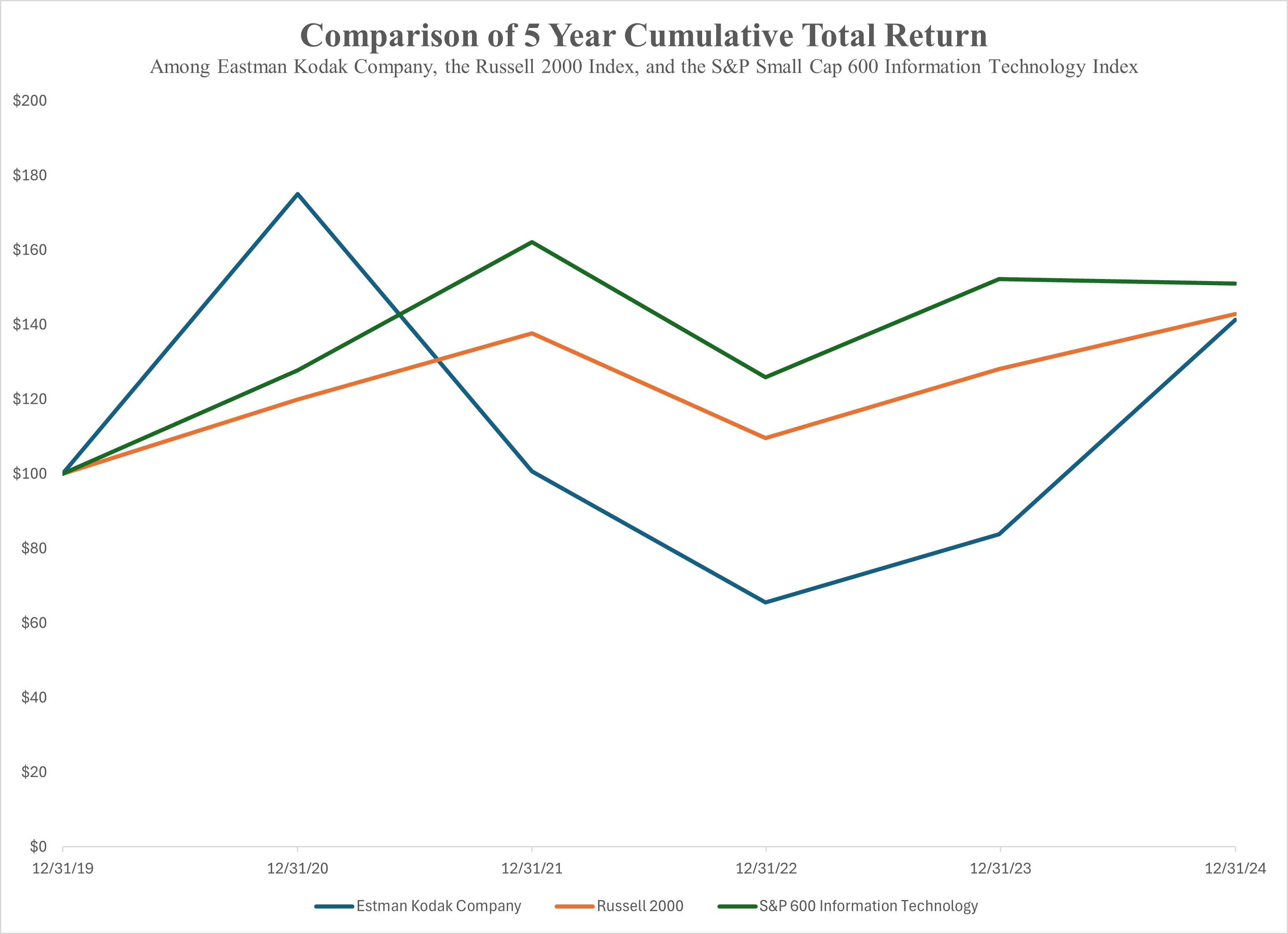
The stock price performance included in this graph is not indicative of, or intended to forecast, future stock price performance.
31
SALES OF UNREGISTERED SECURITIES DURING THE YEAR ENDED DECEMBER 31, 2024
None.
ISSUER PURCHASES OF EQUITY SECURITIES DURING THE QUARTER ENDED DECEMBER 31,2024
|
|
Total Number |
|
|
Average |
|
|
Total Number |
|
Maximum Number of Shares |
||
October 1 through 31, 2024 |
|
|
4,461 |
|
|
$ |
4.77 |
|
|
N/A |
|
N/A |
November 1 through 30, 2024 |
|
|
78,637 |
|
|
$ |
7.22 |
|
|
N/A |
|
N/A |
December 1 through 31, 2024 |
|
|
— |
|
|
$ |
— |
|
|
N/A |
|
N/A |
Total |
|
|
83,098 |
|
|
$ |
7.09 |
|
|
|
|
|
ITEM 6. [RESERVED]
32
ITEM 7. MANAGEMENT’S DISCUSSION AND ANALYSIS OF FINANCIAL CONDITION AND RESULTS OF OPERATIONS
The following Management’s Discussion and Analysis of Financial Condition and Results of Operations (“MD&A”) is intended to help the reader understand the results of operations and financial condition of Kodak and should be read in conjunction with the consolidated financial statements and notes thereto included in Part II, Item 8. “Financial Statements and Supplementary Data” (“Item 8”) of this Annual Report on Form 10-K. All references to Notes relate to Notes to the Financial Statements in Item 8.
CAUTIONARY STATEMENT PURSUANT TO SAFE HARBOR PROVISIONS OF THE PRIVATE SECURITIES LITIGATION REFORM ACT OF 1995
This report on Form 10-K includes "forward–looking statements" as that term is defined under the Private Securities Litigation Reform Act of 1995.
Forward–looking statements include statements concerning Kodak’s plans, objectives, goals, strategies, future events, future revenue or performance, capital expenditures, liquidity, investments, financing needs and business trends and other information that is not historical information. When used in this document, the words “estimates,” “expects,” “anticipates,” “projects,” “plans,” “intends,” “believes,” “predicts,” “forecasts,” “strategy,” “continues,” “goals,” “targets” or future or conditional verbs, such as “will,” “should,” “could,” or “may,” and similar words and expressions, as well as statements that do not relate strictly to historical or current facts, are intended to identify forward–looking statements. All forward–looking statements, including management’s examination of historical operating trends and data, are based upon Kodak’s current expectations and assumptions. Forward-looking statements are subject to risks, uncertainties and other factors that could cause actual results or outcomes, or timing of actual results or outcomes, to differ materially from historical results or those expressed in or implied by such forward-looking statements. Important factors that could cause actual events, results or outcomes, or their timing, to differ materially from the forward-looking statements include, among others, the risks and uncertainties described in more detail in this report on Form 10–K under the headings “Business,” “Risk Factors,” “Legal Proceedings” and/or “Management’s Discussion and Analysis of Financial Condition and Results of Operations–Liquidity and Capital Resources,” and in other filings the Company makes with the SEC from time to time, as well as the following:
33
Future events and other factors may cause Kodak’s actual results to differ materially from the forward–looking statements. All forward–looking statements attributable to Kodak or persons acting on its behalf apply only as of the date of this report on Form 10-K and are expressly qualified in their entirety by the cautionary statements included in this document. Kodak undertakes no obligation to update or revise forward–looking statements to reflect events or circumstances that arise after the date made or to reflect the occurrence of unanticipated events, except as required by law.
The following MD&A provides a historical and prospective narrative on the Company’s financial condition and results of operations for the year ended December 31, 2024 as compared to the year ended December 31, 2023. Cross references to Notes in this MD&A are to the Notes in the Financial Statements included in Part II, Item 8, "Financial Statements and Supplementary Data". The discussion of the Company’s financial condition and results of operations for the year ended December 31, 2023 compared to 2022 is included in Part II, Item 7. Management’s Discussion and Analysis of Financial Condition and Results of Operations in the Company’s Annual Report on Form 10–K for the year ended December 31, 2023.
EXECUTIVE OVERVIEW
Consolidated revenues in the year ended December 31, 2024 were $1.043 billion, a decline of $74 million (7%) from 2023. Currency fluctuations impacted revenue unfavorably in 2024 compared to 2023 ($3 million).
Print revenues, which accounted for 71% of Kodak’s total revenues in 2024, declined by $91 million (11%) compared to 2023. Advanced Materials and Chemicals revenue improved $16 million (6%) from 2023 to 2024.
Economic Environment and Other Global Events:
Kodak's products are sold and serviced in numerous countries across the globe with more than half of sales generated outside the U.S. Current global economic conditions remain highly volatile due to the uncertain and unpredictable macroeconomic environment, heightened levels of inflation, the war in Ukraine, the conflicts involving Israel, changes in trade policies, including tariffs or other trade restrictions or the threat of such actions, and other global events which impacted Kodak’s operations. Kodak is experiencing revenue declines and increased manufacturing costs for certain businesses due to lower volumes and increases in labor, material and distribution costs, as well as supply chain disruptions and shortages in materials and labor.
Kodak has implemented various pricing actions and customer-focused initiatives to mitigate the impact of increased manufacturing costs, primarily within its Print and Advanced Materials and Chemicals segments. Largely beginning in the latter part of the second quarter of 2021, in order to mitigate the impact of higher aluminum, energy and packaging costs within Prepress Solutions, the Print segment implemented pricing actions on purchases of plates that continue to be periodically reviewed and adjusted accordingly. In addition, the Advanced Materials and Chemicals segment implemented various pricing actions primarily within its Industrial Films and Chemicals and Motion Picture businesses.
The Print segment is experiencing a slowdown in customer demand for plates that negatively impacted volume due to current global economic conditions and the impact of pricing actions. In addition to the pricing actions and customer initiatives described above, Kodak has implemented supply chain and workforce optimization, productivity improvements and other cost savings activities. The combined actions have largely mitigated the impact of lower volumes and increased manufacturing costs. However, the potential worsening of economic conditions, continued decreases in volume and increases in manufacturing and other costs without further price increases, productivity improvements or other cost saving measures, could unfavorably impact this segment's operating results.
34
The Electrophotographic Printing Solutions business (the "EPS Business") within the Print Segment experienced higher than expected volume declines in 2024. During the third quarter of 2024, Kodak recorded an inventory reserve adjustment of $4 million resulting from higher-than-expected volume declines for certain component and service parts sold to its installed base of NEXFINITY printers due to the negative impact of recent pricing actions and ceasing the manufacturing of NEXFINITY printers effective December 2022. During the fourth quarter of 2024, Kodak recorded an inventory reserve adjustment of $4 million related to EPS Business black and white consumables and service parts due to the reduction in forecasted demand communicated from its primary distributor. As of December 31, 2024, the carrying value of inventory for the EPS Business was approximately $7 million.
The Advanced Materials and Chemicals segment has also experienced labor shortages in certain manufacturing areas. Increased demand for consumer film products along with manufacturing equipment limitations and labor shortages have contributed to increased backorders. During 2024, the Advanced Materials and Chemicals segment reduced the amount of backorders compared to levels seen in prior years. This was driven by increased headcount and capital investments in equipment upgrades and new equipment that increased capacity and streamlined processes. Increased demand for film products may continue to place stress on manufacturing equipment and the labor force without further investment or additional hiring in specific areas.
Kodak has implemented numerous measures to mitigate the challenges associated with supply chain disruptions and shortages in materials, including increasing safety stock on certain materials, increasing lead‐times, providing suppliers with longer forecasts of future demand and certifying additional sources or substitute materials where possible. These measures have enabled Kodak to largely meet current demand.
Following the cessation of U.S. plate manufacturing operations by Kodak’s key competitors, Kodak has faced increasing competition in the U.S. from low-priced plates imported from China and Japan. On September 28, 2023, Kodak filed petitions with the U.S. Department of Commerce ("Commerce Department") and the U.S. International Trade Commission ("ITC") requesting relief from unfairly traded imports of plates from China and Japan in the form of the imposition of anti-dumping and/or countervailing duties on such imported plates. After making an affirmative preliminary determination on November 15, 2023, on October 22, 2024 the ITC made a final determination that a U.S. industry is materially injured by reason of imports of aluminum lithographic printing plates from China and Japan that the Commerce Department has determined are sold at less than fair value and subsidized by the government of China. The Commerce Department conducted investigations to determine dumping and subsidy margins against imports of plates manufactured in China and Japan. The Commerce Department announced preliminary findings in its countervailing duty investigation on imports of plates manufactured in China on February 27, 2024 and announced preliminary findings in its anti-dumping duty investigations on imports of plates manufactured in China and Japan on April 26, 2024, which were amended with respect to plates from China on May 28, 2024. The Commerce Department announced final findings in its anti-dumping duty investigations on imports of plates manufactured in China and Japan and its countervailing duty investigation on imports of plates manufactured in China on September 23, 2024. As a result of the determinations by the ITC and Commerce Department, duties are now being imposed on U.S. imports of plates as follows: (i) anti-dumping duties of 115.84% on such plates manufactured in China by Fuji and 317.43% on such plates manufactured in China by other entities (in each case, imposed on plates imported on or after May 1, 2024), (ii) countervailing duties of 35.66% on practically all such plates manufactured in China (imposed on plates imported on or after March 1, 2024), and (iii) anti-dumping duties of 91.83% on practically all such plates manufactured in Japan (imposed on plates imported on or after May 1, 2024). There can be no assurance that the duties imposed on imported plates will provide Kodak effective relief and will not be reduced or impaired by any appeal or other challenge.
Kodak is monitoring the events surrounding the conflicts involving Israel and the impact on the operations of its Israel subsidiary. A leased warehouse in Israel was destroyed in 2023; however, none of Kodak’s employees were injured. While the potential impact of future developments related to this conflict is difficult to predict at this time, Kodak has been able to adapt its operations to avoid material disruption to its business. The direct operations of Kodak’s Israel subsidiary were less than 1% of total consolidated revenue and assets in 2024.
Kodak also continues to monitor the events surrounding the war in Ukraine and the various sanctions imposed in response to the war. Kodak believes it is in compliance with all sanctions. Kodak has experienced worldwide supply constraints for aluminum and increased energy and transportation costs due in part to the war in Ukraine. The extent to which the war in Ukraine will continue to impact the global economy and Kodak's business and operations remains uncertain.
The war in Ukraine and the international response have disrupted Kodak’s ability to operate its Russian subsidiary in the ordinary course, affecting its ability to pay vendors and employees, receive amounts owed from customers in Russia and deliver product. Kodak is in the process of an orderly winding down of its Russian subsidiary and has ceased its direct Russian operations. The direct operations of Kodak’s Russian subsidiary did not have a material impact on the Company’s financial statements (less than 1% of total consolidated revenues and assets for 2024, 2023 and 2022), and there were no material impacts to the consolidated results of operations for the years ended December 31, 2024 and 2023 from the wind-down activities.
35
The ongoing changes in global economic conditions and the impact of other global events on Kodak’s operations and financial performance remains uncertain and will depend on several factors such as the slowdown in customer demand, the ability to offset higher labor, material and distribution costs through pricing actions, duration of supply chain disruptions and the ability to secure raw materials and components.
Business Overview and Strategy:
Segments within the print industry and the film industry face competition from digital substitution. Kodak’s strategy is to:
A discussion of opportunities and challenges related to Kodak’s strategy follows:
36
RESULTS OF OPERATIONS
|
|
Year Ended |
|
|
|
|
|
Year Ended |
|
|
|
|
|
|
|
|||||
|
|
December 31, |
|
|
% of |
|
|
December 31, |
|
|
% of |
|
|
$ Change vs. |
|
|||||
(in millions) |
|
2024 |
|
|
Sales |
|
|
2023 |
|
|
Sales |
|
|
2023 |
|
|||||
Revenues |
|
$ |
1,043 |
|
|
|
|
|
$ |
1,117 |
|
|
|
|
|
$ |
(74 |
) |
||
Cost of revenues |
|
|
840 |
|
|
|
|
|
|
907 |
|
|
|
|
|
|
(67 |
) |
||
Gross profit |
|
|
203 |
|
|
|
19 |
% |
|
|
210 |
|
|
|
19 |
% |
|
|
(7 |
) |
Selling, general and administrative expenses |
|
|
179 |
|
|
|
17 |
% |
|
|
159 |
|
|
|
14 |
% |
|
|
20 |
|
Research and development costs |
|
|
33 |
|
|
|
3 |
% |
|
|
34 |
|
|
|
3 |
% |
|
|
(1 |
) |
Restructuring costs and other |
|
|
8 |
|
|
|
1 |
% |
|
|
7 |
|
|
|
1 |
% |
|
|
1 |
|
Other operating (income) expense, net |
|
|
(10 |
) |
|
|
(1 |
%) |
|
|
6 |
|
|
|
1 |
% |
|
|
(16 |
) |
(Loss) earnings from continuing operations |
|
|
(7 |
) |
|
|
(1 |
%) |
|
|
4 |
|
|
|
0 |
% |
|
|
(11 |
) |
Interest expense |
|
|
59 |
|
|
|
6 |
% |
|
|
52 |
|
|
|
5 |
% |
|
|
7 |
|
Pension income excluding service cost component |
|
|
(173 |
) |
|
|
(17 |
%) |
|
|
(161 |
) |
|
|
(14 |
%) |
|
|
(12 |
) |
Loss on early extinguishment of debt |
|
|
— |
|
|
|
— |
|
|
|
27 |
|
|
|
2 |
% |
|
|
(27 |
) |
Other income, net |
|
|
(3 |
) |
|
|
(0 |
%) |
|
|
(1 |
) |
|
|
(0 |
%) |
|
|
(2 |
) |
Earnings from continuing operations before income taxes |
|
|
110 |
|
|
|
11 |
% |
|
|
87 |
|
|
|
8 |
% |
|
|
23 |
|
Provision for income taxes |
|
|
8 |
|
|
|
1 |
% |
|
|
12 |
|
|
|
1 |
% |
|
|
(4 |
) |
NET EARNINGS |
|
$ |
102 |
|
|
|
10 |
% |
|
$ |
75 |
|
|
|
7 |
% |
|
$ |
27 |
|
37
Revenues
For the year ended December 31, 2024, revenues declined approximately $74 million compared with 2023 primarily due to lower volume as well as price and product mix declines in Print ($82 million and $5 million, respectively) and unfavorable foreign currency fluctuations ($3 million), partially offset by improved pricing and product mix and higher volume in Advanced Materials and Chemicals ($12 million and $3 million, respectively) and higher volume in Brand ($2 million). See segment discussions for additional details.
Gross Profit
Gross profit for 2024 declined approximately $7 million compared with 2023, primarily due to lower margins in Advanced Materials and Chemicals ($5 million), lower volumes and less favorable pricing and product mix in Print ($4 million and $2 million, respectively), inventory reserve adjustments in the EPS Business ($8 million) and higher aluminum costs ($4 million), partially offset by improved pricing and product mix within Advanced Materials and Chemicals ($11 million), higher restructuring costs in the prior year ($2 million), improved volume in Brand ($2 million) and the net change in employee benefits reserves ($1 million). See segment discussions for additional details.
Selling, General and Administrative Expenses
Consolidated SG&A increased $20 million in 2024 primarily due to investments in information technology systems ($2 million) and changes in organizational structure ($2 million) to drive further operational efficiencies, as well as costs associated with the drupa trade show ($2 million) and certain litigation matters ($7 million). In addition, the prior year had $15 million of income representing insurance reimbursement of legal costs previously paid by the Company associated with investigations and litigation. These cost increases were partially offset by a decline in equity compensation costs ($1 million), the net change in employee benefits reserves ($1 million) and reduction in other SG&A costs ($6 million).
Research and Development Costs
Consolidated R&D expenses were relatively flat in 2024 compared with 2023.
Restructuring Costs and Other
These costs, as well as restructuring costs reported in Cost of revenues, are discussed under the "Restructuring Costs and Other" section in this MD&A and Note 18, “Restructuring Costs and Other."
Interest Expense
The increase in interest expense in 2024 of $7 million represents the full year of interest expense associated with the refinancing transactions that closed in the third quarter of 2023. Refer to Note 8, “Debt and Credit Facilities” for further information.
Other Operating (Income) Expense, Net
For details, refer to Note 15, “Other Operating (Income) Expense, Net.”
Pension Income
For details, refer to Note 19, “Retirement Plans."
Loss on Early Extinguishment of Debt
For details, refer to Note 8, "Debt and Credit Facilities."
Other Income, Net
For details, refer to Note 16, “Other (Income) Charges, Net.”
Provision for Income Taxes
For details, refer to Note 17, “Income Taxes.”
38
DETAILED RESULTS OF OPERATIONS
Net Revenues from Continuing Operations by Reportable Segment
|
|
Year Ended December 31, |
|
|||||
|
|
2024 |
|
|
2023 |
|
||
(in millions) |
|
|
|
|
|
|
||
|
$ |
737 |
|
|
$ |
828 |
|
|
Advanced Materials and Chemicals |
|
|
271 |
|
|
|
255 |
|
Brand |
|
|
20 |
|
|
|
17 |
|
Total of reportable segments |
|
|
1,028 |
|
|
|
1,100 |
|
All Other revenues |
|
|
15 |
|
|
|
17 |
|
Consolidated total |
|
$ |
1,043 |
|
|
$ |
1,117 |
|
Kodak’s segment measure of profit and loss is an adjusted earnings before interest, taxes, depreciation and amortization (“Operational EBITDA”). As demonstrated in the table below, Operational EBITDA represents the earnings from continuing operations before income taxes excluding non-service cost components of pension and other postemployment benefits income; depreciation and amortization expense; restructuring costs and other; stock-based compensation expense; consulting and other costs; idle costs; other operating income (expense), net; loss on early extinguishment of debt; interest expense and other income, net.
Segment Operational EBITDA and Consolidated Earnings from Continuing Operations Before Income Taxes
|
|
Year Ended December 31, |
|
|||||
(in millions) |
|
2024 |
|
|
2023 |
|
||
|
$ |
(8 |
) |
|
$ |
20 |
|
|
Advanced Materials and Chemicals |
|
|
17 |
|
|
|
10 |
|
Brand |
|
|
17 |
|
|
|
15 |
|
All Other Operational EBITDA |
|
|
2 |
|
|
|
2 |
|
Depreciation and amortization |
|
|
(28 |
) |
|
|
(30 |
) |
Restructuring costs and other |
|
|
(8 |
) |
|
|
(10 |
) |
Stock-based compensation |
|
|
(6 |
) |
|
|
(7 |
) |
Consulting and other costs (1) |
|
|
(1 |
) |
|
|
13 |
|
Idle costs (2) |
|
|
(2 |
) |
|
|
(3 |
) |
Other operating income (expense), net (3) |
|
|
10 |
|
|
|
(6 |
) |
Interest expense (3) |
|
|
(59 |
) |
|
|
(52 |
) |
Pension income excluding service cost component (3) |
|
|
173 |
|
|
|
161 |
|
Loss on early extinguishment of debt (3) |
|
|
— |
|
|
|
(27 |
) |
Other income, net (3) |
|
|
3 |
|
|
|
1 |
|
Consolidated earnings from continuing operations before income taxes |
|
$ |
110 |
|
|
$ |
87 |
|
In 2024, Kodak decreased employee benefit reserves by $2 million primarily reflecting a decrease in workers’ compensation reserves driven by changes in discount rates. The decrease in reserves in 2024 impacted gross profit and SG&A each by approximately $1 million.
In 2023, Kodak decreased employee benefit reserves by $1 million primarily reflecting a reduction in workers’ compensation reserves driven by changes in discount rates. The decrease in reserves in 2023 impacted SG&A by approximately $1 million.
39
PRINT SEGMENT
|
|
Year Ended December 31, |
|
|||||||||
(in millions) |
|
2024 |
|
|
2023 |
|
|
$ Change |
|
|||
Revenues |
|
$ |
737 |
|
|
$ |
828 |
|
|
$ |
(91 |
) |
|
|
|
|
|
|
|
|
|
|
|||
Operational EBITDA |
|
|
(8 |
) |
|
|
20 |
|
|
|
(28 |
) |
Operational EBITDA as a % of revenues |
|
|
(1 |
%) |
|
|
2 |
% |
|
|
|
|
Revenues
The decrease in Print revenues of approximately $91 million in 2024 primarily reflected reduced volumes in Prepress Solutions ($46 million), volume declines in Electrophotographic Printing Solutions ($24 million), less favorable pricing in Prepress Solutions ($10 million), lower volumes in Prosper ($10 million), declines in Software volume ($2 million) and unfavorable foreign currency ($3 million). The unfavorable impacts were partially offset by favorable pricing and product mix in Electrophotographic Printing Solutions ($5 million).
Operational EBITDA
Print Operational EBITDA declined approximately $28 million in 2024, and was primarily related to inventory reserve adjustments in Electrophotographic Printing Solutions ($8 million), higher SG&A costs ($9 million), lower volumes and less favorable pricing in Prepress Solutions ($9 million and $8 million, respectively) and higher aluminum costs ($4 million). These unfavorable impacts were partially offset by favorable pricing and product mix in Electrophotographic Printing Solutions ($6 million) and volume changes for Prosper ($4 million).
ADVANCED MATERIALS AND CHEMICALS SEGMENT
|
|
Year Ended December 31, |
|
|||||||||
(in millions) |
|
2024 |
|
|
2023 |
|
|
$ Change |
|
|||
Revenues |
|
$ |
271 |
|
|
$ |
255 |
|
|
$ |
16 |
|
|
|
|
|
|
|
|
|
|
|
|||
Operational EBITDA |
|
|
17 |
|
|
|
10 |
|
|
|
7 |
|
Operational EBITDA as a % of revenues |
|
|
6 |
% |
|
|
4 |
% |
|
|
|
|
Revenues
The improvement in Advanced Materials and Chemicals revenues of approximately $16 million in 2024 was primarily the result of pricing and product mix improvements in Industrial Film and Chemicals ($11 million) and volume increases in Motion Picture ($3 million).
Operational EBITDA
Advanced Materials and Chemicals Operational EBITDA improved approximately $7 million in 2024, and primarily reflected improved pricing and product mix in Industrial Film and Chemicals ($11 million), higher volumes in Motion Picture ($1 million) and lower research and development and manufacturing costs ($2 million and $1 million, respectively), partially offset by lower margins in Industrial Film and Chemicals ($6 million) and higher SG&A costs ($3 million).
BRAND SEGMENT
|
|
Year Ended December 31, |
|
|||||||||
(in millions) |
|
2024 |
|
|
2023 |
|
|
$ Change |
|
|||
Revenues |
|
$ |
20 |
|
|
$ |
17 |
|
|
$ |
3 |
|
|
|
|
|
|
|
|
|
|
|
|||
Operational EBITDA |
|
|
17 |
|
|
|
15 |
|
|
|
2 |
|
Operational EBITDA as a % of revenues |
|
|
85 |
% |
|
|
88 |
% |
|
|
|
|
There were no material changes to Brand revenues or Operational EBITDA in 2024.
40
RESTRUCTURING COSTS AND OTHER
2024
Restructuring actions taken in 2024 were initiated to reduce Kodak’s cost structure as part of its commitment to drive sustainable profitability and included various targeted reductions in manufacturing, service, sales and administrative, and research and development functions.
As a result of these actions, for the year ended December 31, 2024, Kodak recorded $8 million of charges which were reported in Restructuring costs and other in the Consolidated Statement of Operations.
Kodak made cash payments related to restructuring of approximately $7 million for the year ended December 31, 2024.
The restructuring actions implemented in 2024 are expected to generate future annual cash savings of approximately $12 million. These savings are expected to reduce future annual Cost of revenues and SG&A expenses by $5 million and $7 million, respectively. Kodak expects the majority of the annual savings to take effect by the end of 2025 as actions are completed. See Note 18, “Restructuring Costs and Other” for additional information on Kodak’s restructuring actions.
LIQUIDITY AND CAPITAL RESOURCES
Management’s Assessment of Liquidity
Kodak ended the year with a cash balance of $201 million, a decrease of $54 million from December 31, 2023.
The refinancing transactions entered into during 2023, cash proceeds related to brand licensing arrangements and savings relating to rationalization, cost reductions and operational efficiencies provided additional liquidity to the Company to fund on‐going operations and to invest in growth opportunities in Kodak’s businesses of print and advanced materials and chemicals and for corporate infrastructure investments expected to contribute to improvements in cash flow.
Available liquidity includes existing cash balances. The amount of available liquidity is subject to fluctuations and includes cash balances held by various entities worldwide. At December 31, 2024 and 2023 approximately $118 million and $167 million, respectively, of cash and cash equivalents were held within the U.S. and approximately $83 million and $88 million, respectively, of cash and cash equivalents were held outside the U.S. Cash balances held outside the U.S. are generally required to support local country operations and may have high tax costs or other limitations that delay the ability to repatriate, and therefore may not be readily available for transfer to other jurisdictions. Kodak utilizes cash balances outside the U.S. to fund needs in the U.S. through the use of intercompany loans.
As of December 31, 2024 and 2023, outstanding intercompany loans to the U.S. were $483 million and $460 million, respectively, which included short-term intercompany loans from Kodak’s international finance center of $208 million and $173 million, respectively. In China, where approximately $29 million of cash and cash equivalents was held as of both December 31, 2024 and 2023, there are limitations related to net asset balances that may impact the ability to make cash available to other jurisdictions in the world. Under the terms of the Amended and Restated Term Loan Credit Agreement, the Company is permitted to invest up to $60 million (or $75 million after the Deleveraging Milestone Date) in Restricted Subsidiaries that are not Loan Parties and in joint ventures or Unrestricted Subsidiaries that are not party to the Amended and Restated Term Loan Credit Agreement.
The Company’s Hong Kong subsidiary has an intercompany loan from one of the Company’s Chinese subsidiaries with a maturity date of November 16, 2024, the proceeds of which were in turn loaned to the Company. The terms of the intercompany loan were modified during the fourth quarter of 2024 to extend the maturity date to November 16, 2026 and for the Company to make efforts to repay the outstanding loan balance prior to maturity. The prior intercompany loan agreement provided for it to be repaid over two years in four equal $20 million installments, the first of which was due by November 16, 2023 with the remaining installments due in 2024. The Company paid $2 million in the first quarter of 2024 and $10 million in the second quarter of 2024 towards the first $20 million installment. The outstanding amount of the intercompany loan as of December 31, 2024 was $68 million. The Company is evaluating repayment alternatives for the current loan agreement which would allow Kodak and its subsidiaries to perform their obligations to each other while minimizing the impact on U.S. liquidity taking into account requirements imposed by Chinese regulators. Any amounts repaid to the Chinese subsidiary may not be able to be loaned, repatriated or otherwise moved back to the U.S., in which case the Company’s U.S. liquidity would be reduced.
During the third quarter of 2023, Kodak entered into multiple long-term brand licensing arrangements and recorded total deferred revenue of approximately $57 million. Kodak received approximately $12 million of cash proceeds related to these licensing arrangements in 2023, received $40 million in the first quarter of 2024 and expects to receive $5 million in 2025.
41
Kodak's cash flows continue to be negatively impacted by volume declines, higher manufacturing costs and increased labor, material and distribution costs, supply chain disruptions and shortages in materials and labor. The impacts from price increases, continued cost reduction actions and supply chain-related cost improvements continue to positively impact Kodak’s operations. The economic uncertainties surrounding the current inflationary environment and other global events represent additional elements of complexity in Kodak’s plans to return to sustainable positive cash flow. The Company cannot predict the duration and scope of such events, including the war in Ukraine and the conflicts involving Israel, and other factors such as the ability to continue to secure raw materials and components, the impact of rising costs of labor, commodity and distribution costs, the ability to maintain current pricing levels or how quickly and to what extent normal economic and operating conditions can resume.
Kodak's plans to return to sustainable positive cash flow include generating profitable revenues through continued pricing actions and customer-focused initiatives, implementing effective working capital utilization, reducing operating expenses, continuing to simplify the organizational structure, investing in IT systems to drive operational efficiencies, generating cash from selling and leasing underutilized assets or through new licensing opportunities and implementing ways to reduce cash collateral needs. In addition, proceeds received from the settlement of the KRIP, after required debt prepayments, as further discussed below, would be available for use for strategic growth or general corporate purposes.
Kodak believes its liquidity position is adequate to fund its operating and investing needs and to provide the flexibility to respond as necessary to ordinary changes in the business and economic environment within the next twelve months from the date of this filing.
On February 26, 2025, the Company entered into an amendment to the Amended and Restated Term Loan Credit Agreement (the “2025 Term Loan Credit Agreement Amendment”) and an amendment to the Amended and Restated L/C Facility Agreement (the “2025 L/C Facility Agreement Amendment”) to modify the maturity date of each respective agreement. To the extent the Series B or Series C Preferred Stock maturity date is not extended, and the shares remain outstanding, then the maturity date of the Term Loans under the 2025 Amended and Restated Term Loan Credit Agreement will be accelerated from August 15, 2028 to May 21, 2026. In addition, the maturity date of the 2025 Amended and Restated L/C Facility Agreement would be accelerated to May 11, 2026.
Kodak’s ability to adequately fund its long‐term liquidity, debt service and capital requirements will be dependent on its ability to convert, redeem, extend or refinance the existing Series B and Series C Preferred Stock past their current maturities of May 26, 2026, to obtain sufficient proceeds from the settlement of KRIP to reduce the amount of the Term Loans and to use in the funding of the Company’s strategic growth initiatives, to generate positive cash flows from operations and to manage world‐wide cash through intercompany loans, distributions or other mechanisms.
KODAK RETIREMENT INCOME PLAN
On January 21, 2025, the Board of Directors of Kodak approved the termination of KRIP effective March 31, 2025, at which time all benefits under KRIP will be frozen. Kodak expects that KRIP’s liabilities would be satisfied through a combination of lump sum distributions to active and terminated vested participants who elect a lump sum distribution and the purchase of an annuity from an insurance company with respect to existing KRIP annuity obligations for current retirees and beneficiaries and annuity obligations arising from the termination to active and terminated vested participants who do not elect to receive lump sum distributions. The cost to satisfy KRIP’s liabilities will be affected by a variety of factors including interest rate fluctuations, the portion of active and terminated vested participants who elect lump-sum distributions, the premium payable to purchase the annuity, and other actuarial factors used to calculate the value of KRIP’s ongoing annuity obligations. While KRIP has hedging arrangements in place designed to hedge interest rates for practically all of KRIP’s liabilities, a significant portion of those arrangements are linked to fluctuations in US treasury rates and would not hedge against changes to the difference between the discount rates used to value KRIP’s liabilities and US treasury rates (i.e., the credit spread) or non-interest rate factors that may influence the amount of KRIP’s liabilities.
After KRIP’s liabilities and applicable legal requirements have been satisfied, KRIP’s surplus assets would revert to Kodak as the settlor of KRIP subject to an excise tax. Based on current assumptions, Kodak estimates KRIP would have surplus assets of between $750 million and $900 million after the satisfaction of KRIP’s liabilities. The actual amount of surplus assets available after the satisfaction of KRIP’s liabilities will be affected by the actual amount paid to satisfy KRIP’s liabilities, the return on KRIP’s assets during the period over which KRIP’s assets are liquidated and its liabilities satisfied (the “Liquidation Period”), the degree to which KRIP’s hedging strategy is effective in hedging fluctuations in the amount of KRIP’s liabilities during the Liquidation Period, the amounts realized from Hedge Fund Assets in the course of their redemption during the Liquidation Period, the amounts realized from distributions from or any sale of remaining KRIP Illiquid Assets during the Liquidation Period, the value of Hedge Fund Assets or KRIP Illiquid Assets held in the portfolio at the time of reversion, actuarial experience on plan liabilities during the Liquidation Period, the duration of the Liquidation Period, and the costs associated with the termination and liquidation process.
42
In order to reduce the amount of the surplus assets subject to excise tax and to reduce the rate of the excise tax from 50% to 20%, Kodak expects that it would direct the transfer of or otherwise contribute 25% of the surplus assets (which may include all or a significant portion of remaining non-cash assets) to the Kodak Cash Balance Plan (the “Replacement Plan”). After the capitalization of the Replacement Plan and the payment of the 20% excise tax on the remaining surplus, Kodak projects it would receive proceeds from KRIP having a value of between $450 million and $540 million. Kodak believes no material amount of income tax would be owed on this amount due to available tax attributes. In addition to the proceeds received by Kodak from KRIP, the Replacement Plan is projected to have assets having a value of between $190 million and $225 million which would allow Kodak to provide valuable benefits to its current employee base for the foreseeable future without additional cash cost to Kodak.
Under the terms of the Amended and Restated Term Loan Credit Agreement, Kodak is obligated to use 100% of the net cash proceeds of any reversion from KRIP (“Reversion Proceeds”) to prepay Term Loans outstanding under the Amended and Restated Term Loan Credit Agreement until the amount of the Term Loans is reduced to $300 million and, thereafter, to use 50% of the Reversion Proceeds to prepay Term Loans until the amount of the Term Loans is reduced to $200 million, in each case plus a 1% prepayment fee. Reversion Proceeds not used to prepay Term Loans would be included in the calculation of Excess Cash Flow as defined in the Amended and Restated Term Loan Credit Agreement and could thereby trigger additional prepayment obligations under the Amended and Restated Term Loan Credit Agreement which cannot be estimated at this time. Assuming these obligations are not amended, waived or otherwise modified in the interim, no other prepayments are made in the interim, and Kodak uses the Reversion Proceeds to prepay only the minimum amount required under the Amended and Restated Term Loan Credit Agreement, Kodak expects it would use approximately $290 million of the Reversion Proceeds to satisfy these obligations, leaving a Term Loan balance of $200 million and yielding an annual interest cost savings of approximately $40 million. Based on all of the foregoing projections and after the projected prepayment of Term Loans, Kodak projects that it would receive cash or other assets from the KRIP surplus having a value of between $160 million and $250 million.
At the time the formal determination was made to terminate KRIP, Kodak estimated that it would take between 10 and 12 months to determine and satisfy KRIP’s liabilities and between 11 and 15 months before Kodak receives any Reversion Proceeds; however, these time frames are subject to factors beyond Kodak’s control including (i) the availability of an annuity product to satisfy KRIP’s annuity obligations at an acceptable cost and on acceptable terms, (ii) the continued conversion of investments into cash or other liquid assets at the pace currently anticipated, and (iii) regulatory review and approval of various aspects of the terms of KRIP, KRIP’s activities, and the termination and liquidation process.
Amended and Restated Term Loan Credit Agreement
During the first quarter of 2024, the Company prepaid $17 million of the Term Loans with net proceeds from the sale of Target Non-Core Assets (as defined in the Amended and Restated Term Loan Agreement).
Amended and Restated Letter of Credit Facility Agreement
Approximately $27 million and $31 million of letters of credit were issued under the Amended and Restated L/C Facility Agreement as of December 31, 2024 and 2023, respectively. The letters of credit under the Amended and Restated L/C Facility Agreement are collateralized by cash collateral (the “L/C Cash Collateral”). The L/C Cash Collateral was $29 million and $32 million at December 31, 2024 and 2023, respectively, which was classified as Restricted Cash.
43
Cash Flow:
Cash, cash equivalents and restricted cash balances were as follows:
|
|
As of December 31, |
|
|||||
(in millions) |
|
2024 |
|
|
2023 |
|
||
Cash, cash equivalents and restricted cash |
|
$ |
301 |
|
|
$ |
377 |
|
Cash Flow Activity
|
|
Year Ended December 31, |
|
|
Year-Over- |
|
||||||
(in millions) |
|
2024 |
|
|
2023 |
|
|
Year Change |
|
|||
Cash flows from operating activities: |
|
|
|
|
|
|
|
|
|
|||
Net cash (used in) provided by operating activities |
|
$ |
(7 |
) |
|
$ |
38 |
|
|
$ |
(45 |
) |
|
|
|
|
|
|
|
|
|
|
|||
Cash flows from investing activities: |
|
|
|
|
|
|
|
|
|
|||
Net cash used in investing activities |
|
|
(39 |
) |
|
|
(32 |
) |
|
|
(7 |
) |
|
|
|
|
|
|
|
|
|
|
|||
Cash flows from financing activities: |
|
|
|
|
|
|
|
|
|
|||
Net cash (used in) provided by financing activities |
|
|
(23 |
) |
|
|
85 |
|
|
|
(108 |
) |
|
|
|
|
|
|
|
|
|
|
|||
Effect of exchange rate changes on cash, cash |
|
|
(7 |
) |
|
|
— |
|
|
|
(7 |
) |
|
|
|
|
|
|
|
|
|
|
|||
Net (decrease) increase in cash, cash equivalents and restricted cash |
|
$ |
(76 |
) |
|
$ |
91 |
|
|
$ |
(167 |
) |
Operating Activities
Net cash from operating activities declined $45 million for the year ended December 31, 2024 as compared with the prior year primarily due to a decrease in liabilities excluding borrowings and trade payable of $67 million, driven by $57 million of deferred revenue related to brand licensing agreements entered into in the prior year, increased investment in inventory ($26 million), decline in proceeds from insurance reimbursements ($20 million) and a refund from a governmental authority ($9 million), both received in the prior year. This decline was partially offset by a decrease in trade receivables of $67 million primarily driven by $40 million of cash proceeds related to brand licensing received in 2024 and reduction in trade accounts payable ($11 million).
Investing Activities
Net cash used in investing activities increased $7 million for the year ended December 31, 2024 as compared to the prior year due to an increase in additions to properties ($24 million) partially offset by proceeds from the sale of assets ($17 million).
Financing Activities
Net cash used in financing activities increased $108 million in the year ended December 31, 2024 compared to the prior year, primarily due to the net proceeds of $90 million received from the July 21, 2023 financing transactions and the $17 million Amended and Restated Term Loan prepayment in 2024.
44
Other Collateral Requirements
The NYS WCB requires security deposits related to self-insured workers’ compensation obligations, which security deposits are recalculated annually. Due to changes in 2019 to the manner in which the required security deposit is determined, the Company has been required to post additional collateral over the last several years. At December 31, 2022, the Company posted $75 million of collateral, representing 107% of the Company’s undiscounted actuarial workers’ compensation obligations. Effective May 1, 2023, the Company added New York to its existing workers compensation liability insurance policy and is no longer self-insured for future claims. As a result, the NYS WCB confirmed the Company will no longer be obligated to post any additional collateral. Further, the NYS WCB confirmed the Company can request a review of the security deposits supporting the historical liability beginning on July 1, 2025 with the submission of a current actuarial report. Based on the results of the actuarial valuation report, the required security deposits may be eligible for reduction in 2025 and future periods.
Based on the legacy nature of the Company’s workers’ compensation obligations, the undiscounted actuarial obligation has been declining and the Company expects this trend to continue. While it may not be indicative of the rate of future declines, the undiscounted actuarial liability declined by an average of $5.1 million per year between 2014 and 2024. Accordingly, subject to the possibility of other changes to the calculation of required security deposits by the NYS WCB, the Company expects the amount of the required security deposits to decline over time and the gradual return of the security deposits that have been made or the capital used to support such security deposits.
In the third quarter of 2023, the Company deposited $68 million directly with the NYS WCB and cancelled the corresponding letter of credit supporting the associated liability. As of December 31, 2024, the Company had $45 million of surety bonds and $30 million deposited directly with the NYS WCB supporting the associated liability. The surety bonds are collateralized with $25 million of cash and the Company could be required to provide up to $20 million of cash or letters of credit to the issuers of certain surety bonds in the future to fully collateralize the bonds.
Other Uses of Cash Related to Financing Transactions
The holders of the Term Loans are entitled to quarterly cash interest payments at a rate of 7.5% per annum. The holders of Series B Preferred Stock are entitled to cumulative dividends payable quarterly in cash at a rate of 4% per annum. All interest and dividends have been paid when due.
Defined Benefit Pension and Postretirement Plans
Kodak made contributions (funded plans) or paid net benefits (unfunded plans) totaling approximately $15 million relating to its non-U.S. defined benefit pension and postretirement benefit plans in 2024. For 2025, the forecasted contribution (funded plans) and net benefit payment (unfunded plans) requirements for its non-U.S. defined benefit pension and postretirement plans are approximately $10 million. Kodak does not expect to make any cash contributions to the KRIP in 2025 and expects benefit payments (unfunded plans) related to its non-major U.S. plans to be less than $1 million.
Capital Expenditures
Cash flows from investing activities included $56 million for capital expenditures for the year ended December 31, 2024. Kodak expects approximately $35 million to $45 million of cash flows for investing activities from capital expenditures for the year ending December 31, 2025.
BEPS Pillar 2
In December 2021, the OECD introduced Base Erosion and Profit Shifting (“BEPS”) Pillar 2 rules that imposed a global minimum tax rate of 15%. Numerous countries, including European Union member states, enacted legislation that took effect on January 1, 2024. To mitigate the administrative burden in complying with the OECD Global BEPS rules during the initial years of implementation, the OECD developed the temporary “Transitional Country-by-Country Safe Harbor” ("Safe Harbor"). The Safe Harbor applies for fiscal years beginning on or before December 31, 2026. Under the Safe Harbor, the top-up tax for such jurisdiction is deemed to be zero, provided that at least one of the Safe Harbor tests is met for the jurisdiction.
Kodak was able to avail itself of the Pillar 2 Safe Harbor in most of the jurisdictions in which it operates. As of December 31, 2024, the impact of Pillar 2 legislation was immaterial to Kodak.
General implementation of the Global minimum tax (by non- US taxing authorities) became effective January 1, 2025. Kodak’s policy is to recognize the impact related to the Safe Harbor as period costs. The Company believes that it will continue to benefit from the Safe Harbor provisions and that there will not be a material impact to the financial statements.
45
Kodak will continue to monitor the legislative developments of Pillar 2 framework in the jurisdictions in which it operates.
Contractual Obligations
The impact that contractual obligations are expected to have on Kodak's cash flow in future periods is as follows:
|
|
|
|
|
As of December 31, 2024 |
|
||||||||||||||||||||||
(in millions) |
|
Total |
|
|
2025 |
|
|
2026 |
|
|
2027 |
|
|
2028 |
|
|
2029 |
|
|
2030+ |
|
|||||||
Long-term debt (1) |
|
$ |
572 |
|
|
$ |
1 |
|
|
$ |
1 |
|
|
$ |
2 |
|
|
$ |
561 |
|
|
$ |
1 |
|
|
$ |
6 |
|
Interest payments on debt (2) |
|
|
158 |
|
|
|
38 |
|
|
|
40 |
|
|
|
41 |
|
|
|
37 |
|
|
|
1 |
|
|
|
1 |
|
Operating lease obligations |
|
|
46 |
|
|
|
14 |
|
|
|
8 |
|
|
|
6 |
|
|
|
5 |
|
|
|
4 |
|
|
|
9 |
|
Purchase obligations (3) |
|
|
19 |
|
|
|
9 |
|
|
|
6 |
|
|
|
2 |
|
|
|
1 |
|
|
|
1 |
|
|
|
— |
|
Convertible preferred stock cash |
|
|
7 |
|
|
|
4 |
|
|
|
3 |
|
|
|
— |
|
|
|
— |
|
|
|
— |
|
|
|
— |
|
Total (5) (6) (7) |
|
$ |
802 |
|
|
$ |
66 |
|
|
$ |
58 |
|
|
$ |
51 |
|
|
$ |
604 |
|
|
$ |
7 |
|
|
$ |
16 |
|
46
CRITICAL ACCOUNTING POLICIES AND ESTIMATES
Preparation of the Company’s Consolidated Financial Statements in conformity with accounting principles generally accepted in the United States (U.S. GAAP) requires management to make estimates and assumptions that affect the reported amounts of assets, liabilities, revenues and expenses. Significant accounting policies used in the preparation of the Consolidated Financial Statements are more fully described in Note 1, “Basis of Presentation and Summary of Significant Accounting Policies.” The accounting policies most critical to the preparation of the consolidated financial statements and require the most difficult, subjective or complex judgments are described below.
Revenue Recognition
Kodak sells a wide portfolio of products and services to its customers. Kodak’s agreements have varying terms and conditions depending on the goods and services being sold, the rights and obligations conveyed and the legal jurisdiction of the arrangement. While most of Kodak’s agreements have standard terms and conditions, more complex equipment arrangements may contain nonstandard terms and conditions that require significant contract interpretation to determine the appropriate accounting.
For equipment sales, revenue recognition may depend on completion of installation based on the type of equipment, level of customer specific customization and other contractual terms. In instances in which the agreement with the customer contains a customer acceptance clause, revenue is deferred until customer acceptance is obtained, provided the customer acceptance clause is considered to be substantive.
Kodak’s brand licensing agreements (symbolic licenses) may include upfront payments with a defined license period or a perpetual license term. Significant judgment is required to determine the term over which revenue will be recognized and whether a significant financing component exists. No significant brand licensing agreements were entered into in 2024.
Taxes
Kodak accounts for income taxes using the asset and liability method. This approach requires the recognition of deferred tax assets and liabilities for the expected future tax consequences of operating losses, credit carryforwards and temporary differences between the carrying amounts and tax basis of Kodak’s assets and liabilities.
Kodak records a valuation allowance to reduce its net deferred tax assets to the amount that is more likely than not to be realized. Management is required to exercise judgment in assessing the realizability of Kodak’s deferred tax assets, considering all available positive and negative evidence. Inherent in this process is the requirement to estimate forecasted earnings, future taxable income, and prudent and feasible tax planning strategies on a jurisdiction-by-jurisdiction basis. It is possible that actual results will differ from assumptions and require adjustments to allowances. Future periods may also provide positive evidence sufficient to conclude that all or part of the valuation allowance recorded in each jurisdiction can be reversed. However, when an accumulation of recent losses or other negative evidence exists, it can be challenging to use forecasted earnings as a source of income when determining whether deferred tax assets can be realized.
Kodak’s ability to utilize its U.S. net operating losses (“NOLs”) and tax credits may be subject to limitations imposed by Section 382 of the Internal Revenue Code. Section 382 limits the utilization of NOLs in the event of significant changes in the stock ownership of the Company. An ownership change occurs if, among other things, the aggregate ownership of stockholders owning five percent of Kodak’s stock increases by more than 50 percentage points over a three-year rolling period. An ownership change can also occur by other items, such as the sale of Kodak shares that are owned by its 5% shareholders. Future transactions, when combined with reported transactions within the testing period, could aggregate an ownership change during the testing period in excess of 50 percentage points.
A Section 382 ownership change would significantly impair Kodak’s ability to utilize NOLs and tax credits in the U.S. As of December 31, 2024, Kodak had available U.S. NOL carry-forwards for income tax purposes of approximately $1,677 million and unused foreign tax credits of $134 million. Any impairment of these tax attributes would be fully offset by a corresponding decrease in Kodak’s U.S. valuation allowance, which would result in no net tax provision.
Kodak intends to repatriate its offshore earnings when prudent. Accordingly, it recorded deferred tax liabilities of $15 million and $16 million for potential taxes on undistributed earnings as of December 31, 2024 and 2023, respectively. These taxes are primarily attributable to foreign withholding taxes.
Kodak operates within multiple taxing jurisdictions worldwide and is subject to audit in these jurisdictions. These audits can involve complex issues, which may require many years to resolve. Management believes that adequate provisions have been made for such issues, however, there is the possibility that the ultimate resolution of such issues could have an adverse effect on the earnings of Kodak.
47
Conversely, if these issues are resolved favorably, the related provisions would be reduced, thus having a positive impact on earnings. Management’s ongoing assessments of the outcomes of these issues and related tax positions requires judgment.
Pension and Other Postretirement Benefits
Kodak’s defined benefit pension and other postretirement benefit costs and obligations are estimated using several key assumptions. The assumptions that have the most significant effect on the Company’s consolidated financial position and results of operations are the expected rate of return on plan assets (“EROA”) and discount rates. Actual results that differ from Kodak’s assumptions are recorded as unrecognized gains and losses as a component of accumulated other comprehensive (loss) income in shareholders’ equity and are amortized to earnings over the estimated future service period of the active participants in the plan or, if the plan is almost entirely inactive, the average remaining lifetime expectancy of inactive participants, to the extent such total net unrecognized gains and losses exceed 10% of the greater of the plan's projected benefit obligation ("PBO") or the calculated value of plan assets. Significant differences in actual experience or significant changes in future assumptions would affect Kodak’s pension and other postretirement benefit costs and obligations.
Return on Plan Assets
EROA is a long-term assumption, which Kodak reviews annually. Kodak utilizes asset and liability modeling studies to adjust asset exposures to conform to its investment strategy, and to review its liability hedging program. These studies generate forward-looking estimates of correlation, risk and return which are used in the development of the EROA. The EROA is estimated utilizing a forward-looking building block model which factors in the expected risk of each asset category, return, and correlation over a five to seven-year horizon, and weighs the exposures by the strategic asset allocation.
Historical inputs are utilized in the forecasting model, including historical asset returns with adjustments based on the forward-looking view. Kodak aggregates investments into major asset categories based on the underlying benchmark of the strategy. Each allocation to these major asset categories is determined to accomplish unique objectives, including enhancing portfolio return, providing portfolio diversification, or hedging plan liabilities, in accordance with the overall investment strategy.
The EROA, once set, is applied to the calculated value of plan assets in the determination of the expected return component of Kodak’s pension expense. Kodak uses a calculated value of plan assets, which recognizes gains and losses in the fair value of assets over a four-year period, to calculate expected return on plan assets.
At December 31, 2024, the calculated value of the assets of Kodak’s major U.S. and non-U.S. defined benefit pension plans was approximately $4.1 billion and the fair value of the assets of Kodak’s major U.S. and non-U.S. defined benefit pension plans was approximately $3.6 billion. Asset gains and losses that are not yet reflected in the calculated value of plan assets are not included in amortization of unrecognized gains and losses.
Kodak’s major U.S. defined benefit pension plan accounts for substantially all of Kodak’s net pension income and represents approximately 86% of the total fair value of major plan assets as of December 31, 2024. The following table presents actual and expected return on plan assets, as well as the corresponding percentages for Kodak’s major U.S. defined benefit pension plan:
|
|
Year Ended December 31, |
|
|
||||||||||
|
|
2024 |
|
|
2023 |
|
|
|
2022 |
|
|
|||
(in millions) |
|
|
|
|
|
|
|
|
|
|
|
|||
Actual return on plan assets |
|
$ |
(149 |
) |
|
$ |
170 |
|
|
|
$ |
(152 |
) |
|
Expected return on plan assets |
|
|
248 |
|
|
|
257 |
|
|
|
|
178 |
|
|
|
|
|
|
|
|
|
|
|
|
|
|
|||
Actual rate of return on plan assets |
|
|
(2.7 |
%) |
|
|
3.9 |
|
% |
|
|
(6.1 |
) |
% |
Expected rate of return on plan assets |
|
|
7.1 |
% |
|
|
7.5 |
|
% |
|
|
5.3 |
|
% |
The actual rate of return on Kodak’s major U.S. defined benefit pension plan for 2024 was negative 2.7% which was lower than the expected rate of return of 7.1%, and was driven by the sale of KRIP Illiquid Assets and change in investment strategy initiated in April 2024 designed to preserve and maximize the value of KRIP's over-funding by reducing investment risk and improving the overall liquidity of KRIP. See Note 19, "Retirement Plans" for further discussion. For 2023 the actual rate of return was 3.9%, which was lower than the expected rate of return of 7.5%, driven by lower than expected returns in the private equity asset class. For 2022 the actual rate of return was negative 6.1%, lower than the expected rate of return of 5.3%, driven by lower than expected bond performance due to rising interest rates. The expected average rate of return on plan assets is a long-term, forward-looking assumption and will likely differ from the actual return in any specific year.
48
Gains or losses from direct investments in derivative instruments by Kodak’s major U.S. defined benefit pension plan can be volatile from year to year and could materially affect the fair value of plan assets. The total net realized (losses) gains from these derivative investments that were included in the actual return on plan assets balance in the table above for the years ending December 31, 2024, 2023 and 2022 were approximately ($18) million, ($1) million and ($128) million, respectively. Refer to the Derivative Instruments discussion below for additional information.
Approximately $0.9 billion and $2.7 billion of the total fair value of Kodak’s major U.S. defined pension plan as of December 31, 2024 and 2023, respectively, represents plan assets where the fair market value is not readily determinable and are measured using the net asset value (“NAV”) per share expedient. The decrease in investments valued at NAV compared to December 31, 2023 was related to the sale of KRIP Illiquid Assets and the redemption of hedge funds as part of KRIP’s change in investment strategy in April 2024. The majority of the hedge fund investments remaining at December 31, 2024 have been or are expected to be redeemed in 2025, with the exception of one fund which has a required redemption period that extends beyond 2025. For private equity funds, the investors do not have an option to redeem their interest in these funds but rather receive distributions from time to time through the liquidation of the underlying investments in the funds. Other than the sale of KRIP's Illiquid Assets in 2024, secondary sales of a material portion of the investments in these funds are infrequent and, historically, immaterial portions of these funds were sold for values not significantly different from NAV.
Discount Rates:
Generally, Kodak bases the discount rate assumption for its significant plans on high quality corporate bond yields in the respective countries as of the measurement date. Specifically, for its U.S., Canadian, Euro-zone and UK plans, Kodak determines a discount rate using a cash flow model to incorporate the expected timing of benefit payments and an AA-rated corporate bond yield curve. For Kodak’s U.S. Plan, spot rates of the FTSE Above Median Pension Discount Curve are used. For Kodak’s non-U.S. plans, discount rates are determined by comparison to published local high-quality bond yields or indices considering estimated plan duration and removing any outlying bonds, as warranted.
Changes in discount rates for Kodak’s major U.S. defined benefit plan has the most significant effect on the total PBO for Kodak's plans.
The table below shows the discount rates for Kodak’s major U.S. pension plan for the years shown:
|
|
Year Ended December 31, |
|
|||||||||
|
|
2024 |
|
|
2023 |
|
|
2022 |
|
|||
Discount Rates - Projected Benefit Obligation: |
|
|
5.45 |
% |
|
|
4.92 |
% |
|
|
5.13 |
% |
U.S. Plan |
|
|
|
|
|
|
|
|
|
|||
As discount rates reflect the market rate on the measurement date, the rates can be volatile from year to year. The increase in the discount rate for Kodak’s major U.S. defined benefit pension plan from December 31, 2023 to December 31, 2024 resulted in a decrease in the PBO of approximately $83 million at December 31, 2024. The decrease in the discount rate for Kodak’s major U.S. defined benefit pension plan from December 31, 2022 to December 31, 2023 resulted in an increase in the PBO of approximately $40 million at December 31, 2023.
Sensitivity Analysis:
The following table illustrates the sensitivity to a change to certain key assumptions used in the calculation of expense for the year ending December 31, 2024 and the PBO at December 31, 2024 for Kodak's major U.S. and non-U.S. defined benefit pension plans:
|
|
Impact on 2025 |
|
|
Impact on PBO |
|
||||||||||
|
|
Pre-Tax Pension Expense |
|
|
December 31, 2024 |
|
||||||||||
|
|
Increase (Decrease) |
|
|
Increase (Decrease) |
|
||||||||||
(in millions) |
|
U.S. |
|
|
Non-U.S. |
|
|
U.S. |
|
|
Non-U.S. |
|
||||
Change in assumption: |
|
|
|
|
|
|
|
|
|
|
|
|
||||
25 basis point decrease in discount rate |
|
$ |
5 |
|
|
$ |
— |
|
|
$ |
38 |
|
|
$ |
11 |
|
25 basis point increase in discount rate |
|
|
(5 |
) |
|
|
— |
|
|
|
(37 |
) |
|
|
(10 |
) |
25 basis point decrease in EROA |
|
|
9 |
|
|
|
1 |
|
|
N/A |
|
|
N/A |
|
||
25 basis point increase in EROA |
|
|
(9 |
) |
|
|
(1 |
) |
|
N/A |
|
|
N/A |
|
||
49
Total pension income from continuing operations before special termination benefits, curtailments and settlements for the major U.S. defined benefit pension plan was $151 million for 2024 and is expected to be approximately $76 million in 2025. The decrease in pension income for 2025 is driven primarily by lower EROA due to the change in investment strategy as discussed above. Pension expense from continuing operations before special termination benefits, curtailments and settlements for the major non-U.S. defined benefit pension plans was $3 million for 2024 and is projected to be less than $1 million in 2025.
Derivative Instruments:
Kodak’s major U.S. defined benefit plan utilizes derivative investments primarily to hedge liability interest rate risk to U.S. government bonds. Kodak’s major U.S. defined benefit pension plan’s derivative portfolio consists of exchange traded futures contracts. As of December 31, 2024 and 2023 the notional amount of these derivative instruments was approximately $574 million and $384 million, respectively. Daily variation margin payments are made to or received from the counterparty for changes in the market value of futures contracts and are recorded as realized gains and losses in the actual return on plan assets balance. As these futures contracts have short-term maturities, the fair value of these derivative instruments at December 31, 2024 and 2023 was ($5) million and $1 million, respectively, which represents the unrealized losses and gains on these contracts. Refer to Note 19, “Retirement Plans” for additional information.
An increase in interest rates is the primary factor that could precipitate material losses in Kodak’s major U.S. defined benefit plan's existing derivatives portfolio. A 25-basis point increase in interest rates would cause a loss from the government bond derivatives of approximately $21 million. However, as illustrated in the above table, a 25-basis point increase in the discount rate used to measure the PBO of the U.S. Plan would cause a $37 million decrease in the PBO. Accordingly, while an increase in interest rates would expose the U.S. Plan’s derivative investments to losses, it would also likely result in an offsetting decrease to the U.S. Plan’s PBO.
Kodak’s major U.S. defined benefit plan has invested in a diversified portfolio of hedge funds that utilize a variety of investment strategies. The total NAV of these hedge funds was approximately $0.7 billion and $1.6 billion as of December 31, 2024 and 2023, respectively. Separate from the major U.S. defined benefit plan’s direct investments in exchange traded futures contracts, hedge funds may utilize derivative instruments to execute their investment strategy.
Any gains or losses, as well as changes in the fair value of derivative investments held by the hedge fund, are included in the hedge fund’s NAV. Losses could occur in the future from hedge fund investments which may result in part from the use of derivative investments by the hedge funds. However, the maximum potential loss on any individual fund would be limited to the U.S. Plan’s investment in that fund.
Inventories
Inventories are stated at the lower of average cost or net realizable value. Judgment is required to assess the ultimate demand for and realizable value of inventory. The analysis of inventory carrying values considers several factors including length of time inventory is on hand, historical sales, product shelf life, product life cycle, product category and product obsolescence. The Company also relies, in certain instances, on demand forecasts from its distributors, and adverse changes in such demand forecasts, when they become known, are taken into consideration when analyzing the carrying values of inventories.
New Accounting Pronouncements
A description of new accounting pronouncements is contained in Note 1, “Basis of Presentation and Summary of Significant Accounting Policies.”
50
ITEM 7A. QUANTITATIVE AND QUALITATIVE DISCLOSURES ABOUT MARKET RISK
Kodak, as a result of its global operating and financing activities, is exposed to changes in foreign currency exchange rates, commodity prices, and interest rates, which may adversely affect its results of operations and financial position. In seeking to minimize the risks associated with such activities, Kodak may enter into derivative contracts. Kodak does not utilize financial instruments for trading or other speculative purposes. Foreign currency forward contracts are used to hedge existing foreign currency denominated assets and liabilities, especially those of Kodak’s international finance center, as well as forecasted foreign currency denominated intercompany sales.
Kodak’s exposure to changes in interest rates results from its investing and borrowing activities used to meet its liquidity needs. Long-term debt is generally used to finance long-term investments, while short-term debt is used to meet working capital requirements.
Using a sensitivity analysis based on estimated fair value of open foreign currency forward contracts using available forward rates, if the U.S. dollar had been 10% stronger at December 31, 2024 and 2023, the fair value of open forward contracts would have decreased $17 million and $12 million, respectively. Such changes in fair value would be substantially offset by the revaluation or settlement of the underlying positions hedged.
The majority of the Company’s debt is fixed rate debt. The fair market value of fixed-rate debt is sensitive to changes in interest rates. At December 31, 2024 and 2023, a 10% change in market interest rates would change the fair value of the Company’s debt by approximately $6 million and $5 million, respectively.
Kodak’s financial instrument counterparties are high-quality investment or commercial banks with significant experience with such instruments. Kodak manages exposure to counterparty credit risk by requiring specific minimum credit standards and diversification of counterparties. Kodak has procedures to monitor the credit exposure amounts. The maximum credit exposure at December 31, 2024 was not significant to Kodak.
51
ITEM 8. FINANCIAL STATEMENTS AND SUPPLEMENTARY DATA
Report of Independent Registered Public Accounting Firm
To the Shareholders and the Board of Directors of Eastman Kodak Company
Opinion on the Financial Statements
We have audited the accompanying consolidated statement of financial position of Eastman Kodak Company (the Company) as of December 31, 2024 and 2023, the related consolidated statement of operations, comprehensive (loss) income, equity (deficit) and cash flow for each of the three years in the period ended December 31, 2024, and the related notes and financial statement schedule listed in the Index at Item 15 (collectively referred to as the “consolidated financial statements”). In our opinion, the consolidated financial statements present fairly, in all material respects, the financial position of the Company at December 31, 2024 and 2023, and the results of its operations and its cash flows for each of the three years in the period ended December 31, 2024, in conformity with U.S. generally accepted accounting principles.
We also have audited, in accordance with the standards of the Public Company Accounting Oversight Board (United States) (PCAOB), the Company’s internal control over financial reporting as of December 31, 2024, based on criteria established in Internal Control—Integrated Framework issued by the Committee of Sponsoring Organizations of the Treadway Commission (2013 framework), and our report dated March 17, 2025 expressed an unqualified opinion thereon.
Basis for Opinion
These financial statements are the responsibility of the Company's management. Our responsibility is to express an opinion on the Company’s financial statements based on our audits. We are a public accounting firm registered with the PCAOB and are required to be independent with respect to the Company in accordance with the U.S. federal securities laws and the applicable rules and regulations of the Securities and Exchange Commission and the PCAOB.
We conducted our audits in accordance with the standards of the PCAOB. Those standards require that we plan and perform the audit to obtain reasonable assurance about whether the financial statements are free of material misstatement, whether due to error or fraud. Our audits included performing procedures to assess the risks of material misstatement of the financial statements, whether due to error or fraud, and performing procedures that respond to those risks. Such procedures included examining, on a test basis, evidence regarding the amounts and disclosures in the financial statements. Our audits also included evaluating the accounting principles used and significant estimates made by management, as well as evaluating the overall presentation of the financial statements. We believe that our audits provide a reasonable basis for our opinion.
Critical Audit Matter
The critical audit matter communicated below is a matter arising from the current period audit of the financial statements that was communicated or required to be communicated to the audit committee and that: (1) relates to accounts or disclosures that are material to the financial statements and (2) involved our especially challenging, subjective or complex judgments. The communication of the critical audit matter does not alter in any way our opinion on the consolidated financial statements, taken as a whole, and we are not, by communicating the critical audit matter below, providing a separate opinion on the critical audit matter or on the account or disclosure to which it relates.
|
|
Retirement Benefits – U.S. Plan Projected Benefit Obligation |
|
Description of the Matter |
|
As described in Note 19 to the consolidated financial statements, at December 31, 2024 the Company’s projected benefit obligation for its U.S. Plan was $2,184 million and the fair value of plan assets was $3,128 million, resulting in an overfunded status of $944 million. The projected benefit obligation for the U.S. Plan was measured using actuarial techniques that incorporate management’s assumption for the discount rate, as well as other assumptions.
Auditing the projected benefit obligation of the U.S. Plan was complex and required the involvement of specialists as a result of certain assumptions, including the discount rate, used in the measurement process. The discount rate has a significant effect on the projected benefit obligation.
|
52
How We Addressed the Matter in Our Audit |
|
We obtained an understanding, evaluated the design and tested the operating effectiveness of the Company's controls that address the risks of material misstatement relating to the measurement and valuation of the projected benefit obligation. For example, we tested controls over management’s review of the inputs used to calculate the projected benefit obligation and management's controls over the discount rate. Our audit procedures included, among others, evaluating the methodology used to determine the projected benefit obligation and the discount rate. For example, we involved actuarial specialists to assist in evaluating management’s methodology for determining the discount rate that reflects the amount and duration of the benefit payments used to measure the projected benefit obligation. We also tested the completeness and accuracy of the underlying data used in the actuarial calculations. |
/s/ Ernst & Young LLP
We have served as the Company’s auditor since 2020.
Rochester, New York
March 17, 2025
|
# of PCAOB ID |
EY-42; |
Auditor Name: |
Ernst & Young |
Auditor Location: |
Rochester, New York, USA |
53
Report of Independent Registered Public Accounting Firm
To the Shareholders and the Board of Directors of Eastman Kodak Company
Opinion on Internal Control Over Financial Reporting
We have audited Eastman Kodak Company’s internal control over financial reporting as of December 31, 2024, based on criteria established in Internal Control—Integrated Framework issued by the Committee of Sponsoring Organizations of the Treadway Commission (2013 framework) (the COSO criteria). In our opinion, Eastman Kodak Company (the Company) maintained, in all material respects, effective internal control over financial reporting as of December 31, 2024, based on the COSO criteria.
We also have audited, in accordance with the standards of the Public Company Accounting Oversight Board (United States) (PCAOB), the consolidated statement of financial position of the Company as of December 31, 2024 and 2023, the related consolidated statement of operations, comprehensive (loss) income, equity (deficit) and cash flow for each of the three years in the period ended December 31, 2024, and the related notes and financial statement schedule listed in the Index at Item 15 and our report dated March 17, 2025 expressed an unqualified opinion thereon.
Basis for Opinion
The Company’s management is responsible for maintaining effective internal control over financial reporting and for its assessment of the effectiveness of internal control over financial reporting included in the accompanying Management’s Report on Internal Control Over Financial Reporting. Our responsibility is to express an opinion on the Company’s internal control over financial reporting based on our audit. We are a public accounting firm registered with the PCAOB and are required to be independent with respect to the Company in accordance with the U.S. federal securities laws and the applicable rules and regulations of the Securities and Exchange Commission and the PCAOB.
We conducted our audit in accordance with the standards of the PCAOB. Those standards require that we plan and perform the audit to obtain reasonable assurance about whether effective internal control over financial reporting was maintained in all material respects.
Our audit included obtaining an understanding of internal control over financial reporting, assessing the risk that a material weakness exists, testing and evaluating the design and operating effectiveness of internal control based on the assessed risk, and performing such other procedures as we considered necessary in the circumstances. We believe that our audit provides a reasonable basis for our opinion.
Definition and Limitations of Internal Control Over Financial Reporting
A company’s internal control over financial reporting is a process designed to provide reasonable assurance regarding the reliability of financial reporting and the preparation of financial statements for external purposes in accordance with generally accepted accounting principles. A company’s internal control over financial reporting includes those policies and procedures that (1) pertain to the maintenance of records that, in reasonable detail, accurately and fairly reflect the transactions and dispositions of the assets of the company; (2) provide reasonable assurance that transactions are recorded as necessary to permit preparation of financial statements in accordance with generally accepted accounting principles, and that receipts and expenditures of the company are being made only in accordance with authorizations of management and directors of the company; and (3) provide reasonable assurance regarding prevention or timely detection of unauthorized acquisition, use, or disposition of the company’s assets that could have a material effect on the financial statements.
Because of its inherent limitations, internal control over financial reporting may not prevent or detect misstatements. Also, projections of any evaluation of effectiveness to future periods are subject to the risk that controls may become inadequate because of changes in conditions, or that the degree of compliance with the policies or procedures may deteriorate.
/s/ Ernst & Young LLP
Rochester, New York
March 17, 2025
54
EASTMAN KODAK COMPANY
CONSOLIDATED STATEMENT OF OPERATIONS
(in millions, except per share data) |
|
Year Ended December 31, |
|
|||||||||
|
|
2024 |
|
|
2023 |
|
|
2022 |
|
|||
Revenues |
|
|
|
|
|
|
|
|
|
|||
Sales |
|
$ |
882 |
|
|
$ |
917 |
|
|
$ |
983 |
|
Services |
|
|
161 |
|
|
|
200 |
|
|
|
222 |
|
Total net revenues |
|
|
1,043 |
|
|
|
1,117 |
|
|
|
1,205 |
|
Cost of revenues |
|
|
|
|
|
|
|
|
|
|||
Sales |
|
|
720 |
|
|
|
765 |
|
|
|
885 |
|
Services |
|
|
120 |
|
|
|
142 |
|
|
|
150 |
|
Total cost of revenues |
|
|
840 |
|
|
|
907 |
|
|
|
1,035 |
|
Gross profit |
|
|
203 |
|
|
|
210 |
|
|
|
170 |
|
Selling, general and administrative expenses |
|
|
179 |
|
|
|
159 |
|
|
|
153 |
|
Research and development costs |
|
|
33 |
|
|
|
34 |
|
|
|
34 |
|
Restructuring costs and other |
|
|
8 |
|
|
|
7 |
|
|
|
10 |
|
Other operating (income) expense, net |
|
|
(10 |
) |
|
|
6 |
|
|
|
(1 |
) |
(Loss) earnings from continuing operations before interest expense, |
|
|
(7 |
) |
|
|
4 |
|
|
|
(26 |
) |
Interest expense |
|
|
59 |
|
|
|
52 |
|
|
|
40 |
|
Pension income excluding service cost component |
|
|
(173 |
) |
|
|
(161 |
) |
|
|
(98 |
) |
Loss on early extinguishment of debt |
|
|
— |
|
|
|
27 |
|
|
|
— |
|
Other (income) charges, net |
|
|
(3 |
) |
|
|
(1 |
) |
|
|
1 |
|
Earnings from continuing operations before income taxes |
|
|
110 |
|
|
|
87 |
|
|
|
31 |
|
Provision for income taxes |
|
|
8 |
|
|
|
12 |
|
|
|
5 |
|
NET EARNINGS |
|
$ |
102 |
|
|
$ |
75 |
|
|
$ |
26 |
|
|
|
|
|
|
|
|
|
|
|
|||
Basic earnings per share attributable to Eastman Kodak Company |
|
$ |
0.97 |
|
|
$ |
0.71 |
|
|
$ |
0.16 |
|
|
|
|
|
|
|
|
|
|
|
|||
Diluted earnings per share attributable to Eastman Kodak Company |
|
$ |
0.90 |
|
|
$ |
0.67 |
|
|
$ |
0.16 |
|
|
|
|
|
|
|
|
|
|
|
|||
Number of common shares used in basic and diluted earnings per share: |
|
|
|
|
|
|
|
|
|
|||
Basic |
|
|
80.1 |
|
|
|
79.4 |
|
|
|
78.9 |
|
Diluted |
|
|
92.3 |
|
|
|
90.5 |
|
|
|
80.6 |
|
The accompanying notes are an integral part of these consolidated financial statements.
55
EASTMAN KODAK COMPANY
CONSOLIDATED STATEMENT OF COMPREHENSIVE (LOSS) INCOME
(in millions)
|
|
Year Ended December 31, |
|
|||||||||
|
|
2024 |
|
|
2023 |
|
|
2022 |
|
|||
NET EARNINGS |
|
$ |
102 |
|
|
$ |
75 |
|
|
$ |
26 |
|
|
|
|
|
|
|
|
|
|
|
|||
Other comprehensive (loss) income, net: |
|
|
|
|
|
|
|
|
|
|||
Currency translation adjustments |
|
|
(16 |
) |
|
|
(8 |
) |
|
|
(12 |
) |
Pension and other postretirement benefit plan obligation activity, |
|
|
(369 |
) |
|
|
(173 |
) |
|
|
253 |
|
Other comprehensive (loss) income, net attributable to Eastman Kodak Company |
|
|
(385 |
) |
|
|
(181 |
) |
|
|
241 |
|
COMPREHENSIVE (LOSS) INCOME, NET |
|
$ |
(283 |
) |
|
$ |
(106 |
) |
|
$ |
267 |
|
The accompanying notes are an integral part of these consolidated financial statements.
56
EASTMAN KODAK COMPANY
CONSOLIDATED STATEMENT OF FINANCIAL POSITION
(in millions, except per share data)
|
|
As of December 31, |
|
|||||
|
|
2024 |
|
|
2023 |
|
||
ASSETS |
|
|
|
|
|
|
||
Cash and cash equivalents |
|
$ |
201 |
|
|
$ |
255 |
|
Trade receivables, net of allowances of $7 and $8 respectively |
|
|
138 |
|
|
|
195 |
|
Inventories, net |
|
|
219 |
|
|
|
217 |
|
Other current assets |
|
|
37 |
|
|
|
45 |
|
Total current assets |
|
|
595 |
|
|
|
712 |
|
Property, plant and equipment, net |
|
|
189 |
|
|
|
169 |
|
Goodwill |
|
|
12 |
|
|
|
12 |
|
Intangible assets, net |
|
|
20 |
|
|
|
24 |
|
Operating lease right-of-use assets |
|
|
27 |
|
|
|
30 |
|
Restricted cash |
|
|
92 |
|
|
|
110 |
|
Pension and other postretirement assets |
|
|
989 |
|
|
|
1,216 |
|
Other long-term assets |
|
|
77 |
|
|
|
82 |
|
TOTAL ASSETS |
|
$ |
2,001 |
|
|
$ |
2,355 |
|
|
|
|
|
|
|
|
||
LIABILITIES, REDEEMABLE, CONVERTIBLE PREFERRED STOCK AND EQUITY |
|
|
|
|
|
|
||
Accounts payable, trade |
|
$ |
120 |
|
|
$ |
125 |
|
Short-term borrowings and current portion of long-term debt |
|
|
1 |
|
|
|
1 |
|
Current portion of operating leases |
|
|
11 |
|
|
|
13 |
|
Other current liabilities |
|
|
129 |
|
|
|
144 |
|
Total current liabilities |
|
|
261 |
|
|
|
283 |
|
Long-term debt, net of current portion |
|
|
466 |
|
|
|
457 |
|
Pension and other postretirement liabilities |
|
|
197 |
|
|
|
237 |
|
Operating leases, net of current portion |
|
|
21 |
|
|
|
24 |
|
Other long-term liabilities |
|
|
197 |
|
|
|
213 |
|
Total liabilities |
|
|
1,142 |
|
|
|
1,214 |
|
|
|
|
|
|
|
|
||
Commitments and contingencies (Note 11) |
|
|
|
|
|
|
||
|
|
|
|
|
|
|
||
Redeemable, convertible preferred stock, no par value, $100 per share |
|
|
218 |
|
|
|
210 |
|
|
|
|
|
|
|
|
||
Equity |
|
|
|
|
|
|
||
Common stock, $0.01 par value |
|
|
— |
|
|
|
— |
|
Additional paid in capital |
|
|
1,150 |
|
|
|
1,156 |
|
Treasury stock, at cost |
|
|
(12 |
) |
|
|
(11 |
) |
Accumulated deficit |
|
|
(393 |
) |
|
|
(495 |
) |
Accumulated other comprehensive (loss) income |
|
|
(104 |
) |
|
|
281 |
|
Total equity |
|
|
641 |
|
|
|
931 |
|
TOTAL LIABILITIES, REDEEMABLE CONVERTIBLE PREFERRED STOCK AND EQUITY |
|
$ |
2,001 |
|
|
$ |
2,355 |
|
The accompanying notes are an integral part of these consolidated financial statements.
57
EASTMAN KODAK COMPANY
CONSOLIDATED STATEMENT OF EQUITY (DEFICIT)
(in millions, except share data)
|
|
|
|
|
|
|
|
|
|
|
Accumulated |
|
|
|
|
|
|
|
|
Redeemable |
|
|||||||
|
|
|
|
|
Additional |
|
|
|
|
|
Other |
|
|
|
|
|
|
|
|
Convertible |
|
|||||||
|
|
Common |
|
|
Paid in |
|
|
Accumulated |
|
|
Comprehensive |
|
|
Treasury |
|
|
|
|
|
Preferred |
|
|||||||
|
|
Stock |
|
|
Capital |
|
|
Deficit |
|
|
Income (Loss) |
|
|
Stock |
|
|
Total |
|
|
Stock (1) |
|
|||||||
Equity (deficit) as of December 31, 2021 |
|
$ |
— |
|
|
$ |
1,166 |
|
|
$ |
(596 |
) |
|
$ |
221 |
|
|
$ |
(10 |
) |
|
|
781 |
|
|
$ |
196 |
|
Net earnings |
|
|
— |
|
|
|
— |
|
|
|
26 |
|
|
|
— |
|
|
|
— |
|
|
|
26 |
|
|
|
— |
|
Other comprehensive (loss) income (net of tax): |
|
|
|
|
|
|
|
|
|
|
|
|
|
|
|
|
|
|
|
|
|
|||||||
Currency translation adjustments |
|
|
— |
|
|
|
— |
|
|
|
— |
|
|
|
(12 |
) |
|
|
— |
|
|
|
(12 |
) |
|
|
— |
|
Pension and other postretirement |
|
|
— |
|
|
|
— |
|
|
|
— |
|
|
|
253 |
|
|
|
— |
|
|
|
253 |
|
|
|
— |
|
Preferred stock cash and accrued dividends |
|
|
— |
|
|
|
(4 |
) |
|
|
— |
|
|
|
— |
|
|
|
— |
|
|
|
(4 |
) |
|
|
— |
|
Preferred stock in-kind dividends |
|
|
— |
|
|
|
(5 |
) |
|
|
— |
|
|
|
— |
|
|
|
— |
|
|
|
(5 |
) |
|
|
5 |
|
Preferred stock deemed dividends |
|
|
— |
|
|
|
(2 |
) |
|
|
— |
|
|
|
— |
|
|
|
— |
|
|
|
(2 |
) |
|
|
2 |
|
Treasury stock purchases (2) |
|
|
— |
|
|
|
— |
|
|
|
— |
|
|
|
— |
|
|
|
(1 |
) |
|
|
(1 |
) |
|
|
— |
|
Stock-based compensation |
|
|
— |
|
|
|
5 |
|
|
|
— |
|
|
|
— |
|
|
|
— |
|
|
|
5 |
|
|
|
— |
|
Equity (deficit) as of December 31, 2022 |
|
$ |
— |
|
|
$ |
1,160 |
|
|
$ |
(570 |
) |
|
$ |
462 |
|
|
$ |
(11 |
) |
|
$ |
1,041 |
|
|
$ |
203 |
|
Net earnings |
|
|
— |
|
|
|
— |
|
|
|
75 |
|
|
|
— |
|
|
|
— |
|
|
|
75 |
|
|
|
— |
|
Other comprehensive loss (net of tax): |
|
|
|
|
|
|
|
|
|
|
|
|
|
|
|
|
|
|
|
|
|
|||||||
Currency translation adjustments |
|
|
— |
|
|
|
— |
|
|
|
— |
|
|
|
(8 |
) |
|
|
— |
|
|
|
(8 |
) |
|
|
— |
|
Pension and other postretirement |
|
|
— |
|
|
|
— |
|
|
|
— |
|
|
|
(173 |
) |
|
|
— |
|
|
|
(173 |
) |
|
|
— |
|
Preferred stock cash and accrued dividends |
|
|
— |
|
|
|
(4 |
) |
|
|
— |
|
|
|
— |
|
|
|
— |
|
|
|
(4 |
) |
|
|
— |
|
Preferred stock in-kind dividends |
|
|
— |
|
|
|
(5 |
) |
|
|
— |
|
|
|
— |
|
|
|
— |
|
|
|
(5 |
) |
|
|
5 |
|
Preferred stock deemed dividends |
|
|
— |
|
|
|
(2 |
) |
|
|
— |
|
|
|
— |
|
|
|
— |
|
|
|
(2 |
) |
|
|
2 |
|
Stock-based compensation |
|
|
— |
|
|
|
7 |
|
|
|
— |
|
|
|
— |
|
|
|
— |
|
|
|
7 |
|
|
|
— |
|
Equity (deficit) as of December 31, 2023 |
|
$ |
— |
|
|
$ |
1,156 |
|
|
$ |
(495 |
) |
|
$ |
281 |
|
|
$ |
(11 |
) |
|
$ |
931 |
|
|
$ |
210 |
|
Net earnings |
|
|
— |
|
|
|
— |
|
|
|
102 |
|
|
|
— |
|
|
|
— |
|
|
|
102 |
|
|
|
— |
|
Other comprehensive loss (net of tax): |
|
|
|
|
|
|
|
|
|
|
|
|
|
|
|
|
|
|
|
|
|
|||||||
Currency translation adjustments |
|
|
— |
|
|
|
— |
|
|
|
— |
|
|
|
(16 |
) |
|
|
— |
|
|
|
(16 |
) |
|
|
— |
|
Pension and other postretirement |
|
|
— |
|
|
|
— |
|
|
|
— |
|
|
|
(369 |
) |
|
|
— |
|
|
|
(369 |
) |
|
|
— |
|
Preferred stock cash and accrued dividends |
|
|
— |
|
|
|
(4 |
) |
|
|
— |
|
|
|
— |
|
|
|
— |
|
|
|
(4 |
) |
|
|
— |
|
Preferred stock in-kind dividends |
|
|
— |
|
|
|
(6 |
) |
|
|
— |
|
|
|
— |
|
|
|
— |
|
|
|
(6 |
) |
|
|
6 |
|
Preferred stock deemed dividends |
|
|
— |
|
|
|
(2 |
) |
|
|
— |
|
|
|
— |
|
|
|
— |
|
|
|
(2 |
) |
|
|
2 |
|
Treasury stock purchases (2) |
|
|
— |
|
|
|
— |
|
|
|
— |
|
|
|
— |
|
|
|
(1 |
) |
|
|
(1 |
) |
|
|
— |
|
Stock-based compensation |
|
|
— |
|
|
|
6 |
|
|
|
— |
|
|
|
— |
|
|
|
— |
|
|
|
6 |
|
|
|
— |
|
Equity (deficit) as of December 31, 2024 |
|
$ |
— |
|
|
$ |
1,150 |
|
|
$ |
(393 |
) |
|
$ |
(104 |
) |
|
$ |
(12 |
) |
|
$ |
641 |
|
|
$ |
218 |
|
The accompanying notes are an integral part of these consolidated financial statements.
58
EASTMAN KODAK COMPANY
CONSOLIDATED STATEMENT OF CASH FLOW
|
|
Year Ended December 31, |
|
|||||||||
(in millions) |
|
2024 |
|
|
2023 |
|
|
2022 |
|
|||
Cash flows from operating activities: |
|
|
|
|
|
|
|
|
|
|||
Net earnings |
|
$ |
102 |
|
|
$ |
75 |
|
|
$ |
26 |
|
Adjustments to reconcile to net cash (used in) provided by operating activities: |
|
|
|
|
|
|
|
|
|
|||
Depreciation and amortization |
|
|
28 |
|
|
|
30 |
|
|
|
29 |
|
Pension and other postretirement income |
|
|
(155 |
) |
|
|
(145 |
) |
|
|
(77 |
) |
Change in fair value of the Preferred Stock and Convertible Notes embedded |
|
|
— |
|
|
|
2 |
|
|
|
(3 |
) |
Asset impairments |
|
|
4 |
|
|
|
5 |
|
|
|
1 |
|
Stock based compensation |
|
|
6 |
|
|
|
7 |
|
|
|
5 |
|
Non-cash changes in workers' compensation and other employee benefit |
|
|
(2 |
) |
|
|
(1 |
) |
|
|
(15 |
) |
Net gain on sales of assets |
|
|
(17 |
) |
|
|
— |
|
|
|
— |
|
Loss on early extinguishment of debt |
|
|
— |
|
|
|
27 |
|
|
|
— |
|
Benefit from deferred income taxes |
|
|
(1 |
) |
|
|
(1 |
) |
|
|
(3 |
) |
Decrease (increase) in trade receivables |
|
|
51 |
|
|
|
(16 |
) |
|
|
(12 |
) |
Decrease (increase) in miscellaneous receivables |
|
|
1 |
|
|
|
6 |
|
|
|
(1 |
) |
(Increase) decrease in inventories |
|
|
(7 |
) |
|
|
19 |
|
|
|
(31 |
) |
Decrease in trade accounts payable |
|
|
(3 |
) |
|
|
(14 |
) |
|
|
(12 |
) |
(Decrease) increase in liabilities excluding borrowings and trade payables |
|
|
(46 |
) |
|
|
21 |
|
|
|
(36 |
) |
Other items, net |
|
|
32 |
|
|
|
23 |
|
|
|
13 |
|
Total adjustments |
|
|
(109 |
) |
|
|
(37 |
) |
|
|
(142 |
) |
Net cash (used in) provided by operating activities |
|
|
(7 |
) |
|
|
38 |
|
|
|
(116 |
) |
|
|
|
|
|
|
|
|
|
|
|||
Cash flows from investing activities: |
|
|
|
|
|
|
|
|
|
|||
Additions to properties |
|
|
(56 |
) |
|
|
(32 |
) |
|
|
(31 |
) |
Purchase of preferred equity interest |
|
|
— |
|
|
|
— |
|
|
|
(25 |
) |
Net proceeds from sales of assets |
|
|
17 |
|
|
|
— |
|
|
|
— |
|
Net cash used in investing activities |
|
|
(39 |
) |
|
|
(32 |
) |
|
|
(56 |
) |
|
|
|
|
|
|
|
|
|
|
|||
Cash flows from financing activities: |
|
|
|
|
|
|
|
|
|
|||
Net proceeds from Amended and Restated Term Loan Agreement |
|
|
— |
|
|
|
435 |
|
|
|
— |
|
Net proceeds from Original Term Loan Credit Agreement |
|
|
— |
|
|
|
— |
|
|
|
49 |
|
Repayment of Original Term Loan Credit Agreement |
|
|
— |
|
|
|
(316 |
) |
|
|
— |
|
Repayment of Convertible Notes |
|
|
— |
|
|
|
(28 |
) |
|
|
— |
|
Other debt acquisition costs |
|
|
— |
|
|
|
(1 |
) |
|
|
— |
|
Repayment of Amended and Restated Term Loan Agreement |
|
|
(17 |
) |
|
|
— |
|
|
|
— |
|
Preferred stock cash dividend payments |
|
|
(4 |
) |
|
|
(4 |
) |
|
|
(4 |
) |
Treasury stock purchases |
|
|
(1 |
) |
|
|
— |
|
|
|
(1 |
) |
Finance lease payments |
|
|
(1 |
) |
|
|
(1 |
) |
|
|
(1 |
) |
Net cash (used in) provided by financing activities |
|
|
(23 |
) |
|
|
85 |
|
|
|
43 |
|
Effect of exchange rate changes on cash, cash equivalents and restricted cash |
|
|
(7 |
) |
|
|
— |
|
|
|
(8 |
) |
Net (decrease) increase in cash, cash equivalents and restricted cash |
|
|
(76 |
) |
|
|
91 |
|
|
|
(137 |
) |
Cash, cash equivalents and restricted cash, beginning of period |
|
|
377 |
|
|
|
286 |
|
|
|
423 |
|
Cash, cash equivalents and restricted cash, end of period (1) |
|
$ |
301 |
|
|
$ |
377 |
|
|
$ |
286 |
|
The accompanying notes are an integral part of these consolidated financial statements.
59
EASTMAN KODAK COMPANY
CONSOLIDATED STATEMENT OF CASH FLOW (Continued)
SUPPLEMENTAL CASH FLOW INFORMATION
|
|
Year Ended December 31, |
|
|||||||||
(in millions) |
|
2024 |
|
|
2023 |
|
|
2022 |
|
|||
Cash paid for interest and income taxes was: |
|
|
|
|
|
|
|
|
|
|||
Interest (net of portion capitalized of $6 in 2024 and $3 in both 2023 and 2022) |
|
$ |
31 |
|
|
$ |
26 |
|
|
$ |
23 |
|
Income taxes (net of refunds) |
|
$ |
13 |
|
|
$ |
9 |
|
|
$ |
6 |
|
The accompanying notes are an integral part of these consolidated financial statements.
60
EASTMAN KODAK COMPANY
NOTES TO FINANCIAL STATEMENTS
NOTE 1: BASIS OF PRESENTATION AND SUMMARY OF SIGNIFICANT ACCOUNTING POLICIES
ACCOUNTING PRINCIPLES
The consolidated financial statements and accompanying notes are prepared in accordance with accounting principles generally accepted in the United States of America (“U.S. GAAP”). The following is a description of the significant accounting policies of Kodak.
BASIS OF CONSOLIDATION
The consolidated financial statements include the accounts of Eastman Kodak Company ("EKC") and all companies directly or indirectly controlled by EKC, either through majority ownership or otherwise. Kodak consolidates variable interest entities if Kodak has a controlling financial interest and is determined to be the primary beneficiary of the entity.
RECLASSIFICATIONS
Certain amounts from previous periods have been reclassified to conform to the current period classification for deferred income taxes in Note 17, "Income Taxes" and for pension asset fair value classification in Note 19, "Retirement Plans."
USE OF ESTIMATES
The preparation of financial statements in conformity with U.S. GAAP requires management to make estimates and assumptions that affect the reported amounts of assets and liabilities and disclosure of commitments and contingencies at year end and the reported amounts of revenues and expenses during the reporting periods presented. Actual results could differ from these estimates.
FOREIGN CURRENCY
For most subsidiaries and branches outside the U.S., the local currency is the functional currency. The financial statements of these subsidiaries and branches are translated into U.S. dollars as follows: assets and liabilities at year-end exchange rates; revenue, expenses and cash flows at average exchange rates; and shareholders’ equity at historical exchange rates. For those subsidiaries for which the local currency is the functional currency, the resulting translation adjustment is recorded as a component of Accumulated other comprehensive (loss) income in the accompanying Consolidated Statement of Financial Position.
For certain other subsidiaries and branches outside the U.S., operations are conducted primarily in U.S. dollars, which is therefore the functional currency. Monetary assets and liabilities of these foreign subsidiaries and branches, which are recorded in local currency, are remeasured at year-end exchange rates, while revenue, expense, and gain and loss accounts, which are recorded in local currency, are remeasured at average exchange rates. Non-monetary assets and liabilities are remeasured at historical exchange rates. Adjustments that result from the remeasurement of the assets and liabilities of these subsidiaries are included in Other (income) charges, net in the accompanying Consolidated Statement of Operations.
The effects of foreign currency transactions, including related hedging activities, are included in Other (income) charges, net, in the accompanying Consolidated Statement of Operations.
CASH EQUIVALENTS
All highly liquid investments with a remaining maturity of three months or less at date of purchase are considered to be cash equivalents.
ALLOWANCE FOR CREDIT LOSSES
Kodak records an allowance for credit losses against financial assets measured at amortized cost basis (primarily accounts receivable) for the current expected credit losses inherent in the asset over its expected life. The allowance for credit losses is maintained based on historical experience, current conditions and reasonable and supportable forecasts that affect the collectability of the reported amount. Kodak records a specific reserve for individual accounts when Kodak becomes aware of specific customer circumstances evidencing the customer's inability to pay, such as in the case of a bankruptcy filing or deterioration in the customer's operating results or financial position.
61
INVENTORIES
Inventories are stated at the lower of cost or net realizable value. The cost of inventories is determined by the average cost method, which approximates current cost. Kodak provides inventory reserves for excess, obsolete or slow-moving inventory based on changes in customer demand, technology developments or other economic factors.
PROPERTY, PLANT AND EQUIPMENT
Property, plant and equipment are recorded at cost, net of accumulated depreciation. Kodak capitalizes additions and improvements while maintenance and repairs are charged to expense as incurred. Upon sale or other disposition, the applicable amounts of asset cost and accumulated depreciation are removed from the accounts and the net amount, less proceeds from disposal, is charged or credited to Other operating (income) expense, net in the Consolidated Statement of Operations.
Kodak calculates depreciation expense using the straight-line method over the assets’ estimated useful lives, which are as follows:
|
|
Estimated |
|
|
Lives |
Buildings and building improvements |
|
5-40 |
Land improvements |
|
4-20 |
Leasehold improvements |
|
3-20 |
Equipment |
|
3-20 |
Tooling |
|
1-3 |
Furniture and fixtures |
|
5-10 |
Kodak depreciates leasehold improvements over the shorter of the lease term or the assets’ estimated useful life.
INTERNAL USE SOFTWARE
Expenditures for software purchases and software developed for internal use are capitalized and depreciated on a straight-line basis over the estimated useful lives, generally 3 to 10 years. For software developed for internal use, only certain costs are capitalized, including external direct costs of materials and services associated with developing or obtaining the software, and payroll and payroll-related costs for employees who are directly associated with internal-use software projects. Capitalization of these costs ceases no later than the point at which the project is substantially complete and ready for its intended use. Costs associated with preliminary project stage activities, training, maintenance, and other post-implementation stage activities are expensed as incurred. The carrying value of owned software and development costs is recorded in Property, plant and equipment, net while the carrying value of cloud-based software and development costs is recorded in Other long-term assets. The carrying value of software and development costs is reviewed for impairment when events or changes in circumstances indicate that the carrying value of such assets may not be recoverable.
GOODWILL
Goodwill is not amortized but is required to be assessed for impairment at least annually and whenever events or changes in circumstances occur that would more likely than not reduce the fair value of the reporting unit below its carrying amount.
When testing goodwill for impairment, Kodak may assess qualitative factors for some or all of its reporting units to determine whether it is more likely than not (that is, a likelihood of more than 50 percent) that the fair value of a reporting unit is less than its carrying amount, including goodwill. If Kodak determines based on this qualitative test of impairment that it is more likely than not that a reporting unit’s fair value is less than its carrying amount or elects to bypass the qualitative assessment for some or all of its reporting units, then a quantitative goodwill impairment test is performed. The amount of goodwill impairment, if any, is calculated as the amount by which a reporting unit’s carrying value exceeds its fair value, not to exceed the carrying amount of goodwill. Determining the fair value of a reporting unit involves the use of significant estimates and assumptions. Refer to Note 5, “Goodwill and Other Intangible Assets.”
WORKERS’ COMPENSATION
Kodak participates in high-deductible insurance programs with retention and per occurrence deductible levels for claims related to workers’ compensation. The estimated liability for workers’ compensation is based on actuarially estimated, discounted cost of claims, including claims incurred but not reported. Historical loss development factors are utilized to project the future development of incurred losses, and the amounts are adjusted based on actual claim experience, settlements, claim development trends, changes in state regulations and judicial interpretations.
62
Refer to Note 6, “Other Current Liabilities” and Note 7, “Other Long-Term Liabilities” for the estimated liabilities. Amounts recoverable from insurance companies or third parties are estimated using historical experience and estimates of future recoveries. Estimated recoveries are not offset against the related accrual. The amount recorded for the estimated recoveries at December 31, 2024 and 2023 was $14 million and $16 million, respectively, of which $12 million was reported in Other long-term assets in the Consolidated Statement of Financial Position in both periods. The remaining $2 million and $4 million, respectively, was reported in Other current assets in the Consolidated Statement of Financial Position.
LEASES
Kodak as lessee
Kodak determines if an arrangement is a lease at inception. The primary criteria used to classify transactions as operating or finance leases are: (1) whether the ownership transfers at the end of the lease, (2) whether the lease term is equal to or greater than 75% of the economic life of the asset, and (3) whether the present value of the minimum lease payments is equal to or greater than 90% of the fair value of the asset at inception of the lease. Kodak does not have leases that include assets of a specialized nature, and generally does not provide residual value guarantees or have any leases for which the exercise of end-of-lease purchase options is reasonably assured at lease inception.
Operating lease right-of-use (“ROU”) assets represent the right to use an underlying asset for the lease term and operating lease liabilities represent the obligation to make lease payments arising from the operating lease. ROU assets and lease liabilities are recognized at the lease commencement date based on the present value of lease payments over the lease term. The ROU assets are adjusted for prepayments and lease incentives. Variable lease payments are excluded from the measurement of ROU assets and lease liabilities and are recognized in expense in the period in which the obligation for those payments is incurred. Lease agreements may include options to extend or terminate the lease at Kodak’s discretion, which are included in the determination of the lease term when they are reasonably certain to be exercised.
Kodak’s lease agreements are primarily for real estate space and vehicles. Arrangements for goods and services are assessed to determine if the arrangement contains a lease at its inception. Operating leases are included within Operating lease ROU assets, Current portion of operating leases and Operating leases, net of current portion in the Consolidated Statement of Financial Position. Finance leases are included in Property, plant and equipment, net, Short-term borrowings and current portion of long-term debt and Long-term debt, net of current portion in the Consolidated Statement of Financial Position.
When available, the rate implicit in the lease is used to discount lease payments to present value; however, many leases do not provide a readily determinable implicit rate. Therefore, Kodak typically uses its incremental borrowing rate to discount the lease payments at lease commencement. The incremental borrowing rate is the rate of interest that EKC would have to pay to borrow, on a collateralized basis, over a similar term. Renewal options and/or termination options are factored into the determination of lease payments if considered probable.
Rental expense related to operating leases is recognized on a straight-line basis over the lease term. The lease agreements may include both lease and non-lease components. Kodak does not separate lease and non-lease components for real estate leases but does separate lease and non-lease components for equipment leases.
Kodak as Lessor
Kodak places its own equipment at customer sites under sales-type and operating lease arrangements.
Arrangements classified as sales-type leases with revenue recognition at inception generally transfer title to the equipment by the end of the lease term or have a lease term that is for a major part of the remaining economic life of the equipment. Leases meeting the sales-type lease criteria with variable lease payments that do not depend upon a reference rate or index are classified as operating leases if they would otherwise result in a day-one loss. If the arrangement meets the criteria for a sales-type lease but collectability is not considered probable, Kodak will not derecognize the asset and will record all payments received as a liability until the earlier of collectability becoming probable or the termination of the lease.
Arrangements that do not meet the sales-type lease criteria are classified as operating leases with revenue recognized over the term. Equipment subject to operating leases is included in Property, plant and equipment, net in the Consolidated Statement of Financial Position and is depreciated to estimated residual value over its expected useful life. Equipment operating lease terms and depreciable lives generally vary from 3 to 7 years.
The core operations of Eastman Business Park are commercial real estate management activities including real estate leasing and related facility management services. Kodak also leases underutilized portions of its other real estate properties to third parties under both operating lease and sublease agreements. Payments received under operating lease agreements for Eastman Business Park are recognized on a straight-line basis over the term and are reported in Revenues in the Consolidated Statement of Operations.
63
Payments received under lease and sublease agreements for other underutilized space are recognized on a straight-line basis and reported as cost reductions in Cost of revenues, Selling, general and administrative (“SG&A”) expenses, Research and Development (“R&D”) costs and Other (income) charges, net.
Renewal options and/or termination options are factored into the determination of lease payments if considered probable. Kodak does not separate lease and non-lease components of contracts for real estate leases but does separate lease and non-lease components for equipment leases.
REVENUE
Kodak’s revenue transactions include sales of products (such as components and consumables for use in Kodak and other manufacturers’ equipment, film-based products and specialty materials and chemicals), equipment, software, services (such as extended warranty, customer support and maintenance agreements, consulting, training and education, engineering, coating and contract manufacturing services), integrated solutions, intellectual property and brand licensing, and commercial real estate management activities.
Contracts with customers may include multiple performance obligations including equipment, optional software licenses and service agreements. For such arrangements, revenue is typically allocated to each performance obligation based on its relative standalone selling price. Standalone selling prices are based on the observable prices of the products or services when sold separately or by using expected cost-plus margin when directly observable prices are not available. The Company reassesses its standalone selling prices at least annually.
Equipment is generally dependent on, and interrelated with, the underlying operating system (firmware) and cannot function without the operating system; in these cases, the hardware and software licenses are accounted for as a single performance obligation. Service agreements generally have a one-year initial term subject to annual renewals and may be prepaid or paid over time; for such arrangements, revenue is allocated to each performance obligation based on its relative standalone selling price. Kodak applies the residual allocation method for sales of certain complex, highly customized equipment due to significant variability in pricing.
Revenue is recognized when control of the promised goods or services is transferred to customers in an amount that reflects the consideration Kodak expects to be entitled to in exchange for those goods or services.
For product sales (such as plates, film, inks, specialty materials and chemicals and other consumables), revenue is recognized when control has transferred from Kodak to the buyer, which may be upon shipment or upon delivery to the customer site, based on contract terms or legal requirements in certain jurisdictions.
For non-complex equipment installations and software sales, revenue is recognized when control of each distinct performance obligation has transferred from Kodak to the buyer, which is generally met when the equipment or software is delivered and installed at the customer site, as delivery and installation generally occur within the same period. For complex equipment installations or integrated software solutions, revenue is deferred until receipt of customer acceptance and control has transferred to the buyer.
Software licenses are sold both in bundled equipment arrangements as discussed above or on a standalone basis. Perpetual licenses are usually sold with post-contract support services (“PCS”) which are considered distinct performance obligations as the customer’s use of the existing software is not dependent upon future upgrades. Kodak recognizes software revenue at the time that the customer obtains control over the software which generally occurs upon installation, while revenue allocated to the PCS is recognized over the service period. The Company also sells Software-as-a-Service ("SaaS") arrangements with revenue recognized over the contract term.
Service revenue related to equipment and software support is recognized using the time-based method ratably over the contractual period as it best depicts when the customer receives the benefit from the service. Service revenue for time-and-materials based agreements is recognized as services are performed. In service arrangements such as consulting where final acceptance by the customer is required, revenue is deferred until all acceptance criteria have been met and Kodak has a legal right to payment.
Kodak’s licensing revenue is comprised of software licenses as discussed above, licenses to use functional intellectual property (e.g. patents and technical know-how) and licenses to use symbolic intellectual property (e.g. brand names and trademarks). The timing and the amount of revenue recognized from the licensing of intellectual property depends upon a variety of factors, including the nature of the performance obligations (functional vs. symbolic licenses), specific terms of each agreement, and the payment terms. Aside from software licenses discussed above, Kodak’s functional licenses generally provide the right to use functional intellectual property; therefore, non-sales/usage-based revenue is recognized when the customer has the right to use the intellectual property while sales and usage-based royalties are recognized in the period the related sales and usage occurs.
64
Revenue for symbolic licenses such as brand licenses are recognized over time.
Real estate management revenue consists primarily of income from tenant leases, including rent and utilities, as well as facility management services and hosting onsite events. Usage-based revenue is recognized as earned, while tenant lease income is recognized on a straight-line basis over the lease term (Refer to Leases; Kodak as Lessor above).
Deferred revenue is recorded when cash payments are received in advance of satisfying performance obligations, such as deposits required in advance on equipment orders, prepaid service contracts, prepaid tenant lease income or prepaid royalties on intellectual property arrangements. Interest expense is imputed for payments received greater than one year in advance of performance.
Payment terms and conditions vary by contract type, although terms generally include a requirement of payment within 30 to 60 days. With the exception of brand licensing arrangements, Kodak applies the practical expedient with respect to implied financial components and only imputes interest for payment terms greater than one year.
Sales and usage-based taxes are excluded from revenues.
Certain customers may receive cash-based incentives or credits, which are accounted for as variable consideration. At the time revenue is recognized, Kodak records reductions to revenue for customer incentive programs, rebates and promotional allowances. For those incentives that require estimation, such as for volume rebates, Kodak uses historical experience and both internal and customer data to estimate the sales incentive at the time revenue is recognized.
Incremental direct costs of obtaining a contract consist of sales commissions. Kodak expenses sales commissions when incurred if the amortization period would be one year or less; otherwise, sales commissions are initially deferred and subsequently amortized on a straight-line basis over the life of the contract. These costs are recorded in SG&A expenses in the Consolidated Statement of Operations. Kodak accrues the estimated cost of post-sale obligations, including basic product warranties, at the time of revenue recognition.
Kodak does not disclose the value of unsatisfied performance obligations for contracts with an original expected length of one year or less or for which revenue is recognized at the amount to which Kodak has the right to invoice for services performed.
Performance obligations with an original expected length of greater than one year generally consist of deferred service contracts, operating leases and brand licensing arrangements. As of December 31, 2024, there was approximately $94 million of unrecognized revenue from unsatisfied performance obligations. Approximately 20% of the revenue from unsatisfied performance obligations is expected to be recognized in 2025, 15% in 2026, 10% in 2027, 10% in 2028 and 45% thereafter.
SHIPPING AND HANDLING COSTS
Amounts charged to customers and costs incurred by Kodak related to shipping and handling are included in Net revenue and Cost of revenues, respectively.
RESEARCH AND DEVELOPMENT COSTS
R&D costs, which include costs incurred in connection with new product development, fundamental and exploratory research, process improvement, product use technology and product accreditation, are expensed in the period in which they are incurred.
ADVERTISING
Advertising costs are expensed as incurred and are included in SG&A expenses in the accompanying Consolidated Statement of Operations. Advertising expenses amounted to $4 million, $2 million and $3 million for the years ended December 31, 2024, 2023 and 2022.
IMPAIRMENT OF LONG-LIVED ASSETS
The carrying values of long-lived assets, other than goodwill and intangible assets with indefinite useful lives, are reviewed for impairment whenever events or changes in circumstances indicate that the carrying values may not be recoverable.
65
Long-lived assets are grouped with other assets and liabilities at the lowest level for which identifiable cash flows are largely independent of the cash flows of other assets and liabilities. If the sum of the expected undiscounted cash flows from the use of and eventual disposition of such asset group is less than the carrying value of the asset group a loss is recognized to the extent the carrying value of the asset group exceeds its fair value. Kodak determines fair value through quoted market prices in active markets or using a discounted cash flow analysis.
The remaining useful lives of long-lived assets are reviewed in connection with the assessment of recoverability of long-lived assets and the ongoing strategic review of the business and operations. If the review indicates that the remaining useful life of the long-lived asset has changed significantly, the depreciation on that asset is adjusted to facilitate full cost recovery over its revised estimated remaining useful life.
The carrying values of indefinite-lived intangible assets are evaluated for potential impairment annually or whenever events or changes in circumstances indicate that it is more likely than not that the asset is impaired. The fair value of the Kodak trade name is valued using the income approach, specifically the relief from royalty method. Refer to Note 5, “Goodwill and Other Intangible Assets.”
INCOME TAXES
Kodak recognizes deferred tax liabilities and assets for the expected future tax consequences of operating losses, credit carry-forwards and temporary differences between the carrying amounts and tax basis of Kodak’s assets and liabilities. Kodak records a valuation allowance to reduce its net deferred tax assets to the amount that is more likely than not to be realized. For discussion of the amounts and components of the valuation allowances as of December 31, 2024 and 2023, refer to Note 17, “Income Taxes.”
The undistributed earnings of Kodak’s foreign subsidiaries are not considered permanently reinvested. Kodak has recognized a deferred tax liability (net of related foreign tax credits) on the foreign subsidiaries’ undistributed earnings.
RECENTLY ADOPTED ACCOUNTING PRONOUNCEMENTS
In November 2023, the Financial Accounting Standards Board (“FASB”) issued Accounting Standards Update (“ASU”) 2023-07, Segment Reporting (Topic 280): Improvements to Reportable Segment Disclosures. ASU 2023-07 improves reportable segment disclosure requirements, primarily through enhanced disclosures about significant segment expenses. In addition, the ASU enhances interim disclosure requirements, clarifies circumstances in which an entity can disclose multiple segment measures of profit or loss, and contains other disclosure requirements. The ASU is required to be applied retrospectively to all periods presented in the financial statements, but does not change how an entity identifies its operating segments, aggregates those operating segments, or applies the quantitative thresholds to determine its reportable segments. The ASU is effective for Kodak for fiscal years beginning after December 15, 2023 (January 1, 2024 for Kodak) and interim periods within fiscal years beginning after December 15, 2024 (January 1, 2025 for Kodak). Kodak adopted the new standard effective January 1, 2024 which primarily resulted in expanded disclosures of expenses included in Kodak's segment measure of profitability. Refer to Note 26, “Segment Information.”
RECENTLY ISSUED ACCOUNTING PRONOUNCEMENTS
In December 2023, the FASB issued ASU 2023-09, Income Taxes (Topic 740): Improvements to Income Tax Disclosures. ASU 2023-09 requires disclosure of additional categories of information about federal, state and foreign income taxes in the rate reconciliation table and more details about the reconciling items in some categories if items meet a quantitative threshold. The ASU requires entities to disclose income taxes paid, net of refunds, disaggregated by federal (national), state and foreign taxes for annual periods and to disaggregate the information by jurisdiction based on a quantitative threshold. The guidance makes several other changes to the disclosure requirements. The ASU is required to be applied prospectively, with the option to apply it retrospectively. The ASU is effective for Kodak for fiscal years beginning after December 15, 2024 (January 1, 2025 for Kodak). The Company is currently evaluating the ASU to determine its impact on the Company's disclosures.
In November 2024, the FASB issued ASU 2024-03, Income Statement – Reporting Comprehensive Income – Expense Disaggregation Disclosures (Subtopic 220-40): Disaggregation of Income Statement Expenses. ASU 2024-03 requires public business entities to disclose specified information about certain costs and expenses, including but not limited to purchases of inventory, employee compensation, depreciation, and intangible asset amortization, in a tabular format within the notes to their financial statements, as well as provide additional disclosures related to certain other specified expenses. The ASU may be applied on either a prospective or retrospective basis and is effective for annual reporting periods beginning after December 15, 2026 (January 1, 2027 for Kodak) and interim reporting periods beginning after December 15, 2027 (January 1, 2028 for Kodak). The Company is currently evaluating the ASU to determine its impact on the Company's disclosures.
66
NOTE 2: CASH, CASH EQUIVALENTS AND RESTRICTED CASH
The following table provides a reconciliation of cash, cash equivalents and restricted cash reported within the Statement of Financial Position that sums to the total of such amounts shown in the Statement of Cash Flows:
|
|
As of December 31, |
|
|||||
(in millions) |
|
2024 |
|
|
2023 |
|
||
Cash and cash equivalents |
|
$ |
201 |
|
|
$ |
255 |
|
Restricted cash reported in Other current assets |
|
|
8 |
|
|
|
12 |
|
Restricted cash |
|
|
92 |
|
|
|
110 |
|
Total cash, cash equivalents and restricted cash shown in |
|
$ |
301 |
|
|
$ |
377 |
|
Restricted cash reported in Other current assets on the Consolidated Statement of Financial Position primarily represented amounts that support hedging activities. In addition, restricted cash reported in Other current assets as of December 31, 2023 included an escrow of $3 million in China to secure ongoing obligations under a supply agreement associated with the strategic relationship with Lucky HuaGuang Graphics Co. Ltd. ("HuaGuang"). The escrow agreement under the supply agreement expired in the third quarter of 2024.
Restricted cash included $29 million and $32 million as of December 31, 2024 and 2023, respectively, representing the cash collateral required to be posted by the Company under the Letter of Credit Facility (“L/C Cash Collateral”) (Refer to Note 8, “Debt and Credit Facilities” for information on the Restricted cash supporting the L/C Cash Collateral). In addition, restricted cash as of December 31, 2024 and 2023 included $55 million and $63 million, respectively, representing cash collateral supporting the Company’s undiscounted actuarial workers’ compensation obligations with the New York State Workers’ Compensation Board ("NYS WCB"). Restricted cash as of December 31, 2024 and 2023 included $6 million and $8 million, respectively, of security posted related to Brazilian legal contingencies. In addition, restricted cash as of December 31, 2023 included $5 million of cash collateral posted in the United Kingdom for a letter of credit for aluminum purchases.
NOTE 3: INVENTORIES, NET
|
|
As of December 31, |
|
|||||
(in millions) |
|
2024 |
|
|
2023 |
|
||
Finished goods |
|
$ |
90 |
|
|
$ |
85 |
|
Work in process |
|
|
69 |
|
|
|
68 |
|
Raw materials |
|
|
60 |
|
|
|
64 |
|
Total |
|
$ |
219 |
|
|
$ |
217 |
|
During the third quarter of 2024, Kodak recorded an inventory reserve adjustment of $4 million in its Electrophotographic Printing Solutions (“EPS”) business related to higher-than-expected volume declines for certain component and service parts sold to its installed base of printers due to the negative impact of recent pricing actions and ceasing the manufacturing of NEXFINITY printers effective December 2022. During the fourth quarter of 2024, Kodak recorded an inventory reserve adjustment of $4 million related to EPS black and white consumables and service parts due to the reduction in forecasted demand communicated from its primary distributor. The inventory reserve adjustments are recorded in Cost of revenues in the Consolidated Statement of Operations.
NOTE 4: PROPERTY, PLANT AND EQUIPMENT, NET
|
|
As of December 31, |
|
|||||
(in millions) |
|
2024 |
|
|
2023 |
|
||
Land |
|
$ |
45 |
|
|
$ |
55 |
|
Buildings and building improvements |
|
|
137 |
|
|
|
137 |
|
Machinery and equipment |
|
|
434 |
|
|
|
420 |
|
Construction in progress |
|
|
55 |
|
|
|
27 |
|
Property, plant and equipment, gross |
|
|
671 |
|
|
|
639 |
|
Accumulated depreciation |
|
|
(482 |
) |
|
|
(470 |
) |
Property, plant and equipment, net |
|
$ |
189 |
|
|
$ |
169 |
|
67
Depreciation expense was $24 million, $26 million and $24 million for the years ended December 31, 2024, 2023 and 2022, respectively.
NOTE 5: GOODWILL AND OTHER INTANGIBLE ASSETS
The following table presents the changes in the carrying value of goodwill by reportable segment.
|
|
|
|
|
Advanced |
|
|
|
|
|
|
|
||||
|
|
|
|
|
Materials and |
|
|
|
|
|
Consolidated |
|
||||
(in millions) |
|
|
|
Chemicals |
|
|
Brand |
|
|
Total |
|
|||||
Balance as of December 31, 2022 |
|
$ |
6 |
|
|
$ |
— |
|
|
$ |
6 |
|
|
$ |
12 |
|
Impairment |
|
|
— |
|
|
|
— |
|
|
|
— |
|
|
|
— |
|
As of December 31, 2023 |
|
|
6 |
|
|
|
— |
|
|
|
6 |
|
|
|
12 |
|
Impairment |
|
|
— |
|
|
|
— |
|
|
|
— |
|
|
|
— |
|
As of December 31, 2024 |
|
$ |
6 |
|
|
$ |
— |
|
|
$ |
6 |
|
|
$ |
12 |
|
|
|
|
|
|
|
|
|
|
|
|
|
|
||||
Gross goodwill |
|
$ |
62 |
|
|
$ |
8 |
|
|
$ |
6 |
|
|
$ |
76 |
|
Accumulated impairment losses |
|
|
(56 |
) |
|
|
(8 |
) |
|
|
— |
|
|
|
(64 |
) |
Balance as of December 31, 2024 |
|
$ |
6 |
|
|
$ |
— |
|
|
$ |
6 |
|
|
$ |
12 |
|
The Print segment has four goodwill reporting units: Prepress Solutions; Electrophotographic Printing Solutions; Prosper; and Software. The Advanced Materials and Chemicals segment has two goodwill reporting units: Motion Picture and Industrial Films and Chemicals; and Advanced Materials and Functional Printing. The Brand segment has one goodwill reporting unit. As of December 31, 2024, goodwill is only recorded in the Brand and Software reporting units.
Based upon the results of Kodak’s December 31, 2024 and 2023 annual impairment tests, no impairment of goodwill was indicated. As of December 31, 2024 and 2023 the carrying value of the Brand reporting unit was negative.
The gross carrying amount and accumulated amortization by major intangible asset category as of December 31, 2024 and 2023 were as follows:
|
|
As of December 31, 2024 |
||||||||||||
|
|
|
|
|
|
|
|
|
|
|
Weighted Average |
|||
|
|
|
|
|
|
|
|
|
|
|
Remaining |
|||
|
|
Gross Carrying |
|
|
Accumulated |
|
|
|
|
|
Amortization Period |
|||
(in millions) |
|
Amount |
|
|
Amortization |
|
|
Net |
|
|
(in years) |
|||
Technology-based |
|
$ |
99 |
|
|
$ |
96 |
|
|
$ |
3 |
|
|
1 year |
Kodak trade name |
|
|
17 |
|
|
|
— |
|
|
|
17 |
|
|
Indefinite |
Customer-related and other |
|
|
9 |
|
|
|
9 |
|
|
|
— |
|
|
N/A |
Total |
|
$ |
125 |
|
|
$ |
105 |
|
|
$ |
20 |
|
|
|
|
|
As of December 31, 2023 |
||||||||||||
|
|
|
|
|
|
|
|
|
|
|
Weighted Average |
|||
|
|
|
|
|
|
|
|
|
|
|
Remaining |
|||
|
|
Gross Carrying |
|
|
Accumulated |
|
|
|
|
|
Amortization Period |
|||
(in millions) |
|
Amount |
|
|
Amortization |
|
|
Net |
|
|
(in years) |
|||
Technology-based |
|
$ |
99 |
|
|
$ |
92 |
|
|
$ |
7 |
|
|
2 years |
Kodak trade name |
|
|
17 |
|
|
|
— |
|
|
|
17 |
|
|
Indefinite life |
Customer-related |
|
|
9 |
|
|
|
9 |
|
|
|
— |
|
|
N/A |
Total |
|
$ |
125 |
|
|
$ |
101 |
|
|
$ |
24 |
|
|
|
Based on the results of Kodak’s December 31, 2024 annual impairment test, no impairment of Kodak's trade name was indicated. Based on the results of Kodak’s December 31, 2023 annual impairment test, the carrying value of the Kodak trade name exceeded its fair value and Kodak recorded a pre-tax impairment charge of less than $1 million.
68
The impairment charge was included in Other operating (income) expense, net in the Consolidated Statement of Operations.
Amortization expense related to intangible assets was $4 million for both of the years ended December 31, 2024 and 2023 and $5 million for the year ended December 31, 2022.
Estimated amortization expense for 2025 related to intangible assets that are currently being amortized as of December 31, 2024 is $3 million.
NOTE 6: OTHER CURRENT LIABILITIES
|
|
As of December 31, |
|
|||||
(in millions) |
|
2024 |
|
|
2023 |
|
||
Deferred revenue and customer deposits |
|
$ |
35 |
|
|
$ |
37 |
|
Employment-related liabilities |
|
|
32 |
|
|
|
36 |
|
Customer rebates |
|
|
12 |
|
|
|
12 |
|
Workers' compensation |
|
|
9 |
|
|
|
10 |
|
Restructuring liabilities |
|
|
5 |
|
|
|
5 |
|
Accrued interest |
|
|
9 |
|
|
|
9 |
|
Preferred Stock dividends payable |
|
|
1 |
|
|
|
1 |
|
Other |
|
|
26 |
|
|
|
34 |
|
Total |
|
$ |
129 |
|
|
$ |
144 |
|
The customer rebate amounts will potentially be settled through customer deductions applied to outstanding trade receivables in lieu of cash payments.
The Other component above consists of other miscellaneous current liabilities that, individually, were less than 5% of the total current liabilities component within the Consolidated Statement of Financial Position and therefore have been aggregated in accordance with Regulation S-X.
NOTE 7: OTHER LONG-TERM LIABILITIES
|
|
As of December 31, |
|
|||||
(in millions) |
|
2024 |
|
|
2023 |
|
||
Workers' compensation |
|
$ |
53 |
|
|
$ |
56 |
|
Asset retirement obligations |
|
|
43 |
|
|
|
43 |
|
Deferred taxes |
|
|
24 |
|
|
|
27 |
|
Deferred brand licensing revenue |
|
|
57 |
|
|
|
63 |
|
Environmental liabilities |
|
|
9 |
|
|
|
9 |
|
Embedded conversion option derivative liabilities |
|
|
1 |
|
|
|
2 |
|
Other |
|
|
10 |
|
|
|
13 |
|
Total |
|
$ |
197 |
|
|
$ |
213 |
|
The Other component above consists of other miscellaneous long-term liabilities that, individually, were less than 5% of the total liabilities component in the accompanying Consolidated Statement of Financial Position and therefore have been aggregated in accordance with Regulation S-X.
69
NOTE 8: DEBT AND CREDIT FACILITIES
Debt and finance leases and related maturities and interest rates were as follows at December 31, 2024 and 2023:
|
|
|
|
|
|
Weighted-Average |
|
As of December 31, |
|
|||||
|
|
|
|
|
|
Effective |
|
2024 |
|
|
2023 |
|
||
(in millions) |
|
Type |
|
Maturity |
|
Interest Rate |
|
Carrying Value |
|
|
Carrying Value |
|
||
Current portion: |
|
|
|
|
|
|
|
|
|
|
|
|
||
|
|
RED-Rochester, LLC |
|
|
|
11.46% |
|
$ |
1 |
|
|
$ |
1 |
|
|
|
|
|
|
|
|
|
|
1 |
|
|
|
1 |
|
|
|
|
|
|
|
|
|
|
|
|
|
|
||
Non-current portion: |
|
|
|
|
|
|
|
|
|
|
|
|
||
|
|
Term Loans |
|
2028 |
|
13.48% |
|
|
455 |
|
|
|
446 |
|
|
|
RED-Rochester, LLC |
|
2033 |
|
11.46% |
|
|
10 |
|
|
|
10 |
|
|
|
Finance Leases |
|
Various |
|
Various |
|
|
1 |
|
|
|
1 |
|
|
|
|
|
|
|
|
|
|
466 |
|
|
|
457 |
|
|
|
|
|
|
|
|
|
$ |
467 |
|
|
$ |
458 |
|
Annual maturities of debt and finance leases outstanding at December 31, 2024 were as follows:
|
|
Carrying |
|
|
Maturity |
|
||
(in millions) |
|
Value |
|
|
Value |
|
||
2025 |
|
|
1 |
|
|
|
1 |
|
2026 |
|
|
1 |
|
|
|
1 |
|
2027 |
|
|
2 |
|
|
|
2 |
|
2028 |
|
|
456 |
|
|
|
561 |
|
2029 |
|
|
1 |
|
|
|
1 |
|
2030 and thereafter |
|
|
6 |
|
|
|
6 |
|
Total |
|
$ |
467 |
|
|
$ |
572 |
|
Term Loan Credit Agreement
On February 26, 2021, the Company and certain of its subsidiaries (the "Subsidiary Guarantors") entered into a Credit Agreement (the “Original Term Loan Credit Agreement”) with certain funds affiliated with Kennedy Lewis Investment Management LLC (“KLIM”) as lenders (the “Original Term Loan Lenders”) and Alter Domus (US) LLC, as administrative agent (the “Term Loan Agent”). Pursuant to the Original Term Loan Credit Agreement, the Original Term Loan Lenders provided the Company with (i) an initial term loan in the amount of $225 million, which was drawn in full on the same date, and (ii) a commitment to provide delayed draw term loans in an aggregate principal amount of up to $50 million on or before February 26, 2023 (collectively, the “Original Term Loans”). The delayed draw term loans were drawn in full on June 15, 2022. The maturity date of the Original Term Loans was February 26, 2026, and the Original Term Loans were non-amortizing.
On June 30, 2023, the Company and the Subsidiary Guarantors entered into an amendment (the “Term Loan Amendment”) to the Original Term Loan Credit Agreement (the Original Term Loan Credit Agreement, as amended and restated by the Term Loan Amendment, the “Amended and Restated Term Loan Credit Agreement”), with certain funds affiliated with KLIM as lenders (the “Term Loan Lenders”) and the Term Loan Agent. Subject to the terms and conditions of the Term Loan Amendment, the Term Loan Lenders provided the Company with a commitment to provide term loans in an aggregate principal amount of $450 million (the “Term Loans”).
On July 21, 2023, the Amended and Restated Term Loan Credit Agreement became effective and the Company completed its borrowing of the Term Loans. The Company received net proceeds of $435 million from the Term Loans which were used to (i) refinance the obligations under the Original Term Loan Credit Agreement, (ii) repay in full and terminate the commitments under the Company’s asset-based revolving credit facility made available pursuant to the 2023 Amended ABL Credit Agreement as defined below, (iii) repay in full the Company’s outstanding 5.0% unsecured convertible promissory notes due May 28, 2026 (the "Convertible Notes") held by the Original Term Loan Lenders, (iv) pay certain fees and expenses related to the foregoing and the Amended and Restated L/C Facility Agreement (defined below), (v) provide cash collateral in respect of the Amended and Restated L/C Facility Agreement, as described below, or other collateral obligations, and (vi) for general corporate purposes and working capital needs of the Company and its subsidiaries (a net amount of $29 million).
70
The Term Loan Amendment also amended and restated the Original Term Loan Credit Agreement to, among other things, (i) extend the maturity date to the earlier of August 15, 2028 or the date that is 91 days prior to the maturity date or mandatory redemption date of any of the Company’s then-outstanding Series B Preferred Stock or Series C Preferred Stock ("Convertible Securities") or any extensions or refinancings of any of the foregoing, (ii) make certain other changes to the terms of the Original Term Loan Credit Agreement and (iii) make certain other changes to the terms of the Guarantee and Collateral Agreement, dated as of February 26, 2021, among the Company, the Subsidiary Guarantors and the Term Loan Agent.
The Term Loans bear interest at a rate of 7.5% per annum payable in cash and 5.0% per annum payable “in-kind” ("PIK") or in cash at the Company’s option, for an aggregate interest rate of 12.5% per annum. Obligations under the Amended and Restated Term Loan Credit Agreement are secured by a first priority lien on substantially all assets of the Company and the Subsidiary Guarantors (subject to certain exceptions) not constituting L/C Cash Collateral, as defined below (collectively, the “Term Loan Priority Collateral”), and a second priority lien on the L/C Cash Collateral. The aggregate carrying value of the Term Loan Priority Collateral and L/C Cash Collateral as of December 31, 2024 was $3.9 billion.
The Amended and Restated Term Loan Credit Agreement continues to limit, among other things, the ability of the Company and its Restricted Subsidiaries (as defined in the Amended and Restated Term Loan Credit Agreement) to (i) incur indebtedness, (ii) incur or create liens, (iii) dispose of assets, (iv) make restricted payments and (v) make investments. The Amended and Restated Term Loan Credit Agreement contains customary affirmative covenants, including delivery of certain of the Company’s financial statements, and customary event of default provisions, including a cross-default provision that would give rise to an event of default if there is a default under or acceleration of “Material Indebtedness” other than intercompany indebtedness. Material Indebtedness includes obligations having a principal amount of at least $20 million (increasing to $25 million if the Term Loans are paid down to $200 million, which is referred to as the “Deleveraging Milestone Date”). The Amended and Restated Term Loan Credit Agreement does not include a financial maintenance covenant or any subjective acceleration clauses.
On an annual basis, the Company is obligated to prepay, within 10 business days following the filing of annual Form 10-K, outstanding Term Loans in an amount equal to Excess Cash Flow (“ECF”) as defined in the Amended and Restated Term Loan Credit Agreement provided no such prepayment is required if such prepayment would cause U.S. liquidity to be less than $60 million, or $85 million after the Deleveraging Milestone Date. For the year ended December 31, 2024, ECF was a negative amount. In addition to customary prepayment covenants, the Company is also required to use the Net Proceeds from the monetization of Target Non-Core Assets as such terms are defined in the Amended and Restated Term Loan Credit Agreement to make prepayments subject to certain exceptions. During the first quarter of 2024, the Company prepaid $17 million of the Term Loans with Net Proceeds from the sale of Target Non-Core Assets.
On February 26, 2025, the Company and the Subsidiary Guarantors entered into an amendment to the Amended and Restated Term Loan Credit Agreement (the “2025 Term Loan Credit Agreement Amendment”) with the Term Loan Lenders and the Term Loan Agent to modify the maturity date of the Term Loans to the earlier of August 15, 2028 or May 21, 2026, the date that is five days prior to the maturity date or mandatory redemption date of any of the Company’s then-outstanding Convertible Securities or any extensions or refinancings of any of the foregoing.
Loss on Early Extinguishment of Debt - Original Term Loans
The Company used $316 million of the net proceeds received from the Term Loans, which represented the aggregate principal amount of the Original Term Loans plus accrued PIK and prepayment premium, to refinance the Company’s obligations under the Original Term Loan Credit Agreement. In addition, the Company used $2 million of the net proceeds to pay accrued and unpaid cash interest. The carrying value of the Original Term Loans as of July 21, 2023 was approximately $293 million. The Company recorded a loss on early extinguishment of debt of approximately $23 million during the third quarter of 2023.
Board Rights Agreement
On June 30, 2023, in connection with the execution of the Term Loan Amendment, the Company entered into an amendment (the "Board Rights Agreement Amendment") to the letter agreement with KLIM, dated February 26, 2021 (the “Original Board Rights Agreement”). Pursuant to the Board Rights Agreement Amendment, KLIM's right to nominate one individual for election as a member of the Company’s board of directors will last until the date on which KLIM ceases to hold at least $200 million of the original principal amount of Term Loans. The individual nominated pursuant to the Original Board Rights Agreement was appointed to the Company's Board of Directors on April 1, 2021 and has been elected to serve one-year terms at each of the annual meetings since May 19, 2021.
71
Securities Purchase Agreement
On February 26, 2021, the Company and the Term Loan Lenders (the “Buyers”), entered into a Securities Purchase Agreement (the “Securities Purchase Agreement”) pursuant to which the Company sold to the Buyers (i) an aggregate of 1,000,000 shares (the “Purchased Shares”) of the Company’s common stock, par value $0.01 per share (“Common Stock”) for a purchase price of $10.00 in cash per share for an aggregate purchase price of $10 million and (ii) $25 million aggregate principal amount of the newly issued Convertible Notes in a private placement transaction. The issuance and sale of the Purchased Shares and Convertible Notes were consummated on February 26, 2021.
Convertible Notes
The Convertible Notes bore interest at a rate of 5.0% per annum, which was payable in cash on the maturity date and in additional shares of Common Stock on any conversion date. The payment of interest only at the maturity date has the same effect as delivering additional debt instruments to the holders of the Convertible Notes and therefore is considered PIK. Therefore, PIK was being added to the carrying value of the debt through the term and interest expense was recorded using the effective interest method. The maturity date of the Convertible Notes was May 28, 2026.
Embedded Derivatives
The Convertible Notes were considered more akin to a debt-type instrument and the economic characteristics and risks of the embedded conversion features were not considered clearly and closely related to the Convertible Notes. Kodak allocated $12 million of the net proceeds received to a derivative liability based on the aggregate fair value of the embedded features on the date of issuance which reduced the net carrying value of the Convertible Notes. The derivative was being accounted for at fair value with subsequent changes in the fair value being reported as part of Other (income) charges, net in the Consolidated Statement of Operations. The fair value of the Convertible Notes embedded derivative at July 21, 2023, when the Convertible Notes were repaid, was a liability of $5 million.
Loss on Early Extinguishment of Debt - Convertible Notes
The carrying value, including the fair value of the embedded derivative liability, of the Convertible Notes at July 21, 2023 was approximately $24 million. The Company used $28 million of the net proceeds received from the Term Loans to repay in full the aggregate principal amount of the Convertible Notes plus accrued PIK interest. The Company recorded a loss on early extinguishment of debt of approximately $4 million during the third quarter of 2023.
Securities Registration Rights Agreement
On February 26, 2021, the Company and the Buyers entered into a Registration Rights Agreement (the “Securities Registration Rights Agreement”) providing the Buyers with registration rights in respect of the Purchased Shares and the Common Stock issuable upon conversion of the Convertible Notes. The Securities Registration Rights Agreement contains other customary terms and conditions, including certain customary indemnification obligations; however, the Securities Registration Rights Agreement does not obligate the Company to facilitate an underwritten offering of the registered Common Stock by the Buyers.
Amended ABL Credit Agreement
On September 3, 2013, the Company entered into an Asset Based Revolving Credit Agreement (the “Original ABL Credit Agreement”). On February 26, 2021, the Company and the Subsidiary Guarantors entered into a fourth amendment to the Original ABL Credit Agreement (as amended in 2021, the “Amended ABL Credit Agreement”), among the Company, the Subsidiary Guarantors, the lenders party thereto, Bank of America, N.A., as agent (the “Agent”), and Bank of America, N.A. and JPMorgan Chase Bank, N.A., as arrangers, with the Agent and the Required Lenders. Each of the capitalized but undefined terms used in the context of describing the Amended ABL Credit Agreement has the meaning ascribed to such term in the Amended ABL Credit Agreement.
The Amended ABL Credit Agreement amended the Original ABL Credit Agreement to, among other things, (i) extend the maturity date to February 26, 2024 or the date that was 90 days prior to the earliest scheduled maturity date or mandatory redemption date of any of the Company’s Term Loans, Convertible Notes, Series B Preferred Stock, Series C Preferred Stock or any refinancings of any of the foregoing and (ii) decreased the aggregate amount of commitments from $110 million to $90 million, which decreased the minimum Excess Availability to $11.25 million from the previous amount of $13.75 million. Commitments under the Amended ABL Credit Agreement continued to be able to be used in the form of revolving loans or letters of credit.
On March 14, 2023, the Company and the Subsidiary Guarantors entered into amendment No.
72
5 to the Amended and Restated Credit Agreement (the “2023 Amended ABL Credit Agreement") with the lenders party thereto (the “Lenders”), Bank of America, N.A., as administrative agent and collateral agent to, among other things: (i) extend the maturity date of the Company's asset based loan facility from February 26, 2024 to the earliest of June 12, 2024, the termination of the 2023 Amended L/C Facility Agreement (as defined below) or the date that is 91 days prior to the earliest scheduled maturity date or mandatory redemption date of any of the Company’s Original Term Loans, Convertible Notes, Series B Preferred Stock, Series C Preferred Stock or any refinancings of any of the foregoing; (ii) require the Company to maintain daily Minimum Liquidity of $50 million, subject to certain cure rights, and to maintaining quarterly Minimum Liquidity of $80 million, and (iii) on February 26, 2024, decrease the aggregate amount of commitments from $90 million to $81 million. Each of the capitalized but undefined terms used in the context of describing the 2023 Amended ABL Credit Agreement has the meaning ascribed to such term in the 2023 Amended ABL Credit Agreement.
If Minimum Liquidity fell below the daily or quarterly required minimum, an Event of Default would have occurred, in which case the Agent had the right to declare the obligation of each Lender to make Revolving Loans and of the Issuing Banks to issue Letters of Credit to be terminated, and declare the Revolving Loans, all interest thereon and all other amounts payable under the 2023 Amended ABL Credit Agreement to be due and payable.
Approximately $58 million letters of credit were issued under the 2023 Amended ABL Credit Agreement as of July 21, 2023 and December 31, 2022.
On July 21, 2023, the Company used the net proceeds from the Term Loans to repay in full the amounts outstanding under its 2023 Amended ABL Credit Agreement. Upon the administrative agent’s receipt of the payment, the 2023 Amended ABL Credit Agreement was terminated and the lenders’ security interest in any of the Company’s or its subsidiaries assets or property securing the 2023 Amended ABL Credit Agreement was released.
Letter of Credit Facility Agreement
On February 26, 2021, the Company and the Subsidiary Guarantors entered into a Letter of Credit Facility Agreement (the “L/C Facility Agreement”) among the Company, the Subsidiary Guarantors, the lenders party thereto (the “L/C Lenders”), Bank of America, N.A., as agent, and Bank of America, N.A., as issuing bank. Pursuant to the L/C Facility Agreement, the L/C Lenders committed to issue letters of credit on the Company’s behalf in an aggregate amount of up to $50 million, provided that the Company posts cash collateral in an amount greater than or equal to 103% of the aggregate amount of letters of credit issued and outstanding at any given time (the “L/C Cash Collateral”).
On March 14, 2023, the Company entered into an amendment to the L/C Facility Agreement (the “2023 Amended L/C Facility Agreement”) to, among other things: (i) extend the maturity date of the L/C Facility Agreement from February 26, 2024 to the earliest of June 12, 2024, the termination of the 2023 Amended ABL Credit Agreement, as applicable, or the date that is 91 days prior to the earliest scheduled maturity date or mandatory redemption date of any of the Company’s Term Loans, Convertible Notes, Series B Preferred Stock, Series C Preferred Stock or any refinancing of any of the foregoing and (ii) require the Company to maintain daily Minimum Liquidity of $50 million, subject to certain cure rights, and to maintaining a quarterly Minimum Liquidity of $80 million. Each of the capitalized but undefined terms used in the context of describing the 2023 Amended L/C Facility Agreement has the meaning ascribed to such term in the 2023 Amended L/C Facility Agreement.
The 2023 Amended L/C Facility Agreement required the Company to maintain Excess Availability above the greater of 12.5% of lender commitments or $11.25 million. If Excess Availability fell below the greater of 12.5% of lender commitments or $11.25 million, a Fixed Charge Coverage Ratio Trigger Event would have occurred under the 2023 Amended L/C Facility Agreement. During any Fixed Charge Coverage Ratio Trigger Event, the Company would have been required to maintain a Fixed Charge Coverage Ratio of greater than or equal to 1.0 to 1.0. Since Excess Availability was greater than 12.5% of lender commitments or $11.25 million throughout the term of the 2023 Amended L/C Facility Agreement, Kodak was not required to have a minimum Fixed Charge Coverage Ratio of greater than or equal to 1.0 to 1.0.
On June 30, 2023, the Company and the Subsidiary Guarantors entered into an amendment (the “June 2023 L/C Facility Amendment”) to the 2023 Amended L/C Facility Agreement (as amended and restated by the June 2023 L/C Facility Amendment, the “Amended and Restated L/C Facility Agreement”), with Bank of America, N.A., as L/C Lender, L/C Agent and Issuing Bank. The June 2023 L/C Facility Amendment became effective on July 21, 2023.
Under the terms and conditions of the June 2023 L/C Facility Amendment, the L/C Lender increased the commitment to issue letters of credit on the Company’s behalf from an aggregate amount of up to $50 million, to an aggregate amount of up to $100 million (the “L/C Facility Commitments”), until August 30, 2023; provided that, at all times, the Company posted cash collateral in an amount greater than or equal to 104% of the aggregate amount of letters of credit issued and outstanding at any given time (the “L/C Cash Collateral”).
Upon the termination of the 2023 Amended ABL Credit Agreement on July 21, 2023, the letters of credit totaling $58 million issued under the 2023 Amended ABL Credit Agreement were transferred to the Amended and Restated L/C Facility Agreement. The Company used $59 million of the net proceeds from the Term Loans to cash collateralize the letters of credit transferred to the L/C Facility.
73
In August 2023, the Company used $68 million of the funds in the L/C Cash Collateral account to cash collateralize the Company’s undiscounted actuarial workers’ compensation obligations directly with the NYS WCB, reducing the issued letters of credit to $31 million, and elected to reduce the L/C Facility Commitments to $50 million effective August 15, 2023.
The June 2023 L/C Facility Amendment also amended and restated the 2023 Amended L/C Facility Agreement to, among other things, (i) extended the maturity date to the earliest of (x) the fifth anniversary of the Restatement Date (as defined therein), (y) the date that is 90 days prior to the maturity of the Amended and Restated Term Loan Credit Agreement, as such date may be extended pursuant to the terms thereof (or the maturity date of any refinancing thereof), or (z) the date that is 90 days prior to the earliest scheduled maturity date or mandatory redemption date of any of the Company’s then-outstanding Convertible Securities or any refinancings of any of the foregoing, (ii) eliminated the existing cash maintenance requirements, and (iii) made certain other changes to the terms of the 2023 Amended L/C Facility Agreement.
Approximately $27 million and $31 million letters of credit were issued under the Amended and Restated L/C Facility Agreement as of December 31, 2024 and 2023, respectively. The balance on deposit in the L/C Cash Collateral account as of December 31, 2024 and 2023 was approximately $29 million and $32 million, respectively.
The Company’s obligations under the Amended and Restated L/C Facility Agreement are guaranteed by the Subsidiary Guarantors and are secured by (i) a first priority lien on the L/C Cash Collateral and (ii) a second priority lien on certain Term Loan Priority Collateral of the Company and U.S. subsidiary guarantors.
The Amended and Restated L/C Facility Agreement contains certain affirmative and negative covenants similar to the affirmative and negative covenants contained in the Amended and Restated Term Loan Credit Agreement. The Amended and Restated L/C Facility Agreement does not include a minimum liquidity or financial maintenance covenant.
The Company will pay an unused line fee of 37.5-50 basis points per annum, depending on whether the unused portion of the maximum commitments is less than or equal to 50% or greater than 50% of such commitments, respectively. The Company will pay a letter of credit fee of 3.75% per annum on issued and outstanding letters of credit, in addition to a fronting fee of 25 basis points on such letters of credit. Amounts drawn under any letter of credit will be reimbursed from the L/C Cash Collateral. If not so reimbursed, and not otherwise repaid by the Company to the L/C Lender, such amounts will accrue interest, to be paid monthly, at a floating Base Rate (as defined in the Amended and Restated L/C Facility Agreement) plus 2.75% per annum until repaid.
On February 26, 2025, the Company and the Subsidiary Guarantors entered into an amendment to the Amended and Restated L/C Facility Agreement (the “2025 L/C Facility Agreement Amendment”) with the L/C Lenders and Bank of America, N.A. to modify the maturity date of the facility to the earliest of (x) the fifth anniversary of the Restatement Date, (y) May 11, 2026, the date that is 10 days prior to the maturity of the Amended and Restated Term Loan Credit Agreement, as such date may be extended pursuant to the terms thereof, or (z) May 11, 2026, the date that is 15 days prior to the earliest scheduled maturity date or mandatory redemption date of any of the Company’s then-outstanding Convertible Securities. Upon a Permitted Refinancing (as defined therein) of any of the foregoing, the springing maturity date will be 30 days prior to the maturity date or redemption date of the refinancing.
RED-Rochester, LLC
In January 2019 Kodak entered into a series of agreements with RED-Rochester, LLC (“RED”), which provides utilities to Eastman Business Park. Kodak received a payment of $14 million from RED. Kodak is required to pay a minimum annual payment to RED of approximately $2 million regardless of utility usage. Kodak is accounting for the $14 million payment from RED as debt. The minimum payments required under the agreement from Kodak to RED are reported as a reduction of the debt and interest expense using the effective interest method. The debt payments to RED continue until August 2033.
NOTE 9: REDEEMABLE, CONVERTIBLE PREFERRED STOCK
Redeemable convertible preferred stock was as follows:
|
|
As of December 31, |
|
|||||
(in millions) |
|
2024 |
|
|
2023 |
|
||
Series B preferred stock |
|
$ |
98 |
|
|
$ |
96 |
|
Series C preferred stock |
|
|
120 |
|
|
|
114 |
|
Total |
|
$ |
218 |
|
|
$ |
210 |
|
74
Series B Preferred Stock
Repurchase and Exchange Agreement
On February 26, 2021 the Company entered into a Series A Preferred Stock Repurchase and Exchange Agreement (the “Repurchase and Exchange Agreement”) with Southeastern Asset Management, Inc. (“Southeastern”), Longleaf Partners Small-Cap Fund, C2W Partners Master Fund Limited and Deseret Mutual Pension Trust, which are investment funds managed by Southeastern (such investment funds, collectively, the “Purchasers”). The Company repurchased one million shares of its Series A Preferred Stock under the terms of the Repurchase and Exchange Agreement for $100,641,667, representing the liquidation value of such Series A Preferred Stock plus accrued and unpaid dividends. In addition, the Company and the Purchasers agreed to exchange the remaining one million shares of the Company's Series A Preferred Stock held by the Purchasers for shares of the Company’s newly created 4.0% Series B Convertible Preferred Stock, no par value (the “Series B Preferred Stock”) on a one-for-one basis plus accrued and unpaid dividends of $641,667. The exchange of shares of Series A Preferred Stock for shares of Series B Preferred Stock was a noncash financing activity. The fair value of the Series B Preferred Stock at the time of issuance was approximately $95 million. The Company has classified the Series B Preferred Stock as temporary equity in the Consolidated Statement of Financial Position.
Dividend and Other Rights
On February 25, 2021, the Company filed with the Department of Treasury of the State of New Jersey a Certificate of Amendment to the Second Amended and Restated Certificate of Incorporation of the Company (the “Series B Certificate of Designations”) which established the designation, number of shares, rights, preferences and limitations of the Series B Preferred Stock which became effective upon filing. The Series B Preferred Stock ranks senior to the Common Stock and pari passu with the Series C Preferred Stock with respect to dividend rights and rights on liquidation, winding-up and dissolution. The Series B Preferred Stock has a liquidation preference of $100 per share, and the holders of Series B Preferred Stock are entitled to cumulative dividends payable quarterly in cash at a rate of 4.0% per annum. If dividends on any Series B Preferred Stock are in arrears for six or more consecutive or non-consecutive dividend periods, the holders of the Series B Preferred Stock will be entitled to nominate one director at the next annual shareholder meeting and all subsequent shareholder meetings until all accumulated dividends on such Series B Preferred Stock have been paid or set aside. Dividends owed on the Series B Preferred Stock have been declared and paid when due. Holders of Series B Preferred Stock will have certain limited special approval rights, including with respect to the issuance of pari passu or senior equity securities of the Company.
Conversion Features
Each share of Series B Preferred Stock is convertible, at the option of each holder at any time, into shares of Common Stock at the initial conversion rate of 9.5238 shares of Common Stock for each share of Series B Preferred Stock (equivalent to an initial conversion price of $10.50 per share of Common Stock). The initial conversion rate and the corresponding conversion price are subject to certain customary anti-dilution adjustments. If a holder elects to convert any shares of Series B Preferred Stock during a specified period in connection with a fundamental change (as defined in the Series B Certificate of Designations), such holder can elect to have the conversion rate adjusted and can elect to receive a cash payment in lieu of shares for a portion of the shares. Such holder will also be entitled to a payment in respect of accumulated dividends. In addition, the Company will have the right to require holders to convert any shares of Series B Preferred Stock in connection with certain reorganization events in which case the conversion rate will be adjusted, subject to certain limitations.
The Company has the right to cause the mandatory conversion of the Series B Preferred Stock into shares of Common Stock if the closing price of the Common Stock has equaled or exceeded $14.50 (subject to adjustment in the same manner as the conversion price) for 45 trading days within a period of 60 consecutive trading days.
Embedded Conversion Features
The Company concluded that the Series B Preferred Stock was more akin to a debt-type instrument and that the economic characteristics and risks of the conversion option upon a fundamental change by the holder was not considered clearly and closely related to the Series B Preferred Stock. Accordingly, this embedded conversion feature was bifurcated from the Series B Preferred Stock and is being separately accounted for as a derivative. The Company allocated $1 million to the derivative liability based on the aggregate fair value of the embedded conversion feature on the date of issuance which reduced the original carrying value of the Series B Preferred Stock.
The conversion option upon a fundamental change embedded derivative value at issuance was calculated as the difference between the total value of the Series B Preferred Stock and the sum of the net present value of the cash flows if the Series B Preferred Stock is redeemed on its redemption date and the values of other embedded derivatives. Other than events which alter the likelihood of a fundamental change, the value of the conversion option upon a fundamental change embedded derivative reflects the value as of the issuance date, amortized for the passage of time.
75
The derivative amortization is reported in Other (income) charges, net in the Consolidated Statement of Operations.
The carrying value of the Series B Preferred Stock embedded derivative as of December 31, 2024 and 2023 was a liability of less than $1 million and $1 million, respectively, and is included in Other long-term liabilities in the accompanying Consolidated Statement of Financial Position.
The carrying value of the Series B Preferred Stock at the time of issuance, $93 million ($95 million fair value of Series B Preferred Stock on February 26, 2021 less $1 million allocated to the derivative liability and $1 million of transaction costs) is being accreted to the mandatory redemption amount using the effective interest method to Additional paid in capital in the Consolidated Statement of Financial Position as a deemed dividend from the date of issuance through the mandatory redemption date, May 28, 2026.
Redemption Features
If any shares of Series B Preferred Stock have not been converted prior to May 28, 2026 (the “Redemption Date”), the Company is required to redeem such shares at $100 per share plus the amount of accrued and unpaid dividends. As the Company concluded that the Series B Preferred Stock is considered more akin to a debt-type instrument, the redemption feature is considered to be clearly and closely related to the host contract and therefore was not required to be separated from the Series B Preferred Stock.
Series B Registration Rights Agreement
On November 15, 2016, the Company and the Purchasers entered into a Registration Rights Agreement (the “Series A Registration Rights Agreement”) which provided the Purchasers with customary registration rights in respect of the shares of Common Stock issuable upon conversion of the Company's Series A Preferred Stock held by the Purchasers. The Series A Registration Rights Agreement contains other customary terms and conditions, including certain customary indemnification obligations. The Repurchase and Exchange Agreement extended the registration rights provided under the Series A Registration Rights Agreement to shares of Common Stock issuable upon conversion of the Series B Preferred Stock.
Series C Preferred Stock
Purchase Agreement
On February 26, 2021, the Company and GO EK Ventures IV, LLC (the “Investor”) entered into a Series C Preferred Stock Purchase Agreement (the “Purchase Agreement”) pursuant to which the Company agreed to sell to the Investor, and the Investor agreed to purchase from the Company, an aggregate of 1,000,000 shares of the Company’s newly created 5.0% Series C Convertible Preferred Stock, no par value per share (the “Series C Preferred Stock”), for a purchase price of $100 per share, representing $100 million of gross proceeds to the Company. The initial issuance and sale of 750,000 shares ($75 million gross proceeds) closed on February 26, 2021. The final issuance and sale of the remaining 250,000 shares ($25 million gross proceeds) closed on March 30, 2021 after expiration of the waiting period under the Hart-Scott-Rodino Antitrust Improvements Act. The Investor is a fund managed by Grand Oaks Capital. The Company used the proceeds from the sale of the Series C Preferred Stock for general corporate purposes including the funding of growth initiatives. The Company has classified the Series C Preferred Stock as temporary equity in the Consolidated Statement of Financial Position.
Dividend and Other Rights
On February 25, 2021, the Company filed with the Department of Treasury of the State of New Jersey a Certificate of Amendment to the Second Amended and Restated Certificate of Incorporation of the Company (the “Series C Certificate of Designations”) which established the designation, number of shares, rights, preferences and limitations of the Series C Preferred Stock and became effective upon filing. The Series C Preferred Stock ranks senior to the Common Stock and pari passu with the Series B Preferred Stock with respect to dividend rights and rights on liquidation, winding-up and dissolution. The Series C Preferred Stock has an initial liquidation preference of $100 per share, and holders of Series C Preferred Stock are entitled to cumulative dividends payable quarterly “in-kind” in the form of additional shares of Series C Preferred Stock at a rate of 5.0% per annum. If dividends on the Series C Preferred Stock are not declared and paid for any given fiscal quarter, the liquidation preference is automatically increased by the amount of such unpaid dividends. Holders of the Series C Preferred Stock are also entitled to participate in any dividends paid on the Common Stock (other than stock dividends) on an as-converted basis, with such dividends on any shares of the Series C Preferred Stock being payable upon conversion of such shares of Series C Preferred Stock to Common Stock. Dividends owed on the Series C Preferred Stock have been declared and additional Series C shares issued when due.
Holders of Series C Preferred Stock are entitled to vote together with the holders of the Common Stock as a single class, in each case, on an as-converted basis, except where a separate class vote is required by law. Holders of Series C Preferred Stock have certain limited special approval rights, including with respect to the issuance of pari passu or senior equity securities of the Company.
76
Pursuant to the Purchase Agreement, the Investor has the right to nominate one director at each annual or special meeting of the Company’s shareholders ("Designee") until the earlier of the third anniversary of the execution of the Purchase Agreement and such time as the Investor and its Affiliates (as defined in the Purchase Agreement) do not hold at least a majority of the Series C Preferred Stock purchased under the Purchase Agreement. The Designee was elected to serve one-year terms at each of the annual meetings since May 19, 2021. In the third quarter of 2023 the Designee resigned and a successor Designee nominated by the Investor was appointed by the Company's Board of Directors to fill the vacancy.
Conversion Features
Each share of Series C Preferred Stock is convertible, at the option of each holder at any time, into shares of Common Stock at the initial conversion price of $10 per share of Common Stock. The initial conversion price and the corresponding conversion rate are subject to certain customary anti-dilution adjustments and to proportional increase in the event the liquidation preference of the Series C Preferred Stock is automatically increased as described above. If a holder elects to convert any shares of Series C Preferred Stock during a specified period in connection with a fundamental change (as defined in the Series C Certificate of Designations), such holder can elect to have the conversion rate adjusted and can elect to receive a cash payment in lieu of shares for a portion of the shares of Common Stock. Such holder will also be entitled to a payment in respect of accumulated dividends and a payment based on the present value of all required remaining dividend payments through May 28, 2026, the mandatory redemption date. Such additional payments will be payable at the Company’s option in cash or in additional shares of Common Stock. In addition, the Company will have the right to require holders to convert any shares of Series C Preferred Stock in connection with certain reorganization events in which case the conversion rate will be adjusted, subject to certain limitations.
The Company has the right to cause the mandatory conversion of the Series C Preferred Stock into shares of Common Stock (i) at any time after February 26, 2023 if the closing price of the Common Stock has equaled or exceeded 200% of the then-effective conversion price for 45 trading days within a period of 60 consecutive trading days, or (ii) at any time after February 26, 2024 if the closing price of the Common Stock has equaled or exceeded 150% of the then-effective conversion price for 45 trading days within a period of 60 consecutive trading days.
Embedded Conversion Features
The Company concluded that the Series C Preferred Stock is more akin to a debt-type instrument and that the economic characteristics and risks of the conversion option upon a fundamental change by the holder is not considered clearly and closely related to the Series C Preferred Stock. Accordingly, this embedded conversion feature was bifurcated from the Series C Preferred Stock and separately accounted for as a derivative. The Company allocated $2 million of the net proceeds received to the derivative liability based on the aggregate fair value of the embedded conversion features on the dates of issuance which reduced the original carrying value of the Series C Preferred Stock.
The conversion option upon a fundamental change embedded derivative value at issuance was calculated as the difference between the total value of the Series C Preferred Stock and the sum of the net present value of the cash flows if the Series C Preferred Stock is redeemed on its redemption date and the values of other embedded derivatives. Other than events which alter the likelihood of a fundamental change, the value of the conversion option upon a fundamental change embedded derivative reflects the value as of the issuance date, amortized for the passage of time. The derivative amortization is reported in Other (income) charges, net in the Consolidated Statement of Operations.
The carrying value of the Series C Preferred Stock embedded derivative as of December 31, 2024 and 2023 was a liability of less than $1 million and $1 million, respectively, and is included in Other long-term liabilities in the accompanying Consolidated Statement of Financial Position.
The carrying value of the Series C Preferred Stock at the time of issuance, $97 million ($100 million aggregate gross proceeds less $2 million allocated to the derivative liability and $1 million in transaction costs) is being accreted to the mandatory redemption amount using the effective interest method to Additional paid in capital in the Consolidated Statement of Financial Position as a deemed dividend from the date of issuance through the mandatory redemption date.
77
Redemption Features
If any shares of Series C Preferred Stock have not been converted prior to the Redemption Date, the Company is required to redeem such shares at $100 per share plus the amount of accrued and unpaid dividends thereon; provided that the holders of the Series C Preferred Stock have the right to extend such redemption date by up to two years. As the Company concluded that the Series C Preferred Stock is more akin to a debt-type instrument, the redemption feature is considered to be clearly and closely related to the host contract and therefore was not required to be separated from the Series C Preferred Stock.
Series C Registration Rights Agreement
On February 26, 2021, the Company and the Investor entered into a Registration Rights Agreement (the “Series C Registration Rights Agreement”) which provides the Investor with customary registration rights in respect of the shares of Common Stock issuable upon conversion of the Series C Preferred Stock. The Series C Registration Rights Agreement contains other customary terms and conditions, including certain customary indemnification obligations.
NOTE 10: LEASES
Kodak as lessee
The table below presents the lease-related assets and liabilities on the Consolidated Statement of Financial Position:
|
|
Classification in the |
|
December 31, |
|
|||||
(in millions) |
|
Consolidated Statement of Financial Position |
|
2024 |
|
|
2023 |
|
||
Assets |
|
|
|
|
|
|
|
|
||
Operating lease assets |
|
Operating lease right-of-use assets |
|
$ |
27 |
|
|
$ |
30 |
|
Finance lease assets |
|
Property, plant and equipment, net |
|
|
1 |
|
|
|
1 |
|
Total lease assets |
|
|
|
$ |
28 |
|
|
$ |
31 |
|
|
|
|
|
|
|
|
|
|
||
Liabilities |
|
|
|
|
|
|
|
|
||
Current |
|
|
|
|
|
|
|
|
||
Operating lease liabilities |
|
Current portion of operating leases |
|
$ |
11 |
|
|
$ |
13 |
|
Noncurrent |
|
|
|
|
|
|
|
|
||
Operating lease liabilities |
|
Operating leases, net of current portion |
|
|
21 |
|
|
|
24 |
|
Finance lease liabilities |
|
Long-term debt, net of current portion |
|
|
1 |
|
|
|
1 |
|
Total lease liabilities |
|
|
|
$ |
33 |
|
|
$ |
38 |
|
Lease Costs
The table below presents certain information related to the lease expense for finance and operating leases. Lease expense is presented gross of sublease income. See “Kodak as Lessor” section below for income from subleases.
|
|
Year Ended December 31, |
|
|||||||||
(in millions) |
|
2024 |
|
|
2023 |
|
|
2022 |
|
|||
Finance lease expense |
|
|
|
|
|
|
|
|
|
|||
Amortization of leased assets |
|
$ |
1 |
|
|
$ |
1 |
|
|
$ |
1 |
|
Interest on lease liabilities |
|
|
— |
|
|
|
— |
|
|
|
— |
|
Operating lease expense |
|
|
16 |
|
|
|
16 |
|
|
|
17 |
|
Variable lease expense (1) |
|
|
7 |
|
|
|
7 |
|
|
|
7 |
|
Total lease expense |
|
$ |
24 |
|
|
$ |
24 |
|
|
$ |
25 |
|
78
Other Information
The table below presents supplemental information related to leases. Changes in operating lease liabilities and operating lease assets are included in (Decrease) increase in liabilities excluding borrowings and trade payables, and Other items, net, respectively, in the Consolidated Statement of Cash Flows.
|
|
Year Ended December 31, |
|
|||||||||
(in millions) |
|
2024 |
|
|
2023 |
|
|
2022 |
|
|||
Cash paid for amounts included in the measurement |
|
|
|
|
|
|
|
|
|
|||
Operating cash flows for operating leases |
|
$ |
15 |
|
|
$ |
20 |
|
|
$ |
19 |
|
Operating cash flow for finance leases |
|
|
— |
|
|
|
— |
|
|
|
— |
|
Financing cash flow for finance leases |
|
|
1 |
|
|
|
1 |
|
|
|
1 |
|
Total |
|
$ |
16 |
|
|
$ |
21 |
|
|
$ |
20 |
|
|
|
|
|
|
|
|
|
|
|
|||
Noncash transaction: |
|
|
|
|
|
|
|
|
|
|||
Right-of-use asset obtained in exchange for new operating |
|
$ |
7 |
|
|
$ |
2 |
|
|
$ |
4 |
|
|
|
|
|
|
|
|
|
|
|
|||
Weighted-average remaining lease term (in years) |
|
|
|
|
|
|
|
|
|
|||
Operating |
|
|
4 |
|
|
|
5 |
|
|
|
5 |
|
Finance |
|
|
3 |
|
|
|
3 |
|
|
|
3 |
|
Weighted-average discount rate |
|
|
|
|
|
|
|
|
|
|||
Operating |
|
|
13.50 |
% |
|
|
13.22 |
% |
|
|
12.17 |
% |
Finance |
|
|
8.42 |
% |
|
|
6.42 |
% |
|
|
5.18 |
% |
Undiscounted Cash Flows
The table below reconciles the undiscounted cash flows for the next five years and thereafter to the finance lease liabilities and operating lease liabilities recorded on the Consolidated Statement of Financial Position.
Undiscounted future cash flows: |
|
|
|
|
|
|
||
(in millions) |
|
Operating Leases |
|
|
Finance Leases |
|
||
2025 |
|
$ |
14 |
|
|
$ |
— |
|
2026 |
|
|
8 |
|
|
|
1 |
|
2027 |
|
|
6 |
|
|
|
— |
|
2028 |
|
|
5 |
|
|
|
— |
|
2029 |
|
|
4 |
|
|
|
— |
|
Thereafter |
|
|
9 |
|
|
|
— |
|
Total minimum lease payments |
|
|
46 |
|
|
|
1 |
|
Less: amount of lease payments representing interest |
|
|
(14 |
) |
|
|
— |
|
Present value of future minimum lease payments |
|
|
32 |
|
|
|
1 |
|
Less: current obligations under leases |
|
|
11 |
|
|
|
— |
|
Long-term lease obligations |
|
$ |
21 |
|
|
$ |
1 |
|
At December 31, 2024, Kodak had approximately $6 million of lease arrangements that were legally binding but had not yet commenced. These lease arrangements will commence in 2025 and are not included in the undiscounted future cash flows above.
Kodak as Lessor
Kodak’s net investment in sales-type leases as of both December 31, 2024 and 2023 was $3 million. The current portion of the net investment in sales-type leases is included in Other current assets in the Consolidated Statement of Financial Position. The portion of the net investment in sales-type leases due after one year is included in Other long-term assets.
79
The table below reconciles the undiscounted cash flows to be received to the net investment in sales-type leases recorded in the Consolidated Statement of Financial Position:
(in millions) |
|
|
|
|
2025 |
|
$ |
1 |
|
2026 |
|
|
1 |
|
2027 and thereafter |
|
|
1 |
|
Total minimum lease payments |
|
|
3 |
|
Less: unearned interest |
|
|
— |
|
Net investment in sales-type leases |
|
$ |
3 |
|
Undiscounted cash flows to be received for the next five years and thereafter for operating leases and subleases are:
(in millions) |
|
|
|
|
2025 |
|
$ |
9 |
|
2026 |
|
|
7 |
|
2027 |
|
|
3 |
|
2028 |
|
|
3 |
|
2029 |
|
|
1 |
|
Thereafter |
|
|
16 |
|
Total minimum lease payments |
|
$ |
39 |
|
Income recognized on lease arrangements for the years ended December 31, 2024, 2023 and 2022 is presented below:
|
|
Year Ended December 31, |
|
|||||||||
(in millions) |
|
2024 |
|
|
2023 |
|
|
2022 |
|
|||
Lease income - sales-type leases |
|
$ |
2 |
|
|
$ |
1 |
|
|
$ |
1 |
|
Lease income - operating leases |
|
|
9 |
|
|
|
9 |
|
|
|
8 |
|
Variable lease income (1) |
|
|
6 |
|
|
|
5 |
|
|
|
5 |
|
Total lease income |
|
$ |
17 |
|
|
$ |
15 |
|
|
$ |
14 |
|
(1) Variable lease income primarily represents operating costs under real estate leases and incremental variable income based on usage under equipment leases.
Equipment subject to operating leases and the related accumulated depreciation were as follows:
|
|
As of December 31, |
|
|||||
(in millions) |
|
2024 |
|
|
2023 |
|
||
Equipment subject to operating leases |
|
$ |
24 |
|
|
$ |
26 |
|
Accumulated depreciation |
|
|
(17 |
) |
|
|
(18 |
) |
Equipment subject to operating leases, net |
|
$ |
7 |
|
|
$ |
8 |
|
Equipment subject to operating leases, net is included in Property, plant and equipment, net in the Consolidated Statement of Financial Position.
NOTE 11: COMMITMENTS AND CONTINGENCIES
Asset Retirement Obligations
Kodak’s asset retirement obligations primarily relate to asbestos contained in buildings that Kodak owns. In many of the countries in which Kodak operates, environmental regulations exist that require Kodak to handle and dispose of asbestos in a special manner if a building undergoes major renovations or is demolished. Otherwise, Kodak is not required to remove the asbestos from its buildings. Kodak records a liability equal to the estimated fair value of its obligation to perform asset retirement activities related to the asbestos, computed using an expected present value technique, when sufficient information exists to calculate the fair value. Kodak does not have a liability recorded related to every building that contains asbestos because Kodak cannot estimate the fair value of its obligation for certain buildings due to a lack of sufficient information about the range of time over which the obligation may be settled through demolition, renovation or sale of the building.
80
The balance of asset retirement obligations was $43 million and there was no significant activity for either of the years ended December 31, 2024 and 2023.
Other Commitments and Contingencies
As of December 31, 2024 the Company had outstanding letters of credit of $27 million issued under the Amended and Restated L/C Facility Agreement, as well as bank guarantees and letters of credit of $2 million, surety bonds in the amount of $47 million, and restricted cash of $100 million, primarily related to cash collateral supporting the Company’s undiscounted actuarial workers’ compensation obligations with the NYS WCB, cash collateral to ensure payment of possible casualty and workers’ compensation claims, cash collateral supporting the outstanding letters of credit under the Amended and Restated L/C Facility Agreement, to ensure payment of possible legal contingencies, hedging activities, environmental liabilities, rental payments and to support various customs, tax and trade activities. The restricted cash is recorded in Current assets and Restricted cash in the Consolidated Statement of Financial Position.
Kodak’s Brazilian operations are involved in various litigation matters in Brazil and have received or been the subject of numerous governmental assessments related to indirect and other taxes in various stages of litigation, as well as civil litigation and disputes associated with former employees and contract labor. The tax matters, which comprise the majority of the litigation matters, are primarily related to federal and state value-added taxes and income taxes. Kodak’s Brazilian operations are disputing these matters and intend to vigorously defend its position. Kodak routinely assesses all these matters as to the probability of ultimately incurring a liability in its Brazilian operations and records its best estimate of the ultimate loss in situations where it assesses the likelihood of loss as probable. As of December 31, 2024, Kodak’s Brazilian Operations maintained accruals of approximately $4 million for claims aggregating approximately $79 million inclusive of interest and penalties where appropriate. The unreserved portion of the indirect taxes, civil litigation and disputes involving former employees and contract labor claims, inclusive of any related interest and penalties, for which there was at least a reasonable possibility that a loss may be incurred, amounted to approximately $4 million.
In connection with assessments in Brazil, local regulations require Kodak's Brazilian operations to post security for a portion of the amounts in dispute. As of December 31, 2024, Kodak's Brazilian operations have posted security composed of $6 million of pledged cash reported within Restricted cash in the Consolidated Statement of Financial Position and liens on certain Brazilian assets with a net book value of approximately $35 million. Generally, any encumbrances on the Brazilian assets would be removed to the extent the matter is resolved in favor of Kodak's Brazilian operations. The matter securing the lien on the non-cash assets was resolved in favor of Kodak's Brazilian operations on March 12, 2024 and those operations are in the process of having the lien on those assets removed.
The Company has received five requests under New Jersey law demanding, among other things, that the Company take certain actions in response to alleged breaches of fiduciary duty relating to option grants and securities transactions and alleged proxy statement disclosure deficiencies (each a “Derivative Demand,” and collectively the “Derivative Demands”) in the context of an announcement on July 28, 2020 (the “DFC Announcement”) by the U.S. International Development Finance Corporation (the “DFC”) regarding the signing of a non-binding letter of interest to provide a subsidiary of the Company with a potential $765 million loan (the “DFC Loan”) to support the launch of Kodak Pharmaceuticals, an initiative that would manufacture pharmaceutical ingredients for essential generic drugs (the “DFC Pharmaceutical Project”).
On May 19, 2021 Louis Peters, one of the persons making a Derivative Demand (“Peters”), commenced a derivative lawsuit on behalf of the Company against certain officers and current and former directors of the Company and the Company as a nominal defendant in the Supreme Court of the State of New York in Monroe County seeking damages and equitable relief based on alleged breaches of fiduciary duty and unjust enrichment resulting from stock trades, option grants and a charitable contribution in the context of the DFC Announcement of the potential DFC Loan and DFC Pharmaceutical Project (the “State Derivative Lawsuit”). The plaintiff filed an amended complaint in the State Derivative Lawsuit on August 23, 2021, and the Company and individual defendants filed motions to dismiss (or alternatively, in the case of the Company, a motion for summary judgment) in the State Derivative Lawsuit on October 22, 2021. On March 17, 2022, the court issued an order staying the State Derivative Lawsuit pending the resolution of the Federal Derivative Lawsuit described below. On January 24, 2025, the parties stipulated to the dismissal of the State Derivative Lawsuit with prejudice based on the dismissal of the Federal Derivative Lawsuit as described below. Following this dismissal, there are no remaining ongoing proceedings stemming from the DFC Announcement.
On September 2, 2021 Herbert Silverberg, another person making a Derivative Demand (“Silverberg”), commenced a derivative lawsuit on behalf of the Company against one current and one former director of the Company and the Company as a nominal defendant in the Federal District Court for the Western District of New York seeking damages and equitable relief on a basis overlapping with the State Derivative Lawsuit and alleged proxy statement misrepresentations and omissions. On October 4, 2021, Peters commenced a derivative lawsuit on behalf of the Company against the same parties named in the State Derivative Lawsuit in the Federal District Court for the Western District of New York seeking damages and equitable relief on a basis overlapping with the State Derivative Lawsuit and alleged violations of Section 10(b) of the Exchange Act.
81
The Federal derivative lawsuits filed by Silverberg and Peters were consolidated into a single proceeding (the “Federal Derivative Lawsuit”) on January 18, 2022, and Peters was appointed as lead plaintiff in the Federal Derivative Lawsuit. An amended consolidated complaint combining the allegations contained in the Federal derivative lawsuits filed by Silverberg and Peters was filed in the Federal Derivative Lawsuit on February 16, 2022, and the Company and individual defendants served motions to dismiss or, in the alternative in the case of the Company, for summary judgment on April 15, 2022. Threshold discovery in the case was completed, and the Company and individual defendants formally filed their motions to dismiss/for summary judgment on September 30, 2022. The plaintiffs filed an opposition to the motions to dismiss/for summary judgment on November 14, 2022, and the Company and the individual defendants filed responses to the plaintiffs’ opposition on December 27, 2022 and December 23, 2022, respectively. A hearing with respect to the motions to dismiss/for summary judgment was held on August 9, 2023, and the lawsuit was dismissed in its entirety with prejudice on September 26, 2023. The plaintiffs/appellants filed a notice of appeal of the dismissal on October 25, 2023 and filed their brief on appeal on March 21, 2024. The Company filed its response brief on June 20, 2024, and the plaintiffs/appellants filed their reply brief on July 11, 2024. The Second Circuit Court of Appeals heard oral argument with respect to the appeal on December 12, 2024 and affirmed the dismissal on December 18, 2024.
In addition, Kodak is involved in various lawsuits, claims, investigations, remediations and proceedings, including, from time to time, commercial, customs, employment, environmental, tort and health and safety matters, which are being handled and defended in the ordinary course of business. Kodak is also subject, from time to time, to various assertions, claims, proceedings and requests for indemnification concerning intellectual property, including patent infringement suits involving technologies that are incorporated in a broad spectrum of Kodak’s products such as the on-going patent infringement claims brought by FUJIFILM Corporation against Eastman Kodak Company (in the US) and its German subsidiaries (in Germany) alleging that certain of Kodak’s SONORA process free plates infringe four of its patents in each jurisdiction. These matters are in various stages of investigation and litigation and are being vigorously defended. Based on information currently available, Kodak does not believe that it is probable that the outcomes in these various matters, individually or collectively, will have a material adverse effect on its financial condition or results of operations. Litigation is inherently unpredictable, and judgments could be rendered or settlements entered that could adversely affect Kodak’s operating results or cash flows in a particular period. Kodak routinely assesses all of its litigation and threatened litigation as to the probability of ultimately incurring a liability and records its best estimate of the ultimate loss in situations where it assesses the likelihood of loss as probable.
NOTE 12: GUARANTEES
In accordance with the terms of a settlement agreement concerning certain of the Company’s historical environmental liabilities at Eastman Business Park ("EBP"), in the event the historical liabilities exceed $99 million, the Company will become liable for 50% of the portion above $99 million with no limitation to the maximum potential future payments. There is no liability recorded related to this guarantee.
Indemnifications
Kodak may, in certain instances, indemnify third parties when it sells businesses and real estate, and in the ordinary course of business with its customers, suppliers, service providers and business partners. Additionally, Kodak indemnifies officers and directors who are, or were, serving at Kodak’s request in such capacities. Historically, costs incurred to settle claims related to these indemnifications have not been material to Kodak’s financial position, results of operations or cash flows. Further, the fair value of any right to indemnification granted during the year ended December 31, 2024 was not material to Kodak’s financial position, results of operations or cash flows.
82
Extended Warranty Arrangements
Kodak offers its customers extended warranty arrangements that are generally one year, but may range from three months to six years after the original warranty period. Kodak provides repair services and routine maintenance under these arrangements. Kodak has not separated the extended warranty costs from the routine maintenance service costs, as it is not practicable to do so. Therefore, these costs have been aggregated in the discussion that follows. The change in Kodak's deferred revenue balance in relation to these extended warranty and maintenance arrangements, which is reflected in Other current liabilities in the accompanying Consolidated Statement of Financial Position, was as follows:
(in millions) |
|
|
|
|
Deferred revenue on extended warranties as of December 31, 2022 |
|
$ |
19 |
|
New extended warranty and maintenance arrangements |
|
|
87 |
|
Recognition of extended warranty and maintenance arrangement revenue |
|
|
(89 |
) |
Deferred revenue on extended warranties as of December 31, 2023 |
|
|
17 |
|
New extended warranty and maintenance arrangements |
|
|
69 |
|
Recognition of extended warranty and maintenance arrangement revenue |
|
|
(74 |
) |
Deferred revenue on extended warranties as of December 31, 2024 |
|
$ |
12 |
|
Costs incurred under these extended warranty and maintenance arrangements for the years ended December 31, 2024, 2023 and 2022 amounted to $59 million, $77 million and $78 million, respectively.
NOTE 13: FINANCIAL INSTRUMENTS
Kodak, as a result of its global operating and financing activities, is exposed to changes in foreign currency exchange rates and interest rates, which may adversely affect its results of operations and financial position. Kodak manages such exposures, in part, with derivative financial instruments. Foreign currency forward contracts are used to mitigate currency risk related to foreign currency denominated assets and liabilities, as well as forecasted foreign currency denominated intercompany assets.
Kodak’s exposure to changes in interest rates results from its investing and borrowing activities used to meet its liquidity needs. Kodak does not utilize financial instruments for trading or other speculative purposes.
Kodak’s foreign currency forward contracts are not designated as hedges and are marked to market through net income at the same time that the exposed assets and liabilities are re-measured through net income (both in Other (income) charges, net in the Consolidated Statement of Operations). The notional amount of such contracts open at December 31, 2024 and 2023 was approximately $251 million and $279 million, respectively. The majority of the contracts of this type held by Kodak at December 31, 2024 and 2023 were denominated in euros, Chinese renminbi and Japanese yen.
The net effect of foreign currency forward contracts in the results of operations is shown in the following table:
|
|
Year Ended December 31, |
|
|||||||||
(in millions) |
|
2024 |
|
|
2023 |
|
|
2022 |
|
|||
Net loss from derivatives not designated as hedging instruments |
|
$ |
13 |
|
|
$ |
12 |
|
|
$ |
16 |
|
Kodak had no derivatives designated as hedging instruments for the years ended December 31, 2024 and 2023. Kodak’s derivative counterparties are high-quality investment or commercial banks with significant experience with such instruments. Kodak manages exposure to counterparty credit risk by requiring specific minimum credit standards and diversification of counterparties. Kodak has procedures to monitor the credit exposure amounts. The maximum credit exposure at December 31, 2024 was not significant to Kodak.
In the event of a default under the Company’s credit agreements, or a default under any derivative contract or similar obligation of Kodak, subject to certain minimum thresholds, the derivative counterparties would have the right, although not the obligation, to require immediate settlement of some or all open derivative contracts at their then-current fair value, but with liability positions netted against asset positions with the same counterparty.
Fair Value
Fair values of Kodak’s foreign currency forward contracts are determined using observable inputs (Level 2 fair value measurements) and are based on the present value of expected future cash flows (an income approach valuation technique) considering the risks involved and using discount rates appropriate for the duration of the contracts. The gross fair value of foreign currency forward contracts in an asset position are reported in Other current assets and the gross fair value of foreign currency forward contracts in a liability position are reported in Other current liabilities in the Consolidated Statement of Financial Position.
83
The gross fair value of foreign currency forward contracts in an asset position as of December 31, 2024 and 2023 was $0 million and $3 million, respectively. The gross fair value of the foreign currency forward contracts in a liability position as of December 31, 2024 was $3 million. There were no foreign currency forward contracts in a liability position as of December 31, 2023.
The fair values of long-term borrowings were $436 million and $396 million at December 31, 2024 and 2023, respectively. Fair values of long-term borrowings (Level 2 fair value measurements) are determined by reference to quoted market prices, if available, or by pricing models based on the value of related cash flows discounted at current market interest rates.
Transfers between levels of the fair value hierarchy are recognized based on the actual date of the event or change in circumstances that caused the transfer. There were no transfers between levels of the fair value hierarchy during the year ended December 31, 2024.
The carrying values of cash and cash equivalents, restricted cash and the current portion of long-term borrowings approximate their fair values.
NOTE 14: REVENUE
Disaggregation of Revenue
The following tables present revenue disaggregated by major product, portfolio summary and geography:
Major product:
|
|
Year Ended |
|
|||||||||||||||||
|
|
December 31, 2024 |
|
|||||||||||||||||
|
|
|
|
|
Advanced |
|
|
|
|
|
|
|
|
|
|
|||||
|
|
|
|
|
Materials |
|
|
|
|
|
|
|
|
|
|
|||||
(in millions) |
|
|
|
Chemicals |
|
|
Brand |
|
|
Other |
|
|
Total |
|
||||||
Core products and services (1) |
|
|
|
|
|
|
|
|
|
|
|
|
|
|
|
|||||
Plates, inks and other consumables |
|
$ |
520 |
|
|
$ |
27 |
|
|
$ |
— |
|
|
$ |
— |
|
|
$ |
547 |
|
Ongoing service arrangements |
|
|
155 |
|
|
|
— |
|
|
|
— |
|
|
|
— |
|
|
|
155 |
|
Total annuities |
|
|
675 |
|
|
|
27 |
|
|
|
— |
|
|
|
— |
|
|
|
702 |
|
Equipment & Software |
|
|
62 |
|
|
|
1 |
|
|
|
— |
|
|
|
— |
|
|
|
63 |
|
Film and chemicals |
|
|
— |
|
|
|
239 |
|
|
|
— |
|
|
|
— |
|
|
|
239 |
|
Total core products and services |
|
|
737 |
|
|
|
267 |
|
|
|
— |
|
|
|
— |
|
|
|
1,004 |
|
Growth products (2) |
|
|
— |
|
|
|
4 |
|
|
|
— |
|
|
|
— |
|
|
|
4 |
|
Other (3) |
|
|
— |
|
|
|
— |
|
|
|
20 |
|
|
|
15 |
|
|
|
35 |
|
Total |
|
$ |
737 |
|
|
$ |
271 |
|
|
$ |
20 |
|
|
$ |
15 |
|
|
$ |
1,043 |
|
|
|
Year Ended |
|
|||||||||||||||||
|
|
December 31, 2023 |
|
|||||||||||||||||
|
|
|
|
|
Advanced |
|
|
|
|
|
|
|
|
|
|
|||||
|
|
|
|
|
Materials |
|
|
|
|
|
|
|
|
|
|
|||||
(in millions) |
|
|
|
Chemicals |
|
|
Brand |
|
|
Other |
|
|
Total |
|
||||||
Core products and services (1) |
|
|
|
|
|
|
|
|
|
|
|
|
|
|
|
|||||
Plates, inks and other consumables |
|
$ |
571 |
|
|
$ |
26 |
|
|
$ |
— |
|
|
$ |
— |
|
|
$ |
597 |
|
Ongoing service arrangements |
|
|
185 |
|
|
|
— |
|
|
|
— |
|
|
|
— |
|
|
|
185 |
|
Total annuities |
|
|
756 |
|
|
|
26 |
|
|
|
— |
|
|
|
— |
|
|
|
782 |
|
Equipment & Software |
|
|
72 |
|
|
|
— |
|
|
|
— |
|
|
|
— |
|
|
|
72 |
|
Film and chemicals |
|
|
— |
|
|
|
215 |
|
|
|
— |
|
|
|
— |
|
|
|
215 |
|
Total core products and services |
|
|
828 |
|
|
|
241 |
|
|
|
— |
|
|
|
— |
|
|
|
1,069 |
|
Growth products (2) |
|
|
— |
|
|
|
14 |
|
|
|
— |
|
|
|
— |
|
|
|
14 |
|
Other (3) |
|
|
— |
|
|
|
— |
|
|
|
17 |
|
|
|
17 |
|
|
|
34 |
|
Total |
|
$ |
828 |
|
|
$ |
255 |
|
|
$ |
17 |
|
|
$ |
17 |
|
|
$ |
1,117 |
|
84
|
|
Year Ended |
|
|||||||||||||||||
|
|
December 31, 2022 |
|
|||||||||||||||||
|
|
|
|
|
Advanced |
|
|
|
|
|
|
|
|
|
|
|||||
|
|
|
|
|
Materials |
|
|
|
|
|
|
|
|
|
|
|||||
(in millions) |
|
|
|
Chemicals |
|
|
Brand |
|
|
Other |
|
|
Total |
|
||||||
Core products and services (1) |
|
|
|
|
|
|
|
|
|
|
|
|
|
|
|
|||||
Plates, inks and other consumables |
|
$ |
652 |
|
|
$ |
26 |
|
|
$ |
— |
|
|
$ |
— |
|
|
$ |
678 |
|
Ongoing service arrangements |
|
|
205 |
|
|
|
— |
|
|
|
— |
|
|
|
— |
|
|
|
205 |
|
Total annuities |
|
|
857 |
|
|
|
26 |
|
|
|
— |
|
|
|
— |
|
|
|
883 |
|
Equipment & Software |
|
|
81 |
|
|
|
— |
|
|
|
— |
|
|
|
— |
|
|
|
81 |
|
Film and chemicals |
|
|
— |
|
|
|
192 |
|
|
|
— |
|
|
|
— |
|
|
|
192 |
|
Total core products and services |
|
|
938 |
|
|
|
218 |
|
|
|
— |
|
|
|
— |
|
|
|
1,156 |
|
Growth products (2) |
|
|
— |
|
|
|
16 |
|
|
|
— |
|
|
|
— |
|
|
|
16 |
|
Other (3) |
|
|
— |
|
|
|
— |
|
|
|
17 |
|
|
|
16 |
|
|
|
33 |
|
Total |
|
$ |
938 |
|
|
$ |
234 |
|
|
$ |
17 |
|
|
$ |
16 |
|
|
$ |
1,205 |
|
Geography (1):
|
|
Year Ended |
|
|||||||||||||||||
|
|
December 31, 2024 |
|
|||||||||||||||||
|
|
|
|
|
Advanced |
|
|
|
|
|
|
|
|
|
|
|||||
|
|
|
|
|
Materials |
|
|
|
|
|
|
|
|
|
|
|||||
(in millions) |
|
|
|
Chemicals |
|
|
Brand |
|
|
Other |
|
|
Total |
|
||||||
United States |
|
$ |
231 |
|
|
$ |
214 |
|
|
$ |
20 |
|
|
$ |
15 |
|
|
$ |
480 |
|
Canada |
|
|
15 |
|
|
|
2 |
|
|
|
— |
|
|
|
— |
|
|
|
17 |
|
North America |
|
|
246 |
|
|
|
216 |
|
|
|
20 |
|
|
|
15 |
|
|
|
497 |
|
Europe, Middle East and Africa |
|
|
312 |
|
|
|
22 |
|
|
|
— |
|
|
|
— |
|
|
|
334 |
|
Asia Pacific |
|
|
161 |
|
|
|
32 |
|
|
|
— |
|
|
|
— |
|
|
|
193 |
|
Latin America |
|
|
18 |
|
|
|
1 |
|
|
|
— |
|
|
|
— |
|
|
|
19 |
|
Total Sales |
|
$ |
737 |
|
|
$ |
271 |
|
|
$ |
20 |
|
|
$ |
15 |
|
|
$ |
1,043 |
|
|
|
Year Ended |
|
|||||||||||||||||
|
|
December 31, 2023 |
|
|||||||||||||||||
|
|
|
|
|
Advanced |
|
|
|
|
|
|
|
|
|
|
|||||
|
|
|
|
|
Materials |
|
|
|
|
|
|
|
|
|
|
|||||
(in millions) |
|
|
|
Chemicals |
|
|
Brand |
|
|
Other |
|
|
Total |
|
||||||
United States |
|
$ |
250 |
|
|
$ |
199 |
|
|
$ |
17 |
|
|
$ |
17 |
|
|
$ |
483 |
|
Canada |
|
|
17 |
|
|
|
2 |
|
|
|
— |
|
|
|
— |
|
|
|
19 |
|
North America |
|
|
267 |
|
|
|
201 |
|
|
|
17 |
|
|
|
17 |
|
|
|
502 |
|
Europe, Middle East and Africa |
|
|
360 |
|
|
|
20 |
|
|
|
— |
|
|
|
— |
|
|
|
380 |
|
Asia Pacific |
|
|
178 |
|
|
|
33 |
|
|
|
— |
|
|
|
— |
|
|
|
211 |
|
Latin America |
|
|
23 |
|
|
|
1 |
|
|
|
— |
|
|
|
— |
|
|
|
24 |
|
Total Sales |
|
$ |
828 |
|
|
$ |
255 |
|
|
$ |
17 |
|
|
$ |
17 |
|
|
$ |
1,117 |
|
85
|
|
Year Ended |
|
|||||||||||||||||
|
|
December 31, 2022 |
|
|||||||||||||||||
|
|
|
|
|
Advanced |
|
|
|
|
|
|
|
|
|
|
|||||
|
|
|
|
|
Materials |
|
|
|
|
|
|
|
|
|
|
|||||
(in millions) |
|
|
|
Chemicals |
|
|
Brand |
|
|
Other |
|
|
Total |
|
||||||
United States |
|
$ |
276 |
|
|
$ |
177 |
|
|
$ |
17 |
|
|
$ |
16 |
|
|
$ |
486 |
|
Canada |
|
|
20 |
|
|
|
2 |
|
|
|
— |
|
|
|
— |
|
|
|
22 |
|
North America |
|
|
296 |
|
|
|
179 |
|
|
|
17 |
|
|
|
16 |
|
|
|
508 |
|
Europe, Middle East and Africa |
|
|
410 |
|
|
|
19 |
|
|
|
— |
|
|
|
— |
|
|
|
429 |
|
Asia Pacific |
|
|
199 |
|
|
|
35 |
|
|
|
— |
|
|
|
— |
|
|
|
234 |
|
Latin America |
|
|
33 |
|
|
|
1 |
|
|
|
— |
|
|
|
— |
|
|
|
34 |
|
Total Sales |
|
$ |
938 |
|
|
$ |
234 |
|
|
$ |
17 |
|
|
$ |
16 |
|
|
$ |
1,205 |
|
Contract Balances
The timing of revenue recognition, billings and cash collections results in billed trade receivables, unbilled receivables (contract assets), and customer advances and deposits (contract liabilities) in the Consolidated Statement of Financial Position. The contract assets are transferred to trade receivables when the rights to consideration become unconditional. The amounts recorded for contract assets are reported in Other current assets in the Consolidated Statement of Financial Position. The contract liabilities primarily relate to brand licensing agreements, prepaid service contracts or upfront payments for certain equipment purchases. The amounts recorded for contract liabilities are reported in Other current liabilities and Other long-term liabilities in the Consolidated Statement of Financial Position. Contract assets and liabilities consisted of the following:
|
|
As of December 31, |
|
|||||
(in millions) |
|
2024 |
|
|
2023 |
|
||
Contract assets |
|
$ |
5 |
|
|
$ |
1 |
|
|
|
|
|
|
|
|
||
Contract liabilities - current |
|
|
35 |
|
|
|
37 |
|
Contract liabilities - long-term |
|
|
57 |
|
|
|
63 |
|
Total |
|
$ |
92 |
|
|
$ |
100 |
|
Activity in deferred revenue accounts consisted of:
|
|
Year Ended December 31, |
|
|||||||||
(in millions) |
|
2024 |
|
|
2023 |
|
|
2022 |
|
|||
Beginning liabilities recognized in revenue |
|
$ |
33 |
|
|
$ |
33 |
|
|
$ |
38 |
|
Cash payments received, net of revenue recognized |
|
|
24 |
|
|
|
39 |
|
|
|
30 |
|
86
NOTE 15: OTHER OPERATING (INCOME) EXPENSE, NET
|
|
Year Ended December 31, |
|
|||||||||
(in millions) |
|
2024 |
|
|
2023 |
|
|
2022 |
|
|||
Gain on sale of assets (1) |
|
$ |
(17 |
) |
|
$ |
— |
|
|
$ |
— |
|
Asset impairments (2) (3) (4) |
|
|
4 |
|
|
|
5 |
|
|
|
1 |
|
Legal settlements |
|
|
1 |
|
|
|
— |
|
|
|
(1 |
) |
Other |
|
|
2 |
|
|
|
1 |
|
|
|
(1 |
) |
Total |
|
$ |
(10 |
) |
|
$ |
6 |
|
|
$ |
(1 |
) |
NOTE 16: OTHER (INCOME) CHARGES, NET
|
|
Year Ended December 31, |
|
|||||||||
(in millions) |
|
2024 |
|
|
2023 |
|
|
2022 |
|
|||
Interest income |
|
$ |
(12 |
) |
|
$ |
(15 |
) |
|
$ |
(1 |
) |
Change in fair value of embedded conversion features derivative |
|
|
— |
|
|
|
2 |
|
|
|
(3 |
) |
Loss on foreign exchange transactions |
|
|
9 |
|
|
|
9 |
|
|
|
4 |
|
Other |
|
|
— |
|
|
|
3 |
|
|
|
1 |
|
Total |
|
$ |
(3 |
) |
|
$ |
(1 |
) |
|
$ |
1 |
|
NOTE 17: INCOME TAXES
The components of earnings (loss) from continuing operations before income taxes and the related provision for U.S. and other income taxes were as follows:
|
|
Year Ended December 31, |
|
|||||||||
(in millions) |
|
2024 |
|
|
2023 |
|
|
2022 |
|
|||
Earnings (loss) from continuing operations before income taxes: |
|
|
|
|
|
|
|
|
|
|||
U.S. |
|
$ |
70 |
|
|
$ |
36 |
|
|
$ |
(2 |
) |
Outside the U.S. |
|
|
40 |
|
|
|
51 |
|
|
|
33 |
|
Total |
|
$ |
110 |
|
|
$ |
87 |
|
|
$ |
31 |
|
U.S. income taxes: |
|
|
|
|
|
|
|
|
|
|||
Deferred benefit |
|
$ |
(1 |
) |
|
$ |
(1 |
) |
|
$ |
(3 |
) |
Income taxes outside the U.S.: |
|
|
|
|
|
|
|
|
|
|||
Current provision |
|
|
9 |
|
|
|
12 |
|
|
|
7 |
|
Deferred provision |
|
|
— |
|
|
|
1 |
|
|
|
1 |
|
Total provision |
|
$ |
8 |
|
|
$ |
12 |
|
|
$ |
5 |
|
87
The differences between income taxes computed using the U.S. federal income tax rate and the provision for income taxes for continuing operations were as follows:
|
|
Year Ended December 31, |
|
|||||||||
(in millions) |
|
2024 |
|
|
2023 |
|
|
2022 |
|
|||
Amount computed using the statutory rate |
|
$ |
23 |
|
|
$ |
18 |
|
|
$ |
7 |
|
Increase (reduction) in taxes resulting from: |
|
|
|
|
|
|
|
|
|
|||
Unremitted foreign earnings |
|
|
— |
|
|
|
1 |
|
|
|
(2 |
) |
Operations outside the U.S. |
|
|
7 |
|
|
|
13 |
|
|
|
4 |
|
Legislative tax law and rate changes |
|
|
— |
|
|
|
— |
|
|
|
— |
|
Valuation allowance |
|
|
(23 |
) |
|
|
(19 |
) |
|
|
(9 |
) |
Tax settlements and adjustments, including interest |
|
|
1 |
|
|
|
— |
|
|
|
4 |
|
Other, net |
|
|
— |
|
|
|
(1 |
) |
|
|
1 |
|
Provision for income taxes |
|
$ |
8 |
|
|
$ |
12 |
|
|
$ |
5 |
|
The significant components of deferred tax assets and liabilities were as follows:
|
|
As of December 31, |
|
|||||
(in millions) |
|
2024 |
|
|
2023 |
|
||
Deferred tax assets |
|
|
|
|
|
|
||
Restructuring programs |
|
$ |
1 |
|
|
$ |
1 |
|
Leasing |
|
|
7 |
|
|
|
8 |
|
Foreign tax credit |
|
|
134 |
|
|
|
281 |
|
Inventories |
|
|
13 |
|
|
|
11 |
|
Investment tax credit |
|
|
21 |
|
|
|
25 |
|
Employee deferred compensation |
|
|
7 |
|
|
|
9 |
|
Workers' compensation and other employee reserves |
|
|
13 |
|
|
|
14 |
|
Depreciation |
|
|
26 |
|
|
|
31 |
|
Research and development costs |
|
|
44 |
|
|
|
42 |
|
Tax loss carryforwards |
|
|
539 |
|
|
|
529 |
|
Other deferred revenue |
|
|
2 |
|
|
|
2 |
|
Other |
|
|
71 |
|
|
|
79 |
|
Total deferred tax assets before valuation allowances |
|
$ |
878 |
|
|
$ |
1,032 |
|
Valuation allowances |
|
|
(671 |
) |
|
|
(778 |
) |
Total net deferred tax assets |
|
$ |
207 |
|
|
$ |
254 |
|
|
|
|
|
|
|
|
||
Deferred tax liabilities |
|
|
|
|
|
|
||
Pension and postretirement obligations |
|
$ |
(205 |
) |
|
$ |
(251 |
) |
Leasing |
|
$ |
(5 |
) |
|
$ |
(6 |
) |
Goodwill/intangibles |
|
|
(6 |
) |
|
|
(8 |
) |
Unremitted foreign earnings |
|
|
(15 |
) |
|
|
(16 |
) |
Total deferred tax liabilities |
|
|
(231 |
) |
|
|
(281 |
) |
Net deferred tax liabilities |
|
$ |
(24 |
) |
|
$ |
(27 |
) |
Deferred tax liabilities are reported in the following component within the Consolidated Statement of Financial Position:
|
|
As of December 31, |
|
|||||
(in millions) |
|
2024 |
|
|
2023 |
|
||
Other long-term liabilities |
|
$ |
(24 |
) |
|
$ |
(27 |
) |
Net deferred tax liabilities |
|
$ |
(24 |
) |
|
$ |
(27 |
) |
As of December 31, 2024, Kodak had available domestic and foreign net operating loss ("NOL") carryforwards for income tax purposes of approximately $2,228 million, of which approximately $1,062 million have an indefinite carryforward period. The $1,062 million with an indefinite carryforward period includes $218 million of U.S interest carryforward. The remaining $1,166 million that do not have an indefinite carryforward period expire between the years 2025 and 2043. Kodak also had foreign tax and investment tax credit carryforwards of $134 million and $21 million, respectively, which expire between 2025 and 2039.
88
A total of $97 million of the foreign tax credit carryforwards will expire in 2025 if left unutilized. If written off, these tax attributes are expected to be fully offset by a corresponding decrease in Kodak's valuation allowance, resulting in no net tax provision.
As of December 31, 2024, approximately $147 million of unused foreign tax credits expired and were written off. The write-off of these tax attributes was fully offset by a corresponding reduction in Kodak’s valuation allowance, which resulted in no net tax provision.
As of December 31, 2024, Kodak had available $10 million of tax credits related to its research and development activities. These credits expire between 2034 and 2043. A full valuation allowance has been recorded on these credits.
Kodak’s ability to utilize its U.S. NOLs and tax credits may be subject to limitations imposed by Section 382 of the Internal Revenue Code. Section 382 limits the utilization of NOLs in the event of significant changes in the stock ownership of the Company. An ownership change occurs if, among other things, the aggregate ownership of stockholders owning five percent of Kodak’s stock increases by more than 50 percentage points over a three-year rolling period. An ownership change can also occur by other events, such as the sale of Kodak shares that are owned by its 5% shareholders. Future transactions, when combined with reported transactions within the testing period could aggregate to an ownership change during the testing period in excess of 50 percentage points.
Kodak intends to repatriate its offshore earnings when prudent. Accordingly, it recorded deferred tax liabilities of $15 million and $16 million for potential taxes on undistributed earnings as of December 31, 2024 and 2023, respectively. These taxes are primarily attributable to foreign withholding taxes.
Kodak’s valuation allowance as of December 31, 2024 was $671 million. Of this amount, $259 million was attributable to Kodak’s net deferred tax assets outside the U.S. of $251 million, and $412 million related to Kodak’s net deferred tax assets in the U.S. of $396 million, for which Kodak believes it is not more likely than not that the assets will be realized.
Kodak’s valuation allowance as of December 31, 2023 was $778 million. Of this amount, $290 million was attributable to Kodak’s net deferred tax assets outside the U.S. of $279 million, and $488 million related to Kodak’s net deferred tax assets in the U.S. of $472 million, for which Kodak believes it is not more likely than not that the assets will be realized.
Accounting for Uncertainty in Income Taxes
A reconciliation of the beginning and ending amount of Kodak’s liability for income taxes associated with unrecognized tax benefits is as follows:
|
|
Year Ended December 31, |
|
|||||||||
(in millions) |
|
2024 |
|
|
2023 |
|
|
2022 |
|
|||
Balance as of January 1 |
|
$ |
2 |
|
|
$ |
3 |
|
|
$ |
4 |
|
Tax positions related to the current year: |
|
|
|
|
|
|
|
|
|
|||
Additions |
|
|
1 |
|
|
|
— |
|
|
|
— |
|
Tax positions related to prior years: |
|
|
|
|
|
|
|
|
|
|||
Additions |
|
|
1 |
|
|
|
1 |
|
|
|
1 |
|
Reductions |
|
|
(2 |
) |
|
|
(1 |
) |
|
|
(2 |
) |
Settlements with taxing jurisdictions |
|
|
— |
|
|
|
(1 |
) |
|
|
— |
|
Balance as of December 31 |
|
$ |
2 |
|
|
$ |
2 |
|
|
$ |
3 |
|
Kodak’s policy is to recognize interest and/or penalties related to income tax matters as a component of its provision for income taxes. Kodak had approximately $11 million, $10 million and $10 million of interest and penalties associated with uncertain tax benefits accrued as of December 31, 2024, 2023 and 2022 respectively.
Kodak had uncertain tax benefits of approximately $14 million, $13 million and $13 million as of December 31, 2024, 2023 and 2022 respectively, that, if recognized, would affect the effective income tax rate. Kodak has classified certain income tax liabilities as current or noncurrent based on management’s estimate of when these liabilities will be settled. The current income tax liabilities are recorded in Other current liabilities in the Consolidated Statement of Financial Position. Noncurrent income tax liabilities are recorded in Other long-term liabilities in the Consolidated Statement of Financial Position.
89
It is reasonably possible that the liability associated with Kodak’s unrecognized tax benefits will increase or decrease within the next twelve months. These changes may be the result of settling ongoing audits or the expiration of statutes of limitations. Audit outcomes and the timing of audit settlements are subject to significant uncertainty.
Although management believes that adequate provision has been made for such issues, there is the possibility that the ultimate resolution of such issues could have an adverse effect on the earnings of Kodak. Conversely, if these issues are resolved favorably in the future, the related provision would be reduced, thus having a positive impact on earnings.
Kodak is subject to taxation and files income tax returns in the U.S. federal jurisdiction and in many state and foreign jurisdictions. Kodak has substantially concluded all U.S. federal income tax matters for years through 2019 and state income tax matters for years through 2016 with the respective tax authorities. With respect to countries outside the U.S., Kodak has substantially concluded all material foreign income tax matters through 2013 with respective foreign tax jurisdiction authorities.
NOTE 18: RESTRUCTURING COSTS AND OTHER
Kodak recognizes the need to continually rationalize its workforce and streamline its operations in the face of ongoing business and economic changes. Charges for restructuring initiatives are recorded in the period in which Kodak commits to a formalized restructuring plan, or executes the specific actions contemplated by the plan and all criteria for liability recognition under the applicable accounting guidance have been met.
The activity incurred in relation to restructuring programs during the three years ended December 31, 2024 were as follows:
|
|
|
|
|
|
|
|
Inventory |
|
|
|
|
||||
|
|
Severance |
|
|
Exit Costs |
|
|
Write- |
|
|
|
|
||||
(in millions) |
|
Reserve (1) |
|
|
Reserve (1) |
|
|
downs (1) |
|
|
Total |
|
||||
Balance as of December 31, 2021 |
|
$ |
4 |
|
|
$ |
1 |
|
|
$ |
— |
|
|
$ |
5 |
|
Charges |
|
|
6 |
|
|
|
4 |
|
|
|
3 |
|
|
|
13 |
|
Utilization/cash payments |
|
|
(6 |
) |
|
|
— |
|
|
|
(3 |
) |
|
|
(9 |
) |
Other adjustments & reclasses (2) |
|
|
(2 |
) |
|
|
— |
|
|
|
— |
|
|
|
(2 |
) |
Balance as of December 31, 2022 |
|
|
2 |
|
|
|
5 |
|
|
|
— |
|
|
|
7 |
|
Charges |
|
|
8 |
|
|
|
(1 |
) |
|
|
3 |
|
|
|
10 |
|
Utilization/cash payments |
|
|
(6 |
) |
|
|
(3 |
) |
|
|
(3 |
) |
|
|
(12 |
) |
Balance as of December 31, 2023 |
|
|
4 |
|
|
|
1 |
|
|
|
— |
|
|
|
5 |
|
Charges |
|
|
7 |
|
|
|
1 |
|
|
|
— |
|
|
|
8 |
|
Utilization/cash payments |
|
|
(7 |
) |
|
|
— |
|
|
|
— |
|
|
|
(7 |
) |
Other adjustments & reclasses (2) |
|
|
(1 |
) |
|
|
— |
|
|
|
— |
|
|
|
(1 |
) |
Balance as of December 31, 2024 |
|
$ |
3 |
|
|
$ |
2 |
|
|
$ |
— |
|
|
$ |
5 |
|
2022 Activity
Restructuring actions taken in 2022 were initiated to reduce Kodak’s cost structure as part of its commitment to drive sustainable profitability and included various targeted reductions in manufacturing, service, sales, research and development and other administrative functions.
As a result of these actions, for the year ended December 31, 2022, Kodak recorded $13 million of charges of which $10 million were reported as Restructuring costs and other and $3 million were reported as Cost of revenues in the accompanying Consolidated Statement of Operations.
The 2022 severance costs related to the elimination of approximately 115 positions, including approximately 50 administrative, 40 manufacturing/service and 25 research and development positions. The geographic composition of these positions included approximately 65 in the U.S. and Canada and 50 throughout the rest of the world. The 2022 exit costs related to the cessation of manufacturing of the EPS equipment products and represent contractual obligations associated with open purchase orders as of December 31, 2022.
90
2023 Activity
Restructuring actions taken in 2023 were initiated to reduce Kodak’s cost structure as part of its commitment to drive sustainable profitability and included actions to complete the process of ceasing manufacturing of the EPS equipment products as well as various targeted reductions in manufacturing, service, sales and administrative functions.
As a result of these actions, for the year ended December 31, 2023, Kodak recorded $10 million of charges of which $7 million were reported as Restructuring costs and other and $3 million were reported as Cost of revenues in the accompanying Consolidated Statement of Operations.
The 2023 severance costs related to the elimination of approximately 130 positions, including approximately 50 administrative and 80 manufacturing/service positions. The geographic composition of these positions included approximately 20 in the U.S. and Canada and 110 throughout the rest of the world.
2024 Activity
Restructuring actions taken in 2024 were initiated to reduce Kodak’s cost structure as part of its commitment to drive sustainable profitability and included various targeted reductions in manufacturing, service, sales, administrative, and research and development functions.
As a result of these actions, for the year ended December 31, 2024, Kodak recorded $8 million of charges which were reported as Restructuring costs and other in the accompanying Consolidated Statement of Operations.
The 2024 severance costs related to the elimination of approximately 135 positions, including approximately 55 administrative, 75 manufacturing/service and 5 research and development positions. The geographic composition of these positions included approximately 70 in the U.S. and Canada and 65 throughout the rest of the world.
As a result of these initiatives, the majority of the severance liabilities as of December 31, 2024 will be paid during periods through the end of 2025. The $2 million exit cost reserve relates to a liability for which timing of the payment is uncertain.
NOTE 19: RETIREMENT PLANS
Substantially all U.S. employees are covered by a noncontributory defined benefit plan, the Kodak Retirement Income Plan (“KRIP” or the "U.S. Plan"), which is funded by Company contributions to an irrevocable trust fund. The funding policy for KRIP is to contribute amounts sufficient to meet minimum funding requirements as determined by employee benefit and tax laws plus any additional amounts the Company determines to be appropriate. Assets in the trust fund are held for the sole benefit of participating employees and retirees. The projected benefit obligation for the U.S. Plan was measured using actuarial techniques that incorporate management’s assumption for the discount rate, as well as other assumptions.
For U.S. employees hired prior to March 1999, KRIP’s benefits were generally based on a formula recognizing length of service and final average earnings. KRIP included a separate cash balance formula for all U.S. employees hired after February 1999, as well as employees hired prior to that date who opted into the cash balance formula during a special election period. Effective January 1, 2015 the KRIP was amended to provide that all participants accrue benefits under a single, revised cash balance formula (the “Cash Balance Plan”). The Cash Balance Plan credits employees’ hypothetical accounts with an amount equal to a specified percentage of their pay, plus an interest crediting rate based on the 30-year Treasury bond rate. In May 2022, KRIP was amended to increase the employees’ crediting rates from 9% or 10% of pay based on employee classification to 12% or 13% of pay, retroactive to January 1, 2022. The plan amendment also provided a one-time service credit to eligible employees’ cash balance accounts. In May 2023, KRIP was amended to provide another one-time service credit to eligible employees’ cash balance accounts.
During 2024 the Company, in conjunction with the KRIP Committee, implemented various actions designed to preserve and maximize the value of KRIP’s over-funding by reducing investment risk and improving the overall liquidity of KRIP. During the first quarter of 2024, the KRIP Committee outsourced the investment management of KRIP to NEPC, LLC ("NEPC"). Effective April 1, 2024, the KRIP Committee approved an updated investment policy that modified the target asset allocations by allocating a greater portion of KRIP’s assets to lower risk investments as well as interest rate hedging investments which aim to manage the liability interest rate risk associated with KRIP's liabilities. As contemplated by the updated investment policy, NEPC subsequently initiated the redemption of a substantial majority of KRIP’s hedge fund investments and expanded its interest rate hedging strategy with a portion of those proceeds.
On November 20, 2024, the Kodak Retirement Income Plan Trust (the “Trust”), in its capacity as holder of assets for the benefit of KRIP, entered into a Purchase and Sale Agreement (the “Agreement”) with Mastercard Foundation (the “Buyer”) related to the sale of a portion of KRIP's private equity and certain other illiquid investments (collectively, "KRIP Illiquid Assets").
91
Pursuant to the Agreement, on December 31, 2024, the Trust sold to the Buyer (the “Mastercard Closing”) KRIP Illiquid Assets for a cash purchase price of $510 million, which was received at the Mastercard Closing.
Subsequent to the entry into the Agreement, the Trust entered into Purchase and Sale Agreements similar to the Agreement (collectively, the “Other Agreements” and, together with the Agreement, the “Sale Agreements”) with four other investors for a portion of the remaining KRIP Illiquid Assets. Pursuant to the Other Agreements, on December 31, 2024 (together with the Mastercard Closing, the “Closings”) the Trust sold to these investors KRIP Illiquid Assets for a purchase price of $49 million, of which $33 million was received in cash on December 31, 2024, $7 million was received in cash in January 2025 and $9 million is payable on a deferred basis on December 31, 2025.
The total aggregate net asset value ("NAV") of the KRIP Illiquid assets as of December 31, 2023 that were sold pursuant to the Sale Agreements was approximately $840 million. KRIP received net distributions in 2024 related to these assets of approximately $43 million and cash proceeds at the Closings of $543 million. The $7 million cash received in January 2025 and the $9 million of deferred proceeds was recorded as a receivable as of December 31, 2024. As a result, the loss on the sale of KRIP Illiquid Assets sold pursuant to the Sale Agreements was approximately $238 million as of December 31, 2024.
On January 21, 2025, the Board of Directors of Kodak approved the termination of KRIP effective March 31, 2025, and no further benefits will accrue under KRIP following such date. In addition, the Board of Directors approved a defined benefit retirement plan (the “Kodak Cash Balance Plan”) as a replacement for KRIP which became effective on March 1, 2025 for new hires and becomes effective on April 1, 2025 for current employees. The benefits under the Kodak Cash Balance Plan are substantially the same as those under the cash balance feature of KRIP.
Many subsidiaries and branches operating outside the U.S. have defined benefit retirement plans covering substantially all employees. Contributions by Kodak for these plans are typically deposited under government or other fiduciary-type arrangements. Retirement benefits are generally based on contractual agreements that provide for benefit formulas using years of service and/or compensation prior to retirement. The actuarial assumptions used for these plans, which include the discount rate, expected return on plan assets (for funded plans) as well as other assumptions, reflect the diverse economic environments within the various countries in which Kodak operates.
Information on the major funded and unfunded U.S. and Non-U.S. defined benefit pension plans is presented below. The information for the U.S. for all years presented relates to KRIP. The composition of the major Non-U.S. plans may vary from year to year. If the major Non-U.S. plan composition changes, prior year data is conformed to ensure comparability.
92
Obligations and Funded Status:
The measurement date used to determine the pension obligation for all funded and unfunded U.S. and Non-U.S. defined benefit plans is December 31.
|
|
Year Ended |
|
|
Year Ended |
|
||||||||||
|
|
December 31, 2024 |
|
|
December 31, 2023 |
|
||||||||||
(in millions) |
|
U.S. |
|
|
Non-U.S. |
|
|
U.S. |
|
|
Non-U.S. |
|
||||
Change in Benefit Obligation |
|
|
|
|
|
|
|
|
|
|
|
|
||||
Projected benefit obligation at beginning of period |
|
$ |
2,386 |
|
|
$ |
588 |
|
|
$ |
2,482 |
|
|
$ |
577 |
|
Service cost |
|
|
13 |
|
|
|
2 |
|
|
|
13 |
|
|
|
2 |
|
Interest cost |
|
|
109 |
|
|
|
18 |
|
|
|
117 |
|
|
|
20 |
|
Benefit payments |
|
|
(269 |
) |
|
|
(41 |
) |
|
|
(283 |
) |
|
|
(43 |
) |
Plan Amendments |
|
|
— |
|
|
|
— |
|
|
|
29 |
|
|
|
— |
|
Actuarial (gain) loss |
|
|
(56 |
) |
|
|
(12 |
) |
|
|
28 |
|
|
|
12 |
|
Special termination benefits |
|
|
1 |
|
|
|
— |
|
|
|
— |
|
|
|
— |
|
Currency adjustments |
|
|
— |
|
|
|
(9 |
) |
|
|
— |
|
|
|
20 |
|
Projected benefit obligation at end of period |
|
$ |
2,184 |
|
|
$ |
546 |
|
|
$ |
2,386 |
|
|
$ |
588 |
|
|
|
|
|
|
|
|
|
|
|
|
|
|
||||
Change in Plan Assets |
|
|
|
|
|
|
|
|
|
|
|
|
||||
Fair value of plan assets at beginning of period |
|
$ |
3,546 |
|
|
$ |
528 |
|
|
$ |
3,659 |
|
|
$ |
526 |
|
Actual Return on plan assets |
|
|
(149 |
) |
|
|
5 |
|
|
|
170 |
|
|
|
25 |
|
Employer contributions |
|
|
— |
|
|
|
5 |
|
|
|
— |
|
|
|
6 |
|
Benefit payments |
|
|
(269 |
) |
|
|
(41 |
) |
|
|
(283 |
) |
|
|
(43 |
) |
Currency adjustments |
|
|
— |
|
|
|
(3 |
) |
|
|
— |
|
|
|
14 |
|
Fair value of plan assets at end of period |
|
$ |
3,128 |
|
|
$ |
494 |
|
|
$ |
3,546 |
|
|
$ |
528 |
|
|
|
|
|
|
|
|
|
|
|
|
|
|
||||
Over (under) funded status at end of period |
|
$ |
944 |
|
|
$ |
(52 |
) |
|
$ |
1,160 |
|
|
$ |
(60 |
) |
|
|
|
|
|
|
|
|
|
|
|
|
|
||||
Accumulated benefit obligation at end of period |
|
$ |
2,181 |
|
|
$ |
538 |
|
|
$ |
2,384 |
|
|
$ |
579 |
|
An actuarial gain of $56 million related to the U.S. Plan's projected benefit obligation ("PBO") was recognized in 2024, primarily driven by an increase in the discount rate ($83 million), partially offset by a loss associated with unfavorable demographic experience ($22 million), as well as a loss associated with an increase in the cash balance interest crediting rate ($5 million). In 2023, a PBO actuarial loss of $28 million was recognized for the U.S. Plan primarily driven by a decrease in the discount rate ($40 million), partially offset by a gain associated with favorable mortality experience ($12 million). Additionally, a prior service cost was recognized as a result of a plan amendment ($29 million) in 2023. The Non-U.S. PBO actuarial gain of $12 million recognized in 2024 was driven by lower inflation assumptions ($8 million), increases in discount rates ($1 million) and favorable demographic experience ($3 million). The Non-U.S. PBO actuarial loss of $12 million recognized in 2023 was driven by decreases in discount rates ($20 million) and unfavorable demographic experience ($1 million), partially offset by gains associated with lower inflation assumptions ($9 million).
The actual return on plan assets for the U.S. Plan was a loss of $149 million for the year ended December 31, 2024, which was driven by the loss on the sale of KRIP Illiquid Assets of $238 million partially offset by strong performance of debt securities and hedge funds. The actual return on plan assets for the year ended December 31, 2023 was $170 million, which reflected strong performance of debt securities and certain hedge fund investments. The total net realized losses from derivative investments for 2024 and 2023 were approximately $18 million and $1 million, respectively. Refer to discussion below on derivative instruments for further information.
93
The weighted-average assumptions used to determine the benefit obligation amounts for all major funded and unfunded U.S. and Non-U.S. defined benefit plans were as follows:
|
|
As of December 31, |
|
|||||||||||||||||||||
|
|
2024 |
|
|
2023 |
|
|
2022 |
|
|||||||||||||||
|
|
U.S. |
|
|
Non-U.S. |
|
|
U.S. |
|
|
Non-U.S. |
|
|
U.S. |
|
|
Non-U.S. |
|
||||||
Discount rate |
|
|
5.45 |
% |
|
|
3.49 |
% |
|
|
4.92 |
% |
|
|
3.47 |
% |
|
|
5.13 |
% |
|
|
3.93 |
% |
Salary increase rate |
|
|
1.00 |
% |
|
|
2.29 |
% |
|
|
1.50 |
% |
|
|
2.06 |
% |
|
|
1.00 |
% |
|
|
2.71 |
% |
Interest crediting rate for cash balance plan |
|
|
4.75 |
% |
|
NA |
|
|
|
4.00 |
% |
|
NA |
|
|
|
4.00 |
% |
|
NA |
|
|||
Amounts recognized in the Consolidated Statement of Financial Position for all major funded and unfunded U.S. and Non-U.S. defined benefit plans are as follows:
|
|
As of December 31, |
|
|||||||||||||
|
|
2024 |
|
|
2023 |
|
||||||||||
(in millions) |
|
U.S. |
|
|
Non-U.S. |
|
|
U.S. |
|
|
Non-U.S. |
|
||||
Pension and other postretirement assets |
|
$ |
944 |
|
|
$ |
32 |
|
|
$ |
1,160 |
|
|
$ |
42 |
|
Pension and other postretirement liabilities |
|
|
— |
|
|
|
(84 |
) |
|
|
— |
|
|
|
(102 |
) |
Net amount recognized |
|
$ |
944 |
|
|
$ |
(52 |
) |
|
$ |
1,160 |
|
|
$ |
(60 |
) |
Information with respect to the major funded and unfunded U.S. and Non-U.S. defined benefit plans with a PBO in excess of the fair value of plan assets is as follows:
|
|
As of December 31, |
|
|||||||||||||
|
|
2024 |
|
|
2023 |
|
||||||||||
(in millions) |
|
U.S. |
|
|
Non-U.S. |
|
|
U.S. |
|
|
Non-U.S. |
|
||||
Projected benefit obligation |
|
$ |
— |
|
|
$ |
194 |
|
|
$ |
— |
|
|
$ |
406 |
|
Fair value of plan assets |
|
|
— |
|
|
|
110 |
|
|
|
— |
|
|
|
304 |
|
Information with respect to the major funded and unfunded U.S. and Non-U.S. defined benefit plans with an accumulated benefit obligation in excess of the fair value of plan assets is as follows:
|
|
As of December 31, |
|
|||||||||||||
|
|
2024 |
|
|
2023 |
|
||||||||||
(in millions) |
|
U.S. |
|
|
Non-U.S. |
|
|
U.S. |
|
|
Non-U.S. |
|
||||
Accumulated benefit obligation |
|
$ |
— |
|
|
$ |
187 |
|
|
$ |
— |
|
|
$ |
397 |
|
Fair value of plan assets |
|
|
— |
|
|
|
110 |
|
|
|
— |
|
|
|
304 |
|
Amounts recognized in accumulated other comprehensive (loss) income in shareholders’ equity for all major funded and unfunded U.S. and Non-U.S. defined benefit plans consist of:
|
|
As of December 31, |
|
|||||||||||||
|
|
2024 |
|
|
2023 |
|
||||||||||
(in millions) |
|
U.S. |
|
|
Non-U.S. |
|
|
U.S. |
|
|
Non-U.S. |
|
||||
Prior service (cost) credit |
|
$ |
(33 |
) |
|
$ |
1 |
|
|
$ |
(45 |
) |
|
$ |
2 |
|
Net actuarial gain (loss) |
|
|
71 |
|
|
|
(52 |
) |
|
|
449 |
|
|
|
(52 |
) |
Total |
|
$ |
38 |
|
|
$ |
(51 |
) |
|
$ |
404 |
|
|
$ |
(50 |
) |
94
Other changes in major plan assets and benefit obligations recognized in Other comprehensive (loss) income are as follows:
|
|
Year Ended December 31, |
|
|||||||||||||||||||||
|
|
2024 |
|
|
2023 |
|
|
2022 |
|
|||||||||||||||
(in millions) |
|
U.S. |
|
|
Non-U.S. |
|
|
U.S. |
|
|
Non-U.S. |
|
|
U.S. |
|
|
Non-U.S. |
|
||||||
Newly established (loss) gain |
|
$ |
(341 |
) |
|
$ |
(2 |
) |
|
$ |
(115 |
) |
|
$ |
(7 |
) |
|
$ |
149 |
|
|
$ |
120 |
|
Newly established prior service cost |
|
|
— |
|
|
|
— |
|
|
|
(29 |
) |
|
|
— |
|
|
|
(28 |
) |
|
|
— |
|
Amortization of: |
|
|
|
|
|
|
|
|
|
|
|
|
|
|
|
|
|
|
||||||
Prior service cost (credit) |
|
|
12 |
|
|
|
— |
|
|
|
9 |
|
|
|
— |
|
|
|
(3 |
) |
|
|
— |
|
Net actuarial (gain) loss |
|
|
(37 |
) |
|
|
2 |
|
|
|
(30 |
) |
|
|
1 |
|
|
|
— |
|
|
|
10 |
|
Total (loss) income recognized in Other comprehensive (loss) income |
|
$ |
(366 |
) |
|
$ |
— |
|
|
$ |
(165 |
) |
|
$ |
(6 |
) |
|
$ |
118 |
|
|
$ |
130 |
|
For the year ended December 31, 2024, the U.S. loss consisted of the PBO actuarial gain of $56 million and an asset actuarial loss of $397 million as actual asset returns were less than expected returns primarily due to the sale of the KRIP Illiquid Assets as discussed above, and the Non-U.S. loss consisted of the PBO actuarial gain of $12 million offset by asset actuarial losses of $14 million as actual asset returns were less than expected returns. For the year ended December 31, 2023, the U.S. loss consisted of the PBO actuarial loss of $28 million and an asset actuarial loss of $87 million as actual asset returns were less than expected returns and the Non-U.S. loss consisted of the PBO actuarial loss of $12 million partially offset by asset actuarial gains of $5 million as actual asset returns exceeded expected returns.
Pension (Income) Expense:
Pension (income) expense for all defined benefit plans included:
|
|
Year Ended December 31, |
|
|||||||||||||||||||||
|
|
2024 |
|
|
2023 |
|
|
2022 |
|
|||||||||||||||
(in millions) |
|
U.S. |
|
|
Non-U.S. |
|
|
U.S. |
|
|
Non-U.S. |
|
|
U.S. |
|
|
Non-U.S. |
|
||||||
Major defined benefit plans: |
|
|
|
|
|
|
|
|
|
|
|
|
|
|
|
|
|
|
||||||
Service cost |
|
$ |
13 |
|
|
$ |
2 |
|
|
$ |
13 |
|
|
$ |
2 |
|
|
$ |
13 |
|
|
$ |
3 |
|
Interest cost |
|
|
109 |
|
|
|
18 |
|
|
|
117 |
|
|
|
20 |
|
|
|
80 |
|
|
|
9 |
|
Expected return on plan assets |
|
|
(248 |
) |
|
|
(19 |
) |
|
|
(257 |
) |
|
|
(20 |
) |
|
|
(178 |
) |
|
|
(14 |
) |
Amortization of: |
|
|
|
|
|
|
|
|
|
|
|
|
|
|
|
|
|
|
||||||
Prior service cost (credit) |
|
|
12 |
|
|
|
— |
|
|
|
9 |
|
|
|
— |
|
|
|
(3 |
) |
|
|
— |
|
Actuarial (gain) loss |
|
|
(37 |
) |
|
|
2 |
|
|
|
(30 |
) |
|
|
1 |
|
|
|
— |
|
|
|
10 |
|
Pension (income) expense before special termination benefits |
|
|
(151 |
) |
|
|
3 |
|
|
|
(148 |
) |
|
|
3 |
|
|
|
(88 |
) |
|
|
8 |
|
Special termination benefits |
|
|
1 |
|
|
|
— |
|
|
|
|
|
|
— |
|
|
|
2 |
|
|
|
— |
|
|
Net pension (income) expense for major defined benefit plans |
|
|
(150 |
) |
|
|
3 |
|
|
|
(148 |
) |
|
|
3 |
|
|
|
(86 |
) |
|
|
8 |
|
Other plans including unfunded plans |
|
|
— |
|
|
|
(8 |
) |
|
|
— |
|
|
|
1 |
|
|
|
— |
|
|
|
— |
|
Net pension (income) expense |
|
$ |
(150 |
) |
|
$ |
(5 |
) |
|
$ |
(148 |
) |
|
$ |
4 |
|
|
$ |
(86 |
) |
|
$ |
8 |
|
The special termination benefits were incurred as a result of Kodak’s restructuring actions and, therefore, have been included in Restructuring costs and other in the Consolidated Statement of Operations for those periods.
95
The weighted-average assumptions used to determine net pension (income) expense for all the major funded and unfunded U.S. and Non-U.S. defined benefit plans were as follows:
|
|
Year Ended December 31, |
|
|||||||||||||||||||||
|
|
2024 |
|
|
2023 |
|
|
2022 |
|
|||||||||||||||
|
|
U.S. |
|
|
Non-U.S. |
|
|
U.S. |
|
|
Non-U.S. |
|
|
U.S. |
|
|
Non-U.S. |
|
||||||
Effective rate for service cost |
|
|
4.88 |
% |
|
|
3.11 |
% |
|
|
5.04 |
% |
|
|
3.44 |
% |
|
|
3.45 |
% |
|
|
1.60 |
% |
Effective rate for interest cost |
|
|
4.85 |
% |
|
|
3.43 |
% |
|
|
5.02 |
% |
|
|
3.80 |
% |
|
|
2.97 |
% |
|
|
1.20 |
% |
Salary increase rate |
|
|
1.50 |
% |
|
|
2.46 |
% |
|
|
1.00 |
% |
|
|
2.71 |
% |
|
|
1.00 |
% |
|
|
2.39 |
% |
Expected rate of return on plan assets |
|
|
7.10 |
% |
|
|
3.93 |
% |
|
|
7.50 |
% |
|
|
4.16 |
% |
|
|
5.30 |
% |
|
|
2.67 |
% |
Interest crediting rate for cash balance plan |
|
|
4.00 |
% |
|
NA |
|
|
|
3.85 |
% |
|
NA |
|
|
|
2.58 |
% |
|
NA |
|
|||
The expected return on plan assets (“EROA”) is a long-term rate of return which is based on a combination of formal asset and liability studies that include forward-looking return expectations given the current asset allocation.
Kodak uses the spot yield curve approach to estimate the service and interest costs by applying the specific spot rates along the yield curve used to determine the benefit obligations to relevant projected cash outflows.
Plan Asset Investment Strategy
The investment strategy underlying the asset allocation for the pension assets is to achieve an optimal return on assets with an acceptable level of risk while providing for the long-term liabilities and maintaining sufficient liquidity to pay current benefits and other cash obligations of the plans. This is primarily achieved by investing in a broad portfolio constructed of various asset classes including equity, debt, real estate, private equity, hedge funds and other assets and instruments. As part of KRIP’s strategy to reduce investment risk and improve the overall liquidity of the plan, KRIP transferred a significant portion of its assets to lower risk investments in 2024. In addition, the U.S. Plan uses derivative investments primarily to hedge liability interest rate risk to U.S. government bonds. As part of the change in investment strategy in 2024, KRIP expanded its interest rate hedging strategy. Other investment objectives include maintaining broad diversification between and within asset classes and investment managers and managing asset volatility relative to plan liabilities.
Every three years, or when market conditions have changed materially, each of Kodak’s major pension plans will undertake an asset allocation or asset and liability modeling study. The asset allocation and expected return on the plans’ assets are individually set to provide for benefits and other cash obligations within each country’s legal investment constraints.
Actual allocations may vary from the target asset allocations due to market value fluctuations, the length of time it takes to implement changes in strategy, and the timing of cash contributions and cash requirements of the plans. The asset allocations are monitored and are rebalanced in accordance with the policy set forth for each plan.
Plan Asset Risk Management
Kodak evaluates its defined benefit plans’ asset portfolios for the existence of significant concentrations of risk. Types of concentrations that are evaluated include, but are not limited to, investment concentrations in a single entity, type of industry, foreign country, individual fund and single investment manager. The most significant concentrations of risk are with two investment management firms (Loomis Sayles and Income Research + Management) which each managed 14% of plan assets as of December 31, 2024, and 10% of plan assets as of December 31, 2023.
96
The Company’s weighted-average asset allocations for its major U.S. defined benefit pension plan by asset category, are as follows:
|
|
As of December 31, |
|
|
|
|||||
|
|
2024 |
|
|
2023 |
|
|
2024 Target |
||
Asset Category |
|
|
|
|
|
|
|
|
||
Debt securities |
|
|
42 |
% |
|
|
20 |
% |
|
62-82% |
Real estate |
|
|
0 |
% |
|
|
0 |
% |
|
0% |
Cash and cash equivalents |
|
|
31 |
% |
|
|
5 |
% |
|
0-10% |
Private equity |
|
|
5 |
% |
|
|
31 |
% |
|
0-35% |
Hedge funds |
|
|
22 |
% |
|
|
44 |
% |
|
0% |
Total |
|
|
100 |
% |
|
|
100 |
% |
|
|
As a result of the change in KRIP’s investment strategy in 2024, the sale of a significant portion of KRIP’s Illiquid Assets and the timing of hedge fund redemptions, the debt securities, cash and cash equivalents and hedge funds investment categories at December 31, 2024 were outside of the previously established target allocations. Due to timing of asset sales and hedge fund redemptions, certain amounts included in the cash and cash equivalents target are recorded as receivables at year-end. The investment allocation is likely to be further adjusted during 2025 in connection with the termination of KRIP.
Kodak’s weighted-average asset allocations for its major Non-U.S. defined benefit pension plans by asset category, are as follows:
|
|
As of December 31, |
|
|
|
|||||
|
|
2024 |
|
|
2023 |
|
|
2024 Target |
||
Asset Category |
|
|
|
|
|
|
|
|
||
Equity securities |
|
|
6 |
% |
|
|
6 |
% |
|
0-10% |
Debt securities |
|
|
17 |
% |
|
|
16 |
% |
|
15-25% |
Real estate |
|
|
2 |
% |
|
|
2 |
% |
|
0-5% |
Cash and cash equivalents |
|
|
9 |
% |
|
|
2 |
% |
|
0-5% |
Hedge Funds |
|
|
0 |
% |
|
|
6 |
% |
|
0% |
Private equity |
|
|
6 |
% |
|
|
8 |
% |
|
0-10% |
Insurance contracts |
|
|
60 |
% |
|
|
60 |
% |
|
25-75% |
Total |
|
|
100 |
% |
|
|
100 |
% |
|
|
Derivative Investments
The U.S. Plan derivative instruments consist primarily of direct investments in exchange traded futures contracts. Government bond exposure is obtained via U.S. government bond futures. Foreign currency futures contracts are used to partially hedge foreign currency risk.
As of December 31, 2024 and 2023, the notional amount for exchange traded futures contracts was approximately $574 million and $384 million, respectively. Realized gains and losses from these derivative investments are included in the actual return on plan assets balance. The total fair value of these derivative instruments at December 31, 2024 and 2023 was $(5) million and $1 million, respectively, which represents the unrealized losses and gains on these contracts and is included in the derivative line items in the table of plan assets below. The U.S. defined benefit pension plan is required to maintain cash on deposit to collateralize its obligations under its futures contracts. As of the years ended December 31, 2024 and 2023, approximately $5 million and $9 million, respectively, was on deposit in cash and Treasury bills to fulfill these requirements and is included in the cash and cash equivalents asset class in the table below.
The U.S. Plan has invested in a diversified portfolio of hedge funds that may utilize derivative instruments to execute their investment strategy. Any gains or losses, as well as changes in the fair value of derivative investments held by a hedge fund, are included in the hedge fund’s NAV.
97
Fair Value Measurements
Kodak’s plan assets are accounted for at fair value and are classified within the fair value hierarchy based on the lowest level of input that is significant to the fair value measurement, with the exception of investments for which fair value is measured using the NAV per share expedient. Kodak’s assessment of the significance of a particular input to the fair value measurement requires judgment and may affect the valuation of fair value of assets and their placement within the fair value hierarchy levels.
The fair value of Kodak’s U.S. defined benefit pension plan assets at December 31, 2024 and 2023 by asset class is presented in the tables below:
U.S. Plan
|
|
December 31, 2024 |
|
|||||||||||||||||
|
|
Quoted Prices |
|
|
|
|
|
|
|
|
|
|
|
|
|
|||||
|
|
in Active |
|
|
|
|
|
|
|
|
|
|
|
|
|
|||||
|
|
Markets for |
|
|
Significant |
|
|
Significant |
|
|
|
|
|
|
|
|||||
|
|
Identical |
|
|
Observable |
|
|
Unobservable |
|
|
|
|
|
|
|
|||||
|
|
Assets |
|
|
Inputs |
|
|
Inputs |
|
|
Measured at |
|
|
|
|
|||||
(in millions) |
|
(Level 1) |
|
|
(Level 2) |
|
|
(Level 3) |
|
|
NAV |
|
|
Total |
|
|||||
Cash and cash equivalents (1) |
|
$ |
843 |
|
|
$ |
— |
|
|
$ |
— |
|
|
$ |
— |
|
|
$ |
843 |
|
|
|
|
|
|
|
|
|
|
|
|
|
|
|
|
|
|||||
Debt Securities: (2) |
|
|
|
|
|
|
|
|
|
|
|
|
|
|
|
|||||
Government bonds |
|
|
|
|
|
482 |
|
|
|
— |
|
|
|
— |
|
|
|
482 |
|
|
Investment grade bonds |
|
|
— |
|
|
|
836 |
|
|
|
— |
|
|
|
— |
|
|
|
836 |
|
|
|
|
|
|
|
|
|
|
|
|
|
|
|
|
|
|||||
Other: |
|
|
|
|
|
|
|
|
|
|
|
|
|
|
|
|||||
Hedge funds |
|
|
— |
|
|
|
— |
|
|
|
— |
|
|
|
689 |
|
|
|
689 |
|
Private equity |
|
|
— |
|
|
|
— |
|
|
|
— |
|
|
|
167 |
|
|
|
167 |
|
Derivatives with unrealized losses |
|
|
(5 |
) |
|
|
— |
|
|
|
— |
|
|
|
— |
|
|
|
(5 |
) |
|
|
$ |
838 |
|
|
$ |
1,318 |
|
|
$ |
— |
|
|
$ |
856 |
|
|
$ |
3,012 |
|
Net receivables (3) |
|
|
|
|
|
|
|
|
|
|
|
|
|
|
116 |
|
||||
Total |
|
|
|
|
|
|
|
|
|
|
|
|
|
$ |
3,128 |
|
||||
98
U.S. Plan
|
|
December 31, 2023 |
|
|||||||||||||||||
|
|
Quoted Prices |
|
|
|
|
|
|
|
|
|
|
|
|
|
|||||
|
|
in Active |
|
|
|
|
|
|
|
|
|
|
|
|
|
|||||
|
|
Markets for |
|
|
Significant |
|
|
Significant |
|
|
|
|
|
|
|
|||||
|
|
Identical |
|
|
Observable |
|
|
Unobservable |
|
|
|
|
|
|
|
|||||
|
|
Assets |
|
|
Inputs |
|
|
Inputs |
|
|
Measured at |
|
|
|
|
|||||
(in millions) |
|
(Level 1) |
|
|
(Level 2) |
|
|
(Level 3) |
|
|
NAV |
|
|
Total |
|
|||||
Cash and cash equivalents (1) |
|
$ |
120 |
|
|
$ |
— |
|
|
$ |
— |
|
|
$ |
— |
|
|
$ |
120 |
|
|
|
|
|
|
|
|
|
|
|
|
|
|
|
|
|
|||||
Debt Securities: (2) |
|
|
|
|
|
|
|
|
|
|
|
|
|
|
|
|||||
Government bonds |
|
|
— |
|
|
|
32 |
|
|
|
— |
|
|
|
— |
|
|
|
32 |
|
Investment grade bonds |
|
|
— |
|
|
|
682 |
|
|
|
— |
|
|
|
— |
|
|
|
682 |
|
|
|
|
|
|
|
|
|
|
|
|
|
|
|
|
|
|||||
Real estate |
|
|
— |
|
|
|
— |
|
|
|
— |
|
|
|
18 |
|
|
|
18 |
|
|
|
|
|
|
|
|
|
|
|
|
|
|
|
|
|
|||||
Other: |
|
|
|
|
|
|
|
|
|
|
|
|
|
|
|
|||||
Hedge funds |
|
|
— |
|
|
|
— |
|
|
|
— |
|
|
|
1,552 |
|
|
|
1,552 |
|
Private equity |
|
|
— |
|
|
|
— |
|
|
|
3 |
|
|
|
1,094 |
|
|
|
1,097 |
|
Derivatives with unrealized gains |
|
|
1 |
|
|
|
|
|
|
|
|
|
|
|
|
1 |
|
|||
|
|
$ |
121 |
|
|
$ |
714 |
|
|
$ |
3 |
|
|
$ |
2,664 |
|
|
$ |
3,502 |
|
Net receivables (3) |
|
|
|
|
|
|
|
|
|
|
|
|
|
|
44 |
|
||||
Total |
|
|
|
|
|
|
|
|
|
|
|
|
|
$ |
3,546 |
|
||||
99
Assets not utilizing the NAV per share expedient are valued as follows:
Investments Valued at NAV
Kodak performs an investment-by-investment analysis to determine if the investment meets the requirements to be measured at NAV. For investments with lagged pricing, Kodak uses the latest available net asset values and considers expected return and other relevant material events for the year-end valuation of these investments.
The total fair value, unfunded commitments and redemption provisions for the U.S. defined benefit pension plan’s investments valued at NAV are as follows:
Investments Valued at NAV at December 31, 2024 |
||||||||||||
|
|
|
|
|
Unfunded |
|
|
Redemption |
|
Redemption |
||
(in millions) |
|
Fair Value |
|
|
Commitments |
|
|
Frequency |
|
Notice Period |
||
Private equity |
|
$ |
167 |
|
|
$ |
24 |
|
|
N/A |
|
N/A |
Hedge Funds |
|
|
689 |
|
|
|
— |
|
|
Bi-Monthly, Monthly, Quarterly, |
|
5-365 days |
Total |
|
$ |
856 |
|
|
$ |
24 |
|
|
|
|
|
Total |
|
|
|
|
|
|
|
|
|
|
||
|
|
|
|
|
|
|
|
|
|
|
||
Investments Valued at NAV at December 31, 2023 |
||||||||||||
|
|
|
|
|
Unfunded |
|
|
Redemption |
|
Redemption |
||
(in millions) |
|
Fair Value |
|
|
Commitments |
|
|
Frequency |
|
Notice Period |
||
Real estate |
|
$ |
18 |
|
|
$ |
— |
|
|
N/A |
|
N/A |
Private equity |
|
|
1,094 |
|
|
|
172 |
|
|
N/A |
|
N/A |
Hedge Funds |
|
|
1,552 |
|
|
|
— |
|
|
Bi-Monthly, Monthly, Quarterly, |
|
5-365 days |
Total |
|
$ |
2,664 |
|
|
$ |
172 |
|
|
|
|
|
Real estate investments primarily included investments in limited partnerships that invest in office, industrial, retail and apartment properties. Investments were primarily valued by the fund manager based on independent appraisals, discounted cash flow models, cost and comparable market transactions. During 2024, Kodak sold its real estate investments as part of the sale of KRIP’s Illiquid Assets.
Private equity investments are primarily comprised of direct limited partnerships and fund-of-fund investments that invest in distressed investments, venture capital, leveraged buyouts and special situations. Private equity investments are valued by the fund manager primarily based on independent appraisals, discounted cash flow models, cost, and comparable market transactions. The term of each fund is typically 10 or more years and the fund’s investors do not have an option to redeem their interest in the fund. The investors in the fund receive distributions through the liquidation of the underlying investments in the fund.
In 2023, the U.S. Plan invested in a portfolio of hedge funds to supplement the return generated by its exchange traded futures contracts, as well as in a separate portfolio of hedge funds where the objective was to seek a higher absolute return. Hedge fund investments were made through direct investments in individual hedge funds. The hedge fund investments substantially consisted of a diversified portfolio of hedge funds that use equity, debt, commodity, currency strategies and derivative instruments. The U.S. defined benefit pension plan evaluated several factors for investing in hedge funds including investment strategy, return, risk, liquidity, correlation to other funds and the number of funds to achieve a diversified portfolio of hedge funds.
100
Regarding the portion of hedge funds intended to supplement the return generated by its exchange traded futures contracts, the U.S. Plan maintained cash and Treasury bills as liquidity reserves that served as variation margin for these futures contracts. Approximately $77 million of cash liquidity reserves associated with these hedge funds as of December 31, 2023 is included in the cash and cash equivalents asset class in the table above.
In 2024, based on the change in investment strategy designed to preserve and maximize the value of KRIP’s over-funding by reducing investment risk and improving the overall liquidity of KRIP, the U.S. Plan began liquidating its hedge fund investments. Of the $689 million of hedge fund investments remaining at December 31, 2024, $534 million has been or is expected to be redeemed in 2025. The remainder is required to be redeemed over a five-year period.
Hedge funds are typically valued by each fund’s third-party fund administrator based upon the valuation of the underlying securities and instruments, primarily by applying a market or income valuation methodology as appropriate depending on the specific type of security or instrument held.
The tables below summarize Kodak’s U.S. Plan investments in hedge funds by type for those investments valued at NAV:
U.S. Plan:
|
|
Summarized Asset Information |
||||||
|
|
December 31, 2024 |
||||||
|
|
|
|
|
|
|
|
|
|
|
|
|
|
Redemption |
|
Redemption |
|
(in millions) |
|
Net Asset Value |
|
|
Frequency |
|
Notice Period |
|
Multi-strategy hedge funds |
|
$ |
204 |
|
|
Quarterly |
|
45-90 days |
Relative value hedge funds |
|
|
185 |
|
|
Bi-monthly, Quarterly |
|
6-120 days |
Directional hedge funds |
|
|
52 |
|
|
Monthly |
|
5 days |
Equity long/short hedge funds |
|
|
125 |
|
|
Monthly, Quarterly |
|
45-90 days |
Sector specialist hedge funds |
|
|
44 |
|
|
Quarterly, Semi-Annually |
|
60-90 days |
Long-biased hedge funds |
|
|
79 |
|
|
Quarterly, Annually |
|
60-90 days |
|
|
$ |
689 |
|
|
|
|
|
|
|
Summarized Asset Information |
||||||
|
|
December 31, 2023 |
||||||
|
|
|
|
|
|
|
|
|
|
|
|
|
|
Redemption |
|
Redemption |
|
(in millions) |
|
Net Asset Value |
|
|
Frequency |
|
Notice Period |
|
Multi-strategy hedge funds |
|
$ |
509 |
|
|
Quarterly |
|
45-90 days |
Relative value hedge funds |
|
|
342 |
|
|
Bi-monthly, Quarterly |
|
6-120 days |
Directional hedge funds |
|
|
143 |
|
|
Monthly |
|
5 days |
Equity long/short hedge funds |
|
|
264 |
|
|
Monthly, Quarterly |
|
45-90 days |
Sector specialist hedge funds |
|
|
120 |
|
|
Quarterly, Semi-Annually |
|
60-90 days |
Long-biased hedge funds |
|
|
160 |
|
|
Quarterly, Annually |
|
60-90 days |
Event driven hedge funds |
|
|
14 |
|
|
Quarterly |
|
90 days |
|
|
$ |
1,552 |
|
|
|
|
|
Hedge funds typically have the right to restrict redemption requests beyond Kodak’s control. In these cases, redemptions may extend beyond the general redemption terms outlined in the table above. Certain hedge fund investments have no redemption rights and will become liquid only upon sale by the hedge fund managers. As of the year ended December 31, 2023, these investments represented approximately 1% of the hedge funds investments valued at NAV. As of December 31, 2024, these investments were fully liquidated.
Liquidity
Approximately 5% of total U.S. Plan assets as of December 31, 2024 are invested in private equity funds, where the U.S. Plan receives distributions through the liquidation of the underlying investments. Liquidity of U.S. Plan assets is managed to minimize the likelihood that these investments would need to be sold to cover benefit payments, derivative losses, or any other short-term need.
The total unfunded commitments, if and when they are called over the term of each investment, are expected to be funded by the available liquidity in the U.S. Plan consistent with historical experience.
101
The fair value of Kodak’s major non-U.S. defined benefit pension plans assets at December 31, 2024 and 2023 by asset class are presented in the tables below:
Major Non-U.S. Plans
|
|
December 31, 2024 |
|
|||||||||||||||||
|
|
Quoted Prices |
|
|
|
|
|
|
|
|
|
|
|
|
|
|||||
|
|
in Active |
|
|
|
|
|
|
|
|
|
|
|
|
|
|||||
|
|
Markets for |
|
|
Significant |
|
|
Significant |
|
|
|
|
|
|
|
|||||
|
|
Identical |
|
|
Observable |
|
|
Unobservable |
|
|
|
|
|
|
|
|||||
|
|
Assets |
|
|
Inputs |
|
|
Inputs |
|
|
Measured at |
|
|
|
|
|||||
(in millions) |
|
(Level 1) |
|
|
(Level 2) |
|
|
(Level 3) |
|
|
NAV |
|
|
Total |
|
|||||
Cash and cash equivalents |
|
$ |
43 |
|
|
$ |
— |
|
|
$ |
— |
|
|
$ |
— |
|
|
$ |
43 |
|
|
|
|
|
|
|
|
|
|
|
|
|
|
|
|
|
|||||
Equity securities |
|
|
32 |
|
|
|
— |
|
|
|
— |
|
|
|
— |
|
|
|
32 |
|
|
|
|
|
|
|
|
|
|
|
|
|
|
|
|
|
|||||
Debt securities: |
|
|
|
|
|
|
|
|
|
|
|
|
|
|
|
|||||
Investment grade bonds |
|
|
34 |
|
|
|
48 |
|
|
|
— |
|
|
|
— |
|
|
|
82 |
|
Global high yield & emerging market debt |
|
|
1 |
|
|
|
— |
|
|
|
— |
|
|
|
— |
|
|
|
1 |
|
|
|
|
|
|
|
|
|
|
|
|
|
|
|
|
|
|||||
Real estate |
|
|
— |
|
|
|
— |
|
|
|
— |
|
|
|
10 |
|
|
|
10 |
|
|
|
|
|
|
|
|
|
|
|
|
|
|
|
|
|
|||||
Other: |
|
|
|
|
|
|
|
|
|
|
|
|
|
|
|
|||||
Private equity |
|
|
— |
|
|
|
— |
|
|
|
— |
|
|
|
28 |
|
|
|
28 |
|
Insurance contracts |
|
|
— |
|
|
|
26 |
|
|
|
272 |
|
|
|
— |
|
|
|
298 |
|
|
|
$ |
110 |
|
|
$ |
74 |
|
|
$ |
272 |
|
|
$ |
38 |
|
|
$ |
494 |
|
Major Non-U.S. Plans
|
|
December 31, 2023 |
|
|||||||||||||||||
|
|
Quoted Prices |
|
|
|
|
|
|
|
|
|
|
|
|
|
|||||
|
|
in Active |
|
|
|
|
|
|
|
|
|
|
|
|
|
|||||
|
|
Markets for |
|
|
Significant |
|
|
Significant |
|
|
|
|
|
|
|
|||||
|
|
Identical |
|
|
Observable |
|
|
Unobservable |
|
|
|
|
|
|
|
|||||
|
|
Assets |
|
|
Inputs |
|
|
Inputs |
|
|
Measured at |
|
|
|
|
|||||
(in millions) |
|
(Level 1) |
|
|
(Level 2) |
|
|
(Level 3) |
|
|
NAV |
|
|
Total |
|
|||||
Cash and cash equivalents |
|
$ |
13 |
|
|
$ |
— |
|
|
$ |
— |
|
|
$ |
— |
|
|
$ |
13 |
|
|
|
|
|
|
|
|
|
|
|
|
|
|
|
|
|
|||||
Equity securities |
|
|
33 |
|
|
|
— |
|
|
|
— |
|
|
|
— |
|
|
|
33 |
|
|
|
|
|
|
|
|
|
|
|
|
|
|
|
|
|
|||||
Debt securities: |
|
|
|
|
|
|
|
|
|
|
|
|
|
|
|
|||||
Investment grade bonds |
|
|
35 |
|
|
|
45 |
|
|
|
— |
|
|
|
— |
|
|
|
80 |
|
Global high yield & emerging market debt |
|
|
2 |
|
|
|
— |
|
|
|
— |
|
|
|
— |
|
|
|
2 |
|
|
|
|
|
|
|
|
|
|
|
|
|
|
|
|
|
|||||
Real estate |
|
|
— |
|
|
|
— |
|
|
|
— |
|
|
|
11 |
|
|
|
11 |
|
|
|
|
|
|
|
|
|
|
|
|
|
|
|
|
|
|||||
Other: |
|
|
|
|
|
|
|
|
|
|
|
|
|
|
|
|||||
Hedge Funds |
|
|
— |
|
|
|
— |
|
|
|
— |
|
|
|
29 |
|
|
|
29 |
|
Private equity |
|
|
— |
|
|
|
— |
|
|
|
— |
|
|
|
42 |
|
|
|
42 |
|
Insurance contracts |
|
|
— |
|
|
|
30 |
|
|
|
287 |
|
|
|
— |
|
|
|
317 |
|
Derivatives with unrealized gains |
|
|
1 |
|
|
|
|
|
|
|
|
|
|
|
|
1 |
|
|||
|
|
$ |
84 |
|
|
$ |
75 |
|
|
$ |
287 |
|
|
$ |
82 |
|
|
$ |
528 |
|
102
For Kodak’s major non-U.S. defined benefit pension plans, equity investments are invested broadly in local equity, developed international and emerging markets. Fixed income investments are comprised primarily of government and investment grade corporate bonds. Real estate investments primarily include investments in limited partnerships that invest in office, industrial, and retail properties. Global Balanced Asset Allocation investments are commingled funds that hold a diversified portfolio of passive market exposures, including equities, debt, currencies and commodities. Hedge fund investments are comprised of a diversified portfolio of hedge funds using equity, debt, commodity and currency instruments. Private equity investments are comprised of limited partnerships and fund-of-fund investments that invest in distressed investments, venture capital and leveraged buyouts. Insurance contracts are typically annuities from life insurance companies covering specific pension obligations.
For investments in real estate and private equity funds, the investors do not have an option to redeem their interest in the fund. The investors in the fund receive distributions through the liquidation of the underlying investments in the fund. There are no material unfunded commitments as of December 31, 2024 and 2023.
Of the December 31, 2024 and 2023 investments shown in the major Non-U.S. plans table above, there are no material derivative exposures.
The following is a reconciliation of the beginning and ending balances of level 3 assets of Kodak’s major U.S. defined benefit pension plan:
|
|
U.S. |
|
|||||||||||||||||
|
|
|
|
|
Net Realized and Unrealized Gains |
|
|
|
|
|
|
|
||||||||
|
|
|
|
|
|
|
|
Relating to |
|
|
|
|
|
|
|
|||||
|
|
Balance at |
|
|
Relating to |
|
|
Assets |
|
|
Net Purchases, |
|
|
Balance at |
|
|||||
|
|
January 1, |
|
|
Assets |
|
|
Sold During the |
|
|
Sales and |
|
|
December 31, |
|
|||||
(in millions) |
|
2024 |
|
|
Still Held |
|
|
Period |
|
|
Settlements |
|
|
2024 |
|
|||||
Private Equity |
|
|
3 |
|
|
|
— |
|
|
|
— |
|
|
|
(3 |
) |
|
|
— |
|
Total |
|
$ |
3 |
|
|
$ |
— |
|
|
$ |
— |
|
|
$ |
(3 |
) |
|
$ |
— |
|
|
|
U.S. |
|
|||||||||||||||||
|
|
|
|
|
Net Realized and Unrealized Gains |
|
|
|
|
|
|
|
||||||||
|
|
|
|
|
|
|
|
Relating to |
|
|
|
|
|
|
|
|||||
|
|
Balance at |
|
|
Relating to |
|
|
Assets |
|
|
Net Purchases, |
|
|
Balance at |
|
|||||
|
|
January 1, |
|
|
Assets |
|
|
Sold During the |
|
|
Sales and |
|
|
December 31, |
|
|||||
(in millions) |
|
2023 |
|
|
Still Held |
|
|
Period |
|
|
Settlements |
|
|
2023 |
|
|||||
Private Equity |
|
|
3 |
|
|
|
— |
|
|
|
— |
|
|
|
— |
|
|
|
3 |
|
Total |
|
$ |
3 |
|
|
$ |
— |
|
|
$ |
— |
|
|
$ |
— |
|
|
$ |
3 |
|
|
|
U.S. |
|
|||||||||||||||||
|
|
|
|
|
Net Realized and Unrealized Gains |
|
|
|
|
|
|
|
||||||||
|
|
|
|
|
|
|
|
Relating to |
|
|
|
|
|
|
|
|||||
|
|
Balance at |
|
|
Relating to |
|
|
Assets |
|
|
Net Purchases, |
|
|
Balance at |
|
|||||
|
|
January 1, |
|
|
Assets |
|
|
Sold During the |
|
|
Sales and |
|
|
December 31, |
|
|||||
(in millions) |
|
2022 |
|
|
Still Held |
|
|
Period |
|
|
Settlements |
|
|
2022 |
|
|||||
Private Equity |
|
|
— |
|
|
|
— |
|
|
|
— |
|
|
|
3 |
|
|
|
3 |
|
Total |
|
$ |
— |
|
|
$ |
— |
|
|
$ |
— |
|
|
$ |
3 |
|
|
$ |
3 |
|
103
The following is a reconciliation of the beginning and ending balances of level 3 assets of Kodak’s major non-U.S. defined benefit pension plans:
|
|
Non - U.S. |
|
|||||||||||||||||
|
|
|
|
|
Net Realized and Unrealized Gains |
|
|
|
|
|
|
|
||||||||
|
|
|
|
|
|
|
|
Relating to |
|
|
|
|
|
|
|
|||||
|
|
Balance at |
|
|
Relating to |
|
|
Assets |
|
|
Net Purchases, |
|
|
Balance at |
|
|||||
|
|
January 1, |
|
|
Assets |
|
|
Sold During the |
|
|
Sales and |
|
|
December 31, |
|
|||||
(in millions) |
|
2024 |
|
|
Still Held |
|
|
Period |
|
|
Settlements |
|
|
2024 |
|
|||||
Insurance Contracts |
|
|
287 |
|
|
|
(15 |
) |
|
|
— |
|
|
|
— |
|
|
|
272 |
|
Total |
|
$ |
287 |
|
|
$ |
(15 |
) |
|
$ |
— |
|
|
$ |
— |
|
|
$ |
272 |
|
|
|
Non - U.S. |
|
|||||||||||||||||
|
|
|
|
|
Net Realized and Unrealized Gains |
|
|
|
|
|
|
|
||||||||
|
|
|
|
|
|
|
|
Relating to |
|
|
|
|
|
|
|
|||||
|
|
Balance at |
|
|
Relating to |
|
|
Assets |
|
|
Net Purchases, |
|
|
Balance at |
|
|||||
|
|
January 1, |
|
|
Assets |
|
|
Sold During the |
|
|
Sales and |
|
|
December 31, |
|
|||||
(in millions) |
|
2023 |
|
|
Still Held |
|
|
Period |
|
|
Settlements |
|
|
2023 |
|
|||||
Insurance Contracts |
|
|
289 |
|
|
|
(2 |
) |
|
|
— |
|
|
|
— |
|
|
|
287 |
|
Total |
|
$ |
289 |
|
|
$ |
(2 |
) |
|
$ |
— |
|
|
$ |
— |
|
|
$ |
287 |
|
|
|
Non - U.S. |
|
|||||||||||||||||
|
|
|
|
|
Net Realized and Unrealized Gains |
|
|
|
|
|
|
|
||||||||
|
|
|
|
|
|
|
|
Relating to |
|
|
|
|
|
|
|
|||||
|
|
Balance at |
|
|
Relating to |
|
|
Assets |
|
|
Net Purchases, |
|
|
Balance at |
|
|||||
|
|
January 1, |
|
|
Assets |
|
|
Sold During the |
|
|
Sales and |
|
|
December 31, |
|
|||||
(in millions) |
|
2022 |
|
|
Still Held |
|
|
Period |
|
|
Settlements |
|
|
2022 |
|
|||||
Insurance Contracts |
|
|
342 |
|
|
|
(53 |
) |
|
|
— |
|
|
|
— |
|
|
|
289 |
|
Total |
|
$ |
342 |
|
|
$ |
(53 |
) |
|
$ |
— |
|
|
$ |
— |
|
|
$ |
289 |
|
The following pension benefit payments, which reflect expected future service, are expected to be paid:
(in millions) |
|
U.S. |
|
|
Non-U.S. |
|
||
2025 |
|
$ |
253 |
|
|
$ |
40 |
|
2026 |
|
|
242 |
|
|
|
39 |
|
2027 |
|
|
232 |
|
|
|
38 |
|
2028 |
|
|
221 |
|
|
|
37 |
|
2029 |
|
|
210 |
|
|
|
36 |
|
2030 - 2034 |
|
|
894 |
|
|
|
163 |
|
104
NOTE 20: OTHER POSTRETIREMENT BENEFITS
In Canada, Kodak provides medical, dental, life insurance, and survivor income benefits to eligible retirees. The plan is closed to new participants. Information on the Canada other postretirement benefit plan is presented below.
The measurement date used to determine the net benefit obligation for the Canada other postretirement benefit plan is December 31.
Changes in Kodak’s benefit obligation and funded status were as follows:
|
|
Year Ended December 31, |
|
|||||
(in millions) |
|
2024 |
|
|
2023 |
|
||
Net benefit obligation at beginning of period |
|
$ |
43 |
|
|
$ |
43 |
|
Interest cost |
|
|
1 |
|
|
|
2 |
|
Actuarial loss |
|
|
1 |
|
|
|
— |
|
Benefit payments |
|
|
(2 |
) |
|
|
(2 |
) |
Net benefit obligation at end of period |
|
$ |
43 |
|
|
$ |
43 |
|
|
|
|
|
|
|
|
||
Underfunded status at end of period |
|
|
(43 |
) |
|
|
(43 |
) |
Amounts recognized in the Consolidated Statement of Financial Position consist of:
|
|
As of December 31, |
|
|||||
(in millions) |
|
2024 |
|
|
2023 |
|
||
Other current liabilities |
|
$ |
3 |
|
|
$ |
3 |
|
Pension and other postretirement liabilities |
|
|
40 |
|
|
|
40 |
|
|
|
$ |
43 |
|
|
$ |
43 |
|
Amounts recognized in Accumulated other comprehensive (loss) income consist of:
|
|
As of December 31, |
|
|||||
(in millions) |
|
2024 |
|
|
2023 |
|
||
Net actuarial gain |
|
$ |
8 |
|
|
$ |
10 |
|
Changes in benefit obligations recognized in Other comprehensive (loss) income consist of:
|
|
Year Ended December 31, |
|
|||||
(in millions) |
|
2024 |
|
|
2023 |
|
||
Newly established loss |
|
$ |
(1 |
) |
|
$ |
— |
|
Amortization of: |
|
|
|
|
|
|
||
Net actuarial gain |
|
|
(1 |
) |
|
|
(1 |
) |
Total loss recognized in Other comprehensive (loss) income |
|
$ |
(2 |
) |
|
$ |
(1 |
) |
Other postretirement benefit cost included:
|
|
Year Ended December 31, |
|
|||||||||
(in millions) |
|
2024 |
|
|
2023 |
|
|
2022 |
|
|||
Components of net postretirement benefit cost: |
|
|
|
|
|
|
|
|
|
|||
Service cost |
|
$ |
— |
|
|
$ |
— |
|
|
$ |
— |
|
Interest cost |
|
|
1 |
|
|
|
2 |
|
|
|
1 |
|
Amortization of: |
|
|
|
|
|
|
|
|
|
|||
Actuarial gain |
|
|
(1 |
) |
|
|
(1 |
) |
|
|
— |
|
Other postretirement benefit cost from continuing operations |
|
$ |
— |
|
|
$ |
1 |
|
|
$ |
1 |
|
The weighted-average assumptions used to determine the net benefit obligations were as follows:
105
|
|
As of December 31, |
|
|||||
|
|
2024 |
|
|
2023 |
|
||
Discount rate |
|
|
4.51 |
% |
|
|
4.64 |
% |
Salary increase rate |
|
|
1.90 |
% |
|
|
1.85 |
% |
The weighted-average assumptions used to determine the net postretirement benefit cost were as follows:
|
|
Year Ended December 31, |
|
|||||||||
|
|
2024 |
|
|
2023 |
|
|
2022 |
|
|||
Effective rate for interest cost |
|
|
4.67 |
% |
|
|
5.13 |
% |
|
|
2.53 |
% |
Salary increase rate |
|
|
1.85 |
% |
|
|
2.10 |
% |
|
|
1.85 |
% |
The weighted-average assumed healthcare cost trend rates used to compute the other postretirement amounts were as follows:
|
|
2024 |
|
|
2023 |
|
||
Healthcare cost trend |
|
|
6.24 |
% |
|
|
5.73 |
% |
Rate to which the cost trend rate is assumed to decline (the ultimate trend rate) |
|
|
3.47 |
% |
|
|
3.32 |
% |
Year that the rate reaches the ultimate trend rate |
|
|
2038 |
|
|
|
2040 |
|
The following other postretirement benefits, which reflect expected future service, are expected to be paid:
(in millions) |
|
|
|
|
2025 |
|
$ |
2 |
|
2026 |
|
|
2 |
|
2027 |
|
|
2 |
|
2028 |
|
|
2 |
|
2029 |
|
|
2 |
|
2030 - 2034 |
|
|
11 |
|
NOTE 21: EARNINGS PER SHARE
Basic earnings per share are calculated using the weighted-average number of shares of common stock outstanding during the period. Diluted earnings per share calculations include any dilutive effect of potential common shares. In periods with a net loss from continuing operations, diluted earnings per share are calculated using weighted-average basic shares for that period, as utilizing diluted shares would be anti-dilutive to loss per share.
A reconciliation of the amounts used to calculate basic and diluted earnings per share for the years ended December 31, 2024, 2023 and 2022 follows:
|
|
Year Ended December 31, |
|
|||||||||
(in millions) |
|
2024 |
|
|
2023 |
|
|
2022 |
|
|||
Net income attributable to Eastman Kodak Company |
|
$ |
102 |
|
|
$ |
75 |
|
|
$ |
26 |
|
Less: Preferred Stock cash and accrued dividends |
|
|
(4 |
) |
|
|
(4 |
) |
|
|
(4 |
) |
Less: Preferred Stock in-kind dividends |
|
|
(6 |
) |
|
|
(5 |
) |
|
|
(5 |
) |
Less: Preferred Stock deemed dividends |
|
|
(2 |
) |
|
|
(2 |
) |
|
|
(2 |
) |
Less: Earnings attributable to Series C Preferred shareholders |
|
|
(12 |
) |
|
|
(8 |
) |
|
|
(2 |
) |
Net income available to common shareholders - basic |
|
$ |
78 |
|
|
$ |
56 |
|
|
$ |
13 |
|
|
|
|
|
|
|
|
|
|
|
|||
Effect of dilutive securities: |
|
|
|
|
|
|
|
|
|
|||
Add back: Series B preferred stock cash and deemed dividends |
|
$ |
5 |
|
|
$ |
5 |
|
|
$ |
— |
|
Net earnings available to common shareholders - diluted |
|
$ |
83 |
|
|
$ |
61 |
|
|
$ |
13 |
|
106
|
|
Year Ended December 31, |
|
|||||||||
|
|
2024 |
|
|
2023 |
|
|
2022 |
|
|||
Weighted-average common shares outstanding - basic |
|
|
80.1 |
|
|
|
79.4 |
|
|
|
78.9 |
|
Effect of dilutive securities: |
|
|
|
|
|
|
|
|
|
|||
Unvested restricted stock units and awards |
|
|
1.6 |
|
|
|
0.9 |
|
|
|
0.6 |
|
Stock options |
|
|
1.1 |
|
|
|
0.7 |
|
|
|
1.1 |
|
Series B Preferred Stock |
|
|
9.5 |
|
|
|
9.5 |
|
|
|
— |
|
Weighted-average common shares outstanding - diluted |
|
|
92.3 |
|
|
|
90.5 |
|
|
|
80.6 |
|
The computation of diluted earnings per share for the year ended December 31, 2024 excludes the impact of (1) the assumed conversion of 1.2 million shares of Series C Preferred Stock, (2) the assumed exercise of 2.6 million outstanding employee stock options and (3) the assumed vesting of 0.2 million unvested restricted stock units because the effects would have been anti-dilutive.
The computation of diluted earnings per share for the year ended December 31, 2023 excluded the impact of (1) the assumed conversion of 1.1 million shares of Series C Preferred Stock and (2) the assumed exercise of 3.9 million outstanding employee stock options because they would have been anti-dilutive.
The computation of diluted earnings per share for the year ended December 31, 2022 excluded the impact of (1) the assumed conversion of $25 million of Convertible Notes, (2) the assumed conversion of 1.0 million shares of Series B Preferred Stock, (3) the assumed conversion of 1.1 million shares of Series C Preferred Stock and (4) the assumed exercise of 3.3 million outstanding employee stock options because they would have been anti-dilutive.
NOTE 22: STOCK-BASED COMPENSATION
Kodak’s stock incentive plan is the 2013 Omnibus Incentive Plan (as restated and further amended, the “2013 Plan”). The 2013 Plan is administered by the Compensation, Nominating and Governance Committee of the Board of Directors.
Officers, directors and employees of the Company and its consolidated subsidiaries are eligible to receive awards. Stock options are generally non-qualified, are at exercise prices equal to or greater than the closing price of Kodak’s stock on the date of grant and expire seven years or ten years after the grant date. Stock-based compensation awards granted under Kodak’s stock incentive plan are generally subject to a three-year vesting period from the date of grant, or a later date as determined by the Compensation, Nominating and Governance Committee. Awards are subject to settlement in newly-issued shares of common stock. Unless sooner terminated by the Compensation, Nominating and Governance Committee, no awards may be granted under the 2013 Plan after May 15, 2034.
The maximum number of shares of common stock available for grant under the 2013 Plan is 20.0 million. For stock option grants awarded on or prior to May 19, 2021, for the number of shares available for grant under the 2013 Plan, a stock option counted as a fraction of a share, based on the fair market value of the stock option relative to the closing stock price on the date of grant. For stock option awards granted after May 19, 2021, a stock option counts as one share. Each restricted stock unit and restricted stock award counts as one share. The total number of shares of common stock registered for issuance under the 2013 Plan is approximately 13.5 million. In addition, under the 2013 Plan, the maximum number of shares available for the grant of incentive stock options is 2.0 million shares. The maximum number of shares as to which stock options or stock appreciation rights may be granted to any one person under the 2013 Plan in any calendar year is 2.5 million shares.
The maximum number of awards that may be granted to any non-employee director under the 2013 Plan in any calendar year may not exceed a number of awards with a grant date fair value of $450,000, computed as of the grant date.
Compensation expense is recognized on a straight-line basis over the service or performance period for each separately vesting tranche of the award and is adjusted for actual forfeitures before vesting. Kodak assesses the likelihood that performance-based shares will be earned based on the probability of meeting the performance criteria. For those performance-based awards that are deemed probable of achievement, expense is recorded, and for those awards that are deemed not probable of achievement, no expense is recorded. Kodak assesses the probability of achievement each quarter.
107
Restricted Stock Units and Restricted Stock awards
Restricted stock units and restricted stock awards are payable in shares of the Company common stock upon vesting. The fair value of restricted stock units and restricted stock awards without a market condition is based on the closing market price of the Company’s stock on the grant date. The following inputs were used for restricted stock units issued in 2023 with a market condition (there were no restricted stock units issued in 2024 or 2022 with a market condition):
|
|
Year Ended |
|
|
|
|
December 31, |
|
|
|
|
2023 |
|
|
Fair value of restricted stock units granted |
|
$ |
3.03 |
|
Risk-free interest rate |
|
|
3.80 |
% |
Term (in years) |
|
|
3.0 |
|
Volatility |
|
|
60 |
% |
Weighted-average expected dividend yield |
|
|
0.00 |
% |
Compensation cost related to restricted stock units and restricted stock awards was $6 million, $4 million and $4 million for the years ended December 31, 2024, 2023 and 2022, respectively.
The weighted average grant date fair value of restricted stock units and awards granted for the years ended December 31, 2024, 2023 and 2022 was $5.29, $3.90 and $4.60, respectively. The total fair value of restricted stock units and awards that vested was $8 million, $4 million and $5 million for the years ended December 31, 2024, 2023 and 2022. As of December 31, 2024, there was $4 million of unrecognized compensation cost related to restricted stock units. The cost is expected to be recognized over a weighted average period of 1.5 years.
The following table summarizes information about unvested restricted stock unit and award activity for the year ended December 31, 2024:
|
|
Restricted |
|
|
Weighted-Average |
|
||
Outstanding on December 31, 2023 |
|
|
2,537,584 |
|
|
$ |
4.44 |
|
Granted |
|
|
715,022 |
|
|
$ |
5.29 |
|
Vested |
|
|
1,351,572 |
|
|
$ |
5.00 |
|
Forfeited |
|
|
3,334 |
|
|
$ |
7.23 |
|
Outstanding on December 31, 2024 |
|
|
1,897,700 |
|
|
$ |
4.36 |
|
In addition to the outstanding unvested restricted stock units and awards per the above table, there are also 443,057 vested restricted stock units outstanding as of December 31, 2024 with a weighted average grant date fair value of $5.80.
Stock Options
The following table summarizes information about stock option activity for the year ended December 31, 2024:
|
|
|
|
|
|
|
|
Average |
|
|
|
|
||||
|
|
|
|
|
Weighted |
|
|
Remaining |
|
|
Aggregate |
|
||||
|
|
Shares |
|
|
Exercise |
|
|
Contractual |
|
|
Intrinsic |
|
||||
|
|
Under |
|
|
Price |
|
|
Life |
|
|
Value |
|
||||
|
|
Option |
|
|
Per Share |
|
|
(Years) |
|
|
($ millions) |
|
||||
Outstanding on December 31, 2023 |
|
|
6,748,108 |
|
|
$ |
6.75 |
|
|
|
|
|
|
|
||
Granted |
|
|
— |
|
|
$ |
— |
|
|
|
|
|
|
|
||
Expired |
|
|
479,350 |
|
|
$ |
12.46 |
|
|
|
|
|
|
|
||
Exercised |
|
|
46,441 |
|
|
$ |
3.53 |
|
|
|
|
|
|
|
||
Outstanding on December 31, 2024 |
|
|
6,222,317 |
|
|
$ |
6.34 |
|
|
|
2.57 |
|
|
$ |
13 |
|
Exercisable on December 31, 2024 |
|
|
6,180,650 |
|
|
$ |
6.35 |
|
|
|
2.55 |
|
|
$ |
13 |
|
Expected to vest December 31, 2024 |
|
|
6,222,317 |
|
|
$ |
6.34 |
|
|
|
2.57 |
|
|
$ |
13 |
|
108
The aggregate intrinsic value represents the total pretax intrinsic value that option holders would have received had all option holders exercised their options on the last trading day of the year. The aggregate intrinsic value is the difference between the Kodak closing stock price on the last trading day of the year and the exercise price, multiplied by the number of in-the-money options. The intrinsic values of options outstanding, exercisable or expected to vest as of December 31, 2024 were each $13 million.
There were no options granted in the years ended December 31, 2024 and 2022. The weighted average grant date fair value of options granted for the year ended December 31, 2023 was $2.87. The total fair value of options that vested during the years ended December 31, 2024, 2023 and 2022 was less than $1 million, $1 million and $2 million, respectively. Compensation cost related to stock options for the years ended December 31, 2024, 2023 and 2022 was less than $1 million, $3 million and $1 million, respectively.
As of December 31, 2024, there was less than $1 million of unrecognized compensation cost related to stock options, which will be recognized over a weighted average period of 1.3 years.
There were less than 1 million options exercised in the years ended December 31, 2024, 2023 and 2022.
Kodak utilizes the Black-Scholes option valuation model to estimate the fair value of stock options that do not have a market condition for award vesting and the lattice-based method to estimate the fair value of stock options with a market condition for award vesting.
The expected term of options granted is the period of time the options are expected to be outstanding and is calculated using a simplified method based on the option’s vesting period and original contractual term. The Company uses the historical volatility of the Company’s stock to estimate expected volatility. The risk-free rate was based on the yield on U.S. Treasury notes with a term equal to the option’s expected term.
The following inputs were used for the valuation of stock option grants issued without a market condition in the year ended December 31, 2023 (there were no stock option grants issued in the years ended December 31, 2024 and 2022):
|
|
Year Ended |
|
|
|
|
December 31, |
|
|
|
|
2023 |
|
|
Weighted-average fair value of options granted |
|
$ |
3.48 |
|
Weighted-average risk-free interest rate |
|
|
3.75 |
% |
Expected option lives (in years) |
|
|
4.5 |
|
Weighted-average volatility |
|
|
120 |
% |
Expected dividend yield |
|
|
0 |
% |
The following inputs were used in the lattice-based valuation of stock option grants issued with a market condition in 2023:
|
|
Year Ended |
|
|
|
|
December 31, |
|
|
|
|
2023 |
|
|
Fair value of options granted |
|
$ |
2.25 |
|
Risk-free interest rate |
|
|
3.80 |
% |
Term (in years) |
|
|
3.0 |
|
Volatility |
|
|
60 |
% |
Weighted-average expected dividend yield |
|
|
0.00 |
% |
On February 16, 2023, the Compensation, Nominating and Governance Committee of the Board of Directors approved extending the expiration dates for non-qualified stock options awarded between 2016 and 2020 to 21 currently active employees and directors. No other terms were modified. The contractual terms were extended from approximately seven years to approximately ten years. In November 2023 the extended expiration date of certain options was rescinded. The change in the terms of the awards was accounted for as a modification. As a result of the modification, Kodak recognized $2 million of incremental compensation expense in the year-ended 2023, reflecting the incremental fair value of the 3.5 million awards that were modified over the fair value of the original awards immediately before the modification. The fair value of the awards was calculated using a binomial lattice-based valuation model. The key assumptions used in the fair value calculations were:
109
|
|
February 16, 2023 |
||
|
|
Option Award |
||
|
|
Modifications |
||
|
|
Immediately Before |
|
Immediately After |
Range of fair values |
|
0.000 - 2.1414 |
|
1.322 - 2.2424 |
Range of risk-free interest rates |
|
3.82% - 4.99% |
|
3.82% - 4.99% |
Range of remaining contractual terms (in years) |
|
0.37 - 4.25 |
|
3.37 - 7.25 |
Range of weighted volatilities |
|
66.96% - 103.39% |
|
66.96% - 103.39% |
Expected dividend yield |
|
0.00% |
|
0.00% |
Early exercise model |
|
2.5 |
|
2.5 |
Number of times steps |
|
500 |
|
500 |
On February 26, 2021 James V. Continenza, Executive Chairman and Chief Executive Officer of Kodak, and the Company entered into an Executive Chairman and CEO Agreement, as amended on November 29, 2023 and November 30, 2022 (the “Employment Agreement”). The Employment Agreement is effective for a three-year period ending on February 26, 2027. Pursuant to the Employment Agreement, Mr. Continenza will not have the right to exercise any stock options granted to him in February 2019 or July 2020 to the extent that, after giving effect to the issuance of the Company’s common stock resulting from such exercise, Mr. Continenza (together with his affiliates and any person acting as a group), would beneficially own more than 4.99% of the then issued and outstanding shares of Common Stock (the “Beneficial Ownership Limitation”). The Beneficial Ownership Limitation shall cease and be of no further force and effect upon a Change of Control (as such term is defined in the Company’s Amended and Restated 2013 Omnibus Incentive Plan). The restrictions on the exercisability of previous stock option awards were a modification of the original awards. As the February 2019 and July 2020 stock options were fully vested prior to the modification date and there was no incremental value provided in the modification, no additional compensation expense was recognized.
NOTE 23: SHAREHOLDERS’ EQUITY
The Company has 560 million shares of authorized stock, consisting of: (i) 500 million shares of common stock, par value $0.01 per share, and (ii) 60 million shares of preferred stock, no par value, issuable in one or more series. As of December 31, 2024, there were 80.5 million shares of common stock outstanding, 1.0 million shares of Series B preferred stock issued and outstanding, and 1.2 million shares of Series C preferred stock issued and outstanding. At December 31, 2023, there were 79.6 million shares of common stock outstanding, 1.0 million shares of Series B preferred stock issued and outstanding, and 1.1 million shares of Series C preferred stock issued and outstanding.
Treasury Stock
Treasury stock consisted of approximately 1.3 million and 1.0 million shares at December 31, 2024 and 2023, respectively.
Registration Statements
On August 10, 2021, the Company filed a Registration Statement on Form S-3 (Registration No. 254352) to register for possible resale from time to time of up to 44,490,032 shares of common stock, subject to adjustments for stock splits, stock dividends and reclassifications and similar transactions (the “Resale Shares”). The Company registered the Resale Shares to satisfy its obligations under the following agreements:
110
On August 8, 2024, the Company filed a shelf Registration Statement on Form S-3 (Registration No. 281403) for the offer and sale of securities from time to time in one or more offerings of up to $500,000,000 of common stock, preferred stock, debt securities, warrants, depositary shares, purchase contracts, guarantees and units. This Registration Statement replaced an equivalent shelf Registration Statement on Form S-3 (Registration No. 254353) originally declared effective on August 12, 2021 which was expiring. The Company will file a prospectus supplement to include the specific terms of any offering or sale under either of these shelf registration statements. At December 31, 2024, the Company had not made any offerings or sales of securities pursuant to either of these registration statements.
NOTE 24: OTHER COMPREHENSIVE (LOSS) INCOME
The changes in Other comprehensive (loss) income by component, were as follows:
|
|
Year Ended December 31, |
|
|||||||||
(in millions) |
|
2024 |
|
|
2023 |
|
|
2022 |
|
|||
Currency translation adjustments |
|
|
|
|
|
|
|
|
|
|||
Currency translation adjustments |
|
$ |
(16 |
) |
|
$ |
(8 |
) |
|
$ |
(12 |
) |
Pension and other postretirement benefit plan changes |
|
|
|
|
|
|
|
|
|
|||
Newly established net actuarial (loss) gain |
|
|
(334 |
) |
|
|
(122 |
) |
|
|
277 |
|
Newly established prior service cost |
|
|
— |
|
|
|
(29 |
) |
|
|
(28 |
) |
Tax benefit |
|
|
— |
|
|
|
— |
|
|
|
— |
|
Newly established net actuarial (loss) gain, net of tax |
|
|
(334 |
) |
|
|
(151 |
) |
|
|
249 |
|
Reclassification adjustments: |
|
|
|
|
|
|
|
|
|
|||
Amortization of prior service credit (cost) |
|
|
11 |
|
|
|
9 |
|
|
|
(4 |
) |
Amortization of actuarial (gains) losses |
|
|
(38 |
) |
|
|
(31 |
) |
|
|
8 |
|
Recognition of losses due to settlements and curtailments |
|
|
(8 |
) |
|
|
— |
|
|
|
— |
|
Total reclassification adjustments (a) |
|
|
(35 |
) |
|
|
(22 |
) |
|
|
4 |
|
Tax provision |
|
|
— |
|
|
|
— |
|
|
|
— |
|
Reclassification adjustments, net of tax |
|
|
(35 |
) |
|
|
(22 |
) |
|
|
4 |
|
Pension and other postretirement benefit plan changes, net of tax |
|
|
(369 |
) |
|
|
(173 |
) |
|
|
253 |
|
Other comprehensive (loss) income |
|
$ |
(385 |
) |
|
$ |
(181 |
) |
|
$ |
241 |
|
NOTE 25: ACCUMULATED OTHER COMPREHENSIVE (LOSS) INCOME
Accumulated other comprehensive (loss) income is composed of the following:
|
|
As of December 31, |
|
|||||
(in millions) |
|
2024 |
|
|
2023 |
|
||
Currency translation adjustments |
|
$ |
(136 |
) |
|
$ |
(120 |
) |
Pension and other postretirement benefit plan changes |
|
|
32 |
|
|
|
401 |
|
Total |
|
$ |
(104 |
) |
|
$ |
281 |
|
111
NOTE 26: SEGMENT INFORMATION
Kodak has three reportable segments: Print, Advanced Materials and Chemicals and Brand. Kodak’s reportable segments are based on a combination of factors that the chief operating decision maker (“CODM”) uses to evaluate and manage the business operations, including but not limited to, Kodak’s organizational structure, customer base, markets, products and services and related technologies. Kodak does not aggregate operating segments. A description of Kodak’s reportable segments follows.
Print: The Print segment is comprised of four lines of business, the Prepress Solutions business: the Prosper business, the Software business and the Electrophotographic Printing Solutions business.
Advanced Materials and Chemicals: The Advanced Materials and Chemicals segment is comprised of four lines of business: the Industrial Film and Chemicals business, the Motion Picture business, the Advanced Materials and Functional Printing business and the IP Licensing and Analytical Services business.
Brand: The Brand segment contains the brand licensing business.
The balance of Kodak’s continuing operations, which do not meet the criteria of a reportable segment, are reported in All Other revenues and All Other Operational EBITDA, and primarily represent the operations of the Eastman Business Park, a more than 1,200 acre technology center and industrial complex.
The accounting policies of the segments are the same as those described in the summary of significant accounting policies in Note 1. There are no intersegment sales between the segments.
Kodak’s CODM is the Executive Chairman and Chief Executive Officer. Kodak’s segment measure of profit and loss is an adjusted earnings before interest, taxes, depreciation and amortization (“Operational EBITDA”). Operational EBITDA represents the earnings from operations excluding the provision for income taxes; non-service cost components of pension and other postemployment benefits (“OPEB”) income; depreciation and amortization expense; restructuring costs and other; stock-based compensation expense; consulting and other costs; interest expense; other operating income (expense), net and other income (charges), net.
The CODM uses Operational EBITDA in assessing segment performance and deciding how to allocate resources for each segment predominantly through the annual budget and forecasting process. The CODM evaluates Operational EBITDA budget-to-actual variances, changes in Operational EBITDA from prior periods and when comparing the results of each segment with one another.
Segment financial information is shown below. Asset information by reportable segment is not disclosed below as this information is not regularly provided to or used by the CODM in assessing performance and allocating resources.
112
Segment Revenues, Operational EBITDA and Consolidated Earnings from Continuing Operations Before Income Taxes
|
Year Ended December 31, |
|
|||||||||
|
2024 |
|
|
2023 |
|
|
2022 |
|
|||
(in millions) |
|
|
|
|
|
|
|
|
|||
Print: |
|
|
|
|
|
|
|
|
|||
Revenues from external customers |
$ |
737 |
|
|
$ |
828 |
|
|
$ |
938 |
|
Cost of revenues |
597 |
|
|
|
667 |
|
|
|
797 |
|
|
Selling, general and administrative expenses |
130 |
|
|
|
124 |
|
|
|
117 |
|
|
Research and development expenses |
18 |
|
|
|
17 |
|
|
|
19 |
|
|
Operational EBITDA |
|
(8 |
) |
|
|
20 |
|
|
|
5 |
|
|
|
|
|
|
|
|
|
|
|||
Advanced Materials and Chemicals: |
|
|
|
|
|
|
|
|
|||
Revenues from external customers |
|
271 |
|
|
|
255 |
|
|
|
234 |
|
Cost of revenues |
210 |
|
|
|
203 |
|
|
|
201 |
|
|
Selling, general and administrative expenses |
33 |
|
|
|
30 |
|
|
23 |
|
||
Research and development expenses |
11 |
|
|
|
12 |
|
|
|
11 |
|
|
Operational EBITDA |
|
17 |
|
|
|
10 |
|
|
|
(1 |
) |
|
|
|
|
|
|
|
|
|
|||
Brand: |
|
|
|
|
|
|
|
|
|||
Revenues from external customers |
|
20 |
|
|
|
17 |
|
|
|
17 |
|
Selling, general and administrative expenses |
3 |
|
|
|
2 |
|
|
3 |
|
||
Operational EBITDA |
|
17 |
|
|
|
15 |
|
|
|
14 |
|
|
|
|
|
|
|
|
|
|
|||
Total Operational EBITDA for Reportable Segments |
|
26 |
|
|
|
45 |
|
|
|
18 |
|
All Other Operational EBITDA |
|
2 |
|
|
|
2 |
|
|
|
3 |
|
Depreciation and amortization |
|
(28 |
) |
|
|
(30 |
) |
|
|
(29 |
) |
Restructuring costs and other |
|
(8 |
) |
|
|
(10 |
) |
|
|
(13 |
) |
Stock-based compensation |
|
(6 |
) |
|
|
(7 |
) |
|
|
(5 |
) |
Consulting and other costs (1) |
|
(1 |
) |
|
|
13 |
|
|
|
2 |
|
Idle costs (2) |
|
(2 |
) |
|
|
(3 |
) |
|
|
(3 |
) |
Other operating income (expense), net (3) |
|
10 |
|
|
|
(6 |
) |
|
|
1 |
|
Interest expense (3) |
|
(59 |
) |
|
|
(52 |
) |
|
|
(40 |
) |
Pension income excluding service cost component (3) |
|
173 |
|
|
|
161 |
|
|
|
98 |
|
Loss on early extinguishment of debt (3) |
|
— |
|
|
|
(27 |
) |
|
|
— |
|
Other income (charges), net (3) |
|
3 |
|
|
|
1 |
|
|
|
(1 |
) |
Consolidated earnings from continuing operations before income taxes |
$ |
110 |
|
|
$ |
87 |
|
|
$ |
31 |
|
|
|
|
|
|
|
|
|
|
|||
113
A reconciliation of reportable segment revenues to consolidated revenues follows:
|
Year Ended December 31, |
|
|||||||||
(in millions) |
2024 |
|
|
2023 |
|
|
2022 |
|
|||
Total Reportable Segment Revenues |
$ |
1,028 |
|
|
$ |
1,100 |
|
|
$ |
1,189 |
|
All Other Revenues |
|
15 |
|
|
|
17 |
|
|
16 |
|
|
Total Consolidated Revenues |
$ |
1,043 |
|
|
$ |
1,117 |
|
|
$ |
1,205 |
|
In 2024, Kodak decreased employee benefit reserves by $2 million primarily reflecting a decrease in workers’ compensation reserves of approximately $2 million driven by changes in discount rates. The decrease in reserves in 2024 impacted gross profit and SG&A each by approximately $1 million.
In 2023, Kodak decreased employee benefit reserves by $1 million primarily reflecting a reduction in workers’ compensation reserves of approximately $1 million driven by changes in discount rates. The decrease in reserves in 2023 impacted SG&A by approximately $1 million.
In 2022, Kodak decreased employee benefit reserves by approximately $15 million composed of a reduction in workers’ compensation reserves of approximately $13 million driven by changes in discount rates and a decrease in other employee benefit reserves of approximately $2 million, driven by both changes in discount rates and favorable experience. The decrease in reserves in 2022 impacted gross profit by approximately $9 million, R&D by approximately $1 million and SG&A by approximately $5 million.
Amortization and depreciation expense by segment are not included in the segment measure of profit and loss but are regularly provided to the CODM.
(in millions) |
Year Ended December 31, |
|
|||||||||
Intangible asset amortization expense from continuing operations: |
2024 |
|
|
2023 |
|
|
2022 |
|
|||
$ |
4 |
|
|
$ |
4 |
|
|
$ |
4 |
|
|
Brand |
|
— |
|
|
|
— |
|
|
|
1 |
|
Total |
$ |
4 |
|
|
$ |
4 |
|
|
$ |
5 |
|
|
|
|
|
|
|
|
|
|
|||
|
|
|
|
|
|
|
|
|
|||
|
|
|
|
|
|
|
|
|
|||
(in millions) |
Year Ended December 31, |
|
|||||||||
Depreciation expense from continuing operations: |
2024 |
|
|
2023 |
|
|
2022 |
|
|||
$ |
17 |
|
|
$ |
17 |
|
|
$ |
17 |
|
|
Advanced Materials and Chemicals |
|
6 |
|
|
|
7 |
|
|
|
6 |
|
All Other |
|
1 |
|
|
|
1 |
|
|
|
1 |
|
Total |
$ |
24 |
|
|
$ |
25 |
|
|
$ |
24 |
|
(in millions) |
Year Ended December 31, |
|
|||||
Long-lived assets located in: (1) |
2024 |
|
|
2023 |
|
||
The United States |
$ |
147 |
|
|
$ |
112 |
|
Europe, Middle East and Africa |
|
5 |
|
|
|
6 |
|
Asia Pacific |
|
5 |
|
|
|
5 |
|
Canada and Latin America |
|
36 |
|
|
|
46 |
|
Non-U.S. countries total (2) |
|
46 |
|
|
|
57 |
|
Total |
$ |
193 |
|
|
$ |
169 |
|
Major Customers
No single customer represented 10% or more of Kodak’s total net revenue in any year presented.
114
NOTE 27: BUSINESS COMBINATION
On May 26, 2023 Kodak acquired 100% of the outstanding shares of Graphic Systems Services, Inc., a leading provider of web inkjet press transport systems and other print-related components and engineering services.
The acquisition was immaterial to Kodak's financial position as of December 31, 2023 and its results of operations and cash flows for the year ended December 31, 2023.
ITEM 9. CHANGES IN AND DISAGREEMENTS WITH ACCOUNTANTS ON ACCOUNTING AND FINANCIAL DISCLOSURE
None.
ITEM 9A. CONTROLS AND PROCEDURES
Evaluation of Disclosure Controls and Procedures
Kodak maintains disclosure controls and procedures that are designed to ensure that information required to be disclosed in Kodak’s reports filed or submitted under the Securities Exchange Act of 1934 (the "Exchange Act") is recorded, processed, summarized and reported within the time periods specified in the SEC’s rules and forms, and that such information is accumulated and communicated to management, including Kodak’s Executive Chairman and Chief Executive Officer and Kodak’s Chief Financial Officer, as appropriate, to allow timely decisions regarding required disclosure. Kodak’s management, with participation of Kodak’s Executive Chairman and Chief Executive Officer and Kodak’s Chief Financial Officer, has evaluated the effectiveness of Kodak’s disclosure controls and procedures as of the end of the fiscal year covered by this Annual Report on Form 10-K. Kodak’s Executive Chairman and Chief Executive Officer and Kodak’s Chief Financial Officer have concluded that, as of the end of the fiscal year covered by this Annual Report on Form 10-K, Kodak’s disclosure controls and procedures (as defined in Rules 13a-15(e) and 15d-15(e) under the Exchange Act) were effective.
Management’s Report on Internal Control Over Financial Reporting
The management of Kodak is responsible for establishing and maintaining adequate internal control over financial reporting. Kodak’s internal control over financial reporting is designed to provide reasonable assurance regarding the reliability of financial reporting and the preparation of financial statements for external purposes in accordance with generally accepted accounting principles in the United States of America. Kodak’s internal control over financial reporting includes those policies and procedures that: (i) pertain to the maintenance of records that, in reasonable detail, accurately and fairly reflect the transactions and dispositions of the assets of Kodak; (ii) provide reasonable assurance that transactions are recorded as necessary to permit preparation of financial statements in accordance with generally accepted accounting principles in the United States of America, and that receipts and expenditures of Kodak are being made only in accordance with authorizations of management and directors of Kodak; and (iii) provide reasonable assurance regarding prevention or timely detection of unauthorized acquisition, use or disposition of Kodak’s assets that could have a material effect on the financial statements.
Internal control over financial reporting cannot provide absolute assurance of achieving financial reporting objectives because of its inherent limitations. Internal control over financial reporting is a process that involves human diligence and compliance and is subject to lapses in judgment or breakdowns resulting from human failures. Internal control over financial reporting also can be circumvented by collusion or improper management override.
Because of such limitations, there is a risk that material misstatements may not be prevented or detected on a timely basis by internal control over financial reporting. However, these inherent limitations are known features of the financial reporting process. Therefore, it is possible to design into the process safeguards to reduce, though not eliminate, this risk. Because of its inherent limitations, internal control over financial reporting may not prevent or detect misstatements. Also, projections of any evaluation of effectiveness to future periods are subject to the risk that controls may become inadequate because of changes in conditions, or that the degree of compliance with the policies or procedures may deteriorate.
Management assessed the effectiveness of Kodak’s internal control over financial reporting as of December 31, 2024. In making this assessment, management used the criteria set forth by the Committee of Sponsoring Organizations of the Treadway Commission (“COSO”) in "Internal Control-Integrated Framework” (2013). Based on management’s assessment using the COSO criteria, management has concluded that Kodak's internal control over financial reporting was effective as of December 31, 2024. The effectiveness of Kodak’s internal control over financial reporting as of December 31, 2024 has been audited by Ernst & Young LLP, Kodak’s independent registered public accounting firm, as stated in their report.
115
Changes in Internal Control over Financial Reporting
Refer to Item 8, "Financial Statements and Supplementary Data." Kodak is in the process of a multi-year project to modernize and enhance the Company’s global information technology systems, to improve and standardize business and financial processes and to increase the efficiency and effectiveness of financial planning and reporting. As the phased implementation occurs, it may result in changes to processes and procedures which may result in changes to internal controls over financial reporting. As such changes occur, Kodak evaluates whether they materially affect the Company’s internal controls over financial reporting.
There have been no changes identified in Kodak’s internal control over financial reporting that occurred during Kodak’s fourth quarter that has materially affected, or is reasonably likely to materially affect, Kodak’s internal control over financial reporting.
ITEM 9B. OTHER INFORMATION
Rule 10b5-1 Trading Plans
The adoption or termination of contracts, instructions or written plans for the purchase or sale of our securities by our Section 16 officers and directors for the three months ended December 31, 2024, which is intended to satisfy the affirmative defense conditions of Rule 10b5-1(c) under the Exchange Act (“Rule 10b5-1 Plan”), was as follows:
|
On December 23, 2024, David E. Bullwinkle, Chief Financial Officer and Senior Vice President, adopted a Rule 10b5-1 Plan effective January 1, 2025 with respect to the potential exercise of vested stock options and the associated sale of up to 518,289 shares of Kodak common stock, subject to certain conditions, which plan commences on April 2, 2025 and expires on January 1, 2026 or upon the earlier completion of all authorized transactions under such plan. |
During the three months ended December 31, 2024, none of our other Section 16 officers or directors adopted or terminated a Rule 10b5-1 trading arrangement or "non-Rule 10b5-1 trading arrangement," as such terms are defined in Item 408 of Regulation S-K.
ITEM 9C. DISCLOSURE REGARDING FOREIGN JURISDICTIONS THAT PREVENT INSPECTIONS ITEM 10.
Not applicable.
116
PART III
DIRECTORS, EXECUTIVE OFFICERS AND CORPORATE GOVERNANCE
The information required by Item 10 regarding directors is incorporated by reference from the information under the caption "Board of Directors and Corporate Governance - Director Nominees" in the Company's Notice of 2025 Annual Meeting and Proxy Statement (the “Proxy Statement”), which will be filed within 120 days after December 31, 2024. The information required by Item 10 regarding audit committee composition and audit committee financial expert disclosure is incorporated by reference from the information under the caption "Board of Directors and Corporate Governance - Committees of the Board - Audit and Finance Committee" in the Proxy Statement. The information required by Item 10 regarding executive officers is contained in Part I of this report under the caption "Information About our Executive Officers." The information required by Item 10 regarding our Insider Trading Policy is incorporated by reference from information under the caption "Insider Trading Policy" in the Proxy Statement. The information required by Item 10 regarding compliance with Section 16(a) of the Securities Exchange Act of 1934 is incorporated by reference, if necessary, from information under the caption "Security Ownership of Certain Beneficial Owners and Management – Delinquent Section 16(a) Reports" in the Proxy Statement.
We have adopted a Business Conduct Guide that applies to all of our officers and employees, including our principal executive, principal financial and principal accounting officers, or persons performing similar functions, as well as a Directors’ Code of Conduct that applies to our directors. Our Business Conduct Guide and Directors’ Code of Conduct are posted on our website located at http://investor.kodak.com/corporate-governance/supporting-documents. We intend to disclose future amendments to certain provisions of the Business Conduct Guide and Directors' Code of Conduct and waivers of the Business Conduct Guide or Directors' Code of Conduct granted to executive officers and directors on the website within four business days following the date of the amendment or waiver.
The Company has adopted insider trading policies and procedures governing the purchase, sale, and/or other transactions in the Company’s securities by directors, officers, and employees, or the Company itself, that we believe are reasonably designed to promote compliance with insider trading laws, rules and regulations, and the listing standards applicable to the Company (the “Insider Trading Policy”). The Insider Trading Policy is filed as Exhibit 19 to this Annual Report on Form 10-K.
ITEM 11. EXECUTIVE COMPENSATION
The information required by Item 11 is incorporated herein by reference from the information under the following captions in the Proxy Statement: "Executive Compensation,” “Director Compensation” and “Board of Directors and Corporate Governance – Compensation, Nominating and Governance Committee Interlocks and Insider Participation.”
117
ITEM 12. SECURITY OWNERSHIP OF CERTAIN BENEFICIAL OWNERS AND MANAGEMENT AND RELATED STOCKHOLDER MATTERS
The information required by Item 12 is incorporated by reference from the information under the caption "Security Ownership of Certain Beneficial Owners and Management" in the Proxy Statement. “Securities Authorized for Issuance Under Equity Compensation Plans” is shown below.
EQUITY COMPENSATION PLAN INFORMATION
Information as of December 31, 2024, regarding the Company’s equity compensation plans is summarized in the following table:
Plan Category |
|
Number of |
|
|
Weighted- |
|
|
Number of |
|
|||
|
|
(a) |
|
|
(b) |
|
|
(c) |
|
|||
Equity compensation plans approved by security holders |
|
|
8,563,074 |
|
|
$ |
6.34 |
|
|
|
8,779,221 |
|
Equity compensation plans not approved by security holders |
|
|
— |
|
|
|
— |
|
|
|
— |
|
Total |
|
|
8,563,074 |
|
|
$ |
6.34 |
|
|
|
8,779,221 |
|
ITEM 13. CERTAIN RELATIONSHIPS AND RELATED TRANSACTIONS, AND DIRECTOR INDEPENDENCE
The information required by Item 13 is incorporated by reference from the information under the captions "Certain Relationships and Related Transactions" and "Board of Directors and Corporate Governance – Director Independence" in the Proxy Statement.
ITEM 14. PRINCIPAL ACCOUNTANT FEES AND SERVICES
The information required by Item 14 is incorporated by reference from the information under the caption “Principal Accountant Fees and Services” in the Proxy Statement.
118
PART IV
ITEM 15. EXHIBITS AND FINANCIAL STATEMENT SCHEDULES
(a) The following documents are filed as part of this Annual Report on Form 10-K:
(1) Financial Statements
The financial statements filed as part of this Annual Report on Form 10-K are included in Part II, Item 8 of this Annual Report on Form 10-K.
(2) Financial Statement Schedules
The applicable financial statement schedules are included below:
Schedule II
Eastman Kodak Company
Valuation and Qualifying Accounts
|
|
|
|
|
|
|
|
Net |
|
|
|
|
||||
|
|
Beginning |
|
|
|
|
|
Deductions |
|
|
Ending |
|
||||
(in millions) |
|
Balance |
|
|
Additions |
|
|
and Other |
|
|
Balance |
|
||||
Year ended December 31, 2024 |
|
|
|
|
|
|
|
|
|
|
|
|
||||
Reserve for doubtful accounts |
|
$ |
8 |
|
|
|
2 |
|
|
|
3 |
|
|
$ |
7 |
|
Deferred tax valuation allowance |
|
$ |
778 |
|
|
|
103 |
|
|
|
210 |
|
|
$ |
671 |
|
|
|
|
|
|
|
|
|
|
|
|
|
|
||||
Year ended December 31, 2023 |
|
|
|
|
|
|
|
|
|
|
|
|
||||
Reserve for doubtful accounts |
|
$ |
7 |
|
|
|
3 |
|
|
|
2 |
|
|
$ |
8 |
|
Deferred tax valuation allowance |
|
$ |
826 |
|
|
|
62 |
|
|
|
110 |
|
|
$ |
778 |
|
|
|
|
|
|
|
|
|
|
|
|
|
|
||||
Year ended December 31, 2022 |
|
|
|
|
|
|
|
|
|
|
|
|
||||
Reserve for doubtful accounts |
|
$ |
7 |
|
|
|
2 |
|
|
|
2 |
|
|
$ |
7 |
|
Deferred tax valuation allowance |
|
$ |
934 |
|
|
|
18 |
|
|
|
126 |
|
|
$ |
826 |
|
All other schedules have been omitted because they are not applicable or the information required is shown in the financial statements or notes thereto.
(3) Exhibits
The exhibits listed in the accompanying Index to Exhibits are filed as part of, or incorporated by reference into, this Annual Report on Form 10-K.
119
Eastman Kodak Company
Index to Exhibits
|
Exhibit Number |
|
|
|
(3.1) |
|
|
|
(3.2) |
|
|
|
(3.3) |
|
|
|
(3.4) |
|
|
|
(3.5) |
|
|
|
(3.6) |
|
|
|
(3.7) |
|
|
|
(3.8) |
|
|
|
(4.1) |
|
|
|
(4.2) |
|
|
|
(4.3) |
|
|
|
(4.4) |
|
|
|
120
(4.5) |
|
|
|
(4.6) |
(4.7) |
|
|
|
(4.8) |
|
|
|
(4.9) |
|
|
|
(4.10) |
|
|
|
*(10.1) |
Eastman Kodak Company 2013 Omnibus Incentive Plan (As Amended and Restated effective May 20, 2020 |
|
|
*(10.2) |
|
|
|
*(10.3) |
|
|
|
*(10.4) |
|
|
|
*(10.5) |
|
|
|
*(10.6) |
|
|
|
*(10.7) |
|
|
|
*(10.8) |
|
|
|
121
*(10.9) |
|
|
|
*(10.10) |
|
|
|
*(10.11) |
*(10.12) |
|
|
|
*(10.13) |
|
|
|
*(10.14) |
|
|
|
*(10.15) |
|
|
|
*(10.16) |
|
|
|
*(10.17) |
|
|
|
*(10.18) |
|
|
|
*(10.19) |
|
|
|
*(10.20) |
|
|
|
*(10.21) |
|
|
|
*(10.22) |
|
|
|
122
*(10.23) |
|
|
|
*(10.24) |
|
|
|
*(10.25) |
|
|
|
*(10.26) |
(10.27) |
|
|
|
(10.28) |
|
|
|
(10.29) |
|
|
|
(10.30) |
|
|
|
(10.31) |
|
|
|
(10.32) |
|
|
|
(10.33) |
|
|
|
(10.34) |
|
|
|
(10.35) |
|
|
|
123
(10.36) |
|
|
|
(10.37)# |
|
|
|
(10.38) |
|
|
|
(19) |
Eastman Kodak Company Policy on Insider Trading, filed herewith. |
|
|
(21) |
|
|
|
(23.1) |
Consent of Ernst & Young LLP, Independent Registered Public Accounting Firm, filed herewith. |
|
|
(31.1) |
Certification signed by James V. Continenza, filed herewith. |
|
|
(31.2) |
Certification signed by David E. Bullwinkle, filed herewith. |
|
|
(32.1)(1) |
|
|
|
(32.2)(1) |
(97) |
|
|
|
101.INS |
Inline XBRL Instance Document - the instance document does not appear in the Interactive Data File as its XBRL tags are embedded within the Inline XBRL document |
|
|
101.SCH |
Inline XBRL Taxonomy Extension Schema With Embedded Linkbase Documents |
|
|
104 |
Cover page formatted as Inline XBRL and contained in Exhibit 101 |
|
|
* Management contract or compensatory plan or arrangement.
# Certain identified information has been omitted by means of marking such information with asterisks in reliance on Item 601(b)(10)(iv) of Regulation S-K because it is both (i) not material and (ii) the type that the registrant treats as private or confidential.
(1) Furnished herewith. The certifications that accompany this Annual Report on Form 10-K are not deemed filed with the SEC and are not to be incorporated by reference into any filing of the Registrant under the Securities Act of 1933, as amended, or the Securities Exchange Act of 1934, as amended (whether made before or after the date of this Annual Report on Form 10 K), irrespective of any general incorporation language contained in such filing.
ITEM 16. FORM 10-K SUMMARY Pursuant to the requirements of Section 13 or 15(d) of the Securities Exchange Act of 1934, the registrant has duly caused this report to be signed on its behalf by the undersigned, thereunto duly authorized.
None.
124
SIGNATURES
|
EASTMAN KODAK COMPANY |
|
|
(Registrant) |
|
|
|
|
By: |
/s/ James V. Continenza |
|
|
James V. Continenza |
|
|
Executive Chairman and Chief Executive Officer |
|
|
March 17, 2025 |
|
Pursuant to the requirements of the Securities Exchange Act of 1934, this report has been signed below by the following persons on behalf of the registrant and in the capacities and on the date indicated.
|
|
Signature |
|
Title |
|
|
|
|
|
By: |
|
/s/ James V. Continenza |
|
Executive Chairman and Chief Executive Officer |
|
|
James V. Continenza |
|
(Principal Executive Officer) |
|
|
|
|
|
By: |
|
/s/ David E. Bullwinkle |
|
Chief Financial Officer and Senior Vice President |
|
|
David E. Bullwinkle |
|
(Principal Financial Officer) |
|
|
|
|
|
By: |
|
/s/ Richard T. Michaels |
|
Chief Accounting Officer and Corporate Controller |
|
|
Richard T. Michaels |
|
(Principal Accounting Officer) |
|
|
|
|
|
By: |
|
/s/ David P. Bovenzi |
|
Director |
|
|
David P. Bovenzi |
|
|
|
|
|
|
|
By: |
|
/s/ Philippe D. Katz |
|
Director |
|
|
Philippe D. Katz |
|
|
|
|
|
|
|
By: |
|
/s/ Kathleen B. Lynch |
|
Director |
|
|
Kathleen B. Lynch |
|
|
|
|
|
|
|
By: |
|
/s/ Jason New |
|
Director |
|
|
Jason New |
|
|
|
|
|
|
|
By: |
|
/s/ Darren L. Richman |
|
Director |
|
|
Darren L. Richman |
|
|
|
|
|
|
|
By: |
|
/s/ Michael E. Sileck, Jr. |
|
Director |
|
|
Michael E. Sileck, Jr. |
|
|
Date: March 17, 2025
125
[Execution]
CONFIDENTIAL
Exhibit (10.28)
AMENDMENT NO. 3 TO LETTER OF CREDIT FACILITY AGREEMENT
AMENDMENT NO. 3 TO LETTER OF CREDIT FACILITY AGREEMENT, dated as of February 26, 2025 (this “Amendment No. 3”), is by and among Bank of America, N.A., a national banking association, in its capacity as administrative agent and collateral agent (in such capacity, together with its successors and assigns, “Agent”) pursuant to the LC Credit Agreement (as defined below), and in its capacity as lender (in such capacity, “Lender”), Bank of America, N.A., as issuing bank (in such capacity, “Issuing Bank”), Eastman Kodak Company, a New Jersey corporation (the “Borrower” or “Company”) and the subsidiaries of Borrower party hereto as Guarantors (individually, each a “Guarantor” and collectively, “Guarantors”).
W I T N E S S E T H :
WHEREAS, Agent, Issuing Bank and Lender have entered into the letter of credit facility pursuant to which Issuing Bank has issued, and may from time to time issue, letters of credit to Borrower as set forth in the Letter of Credit Facility Agreement, dated as of February 26, 2021, by and among Borrower, Guarantors, Lender, Issuing Bank and Agent (as amended by Amendment No. 1 to Letter of Credit Facility Agreement, dated as of March 14, 2023, and by Amendment No. 2 to Letter of Credit Facility Agreement, dated as of June 30, 2023, and as amended pursuant hereto and as may hereafter be further amended, modified, supplemented, extended, renewed, restated or replaced, the “LC Credit Agreement”) and the other Loan Documents (as defined in the LC Credit Agreement);
WHEREAS, Borrower and Guarantors have requested that Agent, Issuing Bank and Lender agree to certain amendments to the LC Credit Agreement, and Agent, Issuing Bank and Lender are willing to agree to such amendments, subject to the terms and conditions contained herein; and
WHEREAS, by this Amendment No. 3, Agent, Issuing Bank, Lender and the Loan Parties intend to evidence such amendments, which shall not be effective unless and until the satisfaction of the applicable conditions precedent set forth herein.
NOW, THEREFORE, in consideration of the foregoing and the mutual agreements and covenants contained herein, and other good and valuable consideration, the receipt and sufficiency of which are hereby acknowledged, the parties hereto agree as follows:
4898-7160-0670 v.6
8338823.2
“Maturity Date” means the earliest of: (a) the fifth anniversary of the Restatement Date, (b) ten (10) days prior to the maturity of the Term Loan Facility as such date may be extended pursuant to the terms thereof (or the maturity date of any Permitted Refinancing thereof, in which case thirty (30) days prior to the maturity date of any Indebtedness arising pursuant to such Permitted Refinancing), (c) fifteen (15) days prior to the date required for the redemption of the Series B Preferred Stock (or, if the Series B Preferred Stock shall have been replaced, refinanced or otherwise retired with proceeds of any preferred equity interests or unsecured convertible debt pursuant to a Permitted Refinancing thereof, then thirty (30) days prior to the mandatory redemption date or other obligation for the purchase or defeasance of such preferred equity interests and/or the mandatory redemption date or other obligation for the purchase or defeasance or maturity date of such unsecured convertible debt, as the case may be), or (d) fifteen (15) days prior to the date required for the redemption of the Series C Preferred Stock (or, if the Series C Preferred Stock shall have been replaced, refinanced or otherwise retired with proceeds of any preferred equity interests or unsecured convertible debt pursuant to a Permitted Refinancing thereof, then thirty (30) days prior to the mandatory redemption date or other obligation for the purchase or defeasance of such preferred equity interests and/or the mandatory redemption date or other obligation for the purchase or defeasance or maturity date of such unsecured convertible debt, as the case may be); provided, that, to the extent that the Maturity Date does not fall on a Business Day, then the Maturity Date shall be the immediately preceding Business Day.
4898-7160-0670 v.6
8338823.2
4898-7160-0670 v.6
8338823.2
[REMAINDER OF THIS PAGE INTENTIONALLY LEFT BLANK]
4898-7160-0670 v.6
8338823.2
IN WITNESS WHEREOF, the parties hereto have caused this Amendment No. 3 to be duly executed and delivered by their authorized officers as of the day and year first above written.
EASTMAN KODAK COMPANY
By: /s/ Matthew C. Ebersold
Name: Matthew C. Ebersold
Title: Treasurer
KODAK (NEAR EAST), INC.
KODAK AMERICAS, LTD.
By: /s/ Matthew C. Ebersold
Name: Matthew C. Ebersold
Title: Treasurer
EASTMAN KODAK INTERNATIONAL CAPITAL COMPANY, INC.
By: /s/ Matthew C. Ebersold
Name: Matthew C. Ebersold
Title: Director, President & Treasurer
KODAK PHILIPPINES, LTD.
By: /s/ Matthew C. Ebersold
Name: Matthew C. Ebersold
Title: Director and Treasurer
[Amendment No. 3 to Letter of Credit Facility Agreement – Eastman Kodak Company]
BANK OF AMERICA, N.A.,
as Agent, Issuing Bank and Lender
By: /s/ Matthew T.
Name: Matthew T. O’Keefe
Title: Senior Vice President
[Amendment No. 3 to Letter of Credit Facility Agreement – Eastman Kodak Company]
EXHIBIT (10.31)
First Amendment to Amended and Restated Credit Agreement
O’Keefe This First Amendment to Amended and Restated Credit Agreement (this “Amendment”) is entered into as of February 26, 2025, by and among Eastman Kodak Company, a New Jersey corporation (the “Borrower”), the other undersigned Loan Parties (as defined in the Credit Agreement (as defined below)) identified on the signature pages hereto, the undersigned Lenders identified on the signature pages hereto (the “Lenders”), and Alter Domus (US) LLC, as administrative agent (in such capacity, the “Administrative Agent”).
Recitals
1. Defined Terms.
1.1 All capitalized terms used herein, including the Recitals, but not defined herein shall have the same meanings herein as such terms have in the Credit Agreement.
2. Amendment. On the First Amendment Effective Date, subject to the terms and conditions set forth herein:
2.1 The definition of “Maturity Date” in Section 1.01 of the Existing Credit Agreement shall be amended and restated in its entirety as follows:
“Maturity Date” means the earlier of: (i) August 15, 2028 (or in the case of any Extended Loans, the maturity date related to such Extended Loans as such date may be extended pursuant to Section 2.16) and (ii) 5 days prior to the mandatory redemption date of any outstanding shares of Series B Preferred Stock and Series C Preferred Stock, (or, if the Series B Preferred Stock and/or the Series C Preferred Stock shall have been replaced, refinanced or otherwise retired with proceeds of any preferred equity interests or unsecured convertible debt, then 5 days prior to the mandatory redemption date of such preferred equity interests and/or unsecured convertible debt, as the case may be) with written notice of such date provided to the Administrative Agent and the Lenders by the Borrower; provided that, to the extent that the Maturity Date does not fall on a Business Day, then the Maturity Date shall be the immediately preceding Business Day.
-1-
3. Representations of the Loan Parties. To induce the Administrative Agent and each of the Lenders to execute and deliver this Amendment, each Loan Party represents and warrants as of the First Amendment Effective Date that:
3.1. the execution, delivery and performance by each Loan Party of this Amendment (a) are within each Loan Party’s corporate powers, and have been duly authorized by all necessary corporate action; (b) will not violate any Applicable Law or regulation or the charter, by-laws or other organizational documents of the Borrower or any of the Loan Parties or any order of any Governmental Authority applicable to the Borrower or any Loan Party; (c) does not require any consent or approval of, registration or filing with, or any other action by, any Governmental Authority with competent jurisdiction over the Borrower or any Loan Party, except (i) such as have been obtained or made and are in full force and effect, (ii) any consent or approval of, registration or filings necessary to perfect Liens created under the Loan Documents (or release existing Liens) and (iii) immaterial consents, approvals, registrations or filings; and (d) will not violate or result in a default under any indenture, agreement or other instrument binding upon the Borrower or any of the other Loan Parties or its assets, or give rise to a right thereunder to require any payment to be made by the Borrower or any of the other Loan Parties, except with respect to any default, conflict, breach or contravention or payment, to the extent that such violation, conflict, breach, contravention or payment would not reasonably be expected to have a Material Adverse Effect;
3.2. this Amendment has been duly executed and delivered by each Loan Party and constitutes, when executed and delivered by such Loan Party, a legal, valid and binding obligation of each Loan Party, enforceable against such Loan Party in accordance with its terms subject to applicable bankruptcy, insolvency, reorganization, moratorium or other laws affecting creditors’ rights generally and subject to general principles of equity, regardless of whether considered in a proceeding in equity or at law;
3.3. after giving effect to this Amendment, no Default or Event of Default has occurred and is continuing;
3.4 none of the execution, delivery or performance of this Amendment impairs the validity of the Liens granted pursuant to the Loan Documents, which Liens, remain valid, subsisting and perfected to the same extent and secure the Obligations with the same priority required by the Loan Documents; and
3.5 all of the representations and warranties set forth in the Credit Agreement are true and correct in all material respects (or, with respect to any representation or warranty that is itself modified or qualified by materiality or a “Material Adverse Effect” standard, such representation or warranty shall be true and correct in all respects) on and as of the date hereof, as if made on the date hereof, except to the extent any such representation or warranty is made as of a specified date, in which case such representation or warranty shall have been true and correct in all material respects as of such date.
-2-
4. Conditions Precedent to Effective Date. This Amendment shall become effective on the date on which each of the following conditions is satisfied (or waived by the Lenders in writing) (such date, the “First Amendment Effective Date”):
4.1 the Administrative Agent and the Lenders shall have received duly executed counterparts of this Amendment from each of the Borrower, the other Loan Parties and each of the Lenders;
4.2 the representations and warranties contained in this Amendment, the Credit Agreement and the other Loan Documents shall be true and correct in all material respects on and as of such date as if made on and as of such date (except to the extent such representation and warranty speaks to an earlier date, in which case such representation and warranty shall be true and correct in all material respects on and as of such earlier date), in each case, without duplication of materiality qualifiers; and
4.3 no Default or Event of Default shall exist or have occurred and be continuing (after giving effect to the provisions of this Amendment).
5. Effect of this Amendment; No Novation. Except as expressly set forth herein, no other amendments, changes or modifications to the Loan Documents are intended or implied, and in all other respects the Loan Documents are hereby specifically ratified, reaffirmed and confirmed by each Loan Party as of the First Amendment Effective Date and the Loan Parties shall not be entitled to any other or further amendment by virtue of the provisions of this Amendment or with respect to the subject matter of this Amendment. To the extent of conflict between the terms of this Amendment and the other Loan Documents, the terms of this Amendment shall control. On and after the First Amendment Effective Date, the Credit Agreement and this Amendment shall be read and construed as one agreement. On and after the First Amendment Effective Date, each reference in the Credit Agreement to “this Agreement”, “hereunder”, “hereof”, “herein” or words of like import, and each reference in the other Loan Documents to the Credit Agreement, shall mean and be a reference to the Existing Credit Agreement as amended by this Amendment. The parties hereto acknowledge and agree that this Amendment does not constitute a novation, satisfaction, payment, re-borrowing or termination of the “Obligations” under the Existing Credit Agreement or the other Loan Documents, and that all such “Obligations” under the Existing Credit Agreement or the other Loan Documents are in all respects continued and outstanding as “Obligations” under the Credit Agreement. The parties hereto hereby acknowledge and agree that this Amendment shall constitute a Loan Document for all purposes of the Credit Agreement and the other Loan Documents.
6. Entire Agreement. This Amendment represents the entire agreement and understanding concerning the subject matter hereof among the parties hereto, and supersedes all other prior agreements, understandings, negotiations and discussions, representations, warranties, commitments, proposals, offers and contracts concerning the subject matter hereof, whether oral or written.
7. Governing Law and Waiver of Right to Trial by Jury.
-3-
7.1 THIS AMENDMENT SHALL BE CONSTRUED IN ACCORDANCE WITH AND GOVERNED BY THE LAW OF THE STATE OF NEW YORK (EXCEPT FOR THE CONFLICT OF LAWS RULES THEREOF, BUT INCLUDING GENERAL OBLIGATIONS LAW SECTIONS 5-1401 AND 5-1402).
7.2 Each of the parties hereto hereby irrevocably and unconditionally submits, for itself and its property to the exclusive jurisdiction of the Supreme Court of the State of New York and of the United States District Court of the Southern District of New York, in each case sitting in New York County, and any appellate court from any thereof (and, to the extent necessary to enforce the Administrative Agent’s or the Lenders’ rights under the Loan Documents, courts where Collateral may be located or deemed to be located and any appellate court thereof), in any action or proceeding arising out of or relating to any Loan Document, or for recognition or enforcement of any judgment relating to any Loan Document, and each of the parties hereto hereby irrevocably and unconditionally agrees that all claims in respect of any such action or proceeding may be heard and determined in such New York State or, to the extent permitted by law, in such Federal court. Each of the parties hereto agrees that a final judgment in any such action or proceeding shall be conclusive and may be enforced in other jurisdictions by suit on the judgment or in any other manner provided by law.
7.3 Each of the parties hereto hereby irrevocably and unconditionally waives, to the fullest extent it may legally and effectively do so, any objection which it may now or hereafter have to the laying of venue of any suit, action or proceeding arising out of or relating to this Amendment or any other Loan Document in any court referred to in Section 7.2. Each of the parties hereto hereby irrevocably waives, to the fullest extent permitted by law, the defense of an inconvenient forum to the maintenance of such action or proceeding in any such court.
7.4 Each party to this Amendment irrevocably consents to service of process in the manner provided for notices in Section 9.01 of the Credit Agreement. Nothing in this Amendment or any other Loan Document will affect the right of any party to this Amendment to serve process in any other manner permitted by law.
7.5 WAIVER OF JURY TRIAL. EACH PARTY HERETO HEREBY WAIVES, TO THE FULLEST EXTENT PERMITTED BY APPLICABLE LAW, ANY RIGHT IT MAY HAVE TO A TRIAL BY JURY IN ANY LEGAL PROCEEDING DIRECTLY OR INDIRECTLY ARISING OUT OF OR RELATING TO THIS AMENDMENT, ANY OTHER LOAN DOCUMENT OR THE TRANSACTIONS CONTEMPLATED HEREBY (WHETHER BASED ON CONTRACT, TORT OR ANY OTHER THEORY). EACH PARTY HERETO (A) CERTIFIES THAT NO REPRESENTATIVE, AGENT OR ATTORNEY OF ANY OTHER PARTY HAS REPRESENTED, EXPRESSLY OR OTHERWISE, THAT SUCH OTHER PARTY WOULD NOT, IN THE EVENT OF LITIGATION, SEEK TO ENFORCE THE FOREGOING WAIVER AND (B) ACKNOWLEDGES THAT IT AND THE OTHER PARTIES HERETO HAVE BEEN INDUCED TO ENTER INTO THIS AGREEMENT BY, AMONG OTHER THINGS, THE MUTUAL WAIVERS AND CERTIFICATIONS IN THIS SECTION.
8. Binding Effect. This Amendment shall be binding upon and inure to the benefit of each of the parties hereto and their respective successors and permitted assigns.
-4-
9. Further Assurances. Each of the Loan Parties shall execute and deliver such additional documents and take such additional action as may be reasonably requested by the Administrative Agent or the Lenders to effectuate the provisions and purposes of this Amendment.
10. Amendment; Final Agreement. This Amendment may not be amended, supplemented, or otherwise modified except by a written agreement entered into in accordance with Section 9.02 of the Credit Agreement. This Amendment represents the final agreement between the parties and may not be contradicted by evidence of prior, contemporaneous or subsequent oral agreements of the parties.
11. Fees and Expenses. The Borrower shall pay all reasonable and documented fees, costs and expenses incurred by the Administrative Agent and the Lenders to the extent required pursuant to Section 9.03 of the Credit Agreement in connection with this Amendment and the other instruments and documents being executed and delivered in connection herewith and the transactions contemplated hereby and matters herein.
12. Counterparts. This Amendment may be executed in counterparts and by different parties on separate counterpart signature pages, each of which constitutes an original and all of which taken together constitute one and the same instrument. Delivery of a counterpart hereof by facsimile transmission or by e‑mail transmission of an Adobe portable document format file (also known as a “PDF” file) shall be effective as delivery of a manually executed counterpart hereof.
[Remainder of Page Intentionally Left Blank; Signature Pages to Follow]
-5-
This First Amendment to Amended and Restated Credit Agreement is entered into as of the date and year first above written.
Borrower
Eastman Kodak Company
By: /s/ Matthew C. Ebersold
Name: Matthew C. Ebersold
Title: Treasurer
[First Amendment to Amended and Restated Credit Agreement – Eastman Kodak Company]
Other Loan Parties
Kodak (Near East), Inc.
Kodak Americas, Ltd.
By: /s/ Matthew C. Ebersold
Name: Matthew C. Ebersold
Title: Treasurer
Eastman Kodak International Capital Company, Inc.
By: /s/ Matthew C. Ebersold
Name: Matthew C. Ebersold
Title: Director, President & Treasurer
Kodak International Finance Limited
By: /s/ Matthew C. Ebersold
Name: Matthew C. Ebersold
Title: Director
Kodak Canada ULC
Kodak Philippines, Ltd.
Graphic Systems Services, Inc.
By: /s/ Matthew C. Ebersold
Name: Matthew C. Ebersold
Title: Director and Treasurer
Kodak Limited
By: /s/ Helen Griffiths
Name: Helen Griffiths
Title: Director and Secretary
[First Amendment to Amended and Restated Credit Agreement – Eastman Kodak Company]
Accepted and agreed to.
ALTER DOMUS (US) LLC, as Administrative Agent KENNEDY LEWIS (EU) SVP LP, as a Lender
By: /s/ Pinju Chiu
Name: Pinju Chiu
Title: Associate Counsel
[First Amendment to Amended and Restated Credit Agreement – Eastman Kodak Company]
By: Kennedy Lewis Management LP, its Investment Advisor
By: /s/ Melissa Griffiths
Name: Melissa Griffiths
Title: Authorized Signatory
KLIM DELTA HQC3 LP, as a Lender
By: Kennedy Lewis Management LP, its Investment Advisor
By: /s/ Melissa Griffiths
Name: Melissa Griffiths
Title: Authorized Signatory
KENNEDY LEWIS CAPITAL PARTNERS
MASTER FUND II LP, as a Lender
By: Kennedy Lewis Management LP, its Investment Advisor
By: /s/ Melissa Griffiths
Name: Melissa Griffiths
Title: Authorized Signatory
[First Amendment to Amended and Restated Credit Agreement – Eastman Kodak Company]
KENNEDY LEWIS CAPITAL PARTNERS
MASTER FUND III LP, as a Lender
By: Kennedy Lewis Management LP, its Investment Advisor
By: /s/ Melissa Griffiths
Name: Melissa Griffiths
Title: Authorized Signatory
KLCP CO-INVESTMENT OPPORTUNITIES III LP, as a Lender
By: Kennedy Lewis Management LP, its Investment Advisor
By: /s/ Melissa Griffiths
Name: Melissa Griffiths
Title: Authorized Signatory
KITKA FUND LP, as a Lender
By: Kennedy Lewis Management LP, its Investment Advisor
By: /s/ Melissa Griffiths
Name: Melissa Griffiths
Title: Authorized Signatory
[First Amendment to Amended and Restated Credit Agreement – Eastman Kodak Company]
FP CREDIT PARTNERS II AIV, L.P., as a Lender
By: FP Credit Partners GP II, L.P.
Its: General Partner
By: FP Credit Partners GP II Management, LLC
Its: General Partner
By: /s/ Scott Eisenberg
Name: Scott Eisenberg
Title: Managing Director
FP CREDIT PARTNERS PHOENIX II AIV, L.P., as a Lender
By: FP Credit Partners GP II, L.P.
Its: General Partner
By: FP Credit Partners GP II Management, LLC
Its: General Partner
By: /s/ Scott Eisenberg
Name: Scott Eisenberg
Title: Managing Director
[First Amendment to Amended and Restated Credit Agreement – Eastman Kodak Company]
Exhibit 10.37
Execution Version
AGREEMENT OF PURCHASE AND SALE
This Agreement of Purchase and Sale, dated as of November 20, 2024 (this “Purchase Agreement” or this “Agreement”), is by and between MASTERCARD FOUNDATION, a “charitable foundation” within the meaning of the Income Tax Act (Canada) (“Buyer”), on the one hand, and Trust Under the Kodak Retirement Income Plan (f/k/a Kodak Retirement Income Plan Trust) (“Seller”), on the other hand.
WITNESSETH:
WHEREAS, Seller owns the Portfolio Property (as hereinafter defined); and
WHEREAS, Buyer desires to purchase from Seller, and Seller desires to sell to Buyer, the Portfolio Property, upon the terms and subject to the conditions set forth in this Purchase Agreement.
NOW THEREFORE, in consideration of the mutual agreements, covenants, representations, warranties and indemnities contained in this Purchase Agreement, Buyer and Seller agree as follows:
For purposes of this Purchase Agreement, the following terms not otherwise defined herein shall have the meanings set forth below:
1
2
3
4
5
6
7
8
9
10
11
12
The Seller hereby represents and warrants to Buyer, as of the date of this Purchase Agreement and as of each Closing Date, as follows:
13
14
15
16
Buyer hereby represents and warrants to Seller, as of the date of this Purchase Agreement and as of each Closing Date, as follows:
17
18
19
20
21
22
23
24
The obligations of the Seller to consummate the transactions contemplated by this Purchase Agreement at any Closing are, at the option of the Seller, subject to satisfaction (or waiver) of each of the following conditions with respect to each Interest to be transferred by the Seller at such Closing, and Buyer shall use all reasonable efforts to cause each such condition to be timely satisfied:
25
26
The obligations of Buyer to consummate the transactions contemplated by this Purchase Agreement at any Closing are, at the option of Buyer, subject to satisfaction (or waiver) of each of the following conditions with respect to each Interest to be transferred by the Seller at such Closing, and the Seller shall use all reasonable efforts to cause each such condition to be timely satisfied:
27
28
Each and every representation and warranty in this Purchase Agreement, the Schedules to it, the Additional Seller’s Documents and the Additional Buyer’s Documents, and all rights of Buyer and Seller to bring any claims in respect of any breach of any such representation or warranty contained in this Purchase Agreement, the Schedules to it, the Additional Seller’s Documents and the Additional Buyer’s Documents, shall survive the applicable Closing and shall be fully effective and enforceable for a period of eighteen (18) months from the applicable Closing Date, except that (a) the representations and warranties contained in Section 5(a) (Authorization), Section 5(b) (Title), Section 5(c) (No Conflicts), Section 5(f) (Brokers), Section 6(a) (Authorization), Section 6(b) (No Conflicts), and Section 6(e) (Brokers) shall survive until the expiration of the applicable statute of limitations, and (b) the representations and warranties contained in Section 6(f) (Availability of Funds) shall survive until the date that the Interest Purchase Price in respect of each Interest to be transferred to Buyer pursuant to this Purchase Agreement has been paid to the Seller in full. To the extent that notice of an indemnity claim under Section 12 for a breach of a representation, warranty, covenant, or agreement is properly given in writing prior to the expiration time of such representation, warranty, covenant or agreement specified herein (if any), the parties’ indemnification rights with respect to such representation or warranty shall survive the time at which they would otherwise expire pursuant to this Section 11 solely with respect to the matter (and only to the extent reasonably within the scope of the matter) in such notice until such claim is finally resolved in accordance with the terms of this Purchase Agreement. Any investigation or other examination that may be made at any time by or on behalf of a party to which representations and warranties are made shall not limit, diminish or in any way affect the specific representations and warranties in this Purchase Agreement, and the parties may rely on the specific representations and warranties in this Purchase Agreement, irrespective of any information obtained by them by any investigation, examination or otherwise.
29
30
31
32
33
34
If the sale, assignment or transfer of all or any portion of the Portfolio Property (other than rights afforded pursuant to a side letter), or a request for permission to sell, assign or transfer all or any portion of the Portfolio Property would require the consent of any other party pursuant to the relevant Portfolio Property Agreement or pursuant to applicable laws, rules or regulations, then this Purchase Agreement shall not constitute a contract to sell, assign or transfer such Portfolio Property, or such affected part thereof, until such time as such consent has been received or the requirement therefor duly waived to the extent that an attempted sale, assignment or transfer without such consent or wavier would (a) constitute a breach of the relevant Portfolio Property Agreement, (b) create rights in others not desired by the Seller or the Buyer, or (c) create rights in third parties against the Seller or Buyer. The Buyer and the Seller shall cooperate and use commercially reasonable efforts to procure all Approvals which may be required in order to assign the Portfolio Property and, if applicable, to admit Buyer as a substitute limited partner (of each Fund that is organized as a limited partnership) or substitute member, shareholder or unitholder (of each Fund that is organized as a limited liability company, corporation, company, or other similar entity) of each such Fund.
35
36
Kodak Retirement Income Plan
343 State Street
Rochester, NY 14650
Attn: [* * *]
Email: [* * *]
with copies to (which shall not constitute notice):
Morgan, Lewis & Bockius LLP
101 Park Avenue
New York, New York 10178
United States of America
Attention: [* * *]
Email: [* * *]
or to such other person or address as Seller shall furnish to Buyer in writing.
Mastercard Foundation
c/o Mastercard Foundation Asset Management Corporation
250 Yonge Street, Suite 2400
Toronto, Ontario
Canada M5B 2L7
Attn: [* * *]
Email: [* * *]
with copies to (which shall not constitute notice):
Torys LLP
1114 Avenue of the Americas, 23rd Floor or to such other person or address as Buyer shall furnish to Seller in writing.
37
New York, New York
10036-7703
Attn: [* * *]
Email: [* * *]
38
39
40
[Remainder of Page Intentionally Left Blank]
41
IN WITNESS WHEREOF, the parties have executed this Purchase Agreement, acting by their duly authorized agents, as of the date first above written.
|
The decision to participate in the investment, any representations made herein by the participant, and any actions taken hereunder by the participant has/ have been made solely at the direction of the investment fiduciary who has sole investment discretion with respect to this investment. |
SELLER: TRUST UNDER THE KODAK RETIREMENT INCOME PLAN (F/K/A KODAK RETIREMENT INCOME PLAN TRUST) By: The Bank of New York Mellon, solely in its capacity as Directed Trustee (a directed by the Investment Fiduciary), and not in its individual capacity
By: [* * *] Name: [* * *] Title: As Agent
|
|
BUYER: MASTERCARD FOUNDATION By: Mastercard Foundation Asset Management Corporation, its investment manager By: [* * *] Name: [* * *] Title: Chief Investment Officer |
|
|
Signature Page to Agreement of Purchase and Sale
Schedule I |
||||||||
|
|
|
|
|
|
|
|
|
Fund (and related Interest) |
Hedge Fund (Yes/ No) |
Cut Off Date |
Percentage of Seller’s Total Interest in the Fund (other than any Hedge Fund) to be Transferred |
Capital Commitment (in Fund Currency) |
Capital Account Balance as of the Cut Off Date (in Fund Currency) |
Remaining Capital Commitment (in Fund Currency) |
Purchase Price |
Purchase Price Allocation (in U.S. Dollars) |
|
|
|
|
|
|
|
|
|
|
[* * *]
|
||||||||
Purchase Price (EUR): |
|
|
|
- |
- |
- |
- |
|
Purchase Price (GBP) |
|
|
|
17,400,000.00 |
8,160,689.00 |
11,962,105.00 |
7,374,418.88 |
|
Purchase Price (USD): |
|
|
|
1,007,015,242.00 |
754,071,263.73 |
126,442,947.59 |
541,279,359.00 |
550,588,087.95 |
|
|
|
|
|
|
|
|
|
Note: Utilizing Exchange Rate as of the Cut Off Date where applicable; GBP to USD of 1.2623 as of March 29th 2024 |
|
|||||||
Schedule I Continued |
||
|
|
|
List of Side Pocket Investments |
||
|
|
|
|
|
|
Name of Hedge Fund |
Name of Side Pocket Investment |
Cut Off Date |
[* * *] |
||
Schedule II |
|||
|
|
|
|
Distributions after the Cut Off Date |
|||
Sorted by date |
|
|
|
Interest |
Date |
Value (in Fund Currency) |
Value (in U.S. Dollars) |
[* * *] |
|||
|
|
|
|
Total (EUR): |
|
- |
- |
Total (GBP): |
|
- |
- |
Total (USD): |
|
32,460,940.10 |
32,460,940.10 |
Schedule II Continued |
|||
|
|
|
|
Capital Contributions after the Cut Off Date |
|||
Sorted by date |
|
|
|
Interest |
Date |
Value (in Fund Currency) |
Value (in U.S. Dollars) |
[* * *] |
|||
|
|
|
|
Total (EUR): |
|
- |
|
Total (GBP): |
|
1,473,684.21 |
|
Total (USD): |
|
18,391,008.79 |
20,252,419.32 |
Note: Utilizing Exchange Rates as of respective contribution dates where applicable; GBP to USD of 1.2454 on April 17th 2024; GBP to USD of 1.2867 on July 26th 2024 |
|||
Schedule III
See Attached
[* * *]
Exhibit A
Buyer’s Closing Certificate
Delivery and Wire Transfer Instructions _______________ (the “Buyer”), pursuant to Section 8 of the Agreement of Purchase and Sale dated as of _________, 2024 (the “Purchase Agreement”) by and between Buyer, on the one hand, and [INSERT NAME] (“Seller”), on the other hand, hereby certifies to the Seller as follows:
1. Representations and Warranties. The representations and warranties of Buyer contained in the Purchase Agreement and in the Additional Buyer’s Documents to which Buyer is a party with respect to the Interest(s) being transferred by the Seller to Buyer as of the date hereof are true and accurate in all material respects (disregarding any “materiality”, “material adverse effect” or words of similar import), in each case as of the date when made and at and as of the date hereof as though such representations and warranties were made at and as of the date hereof, except in each case to the extent that they expressly refer to an earlier or specific time, in which case they were true and correct in all material respects as of such time.
2. Performance. Buyer has performed in all material respects all agreements and obligations and complied with all conditions required by the Purchase Agreement and any Additional Buyer’s Documents to which it is a party to be performed or complied with by Buyer at or prior to the date hereof.
Capitalized terms used in this certificate which are not otherwise defined have the meanings given to them in the Purchase Agreement.
IN WITNESS WHEREOF, the undersigned has executed this Buyer’s Closing Certificate this ___ day of ________, 2024.
BUYER:
[NAME OF BUYER]
By:
Name:
Title:
Exhibit B
Seller’s Closing Certificate
[INSERT NAME] (the “Seller”) pursuant to Section 9 of the Agreement of Purchase and Sale dated as of _________, 2024 (the “Purchase Agreement”) by and between Seller, on the one hand, and ____________ (the “Buyer”), on the other hand, hereby certifies to Buyer as follows with respect to Seller:
1. Representations and Warranties. The representations and warranties of Seller contained in the Purchase Agreement and in the Additional Seller’s Documents to which it is a party with respect to the Interest(s) being transferred by Seller to Buyer as of the date hereof are true and accurate in all material respects (disregarding any “materiality”, “material adverse effect” or words of similar import), in each case as of the date when made and at and as of the date hereof (as modified in terms of the amount and timing of any Distributions and Capital Contributions by the latest delivered Pre-Closing Notice and amended Schedule II in each case in accordance with the terms of the Purchase Agreement) as though such representations and warranties were made at and as of the date hereof, except in each case to the extent that they expressly refer to an earlier or specific time, in which case they were true and correct in all material respects as of such time.
2. Performance. Seller has performed in all material respects all agreements and obligations and complied with all conditions required by the Purchase Agreement and any Additional Seller’s Documents to which it is a party to be performed or complied with by Seller at or prior to the date hereof.
Capitalized terms used in this certificate which are not otherwise defined have the meanings given to them in the Purchase Agreement.
IN WITNESS WHEREOF, the undersigned has executed this Seller’s Closing Certificate this ___ day of ________, 2024.
SELLER:
[INSERT NAME]
By:
Name:
Title:
Exhibit C
[LETTERHEAD]
[INSERT DATE]
[INSERT BUYER CONTACT DETAILS]
Pre-Closing Notice
Ladies and Gentlemen:
This Pre-Closing Notice is delivered pursuant to the Agreement of Purchase and Sale, dated [INSERT DATE] (the “Purchase Agreement”), by and between [SELLER] (the “Seller”) and [BUYER](the “Buyer”). Capitalized terms used herein, but not defined herein, shall have the respective meanings given to such terms in the Purchase Agreement.
In accordance with Section 3(b) of the Purchase Agreement, we hereby notify you that:
1. The Closing Date for the Interests set forth on Appendix A hereto shall be on [INSERT DATE].
2. The corresponding Interest Purchase Price as of the date hereof for each such Interest has been calculated in Appendix A, attached hereto, in the manner described in Section 4 of the Purchase Agreement on the basis of the information available to us at the time of calculation.
3. Appendix B sets forth a list, for each Interest to be sold on the anticipated Closing Date, of each of the Capital Contributions after the Cut Off Date through the anticipated Closing Date and each of the Distributions received after the Cut Off Date through the anticipated Closing Date for which we are aware.
4. Wiring instructions for the account designated by the Seller to which the Interest Purchase Price for each such Interest shall be paid are set forth on Appendix C attached hereto.
Sincerely,
[INSERT NAME]
By: ___________________________
Name:
Title:
Appendix A
[Note: only list Interests to be transferred at Closing]
Fund (and related Interest) |
Fund Type |
Hedge Fund (Yes/No) |
Cut Off Date |
Percentage of Seller’s Total Interest in the Fund (other than any Hedge Fund) to be Transferred |
Capital Commitment (in Fund Currency) |
Capital Account Balance as of the Cut Off Date (in Fund Currency) |
Remaining Capital Commitment (in Fund Currency) |
Purchase Price Allocation (in Fund Currency) |
Purchase Price Allocation (in U.S. Dollars) |
Capital Contributions (in Fund Currency) |
Capital Contributions (in U.S. Dollars) |
Distributions (in Fund Currency) |
Distributions (in U.S. Dollars) |
Interest Purchase Price (as adjusted) (in Fund Currency) |
Interest Purchase Price (as adjusted) (in U.S. Dollars) |
|
|
|
|
|
|
|
|
|
|
|
|
|
|
|
|
|
|
|
|
|
|
|
|
|
|
|
|
|
|
|
|
|
|
|
|
|
|
|
|
|
|
|
|
|
|
|
|
|
|
|
|
|
|
|
|
|
|
|
|
|
|
|
|
|
|
|
|
|
|
|
|
|
|
|
|
|
|
|
|
|
|
|
|
|
|
|
|
|
|
|
|
|
|
|
|
|
|
|
|
|
|
|
|
|
|
|
|
|
|
|
|
|
|
|
|
|
|
|
|
|
|
|
|
|
|
|
|
|
|
|
|
|
|
|
|
|
|
|
|
|
|
|
|
|
|
|
|
|
|
|
|
|
|
|
|
|
|
|
|
|
|
|
|
|
|
|
|
|
|
|
|
|
|
|
|
|
|
|
|
|
|
|
|
|
|
|
|
|
|
|
|
|
|
|
|
|
|
|
|
|
|
|
|
|
|
|
|
|
|
|
|
|
|
|
|
|
|
|
|
|
|
|
|
TOTALS |
|
|
|
|
|
|
|
|
|
|
|
|
|
|
|
Appendix A Continued
List of Side Pocket Investments
|
Name of Hedge Fund |
Name of Side Pocket Investment |
Cut Off Date |
|
|
|
|
|
|
|
|
|
|
|
|
|
|
|
|
|
|
|
|
|
|
|
|
|
|
|
|
|
|
|
|
|
|
|
|
Appendix B
Distributions after the Cut Off Date (sorted by Fund)
|
Interest |
Date |
Value (in Fund Currency) |
Value (in U.S. Dollars) |
|
|
|
|
|
|
|
|
|
|
|
|
Appendix B Continued
Capital Contributions after the Cut Off Date (sorted by Fund)
|
Interest |
Date |
Value (in Fund Currency) |
Value (in U.S. Dollars) |
|
|
|
|
|
|
|
|
|
|
|
|
|
|
|
|
|
|
|
|
|
|
|
|
|
|
|
|
|
|
|
|
|
|
|
|
|
|
|
|
|
|
|
|
|
|
|
|
Appendix C
Wiring Instructions
Set forth below are the wiring instructions on behalf of the Seller in connection with the sale of the Interest[s].
Bank: |
|
Address: |
|
|
|
ABA |
|
SWIFT: |
|
Credit Name: |
|
Credit Account# |
|
Further Credit: |
|
Exhibit 19
EASTMAN KODAK COMPANY
POLICY ON INSIDER TRADING
This policy supersedes all previous insider trading policies and any addenda or supplements adopted by the Board of Directors of Eastman Kodak Company (including its direct and indirect subsidiaries, the “Company”). This policy is administered by the Company’s General Counsel or his or her designee (the “Securities Trading Compliance Officer”).
Introduction
Federal and state securities laws generally prohibit any person who is aware of material non-public information about a company or its securities from purchasing or selling or making other transfers of the securities of that company in violation of duty. These laws also prohibit such person from disclosing material non-public information to other persons who then trade on the basis of that information.
The purpose of this Policy on Insider Trading (this “Policy”) is to help the Company and the Company Insiders (as defined below) comply with the insider trading laws and to avoid circumstances where the Company and the Company Insiders could be perceived to have violated those laws. Violations of the insider trading laws can result in serious liabilities and both civil and criminal penalties.
It is your responsibility to comply with the insider trading laws and this Policy. If you have questions about this Policy, please contact our Securities Trading Compliance Officer. Information on how to contact the Securities Trading Compliance Officer is set forth under the heading “Company Assistance – Information about the Securities Trading Compliance Officer.”
Persons Subject to This Policy
If you are a director, officer, or employee of the Company or a contractor or consultant who has access to material non-public information concerning the Company and/or other publicly traded companies conducting business with the Company whom the Company has notified as such (collectively, “Company Insiders”), then this Policy applies to you. Unless otherwise indicated, the use of “you” throughout this Policy refers to Company Insiders.
This Policy also applies to your family members who reside with you, anyone else who lives with you, any family members who do not live with you but whose transactions in Company Securities (defined below) are subject to your influence or control (such as parents or children who consult with you before they trade in Company Securities) (collectively, “your household”) and any entity whose transactions in Company Securities are controlled by you or any member of your household (such persons and entities collectively referred to as “Related Persons”).
You are responsible for making sure that your Related Persons comply with this Policy.
Additionally, because of their access to confidential information on a regular basis, this Policy subjects directors and certain designated officers and employees of the Company (the “Covered Persons”) to additional restrictions on trading in Company Securities. The restrictions for the Covered Persons are set forth below under the heading “Additional Trading Restrictions for Covered Persons.”
Finally, individuals who are cleared for special “coded” projects that are deemed material non-public information by the Securities Trading Compliance Officer and individuals who are involved in significant technological developments or projects that are material to the Company, in each case who are not Covered Persons (each, a “Project Insider”), will be notified by email by the Securities Trading Compliance Officer and will be subject to additional restrictions on trading in Company Securities. The restrictions for Project Insiders are set forth below under the heading “Requirements Applicable to Project Insiders.”
Transactions Covered by This Policy
Except as specifically set forth in this Policy, this Policy applies to any transactions in the Company’s securities, including common stock, preferred stock, options to purchase stock, warrants, debt securities (debentures, bonds, notes and debentures), derivative securities (such as exchange-traded put and call options, swaps, and convertible instruments), calls and short sales involving Company securities, whether or not issued by the Company, or other similar instruments, and includes any securities held in your personal accounts or securities awarded by the Company or held in Company sponsored plans (“Company Securities”).
This Policy also applies to transactions in the securities of another company if you become aware of material non-public information about that company in the course of your work or service for the Company (such other companies, “Covered Companies”).
For purposes of this Policy, the term “transact,” “transactions,” “trade” or “trading” means broadly any purchase, sale or other transaction to acquire, transfer or dispose of securities or an interest therein, including gifts, pledges or loans of securities, exercises of stock options, or contributions to a trust.
Notwithstanding this general rule, this Policy contains certain exceptions that are discussed in more detail below under the heading “Exceptions to this Policy.”
Definition of Material Non-public Information
Material information. Information is generally considered “material” if there is a substantial likelihood that a reasonable investor would consider it important in making a decision to buy, sell or hold a security, or if the disclosure of the information would be expected to significantly alter the total mix of the information available in the marketplace. In simple terms, material information is any type of information that could reasonably be expected to affect the market price of a company’s securities. The information may concern the Company or another company and may be positive or negative.
2
In addition, it should be emphasized that material information does not have to relate to a company’s business; information about the contents of a forthcoming publication in the financial press that is expected to affect the market price of a security could well be material. Examples of information which may be material include, but are not limited to:
Non-public information. Non-public information is information that is not generally known or available to the public. One common misconception is that material information loses its “non-public” status as soon as a press release is issued disclosing the information. In fact, information is considered to be available to the pubic only when it has been released broadly to the marketplace (such as by a press release over the wire and/or a filing with the Securities and Exchange Commission or by means of a Regulation FD-compliant webcast), and the investing public has had enough time to absorb the information fully. For purposes of this policy, information is considered non-public until after the second full trading day after the information is released.
3
A “trading day” is a day on which the New York Stock Exchange is open for business. For example, if the Company announces financial earnings after the close of the market on a Tuesday, the first time you can buy or sell Company Securities is the opening of the market on Friday (assuming you are not in possession of other material non-public information at that time). If, however, the Company announces earnings before the opening of the market on a Tuesday, the first time you can buy or sell the Company Securities is the opening of the market on Thursday.
If securities transactions ever become the subject of scrutiny by regulators, they are likely to be viewed after-the-fact with the benefit of hindsight. If you are not sure whether information is material or non-public, err on the side of caution and do not trade or consult with the Securities Trading Compliance Officer for guidance before engaging in any transaction in Company Securities or securities of any Covered Company.
Trading and Disclosure Restrictions
The following trading and disclosure restrictions apply to all Company Insiders and Related Persons:
In certain situations, U.S. or other securities laws may also prohibit trading (or recommending or suggesting that anyone else trade) in the securities of any other company while the person has material non-public information obtained in the course of the person’s employment or service with the Company that, even if not directly about the other company, could materially affect the market price for securities of that other company.
4
Additional Trading Restrictions for Covered Persons
In addition to the requirements set forth above, Covered Persons and their Related Persons are subject to the additional restrictions enumerated below and must sign the Certification attached to this policy as Exhibit A and return it to the Securities Trading Compliance Officer at the electronic mail address indicated on the Certification. Covered Persons include: (i) Executive Officers (who are “officers” as defined by Rule 16a-1 of the Securities Exchange Act of 1934, as amended); (ii) members of the Executive Leadership Team; (iii) members of the Company’s Board of Directors; (iv) the Company’s Investor Relations Staff; (v) additional individuals who have access to and substantive knowledge of the material non-public information regarding Company financials with respect to the Company on a consolidated basis, a critical reporting division, or a critical region which, under the current configuration, includes the Americas and EAMER regions, the Print Segment, or the Advanced Materials & Chemicals segment; and (vi) such other persons the Securities Trading Compliance Officer may designate from time to time. If you are identified as a Covered Person, you will be notified by email by the Securities Trading Compliance Officer and added to the list of Covered Persons (the “Insiders List”). If you are no longer a Covered Person, you will be notified by email by the Securities Trading Compliance Officer and removed from the Insiders List.
5
The trading restrictions under this section “Additional Trading Restrictions for Covered Persons” do not apply to those transactions discussed under the heading “Exceptions to This Policy” below.
Prohibited and Special Transactions
In addition to the other restrictions and prohibitions contained in this Policy, directors, officers and employees of the Company may not engage in the following types of transactions because of a heightened legal risk and/or the appearance of improper or inappropriate conduct in certain types of transactions.
6
7
Although this Policy does not prohibit standing or limit orders, directors, officers and employees of the Company should use extreme caution when placing standing or limit orders with a broker (other than under an approved Rule 10b5-1 Plan as described below). Such open orders may result in the execution of a trade by a broker at a time when you are aware of material non-public information or otherwise are not permitted to trade in Company Securities (e.g., during a closed trading window), which may result in inadvertent insider trading violations, violations of Section 16 (in the case of directors and Executive Officers) and violations of this Policy. If a standing order or limit order must be placed (outside of an approved Rule 10b5-1 Plan), the order should be used only for a brief period of time and must be terminated prior to the end of an open trading window (if applicable) or if you subsequently obtain material non-public information and must otherwise comply with the restrictions and procedures in this Policy.
Requirements Applicable to Project Insiders
Project Insiders may not transact (directly or indirectly through Related Persons) in any Company Securities without prior approval. Project Insiders will be given notice of any pre-approval requirement at the time such person is designated as a Project Insider with respect to the relevant project or development and, in connection with such notice, shall acknowledge his or her receipt of, and compliance with, this Policy. If a Project Insider decides to engage in a transaction involving Company Securities while the relevant project or development is ongoing, the Project Insider must notify the Securities Trading Compliance Officer in writing of the amount and nature of the proposed trade(s), certify in writing that the Project Insider is not in possession of material non-public information concerning the Company and otherwise comply with the procedures regarding preclearance applicable to Covered Persons set forth above under the heading “Additional Trading Restrictions for Covered Persons.”
Exceptions to This Policy
The restriction on trading in Company Securities under the heading “Trading and Disclosure Restrictions” and the restriction applicable to Covered Persons under the heading “Additional Trading Restrictions for Covered Persons” do not apply to the transactions described below, except as specifically noted.
Transactions under Company Plans. Certain transactions in Company Securities pursuant to certain employee benefit plans that the Company has or adopts hereafter are not prohibited by this Policy. These are:
8
Rule 10b5-1 Trading Plans. This Policy does not apply to the execution of transactions pursuant to a Rule 10b5-1 Plan that has been adopted and administered in accordance with the Company’s 10b5-1 Policy which is attached hereto as Exhibit B.
Certain Transfers. This Policy does not apply to transferring securities to an entity that does not involve a change in the beneficial ownership of the securities (for example, transferring shares from one brokerage account to another brokerage account controlled by you).
Transactions with the Company. This Policy does not apply to any other purchase of Company Securities from the Company or sales of Company Securities to the Company in accordance with applicable securities and state laws.
Mutual Funds. This Policy does not apply to transactions in mutual funds or exchange-traded funds that are invested in Company Securities so long as (a) you do not control the investment decisions on individual stocks within the fund, and (b) Company Securities do not represent a substantial portion of the assets of the fund.
In addition, specific exceptions to this Policy may be made when the person requesting approval does not possess material non-public information, personal circumstances warrant the exception and the exception would not otherwise contravene the law or the purposes of this Policy. Any request for an exception should be directed in writing to the Securities Trading Compliance Officer.
Company Transactions
From time to time, the Company may engage in transactions in its own securities. It is the Company’s policy to comply with all applicable securities and state laws (including appropriate approvals by the Board of Directors or appropriate committee, if required) when engaging in transactions in Company securities (and/or in compliance with the Company’s equity plans and award agreements, if applicable).
Post-Termination Transactions
This Policy may continue to apply to your transactions in Company Securities or securities of any Covered Company even after you have terminated your employment or service with the Company. If you are in possession of material non-public information about the Company or Company Securities or any Covered Company or its securities when your employment or service terminates, you may not trade in Company Securities and/or securities of such Covered Company until that information has become public or is no longer material.
9
Consequences of Violating Insider Trading Laws or This Policy
The consequences of violating the insider trading laws or this Policy can be severe. They include the following:
Civil and criminal penalties. Potential penalties for insider trading violations include:
Company Discipline. If you violate this Policy or insider trading laws, you may be subject to disciplinary action by the Company, up to and including termination. A violation of our Company policy is not necessarily the same as a violation of law and we may determine that specific conduct violates this Policy whether or not the conduct also violates the insider trading laws. We are not required to await the filing or conclusion of a civil or criminal action against an alleged violator before taking disciplinary action.
Reporting of Violations. Any employee, officer or director who violates this Policy or any federal or state laws governing insider trading or tipping, or knows of any such violation by any other employee, officer or director, must report the violation immediately to the Securities Trading Compliance Officer.
Company Assistance – Information about the Securities Trading Compliance Officer
We have designated the General Counsel of the Company as the Securities Trading Compliance Officer for this Policy. If you have a question about this Policy or whether it applies to a particular transaction, contact our Securities Trading Compliance Officer for additional guidance.
* * *
Adopted and approved by the Board of Directors
March 14, 2025
10
Exhibit A
CERTIFICATION
I hereby acknowledge receipt of the Eastman Kodak Company Policy on Insider Trading (the “Policy”), and I certify that:
Signature
Print Name
[Title and Department / Office]
Date of Signature
Return this Certification to: stocktrading@kodak.com.
Exhibit B
EASTMAN KODAK COMPANY
10b5-1 Policy
POLICY PURPOSE
General
To help prevent inadvertent violations of the federal securities laws and avoid even the appearance of trading on inside information, the Board of Directors of the Company has adopted this 10b5-1 Policy. This Policy applies to Directors, Officers, and other Employees of the Company and its subsidiaries (including their Family Members and Controlled Entities) who hold Company Securities.
Policy Purpose
Rule 10b5-1 under the Exchange Act provides an affirmative defense from insider trading liability under Rule 10b-5. In order to be eligibile to rely on this defense, a person subject to this Policy must enter into a Rule 10b5-1 Plan (“Plan”) for transactions in Company Securities that meets certain conditions specified in Rule 10b5-1 and the requirements set forth in this 10b5-1 Policy. If the plan meets the requirements of Rule 10b5-1 and this 10b5-1 Policy, Company Securities may be purchased or sold without regard to certain insider trading restrictions. Insider trading restrictions are documented in the Company’s Insider Trading Policy.
A Rule 10b5-1 Plan must be entered into at a time when the person entering into the Plan is not aware of material nonpublic information. Once the Plan is adopted, the person must not subsequently exercise any influence over the amount of securities to be traded, the price at which they are to be traded or the date of the trade. The Plan must either specify the amount, pricing and timing of transactions in advance or delegate discretion on these matters to an independent third party or broker without any material nonpublic information about the Company or Company Securities.
POLICY DEFINITIONS
Administrator means the individual appointed by the Company to administer this 10b5-1 Policy.
Company or Kodak means Eastman Kodak Company.
Company Securities includes common stock, preferred stock, warrants, debt securities, derivative securities, a stock option exercise, gift, loan, pledge or hedge, contribution to a trust, or any other transfer.
Controlled Entity means, with respect to any Officer, Director or Employee, any entity whose transactions in Company Securities are directly or indirectly controlled by such person.
Director means an individual serving as a member of the Board of Directors of the Company.
Employee means a regular full-time or part-time employee of the Company.
Exchange Act means the Securities Exchange Act of 1934, as amended from time to time.
Family Member means, with respect to any Officer, Director or Employee, any family member who reside with such person, anyone else who lives with such person, any family members who do not live with such person but whose transactions in Company Securities are subject to such person’s influence or control (such as parents or children who consult with such person before they trade in Company Securities).
Insider Trading Policy prohibits all employees from trading in Kodak securities on the basis of material nonpublic information, or transmitting material nonpublic information to another person, including family members, who may trade, or advise others to trade, Kodak stock on the basis of such information. The full content of the Insider Trading Policy is available on the Company’s policies and procedures website.
Officer means “officer” of the Company as defined in Rule 16a-1(f) under the Exchange Act.
Participants means Directors, Officers and Employees (and their Family Members and Controlled Entities).
Plan refers to a 10b5-1 plan.
Trading Window means a trading window applicable to Covered Persons as described in the Insider Trading Policy.
Rule 10b5-1 means Rule 10b5-1 promulgated under the Exchange Act, as amended from time to time.
PARTICIPATION
All Directors, Officers and other Employees (including their Family Members and Controlled Entities) who currently hold Company Securities will be eligible to enter into a Plan.
All Plans must be approved in writing in advance by the General Counsel of the Company and meet the requirements of Rule 10b5-1 and the guidelines set forth in this policy document. In the event the General Counsel desires to enter into a Plan, such Plan may be approved in writing in advance by the Chief Financial Officer of the Company.
POLICY ADMINISTRATION
The General Counsel of the Company shall be the Administrator of this 10b5-1 Policy. The Administrator shall have such authority as may be necessary or helpful to enable him or her to discharge the obligations required by this 10b5-1 Policy. Without limiting the generality of the foregoing, the Administrator shall have the exclusive right at any time to construe, implement, prescribe, amend, terminate and administer this 10b5-1 Policy and to make any other determinations necessary, appropriate, or advisable for this 10b5-1 Policy's administration. The Administrator will have full discretion with respect to determining all questions of Policy interpretation and all such decisions shall be final, binding, and conclusive upon all Participants. The Administrator may delegate ministerial administrative functions, and with appropriate guidance may delegate discretionary administrative functions, to designated members of Kodak's Human Resources organization from time to time as the Administrator may consider necessary or convenient.
2
No personal legal or financial advice is being provided by the Administrator regarding any Plan or proposed trades. Participants remain ultimately responsible for ensuring that their Plans and contemplated transactions fully comply with applicable securities laws. It is recommended that Participants consult with their own attorneys, brokers, or other advisors about any contemplated Plan.
The Administrator, acting in good faith, is authorized by the Company to modify or delete any part of this 10b5-1 Policy for any reason including, without limiting the generality of the foregoing, because he or she deems such part to be inequitable, unsatisfactory or inconsistent with the business objectives of the Company.
Note that for any Director or Officer, the Company is required to disclose the material terms of his or her Plan (and may be required to disclose the material terms of Plans of Family Members and Controlled Entities of such persons), other than with respect to price, in its periodic report for the quarter in which the Plan is adopted or terminated or modified.
PLAN GUIDELINES
Plan Adoption:
3
Plan Modification/Termination:
Plan Administration:
4
MISCELLANEOUS
Amendment/Termination
The Administrator may suspend or terminate this 10b5-1 Policy and any Plans pursuant to this 10b5-1 Policy at any time with or without prior notice.
Adopted and approved by the Board of Directors
March 14, 2025
5
|
Exhibit (21) |
Eastman Kodak Company and Subsidiary Companies |
|
|
|
Subsidiaries of the Registrant as of December 31, 2024 are listed below: |
|
|
|
1680382 Ontario Limited |
Ontario, Canada |
Eastman Kodak Holdings B.V. |
Netherlands |
Eastman Kodak International Capital Company, Inc. |
Delaware |
Eastman Kodak Sarl |
Switzerland |
Kodak |
France |
Kodak (Australasia) Pty. Ltd. |
Australia |
Kodak (China) Company Limited |
China |
Kodak (China) Investment Company Limited |
China |
Kodak (China) Limited |
Hong Kong |
Kodak (Malaysia) Sdn. Bhd. |
Malaysia |
Kodak (Near East), Inc. |
New York |
Kodak (Singapore) Pte. Limited |
Singapore |
Kodak (Thailand) Limited |
Thailand |
Kodak (Xiamen) Digital Imaging Products Company |
China |
Kodak A/S |
Denmark |
Kodak Americas, Ltd. |
New York |
Kodak Argentina S.A.I.C. |
Argentina |
Kodak Brasileira Comércio de Produtos para Imagem e Serviços Ltda. |
Brazil |
Kodak Canada ULC |
British Columbia, Canada |
Kodak Chilena S.A.F. |
Chile |
Kodak Electronic Products (Shanghai) Company Limited |
China |
Kodak Film Lab Atlanta, Inc. |
Delaware |
Kodak GmbH |
Austria |
Kodak GmbH |
Germany |
Kodak Graphic Communications GmbH |
Germany |
Kodak Graphic Communications Limited |
United Kingdom |
Kodak Holding GmbH |
Germany |
Kodak IL Ltd. |
Israel |
Kodak India Private Limited |
India |
Kodak International Finance Limited |
United Kingdom |
Kodak Japan Ltd. |
Japan |
Kodak Korea Limited |
South Korea |
Kodak Light Blocking New Materials LLC |
Delaware |
Kodak Limited |
United Kingdom |
Kodak Mexicana S.A.de C.V. |
Mexico |
Kodak Nederland B.V. |
Netherlands |
Kodak New Zealand Limited |
New Zealand |
Kodak Nordic AB |
Sweden |
Kodak OOO |
Russia |
Kodak Oy |
Finland |
-1-
Kodak Philippines, Ltd. |
New York |
Kodak Polska Sp.zo.o |
Poland |
Kodak Polychrome Graphics Company Ltd. |
Barbados |
Kodak SA/NV |
Belgium |
Kodak Societa per Azioni |
Italy |
Kodak Societe Anonyme |
Switzerland |
Kodak Unterstützungsgesellschaft GmbH |
Germany |
Kodak, Sociedad Anonima |
Spain |
KPG Finance (Barbados) SRL |
Barbados |
Laboratories Kodak S.A.S. |
France |
NPEC Inc. |
California |
12-17-2024
-2-
Exhibit 23.1
CONSENT OF INDEPENDENT REGISTERED PUBLIC ACCOUNTING FIRM
We consent to the incorporation by reference in the following Registration Statements:
of our reports dated March 17, 2025, with respect to the consolidated financial statements of Eastman Kodak Company and the effectiveness of internal control over financial reporting of Eastman Kodak Company included in this Annual Report (Form 10-K) of Eastman Kodak Company for the year ended December 31, 2024.
/s/ Ernst & Young LLP
Rochester, New York
March 17, 2025
Exhibit (31.1)
CERTIFICATION
I, James V. Continenza, certify that:
a) Designed such disclosure controls and procedures, or caused such disclosure controls and procedures to be designed under our supervision, to ensure that material information relating to the registrant, including its consolidated subsidiaries, is made known to us by others within those entities, particularly during the period in which this report is being prepared;
b) Designed such internal control over financial reporting, or caused such internal control over financial reporting to be designed under our supervision, to provide reasonable assurance regarding the reliability of financial reporting and the preparation of financial statements for external purposes in accordance with generally accepted accounting principles;
c) Evaluated the effectiveness of the registrant's disclosure controls and procedures and presented in this report our conclusions about the effectiveness of the disclosure controls and procedures, as of the end of the period covered by this report based on such evaluation; and
d) Disclosed in this report any change in the registrant's internal control over financial reporting that occurred during the registrant's most recent fiscal quarter (the registrant’s fourth fiscal quarter in the case of an annual report) that has materially affected, or is reasonably likely to materially affect, the registrant's internal control over financial reporting; and
a) All significant deficiencies and material weaknesses in the design or operation of internal control over financial reporting which are reasonably likely to adversely affect the registrant's ability to record, process, summarize and report financial information; and
b) Any fraud, whether or not material, that involves management or other employees who have a significant role in the registrant's internal control over financial reporting.
/s/ James V. Continenza
James V. Continenza
Executive Chairman and
Chief Executive Officer
Date: March 17, 2025
Exhibit (31.2)
CERTIFICATION
I, David E. Bullwinkle, certify that:
a) Designed such disclosure controls and procedures, or caused such disclosure controls and procedures to be designed under our supervision, to ensure that material information relating to the registrant, including its consolidated subsidiaries, is made known to us by others within those entities, particularly during the period in which this report is being prepared;
b) Designed such internal control over financial reporting, or caused such internal control over financial reporting to be designed under our supervision, to provide reasonable assurance regarding the reliability of financial reporting and the preparation of financial statements for external purposes in accordance with generally accepted accounting principles;
c) Evaluated the effectiveness of the registrant's disclosure controls and procedures and presented in this report our conclusions about the effectiveness of the disclosure controls and procedures, as of the end of the period covered by this report based on such evaluation; and
d) Disclosed in this report any change in the registrant's internal control over financial reporting that occurred during the registrant's most recent fiscal quarter (the registrant’s fourth fiscal quarter in the case of an annual report) that has materially affected, or is reasonably likely to materially affect, the registrant's internal control over financial reporting; and
a) All significant deficiencies and material weaknesses in the design or operation of internal control over financial reporting which are reasonably likely to adversely affect the registrant's ability to record, process, summarize and report financial information; and
b) Any fraud, whether or not material, that involves management or other employees who have a significant role in the registrant's internal control over financial reporting.
/s/ David E. Bullwinkle
David E. Bullwinkle
Chief Financial Officer and
Senior Vice President
Date: March 17, 2025
Exhibit (32.1)
CERTIFICATION PURSUANT TO
18 U.S.C. Section 1350,
AS ADOPTED PURSUANT TO
SECTION 906 OF THE SARBANES-OXLEY ACT OF 2002
In connection with the Annual Report of Eastman Kodak Company (the "Company") on Form 10-K
for the period ended December 31, 2024, as filed with the Securities and Exchange Commission on the date hereof (the "Report"), I, James V. Continenza, Executive Chairman and Chief Executive Officer of the Company, certify, pursuant to 18 U.S.C. Section 1350, as adopted pursuant to Section 906 of the Sarbanes-Oxley Act of 2002, that to the best of my knowledge:
1) The Report fully complies with the requirements of section 13(a) or 15(d) of the Securities Exchange Act of 1934; and
2) The information contained in the Report fairly presents, in all material respects, the financial condition and results of operations of the Company.
/s/ James V. Continenza
James V. Continenza
Executive Chairman and
Chief Executive Officer
Date: March 17, 2025
Exhibit (32.2)
CERTIFICATION PURSUANT TO
18 U.S.C. Section 1350,
AS ADOPTED PURSUANT TO
SECTION 906 OF THE SARBANES-OXLEY ACT OF 2002
In connection with the Annual Report of Eastman Kodak Company (the "Company") on Form 10-K for the period ended December 31, 2024, as filed with the Securities and Exchange Commission on the date hereof (the "Report"), I, David E. Bullwinkle, Chief Financial Officer and Senior Vice President of the Company, certify, pursuant to 18 U.S.C. Section 1350, as adopted pursuant to Section 906 of the Sarbanes-Oxley Act of 2002, that to the best of my knowledge:
1) The Report fully complies with the requirements of section 13(a) or 15(d) of the Securities Exchange Act of 1934; and
2) The information contained in the Report fairly presents, in all material respects, the financial condition and results of operations of the Company.
/s/ David E. Bullwinkle
David E. Bullwinkle
Chief Financial Officer and
Senior Vice President
Date: March 17, 2025